

生物多样性 ›› 2025, Vol. 33 ›› Issue (12): 25352. DOI: 10.17520/biods.2025352 cstr: 32101.14.biods.2025352
张兵1,2,*( )(
)( ), 张春雨1(), 陈相秀1(), 陈浩缜2(), 潘萌2(), 王少鹏2()
收稿日期:2025-09-01
接受日期:2025-11-03
出版日期:2025-12-20
发布日期:2026-01-09
通讯作者:
*E-mail: bzhang3@bjfu.edu.cn
基金资助:
Bing Zhang1,2,*()(), Chunyu Zhang1(), Xiangxiu Chen1(), Haozhen Chen2(), Meng Pan2(), Shaopeng Wang2()
Received:2025-09-01
Accepted:2025-11-03
Online:2025-12-20
Published:2026-01-09
Supported by:摘要:
人工造林导致的林型变化会显著影响土壤生物群落结构和功能。跳虫作为土壤中重要的分解者类群, 其不同物种间体型差异可达百倍, 且体型大小、体重和代谢速率间均为非线性关系。为评估林型变化和凋落物理化性质对土壤跳虫群落“存量”功能(密度和生物量)和“流量”功能(代谢速率)影响的异同, 本文以北京市东灵山辽东栎(Quercus liaotungensis)天然林、华北落叶松(Larix principis-rupprechtii)人工林和油松(Pinus tabuliformis)人工林中的土壤跳虫为研究对象, 综合分析了林型和林下凋落物生物量以及氮、磷元素浓度对跳虫密度、生物量和代谢速率等功能的影响。结果显示: (1)林型不显著影响跳虫群落总密度、总生物量和总代谢速率; 但油松林中跳虫群落密度结构、生物量结构和代谢结构与华北落叶松林和辽东栎林显著不同; (2)凋落物氮、磷元素浓度(而非凋落物生物量)显著影响(正相关)跳虫群落和3个目跳虫的密度、生物量和代谢速率; (3)林型对跳虫群落平均体长、平均体重和平均代谢速率无显著影响, 但显著影响了长角跳目和愈腹目平均体长、平均体重和平均代谢速率, 并且凋落物生物量和氮、磷元素浓度与部分目跳虫的平均体长、平均体重和平均代谢速率显著相关。这些结果表明, 东灵山60年华北落叶松人工林与辽东栎天然林的跳虫密度、生物量和代谢速率等功能指标相近, 但油松人工林中跳虫群落的功能已出现显著变化, 这种变化主要与油松人工林中低质量(氮、磷元素浓度)的凋落物有关。林型和凋落物理化性质对跳虫总密度、总生物量和总代谢速率以及对跳虫平均体长、平均体重和平均代谢速率的影响程度与跳虫类群有关。此外, 本研究还发现, 林型和凋落物理化性质对3个目跳虫的代谢速率和生物量的影响程度相似, 而与对密度的影响存在较大差异。通过在跳虫群落和目水平上分析不同生境下跳虫的密度和生物量等“存量”功能和代谢速率等“流量”功能的影响差异, 本研究为系统探究环境变化如何影响土壤动物群落的生态功能提供了新视角。
张兵, 张春雨, 陈相秀, 陈浩缜, 潘萌, 王少鹏 (2025) 北京市东灵山人工林和天然林对土壤跳虫体型、生物量和代谢功能的影响. 生物多样性, 33, 25352. DOI: 10.17520/biods.2025352.
Bing Zhang, Chunyu Zhang, Xiangxiu Chen, Haozhen Chen, Meng Pan, Shaopeng Wang (2025) Effects of artificial plantations and natural forests on the body size, biomass, and metabolic function of soil Collembola on the Dongling Mountain, Beijing. Biodiversity Science, 33, 25352. DOI: 10.17520/biods.2025352.
| 功能指标 Functional metrics | 林型 Forest type | 辽东栎 Oak forests | 华北落叶松 Larch plantations | 油松 Pine plantations |
|---|---|---|---|---|
| 密度 Density | 辽东栎 Oak forests | - | 0.12NS | 0.26* |
| 华北落叶松 Larch plantations | 1.1 | - | 0.40** | |
| 油松 Pine plantations | 2.8 | 5.4 | - | |
| 生物量 Biomass | 辽东栎 Oak forests | - | 0.11NS | 0.30* |
| 华北落叶松 Larch plantations | 1 | - | 0.41* | |
| 油松 Pine plantations | 3.4 | 5.5 | - | |
| 代谢速率 Metabolic rate | 辽东栎 Oak forests | - | 0.11NS | 0.29** |
| 华北落叶松 Larch plantations | 1 | - | 0.41** | |
| 油松 Pine plantations | 3.3 | 5.6 | - |
表1 北京市东灵山3种林型土壤跳虫群落密度结构、生物量结构和代谢速率结构置换多元方差分析。对角线上方数字表示R²值, 下方数字表示F值。每个林型5个样地重复, 共收集23种跳虫, 其中2种只出现在1个样地, 在置换多元方差分析时被剔除。
Table 1 Multivariate analysis of variance (MANOVA) of soil Collembola community based on density, biomass, and metabolic rate across three forest types in Dongling Mountain, Beijing. Numbers above the diagonal represent R² values, while numbers below diagonal represent F-values.
| 功能指标 Functional metrics | 林型 Forest type | 辽东栎 Oak forests | 华北落叶松 Larch plantations | 油松 Pine plantations |
|---|---|---|---|---|
| 密度 Density | 辽东栎 Oak forests | - | 0.12NS | 0.26* |
| 华北落叶松 Larch plantations | 1.1 | - | 0.40** | |
| 油松 Pine plantations | 2.8 | 5.4 | - | |
| 生物量 Biomass | 辽东栎 Oak forests | - | 0.11NS | 0.30* |
| 华北落叶松 Larch plantations | 1 | - | 0.41* | |
| 油松 Pine plantations | 3.4 | 5.5 | - | |
| 代谢速率 Metabolic rate | 辽东栎 Oak forests | - | 0.11NS | 0.29** |
| 华北落叶松 Larch plantations | 1 | - | 0.41** | |
| 油松 Pine plantations | 3.3 | 5.6 | - |
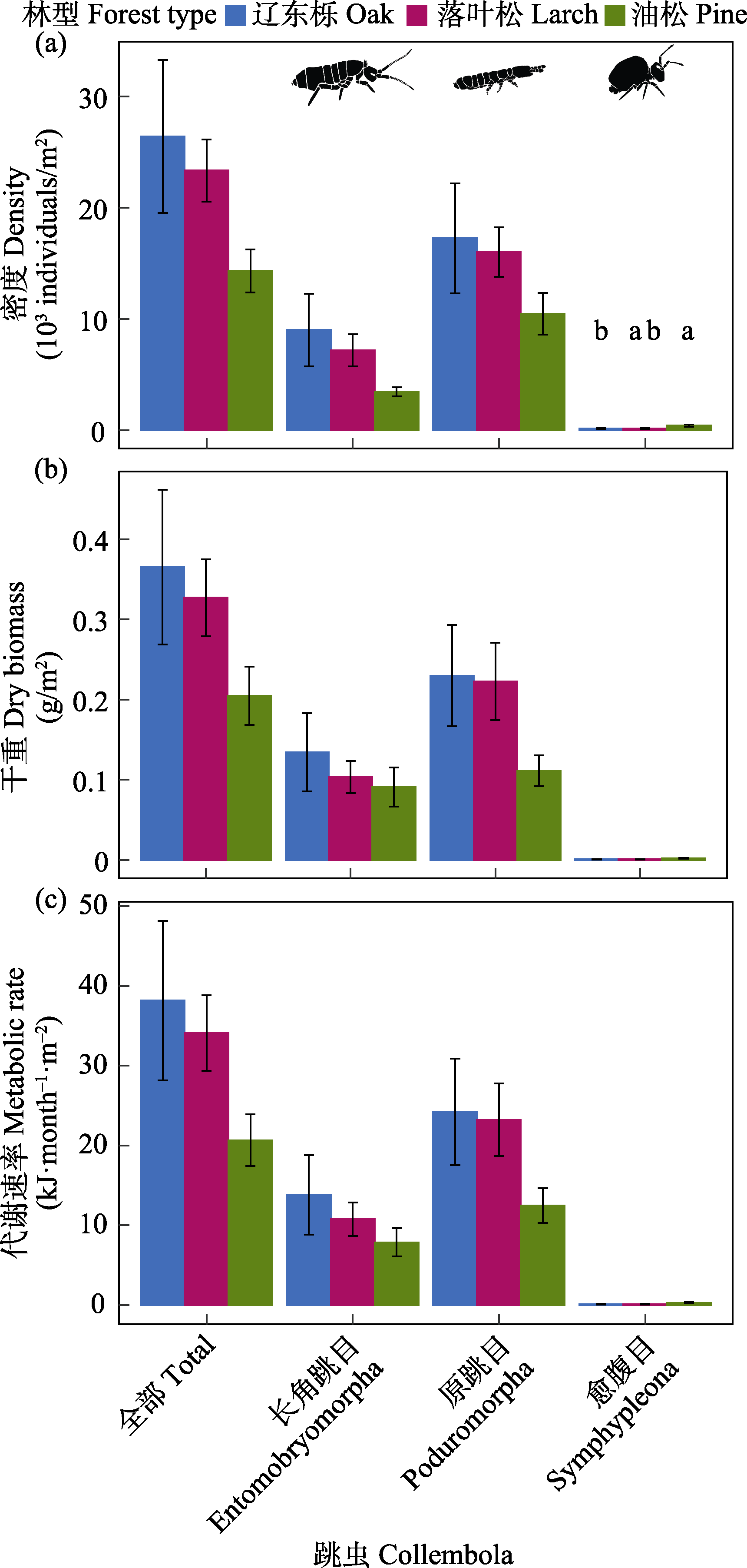
图1 东灵山天然林(辽东栎林)和人工林(油松林和华北落叶松林)中土壤跳虫群落和3个目跳虫密度、生物量和代谢速率(平均值 ± 标准误)。图中不同字母代表存在显著差异(Tukey’s HSD多重比较, P < 0.05, 或者秩和检验)。
Fig. 1 Total density, dry biomass, and metabolic rates (mean ± standard errors) of Collembola and its three orders (Entomobryomorpha, Poduromorpha, and Symphypleona) in natural oak forests and larch and pine plantations on the Dongling Mountain. Different letters above bars indicate significant differences (Tukey’s HSD test, P < 0.05, or Kruskal-Wallis test).
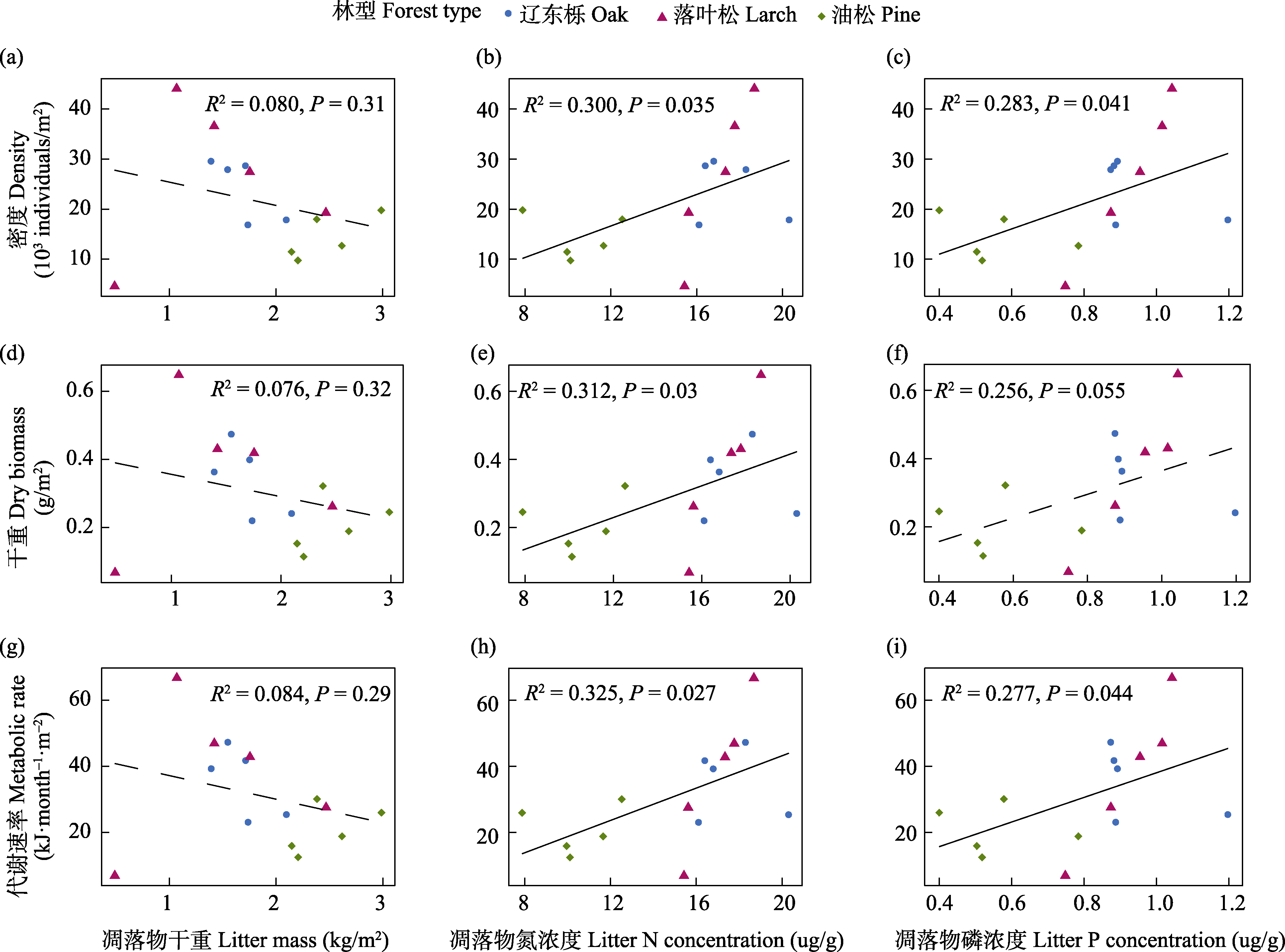
图2 东灵山天然林(辽东栎林)和人工林(油松林和华北落叶松林)中跳虫群落总密度、生物量和代谢速率与凋落物生物量和氮、磷元素浓度的关系
Fig. 2 Regression relationships between total density, dry biomass, and metabolic rate of Collembola communities and litter mass, nitrogen and phosphorus concentrations in natural oak forests and larch and pine plantations on the Dongling Mountain
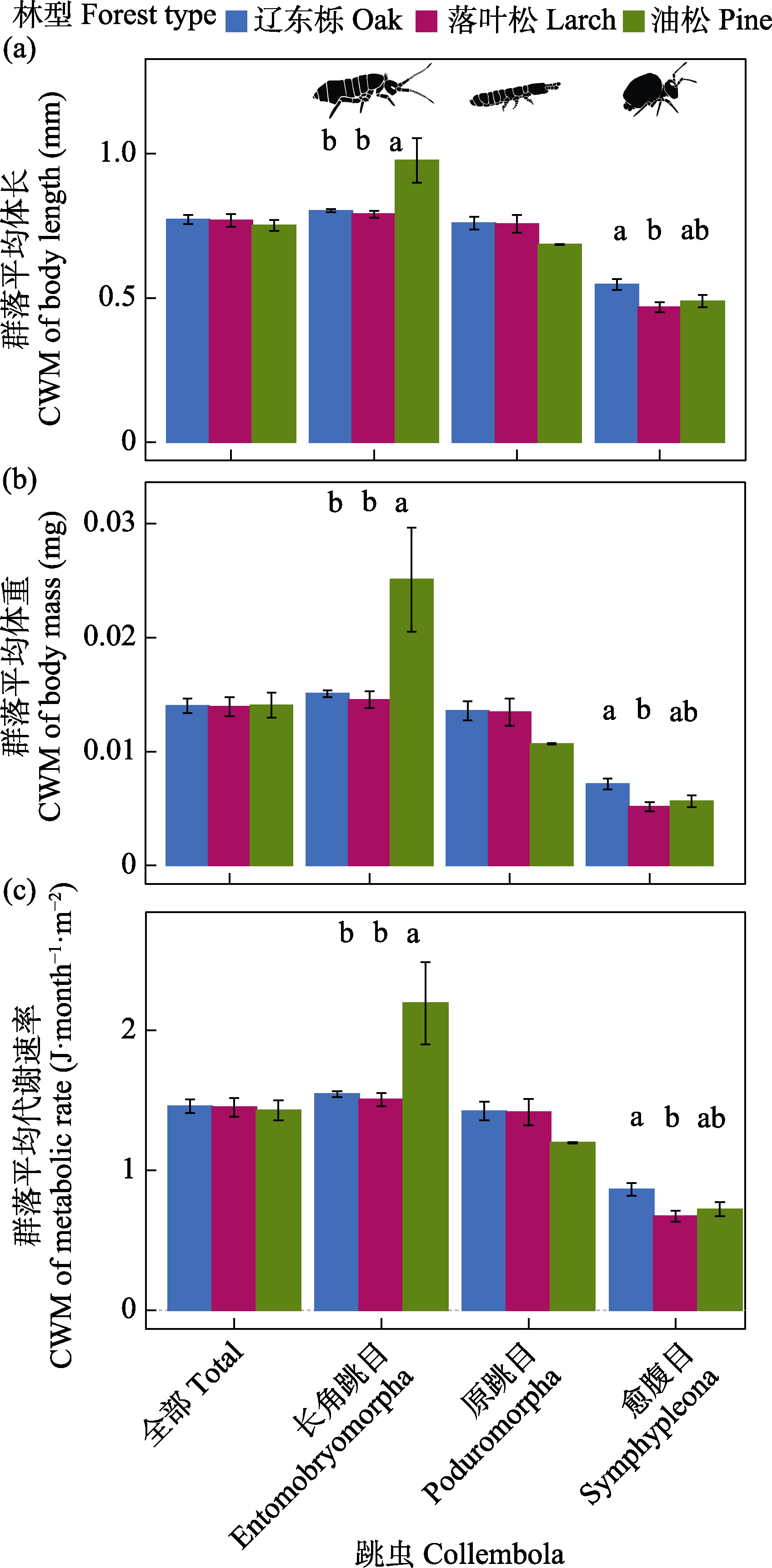
图 3 东灵山天然林(辽东栎林)和人工林(油松林和华北落叶松林)中跳虫群落和3个目跳虫平均体长、平均体重(干重)和平均代谢速率(平均值±标准误)。图中不同字母代表存在显著差异(Tukey’s HSD多重比较, P < 0.05, 或者秩和检验)。
Fig. 3 Community weighted mean (CWM, mean ± standard errors) of body length, dry body mass, and metabolic rates of Collembola class and its three orders (Entomobryomorpha, Poduromorpha, and Symphypleona) in natural oak forests and larch and pine plantations on the Dongling Mountain. Different letters above bars indicate significant differences among forest types (Tukey’s HSD test, P < 0.05, or Kruskal-Wallis test).
| [1] |
Barnes AD, Jochum M, Lefcheck JS, Eisenhauer N, Scherber C, O’Connor MI, de Ruiter P, Brose U (2018) Energy flux: The link between multitrophic biodiversity and ecosystem functioning. Trends in Ecology & Evolution, 33, 186-197.
DOI URL |
| [2] |
Barnes AD, Jochum M, Mumme S, Haneda NF, Farajallah A, Widarto TH, Brose U (2014) Consequences of tropical land use for multitrophic biodiversity and ecosystem functioning. Nature Communications, 5, 5351.
DOI PMID |
| [3] |
Bonfanti J, Hedde M, Joimel S, Krogh PH, Violle C, Nahmani J, Cortet J (2018) Intraspecific body size variability in soil organisms at a European scale: Implications for functional biogeography. Functional Ecology, 32, 2562-2570.
DOI URL |
| [4] | Brown JH, Gillooly JF, Allen AP, Savage VM, West GB (2004) Toward a metabolic theory of ecology. Ecology, 85, 1771-1789. |
| [5] |
Chauvat M, Titsch D, Zaytsev AS, Wolters V (2011) Changes in soil faunal assemblages during conversion from pure to mixed forest stands. Forest Ecology and Management, 262, 317-324.
DOI URL |
| [6] |
Chen JX, Ma ZC, Yan HJ, Zhang F (2007) Roles of springtails in soil ecosystem. Biodiversity Science, 15, 154-161. (in Chinese with English abstract)
DOI |
|
[陈建秀, 麻智春, 严海娟, 张峰 (2007) 跳虫在土壤生态系统中的作用. 生物多样性, 15, 154-161.]
DOI |
|
| [7] |
Ehnes RB, Pollierer MM, Erdmann G, Klarner B, Eitzinger B, Digel C, Ott D, Maraun M, Scheu S, Brose U (2014) Lack of energetic equivalence in forest soil invertebrates. Ecology, 95, 527-537.
PMID |
| [8] |
Ehnes RB, Rall BC, Brose U (2011) Phylogenetic grouping, curvature and metabolic scaling in terrestrial invertebrates. Ecology Letters, 14, 993-1000.
DOI PMID |
| [9] |
Fujii S, Berg MP, Cornelissen JHC (2020) Living litter: Dynamic trait spectra predict fauna composition. Trends in Ecology & Evolution, 35, 886-896.
DOI URL |
| [10] | Gao M, Ma XL, Yang JY, Huang XR, Wu YN (2017) Influence of the mixed modes of larch and birch on soil faunal community in mountain area of northern Hebei, China. Scientia Silvae Sinicae, 53(1), 70-81. (in Chinese with English abstract) |
| [高敏, 马香丽, 杨晋宇, 黄选瑞, 吴亚楠 (2017) 冀北山地华北落叶松人工林与白桦混交改造模式对土壤动物群落的影响. 林业科学, 53(1), 70-81.] | |
| [11] |
Hasegawa M, Ota AT, Kabeya D, Okamoto T, Saitoh T, Nishiyama Y (2014) The effects of mixed broad-leaved trees on the collembolan community in larch plantations of central Japan. Applied Soil Ecology, 83, 125-132.
DOI URL |
| [12] | Hopkin SP (1997) Biology of the Springtails (Insecta, Collembola). Oxford University Press, Oxford. |
| [13] |
Jochum M, Barnes AD, Brose U, Gauzens B, Sünnemann M, Amyntas A, Eisenhauer N (2021) For flux’s sake: General considerations for energy-flux calculations in ecological communities. Ecology and Evolution, 11, 12948-12969.
DOI PMID |
| [14] |
Jochum M, Barnes AD, Ott D, Lang B, Klarner B, Farajallah A, Scheu S, Brose U (2017a) Decreasing stoichiometric resource quality drives compensatory feeding across trophic levels in tropical litter invertebrate communities. The American Naturalist, 190, 131-143.
DOI URL |
| [15] |
Jochum M, Barnes AD, Weigelt P, Ott D, Rembold K, Farajallah A, Brose U (2017b) Resource stoichiometry and availability modulate species richness and biomass of tropical litter macro-invertebrates. Journal of Animal Ecology, 86, 1114-1123.
DOI URL |
| [16] |
Karamian M, Mirzaei J, Heydari M, Mirab-balou M, Kooch Y, Pehlivan N (2023) Non-native and native tree species plantations and seasonality could have substantial impacts on the diversity of indigenous soil fauna in a semi-arid forest ecosystem. Environmental Monitoring and Assessment, 195, 1268.
DOI PMID |
| [17] |
Kaspari M, Yanoviak SP (2009) Biogeochemistry and the structure of tropical brown food webs. Ecology, 90, 3342-3351.
PMID |
| [18] |
Kolokotrones T, Savage V, Deeds EJ, Fontana W (2010) Curvature in metabolic scaling. Nature, 464, 753-756.
DOI |
| [19] |
Korboulewsky N, Heiniger C, De Danieli S, Brun JJ (2021) Effect of tree mixture on Collembola diversity and community structure in temperate broadleaf and coniferous forests. Forest Ecology and Management, 482, 118876.
DOI URL |
| [20] |
Korboulewsky N, Perez G, Chauvat M (2016) How tree diversity affects soil fauna diversity: A review. Soil Biology and Biochemistry, 94, 94-106.
DOI URL |
| [21] | Lu JZ, Yang JB, Bluhm C, Foltran E, Rivera Pérez CA, Glatthorn J, Ammer C, Lamersdorf N, Polle A, Berg M, Potapov AM, Scheu S (2025) Mixed forests with native species mitigate impacts of introduced Douglas fir on soil decomposers (Collembola). Ecological Applications, 35, e70034. |
| [22] | Ma XL, Yang JY, Huang XR, Wu YN (2016) Meso- and micro-faunal communities of litter layer in the pure and mixed larch plantations, Saihanba area. Journal of Sichuan Agricultural University, 34, 147-152. (in Chinese with English abstract) |
| [马香丽, 杨晋宇, 黄选瑞, 吴亚楠 (2016) 塞罕坝落叶松纯林和混交林凋落物层中小型土壤动物群落特征. 四川农业大学学报, 34, 147-152.] | |
| [23] |
Malcicka M, Berg MP, Ellers J (2017) Ecomorphological adaptations in Collembola in relation to feeding strategies and microhabitat. European Journal of Soil Biology, 78, 82-91.
DOI URL |
| [24] | Manning P, van der Plas F, Soliveres S, Allan E, Maestre FT, Mace G, Whittingham MJ, Fischer M (2018) Redefining ecosystem multifunctionality. Nature Ecology & Evolution, 2, 427-436. |
| [25] |
Meehan TD (2006) Mass and temperature dependence of metabolic rate in litter and soil invertebrates. Physiological and Biochemical Zoology, 79, 878-884.
PMID |
| [26] | Moretti M, Dias ATC, de Bello F, Altermatt F, Chown SL, Azcárate FM, Bell JR, Fournier B, Hedde M, Hortal J, Ibanez S, Öckinger E, Sousa JP, Ellers J, Berg MP (2017) Handbook of protocols for standardized measurement of terrestrial invertebrate functional traits. Functional Ecology, 31, 558-567. |
| [27] |
Mueller KE, Eisenhauer N, Reich PB, Hobbie SE, Chadwick OA, Chorover J, Dobies T, Hale CM, Jagodziński AM, Kałucka I, Kasprowicz M, Kieliszewska-Rokicka B, Modrzyński J, Rożen A, Skorupski M, Sobczyk Ł, Stasińska M, Trocha LK, Weiner J, Wierzbicka A, Oleksyn J (2016) Light, earthworms, and soil resources as predictors of diversity of 10 soil invertebrate groups across monocultures of 14 tree species. Soil Biology and Biochemistry, 92, 184-198.
DOI URL |
| [28] |
Ortiz DC, de Souza TAF, Pech TM, Bartz MLC, Baretta D, Siminski A, Niemeyer JC (2022) Soil ecosystem changes by vegetation on old-field sites over five decades in the Brazilian Atlantic forest. Journal of Forestry Research, 33, 667-677.
DOI |
| [29] |
Ott D, Digel C, Klarner B, Maraun M, Pollierer M, Rall BC, Scheu S, Seelig G, Brose U (2014a) Litter elemental stoichiometry and biomass densities of forest soil invertebrates. Oikos, 123, 1212-1223.
DOI URL |
| [30] |
Ott D, Digel C, Rall BC, Maraun M, Scheu S, Brose U (2014b) Unifying elemental stoichiometry and metabolic theory in predicting species abundances. Ecology Letters, 17, 1247-1256.
DOI URL |
| [31] |
Pollierer MM, Drescher J, Potapov A, Kasmiatun, Mawan A, Mutiari M, Nazarreta R, Hidayat P, Buchori D, Scheu S (2023) Rainforest conversion to plantations fundamentally alters energy fluxes and functions in canopy arthropod food webs. Ecology Letters, 26, 1663-1675.
DOI URL |
| [32] |
Potapov AM, Beaulieu F, Birkhofer K, Bluhm SL, Degtyarev MI, Devetter M, Goncharov AA, Gongalsky KB, Klarner B, Korobushkin DI, Liebke DF, Maraun M, Mc Donnell RJ, Pollierer MM, Schaefer I, Shrubovych J, Semenyuk II, Sendra A, Tuma J, Tůmová M, Vassilieva AB, Chen TW, Geisen S, Schmidt O, Tiunov AV, Scheu S (2022) Feeding habits and multifunctional classification of soil-associated consumers from protists to vertebrates. Biological Reviews, 97, 1057-1117.
DOI URL |
| [33] | Potapov AM, Dupérré N, Jochum M, Dreczko K, Klarner B, Barnes AD, Krashevska V, Rembold K, Kreft H, Brose U, Widyastuti R, Harms D, Scheu S (2020) Functional losses in ground spider communities due to habitat structure degradation under tropical land-use change. Ecology, 101, e02957. |
| [34] |
Potapov AM, Klarner B, Sandmann D, Widyastuti R, Scheu S (2019) Linking size spectrum, energy flux and trophic multifunctionality in soil food webs of tropical land-use systems. Journal of Animal Ecology, 88, 1845-1859.
DOI PMID |
| [35] | R Development Core Team (2023) R: A Language and Environment for Statistical Computing. R Foundation for Statistical Computing, Vienna, Austria. |
| [36] |
Salamon JA, Scheu S, Schaefer M (2008) The Collembola community of pure and mixed stands of beech (Fagus sylvatica) and spruce (Picea abies) of different age. Pedobiologia, 51, 385-396.
DOI URL |
| [37] |
Salamon JA, Alphei J (2009) The Collembola community of a Central European forest: Influence of tree species composition. European Journal of Soil Biology, 45, 199-206.
DOI URL |
| [38] |
Sechi V, Brussaard L, De Goede RGM, Rutgers M, Mulder C (2015) Choice of resolution by functional trait or taxonomy affects allometric scaling in soil food webs. The American Naturalist, 185, 142-149.
DOI PMID |
| [39] |
Sun X, Deharveng L, Bedos A, Chang L, Scheu S, Wu DH (2020) Changes in diversity and body size of Onychiurinae (Collembola: Onychiuridae) along an altitudinal gradient in Changbai Mountain, China. Soil Ecology Letters, 2, 230-239.
DOI |
| [40] |
Turnbull MS, George PBL, Lindo Z (2014) Weighing in: Size spectra as a standard tool in soil community analyses. Soil Biology and Biochemistry, 68, 366-372.
DOI URL |
| [41] |
Ulrich W, Fiera C (2010) Environmental correlates of body size distributions of European springtails (Hexapoda: Collembola). Global Ecology and Biogeography, 19, 905-915.
DOI URL |
| [42] |
Xie ZJ, Chen TW, Potapov M, Zhang F, Wu DH, Scheu S, Sun X (2022) Ecological and evolutionary processes shape below-ground springtail communities along an elevational gradient. Journal of Biogeography, 49, 469-482.
DOI URL |
| [43] |
Xu GR, Zhang S, Lin YH, Ma KM (2015) Context dependency of the density-body mass relationship in litter invertebrates along an elevational gradient. Soil Biology and Biochemistry, 88, 323-332.
DOI URL |
| [44] | Yin WY (1998) Pictorial Keys to Soil Animals of China. Science Press, Beijing. (in Chinese) |
| [尹文英 (1998) 中国土壤动物检索图鉴. 科学出版社, 北京.] | |
| [45] |
Yoshida T, Hijii N (2014) The body-size distribution of arboreal collembolans in relation to the vertical structure of a Japanese cedar plantation. Applied Soil Ecology, 83, 116-124.
DOI URL |
| [46] |
Zhang B, Chen HZ, Deng MQ, Li X, Chen TW, Liu LL, Scheu S, Wang SP (2023) Multidimensional stoichiometric mismatch explains differences in detritivore biomass across three forest types. Journal of Animal Ecology, 92, 454-465.
DOI URL |
| [47] | Zhu JJ, Zheng X (2019) The prospects of development of the Three-North Afforestation Program (TNAP): On the basis of the results of the 40-year construction general assessment of the TNAP. Chinese Journal of Ecology, 38, 1600-1610. (in Chinese with English abstract) |
| [朱教君, 郑晓 (2019) 关于三北防护林体系建设的思考与展望——基于40年建设综合评估结果. 生态学杂志, 38, 1600-1610.] |
| [1] | 蒋翠憶, 谢致敬, 田中平, 李玥莹, 郑明心, 房帅, 米尔卡米力∙麦麦提, 依里帆∙艾克拜尔江, 高梅香, 张健. 微地形生境异质性对新疆西天山森林土壤跳虫群落分异的塑造作用[J]. 生物多样性, 2026, 34(4): 25300-. |
| [2] | 刘淑琪, 崔东, 江智诚, 刘江慧, 闫江超. 短期氮、水添加和刈割减弱了苦豆子型退化草地土壤生物多样性与生态系统多功能性的联系[J]. 生物多样性, 2025, 33(3): 24305-. |
| [3] | 王嘉陈, 徐汤俊, 许唯, 张高季, 尤艺瑾, 阮宏华, 刘宏毅. 城市景观格局对大蚰蜒种群遗传结构的影响[J]. 生物多样性, 2025, 33(1): 24251-. |
| [4] | 马骅, 李常青, 余品锋, 陈杰, 贺天耀, 王可洪. 澎溪河消落带大型土壤动物群落分布格局及其影响因素[J]. 生物多样性, 2024, 32(7): 24117-. |
| [5] | 孙怡欣, 侯春雨, 周磊, 魏雪, 马金豪, 薛娟, 李小涵, 吴鹏飞. 青藏高原盆栽一年生和多年生豆科牧草对土壤线虫群落的影响[J]. 生物多样性, 2024, 32(7): 24040-. |
| [6] | 王党军, 谢午阳, 林小元, 乔秀娟, 徐耀粘, 田秋香, 刘峰, 张娅妮, 左娟, 江明喜. 八大公山森林土壤动物群落与叶经济谱及凋落物分解速率的关系[J]. 生物多样性, 2024, 32(12): 24261-. |
| [7] | 段曼微, 李香, 周阳, 赵敏欣, 孙秀玲, 韩冰, 张刚, 权子豪, 李凯. 基于蛾类多样性研究人工林斑块的边缘效应[J]. 生物多样性, 2023, 31(5): 23074-. |
| [8] | 谢致敬, 刘相钰, 孙晓铭, 刘继亮, 刘占锋, 张晓珂, 陈军, 杨效东, 朱波, 柯欣, 吴东辉. 中国土壤动物多样性监测网络建设、进展与展望[J]. 生物多样性, 2023, 31(12): 23365-. |
| [9] | 李国华, 郭向阳, 李霖明, 任明迅, 万玲, 丁琼, 李娟玲. 海南热带雨林国家公园不同植被类型的大型真菌多样性[J]. 生物多样性, 2022, 30(7): 22110-. |
| [10] | 王定一, 倪祥银, 岳楷, 张潇月, 康自佳, 朱玲, 吴福忠. 白蚁活动对中亚热带次生林和人工林的危害差异[J]. 生物多样性, 2022, 30(3): 21324-. |
| [11] | 姚海凤, 张赛超, 上官华媛, 李志鹏, 孙新. 城市化对土壤动物群落结构和多样性的影响[J]. 生物多样性, 2022, 30(12): 22547-. |
| [12] | 程建伟, 王亚东, 王桠楠, 李莹, 郭颖, 白正, 刘新民, 李永宏. 半干旱草原大中型土壤动物在畜粪分解中的作用[J]. 生物多样性, 2022, 30(12): 22575-. |
| [13] | 徐聪, 张飞宇, 俞道远, 孙新, 张峰. 土壤动物的分子分类预测策略评估[J]. 生物多样性, 2022, 30(12): 22252-. |
| [14] | 冯怡琳, 王永珍, 林永一, 赵文智, 高俊伟, 刘继亮. 戈壁生态系统蚁穴微生境对大型土壤动物多样性的影响[J]. 生物多样性, 2022, 30(12): 22282-. |
| [15] | 刘厶瑶, 李柱, 柯欣, 孙丽娜, 吴龙华, 赵杰杰. 贵州省典型汞铊矿区周边农田土壤跳虫群落特征[J]. 生物多样性, 2022, 30(12): 22265-. |
| 阅读次数 | ||||||
|
全文 |
|
|||||
|
摘要 |
|
|||||
备案号:京ICP备16067583号-7
Copyright © 2026 版权所有 《生物多样性》编辑部
地址: 北京香山南辛村20号, 邮编:100093
电话: 010-62836137, 62836665 E-mail: biodiversity@ibcas.ac.cn
