

生物多样性 ›› 2026, Vol. 34 ›› Issue (8): 26215. DOI: 10.17520/biods.2026215 cstr: 32101.14.biods.2026215
邢衍阔, 王震, 杜静, 高祥刚, 鹿志创( ), 王舒扬, 田甲申*(
 )
收稿日期:2026-06-08
接受日期:2026-08-20
出版日期:2026-08-20
发布日期:2026-10-21
通讯作者:
*E-mail: tianjiashen@163.com
基金资助:
Yankuo Xing, Zhen Wang, Jing Du, Xianggang Gao, Zhichuang Lu(), Shuyang Wang, Jiashen Tian*()
Received:2026-06-08
Accepted:2026-08-20
Online:2026-08-20
Published:2026-10-21
Contact:
*E-mail: tianjiashen@163.com
Supported by:摘要:
斑海豹(Phoca largha)是我国国家一级重点保护野生动物, 也是黄渤海生态系统中的旗舰物种和重要生态指示物种。近年来, 全球气候变化导致海洋生态系统结构变化, 同时航运活动和渔业捕捞等人类干扰持续增强, 多重压力叠加可能影响斑海豹栖息地稳定性及种群长期生存。然而, 气候变化如何驱动斑海豹潜在栖息地变化, 以及未来不同气候情景下其潜在栖息地格局变化仍缺乏系统评估。本研究整合了2023-2025年15只斑海豹的卫星标记数据以及2018-2025年的调查数据作为斑海豹的分布数据, 基于10种物种分布模型算法, 通过受试者工作特征曲线下面积(area under the curve, AUC)和真实技巧统计值(true skill statistic, TSS)筛选9种表现较优的算法构建组合模型, 结合6个环境因子和2个人类活动因子, 预测当前及SSP1-2.6、SSP2-4.5和SSP5-8.5情景下2050s和2100s时期斑海豹潜在适生区变化。结果表明, 组合模型AUC值为0.87, TSS值为0.69, 显示出较高的预测准确性。变量贡献分析显示, 海表温度是影响斑海豹潜在分布的关键环境因子, 其贡献率高于其他变量, 捕捞强度和船舶交通强度等人为干扰因子的贡献相对较低, 但仍可能通过影响栖息环境质量对斑海豹分布产生潜在影响。在当前气候条件下, 斑海豹潜在适生区主要集中于渤海和黄海北部海域, 呈现明显的近岸分布特征。未来气候情景模拟结果显示, 随着气候变化加剧, 黄渤海大部分区域适宜性明显降低, 呈持续退缩趋势。到2050s, 在SSP1-2.6、SSP2-4.5和SSP5-8.5情景下, 适生区面积分别减少45.8%、52.1%和65.7%; 到2100s, 分别减少68.9%、95.6%和99.8%。本研究揭示了气候变化背景下斑海豹潜在栖息地收缩趋势及其主要驱动因素, 表明未来海洋升温可能成为影响斑海豹栖息地适宜性的关键因素, 研究结果可为黄渤海海洋生态保护、斑海豹关键栖息地识别及气候适应性保护管理策略制定提供科学依据。
邢衍阔, 王震, 杜静, 高祥刚, 鹿志创, 王舒扬, 田甲申 (2026) 气候变化与人类活动影响下的斑海豹栖息地适宜性预测. 生物多样性, 34, 26215. DOI: 10.17520/biods.2026215.
Yankuo Xing, Zhen Wang, Jing Du, Xianggang Gao, Zhichuang Lu, Shuyang Wang, Jiashen Tian (2026) Prediction of habitat suitability for spotted seals under the impacts of climate change and human activities. Biodiversity Science, 34, 26215. DOI: 10.17520/biods.2026215.
| 信标编号 Beacon number | 性别 Gender | 放归日期 Release date | 信号结束日 期 Signal end date | 信标持续时 间 Tracking duration (d) |
|---|---|---|---|---|
| 236338 | 雌性 Female | 2023.04.16 | 2023.04.18 | 3 |
| 236339 | 雌性 Female | 2023.04.16 | 2023.08.13 | 120 |
| 236340 | 雄性 Male | 2023.04.16 | 2023.05.06 | 21 |
| 236341 | 雄性 Male | 2023.04.16 | 2023.05.13 | 28 |
| 236342 | 雌性 Female | 2023.04.16 | 2023.08.14 | 121 |
| 236343 | 雄性 Male | 2023.04.16 | 2023.06.10 | 56 |
| 236344 | 雄性 Male | 2023.12.13 | 2024.04.29 | 139 |
| 236346 | 雄性 Male | 2023.12.13 | 2024.04.24 | 134 |
| 236347 | 雌性 Female | 2023.12.13 | 2024.05.04 | 144 |
| 182228 | 雄性 Male | 2024.04.16 | 2024.06.01 | 47 |
| 269034 | 雌性 Female | 2025.06.06 | 2025.07.02 | 27 |
| 269035 | 雄性 Male | 2025.06.06 | 2025.08.21 | 77 |
| 269036 | 雄性 Male | 2025.06.06 | 2025.07.02 | 27 |
| 269037 | 雄性 Male | 2025.06.06 | 2025.07.27 | 52 |
| 269038 | 雄性 Male | 2025.06.06 | 2025.08.14 | 70 |
表1 斑海豹的卫星信标部署信息及持续时间
Table 1 Satellite beacon deployment information and duration for spotted seals
| 信标编号 Beacon number | 性别 Gender | 放归日期 Release date | 信号结束日 期 Signal end date | 信标持续时 间 Tracking duration (d) |
|---|---|---|---|---|
| 236338 | 雌性 Female | 2023.04.16 | 2023.04.18 | 3 |
| 236339 | 雌性 Female | 2023.04.16 | 2023.08.13 | 120 |
| 236340 | 雄性 Male | 2023.04.16 | 2023.05.06 | 21 |
| 236341 | 雄性 Male | 2023.04.16 | 2023.05.13 | 28 |
| 236342 | 雌性 Female | 2023.04.16 | 2023.08.14 | 121 |
| 236343 | 雄性 Male | 2023.04.16 | 2023.06.10 | 56 |
| 236344 | 雄性 Male | 2023.12.13 | 2024.04.29 | 139 |
| 236346 | 雄性 Male | 2023.12.13 | 2024.04.24 | 134 |
| 236347 | 雌性 Female | 2023.12.13 | 2024.05.04 | 144 |
| 182228 | 雄性 Male | 2024.04.16 | 2024.06.01 | 47 |
| 269034 | 雌性 Female | 2025.06.06 | 2025.07.02 | 27 |
| 269035 | 雄性 Male | 2025.06.06 | 2025.08.21 | 77 |
| 269036 | 雄性 Male | 2025.06.06 | 2025.07.02 | 27 |
| 269037 | 雄性 Male | 2025.06.06 | 2025.07.27 | 52 |
| 269038 | 雄性 Male | 2025.06.06 | 2025.08.14 | 70 |
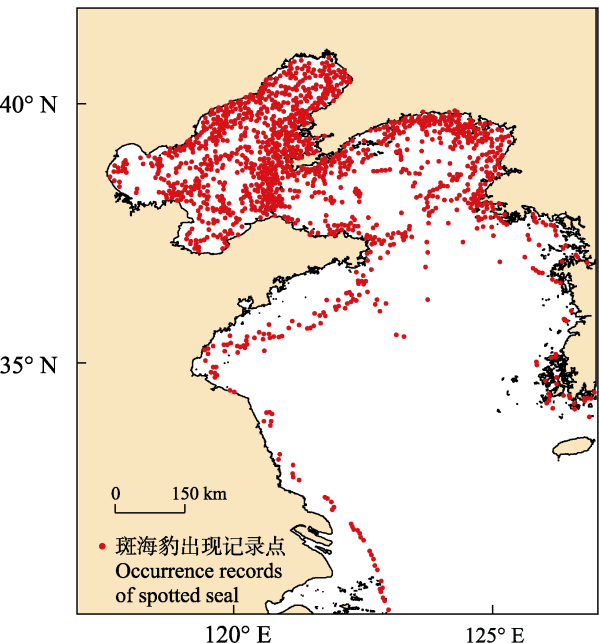
图1 研究区域与斑海豹出现记录
Fig. 1 Study area and occurrence records of spotted seals
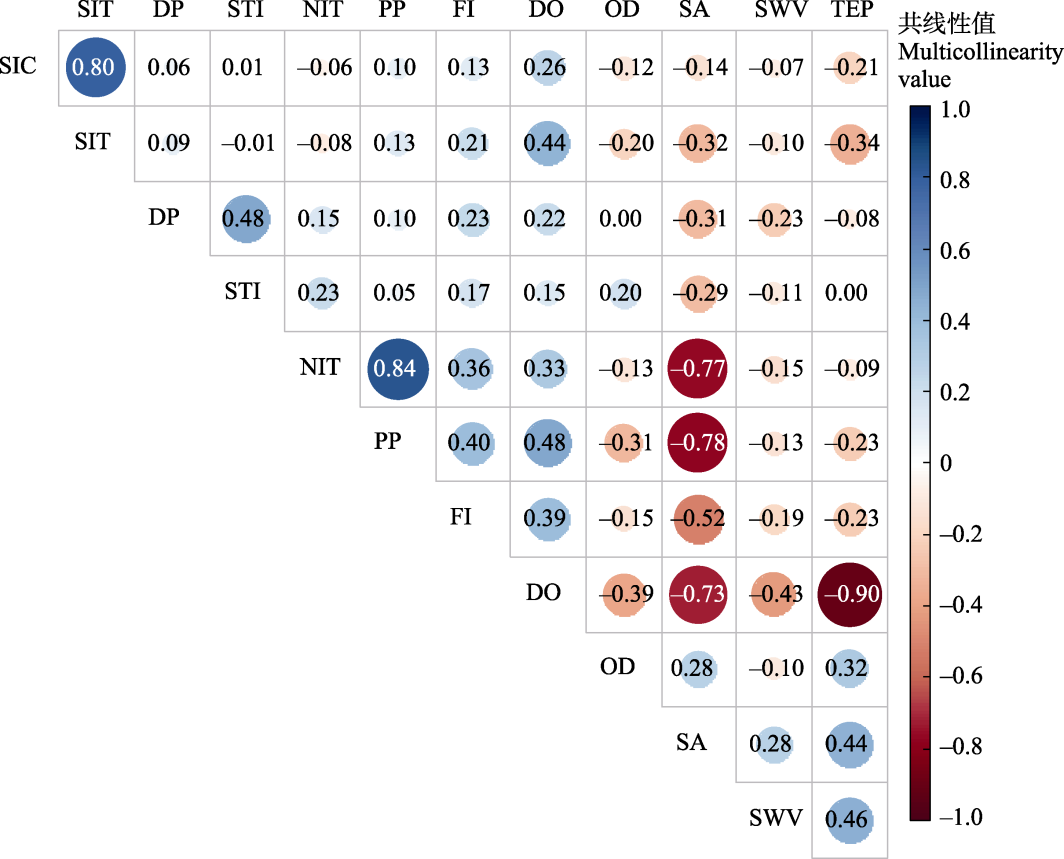
图2 环境变量的多重共线性分析结果。SIC: 海冰覆盖率; SIT: 海冰厚度; DP: 水深; STI: 船舶交通强度; NIT: 硝酸盐; PP: 初级生产力; FI: 捕捞强度; DO: 溶解氧; OD: 离岸距离; SA: 海表盐度; SWV: 海水流速; TEP: 海表温度。
Fig. 2 Multicollinearity analysis results of the environmental variables. SIC, Sea ice cover; SIT, Sea ice thickness; DP, Depth; STI, Ship traffic intensity; NIT, Nitrate; PP, Primary productivity; FI, Fishing intensity; DO, Dissolved oxygen; OD, Offshore distance; SA, Sea surface salinity; SWV, Sea water velocity; TEP, Sea surface temperature.
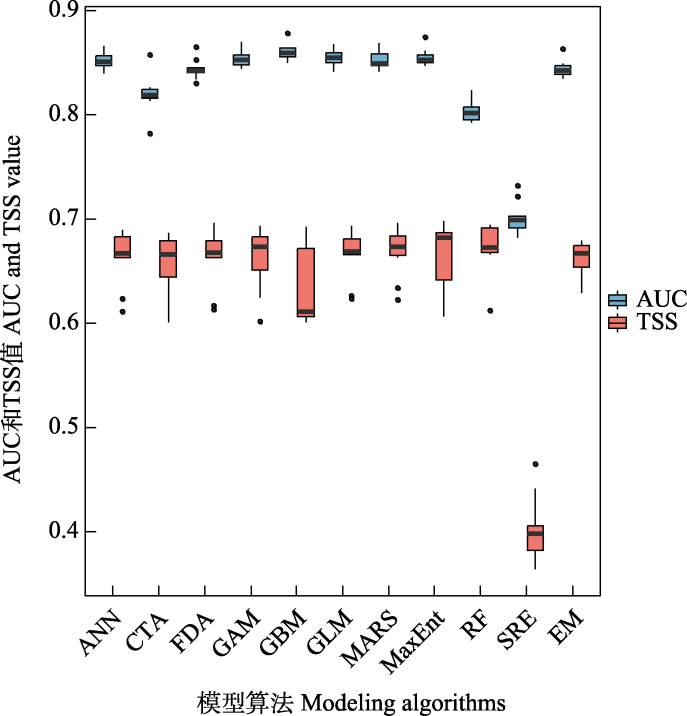
图3 10种单一模型和组合模型的受试者工作特征曲线下面积(AUC)和真实技巧统计值(TSS)。ANN: 人工神经网络; CTA: 分类回归树分析; FDA: 柔性判别分析; GAM: 广义加性模型; GBM: 梯度提升模型; GLM: 广义线性模型; MARS: 多元适应回归样条; MaxEnt: 最大熵模型; RF: 随机森林; SRE: 表面分布区室模型; EM: 组合模型。
Fig. 3 The area under the receiver operating characteristic curve (AUC) and true skill statistic (TSS) values for 10 single models and the ensemble model. ANN, Artificial neural network; CTA, Classification tree analysis; FDA, Flexible discriminant analysis; GAM, Generalized additive model; GBM, Generalized boosting model; GLM, Generalized linear model; MARS, Multiple adaptive regression splines; MaxEnt, Maximum entropy; RF, Random forest; SRE, Surface range envelope; EM, Ensemble models.
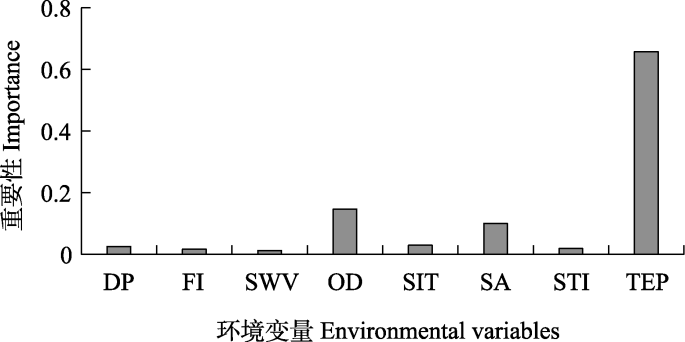
图4 组合模型中环境变量对斑海豹分布预测的重要性。DP: 水深; FI: 捕捞强度; SWV: 海水流速; OD: 离岸距离; SIT: 海冰厚度; SA: 海表盐度; STI: 船舶交通强度; TEP: 海表温度。
Fig. 4 Importance of environmental variables in predicting spotted seal distribution based on ensemble models. DP, Depth; FI, Fishing intensity; SWV, Sea water velocity; OD, Offshore distance; SIT, Sea ice thickness; SA, Sea surface salinity; STI, Ship traffic intensity; TEP, Sea surface temperature.
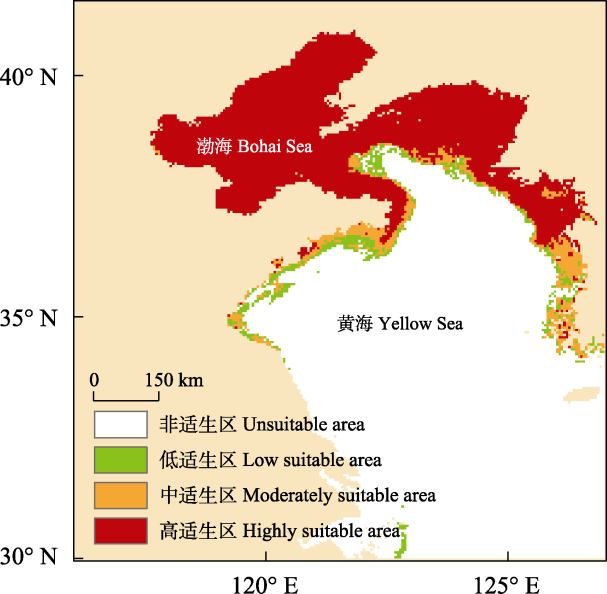
图5 当前气候情景下斑海豹适生区预测
Fig. 5 Predictions of the suitable area for spotted seals under the current climate scenario
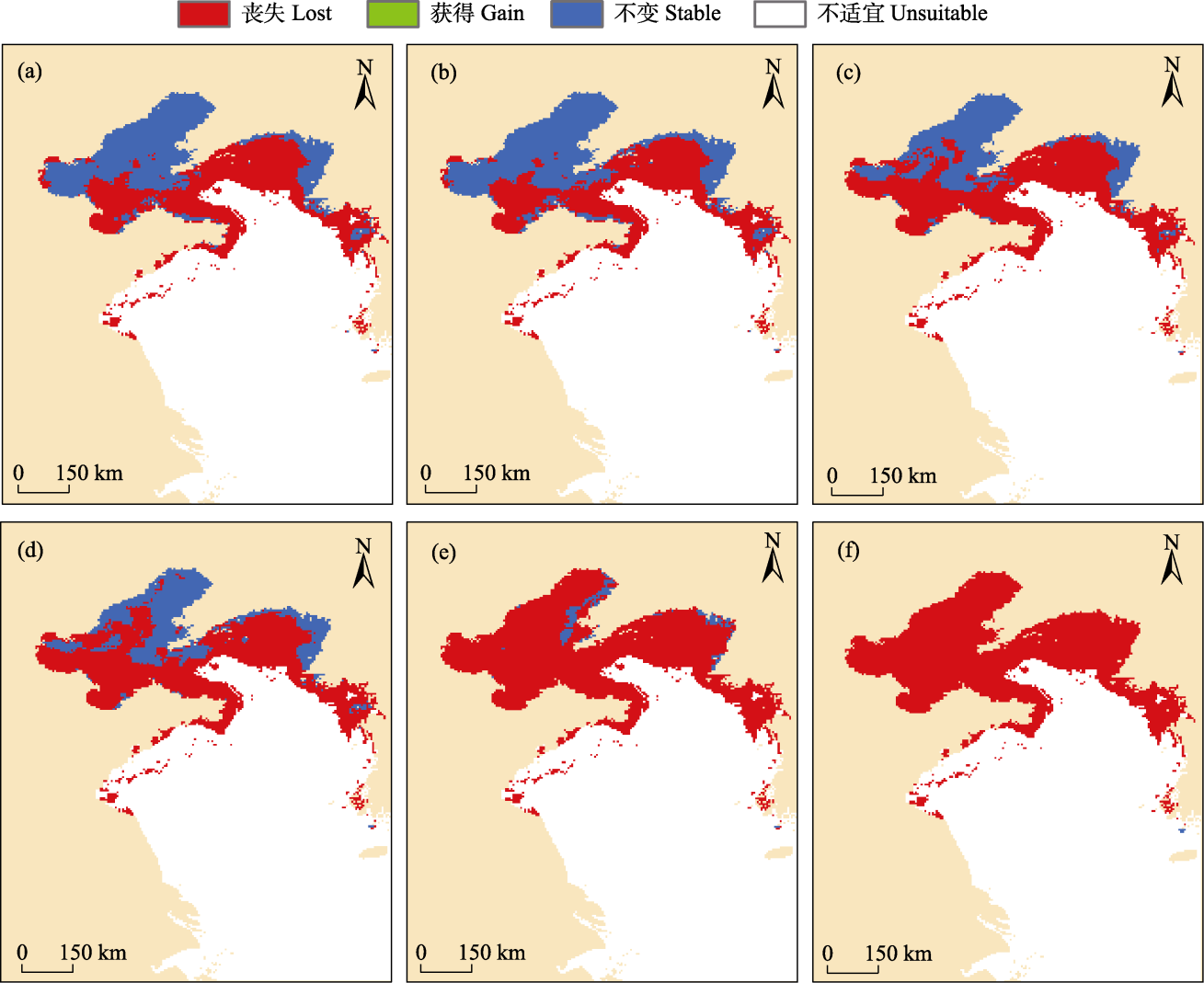
图6 未来气候情景下斑海豹适生区的范围变化。(a-c): 到2050s, 在SSP1-2.6、SSP2-4.5和SSP5-8.5情景下的预测变化; (d-f): 到2100s, 在SSP1-2.6、SSP2-4.5和SSP5-8.5情景下的预测变化。
Fig. 6 Changes in suitable area of spotted seals under future climate scenarios. (a-c), Projected changes by the 2050s under SSP1-2.6, SSP2-4.5, and SSP5-8.5 scenarios; (d-f), Projected changes by the 2100s under SSP1-2.6, SSP2-4.5, and SSP5-8.5 scenarios.
| 气候情景 Climate scenarios | 不变面积 Stable area (km2) | 丧失面积 Lost area (km2) | 丧失比例 Proportion of loss (%) |
|---|---|---|---|
| 2050s-SSP1-2.6 | 107,750.5 | 91,173.5 | 45.8 |
| 2050s-SSP2-4.5 | 95,317.7 | 103,606.3 | 52.1 |
| 2050s-SSP5-8.5 | 68,213.7 | 130,710.3 | 65.7 |
| 2100s-SSP1-2.6 | 61,710.0 | 137,214.0 | 68.9 |
| 2100s-SSP2-4.5 | 8,681.7 | 190,242.5 | 95.6 |
| 2100s-SSP5-8.5 | 423.5 | 198,500.5 | 99.8 |
表2 未来气候情景下斑海豹适宜栖息地面积变化
Table 2 Range size change of the suitable habitats of spotted seals under future climate scenarios
| 气候情景 Climate scenarios | 不变面积 Stable area (km2) | 丧失面积 Lost area (km2) | 丧失比例 Proportion of loss (%) |
|---|---|---|---|
| 2050s-SSP1-2.6 | 107,750.5 | 91,173.5 | 45.8 |
| 2050s-SSP2-4.5 | 95,317.7 | 103,606.3 | 52.1 |
| 2050s-SSP5-8.5 | 68,213.7 | 130,710.3 | 65.7 |
| 2100s-SSP1-2.6 | 61,710.0 | 137,214.0 | 68.9 |
| 2100s-SSP2-4.5 | 8,681.7 | 190,242.5 | 95.6 |
| 2100s-SSP5-8.5 | 423.5 | 198,500.5 | 99.8 |
| [1] | Aiello-Lammens ME, Boria RA, Radosavljevic A, Vilela B, Anderson RP (2015) spThin: An R package for spatial thinning of species occurrence records for use in ecological niche models. Ecography, 38, 541-545. |
| [2] | Assis J, Fernández Bejarano SJ, Salazar VW, Schepers L, Gouvêa L, Fragkopoulou E, Leclercq F, Vanhoorne B, Tyberghein L, Serrão EA, Verbruggen H, De Clerck O (2024) Bio-ORACLE v3.0. Pushing marine data layers to the CMIP 6 Earth System Models of climate change research. Global Ecology and Biogeography, 33, e13813. |
| [3] | Barbet-Massin M, Jiguet F, Albert CH, Thuiller W (2012) Selecting pseudo-absences for species distribution models: How, where and how many? Methods in Ecology and Evolution, 3, 327-338. |
| [4] | Biber MF, Voskamp A, Hof C (2023) Potential effects of future climate change on global reptile distributions and diversity. Global Ecology and Biogeography, 32, 519-534. |
| [5] | Branstetter BK, Sills JM (2022) Mechanisms of auditory masking in marine mammals. Animal Cognition, 25, 1029-1047. |
| [6] | Chen BY, Yang CW (2024) The prediction of global suitable habitat distribution for East Asian finless porpoise. Journal of Nanjing Normal University (Natural Science Edition), 47(2), 76-83. (in Chinese with English abstract) |
| [陈炳耀, 杨丛汶 (2024) 东亚江豚全球适宜栖息地分布预测. 南京师大学报(自然科学版), 47(2), 76-83.] | |
| [7] | Clement DM, Pavanato H, Lenky C, Pine MK (2025) Immediate and short-term effects of pile-driving on Hector’s dolphin in Lyttelton Harbour, Aotearoa New Zealand. Frontiers in Marine Science, 12, 1554536. |
| [8] | Costa LL, Bulhões EMR, Caetano JPA, Arueira VF, de Almeida DT, Vieira TB, Cardoso LJT, Zalmon IR (2023) Do costal erosion and urban development threat loggerhead sea turtle nesting? Implications for sandy beach management. Frontiers in Marine Science, 10, 1242903. |
| [9] | Davidson AD, Boyer AG, Kim H, Pompa-Mansilla S, Hamilton MJ, Costa DP, Ceballos G, Brown JH (2012) Drivers and hotspots of extinction risk in marine mammals. Proceedings of the National Academy of Sciences, USA, 109, 3395-3400. |
| [10] | Depellegrin D, Martí Llambrich C, Roy S, Anbleyth-Evans J, Bongiorni L, Menegon S (2023) Risk-based analysis of recreational ecosystem services supply and demand in beach areas of the Adriatic Sea. Ocean & Coastal Management, 243, 106725. |
| [11] | Dormann CF, Elith J, Bacher S, Buchmann C, Carl G, Carré G, Márquez JRG, Gruber B, Lafourcade B, Leitão PJ, Münkemüller T, McClean C, Osborne PE, Reineking B, Schröder B, Skidmore AK, Zurell D, Lautenbach S (2013) Collinearity: A review of methods to deal with it and a simulation study evaluating their performance. Ecography, 36, 27-46. |
| [12] | Douglas DC, Weinzierl R, Davidson SC, Kays R, Wikelski M, Bohrer G (2012) Moderating Argos location errors in animal tracking data. Methods in Ecology and Evolution, 3, 999-1007. |
| [13] | Duquesne E, Fournier D (2025) Climate change redefines sea turtle hotspots: Vessel strike risks and gaps in protected areas. Science Advances, 11, eadw4495. |
| [14] | Erbe C, Marley SA, Schoeman RP, Smith JN, Trigg LE, Embling CB (2019) The effects of ship noise on marine mammals-A review. Frontiers in Marine Science, 6, 606. |
| [15] | Feng X, Park DS, Walker C, Peterson AT, Merow C, Papeş M (2019) A checklist for maximizing reproducibility of ecological niche models. Nature Ecology & Evolution, 3, 1382-1395. |
| [16] | Florko KRN, Tai TC, Cheung WWL, Ferguson SH, Sumaila UR, Yurkowski DJ, Auger-Méthé M (2021) Predicting how climate change threatens the prey base of Arctic marine predators. Ecology Letters, 24, 2563-2575. |
| [17] | França S, Cabral HN (2019) Distribution models of estuarine fish species: The effect of sampling bias, species ecology and threshold selection on models’ accuracy. Ecological Informatics, 51, 168-176. |
| [18] | Grebmeier JM, Overland JE, Moore SE, Farley EV, Carmack EC, Cooper LW, Frey KE, Helle JH, McLaughlin FA, Mcnutt SL (2006) A major ecosystem shift in the northern Bering Sea. Science, 311, 1461-1464. |
| [19] | Halliday WD, Insley SJ, Hilliard RC, de Jong T, Pine MK (2017) Potential impacts of shipping noise on marine mammals in the western Canadian Arctic. Marine Pollution Bulletin, 123, 73-82. |
| [20] | Halpern BS, Frazier M, Afflerbach J, Lowndes JS, Micheli F, O’Hara C, Scarborough C, Selkoe KA (2019) Recent pace of change in human impact on the world’s ocean. Scientific Reports, 9, 11609. |
| [21] | Han JB (2009) Studies on Population Resources and Molecular Genetic Characteristics of Spotted Seals (Phoca largha) in Chinese Waters. PhD dissertation, Institute of Oceanology, Chinese Academy of Sciences, Qingdao, Shandong. (in Chinese with English abstract) |
| [韩家波 (2009) 中国海域斑海豹种群资源和分子遗传特征研究. 博士学位论文, 中国科学院海洋研究所, 山东青岛.] | |
| [22] | Han JB, Lu ZC, Tian JS, Ma ZQ, Wang ZH, Yang Y, Wang QG, Song XR, Peng ZP (2013) Release studies on spotted seals (Phoca largha) using satellite telemetry tracking technique. Acta Theriologica Sinica, 33, 300-307. (in Chinese with English abstract) |
| [韩家波, 鹿志创, 田甲申, 马志强, 王召会, 杨勇, 王勤国, 宋新然, 彭志平 (2013) 基于卫星信标跟踪的斑海豹放流效果研究. 兽类学报, 33, 300-307.] | |
| [23] | Hastings RA, Rutterford LA, Freer JJ, Collins RA, Simpson SD, Genner MJ (2020) Climate change drives poleward increases and equatorward declines in marine species. Current Biology, 30, 1572-1577.e2. |
| [24] | Heithaus MR, Frid A, Wirsing AJ, Worm B (2008) Predicting ecological consequences of marine top predator declines. Trends in Ecology & Evolution, 23, 202-210. |
| [25] | Holyoak M, Heath SK (2016) The integration of climate change, spatial dynamics, and habitat fragmentation: A conceptual overview. Integrative Zoology, 11, 40-59. |
| [26] | Kovacs KM, Lydersen C, Overland JE, Moore SE (2011) Impacts of changing sea-ice conditions on Arctic marine mammals. Marine Biodiversity, 41, 181-194. |
| [27] | Li XW, Zhao JM, Liu H, Zhang H, Hou XY (2018) Status, problems and optimized management of spawning, feeding, overwintering grounds and migration route of marine fishery resources in Bohai Sea and Yellow Sea. Transactions of Oceanology and Limnology, 40, 147-157. (in Chinese with English abstract) |
| [李晓炜, 赵建民, 刘辉, 张华, 侯西勇 (2018) 渤黄海渔业资源三场一通道现状、问题及优化管理政策. 海洋湖沼通报, 40, 147-157.] | |
| [28] | Luck C, Jessopp M, Cronin M, Rogan E (2022) Using population viability analysis to examine the potential long-term impact of fisheries bycatch on protected species. Journal for Nature Conservation, 67, 126157. |
| [29] | Lydersen C, Vaquie-Garcia J, Lydersen E, Christensen GN, Kovacs KM (2017) Novel terrestrial haul-out behaviour by ringed seals (Pusa hispida) in Svalbard, in association with harbour seals (Phoca vitulina). Polar Research, 36, 1374124. |
| [30] | Ma YX, Cheng B, Xu N, Yuan S, Shi HH, Shi WQ (2022) Long-term ice conditions in Yingkou, a coastal region northeast of the Bohai Sea, between 1951/1952 and 2017/2018: Modeling and observations. Remote Sensing, 14, 182. |
| [31] | Ma ZJ, Chen Y, Melville DS, Fan J, Liu JG, Dong JW, Tan K, Cheng XF, Fuller RA, Xiao XM, Li B (2019) Changes in area and number of nature reserves in China. Conservation Biology, 33, 1066-1075. |
| [32] | Massimino D, Johnston A, Gillings S, Jiguet F, Pearce-Higgins JW (2017) Projected reductions in climatic suitability for vulnerable British birds. Climatic Change, 145, 117-130. |
| [33] | Mi CR, Huettmann F, Li XH, Jiang ZW, Du WG, Sun BJ (2022) Effects of climate and human activity on the current distribution of amphibians in China. Conservation Biology, 36, e13964. |
| [34] | Monzón J, Moyer-Horner L, Palamar MB (2011) Climate change and species range dynamics in protected areas. BioScience, 61, 752-761. |
| [35] | Morato T, González-Irusta JM, Dominguez-Carrió C, Wei CL, Davies A, Sweetman AK, Taranto GH, Beazley L, García-Alegre A, Grehan A, Laffargue P, Murillo FJ, Sacau M, Vaz S, Kenchington E, Arnaud-Haond S, Callery O, Chimienti G, Cordes E, Egilsdottir H, Freiwald A, Gasbarro R, Gutiérrez-Zárate C, Gianni M, Gilkinson K, Wareham Hayes VE, Hebbeln D, Hedges K, Henry LA, Johnson D, Koen-Alonso M, Lirette C, Mastrototaro F, Menot L, Molodtsova T, Durán Muñoz P, Orejas C, Pennino MG, Puerta P, Ragnarsson SÁ, Ramiro-Sánchez B, Rice J, Rivera J, Roberts JM, Ross SW, Rueda JL, Sampaio Í, Snelgrove P, Stirling D, Treble MA, Urra J, Vad J, van Oevelen D, Watling L, Walkusz W, Wienberg C, Woillez M, Levin LA, Carreiro-Silva M (2020) Climate-induced changes in the suitable habitat of cold-water corals and commercially important deep-sea fishes in the North Atlantic. Global Change Biology, 26, 2181-2202. |
| [36] | Moullec F, Asselot R, Auch D, Blöcker AM, Börner G, Färber L, Ofelio C, Petzold J, Santelia ME, Schwermer H, Sguotti C, Steidle L, Tams V, Pellerin F (2021) Identifying and addressing the anthropogenic drivers of global change in the North Sea: A systematic map protocol. Environmental Evidence, 10, 19. |
| [37] | Sorte CJB, Williams SL, Carlton JT (2010) Marine range shifts and species introductions: Comparative spread rates and community impacts. Global Ecology and Biogeography, 19, 303-316. |
| [38] | Sun YD, Wang D, Gao ZQ, Gao M, Wang YQ (2023) Linear and nonlinear trend analyses of sea surface temperature in the Bohai and Yellow seas of China during 1982-2021. Marine Sciences, 47(5), 41-53. (in Chinese with English abstract) |
| [孙艺迪, 王德, 高志强, 高猛, 王跃启 (2023) 1982-2021 年黄、渤海表层温度变化的线性和非线性特征分析. 海洋科学, 47(5), 41-53.] | |
| [39] | Thuiller W, Lafourcade B, Engler R, Araújo MB (2009) BIOMOD-A platform for ensemble forecasting of species distributions. Ecography, 32, 369-373. |
| [40] | Trukhin AM, Permyakov PA, Ryazanov SD, Lobanov VB, Kim HW, Choi YM, Sohn H (2021) Migrations of young spotted seals (Phoca largha) from Peter the Great Bay, Sea of Japan/East Sea, and the pattern of their use of seasonal habitats. PLoS ONE, 16, e0257121. |
| [41] | Wang N, Ding K (2019) Effects of the marine environment on spotted seals survival (Phoca largha) in the Bohai Sea. Marine Science Bulletin, 38, 202-209. (in Chinese with English abstract) |
| [王诺, 丁凯 (2019) 渤海海洋环境对斑海豹生存影响研究. 海洋通报, 38, 202-209.] | |
| [42] | Wang PL, Han JB, Ma ZQ (2008) Status survey of spotted seal (Phoca largha) in Bohai and Yellow Sea. Chinese Journal of Wildlife, 29, 29-31, 39. (in Chinese with English abstract) |
| [王丕烈, 韩家波, 马志强 (2008) 黄渤海斑海豹种群现状调查. 野生动物杂志, 29, 29-31, 39.] | |
| [43] | Wang XX, Chen XG, Liu JN, Zhang FF, Li LW, Du JZ (2021) Radon traced seasonal variations of water mixing and accompanying nutrient and carbon transport in the Yellow-Bohai Sea. Science of the Total Environment, 784, 147161. |
| [44] | Wang Y, Liu RY, Su JL (2013) Oceanography of China. Science Press, Beijing. (in Chinese) |
| [王颖, 刘瑞玉, 苏纪兰 (2013) 中国海洋地理. 科学出版社, 北京.] | |
| [45] | Wang Z, Lu ZC, Han JB, Tian JG, Xing YK, Gao XG, Du J, Chai YQ, Tian JS (2026) The population dynamics of spotted seal (Phoca largha) at haul-out sites in China’s coastal waters. Acta Ecologica Sinica, 46, 6257-6270. (in Chinese with English abstract) |
| [王震, 鹿志创, 韩家波, 田继光, 邢衍阔, 高祥刚, 杜静, 柴裕乔, 田甲申 (2026) 斑海豹在中国海域上岸点的种群动态. 生态学报, 46, 6257-6270.] | |
| [46] | Wei BH, Li BH, Liu Y, Wang AL (2023) Reconstruction of sea ice extent in the Liaodong Bay and analysis of its impact factors. Haiyang Xuebao, 45(11), 20-33. (in Chinese with English abstract) |
| [魏彬航, 李宝辉, 刘煜, 王安良 (2023) 辽东湾海冰分布面积历史数据重构及其影响因素分析. 海洋学报, 45(11), 20-33.] | |
| [47] | Weijerman M, Robinson S, Parrish F, Polovina J, Littnan C (2017) Comparative application of trophic ecosystem models to evaluate drivers of endangered Hawaiian monk seal populations. Marine Ecology Progress Series, 582, 215-229. |
| [48] | Whitney CK, Cheung WWL, Ban NC (2023) Considering the implications of climate-induced species range shifts in marine protected areas planning. FACETS, 8, 1-10. |
| [49] | Womersley FC, Sousa LL, Humphries NE, Abrantes K, Araujo G, Bach SS, Barnett A, Berumen ML, Lion SB, Braun CD, Clingham E, Cochran JEM, de la Parra R, Diamant S, Dove ADM, Duarte CM, Dudgeon CL, Erdmann MV, Espinoza E, Ferreira LC, Fitzpatrick R, Cano JG, Green JR, Guzman HM, Hardenstine R, Hasan A, Hazin FHV, Hearn AR, Hueter RE, Jaidah MY, Labaja J, Ladino F, Macena BCL, Meekan MG, Morris JJ, Norman BM, Peñaherrera-Palma CR, Pierce SJ, Quintero LM, Ramírez-Macías D, Reynolds SD, Robinson DP, Rohner CA, Rowat DRL, Sequeira AMM, Sheaves M, Shivji MS, Sianipar AB, Skomal GB, Soler G, Syakurachman I, Thorrold SR, Thums M, Tyminski JP, Webb DH, Wetherbee BM, Queiroz N, Sims DW (2024) Climate-driven global redistribution of an ocean giant predicts increased threat from shipping. Nature Climate Change, 14, 1282-1291. |
| [50] | Yan HK, Wang N, Wu N, Lin WN (2018) Abundance, habitat conditions, and conservation of the largha seal (Phoca largha) during the past half century in the Bohai Sea, China. Mammal Study, 43, 1-9. |
| [51] | Yang H, Liu HF, Wang ZX, Wu XR, Wang HD (2025) Habitat suitability for sea cucumber Apostichopus japonicus based on ecological dynamics. Journal of Beijing Normal University (Natural Science), 61, 361-369. (in Chinese with English abstract) |
| [杨浩, 刘海飞, 王子昕, 吴雪榕, 王洪达 (2025) 基于生态动力学的黄渤海刺参栖息地适宜性研究. 北京师范大学学报(自然科学版), 61, 361-369.] | |
| [52] | Yang LY, Zhuang HF, Liu SH, Cong BL, Huang WH, Li TT, Liu KY, Zhao LL (2023) Estimating the spatial distribution and future conservation requirements of the spotted seal in the North Pacific. Animals, 13, 3260. |
| [53] | Zhang CC, Wei H, Song GS, Xie C (2020) IPCC-CMIP5 based projection and analysis of future sea surface temperature changes in coastal seas east of China. Oceanologia et Limnologia Sinica, 51, 1288-1300. (in Chinese with English abstract) |
| [张翠翠, 魏皓, 宋贵生, 谢川 (2020) 基于IPCC-CMIP5的中国东部近海表层水温未来预估分析. 海洋与湖沼, 51, 1288-1300.] | |
| [54] | Zhang ZX, Capinha C, Weterings R, McLay CL, Xi D, Lü HJ, Yu LY (2019) Ensemble forecasting of the global potential distribution of the invasive Chinese mitten crab, Eriocheir sinensis. Hydrobiologia, 826, 367-377. |
| [55] | Zhang ZZ, Mammola S, Liang ZQ, Capinha C, Wei QW, Wu YA, Zhou J, Wang CR (2020) Future climate change will severely reduce habitat suitability of the Critically Endangered Chinese giant salamander. Freshwater Biology, 65, 971-980. |
| [56] | Zhao YQ, Zhao PY, Xu ZH, Li ZG (2025) Contribution of climate change and human activity to vegetation recovery in Shanxi Province from 2002 to 2022. Chinese Journal of Applied Ecology, 36, 219-226. (in Chinese with English abstract) |
| [赵瑜琦, 赵鹏云, 许泽海, 李志刚 (2025) 2002-2022年气候变化和人类活动对山西省植被恢复的贡献. 应用生态学报, 36, 219-226.] | |
| [57] | Zizka A, Silvestro D, Andermann T, Azevedo J, Duarte Ritter C, Edler D, Farooq H, Herdean A, Ariza M, Scharn R, Svantesson S, Wengström N, Zizka V, Antonelli A (2019) CoordinateCleaner: Standardized cleaning of occurrence records from biological collection databases. Methods in Ecology and Evolution, 10, 744-751. |
| [1] | 谷际岐, 赖江山, 王瑛, 吴浩然, 张雪, 宋晓彤, 邵小明, 娄安如. 联合物种分布模型与生物群落层次建模框架: 生态学理论、方法及应用[J]. 生物多样性, 2026, 34(1): 25364-. |
| [2] | 徐进博, 崔雅倩, 王渊, 王伟波, 刘锋, 王广龙, 扈晶晶, 普布顿珠, 边巴多吉, 旦增, 胡开, 王小川, 宋刚, 吕永磊, 温知新. 西藏雅鲁藏布大峡谷国家级自然保护区内白颊猕猴的栖息地适宜性评价[J]. 生物多样性, 2025, 33(7): 24493-. |
| [3] | 李基才, 邵长亮, 高帅帅, 李佳. 新疆卡拉麦里国家公园候选区蒙古野驴夏季水源利用规律、活动范围和适宜生境分布[J]. 生物多样性, 2025, 33(7): 24509-. |
| [4] | 韩思成, 陆道炜, 韩宇辰, 栗若寒, 杨晶, 孙戈, 杨陆, 钱俊伟, 方翔, 罗述金. 北京近郊浅山地区的野生豹猫分布及环境影响因素[J]. 生物多样性, 2024, 32(8): 24138-. |
| [5] | 孙维悦, 舒江平, 顾钰峰, 莫日根高娃, 杜夏瑾, 刘保东, 严岳鸿. 基于保护基因组学揭示荷叶铁线蕨的濒危机制[J]. 生物多样性, 2022, 30(7): 21508-. |
| [6] | 余元钧, 罗火林, 刘南南, 熊冬金, 罗毅波, 杨柏云. 气候变化对中国大黄花虾脊兰及其传粉者适生区的影响[J]. 生物多样性, 2020, 28(7): 769-778. |
| [7] | 李熠,唐志尧,闫昱晶,王科,蔡磊,贺金生,古松,姚一建. 物种分布模型在大型真菌红色名录评估及保护中的应用: 以冬虫夏草为例[J]. 生物多样性, 2020, 28(1): 99-106. |
| [8] | 史晓昀,施小刚,胡强,官天培,付强,张剑,姚蒙,李晟. 四川邛崃山脉雪豹与散放牦牛潜在分布重叠与捕食风险评估[J]. 生物多样性, 2019, 27(9): 951-959. |
| [9] | 张晓玲, 李亦超, 王芸芸, 蔡宏宇, 曾辉, 王志恒. 未来气候变化对不同国家茶适宜分布区的影响[J]. 生物多样性, 2019, 27(6): 595-606. |
| [10] | 余建平, 申云逸, 宋小友, 陈小南, 李晟, 申小莉. 钱江源国家公园体制试点区功能分区对黑麂保护的有效性评估[J]. 生物多样性, 2019, 27(1): 5-12. |
| [11] | 丁晨晨, 胡一鸣, 李春旺, 蒋志刚. 印度野牛在中国的分布及其栖息地适宜性分析[J]. 生物多样性, 2018, 26(9): 951-961. |
| [12] | 雷军成, 王莎, 王军围, 吴军. 未来气候变化对我国特有濒危动物黑麂 适宜生境的潜在影响[J]. 生物多样性, 2016, 24(12): 1390-1399. |
| [13] | 吴强, 李忠义, 戴芳群, 陈瑞盛, 王俊, 单秀娟, 金显仕. 黄渤海甲壳类的分类多样性[J]. 生物多样性, 2016, 24(11): 1306-1314. |
| [14] | 吴文, 李月辉, 胡远满, 陈龙, 李悦, 李泽鸣, 聂志文, 陈探. 小兴安岭南麓马鹿冬季适宜生境评价[J]. 生物多样性, 2016, 24(1): 20-29. |
| [15] | 朱丽, 马克平. 洲际入侵植物生态位稳定性研究进展[J]. 生物多样性, 2010, 18(6): 547-558. |
| 阅读次数 | ||||||
|
全文 |
|
|||||
|
摘要 |
|
|||||
备案号:京ICP备16067583号-7
Copyright © 2026 版权所有 《生物多样性》编辑部
地址: 北京香山南辛村20号, 邮编:100093
电话: 010-62836137, 62836665 E-mail: biodiversity@ibcas.ac.cn
