

生物多样性 ›› 2026, Vol. 34 ›› Issue (6): 25339. DOI: 10.17520/biods.2025339 cstr: 32101.14.biods.2025339
• 研究报告: 动物多样性 • 下一篇
李开飞1,2, 龚进玲1, 胡飞飞1, 李学梅1, 卢昭远1, 罗鸣钟2,*( )(
)( ), 朱挺兵1,*()()
收稿日期:2025-08-22
接受日期:2026-03-05
出版日期:2026-06-20
发布日期:2026-07-30
通讯作者:
*共同通讯作者 E-mail: kklmz413@yangtzeu.edu.cn; zhutb@yf.ac.cn
基金资助:
Kaifei Li1,2, Jinling Gong1, Feifei Hu1, Xuemei Li1, Zhaoyuan Lu1, Mingzhong Luo2,*()(), Tingbing Zhu1,*()()
Received:2025-08-22
Accepted:2026-03-05
Online:2026-06-20
Published:2026-07-30
Contact:
*Co-authors for correspondence. E-mail: kklmz413@yangtzeu.edu.cn; zhutb@yf.ac.cn
Supported by:摘要: 泸沽湖是我国西南地区重要的高原深水型湖泊, 其鱼类群落状况已多年未见报道。本研究于2023–2024年春季(5月)和秋季(10月)对泸沽湖鱼类群落共开展了4次现场调查, 并结合冗余分析(redundancy analysis, RDA)与聚类方法, 揭示了环境因子对鱼类群落时空分异的驱动机制。共采集到鱼类14种, 隶属2目4科, 其中鲤形目占绝对优势(种数占比85.71%)。土著鱼类仅采集到1种, 为泥鳅(Misgurnus anguillicaudatus)。外来鱼类共采集到13种, 占鱼类种类数的92.86%。相对重要性指数(index of relative importance, IRI)显示, 鲫(Carassius auratus, IRI = 8,509)和麦穗鱼(Pseudorasbora parva, IRI = 1,763)在所有调查季节均维持高出现频率, 为全年优势种。RDA表明, 不同季节环境因子对鱼类群落结构变异的影响程度和方式存在差异, 春季鱼类群落结构变异主要受NO3‒-N、pH值等环境因子影响, 而秋季鱼类群落结构变异主要受NO3‒-N、总氮(total nitrogen, TN)等环境因子影响。丰度生物量比较曲线(abundance-biomass comparison curve, ABC)显示秋季生物量曲线显著高于丰度曲线, 呈现出“秋季稳态-春季亚稳态”模式。针对当前泸沽湖鱼类群落面临的土著鱼类衰退、外来鱼类占据优势等突出问题, 建议加强土著鱼类保护研究、强化对污染和外来鱼类放生活动的管控, 并建立渔业资源长期监测体系。
李开飞, 龚进玲, 胡飞飞, 李学梅, 卢昭远, 罗鸣钟, 朱挺兵 (2026) 泸沽湖鱼类群落结构特征及驱动因子. 生物多样性, 34, 25339. DOI: 10.17520/biods.2025339.
Kaifei Li, Jinling Gong, Feifei Hu, Xuemei Li, Zhaoyuan Lu, Mingzhong Luo, Tingbing Zhu (2026) Fish community structure and driving factors in Lugu Lake, Southwest China. Biodiversity Science, 34, 25339. DOI: 10.17520/biods.2025339.
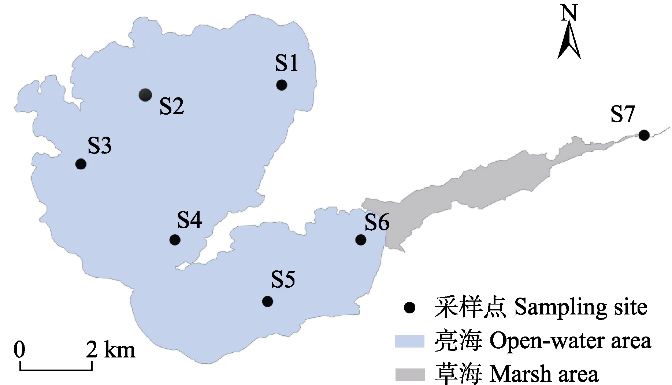
图1 泸沽湖鱼类采样点示意图
Fig. 1 Schematic diagram of fish sampling points in Lugu Lake
| 物种 Species | 总计 | 2023 | 2024 | 相对重要性 指数 IRI | 分类 Classification | ||||||
|---|---|---|---|---|---|---|---|---|---|---|---|
| Total | 5月 May | 10月 October | 5月 May | 10月 October | |||||||
| 数量Number | 出现率F% | 数量Number | 出现率F% | 数量Number | 出现率F% | 数量Number | 出现率F% | ||||
| 鲤形目 Cypriniformes | |||||||||||
| 鲤科 Cyprinidae | |||||||||||
| 棒花鱼 Abbottina rivularis | 302 | 144 | 100 | 20 | 42.86 | 98 | 71.43 | 40 | 71.43 | 727 | 重要种(C) |
| 䱗 Hemiculter leucisculus | 72 | 16 | 14.29 | 11 | 42.86 | 43 | 42.86 | 2 | 28.57 | 97 | 一般种(G) |
| 麦穗鱼 Pseudorasbora parva | 685 | 134 | 100 | 108 | 85.71 | 412 | 100 | 31 | 100 | 1,763 | 优势种(D) |
| 鲫 Carassius auratus | 1,278 | 479 | 100 | 328 | 100 | 440 | 100 | 31 | 85.71 | 8,509 | 优势种(D) |
| 鲤 Cyprinus carpio | 181 | 67 | 85.71 | 49 | 71.43 | 59 | 100 | 6 | 28.57 | 1,089 | 优势种(D) |
| 鲢 Hypophthalmichthys molitrix | 35 | 3 | 28.57 | 25 | 71.43 | 4 | 28.57 | 3 | 28.57 | 362 | 重要种(C) |
| 散鳞镜鲤 Cyprinus carpio var. specularis | 48 | 21 | 42.86 | 8 | 42.86 | 15 | 28.57 | 4 | 42.86 | 43 | 一般种(G) |
| 鳙 Hypophthalmichthys nobilis | 7 | 3 | 28.57 | - | - | 2 | 28.57 | 2 | 28.57 | 58 | 一般种(G) |
| 草鱼 Ctenopharyngodon idella | 3 | 1 | 14.29 | 1 | 14.29 | 1 | 14.29 | - | - | 1 | 少见种(R) |
| 中华鳑鲏 Rhodeus sinensis | 641 | 148 | 71.43 | 203 | 85.71 | 254 | 85.71 | 36 | 85.71 | 1,429 | 优势种(D) |
| 鳅科 Cobitidae | |||||||||||
| 大鳞副泥鳅 Paramisgurnus dabryanus | 65 | 35 | 57.14 | 6 | 28.57 | 21 | 28.57 | 3 | 28.57 | 75 | 一般种(G) |
| 泥鳅 Misgurnus anguillicaudatus* | 12 | 2 | 28.57 | - | - | 10 | 14.29 | - | - | 4 | 少见种(R) |
| 鲈形目 Perciformes | |||||||||||
| 虾虎鱼科 Gobiidae | |||||||||||
| 真吻虾虎鱼 Rhinogobius similis | 235 | 10 | 42.86 | 112 | 85.71 | 98 | 85.71 | 15 | 71.43 | 422 | 重要种(C) |
| 塘鳢科 Eleotridae | |||||||||||
| 小黄黝鱼 Hypseleotris swinhonis | 41 | - | - | - | - | 23 | 42.86 | 18 | 85.71 | 30 | 一般种(G) |
表1 泸沽湖鱼类种类组成
Table 1 Species composition of fishes in Lugu Lake
| 物种 Species | 总计 | 2023 | 2024 | 相对重要性 指数 IRI | 分类 Classification | ||||||
|---|---|---|---|---|---|---|---|---|---|---|---|
| Total | 5月 May | 10月 October | 5月 May | 10月 October | |||||||
| 数量Number | 出现率F% | 数量Number | 出现率F% | 数量Number | 出现率F% | 数量Number | 出现率F% | ||||
| 鲤形目 Cypriniformes | |||||||||||
| 鲤科 Cyprinidae | |||||||||||
| 棒花鱼 Abbottina rivularis | 302 | 144 | 100 | 20 | 42.86 | 98 | 71.43 | 40 | 71.43 | 727 | 重要种(C) |
| 䱗 Hemiculter leucisculus | 72 | 16 | 14.29 | 11 | 42.86 | 43 | 42.86 | 2 | 28.57 | 97 | 一般种(G) |
| 麦穗鱼 Pseudorasbora parva | 685 | 134 | 100 | 108 | 85.71 | 412 | 100 | 31 | 100 | 1,763 | 优势种(D) |
| 鲫 Carassius auratus | 1,278 | 479 | 100 | 328 | 100 | 440 | 100 | 31 | 85.71 | 8,509 | 优势种(D) |
| 鲤 Cyprinus carpio | 181 | 67 | 85.71 | 49 | 71.43 | 59 | 100 | 6 | 28.57 | 1,089 | 优势种(D) |
| 鲢 Hypophthalmichthys molitrix | 35 | 3 | 28.57 | 25 | 71.43 | 4 | 28.57 | 3 | 28.57 | 362 | 重要种(C) |
| 散鳞镜鲤 Cyprinus carpio var. specularis | 48 | 21 | 42.86 | 8 | 42.86 | 15 | 28.57 | 4 | 42.86 | 43 | 一般种(G) |
| 鳙 Hypophthalmichthys nobilis | 7 | 3 | 28.57 | - | - | 2 | 28.57 | 2 | 28.57 | 58 | 一般种(G) |
| 草鱼 Ctenopharyngodon idella | 3 | 1 | 14.29 | 1 | 14.29 | 1 | 14.29 | - | - | 1 | 少见种(R) |
| 中华鳑鲏 Rhodeus sinensis | 641 | 148 | 71.43 | 203 | 85.71 | 254 | 85.71 | 36 | 85.71 | 1,429 | 优势种(D) |
| 鳅科 Cobitidae | |||||||||||
| 大鳞副泥鳅 Paramisgurnus dabryanus | 65 | 35 | 57.14 | 6 | 28.57 | 21 | 28.57 | 3 | 28.57 | 75 | 一般种(G) |
| 泥鳅 Misgurnus anguillicaudatus* | 12 | 2 | 28.57 | - | - | 10 | 14.29 | - | - | 4 | 少见种(R) |
| 鲈形目 Perciformes | |||||||||||
| 虾虎鱼科 Gobiidae | |||||||||||
| 真吻虾虎鱼 Rhinogobius similis | 235 | 10 | 42.86 | 112 | 85.71 | 98 | 85.71 | 15 | 71.43 | 422 | 重要种(C) |
| 塘鳢科 Eleotridae | |||||||||||
| 小黄黝鱼 Hypseleotris swinhonis | 41 | - | - | - | - | 23 | 42.86 | 18 | 85.71 | 30 | 一般种(G) |
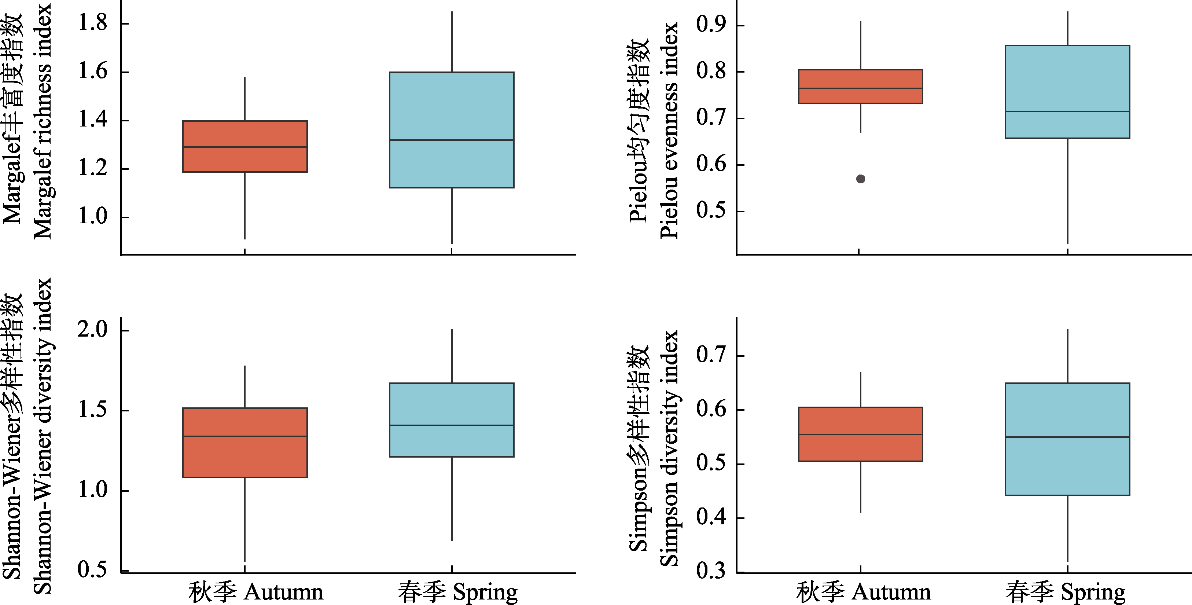
图2 泸沽湖春秋两季鱼类群落多样性
Fig. 2 Fish community diversity in Lugu Lake in spring and autumn
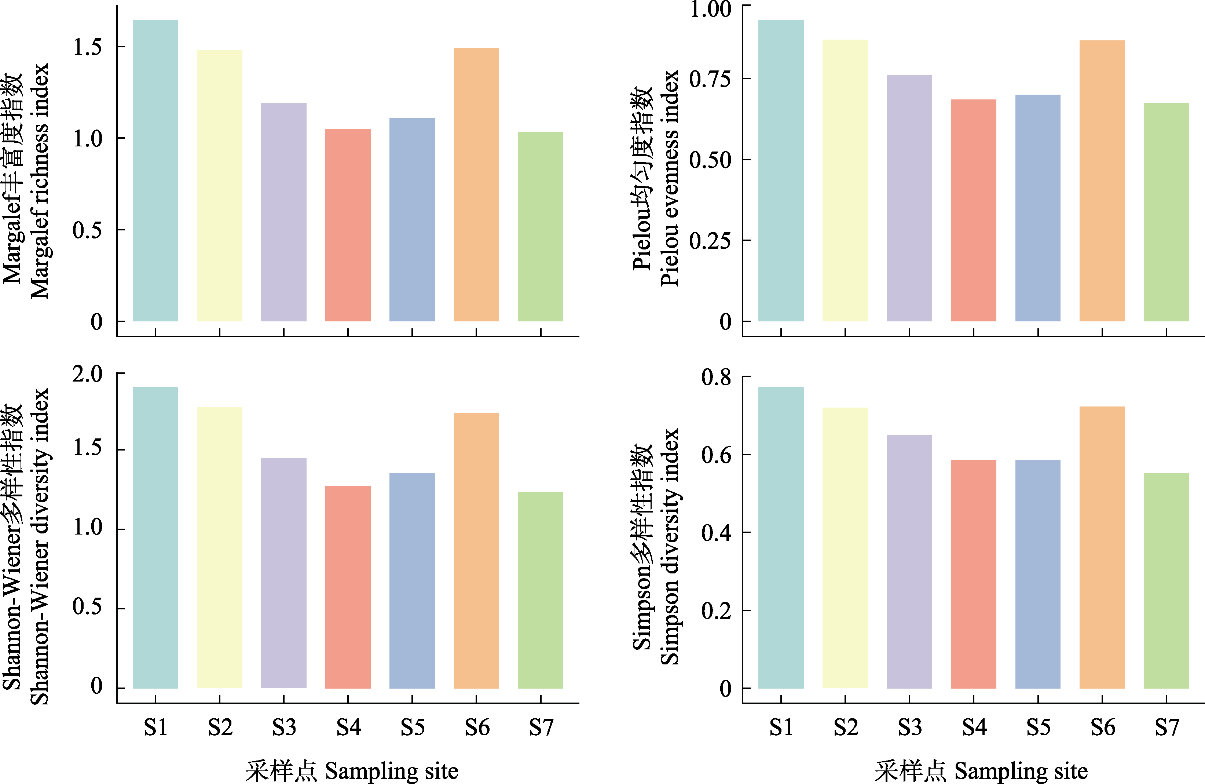
图3 泸沽湖各采样点鱼类群落多样性指数
Fig. 3 Fish community diversity indices of each sampling site in Lugu Lake
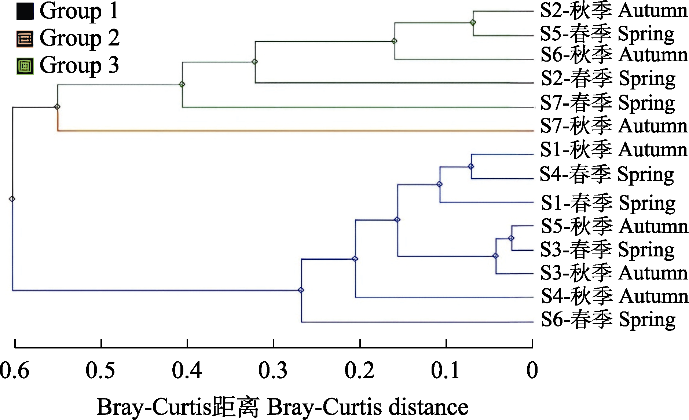
图4 泸沽湖鱼类群落非加权组平均法聚类分析
Fig. 4 unweighted pair-group method with arithmetic mean cluster analysis of fish community in Lugu Lake
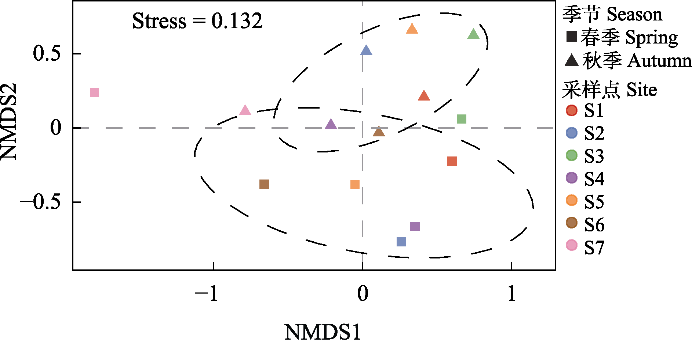
图5 泸沽湖鱼类群落非度量多维尺度排序分析
Fig. 5 Non-metric multidimensional scaling ordination analysis of fish communities in Lugu Lake
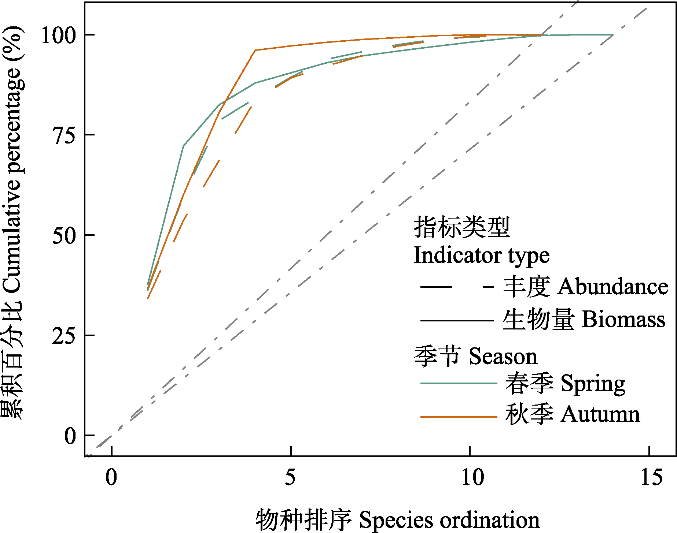
图6 泸沽湖鱼类群落丰度-生物量比较曲线季节对比
Fig. 6 Seasonal contrast of abundance-biomass comparison curve of fish community in Lugu Lake
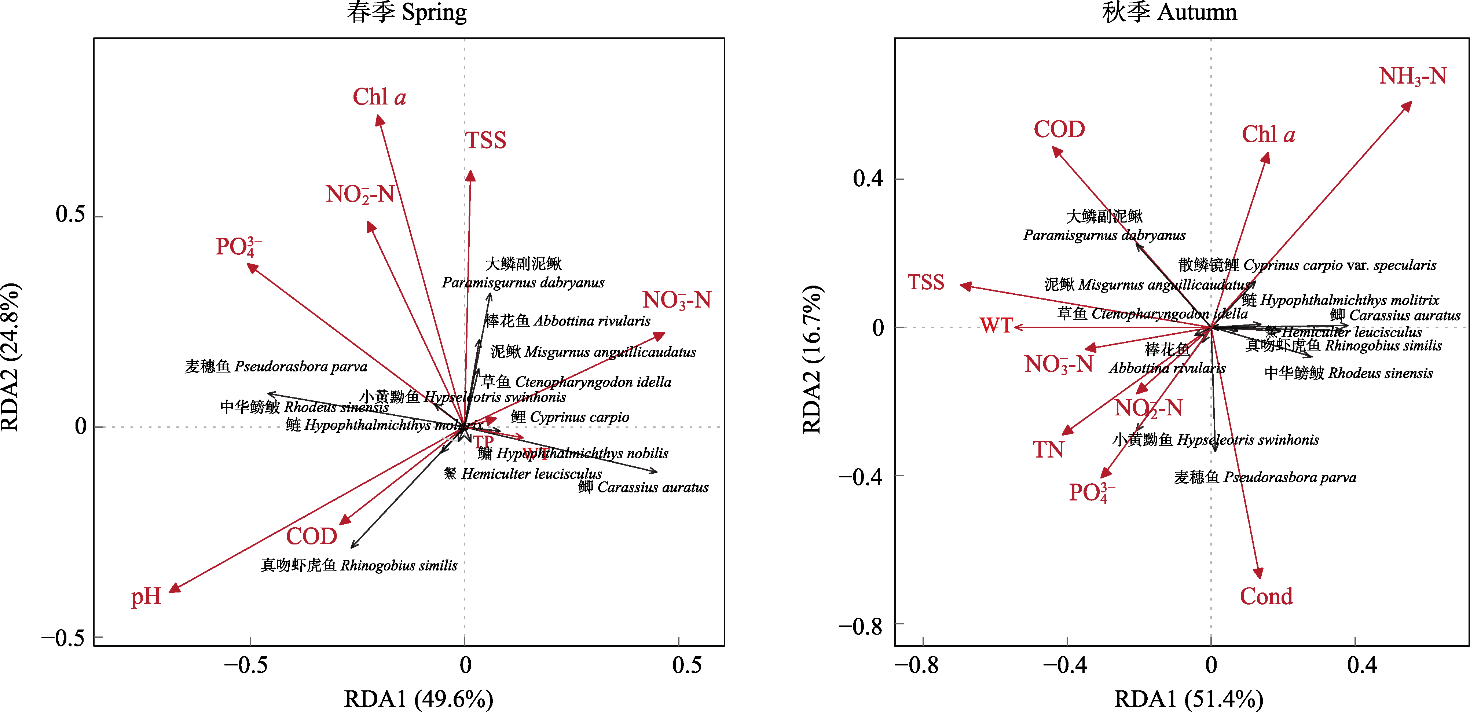
图7 泸沽湖鱼类群落分布与环境因子冗余分析(RDA)双序图。Chl a: 叶绿素a; TSS: 总悬浮固体; NO2‒-N: 亚硝酸盐氮; NO3‒-N: 硝酸盐氮; PO43‒: 磷酸根离子; NH3-N: 氨氮; COD: 化学需氧量; TN: 总氮; WT: 水温; Cond: 电导率; TP: 总磷。
Fig. 7 Dual-sequence diagram of fish community distribution and environmental factor redundancy analysis (RDA) in Lugu Lake. Chl a, Chlorophyll a; TSS, Total suspended solids; NO2‒-N, Nitrite nitrogen; NO3‒-N, Nitrate nitrogen; PO43‒, Phosphate ion; NH3-N, Ammonia nitrogen; COD, Chemical oxygen demand; TN, Total nitrogen; WT, Water temperature; Cond, Conductivity; TP, Total phosphorus.
| [1] | Bai Y, Zhang YL, Zhou YQ, Shi K, Liu ML, Yang GJ (2016) Spatial distribution of the thermal stratification in Qiandao Lake and its influencing factors. Oceanologia et Limnologia Sinica, 47, 906-914. (in Chinese with English abstract) |
| [白杨, 张运林, 周永强, 施坤, 刘明亮, 杨桂军 (2016) 千岛湖水温垂直分层的空间分布及其影响因素. 海洋与湖沼, 47, 906-914.] | |
| [2] | Borcard D, Legendre P, Drapeau P (1992) Partialling out the spatial component of ecological variation. Ecology, 73, 1045-1055. |
| [3] | Cao SQ, Yang SY, Hu CJ, Yang MJ, Li ZG (2025) Cause analysis and countermeasures for fish fauna changes in Lugu Lake. China Fisheries, (1), 38-40. (in Chinese) |
| [曹寿清, 杨思雅, 胡江春, 杨慕静, 李正光 (2025) 泸沽湖鱼类区系变化原因分析及对策措施. 中国水产, (1), 38-40.] | |
| [4] | Chen HD, Zhang H, Fu S, Lin ZM, Liu C, Chen KN, Zhang YG, Mao ZG, Mei XY, Liu ZW, Yu JL (2024) Spatiotemporal patterns of fish communities and diversity in Lake Hengshui and their relationships with water environmental factors. Journal of Lake Sciences, 36, 1447-1458. (in Chinese with English abstract) |
| [陈浩东, 张韩, 付适, 林镇美, 刘成, 陈开宁, 张余广, 毛志刚, 梅雪英, 刘正文, 于谨磊 (2024) 衡水湖鱼类群落及多样性的时空差异以及与水环境因子的关系. 湖泊科学, 36, 1447-1458.] | |
| [5] | Chen KQ, Li QS, Han YQ, Li W, Zhang Y, Li KY, He H (2021) Effects of Carassius auratus on water turbidity, nutrient levels and plankton biomass in shallow lakes: A mesocosm experiment. Journal of Lake Sciences, 33, 397-404. (in Chinese with English abstract) |
| [陈坤全, 李启升, 韩燕青, 李伟, 张又, 李宽意, 何虎 (2021) 鲫(Carassius auratus)对浅水湖泊水体浊度、营养水平和浮游生物生物量的影响——基于中宇宙模拟实验. 湖泊科学, 33, 397-404.] | |
| [6] | Clarke KR, Warwick RM (2001) Change in Marine Communities: An Approach to Statistical Analysis and Interpretation, 2nd edn. PRIMER-E, Plymouth. |
| [7] | Deng SY, Guo W, Wen WW, Wang MG, Huang LP, Chen ZD, Chen GJ, Zhao SY (2024) The effects of water eutrophication and species invasion on the food web of Xingyun Lake. China Environmental Science, 44, 932-943. (in Chinese with English abstract) |
| [邓素炎, 郭雯, 温雯雯, 王明果, 黄林培, 陈子栋, 陈光杰, 赵帅营 (2024) 水体富营养化及物种入侵对星云湖食物网的影响. 中国环境科学, 44, 932-943.] | |
| [8] | Feng J (2018) Research status and prospect analysis of Paraloach macrolepis. Fishery Guide to be Rich, (5), 44-46. (in Chinese) |
| [冯军 (2018) 大鳞副泥鳅的研究现状及前景分析. 渔业致富指南, (5), 44-46.] | |
| [9] | Han X, Xing P, Liu R, Chen L (2024) Organic phosphorus transformation mechanisms in stratified oligotrophic plateau lakes. Water Research, 249, 121420. |
| [10] | Hill MO, Gauch HG (1980) Detrended correspondence analysis: An improved ordination technique. Vegetatio, 42, 47-58. |
| [11] | Huang S, Li LX, Dao W, Li X (2020) Spatial distribution characteristics analysis and resources assessment of fish in Lugu Lake. South China Fisheries Science, 16(1), 53-61. (in Chinese with English abstract) |
| [黄朔, 李连翔, 刀微, 李旭 (2020) 泸沽湖鱼类空间分布特征分析与资源量评估. 南方水产科学, 16(1), 53-61.] | |
| [12] | Kong DP, Chen XY, Yang JX (2006) Fish fauna status in the Lugu Lake with preliminary analysis on cause and effect of human impacts. Zoological Research, 27, 94-97. |
| [13] | Lepš J, Šmilauer P (2003) Multivariate Analysis of Ecological Data Using CANOCO. Cambridge University Press, Cambridge. |
| [14] | Liu CC, Niu JG, Zhang T, Liu H, Cai LG, Wang L, Minawaer M (2022) Fish community structure and habitat suitability of alien fishes in the Ili River, China. Acta Ecologica Sinica, 42, 2571-2581. (in Chinese with English abstract) |
| [刘春池, 牛建功, 张涛, 刘鸿, 蔡林钢, 王丽, 米乃瓦尔∙木衣提 (2022) 我国伊犁河鱼类群落结构及外来鱼类适生性. 生态学报, 42, 2571-2581.] | |
| [15] | Liu JZ, Penna D, Xiao X, Guo L, Chen G, Jiang C, Wu HW, Wang SJ, Jiang ZY, Jin Z, An ZS (2025) Towards an isotope-based conceptual catchment model of the ecohydrological cycle in the critical zone on the Loess Plateau of China. Journal of Hydrology, 656, 133042. |
| [16] | Liu YY, Chen GJ, Wang L, Suo Q (2025) The influence of watershed land use on the ecological environment in Lugu Lake. Chinese Journal of Ecology, 44, 206-215. (in Chinese with English abstract) |
| [刘园园, 陈光杰, 王露, 索旗 (2025) 流域土地利用对泸沽湖生态环境的影响. 生态学杂志, 44, 206-215.] | |
| [17] | Liu Z, Zhang JY, Wei Y, Liao RX, Zhang LL, Liu XC (2025) Variation characteristics and driving factors of dissolved oxygen in water source reservoirs of upper Changjiang River: Case of Nianzitan Reservoir. Yangtze River, 56(5), 57-65. (in Chinese with English abstract) |
| [刘壮, 张静怡, 魏峣, 廖瑞雪, 张李玲, 刘晓聪 (2025) 长江上游水源地水库溶解氧变化及驱动因子研究——以碾子滩水库为例. 人民长江, 56(5), 57-65.] | |
| [18] | Lu ZH, Yang JR, He YZ, Xiao ZH (2016) Countermeasures for agricultural non-point source pollution control in Lugu Lake Scenic Area, Yunnan. Agricultural Engineering Technology, 36(11), 37, 39. (in Chinese) |
| [卢正华, 杨建荣, 和义忠, 肖支华 (2016) 云南泸沽湖景区农业面源污染治理对策及建议. 农业工程技术, 36(11), 37, 39.] | |
| [19] | Margalef R (1958) Information theory in ecology. General Systems, 3, 36-71. |
| [20] | Peng X, Xu DY, Dong YZ, Deng SH (2015) The situation and protection measures of fish resources in the Lugu Lake. Journal of Xichang College (Natural Science Edition), 29(2), 1-4. (in Chinese with English abstract) |
| [彭徐, 徐大勇, 董艳珍, 邓思红 (2015) 泸沽湖鱼类资源现状及保护对策. 西昌学院学报(自然科学版), 29(2), 1-4.] | |
| [21] | Pielou EC (1966) The measurement of diversity in different types of biological collections. Journal of Theoretical Biology, 13, 131-144. |
| [22] | Pinkas L, Oliphant MS, Iverson ILK (1971) Food habits of albacore, bluefin tuna, and bonito in California waters. California Department of Fish and Game, 152, 1-105. |
| [23] | Scheffer M, Carpenter S, Foley JA, Folke C, Walker B (2001) Catastrophic shifts in ecosystems. Nature, 413, 591-596. |
| [24] | Shannon CE (1948) A mathematical theory of communication. Bell System Technical Journal, 27, 379-423. |
| [25] | Simpson EH (1949) Measurement of diversity. Nature, 163, 688. |
| [26] | Somerfield PJ, Clarke KR, Gorley RN (2021) Analysis of similarity (ANOSIM) for 2-way layouts. Journal of Experimental Marine Biology and Ecology, 534, 151475. |
| [27] | Wan SS, Liu JF, Chen YW, Zou HY, Deng F, Liu YT, Xie ZH, Li W, Zhang XL (2024) Spatial and temporal distribution characteristics of phytoplankton community structure and its influencing factors in Poyang Lake. Journal of Nanchang Institute of Technology, 43(1), 42-50, 64. (in Chinese with English abstract) |
| [万珊珊, 刘金福, 陈宇炜, 邹浩月, 邓枫, 刘宇天, 谢志豪, 李威, 张晓亮 (2024) 鄱阳湖浮游植物群落结构时空分布特征及其影响因素. 南昌工程学院学报, 43(1), 42-50, 64.] | |
| [28] | Wang YH, Zhuang DD, Zhang KX, Gao LC (1981) Descriptions of three new schizothoracid fishes from lake Luguhu of Yunnan Plateau, China. Acta Zootaxonomica Sinica, 6, 328-333. (in Chinese with English abstract) |
| [王幼槐, 庄大栋, 张开翔, 高礼存 (1981) 云南高原泸沽湖裂腹鱼类三新种. 动物分类学报, 6, 328-333.] | |
| [29] | Warwick RM (1986) A new method for detecting pollution effects on marine macrobenthic communities. Marine Biology, 92, 557-562. |
| [30] | Wen XY (2017) Study on Thermodynamics and Stable Isotopes of Water Body in the Lugu Lake. PhD dissertation, Yunnan Normal University, Kunming. (in Chinese with English abstract) |
| [文新宇 (2017) 泸沽湖热力学及其水体稳定同位素研究. 博士学位论文, 云南师范大学, 昆明.] | |
| [31] | Wu F, Li YF, Ma BS, Zhang Y, Ru HJ, Shen ZW, Wei N (2025) Fish community structure and environmental impact factors in Three Gorges Reservoir during summer and autumn. South China Fisheries Science, 21(2), 81-89. (in Chinese with English abstract) |
| [吴凡, 李云峰, 马宝珊, 张燕, 茹辉军, 沈子伟, 魏念 (2025) 三峡库区夏季和秋季鱼类群落结构及环境影响因子研究. 南方水产科学, 21(2), 81-89.] | |
| [32] | Xie PP, Wei R, Chen GQ, Lin WQ, Zhou WZ, Mei XY (2025) Effects of Pseudorasbora parva and Cyprinus carpio on growth of submerged macrophyte and water quality. Acta Agriculturae Universitatis Jiangxiensis, 47, 744-754. (in Chinese with English abstract) |
| [谢盼盼, 魏冉, 陈广启, 林文清, 周文竹, 梅雪英 (2025) 麦穗鱼和鲤对沉水植物生长和水质影响的比较研究. 江西农业大学学报, 47, 744-754.] | |
| [33] | Xing T, Yong Y, Hou J, Wu Y, Wu D, Liu HB (2022) Comprehensive evaluation of water quality based on principal component analysis and hierarchical cluster analysis. Sichuan Environment, 41(4), 131-139. (in Chinese with English abstract) |
| [邢涛, 雍毅, 侯江, 吴怡, 吴迪, 刘恒博 (2022) 基于主成分分析与层次聚类分析的水质综合评价. 四川环境, 41(4), 131-139.] | |
| [34] | Xiong M, Guo W (2023) Eco-hydrological regulation of hydropower station to promote the reproduction of fishes spawning drifting eggs. Journal of Changjiang River Scientific Research Institute, 40(10), 1-5. (in Chinese with English abstract) |
| [熊明, 郭卫 (2023) 面向产漂流性卵鱼类繁殖的水电站生态水文过程调控. 长江科学院院报, 40(10), 1-5.] | |
| [35] | Xu MW (2020) Investigation on fish diversity in Luguhu Provincial Nature Reserve. Forest Inventory and Planning, 45(3), 54-59, 157. (in Chinese with English abstract) |
| [徐明旺 (2020) 泸沽湖省级自然保护区鱼类物种多样性调查研究. 林业调查规划, 45(3), 54-59, 157.] | |
| [36] | Zhang E, Cao WX (2021) China’s Red List of Biodiversity∙ Vertebrates (Volume V): Freshwater Fishes. Science Press, Beijing. (in Chinese and in English) |
| [张鹗, 曹文宣 (2021) 中国生物多样性红色名录∙脊椎动物(第五卷): 淡水鱼类. 科学出版社, 北京.] | |
| [37] | Zhang YQ (2014) The current water resources situation of Lugu Lake and countermeasures for sustainable management. Journal of Ningxia Agriculture and Forestry Science and Technology, 55(3), 53-55, 91. (in Chinese with English abstract) |
| [张雅琼 (2014) 泸沽湖水资源现状及可持续管理的措施. 宁夏农林科技, 55(3), 53-55, 91.] | |
| [38] | Zhao B, Hu YS, Yu HR, Chen SK, Xing T, Guo SS, Zhang H (2023) A method for researching the eutrophication and N/P loads of plateau lakes: Lugu Lake as a case. Science of the Total Environment, 876, 162747. |
| [1] | 唐航, 孙牧汎, 林小甜, 陈怡, 曹凤勤, 杨艳. 生境类型与月份变化对热带蜂类昆虫多样性与群落结构的影响[J]. 生物多样性, 2026, 34(8): 26172-. |
| [2] | 董奕飞, 吴春慧, 杨正宽, 郑星雨, 田阔, 张秀梅, 王一航. 筏式贻贝养殖与自然贻贝礁生境大型附着动物群落结构及功能特征分析比较[J]. 生物多样性, 2026, 34(8): 26098-. |
| [3] | 程建伟, 梁启瑞, 温豪杰, 梁海斌, 霍娜, 窦永静, 郝百惠, 刘新民, 王欣禹, 马文红. 氮添加对内蒙古典型草原线虫群落结构及生态指数的影响[J]. 生物多样性, 2026, 34(7): 26190-. |
| [4] | 徐光来, 叶文郡, 田柳燕, 张婷, 吴顺, 马健维, 武宗帝, 张寒旭, 池建宇. 青弋江支流大型底栖动物时空beta多样性及影响因素[J]. 生物多样性, 2026, 34(7): 26024-. |
| [5] | 黄莉, 刘志发, 龚粤宁, 李步杭, 张健. 广东南岭16个1 ha森林动态监测样地植物群落组成与结构[J]. 生物多样性, 2026, 34(3): 25357-. |
| [6] | 邹怡. α多样性指数选择: 不等量采样下的模拟比较[J]. 生物多样性, 2026, 34(1): 25278-. |
| [7] | 侯馨博, 赵秀海, 何怀江, 张春雨, 王娟, 任雪莹, 张新娜. 蒙古栎纯林根际与非根际微生物群落结构对土壤碳氮的响应[J]. 生物多样性, 2025, 33(7): 25119-. |
| [8] | 彭文, 邓泽帅, 郑文宝, 龚凌轩, 曾玉枫, 孟昊, 陈军, 杨道德. eDNA技术在两栖动物调查中的应用: 以湖南莽山国家级自然保护区为例[J]. 生物多样性, 2025, 33(6): 24552-. |
| [9] | 潘正东, 林熙戎, 薛华, 胡治颖, 郭弘艺, 张亚, 吴阿娜, 唐文乔. 上海主要内陆水体鱼类物种多样性本底及群落结构[J]. 生物多样性, 2025, 33(6): 24290-. |
| [10] | 张明燡, 王晓梅, 郑言鑫, 吴楠, 李东浩, 樊恩源, 李娜, 单秀娟, 于涛, 赵春暖, 李波, 徐帅, 吴玉萍, 任利群. 黄河口典型牡蛎礁分布区资源状况和栖息地功能[J]. 生物多样性, 2025, 33(4): 24208-. |
| [11] | 王太, 宋福俊, 张永胜, 娄忠玉, 张艳萍, 杜岩岩. 河西走廊内陆河水系鱼类多样性及资源现状[J]. 生物多样性, 2025, 33(4): 24387-. |
| [12] | 仝淼, 王欢, 张文双, 王超, 宋建潇. 重金属污染土壤中细菌抗生素抗性基因分布特征[J]. 生物多样性, 2025, 33(3): 24101-. |
| [13] | 李艳朋, 陈洁, 卢春洋, 许涵. 海南尖峰岭热带山地雨林64 ha次生林动态监测样地群落结构特征[J]. 生物多样性, 2025, 33(2): 24445-. |
| [14] | 贾贞妮, 张意岑, 杜彦君, 任海保. 干扰对中亚热带森林群落物种多样性演替动态的影响[J]. 生物多样性, 2025, 33(2): 24078-. |
| [15] | 王文琪, 杨永川, 昌维, 胡四维, 牟文博, 曾岩. 不同生境下甘松群落结构、生长特征及潜在资源量估算[J]. 生物多样性, 2025, 33(11): 25382-. |
| 阅读次数 | ||||||
|
全文 |
|
|||||
|
摘要 |
|
|||||
备案号:京ICP备16067583号-7
Copyright © 2026 版权所有 《生物多样性》编辑部
地址: 北京香山南辛村20号, 邮编:100093
电话: 010-62836137, 62836665 E-mail: biodiversity@ibcas.ac.cn
