

生物多样性 ›› 2026, Vol. 34 ›› Issue (4): 25377. DOI: 10.17520/biods.2025377 cstr: 32101.14.biods.2025377
苏璇1,2,3, 时雷雷1,2,3, 陈娟娟4, 单燕祥3,5, 张吉6, 张洪芝1,2,3,*( ), 傅声雷1,2,3,*()
收稿日期:2025-09-25
接受日期:2026-02-20
出版日期:2026-04-20
发布日期:2026-05-28
通讯作者:
*E-mail: hongzhi-0729@163.com;fsl@vip.henu.edu.cn
基金资助:
Xuan Su1,2,3, Leilei Shi1,2,3, Juanjuan Chen4, Yanxiang Shan3,5, Ji Zhang6, Hongzhi Zhang1,2,3,*(), Shenglei Fu1,2,3,*()
Received:2025-09-25
Accepted:2026-02-20
Online:2026-04-20
Published:2026-05-28
Contact:
*E-mail: hongzhi-0729@163.com;fsl@vip.henu.edu.cn
Supported by:摘要:
线蚓隶属于环节动物门环带纲, 是环带纲的第二大科。线蚓在改良土壤结构、增加孔隙度、提升通气透水性, 促进土壤颗粒混合并形成稳定团聚体等方面扮演重要的调控作用, 被誉为“微型生态系统工程师”。线蚓作为关键的有机物分解者, 参与养分循环, 与土壤微生物、植物根系及其他土壤动物间存在复杂且紧密的相互作用关系, 是土壤食物网的重要一环。本文从营养生态学和生态功能方面梳理了线蚓的研究进展。在营养生态学方面, 明确了线蚓食物来源的多样性, 揭示了其营养物质吸收与转化的生理机制, 初步厘清了其营养生态位特征; 在生态功能方面, 发现了线蚓对土壤结构具有重塑作用, 阐明了其在碳循环(加速有机质矿化、调控微生物活性影响碳释放与固定)和氮循环(促进有机氮矿化、影响无机氮释放与迁移)中的双重调控效应, 以及其与土壤微生物、其他土壤动物及植物根系的复杂关系。当前, 线蚓生态学在基础研究与应用层面仍存在许多不足, 为了深入理解线蚓的生态功能和生态服务潜能, 未来需要从多学科交叉的视野针对线蚓营养生态学的生物机制和多维生态功能开展深入系统的研究, 以期利用线蚓的生物学特性和生态功能服务生产实践和环境可持续发展。
苏璇, 时雷雷, 陈娟娟, 单燕祥, 张吉, 张洪芝, 傅声雷 (2026) 土壤线蚓的营养生态学和生态功能研究进展. 生物多样性, 34, 25377. DOI: 10.17520/biods.2025377.
Xuan Su, Leilei Shi, Juanjuan Chen, Yanxiang Shan, Ji Zhang, Hongzhi Zhang, Shenglei Fu (2026) Advances of the trophic ecology and ecological functions of soil enchytraeids. Biodiversity Science, 34, 25377. DOI: 10.17520/biods.2025377.
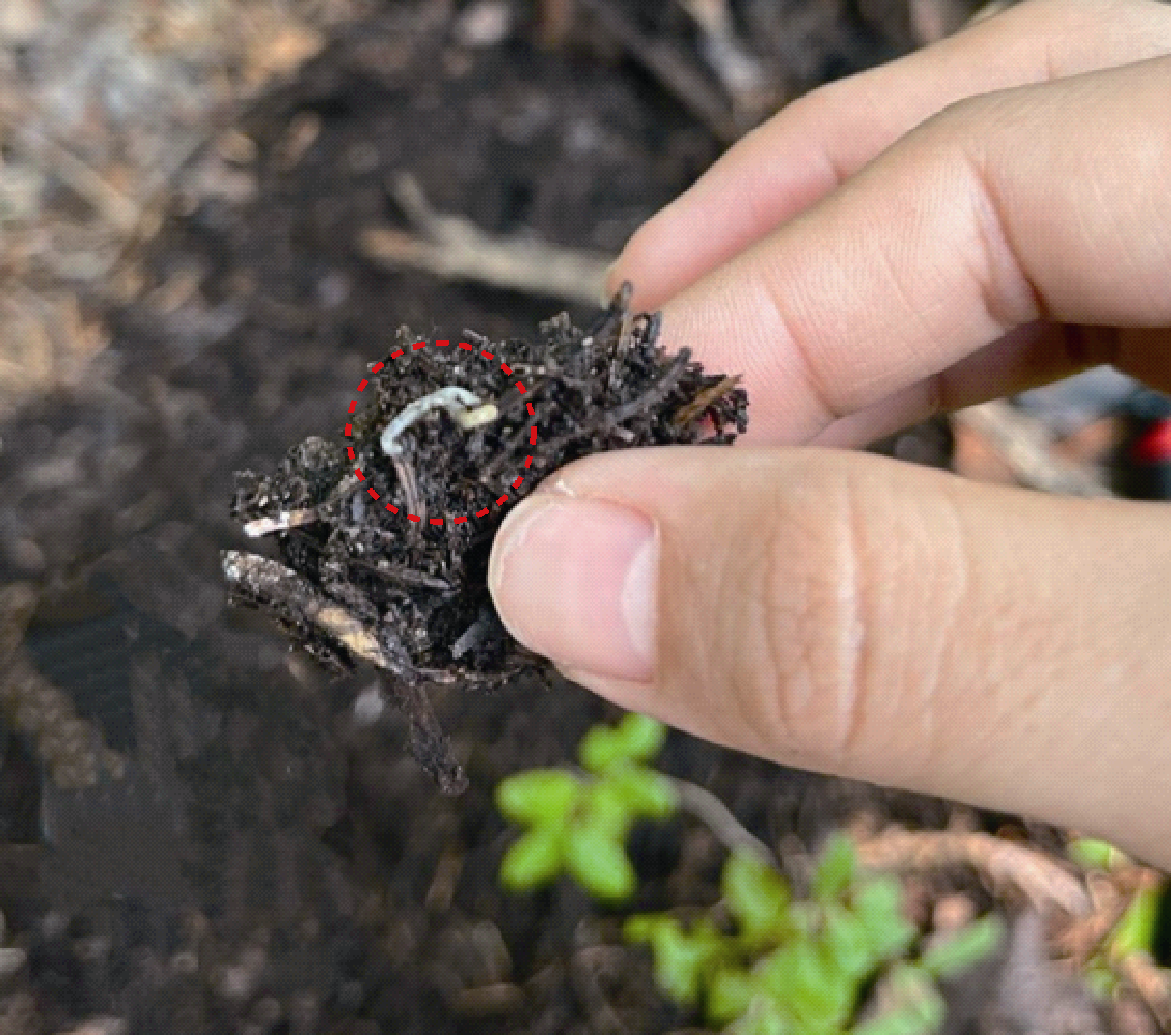
图1 发现于吉林长白山森林生态系统国家野外科学观测研究站落叶松林土壤层中的线蚓: 在自然生境中的形态及栖息状态。
Fig. 1 Morphology and habitat of an enchytraeid specimen found in the soil layer under a larch forest at the Jilin Changbai Mountain Forest Ecosystem National Field Observation and Research Station.
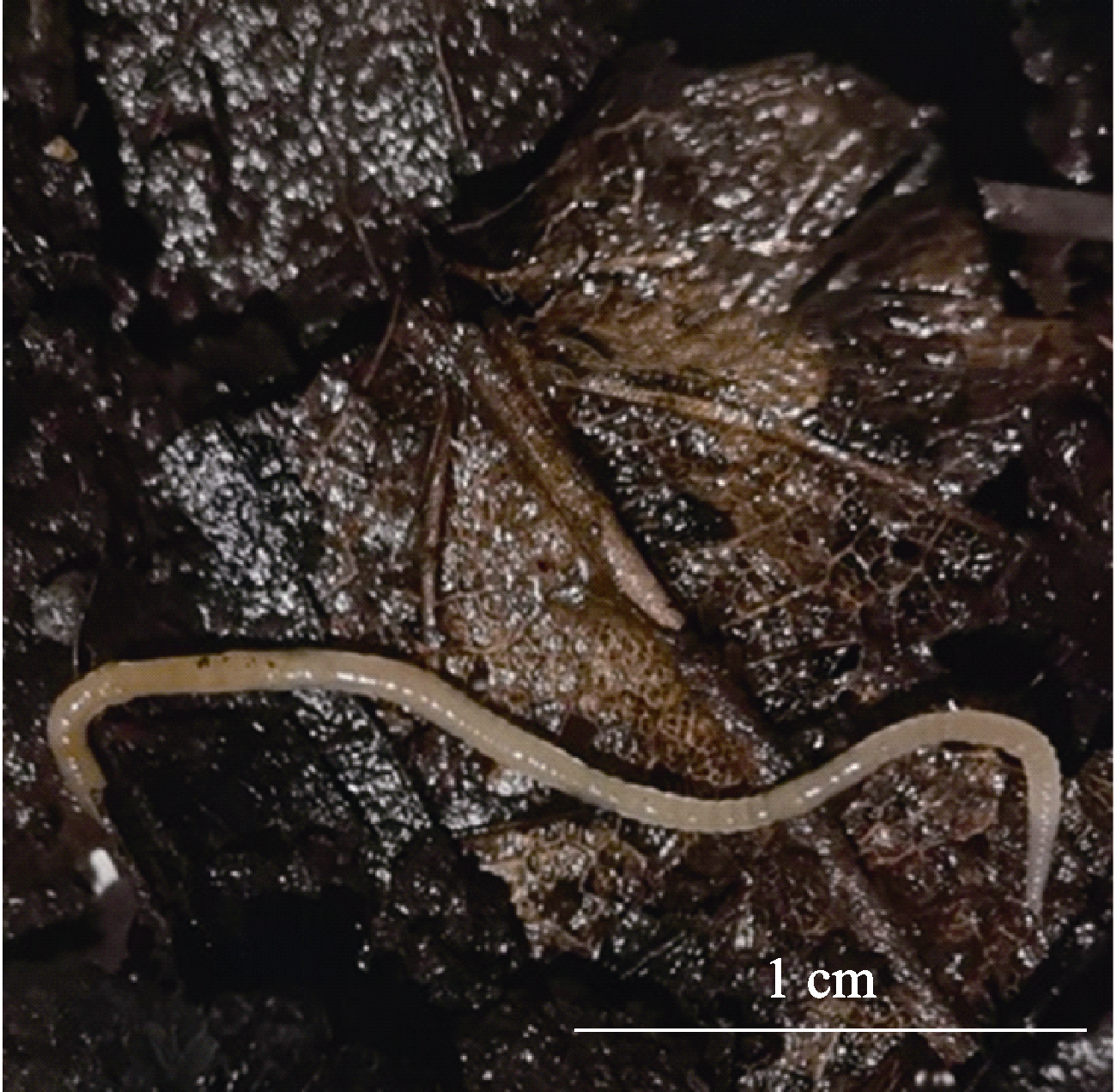
图2 采集于吉林长白山森林生态系统国家野外科学观测研究站的落叶松林土壤层该线蚓样本
Fig. 2 An enchytraeid specimen collected from the soil layer under the larch forest at the Jilin Changbai Mountain Forest Ecosystem National Field Observation and Research Station
| 物种 Species | δ13C (or Δ13C) (‰) | δ13N/ (orΔ15N) (‰) | 参考文献 Reference |
|---|---|---|---|
| 线蚓 Enchytraeids | -11.5 | 4.9 | Briones & Ineson, |
| Fridericia christeri | -25.4 | 13.9 | Schmidt et al., |
| Fridericia galba | -25.6 | 12.9 | Schmidt et al., |
| 巴氏线蚓 Enchytraeus buchholzi | -24.4±0.2 | 7.0±0.8 | Schmidt et al., |
| Achaeta pannonica | 6.6±0.2 | 11.5±0.9 | Korobushkin et al., |
| 附支巴氏蚓 Buchholzia appendiculata | 5.5±0 | 5.5±0 | Korobushkin et al., |
| Cognettia sphagnetorum | 8.3±0.2 | 8.3±0.3 | Korobushkin et al., |
| Cognettia glandulosa | 3.8±0.4 | 6.5±0.6 | Korobushkin et al., |
| Cognettia lapponica | 4.6±0.3 | 7.8±0.5 | Korobushkin et al., |
| Cognettia sp. | 6.1±0.1 | 6.4±0.1 | Korobushkin et al., |
| Enchytraeus albidus | 1.7±0.2 | 4.0±0.3 | Korobushkin et al., |
| Enchytraeus dichaetus | 6.3±0.8 | 9.0±0 | Korobushkin et al., |
| 巴氏线蚓 Enchytraeus buchholzi | 5.1±0.3 | 7.7±0.3 | Korobushkin et al., |
| 类球白线蚓 Fridericia bulboides | 3.9±0.5 | 8.7±0.8 | Korobushkin et al., |
| Fridericia galba | 2.1±0.1 | 5.4±0.3 | Korobushkin et al., |
| Globulidrilus riparius | 0.9±0 | 3.0±0 | Korobushkin et al., |
| Lumbricillus lineatus | 1.5±1.2 | 5.5±0.3 | Korobushkin et al., |
| Lumbricillus pagenstecheri | 1.2±0.7 | 4.0±0.4 | Korobushkin et al., |
| Lumbricillus rivalis | 1.7±0.2 | 3.5±0.2 | Korobushkin et al., |
| Lumbricillus viridis | 0.6±0.1 | 5.0±0.1 | Korobushkin et al., |
表1 线蚓13C和15N同位素数值汇总。线蚓科、Fridericia christeri、F. galba、Enchytraeus buchholzi的数据为δ13C和δ15N值, 反映其相对于国际标准物质的稳定同位素比值。其余物种数据为Δ13C和Δ15N值, 计算公式为Δ=δ_sample − δ_baseline (δ_baseline为本地基线食物源δ值)。该校正消除不同区域间因同位素基线导致的波动, 更精准地揭示各物种相对于本地基础食物源的同位素富集特征与营养生态位差异。
Table 1 Summary of δ13C (or Δ13C) and δ13N (or Δ15N) values for enchytraeids. δ13C and δ15N values are presented for enchytraeids, Fridericia christeri, F. galba, and Enchytraeus buchholzi, relative to international standards. Δ13C and Δ15N values for other species were calculated as Δ=δ_sample ‒ δ_baseline, where δ_baseline is the local baseline food source. This calculation effectively eliminates fluctuations in isotopic baselines caused by differences in environmental backgrounds across study areas, thereby more accurately revealing the isotopic enrichment characteristics and trophic niche differences of each species relative to local basal food sources in their respective ecosystems.
| 物种 Species | δ13C (or Δ13C) (‰) | δ13N/ (orΔ15N) (‰) | 参考文献 Reference |
|---|---|---|---|
| 线蚓 Enchytraeids | -11.5 | 4.9 | Briones & Ineson, |
| Fridericia christeri | -25.4 | 13.9 | Schmidt et al., |
| Fridericia galba | -25.6 | 12.9 | Schmidt et al., |
| 巴氏线蚓 Enchytraeus buchholzi | -24.4±0.2 | 7.0±0.8 | Schmidt et al., |
| Achaeta pannonica | 6.6±0.2 | 11.5±0.9 | Korobushkin et al., |
| 附支巴氏蚓 Buchholzia appendiculata | 5.5±0 | 5.5±0 | Korobushkin et al., |
| Cognettia sphagnetorum | 8.3±0.2 | 8.3±0.3 | Korobushkin et al., |
| Cognettia glandulosa | 3.8±0.4 | 6.5±0.6 | Korobushkin et al., |
| Cognettia lapponica | 4.6±0.3 | 7.8±0.5 | Korobushkin et al., |
| Cognettia sp. | 6.1±0.1 | 6.4±0.1 | Korobushkin et al., |
| Enchytraeus albidus | 1.7±0.2 | 4.0±0.3 | Korobushkin et al., |
| Enchytraeus dichaetus | 6.3±0.8 | 9.0±0 | Korobushkin et al., |
| 巴氏线蚓 Enchytraeus buchholzi | 5.1±0.3 | 7.7±0.3 | Korobushkin et al., |
| 类球白线蚓 Fridericia bulboides | 3.9±0.5 | 8.7±0.8 | Korobushkin et al., |
| Fridericia galba | 2.1±0.1 | 5.4±0.3 | Korobushkin et al., |
| Globulidrilus riparius | 0.9±0 | 3.0±0 | Korobushkin et al., |
| Lumbricillus lineatus | 1.5±1.2 | 5.5±0.3 | Korobushkin et al., |
| Lumbricillus pagenstecheri | 1.2±0.7 | 4.0±0.4 | Korobushkin et al., |
| Lumbricillus rivalis | 1.7±0.2 | 3.5±0.2 | Korobushkin et al., |
| Lumbricillus viridis | 0.6±0.1 | 5.0±0.1 | Korobushkin et al., |
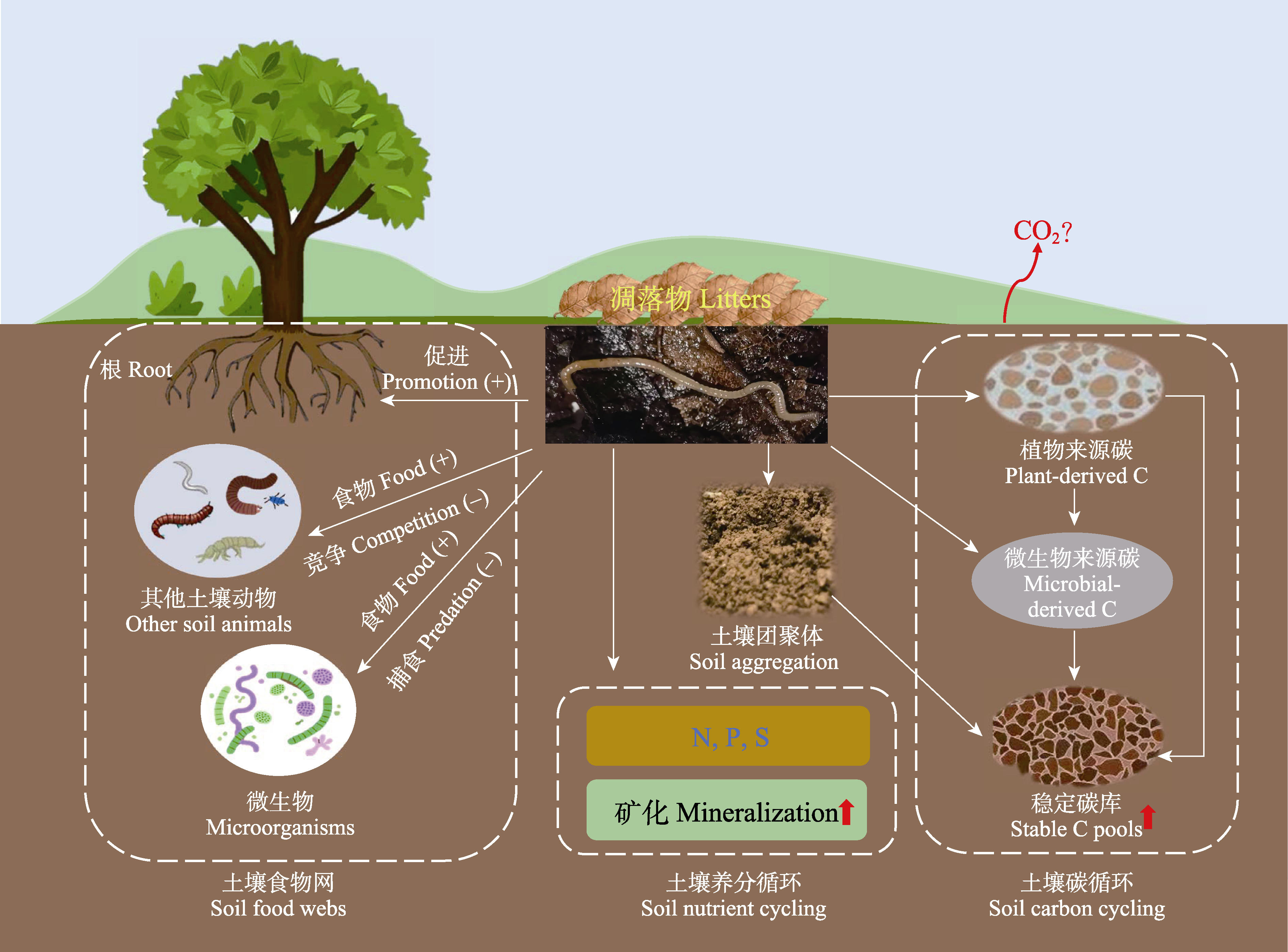
图3 线蚓的生态功能示意图。线蚓在土壤生态系统中的关键作用主要包括三方面: 土壤结构改良功能; 养分循环和碳循环调控功能; 土壤食物网维系功能。
Fig. 3 Ecological functions of enchytraeids. Key roles of enchytraeids in soil ecosystems include three aspects: soil structure improvement; nutrient and carbon cycle regulation; and soil food web maintenance.
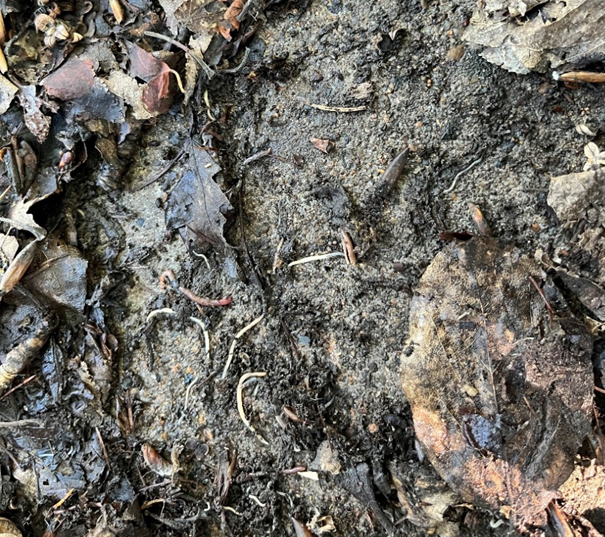
图4 吉林长白山森林生态系统国家野外科学观测研究站青杨林下井盖表面聚集的线蚓及周边环境中的蚯蚓。井盖表面可见大量线蚓聚集, 周边土壤及凋落物中则有大量蚯蚓活动, 清晰展现两类环带纲动物不同的生境分布特征。
Fig. 4 Enchytraeids aggregating on the surface of a manhole cover and earthworms in the surrounding environment under a Populus cathayana forest at the Jilin Changbai Mountain Forest Ecosystem National Field Observation and Research Station. Enchytraeids densely aggregated on the manhole cover surface, while numerous earthworms inhabit the adjacent soil and litter, presenting distinct the habitat preferences of these two clitellate groups.
| [1] |
Ameloot N, Graber ER, Verheijen FGA, De Neve S (2013) Interactions between biochar stability and soil organisms: Review and research needs. European Journal of Soil Science, 64, 379-390.
DOI URL |
| [2] |
Bardgett RD, van der Putten WH (2014) Belowground biodiversity and ecosystem functioning. Nature, 515, 505-511.
DOI |
| [3] | Briones MJI (2014) Soil fauna and soil functions: A jigsaw puzzle. Frontiers in Environmental Science, 2, 7. |
| [4] |
Briones MJI, Carreira J, Ineson P (1998) Cognettia sphagnetorum (Enchytraeidae) and nutrient cycling in organic soils: A microcosm experiment. Applied Soil Ecology, 9, 289-294.
DOI URL |
| [5] |
Briones MJI, Ineson P (2002) Use of 14C carbon dating to determine feeding behaviour of enchytraeids. Soil Biology and Biochemistry, 34, 881-884.
DOI URL |
| [6] |
Brockmeyer V, Schmid R, Westheide W (1990) Quantitative investigations of the food of two terrestrial enchytraeid species (Oligochaeta). Pedobiologia, 34, 151-156.
DOI URL |
| [7] |
Carrera N, Barreal ME, Rodeiro J, Briones MJI (2011) Interactive effects of temperature, soil moisture and enchytraeid activities on C losses from a peatland soil. Pedobiologia, 54, 291-299.
DOI URL |
| [8] | Chen JJ (2024) Integrative Taxonomy of Enchytraeidae (Annelida: Clitellata) from China.PhD dissertation, Institute of Hydrobiology, Chinese Academy of Sciences, Wuhan.(in Chinese with English abstract) |
| [陈娟娟 (2024) 中国线蚓科(环节动物门: 环带纲)整合分类研究. 博士学位论文, 中国科学院水生生物研究所, 武汉.] | |
| [9] |
Cole L, Bardgett RD, Ineson P (2000) Enchytraeid worms (Oligochaeta) enhance mineralization of carbon in organic upland soils. European Journal of Soil Science, 51, 185-192.
DOI URL |
| [10] |
Coyle DR, Nagendra UJ, Taylor MK, Campbell JH, Cunard CE, Joslin AH, Mundepi A, Phillips CA, Callaham MA (2017) Soil fauna responses to natural disturbances, invasive species, and global climate change: Current state of the science and a call to action. Soil Biology and Biochemistry, 110, 116-133.
DOI URL |
| [11] |
Crotty FV, Blackshaw RP, Murray PJ (2011) Tracking the flow of bacterially derived 13C and 15N through soil faunal feeding channels. Rapid Communications in Mass Spectrometry, 25, 1503-1513.
DOI PMID |
| [12] |
Darrah PR (1991) Models of the rhizosphere. I. Microbial population dynamics around a root releasing soluble and insoluble carbon. Plant and Soil, 133, 187-199.
DOI URL |
| [13] |
Dash MC, Nanda B, Mishra PC (1981) Digestive enzymes in three species of Enchytraeidae (Oligochaeta). Oikos, 36, 316-318.
DOI URL |
| [14] |
Didden WAM (1990) Involvement of Enchytraeidae (Oligochaeta) in soil structure evolution in agricultural fields. Biology and Fertility of Soils, 9, 152-158.
DOI URL |
| [15] |
Didden WAM (1993) Ecology of terrestrial Enchytraeidae. Pedobiologia, 37, 2-29.
DOI URL |
| [16] |
Didden WAM, Marinissen JCY, Vreeken-Buijs MJ, Burgers SLGE, de Fluiter R, Geurs M, Brussaard L (1994) Soil meso- and macrofauna in two agricultural systems: Factors affecting population dynamics and evaluation of their role in carbon and nitrogen dynamics. Agriculture, Ecosystems & Environment, 51, 171-186.
DOI URL |
| [17] | Dózsa-Farkas K (1976) Über die Nahrungswahl zweier Enchytraeiden-Arten (Oligochaeta: Enchytraeidae). Pedobiologia, 16, 57-69. |
| [18] | Dózsa-Farkas K (1991) Neue EnchytraeidenArt aus tieferen Bodenschichten eines Hainbuchen-Eichenwaldes in Ungarn (Oligochaeta, Enchytraeidae). Acta Zoologica Academiae Scientiarum Hungaricae, 37, 21-25. |
| [19] |
Erséus C, Rota E, Matamoros L, De Wit P (2010) Molecular phylogeny of Enchytraeidae (Annelida, Clitellata). Molecular Phylogenetics and Evolution, 57, 849-858.
DOI PMID |
| [20] |
Gajda Ł, Daszkowska-Golec A, Świątek P (2024) Discovery and characterization of the α-amylases cDNAs from Enchytraeus albidus shed light on the evolution of “Enchytraeus-Eisenia type” Amy homologs in Annelida. Biochimie, 221, 38-59.
DOI URL |
| [21] |
Gajda Ł, Gorgoń S, Urbisz AZ (2017) Food preferences of enchytraeids. Pedobiologia, 63, 19-36.
DOI URL |
| [22] |
Gelder SR (1984) Diet and histophysiology of the alimentary canal of Lumbricillus lineatus (Oligochaeta, Enchytraeidae). Hydrobiologia, 115, 71-81.
DOI URL |
| [23] | Giere O, Hauschildt D (1979) Experimental studies on the life cycle and production of the littoral oligochaete Lumbricillus lineatus, and its response to oil pollution. In: Cyclic Phenomena in Marine Plants and Animals (eds Naylor E, Hartnall RG), pp. 113-122. Elsevier, Oxford. |
| [24] |
Hartzell S (2005) Calculation of broadband time histories of ground motion, Part II: Kinematic and dynamic modeling using theoretical Green’s functions and comparison with the 1994 Northridge earthquake. Bulletin of the Seismological Society of America, 95, 614-645.
DOI URL |
| [25] | Haukka JK (1987) Growth and survival of Eisenia fetida (Sav.) (Oligochaeta: Lumbricidae) in relation to remperature, moisture and presence of Enchytraeus albidus (Henle) (Enchytraeidae). Biology and Fertility of Soils, 3, 99-102. |
| [26] |
Jaffee BA, Santos PF, Muldoon AE (1997) Suppression of nematophagous fungi by enchytraeid worms: A field exclosure experiment. Oecologia, 112, 412-423.
DOI PMID |
| [27] |
John K, Degtyarev M, Gorbunova A, Korobushkin D, Knöss H, Wolters V, Zaitsev AS (2019) Enchytraeids simultaneously stimulate rice straw degradation and mitigate CO2 release in a paddy soil. Soil Biology and Biochemistry, 131, 191-194.
DOI URL |
| [28] |
Kato R, Ritz K, Toyota K (2024) Enchytraeid-stimulation of nitrogen mineralization from green plant residues in an organic soil. Pedobiologia, 104, 150957.
DOI URL |
| [29] |
Korobushkin DI, Guseva PA, Gongalsky KB, Saifutdinov RA, Zaitsev AS, Degtyarev MI (2024) Are there different trophic niches of enchytraeids? A stable isotopic (δ13C, δ15N) evidence. Soil Biology and Biochemistry, 194, 109422.
DOI URL |
| [30] |
Krištůfek V, Fischer S, Bührmann J (1999) In situ monitoring of chitin degradation by Streptomyces lividans pCHIO12 within Enchytraeus crypticus (Oligochaeta) feeding on Aspergillus proliferans. FEMS Microbiology Ecology, 28, 41-48.
DOI URL |
| [31] |
Lagerlof J, Andren O, Paustian K (1989) Dynamics and contribution to carbon flows of Enchytraeidae (Oligochaeta) under four cropping systems. Journal of Applied Ecology, 26, 183-199.
DOI URL |
| [32] |
Larsen T, Pollierer MM, Holmstrup M, D’Annibale A, Maraldo K, Andersen N, Eriksen J (2016) Substantial nutritional contribution of bacterial amino acids to earthworms and enchytraeids: A case study from organic grasslands. Soil Biology and Biochemistry, 99, 21-27.
DOI URL |
| [33] |
Latter PM, Howson G (1978) Studies on the microfauna of blanket bog with particular reference to Enchytraeidae. Journal of Animal Ecology, 47, 425-448.
DOI URL |
| [34] | Laurén A, Lappalainen M, Saari P, Kukkonen JVK, Koivusalo H, Piirainen S, Setälä H, Sarjala T, Bylund D, Heinonen J, Nieminen M, Palviainen M, Launiainen S, Finér L (2012) Nitrogen and carbon dynamics and the role of enchytraeid worms in decomposition of L, F and H layers of boreal mor. Water, Air, & Soil Pollution, 223, 3701-3719. |
| [35] | Laverack MS (1963) The Physiology of Earthworms. Pergamon, Oxford. |
| [36] |
Maraldo K, Christensen B, Holmstrup M (2011) The excretion of ammonium by enchytraeids (Cognettia sphagnetorum). Soil Biology and Biochemistry, 43, 991-996.
DOI URL |
| [37] |
Maraun M, Thomas T, Fast E, Treibert N, Caruso T, Schaefer I, Lu JZ, Scheu S (2023) New perspectives on soil animal trophic ecology through the lens of C and N stable isotope ratios of oribatid mites. Soil Biology and Biochemistry, 177, 108890.
DOI URL |
| [38] |
Marinissen JCY, Didden WAM (1997) Influence of the Enchytraeid worm Buchholzia appendiculata on aggregate formation and organic matter decomposition. Soil Biology and Biochemistry, 29, 387-390.
DOI URL |
| [39] |
Martin A, Marinissen JCY (1993) Biological and physico-chemical processes in excrements of soil animals. Geoderma, 56, 331-347.
DOI URL |
| [40] | Nagy H, Dózsa-Farkas K, Felföldi T (2023) New insights into the Enchytraeus albidus complex (Annelida, Enchytraeidae), with the description of three new species from seashores in Italy and Croatia. European Journal of Taxonomy, 870, 1-24. |
| [41] | O’Connor FB (1967) The Enchytraeidae. In: Soil Biology (eds Burgess A, Raw F), pp. 213-257. Academic Press, London. |
| [42] |
Osler GHR, Sommerkorn M (2007) Toward a complete soil C and N cycle: Incorporating the soil fauna. Ecology, 88, 1611-1621.
PMID |
| [43] |
Pélosi C, Thiel P, Bart S, Amossé J (2021) The contributions of enchytraeids and earthworms to the soil mineralization process in soils with fungicide. Ecotoxicology, 30, 1910-1921.
DOI PMID |
| [44] |
Pélosi C, Römbke J (2016) Are Enchytraeidae (Oligochaeta, Annelida) good indicators of agricultural management practices? Soil Biology and Biochemistry, 100, 255-263.
DOI URL |
| [45] | Poinar G Jr, Lambert JB, Wu YY (2007) Araucarian source of fossiliferous Burmese amber: Spectroscopic and anatomical evidence. Journal of the Botanical Research Institute of Texas, 1, 449-455. |
| [46] |
Ponge JF (1991) Food resources and diets of soil animals in a small area of Scots pine litter. Geoderma, 49, 33-62.
DOI URL |
| [47] | Ponge, JF (2010) The Soil under the Microscope: The Optical Examination of a Small Area of Scots Pine Litter (Pinus sylvestris L.). PhD dissertation, Éditions Universitaires Européennes, Saarbrücken. |
| [48] |
Potapov AM, Beaulieu F, Birkhofer K, Bluhm SL, Degtyarev MI, Devetter M, Goncharov AA, Gongalsky KB, Klarner B, Korobushkin DI, Liebke DF, Maraun M, Mc Donnell RJ, Pollierer MM, Schaefer I, Shrubovych J, Semenyuk II, Sendra A, Tuma JR, Tůmová M, Vassilieva AB, Chen TW, Geisen S, Schmidt O, Tiunov AV, Scheu S (2022) Feeding habits and multifunctional classification of soil-associated consumers from protists to vertebrates. Biological Reviews, 97, 1057-1117.
DOI URL |
| [49] |
Prantoni AL, De Wit P, Erséus C (2016) First reports of Grania (Clitellata: Enchytraeidae) from Africa and South America: Molecular phylogeny and descriptions of nine new species. Zoological Journal of the Linnean Society, 176, 485-510.
DOI URL |
| [50] |
Prendergast-Miller M, Cole L, Standen V, Rees R, Parker J, Leith I, Sheppard L (2008) Are enchytraeid worms (Oligochaeta) sensitive indicators of ammonia-N impacts on an ombrotrophic bog? European Journal of Soil Biology, 44, 101-108.
DOI URL |
| [51] | Sandor M, Schrader S (2012) Interaction of earthworms and enchytraeids in organically amended soil. North-western Journal of Zoology, 8, 46-56 |
| [52] | Schmelz RM (2003) Taxonomy of Fridericia (Oligochaeta, Enchytraeidae) Revision of Species with Morphological and Biochemical Methods. Naturwissenschaftlicher Verein in Hamburg, Hamburg. |
| [53] | Schmelz RM, Collado R (2013) Enchytraeidae (Oligochaeta, Annelida) from a field site in Portugal, with the description of five new species and a redescription of Enchylea heteroducta Nielsen & Christensen, 1963. Zootaxa, 3647, 307-328. |
| [54] |
Schmidt O, Curry JP, Dyckmans J, Rota E, Scrimgeour CM (2004) Dual stable isotope analysis (δ13C and δ15N) of soil invertebrates and their food sources. Pedobiologia, 48, 171-180.
DOI URL |
| [55] |
Schrader S, Seibel C (2001) Impact of cultivation management in an agroecosystem on hot spot effects of earthworm middens. European Journal of Soil Biology, 37, 309-313.
DOI URL |
| [56] |
Serbource C, Sammartino S, Cornu S, Papillon J, Adrien J, Pélosi C (2025) Enchytraeids: Small but important ecosystem engineers. Geoderma, 453, 117150.
DOI URL |
| [57] |
Setälä H (2002) Sensitivity of ecosystem functioning to changes in trophic structure, functional group composition and species diversity in belowground food webs. Ecological Research, 17, 207-215.
DOI URL |
| [58] |
Standen V, Latter PM (1977) Distribution of a population of Cognettia sphagnetorum (Enchytraeidae) in relation to microhabitats in a blanket bog. Journal of Animal Ecology, 46, 213-229.
DOI URL |
| [59] |
Šustr V, Chalupský J (1996) Activity of digestive enzymes in two species of potworms (Oligochaeta, Enchytraeidae). Pedobiologia, 40, 255-259.
DOI URL |
| [60] |
Šustr V, Chalupský J, Krištůfek V (1997) Effects of artificial acidification and liming on the activity of digestive enzymes in Cognettia sphagnetorum (Vejdovský, 1878) (Annelida, Enchytraeidae). Biology and Fertility of Soils, 24, 227-230.
DOI URL |
| [61] |
Topoliantz S, Ponge JF, Viaux P (2000) Earthworm and enchytraeid activity under different arable farming systems, as exemplified by biogenic structures. Plant and Soil, 225, 39-51.
DOI |
| [62] |
Toutain F, Villemin G, Albrecht A, Reisinger O (1982) Etude ultrastructurale des Processus de biodegradation. II. Modèle Enchytraeicles-Litière de feuillus. Pedobiologia, 23, 145-156.
DOI URL |
| [63] |
Tyler AN, Carter S, Davidson DA, Long DJ, Tipping R (2001) The extent and significance of bioturbation on 137Cs distributions in upland soils. Catena, 43, 81-99.
DOI URL |
| [64] |
Urbášek F, Chalupský J (1992) Effects of artificial acidification and liming on biomass and on the activity of digestive enzymes in Enchytraeidae (Oligochaeta): Results of an ongoing study. Biology and Fertility of Soils, 14, 67-70.
DOI URL |
| [65] |
van Vliet PCJ, Beare MH, Coleman DC, Hendrix PF (2004) Effects of enchytraeids (Annelida: Oligochaeta) on soil carbon and nitrogen dynamics in laboratory incubations. Applied Soil Ecology, 25, 147-160.
DOI URL |
| [66] |
van Vliet PCJ, West LT, Hendrix PF, Coleman DC (1993) The influence of Enchytraeidae (Oligochaeta) on the soil porosity of small microcosms. Geoderma, 56, 287-299.
DOI URL |
| [67] |
Williams BL, Griffiths BS (1989) Enhanced nutrient mineralization and leaching from decomposing Sitka spruce litter by enchytraeid worms. Soil Biology and Biochemistry, 21, 183-188.
DOI URL |
| [68] |
Wolters V (1988) Effects of Mesenchytraeus glandulosus (Oligochaeta, Enchytraeidae) on decomposition processes. Pedobiologia, 32, 387-398.
DOI URL |
| [1] | 洪欣艺, 蔡易朗, 方嘉乐, 姚可侃, 李佳乐, 王懿祥, 白尚斌, 王楠, 周秀梅. 西溪湿地土壤病毒多样性及其碳代谢基因解析[J]. 生物多样性, 2025, 33(9): 25190-. |
| [2] | 张明燡, 王晓梅, 郑言鑫, 吴楠, 李东浩, 樊恩源, 李娜, 单秀娟, 于涛, 赵春暖, 李波, 徐帅, 吴玉萍, 任利群. 黄河口典型牡蛎礁分布区资源状况和栖息地功能[J]. 生物多样性, 2025, 33(4): 24208-. |
| [3] | 陈丁松, 刘子恺, 贺子洋, 陈伟东. 缓步动物多样性、分布特征和生态功能研究进展[J]. 生物多样性, 2025, 33(2): 24406-. |
| [4] | 姚保民, 曾青, 张丽梅. 土壤原生生物多样性及其生态功能研究进展[J]. 生物多样性, 2022, 30(12): 22353-. |
| [5] | 李世雄, 王彦龙, 王玉琴, 尹亚丽. 土壤细菌群落特征对高寒草甸退化的响应[J]. 生物多样性, 2021, 29(1): 53-64. |
| [6] | 孙晶琦, 陈泉, 李航宇, 常艳芬, 巩合德, 宋亮, 卢华正. 附生蕨类植物的克隆性研究进展[J]. 生物多样性, 2019, 27(11): 1184-1195. |
| [7] | 张晓珂, 梁文举, 李琪. 我国土壤线虫生态学研究进展和展望[J]. 生物多样性, 2018, 26(10): 1060-1073. |
| [8] | 王梦茹, 傅声雷, 徐海翔, 王美娜, 时雷雷. 陆地生态系统中马陆的生态功能[J]. 生物多样性, 2018, 26(10): 1051-1059. |
| [9] | 孙工棋, 曲艺, 唐美庆, 刘晓, 栾晓峰. 基于我国陆生濒危哺乳动物保护的生态功能区优先保护规划[J]. 生物多样性, 2013, 21(1): 47-53. |
| [10] | 吴纪华, 宋慈玉, 陈家宽. 食微线虫对植物生长及土壤养分循环的影响[J]. 生物多样性, 2007, 15(2): 124-133. |
| [11] | 张卫信, 陈迪马, 赵灿灿. 蚯蚓在生态系统中的作用[J]. 生物多样性, 2007, 15(2): 142-153. |
| [12] | 于广志, 蒋志刚. 自然保护区的缓冲区:模式、功能及规划原则[J]. 生物多样性, 2003, 11(3): 256-261. |
| 阅读次数 | ||||||
|
全文 |
|
|||||
|
摘要 |
|
|||||
备案号:京ICP备16067583号-7
Copyright © 2026 版权所有 《生物多样性》编辑部
地址: 北京香山南辛村20号, 邮编:100093
电话: 010-62836137, 62836665 E-mail: biodiversity@ibcas.ac.cn
