

生物多样性 ›› 2016, Vol. 24 ›› Issue (8): 966-976. DOI: 10.17520/biods.2016057 cstr: 32101.14.biods.2016057
• 论坛 • 上一篇
谢平*( )
)
收稿日期:2016-02-28
接受日期:2016-07-12
出版日期:2016-08-20
发布日期:2016-09-02
通讯作者:
谢平
Ping Xie*()
Received:2016-02-28
Accepted:2016-07-12
Online:2016-08-20
Published:2016-09-02
Contact:
Xie Ping
摘要:
真核生物的起源是一个根本性的、令人生畏的进化谜题, 目前设想的关于“核”起源的流行情景还远谈不上清晰。关于真核生物的起源可谓众说纷纭, 有共营模型、自演化模型、病毒性真核生物起源模型和外膜假说, 等等。迄今为止, 真核演化的动因则鲜有涉及。笔者发现, 从原核生物到真核生物, 基因组的DNA总量大约增加了3.5个数量级, 而这与现代真核生物的DNA压缩比(packing ratio)惊人地一致! 这样, 仅仅用偶然的吞噬、共生或寄生来解释真核生物的起源, 无论如何是难以让人信服的(其实, 正是内共生理论将人们引入了歧途), 而关键是需要解释基因组为何急剧增大。这可能与DNA的复制错误或多倍化现象不无关系, 当然并非完全排除不同种类个体之间的侧向的基因流动或整合的可能贡献。不难理解, DNA压缩机制的成型应该就是迈向真核生物的关键一步, 自然还伴随了细胞内部的结构分化、更为精巧而复杂的细胞分裂机制的发展, 等等。因此, 本文提出细胞核起源的新学说——压缩与结构化假说。此外, 从分子遗传学的角度来说, “性”一点都不神秘, 就是将两个个体的基因组拼在一起而已, 藉此种族多样的遗传信息分散到了个体之中; 而从生态的角度来看, “性”的原始动机就是与休眠事件的偶联。
谢平 (2016) 细胞核和有性生殖是如何起源的?. 生物多样性, 24, 966-976. DOI: 10.17520/biods.2016057.
Ping Xie (2016) How did nucleus and sexual reproduction come into being?. Biodiversity Science, 24, 966-976. DOI: 10.17520/biods.2016057.
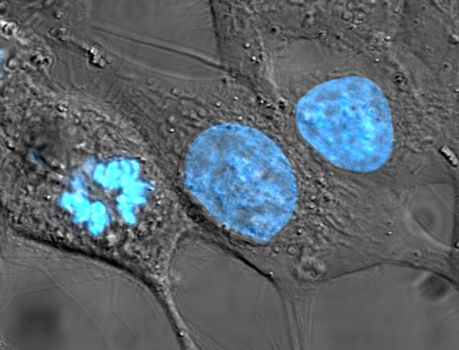
图1 用蓝色荧光染料染色的海拉细胞(HeLa cells)的核DNA, 中间以及最右的细胞处于细胞间期, 因此整个核被标记, 而左边的细胞正在进入有丝分裂, 因此核DNA已经浓缩(来源: 维基百科)
Fig. 1 Cultured HeLa cells have been stained with Hoechst turning their nuclei blue. The central and rightmost cells are in interphase, so the entire nuclei are labeled. The cell on the left is going through mitosis and its DNA has condensed (source: Wikipedia)
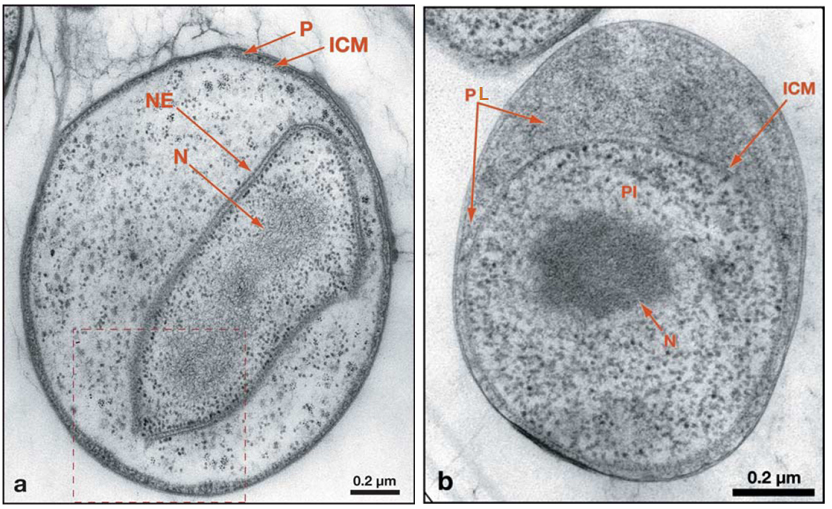
图2 通过冷替代方式固定和准备的Gemmata obscuriglobus(a)和斯氏小梨形菌(Pirellula staleyi)(b)的薄切片透射电镜图。NE: 核膜; N: 拟核; ICM: 细胞质内膜; P: 外室细胞质; PL: pirellulosome (小梨形菌属的一种膜细胞隔室) (引自Fuerst, 2005)
Fig. 2 (a) Transmission electron micrograph of thin section of Gemmata obscuriglobus fixed and prepared via cryosubstitution, showing the membrane-bound nuclear body with its nuclear envelope (NE) surrounding the nucleoid (N) and the more general features of the planctomycete cell plan, including the intracytoplasmic membrane (ICM) and paryphoplasm (P). (b) Transmission electron micrograph of thin section of cryosubstituted cell of Pirellula staleyi displaying compartmentalization into pirellulosome (PI) and P separated by the ICM. N is contained within the pirellulosome and thus compartmentalized and surrounded by the single ICM membrane (cited from Fuerst, 2005)
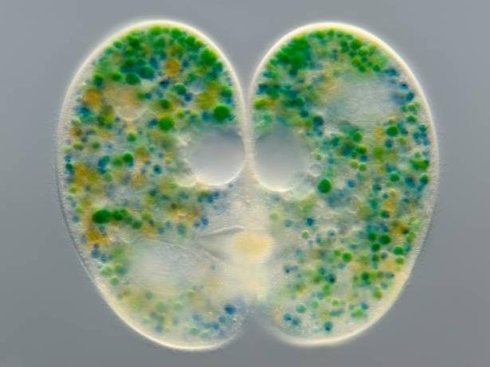
图3 一种纤毛虫(Nassula ornata)与藻类的共生现象(× 160倍)(来源: Wim van Egmond)
Fig. 3 Symbiosis of the ciliate Nassula ornata with algae (magnification:160 ×) (source: Wim van Egmond)
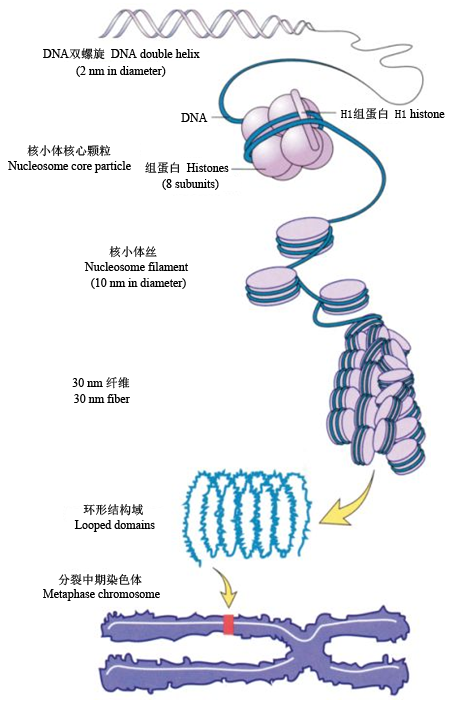
图4 DNA压缩成染色体的过程(来源: 百度图片)
Fig. 4 Compaction of DNA into chromosome (source: Baidu photo)
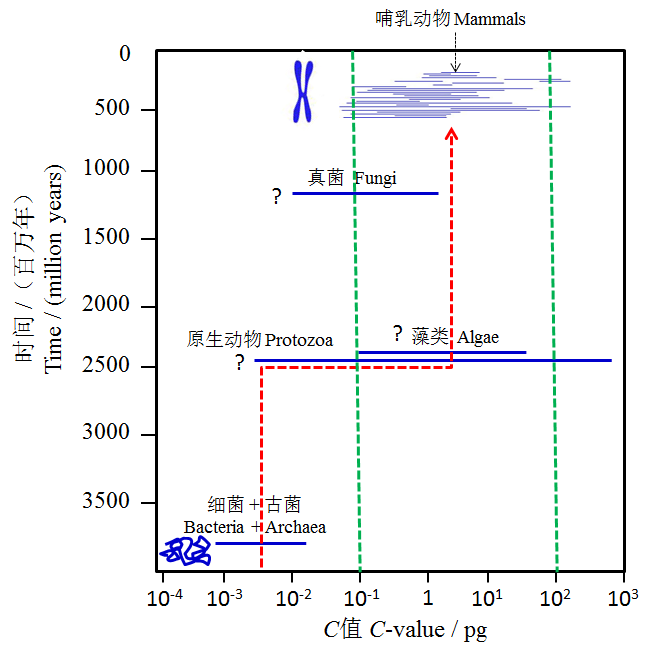
图5 根据各类生物的C值推测真核生物DNA的压缩原理, 带箭头的红色虚线表示C值中位数的演化轨迹, 绿色虚线表示大多数真核生物C值的主要分布区间, 问号表示该类生物起源的年代仍然存在争议。C值引自Gregory (2004)。
Fig. 5 Packing principle of eukaryotic DNA based on “C value” of various organisms. The dotted red line with an arrow indicates evolutionary track of the median “C value”, and the dotted green line shows the major range of the “C value” of most eukaryotes. Question marks indicate uncertainity about the dates of their origins. C values of various organisms are cited from Gregory (2004)
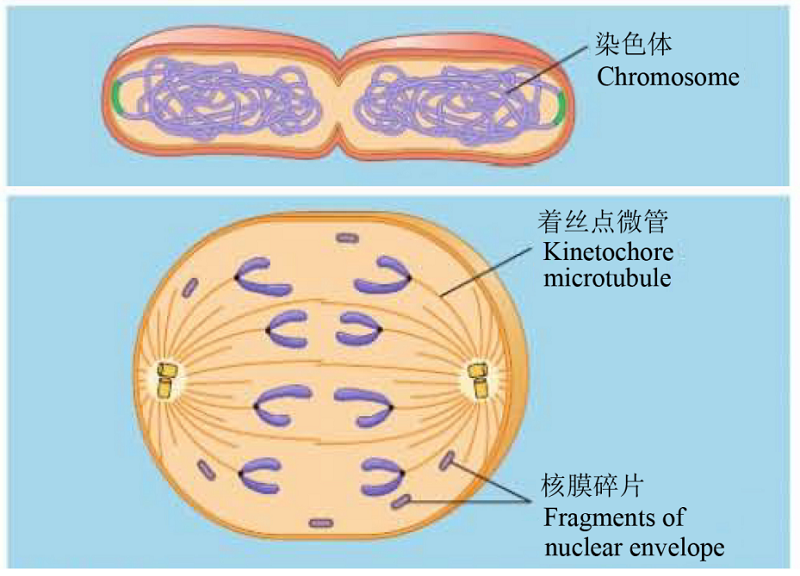
图6 原核(上图, 大肠杆菌Escherichia coli)和真核(下图)细胞的分裂比较(引自Campbell & Reece, 2008)
Fig. 6 Comparison of the cell divisions between bacteria (upper figure, the bacterium Escherichia coli) and eukaryotes (lower figure) (cited from Campbell & Reece, 2008)
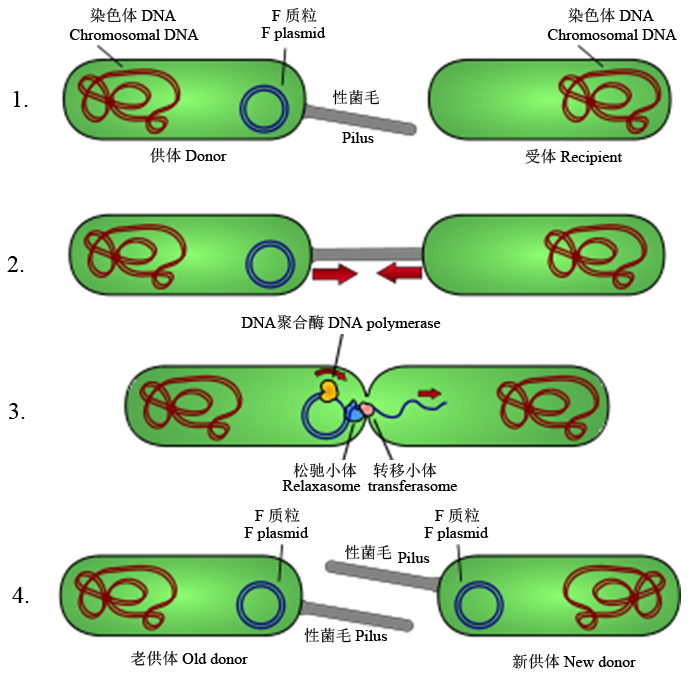
图7 细菌结合示意图。1: 供体细胞产生性菌毛; 2: 性菌毛接触受体细胞, 使两个细胞连接在一起; 3: 能移动的质体被切开, 一个单股的DNA被转移到受体细胞; 4: 两个细胞质粒重新环化, 合成第二股链, 产生性菌毛, 两个细胞又称为活性的供体(来源: 维基百科)。
Fig. 7 Schematic drawing of bacterial conjugation. Conjugation diagram. 1, Donor cell produces pilus; 2, Pilus attaches to recipient cell and brings the two cells together; 3, The mobile plasmid is nicked and a single strand of DNA is then transferred to the recipient cell; 4, Both cells synthesize a complementary strand to produce a double stranded circular plasmid and also reproduce pili; both cells are now viable donors (cited from Wikipedia).
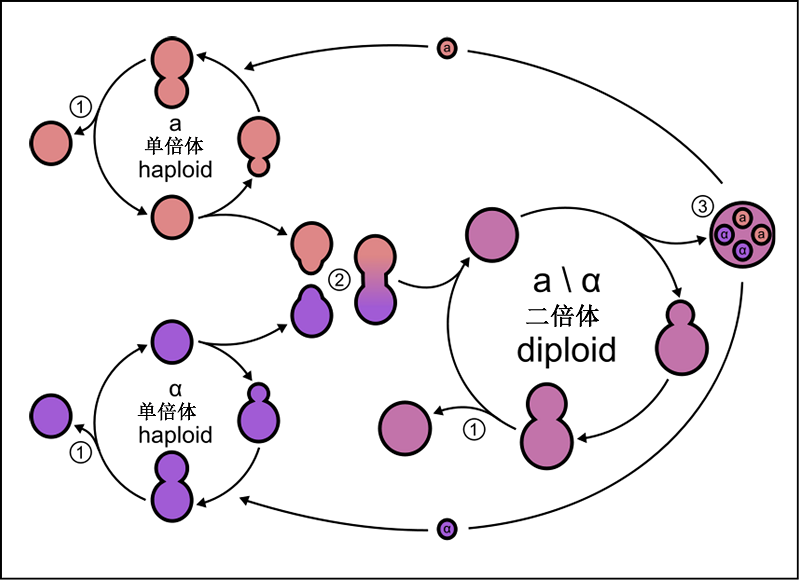
图8 酵母的生活史。(1)出芽生殖; (2)细胞融合; (3)孢子(引自Wikipedia)
Fig. 8 The yeast cell’s life cycle. (1) Budding; (2) Conjugation; (3) Spore. (cited from Wikipedia)
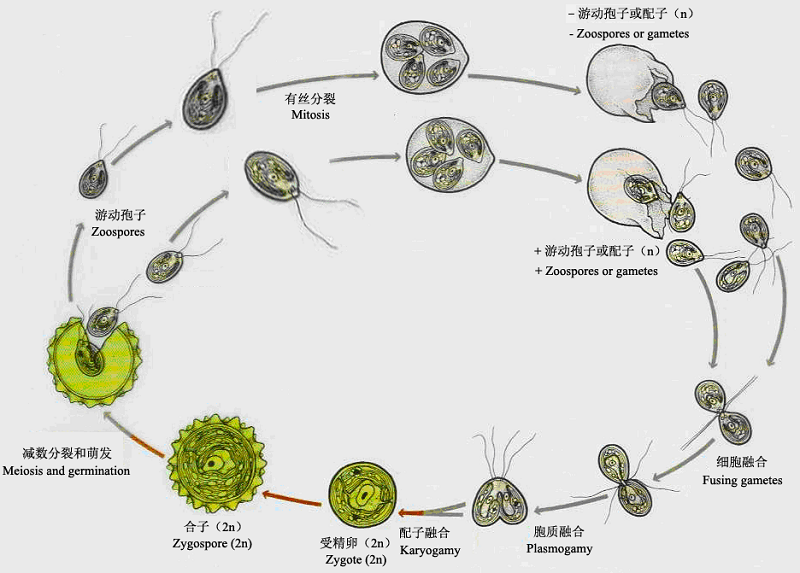
图9 绿藻—衣藻的生活史(引自Raven et al, 1992)
Fig. 9 Life cycle of a green alga, Chlamydomonas (cited from Raven et al, 1992)
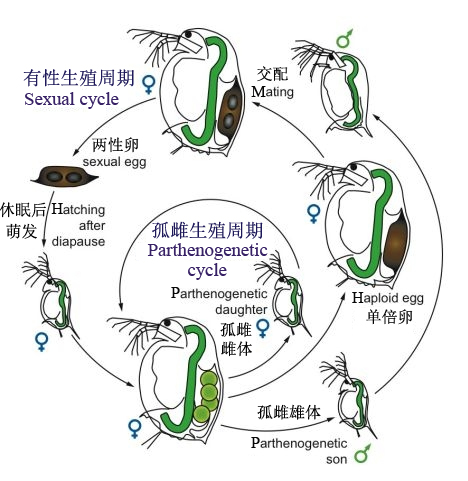
图10 周期性孤雌生殖水蚤的生活周期(仿Ebert, 2005)
Fig. 10 Life cycle of a cyclic parthenogenetic Daphnia (after Ebert, 2005)
| [1] | Bell G (1982) The Masterpiece of Nature: the Evolution and Genetics of Sexuality. University of California Press, Berkeley. |
| [2] | Bell PJ (2001) Viral eukaryogenesis: was the ancestor of the nucleus a complex DNA virus? Journal of Molecular Evolution, 53, 251-256. |
| [3] | Campbell NA, Reece JB (2008) Biology, 8th edn. Benjamin Cummings, San Francisco. |
| [4] | Coyne JA (2009) Why Evolution is True. Viking Penguin, New York David LA, Alm EJ (2011) Rapid evolutionary innovation during an Archaean genetic expansion. Nature, 469, 93-96. |
| [5] | de Roos AD (2006) The origin of the eukaryotic cell based on conservation of existing interfaces. Artificial Life, 12, 513-523. |
| [6] | Ebert D (2005) Ecology, Epidemiology, and Evolution of Parasitism in Daphnia. National Library of Medicine (US), National Center for Biotechnology Information, Bethesda, MD. |
| [7] | Fuerst JA (2005) Intracellular compartmentation in planctomycetes. Annual Review of Microbiology, 59, 299-328. |
| [8] | Gregory TR (2004) Macroevolution, hierarchy theory, and the C-value enigma. Paleobiology, 30, 179-202. |
| [9] | Hadany L, Comeron JM (2008) Why are sex and recombination so common? Annals of the New York Academy of Sciences, 1133, 26-43. |
| [10] | Hogan CM (2010) Archaea. In: Encyclopedia of Earth (eds Monosson E, Cleveland C). National Council for Science and the Environment, Washington, DC. |
| [11] | Jacob F (1998) Of Flies, Mice and Men (translated from the French edition). Harvard University Press, Cambridge MA. |
| [12] | Koonin EV (2015) Origin of eukaryotes from within archaea, archaeal eukaryome and bursts of gene gain: eukaryogenesis just made easier? Philosophical Transactions of the Royal Society B, 370, 20140333. |
| [13] | Margulis L (1981) Symbiosis in Cell Evolution, pp. 206-227. W. H. Freeman and Company, San Francisco. |
| [14] | Martin WF, Garg S, Zimorski V (2015) Endosymbiotic theories for eukaryote origin. Philosophical Transactions of the Royal Society B, 370, 20140330. |
| [15] | McInerney J, Pisani D, O’Connell MJ (2015) The ring of life hypothesis for eukaryote origins is supported by multiple kinds of data. Philosophical Transactions of the Royal Society B, 370, 20140323 |
| [16] | Mereschkowsky K (1910) Theorie der zwei Plasmaarten als Grundlage der Symbiogenesis, einer neuen Lehre von der Entstehung der Organismen. Biologisches Centralblatt 30, 353-367. |
| [17] | Moreira D, López-García P (2015) Evolution of viruses and cells: do we need a fourth domain of life to explain the origin of eukaryotes? Philosophical Transactions of the Royal Society B, 370, 20140327. |
| [18] | Pennisi E (2004) Evolutionary biology. The birth of the nucleus. Science, 305, 766-768. |
| [19] | Prescott DM (1994) The DNA of ciliated protozoa. Microbiological Reviews, 58, 233-267. |
| [20] | Raven PH, Evert RF, Eichhorn SE (1992) Biology of Plants, 5th edn. Worth Publishers, New York. |
| [21] | Schurko AM, Neiman M, Logsdon JM Jr (2008) Signs of sex: what we know and how we know it. Trends in Ecology & Evolution, 24, 208-217. |
| [22] | Takemura M (2001) Poxviruses and the origin of the eukaryotic nucleus. Journal of Molecular Evolution, 52, 419-442. |
| [23] | Villarreal L, DeFilippis V (2000) A hypothesis for DNA viruses as the origin of eukaryotic replication proteins. Journal of Virology, 74, 7079-7084. |
| [24] | Wallin IE (1923) The mitochondria problem. The American Naturalist, 57, 255-261. |
| [25] | Xie P (2013) Scaling Ecology to Understand Natural Design of Life Systems and Their Operations and Evolutions—Integration of Ecology, Genetics and Evolution Through Reproduction. Science Press, Beijing. |
| [谢平 (2013) 从生态学透视生命系统的设计、运作与演化——生态、遗传和进化通过生殖的融合. 科学出版社, 北京.] | |
| [26] | Xie P (2014) The Aufhebung and Breakthrough of the Theories on the Origin and Evolution of Life—Life in Philosophy and Philosophy in Life Sciences. Science Press, Beijing. |
| [谢平 (2014) 生命的起源-进化理论之扬弃与革新——哲学中的生命, 生命中的哲学. 科学出版社, 北京.] | |
| [27] | Zimmer C (2009) On the origin of sexual reproduction. Science, 324, 1254-1256. |
| [1] | 贾晓旭, 陈皖强, 唐修君, 樊艳凤, 张静, 王海威, 高玉时. 西南地区家鸡线粒体DNA控制区遗传多样性和基因渗入[J]. 生物多样性, 2026, 34(5): 26003-. |
| [2] | 张德喜, 周倩, 裴雪竹, 张红勇, 裴应泰, 孙杉, 刘名信, 张立勋, 赵长明. 甘肃兴隆山森林节肢动物标本照片与DNA条形码数据集[J]. 生物多样性, 2026, 34(4): 25409-. |
| [3] | 康志成, 高春蕾, 郭嘉宁, 孟范平, 王宗灵. 渤海与北黄海春季有害甲藻包囊: 多样性、分布及环境相关性[J]. 生物多样性, 2026, 34(3): 25426-. |
| [4] | 刘俊, 张天祥, 张壹萱, 黄晓凤, 韩卫杰, 吴问国, 黄晓飞, 黄理政, 张阳. 基于DNA宏条形码的江西桃红岭梅花鹿食性与营养策略[J]. 生物多样性, 2026, 34(2): 25214-. |
| [5] | 闫姿伶, 陈晓宇, 姚蒙. 基于环境DNA宏条形码的无脊椎动物多样性研究: 生物信息学流程比较与评估[J]. 生物多样性, 2026, 34(1): 25369-. |
| [6] | 彭欣, 刘传, 黄晓磊. 基于GenBank数据库的真核生物遗传数据时空格局分析[J]. 生物多样性, 2025, 33(8): 25184-. |
| [7] | 李云翱, 张文富, 赵桂刚, 杨春燕, 陈向清, 袁盛东, 曹敏, 蔡望, 杨洁. 空气环境DNA在陆生脊椎动物多样性监测上的应用: 以西双版纳20 ha森林动态样地为例[J]. 生物多样性, 2025, 33(6): 24318-. |
| [8] | 彭文, 邓泽帅, 郑文宝, 龚凌轩, 曾玉枫, 孟昊, 陈军, 杨道德. eDNA技术在两栖动物调查中的应用: 以湖南莽山国家级自然保护区为例[J]. 生物多样性, 2025, 33(6): 24552-. |
| [9] | 伍金山, 杨长乐, 马玉凤, 李亚旋, 高文家, 叶·库斯力, 叶樑洪, 杨宇骄, 徐梦琦, 廖廷琼, 钟林强, 单文娟. 艾比湖湿地国家级自然保护区马鹿遗传多样性及遗传结构[J]. 生物多样性, 2025, 33(12): 25233-. |
| [10] | 寇毅秀, 翁朝红, 吉芬芬, 谢仰杰, 王家樵, 潘杭钊, 赵云廷, 叶坤. 环境DNA技术在濒危水生动物监测中的应用[J]. 生物多样性, 2025, 33(11): 24574-. |
| [11] | 贺加贝, 柯可, 孙海明, 胡丽萍, 赵晓伟, 王文豪, 赵强. 基于DNA宏条形码技术分析香螺食性[J]. 生物多样性, 2025, 33(1): 24403-. |
| [12] | 姜熠辉, 刘岳, 曾旭, 林喆滢, 王楠, 彭吉豪, 曹玲, 曾聪. 东海六个国家级海洋保护区鱼类多样性和连通性[J]. 生物多样性, 2024, 32(6): 24128-. |
| [13] | 罗小燕, 李强, 黄晓磊. 戴云山国家级自然保护区访花昆虫DNA条形码数据集[J]. 生物多样性, 2023, 31(8): 23236-. |
| [14] | 董志远, 陈琳琳, 张乃鹏, 陈莉, 孙德斌, 倪艳梅, 李宝泉. 基于环境DNA宏条形码技术研究黄河三角洲典型潮沟系统鱼类多样性及其对水文连通性的响应[J]. 生物多样性, 2023, 31(7): 23073-. |
| [15] | 邢超, 林依, 周智强, 赵联军, 蒋仕伟, 林蓁蓁, 徐基良, 詹祥江. 基于DNA条形码技术构建王朗国家级自然保护区陆生脊椎动物遗传资源数据库及物种鉴定[J]. 生物多样性, 2023, 31(7): 22661-. |
| 阅读次数 | ||||||
|
全文 |
|
|||||
|
摘要 |
|
|||||
备案号:京ICP备16067583号-7
Copyright © 2026 版权所有 《生物多样性》编辑部
地址: 北京香山南辛村20号, 邮编:100093
电话: 010-62836137, 62836665 E-mail: biodiversity@ibcas.ac.cn
