

生物多样性 ›› 2026, Vol. 34 ›› Issue (2): 25214. DOI: 10.17520/biods.2025214 cstr: 32101.14.biods.2025214
• 研究报告:动物多样性 • 下一篇
刘俊1( ), 张天祥1(), 张壹萱1, 黄晓凤1, 韩卫杰1, 吴问国2, 黄晓飞3, 黄理政4, 张阳1,*()(
 )
)
收稿日期:2025-06-06
接受日期:2025-11-12
出版日期:2026-02-20
发布日期:2026-03-23
通讯作者:
张阳
基金资助:
Jun Liu1(), Tianxiang Zhang1(), Yixuan Zhang1, Xiaofeng Huang1, Weijie Han1, Wenguo Wu2, Xiaofei Huang3, Lizheng Huang4, Yang Zhang1,*()()
Received:2025-06-06
Accepted:2025-11-12
Online:2026-02-20
Published:2026-03-23
Contact:
Yang Zhang
Supported by:摘要:
食物营养是野生动物生存、繁殖和适应环境的基础, 对于野生动物种群的存续与发展具有重要意义。华南梅花鹿(Cervus nippon kopschi)江西桃红岭种群是江西仅存的野生梅花鹿种群, 具有极高的生态价值, 目前对其不同季节的取食和营养策略尚不明确。本研究分别于秋季(2022年10月)、冬季(2023年1月)、春季(2023年4月)、夏季(2023年7月)在江西桃红岭梅花鹿国家级自然保护区采集梅花鹿新鲜粪便样品, 并通过高通量测序和理化检测对其不同季节的食物组成和营养成分进行分析。结果表明: 桃红岭梅花鹿共采食植物31科37属37种, 春季主要采食的植物为悬钩子属植物(Rubus spp., 32.56%)和白栎(Quercus fabri, 13.13%); 夏季主要采食植物为黄檀(Dalbergia hupeana, 30.20%)、悬钩子属植物(12.45%)和长箭叶蓼(Persicaria hastatosagittata, 12.04%); 秋季主要采食植物为檵木(Loropetalum chinense, 65.21%)和悬钩子属植物(11.19%); 冬季主要采食植物为悬钩子属植物(53.21%)和薹草属植物(Carex spp., 18.92%)。食物多样性分析表明, 桃红岭梅花鹿不同季节采食植物组成存在显著差异, 其中夏季食物多样性指数最高, 秋季和冬季食物多样性指数较低。食物营养及营养摄入量分析表明, 桃红岭梅花鹿在夏季和冬季的营养摄入量较高, 在秋季的营养摄入量较低, 且食物营养含量不是桃红岭梅花鹿选择食物的主要影响因素。本研究揭示了桃红岭梅花鹿不同季节的取食营养策略, 为华南梅花鹿保护管理政策的制定提供了科学依据。
刘俊, 张天祥, 张壹萱, 黄晓凤, 韩卫杰, 吴问国, 黄晓飞, 黄理政, 张阳 (2026) 基于DNA宏条形码的江西桃红岭梅花鹿食性与营养策略. 生物多样性, 34, 25214. DOI: 10.17520/biods.2025214.
Jun Liu, Tianxiang Zhang, Yixuan Zhang, Xiaofeng Huang, Weijie Han, Wenguo Wu, Xiaofei Huang, Lizheng Huang, Yang Zhang (2026) Diet and nutritional strategies of sika deer in Taohongling, Jiangxi, based on DNA metabarcoding. Biodiversity Science, 34, 25214. DOI: 10.17520/biods.2025214.
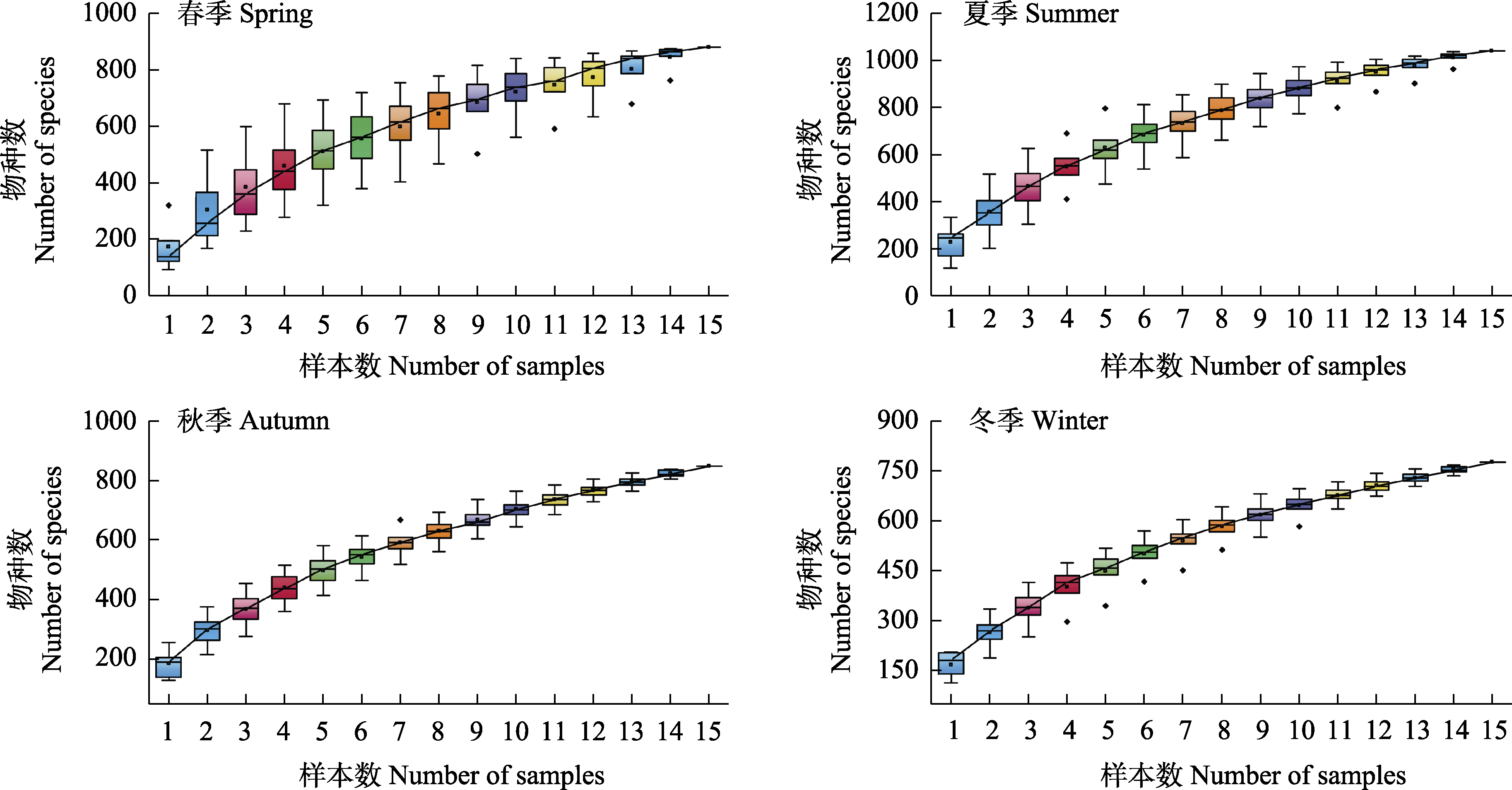
图1 江西桃红岭梅花鹿国家级自然保护区不同季节梅花鹿样品的物种累积曲线
Fig. 1 Species accumulation curves of sika deer samples from different seasons in the Jiangxi Taohongling Sika Deer National Nature Reserve
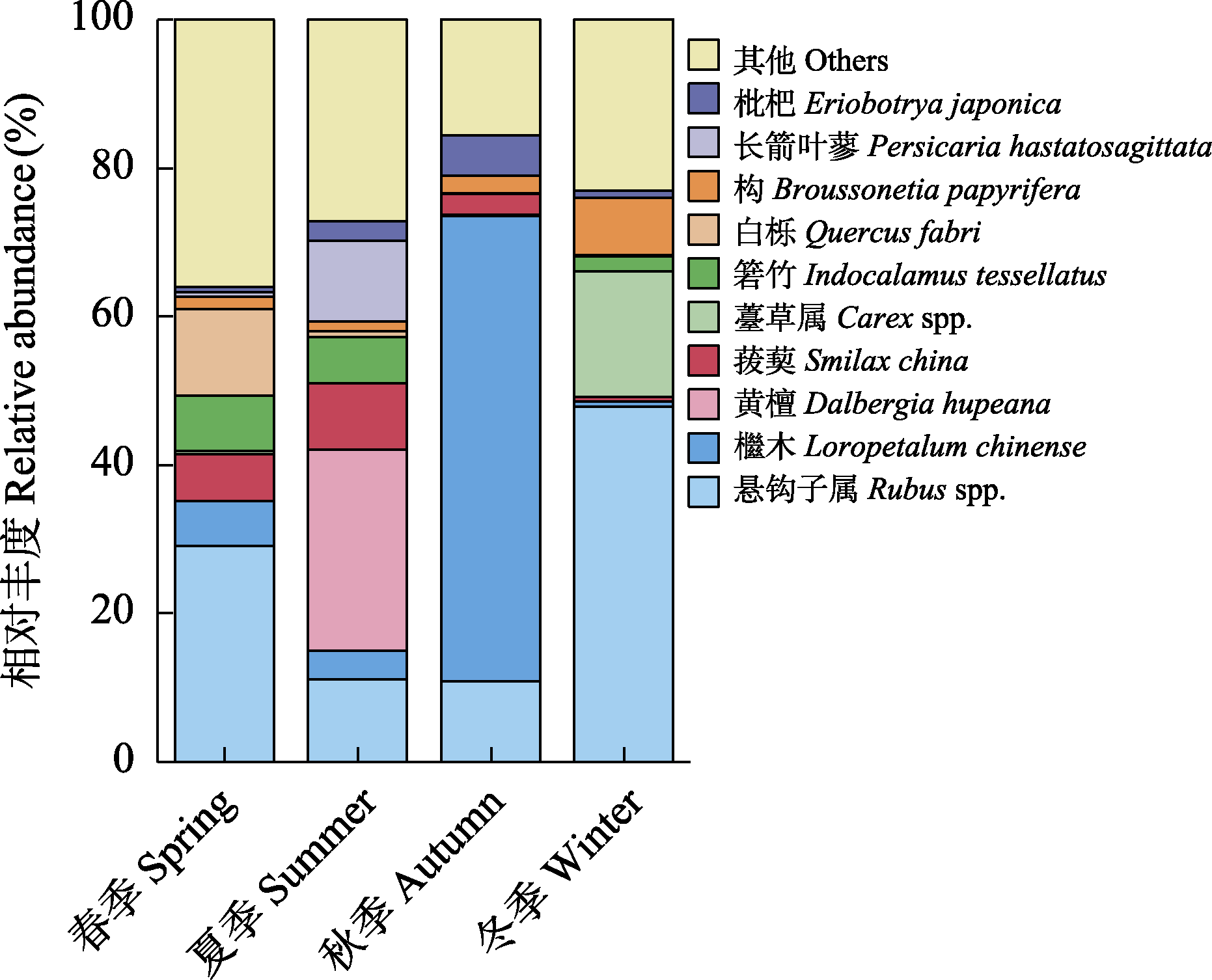
图2 江西桃红岭梅花鹿国家级自然保护区不同季节梅花鹿的食物组成
Fig. 2 Seasonal diet composition of sika deer in the Jiangxi Taohongling Sika Deer National Nature Reserve
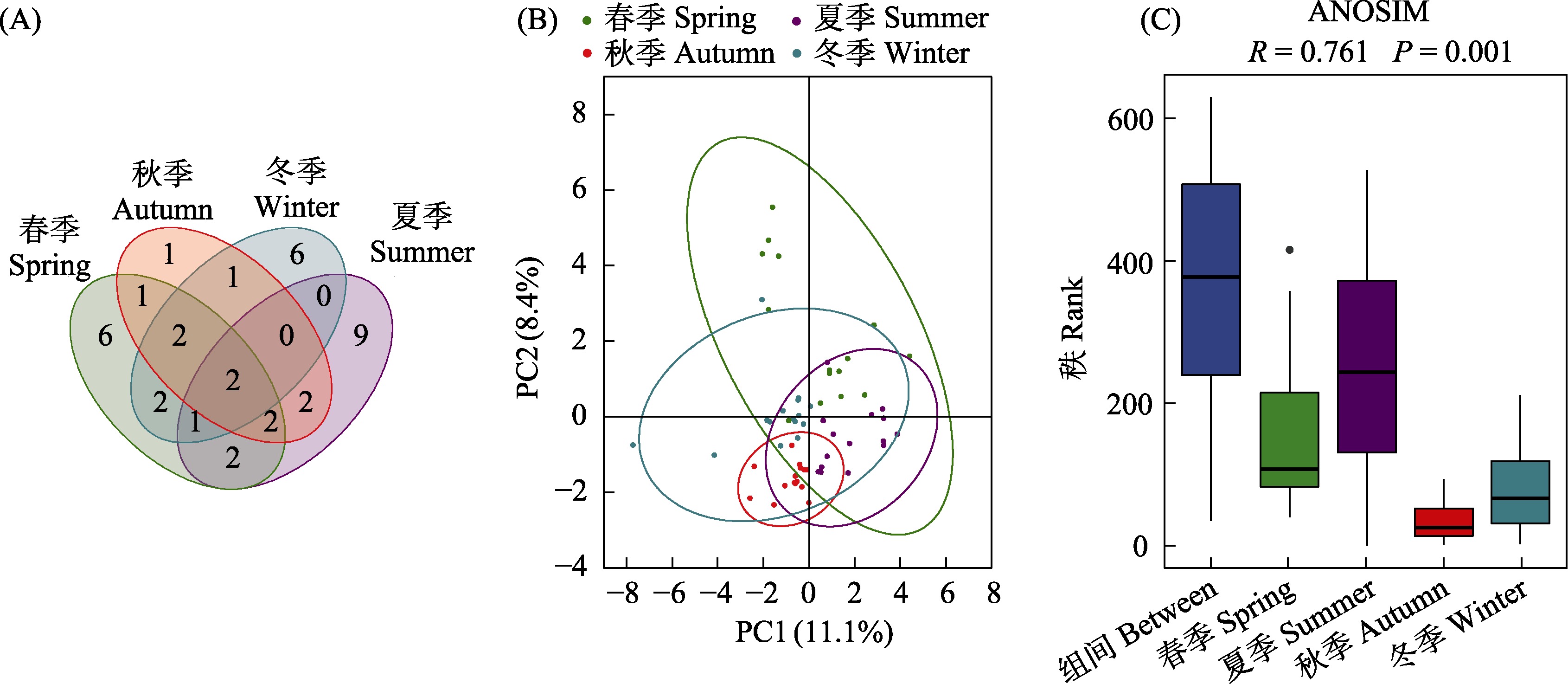
图3 江西桃红岭梅花鹿国家级自然保护区梅花鹿食物组成的Venn图(A)、主成分分析(PCA) (B)和相似性分析(ANOSIM) (C)
Fig. 3 Venn diagrams (A), principal component analysis (PCA) (B), and analysis of similarities (ANOSIM) (C) of diet composition of sika deer in the Jiangxi Taohongling Sika Deer National Nature Reserve
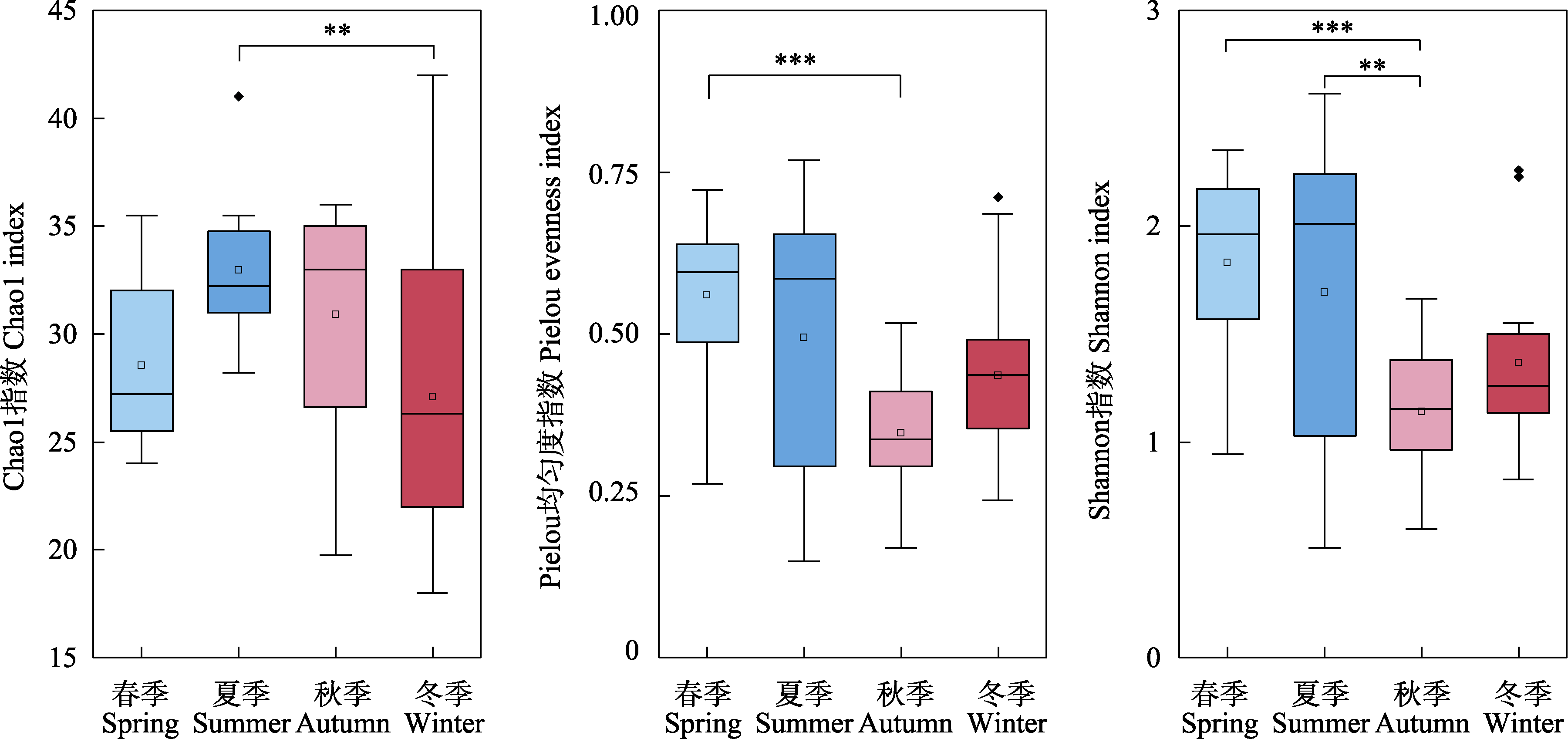
图4 江西桃红岭梅花鹿国家级自然保护区不同季节梅花鹿食物组成的多样性
Fig. 4 Seasonal dietary diversity of sika deer in the Jiangxi Taohongling Sika Deer National Nature Reserve
| 序号 No. | 物种 Species | 粗蛋白 Crude protein (%) | 粗脂肪 Crude fat (%) | 粗纤维 Crude fiber (%) | 钙 Calcium (%) | 磷 Phosphorus (%) |
|---|---|---|---|---|---|---|
| 1 | 长箭叶蓼 Persicaria hastatosagittata | 14.90 ± 0.13 | 2.11 ± 0.08 | 35.59 ± 0.10 | 0.151 ± 0.004 | 1.717 ± 0.019 |
| 2 | 鸭舌草 Monochoria vaginalis | 10.09 ± 0.08 | 1.57 ± 0.09 | 14.68 ± 0.13 | 0.290 ± 0.005 | 1.185 ± 0.060 |
| 3 | 八角枫 Alangium chinense | 16.94 ± 0.33 | 3.65 ± 0.06 | 13.99 ± 0.25 | 0.308 ± 0.007 | 1.253 ± 0.038 |
| 4 | 南烛 Vaccinium bracteatum | 12.40 ± 0.15 | 3.74 ± 0.06 | 34.68 ± 0.40 | 0.108 ± 0.006 | 1.086 ± 0.075 |
| 5 | 茶 Camellia sinensis | 21.43 ± 0.07 | 2.62 ± 0.02 | 21.11 ± 0.04 | 0.260 ± 0.006 | 0.655 ± 0.042 |
| 6 | 黄檀 Dalbergia hupeana | 18.49 ± 0.08 | 2.89 ± 0.10 | 23.98 ± 0.03 | 0.037 ± 0.004 | 2.450 ± 0.070 |
| 7 | 紫藤 Wisteria sinensis | 20.04 ± 0.03 | 2.13 ± 0.07 | 33.30 ± 0.03 | 0.011 ± 0.001 | 1.860 ± 0.048 |
| 8 | 白栎 Quercus fabri | 13.86 ± 0.06 | 0.65 ± 0.04 | 28.04 ± 0.30 | 0.122 ± 0.004 | 1.069 ± 0.037 |
| 9 | 山胡椒 Lindera glauca | 14.72 ± 0.07 | 3.08 ± 0.02 | 27.70 ± 0.05 | 0.112 ± 0.004 | 0.512 ± 0.009 |
| 10 | 菝葜 Smilax china | 11.87 ± 0.04 | 3.08 ± 0.08 | 22.82 ± 0.04 | 0.037 ± 0.002 | 1.070 ± 0.060 |
| 11 | 扁担杆 Grewia biloba | 17.05 ± 0.24 | 5.79 ± 0.18 | 19.29 ± 0.15 | 0.139 ± 0.008 | 2.051 ± 0.039 |
| 12 | 薹草属 Carex spp. | 10.09 ± 0.26 | 2.54 ± 0.18 | 29.66 ± 0.33 | 0.127 ± 0.004 | 1.034 ± 0.033 |
| 13 | 箬竹 Indocalamus tessellatus | 10.46 ± 0.25 | 2.77 ± 0.16 | 25.83 ± 0.40 | 0.111 ± 0.001 | 0.595 ± 0.060 |
| 14 | 构 Broussonetia papyrifera | 18.45 ± 0.25 | 1.27 ± 0.05 | 18.76 ± 0.45 | 0.261 ± 0.029 | 3.125 ± 0.100 |
| 15 | 枇杷 Eriobotrya japonica | 9.44 ± 0.29 | 2.17 ± 0.06 | 29.29 ± 0.82 | 0.089 ± 0.006 | 1.401 ± 0.026 |
| 16 | 金樱子 Rosa laevigata | 13.85 ± 0.14 | 4.51 ± 0.34 | 16.53 ± 0.33 | 0.129 ± 0.005 | 0.969 ± 0.034 |
| 17 | 悬钩子属 Rubus spp. | 15.84 ± 0.25 | 1.91 ± 0.04 | 31.25 ± 0.47 | 0.168 ± 0.003 | 1.570 ± 0.038 |
| 18 | 盐麸木 Rhus chinensis | 14.51 ± 0.14 | 5.22 ± 0.15 | 33.49 ± 0.28 | 0.122 ± 0.002 | 0.781 ± 0.018 |
| 19 | 檵木 Loropetalum chinense | 9.45 ± 0.05 | 1.28 ± 0.16 | 22.27 ± 0.06 | 0.011 ± 0.001 | 1.260 ± 0.038 |
| 20 | 蛇葡萄 Ampelopsis glandulosa | 14.74 ± 0.19 | 1.71 ± 0.09 | 28.48 ± 0.17 | 0.160 ± 0.006 | 2.290 ± 0.056 |
| 21 | 杉木 Cunninghamia lanceolata | 13.00 ± 0.44 | 2.64 ± 0.06 | 39.54 ± 0.49 | 0.130 ± 0.005 | 1.324 ± 0.012 |
| 22 | 海金沙 Lygodium japonicum | 18.20 ± 0.05 | 2.07 ± 0.10 | 25.18 ± 0.07 | 0.260 ± 0.008 | 0.217 ± 0.006 |
表1 江西桃红岭梅花鹿国家级自然保护区梅花鹿主要食源植物营养成分(干物质基础)
Table 1 Nutritional composition of major food for sika deer in the Jiangxi Taohongling Sika Deer National Nature Reserve (dry matter basis)
| 序号 No. | 物种 Species | 粗蛋白 Crude protein (%) | 粗脂肪 Crude fat (%) | 粗纤维 Crude fiber (%) | 钙 Calcium (%) | 磷 Phosphorus (%) |
|---|---|---|---|---|---|---|
| 1 | 长箭叶蓼 Persicaria hastatosagittata | 14.90 ± 0.13 | 2.11 ± 0.08 | 35.59 ± 0.10 | 0.151 ± 0.004 | 1.717 ± 0.019 |
| 2 | 鸭舌草 Monochoria vaginalis | 10.09 ± 0.08 | 1.57 ± 0.09 | 14.68 ± 0.13 | 0.290 ± 0.005 | 1.185 ± 0.060 |
| 3 | 八角枫 Alangium chinense | 16.94 ± 0.33 | 3.65 ± 0.06 | 13.99 ± 0.25 | 0.308 ± 0.007 | 1.253 ± 0.038 |
| 4 | 南烛 Vaccinium bracteatum | 12.40 ± 0.15 | 3.74 ± 0.06 | 34.68 ± 0.40 | 0.108 ± 0.006 | 1.086 ± 0.075 |
| 5 | 茶 Camellia sinensis | 21.43 ± 0.07 | 2.62 ± 0.02 | 21.11 ± 0.04 | 0.260 ± 0.006 | 0.655 ± 0.042 |
| 6 | 黄檀 Dalbergia hupeana | 18.49 ± 0.08 | 2.89 ± 0.10 | 23.98 ± 0.03 | 0.037 ± 0.004 | 2.450 ± 0.070 |
| 7 | 紫藤 Wisteria sinensis | 20.04 ± 0.03 | 2.13 ± 0.07 | 33.30 ± 0.03 | 0.011 ± 0.001 | 1.860 ± 0.048 |
| 8 | 白栎 Quercus fabri | 13.86 ± 0.06 | 0.65 ± 0.04 | 28.04 ± 0.30 | 0.122 ± 0.004 | 1.069 ± 0.037 |
| 9 | 山胡椒 Lindera glauca | 14.72 ± 0.07 | 3.08 ± 0.02 | 27.70 ± 0.05 | 0.112 ± 0.004 | 0.512 ± 0.009 |
| 10 | 菝葜 Smilax china | 11.87 ± 0.04 | 3.08 ± 0.08 | 22.82 ± 0.04 | 0.037 ± 0.002 | 1.070 ± 0.060 |
| 11 | 扁担杆 Grewia biloba | 17.05 ± 0.24 | 5.79 ± 0.18 | 19.29 ± 0.15 | 0.139 ± 0.008 | 2.051 ± 0.039 |
| 12 | 薹草属 Carex spp. | 10.09 ± 0.26 | 2.54 ± 0.18 | 29.66 ± 0.33 | 0.127 ± 0.004 | 1.034 ± 0.033 |
| 13 | 箬竹 Indocalamus tessellatus | 10.46 ± 0.25 | 2.77 ± 0.16 | 25.83 ± 0.40 | 0.111 ± 0.001 | 0.595 ± 0.060 |
| 14 | 构 Broussonetia papyrifera | 18.45 ± 0.25 | 1.27 ± 0.05 | 18.76 ± 0.45 | 0.261 ± 0.029 | 3.125 ± 0.100 |
| 15 | 枇杷 Eriobotrya japonica | 9.44 ± 0.29 | 2.17 ± 0.06 | 29.29 ± 0.82 | 0.089 ± 0.006 | 1.401 ± 0.026 |
| 16 | 金樱子 Rosa laevigata | 13.85 ± 0.14 | 4.51 ± 0.34 | 16.53 ± 0.33 | 0.129 ± 0.005 | 0.969 ± 0.034 |
| 17 | 悬钩子属 Rubus spp. | 15.84 ± 0.25 | 1.91 ± 0.04 | 31.25 ± 0.47 | 0.168 ± 0.003 | 1.570 ± 0.038 |
| 18 | 盐麸木 Rhus chinensis | 14.51 ± 0.14 | 5.22 ± 0.15 | 33.49 ± 0.28 | 0.122 ± 0.002 | 0.781 ± 0.018 |
| 19 | 檵木 Loropetalum chinense | 9.45 ± 0.05 | 1.28 ± 0.16 | 22.27 ± 0.06 | 0.011 ± 0.001 | 1.260 ± 0.038 |
| 20 | 蛇葡萄 Ampelopsis glandulosa | 14.74 ± 0.19 | 1.71 ± 0.09 | 28.48 ± 0.17 | 0.160 ± 0.006 | 2.290 ± 0.056 |
| 21 | 杉木 Cunninghamia lanceolata | 13.00 ± 0.44 | 2.64 ± 0.06 | 39.54 ± 0.49 | 0.130 ± 0.005 | 1.324 ± 0.012 |
| 22 | 海金沙 Lygodium japonicum | 18.20 ± 0.05 | 2.07 ± 0.10 | 25.18 ± 0.07 | 0.260 ± 0.008 | 0.217 ± 0.006 |
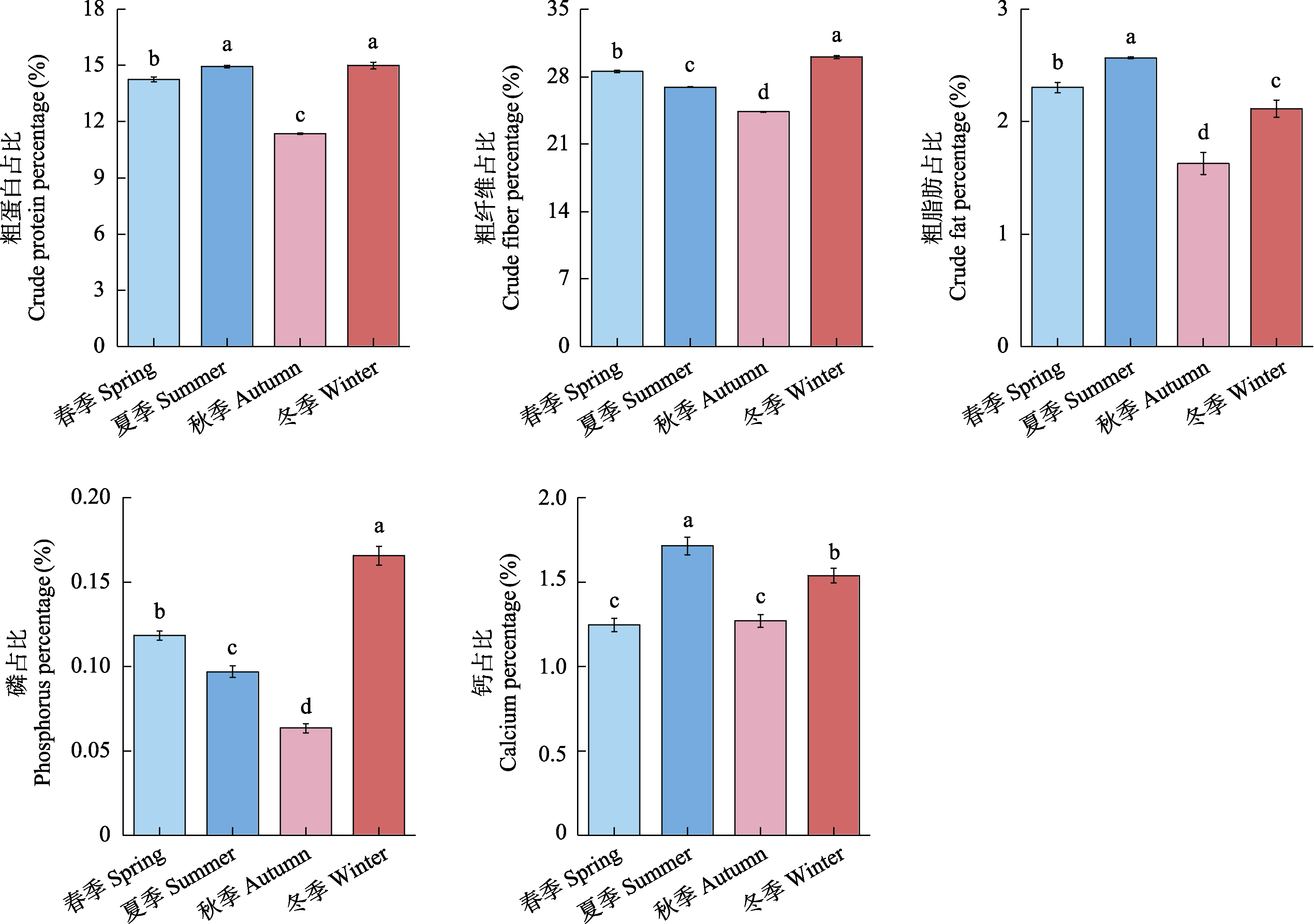
图5 江西桃红岭梅花鹿国家级自然保护区不同季节梅花鹿营养摄入差异。不同小写字母表示组间差异显著(P < 0.05)。
Fig. 5 Seasonal differences in nutrient intake of sika deer in the Jiangxi Taohongling Sika Deer National Nature Reserve. Different lowercase letters indicate significant differences among groups (P < 0.05).
| [1] |
Ando H, Fujii C, Kawanabe M, Ao Y, Inoue T, Takenaka A (2018) Evaluation of plant contamination in metabarcoding diet analysis of a herbivore. Scientific Reports, 8, 15563.
DOI PMID |
| [2] | AOAC International (2019) Official Methods of Analysis of AOAC International, 21st edn. Gaithersburg, MD, USA. |
| [3] |
Bester T, Schmitt MH, Shrader AM (2023) The deterrent effects of individual monoterpene odours on the dietary decisions of African elephants. Animal Cognition, 26, 1049-1063.
DOI PMID |
| [4] | Chao A (1984) Nonparametric estimation of the number of classes in a population. Scandinavian Journal of Statistics, 11, 265-270. |
| [5] | Cheng MH, Li J, Zhang Y, Cong W, Zhang Y, Jiang J, Huang TP, Mei YJ, Li SH, Zhang YG (2024) Golden snub-nosed monkey diet research in Shennongjia National Park based on DNA barcoding technology. Acta Ecologica Sinica, 44, 6424-6435. (in Chinese with English abstract) |
| [程铭昊, 李劲, 张溢, 丛微, 张宇, 蒋军, 黄天鹏, 梅玉娇, 李书航, 张于光 (2024) 基于DNA条形码技术的神农架国家公园川金丝猴食性研究. 生态学报, 44, 6424-6435.] | |
| [6] | China Plant BOL Group, Li DZ, Gao LM, Li HT, Wang H, Ge XJ, Liu JQ, Chen ZD, Zhou SL, Chen SL, Yang JB, Fu CX, Zeng CX, Yan HF, Zhu YJ, Sun YS, Chen SY, Zhao L, Wang K, Yang T, Duan GW (2011) Comparative analysis of a large dataset indicates that internal transcribed spacer (ITS) should be incorporated into the core barcode for seed plants. Proceedings of the National Academy of Sciences, USA, 108, 19641-19646. |
| [7] | Dai X, Gu XZ, Shi J, Yuan F, Yin BF, Wang AQ, Wei WH, Yang SM (2012) The seasonal changes of plant secondary metabolites and their influence on the food selection of plateau pika. Acta Theriologica Sinica, 32, 306-317. (in Chinese with English abstract) |
| [戴鑫, 顾新州, 石佳, 袁飞, 殷宝法, 王爱勤, 魏万红, 杨生妹 (2012) 植物次生代谢物含量的季节性变化及其对高原鼠兔食物选择的影响. 兽类学报, 32, 306-317.] | |
| [8] |
De Barba M, Miquel C, Boyer F, Mercier C, Rioux D, Coissac E, Taberlet P (2014) DNA metabarcoding multiplexing and validation of data accuracy for diet assessment: Application to omnivorous diet. Molecular Ecology Resources, 14, 306-323.
DOI PMID |
| [9] |
Duffy JE, Cardinale BJ, France KE, McIntyre PB, Thébault E, Loreau M (2007) The functional role of biodiversity in ecosystems: Incorporating trophic complexity. Ecology Letters, 10, 522-538.
DOI PMID |
| [10] |
Emlen JM (1966) The role of time and energy in food preference. The American Naturalist, 100, 611-617.
DOI URL |
| [11] | Erickson DL, Reed E, Ramachandran P, Bourg NA, McShea WJ, Ottesen A (2017) Reconstructing a herbivore’s diet using a novel rbcL DNA mini-barcode for plants. AoB Plants, 9, plx015. |
| [12] |
Estell RE (2010) Coping with shrub secondary metabolites by ruminants. Small Ruminant Research, 94, 1-9.
DOI URL |
| [13] |
Gao LM, Liu J, Cai J, Yang JB, Zhang T, Li DZ (2012) A synopsis of technical notes on the standards for plant DNA barcoding. Plant Diversity and Resources, 34, 592-606. (in Chinese with English abstract)
DOI URL |
| [高连明, 刘杰, 蔡杰, 杨俊波, 张挺, 李德铢 (2012) 关于植物DNA条形码研究技术规范. 植物分类与资源学报, 34, 592-606.] | |
| [14] |
García-Robledo C, Erickson DL, Staines CL, Erwin TL, Kress WJ (2013) Tropical plant-herbivore networks: Reconstructing species interactions using DNA barcodes. PLoS ONE, 8, e52967.
DOI URL |
| [15] | Guo YP, Zhang H, Zhao XG, Luo HL, Zhang YJ (2021) Applications of DNA metabarcoding in diet identification of herbivores. Biotechnology Bulletin, 37, 252-260. (in Chinese with English abstract) |
|
[郭艳萍, 张浩, 赵新钢, 罗海玲, 张英俊 (2021) DNA宏条形码技术在食草动物食性研究中的应用. 生物技术通报, 37, 252-260.]
DOI |
|
| [16] |
Irwin DM, Kocher TD, Wilson AC (1991) Evolution of the cytochrome b gene of mammals. Journal of Molecular Evolution, 32, 128-144.
PMID |
| [17] | Jiang ZG (2009) Biodiversity and Sika Deer in the Taohongling Nature Reserve, Jiangxi, China. Tsinghua University Press, Beijing. (in Chinese) |
| [蒋志刚 (2009) 江西桃红岭梅花鹿国家级自然保护区生物多样性研究. 清华大学出版社, 北京.] | |
| [18] |
Kajtoch Ł, Kubisz D, Heise W, Mazur MA, Babik W (2015) Plant-herbivorous beetle networks: Molecular characterization of trophic ecology within a threatened steppic environment. Molecular Ecology, 24, 4023-4038.
DOI PMID |
| [19] | Kang YK, Zhang DG, Gou JY, Wang HF, Yang YB, Su JH (2019) Food habits and its seasonal changes of plateau pika (Ochotona curzniae) in Gannan meadow. Journal of Gansu Agricultural University, 54(2), 132-138. (in Chinese with English abstract) |
| [康宇坤, 张德罡, 缑晶毅, 王海芳, 杨莹博, 苏军虎 (2019) 甘南草原高原鼠兔食性及其季节性变化. 甘肃农业大学学报, 54(2), 132-138.] | |
| [20] | Kocher TD, Thomas WK, Meyer A, Edwards SV, Pääbo S, Villablanca FX, Wilson AC (1989) Dynamics of mitochondrial DNA evolution in animals: Amplification and sequencing with conserved primers. Proceedings of the National Academy of Sciences, USA, 86, 6196-6200. |
| [21] |
Li RF, Wang DD, Cao ZM, Liu YQ, Wu WG, Liu WH, Zhan JW, Xu YT (2024) DNA metabarcoding reveals diet diversity and niche partitioning by two sympatric herbivores in summer. PeerJ, 12, e18665.
DOI URL |
| [22] | Liu C, Zhang R, Du HR, Sun Y, Yuan ZA, Yu JJ, Zhang MH (2021) Impact of climate change on potential habitat of sika deer in China. Chinese Journal of Wildlife, 42, 329-340. (in Chinese with English abstract) |
| [刘策, 张日, 杜海荣, 孙悦, 袁子奥, 于晶晶, 张明海 (2021) 气候变化对中国梅花鹿潜在栖息地影响. 野生动物学报, 42, 329-340.] | |
| [23] | Liu G, Ning Y, Xia XF, Gong MH (2018) The application of high-throughput sequencing technologies to wildlife diet analysis. Acta Ecologica Sinica, 38, 3347-3356. (in Chinese with English abstract) |
| [刘刚, 宁宇, 夏晓飞, 龚明昊 (2018) 高通量测序技术在野生动物食性分析中的应用. 生态学报, 38, 3347-3356.] | |
| [24] |
Liu HM, Ju Y, Tamate H, Wang TJ, Xing XM (2021) Phylogeography of sika deer (Cervus nippon) inferred from mitochondrial cytochrome b gene and microsatellite DNA. Gene, 772, 145375.
DOI URL |
| [25] |
Liu J, Yan HF, Newmaster SG, Pei NC, Ragupathy S, Ge XJ (2015) The use of DNA barcoding as a tool for the conservation biogeography of subtropical forests in China. Diversity and Distributions, 21, 188-199.
DOI URL |
| [26] | Liu YZ, Hu JL, Gore J (2024) Ecosystem stability relies on diversity difference between trophic levels. Proceedings of the National Academy of Sciences, USA, 121, e2416740121. |
| [27] | Luo D, Li Y, Shi L (2018) Seasonal variation in feeding habits of the Asiatic ibex (Capra sibirica) in the central Tianshan Mountains. Chinese Journal of Zoology, 53, 321-328. (in Chinese with English abstract) |
| [罗东, 李叶, 时磊 (2018) 天山中部地区北山羊食性及其季节变化. 动物学杂志, 53, 321-328.] | |
| [28] |
McLennan MR, Hockings KJ (2014) Wild chimpanzees show group differences in selection of agricultural crops. Scientific Reports, 4, 5956.
DOI PMID |
| [29] |
Pielou EC (1966) The measurement of diversity in different types of biological collections. Journal of Theoretical Biology, 13, 131-144.
DOI URL |
| [30] |
Popp M, Hann S, Koellensperger G (2010) Environmental application of elemental speciation analysis based on liquid or gas chromatography hyphenated to inductively coupled plasma mass spectrometry—A review. Analytica Chimica Acta, 668, 114-129.
DOI URL |
| [31] | Qi Q, Bao H, Jiang GS (2023) Feeding nutrition strategies and the underlying factors of Siberian roe deer in winter and spring. Chinese Journal of Wildlife, 44, 46-55. (in Chinese with English abstract) |
| [齐琦, 包衡, 姜广顺 (2023) 冬春季狍取食营养策略及影响因素研究. 野生动物学报, 44, 46-55.] | |
| [32] |
Sassi PL, Borghi CE, Dacar MA, Bozinovic F (2011) Geographic and seasonal variability in feeding behaviour of a small herbivorous rodent. Acta Theriologica, 56, 35-43.
DOI URL |
| [33] |
Shannon CE (1948) A mathematical theory of communication. Bell System Technical Journal, 27, 379-423.
DOI URL |
| [34] | Si XY, Zhao TB, Mao YQ, Bi JH, Zhan YB (2007) The review and evaluation on the study method for herbivore food-habit. Journal of Medical Pest Control, 23, 957-959. (in Chinese with English abstract) |
| [司晓艳, 赵天飙, 毛永强, 毕俊怀, 战永波 (2007) 食草动物食性研究方法的评价. 医学动物防制, 23, 957-959.] | |
| [35] |
Simpson SJ, Sibly RM, Lee KP, Behmer ST, Raubenheimer D (2004) Optimal foraging when regulating intake of multiple nutrients. Animal Behaviour, 68, 1299-1311.
DOI URL |
| [36] |
Soininen EM, Valentini A, Coissac E, Miquel C, Gielly L, Brochmann C, Brysting AK, Sønstebø JH, Ims RA, Yoccoz NG, Taberlet P (2009) Analysing diet of small herbivores: The efficiency of DNA barcoding coupled with high-throughput pyrosequencing for deciphering the composition of complex plant mixtures. Frontiers in Zoology, 6, 16.
DOI PMID |
| [37] |
Srivathsan A, Sha JCM, Vogler AP, Meier R (2015) Comparing the effectiveness of metagenomics and metabarcoding for diet analysis of a leaf-feeding monkey (Pygathrix nemaeus). Molecular Ecology Resources, 15, 250-261.
DOI PMID |
| [38] | Sun X, Lv FY, Hu XQ, Tian J, Yang RJ, Yao J, Huang ZQ, Zhai JC (2025) Geographical variation of diet composition of Cervus nippon kopschi in Jiangxi, China based on DNA metabarcoding. Animals, 15, 940. |
| [39] |
Taberlet P, Coissac E, Pompanon F, Brochmann C, Willerslev E (2012) Towards next-generation biodiversity assessment using DNA metabarcoding. Molecular Ecology, 21, 2045-2050.
DOI PMID |
| [40] |
Tillmar AO, Dell’Amico B, Welander J, Holmlund G (2013) A universal method for species identification of mammals utilizing next generation sequencing for the analysis of DNA mixtures. PLoS ONE, 8, e83761.
DOI URL |
| [41] |
Van Soest PJ, Robertson JB, Lewis BA (1991) Methods for dietary fiber, neutral detergent fiber, and nonstarch polysaccharides in relation to animal nutrition. Journal of Dairy Science, 74, 3583-3597.
DOI PMID |
| [42] |
Wang DD, Cao ZM, Liu YQ, Li RF, Wu RT, Wu WG, Liu WH, Hu XL, Xu YT (2025) DNA metabarcoding illuminates seasonal dietary pattern and niche partitioning by three sympatric herbivores. Ecology and Evolution, 15, e71321.
DOI URL |
| [43] |
Wang DD, Hu XL, Li ML, Liu J, Tang M, Liu WH, Zhan JW, Xu YT, Zhang WW (2023) Diet composition and interspecific niche of Taohongling sika deer (Cervus nippon kopschi) and its sympatric Reeve’s muntjac (Muntiacus reevesi) and Chinese hare (Lepus sinensis) in winter (Animalia, Mammalia). ZooKeys, 1149, 17-36.
DOI URL |
| [44] | Wei FW (2022) Taxonomy and Distribution of Mammals in China. Science Press, Beijing. (in Chinese) |
| [魏辅文 (2022) 中国兽类分类与分布. 科学出版社, 北京.] | |
| [45] |
Westoby M (1974) An analysis of diet selection by large generalist herbivores. The American Naturalist, 108, 290-304.
DOI URL |
| [46] | Wu WG, Zhu W, Gao YM, Wang JQ, Wang LZ (2012) Biodiversity in Jiangxi Taohong Ridge Sika Deer Nature Reserve. Chinese Journal of Wildlife, 33, 221-224. (in Chinese with English abstract) |
| [吴问国, 朱文, 高依敏, 王洁清, 王良珍 (2012) 江西桃红岭梅花鹿自然保护区生物多样性现状. 野生动物学报, 33, 221-224.] | |
| [47] | Yan LJ, Wang P, Shi QL, Liu J, Shi YE, Chi LK (2023) Applications of animal diet analysis based on DNA metabarcoding in ecological research. Acta Ecologica Sinica, 43, 3007-3019. (in Chinese with English abstract) |
| [严丽君, 王普, 施启龙, 刘佳, 施云娥, 池利昆 (2023) 动物食性分析在生态学中的应用研究进展——基于DNA宏条形码技术. 生态学报, 43, 3007-3019.] | |
| [48] | Yang J, Ding TM, Hu PX (1990) Preliminary report on ecological study of sika deer subspecies in Southern China. Chinese Journal of Wildlife, (3), 17-19. (in Chinese) |
| [杨晶, 丁铁明, 胡平喜 (1990) 梅花鹿南方亚种生态研究初报. 野生动物, (3), 17-19.] | |
| [49] | Yong ZY, Guo C, Zhang MW, Wang Y, Li B (2011) Significance and methodology of rodent’s food habit research: A review. Chinese Journal of Ecology, 30, 2637-2645. (in Chinese with English abstract) |
| [雍仲禹, 郭聪, 张美文, 王勇, 李波 (2011) 啮齿动物食性研究的意义及方法评述. 生态学杂志, 30, 2637-2645.] | |
| [50] | Zhao C (2018) Nutrition Diet Strategy, Micro-habitat Selection and Evaluation of Alpine Musk Deer (Moschus sifanicus) in Helan Mountains, China. PhD dissertation, Northeast Forestry University, Harbin. (in Chinese with English abstract) |
| [赵唱 (2018) 贺兰山马麝的营养采食策略和微生境选择及评价研究. 博士学位论文, 东北林业大学, 哈尔滨.] | |
| [51] | Zhao C, Liu ZX, Teng LW, Gao H, Sun YJ, Wang ZY, Wang JF, Ma ZQ, Liu ZS (2018) Summer foraging strategy of alpine musk deer (Moschus sifanicus) in the Helan Mountains. Chinese Journal of Wildlife, 39, 215-223. (in Chinese with English abstract) |
| [赵唱, 刘尊显, 滕丽微, 高惠, 孙玉姣, 王志勇, 王继飞, 马忠其, 刘振生 (2018) 贺兰山马麝夏季营养采食策略. 野生动物学报, 39, 215-223.] | |
| [52] | Zheng RQ, Bao YX (2004) Study methods and procedures for ungulate food habits. Acta Ecologica Sinica, 24, 1532-1539. (in Chinese with English abstract) |
| [郑荣泉, 鲍毅新 (2004) 有蹄类食性研究方法及研究进展. 生态学报, 24, 1532-1539.] | |
| [53] | Zhong LQ (2020) Winter Foraging and Nutritional Strategy, Feeding Habitat Suitability Assessment of Sympatric Red Deer (Cervus elaphus) and Sika Deer (Cervus nippon) in the Muling Forest Region, Northeast China. PhD dissertation, Northeast Forestry University, Harbin. (in Chinese with English abstract) |
| [钟林强 (2020) 同域分布马鹿与梅花鹿采食和营养策略及采食生境评价. 博士学位论文, 东北林业大学, 哈尔滨.] |
| [1] | 康志成, 高春蕾, 郭嘉宁, 孟范平, 王宗灵. 渤海与北黄海春季有害甲藻包囊: 多样性、分布及环境相关性[J]. 生物多样性, 2026, 34(3): 25426-. |
| [2] | 贺加贝, 柯可, 孙海明, 胡丽萍, 赵晓伟, 王文豪, 赵强. 基于DNA宏条形码技术分析香螺食性[J]. 生物多样性, 2025, 33(1): 24403-. |
| [3] | 麦晓烔, 康佳, 李梓琛, 王天明. 东北虎豹国家公园梅花鹿活动节律及其对道路的响应[J]. 生物多样性, 2024, 32(11): 24178-. |
| [4] | 董志远, 陈琳琳, 张乃鹏, 陈莉, 孙德斌, 倪艳梅, 李宝泉. 基于环境DNA宏条形码技术研究黄河三角洲典型潮沟系统鱼类多样性及其对水文连通性的响应[J]. 生物多样性, 2023, 31(7): 23073-. |
| [5] | 湛振杰, 张超, 陈敏豪, 王嘉栋, 富爱华, 范雨薇, 栾晓峰. 基于DNA宏条形码技术的大兴安岭北部欧亚水獭冬季食性分析[J]. 生物多样性, 2023, 31(6): 22586-. |
| [6] | 彭步青, 陶玲, 李靖, 范荣辉, 陈顺德, 付长坤, 王琼, 唐刻意. 基于DNA宏条形码研究四川老君山国家级自然保护区6种同域共存小型哺乳动物的食性[J]. 生物多样性, 2023, 31(4): 22474-. |
| [7] | 沈梅, 郭宁宁, 罗遵兰, 郭晓晨, 孙光, 肖能文. 基于eDNA metabarcoding探究北京市主要河流鱼类分布及影响因素[J]. 生物多样性, 2022, 30(7): 22240-. |
| [8] | 林俊辉, 何雪宝, 王建军, 林和山, 黄雅琴, 刘坤, 牟剑锋, 张舒怡, 江锦祥. 福建洛阳江口红树林湿地大型底栖动物多样性及季节变化[J]. 生物多样性, 2016, 24(7): 791-801. |
| [9] | 孙柔鑫, 王彦国, 连光山, 林茂. 海南岛西北沿岸海域浮游桡足类的分布及群落特征[J]. 生物多样性, 2014, 22(3): 320-328. |
| [10] | 王雨, 叶又茵, 林茂, 陈兴群. 南海北部夜光藻种群的时空分布及其环境适应性[J]. 生物多样性, 2012, 20(6): 685-692. |
| [11] | 刘淑德, 线薇微. 长江口及其邻近水域鱼类浮游生物群落的时空格局[J]. 生物多样性, 2009, 17(2): 151-159. |
| [12] | 凌琪, 王晏平, 王莉, 舒莹, 陶勇, 鲍立宁. 合肥城区空气真菌浓度的时空分布特征[J]. 生物多样性, 2008, 16(2): 175-180. |
| [13] | 徐言朋, 郑家文, 丁平, 蒋萍萍, 蔡路昀, 黄晓风, 姚小华, 徐向荣, 余泽平. 官山白颈长尾雉活动区域海拔高度的季节变化及其影响因素[J]. 生物多样性, 2007, 15(4): 337-343. |
| [14] | 郑成兴, 李荣冠, 江锦祥, 郑风武, 王建军, 黄心光, 林俊辉. 泉州湾岩相潮间带底栖生物生态研究 Ⅰ.物种多样性与分布特征[J]. 生物多样性, 2004, 12(6): 594-610. |
| [15] | 王向华, 刘培贵. 云南野生贸易真菌资源调查及研究[J]. 生物多样性, 2002, 10(3): 318-325. |
| 阅读次数 | ||||||
|
全文 |
|
|||||
|
摘要 |
|
|||||
备案号:京ICP备16067583号-7
Copyright © 2026 版权所有 《生物多样性》编辑部
地址: 北京香山南辛村20号, 邮编:100093
电话: 010-62836137, 62836665 E-mail: biodiversity@ibcas.ac.cn
