

生物多样性 ›› 2025, Vol. 33 ›› Issue (12): 25182. DOI: 10.17520/biods.2025182 cstr: 32101.14.biods.2025182
所属专题: 数据论文
陈啸1( ), 马晓慧1, 陈家丞1, 姚鼎1, 余欣奕1, 宋文飞1, 蒋忠冠2, 苏时萍1,*()(
 )
)
收稿日期:2025-05-17
接受日期:2025-12-03
出版日期:2025-12-20
发布日期:2026-02-14
通讯作者:
*E-mail: sushiping@ahau.edu.cn
基金资助:
Xiao Chen1(), Xiaohui Ma1, Jiacheng Chen1, Ding Yao1, Xinyi Yu1, Wenfei Song1, Zhongguan Jiang2, Shiping Su1,*()()
Received:2025-05-17
Accepted:2025-12-03
Online:2025-12-20
Published:2026-02-14
Supported by:摘要:
安徽省池州市地处长江中下游, 是我国乃至全球生物多样性的热点区域之一。针对该区域的鱼类多样性研究相对匮乏, 加之近年来长江流域鱼类分类学发生了显著变化, 诸如新物种的发现与描述、同物异名的修订以及属级分类单元的变动等。 因此, 该区域鱼类多样性需系统性研究与总结。为此, 本研究于2023年9月至2024年9月对池州市通江支流的鱼类进行了实地调查, 结合历史记录和参照最新分类学研究进展, 本文更新了池州市主要通江支流鱼类物种名录。结果表明, 池州市主要通江支流共有鱼类136种, 隶属15目32科81属, 包括土著鱼类134种, 外来鱼类2种。物种组成以鲤形目鱼类为主; 鲴科和鮈科物种数目最多。物种更新名录包含了新记录种17个, 其中有1个外来种。本次鱼类物种更新名录中, 24个有效物种发生了分类学变更, 有20个历史记录物种被剔除。此外, 历史记录有分布但本次调查未采集到的种有50个, 表明这些鱼类的种群数量正急剧下降, 而这些鱼类分别具有洄游性、喜流性、喜贝性等独特的生态偏好, 说明池州市鱼类多样性正面临人为影响的严重威胁。本次名录的更新弥补了历史数据准确性方面的差距, 为池州市渔业资源的可持续管理和生物多样性保护战略提供了基础数据, 为渔业发展和生态恢复提供了决策依据。
陈啸, 马晓慧, 陈家丞, 姚鼎, 余欣奕, 宋文飞, 蒋忠冠, 苏时萍 (2025) 安徽省池州市主要通江支流鱼类物种更新名录. 生物多样性, 33, 25182. DOI: 10.17520/biods.2025182.
Xiao Chen, Xiaohui Ma, Jiacheng Chen, Ding Yao, Xinyi Yu, Wenfei Song, Zhongguan Jiang, Shiping Su (2025) Updated species checklist of freshwater fishes from major tributaries of Yangtze River in Chizhou of Anhui Province, China. Biodiversity Science, 33, 25182. DOI: 10.17520/biods.2025182.
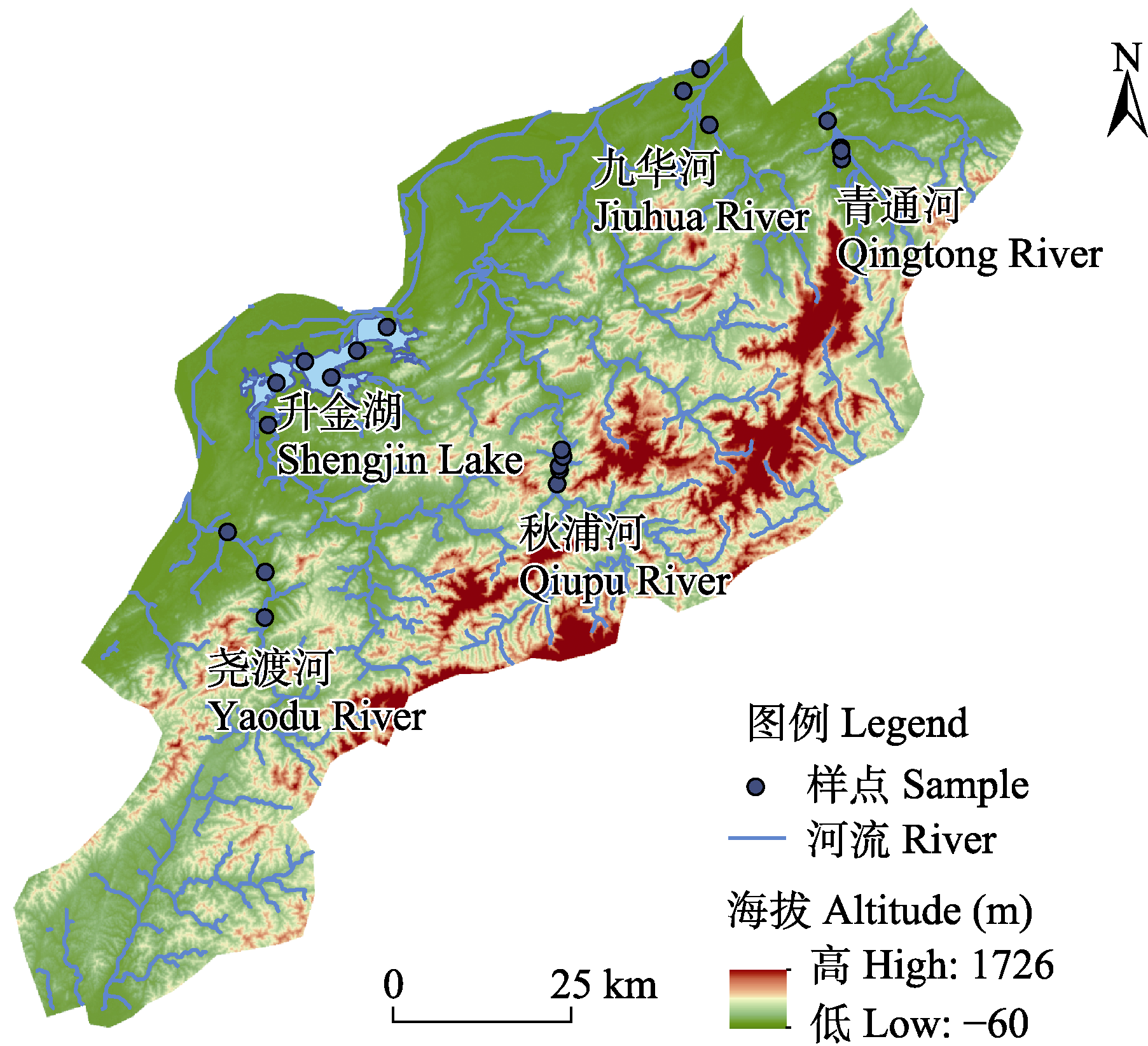
图1 安徽省池州市淡水鱼类多样性调查样点分布图
Fig. 1 Distribution map of sampling sites for the freshwater fish diversity survey in Chizhou City, Anhui Province
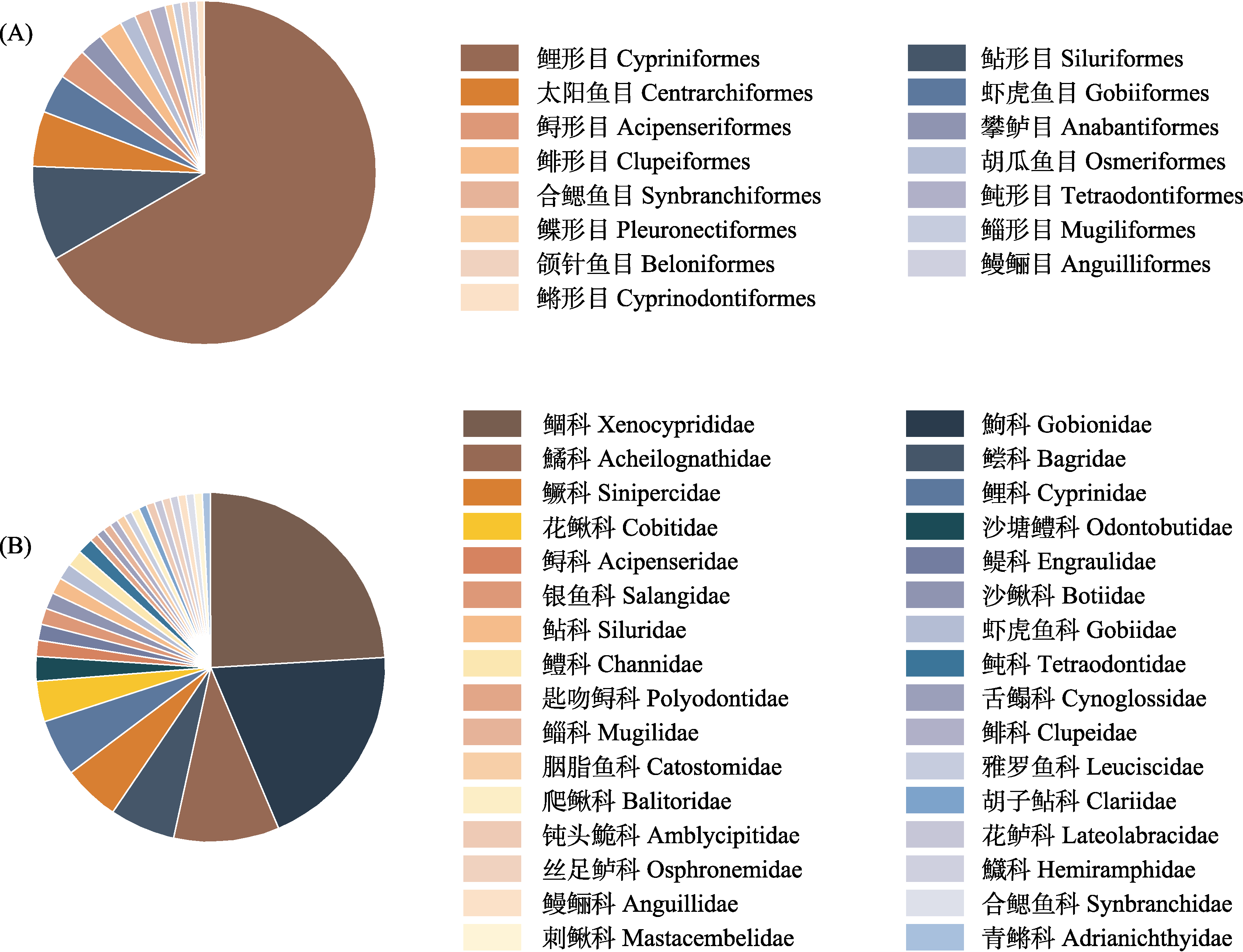
图2 安徽省池州市鱼类群落目级(A)和科级(B)的物种组成丰富度
Fig. 2 Species richness at the order level (A) and the family level (B) of fish assemblages in Chizhou City, Anhui Province
| [1] |
Abell R, Thieme ML, Revenga C, Bryer M, Kottelat M, Bogutskaya N, Coad B, Mandrak N, Balderas SC, Bussing W, Stiassny MLJ, Skelton P, Allen GR, Unmack P, Naseka A, Ng R, Sindorf N, Robertson J, Armijo E, Higgins JV, Heibel TJ, Wikramanayake E, Olson D, López HL, Reis RE, Lundberg JG, Sabaj Pérez MH, Petry P (2008) Freshwater ecoregions of the world: A new map of biogeographic units for freshwater biodiversity conservation. BioScience, 58, 403-414.
DOI URL |
| [2] | Banarescu P (1970) Remarks on the genus Xenocypris (Pisces, Cyprinidae) with description of a new subspecies. Revue Roumaine de Biologie Série Zoologie, 15, 395-402. |
| [3] | Bañón R, Pardo PC, Álvarez-Salgado XA, de Carlos A, Arronte JC, Piedracoba S (2024) Tropicalization of fish fauna of Galician coastal waters, in the NW Iberian upwelling system. Regional Studies in Marine Science, 70, 103369. |
| [4] | Berg LS (1909) Ichthyologia Amurensis. Bulletin de Academie Imperiale des Sciences de St. Petersbourg. VI Série, 8, 24(9), 1-270. |
| [5] | Berg LS (1964) Freshwater Fishes of the USSR and Adjacent Countries. Israel Program for Scientific Translations, Jerusalem. |
| [6] |
Betancur-R R, Wiley EO, Arratia G, Acero A, Bailly N, Miya M, Lecointre G, Ortí G (2017) Phylogenetic classification of bony fishes. BMC Evolutionary Biology, 17, 162.
DOI PMID |
| [7] | Bogutskaya NG, Naseka AM, Shedko SV, Vasil’eva ED, Chereshnev IA (2008) The fishes of the Amur River: Updated checklist and zoogeography. Ichthyological Exploration of Freshwaters, 19, 301-366. |
| [8] | Bohlen J, Šlechtová V (2016) Leptobotia bellacauda, a new species of loach from the lower Yangtze basin in China (Teleostei: Cypriniformes: Botiidae). Zootaxa, 4205, 65. |
| [9] | Brosse S, Charpin N, Su GH, Toussaint A, Herrera-R GA, Tedesco PA, Villéger S (2021) FISHMORPH: A global database on morphological traits of freshwater fishes. Global Ecology and Biogeography, 30, 2330-2336. |
| [10] |
Cao L, Shao WH, Yi WJ, Zhang E (2023) A review of conservation status of freshwater fish diversity in China. Journal of Fish Biology, 104, 345-364.
DOI PMID |
| [11] | Cao WX (2021) On the assessment and evaluation of the state of the water ecosystem of the Yangtze River (preface). Acta Hydrobiologica Sinica, 45, 1381. (in Chinese) |
| [曹文宣 (2021) 关于对长江水生态环境状况的评估与考核(序言). 水生生物学报, 45, 1381.] | |
| [12] | Cavin L (2017) Freshwater Fishes: 250 million Years of Evolutionary History. Elsevier, Oxford, London. |
| [13] | Changjiang Water Resources Commission (2022) Importance of Yangtze River. In: Report on Yangtze River Rehabilitation and Protection 2019 (ed. Ma JH). Springer, Singapore. |
| [14] |
Chen IS, Wu JH, Huang SP (2009) The taxonomy and phylogeny of the cyprinid genus Opsariichthys Bleeker (Teleostei: Cyprinidae) from Taiwan, with description of a new species. Environmental Biology of Fishes, 86, 165-183.
DOI URL |
| [15] | Chen WJ, Fu HY (2024) Fishes of Jiangxi Province. Science Press, Beijing. (in Chinese) |
| [陈文静, 付辉云 (2024) 江西鱼类志. 科学出版社, 北京.] | |
| [16] |
Chen X, Su SP, Zhang XH, Van der Laan R, Zhang E (2025) Types matter: Taxonomic status of Chanodichthys oxycephalus (Bleeker, 1871) (Cypriniformes, Xenocyprididae) and some relevant species of East Asia. ZooKeys, 1257, 285-303.
DOI URL |
| [17] |
Chen X, Wang M, Zhang E (2022) Updated species checklist of fishes from Lake Dongting in Hunan Province, South China: Species diversity and conservation. ZooKeys, 1108, 51-88.
DOI URL |
| [18] | Chen YX, Chen H, He DK, Chen YF (2018) Two new species of the genus Cobitis (Cypriniformes: Cobitidae) from South China. Zoological Systematics, 43, 156-168. |
| [19] | Chen YX, He DK, Chen H, Chen YF (2017) Taxonomic study of the genus Niwaella (Cypriniformes: Cobitidae) from East China, with description of four new species. Zoological Systematics, 42, 490-507. |
| [20] | Chen YY (1998) Fauna Sinica∙Osteichthyes∙Cypriniformes (II). Science Press, Beijing. (in Chinese) |
| [陈宜瑜 (1998) 中国动物志∙硬骨鱼纲∙鲤形目(中). 科学出版社, 北京.] | |
| [21] | Cheng YQ, Hu WH, Zhang YX (1998) Study on the construction of Chizhou nature protection system and sustainable development strategy. Journal of Anqing Teachers College (Natural Science), 4(4), 91-93. (in Chinese) |
| [程元启, 胡维华, 张跃西 (1998) 池州自然保护体系建设与可持续发展战略研究. 安庆师范学院学报(自然科学版), 4(4), 91-93.] | |
| [22] | Chu XL, Zheng BS, Dai DY (1999) Fauna Sinica∙Osteichthyes∙Siluriformes. Science Press, Beijing. (in Chinese) |
| [褚新洛, 郑葆珊, 戴定远 (1999) 中国动物志∙硬骨鱼纲∙鲇形目. 科学出版社, 北京.] | |
| [23] | CITES (2019) Checklist of Convention on International Trade in Endangered Species. https://checklist.cites.org/#/en/search/country_ids%5B%5D=160&output_layout=alphabetical&level_of_listing=0&show_synonyms=1&show_author=1&show_english=1&show_spanish=1&show_french=1&scientific_name=&page=1&per_page=20:2019. (accessed on 2025-12-11) |
| [24] |
Deng QL, Li MZ, Yu D, Chen L, Li WJ, Cai XW, Liu HZ (2024) Molecular phylogenetic analysis of the East Asian hemicultrine fishes (Teleostei: Cyprinidae: Xenocypridinae), with suggestions to their generic classification and redescription of the recently described species Hemiculter yungaoi Vasil’eva et al. 2022. Journal of Fish Biology, 105, 239-253.
DOI URL |
| [25] | Diao ZS, Shen JR (1981) Fishes and their distribution in Wannan Mountain. Journal of Anhui Agricultural Sciences, 9(1), 82-88. (in Chinese) |
| [刁铸山, 沈菊人 (1981) 皖南山区的鱼类及其地理分布. 安徽农业科学, 9(1), 82-88.] | |
| [26] |
Du H, Wang CY, Wei QW, Zhang H, Wu JM, Li L (2013) Distribution and movement of juvenile and sub-adult Chinese sturgeon (Acipenser sinensis Gray, 1835) in the Three Gorges Reservoir and the adjacent upstream free-flowing Yangtze River section: A re-introduction trial. Journal of Applied Ichthyology, 29, 1383-1388.
DOI URL |
| [27] | Du HJ, Wang BZ, Liu JJ, Jiang W, Li ZY (2025) Reflections on the conservation strategies for germplasm resources of Chinese sturgeon (Acipenser sinensis). Acta Hydrobiologica Sinica, 49, 012509. (in Chinese with English abstract) |
| [杜合军, 王彬忠, 刘娟娟, 姜伟, 李志远 (2025) 中华鲟种质资源保护策略的思考. 水生生物学报, 49, 012509.] | |
| [28] | Fang SX (2011) Countermeasures and effects of river lake water system connection in the main urban area of Chizhou City. China Water Resources, (10), 25-26. (in Chinese) |
| [方曙祥 (2011) 池州市主城区河湖水系贯通的对策与成效. 中国水利, (10), 25-26.] | |
| [29] | Fish Research Office, Institute of Hydrobiology, Hubei Province 1976) Fishes in the Yangtze River. Science Press, Beijing. (in Chinese) |
| [湖北省水生生物研究所鱼类研究室 (1976) 长江鱼类. 科学出版社, 北京.] | |
| [30] | Fu CZ, Wu JH, Chen JK, Wu QH, Lei GC (2003) Freshwater fish biodiversity in the Yangtze River basin of China: Patterns, threats and conservation. Biodiversity & Conservation, 12, 1649-1685. |
| [31] | Han Y, He YF, Gou ZY, Li CJ, Ma BS, Lin PC, Gao X (2025) Growth characteristics and changes of Rhinogobio cylindricus in the upper reaches of the Yangtze River after ten-year fishing ban. Acta Hydrobiologica Sinica, 49, 022504. (in Chinese with English abstract) |
| [韩毓, 何勇凤, 苟钟友, 李承君, 马宝珊, 林鹏程, 高欣 (2025) 长江十年禁渔后长江上游圆筒吻鮈生长特征及其变化. 水生生物学报, 49, 022504.] | |
| [32] | Hu JY, Yao WQ (1996) Fishes in Yangtze River of Anhui Region. Journal of Anhui University (Natural Science Edition), 20, 96-101. (in Chinese with English abstract) |
| [胡菊英, 姚闻卿 (1996) 长江下游安徽江段的鱼类. 安徽大学学报(自然科学版), 20, 96-101.] | |
| [33] | Hu WZ, Shi DF, Zheng SJ (2006) Present condition of ecological agriculture development and the countermeasure. Journal of Anhui Agricultural Sciences, 34, 3295-3297. (in Chinese with English abstract) |
| [胡维兆, 史杜芳, 郑淑婧 (2006) 生态农业发展现状及对策研究——以安徽省池州市为例. 安徽农业科学, 34, 3295-3297.] | |
| [34] |
Hughes RM, Herlihy AT, Peck DV (2021) Sampling efforts for estimating fish species richness in western USA river sites. Limnologica, 87, 125859.
DOI URL |
| [35] |
Isaac NJB, Mallet J, Mace GM (2004) Taxonomic inflation: Its influence on macroecology and conservation. Trends in Ecology & Evolution, 19, 464-469.
DOI URL |
| [36] | Jia L (2021) Current situation and protection countermeasures of wetland ecological restoration in the west of Pingtian Lake in Chizhou City. Journal of Chizhou University, 35(6), 66-69. (in Chinese) |
| [贾莉 (2021) 池州市平天湖西部湿地生态修复现状及保护对策. 池州学院学报, 35(6), 66-69.] | |
| [37] | Jia L, Sun JP, He XQ, Liu ZW, Pan WW (2024) Soil heavy metal pollution characteristics and ecological risk assessment—A case study of a typical agricultural land in Chizhou City. Journal of Shenyang Agricultural University, 55, 435-445. (in Chinese with English abstract) |
| [贾莉, 孙建平, 何小青, 刘赵文, 潘文武 (2024) 农用地土壤重金属污染特征及其生态风险评价——以池州市某典型农用地为例. 沈阳农业大学学报, 55, 435-445.] | |
| [38] | Jiang H, Wang LQ, Guan YL, Hu W, Pan TS, She L (2009) Resources investigation of Yangtze River reeves shad and cause analysis of being endangered. Journal of Hydroecology, 2(4), 140-142. (in Chinese) |
| [江河, 汪留全, 管远亮, 胡王, 潘庭双, 佘磊 (2009) 长江鲥鱼资源调查及濒危原因分析. 水生态学杂志, 2(4), 140-142.] | |
| [39] | Kang B, Huang XX, Yan YZ, Yan YR, Lin H (2018) Continental-scale analysis of taxonomic and functional fish diversity in the Yangtze River. Global Ecology and Conservation, 15, e00442. |
| [40] | Kathy H (2021) The World’s Forgotten Fishes. https://freshwaterblog.net/2021/02/23/worlds-forgotten-fishes-in-catastrophic-decline/.(accesseson2025-12-12) |
| [41] | Kottelat M (2001) Fishes of Laos. Wildlife Heritage Trust Publications, Colombo, Sri Lanka. |
| [42] | Kottelat M (2006) Fishes of Mongolia: A Check-list of the Fishes Known to Occur in Mongolia with Comments on Systematics and Nomenclature. Environment and Social Development, East Asia and Pacific Region, World Bank, Washington DC. |
| [43] | Kottelat M (2013) The fishes of the inland waters of Southeast Asia: A catalogue and core bibliography of the fishes known to occur in freshwaters, mangroves and estuaries. Raffles Bulletin of Zoology, 27(Suppl.), 1-663. |
| [44] | Kottelat M, Freyhof J (2007) Handbook of European Freshwater Fishes. Cornol & Freyhof, Berlin. |
| [45] | Li F, Arai R (2010) Rhodeus shitaiensis, a new bitterling from China (Teleostei: Cyprinidae). Ichthyological Exploration of Freshwaters, 21, 303-312. |
| [46] | Li G, Ji M, Song PF (2020) Monitoring and analysis of urban expansion in Chizhou based on RS. Journal of Geomatics, 45(2), 26-30. (in Chinese with English abstract) |
| [李刚, 季民, 宋鹏飞 (2020) 基于RS的池州市城市扩张监测与分析. 测绘地理信息, 45(2), 26-30.] | |
| [47] | Li J, Li XH, Chen XL (2008) A new species of the genus Leptobotia from Guangxi, China (Cypriniformes, Cobitidae). Zoological Systematics, 33, 630-633. (in Chinese with English abstract) |
| [李捷, 李新辉, 陈湘粦 (2008) 广西薄鳅属鱼类一新种(鲤形目, 鳅科). 动物分类学报, 33, 630-633.] | |
| [48] | Li JS, Jin YC, Wang W, Zhao ZP, Wu XP (2016) Priority Areas for Biodiversity Conservation in China. Science Press, Beijing. (in Chinese) |
| [李俊生, 靳勇超, 王伟, 赵志平, 吴晓莆 (2016) 中国陆域生物多样性保护优先区域. 科学出版社, 北京.] | |
| [49] |
Li XJ, Sun ZX, Tang WQ, Zhao YH (2022) Revalidation and redescription of Sarcocheilichthys sciistius (Abbott, 1901) (Cypriniformes: Cyprinidae) from the northern China. Zootaxa, 5141, 341-357.
DOI URL |
| [50] |
Liu DW, Jim CY, Xie CP, Hou SL, Xue XM (2025) Invasive non-native fish species in the Yangtze River: A looming ecological crisis and mitigation strategies. Nature Conservation, 58, 261-271.
DOI URL |
| [51] | Liu F, Lin PC, Li MZ, Gao X, Wang CL, Liu HZ (2019) Situations and conservation strategies of fish resources in the Yangtze River basin. Acta Hydrobiologica Sinica, 43(S1), 144-156. (in Chinese with English abstract) |
| [刘飞, 林鹏程, 黎明政, 高欣, 王春伶, 刘焕章 (2019) 长江流域鱼类资源现状与保护对策. 水生生物学报, 43(S1), 144-156.] | |
| [52] | Liu JS, Wang QD, Xie SQ, Wang GT, Gui JF (2020) Ranching management in lakes and reservoirs of China—— Community biomanipulation, restoration of biodiversity and resources utilization. Science & Technology for Development, 16, 237-242. (in Chinese with English abstract) |
| [刘家寿, 王齐东, 解绶启, 王桂堂, 桂建芳 (2020) 内陆大水面生态牧场化管理——群落调控、生物多样性恢复与资源利用. 科技促进发展, 16, 237-242.] | |
| [53] |
Liu SP, Chen DQ, Duan XB, Qiu SL, Wang LM (2002) The resources status quo and protection strategies on Chinese shad. Acta Hydrobiologica Sinica, 26, 679-684. (in Chinese with English abstract)
DOI URL |
| [刘绍平, 陈大庆, 段辛斌, 邱顺林, 王利民 (2002) 中国鲥鱼资源现状与保护对策. 水生生物学报, 26, 679-684.] | |
| [54] |
Luo YL (1990) A revision of fishes of the cyprinid genus Megalobrama. Acta Hydrobiologica Sinica, 14, 160-165. (in Chinese with English abstract)
DOI URL |
| [罗云林 (1990) 鲂属鱼类的分类整理. 水生生物学报, 14, 160-165.] | |
| [55] |
Marta S, Lacasella F, Romano A, Ficetola GF (2019) Cost-effective spatial sampling designs for field surveys of species distribution. Biodiversity and Conservation, 28, 2891-2908.
DOI |
| [56] |
Miqueleiz I, Abell R, Revenga C, Petry P, Thieme M, Weis S, Fluet-Chouinard E, Durso AM, Boucher TM, Bogues BB, Chenxi A, Levanti D, Saxton RJ, McIntyre PB (2025) Ecoregional distributions of the world’s freshwater vertebrate species. Scientific Data, 12, 1286.
DOI |
| [57] |
O’Shaughnessy KA, Vilizzi L, Daniel W, McGarrity ME, Bauer H, Hartman L, Geiger S, Sammarco P, Kolian S, Porter S, Dutton J, McClure MR, Norberg M, Fogg A, Lyons TJ, Procopio J, Bantista L, Bennett W, Wicksten M, Reeves D, Lively J, Robinson E, Brenner J, Goy J, Morgan-Olvera A, Yunnie ALE, Copp GH (2023) Horizon scanning for potentially invasive non-native marine species to inform trans-boundary conservation management— Example of the northern Gulf of Mexico. Aquatic Invasions, 18, 415-453.
DOI URL |
| [58] |
Pompeu PS, de Carvalho DR, Leal CG, Leitão RP, Alves CBM, Braga DF, Castro MA, Junqueira NT, Hughes RM (2021) Sampling efforts for determining fish species richness in megadiverse tropical regions. Environmental Biology of Fishes, 104, 1487-1499.
DOI |
| [59] | Reshetnikov Y, Bogutskaya NG, Vasil’eva E, Dorofeeva A, Naseka A, Popova O, Savvaitova A, Sokolov I (1997) An annotated checklist of the freshwater fishes of Russia. Journal of Ichthyology, 37, 687-736. |
| [60] | Roberts TR (1984) Skeletal anatomy and classification of the neotenic Asian Salmoniform superfamily Salangonidea (Icefishes or Noodlefishes). Proceedings of the California Academy of Sciences, 43, 179-220. |
| [61] | Sayer CA, Fernando E, Jimenez RR, MacFarlane NBW, Rapacciuolo G, Böhm M, Brooks TM, Contreras-MacBeath T, Cox NA, Harrison I, Hoffmann M, Jenkins R, Smith KG, Vié JC, Abbott JC, Allen DJ, Allen GR, Barrios V, Boudot JP, Carrizo SF, Charvet P, Clausnitzer V, Congiu L, Crandall KA, Cumberlidge N, Cuttelod A, Dalton J, Daniels AG, De Grave S, De Knijf G, Dijkstra KB, Dow RA, Freyhof J, García N, Gessner J, Getahun A, Gibson C, Gollock MJ, Grant MI, Groom AER, Hammer MP, Hammerson GA, Hilton-Taylor C, Hodgkinson L, Holland RA, Jabado RW, Juffe Bignoli D, Kalkman VJ, Karimov BK, Kipping J, Kottelat M, Lalèyè PA, Larson HK, Lintermans M, Lozano F, Ludwig A, Lyons TJ, Máiz-Tomé L, Molur S, Ng HH, Numa C, Palmer-Newton AF, Pike C, Pippard HE, Polaz CNM, Pollock CM, Raghavan R, Rand PS, Ravelomanana T, Reis RE, Rigby CL, Scott JA, Skelton PH, Sloat MR, Snoeks J, Stiassny MLJ, Tan HH, Taniguchi Y, Thorstad EB, Tognelli MF, Torres AG, Torres Y, Tweddle D, Watanabe K, Westrip JRS, Wright EGE, Zhang E, Darwall WRT (2025) One-quarter of freshwater fauna threatened with extinction. Nature, 638, 138-145. |
| [62] | Shang KY, Jiang M, Lin PC, Liu HZ (2023) River-lake disconnection on fish taxonomic distinctness in lakes from middle and lower reaches of the Yangtze River. Acta Hydrobiologica Sinica, 47, 133-146. (in Chinese with English abstract) |
| [尚坤钰, 姜明, 林鹏程, 刘焕章 (2023) 江湖阻隔对长江中下游湖泊鱼类群落分类多样性的影响. 水生生物学报, 47, 133-146.] | |
| [63] | Shao WH, Cheng JL, Zhang E (2024) Tachysurus taeniatus (Günther, 1873), a senior synonym of the congeneric species T. ondon (Shaw, 1934) (Teleostei, Bagridae) from eastern China. ZooKeys, 1218, 153-166. |
| [64] |
Shi CX, Liang YY, Xie C, Jiang ZG (2025) Relationships between community stability and diversity of fish assemblages before and after pen-culture ban in Lake Shengjin, lower reaches of Yangtze River. Journal of Lake Sciences, 37, 543-554. (in Chinese with English abstract)
DOI URL |
| [施晨曦, 梁阳阳, 谢畅, 蒋忠冠 (2025) 围网拆除前后长江下游升金湖鱼类群落稳定性和多样性的关系. 湖泊科学, 37, 543-554.] | |
| [65] |
Suzuki T, Shibukawa K, Senou H, Chen IS (2016) Redescription of Rhinogobius similis Gill 1859 (Gobiidae: Gobionellinae), the type species of the genus Rhinogobius Gill 1859, with designation of the neotype. Ichthyological Research, 63, 227-238.
DOI URL |
| [66] |
Tan M, Armbruster JW (2018) Phylogenetic classification of extant genera of fishes of the order Cypriniformes (Teleostei: Ostariophysi). Zootaxa, 4476, 6-39.
DOI PMID |
| [67] | Tang QY, Yu D, Yang JQ, Liu HZ (2010) Geographical speciation process of the genusLepturichthys (Cypriniformes: Balitoridae). Zoological Research, 31, 230-238. (in Chinese with English abstract) |
| [唐琼英, 俞丹, 杨金权, 刘焕章 (2010) 犁头鳅属鱼类物种地理分化过程. 动物学研究, 31, 230-238.] | |
| [68] |
Tautz D, Arctander P, Minelli A, Thomas RH, Vogler AP (2003) A plea for DNA taxonomy. Trends in Ecology & Evolution, 18, 70-74.
DOI URL |
| [69] |
Torreblanca D, Báez JC (2025) Tropicalization of the Mediterranean Sea reflected in fish diversity changes: A case study from Spanish waters. Journal of Marine Science and Engineering, 13, 1119.
DOI URL |
| [70] |
Van der Laan R, Eschmeyer WN, Fricke R (2014) Family-group names of recent fishes. Zootaxa, 3882, 1-230.
DOI PMID |
| [71] | Vasil’eva ED, Makeeva AP (2003) Taxonomic status of the black Amur bream and some remarks on problems of taxonomy of the genera Megalobrama and Sinibrama (Cyprinidae, Cultrinae). Journal of Ichthyology, 43, 607-623. |
| [72] | Wang HZ, Liu XQ, Wang HJ (2019) The Yangtze river-floodplain ecosystem: Multiple threats and holistic conservation. Acta Hydrobiologica Sinica, 43(S1), 157-182. (in Chinese with English abstract) |
| [王洪铸, 刘学勤, 王海军 (2019) 长江河流-泛滥平原生态系统面临的威胁与整体保护对策. 水生生物学报, 43(S1), 157-182.] | |
| [73] | Wang L, Lu L, Yang YF, Cheng YW, Wang Y (2023) Functional zoning of nature reserves based on ecosystem service tradeoffs: A case study of Anhui Shengjin Lake National Nature Reserve. National Park, 1, 151-162. (in Chinese with English abstract) |
| [王立, 陆林, 杨永峰, 程亚文, 王原 (2023) 基于生态系统服务权衡的自然保护区功能区划——以安徽升金湖国家级自然保护区为例. 国家公园(中英文), 1, 151-162.] | |
| [74] |
Wang LH, Huang ZL (2020) What is actually the main cause for the survival crisis of Chinese sturgeon? Journal of Lake Sciences, 32, 924-940. (in Chinese with English abstract)
DOI URL |
| [王鲁海, 黄真理 (2020) 中华鲟(Acipenser sinensis)生存危机的主因到底是什么? 湖泊科学, 32, 924-940.] | |
| [75] | Wang WJ, Chu L, Si C, Zhu R, Chen WH, Chen FM, Yan YZ (2013) Spatial and temporal patterns of stream fish assemblages in the Qiupu Headwaters National Wetland Park. Zoological Research, 34, 417-428. (in Chinese with English abstract) |
| [王文剑, 储玲, 司春, 朱仁, 陈文豪, 陈方明, 严云志 (2013) 秋浦河源国家湿地公园溪流鱼类群落的时空格局. 动物学研究, 34, 417-428.] | |
| [76] |
Wang ZT, Zhang E (2021) An updated species checklist of freshwater fishes from the Ganjiang River. Biodiversity Science, 29, 1256-1264. (in Chinese with English abstract)
DOI URL |
|
[王子彤, 张鹗 (2021) 赣江鱼类物种更新名录. 生物多样性, 29, 1256-1264.]
DOI |
|
| [77] | Wu HL, Zhong JS (2008) Fauna Sinica∙Osteichthyes∙Perciformes (V):Gobioidei. Science Press, Beijing. (in Chinese) |
| [伍汉霖, 钟俊生 (2008) 中国动物志∙硬骨鱼纲∙鲈形目(五): 虾虎鱼亚目. 科学出版社, 北京.] | |
| [78] | Wu RD, Long YC, Malanson GP, Garber PA, Zhang S, Li DQ, Zhao P, Wang LZ, Duo HR (2014) Optimized spatial priorities for biodiversity conservation in China: A systematic conservation planning perspective. PLoS ONE, 9, e103783. |
| [79] | Wu YA, Zhang E, Sun ZW, Ren SJ (2013) Identity of the catfish Liobagrus styani (Teleostei: Amblycipitidae) from Hubei Province, China. Ichthyological Exploration of Freshwaters, 24, 73-84. |
| [80] |
Xiang M, Wei N, Liu HR, Liao ML, Meng ZH, Li XM (2025) Survival strategies and color preferences of mandarin Fish (Siniperca chuatsi) and mud carp (Cirrhinus molitorella): Implications for Aquaculture. Animals, 15, 557.
DOI URL |
| [81] | Xin Q, Zhang E, Cao WX (2009) Onychostoma virgulatum, a new species of cyprinid fish (Pisces: Teleostei) from southern Anhui Province, South China. Ichthyological Exploration of Freshwaters, 20, 255-266. |
| [82] | Xing YC (2011) Species Diversity, Distribution Pattern and Conservation of Fishes in Inland Water of China based on GIS. PhD dissertation, Shanghai Ocean University, Shanghai. (in Chinese with English abstract) |
| [邢迎春 (2011) 基于GIS的中国内陆水域鱼类物种多样性、分布格局及其保育研究. 博士学位论文, 上海海洋大学, 上海.] | |
| [83] | Xu YJ (1997) Assessment of wildlife resources in Huangshan City. Journal of Huizhou University, 7(1), 1-11. (in Chinese) |
| [徐亚君 (1997) 黄山市野生动物资源论证. 徽州师专学报, 7(1), 1-11.] | |
| [84] | Yao WQ (2010) Systeatic Synopsis of Fishes in Anhui Province. Anhui University Press, Hefei. (in Chinese) |
| [姚闻卿 (2010) 安徽鱼类系统检索. 安徽大学出版社, 合肥.] | |
| [85] | Yih PL, Wu CK (1964) Abramidinae. In: The Cyprinid Fishes of China, Volume 1 (ed. Wu H-W). Shanghai Science & Technology Press, Shanghai. (in Chinese) |
| [易伯鲁, 吴清江 (1964) 鳊鱼亚科. 见: 中国鲤科鱼类志(上卷) (伍献文主编),63-120页. 上海科学技术出版社, 上海.] | |
| [86] | Yin D, Liang S, Lin XD (2024) Spatial and temporal evolution characteristics and influencing factors of national aquatic germplasm reserves in the Yangtze River basin. Resources and Environment in the Yangtze Basin, 33, 1663-1678. (in Chinese with English abstract) |
| [尹铎, 梁诗, 林煦丹 (2024) 长江流域国家级水产种质资源保护区时空演变特征及其驱动因素. 长江流域资源与环境, 33, 1663-1678.] | |
| [87] | Yin W (2015) Studies on Phylogeny and Biogeography of the Opsariichthine Fishes. PhD dissertation, Fudan University, Shanghai. (in Chinese with English abstract) |
| [殷维 (2015) 马口鱼类的系统发育和生物地理研究. 博士学位论文, 复旦大学, 上海.] | |
| [88] | Yue PQ (2000) Fauna Sinica∙Osteichthyes∙Cypriniformes (III). Science Press, Beijing. (in Chinese) |
| [乐佩琦 (2000) 中国动物志∙硬骨鱼纲∙鲤形目(下). 科学出版社, 北京.] | |
| [89] | Yue PQ, Chen YY (1998) China Red Data Book of Endangered Animals: Pisces. Science Press, Beijing. (in Chinese and in English) |
| [乐佩琦, 陈宜瑜 (1998) 中国濒危动物红皮书: 鱼类. 科学出版社, 北京.] | |
| [90] | Zhang CY, Zhang E, Zhong JS (2024) An updated species checklist of freshwater fishes and biodiversity conservation in Shennongjia Forestry District. Journal of Shanghai Ocean University, 33, 1187-1198. (in Chinese with English abstract) |
| [张楚依, 张鹗, 钟俊生 (2024) 神农架林区鱼类更新物种名录及其多样性保护. 上海海洋大学学报, 33, 1187-1198.] | |
| [91] | Zhang E (2000) Revision of the cyprinid genus with descriptions of two new species Parasinilabeo, from southern China (Teleostei: Cyprinidae). Ichthyological Exploration of Freshwaters, 11, 265-271. |
| [92] | Zhang E, Cao WX (2021) China’s Red List of Biodiversity∙Vertebrates (Volume Ⅴ): Freshwater Fishes. Science Press, Beijing.(in Chinese and in English) |
| [张鹗, 曹文宣 (2021) 中国生物多样性红色名录∙脊椎动物(第五卷): 淡水鱼类. 科学出版社, 北京.] | |
| [93] |
Zhang E, Xie ZG, Xie CX (2004) Morphological variation between Sinibrama macrops and S. wui, with notes on their validities. Acta Hydrobiologica Sinica, 28, 511-518. (in Chinese with English abstract)
DOI URL |
| [张鹗, 谢仲桂, 谢从新 (2004) 大眼华鳊和伍氏华鳊的形态差异及其物种有效性. 水生生物学报, 28, 511-518.] | |
| [94] |
Zhang H, Jarić I, Roberts DL, He YF, Du H, Wu JM, Wang CY, Wei QW (2020) Extinction of one of the world’s largest freshwater fishes: Lessons for conserving the endangered Yangtze fauna. Science of the Total Environment, 710, 136242.
DOI URL |
| [95] |
Zhang H, Li JY, Wu JM, Wang CY, Du H, Wei QW, Kang M (2017) Ecological effects of the first dam on Yangtze main stream and future conservation recommendations: A review of the past 60 years. Applied Ecology and Environmental Research, 15, 2081-2097.
DOI URL |
| [96] | Zhang H, Wang YX, Yang HL, Tan HM, Chen YX (2021) Taxonomic revision of Chinese species of the genera Misgurnus and Paramisgurnus (Cypriniformes: Cobitidae). Acta Hydrobiologica Sinica, 45, 414-427. (in Chinese with English abstract) |
| [张慧, 王银肖, 杨慧兰, 谭慧敏, 陈咏霞 (2021) 中国泥鳅属和副泥鳅属鱼类的分类整理. 水生生物学报, 45, 414-427.] | |
| [97] |
Zhang W, Zhai DD, Xiong F, Liu HY, Chen YY, Wang Y, Liao CS, Duan XB, Tian HW, Deng HT, Chen DQ (2023) Community structure and functional diversity of fishes in the Three Gorges Reservoir. Biodiversity Science, 31, 22136. (in Chinese with English abstract)
DOI |
|
[张伟, 翟东东, 熊飞, 刘红艳, 陈元元, 王莹, 廖传松, 段辛斌, 田辉伍, 邓华堂, 陈大庆 (2023) 三峡库区鱼类群落结构和功能多样性. 生物多样性, 31, 22136.]
DOI |
|
| [98] |
Zhang XG, Tong JG, Yang JY, Xiong BX (2010) Threatened fishes of the world: Luciobrama macrocephalus (Cyprinidae). Environmental Biology of Fishes, 89, 187-188.
DOI URL |
| [99] | Zhao CY, Jiang YZ, Fang XZ, Zhou X (2010) Biological characteristics and ornamental value of Rhodeinae. Bulletin of Biology, 45(4), 7-9. (in Chinese) |
| [赵朝阳, 姜彦钟, 方秀珍, 周鑫 (2010) 鳑鲏的生物学特性及观赏价值. 生物学通报, 45(4), 7-9.] | |
| [100] |
Zhao YH, Kullander F, Kullander SO, Zhang CG (2009) A review of the genus Distoechodon (Teleostei: Cyprinidae), and description of a new species. Environmental Biology of Fishes, 86, 31-44.
DOI URL |
| [101] |
Zhao YH, Xing YC, Lü BB, Zhou CJ, Yang WB, Zhao K (2020) Species diversity and conservation of freshwater fishes in the Yellow River basin. Biodiversity Science, 28, 1496-1510. (in Chinese with English abstract)
DOI URL |
| [赵亚辉, 邢迎春, 吕彬彬, 周传江, 杨文波, 赵凯 (2020) 黄河流域淡水鱼类多样性和保护. 生物多样性, 28, 1496-1510.] | |
| [102] | Zheng SM, Wu Q, He LJ, Zhang ZG (2015) Native Ornamental Fish of China—Illustrated Book. Science Press, Beijing. (in Chinese) |
| [郑曙明, 吴青, 何利君, 张志钢 (2015) 中国原生观赏鱼图鉴. 科学出版社, 北京.] | |
| [103] | Zhou CJ, Yang CX, Meng XL, Zhang JX, Song DY, Zhao HP, Nie GX (2020) Rhynchocypris classification status determination in Henan Province. Journal of Henan Normal University (Natural Science Edition), 48, 118-124. (in Chinese with English abstract) |
| [周传江, 杨长幸, 孟晓林, 张建新, 宋东蓥, 赵海鹏, 聂国兴 (2020) 河南省大吻鱥属鱼类分类现状厘定. 河南师范大学学报(自然科学版), 48, 118-124.] | |
| [104] | Zhou CW, Yang Q, Cai DL (1988) On the classification and distribution of the Sinipercinae fishes (Family Serranidae). Zoological Research, 9, 113-125. (in Chinese with English abstract) |
| [周才武, 杨青, 蔡德霖 (1988) 鳜亚科Sinipercinae鱼类的分类整理和地理分布. 动物学研究, 9, 113-125.] | |
| [105] |
Zhou JF, Wu QJ, Ye YZ, Tong JG (2003) Genetic divergence between Cyprinus carpio carpio and Cyprinus carpio haematopterus as assessed by mitochondrial DNA analysis, with emphasis on origin of European domestic carp. Genetica, 119, 93-97.
DOI |
| [106] |
Zhou JJ, Yuan LY, Shao WH (2024) Tachysurus wuyueensis (Teleostei, Bagridae), a new species of catfish from the Qiantang-Jiang basin, southeast China. Zoosystematics and Evolution, 100, 583-595.
DOI URL |
| [107] |
Zhu CD, Luo AR, Bai M, Orr MC, Hou ZE, Ge SQ, Chen J, Hu YB, Zhou XM, Qiao GX, Kong HZ, Lu LM, Jin XH, Cai L, Wei XL, Zhao RL, Miao W, Wang QF, Sha ZL, Lin Q, Qu M, Jiang JP, Li JT, Che J, Jiang XL, Chen XY, Gao LM, Ren ZX, Xiang CL, Luo SX, Wu DH, Liu D, Peng YQ, Su T, Cai CY, Zhu TQ, Cai WZ, Liu XY, Li H, Xue HJ, Ye Z, Chen XX, Tang P, Wei SJ, Pang H, Xie Q, Zhang F, Zhang F, Peng XJ, Zhang AB, Gao TP, Zhou CF, Shao C, Ma LB, Wei ZM, Luan YX, Yin ZW, Dai W, Wei C, Huang XL, Liu JX, Chen XS, Yi TC, Zhang ZS, Aishan Z, Li Q, Hu HY (2022) A joint call for actions to advance taxonomy in China. Zoological Systematics, 47, 188-197.
DOI |
| [108] | Zhu DL, Dai YT, Su X, Zou Y, Hu BQ (2023) Research on land and resource utilization and ecological environment protection in Anhui section of the Yangtze River. China Development, 23(5), 58-80. (in Chinese with English abstract) |
| [朱道林, 代亚婷, 苏欣, 邹野, 胡弼乔 (2023) 关于长江安徽段国土资源利用与生态环境保护的调研. 中国发展, 23(5), 58-80.] | |
| [109] | Zhu L, Yu D, Liu HZ (2020) Zacco sinensis sp. nov. (Cypriniformes: Cyprinidae), a new fish species from northern China. Sichuan Journal of Zoology, 39, 168-176. (in Chinese with English abstract) |
| [朱兰, 俞丹, 刘焕章 (2020) 中国北方鱲属鱼类一新种——中华鱲(鲤形目: 鲤科). 四川动物, 39, 168-176.] |
| [1] | 张海龙, 聂海燕, 刘萌萌, 魏美才, 李泽建. 浙江乌岩岭叶蜂多样性分布及影响因素[J]. 生物多样性, 2026, 34(5): 25459-. |
| [2] | 梁竣策, 李开枝, 谭烨辉. 南海翼足类物种多样性与分布[J]. 生物多样性, 2026, 34(5): 25487-. |
| [3] | 周丽洁, 郝珉辉, 何怀江, 程艳霞, 张春雨, 赵秀海. 小兴安岭森林β多样性格局、组分及其影响因素[J]. 生物多样性, 2026, 34(4): 25443-. |
| [4] | 彭昀月, 彭奎, 刘昕然, 孙天怡, 张小全. 生物多样性信用的企业参与途径、市场发展障碍与建议[J]. 生物多样性, 2026, 34(4): 26031-. |
| [5] | 李伯尧, 盛天成, 幸小云. 生物多样性风险对企业财务绩效的影响: 来自中国上市公司的证据[J]. 生物多样性, 2026, 34(4): 25330-. |
| [6] | 刘昊, 张玉霄, 刘冰, 李飞飞, 马洪峥, 覃海宁, 李德铢, 陈文俐. 中国禾本科植物多样性及其物种名录[J]. 生物多样性, 2026, 34(4): 25438-. |
| [7] | 孔孜亦, 王德港, 王建涛, 裴志永, 孙晶, 张长春, 张军国. 基于SCD-HRNet模型的野生动物姿态估计及其在生物多样性监测中的应用: 以内蒙古赛罕乌拉地区为例[J]. 生物多样性, 2026, 34(4): 25287-. |
| [8] | 张德喜, 周倩, 裴雪竹, 张红勇, 裴应泰, 孙杉, 刘名信, 张立勋, 赵长明. 甘肃兴隆山森林节肢动物标本照片与DNA条形码数据集[J]. 生物多样性, 2026, 34(4): 25409-. |
| [9] | 朱浩友, 周友兵, 罗怡, 周昭敏. 南充市城区繁殖鸟类群落20年前后的变化[J]. 生物多样性, 2026, 34(3): 24560-. |
| [10] | 侯姝彧, 刘盈盈, 杨锐. 《昆蒙框架》背景下国际OECMs体系构建实践进展及中国化思路[J]. 生物多样性, 2026, 34(3): 25264-. |
| [11] | 程晓帆, 李青媛, 李媛辉, 张明祥. 外来入侵物种治理政策体系的困境与出路[J]. 生物多样性, 2026, 34(2): 25332-. |
| [12] | 陈璐露, 汤皓婷, 冷红, 袁青, 杨昕悦. 城市街区建成环境对生物多样性的影响[J]. 生物多样性, 2026, 34(2): 25286-. |
| [13] | 高雯琪, 向景荣, 赵耀, 范灵霜, 谷圆, 邵韦涵, 李高俊, 赵光军, 陈明斌, 蔡杏伟, 陈凯. 海南热带雨林国家公园黎母山和尖峰岭溪流鱼类群落特征及其对土地利用的响应[J]. 生物多样性, 2026, 34(2): 25374-. |
| [14] | 卢晓强, 芮丹, 张江峰, 尹冰鑫, 王雨露, 岑雨婷, 崔怡晨, 杨万霞. 氮输入驱动的关键生态过程对生物多样性的影响及其管理启示[J]. 生物多样性, 2026, 34(2): 25368-. |
| [15] | 谭廷鸿, 高帆, 杨雨, 肖群英, 吴春芳, 邱娜, 赵宁宁, 周敏, 康公平, 卢志宏, 高健强, 杨红, 杨传东, 邓春英. 中国西南喀斯特地区大型真菌物种编目[J]. 生物多样性, 2026, 34(2): 25281-. |
| 阅读次数 | ||||||
|
全文 |
|
|||||
|
摘要 |
|
|||||
备案号:京ICP备16067583号-7
Copyright © 2026 版权所有 《生物多样性》编辑部
地址: 北京香山南辛村20号, 邮编:100093
电话: 010-62836137, 62836665 E-mail: biodiversity@ibcas.ac.cn
