

生物多样性 ›› 2026, Vol. 34 ›› Issue (4): 25406. DOI: 10.17520/biods.2025406 cstr: 32101.14.biods.2025406
黄语卓1( ), 王梓潆1(), 周伟龙2, 莫佳瑶1(), 张敏华1(), 郝春晖1(), 兰荣光3, 叶沛阳3, 刘宇1,4,*()(
 )
)
收稿日期:2025-10-13
接受日期:2026-01-29
出版日期:2026-04-20
发布日期:2026-05-06
通讯作者:
*E-mail: yuliu@des.ecnu.edu.cn
基金资助:
Yuzhuo Huang1(), Ziying Wang1(), Weilong Zhou2, Jiayao Mo1(), Minhua Zhang1(), Chunhui Hao1(), Rongguang Lan3, Peiyang Ye3, Yu Liu1,4,*()()
Received:2025-10-13
Accepted:2026-01-29
Online:2026-04-20
Published:2026-05-06
Contact:
*E-mail: yuliu@des.ecnu.edu.cn
Supported by:摘要:
植食性昆虫与木本植物的互作关系因其在生态系统中的重要作用而受到广泛关注。尽管已有大量研究探讨了森林中虫食强度的分布格局及其影响因素, 并提出了诸多理论假说, 但这些假说在不同森林群落中缺乏普适性, 尤其是对中亚热带常绿阔叶林的系统性验证较为有限。此外, 现有研究多聚焦于少数树种, 其结论能否推广至整个森林群落仍有待进一步检验与证实。为此, 本研究以浙江百山祖25 ha亚热带森林动态监测样地(简称百山祖样地)中149种阔叶树种的400株个体为研究对象, 比较了不同树种间虫食强度的差异, 其中虫食强度包括虫食率(即叶片虫食面积占比)和虫食频率(即虫食叶片占比); 基于样地监测数据, 采用广义线性混合效应模型探究了多种因素对虫食率的影响, 包括采样树种类别(按树木生活型和多度划分)、叶片大小、邻体树种多样性及其组成, 以及土壤养分等, 旨在揭示影响百山祖样地虫食率的主要驱动因素。结果表明: (1)样地内99.40%的虫食损伤由咀嚼类昆虫造成。平均虫食率为7.18%, 平均虫食频率为65.38%。不同树种的虫食率和虫食频率存在显著差异。其中, 常绿种的虫食率显著高于落叶种, 常见种的虫食率显著高于稀有种, 乔木的虫食率显著高于灌木。(2)树种类别对虫食率具有显著影响, 且虫食率与邻体树种系统发育多样性之间存在显著正相关关系。方差分解结果表明, 采样树的生活型(乔木vs.灌木)的相对贡献最大, 达62.33%。本研究结果支持昆虫植食作用的植物显性假说, 常绿、常见及乔木树种均因其在群落中的显性较高而遭受更强的虫食。同时, 研究也表明百山祖样地存在关联敏感效应, 即系统发育距离越远的树种混交更易吸引植食性昆虫取食。
黄语卓, 王梓潆, 周伟龙, 莫佳瑶, 张敏华, 郝春晖, 兰荣光, 叶沛阳, 刘宇 (2026) 浙江省百山祖25 ha亚热带森林动态监测样地木本植物叶片虫食强度分布格局及其影响因素. 生物多样性, 34, 25406. DOI: 10.17520/biods.2025406.
Yuzhuo Huang, Ziying Wang, Weilong Zhou, Jiayao Mo, Minhua Zhang, Chunhui Hao, Rongguang Lan, Peiyang Ye, Yu Liu (2026) Distribution patterns of leaf herbivory intensity and their influencing factors in woody plants across the 25-ha subtropical forest dynamics plot at Baishanzu, Zhejiang Province. Biodiversity Science, 34, 25406. DOI: 10.17520/biods.2025406.
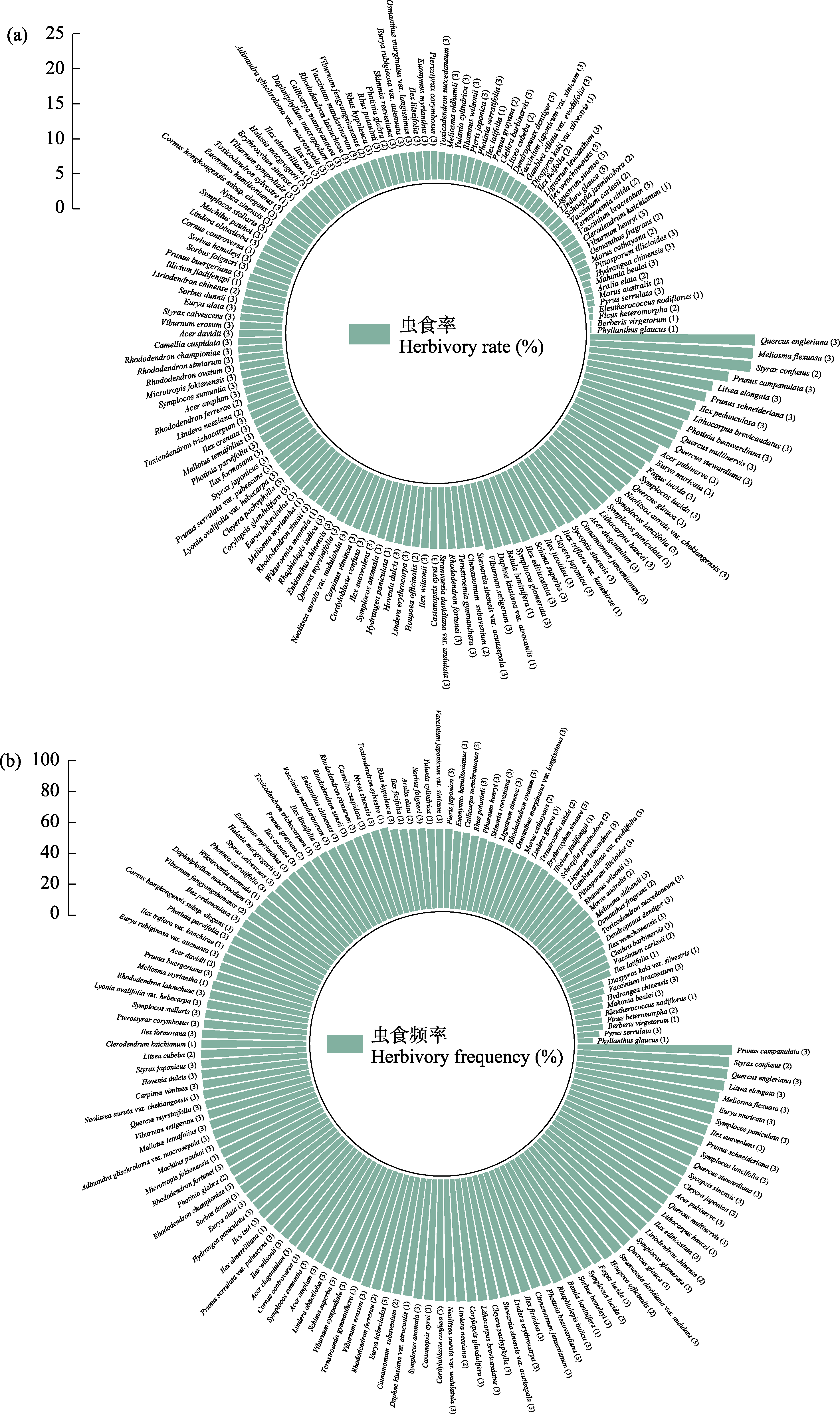
图1 百山祖25 ha亚热带森林动态监测样地叶片虫食率(a)和虫食频率(b)在149个树种中的分布情况。树种名称后为采样株数, 各树种名称、类型、多度以及具体虫食率和虫食频率见附录2。
Fig. 1 Distribution patterns of leaf herbivory rate (a) and herbivory frequency (b) across 149 tree species in the 25-ha subtropical forest dynamics plot at Baishanzu. Number following the species name indicates number of sampled trees. See Appendix 2 for the names, types, and abundance information, as well as the specific herbivory rate and herbivory frequency of each species.
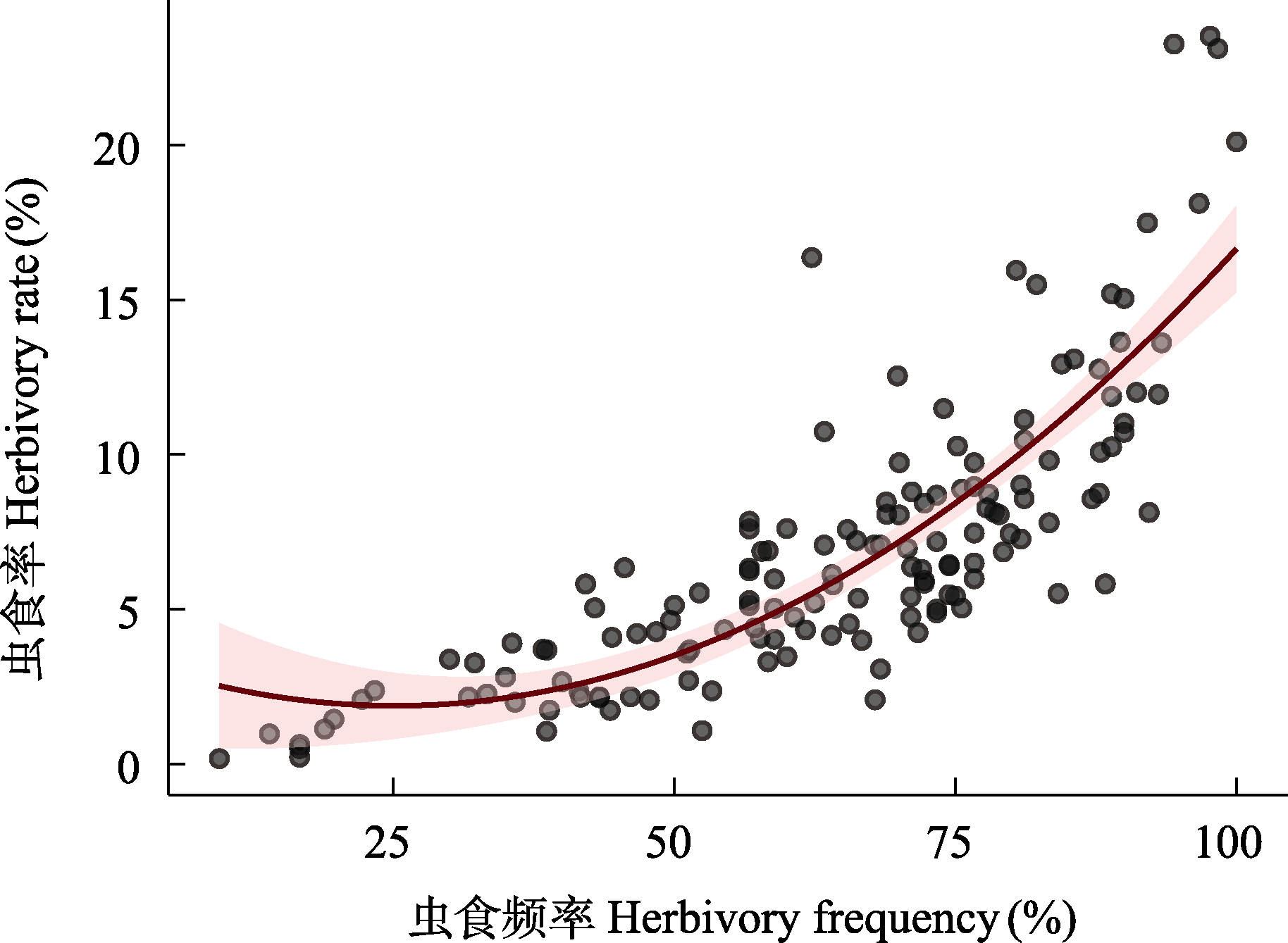
图2 百山祖25 ha亚热带森林动态监测样地149种树种叶片虫食率和虫食频率的关系(基于Spearman相关分析)。趋势线采用二次多项式拟合。
Fig. 2 Relationship between leaf herbivory rate and herbivory frequency across 149 species in the 25-ha subtropical forest dynamics plot at Baishanzu (based on Spearman correlation analysis). The trend line was fitted using a quadratic polynomial.
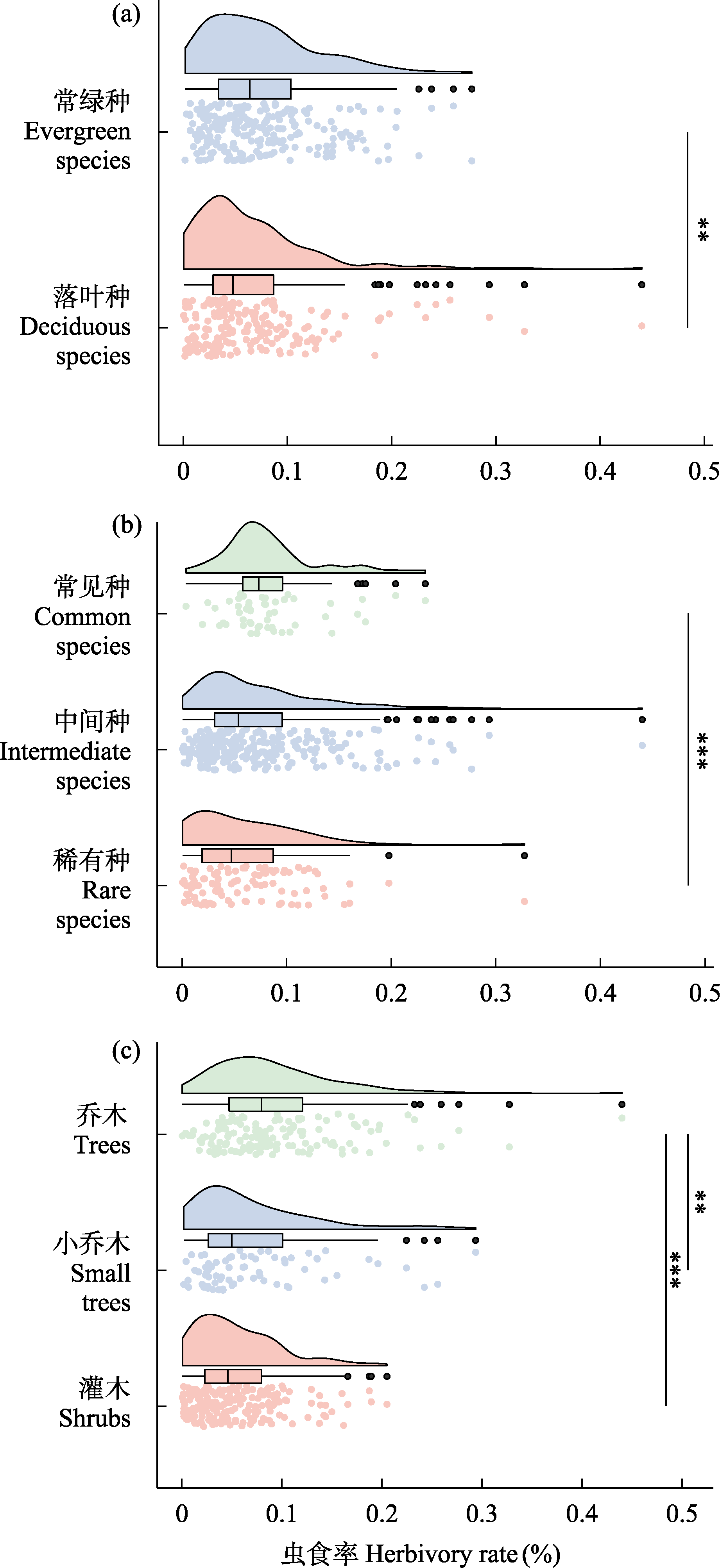
图3 百山祖25 ha亚热带森林动态监测样地不同树种类别的虫食率差异。(a)常绿种和落叶种; (b)常见种、中间种和稀有种; (c)乔木、小乔木和灌木。(b)和(c)中的P值经Bonferroni法校正。**P<0.01; ***P<0.001。
Fig. 3 Differences in leaf herbivory rate in the 25-ha subtropical forest dynamics plot at Baishanzu. (a) Evergreen species and deciduous species; (b) Common species, intermediate species, and rare species; (c) Trees, small trees and shrubs. P-values in (b) and (c) were adjusted using the Bonferroni correction. **P<0.01; ***P<0.001.
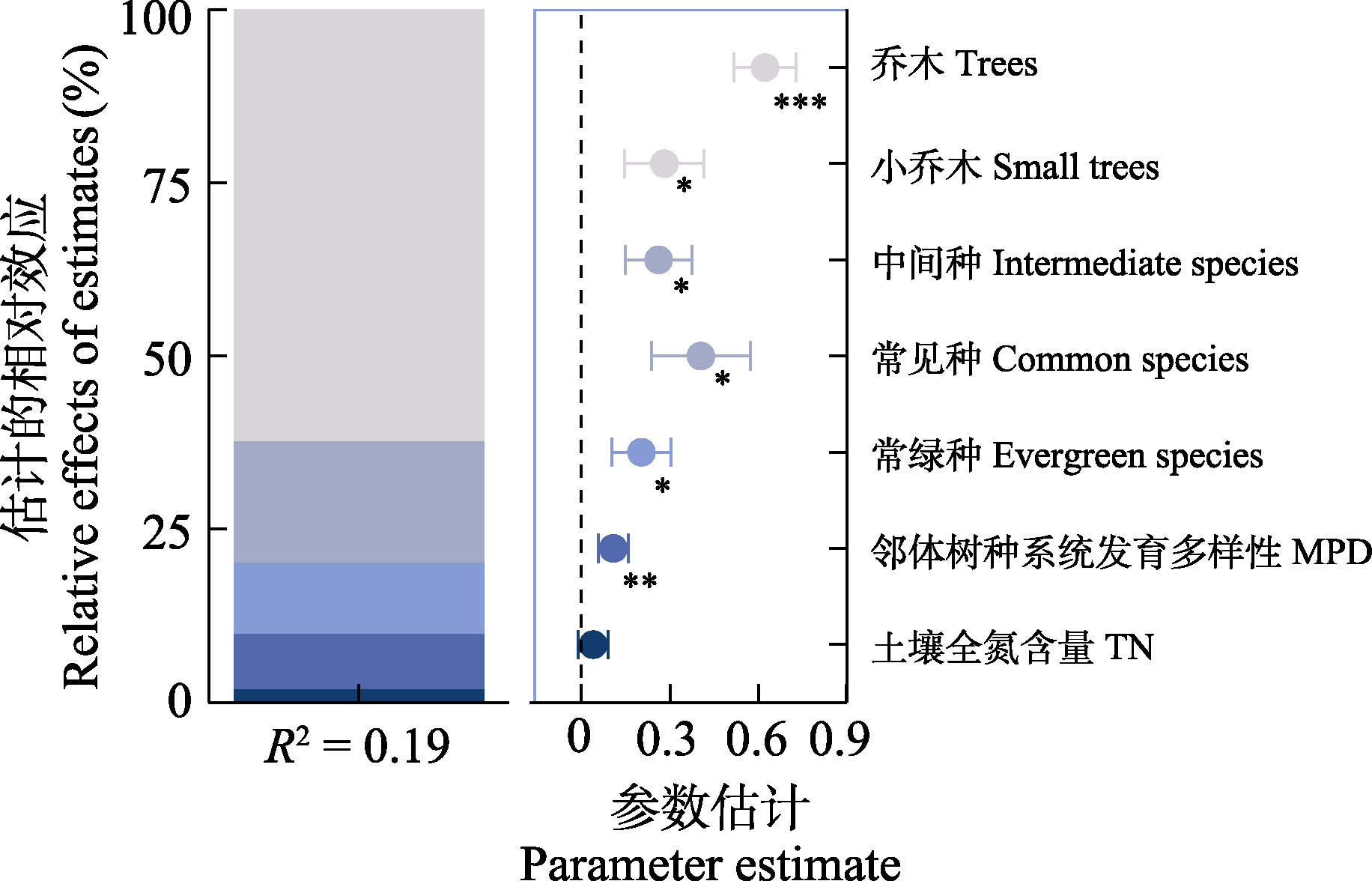
图4 最优模型中预测变量对虫食率的相对影响。模型包括采样树树种生长类型2 (乔木、小乔木和灌木)、树种多度分类(常见种、中间种和稀有种)、树种生长类型1 (常绿种和落叶种)、邻体树种系统发育多样性(MPD)以及土壤全氮含量(TN)。*P<0.05; **P<0.01; ***P<0.001。
Fig. 4 Relative effects of the predictors on leaf herbivory in the most parsimonious model. The model included the life form 2 of the sampled trees (trees, small trees and shrubs), abundance type (common species, intermediate species and rare species), life form 1 (evergreen species and deciduous species), neighboring tree phylogenetic diversity (MPD) and soil total nitrogen content (TN). *P<0.05; **P<0.01; ***P<0.001.
| [1] |
Ackerly D, Knight C, Weiss S, Barton K, Starmer K (2002) Leaf size, specific leaf area and microhabitat distribution of chaparral woody plants: Contrasting patterns in species level and community level analyses. Oecologia, 130, 449-457.
DOI PMID |
| [2] |
Awmack CS, Leather SR (2002) Host plant quality and fecundity in herbivorous insects. Annual Review of Entomology, 47, 817-844.
PMID |
| [3] |
Bachelot B, Kobe RK (2013) Rare species advantage? Richness of damage types due to natural enemies increases with species abundance in a wet tropical forest. Journal of Ecology, 101, 846-856.
DOI URL |
| [4] | Bar-On YM, Phillips R, Milo R (2018) The biomass distribution on Earth. Proceedings of the National Academy of Sciences, USA, 115, 6506-6511. |
| [5] |
Barbosa P, Hines J, Kaplan I, Martinson H, Szczepaniec A, Szendrei Z (2009) Associational resistance and associational susceptibility: Having right or wrong neighbors. Annual Review of Ecology, Evolution, and Systematics, 40, 1-20.
DOI URL |
| [6] |
Bernays EA, Bright KL, Gonzalez N, Angel J (1994) Dietary mixing in a generalist herbivore: Tests of two hypotheses. Ecology, 75, 1997-2006.
DOI URL |
| [7] | Bernays EA, Chapman RE (1994) Host-Plant Selection by Phytophagous Insects. Springer US, Boston, MA. |
| [8] |
Bertheau C, Brockerhoff EG, Roux-Morabito G, Lieutier F, Jactel H (2010) Novel insect-tree associations resulting from accidental and intentional biological ‘invasions’: A meta-analysis of effects on insect fitness. Ecology Letters, 13, 506-515.
DOI PMID |
| [9] |
Blue JD, Souza L, Classen AT, Schweitzer JA, Sanders NJ (2011) The variable effects of soil nitrogen availability and insect herbivory on aboveground and belowground plant biomass in an old-field ecosystem. Oecologia, 167, 771-780.
DOI PMID |
| [10] |
Bogacheva IA (1994) Leaf size selection by insects: A phenomenon created by random sampling. Oikos, 69, 119-124.
DOI URL |
| [11] |
Borer ET, Halpern BS, Seabloom EW (2006) Asymmetry in community regulation: Effects of predators and productivity. Ecology, 87, 2813-2820.
PMID |
| [12] |
Brooks ME, Kristensen K, van Benthem KJ, Magnusson A, Berg CW, Nielsen A, Skaug HJ, Mächler M, Bolker BM (2017) glmmTMB balances speed and flexibility among packages for zero-inflated generalized linear mixed modeling. The R Journal, 9, 378-400.
DOI URL |
| [13] | Cadotte MW, Cardinale BJ, Oakley TH (2008) Evolutionary history and the effect of biodiversity on plant productivity. Proceedings of the National Academy of Sciences, USA, 105, 17012-17017. |
| [14] |
Cadotte MW, Jonathan Davies T, Regetz J, Kembel SW, Cleland E, Oakley TH (2010) Phylogenetic diversity metrics for ecological communities: Integrating species richness, abundance and evolutionary history. Ecology Letters, 13, 96-105.
DOI PMID |
| [15] |
Cárdenas RE, Valencia R, Kraft NJB, Argoti A, Dangles O (2014) Plant traits predict inter- and intraspecific variation in susceptibility to herbivory in a hyperdiverse Neotropical rain forest tree community. Journal of Ecology, 102, 939-952.
DOI URL |
| [16] |
Carmona D, Lajeunesse MJ, Johnson MTJ (2011) Plant traits that predict resistance to herbivores. Functional Ecology, 25, 358-367.
DOI URL |
| [17] |
Castagneyrol B, Bonal D, Damien M, Jactel H, Meredieu C, Muiruri EW, Barbaro L (2017) Bottom-up and top-down effects of tree species diversity on leaf insect herbivory. Ecology and Evolution, 7, 3520-3531.
DOI PMID |
| [18] |
Castagneyrol B, Giffard B, Péré C, Jactel H (2013) Plant apparency, an overlooked driver of associational resistance to insect herbivory. Journal of Ecology, 101, 418-429.
DOI URL |
| [19] |
Castagneyrol B, Jactel H, Moreira X (2018) Anti-herbivore defences and insect herbivory: Interactive effects of drought and tree neighbours. Journal of Ecology, 106, 2043-2057.
DOI URL |
| [20] |
Che-Castaldo C, Crisafulli CM, Bishop JG, Zipkin EF, Fagan WF (2019) Disentangling herbivore impacts in primary succession by refocusing the plant stress and vigor hypotheses on phenology. Ecological Monographs, 89, e01389.
DOI URL |
| [21] |
Chesson P (2000) Mechanisms of maintenance of species diversity. Annual Review of Ecology and Systematics, 31, 343-366.
DOI URL |
| [22] | Cleland EE, Harpole WS (2010) Nitrogen enrichment and plant communities. Annals of the New York Academy of Sciences, 1195, 46-61. |
| [23] |
Coley PD, Barone JA (1996) Herbivory and plant defenses in tropical forests. Annual Review of Ecology and Systematics, 27, 305-335.
DOI URL |
| [24] |
Coley PD, Bryant JP, Chapin FS 3rd(1985) Resource availability and plant antiherbivore defense. Science, 230, 895-899.
DOI PMID |
| [25] |
Connell JH, Tracey JG, Webb LJ (1984) Compensatory recruitment, growth, and mortality as factors maintaining rain forest tree diversity. Ecological Monographs, 54, 141-164.
DOI URL |
| [26] |
Cornelissen T, Wilson Fernandes G, Vasconcellos-Neto J (2008) Size does matter: Variation in herbivory between and within plants and the plant vigor hypothesis. Oikos, 117, 1121-1130.
DOI URL |
| [27] |
Crawley MJ (1985) Reduction of oak fecundity by low-density herbivore populations. Nature, 314, 163-164.
DOI |
| [28] |
Cui EQ, Lu RL, Xu XN, Sun HF, Qiao Y, Ping JY, Qiu SY, Lin YH, Bao JH, Yong YT, Zheng ZM, Yan ER, Xia JY (2022) Soil phosphorus drives plant trait variations in a mature subtropical forest. Global Change Biology, 28, 3310-3320.
DOI PMID |
| [29] |
Damestoy T, Brachi B, Moreira X, Jactel H, Plomion C, Castagneyrol B (2019) Oak genotype and phenolic compounds differently affect the performance of two insect herbivores with contrasting diet breadth. Tree Physiology, 39, 615-627.
DOI PMID |
| [30] | de Souza Amorim D, Brown BV, Boscolo D, Ale-Rocha R, Alvarez-Garcia DM, Balbi MIPA, de Marco Barbosa A, Capellari RS, de Carvalho CJB, Couri MS, de Vilhena Perez Dios R, Aguilar Fachin D, Ferro GB, Flores HF, Frare LM, Gudin FM, Hauser M, Lamas CJE, Lindsay KG, Marinho MAT, Almeida Marques DW, Marshall SA, Mello-Patiu C, Menezes MA, Morales MN, Nihei SS, Oliveira SS, Pirani G, Ribeiro GC, Riccardi PR, de Santis MD, Santos D, dos Santos JR, Silva VC, Wood EM, Rafael JA (2022) Vertical stratification of insect abundance and species richness in an Amazonian tropical forest. Scientific Reports, 12, 1734. |
| [31] |
Du EZ, Terrer C, Pellegrini AFA, Ahlström A, van Lissa CJ, Zhao X, Xia N, Wu XH, Jackson RB (2020) Global patterns of terrestrial nitrogen and phosphorus limitation. Nature Geoscience, 13, 221-226.
DOI |
| [32] |
Dulaurent AM, Porté AJ, van Halder I, Vétillard F, Menassieu P, Jactel H (2012) Hide and seek in forests: Colonization by the pine processionary moth is impeded by the presence of nonhost trees. Agricultural and Forest Entomology, 14, 19-27.
DOI URL |
| [33] |
Ehbrecht M, Seidel D, Annighöfer P, Kreft H, Köhler M, Zemp DC, Puettmann K, Nilus R, Babweteera F, Willim K, Stiers M, Soto D, Boehmer HJ, Fisichelli N, Burnett M, Juday G, Stephens SL, Ammer C (2021) Global patterns and climatic controls of forest structural complexity. Nature Communications, 12, 519.
DOI PMID |
| [34] |
Elser JJ, Bracken MES, Cleland EE, Gruner DS, Harpole WS, Hillebrand H, Ngai JT, Seabloom EW, Shurin JB, Smith JE (2007) Global analysis of nitrogen and phosphorus limitation of primary producers in freshwater, marine and terrestrial ecosystems. Ecology Letters, 10, 1135-1142.
DOI PMID |
| [35] |
Endara MJ, Coley PD (2011) The resource availability hypothesis revisited: A meta-analysis. Functional Ecology, 25, 389-398.
DOI URL |
| [36] | Feeny P (1976) Plant apparency and chemical defense. In: Biochemical Interaction Between Plants and Insects (eds Wallace JW, Mansell RL), pp.1-40. Springer US, Boston, MA. |
| [37] |
Ferrari S, Cribari-Neto F (2004) Beta regression for modelling rates and proportions. Journal of Applied Statistics, 31, 799-815.
DOI URL |
| [38] |
Finch S, Collier RH (2000) Host-plant selection by insects—A theory based on ‘appropriate/inappropriate landings’ by pest insects of cruciferous plants. Entomologia Experimentalis et Applicata, 96, 91-102.
DOI URL |
| [39] |
Fine PVA, Mesones I, Coley PD (2004) Herbivores promote habitat specialization by trees in Amazonian forests. Science, 305, 663-665.
PMID |
| [40] |
Floater GJ, Zalucki MP (2000) Habitat structure and egg distributions in the processionary caterpillar Ochrogaster lunifer: Lessons for conservation and pest management. Journal of Applied Ecology, 37, 87-99.
DOI URL |
| [41] |
Halliday FW, Everingham SE, Bröcher M, Ebeling A, Kempel A, Mundim FM, Strauss AT, Xirocostas ZA, Kohli M (2025) Towards an integrative mechanistic framework for biodiversity-consumer relationships. Trends in Ecology & Evolution, 40, 539-553.
DOI URL |
| [42] |
Herms DA, Mattson WJ (1992) The dilemma of plants: To grow or defend. The Quarterly Review of Biology, 67, 283-335.
DOI URL |
| [43] |
Hill MO (1973) Diversity and evenness: A unifying notation and its consequences. Ecology, 54, 427-432.
DOI URL |
| [44] | Hubbell SP, Foster RB (1986) Commonness and rarity in a neotropical forest:Implications for tropical tree conservation. In: Conservation Biology, the Science of Scarcity & Diversity (ed. Soule M), pp.105-131. Sinauer, Sunderland. |
| [45] |
Huberty AF, Denno RF (2006) Consequences of nitrogen and phosphorus limitation for the performance of two planthoppers with divergent life-history strategies. Oecologia, 149, 444-455.
PMID |
| [46] |
Jactel H, Brockerhoff EG (2007) Tree diversity reduces herbivory by forest insects. Ecology Letters, 10, 835-848.
PMID |
| [47] |
Jactel H, Moreira X, Castagneyrol B (2021) Tree diversity and forest resistance to insect pests: Patterns, mechanisms, and prospects. Annual Review of Entomology, 66, 277-296.
DOI URL |
| [48] |
Jia SH, Wang XG, Yuan ZQ, Lin F, Ye J, Lin GG, Hao ZQ, Bagchi R (2020) Tree species traits affect which natural enemies drive the Janzen-Connell effect in a temperate forest. Nature Communications, 11, 286.
DOI PMID |
| [49] |
Jia SH, Yang XC, Castagneyrol B, Yang LSN, Yin QL, He CM, Yang ZC, Zhu YZ, Hao ZQ (2024) Neighbouring tree effects on leaf herbivory: Insect specialisation matters more than host plant leaf traits. Journal of Ecology, 112, 189-199.
DOI URL |
| [50] |
Jin Y, Qian H (2019) V.PhyloMaker: An R package that can generate very large phylogenies for vascular plants. Ecography, 42, 1353-1359.
DOI |
| [51] | Jiang H, Cai YL, Li K, Wang H, Wang L (2005) Intensity and patterns of leaf area eaten of Lithocarpus glaber by insects, at Tiantong Forest Park, Zhejiang. Chinese Journal of Ecology, 24, 989-993.(in Chinese with English abstract) |
| [江红, 蔡永立, 李恺, 王红, 王亮 (2005) 浙江天童常绿阔叶林石栎叶片昆虫取食状类型和取食强度研究. 生态学杂志, 24, 989-993.] | |
| [52] | Joshi J, Otway SJ, Koricheva J, Pfisterer AB, Alphei J, Roy BA, Scherer-Lorenzen M, Schmid B, Spehn E, Hector A (2008) Bottom-up effects and feedbacks in simple and diverse experimental grassland communities. In: Insects and Ecosystem Function (eds Weisser WW, Siemann E), pp.115-135. Springer, Heidelberg. |
| [53] |
Kembel SW, Cowan PD, Helmus MR, Cornwell WK, Morlon H, Ackerly DD, Blomberg SP, Webb CO (2010) Picante: R tools for integrating phylogenies and ecology. Bioinformatics, 26, 1463-1464.
DOI PMID |
| [54] |
Kikuzawa K, Onoda Y, Wright IJ, Reich PB (2013) Mechanisms underlying global temperature-related patterns in leaf longevity. Global Ecology and Biogeography, 22, 982-993.
DOI URL |
| [55] |
Knuff AK, Staab M, Frey J, Dormann CF, Asbeck T, Klein AM (2020) Insect abundance in managed forests benefits from multi-layered vegetation. Basic and Applied Ecology, 48, 124-135.
DOI URL |
| [56] | Kumar S, Abedin MM, Singh AK, Das S (2020) Role of phenolic compounds in plant-defensive mechanisms. In: Plant Phenolics in Sustainable Agriculture, Vol. 1 (eds Lone R, Shuab R, Kamili AN), pp. 517-532. Springer, Singapore. |
| [57] |
Lai JS, Zhu WJ, Cui DF, Mao LF (2023) Extension of the glmm.hp package to zero-inflated generalized linear mixed models and multiple regression. Journal of Plant Ecology, 16, rtad038.
DOI URL |
| [58] |
Li WB, Chen YX, Shen Y, Lu YD, Yu SX (2021) Plant trait differences and soil moisture jointly affect insect herbivory on seedling young leaves in a subtropical forest. Forest Ecology and Management, 482, 118878.
DOI URL |
| [59] | Li Y, Schuldt A, Bauhus J, Belluau M, Berthelot S, Burghardt KT, Bruelheide H, Castagneyrol B, Chu CJ, Eisenhauer N, Ferlian O, Fründ J, Gebauer T, Gravel D, Jactel H, Li S, Liang Y, Parker JD, Parker WC, Scherer-Lorenzen M, Staab M, Verheyen K, Schmid B, Ma KP, Liu XJ (2025) The tree growth-herbivory relationship depends on functional traits across forest biodiversity experiments. Nature Ecology & Evolution, 9, 2014-2024. |
| [60] |
Liu J, Bai XJ, Yin Y, Wang WG, Li ZQ, Ma PY (2021) Spatial patterns and associations of tree species at different developmental stages in a montane secondary temperate forest of northeastern China. PeerJ, 9, e11517.
DOI URL |
| [61] | Liu XL, Wu YG, Zhang MH, Chen XR, Zhu ZC, Chen DY, Dong S, Li BH, Ding BY, Liu Y (2024) Community composition and structure of a 25-ha forest dynamics plot of subtropical forest in Baishanzu, Zhejiang Province. Biodiversity Science, 32, 23294.(in Chinese with English abstract) |
|
[刘啸林, 吴友贵, 张敏华, 陈小荣, 朱志成, 陈定云, 董舒, 李步杭, 丁炳扬, 刘宇 (2024) 浙江百山祖25 ha亚热带森林动态监测样地群落组成与结构特征. 生物多样性, 32, 23294.]
DOI |
|
| [62] | Liu XY, LeRoy CJ, Wang GB, Guo Y, Song SW, Wang ZP, Wu JF, Luan FG, Song QN, Fang X, Yang QP, Huang DM, Liu J (2023) Leaf defenses of subtropical deciduous and evergreen trees to varying intensities of herbivory. PeerJ, 11, e16350. |
| [63] | Liu ZG, Jing J, Li K, Cai YL (2013) Insect herbivory characteristic on leaves of plant species in the evergreen broad-leaved forests. Ecology and Environmental Sciences, 22, 78-84.(in Chinese with English abstract) |
| [刘志国, 景军, 李恺, 蔡永立 (2013) 亚热带阔叶林植物叶片虫食特征研究. 生态环境学报, 22, 78-84.] | |
| [64] |
Loughnan D, Williams JL (2019) Climate and leaf traits, not latitude, explain variation in plant-herbivore interactions across a species’ range. Journal of Ecology, 107, 913-922.
DOI |
| [65] |
Michelot A, Simard S, Rathgeber C, Dufrêne E, Damesin C (2012) Comparing the intra-annual wood formation of three European species (Fagus sylvatica, Quercus petraea and Pinus sylvestris) as related to leaf phenology and non-structural carbohydrate dynamics. Tree Physiology, 32, 1033-1045.
DOI PMID |
| [66] |
Mulder CPH, Koricheva J, Huss-Danell K, Högberg P, Joshi J (1999) Insects affect relationships between plant species richness and ecosystem processes. Ecology Letters, 2, 237-246.
DOI URL |
| [67] |
Murphy SJ, Wiegand T, Comita LS (2017) Distance-dependent seedling mortality and long-term spacing dynamics in a neotropical forest community. Ecology Letters, 20, 1469-1478.
DOI PMID |
| [68] | Novotny V, Basset Y (2005) Host specificity of insect herbivores in tropical forests. Proceedings of the Royal Society B: Biological Sciences, 272, 1083-1090. |
| [69] |
Otway SJ, Hector A, Lawton JH (2005) Resource dilution effects on specialist insect herbivores in a grassland biodiversity experiment. Journal of Animal Ecology, 74, 234-240.
DOI URL |
| [70] |
Palacio S, Millard P, Maestro M, Montserrat-Martí G (2007) Non-structural carbohydrates and nitrogen dynamics in Mediterranean sub-shrubs: An analysis of the functional role of overwintering leaves. Plant Biology, 9, 49-58.
PMID |
| [71] |
Pearse IS, Harris DJ, Karban R, Sih A (2013) Predicting novel herbivore-plant interactions. Oikos, 122, 1554-1564.
DOI URL |
| [72] | Perkins LE, Cribb BW, Brewer PB, Hanan J, Grant M, de Torres M, Zalucki MP (2013) Generalist insects behave in a jasmonate-dependent manner on their host plants, leaving induced areas quickly and staying longer on distant parts. Proceedings of the Royal Society B: Biological Sciences, 280, 20122646. |
| [73] |
Ping XY, Du YQ, Lai SR, Kong MQ, Yu GJ (2025) Research progress of plant chemical defense strategies in response to herbivory. Chinese Journal of Plant Ecology, 49, 667-680.(in Chinese with English abstract)
DOI URL |
|
[平晓燕, 杜毅倩, 赖仕蓉, 孔梦桥, 余国杰 (2025) 植物应对食草动物采食的化学防御策略研究进展. 植物生态学报, 49, 667-680.]
DOI |
|
| [74] |
Piper FI, Altmann SH, Lusk CH (2018) Global patterns of insect herbivory in gap and understorey environments, and their implications for woody plant carbon storage. Oikos, 127, 483-496.
DOI URL |
| [75] |
Price PW (1991) The plant vigor hypothesis and herbivore attack. Oikos, 62, 244-251.
DOI URL |
| [76] |
Pringle EG, Adams RI, Broadbent E, Busby PE, Donatti CI, Kurten EL, Renton K, Dirzo R (2011) Distinct leaf-trait syndromes of evergreen and deciduous trees in a seasonally dry tropical forest. Biotropica, 43, 299-308.
DOI URL |
| [77] |
Rasmann S, Pellissier L, Defossez E, Jactel H, Kunstler G (2014) Climate-driven change in plant-insect interactions along elevation gradients. Functional Ecology, 28, 46-54.
DOI URL |
| [78] |
Richards LA, Coley PD (2007) Seasonal and habitat differences affect the impact of food and predation on herbivores: A comparison between gaps and understory of a tropical forest. Oikos, 116, 31-40.
DOI URL |
| [79] |
Rodríguez-Castañeda G (2013) The world and its shades of green: A meta-analysis on trophic cascades across temperature and precipitation gradients. Global Ecology and Biogeography, 22, 118-130.
DOI URL |
| [80] |
Root RB (1973) Organization of a plant-arthropod association in simple and diverse habitats: The fauna of collards (Brassica oleracea). Ecological Monographs, 43, 95-124.
DOI URL |
| [81] | Schoonhoven LM, van Loon JJA, Dicke M (2005) Insect-Plant Biology, 2nd edn. Oxford University Press, Oxford. |
| [82] |
Schuldt A, Baruffol M, Böhnke M, Bruelheide H, Härdtle W, Lang AC, Nadrowski K, von Oheimb G, Voigt W, Zhou HZ, Assmann T (2010) Tree diversity promotes insect herbivory in subtropical forests of south-east China. Journal of Ecology, 98, 917-926.
PMID |
| [83] |
Sholes ODV (2008) Effects of associational resistance and host density on woodland insect herbivores. Journal of Animal Ecology, 77, 16-23.
DOI PMID |
| [84] |
Silva JO, Espírito-Santo MM, Morais HC (2015) Leaf traits and herbivory on deciduous and evergreen trees in a tropical dry forest. Basic and Applied Ecology, 16, 210-219.
DOI URL |
| [85] |
Stam JM, Kroes A, Li YH, Gols R, van Loon JJA, Poelman EH, Dicke M (2014) Plant interactions with multiple insect herbivores: From community to genes. Annual Review of Plant Biology, 65, 689-713.
DOI PMID |
| [86] |
Tucker CM, Cadotte MW, Carvalho SB, Davies TJ, Ferrier S, Fritz SA, Grenyer R, Helmus MR, Jin LS, Mooers AO, Pavoine S, Purschke O, Redding DW, Rosauer DF, Winter M, Mazel F (2017) A guide to phylogenetic metrics for conservation, community ecology and macroecology. Biological Reviews, 92, 698-715.
DOI URL |
| [87] | van Ommen Kloeke AEE, Douma JC, Ordoñez JC, Reich PB, van Bodegom PM (2012) Global quantification of contrasting leaf life span strategies for deciduous and evergreen species in response to environmental conditions. Global Ecology and Biogeography, 21, 224-235. |
| [88] | Wang HW (2007) Studies on Herbivory and Its Influencing Factors of Plants in Subtropical Evergreen Broad-leaved Forest. PhD dissertation, East China Normal University, Shanghai.(in Chinese with English abstract) |
| [王宏伟 (2007) 亚热带常绿阔叶林植物叶片虫食及其影响因素研究. 博士学位论文, 华东师范大学, 上海.] | |
| [89] | Wang RX, Zhang GF, Sun JJ (2014) Correlation of leaf lifespan of major evergreen trees with herbivory frequency in Baohuashan, Jiangsu Province. Chinese Journal of Ecology, 33, 1459-1466.(in Chinese with English abstract) |
| [王瑞雪, 张光富, 孙晶晶 (2014) 江苏宝华山主要常绿植物叶寿命与虫食频度相关性. 生态学杂志, 33, 1459-1466.] | |
| [90] | Wang XH, Zhang J, Zhang ZX (2000) Leaf longevity of evergreen broad-leaved species of Tiantong National Forest Park, Zhejiang Province. Acta Phytoecologica Sinica, 24, 625-629.(in Chinese with English abstract) |
| [王希华, 张婕, 张正祥 (2000) 浙江天童国家森林公园主要常绿阔叶树种叶子寿命的研究. 植物生态学报, 24, 625-629.] | |
| [91] |
Wright IJ, Reich PB, Westoby M, Ackerly DD, Baruch Z, Bongers F, Cavender-Bares J, Chapin T, Cornelissen JHC, Diemer M, Flexas J, Garnier E, Groom PK, Gulias J, Hikosaka K, Lamont BB, Lee T, Lee W, Lusk C, Midgley JJ, Navas ML, Niinemets Ü, Oleksyn J, Osada N, Poorter H, Poot P, Prior L, Pyankov VI, Roumet C, Thomas SC, Tjoelker MG, Veneklaas EJ, Villar R (2004) The worldwide leaf economics spectrum. Nature, 428, 821-827.
DOI |
| [92] |
Xing H, Chen WW, Liu Y, Cahill JF (2024) Local community assembly mechanisms and the size of species pool jointly explain the beta diversity of soil fungi. Microbial Ecology, 87, 58.
DOI PMID |
| [93] | Yan XF, Wang Y, Li YM (2007) Plant secondary metabolism and its response to environment. Acta Ecologica Sinica, 27, 2554-2562.(in Chinese with English abstract) |
| [阎秀峰, 王洋, 李一蒙 (2007) 植物次生代谢及其与环境的关系. 生态学报, 27, 2554-2562.] | |
| [94] | Ying YX, Huang HY, Wu ZB, Huang P, Hu YL (2025) Effects of leaf traits on interspecific differences of leaf herbivory characteristics in subtropical evergreen broad-leaf forest. Chinese Journal of Applied and Environmental Biology, 31, 53-62.(in Chinese with English abstract) |
| [应宇馨, 黄恒宇, 巫智斌, 黄佩, 胡亚林 (2025) 亚热带常绿阔叶林优势植物叶性状对叶片虫食特征种间差异的影响. 应用与环境生物学报, 31, 53-62.] | |
| [95] |
Yu WW, Xing H, Wang CC, Cui XY, Wu X, Liu Y (2024) Assessing soil fungal diversity under different sampling schemes in conjunction with remote sensing technologies in a subtropical forest. Geoderma, 450, 117058.
DOI URL |
| [96] | Yu XD, Zhou HZ, Luo TH (2001) Patterns of damage by phytophagous insects on leaves of Quercus liaotungensi. Acta Phytoecologica Sinica, 25, 553-560.(in Chinese with English abstract) |
| [于晓东, 周红章, 罗天宏 (2001) 辽东栎叶片昆虫取食形状多样性及其变化模式. 植物生态学报, 25, 553-560.] | |
| [97] |
Zhang S, Xu GR, Zhang YX, Zhang WF, Cao M (2023) Canopy height, rather than neighborhood effects, shapes leaf herbivory in a tropical rainforest. Ecology, 104, e4028.
DOI PMID |
| [98] |
Zhang S, Zhang YX, Ma KM (2017) The association of leaf lifespan and background insect herbivory at the interspecific level. Ecology, 98, 425-432.
DOI PMID |
| [99] |
Zhang X, Yang AT, Feng L, Lu ZY, Wang B (2023) Absence of consistent pattern between seasons or among species in effect of leaf size on insect herbivory. Flora, 302, 152257.
DOI URL |
| [1] | 蔡莉, 葛丽萍, 彭丹晓, 胡海花, 陈之端, 牛艳婷. 未来气候变化情景下东亚-北美间断分布属植物潜在分布区比较[J]. 生物多样性, 2026, 34(6): 25478-. |
| [2] | 黄莉, 刘志发, 龚粤宁, 李步杭, 张健. 广东南岭16个1 ha森林动态监测样地植物群落组成与结构[J]. 生物多样性, 2026, 34(3): 25357-. |
| [3] | 吴晓晴, 张美惠, 葛苏婷, 李漫淑, 达良俊, 宋坤, 沈国春, 张健. 上海近自然林重建过程中木本植物物种多样性与地上生物量的时空动态: 以闵行区生态岛为例[J]. 生物多样性, 2025, 33(5): 24444-. |
| [4] | 刘咏华, 童光蓉, 余航远, 王宁宁, 任海保, 陈磊, 马克平, 米湘成. 钱江源-百山祖国家公园候选区钱江源园区冠层三维结构及光谱特征对人为干扰的响应[J]. 生物多样性, 2025, 33(4): 24174-. |
| [5] | 郑博瀚, 陈鑫瑶, 倪健. 中国维管植物生长型和生活型数据集[J]. 生物多样性, 2024, 32(7): 23468-. |
| [6] | 艾妍雨, 胡海霞, 沈婷, 莫雨轩, 杞金华, 宋亮. 附生维管植物多样性及其与宿主特征的相关性: 以哀牢山中山湿性常绿阔叶林为例[J]. 生物多样性, 2024, 32(5): 24072-. |
| [7] | 徐凯伦, 陈小荣, 张敏华, 于婉婉, 吴素美, 朱志成, 陈定云, 兰荣光, 董舒, 刘宇. 演替和地形共同影响浙江百山祖森林群落的性系统多样性[J]. 生物多样性, 2024, 32(12): 24338-. |
| [8] | 楼晨阳, 任海保, 陈小南, 米湘成, 童冉, 朱念福, 陈磊, 吴统贵, 申小莉. 钱江源国家公园森林群落的物种多样性、结构多样性及其对黑麂出现概率的影响[J]. 生物多样性, 2023, 31(6): 22518-. |
| [9] | 谢艳秋, 黄晖, 王春晓, 何雅琴, 江怡萱, 刘子琳, 邓传远, 郑郁善. 福建海岛滨海特有植物种-面积关系及物种丰富度决定因素[J]. 生物多样性, 2023, 31(5): 22345-. |
| [10] | 陈星, 涂淑雯, 戴尊, 高爽, 王幼芳, 邢诗晨, 魏博嘉, 唐录艳, 师瑞萍, 王晓蕊, 刘永英, 赵东平, 唐霞, 姚雪, 赵明水, 吴晗星, 祁祥斌, 张健, 李敏, 王健. 浙江天目山国家级自然保护区苔藓植物多样性[J]. 生物多样性, 2023, 31(4): 22649-. |
| [11] | 薛玉洁, 程安鹏, 李珊, 刘晓娟, 李景文. 亚热带森林中环境和物种多样性对灌木存活的影响[J]. 生物多样性, 2023, 31(3): 22443-. |
| [12] | 商晓凡, 张健, 高浩杰, 库伟鹏, 毕玉科, 李修鹏, 阎恩荣. 岛屿面积与气候共同影响舟山群岛种子植物丰富度格局[J]. 生物多样性, 2023, 31(12): 23392-. |
| [13] | 吴文佳, 袁也, 张静, 周丽霞, 王俊, 任海, 刘占锋. 南亚热带森林演替过程中土壤线虫群落结构变化[J]. 生物多样性, 2022, 30(12): 22205-. |
| [14] | 邵晨, 李耀琪, 罗奥, 王志恒, 席祯翔, 刘建全, 徐晓婷. 不同生活型被子植物功能性状与基因组大小的关系[J]. 生物多样性, 2021, 29(5): 575-585. |
| [15] | 潘玉梅, 张乃莉. 亚热带森林树种多样性对凋落叶分解胞外酶活性的影响[J]. 生物多样性, 2021, 29(11): 1447-1460. |
| 阅读次数 | ||||||
|
全文 |
|
|||||
|
摘要 |
|
|||||
备案号:京ICP备16067583号-7
Copyright © 2026 版权所有 《生物多样性》编辑部
地址: 北京香山南辛村20号, 邮编:100093
电话: 010-62836137, 62836665 E-mail: biodiversity@ibcas.ac.cn
