

生物多样性 ›› 2025, Vol. 33 ›› Issue (12): 25340. DOI: 10.17520/biods.2025340 cstr: 32101.14.biods.2025340
罗春生1,2,3,4, 张俊2,3,4,*( ), 金华1,*(), 尹翔正2,3,4,5, 张元明2,3
收稿日期:2025-08-26
接受日期:2025-11-13
出版日期:2025-12-20
发布日期:2026-01-09
通讯作者:
* 共同通讯作者:E-mail: zhangjun_09_27@126.com;
jhua@dlnu.edu.cn
基金资助:
Chunsheng Luo1,2,3,4, Jun Zhang2,3,4,*(), Hua Jin1,*(), Xiangzheng Yin2,3,4,5, Yuanming Zhang2,3
Received:2025-08-26
Accepted:2025-11-13
Online:2025-12-20
Published:2026-01-09
Supported by:摘要:
叶际微生物对宿主植物健康、适应性及生态系统稳定性具有重要作用, 但目前针对温带荒漠灌木叶际微生物群落多样性特征及其驱动机制的研究仍较为匮乏。本研究以古尔班通古特沙漠3种典型荒漠灌木(淡枝沙拐枣(Calligonum leucocladum)、膜果麻黄(Ephedra przewalskii)和白梭梭(Haloxylon persicum))为研究对象, 基于16S rRNA高通量测序技术, 结合主坐标分析(principle coordinate analysis, PCoA)、冗余分析和零模型构建等方法, 系统解析了叶际细菌群落的多样性特征及确定性与随机性过程对其群落构建的相对贡献。结果表明: 宿主植物身份和地理位置均显著影响叶际细菌群落的多样性和结构(P < 0.05), 其中宿主身份的解释度(R2 = 0.766)显著高于地理位置(R2 = 0.046); 植物功能性状对叶际细菌群落结构变异的独立贡献(9.39%-47.45%)远高于气候因素(0%-0.38%)和土壤性质(1.23%-6.21%); 随机性过程(75.53%-95.24%)主导叶际细菌群落构建, 生态漂变(60.01%-91.43%)是其核心驱动力; 共现网络分析显示, 不同荒漠灌木叶际细菌群落的网络结构紧密, 并且存在显著的网络模块化特征。本研究揭示了干旱区荒漠灌木叶际细菌群落的多样性特征及构建机制, 强调了宿主功能性状的关键作用, 为全球气候变化背景下荒漠生态系统的适应性管理策略制定提供理论依据和实践指导。
罗春生, 张俊, 金华, 尹翔正, 张元明 (2025) 古尔班通古特沙漠灌木叶际细菌群落的多样性特征及其驱动因素. 生物多样性, 33, 25340. DOI: 10.17520/biods.2025340.
Chunsheng Luo, Jun Zhang, Hua Jin, Xiangzheng Yin, Yuanming Zhang (2025) Diversity characteristics and driving factors of phyllosphere bacterial communities in shrubs of the Gurbantunggut Desert. Biodiversity Science, 33, 25340. DOI: 10.17520/biods.2025340.
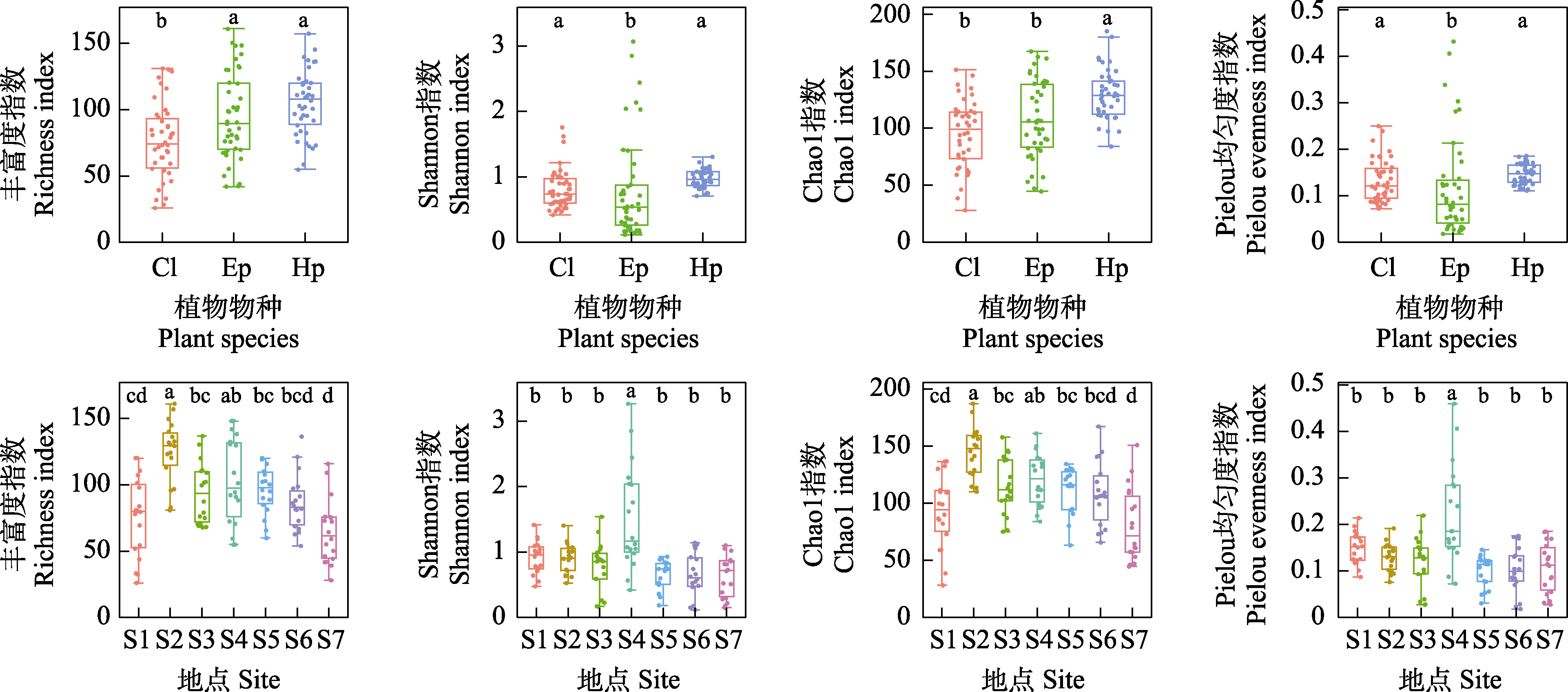
图1 荒漠灌木叶际细菌群落在不同宿主植物和地理位置的α多样性分布特征。Kruskal-Wallis检验结果显示, 不同小写字母表示α多样性指数在不同宿主植物种类和不同地理位置间的显著性差异。Kruskal-Wallis检验结果见附录7和8。植物物种: 白梭梭(Hp)、淡枝沙拐枣(Cl)和膜果麻黄(Ephedra przewalskii, Ep)。地点: S1: 火烧山; S2: 卡拉麦里山自然保护区; S3: 界碑240; S4: 一站; S5: 石西东; S6: 石西南; S7: 石西北。
Fig. 1 Alpha diversity distribution characteristics of phyllosphere bacterial communities in desert shrubs across different host plant and geographic locations. Kruskal-Wallis test results show that different lowercase letters indicate significant differences in alpha diversity indices among different host plant species and geographic locations. Kruskal-Wallis test results see Appendix 7 and 8. Plant species: Hp, Haloxylon persicum; Cl, Calligonum leucocladum; Ep, Ephedra przewalskii. Locations: S1, Huoshaoshan; S2, Karamaili Mountain Nature Reserve; S3, Boundary marker 240; S4, Yizhan; S5, Shixi east; S6, Shixi south; S7, Shixi north.
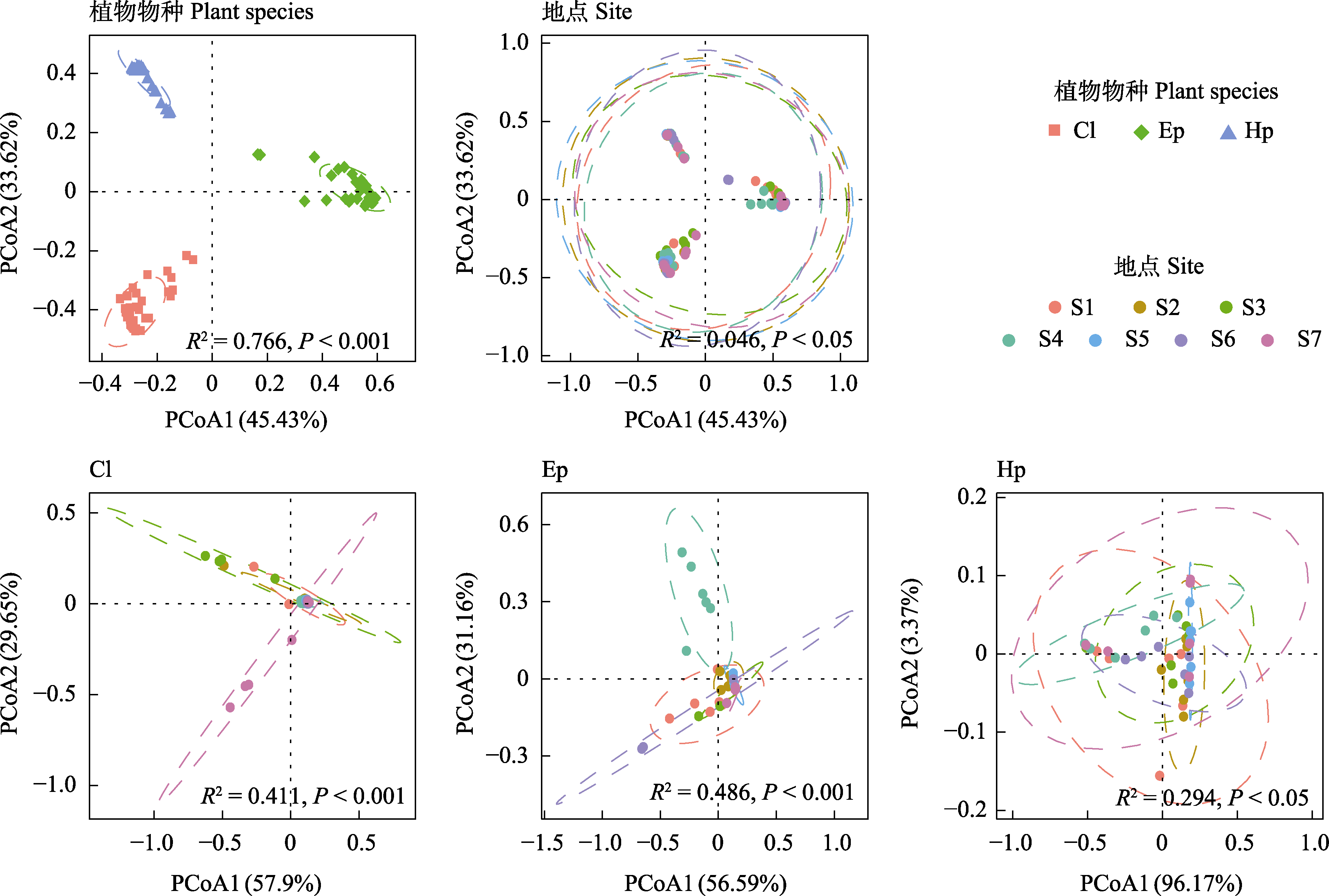
图2 基于Bray-Curtis距离的不同荒漠灌木叶际细菌群落结构主坐标分析(PCoA)。植物物种: Cl: 淡枝沙拐枣; Ep: 膜果麻黄; Hp: 白梭梭。地点: S1: 火烧山; S2: 卡拉麦里山自然保护区; S3: 界碑240; S4: 一站; S5: 石西东; S6: 石西南; S7: 石西北。
Fig. 2 Principal coordinate analysis (PCoA) of phyllosphere bacterial community structure of different desert shrub species based on Bray-Curtis distance. Hp, Haloxylon persicum; Cl, Calligonum leucocladum; Ep, Ephedra przewalskii. Locations: S1, Huoshaoshan; S2, Karamaili Mountain Nature Reserve; S3, Boundary marker 240; S4, Yizhan; S5, Shixi east; S6, Shixi south; S7, Shixi north.
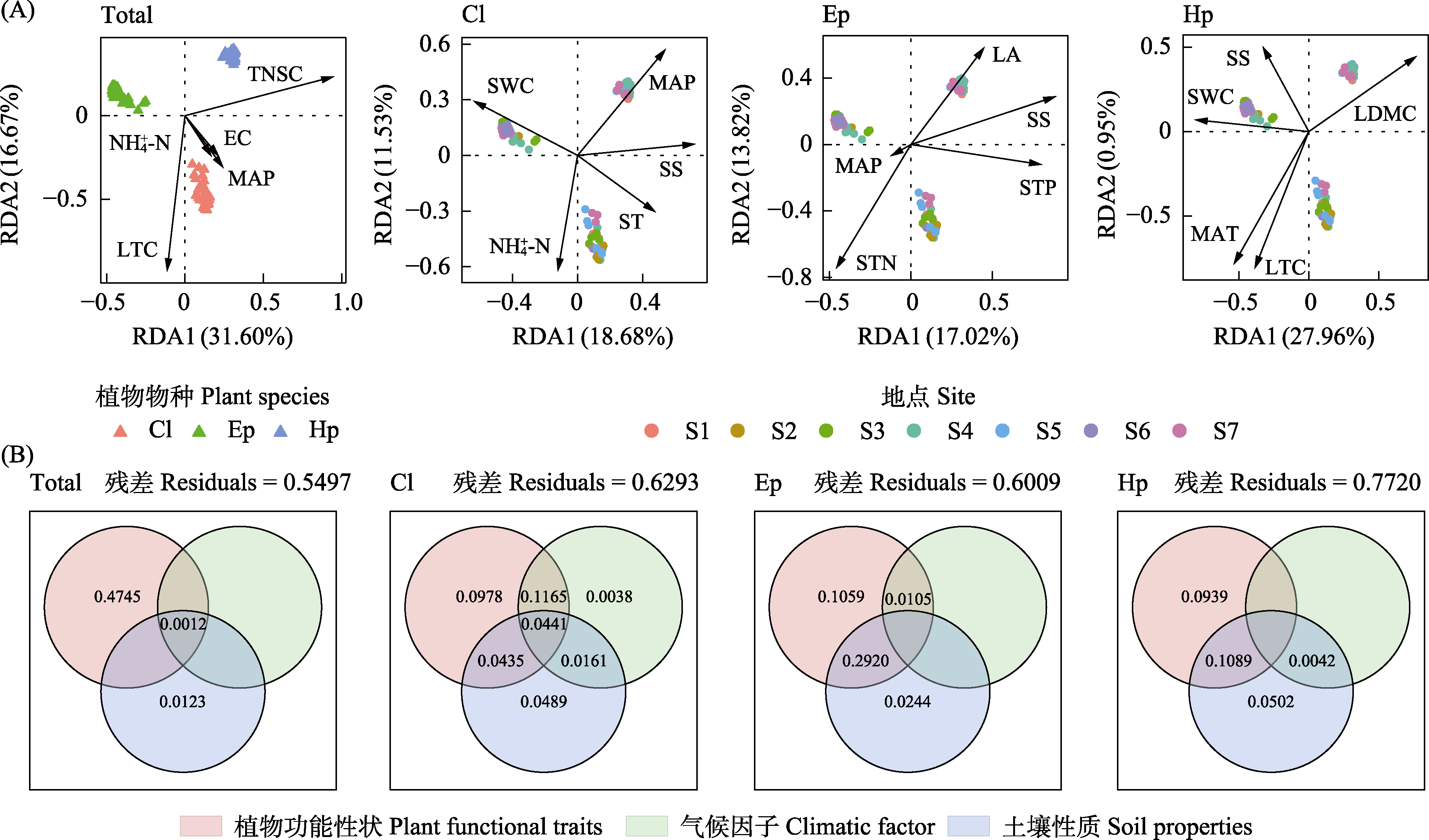
图3 荒漠灌木叶际细菌群落结构变异的影响因素。(A)冗余分析(RDA)显示叶际细菌群落与环境因素的关系。(B)变差分解(variance partitioning analysis, VPA)显示植物功能性状、气候因子和土壤性质对叶际细菌群落结构变异的解释比例。植物物种: Total: 所有物种; Cl: 淡枝沙拐枣; Ep: 膜果麻黄; Hp: 白梭梭。影响因素: LA: 叶片面积; LDMC: 叶片干物质; LTC: 叶片总碳; SS: 叶片可溶性糖; ST: 叶片淀粉; TNSC: 叶片总非结构性碳水化合物; MAP: 年平均降水量; MAT: 年平均温度; SWC: 土壤含水量; EC: 土壤电导率; STN: 土壤总氮; STP: 土壤总磷; NH4+-N: 土壤铵态氮。值 < 0未展示。
Fig. 3 Factors influencing the variation in phyllosphere bacterial community structure of desert shrubs. (A) Redundancy analysis (RDA) showing the relationship between phyllosphere bacterial communities and environmental factors. (B) Variance partitioning analysis (VPA) showing the proportion of variation in phyllosphere bacterial community structure explained by plant functional traits, climatic factors, and soil properties. Plant species: Total, Total species; Cl, Calligonum leucocladum; Ep, Ephedra przewalskii; Hp, Haloxylon persicum. Influencing factors: LA, Leaf area; LDMC, Leaf dry matter content; LTC, Leaf total carbon; SS, Leaf soluble sugars; ST, Leaf starch; TNSC, Leaf total non-structural carbohydrates; MAP, Mean annual precipitation; MAT, Mean annual temperature; SWC, Soil water content; EC, Soil electrical conductivity; STN, Soil total nitrogen; STP, Soil total phosphorus; NH4+-N, Soil ammonium nitrogen. Values < 0 not shown.
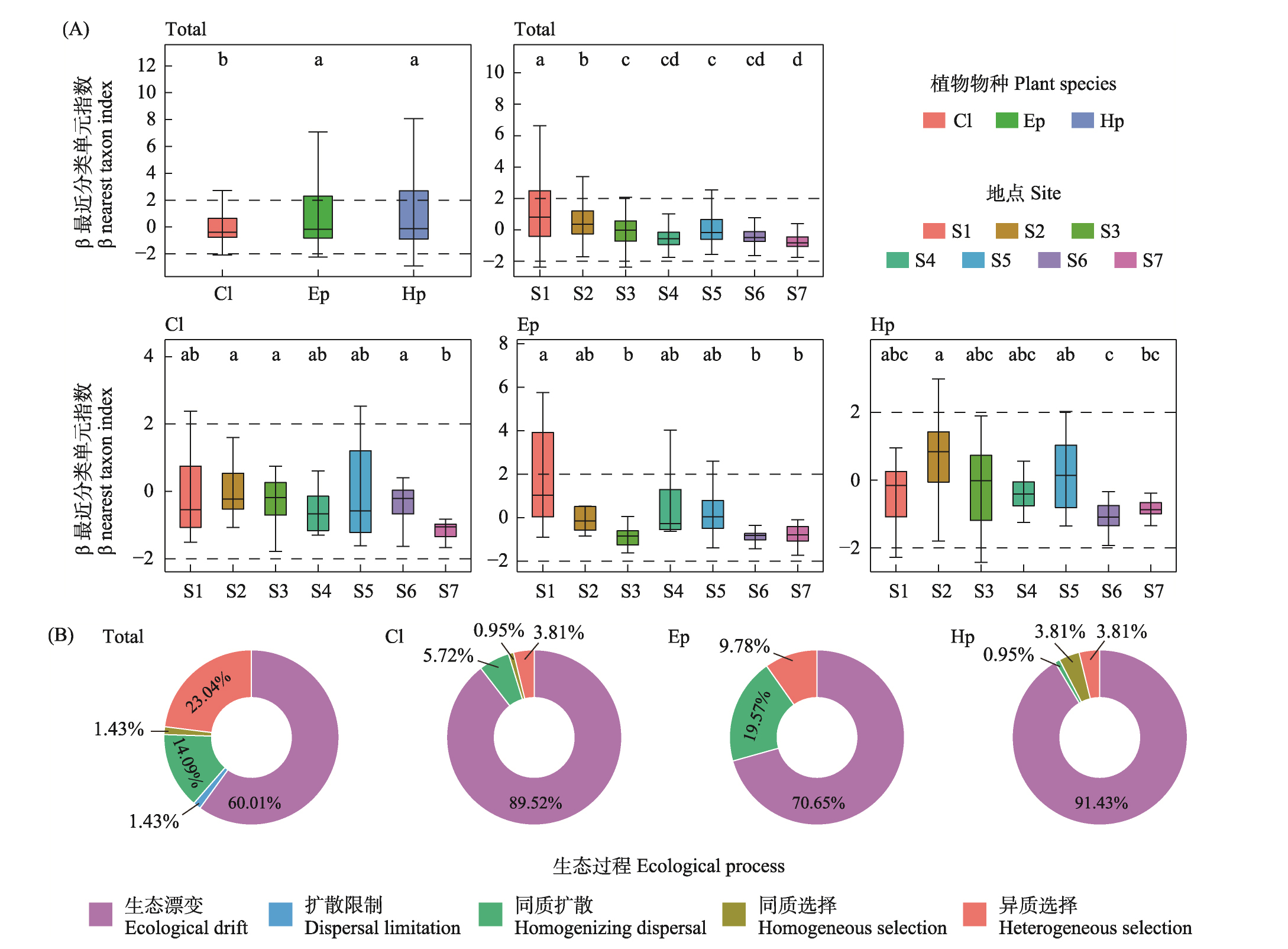
图4 荒漠灌木叶际细菌群落的构建过程。(A)在不同荒漠地理位置上, 3种荒漠灌木叶际细菌群落的β最近分类单元指数(βNTI), 虚线为阈值|2| (> |2|为偏确定性过程, < |2|为偏随机性过程)。Kruskal-Wallis检验结果显示, 不同小写字母表示βNTI在不同宿主植物种类和不同地理位置间的显著性差异。(B)基于零模型分析的确定性过程(同质选择或异质选择)与随机性过程(同质扩散、扩散限制、生态漂变)对微生物群落构建的相对影响。植物物种: Total: 所有物种; Cl: 淡枝沙拐枣; Ep: 膜果麻黄; Hp: 白梭梭。地点: S1: 火烧山; S2: 卡拉麦里山自然保护区; S3: 界碑240; S4: 一站; S5: 石西东; S6: 石西南; S7: 石西北。
Fig. 4 Assembly processes of phyllosphere bacterial communities in desert shrubs. (A) β nearest taxon index (βNTI) of phyllosphere bacterial communities of three desert shrub species across different geographic locations, the dashed line represents the threshold |2| (> |2| indicates predominantly deterministic processes, < |2| indicates predominantly stochastic processes). Kruskal-Wallis test results show that different lowercase letters indicate significant differences in βNTI among different host plant species and geographic locations. (B) Relative contributions of deterministic processes (homogeneous or heterogeneous selection) and stochastic processes (homogenizing dispersal, dispersal limitation, and ecological drift) to microbial community assembly based on null model analysis. Plant species: Total, Total species; Hp, Haloxylon persicum, Cl, Calligonum leucocladum, Ep, Ephedra przewalskii. Locations: S1, Huoshaoshan; S2, Karamaili Mountain Nature Reserve; S3, Boundary marker 240; S4, Yizhan; S5, Shixi east; S6, Shixi south; S7, Shixi north.
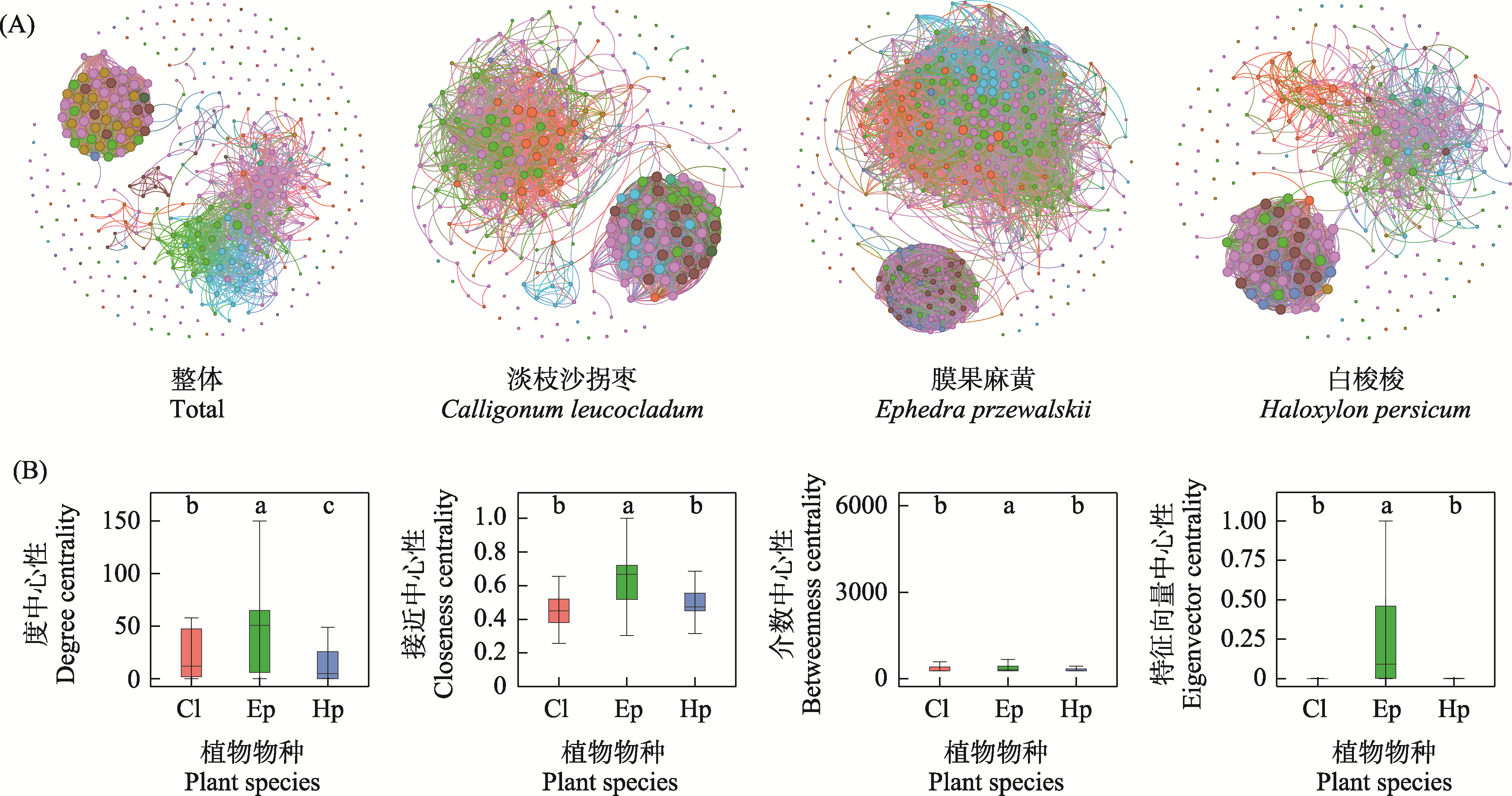
图5 荒漠灌木叶际细菌的共线网络。(A)不同荒漠灌木叶际细菌的共现网络, 相同颜色节点代表同一模块。(B)不同荒漠灌木叶际细菌共现网络的网络中心性指标。植物物种: Total: 所有物种; Cl: 淡枝沙拐枣; Ep: 膜果麻黄; Hp: 白梭梭。Kruskal-Wallis检验结果见附录16。
Fig. 5 Co-occurrence networks of phyllosphere bacteria in desert shrubs. (A) Co-occurrence networks of phyllosphere bacteria in different desert shrub species; nodes with the same color belong to the same module. (B) Network centrality metrics of co-occurrence networks in different desert shrub species. Plant species: Total, Total species; Cl, Calligonum leucocladum; Ep, Ephedra przewalskii; Hp, Haloxylon persicum. Kruskal-Wallis test results see Appendix 16.
| [1] |
Andrews JH, Harris RF (2000) The ecology and biogeography of microorganisms on plant surfaces. Annual Review of Phytopathology, 38, 145-180.
DOI PMID |
| [2] |
Aschenbrenner IA, Cernava T, Erlacher A, Berg G, Grube M (2017) Differential sharing and distinct co-occurrence networks among spatially close bacterial microbiota of bark, mosses and lichens. Molecular Ecology, 26, 2826-2838.
DOI PMID |
| [3] |
Bashir I, War AF, Rafiq I, Reshi ZA, Rashid I, Shouche YS (2022) Phyllosphere microbiome: Diversity and functions. Microbiological Research, 254, 126888.
DOI URL |
| [4] |
Bulgarelli D, Schlaeppi K, Spaepen S, van Themaat EVL, Schulze-Lefert P (2013) Structure and functions of the bacterial microbiota of plants. Annual Review of Plant Biology, 64, 807-838.
DOI PMID |
| [5] | Carlström CI, Field CM, Bortfeld-Miller M, Müller B, Sunagawa S, Vorholt JA (2019) Synthetic microbiota reveal priority effects and keystone strains in the Arabidopsis phyllosphere. Nature Ecology & Evolution, 3, 1445-1454. |
| [6] |
Chaffron S, Rehrauer H, Pernthaler J, von Mering C (2010) A global network of coexisting microbes from environmental and whole-genome sequence data. Genome Research, 20, 947-959.
DOI PMID |
| [7] |
Chase JM (2003) Community assembly: When should history matter? Oecologia, 136, 489-498.
PMID |
| [8] |
Chen QL, Ding J, Zhu D, Hu HW, Delgado-Baquerizo M, Ma YB, He JZ, Zhu YG (2020) Rare microbial taxa as the major drivers of ecosystem multifunctionality in long-term fertilized soils. Soil Biology and Biochemistry, 141, 107686.
DOI URL |
| [9] | Delgado-Baquerizo M, Reich PB, Trivedi C, Eldridge DJ, Abades S, Alfaro FD, Bastida F, Berhe AA, Cutler NA, Gallardo A, García-Velázquez L, Hart SC, Hayes PE, He JZ, Hseu ZY, Hu HW, Kirchmair M, Neuhauser S, Pérez CA, Reed SC, Santos F, Sullivan BW, Trivedi P, Wang JT, Weber-Grullon L, Williams MA, Singh BK (2020) Multiple elements of soil biodiversity drive ecosystem functions across biomes. Nature Ecology & Evolution, 4, 210-220. |
| [10] |
Fan KK, Weisenhorn P, Gilbert JA, Chu HY (2018) Wheat rhizosphere harbors a less complex and more stable microbial co-occurrence pattern than bulk soil. Soil Biology and Biochemistry, 125, 251-260.
DOI URL |
| [11] |
Feng K, Zhang ZJ, Cai WW, Liu WZ, Xu MY, Yin HQ, Wang AJ, He ZL, Deng Y (2017) Biodiversity and species competition regulate the resilience of microbial biofilm community. Molecular Ecology, 26, 6170-6182.
DOI PMID |
| [12] |
Finkel OM, Burch AY, Elad T, Huse SM, Lindow SE, Post AF, Belkin S (2012) Distance-decay relationships partially determine diversity patterns of phyllosphere bacteria on Tamarix trees across the Sonoran Desert. Applied and Environmental Microbiology, 78, 6187-6193.
DOI PMID |
| [13] |
Finkel OM, Burch AY, Lindow SE, Post AF, Belkin S (2011) Geographical location determines the population structure in phyllosphere microbial communities of a salt-excreting desert tree. Applied and Environmental Microbiology, 77, 7647-7655.
DOI PMID |
| [14] |
Foster EA, Franks DW, Morrell LJ, Balcomb KC, Parsons KM, van Ginneken A, Croft DP (2012) Social network correlates of food availability in an endangered population of killer whales, Orcinus orca. Animal Behaviour, 83, 731-736.
DOI URL |
| [15] |
Fürnkranz M, Wanek W, Richter A, Abell G, Rasche F, Sessitsch A (2008) Nitrogen fixation by phyllosphere bacteria associated with higher plants and their colonizing epiphytes of a tropical lowland rainforest of Costa Rica. The ISME Journal, 2, 561-570.
DOI URL |
| [16] |
Gamalero E, Berta G, Massa N, Glick BR, Lingua G (2008) Synergistic interactions between the ACC deaminase- producing bacterium Pseudomonas putida UW4 and the AM fungus Gigaspora rosea positively affect cucumber plant growth. FEMS Microbiology Ecology, 64, 459-467.
DOI PMID |
| [17] |
Gao C, Xu L, Montoya L, Madera M, Hollingsworth J, Chen L, Purdom E, Singan V, Vogel J, Hutmacher RB, Dahlberg JA, Coleman-Derr D, Lemaux PG, Taylor JW (2022) Co-occurrence networks reveal more complexity than community composition in resistance and resilience of microbial communities. Nature Communications, 13, 3867.
DOI PMID |
| [18] | Gilbert B, Levine JM (2017) Ecological drift and the distribution of species diversity. Proceedings of the Royal Society B: Biological Sciences, 284, 20170507. |
| [19] |
Guo CY, Yang A, Zhang WH (2024) Host identity determines the bacterial and fungal community and network structures in the phyllosphere of plant species in a temperate steppe. Phytobiomes Journal, 8, 143-154.
DOI URL |
| [20] |
Guo DL, Mitchell RJ, Hendricks JJ (2004) Fine root branch orders respond differentially to carbon source-sink manipulations in a longleaf pine forest. Oecologia, 140, 450-457.
PMID |
| [21] |
Hernandez DJ, David AS, Menges ES, Searcy CA, Afkhami ME (2021) Environmental stress destabilizes microbial networks. The ISME Journal, 15, 1722-1734.
DOI URL |
| [22] |
Huang G, Li Y (2015) Phenological transition dictates the seasonal dynamics of ecosystem carbon exchange in a desert steppe. Journal of Vegetation Science, 26, 337-347.
DOI URL |
| [23] |
Huang SL, Zha XJ, Fu G (2023) Affecting factors of plant phyllosphere microbial community and their responses to climatic warming—A review. Plants, 12, 2891.
DOI URL |
| [24] |
Hunter PJ, Hand P, Pink D, Whipps JM, Bending GD (2010) Both leaf properties and microbe-microbe interactions influence within-species variation in bacterial population diversity and structure in the lettuce (Lactuca species) phyllosphere. Applied and Environmental Microbiology, 76, 8117-8125.
DOI PMID |
| [25] |
Jousset A, Bienhold C, Chatzinotas A, Gallien L, Gobet A, Kurm V, Küsel K, Rillig MC, Rivett DW, Salles JF, van der Heijden MGA, Youssef NH, Zhang XW, Wei Z, Gera Hol WH (2017) Where less may be more: How the rare biosphere pulls ecosystems strings. The ISME Journal, 11, 853-862.
DOI URL |
| [26] |
Kang LY, Chen LY, Zhang DY, Peng YF, Song YT, Kou D, Deng Y, Yang YH (2022) Stochastic processes regulate belowground community assembly in alpine grasslands on the Tibetan Plateau. Environmental Microbiology, 24, 179-194.
DOI URL |
| [27] | Kembel SW, O’Connor TK, Arnold HK, Hubbell SP, Wright SJ, Green JL (2014) Relationships between phyllosphere bacterial communities and plant functional traits in a neotropical forest. Proceedings of the National Academy of Sciences, USA, 111, 13715-13720. |
| [28] | Kumaravel S, Thankappan S, Raghupathi S, Uthandi S (2018) Draft genome sequence of plant growth-promoting and drought-tolerant Bacillus altitudinis FD48, isolated from rice phylloplane. Genome Announcements, 6, e00019-e00018. |
| [29] |
Laforest-Lapointe I, Messier C, Kembel SW (2016) Host species identity, site and time drive temperate tree phyllosphere bacterial community structure. Microbiome, 4, 27.
DOI PMID |
| [30] |
Li J, Petticord DF, Jin MK, Huang LJ, Hui DF, Sardans J, Peñuelas J, Yang XR, Zhu YG (2025) From nature to urbanity: Exploring phyllosphere microbiome and functional gene responses to the Anthropocene. New Phytologist, 245, 591-606.
DOI PMID |
| [31] | Li Y, Ge Y, Wang JC, Shen CC, Wang JL, Liu YJ (2021) Functional redundancy and specific taxa modulate the contribution of prokaryotic diversity and composition to multifunctionality. Molecular Ecology, 30, 2915-2930. |
| [32] |
Li Y, Wang JS, Pan JX, Zhang RY, Zhou B, Niu SL (2025) Divergent assembly processes of phyllosphere and rhizosphere microbial communities along environmental gradient. Plant, Cell & Environment, 48, 1380-1392.
DOI URL |
| [33] |
Li YS, Jin L, Wu MH, Wang B, Qu N, Zhou HZ, Chen T, Liu GX, Yue M, Zhang GS (2024) Forest management positively reshapes the phyllosphere bacterial community and improves community stability. Environment International, 186, 108611.
DOI URL |
| [34] |
Lindow SE, Brandl MT (2003) Microbiology of the phyllosphere. Applied and Environmental Microbiology, 69, 1875-1883.
DOI PMID |
| [35] |
Liu BW, Li SY, Zhu H, Liu GX (2023) Phyllosphere eukaryotic microalgal communities in rainforests: Drivers and diversity. Plant Diversity, 45, 45-53.
DOI URL |
| [36] |
Liu NN, Hu HF, Ma WH, Deng Y, Wang QG, Luo A, Meng JH, Feng XJ, Wang ZH, Liu NN, Hu HF, Ma WH, Deng Y, Wang QG, Luo A, Meng JH, Feng XJ, Wang ZH (2021) Relative importance of deterministic and stochastic processes on soil microbial community assembly in temperate grasslands. Microorganisms, 9, 1929.
DOI URL |
| [37] |
Locey KJ (2010) Synthesizing traditional biogeography with microbial ecology: The importance of dormancy. Journal of Biogeography, 37, 1835-1841.
DOI URL |
| [38] |
Lomolino MV (2010) Four Darwinian themes on the origin, evolution and preservation of island life. Journal of Biogeography, 37, 985-994.
DOI URL |
| [39] |
Meyer KM, Porch R, Muscettola IE, Vasconcelos ALS, Sherman JK, Metcalf CJE, Lindow SE, Koskella B (2022) Plant neighborhood shapes diversity and reduces interspecific variation of the phyllosphere microbiome. The ISME Journal, 16, 1376-1387.
DOI URL |
| [40] | Mohammadipanah F, Wink J (2016) Actinobacteria from arid and desert habitats: Diversity and biological activity. Frontiers in Microbiology, 6, 1541. |
| [41] |
Müller T, Ruppel S (2014) Progress in cultivation-independent phyllosphere microbiology. FEMS Microbiology Ecology, 87, 2-17.
DOI PMID |
| [42] |
Nemergut DR, Schmidt SK, Fukami T, O’Neill SP, Bilinski TM, Stanish LF, Knelman JE, Darcy JL, Lynch RC, Wickey P, Ferrenberg S (2013) Patterns and processes of microbial community assembly. Microbiology and Molecular Biology Reviews, 77, 342-356.
DOI PMID |
| [43] |
Noble AS, Abbaszadeh J, Lee CK (2025) Host selection is not a universal driver of phyllosphere community assembly among ecologically similar native New Zealand plant species. Microbiome, 13, 35.
DOI PMID |
| [44] |
Pedraza RO, Bellone CH, Carrizo de Bellone S, Boa Sorte PMF, dos Santos Teixeira KR (2009) Azospirillum inoculation and nitrogen fertilization effect on grain yield and on the diversity of endophytic bacteria in the phyllosphere of rice rainfed crop. European Journal of Soil Biology, 45, 36-43.
DOI URL |
| [45] | Power ME, Tilman D, Estes JA, Menge BA, Bond WJ, Mills LS, Daily G, Castilla JC, Lubchenco J, Paine RT (1996) Challenges in the quest for keystones. BioScience, 46, 609-620. |
| [46] |
Purahong W, Hyde KD (2011) Effects of fungal endophytes on grass and non-grass litter decomposition rates. Fungal Diversity, 47, 1-7.
DOI URL |
| [47] |
Qian X, Li HZ, Wang YL, Wu BW, Wu MS, Chen L, Li XC, Zhang Y, Wang XP, Shi MM, Zheng Y, Guo LD, Zhang DX (2019) Leaf and root endospheres harbor lower fungal diversity and less complex fungal co-occurrence patterns than rhizosphere. Frontiers in Microbiology, 10, 1015.
DOI PMID |
| [48] |
Qian X, Li SC, Wu BW, Wang YL, Ji NN, Yao H, Cai HY, Shi MM, Zhang DX (2020) Mainland and island populations of Mussaenda kwangtungensis differ in their phyllosphere fungal community composition and network structure. Scientific Reports, 10, 952.
DOI PMID |
| [49] |
Redford AJ, Bowers RM, Knight R, Linhart Y, Fierer N (2010) The ecology of the phyllosphere: Geographic and phylogenetic variability in the distribution of bacteria on tree leaves. Environmental Microbiology, 12, 2885-2893.
DOI PMID |
| [50] | Reisberg EE, Hildebrandt U, Riederer M, Hentschel U (2013) Distinct phyllosphere bacterial communities on Arabidopsis wax mutant leaves. PLoS ONE, 8, e78613. |
| [51] |
Remus-Emsermann MNP, Tecon R, Kowalchuk GA, Leveau JHJ (2012) Variation in local carrying capacity and the individual fate of bacterial colonizers in the phyllosphere. The ISME Journal, 6, 756-765.
DOI URL |
| [52] |
Ruuskanen MO, Sommeria-Klein G, Havulinna AS, Niiranen TJ, Lahti L (2021) Modelling spatial patterns in host-associated microbial communities. Environmental Microbiology, 23, 2374-2388.
DOI PMID |
| [53] | Sangiorgio D, Cáliz J, Mattana S, Barceló A, De Cinti B, Elustondo D, Hellsten S, Magnani F, Matteucci G, Merilä P, Nicolas M, Ravaioli D, Thimonier A, Vanguelova E, Verstraeten A, Waldner P, Casamayor EO, Peñuelas J, Mencuccini M, Guerrieri R (2024) Host species and temperature drive beech and Scots pine phyllosphere microbiota across European forests. Communications Earth & Environment, 5, 747. |
| [54] |
Shi SJ, Nuccio EE, Shi ZJ, He ZL, Zhou JZ, Firestone MK (2016) The interconnected rhizosphere: High network complexity dominates rhizosphere assemblages. Ecology Letters, 19, 926-936.
DOI PMID |
| [55] |
Stegen JC, Lin XJ, Konopka AE, Fredrickson JK (2012) Stochastic and deterministic assembly processes in subsurface microbial communities. The ISME Journal, 6, 1653-1664.
DOI URL |
| [56] |
Stone BWG, Jackson CR (2016) Biogeographic patterns between bacterial phyllosphere communities of the southern magnolia (Magnolia grandiflora) in a small forest. Microbial Ecology, 71, 954-961.
DOI PMID |
| [57] |
Suseela V, Conant RT, Wallenstein MD, Dukes JS (2012) Effects of soil moisture on the temperature sensitivity of heterotrophic respiration vary seasonally in an old-field climate change experiment. Global Change Biology, 18, 336-348.
DOI URL |
| [58] | Tilman D (2004) Niche tradeoffs, neutrality, and community structure: A stochastic theory of resource competition, invasion, and community assembly. Proceedings of the National Academy of Sciences, USA, 101, 10854-10861. |
| [59] |
Vorholt JA (2012) Microbial life in the phyllosphere. Nature Reviews Microbiology, 10, 828-840.
DOI PMID |
| [60] |
Voříšková J, Baldrian P (2013) Fungal community on decomposing leaf litter undergoes rapid successional changes. The ISME Journal, 7, 477-486.
DOI URL |
| [61] |
Wang WX, Hu CC, Chang Y, Wang LB, Bi QX, Lu X, Zheng ZM, Zheng XQ, Wu D, Niu B (2023) Differentiated responses of the phyllosphere bacterial community of the yellowhorn tree to precipitation and temperature regimes across Northern China. Frontiers in Plant Science, 14, 1265362.
DOI URL |
| [62] |
Wang XG, Lü XT, Dijkstra FA, Zhang HY, Wang XB, Wu YN, Wang ZW, Feng J, Han XG (2019) Changes of plant N : P stoichiometry across a 3000-km aridity transect in grasslands of northern China. Plant and Soil, 443, 107-119.
DOI |
| [63] |
Wang XH, Xiao HL, Pang L, Wang F, Wang XH, Xiao HL, Pang L, Wang F (2024) Fungal hyphae on the assimilation branches are beneficial for Haloxylon ammodendron to absorb atmospheric water vapor: Adapting to an extreme drought environment. Plants, 13, 1233.
DOI URL |
| [64] |
Wang ZH, Jiang Y, Zhang MH, Chu CJ, Chen YF, Fang S, Jin GZ, Jiang MX, Lian JY, Li YP, Liu Y, Ma KP, Mi XC, Qiao XJ, Wang XH, Wang XG, Xu H, Ye WH, Zhu L, Zhu Y, He FL, Kembel SW (2023) Diversity and biogeography of plant phyllosphere bacteria are governed by latitude-dependent mechanisms. New Phytologist, 240, 1534-1547.
DOI URL |
| [65] |
Warmink JA, van Elsas JD (2008) Selection of bacterial populations in the mycosphere of Laccaria proxima: Is type III secretion involved? The ISME Journal, 2, 887-900.
DOI URL |
| [66] |
Wei TT, Cai HY, Zhang XD, Yang JJ, Huang ZN, Sun SJ, Duan TT, Shi MM, Tu TY, Qian X (2024) Impact of plant species identity and island characteristics on phyllosphere fungal community structure in an island ecosystem. Fungal Ecology, 70, 101357.
DOI URL |
| [67] | Wei YQ, Lan GY, Wu ZX, Chen BQ, Quan F, Li MM, Sun SQ, Du HN (2022) Phyllosphere fungal communities of rubber trees exhibited biogeographical patterns, but not bacteria. Environmental Microbiology, 24, 3777-3790. |
| [68] |
Whipps JM, Hand P, Pink D, Bending GD (2008) Phyllosphere microbiology with special reference to diversity and plant genotype. Journal of Applied Microbiology, 105, 1744-1755.
DOI PMID |
| [69] |
Yan ZZ, Chen QL, Li CY, Thi Nguyen BA, He JZ, Hu HW (2022) Contrasting ecological processes shape the Eucalyptus phyllosphere bacterial and fungal community assemblies. Journal of Sustainable Agriculture and Environment, 1, 73-83.
DOI URL |
| [70] |
Yao H, Sun X, He C, Maitra P, Li XC, Guo LD (2019) Phyllosphere epiphytic and endophytic fungal community and network structures differ in a tropical mangrove ecosystem. Microbiome, 7, 57.
DOI PMID |
| [71] |
Zhang AL, Yin JF, Zhang YM, Wang RZ, Zhou XB, Guo H (2023) Plants alter their aboveground and belowground biomass allocation and affect community-level resistance in response to snow cover change in Central Asia, Northwest China. Science of the Total Environment, 902, 166059.
DOI URL |
| [72] |
Zhang J, Zhang YM, Zhang Q (2024) Host plant traits play a crucial role in shaping the composition of epiphytic microbiota in the arid desert, Northwest China. Journal of Arid Land, 16, 699-724.
DOI |
| [73] | Zhou JZ, Ning DL (2017) Stochastic community assembly: Does it matter in microbial ecology? Microbiology and Molecular Biology Reviews, 81, e00002-e00017. |
| [74] |
Zhou Q, Zhang XM, He RJ, Wang SR, Jiao CC, Huang R, He XW, Zeng J, Zhao DY, Zhou Q, Zhang XM, He RJ, Wang SR, Jiao CC, Huang R, He XW, Zeng J, Zhao DY (2019) The composition and assembly of bacterial communities across the rhizosphere and phyllosphere compartments of Phragmites australis. Diversity, 11, 98.
DOI URL |
| [75] |
Zhu YG, Xiong C, Wei Z, Chen QL, Ma B, Zhou SYD, Tan JQ, Zhang LM, Cui HL, Duan GL (2022) Impacts of global change on phyllosphere microbiome. New Phytologist, 234, 1977-1986.
DOI URL |
| [1] | 尹翔正, 姜海燕, 张俊, 罗春生, 张元明. 极端干旱区荒漠灌木叶际细菌群落多样性特征[J]. 生物多样性, 2026, 34(4): 25485-. |
| [2] | 李佳璐, 李启研, 赵珮杉, 高广磊, 丁国栋, 张英. 降水量与塔里木盆地南缘荒漠土壤细菌群落多样性和稳定性的相关性[J]. 生物多样性, 2025, 33(9): 25082-. |
| [3] | 李玉, 周立志. 淮河干流越冬水鸟多样性的时空格局及其影响因素[J]. 生物多样性, 2025, 33(8): 24590-. |
| [4] | 王陈, 徐佳杰, 安瑞志, 卫佩佩, 吴湘君, 巴桑. 环境DNA揭示枯水期雅鲁藏布江中游河段原生动物多样性模式与地理分布格局[J]. 生物多样性, 2025, 33(6): 24486-. |
| [5] | 李尚炫, 明姣, 陈根娟, 武杰, 张丙昌. 晋西北风沙区植被与生物结皮协同发育对土壤细菌群落的影响[J]. 生物多样性, 2025, 33(10): 25236-. |
| [6] | 李斌, 宋鹏飞, 顾海峰, 徐波, 刘道鑫, 江峰, 梁程博, 张萌, 高红梅, 蔡振媛, 张同作. 昆仑山青海片区鸟类群落多样性格局及其驱动因素[J]. 生物多样性, 2024, 32(4): 23406-. |
| [7] | 曲锐, 左振君, 王有鑫, 张良键, 吴志刚, 乔秀娟, 王忠. 基于元素组的生物地球化学生态位及其在不同生态系统中的应用[J]. 生物多样性, 2024, 32(4): 23378-. |
| [8] | 郑梦瑶, 李媛, 王雪蓉, 张越, 贾彤. 芦芽山不同植被类型土壤原生动物群落构建机制[J]. 生物多样性, 2024, 32(4): 23419-. |
| [9] | 徐凯伦, 陈小荣, 张敏华, 于婉婉, 吴素美, 朱志成, 陈定云, 兰荣光, 董舒, 刘宇. 演替和地形共同影响浙江百山祖森林群落的性系统多样性[J]. 生物多样性, 2024, 32(12): 24338-. |
| [10] | 段晓敏, 李佳佳, 李靖宇, 李艳楠, 袁存霞, 王英娜, 刘建利. 腾格里沙漠东南缘藓结皮植物-土壤连续体不同粒径土壤微生物群落多样性[J]. 生物多样性, 2023, 31(9): 23131-. |
| [11] | 张雅丽, 张丙昌, 赵康, 李凯凯, 刘燕晋. 毛乌素沙地不同类型生物结皮细菌群落差异及其驱动因子[J]. 生物多样性, 2023, 31(8): 23027-. |
| [12] | 杨胜娴, 杨清, 李晓东, 巢欣, 刘惠秋, 魏蓝若雪, 巴桑. 确定性过程主导高原典型河流浮游植物地理分布格局和群落构建[J]. 生物多样性, 2023, 31(7): 23092-. |
| [13] | 肖媛媛, 冯薇, 乔艳桂, 张宇清, 秦树高. 固沙灌木林地土壤微生物群落特征对土壤多功能性的影响[J]. 生物多样性, 2023, 31(4): 22585-. |
| [14] | 杜芳, 荣晓莹, 徐鹏, 尹本丰, 张元明. 降水对古尔班通古特沙漠细菌群落多样性和构建过程的影响[J]. 生物多样性, 2023, 31(2): 22492-. |
| [15] | 杨清, 张鹏, 安瑞志, 乔楠茜, 达珍, 巴桑. 拉萨河中下游纤毛虫群落时空分布模式及其驱动机制[J]. 生物多样性, 2022, 30(6): 22012-. |
| 阅读次数 | ||||||
|
全文 |
|
|||||
|
摘要 |
|
|||||
备案号:京ICP备16067583号-7
Copyright © 2026 版权所有 《生物多样性》编辑部
地址: 北京香山南辛村20号, 邮编:100093
电话: 010-62836137, 62836665 E-mail: biodiversity@ibcas.ac.cn
