

生物多样性 ›› 2025, Vol. 33 ›› Issue (12): 25260. DOI: 10.17520/biods.2025260 cstr: 32101.14.biods.2025260
林雅莉1,2( ), 林舒云1(), 廖凌云1,*()(
 ), 张玮仪1(), 陈大樑1, 兰思仁1, 尹伟伦3
收稿日期:2025-07-06
接受日期:2025-11-12
出版日期:2025-12-20
发布日期:2026-01-09
通讯作者:
*E-mail: liaolingyun@fafu.edu.cn
基金资助:
Yali Lin1,2(), Shuyun Lin1(), Lingyun Liao1,*()(), Weiyi Zhang1(), Daliang Chen1, Siren Lan1, Weilun Yin3
Received:2025-07-06
Accepted:2025-11-12
Online:2025-12-20
Published:2026-01-09
Supported by:摘要:
建立自然保护地体系是生物多样性就地保护的主要形式, 而有效的管理投入为实现成功的生态保护结果提供了重要的保障。《昆明-蒙特利尔全球生物多样性框架》目标3提出“2030年全球实现30%有效保护与管理的就地保护覆盖范围”, 如何衡量目标3中就地保护措施的管理有效性, 是全球履约执行目标3的关键。为全面了解管理有效性评估的全球进展, 本文梳理以《生物多样性公约》为主线的自然保护地管理有效性评估发展脉络, 将其划分为初期发展、系统化评估、公平且有效评估、标准动态化评估4个阶段, 并总结各阶段特点, 辨析管理有效性评估的内涵演变及关键评估框架间的关系, 总结国际管理评估工具的发展趋势。基于国际管理有效性评估实践在评估体系构建、评估过程优化及评估结果呈现等方面的经验启示, 并结合我国自然保护地管理的实际需求, 提出构建中国本土化的管理有效性评估框架体系与分阶段评估流程, 旨在促进我国自然保护地管理有效性评估的规范化与标准化, 强化管理有效性评估观念的主流化应用, 以期为我国履约《昆蒙框架》目标3中衡量就地保护的管理有效性评估提供科学参考。
林雅莉, 林舒云, 廖凌云, 张玮仪, 陈大樑, 兰思仁, 尹伟伦 (2025) 《昆蒙框架》背景下自然保护地管理有效性评估演化趋势与启示. 生物多样性, 33, 25260. DOI: 10.17520/biods.2025260.
Yali Lin, Shuyun Lin, Lingyun Liao, Weiyi Zhang, Daliang Chen, Siren Lan, Weilun Yin (2025) Evolutionary trend and enlightenment of the evaluation of the management effectiveness of protected areas under the background of the Kunming-Montreal Global Biodiversity Framework. Biodiversity Science, 33, 25260. DOI: 10.17520/biods.2025260.
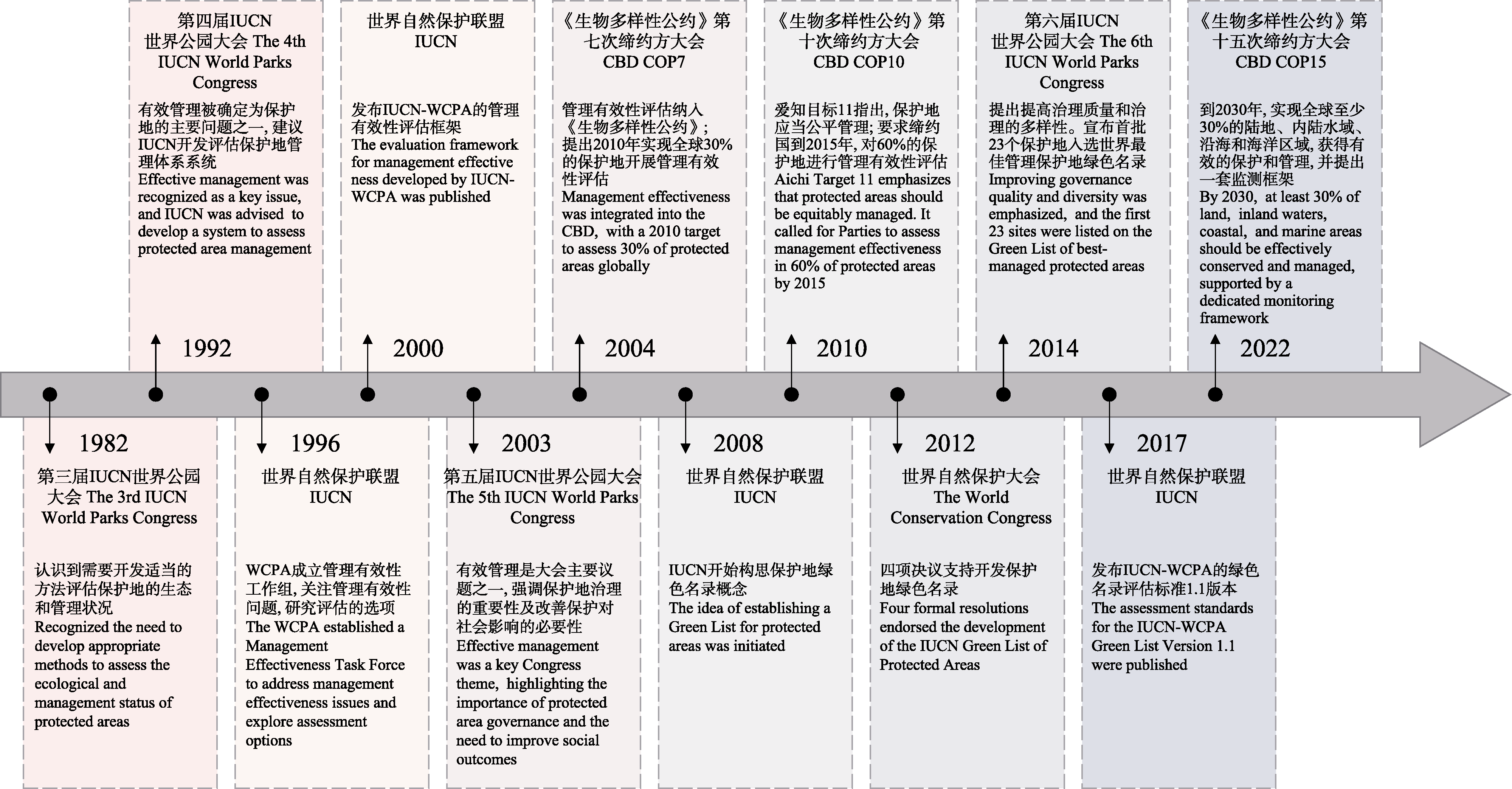
图1 全球自然保护地管理有效性评估的国际政策发展历程
Fig. 1 Timeline of international policy development for evaluating protected area management effectiveness
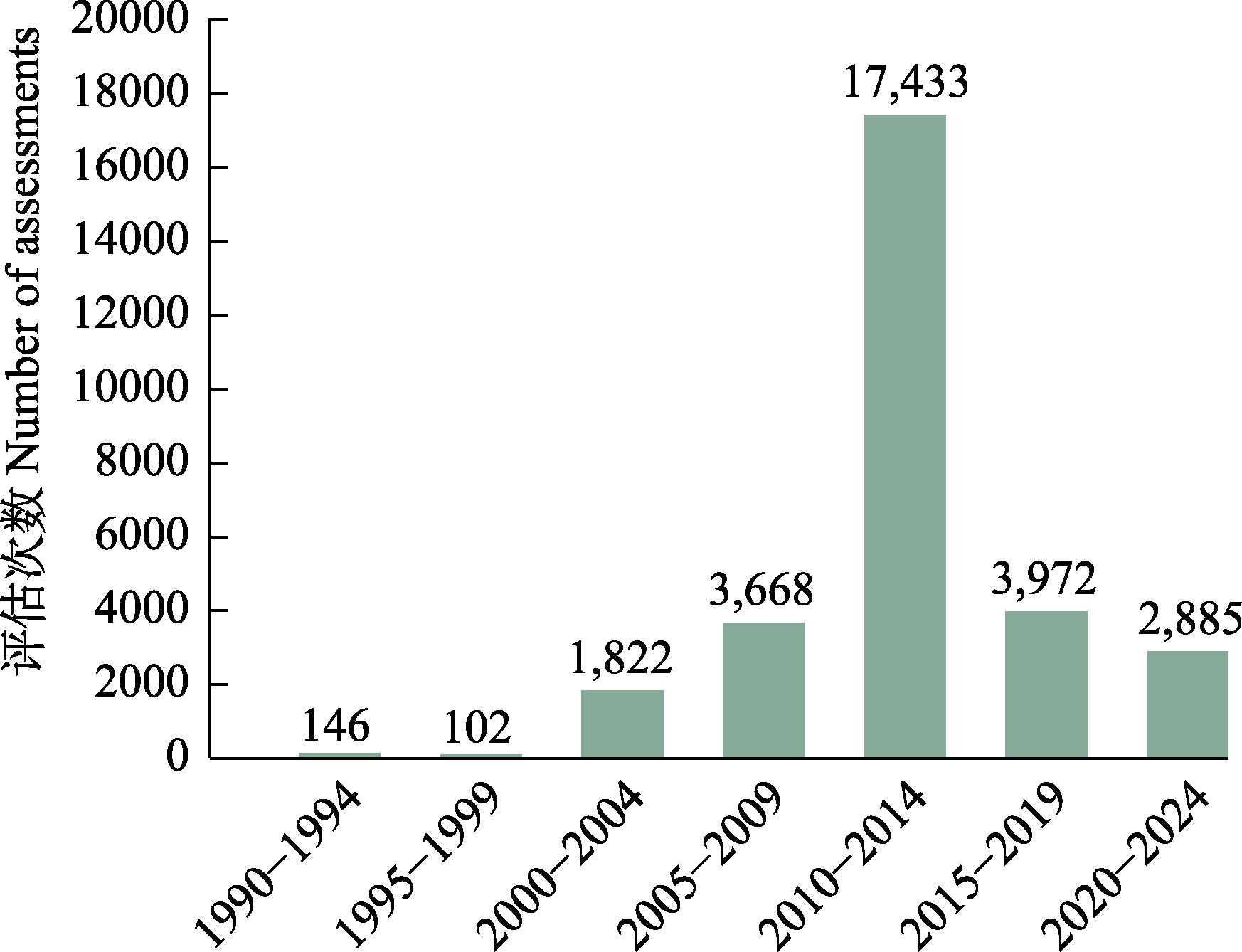
图2 1980-2025年全球自然保护地管理有效评估数据库的管理评估数量
Fig. 2 Number of protected area management effectiveness assessments in the Global Database on Protected Area Management Effectiveness (WD-PAME), 1980-2025
| 特征 Characteristics | 阶段 Phase |
|---|---|
| 初期探索阶段 Early exploratory phase 1980-2000 | (1)基于管理实践的需求 Driven by practical management needs (2)针对保护地某一特征的有效性评估 Effectiveness assessments focused on specific site attributes (3)缺乏衡量管理有效性评估的标准 Absence of standardized evaluation criteria |
| 系统化的评估阶段 Systematic evaluation phase 2000-2010 | (1)管理有效性评估纳入国际公约 Incorporated management effectiveness into international conventions (2)提出WCPA评估框架 Introduction of the WCPA evaluation framework (3)大量评估工具被开发 Development of a wide range of evaluation tools (4)评估关注管理规划与投入 Assessment focused on planning and resource inputs |
| 公平且有效的评估阶段 Fair-and-effective evaluation phase 2010-2020 | (1)管理有效性评估观念的制度化推广 Institutionalization and mainstreaming of management effectiveness concepts (2)重视管理评估的公平性 Increased emphasis on equity in management evaluation (3)提出IUCN绿色名录标准 Proposed the IUCN Green List Standard (4)评估关注保护成效的量化 Shifted toward quantitative assessment of conservation outcomes |
| 标准动态化的评估阶段 Standardized-yet-adaptive evaluation phase 2020- | (1)保护成效置于评估的核心位置 Conservation outcomes placed at the center of evaluation (2)融合多种评估框架 Integration of multiple evaluation frameworks (3)实现分阶段的动态评估 Implement dynamic evaluation in phases (4)以“有效性”呈现就地保护的覆盖范围 Effectiveness-based zoning of in situ conservation coverage |
表1 自然保护地管理有效性评估的发展阶段与特征
Table 1 Developmental stages and characteristics of protected area management effectiveness evaluation
| 特征 Characteristics | 阶段 Phase |
|---|---|
| 初期探索阶段 Early exploratory phase 1980-2000 | (1)基于管理实践的需求 Driven by practical management needs (2)针对保护地某一特征的有效性评估 Effectiveness assessments focused on specific site attributes (3)缺乏衡量管理有效性评估的标准 Absence of standardized evaluation criteria |
| 系统化的评估阶段 Systematic evaluation phase 2000-2010 | (1)管理有效性评估纳入国际公约 Incorporated management effectiveness into international conventions (2)提出WCPA评估框架 Introduction of the WCPA evaluation framework (3)大量评估工具被开发 Development of a wide range of evaluation tools (4)评估关注管理规划与投入 Assessment focused on planning and resource inputs |
| 公平且有效的评估阶段 Fair-and-effective evaluation phase 2010-2020 | (1)管理有效性评估观念的制度化推广 Institutionalization and mainstreaming of management effectiveness concepts (2)重视管理评估的公平性 Increased emphasis on equity in management evaluation (3)提出IUCN绿色名录标准 Proposed the IUCN Green List Standard (4)评估关注保护成效的量化 Shifted toward quantitative assessment of conservation outcomes |
| 标准动态化的评估阶段 Standardized-yet-adaptive evaluation phase 2020- | (1)保护成效置于评估的核心位置 Conservation outcomes placed at the center of evaluation (2)融合多种评估框架 Integration of multiple evaluation frameworks (3)实现分阶段的动态评估 Implement dynamic evaluation in phases (4)以“有效性”呈现就地保护的覆盖范围 Effectiveness-based zoning of in situ conservation coverage |
| 关键技术 Key technologies | 具体的执行方式 Implementation approach | 参考文献 References |
|---|---|---|
| 评估框架Assessment framework | UNEP-WCMC正在制定涵盖治理、管理和保护成效的评估指标体系, 通过整合已有的管理有效性评估、IUCN绿色名录标准、治理评估框架及相关方法, 以提供全面的“有效性”评估视角。在保护地系统层面, 补充如连通性和生态代表性等保护成效指标 UNEP-WCMC is developing an evaluation indicator framework that integrates governance, management, and conservation outcomes. This framework draws on existing approaches, including PAME assessments, the IUCN Green List Standard, governance evaluation frameworks, and related methodologies, to offer a more comprehensive perspective on “effectiveness”. At the system level, additional indicators such as ecological connectivity and representativeness have been proposed to capture conservation outcomes | UNEP-WCMC et al, |
| 数据转化方式 Data transformation method | 计划创建一套与IUCN分类标准、《生物多样性公约》决策一致的评估报告语言。IUCN正开发“保护行动改进基准与评估工具”, 旨在将全球不同的管理评估工具(如METT和RAPPAM)对标绿色名录框架, 使各缔约国或就地保护的管理者能依据绿色名录标准, 报告就地保护“有效性”的达成情况 A standardized reporting language aligned with the IUCN classification system and CBD decisions is also under development. IUCN is developing the “Conservation Action Improvement Benchmark and Assessment Tool” to cross-reference global management evaluation frameworks and tools. The goal is to integrate multiple assessment tools—such as METT and RAPPAM—into the Green List Standard, enabling Parties and in situ conservation managers to report on progress and achievement in management “effectiveness” based on the Green List standard | IUCN, |
| 数据上报方式 Data reporting mechanism | 允许数据提供者根据自身报告能力及数据的可获得性, 分阶段向全球自然保护地管理有效性评估数据库提交不同程度的评估数据 Data providers are allowed to submit data to Global Database on Protected Area Management Effectiveness in phases, with varying levels of detail based on their reporting capacity and data availability | CBD, |
| 结果呈现 Result presentation | UNEP-WCMC旨在开发一个灵活且具有整体性的报告系统, 以兼容全球尽可能多的网站, 向全球保护地管理有效性数据库提交评估结果。新系统将从总体有效性、管理有效性、治理有效性、保护成效四个维度呈现就地保护覆盖面积 UNEP-WCMC aims to develop a flexible yet integrated reporting system compatible with as many global platforms as possible, allowing data to be submitted to the World Database on Protected Area Management Effectiveness. The new system will present assessment results of in situ conservation coverage across four dimensions: overall effectiveness, management effectiveness, governance effectiveness, and conservation outcomes | UNEP-WCMC et al, |
表2 《昆明-蒙特利尔全球生物多样性框架》目标3管理有效性评估实践进展
Table 2 Progress in protected area management effectiveness implementation under Kunming-Montreal Global Biodiversity Framework Target 3
| 关键技术 Key technologies | 具体的执行方式 Implementation approach | 参考文献 References |
|---|---|---|
| 评估框架Assessment framework | UNEP-WCMC正在制定涵盖治理、管理和保护成效的评估指标体系, 通过整合已有的管理有效性评估、IUCN绿色名录标准、治理评估框架及相关方法, 以提供全面的“有效性”评估视角。在保护地系统层面, 补充如连通性和生态代表性等保护成效指标 UNEP-WCMC is developing an evaluation indicator framework that integrates governance, management, and conservation outcomes. This framework draws on existing approaches, including PAME assessments, the IUCN Green List Standard, governance evaluation frameworks, and related methodologies, to offer a more comprehensive perspective on “effectiveness”. At the system level, additional indicators such as ecological connectivity and representativeness have been proposed to capture conservation outcomes | UNEP-WCMC et al, |
| 数据转化方式 Data transformation method | 计划创建一套与IUCN分类标准、《生物多样性公约》决策一致的评估报告语言。IUCN正开发“保护行动改进基准与评估工具”, 旨在将全球不同的管理评估工具(如METT和RAPPAM)对标绿色名录框架, 使各缔约国或就地保护的管理者能依据绿色名录标准, 报告就地保护“有效性”的达成情况 A standardized reporting language aligned with the IUCN classification system and CBD decisions is also under development. IUCN is developing the “Conservation Action Improvement Benchmark and Assessment Tool” to cross-reference global management evaluation frameworks and tools. The goal is to integrate multiple assessment tools—such as METT and RAPPAM—into the Green List Standard, enabling Parties and in situ conservation managers to report on progress and achievement in management “effectiveness” based on the Green List standard | IUCN, |
| 数据上报方式 Data reporting mechanism | 允许数据提供者根据自身报告能力及数据的可获得性, 分阶段向全球自然保护地管理有效性评估数据库提交不同程度的评估数据 Data providers are allowed to submit data to Global Database on Protected Area Management Effectiveness in phases, with varying levels of detail based on their reporting capacity and data availability | CBD, |
| 结果呈现 Result presentation | UNEP-WCMC旨在开发一个灵活且具有整体性的报告系统, 以兼容全球尽可能多的网站, 向全球保护地管理有效性数据库提交评估结果。新系统将从总体有效性、管理有效性、治理有效性、保护成效四个维度呈现就地保护覆盖面积 UNEP-WCMC aims to develop a flexible yet integrated reporting system compatible with as many global platforms as possible, allowing data to be submitted to the World Database on Protected Area Management Effectiveness. The new system will present assessment results of in situ conservation coverage across four dimensions: overall effectiveness, management effectiveness, governance effectiveness, and conservation outcomes | UNEP-WCMC et al, |
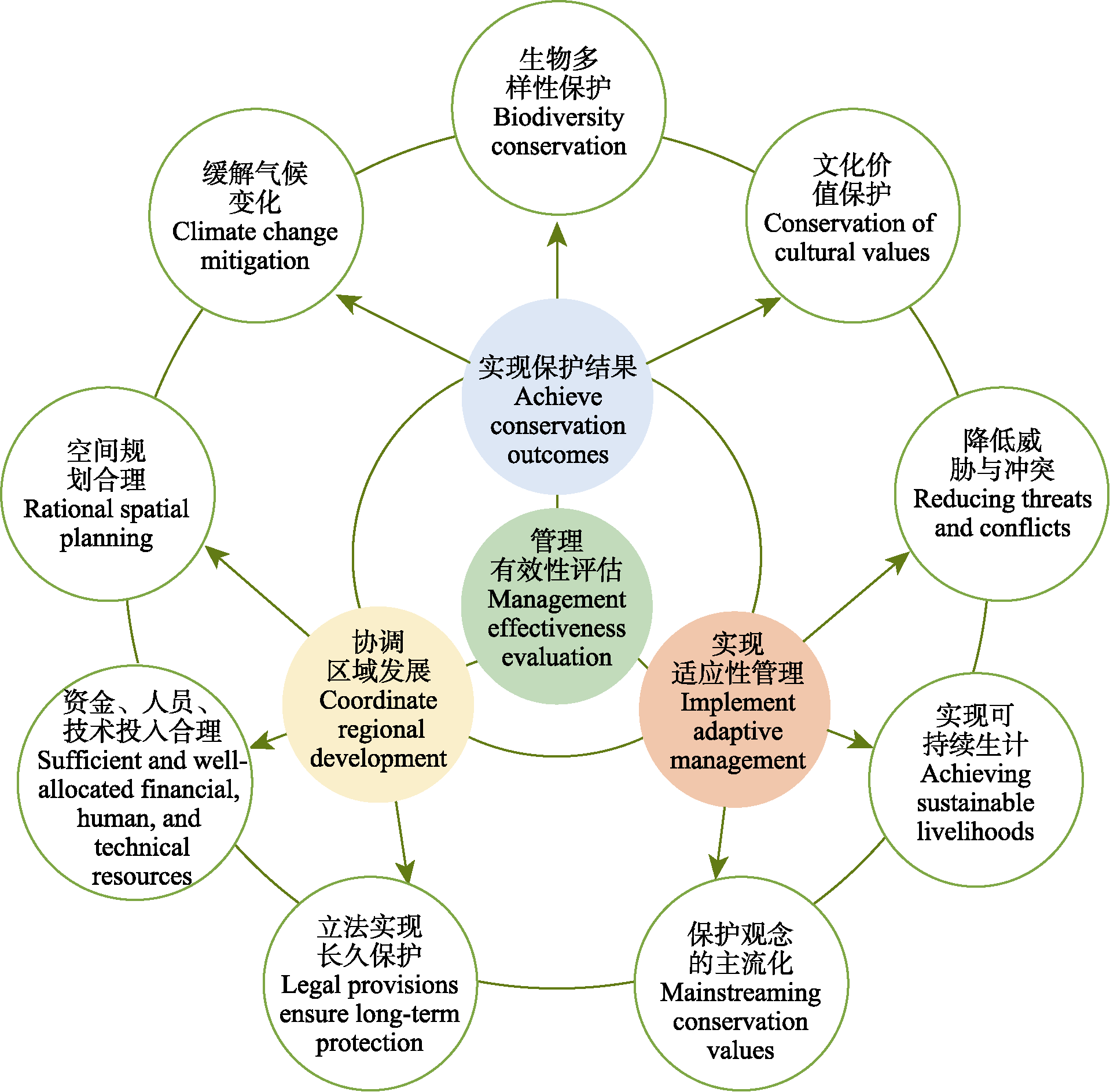
图3 管理有效性评估目的的多元化
Fig. 3 Diversification of purposes in management effectiveness assessments
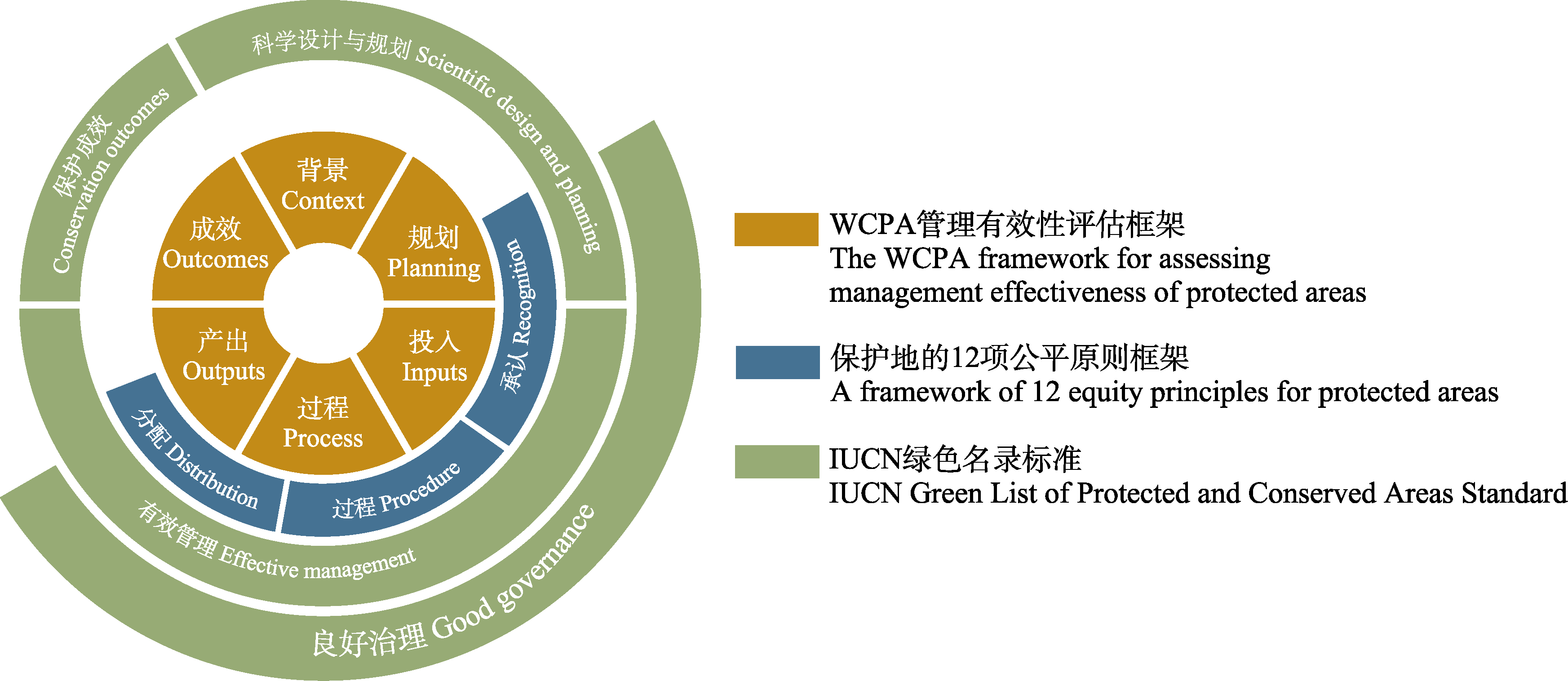
图4 WCPA管理有效性评估框架、保护地的12项公平原则框架和IUCN绿色名录标准之间的关系
Fig. 4 The relationship between the WCPA framework for assessing management effectiveness of protected areas, a framework of 12 equity principles for protected areas, and IUCN Green List of Protected and Conserved Areas Standard
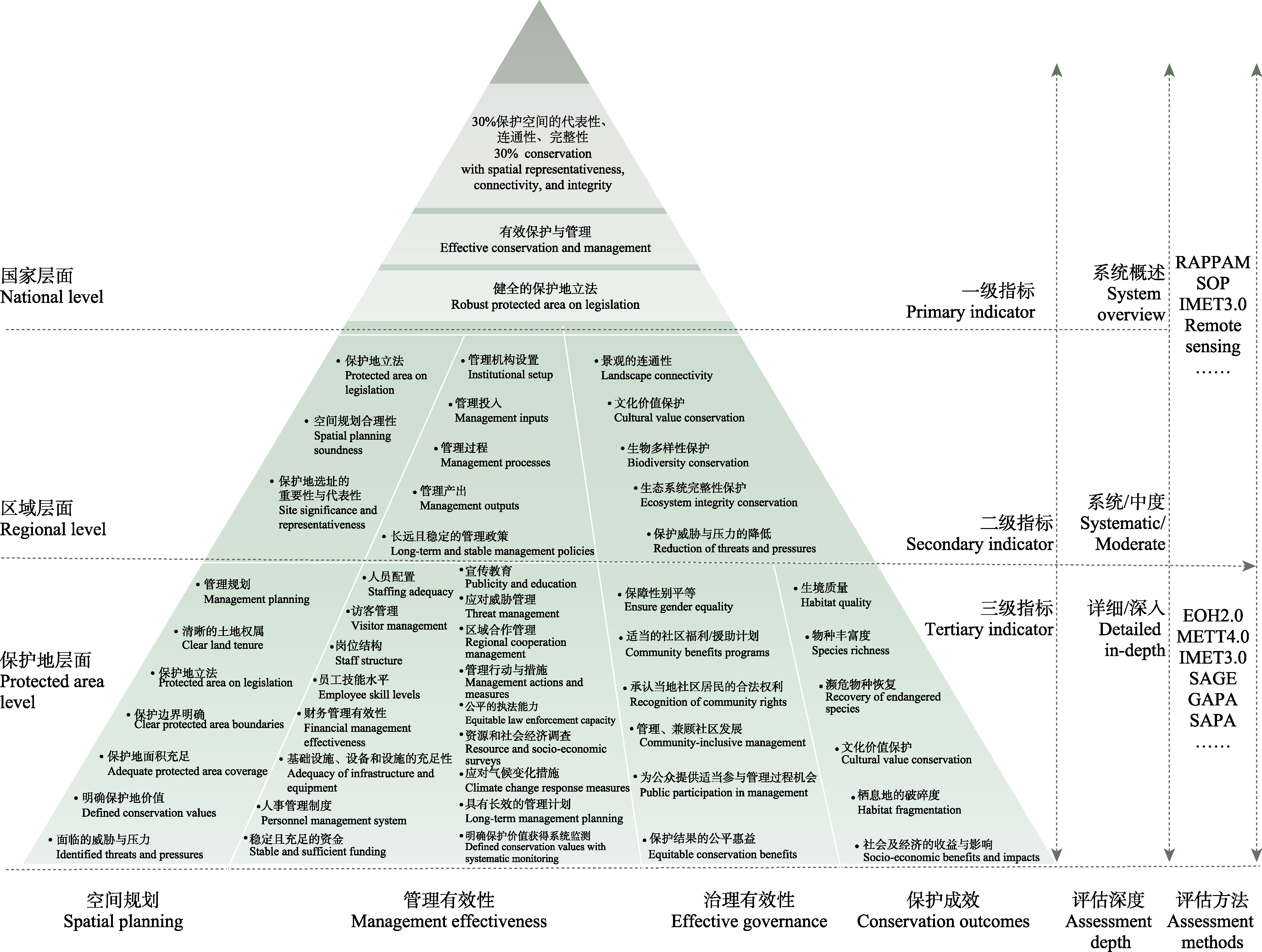
图5 中国自然保护地本土化管理有效性评估框架
Fig. 5 Localized management effectiveness assessment of protected areas framework in China
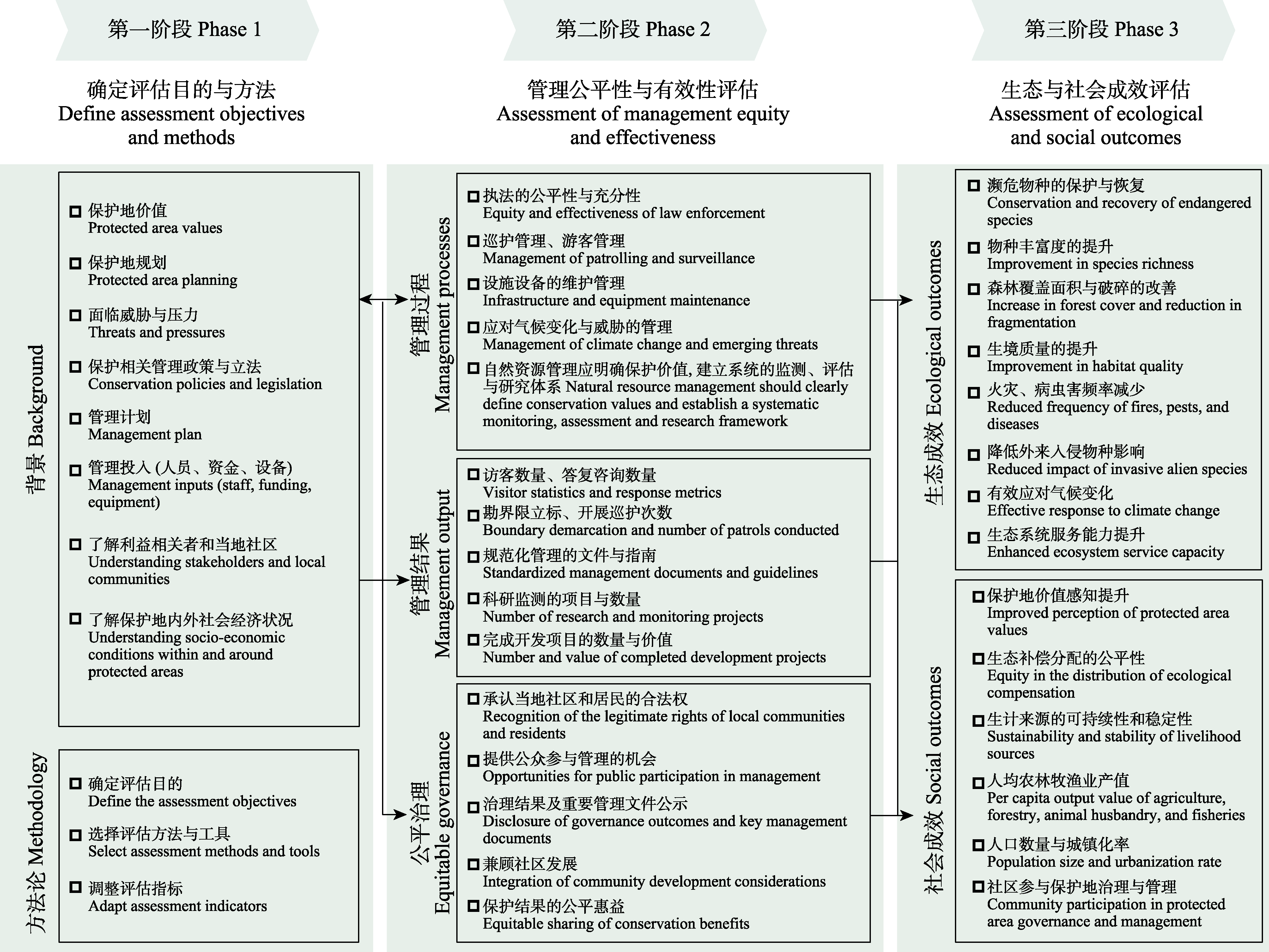
图6 中国自然保护地管理有效性分阶段评估流程
Fig. 6 Phased process for assessing management effectiveness of protected areas in China
| [1] | Alexander M, Rowell TA (1999) Recent developments in management planning and monitoring on protected sites in the UK. Parks, 9, 50-55. |
| [2] |
Arneth A, Leadley P, Claudet J, Coll M, Rondinini C, Rounsevell MDA, Shin YJ, Alexander P, Fuchs R (2023) Making protected areas effective for biodiversity, climate and food. Global Change Biology, 29, 3883-3894.
DOI PMID |
| [3] |
Ban NC, Mills M, Tam J, Hicks CC, Klain S, Stoeckl N, Bottrill MC, Levine J, Pressey RL, Satterfield T (2013) A social-ecological approach to conservation planning: Embedding social considerations. Frontiers in Ecology and the Environment, 11, 194-202.
DOI URL |
| [4] | Barnes MD, Craigie ID, Dudley N, Hockings M (2017) Understanding local-scale drivers of biodiversity outcomes in terrestrial protected areas. Annals of the New York Academy of Sciences, 1399, 42-60. |
| [5] |
Bennett NJ, Dearden P (2014) Why local people do not support conservation: Community perceptions of marine protected area livelihood impacts, governance and management in Thailand. Marine Policy, 44, 107-116.
DOI URL |
| [6] |
Bialowolski P, Rakotobe D, Marelli A, Roggeri P, Paolini C (2023) Use of the IMET tool in the evaluation of protected area management effectiveness in Central Africa. Journal of Environmental Management, 326, 116680.
DOI URL |
| [7] | Blanco R Gabaldon, M (1992) The evaluation of natural protected area systems: A numeric method. Parks, 3, 11-13. |
| [8] | Booker F, Franks P (2019) Governance Assessment for Protected and Conserved Areas (GAPA): Methodology Manual for GAPA Facilitators. IIED, London. |
| [9] | Borrini G, Dudley N, Jaeger T, Lassen B, Neema Pathak N, Phillips A, Sandwith T (2013) Governance of Protected Areas: From Understanding to Action. Best Practice Protected Area Guidelines Series No. 20. IUCN, Gland. |
| [10] | Brandon A (2014) Review of International Protected Area Management Effectiveness (PAME) Experience. https://research.ceu.edu/en/publications/review-of-international-protected-area-management-effectiveness-p.(accessedon2025-06-29) |
| [11] | CBD (Convention on Biological Diversity) (2004) Programme of Work on Protected Areas. https://www.cbd.int/doc/publications/pa-text-en.pdf?utm_source.(accessedon2025-06-29) |
| [12] | CBD (Convention on Biological Diversity) (2024a) Guidance on Using the Indicators of the Monitoring Framework of the Kunming-Montreal Global Biodiversity Framework. >https://www.cbd.int/doc/c/92cf/b458/18519b4c0b487bf9bfc23988/sbstta-26-inf-14-en.pdf?utm_source. (accessed on 2025-06-29) |
| [13] | CBD (Convention on Biological Diversity) (2024b) Recommendation Adopted by the Subsidiary Body on Scientific. https://www.cbd.int/doc/recommendations/sbstta-26/sbstta-26-rec-01-en.pdf?utm_source.(accessedon2025-06-29) |
| [14] |
Chan KMA, Guerry AD, Balvanera P, Klain S, Satterfield T, Basurto X, Bostrom A, Chuenpagdee R, Gould R, Halpern BS, Hannahs N, Levine J, Norton B, Ruckelshaus M, Russell R, Tam J, Woodside U (2012) Where are cultural and social in ecosystem services? A framework for constructive engagement. BioScience, 62, 744-756.
DOI URL |
| [15] | Chrome F (1995) A Regional Monitoring Program for the Wet Tropics of Queensland World Heritage Area. Wet Tropics Management Agency, Cairns. |
| [16] | Cifuentes M (1983) Reservas de Biosfera: Clarificación de su marcoconceptual y diseño y aplicación de una metodología para laplanificación estratégica de un subsistema nacional. Tesis Mag. Scientiae. Universidad de Costa Rica y CATIE, Turrialba. |
| [17] | Cifuentes M, Izurieta A, de Faria HH (2000) Measuring Protected Area Management Effectiveness. Technical Series No.2. WWF & IUCN & GTZ, Turrialba. |
| [18] | Coad L, Leverington F, Knights K, Geldmann J, Eassom A, Kapos V, Kingston N, de Lima M, Zamora C, Cuardros I, Nolte C, Burgess ND, Hockings M (2015) Measuring impact of protected area management interventions: Current and future use of the Global Database of Protected Area Management Effectiveness. Philosophical Transactions of the Royal Society of London Series B: Biological Sciences, 370, 20140281. |
| [19] |
Coad L, Watson JE, Geldmann J, Burgess ND, Leverington F, Hockings M, Knights K, Di Marco M (2019) Widespread shortfalls in protected area resourcing undermine efforts to conserve biodiversity. Frontiers in Ecology and the Environment, 17, 259-264.
DOI URL |
| [20] | Corrigan C, Robinson CJ, Burgess ND, Kingston N, Hockings M (2018) Global review of social indicators used in protected area management evaluation. Conservation Letters, 11, e12397. |
| [21] | de Faria HH (1993) Elaboración de un procedimiento para medir la efectividad de manejo de áreas silvestres protegidas y su aplicación en dos áreas protegidas de Costa Rica. Centro Agronómico Tropical de Investigación y Enseñanza (CATIE), Costa Rica. |
| [22] | DEFRA(Department for Environment Food & Rural Affairs) (2022) Submission from the United Kingdom of Great Britain and Northern Ireland (UK) on Progress Made in the Development of a New Globally Applicable Indicator of Protected Area Management Effectiveness. https://s3.amazonaws.com/cbddocumentspublic-imagebucket-15w2zyxk3prl8/2a0375a6e1c82aaeb8b6f5a24195de2c. (accessed on 2025-11-26) |
| [23] | Deshler WO (1982) A Systematic Approach to Effective Management of Protected Areas. IUCN Commission on National Parks and Protected Areas, Gland. |
| [24] | Du JH, Liu N, Xian YJ, Wang D, Wang W (2022) Enlightenment of biosphere reserve to establishment and management of National Park in China. Bulletin of Chinese Academy of Sciences, 37, 1602-1613. (in Chinese with English abstract) |
| [杜金鸿, 刘宁, 先义杰, 王丁, 王伟 (2022) 世界生物圈保护区对我国国家公园建设与管理的启示. 中国科学院院刊, 37, 1602-1613.] | |
| [25] |
Ervin J (2003a) Protected area assessments in perspective. BioScience, 53, 819-822
DOI URL |
| [26] | Ervin J (2003b) WWF: Rapid Assessment and Prioritization of Protected Area Management (RAPPAM) Methodology. WWF, Gland. |
| [27] |
Feng B, Li DQ, Zhang YG, Xue YD (2021) Progress and analysis on the management effectiveness evaluation of protected area based on Aichi Biodiversity Target 11th in China. Biodiversity Science, 29, 150-159. (in Chinese with English abstract)
DOI URL |
| [冯斌, 李迪强, 张于光, 薛亚东 (2021) 基于爱知生物多样性目标11的我国自然保护地管理有效性评估进展与分析. 生物多样性, 29, 150-159.] | |
| [28] | Ferreira GB, Collen B, Newbold T, Oliveira MJR, Pinheiro MS, de Pinho FF, Rowcliffe M, Carbone C (2020) Strict protected areas are essential for the conservation of larger and threatened mammals in a priority region of the Brazilian Cerrado. Biological Conservation, 251, 108762. |
| [29] | Ferreira LV, Lemos de Sá RM, Buschbacher R, Batmanian G, Bensusan NR, Costa KL (1999) Protected Areas or Endangered Spaces? WWF Report on the Degree of Implementation and the Vulnerability of Brazilian Federal Conservation Areas. WWF-Brazil, Brasília. |
| [30] | Frank L, Jo E, Leitão L, Ossola C (2023) Enhancing Our Heritage Toolkit 2.0: Assessing Management Effectiveness of World Heritage Properties and Other Heritage Places. UNESCO, ICCROM, ICOMOS & IUCN, Paris. |
| [31] | Franks P (2023) Site-Level Assessment of Governance and Equity (SAGE) for Protected and Conserved Areas; Manual for SAGE Facilitators. IIED, London. |
| [32] | Franks P, Booker F, Roe D (2018) Understanding and assessing equity in protected area conservation. IIED Issue Paper. IIED, London. |
| [33] | Franks P, Small R (2016) Social Assessment for Protected Areas (SAPA): Methodology Manual for SAPA Facilitators. IIED, London. |
| [34] | Franks P, Small R (2022) Understanding the Social Impacts of Protected Areas: A Community Perspective, 2nd edn. IIED, London. |
| [35] |
Geldmann J, Barnes M, Coad L, Craigie ID, Hockings M, Burgess ND (2013) Effectiveness of terrestrial protected areas in reducing habitat loss and population declines. Biological Conservation, 161, 230-238.
DOI URL |
| [36] | Geldmann J, Coad L, Barnes MD, Craigie ID, Woodley S, Balmford A, Brooks TM, Hockings M, Knights K, Mascia MB (2018) A global analysis of management capacity and ecological outcomes in terrestrial protected areas. Conservation Letters, 11, e12434. |
| [37] | Geldmann J, Deguignet M, Balmford A, Burgess ND, Dudley N, Hockings M, Kingston N, Klimmek H, Lewis AH, Rahbek C, Stolton S, Vincent C, Wells S, Woodley S, Watson JEM (2021) Essential indicators for measuring site-based conservation effectiveness in the post-2020 global biodiversity framework. Conservation Letters, 14, e12792. |
| [38] |
Ghoddousi A, Loos J, Kuemmerle T (2021) An outcome-oriented, social-ecological framework for assessing protected area effectiveness. BioScience, 72, 201-212.
DOI URL |
| [39] | Grorud-Colvert K, Sullivan-Stack J, Roberts C, Constant V, Horta E, Costa B, Pike EP, Kingston N, Laffoley D, Sala E, Claudet J, Friedlander AM, Gill DA, Lester SE, Day JC, Gonçalves EJ, Ahmadia GN, Rand M, Villagomez A, Ban NC, Gurney GG, Spalding AK, Bennett NJ, Briggs J, Morgan LE, Moffitt R, Deguignet M, Pikitch EK, Darling ES, Jessen S, Hameed SO, Di Carlo G, Guidetti P, Harris JM, Torre J, Kizilkaya Z, Agardy T, Cury P, Shah NJ, Sack K, Cao L, Fernandez M, Lubchenco J (2021) The MPA Guide: A framework to achieve global goals for the ocean. Science, 373, eabf0861. |
| [40] |
Growcock AJ, Sutherland EF, Stathis PT (2009) Challenges and experiences in implementing a management effectiveness evaluation program in a protected area system. Australasian Journal of Environmental Management, 16, 218-226.
DOI URL |
| [41] | Guo ZL, Zhu W, Lei YR, Ning Y, Wang YF (2020) Assessment methods for the protected area management effectiveness. World Forestry Research, 33(3), 13-19. (in Chinese with English abstract) |
| [郭子良, 祝伟, 雷茵茹, 宁宇, 王义飞 (2020) 自然保护地管理有效性评估方法综述. 世界林业研究, 33(3), 13-19.] | |
| [42] | Hilton M, Cook CN (2022) Defining performance thresholds for effective management of biodiversity within protected areas. Conservation Biology, 36, e13963. |
| [43] |
Hockings M (1998) Evaluating management of protected areas: Integrating planning and evaluation. Environmental Management, 22, 337-345.
PMID |
| [44] | Hockings M (2000) Evaluating Protected Area Management: A Review of Systems for Assessing Management Effectiveness of Protected Areas (Occasional Paper No.7). School of Natural and Rural Systems Management, The University of Queensland, Brisbane. |
| [45] | Hockings M, Hardcastle J, Woodley S, Sandwith T, Wilson J, Bammert M, Valenzuela S, Chataigner B, Lefebvre T, Leverington F, Lopoukhine N, MacKinnon K, Miranda Lodoño J (2019) The IUCN Green List of Protected and Conserved Areas: Setting the standard for effective area-based conservation. Parks, 25, 57-66. |
| [46] | Hockings M, Stolton S, Leverington F (2006) Evaluating Effectiveness: A framework for Assessing Management Effectiveness of Protected Areas, 2nd edn. IUCN, Gland. |
| [47] | IUCN (International Union for Conservation of Nature) (2024) Design, Development and Testing of a Self-Assessment Tool for Protected Areas Performance, Aligned to IUCN Standards. https://iucn.org/sites/default/files/2024-04/sop_1_rfp_self-assessment-tool-development.pdf?utm_source. (accessedon2025-06-29) |
| [48] | IUCN-WCPA (International Union for Conservation of Nature- World Commission on Protected Areas) (2024) Assessing and Reporting on the Effectiveness Element of Target 3 of the Global Biodiversity Framework (Technical Note13). https://iucn.org/sites/default/files/2024-05/newiucnwcpatechnicalnote13oneffectiveness.2024.pdf. (accessedon2025-06-29) |
| [49] | IUCN-WCPA (International Union for Conservation of Nature-World Commission on Protected Areas) (2017) IUCN Green List of Protected and Conserved Areas: Standard, version 1.1. IUCN, Gland. |
| [50] | Karadenizm N, Yenilmez Arpa N (2022) Guidelines for Assessing the Management Effectiveness of Protected Areas. https://openknowledge.fao.org/server/api/core/bitstreams/53e47fb8-6c81-4a06-ace3-cc7f571b973a/content. (accessed on 2025-12-17) |
| [51] |
Leverington F, Costa KL, Pavese H, Lisle A, Hockings M (2010) A global analysis of protected area management effectiveness. Environmental Management, 46, 685-698.
DOI PMID |
| [52] | Lin YL, Fan SZ, Liao LY, Lan SR (2022) Evaluating the management effectiveness of protected areas based on RAPPAM in Fujian. Acta Ecologica Sinica, 42, 3119-3133. (in Chinese with English abstract) |
| [林雅莉, 范少贞, 廖凌云, 兰思仁 (2022) 福建省自然保护地管理有效性评估——基于保护地快速评估和优先性确定方法. 生态学报, 42, 3119-3133.] | |
| [53] |
Lockwood M (2010) Good governance for terrestrial protected areas: A framework, principles and performance outcomes. Journal of Environmental Management, 91, 754-766.
DOI PMID |
| [54] |
Maxwell SL, Cazalis V, Dudley N, Hoffmann M, Rodrigues ASL, Stolton S, Visconti P, Woodley S, Kingston N, Lewis E, Maron M, Strassburg BBN, Wenger A, Jonas HD, Venter O, Watson JEM (2020) Area-based conservation in the twenty-first century. Nature, 586, 217-227.
DOI |
| [55] | McNeely JA (1993) Parks for Life: Report of the IVth World Congress on National Parks and Protected Areas (10-21 February 1992). IUCN, Gland. |
| [56] |
Moreaux C, Zafra-Calvo N, Vansteelant NG, Wicander S, Burgess ND (2018) Can existing assessment tools be used to track equity in protected area management under Aichi Target 11? Biological Conservation, 224, 242-247.
DOI URL |
| [57] |
Oldekop JA, Holmes G, Harris WE, Evans KL (2016) A global assessment of the social and conservation outcomes of protected areas. Conservation Biology, 30, 133-141.
DOI PMID |
| [58] | Ospino JO, Yepes GYF (2024) Effectiveness and management of terrestrial protected areas: A bibliometric analysis. Revista Ambiente & Água, 19, e2944. |
| [59] | PNUMA-UICN (Programa de las Naciones Unidas para el Medio Ambiente-Unión Internacional para la Conservación de la Naturaleza) (1990) Manejo de Areas Protegidas en los Trópicos. UICN, Gland. |
| [60] |
Rodrigues ASL, Cazalis V (2020) The multifaceted challenge of evaluating protected area effectiveness. Nature Communications, 11, 5147.
DOI PMID |
| [61] | SCBD (Secretariat of the Convention on Biological Diversity) (2010) Decision X/31: Protected Areas (Document UNEP/CBD/COP/DEC/X/31). https://www.cbd.int/doc/decisions/cop-10/cop-10-dec-31-en.pdf. (accessedon2025-06-29) |
| [62] | SCBD (Secretariat of the Convention on Biological Diversity) (2020) Global Biodiversity Outlook 5. https://www.cbd.int/gbo5. (accessed on 2025-06-29) |
| [63] | Schreckenberg K, Camargo I, Withnall K, Corrigan C, Franks P, Roe D, Scherl LM, Richardson V (2010) Social Assessment of Protected Areas: A Review of Rapid Methodologies. International Institute for Environment and Development, London. |
| [64] |
Shields BP, Moore SA, Eagles PFJ (2016) Indicators for assessing good governance of protected areas: Insights from park managers in Western Australia. Parks, 22, 37-50.
DOI URL |
| [65] | Slezak M (2014) Conservation Report Reinforces Fears over “Paper Parks”. https://www.newscientist.com/article/dn26552-conservation-report-reinforces-fears-over-paper-parks/. (accessed on 2025-06-29) |
| [66] | Stolton S, Dudley N, Belokurov A, Deguignet M, Burgess ND, Hockings M, Leverington F, MacKinnon K, Young L (2019) Lessons learned from 18 years of implementing the Management Effectiveness Tracking Tool (METT): A perspective from the METT developers and implementers. Parks, 25, 79-92. |
| [67] | Stolton S, Dudley N, Hockings M (2021) METT Handbook: A Guide to Using the Management Effectiveness Tracking Tool (METT), 2nd edn. WWF, Gland. |
| [68] | Stolton S, Hockings M, Dudley N, MacKinnon K, Whitten T, Leverington F (2007) Protected Area Management Effectiveness Assessments in Europe. https://bfn.bsz-bw.de/frontdoor/deliver/index/docId/518/file/Skript271b.pdf#page=19. (accessed on 2025-12-06) |
| [69] | Sweatman H (1997) Long-term Monitoring of the Great Barrier Reef. Status Report No. 2. Australian Institute of Marine Science, Townsville. |
| [70] | Thorsell JW (1982) Evaluating Effective Management in Protected Areas: An Application to Arusha National Park, Tanzania. IUCN Commission on National Parks and Protected Areas, Gland. |
| [71] | Tucker G (2006) A Review of Biodiversity Conservation Performance Measures. Earthwatch Institute, Oxford. |
| [72] | UNEP (United Nations Environment Programme) (2002) Global Environment Outlook 3: Past, Present and Future Perspectives. https://www.unep.org/resources/global-environment-outlook-3. (accessed on 2025-06-29) |
| [73] | UNEP-WCMC (United Nations Environment Programme- World Conservation Monitoring Centre) (2025) Global Database on Protected Area Management Effectiveness (GD-PAME): Protected Planet.https://www.protectedplanet.net/en/thematic-areas/protected-areas-management-effectiveness-pame?tab=Results. (accessed on 2025-06-29) |
| [74] | UNEP-WCMC (United Nations Environment Programme-World Conservation Monitoring Centre), IUCN (International Union for Conservation of Nature) (2022) Crosswalk Analysis of Protected Area Effectiveness Assessment Methods and the IUCN Green List Standard: Summary Report. https://resources.unep-wcmc.org/products/WCMC_RT490. (accessed on 2025-06-29) |
| [75] | UNEP-WCMC (United Nations Environment Programme-World Conservation Monitoring Centre), IUCN (International Union for Conservation of Nature)(2024) Protected Planet Report 2024. UNEP-WCMC & IUCN, Cambridge, Gland. |
| [76] | UNEP-WCMC (United Nations Environment Programme-World Conservation Monitoring Centre), IUCN (International Union for Conservation of Nature), JNCC (Joint Nature Conservation Committee) (2022) Recommended Indicators for Reporting on the Effectiveness of Area Based Conservation Measures—Protected Areas and Other Effective Conservation Measures. https://s3.amazonaws.com/cbddocumentspublic-imagebucket-15w2zyxk3prl8/416705076b58135c0d1b27b6dfbaa907. (accessedon2025-06-29) |
| [77] | UNEP-WCMC (United Nations Environment Programme-World Conservation Monitoring Centre), IUCN (International Union for Conservation of Nature), JNCC (Joint Nature Conservation Committee)(2023) Monitoring ‘Effectiveness’ of Areas Contributing to Target3. https://wdpa.s3.eu-west-1.amazonaws.com/PAME/protectedplanet_draft_monitoring_effectiveness_approach.pdf. (accessed on 2025-06-29) |
| [78] |
Van Wee B, Banister D (2016) How to write a literature review paper? Transport Reviews, 36, 278-288.
DOI URL |
| [79] |
Wang W, Li JS (2021) in-situ conservation of biodiversity in China: Advances and prospects. Biodiversity Science, 29, 133-149. (in Chinese with English abstract)
DOI URL |
| [王伟, 李俊生 (2021) 中国生物多样性就地保护成效与展望. 生物多样性, 29, 133-149.] | |
| [80] | Weiss CH (1995) Nothing as practical as good theory:exploring theory-based evaluation for comprehensive community initiatives for children and families. In: New Approaches to Evaluating Community Initiatives: Concepts, Methods, and Contexts (eds Connell J, Kubisch AC, Schorr LB, Weiss CH),pp. 65-92. Aspen Institute, Washington DC. |
| [81] | Williams B, Imam I (2004) Using Logic Models to Bring Together Planning,Evaluation, and Action. Transaction Publishers, New Brunswick, NJ. |
| [82] | WWF (2024) Living Planet Report 2024—A System in Peril. WWF, Gland. |
| [83] | Zeng X, Chen MY, Zeng C, Cheng S, Wang ZH, Liu SR, Zou CX, Ye SF, Zhu ZG, Cao L (2022) Assessing the management effectiveness of China’s marine protected areas: Challenges and recommendations. Ocean & Coastal Management, 224, 106172. |
| [1] | 侯姝彧, 刘盈盈, 杨锐. 《昆蒙框架》背景下国际OECMs体系构建实践进展及中国化思路[J]. 生物多样性, 2026, 34(3): 25264-. |
| [2] | 钱嘉宁. 履行就地保护义务的投资仲裁风险及应对[J]. 生物多样性, 2025, 33(7): 24333-. |
| [3] | 冯晨, 张洁, 黄宏文. 统筹植物就地保护与迁地保护的解决方案: 植物并地保护(parallel situ conservation)[J]. 生物多样性, 2023, 31(9): 23184-. |
| [4] | 董庆栋, 陈超男, 李艳红, 赵体侠, 孙梓欣, 张哲, 朱连奇. 基于NPP和人类扰动指数评估河南伏牛山地区国家级自然保护区群保护成效与溢出/泄漏效应[J]. 生物多样性, 2023, 31(5): 22503-. |
| [5] | 秦乐, 朱彦鹏, 任月恒, 李博炎, 付梦娣, 李俊生. 青藏高原国家级自然保护区管理能力差异及其对保护成效的影响[J]. 生物多样性, 2022, 30(11): 22419-. |
| [6] | 曹明, 李俊生, 王伟, 夏聚一, 冯春婷, 付刚, 黄文婕, 刘方正. 基于InVEST与倾向评分匹配模型评估秦岭国家级自然保护区水源涵养服务保护成效[J]. 生物多样性, 2021, 29(5): 617-628. |
| [7] | 冯斌, 李迪强, 张于光, 薛亚东. 基于爱知生物多样性目标11的我国自然保护地管理有效性评估进展与分析[J]. 生物多样性, 2021, 29(2): 150-159. |
| [8] | 冯斌, 李迪强, 张于光, 薛亚东. 自然保护区减缓和适应气候变化的管理有效性评估: 以广西12个典型自然保护区为例[J]. 生物多样性, 2020, 28(8): 1026-1035. |
| [9] | 王世彤, 吴浩, 刘梦婷, 张佳鑫, 刘检明, 孟红杰, 徐耀粘, 乔秀娟, 魏新增, 卢志军, 江明喜. 极小种群野生植物黄梅秤锤树群落结构与动态[J]. 生物多样性, 2018, 26(7): 749-759. |
| [10] | 张殷波, 张晓龙, 苑虎. 山西省重点保护野生植物就地保护现状[J]. 生物多样性, 2014, 22(2): 167-173. |
| [11] | 马建章, 戎可, 程鲲. 中国生物多样性就地保护的研究与实践[J]. 生物多样性, 2012, 20(5): 551-558. |
| [12] | 秦卫华, 蒋明康, 徐网谷, 贺昭和. 中国1,334种兰科植物就地保护状况评价[J]. 生物多样性, 2012, 20(2): 177-183. |
| [13] | 权佳, 欧阳志云, 徐卫华, 苗鸿. 自然保护区管理有效性评价方法的比较与应用[J]. 生物多样性, 2010, 18(1): 90-99. |
| [14] | 苑虎, 张殷波, 覃海宁, 刘燕, 喻梅. 中国国家重点保护野生植物的就地保护现状[J]. 生物多样性, 2009, 17(3): 280-287. |
| [15] | 卢宝荣, 朱有勇, 王云月. 农作物遗传多样性农家保护的现状及前景[J]. 生物多样性, 2002, 10(4): 409-415. |
| 阅读次数 | ||||||
|
全文 |
|
|||||
|
摘要 |
|
|||||
备案号:京ICP备16067583号-7
Copyright © 2026 版权所有 《生物多样性》编辑部
地址: 北京香山南辛村20号, 邮编:100093
电话: 010-62836137, 62836665 E-mail: biodiversity@ibcas.ac.cn
