

生物多样性 ›› 2017, Vol. 25 ›› Issue (6): 638-646. DOI: 10.17520/biods.2017060 cstr: 32101.14.biods.2017060
周秋杰1, 蔡亚城1, 黄伟伦1, 吴伟1, 代色平2, 王峰3, 周仁超1,*( )
)
收稿日期:2017-02-27
接受日期:2017-04-12
出版日期:2017-06-20
发布日期:2017-07-10
通讯作者:
周仁超
基金资助:
Qiujie Zhou1, Yacheng Cai1, Wei Lun Ng1, Wei Wu1, Seping Dai2, Feng Wang3, Renchao Zhou1,*()
Received:2017-02-27
Accepted:2017-04-12
Online:2017-06-20
Published:2017-07-10
Contact:
Zhou Renchao
摘要:
自然杂交既可以在物种形成、遗传交换和适应性进化方面发挥重要作用, 也可以造成稀有种的下降甚至灭绝以及超级入侵种的产生。涉及到稀有种的自然杂交研究可以为稀有种的保护提供重要的信息。紫毛野牡丹(Melastoma penicillatum)和枝毛野牡丹(M. dendrisetosum)是野牡丹属的两个海南特有种, 其中枝毛野牡丹已处于濒危状态。我们的野外调查和形态观察发现, 海南吊罗山存在紫毛野牡丹和野牡丹(M. candidum)以及枝毛野牡丹和毛菍(M. sanguineum)的嫌疑杂种个体。本研究测定并分析了这些嫌疑杂种及其嫌疑亲本的4个核基因和5个叶绿体基因间隔区序列, 发现嫌疑杂种个体在嫌疑亲本物种的固定替换位点上均为嫌疑亲本物种碱基的杂合状态, 单倍型网络分析表明所有嫌疑杂种个体在每个核基因上均具有来自两个嫌疑亲本的等位基因, 证实了紫毛野牡丹和野牡丹, 以及枝毛野牡丹和毛菍之间确实存在自然杂交。另外, 相对于其他野牡丹属物种, 枝毛野牡丹具有极低的遗传多样性。因为紫毛野牡丹和野牡丹、枝毛野牡丹和毛菍之间均存在很强的生态隔离, 所以因公路修建而造成的生境干扰可能造成了这两个杂交事件的发生。因此避免生境干扰是保护这两个海南特有种最关键的手段。除此之外, 在实验室条件下进行种子萌发或枝条扦插繁殖, 然后将幼苗种植到合适生境中是扩大种群的另一个可行方法。
周秋杰, 蔡亚城, 黄伟伦, 吴伟, 代色平, 王峰, 周仁超 (2017) 野牡丹属两个海南特有种与同属广布种自然杂交的分子证据. 生物多样性, 25, 638-646. DOI: 10.17520/biods.2017060.
Qiujie Zhou, Yacheng Cai, Wei Lun Ng, Wei Wu, Seping Dai, Feng Wang, Renchao Zhou (2017) Molecular evidence for natural hybridization between two Melastoma species endemic to Hainan and their widespread congeners. Biodiversity Science, 25, 638-646. DOI: 10.17520/biods.2017060.
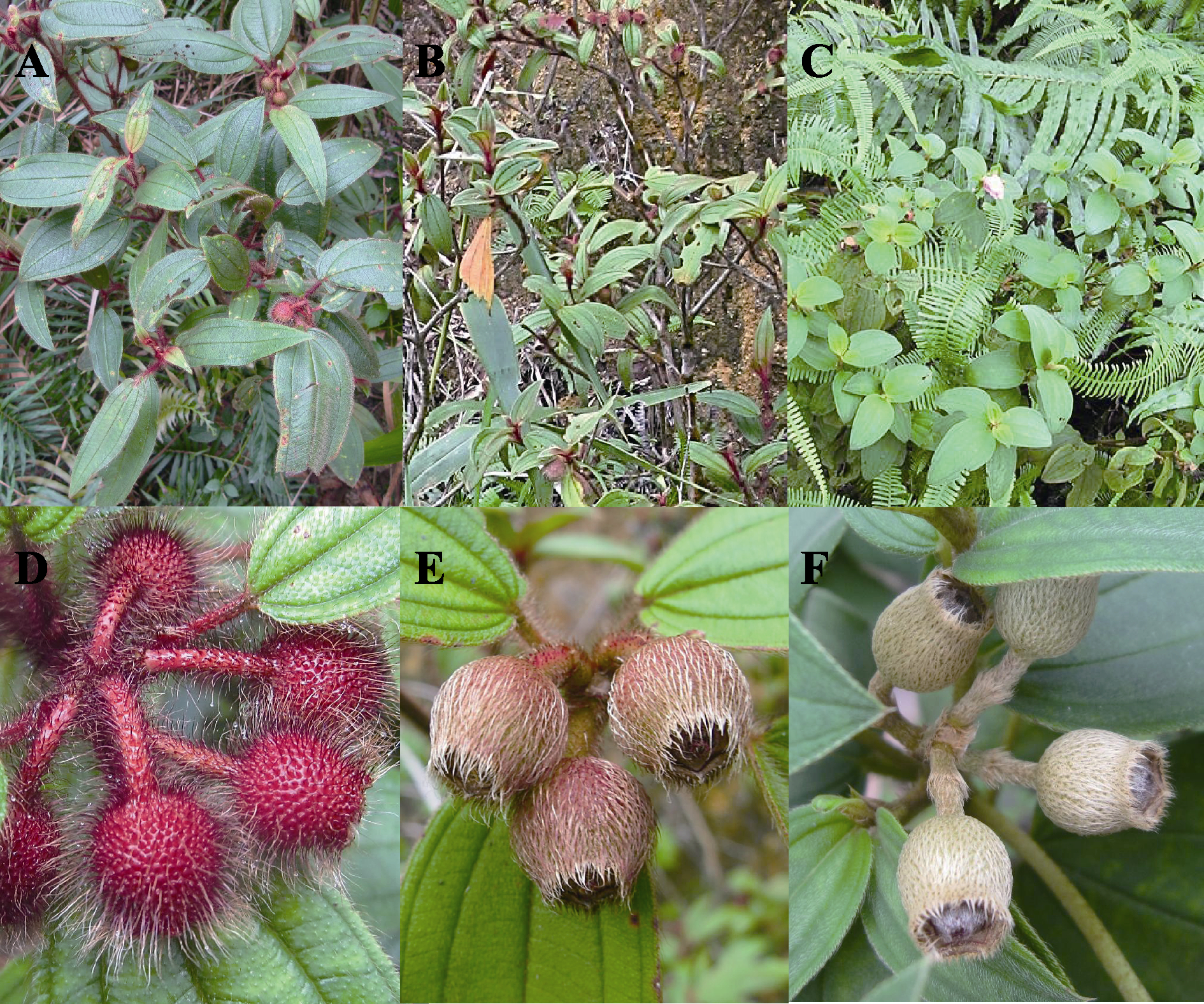
图1 紫毛野牡丹、野牡丹及其嫌疑杂种的部分形态学特征。A: 紫毛野牡丹; B: 紫毛野牡丹和野牡丹的嫌疑杂种; C: 野牡丹; D、E、F分别为紫毛野牡丹、嫌疑杂种和野牡丹的果。
Fig. 1 Morphological comparison between Melastoma penicillatum, M. candidum and their putative hybrid. (A) M. penicillatum, (B) putative hybrid, (C) M. candidum. Fruits of M. penicillatum (D), putative hybrid (E) and M. candidum (F).
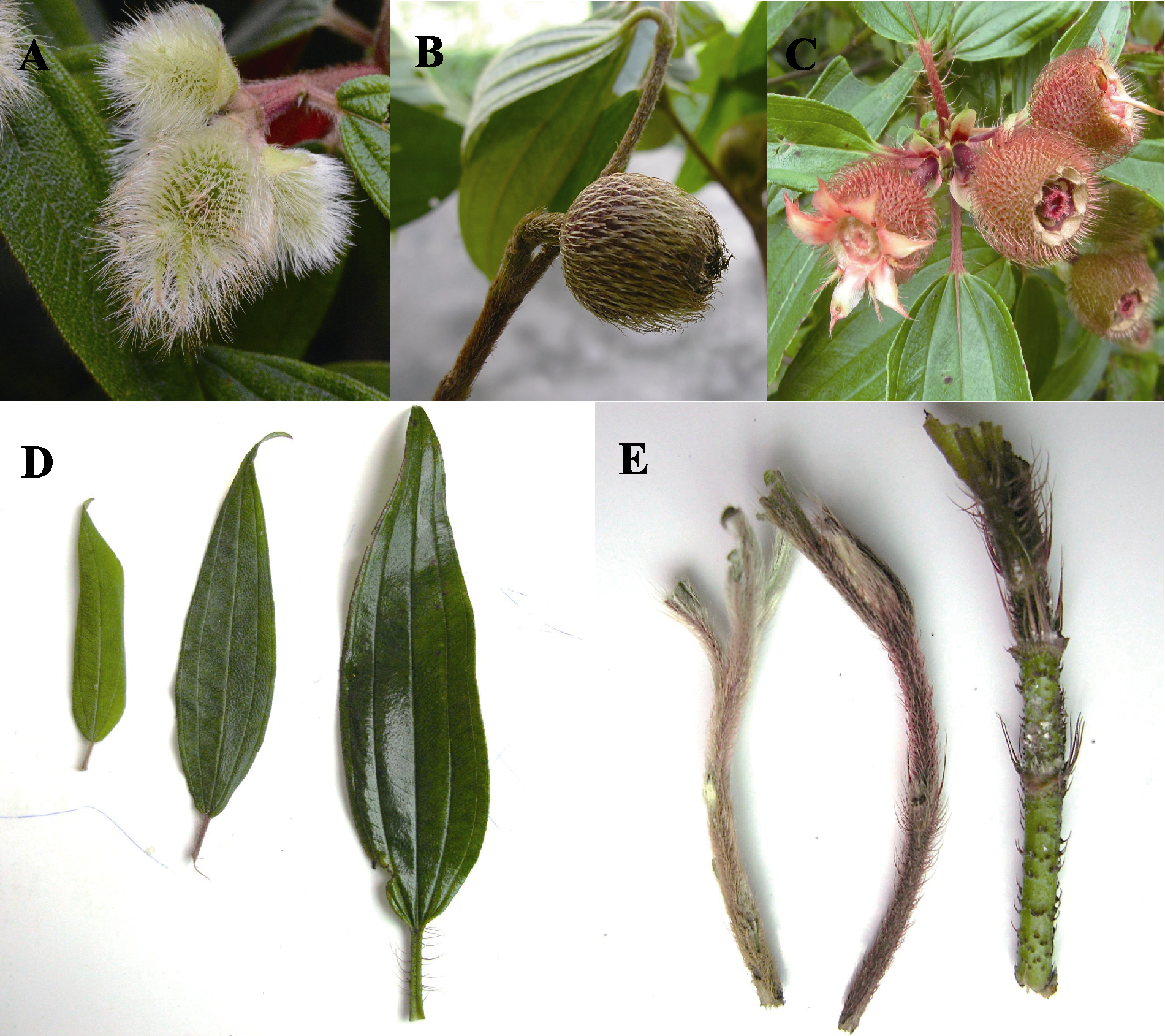
图2 枝毛野牡丹、毛菍及其嫌疑杂种的部分形态学特征。A、B、C分别为枝毛野牡丹、嫌疑杂种和毛菍的果。D、E从左到右分别为枝毛野牡丹(左)、嫌疑杂种(中)和毛菍(右)的叶和幼枝。
Fig. 2 Morphological comparison between Melastoma dendrisetosum, M. sanguineum and their putative hybrid. Fruits of M. dendrisetosum (A), putative hybrid (B) and M. sanguineum (C). D, Leaves of M. dendrisetosum (left), putative hybrid (middle) and M. sanguineum (right). E, Young twigs of M. dendrisetosum (left), putative hybrid (middle) and M. sanguineum (right).
| 类群 Taxon | 采样地点 Location | 个体数量 Sample size |
|---|---|---|
| 野牡丹 M. candidum (Cf) | 福建龙海 Longhai, Fujian | 19 |
| 野牡丹 M. candidum (Ch) | 海南吊罗山 Diaoluoshan, Hainan | 20 |
| 毛菍 M. sanguineum (S) | 海南吊罗山 Diaoluoshan, Hainan | 20 |
| 紫毛野牡丹 M. penicillatum (P) | 海南吊罗山 Diaoluoshan, Hainan | 20 |
| 枝毛野牡丹 M. dendrisetosum (D) | 海南吊罗山 Diaoluoshan, Hainan | 20 |
| 紫毛野牡丹与野牡丹的嫌疑杂种 Putative hybrid between P and C | 海南吊罗山 Diaoluoshan, Hainan | 1 |
| 枝毛野牡丹与毛菍的嫌疑杂种 Putative hybrid between D and S | 海南吊罗山 Diaoluoshan, Hainan | 4 |
表1 4个野牡丹属物种和2个嫌疑杂种的采样信息
Table 1 Sampling details of four species of Melastoma and two putative hybrids used in this study
| 类群 Taxon | 采样地点 Location | 个体数量 Sample size |
|---|---|---|
| 野牡丹 M. candidum (Cf) | 福建龙海 Longhai, Fujian | 19 |
| 野牡丹 M. candidum (Ch) | 海南吊罗山 Diaoluoshan, Hainan | 20 |
| 毛菍 M. sanguineum (S) | 海南吊罗山 Diaoluoshan, Hainan | 20 |
| 紫毛野牡丹 M. penicillatum (P) | 海南吊罗山 Diaoluoshan, Hainan | 20 |
| 枝毛野牡丹 M. dendrisetosum (D) | 海南吊罗山 Diaoluoshan, Hainan | 20 |
| 紫毛野牡丹与野牡丹的嫌疑杂种 Putative hybrid between P and C | 海南吊罗山 Diaoluoshan, Hainan | 1 |
| 枝毛野牡丹与毛菍的嫌疑杂种 Putative hybrid between D and S | 海南吊罗山 Diaoluoshan, Hainan | 4 |
| 类群 Taxon | cam | tpi | |||||||
|---|---|---|---|---|---|---|---|---|---|
| 292 | 244 | 204 | 225 | 258 | 272 | 315 | 340 | 568 | |
| 野牡丹 Melastoma candidum (C) | A | G | T | T | T | G | A | T | C |
| 紫毛野牡丹 M. penicillatum (P) | G | A | A | C | C | A | G | C | T |
| 紫毛野牡丹和野牡丹的嫌疑杂种 Putative hybrid between P and C | R | R | W | Y | Y | R | R | Y | Y |
表2 紫毛野牡丹和野牡丹在cam和tpi基因上的固定变异位点及其嫌疑杂种在这些位点上的碱基组成(R = A + G; Y = C + T; W = T + A)
Table 2 The base composition of the differentially fixed sites at the cam and tpi genes between Melastoma penicillatum and M. candidum in their putative hybrid (R = A + G; Y = C + T; W = T + A)
| 类群 Taxon | cam | tpi | |||||||
|---|---|---|---|---|---|---|---|---|---|
| 292 | 244 | 204 | 225 | 258 | 272 | 315 | 340 | 568 | |
| 野牡丹 Melastoma candidum (C) | A | G | T | T | T | G | A | T | C |
| 紫毛野牡丹 M. penicillatum (P) | G | A | A | C | C | A | G | C | T |
| 紫毛野牡丹和野牡丹的嫌疑杂种 Putative hybrid between P and C | R | R | W | Y | Y | R | R | Y | Y |
| 类群 Taxon | cam | chi | gbss | tpi | ||||||
|---|---|---|---|---|---|---|---|---|---|---|
| 190 | 329 | 661 | 79 | 258 | 315 | 414 | 80 | 240 | 286 | |
| 毛菍 M. sanguineum (S) | T | C | G | C | A | G | G | G | T | A |
| 枝毛野牡丹 M. dendrisetosum (D) | C | T | A | T | C | A | C | A | C | T |
| 枝毛野牡丹和毛菍的嫌疑杂种 Putative hybrid between D and S | Y | Y | R | Y | M | R | S | R | Y | W |
表3 枝毛野牡丹和毛菍在4个基因上的固定变异位点及其嫌疑杂种在这些位点上的碱基组成(R = A + G; Y = C + T; W = T + A; M = A + C; S = C + G)
Table 3 The base composition of the differentially fixed sites at the four nuclear genes between Melastoma dendrisetosum and M. sanguineum in their putative hybrid (R = A + G; Y = C + T; W = T + A; M = A + C; S = C + G)
| 类群 Taxon | cam | chi | gbss | tpi | ||||||
|---|---|---|---|---|---|---|---|---|---|---|
| 190 | 329 | 661 | 79 | 258 | 315 | 414 | 80 | 240 | 286 | |
| 毛菍 M. sanguineum (S) | T | C | G | C | A | G | G | G | T | A |
| 枝毛野牡丹 M. dendrisetosum (D) | C | T | A | T | C | A | C | A | C | T |
| 枝毛野牡丹和毛菍的嫌疑杂种 Putative hybrid between D and S | Y | Y | R | Y | M | R | S | R | Y | W |
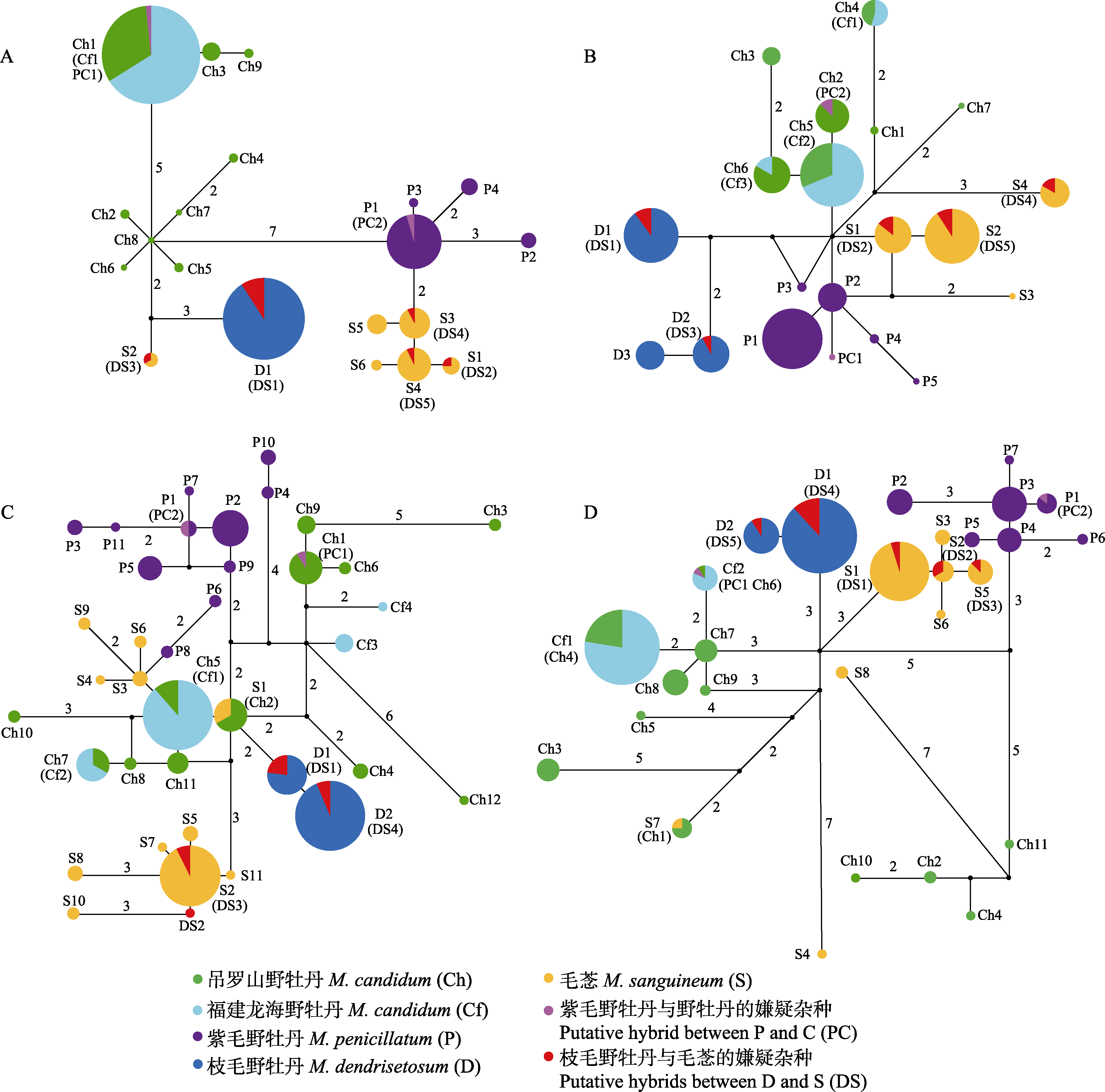
图3 4个野牡丹属物种及2个嫌疑杂种在4个核基因上的单倍型网络图。A、B、C、D分别为tpi、gbss、chi和cam基因的单倍型网络图。两个单倍型之间的连线上的数字代表突变步骤, 未标出数字的均表示一个突变步骤。黑色小圆圈代表未取样到的单倍型或假设的单倍型。
Fig. 3 Median-joining networks of tpi (A), gbss (B), chi (C) and cam (D) genes of the four Melastoma species and the two putative hybrids. The numbers around the connecting lines between haplotypes represent the number of mutational steps between them, while those without numbers represent only one mutational step. Small black circles represent hypothetical or unsampled haplotypes.
| 类群 Taxon | 个体编号 Sample ID | tpi | cam | chi | gbss |
|---|---|---|---|---|---|
| 紫毛野牡丹和野牡丹的嫌疑杂种 Putative hybrid (PC) | PC | PC1PC2 | PC1PC2 | PC1PC2 | PC1 PC2 |
| 枝毛野牡丹和毛菍的嫌疑杂种 Putative hybrid (DS) | DS_1 | DS1DS2 | DS1DS4 | DS1 DS2 | DS1DS2 |
| DS_2 | DS1DS3 | DS2DS4 | DS1DS3 | DS3DS4 | |
| DS_3 | DS1DS4 | DS3DS5 | DS3DS4 | DS1DS2 | |
| DS_4 | DS1DS5 | DS2DS4 | DS1DS3 | DS1DS5 |
表4 野牡丹属2个嫌疑杂种个体在4个核基因上的基因型。PC为紫毛野牡丹和野牡丹的嫌疑杂种个体; DS_1-DS_4为枝毛野牡丹和毛菍的4个嫌疑杂种个体。单下划线、双下划线、波浪线和虚线分别代表与野牡丹、紫毛野牡丹、毛菍和枝毛野牡丹共享该单倍型。单倍型命名同图3。
Table 4 Genotypes of two putative hybrids of Melastoma at four nuclear genes (tpi, cam, chi and gbss). Haplotypes with single, double, wavy, or dotted underlines have identical sequences with those of M. candidum, M. penicillatum, M. sanguineum, and M. dendrisetosum, respectively. Haplotypes without underline are unique to the putative hybrids.
| 类群 Taxon | 个体编号 Sample ID | tpi | cam | chi | gbss |
|---|---|---|---|---|---|
| 紫毛野牡丹和野牡丹的嫌疑杂种 Putative hybrid (PC) | PC | PC1PC2 | PC1PC2 | PC1PC2 | PC1 PC2 |
| 枝毛野牡丹和毛菍的嫌疑杂种 Putative hybrid (DS) | DS_1 | DS1DS2 | DS1DS4 | DS1 DS2 | DS1DS2 |
| DS_2 | DS1DS3 | DS2DS4 | DS1DS3 | DS3DS4 | |
| DS_3 | DS1DS4 | DS3DS5 | DS3DS4 | DS1DS2 | |
| DS_4 | DS1DS5 | DS2DS4 | DS1DS3 | DS1DS5 |
| [1] | Abbott R, Albach D, Ansell S, Arntzen JW, Baird SJE, Bierne N, Boughman J, Brelsford A, Buerkle CA, Buggs R, Dieckmann U, Eroukhmanoff F, Grill A, Cahan SH, Hermansen JS, Hewitt G, Hudson AG, Jiggins C, Jones J, Keller B, Marczewski T, Mallet J, Martinez-Rodriguez P, Möst M, Mullen S, Nichols R, Nolte AW, Parisod C, Pfennig K, Rice AM, Ritchie MG, Seifert B, Smadja CM, Stelkens R, Szymura JM, Väinölä R, Wolf JBW, Zinner D, Butlin RK (2013) Hybridization and speciation. Journal of Evolutionary Biology, 26, 229-246. |
| [2] | Arnold ML (1997) xNatural Hybridization and Evolution. Oxford University Press, Oxford. |
| [3] | Arnold ML (2006) Evolution Through Genetic Exchange. Oxford University Press, Oxford. |
| [4] | Arnold ML, Martin NH (2009) Adaptation by introgression. Journal of Biology, 8, 82. |
| [5] | Bandelt HJ, Forster P, Röhl A (1999) Median-joining networks for inferring intraspecific phylogenies. Molecular Biology and Evolution, 16, 37-48. |
| [6] | Chao LF, Chen YY, Wang SQ, Liu T, Wu W, Dai SP, Wang F, Fan Q, Shi SH, Zhou RC (2014) One species or two? Multilocus analysis of nucleotide variation of Melastoma penicillatum and Melastoma sanguineum (Melastomataceae) in Hainan, China. Biochemical Systematics and Ecology, 55, 275-282. |
| [7] | Chen J, Renner SS (2007) Melastomataceae. In: Flora of China (ed. Editorial Committee of Flora of China), Vol. 13, pp. 360-399. Science Press, Beijing and Missouri Botanical Garden, St Louis. |
| [8] | Chen J (1983) A study of Melastoma (Melastomataceae) in China. Journal of South China Agricultural College, 4(1), 31-36. |
| (in Chinese) [陈介 (1983) 中国野牡丹科野牡丹属植物的研究. 华南农学院学报, 4(1), 31-36.] | |
| [9] | Chen J (1984) Melastomataceae. In: Flora Reipublicae Popularis Sinicae (ed. Editorial Committee of Flora Reipublicae Popularis Sinicae, Chinese Academy of Sciences), Tomus, 53(1), pp. 152-161. Science Press, Beijing. |
| (in Chinese) [陈介 (1984) 野牡丹科. 见: 中国植物志 (中国科学院中国植物志编辑委员会编), 53(1), 152-161. 科学出版社, 北京.] | |
| [10] | Dai SP, Wu W, Zhang RS, Liu T, Chen YY, Shi SH, Zhou RC (2012) Molecular evidence for hybrid origin of Melastoma intermedium. Biochemical Systematics and Ecology, 41, 136-141. |
| [11] | Doyle JJ (1987) A rapid DNA isolation procedure for small quantities of fresh leaf tissue. Phytochemical Bulletin, 19, 11-15. |
| [12] | Grant PR, Grant BR (2014) Speciation undone. Nature, 507, 178-179. |
| [13] | Gross CL (1993) The breeding system and pollinators of Melastoma affine (Melastomataceae): a pioneer shrub in tropical Australia. Biotropica, 25, 468-474. |
| [14] | Huxel GR (1999) Rapid displacement of native species by invasive species: effects of hybridization. Biological Conservation, 89, 143-152. |
| [15] | Librado P, Rozas J (2009) DnaSP v5: a software for comprehensive analysis of DNA polymorphism data. Bioinformatics, 25, 1451-1452. |
| [16] | Liu T, Chen YY, Chao LF, Wang SQ, Wu W, Dai SP, Wang F, Fan Q, Zhou RC (2014) Extensive hybridization and introgression between Melastoma candidum and M. sanguineum. PLoS ONE, 9, e96680. |
| [17] | Lu GH, Wu WH, Wang RZ, Li XL, Wang YQ (2009) Division of labor of heteromorphic stamens in Melastoma malabathricum. Biodiversity Science, 17, 174-181. (in Chinese with English abstract) |
| [路国辉, 武文华, 王瑞珍, 李新亮, 王英强 (2009) 野牡丹异型雄蕊的功能分化. 生物多样性, 17, 174-181.] | |
| [18] | Luo ZL, Zhang DX (2005) A review of heteranthery in flowering plants. Journal of Tropical and Subtropical Botany, 13, 536-542. |
| [19] | Luo ZL, Zhang DX, Renner SS (2008) Why two kinds of stamens in buzz-pollinated flowers? Experimental support for Darwin’s division-of-labour hypothesis. Functional Ecology, 22, 794-800. |
| [20] | Luo ZL, Gu L, Zhang DX (2009) Intrafloral differentiation of stamens in heterantherous flowers. Journal of Systematics and Evolution, 47, 43-56. |
| [21] | Mallet J (2005) Hybridization as an invasion of the genome. Trends in Ecology & Evolution, 20, 229-237. |
| [22] | Meyer K (2001) Revision of the Southeast Asian genus Melastoma. Blumea, 46, 351-398. |
| [23] | Moody ML, Les DH (2002) Evidence of hybridity in invasive watermilfoil (Myriophyllum) populations. Proceedings of the National Academy of Sciences, USA, 99, 14867-14871. |
| [24] | Peng DH, Lan SR, Wu SS (2014) Pollination biology and breeding system of Melastoma dendrisetosum. Forest Research, 27(1), 11-16. (in Chinese with English abstract) |
| [彭东辉, 兰思仁, 吴沙沙 (2014) 中国特有种枝毛野牡丹传粉生物学及繁育系统研究. 林业科学研究, 27(1), 11-16.] | |
| [25] | Renner SS, Meyer K (2001) Melastomeae come full circle: biogeographic reconstruction and molecular clock dating. Evolution, 55, 1315-1324. |
| [26] | Rhymer JM, Simberloff D (1996) Extinction by hybridization and introgression. Annual Review of Ecology and Systematics, 27, 83-109. |
| [27] | Rieseberg LH (1997) Hybrid origins of plant species. Annual Review of Ecology and Systematics, 28, 359-389. |
| [28] | Strand AE, Leebens-Mack J, Milligan BG (1997) Nuclear DNA-based markers for plant evolutionary biology. Molecular Ecology, 6, 113-118. |
| [29] | Taberlet P, Gielly L, Pautou G, Bouvet J (1991) Universal primers for amplification of three non-coding regions of chloroplast DNA. Plant Molecular Biology, 17, 1105-1109. |
| [30] | Thompson JD, Gibson TJ, Plewniak F, Jeanmougin F, Higgins DG (1997) The CLUSTAL_X windows interface: flexible strategies for multiple sequence alignment aided by quality analysis tools. Nucleic Acids Research, 25, 4876-4882. |
| [31] | Todesco M, Pascual MA, Owens GL, Ostevik KL, Moyers BT, Hübner S, Heredia SM, Hahn MA, Caseys C, Bock DG, Rieseberg LH (2016) Hybridization and extinction. Evolutionary Applications, 9, 892-908. |
| [32] | Wolf DE, Takebayashi N, Rieseberg LH (2001) Predicting the risk of extinction through hybridization. Conservation Biology, 15, 1039-1053. |
| [1] | 王倩倩, 陈孝国, 朱锐丰, 张明春, 王新, 李世林, 仁增江措, 彭武, 杨彪. 藏东南黑麝及其同域有蹄类物种的生态适应性差异[J]. 生物多样性, 2026, 34(5): 25433-. |
| [2] | 周丽洁, 郝珉辉, 何怀江, 程艳霞, 张春雨, 赵秀海. 小兴安岭森林β多样性格局、组分及其影响因素[J]. 生物多样性, 2026, 34(4): 25443-. |
| [3] | 陈小勇. 珍稀濒危植物有效迁地保护: 概念、标准和建议[J]. 生物多样性, 2026, 34(4): 25448-. |
| [4] | 张同, 梁力文, 王长剑, 舒服, 王璐, 郭泽光, 卓玛曲珍, 钱芊, 蒋安莉, 敖俊杰, 彭兴文, 伍小刚, 向左甫, 郭克疾, 廖梓延. 基于红外相机的西藏芒康滇金丝猴国家级自然保护区鸟兽多样性及代表性物种的季节性空间利用特征[J]. 生物多样性, 2026, 34(4): 25435-. |
| [5] | 安明态, 吴旭, 余江洪, 胡国雄, 王琨, 刘锋, 吴天柔, 徐钦, 张豪, 徐建, 杨焱冰, 曹威, 严令斌, 李鹤, 李志, 余德会, 黄郎, 陈志萍, 李晓芳, 邹华凯, 龙敏, 顾伟豪, 马宇航, 邱剪. 贵州省高等植物物种多样性编目及分布数据集[J]. 生物多样性, 2026, 34(4): 25427-. |
| [6] | 孔孜亦, 王德港, 王建涛, 裴志永, 孙晶, 张长春, 张军国. 基于SCD-HRNet模型的野生动物姿态估计及其在生物多样性监测中的应用: 以内蒙古赛罕乌拉地区为例[J]. 生物多样性, 2026, 34(4): 25287-. |
| [7] | 鲁夕霞, 周冯祥, 雍李明, 曾千慧, 赵丽媛, 张语克, 王先艳. 1990-2020年围填海对我国中华白海豚栖息地的影响[J]. 生物多样性, 2026, 34(3): 25249-. |
| [8] | 尚晓彤, 黄程, 杨立, 牟希东, 李添明, 刘阳. 全球尺度水产养殖系统减少鸟类致损措施成效评估[J]. 生物多样性, 2026, 34(3): 25453-. |
| [9] | 倪庆永, 番玉买, 张琦, 解萌. 中国懒猴科灵长类研究与保护进展[J]. 生物多样性, 2026, 34(3): 25451-. |
| [10] | 范鹏来, 姚维, 黄乘明, 周岐海. 中国叶猴的研究简史和保护进展[J]. 生物多样性, 2026, 34(3): 25446-. |
| [11] | 郭松涛, 陈国梁, 李保国. 中国灵长类学研究进展[J]. 生物多样性, 2026, 34(3): 25462-. |
| [12] | 向左甫. 中国金丝猴生态、保护与社会行为研究简史及进展[J]. 生物多样性, 2026, 34(3): 25442-. |
| [13] | 侯姝彧, 刘盈盈, 杨锐. 《昆蒙框架》背景下国际OECMs体系构建实践进展及中国化思路[J]. 生物多样性, 2026, 34(3): 25264-. |
| [14] | 罗钰, 郑旭艳, 曹力, 王波, 彭艳琼, 罗银玲, 周会平, 杨小芳, 苗白鸽, 王朝雅, 高洁. 生境简化重塑榕树-榕小蜂互作网络: 挥发物组成与群落结构的适应性响应[J]. 生物多样性, 2026, 34(2): 25328-. |
| [15] | 卢晓强, 芮丹, 张江峰, 尹冰鑫, 王雨露, 岑雨婷, 崔怡晨, 杨万霞. 氮输入驱动的关键生态过程对生物多样性的影响及其管理启示[J]. 生物多样性, 2026, 34(2): 25368-. |
| 阅读次数 | ||||||
|
全文 |
|
|||||
|
摘要 |
|
|||||
备案号:京ICP备16067583号-7
Copyright © 2026 版权所有 《生物多样性》编辑部
地址: 北京香山南辛村20号, 邮编:100093
电话: 010-62836137, 62836665 E-mail: biodiversity@ibcas.ac.cn
