

生物多样性 ›› 2015, Vol. 23 ›› Issue (5): 665-672. DOI: 10.17520/biods.2014158 cstr: 32101.14.biods.2014158
所属专题: 生物多样性与生态系统功能; 土壤生物与土壤健康; 生物入侵
朱珣之1,2, 李强1, 李扬苹3, 韩洪波4, 马克平2,*( )
)
收稿日期:2015-02-03
接受日期:2015-04-18
出版日期:2015-09-20
发布日期:2015-10-12
通讯作者:
马克平
基金资助:
Xunzhi Zhu1,2, Qiang Li1, Yangping Li3, Hongbo Han4, Keping Ma2,*()
Received:2015-02-03
Accepted:2015-04-18
Online:2015-09-20
Published:2015-10-12
Contact:
Ma Keping
摘要:
外来生物入侵可能对生物群落结构和生态系统功能产生多种影响, 但入侵植物与土壤微生物群落组成和多样性的关系尚不清楚。为了揭示外来植物紫茎泽兰(Eupatorium adenophorum)入侵对土壤化学性质和细菌群落组成及多样性的影响, 本研究利用第二代高通量测序技术, 比较了紫茎泽兰不同入侵程度的生境(本地植物群落、紫茎泽兰与本地植物混生群落、紫茎泽兰单优群落)土壤中细菌群落的差异。土壤化学性质分析表明, 土壤pH值、有机质、全N和全K随着紫茎泽兰的入侵而逐渐降低, 而土壤全P则在入侵程度最高的生境土壤中最高。通过测序共获得7,755个细菌OUT (operational taxonomic unit)。结果表明, 紫茎泽兰入侵对土壤的细菌多样性影响较小, ACE和Chao指数在3种不同生境间的差异不显著。细菌在紫茎泽兰与本地植物混生群落中的Shannon指数最低, 即细菌的多样性在中等入侵程度的生境最低。此外, 紫茎泽兰入侵改变了土壤细菌组成和结构, 酸杆菌门(Acidobacteria)和疣微菌门(Verrucomicrobia)的相对丰度, 从本地植物群落、混合群落到紫茎泽兰单优群落, 呈现出先增加后减少的趋势。可见, 紫茎泽兰入侵一定程度上改变了土壤微生物的多样性和群落结构, 并改变了土壤的化学性质。
朱珣之, 李强, 李扬苹, 韩洪波, 马克平 (2015) 紫茎泽兰入侵对土壤细菌的群落组成和多样性的影响. 生物多样性, 23, 665-672. DOI: 10.17520/biods.2014158.
Xunzhi Zhu, Qiang Li, Yangping Li, Hongbo Han, Keping Ma (2015) Eupatorium adenophorum invasion alters soil bacterial community and diversity. Biodiversity Science, 23, 665-672. DOI: 10.17520/biods.2014158.
| 样品 Sample | pH | 全N Total N (%) | 有机质 Organic matter (%) | 全P Total P (mg/kg) | 全K Total K (%) |
|---|---|---|---|---|---|
| E | 6.03±0.19a | 0.337±0.131a | 7.93±3.06a | 1,256.75±249.93a | 1.76±0.08a |
| D | 5.67±0.26ac | 0.256±0.026a | 6.58±0.86a | 747.00±24.76a | 1.42±0.13b |
| R | 5.18±0.10bc | 0.250±0.069a | 5.25±1.60a | 5,659.00±615.13b | 0.62±0.08c |
表1 各样地的土壤化学性质比较。其中样品符号E、D和R分别表示本地植物群落、紫茎泽兰与本地植物混生群落和紫茎泽兰单优群落; 图中数字表示平均值±标准误; 不同字母表示不同土壤该指标差异显著(P <0.05, LSD test)
Table 1 The chemical properties of soil in different sites. E, D, R represent samples from native plant community, Eupatorium adenophorum and native plant mixed community, and E. adenophorum dominated community. Values (mean ± SE) followed by different letters in the same column indicate significant difference at P <0.05 level.
| 样品 Sample | pH | 全N Total N (%) | 有机质 Organic matter (%) | 全P Total P (mg/kg) | 全K Total K (%) |
|---|---|---|---|---|---|
| E | 6.03±0.19a | 0.337±0.131a | 7.93±3.06a | 1,256.75±249.93a | 1.76±0.08a |
| D | 5.67±0.26ac | 0.256±0.026a | 6.58±0.86a | 747.00±24.76a | 1.42±0.13b |
| R | 5.18±0.10bc | 0.250±0.069a | 5.25±1.60a | 5,659.00±615.13b | 0.62±0.08c |
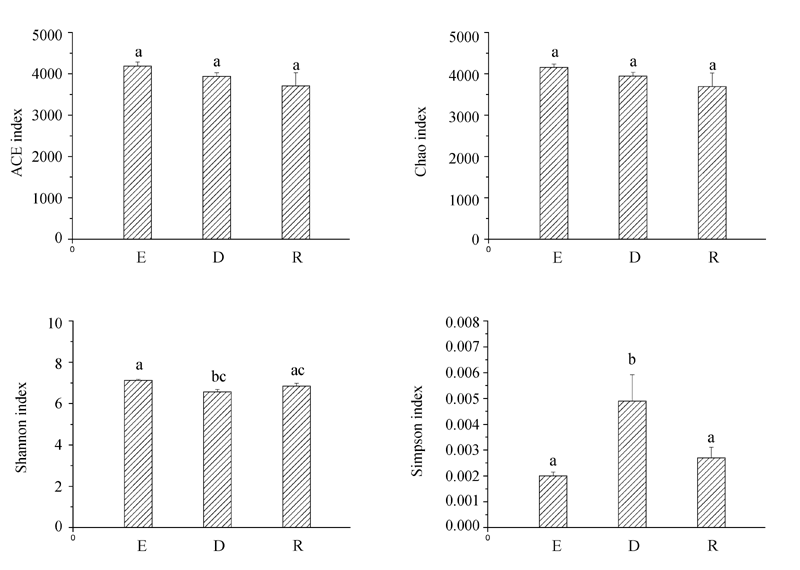
图1 样品在遗传距离0.03下的α丰富度。其中样品符号的字母E、D和R分别表示本地植物群落、紫茎泽兰与本地植物混生群落和紫茎泽兰单优群落。
Fig. 1 Alpha diversity for different samples obtained at genetic distances of 0.03. The letters E, D, R represent samples from native plant community, Eupatorium adenophorum and native plants mixed habitat, and E. adenophorum dominated habitat.
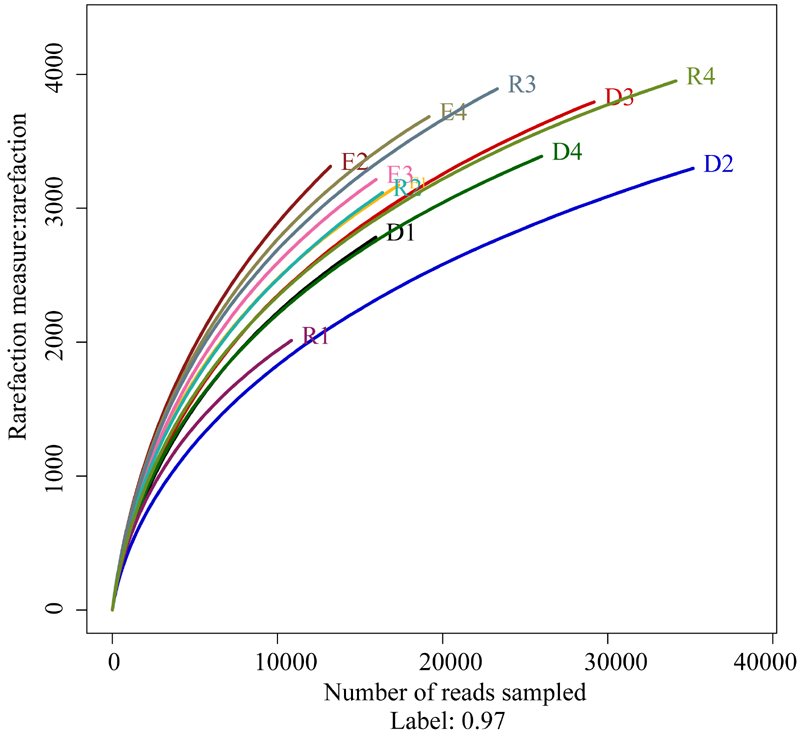
图2 样品在遗传距离0.03下的稀疏曲线
Fig. 2 The rarefaction of different samples obtained at the genetic distances of 0.03
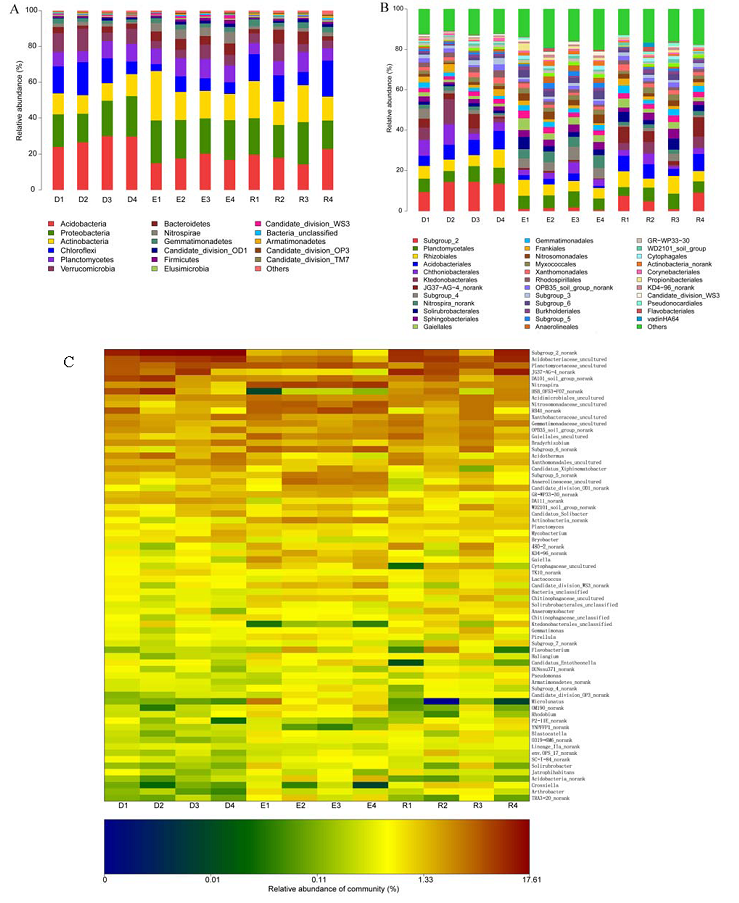
图3 不同分类水平的细菌群落组成。(A)门; (B)目; (C)属。图C中, 不同颜色代表细菌的相对丰度。D1-D4为紫茎泽兰与本地植物混生群落的土壤, E1-E4为本地植物群落的土壤, R1-R4为紫茎泽兰单优群落的土壤。
Fig. 3 Composition of the bacterial community at different taxonomic levels. (A) Phylum; (B) Order; (C) Genus. In (C), different colors represent relative abundances of bacteria. D1-D4 are soils from Eupatorium adenophorum and native plant mixed community; E1-E4 are soils from native plant community; R1-R4 are from communities dominated by E. adenophorum.
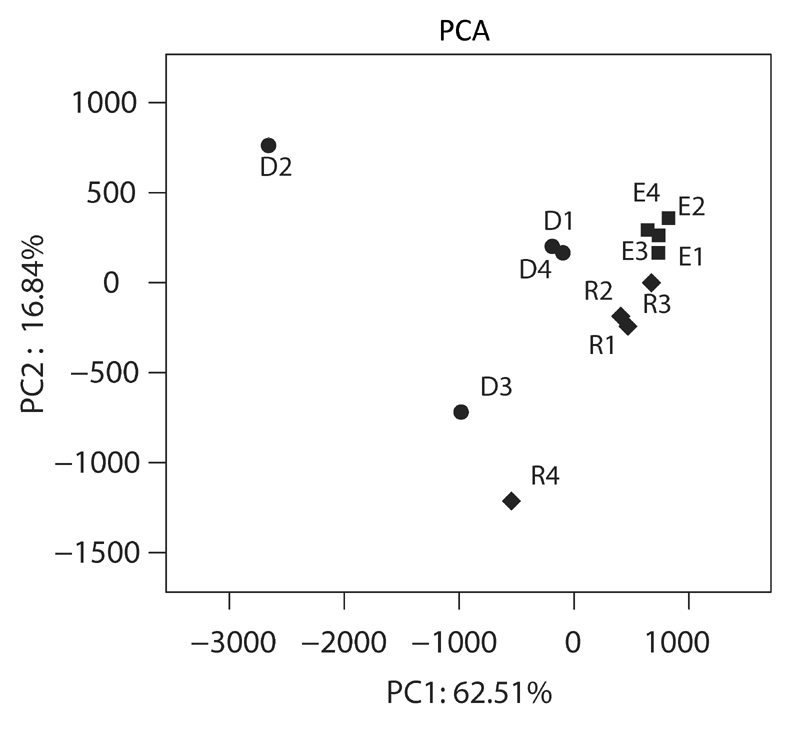
图4 基于OTU数据的不同土壤细菌群落的主成分分析
Fig. 4 Principal Component Analysis (PCA) of all microbial communities base on OTU data
| [1] | Alpert P, Bone E, Holzapfel C (2000) Invasiveness, invasibility and the role of environmental stress in the spread of non-native plants.Perspectives in Plant Ecology, Evolution and Systematics, 3, 52-66. |
| [2] | Amato KR, Yeoman CJ, Kent A, Righini N, Carbonero F, Estrada A, Gaskins HR, Stumpf RM, Yildirim S, Torralba M, Gillis M, Wilson BA, Nelson KE, White BA, Leigh SR (2013) Habitat degradation impacts black howler monkey (Alouatta pigra) gastrointestinal microbiomes.The ISME Journal, 7, 1344-1353. |
| [3] | Callaway RM, Thelen GC, Rodriguez A, Holben WE (2004) Soil biota and exotic plant invasion.Nature, 427, 731-733. |
| [4] | Ellis RJ, Morgan P, Weightman AJ, Fry JC (2003) Cultivation-dependent and -independent approaches for determining bacterial diversity in heavy-metal contaminated soil.Applied and Environmental Microbiology, 69, 3223-3230. |
| [5] | Inderjit, van der Putten WH (2010) Impacts of soil microbial communities on exotic plant invasions.Trends in Ecology and Evolution, 25, 512-519. |
| [6] | Kemp PF, Aller JY (2004) Bacterial diversity in aquatic and other environments: what 16S rDNA libraries can tell us.FEMS Microbiology Ecology, 47, 161-177. |
| [7] | Keylock CJ (2005) Simpson diversity and the Shannon-Wiener index as special cases of a generalized entropy.Oikos, 109, 203-207. |
| [8] | Li HN (李会娜), Liu WX (刘万学), Dai L (戴莲), Wan FH (万方浩), Cao YY (曹远银) (2009) Invasive impacts of Ageratina adenophora (Asteraceae) on the changes of microbial community structure, enzyme activity and fertility in soil ecosystem.Scientia Agricultura Sinica(中国农业科学), 42, 3964-3971. (in Chinese with English abstract) |
| [9] | Lonsdale WM (1999) Global patterns of plant invasions and the concept of invasibility.Ecology, 80, 1522-1536. |
| [10] | Lu P (鲁萍), Sang WG (桑卫国), Ma KP (马克平) (2005) Progress and prospects in research of an exotic invasive species, Eupatorium adenophorum. Acta Phytoecologica Sinica(植物生态学报), 29, 1029-1037. (in Chinese with English abstract) |
| [11] | Lu ZJ, Ma KP (2005) Scale dependent relationships between native plant diversity and the invasion of croftonweed (Eupatorium adenophorum) in southwest China. Weed Science, 53, 600-604. |
| [12] | Mack RN, Simberloff D, Londale WM (2000) Biotic invasions: causes, epidemiology, global consequences, and control.Ecological Applications, 10, 689-710. |
| [13] | Niu HB (牛红榜), Liu WX (刘万学), Wan FH (万方浩) (2007) Invasive effects of Ageratina adenophora Sprengel (Asteraceae) on soil microbial community and physical and chemical properties.Acta Ecologica Sinica(生态学报), 27, 3051-3060. (in Chinese with English abstract) |
| [14] | Niu HB, Liu WX, Wan FH, Liu B (2007) An invasive aster (Ageratina adenophora) invades and dominates forest understories in China: altered soil microbial communities facilitate the invader and inhibit natives.Plant and Soil, 294, 73-85. |
| [15] | Quast C, Pruesse E, Yilmaz P, Gerken J, Schweer T, Yarza P, Peplies J, Glöckner FO (2013) The SILVA ribosomal RNA gene database project: improved data processing and web-based tools.Nucleic Acids Research, 41, 590-596. |
| [16] | Schloss PD, Gevers D, Westcott SL (2011) Reducing the effects of PCR amplification and sequencing artifacts on 16S rRNA-based studies.PLoS ONE, 6, e27310. |
| [17] | Teixeira LCRS, Peixoto RS, Cury JC, Sul WJ, Pellizari VH, Tiedje J, Rosado AS (2010) Bacterial diversity in rhizosphere soil from Antarctic vascular plants of Admiralty Bay, maritime Antarctica.The ISME Journal, 4, 989-1001. |
| [18] | Urich T, Lanzen A, Qi J, Huson DH, Schleper C, Schuster SC (2008) Simultaneous assessment of soil microbial community structure and function through analysis of the meta-transcriptome.PLoS ONE, 3, e2527. |
| [19] | Wu H (吴昊), Ding JQ (丁建清) (2014) Recent progress in invasion ecology.Chinese Science Bulletin(科学通报), 59, 438-448. (in Chinese with English abstract) |
| [20] | Yu WQ (于文清), Liu WX (刘万学), Gui FR (桂富荣), Liu WZ (刘文志), Wan FH (万方浩), Zhang LL (张利莉) (2012) Invasion of exotic Ageratina adenophora Sprengel. alters soil physical and chemical characteristics and arbuscular mycorrhizal fungus community.Acta Ecologica Sinica(生态学报), 32, 7027-7035. (in Chinese with English abstract) |
| [21] | Yu XJ, Yu D, Lu ZJ, Ma KP (2005) A new mechanism of invader success: exotic plant inhibits natural vegetation restoration by changing soil microbe community.Chinese Science Bulletin, 50, 1105-1112. |
| [1] | 梁竣策, 李开枝, 谭烨辉. 南海翼足类物种多样性与分布[J]. 生物多样性, 2026, 34(5): 25487-. |
| [2] | 周丽洁, 郝珉辉, 何怀江, 程艳霞, 张春雨, 赵秀海. 小兴安岭森林β多样性格局、组分及其影响因素[J]. 生物多样性, 2026, 34(4): 25443-. |
| [3] | 彭昀月, 彭奎, 刘昕然, 孙天怡, 张小全. 生物多样性信用的企业参与途径、市场发展障碍与建议[J]. 生物多样性, 2026, 34(4): 26031-. |
| [4] | 杨文高, 李兆光, 袁文珏, 和桂青, 王蕊, 和琼姬, 叶磊, 李燕, 侯志江. 玉龙雪山森林火烧迹地恢复年限对滇牡丹土壤细菌群落的影响[J]. 生物多样性, 2026, 34(4): 25338-. |
| [5] | 李伯尧, 盛天成, 幸小云. 生物多样性风险对企业财务绩效的影响: 来自中国上市公司的证据[J]. 生物多样性, 2026, 34(4): 25330-. |
| [6] | 刘昊, 张玉霄, 刘冰, 李飞飞, 马洪峥, 覃海宁, 李德铢, 陈文俐. 中国禾本科植物多样性及其物种名录[J]. 生物多样性, 2026, 34(4): 25438-. |
| [7] | 孔孜亦, 王德港, 王建涛, 裴志永, 孙晶, 张长春, 张军国. 基于SCD-HRNet模型的野生动物姿态估计及其在生物多样性监测中的应用: 以内蒙古赛罕乌拉地区为例[J]. 生物多样性, 2026, 34(4): 25287-. |
| [8] | 朱浩友, 周友兵, 罗怡, 周昭敏. 南充市城区繁殖鸟类群落20年前后的变化[J]. 生物多样性, 2026, 34(3): 24560-. |
| [9] | 侯姝彧, 刘盈盈, 杨锐. 《昆蒙框架》背景下国际OECMs体系构建实践进展及中国化思路[J]. 生物多样性, 2026, 34(3): 25264-. |
| [10] | 程晓帆, 李青媛, 李媛辉, 张明祥. 外来入侵物种治理政策体系的困境与出路[J]. 生物多样性, 2026, 34(2): 25332-. |
| [11] | 陈璐露, 汤皓婷, 冷红, 袁青, 杨昕悦. 城市街区建成环境对生物多样性的影响[J]. 生物多样性, 2026, 34(2): 25286-. |
| [12] | 高雯琪, 向景荣, 赵耀, 范灵霜, 谷圆, 邵韦涵, 李高俊, 赵光军, 陈明斌, 蔡杏伟, 陈凯. 海南热带雨林国家公园黎母山和尖峰岭溪流鱼类群落特征及其对土地利用的响应[J]. 生物多样性, 2026, 34(2): 25374-. |
| [13] | 卢晓强, 芮丹, 张江峰, 尹冰鑫, 王雨露, 岑雨婷, 崔怡晨, 杨万霞. 氮输入驱动的关键生态过程对生物多样性的影响及其管理启示[J]. 生物多样性, 2026, 34(2): 25368-. |
| [14] | 谭廷鸿, 高帆, 杨雨, 肖群英, 吴春芳, 邱娜, 赵宁宁, 周敏, 康公平, 卢志宏, 高健强, 杨红, 杨传东, 邓春英. 中国西南喀斯特地区大型真菌物种编目[J]. 生物多样性, 2026, 34(2): 25281-. |
| [15] | 章旭日, 罗标, 赵彤, 黄丹, 艾为明. 浙江鱼类多样性: 编目、分布与保护[J]. 生物多样性, 2026, 34(2): 25225-. |
| 阅读次数 | ||||||
|
全文 |
|
|||||
|
摘要 |
|
|||||
备案号:京ICP备16067583号-7
Copyright © 2026 版权所有 《生物多样性》编辑部
地址: 北京香山南辛村20号, 邮编:100093
电话: 010-62836137, 62836665 E-mail: biodiversity@ibcas.ac.cn
