

Biodiv Sci ›› 2025, Vol. 33 ›› Issue (12): 25062. DOI: 10.17520/biods.2025062 cstr: 32101.14.biods.2025062
• Original Papers:Plant Diversity • Previous Articles Next Articles
Yi Li1,2, Yanchao Zhao1, Litong Chen1,*( )
)
Received:2025-02-18
Accepted:2025-05-21
Online:2025-12-20
Published:2026-01-09
Supported by:Yi Li, Yanchao Zhao, Litong Chen. Responses of α and β diversity of alpine meadows to warming were modulated strongly by elevations and soil nutrients[J]. Biodiv Sci, 2025, 33(12): 25062.
| 处理 Treatment | 分子自由度 numDF | 分母自由度 denDF | 物种丰富度 Species richness | Shannon-Wiener多样性指数 Shannon-Wiener diversity index | 反辛普森指数 Inverse-Simpson index |
|---|---|---|---|---|---|
| 氮添加 Nitrogen addition (N) | 1 | 257 | 2.78* | 7.76** | 4.51* |
| 磷添加 Phosphorus addition (P) | 1 | 257 | 11.68** | 2.04 | 1.62 |
| 增温 Warming (W) | 1 | 257 | 1.33 | 0.23 | 0.12 |
| 海拔 Elevation (E) | 2 | 257 | 77.04*** | 0.23 | 3.93* |
| 年际 Year (Y) | 3 | 257 | 18.23*** | 11.78*** | 10.24*** |
| N × P | 1 | 257 | 0.02 | 3.79 | 1.06 |
| N × W | 1 | 257 | 5.26* | 6.90** | 3.84 |
| P × W | 1 | 257 | 17.07*** | 19.76*** | 14.87*** |
| N × E | 2 | 257 | 12.92*** | 4.92** | 1.52 |
| P × E | 2 | 257 | 11.55*** | 20.81*** | 12.78*** |
| W × E | 2 | 257 | 6.59** | 6.37** | 7.16** |
| N × Y | 3 | 257 | 6.38*** | 1.18 | 0.95 |
| P × Y | 3 | 257 | 2.10 | 0.40 | 0.06 |
| W × Y | 3 | 257 | 8.17*** | 3.15* | 3.78* |
| E × Y | 6 | 257 | 11.09*** | 11.66*** | 8.75*** |
| N × P × W | 1 | 257 | 1.77 | 0 | 1.25 |
| N × P × E | 2 | 257 | 4.72* | 3.66* | 5.46** |
| N × W × E | 2 | 257 | 1.91 | 4.58* | 1.83 |
| P × W × E | 2 | 257 | 4.26* | 2.42 | 1.34 |
| N × P × Y | 3 | 257 | 3.73* | 2.35 | 1.82 |
| N × W × Y | 3 | 257 | 3.69* | 0.51 | 0.23 |
| P × W × Y | 3 | 257 | 3.62* | 2.10 | 0.86 |
| N × E × Y | 6 | 257 | 0.62 | 0.26 | 0.30 |
| P × E × Y | 6 | 257 | 0.86 | 2.32* | 1.58 |
| W × E × Y | 6 | 257 | 0.80 | 2.45* | 1.92 |
| N × P × W × E | 2 | 257 | 4.94** | 5.26** | 4.35* |
| N × P × W × Y | 3 | 257 | 0.55 | 0.66 | 0.88 |
| N × P × E × Y | 6 | 257 | 0.38 | 0.91 | 0.71 |
| N × W × E × Y | 6 | 257 | 0.99 | 0.19 | 0.15 |
| P × W × E × Y | 6 | 257 | 1.24 | 0.23 | 0.68 |
| N × P × W × E × Y | 6 | 257 | 0.93 | 0.75 | 0.98 |
Table 1 Effects of elevation, warming, nutrient, year and their interactions on species richness, Shannon-Wiener diversity index, inverse-Simpson index based on linear mixed effects model (F value)
| 处理 Treatment | 分子自由度 numDF | 分母自由度 denDF | 物种丰富度 Species richness | Shannon-Wiener多样性指数 Shannon-Wiener diversity index | 反辛普森指数 Inverse-Simpson index |
|---|---|---|---|---|---|
| 氮添加 Nitrogen addition (N) | 1 | 257 | 2.78* | 7.76** | 4.51* |
| 磷添加 Phosphorus addition (P) | 1 | 257 | 11.68** | 2.04 | 1.62 |
| 增温 Warming (W) | 1 | 257 | 1.33 | 0.23 | 0.12 |
| 海拔 Elevation (E) | 2 | 257 | 77.04*** | 0.23 | 3.93* |
| 年际 Year (Y) | 3 | 257 | 18.23*** | 11.78*** | 10.24*** |
| N × P | 1 | 257 | 0.02 | 3.79 | 1.06 |
| N × W | 1 | 257 | 5.26* | 6.90** | 3.84 |
| P × W | 1 | 257 | 17.07*** | 19.76*** | 14.87*** |
| N × E | 2 | 257 | 12.92*** | 4.92** | 1.52 |
| P × E | 2 | 257 | 11.55*** | 20.81*** | 12.78*** |
| W × E | 2 | 257 | 6.59** | 6.37** | 7.16** |
| N × Y | 3 | 257 | 6.38*** | 1.18 | 0.95 |
| P × Y | 3 | 257 | 2.10 | 0.40 | 0.06 |
| W × Y | 3 | 257 | 8.17*** | 3.15* | 3.78* |
| E × Y | 6 | 257 | 11.09*** | 11.66*** | 8.75*** |
| N × P × W | 1 | 257 | 1.77 | 0 | 1.25 |
| N × P × E | 2 | 257 | 4.72* | 3.66* | 5.46** |
| N × W × E | 2 | 257 | 1.91 | 4.58* | 1.83 |
| P × W × E | 2 | 257 | 4.26* | 2.42 | 1.34 |
| N × P × Y | 3 | 257 | 3.73* | 2.35 | 1.82 |
| N × W × Y | 3 | 257 | 3.69* | 0.51 | 0.23 |
| P × W × Y | 3 | 257 | 3.62* | 2.10 | 0.86 |
| N × E × Y | 6 | 257 | 0.62 | 0.26 | 0.30 |
| P × E × Y | 6 | 257 | 0.86 | 2.32* | 1.58 |
| W × E × Y | 6 | 257 | 0.80 | 2.45* | 1.92 |
| N × P × W × E | 2 | 257 | 4.94** | 5.26** | 4.35* |
| N × P × W × Y | 3 | 257 | 0.55 | 0.66 | 0.88 |
| N × P × E × Y | 6 | 257 | 0.38 | 0.91 | 0.71 |
| N × W × E × Y | 6 | 257 | 0.99 | 0.19 | 0.15 |
| P × W × E × Y | 6 | 257 | 1.24 | 0.23 | 0.68 |
| N × P × W × E × Y | 6 | 257 | 0.93 | 0.75 | 0.98 |
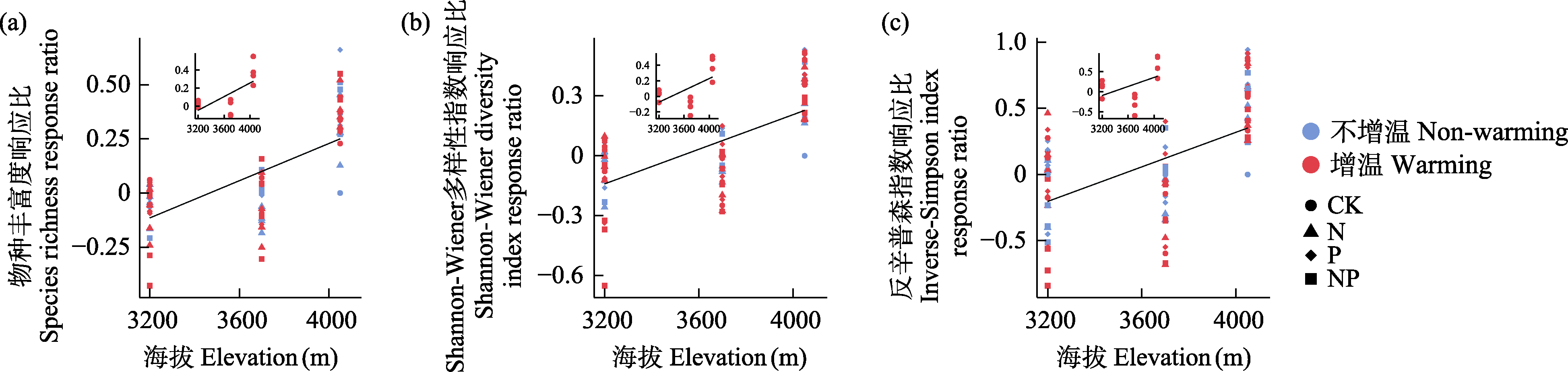
Fig. 1 Relationship between species richness response ratio (a), Shannon-Wiener diversity index response ratio (b), inverse-Simpson index response ratio (c) and elevation from 2021 to 2024. CK, Control; N, Nitrogen addition; P, Phosphorus addition; NP, Nitrogen and phosphorus co-addition. The parent figures represent the relationship between the response ratio and elevation under eight treatments, the subplot represent the relationship between the response ratio and elevation under warming.
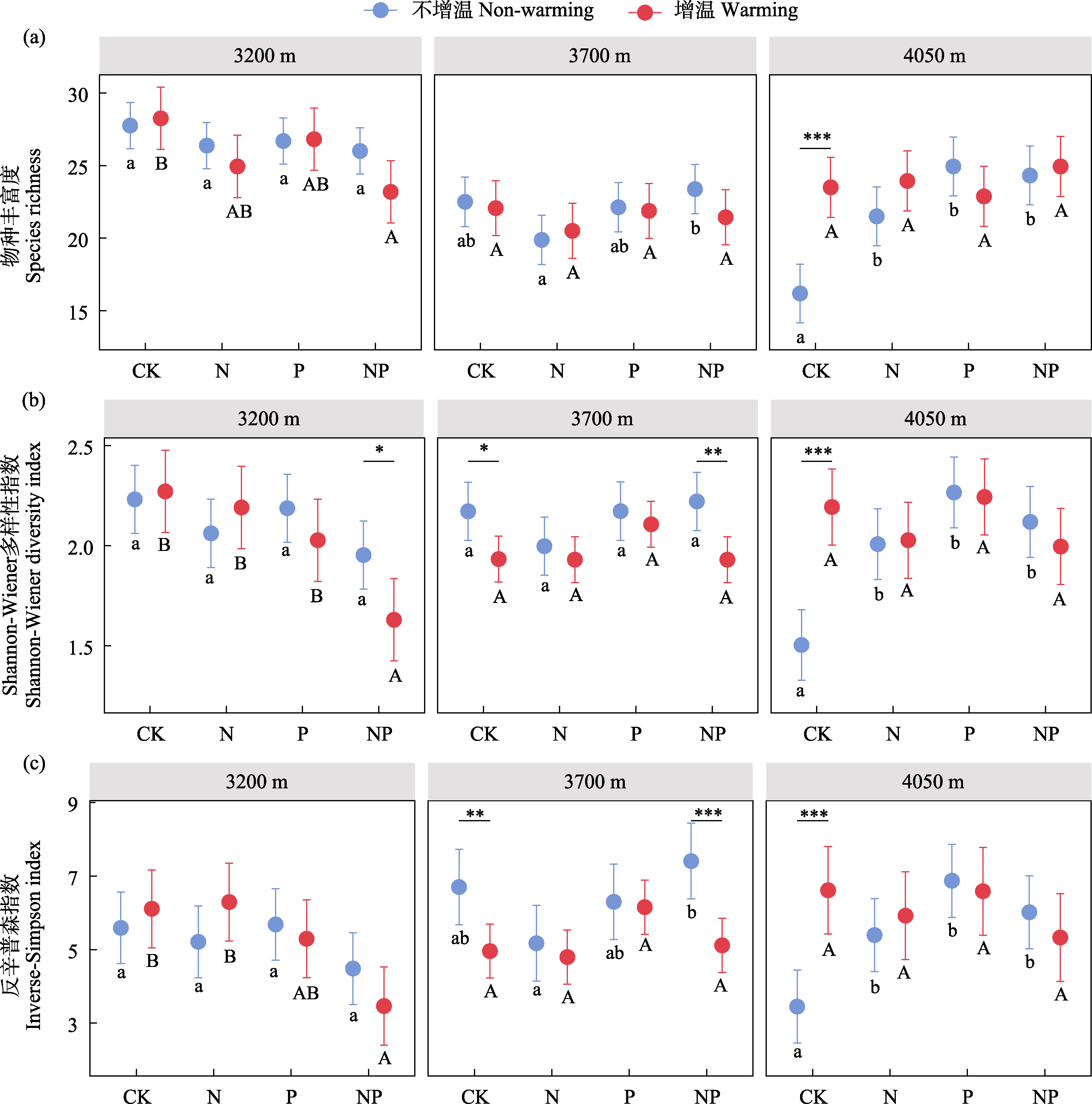
Fig. 2 Effects of warming, nutrient addition, and their interaction on species richness (a), Shannon-Wiener diversity index (b), and inverse-Simpson index (c) at different elevations. CK, Control; N, Nitrogen addition; P, Phosphorus addition; NP, Nitrogen and phosphorus co-addition. Different lowercase and uppercase letters indicate significant differences in the effects of four nutrient treatments on α diversity indices under non-warming and warming conditions, respectively; asterisks represent the significance of differences between warming and non-warming: * P < 0.05; ** P < 0.01; *** P < 0.001.
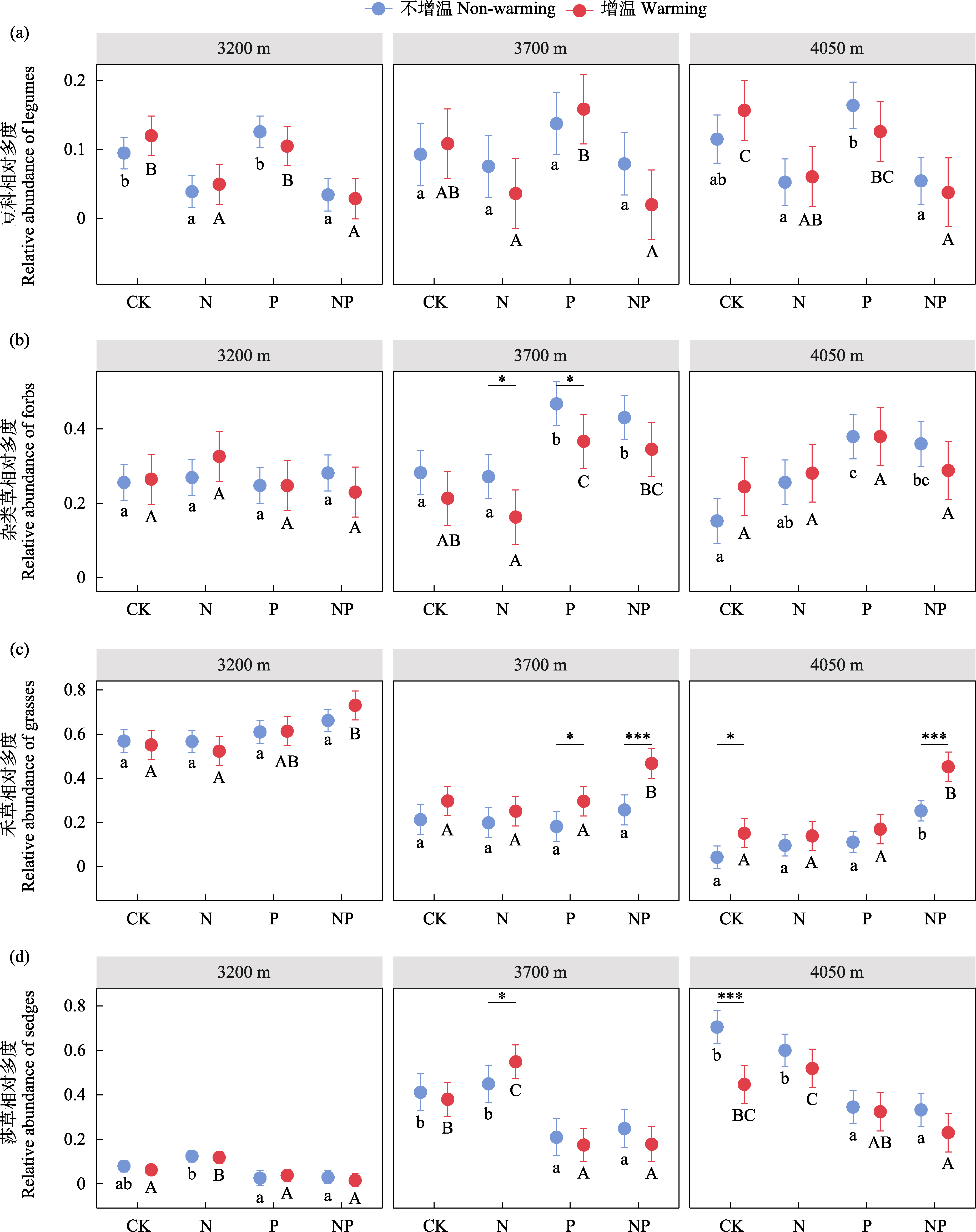
Fig. 3 The effects of warming, nutrient addition and their interaction on the relative abundance of plant functional groups at different elevations. CK, Control; N, Nitrogen addition; P, Phosphorus addition; NP, Nitrogen and phosphorus co-addition. Different lowercase and uppercase letters indicate significant differences in the effects of four nutrient treatments on the relative abundance of plant functional groups under non-warming and warming conditions, respectively; asterisks represent the significance of differences between warming and non-warming: * P < 0.05; ** P < 0.01; *** P < 0.001.
| 处理 Treatment | df | Dbray | Dbray | ||
|---|---|---|---|---|---|
| R2 | F | R2 | F | ||
| 增温 Warming (W) | 1 | 0.01 | 7.79*** | 0 | 5.19** |
| 氮添加 Nitrogen addition (N) | 1 | 0.01 | 7.72*** | 0 | 5.55*** |
| 磷添加 Phosphorus addition (P) | 1 | 0.03 | 24.51*** | 0.01 | 14.06*** |
| 海拔 Elevation (E) | 2 | 0.21 | 98.28*** | 0.13 | 72.78*** |
| 年际 Year (Y) | 3 | 0.15 | 46.74*** | 0.53 | 428.51*** |
| W × N | 1 | 0 | 1.50 | 0 | 1.62 |
| W × P | 1 | 0 | 1.81* | 0 | 1.56 |
| N × P | 1 | 0 | 4.32*** | 0 | 1.63 |
| W × E | 2 | 0.01 | 4.34*** | 0 | 1.17 |
| N × E | 2 | 0.01 | 3.89*** | 0.01 | 2.94** |
| P × E | 2 | 0.02 | 7.86*** | 0 | 2.00* |
| W × Y | 3 | 0.01 | 3.56*** | 0 | 2.60* |
| N × Y | 3 | 0.01 | 2.31*** | 0.01 | 4.45*** |
| P × Y | 3 | 0.01 | 4.24*** | 0 | 3.21** |
| E × Y | 6 | 0.13 | 21.22*** | 0.08 | 21.86*** |
| W × N × P | 1 | 0 | 1.60 | 0 | 1.34 |
| W × N × E | 2 | 0 | 0.88 | 0 | 0.71 |
| W × P × E | 2 | 0 | 1.86** | 0 | 0.83 |
| N × P × E | 2 | 0 | 1.80* | 0 | 0.52 |
| W × N × Y | 3 | 0 | 0.83 | 0 | 0.75 |
| W × P × Y | 3 | 0 | 1.06 | 0 | 2.16* |
| N × P × Y | 3 | 0 | 1.11 | 0 | 2.01* |
| W × E × Y | 6 | 0.02 | 2.40*** | 0 | 0.99 |
| N × E × Y | 6 | 0.01 | 1.62** | 0.01 | 1.83 |
| P × E × Y | 6 | 0.02 | 2.66*** | 0 | 0.97 |
| W × N × P × E | 2 | 0 | 1.75* | 0 | 0.56 |
| W × N × P × Y | 3 | 0 | 0.72 | 0 | 2.10 |
| W × N × E × Y | 6 | 0 | 0.75 | 0 | 0.77 |
| W × P × E × Y | 6 | 0.01 | 1.16 | 0 | 0.38 |
| N × P × E × Y | 6 | 0.01 | 1.06 | 0 | 0.74 |
| W × N × P × E × Y | 6 | 0.01 | 0.87 | 0 | 0.50 |
Table 2 Effect of elevation, warming, nutrient, year and their interactions on Bray-Curtis distance (Dbray) and Jaccard distance (Dbray)
| 处理 Treatment | df | Dbray | Dbray | ||
|---|---|---|---|---|---|
| R2 | F | R2 | F | ||
| 增温 Warming (W) | 1 | 0.01 | 7.79*** | 0 | 5.19** |
| 氮添加 Nitrogen addition (N) | 1 | 0.01 | 7.72*** | 0 | 5.55*** |
| 磷添加 Phosphorus addition (P) | 1 | 0.03 | 24.51*** | 0.01 | 14.06*** |
| 海拔 Elevation (E) | 2 | 0.21 | 98.28*** | 0.13 | 72.78*** |
| 年际 Year (Y) | 3 | 0.15 | 46.74*** | 0.53 | 428.51*** |
| W × N | 1 | 0 | 1.50 | 0 | 1.62 |
| W × P | 1 | 0 | 1.81* | 0 | 1.56 |
| N × P | 1 | 0 | 4.32*** | 0 | 1.63 |
| W × E | 2 | 0.01 | 4.34*** | 0 | 1.17 |
| N × E | 2 | 0.01 | 3.89*** | 0.01 | 2.94** |
| P × E | 2 | 0.02 | 7.86*** | 0 | 2.00* |
| W × Y | 3 | 0.01 | 3.56*** | 0 | 2.60* |
| N × Y | 3 | 0.01 | 2.31*** | 0.01 | 4.45*** |
| P × Y | 3 | 0.01 | 4.24*** | 0 | 3.21** |
| E × Y | 6 | 0.13 | 21.22*** | 0.08 | 21.86*** |
| W × N × P | 1 | 0 | 1.60 | 0 | 1.34 |
| W × N × E | 2 | 0 | 0.88 | 0 | 0.71 |
| W × P × E | 2 | 0 | 1.86** | 0 | 0.83 |
| N × P × E | 2 | 0 | 1.80* | 0 | 0.52 |
| W × N × Y | 3 | 0 | 0.83 | 0 | 0.75 |
| W × P × Y | 3 | 0 | 1.06 | 0 | 2.16* |
| N × P × Y | 3 | 0 | 1.11 | 0 | 2.01* |
| W × E × Y | 6 | 0.02 | 2.40*** | 0 | 0.99 |
| N × E × Y | 6 | 0.01 | 1.62** | 0.01 | 1.83 |
| P × E × Y | 6 | 0.02 | 2.66*** | 0 | 0.97 |
| W × N × P × E | 2 | 0 | 1.75* | 0 | 0.56 |
| W × N × P × Y | 3 | 0 | 0.72 | 0 | 2.10 |
| W × N × E × Y | 6 | 0 | 0.75 | 0 | 0.77 |
| W × P × E × Y | 6 | 0.01 | 1.16 | 0 | 0.38 |
| N × P × E × Y | 6 | 0.01 | 1.06 | 0 | 0.74 |
| W × N × P × E × Y | 6 | 0.01 | 0.87 | 0 | 0.50 |
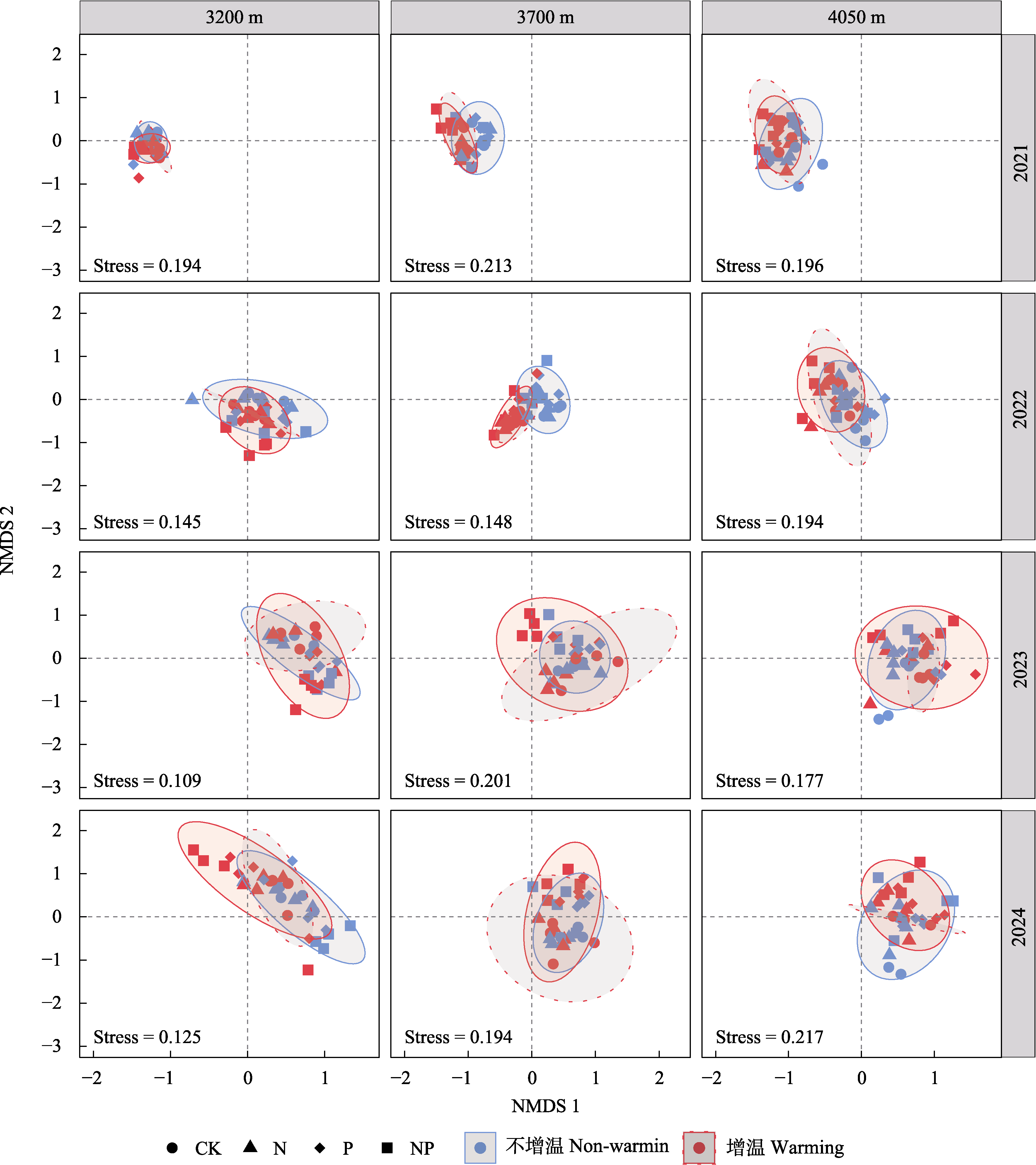
Fig. 4 Results of non-metric multidimensional scaling (NMDS) analysis of the communities composition at different elevations by warming and nutrient addition in 2021-2024. CK, Control; N, Nitrogen addition; P, Phosphorus addition; NP, Nitrogen and phosphorus co-addition. Blue solid line indicates no warming, red solid line indicates warming under nutrient additions, and the red dashed line indicates warming without nutrient additions.
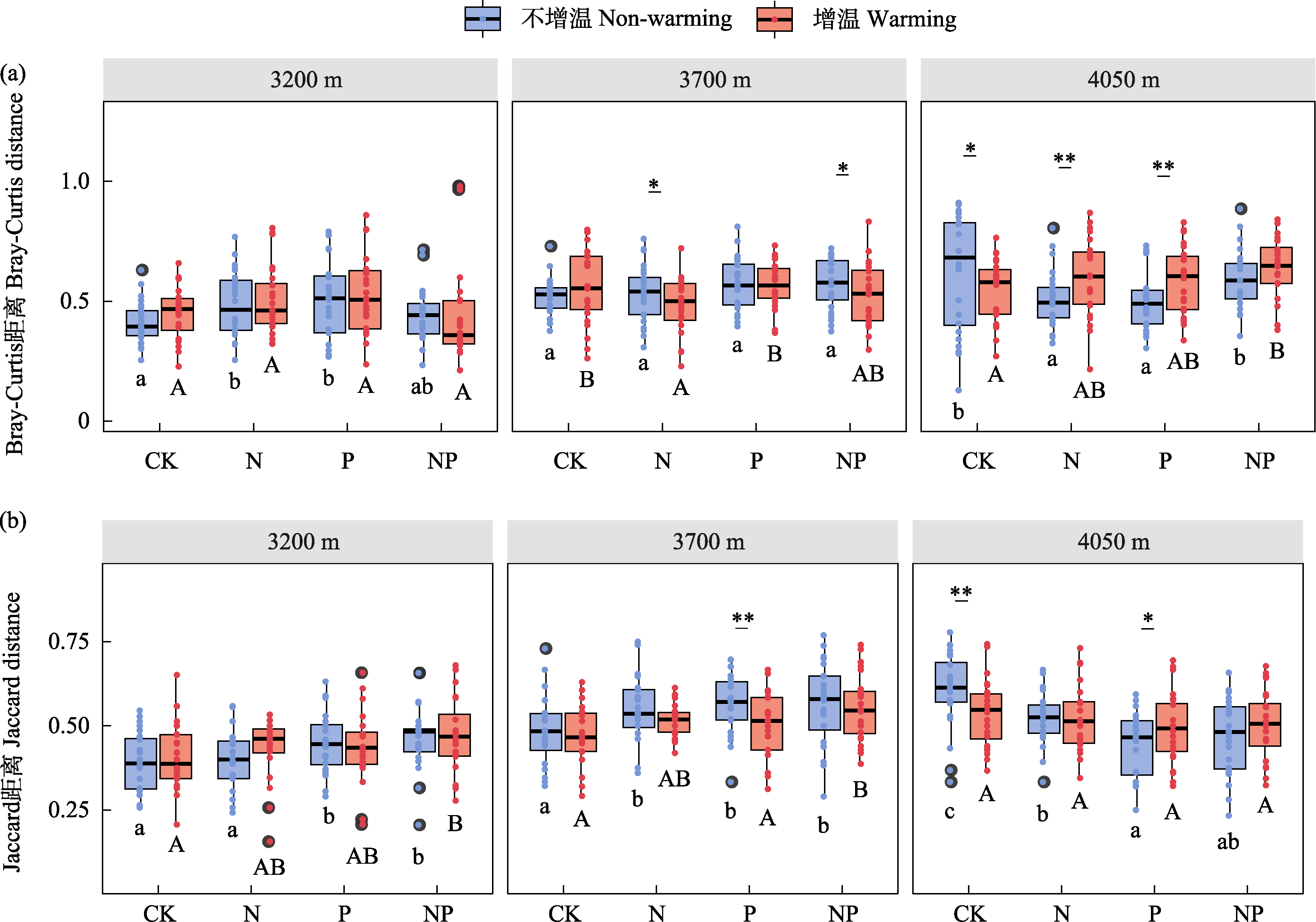
Fig. 5 The effects of warming, nutrient addition and their interaction on β diversity at different elevations, including Bray-Curtis distance (a) and Jaccard distance without species abundance (b). CK, Control; N, Nitrogen addition; P, Phosphorus addition; NP, Nitrogen and phosphorus co-addition. Different lowercase and uppercase letters indicate significant differences in the effects of four nutrient treatments on β diversity indices under non-warming and warming conditions, respectively; asterisks represent the significance of differences between warming and non-warming: * P < 0.05; ** P < 0.01; *** P < 0.001.
| 海拔 Elevation | 处理 Treatment | df | R2 | F |
|---|---|---|---|---|
| 3,200 m | 增温 Warming (W) | 1 | 0.02 | 2.96* |
| 年份 Year (Y) | 1 | 0.24 | 41.61*** | |
| W × Y | 1 | 0.02 | 2.72* | |
| 3,700 m | W | 1 | 0.03 | 4.70*** |
| Y | 1 | 0.19 | 30.67*** | |
| W × Y | 1 | 0.01 | 2.08* | |
| 4,050 m | W | 1 | 0.02 | 3.05** |
| Y | 1 | 0.21 | 33.25*** | |
| W × Y | 1 | 0.01 | 1.38 |
Table 3 Effects of warming and year on the Bray-Curtis distance of three elevations
| 海拔 Elevation | 处理 Treatment | df | R2 | F |
|---|---|---|---|---|
| 3,200 m | 增温 Warming (W) | 1 | 0.02 | 2.96* |
| 年份 Year (Y) | 1 | 0.24 | 41.61*** | |
| W × Y | 1 | 0.02 | 2.72* | |
| 3,700 m | W | 1 | 0.03 | 4.70*** |
| Y | 1 | 0.19 | 30.67*** | |
| W × Y | 1 | 0.01 | 2.08* | |
| 4,050 m | W | 1 | 0.02 | 3.05** |
| Y | 1 | 0.21 | 33.25*** | |
| W × Y | 1 | 0.01 | 1.38 |
| [1] |
A W, Lv WW, Zhou Y, Li BW, Sun JP, Lv JY, Chen LY, Tsecheo D, Wang SP (2024) Drought decreases the positive impact of warming on an alpine grassland community. Science China: Earth Sciences, 67, 3226-3238.
DOI |
| [2] | Band N, Kadmon R, Mandel M, DeMalach N (2022) Assessing the roles of nitrogen, biomass, and niche dimensionality as drivers of species loss in grassland communities. Proceedings of the National Academy of Sciences, USA, 119, e2112010119. |
| [3] | Borderieux J, Gegout JC, Serra-Diaz JM (2024) Extinction drives recent thermophilization but does not trigger homogenization in forest understorey. Nature Ecology & Evolution, 8, 695-704. |
| [4] | Cardinale BJ, Duffy JE, Gonzalez A, Hooper DU, Perrings C, Venail P, Narwani A, Mace GM, Tilman D, Wardle DA, Kinzig AP, Daily GC, Loreau M, Grace JB, Larigauderie A, Srivastava DS, Naeem S (2012) Biodiversity loss and its impact on humanity. Nature, 486, 59-67. |
| [5] |
Chen H, Zhu QA, Peng CH, Wu N, Wang YF, Fang XQ, Gao YH, Zhu D, Yang G, Tian JQ, Kang XM, Piao SL, Ouyang H, Xiang WH, Luo ZB, Jiang H, Song XZ, Zhang Y, Yu GR, Zhao XQ, Gong P, Yao TD, Wu JH (2013) The impacts of climate change and human activities on biogeochemical cycles on the Qinghai-Tibetan Plateau. Global Change Biology, 19, 2940-2955.
DOI PMID |
| [6] |
Elmendorf SC, Henry GHR, Hollister RD, Björk RG, Bjorkman AD, Callaghan TV, Collier LS, Cooper EJ, Cornelissen JHC, Day TA, Fosaa AM, Gould WA, Grétarsdóttir J, Harte J, Hermanutz L, Hik DS, Hofgaard A, Jarrad F, Jónsdóttir IS, Keuper F, Klanderud K, Klein JA, Koh S, Kudo G, Lang SI, Loewen V, May JL, Mercado J, Michelsen A, Molau U, Myers-Smith IH, Oberbauer SF, Pieper S, Post E, Rixen C, Robinson CH, Schmidt NM, Shaver GR, Stenström A, Tolvanen A, Totland Ø, Troxler T, Wahren CH, Webber PJ, Welker JM, Wookey PA (2012) Global assessment of experimental climate warming on tundra vegetation: Heterogeneity over space and time. Ecology Letters, 15, 164-175.
DOI PMID |
| [7] |
Fang C, Verbrigghe N, Sigurdsson BD, Ostonen I, Leblans NIW, Marañón-Jiménez S, Fuchslueger L, Sigurðsson P, Meeran K, Portillo-Estrada M, Verbruggen E, Richter A, Sardans J, Peñuelas J, Bahn M, Vicca S, Janssens IA (2023) Decadal soil warming decreased vascular plant above- and belowground production in a subarctic grassland by inducing nitrogen limitation. New Phytologist, 240, 565-576.
DOI URL |
| [8] |
Fang JY, Wang XP, Shen ZH, Tang ZY, He JS, Yu D, Jiang Y, Wang ZH, Zheng CY, Zhu JL, Guo ZD (2009) Methods and protocols for plant community inventory. Biodiversity Science, 17, 533-548. (in Chinese with English abstract)
DOI |
|
[方精云, 王襄平, 沈泽昊, 唐志尧, 贺金生, 于丹, 江源, 王志恒, 郑成洋, 朱江玲, 郭兆迪 (2009) 植物群落清查的主要内容、方法和技术规范. 生物多样性, 17, 533-548.]
DOI |
|
| [9] | Fu BJ, Ouyang ZY, Shi P, Fan J, Wang XD, Zheng H, Zhao WW, Wu F (2021) Current condition and protection strategies of Qinghai-Tibet Plateau ecological security barrier. Bulletin of Chinese Academy of Sciences, 36, 1298-1306. (in Chinese with English abstract) |
| [傅伯杰, 欧阳志云, 施鹏, 樊杰, 王小丹, 郑华, 赵文武, 吴飞 (2021) 青藏高原生态安全屏障状况与保护对策. 中国科学院院刊, 36, 1298-1306.] | |
| [10] |
Fu G, Sun W, Yu CQ, Zhang XZ, Shen ZX, Li YL, Yang PW, Zhou N (2015) Clipping alters the response of biomass production to experimental warming: A case study in an alpine meadow on the Tibetan Plateau, China. Journal of Mountain Science, 12, 935-942.
DOI URL |
| [11] |
Ganjurjav H, Gao QZ, Gornish ES, Schwartz MW, Liang Y, Cao XJ, Zhang WN, Zhang Y, Li WH, Wan YF, Li Y, Danjiu L, Guo HB, Lin ED (2016) Differential response of alpine steppe and alpine meadow to climate warming in the central Qinghai-Tibetan Plateau. Agricultural and Forest Meteorology, 223, 233-240.
DOI URL |
| [12] |
Hanley N, Perrings C (2019) The economic value of biodiversity. Annual Review of Resource Economics, 11, 355-375.
DOI |
| [13] |
Hoyle GL, Venn SE, Steadman KJ, Good RB, McAuliffe EJ, Williams ER, Nicotra AB (2013) Soil warming increases plant species richness but decreases germination from the alpine soil seed bank. Global Change Biology, 19, 1549-1561.
DOI PMID |
| [14] |
Isbell F, Craven D, Connolly J, Loreau M, Schmid B, Beierkuhnlein C, Bezemer TM, Bonin C, Bruelheide H, de Luca E, Ebeling A, Griffin JN, Guo Q, Hautier Y, Hector A, Jentsch A, Kreyling J, Lanta V, Manning P, Meyer ST, Mori AS, Naeem S, Niklaus PA, Polley HW, Reich PB, Roscher C, Seabloom EW, Smith MD, Thakur MP, Tilman D, Tracy BF, van der Putten WH, van Ruijven J, Weigelt A, Weisser WW, Wilsey B, Eisenhauer N (2015) Biodiversity increases the resistance of ecosystem productivity to climate extremes. Nature, 526, 574-577.
DOI |
| [15] |
Isbell F, Gonzalez A, Loreau M, Cowles J, Diaz S, Hector A, Mace GM, Wardle DA, O’Connor MI, Duffy JE, Turnbull LA, Thompson PL, Larigauderie A (2017) Linking the influence and dependence of people on biodiversity across scales. Nature, 546, 65-72.
DOI URL |
| [16] |
Jing X, Jiang SJ, Liu HY, Li Y, He JS (2022) Complex relationships and feedback mechanisms between climate change and biodiversity. Biodiversity Science, 30, 22462. (in Chinese with English abstract)
DOI |
|
[井新, 蒋胜竞, 刘慧颖, 李昱, 贺金生 (2022) 气候变化与生物多样性之间的复杂关系和反馈机制. 生物多样性, 30, 22462.]
DOI |
|
| [17] |
Jones KR, Watson JEM, Possingham HP, Klein CJ (2016) Incorporating climate change into spatial conservation prioritisation: A review. Biological Conservation, 194, 121-130.
DOI URL |
| [18] |
Ladouceur E, Blowes SA, Chase JM, Clark AT, Garbowski M, Alberti J, Arnillas CA, Bakker JD, Barrio IC, Bharath S, Borer ET, Brudvig LA, Cadotte MW, Chen Q, Collins SL, Dickman CR, Donohue I, Du G, Ebeling A, Eisenhauer N, Fay PA, Hagenah N, Hautier Y, Jentsch A, Jónsdóttir IS, Komatsu K, MacDougall A, Martina JP, Moore JL, Morgan JW, Peri PL, Power Sally A, Ren Z, Risch AC, Roscher C, Schuchardt Max A, Seabloom EW, Stevens CJ, Veen GF, Virtanen R, Wardle GM, Wilfahrt PA, Harpole WS (2022) Linking changes in species composition and biomass in a globally distributed grassland experiment. Ecology Letters, 25, 2699-2712.
DOI PMID |
| [19] | Li S, Delgado-Baquerizo M, Ding JX, Hu H, Huang WG, Sun YS, Ni HW, Kuang YY, Yuan MM, Zhou JZ, Zhang JB, Liang YT (2024) Intrinsic microbial temperature sensitivity and soil organic carbon decomposition in response to climate change. Global Change Biology, 30, e17395. |
| [20] | Liu HY, Mi ZR, Lin L, Wang YH, Zhang ZH, Zhang FW, Wang H, Liu LL, Zhu B, Cao GM, Zhao XQ, Sanders NJ, Classen AT, Reich PB, He JS (2018) Shifting plant species composition in response to climate change stabilizes grassland primary production. Proceedings of the National Academy of Sciences, USA, 115, 4051-4056. |
| [21] | Liu M, Zhang XY, Li XL, Liu Q, Meng WZ, Xu MH (2020) Short-term responses of under-canopy grasslands to the experimental warming on the Loess Plateau, China. Acta Ecologica Sinica, 40, 6009-6024. (in Chinese with English abstract) |
| [刘敏, 张潇月, 李晓丽, 刘琦, 孟万忠, 徐满厚 (2020) 黄土高原林下草地对模拟增温的短期响应. 生态学报, 40, 6009-6024.] | |
| [22] | Liu YZ, Mu JP, Niklas KJ, Li GY, Sun SC (2012) Global warming reduces plant reproductive output for temperate multi-inflorescence species on the Tibetan Plateau. New Phytologist, 195, 427-436. |
| [23] |
Lou J (2006) Entropy and diversity. Oikos, 113, 363-375.
DOI URL |
| [24] | Luo CY, Xu GP, Chao ZG, Wang SP, Lin XW, Hu YG, Zhang ZH, Duan JC, Chang XF, Su AL, Li YN, Zhao XQ, Du MY, Tang YH, Kimball B (2010)Effect of warming and grazing on litter mass loss and temperature sensitivity of litter and dung mass loss on the Tibetan Plateau. Global Change Biology, 16, 1606-1617. |
| [25] |
Ma L, Zhang Q, Zhang ZH, Guo J, Yang XY, Zhou BR, Deng YF, Wang F, She YD, Zhou HK (2020) Effects of gradient warming on species diversity and biomass in alpine meadows. Acta Agrestia Sinica, 28, 1395-1402. (in Chinese with English abstract)
DOI |
|
[马丽, 张骞, 张中华, 郭婧, 杨晓渊, 周秉荣, 邓艳芳, 王芳, 佘延娣, 周华坤 (2020) 梯度增温对高寒草甸物种多样性和生物量的影响. 草地学报, 28, 1395-1402.]
DOI |
|
| [26] |
Ma ZY, Liu HY, Mi ZR, Zhang ZH, Wang YH, Xu W, Jiang L, He JS (2017) Climate warming reduces the temporal stability of plant community biomass production. Nature Communications, 8, 15378.
DOI PMID |
| [27] | Magurran AE (2021) Measuring biological diversity. Current Biology, 31, R1174-R1177. |
| [28] |
Mao C, Kou D, Chen LY, Qin SQ, Zhang DY, Peng YF, Yang YH (2020) Permafrost nitrogen status and its determinants on the Tibetan Plateau. Global Change Biology, 26, 5290-5302.
DOI URL |
| [29] |
Mountain Research Initiative EDW Working Group (2015) Elevation-dependent warming in mountain regions of the world. Nature Climate Change, 5, 424-430.
DOI |
| [30] |
Niu QC, Jin GF, Yin SX, Gan L, Yang ZY, Dorji T, Shen MG (2025) Transcriptional changes underlying the degradation of plant community in alpine meadow under seasonal warming impact. Plant, Cell & Environment, 48, 526-536.
DOI URL |
| [31] | Oksanen J, Simpson GL, Blanchet FG, Kindt R, Legendre P, Minchin PR, O’Hara RB, Solymos P, Stevens MHH, Szoecs E, Wagner H, Barbour M, Bedward M, Bolker B, Borcard D, Carvalho G, Chirico M, Caceres MD, Durand S, Evangelista HBA, FitzJohn R, Friendly M, Furneaux B, Hannigan G, Hill GO, Lahti L, Glinn DM, Ouellette MH, Cunha ER, Smith T, Stier A, Braak CJFT, Weedon J (2022) vegan:Community Ecology Package. R package version 2.6-2. https://cran.r-project.org/package=vegan. (accessed on 2024-12-21) |
| [32] | Ouyang ZY, Zhang GS, Ying LX (2024) Overview of the impacts of climate change on ecosystem distribution and functions across the Tibetan Plateau. Climate Change Research, 20, 699-710. (in Chinese with English abstract) |
| [欧阳志云, 张观石, 应凌霄 (2024) 气候变化对青藏高原生态系统分布范围和生态功能的影响研究进展. 气候变化研究进展, 20, 699-710.] | |
| [33] | Peng Y, Yang JX, Seabloom EW, Leitch AR, Leitch IJ, Wang RZ, Wei CZ, Han XG (2025) Nutrient effects on plant diversity loss arise from nutrient identity and decreasing niche dimension. Ecology, 106, e4496. |
| [34] |
Qin WK, Chen Y, Wang XD, Zhao HY, Hou YH, Zhang QF, Zhu B (2022) Whole-soil warming shifts species composition without affecting diversity, biomass and productivity of the plant community in an alpine meadow. Fundamental Research, 3, 160-169.
DOI URL |
| [35] |
Qiu J (2008) China: The third pole. Nature, 454, 393-396.
DOI |
| [36] | R Core Team (2021) R: A Language and Environment for Statistical Computing. Version 4.1.2. R Foundation for Statistical Computing, Vienna, Austria. |
| [37] |
Rudgers JA, Kivlin SN, Whitney KD, Price MV, Waser NM, Harte J (2014) Responses of high-altitude graminoids and soil fungi to 20 years of experimental warming. Ecology, 95, 1918-1928.
DOI PMID |
| [38] | Rui YC, Wang YF, Chen CR, Zhou XQ, Wang SP, Xu ZH, Duan JC, Kang XM, Lu SB, Luo CY () Warming and grazing increase mineralization of organic P in an alpine meadow ecosystem of Qinghai-Tibet Plateau, China. Plant and Soil, 357, 73-87. |
| [39] |
Suggitt AJ, Wilson RJ, Isaac NJB, Beale CM, Auffret AG, August T, Bennie JJ, Crick HQP, Duffield S, Fox R, Hopkins JJ, MacGregor NA, Morecroft MD, Walker KJ, MacLean IMD (2018) Extinction risk from climate change is reduced by microclimatic buffering. Nature Climate Change, 8, 713-717.
DOI |
| [40] |
Xu W, Ma ZY, Jing X, He JS (2016) Biodiversity and ecosystem multifunctionality: Advances and perspectives. Biodiversity Science, 24, 55-71. (in Chinese with English abstract)
DOI |
|
[徐炜, 马志远, 井新, 贺金生 (2016) 生物多样性与生态系统多功能性: 进展与展望. 生物多样性, 24, 55-71.]
DOI |
|
| [41] |
Tian QY, Liu NN, Bai WM, Li LH, Chen JQ, Reich PB, Yu Q, Guo DL, Smith MD, Knapp AK, Cheng WX, Lu P, Gao Y, Yang A, Wang TZ, Li X, Wang ZW, Ma YB, Han XG, Zhang WH (2016) A novel soil manganese mechanism drives plant species loss with increased nitrogen deposition in a temperate steppe. Ecology, 97, 65-74.
PMID |
| [42] | Wang SP, Duan JC, Xu GP, Wang YF, Zhang ZH, Rui YC, Luo CY, Xu B, Zhu XX, Chang XF, Cui XY, Niu HS, Zhao XQ, Wang WY (2012) Effects of warming and grazing on soil N availability, species composition, and ANPP in an alpine meadow. Ecology, 93, 2365-2376. |
| [43] |
Wang Y, Liu C, Liu B, Lee TM (2025) Integrated outcomes of large-scale ecological restoration projects on biodiversity- eco-environment-society in China. Geography and Sustainability, 6, 100243.
DOI |
| [44] | Wei B, Zhang DY, Wang GQ, Liu Y, Li QL, Zheng ZH, Yang GB, Peng YF, Niu KC, Yang YH (2023) Experimental warming altered plant functional traits and their coordination in a permafrost ecosystem. New Phytologist, 240, 1802-1816. |
| [45] | Ye QD, Ren F, Li YH, Zhang ZY, Fan N, Ye J, Li XL, Li LP (2022) Effects of different nutrient additions on functional traits of alpine plant. Acta Agrestia Sinica, 30, 2737-2744. (in Chinese with English abstract) |
|
[叶琼丹, 任飞, 李永慧, 张子杨, 樊娜, 冶俊, 李希来, 李兰平 (2022) 不同养分添加对高寒植物功能性状的影响. 草地学报, 30, 2737-2744.]
DOI |
|
| [46] |
You QL, Cai ZY, Pepin N, Chen DL, Ahrens B, Jiang ZH, Wu FY, Kang SC, Zhang RN, Wu TH, Wang PL, Li MC, Zuo ZY, Gao YH, Zhai PM, Zhang YQ (2021) Warming amplification over the Arctic Pole and Third Pole: Trends, mechanisms and consequences. Earth-Science Reviews, 217, 103625.
DOI URL |
| [47] | Zhang YL, Li BY, Zheng D (2002) A discussion on the boundary and area of the Tibetan Plateau in China. Geographical Research, 21, 1-8. (in Chinese with English abstract) |
| [张镱锂, 李炳元, 郑度 (2002) 论青藏高原范围与面积. 地理研究, 21, 1-8.] | |
| [48] | Zhao M, Loreau M, Ochoa-Hueso R, Zhang HX, Yang JJ, Zhang YH, Liu HY, Jiang Y, Han XG (2024) Decoupled responses of above- and below-ground beta-diversity to nitrogen enrichment in a typical steppe. Ecology Letters , 27, e14339. |
| [49] |
Zhu EX, Cao ZJ, Jia J, Liu CZ, Zhang ZH, Wang H, Dai GH, He JS, Feng XJ (2021) Inactive and inefficient: Warming and drought effect on microbial carbon processing in alpine grassland at depth. Global Change Biology, 27, 2241-2253.
DOI PMID |
| [50] |
Zwiener VP, Lira-Noriega A, Grady CJ, Padial AA, Vitule JRS (2018) Climate change as a driver of biotic homogenization of woody plants in the Atlantic Forest. Global Ecology and Biogeography, 27, 298-309.
DOI URL |
| [1] | Jin Li, Minghao Cheng, Yi Zhang, Feng Liu, Qinghu Jiang, Jirong Ye, Zhan Chen, Yuguang Zhang. Soil microbial diversity and plant-microbe inter-kingdom ecological networks across an elevational gradient in Abies fargesii forests [J]. Biodiv Sci, 2026, 34(4): 25276-. |
| [2] | Lijie Zhou, Minhui Huang, Huaijiang He, Yanxia Cheng, Chunyu Zhang, Xiuhai Zhao. Disentangling the patterns, components, and influencing factors of forest β diversity in the Xiaoxing’an Mountains, Northeast China [J]. Biodiv Sci, 2026, 34(4): 25443-. |
| [3] | Changqiao Chen, Yanfei Feng, Liqi Lu, Huaijiang He, Chunyu Zhang, Xiuhai Zhao, Minhui Hao. β-diversity pattern and mechanism in a conifer-broadleaf mixed forest in Jiaohe, Jilin Province [J]. Biodiv Sci, 2025, 33(12): 25169-. |
| [4] | Rongjiao Li, Jianghai Dong, Wenfang Zheng, Ruyuan Liu, Lijuan Zhao, Ruihe Gao. Soil faunal diversity characteristics and influencing factors across the altitude gradient in the poplar-birch forest of Guandi Mountains [J]. Biodiv Sci, 2024, 32(9): 24070-. |
| [5] | Xiang Gao, Shufang Pan, Zhengzheng Sun, Jixiao Li, Tianyu Gao, Lu Dong, Ning Wang. Distribution and activity rhythm of small Indian civet (Viverricula indica) in Fenghuang Hill and Qi’ao Island, Zhuhai, Guangdong [J]. Biodiv Sci, 2024, 32(8): 24045-. |
| [6] | Zhixian Sun, Chen Tian, Xin Wang, Yutian Fang, Bo Li, Yahui Zhao. Threats faced by native fishes in tropical coastal cities: A case study of Sanya City, Hainan Province, China [J]. Biodiv Sci, 2024, 32(8): 24165-. |
| [7] | Yao Zhang, Junyao Sun, Wei Li. Temporal and spatial trends in NDVI of vegetation in water level fluctuation zone and drivers along an altitude gradient in the Yarlung Zangbo River Basin [J]. Biodiv Sci, 2024, 32(5): 23432-. |
| [8] | Zhu Yao, Xue Wei, Jinhao Ma, Xiao Ren, Yuying Wang, Lei Hu, Pengfei Wu. Short-term effects of warming and wetting on the soil nematode communities in the alpine meadow [J]. Biodiv Sci, 2024, 32(5): 23483-. |
| [9] | Bin Li, Pengfei Song, Haifeng Gu, Bo Xu, Daoxin Liu, Feng Jiang, Chengbo Liang, Meng Zhang, Hongmei Gao, Zhenyuan Cai, Tongzuo Zhang. Bird community diversity patterns and their drivers in the Qinghai region of Kunlun Mountains [J]. Biodiv Sci, 2024, 32(4): 23406-. |
| [10] | Di Lin, Shuanglin Chen, Que Du, Wenlong Song, Gu Rao, Shuzhen Yan. Investigation of species diversity of myxomycetes in Dabie Mountains [J]. Biodiv Sci, 2024, 32(2): 23242-. |
| [11] | Jia Yao, Congling Zhang, Shixuan Li, Yang Lin, Zhen Wang, Yuhan Zhang, Weilong Zhou, Xinhe Pan, Shan Zhu, Yiqing Wu, Dan Wang, Jinliang Liu, Shanshan Tan, Guochun Shen, Mingjian Yu. Characteristics of plant communities in the Baishanzu continuous elevational transect [J]. Biodiv Sci, 2024, 32(12): 24052-. |
| [12] | Fangfang Wu, Na Liu, Chunmei He, Zuoqiang Yuan, Zhanqing Hao, Qiulong Yin. Elevational gradient pattern of woody plant community structure and diversity in the Qinling Mountains [J]. Biodiv Sci, 2024, 32(12): 24239-. |
| [13] | Zhichao Xu, Meihui Zhu, Zikun Mao, Xugao Wang. Effects of nitrogen addition on seedling dynamics in a broad-leaved Korean pine forest in Northeast China [J]. Biodiv Sci, 2024, 32(12): 24255-. |
| [14] | Weiwei Wang, Xiangcheng Mi, Ningning Wang, Haibao Ren, Zhixi Tang, Zhuning Zhang, Keping Ma, Lei Chen. Plant diversity dataset of the 24-ha Zhejiang Gutianshan subtropical evergreen broad-leaved forest dynamics plot (2005-2020) [J]. Biodiv Sci, 2024, 32(12): 24417-. |
| [15] | Yue Chen, Zikun Mao, Xugao Wang. Research advances and prospects on β diversity based on ecological uniqueness [J]. Biodiv Sci, 2024, 32(12): 24199-. |
| Viewed | ||||||
|
Full text |
|
|||||
|
Abstract |
|
|||||
Copyright © 2026 Biodiversity Science
Editorial Office of Biodiversity Science, 20 Nanxincun, Xiangshan, Beijing 100093, China
Tel: 010-62836137, 62836665 E-mail: biodiversity@ibcas.ac.cn

