

Biodiv Sci ›› 2026, Vol. 34 ›› Issue (6): 26002. DOI: 10.17520/biods.2026002 cstr: 32101.14.biods.2026002
• Bioinventories • Previous Articles Next Articles
Weicai Chen1,2,*( )(
)( ), Guohua Yu3(), Yunming Mo4(), Yongjian Bei5()
Received:2026-01-04
Accepted:2026-03-25
Online:2026-06-20
Published:2026-07-30
Contact:
*E-mail: chenweicai2003@126.com
Supported by:Weicai Chen, Guohua Yu, Yunming Mo, Yongjian Bei. Revision of the checklist of amphibian species in Guangxi, China[J]. Biodiv Sci, 2026, 34(6): 26002.
| 原科中文名 Previous family Chinese name | 原科学名 Previous family scientific name | 原属中文名 Previous genus Chinese name | 原属学名 Previous genus scientific name | 现科中文名 Revised family Chinese name | 现科学名 Revised family scientific name | 现属中文名 Revised genus Chinese name | 现属学名 Revised genus scientific name | 参考文献 References |
|---|---|---|---|---|---|---|---|---|
| 角蟾科 | Megophryidae | 髭蟾属 | Vibrissaphora | 角蟾科 | Megophryidae | 拟髭蟾属 | Leptobrachium | Rao & Wilkinson, |
| 掌突蟾属 | Paramegophrys | 掌突蟾属 | Leptobrachella | Chen JM et al., | ||||
| 角蟾属 | Megophrys | 布角蟾属 | Boulenophrys | Chen et al., | ||||
| 异角蟾属 | Xenophrys | Lyu et al., | ||||||
| 蟾蜍科 | Bufonidae | 溪蟾属 | Torrentophryne | 蟾蜍科 | Bufonidae | 蟾蜍属 | Bufo | Frost et al., |
| 浮蛙科 | Occidozygidae | 浮蛙属 | Occidozyga | 叉舌蛙科 | Dicroglossidae | 浮蛙属 | Occidozyga | Hasan et al., |
| 蟾舌蛙属 | Phrynoglossus | 浮蛙属 | Occidozyga | Hasan et al., | ||||
| 蛙科 | Ranidae | 林蛙属 | Rana | 蛙科 | Ranidae | 蛙属 | Rana | Yuan et al., |
| 趾沟蛙属 | Pseudorana | 蛙属 | Rana | Yuan et al., | ||||
| 沼蛙属 | Boulengerana | 水蛙属 | Hylarana | Oliver et al., | ||||
| 肱腺蛙属 | Sylvirana | 水蛙属 | Hylarana | Oliver et al., | ||||
| 树蛙科 | Rhacophoridae | 水树蛙属 | Aquixalus | 树蛙科 | Rhacophoridae | 原指树蛙属 | Kurixalus | Li et al., |
| 费树蛙属 | Feihyla | Li et al., | ||||||
| 跳树蛙属 | Chirixalus | 侧条树蛙属 | Rohanixalus | Biju et al., | ||||
| 树蛙属 | Rhacophorus | 张树蛙属 | Zhangixalus | Jiang et al., | ||||
| 树蛙属 | Rhacophorus | Jiang et al., |
Table 1 Taxonomic revisions at family and genus level based on Colored Atlas of Guangxi Amphibians (Mo et al., 2014)
| 原科中文名 Previous family Chinese name | 原科学名 Previous family scientific name | 原属中文名 Previous genus Chinese name | 原属学名 Previous genus scientific name | 现科中文名 Revised family Chinese name | 现科学名 Revised family scientific name | 现属中文名 Revised genus Chinese name | 现属学名 Revised genus scientific name | 参考文献 References |
|---|---|---|---|---|---|---|---|---|
| 角蟾科 | Megophryidae | 髭蟾属 | Vibrissaphora | 角蟾科 | Megophryidae | 拟髭蟾属 | Leptobrachium | Rao & Wilkinson, |
| 掌突蟾属 | Paramegophrys | 掌突蟾属 | Leptobrachella | Chen JM et al., | ||||
| 角蟾属 | Megophrys | 布角蟾属 | Boulenophrys | Chen et al., | ||||
| 异角蟾属 | Xenophrys | Lyu et al., | ||||||
| 蟾蜍科 | Bufonidae | 溪蟾属 | Torrentophryne | 蟾蜍科 | Bufonidae | 蟾蜍属 | Bufo | Frost et al., |
| 浮蛙科 | Occidozygidae | 浮蛙属 | Occidozyga | 叉舌蛙科 | Dicroglossidae | 浮蛙属 | Occidozyga | Hasan et al., |
| 蟾舌蛙属 | Phrynoglossus | 浮蛙属 | Occidozyga | Hasan et al., | ||||
| 蛙科 | Ranidae | 林蛙属 | Rana | 蛙科 | Ranidae | 蛙属 | Rana | Yuan et al., |
| 趾沟蛙属 | Pseudorana | 蛙属 | Rana | Yuan et al., | ||||
| 沼蛙属 | Boulengerana | 水蛙属 | Hylarana | Oliver et al., | ||||
| 肱腺蛙属 | Sylvirana | 水蛙属 | Hylarana | Oliver et al., | ||||
| 树蛙科 | Rhacophoridae | 水树蛙属 | Aquixalus | 树蛙科 | Rhacophoridae | 原指树蛙属 | Kurixalus | Li et al., |
| 费树蛙属 | Feihyla | Li et al., | ||||||
| 跳树蛙属 | Chirixalus | 侧条树蛙属 | Rohanixalus | Biju et al., | ||||
| 树蛙属 | Rhacophorus | 张树蛙属 | Zhangixalus | Jiang et al., | ||||
| 树蛙属 | Rhacophorus | Jiang et al., |
| ID | 原属中文名Previous genus Chinese name | 原属学名 Previous genus scientific name | 原种中文名 Previous Chinese common name | 原种学名 Previous species scientific name | 现属中文名 Revised genus Chinese name | 现属学名 Revised genus scientific name | 现种中文名Revised Chinese common name | 现种学名 Revised species scientific name | 参考文献 References | |
|---|---|---|---|---|---|---|---|---|---|---|
| 鱼螈科 Ichthyophiidae | 鱼螈科 Ichthyophiidae | |||||||||
| 1 | 鱼螈属 | Ichthyophis | 版纳鱼螈 | Ichthyophis bannanicus | 鱼螈属 | Ichthyophis | 版纳鱼螈 | Ichthyophis kohtaoensis | Nishikawa et al., | |
| 角蟾科 Megophryidae | 角蟾科 Megophryidae | |||||||||
| 2 | 掌突蟾属 | Paramegophrys | 高山掌突蟾 | Paramegophrys alpinus | 掌突蟾属 | Leptobrachella | 高山掌突蟾 | Leptobrachella alpina | Chen JM et al., | |
| 3 | 福建掌突蟾 | Paramegophrys liui | 大瑶山掌 突蟾 | Leptobrachella dayaoshanensis | Yu et al., | |||||
| 4 | 髭蟾属 | Vibrissaphora | 峨眉髭蟾 | Vibrissaphora boringii | 拟髭蟾属 | Leptobrachium | 峨眉髭蟾 | Leptobrachium boringii | Rao & Wilkinson, | |
| 5 | 雷山髭蟾 | Vibrissaphora leishanensis | 雷山髭蟾 | Leptobrachium leishanensis | Rao & Wilkinson, | |||||
| 6 | 崇安髭蟾瑶山亚种 | Vibrissaphora liui yaoshanensis | 崇安髭蟾 | Leptobrachium liui | Rao & Wilkinson, | |||||
| 7 | 短腿蟾属 | Brachytarsophrys | 宽头短腿蟾 | Brachytarsophrys carinensis | 短腿蟾属 | Brachytarsophrys | 平顶短腿蟾 | Brachytarsophrys platyparietus | Li et al., | |
| 8 | 角蟾属 | Megophrys | 莽山角蟾 | Megophrys mangshanensis | 异角蟾属 | Xenophrys | 莽山角蟾 | Xenophrys mangshanensis | Lyu et al., | |
| 9 | 大角蟾 | Megophrys major | 茅索角蟾 | Xenophrys maosonensis | Lyu et al., | |||||
| 10 | 凹顶角蟾 | Megophrys parva | 凹顶角蟾 | Xenophrys parva | Lyu et al., | |||||
| 11 | 景东角蟾 | Megophrys jindongensis | 布角蟾属 | Boulenophrys | 景东角蟾 | Boulenophrys jingdongensis | Lyu et al., | |||
| 12 | 棘指角蟾 | Megophrys spinata | 棘指角蟾 | Boulenophrys spinata | Lyu et al., | |||||
| 13 | 粗皮角蟾 | Megophrys palpebralespinosa | 粗皮角蟾 | Boulenophrys palpebralespinosa | Lyu et al., | |||||
| 14 | 短肢角蟾 | Megophrys brachykolos | 瑶山角蟾 | Boulenophrys yaoshanensis | Qi et al., | |||||
| 蟾蜍科 Bufonidae | 蟾蜍科 Bufonidae | |||||||||
| 15 | 蟾蜍属 | Bufo | 中华蟾蜍华西亚种 | Bufo gargarizans andrewsi | 蟾蜍属 | Bufo | 华西蟾蜍 | Bufo andrewsi | 车静等, | |
| 16 | 溪蟾属 | Torrentophryne | 隐耳溪蟾 | Torrentophryne cryptotympanicus | 蟾蜍属 | Bufo | 隐耳溪蟾 | Bufo cryptotympanicus | Frost et al., | |
| 浮蛙科 Occidozygidae | 叉舌蛙科 Dicroglossidae | |||||||||
| 17 | 浮蛙属 | Occidozyga | 圆舌浮蛙 | Occidozyga martensii | 浮蛙属 | Occidozyga | 岭南浮蛙 | Occidozyga lingnanica | Lyu et al., | |
| 18 | 尖舌浮蛙 | Occidozyga lima | 中国浮蛙 | Occidozyga obscura | Lyu et al., | |||||
| 蛙科 Ranidae | 蛙科 Ranidae | |||||||||
| 19 | 沼蛙属 | Boulengerana | 沼蛙 | Boulengerana guentheri | 水蛙属 | Hylarana | 沼水蛙 | Hylarana guentheri | Oliver et al., | |
| 20 | 肱腺蛙属 | Sylvirana | 河口水蛙 | Sylvirana hekouensis | 水蛙属 | Hylarana | 河口水蛙 | Hylarana hekouensis | Oliver et al., | |
| 21 | 阔褶水蛙 | Sylvirana latouchii | 阔褶水蛙 | Hylarana latouchii | Oliver et al., | |||||
| 22 | 茅索水蛙 | Sylvirana maosonensis | 茅索水蛙 | Hylarana maosonensis | Oliver et al., | |||||
| 23 | 琴蛙属 | Nidirana | 弹琴蛙 | Nidirana adenopleura | 琴蛙属 | Nidirana | 广西琴蛙 | Nidirana guangxiensis | Lyu et al., | |
| 24 | 桂北琴蛙 | Nidirana guibeiensis | Chen et al., | |||||||
| 25 | 十万大山 琴蛙 | Nidirana shiwandashanensis | Chen et al., | |||||||
| 26 | 瑶琴蛙 | Nidirana yaoica | Lyu et al., | |||||||
| 27 | 趾沟蛙属 | Pseudorana | 越南趾沟蛙 | Pseudorana johnsi | 蛙属 | Rana | 越南趾沟蛙 | Rana johnsi | Yuan et al., | |
| 树蛙科 Rhacophoridae | 树蛙科 Rhacophoridae | |||||||||
| 28 | 水树蛙属 | Aquixalus | 锯腿水树蛙 | Aquixalus odontotasus | 原指树蛙属 | Kurixalus | 海南锯腿 树蛙 | Kurixalus hainanus | Yu et al., | |
| 29 | 白斑水树蛙 | Aquixalus albopunctatus | 棱皮树蛙属 | Theloderma | 白斑棱皮 树蛙 | Theloderma albopunctatum | Poyarkov et al., | |||
| 30 | 刘树蛙属 | Liuixalus | 罗默刘树蛙 | Liuixalus romeri | 刘树蛙属 | Liuixalus | 十万大山 刘树蛙 | Liuixalus shiwandashan | Qin et al., | |
| 31 | 金秀刘树蛙 | Liuixalus jinxiuensis | 费氏刘树蛙 | Liuixalus feii | Yang et al., | |||||
| 32 | 跳树蛙属 | Chirixalus | 侧条跳树蛙 | Chirixalus vittatus | 侧条树蛙属 | Rohanixalus | 汉森侧条 树蛙 | Rohanixalus hansenae | Biju et al., | |
| 33 | 棱皮树蛙属 | Theloderma | 广西棱皮 树蛙 | Theloderma kwangsiensis | 棱皮树蛙属 | Theloderma | 北部湾棱皮树蛙 | Theloderma corticale | Hou et al., | |
| 34 | 树蛙属 | Rhacophorus | 大树蛙 | Rhacophorus dennysi | 张树蛙属 | Zhangixalus | 大树蛙 | Zhangixalus dennysi | Jiang et al., | |
| 35 | 绿背树蛙 | Rhacophorus dorsoviridis | 绿背树蛙 | Zhangixalus dorsoviridis | Jiang et al., | |||||
| 36 | 侏树蛙 | Rhacophorus minimus | 侏树蛙 | Zhangixalus minimus | Jiang et al., | |||||
| 37 | 峨眉树蛙 | Rhacophorus omeimontis | 峨眉树蛙 | Zhangixalus omeimontis | Jiang et al., | |||||
| 38 | 平龙树蛙 | Rhacophorus pinglongensis | 平龙树蛙 | Zhangixalus pinglongensis | Jiang et al., | |||||
| 39 | 瑶山树蛙 | Rhacophorus yaoshanensis | 瑶山树蛙 | Zhangixalus yaoshanensis | Jiang et al., | |||||
Table 2 Species-level taxonomic revisions based on Colored Atlas of Guangxi Amphibians (Mo et al., 2014)
| ID | 原属中文名Previous genus Chinese name | 原属学名 Previous genus scientific name | 原种中文名 Previous Chinese common name | 原种学名 Previous species scientific name | 现属中文名 Revised genus Chinese name | 现属学名 Revised genus scientific name | 现种中文名Revised Chinese common name | 现种学名 Revised species scientific name | 参考文献 References | |
|---|---|---|---|---|---|---|---|---|---|---|
| 鱼螈科 Ichthyophiidae | 鱼螈科 Ichthyophiidae | |||||||||
| 1 | 鱼螈属 | Ichthyophis | 版纳鱼螈 | Ichthyophis bannanicus | 鱼螈属 | Ichthyophis | 版纳鱼螈 | Ichthyophis kohtaoensis | Nishikawa et al., | |
| 角蟾科 Megophryidae | 角蟾科 Megophryidae | |||||||||
| 2 | 掌突蟾属 | Paramegophrys | 高山掌突蟾 | Paramegophrys alpinus | 掌突蟾属 | Leptobrachella | 高山掌突蟾 | Leptobrachella alpina | Chen JM et al., | |
| 3 | 福建掌突蟾 | Paramegophrys liui | 大瑶山掌 突蟾 | Leptobrachella dayaoshanensis | Yu et al., | |||||
| 4 | 髭蟾属 | Vibrissaphora | 峨眉髭蟾 | Vibrissaphora boringii | 拟髭蟾属 | Leptobrachium | 峨眉髭蟾 | Leptobrachium boringii | Rao & Wilkinson, | |
| 5 | 雷山髭蟾 | Vibrissaphora leishanensis | 雷山髭蟾 | Leptobrachium leishanensis | Rao & Wilkinson, | |||||
| 6 | 崇安髭蟾瑶山亚种 | Vibrissaphora liui yaoshanensis | 崇安髭蟾 | Leptobrachium liui | Rao & Wilkinson, | |||||
| 7 | 短腿蟾属 | Brachytarsophrys | 宽头短腿蟾 | Brachytarsophrys carinensis | 短腿蟾属 | Brachytarsophrys | 平顶短腿蟾 | Brachytarsophrys platyparietus | Li et al., | |
| 8 | 角蟾属 | Megophrys | 莽山角蟾 | Megophrys mangshanensis | 异角蟾属 | Xenophrys | 莽山角蟾 | Xenophrys mangshanensis | Lyu et al., | |
| 9 | 大角蟾 | Megophrys major | 茅索角蟾 | Xenophrys maosonensis | Lyu et al., | |||||
| 10 | 凹顶角蟾 | Megophrys parva | 凹顶角蟾 | Xenophrys parva | Lyu et al., | |||||
| 11 | 景东角蟾 | Megophrys jindongensis | 布角蟾属 | Boulenophrys | 景东角蟾 | Boulenophrys jingdongensis | Lyu et al., | |||
| 12 | 棘指角蟾 | Megophrys spinata | 棘指角蟾 | Boulenophrys spinata | Lyu et al., | |||||
| 13 | 粗皮角蟾 | Megophrys palpebralespinosa | 粗皮角蟾 | Boulenophrys palpebralespinosa | Lyu et al., | |||||
| 14 | 短肢角蟾 | Megophrys brachykolos | 瑶山角蟾 | Boulenophrys yaoshanensis | Qi et al., | |||||
| 蟾蜍科 Bufonidae | 蟾蜍科 Bufonidae | |||||||||
| 15 | 蟾蜍属 | Bufo | 中华蟾蜍华西亚种 | Bufo gargarizans andrewsi | 蟾蜍属 | Bufo | 华西蟾蜍 | Bufo andrewsi | 车静等, | |
| 16 | 溪蟾属 | Torrentophryne | 隐耳溪蟾 | Torrentophryne cryptotympanicus | 蟾蜍属 | Bufo | 隐耳溪蟾 | Bufo cryptotympanicus | Frost et al., | |
| 浮蛙科 Occidozygidae | 叉舌蛙科 Dicroglossidae | |||||||||
| 17 | 浮蛙属 | Occidozyga | 圆舌浮蛙 | Occidozyga martensii | 浮蛙属 | Occidozyga | 岭南浮蛙 | Occidozyga lingnanica | Lyu et al., | |
| 18 | 尖舌浮蛙 | Occidozyga lima | 中国浮蛙 | Occidozyga obscura | Lyu et al., | |||||
| 蛙科 Ranidae | 蛙科 Ranidae | |||||||||
| 19 | 沼蛙属 | Boulengerana | 沼蛙 | Boulengerana guentheri | 水蛙属 | Hylarana | 沼水蛙 | Hylarana guentheri | Oliver et al., | |
| 20 | 肱腺蛙属 | Sylvirana | 河口水蛙 | Sylvirana hekouensis | 水蛙属 | Hylarana | 河口水蛙 | Hylarana hekouensis | Oliver et al., | |
| 21 | 阔褶水蛙 | Sylvirana latouchii | 阔褶水蛙 | Hylarana latouchii | Oliver et al., | |||||
| 22 | 茅索水蛙 | Sylvirana maosonensis | 茅索水蛙 | Hylarana maosonensis | Oliver et al., | |||||
| 23 | 琴蛙属 | Nidirana | 弹琴蛙 | Nidirana adenopleura | 琴蛙属 | Nidirana | 广西琴蛙 | Nidirana guangxiensis | Lyu et al., | |
| 24 | 桂北琴蛙 | Nidirana guibeiensis | Chen et al., | |||||||
| 25 | 十万大山 琴蛙 | Nidirana shiwandashanensis | Chen et al., | |||||||
| 26 | 瑶琴蛙 | Nidirana yaoica | Lyu et al., | |||||||
| 27 | 趾沟蛙属 | Pseudorana | 越南趾沟蛙 | Pseudorana johnsi | 蛙属 | Rana | 越南趾沟蛙 | Rana johnsi | Yuan et al., | |
| 树蛙科 Rhacophoridae | 树蛙科 Rhacophoridae | |||||||||
| 28 | 水树蛙属 | Aquixalus | 锯腿水树蛙 | Aquixalus odontotasus | 原指树蛙属 | Kurixalus | 海南锯腿 树蛙 | Kurixalus hainanus | Yu et al., | |
| 29 | 白斑水树蛙 | Aquixalus albopunctatus | 棱皮树蛙属 | Theloderma | 白斑棱皮 树蛙 | Theloderma albopunctatum | Poyarkov et al., | |||
| 30 | 刘树蛙属 | Liuixalus | 罗默刘树蛙 | Liuixalus romeri | 刘树蛙属 | Liuixalus | 十万大山 刘树蛙 | Liuixalus shiwandashan | Qin et al., | |
| 31 | 金秀刘树蛙 | Liuixalus jinxiuensis | 费氏刘树蛙 | Liuixalus feii | Yang et al., | |||||
| 32 | 跳树蛙属 | Chirixalus | 侧条跳树蛙 | Chirixalus vittatus | 侧条树蛙属 | Rohanixalus | 汉森侧条 树蛙 | Rohanixalus hansenae | Biju et al., | |
| 33 | 棱皮树蛙属 | Theloderma | 广西棱皮 树蛙 | Theloderma kwangsiensis | 棱皮树蛙属 | Theloderma | 北部湾棱皮树蛙 | Theloderma corticale | Hou et al., | |
| 34 | 树蛙属 | Rhacophorus | 大树蛙 | Rhacophorus dennysi | 张树蛙属 | Zhangixalus | 大树蛙 | Zhangixalus dennysi | Jiang et al., | |
| 35 | 绿背树蛙 | Rhacophorus dorsoviridis | 绿背树蛙 | Zhangixalus dorsoviridis | Jiang et al., | |||||
| 36 | 侏树蛙 | Rhacophorus minimus | 侏树蛙 | Zhangixalus minimus | Jiang et al., | |||||
| 37 | 峨眉树蛙 | Rhacophorus omeimontis | 峨眉树蛙 | Zhangixalus omeimontis | Jiang et al., | |||||
| 38 | 平龙树蛙 | Rhacophorus pinglongensis | 平龙树蛙 | Zhangixalus pinglongensis | Jiang et al., | |||||
| 39 | 瑶山树蛙 | Rhacophorus yaoshanensis | 瑶山树蛙 | Zhangixalus yaoshanensis | Jiang et al., | |||||
| 编号 Number | 中文名 Chinese common name | 学名 Scientific name | 发表年份 Year | 参考文献 References |
|---|---|---|---|---|
| 蝾螈科 Salamandridae | ||||
| 1 | 吴氏肥螈 | Pachytriton wuguanfui | 2016 | Yuan et al., |
| 角蟾科 Megophryidae | ||||
| 2 | 桂林短腿蟾 | Brachytarsophrys guilinensis | 2025 | Wu XJ et al., |
| 3 | 大明山掌突蟾 | Leptobrachella damingshanensis | 2021 | Chen et al., |
| 4 | 大容山掌突蟾 | Leptobrachella darongshanensis | 2025 | Chen et al., |
| 5 | 大瑶山掌突蟾 | Leptobrachella dayaoshanensis | 2024 | Yu et al., |
| 6 | 桂南掌突蟾 | Leptobrachella guinanensis | 2024 | Chen et al., |
| 7 | 猫儿山掌突蟾 | Leptobrachella maoershanensis | 2017 | Yuan et al., |
| 8 | 上思掌突蟾 | Leptobrachella shangsiensis | 2019 | Chen et al., |
| 9 | 十万大山掌突蟾 | Leptobrachella shiwandashanensis | 2021 | Chen et al., |
| 10 | 雅长掌突蟾 | Leptobrachella yachangensis | 2025 | Huang et al., |
| 11 | 五皇山掌突蟾 | Leptobrachella wuhuangmontis | 2018 | Wang et al., |
| 12 | 武鸣掌突蟾 | Leptobrachella wumingensis | 2023 | Chen et al., |
| 13 | 花坪角蟾 | Boulenophrys mirabilis | 2020 | Lyu et al., |
| 14 | 瑶山角蟾 | Boulenophrys yaoshanensis | 2021 | Qi et al., |
| 叉舌蛙科 Dicroglossidae | ||||
| 15 | 十万大山浮蛙 | Occidozyga shiwandashanensis | 2022 | Chen et al., |
| 蛙科 Ranidae | ||||
| 16 | 广西琴蛙 | Nidirana guangxiensis | 2021 | Lyu et al., |
| 17 | 桂北琴蛙 | Nidirana guibeiensis | 2022 | Chen et al., |
| 18 | 十万大山琴蛙 | Nidirana shiwandashanensis | 2022 | Chen et al., |
| 19 | 瑶琴蛙 | Nidirana yaoica | 2019 | Lyu et al., |
| 20 | 大明山竹叶蛙 | Odorrana damingshanensis | 2024 | Chen et al., |
| 21 | 荔浦臭蛙 | Odorrana lipuensis | 2015 | Mo et al., |
| 22 | 封开臭蛙 | Odorrana fengkaiensis | 2015 | Wang et al., |
| 树蛙科 Rhacophoridae | ||||
| 23 | 十万大山刘树蛙 | Liuixalus shiwandashan | 2015 | Qin et al., |
| 24 | 花坪纤树蛙 | Gracixalus huaping | 2025 | Luo et al., |
| 25 | 刘三姐纤树蛙 | Gracixalus liusanjieae | 2025 | Wu XJ et al., |
| 26 | 田林纤树蛙 | Gracixalus tianlinensis | 2018 | Chen WC et al., |
| 27 | 那坡树蛙 | Rhacophorus napoensis | 2022 | Li et al., |
| 28 | 平龙树蛙 | Zhangixalus pinglongensis | 2016 | Mo et al., |
Table 3 Newly described amphibian species in Guangxi from 2015 to 2025
| 编号 Number | 中文名 Chinese common name | 学名 Scientific name | 发表年份 Year | 参考文献 References |
|---|---|---|---|---|
| 蝾螈科 Salamandridae | ||||
| 1 | 吴氏肥螈 | Pachytriton wuguanfui | 2016 | Yuan et al., |
| 角蟾科 Megophryidae | ||||
| 2 | 桂林短腿蟾 | Brachytarsophrys guilinensis | 2025 | Wu XJ et al., |
| 3 | 大明山掌突蟾 | Leptobrachella damingshanensis | 2021 | Chen et al., |
| 4 | 大容山掌突蟾 | Leptobrachella darongshanensis | 2025 | Chen et al., |
| 5 | 大瑶山掌突蟾 | Leptobrachella dayaoshanensis | 2024 | Yu et al., |
| 6 | 桂南掌突蟾 | Leptobrachella guinanensis | 2024 | Chen et al., |
| 7 | 猫儿山掌突蟾 | Leptobrachella maoershanensis | 2017 | Yuan et al., |
| 8 | 上思掌突蟾 | Leptobrachella shangsiensis | 2019 | Chen et al., |
| 9 | 十万大山掌突蟾 | Leptobrachella shiwandashanensis | 2021 | Chen et al., |
| 10 | 雅长掌突蟾 | Leptobrachella yachangensis | 2025 | Huang et al., |
| 11 | 五皇山掌突蟾 | Leptobrachella wuhuangmontis | 2018 | Wang et al., |
| 12 | 武鸣掌突蟾 | Leptobrachella wumingensis | 2023 | Chen et al., |
| 13 | 花坪角蟾 | Boulenophrys mirabilis | 2020 | Lyu et al., |
| 14 | 瑶山角蟾 | Boulenophrys yaoshanensis | 2021 | Qi et al., |
| 叉舌蛙科 Dicroglossidae | ||||
| 15 | 十万大山浮蛙 | Occidozyga shiwandashanensis | 2022 | Chen et al., |
| 蛙科 Ranidae | ||||
| 16 | 广西琴蛙 | Nidirana guangxiensis | 2021 | Lyu et al., |
| 17 | 桂北琴蛙 | Nidirana guibeiensis | 2022 | Chen et al., |
| 18 | 十万大山琴蛙 | Nidirana shiwandashanensis | 2022 | Chen et al., |
| 19 | 瑶琴蛙 | Nidirana yaoica | 2019 | Lyu et al., |
| 20 | 大明山竹叶蛙 | Odorrana damingshanensis | 2024 | Chen et al., |
| 21 | 荔浦臭蛙 | Odorrana lipuensis | 2015 | Mo et al., |
| 22 | 封开臭蛙 | Odorrana fengkaiensis | 2015 | Wang et al., |
| 树蛙科 Rhacophoridae | ||||
| 23 | 十万大山刘树蛙 | Liuixalus shiwandashan | 2015 | Qin et al., |
| 24 | 花坪纤树蛙 | Gracixalus huaping | 2025 | Luo et al., |
| 25 | 刘三姐纤树蛙 | Gracixalus liusanjieae | 2025 | Wu XJ et al., |
| 26 | 田林纤树蛙 | Gracixalus tianlinensis | 2018 | Chen WC et al., |
| 27 | 那坡树蛙 | Rhacophorus napoensis | 2022 | Li et al., |
| 28 | 平龙树蛙 | Zhangixalus pinglongensis | 2016 | Mo et al., |
| 编号 Number | 中文名 Chinese common name | 学名 Scientific name | 发表年份 Year | 参考文献或标本号 References or vouchers |
|---|---|---|---|---|
| 角蟾科 Megophryidae | ||||
| 1 | 岜沙掌突蟾 | Leptobrachella bashaensis | 2020 | NNU00272-276 |
| 2 | 布氏掌突蟾 | Leptobrachella bourreti | 2018 | Chen JM et al., |
| 3 | 侗掌突蟾 | Leptobrachella dong | 2024 | 曹宇阳等, |
| 4 | 莽山掌突蟾 | Leptobrachella mangshanensis | 2018 | Chen JM et al., |
| 5 | 腹斑掌突蟾 | Leptobrachella ventripunctata | 2022 | 吴志灵等, |
| 6 | 云开掌突蟾 | Leptobrachella yunkaiensis | 2025 | Chen et al., |
| 7 | 黔南短腿蟾 | Brachytarsophrys qiannanensis | 2022 | NNU00590-592 |
| 8 | 从江角蟾 | Boulenophrys congjiangensis | 2021 | NNU00264-266 |
| 9 | 舜皇角蟾 | Boulenophrys shunhuangensis | 2019 | Wang et al., |
| 10 | 湘南角蟾 | Boulenophrys xiangnanensis | 2023 | Lyu et al., |
| 11 | 云开角蟾 | Boulenophrys yunkaiensis | 2024 | 杨海菊和陈伟才, |
| 蟾蜍科 Bufonidae | ||||
| 12 | 红斑蟾蜍 | Bufo rubroventromaculatus | 2025 | Liu et al., |
| 蛙科 Ranidae | ||||
| 13 | 中华湍蛙 | Amolops sinensis | 2019 | Lyu et al., |
| 14 | 河口湍蛙 | Amolops shihaitaoi | 2022 | Wang et al., |
| 15 | 文山湍蛙 | Amolops wenshanensis | 2018 | Yuan et al., |
| 16 | 雷山琴蛙 | Nidirana leishanensis | 2022 | Chen et al., |
| 17 | 湘琴蛙 | Nidirana xiangica | 2020 | Lyu et al., |
| 18 | 北圻臭蛙 | Odorrana bacboensis | 2015 | Wang et al., |
| 19 | 无指盘臭蛙 | Odorrana grahami | 2021 | NNU00537-538,NNU00537-538,653,NNU00537-538,NNU00537-538,653,679 |
| 20 | 黄岗臭蛙 | Odorrana huanggangensis | 2022 | NNU00888-890 |
| 21 | 贵州臭蛙 | Odorrana kweichowensis | 2018 | Li et al., |
| 22 | 龙头山臭蛙 | Odorrana leporipes | 2022 | Liu et al., |
| 23 | 荔波臭蛙 | Odorrana liboensis | 2022 | 莫秋妹等, |
| 24 | 长吻臭蛙 | Odorrana nasica | 2024 | Chen et al., |
| 25 | 鸭嘴竹叶蛙 | Odorrana nasuta | 2018 | 陈伟才, |
| 26 | 安子山臭蛙 | Odorrana yentuensis | 2016 | 卢琳琳等, |
| 树蛙科 Rhacophoridae | ||||
| 27 | 布氏泛树蛙 | Polypedates braueri | 2015 | NNU001618-1620 |
| 28 | 凹顶泛树蛙 | Polypedates impresus | 2015 | NNU00413-416 |
| 29 | 砖背棱皮树蛙 | Theloderma lateriticum | 2019 | Chen et al., |
| 30 | 绿背树蛙 | Zhangixalus dorsoviridis | 2017 | 侯绍兵等, |
| 31 | 南山树蛙 | Zhangixalus nanshanensis | 2025 | NNU001031-1032 |
Table 4 Newly recorded amphibian species in Guangxi from 2015 to 2025
| 编号 Number | 中文名 Chinese common name | 学名 Scientific name | 发表年份 Year | 参考文献或标本号 References or vouchers |
|---|---|---|---|---|
| 角蟾科 Megophryidae | ||||
| 1 | 岜沙掌突蟾 | Leptobrachella bashaensis | 2020 | NNU00272-276 |
| 2 | 布氏掌突蟾 | Leptobrachella bourreti | 2018 | Chen JM et al., |
| 3 | 侗掌突蟾 | Leptobrachella dong | 2024 | 曹宇阳等, |
| 4 | 莽山掌突蟾 | Leptobrachella mangshanensis | 2018 | Chen JM et al., |
| 5 | 腹斑掌突蟾 | Leptobrachella ventripunctata | 2022 | 吴志灵等, |
| 6 | 云开掌突蟾 | Leptobrachella yunkaiensis | 2025 | Chen et al., |
| 7 | 黔南短腿蟾 | Brachytarsophrys qiannanensis | 2022 | NNU00590-592 |
| 8 | 从江角蟾 | Boulenophrys congjiangensis | 2021 | NNU00264-266 |
| 9 | 舜皇角蟾 | Boulenophrys shunhuangensis | 2019 | Wang et al., |
| 10 | 湘南角蟾 | Boulenophrys xiangnanensis | 2023 | Lyu et al., |
| 11 | 云开角蟾 | Boulenophrys yunkaiensis | 2024 | 杨海菊和陈伟才, |
| 蟾蜍科 Bufonidae | ||||
| 12 | 红斑蟾蜍 | Bufo rubroventromaculatus | 2025 | Liu et al., |
| 蛙科 Ranidae | ||||
| 13 | 中华湍蛙 | Amolops sinensis | 2019 | Lyu et al., |
| 14 | 河口湍蛙 | Amolops shihaitaoi | 2022 | Wang et al., |
| 15 | 文山湍蛙 | Amolops wenshanensis | 2018 | Yuan et al., |
| 16 | 雷山琴蛙 | Nidirana leishanensis | 2022 | Chen et al., |
| 17 | 湘琴蛙 | Nidirana xiangica | 2020 | Lyu et al., |
| 18 | 北圻臭蛙 | Odorrana bacboensis | 2015 | Wang et al., |
| 19 | 无指盘臭蛙 | Odorrana grahami | 2021 | NNU00537-538,NNU00537-538,653,NNU00537-538,NNU00537-538,653,679 |
| 20 | 黄岗臭蛙 | Odorrana huanggangensis | 2022 | NNU00888-890 |
| 21 | 贵州臭蛙 | Odorrana kweichowensis | 2018 | Li et al., |
| 22 | 龙头山臭蛙 | Odorrana leporipes | 2022 | Liu et al., |
| 23 | 荔波臭蛙 | Odorrana liboensis | 2022 | 莫秋妹等, |
| 24 | 长吻臭蛙 | Odorrana nasica | 2024 | Chen et al., |
| 25 | 鸭嘴竹叶蛙 | Odorrana nasuta | 2018 | 陈伟才, |
| 26 | 安子山臭蛙 | Odorrana yentuensis | 2016 | 卢琳琳等, |
| 树蛙科 Rhacophoridae | ||||
| 27 | 布氏泛树蛙 | Polypedates braueri | 2015 | NNU001618-1620 |
| 28 | 凹顶泛树蛙 | Polypedates impresus | 2015 | NNU00413-416 |
| 29 | 砖背棱皮树蛙 | Theloderma lateriticum | 2019 | Chen et al., |
| 30 | 绿背树蛙 | Zhangixalus dorsoviridis | 2017 | 侯绍兵等, |
| 31 | 南山树蛙 | Zhangixalus nanshanensis | 2025 | NNU001031-1032 |
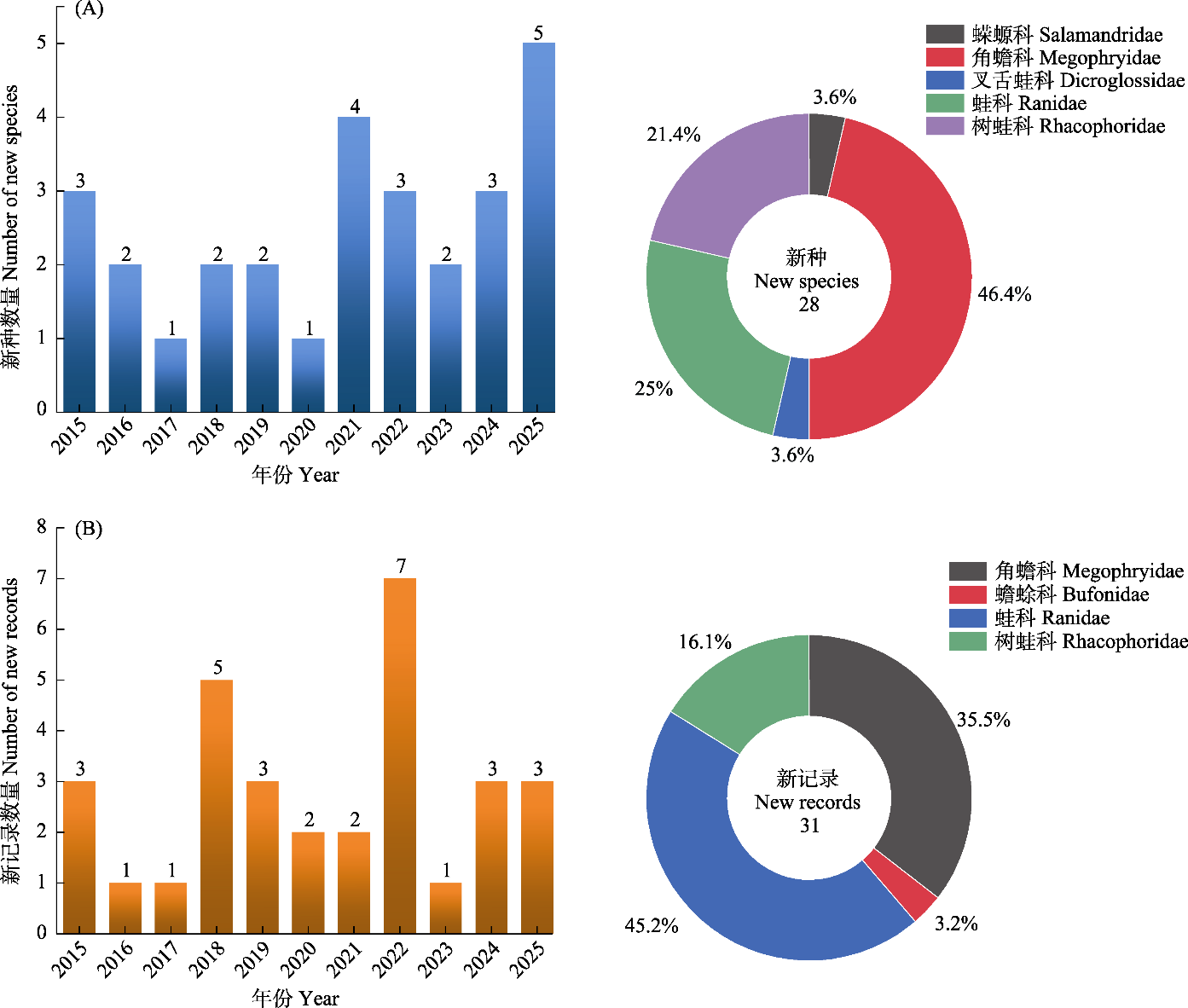
Fig. 1 Overview of newly added amphibians in Guangxi from 2015 to 2025. (A) Annual numbers and family-level composition of newly described species; (B) Annual numbers and family-level composition of newly recorded species.
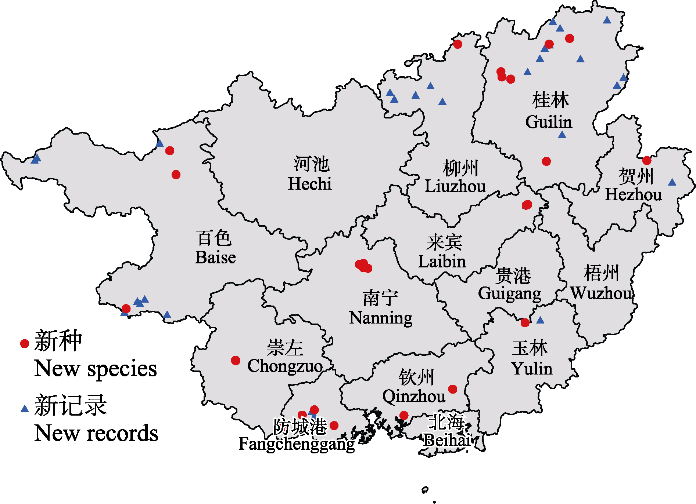
Fig. 2 Geographic distribution of newly added amphibians in Guangxi from 2015 to 2025
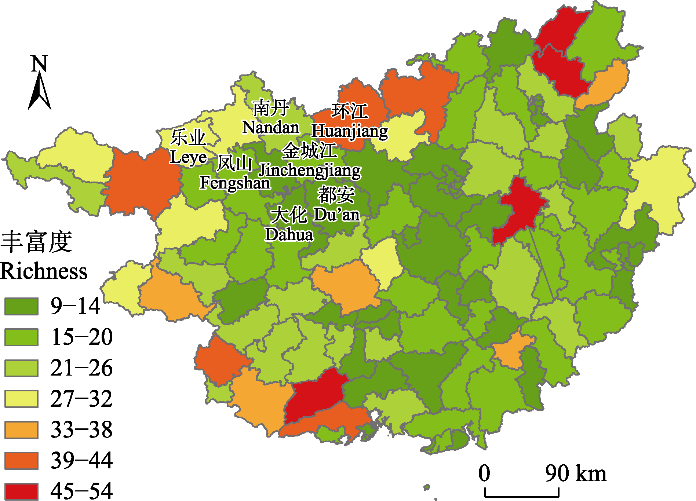
Fig. 3 Hotspot map of county-level amphibian species richness in Guangxi
| [1] | Biju SD, Garg S, Gokulakrishnan G, Chandrakasan S, Thammachoti P, Ren JL, Gopika C, Bisht K, Hamidy A, Shouche Y (2020) New insights on the systematics and reproductive behaviour in tree frogs of the genus Feihyla, with description of a new related genus from Asia (Anura, Rhacophoridae). Zootaxa, 4878, 1-55. |
| [2] | Cao YY, Jiang Y, Wang SN, Che J, Wu CL, Wu YH (2024) New distribution record of Leptobrachella dong in Guangxi. Chinese Journal of Wildlife, 45, 456-460. (in Chinese with English abstract) |
| [曹宇阳, 蒋瑛, 王绍能, 车静, 伍春莲, 吴云鹤 (2024) 广西掌突蟾属新纪录——侗掌突蟾. 野生动物学报, 45, 456-460.] | |
| [3] | Cao YY, Suwannapoom C, Kasyoka Kilunda F, Gao W, Wu CL, Wu YH, Che J (2024) Taxonomic revision of the genus Micryletta (Amphibia, Microhylidae), with description of a new species from Thailand. Zoosystematics and Evolution, 100, 1361-1373. |
| [4] | Che J, Jiang K, Yan F, Zhang YP (2020) Amphibians and Reptiles in Xizang—Diversity and Evolution. Science Press, Beijing. (in Chinese) |
| [车静, 蒋珂, 颜芳, 张亚平 (2020) 西藏两栖爬行动物——多样性与进化. 科学出版社, 北京.] | |
| [5] | Chen JM, Poyarkov NA Jr, Suwannapoom C, Lathrop A, Wu YH, Zhou WW, Yuan ZY, Jin JQ, Chen HM, Liu HQ, Nguyen TQ, Nguyen SN, Duong TV, Eto K, Nishikawa K, Matsui M, Orlov NL, Stuart BL, Brown RM, Rowley JJL, Murphy RW, Wang YY, Che J (2018) Large-scale phylogenetic analyses provide insights into unrecognized diversity and historical biogeography of Asian leaf-litter frogs, genus Leptolalax (Anura: Megophryidae). Molecular Phylogenetics and Evolution, 124, 162-171. |
| [6] | Chen JM, Prendini E, Wu YH, Zhang BL, Suwannapoom C, Chen HM, Jin JQ, Lemmon EM, Lemmon AR, Stuart BL, Raxworthy CJ, Murphy RW, Yuan ZY, Che J (2020) An integrative phylogenomic approach illuminates the evolutionary history of Old World tree frogs (Anura: Rhacophoridae). Molecular Phylogenetics and Evolution, 145, 106724. |
| [7] | Chen JM, Zhou WW, Poyarkov NA Jr, Stuart BL, Brown RM, Lathrop A, Wang YY, Yuan ZY, Jiang K, Hou M, Chen HM, Suwannapoom C, Nguyen SN, Duong TV, Papenfuss TJ, Murphy RW, Zhang YP, Che J (2017) A novel multilocus phylogenetic estimation reveals unrecognized diversity in Asian horned toads, genus Megophrys sensu lato (Anura: Megophryidae). Molecular Phylogenetics and Evolution, 106, 28-43. |
| [8] | Chen WC (2018) Odorrana nasuta Orlov, Le & Ho, 2003. Guangxi Forestry, (3), 33. (in Chinese) |
| [陈伟才 (2018) 鸭嘴竹叶蛙. 广西林业, (3), 33.] | |
| [9] | Chen WC, Bei YJ, Li P (2025) A new species of the genus Leptobrachella (Amphibia, Anura, Megophryidae) from the Darongshan Nature Reserve, Guangxi, China. ZooKeys, 1260, 171-194. |
| [10] | Chen WC, Bei YJ, Liao XW, Zhou SC, Mo YM (2018a) A new species of Gracixalus (Anura: Rhacophoridae) from West Guangxi, China. Asian Herpetological Research, 9, 74-84. |
| [11] | Chen WC, Li P, Peng WX, Liu YJ, Huang Y (2024a) The fourth species of Leptobrachella (Anura, Megophryidae) found at Shiwandashan National Nature Reserve, Guangxi, China. ZooKeys, 1192, 257-279. |
| [12] | Chen WC, Liao XW, Zhou SC, Mo YM (2019a) A new species of Leptobrachella (Anura: Megophryidae) from southern Guangxi, China. Zootaxa, 4563, 67-82. |
| [13] | Chen WC, Liao XW, Zhou SC, Mo YM (2019b) First record of Theloderma lateriticum Bain, Nguyen et Doan, 2009 (Anura Rhacophoridae) from China with redescribed morphology. Biodiversity Journal, 10, 25-36. |
| [14] | Chen WC, Liao XW, Zhou SC, Mo YM, Huang Y (2018b) Rediscovery of Rhacophorus yaoshanensis and Theloderma kwangsiensis at their type localities after five decades. Zootaxa, 4379, 484-496. |
| [15] | Chen WC, Mo YM, Lin L, Qin K (2024b) A new species of Odorrana Fei, Ye & Huang, 1990 (Amphibia, Anura, Ranidae) from central Guangxi, China with a discussion of the taxonomy of Odorrana (Bamburana). ZooKeys, 1190, 131-151. |
| [16] | Chen WC, Peng WX, Li P, Liu YJ (2022a) A new species of Nidirana (Anura, Ranidae) from southern Guangxi, China. Asian Herpetological Research, 13, 109-116. |
| [17] | Chen WC, Peng WX, Li P, Yu GD (2023) A new species of the genus Leptobrachella Smith 1925 (Amphibia, Anura, Megophryidae) from Guangxi, China. ZooKeys, 1178, 1-16. |
| [18] | Chen WC, Peng WX, Liu YJ, Huang Z, Liao XW, Mo YM (2022b) A new species of Occidozyga Kuhl and van Hasselt, 1822 (Anura: Dicroglossidae) from southern Guangxi, China. Zoological Research, 43, 85-89. |
| [19] | Chen WC, Peng WX, Pan WH, Liao NY, Liu YJ, Huang Y (2021a) A new species of Leptobrachella Smith 1925 (Anura: Megophryidae) from southern Guangxi, China. Zootaxa, 5020, 581-596. |
| [20] | Chen WC, Ye JP, Peng WX, Li P, Su TP, Yu GD, Cheng ZY (2022c) A new species of Nidirana (Anura, Ranidae) from northern Guangxi, China. ZooKeys, 1135, 119-137. |
| [21] | Chen WC, Yu GD, Cheng ZY, Meng T, Wei H, Zhou GY, Lu YW (2021b) A new species of Leptobrachella (Anura: Megophryidae) from central Guangxi, China. Zoological Research, 42, 783-788. |
| [22] | Dubois A, Bour R (2010) The nomenclatural status of Torrentophryne (Amphibia, Bufonidae). Alytes, 27(3-4), 147-150. |
| [23] | Fan TH (1931) Preliminary report of reptiles from Yaoshan, Kwangsi, China. Bulletin of the Department Biological, College of Science, Sun Yatsen University, 11, 1-154. |
| [24] | Fei L, Ye CY, Jiang JP (2012) The Colored Atlas of Chinese Amphibians and Their Distributions. Sichuan Science and Technology Press, Chengdu. (in Chinese) |
| [费梁, 叶昌媛, 江建平 (2012) 中国两栖动物及其分布彩色图鉴. 四川科学技术出版社, 成都.] | |
| [25] | Frost DR, Grant T, Faivovich J, Bain RH, Haas A, Haddad CFB, De Sá RO, Channing A, Wilkinson M, Donnellan SC, Raxworthy CJ, Campbell JA, Blotto BL, Moler P, Drewes RC, Nussbaum RA, Lynch JD, Green DM, Wheeler WC (2006) The amphibian tree of life. Bulletin of the American Museum of Natural History, 297, 1-291. |
| [26] | Gao ZW, Qian TY, Jiang JP, Hou DJ, Deng XJ, Yang DD (2022) Species diversity and distribution of amphibians and reptiles in Hunan Province, China. Biodiversity Science, 30, 21290. (in Chinese with English abstract) |
| [高志伟, 钱天宇, 江建平, 侯德佳, 邓学建, 杨道德 (2022) 湖南省两栖、爬行动物物种多样性及其地理分布. 生物多样性, 30, 21290.] | |
| [27] | Guangxi Zoological Society (1988) Distribution List of Terrestrial Vertebrates in Guangxi. Guangxi Normal University Press, Guilin. (in Chinese) |
| [ 广西动物学会 (1988) 广西陆栖脊椎动物分布名录. 广西师范大学出版社, 桂林.] | |
| [28] | Hasan M, Islam MM, Khan MMR, Igawa T, Alam MS, Djong HT, Kurniawan N, Joshy H, Sen YH, Belabut DM, Kurabayashi A, Kuramoto M, Sumida M (2014) Genetic divergences of South and Southeast Asian frogs: A case study of several taxa based on 16S ribosomal RNA gene data with notes on the generic name Fejervarya. Turkish Journal of Zoology, 38, 389-411. |
| [29] | Hou M, Yu GH, Chen HM, Liao CL, Zhang L, Chen J, Li PP, Orlov NL (2017) The taxonomic status and distribution range of six Theloderma species (Anura: Rhacophoridae) with a new record in China. Russian Journal of Herpetology, 24, 99-127. |
| [30] | Hou SB, Yuan ZY, Jiang K, Zhao LS, Wang SN, Wu ZJ, Che J (2017) A new amphibian record in Guangxi: Zhangixalus dorsoviridis and its comparison with similar species. Sichuan Journal of Zoology, 36, 58-60. (in Chinese) |
| [侯绍兵, 袁智勇, 蒋珂, 赵连生, 王绍能, 武正军, 车静 (2017) 广西两栖类新纪录——绿背树蛙及其与形态相似种的比较. 四川动物, 36, 58-60.] | |
| [31] | Huang HY, Chen ZN, Wei ZH, Bu RP, Wu ZJ (2017) DNA barcoding revises a misidentification on mossy frog: New record and distribution extension of Theloderma corticale Boulenger, 1903 (Amphibia: Anura: Rhacophoridae). Mitochondrial DNA Part A, 29, 273-280. |
| [32] | Huang Y, Hu JH, Wang B, Song ZB, Zhou CQ, Jiang JP (2016) Integrative taxonomy helps to reveal the mask of the genus Gynandropaa (Amphibia: Anura: Dicroglossidae). Integrative Zoology, 11, 134-150. |
| [33] | Huang Z, Liao XW, Mo YM (2025a) New record of Leptobrachella dong from Guangxi. Sichuan Journal of Zoology, 44, 592-593. (in Chinese) |
| [黄忠, 廖晓雯, 莫运明 (2025a) 广西龙胜发现侗掌突蟾. 四川动物, 44, 592-593.] | |
| [34] | Huang Z, Wang HT, Qi S, Song HM, Deng ZH, Li YY, Mo YM, Wang YY (2025b) Bufo rubroventromaculatus found in Xinyi, Guangdong and its range expansion. Chinese Journal of Zoology, 60, 619-628. (in Chinese with English abstract) |
| [黄忠, 王昊天, 齐硕, 宋晗铭, 邓振海, 李友余, 莫运明, 王英永 (2025b) 广东发现红斑蟾蜍及其分布区扩大. 动物学杂志, 60, 619-628.] | |
| [35] | Huang Z, Zeng ZC, Wang J, Wang HT, Deng ZH, Wang ZW, Liao XW, Mo YM (2025) A new species of the genus Leptobrachella Smith, 1935 (Anura, Megophryidae) from northwestern Guangxi, China. Herpetozoa, 38, 321-332. |
| [36] | Jiang DC, Jiang K, Ren JL, Wu J, Li JT (2019) Resurrection of the genus Leptomantis, with description of a new genus to the family Rhacophoridae (Amphibia: Anura). Asian Herpetological Research, 10, 1-12. |
| [37] | Jiang JP, Xie F, Li C, Wang B (2021) China’s Red List of Biodiversity∙Vertebrates (IV): Amphibians (volume I and II). Science Press, Beijing. (in Chinese and in English) |
| [江建平, 谢锋, 李成, 王斌 (2021) 中国生物多样性红色名录∙脊椎动物(第四卷): 两栖动物(上下册). 科学出版社, 北京.] | |
| [38] | Li J, Liu S, Yu GH, Sun T (2022) A new species of Rhacophorus (Anura, Rhacophoridae) from Guangxi, China. ZooKeys, 1117, 123-138. |
| [39] | Li JT, Li Y, Klaus S, Rao DQ, Hillis DM, Zhang YP (2013) Diversification of Rhacophorid frogs provides evidence for accelerated faunal exchange between India and Eurasia during the Oligocene. Proceedings of the National Academy of Sciences, USA, 110, 3441-3446. |
| [40] | Li SZ, Xu N, Lv JC, Jiang JP, Wei G, Wang B (2018) A new species of the odorous frog genus Odorrana (Amphibia, Anura, Ranidae) from southwestern China. PeerJ, 6, e5695. |
| [41] | Li Y, Zhang DD, Lyu ZT, Wang J, Li YL, Liu ZY, Chen HH, Rao DQ, Jin ZF, Zhang CY, Wang YY (2020) Review of the genus Brachytarsophrys (Anura: Megophryidae), with revalidation of Brachytarsophrys platyparietus and description of a new species from China. Zoological Research, 41, 105-122. |
| [42] | Liu CC, Hu SQ (1962) A herpetological report of Kwangsi. Acta Zoologica Sinica, 14(Suppl.), 73-104. (in Chinese with English abstract) |
| [刘承钊, 胡淑琴 (1962) 广西两栖爬行动物初步调查报告. 动物学报, 14(增刊), 73-104.] | |
| [43] | Liu S, Hou M, Hui H (2022) Taxonomic reassessment of Odorrana graminea sensu lato in China (Anura: Ranidae). Journal of Animal Diversity, 4, 1-11. |
| [44] | Liu S, Hou M, Mo MZ, Rao DQ (2024) First confirmed record of Bufo rubroventromaculatus Orlov, Ananjeva, Ermakov, Lukonina, Ninh & Nguyen, 2024 (Anura, Bufonidae) from China, with supplementary description of this species. Biodiversity Data Journal, 12, e134392. |
| [45] | Liu XL, Huang JK, Stuart BL, Ai RD, Bernstein JM, Suwannapoom C, Chomdej S, Che J, Yuan ZY (2023) Taxonomic revision of genus Rohanixalus (Anura: Rhacophoridae) in China with description of one new species. Zoological Research, 44, 1146-1151. |
| [46] | Lu LL, Lyu ZT, Wang J, Wang YY (2016) The first record and re-description of Odorrana yentuensis from China. Chinese Journal of Wildlife, 37, 390-394. (in Chinese with English abstract) |
| [卢琳琳, 吕植桐, 王健, 王英永 (2016) 安子山臭蛙(Odorrana yentuensis)的中国国家新分布纪录及其补充描述. 野生动物学报, 37, 390-394.] | |
| [47] | Luo JQ, Zhang BA, Pan YQ, Yu GH (2025) A new species of Gracixalus (Anura, Rhacophoridae) from Guangxi, China, with comments on the taxonomy of Orixalus. Zoosystematics and Evolution, 101, 369-388. |
| [48] | Lyu ZT, Huang LS, Wang J, Li YQ, Chen HH, Qi S, Wang YY (2019a) Description of two cryptic species of the Amolops ricketti group (Anura, Ranidae) from southeastern China. ZooKeys, 812, 133-156. |
| [49] | Lyu ZT, Huang Z, Liao XW, Lin L, Huang Y, Wang YY, Mo YM (2021) A new species of music frog (Anura, Ranidae, Nidirana) from Mt. Daming, Guangxi, China. ZooKeys, 1059, 35-56. |
| [50] | Lyu ZT, Li YQ, Zeng ZC, Zhao J, Liu ZY, Guo GX, Wang YY (2020) Four new species of Asian horned toads (Anura, Megophryidae, Megophrys) from southern China. ZooKeys, 942, 105-140. |
| [51] | Lyu ZT, Mo YM, Wan H, Li YL, Pang H, Wang YY (2019b) Description of a new species of music frogs (Anura, Ranidae, Nidirana) from Mt. Dayao, southern China. ZooKeys, 858, 109-126. |
| [52] | Lyu ZT, Qi S, Wang J, Zhang SY, Zhao J, Zeng ZC, Wan H, Yang JH, Mo YM, Wang YY (2023) Generic classification of Asian horned toads (Anura: Megophryidae: Megophryinae) and monograph of Chinese species. Zoological Research, 44, 380-450. |
| [53] | Lyu ZT, Wang J, Zeng ZC, Luo L, Zhang YW, Guo CP, Ren JL, Qi S, Mo YM, Wang YY (2022) Taxonomic clarifications on the floating frogs (Anura: Dicroglossidae: Occidozyga sensu lato) in southeastern China. Vertebrate Zoology, 72, 495-512. |
| [54] | Mahony S, Foley NM, Biju SD, Teeling EC (2017) Evolutionary history of the Asian horned frogs (Megophryinae): Integrative approaches to timetree dating in the absence of a fossil record. Molecular Biology and Evolution, 34, 744-771. |
| [55] | Mahony S, Kamei RG, Brown RM, Chan KO (2024) Unnecessary splitting of genus-level clades reduces taxonomic stability in amphibians. Vertebrate Zoology, 74, 249-277. |
| [56] | Meegaskumbura M, Senevirathne G, Biju SD, Garg S, Meegaskumbura S, Pethiyagoda R, Hanken J, Schneider CJ (2015) Patterns of reproductive-mode evolution in Old World tree frogs (Anura, Rhacophoridae). Zoologica Scripta, 44, 509-522. |
| [57] | Mo QM, Liu S, Chen H, Yu GH, Sun T (2022) Odorrana liboensis found in Guangxi. Chinese Journal of Zoology, 57, 937-943. (in Chinese with English abstract) |
| [莫秋妹, 刘硕, 陈慧, 余国华, 孙涛 (2022) 广西发现荔波臭蛙. 动物学杂志, 57, 937-943.] | |
| [58] | Mo YM, Chen WC, Liao XW, Zhou SC (2016) A new species of the genus Rhacophorus (Anura: Rhacophoridae) from southern China. Asian Herpetological Research, 7, 139-150. |
| [59] | Mo YM, Chen WC, Wu HY, Zhang W, Zhou SC (2015) A new species of Odorrana inhabiting complete darkness in a karst cave in Guangxi, China. Asian Herpetological Research, 6, 11-17. |
| [60] | Mo YM, Wei ZY, Chen WC (2014) Colored Atlas of Guangxi Amphibians. Guangxi Science and Technology Publishing House, Nanning. (in Chinese) |
| [莫运明, 韦振逸, 陈伟才 (2014) 广西两栖动物彩色图鉴. 广西科学技术出版社, 南宁.] | |
| [61] | Nguyen TV, Liu S, Wilkinson JA, Tran TG, Tran PN, Trofimets AV, Dau VQ, Poyarkov NA (2024) Redescription and a significant range extension of Rhacophorus napoensis Li, Liu, Yu & Sun, 2022 (Amphibia, Anura, Rhacophorinae) with the first record from Vietnam. Herpetozoa, 37, 123-136. |
| [62] | Nishikawa K, Matsui M, Yoshikawa N, Khonsue W, Pomchote P, Hibino M, Nguyen TT, Sanamxay D (2021) Ichthyophis bannaicus Yang, 1984, a junior subjective synonym of I. kohtaoensis Taylor, 1960 (Amphibia, Gymnophiona, Ichthyophiidae), Paris. Alytes, 38, 1-17. |
| [63] | Oliver LA, Prendini E, Kraus F, Raxworthy CJ (2015) Systematics and biogeography of the Hylarana frog (Anura: Ranidae) radiation across tropical Australasia, Southeast Asia, and Africa. Molecular Phylogenetics and Evolution, 90, 176-192. |
| [64] | Poyarkov NA Jr, Orlov NL, Moiseeva AV, Pawangkhanant P, Ruangsuwan T, Vassilieva AB, Galoyan EA, Nguyen TT, Gogoleva SI (2015) Sorting out moss frogs: mtDNA data on taxonomic diversity and phylogenetic relationships of the Indochinese species of the genus Theloderma (Anura, Rhacophoridae). Russian Journal of Herpetology, 22, 241-280. |
| [65] | Qi S, Lyu ZT, Wang J, Mo YM, Zeng ZC, Zeng YJ, Dai KY, Li YQ, Grismer LL, Wang YY (2021) Three new species of the genus Boulenophrys (Anura, Megophryidae) from southern China. Zootaxa, 5072, 401-438. |
| [66] | Qin SB, Mo YM, Jiang K, Cai B, Xie F, Jiang JP, Murphy RW, Li JT, Wang YZ (2015) Two new species of Liuixalus (Rhacophoridae, Anura): Evidence from morphological and molecular analyses. PLoS ONE, 10, e0136134. |
| [67] | Rao DQ, Wilkinson JA (2008) Phylogenetic relationships of the mustache toads inferred from mtDNA sequences. Molecular Phylogenetics and Evolution, 46, 61-73. |
| [68] | Shen YH, Shen DW‚ Mo XY (2008) A new species of salamander Pachytriton archospotus from Hunan Province‚ China (Amphibia‚ Salamandridae). Acta Zoologica Sinica, 54, 645-652. (in Chinese with English abstract) |
| [沈猷慧, 沈端文, 莫小阳 (2008) 中国肥螈属(两栖纲: 蝾螈科)一新种——弓斑肥螈Pachytriton archospotus sp. nov. 动物学报, 54, 645-652.] | |
| [69] | Shui KC, Zhang SY, Liu ZF, Zhu YH, Gong YN, Zhao J (2023) Taxonomic revision of genus Zhangixalus in the Guangdong Nanling National Nature Reserve with two new provincial species records. Sichuan Journal of Zoology, 42, 75-84. (in Chinese with English abstract) |
| [水坤春, 张思雨, 刘志发, 朱永亨, 龚粤宁, 赵健 (2023) 广东南岭国家级自然保护区张树蛙属物种分类厘定兼记2个省级新记录. 四川动物, 42, 75-84.] | |
| [70] | Tan WF (2014) Guangxi Nature Reserve. China Environmental Science Press, Beijing. (in Chinese) |
| [谭伟福 (2014) 广西自然保护区. 中国环境科学出版社, 北京.] | |
| [71] | Tan WF, Luo BT (2010) Research and Conservation of Biodiversity in Guangxi Dayaoshan Natural Reserve. China Environmental Science Press, Beijing. (in Chinese) |
| [谭伟福, 罗保庭 (2010) 广西大瑶山自然保护区生物多样性研究及保护. 中国环境科学出版社, 北京.] | |
| [72] | Tang XP, Ouyang ZY, Jiang YF, Ma W, Xu WH, Chen S, Liu ZL (2023) Spatial planning of national parks in China. National Park, 1, 1-10. (in Chinese with English abstract) |
| [唐小平, 欧阳志云, 蒋亚芳, 马炜, 徐卫华, 陈尚, 刘增力 (2023) 中国国家公园空间布局研究. 国家公园(中英文), 1, 1-10.] | |
| [73] | Wang J, Li J, Du LY, Hou M, Yu GH (2022) A cryptic species of the Amolops ricketti species group (Anura, Ranidae) from China-Vietnam border regions. ZooKeys, 1112, 139-159. |
| [74] | Wang J, Yang JH, Li Y, Lyu ZT, Zeng ZC, Liu ZY, Ye YH, Wang YY (2018) Morphology and molecular genetics reveal two new Leptobrachella species in southern China (Anura, Megophryidae). ZooKeys, 776, 105-137. |
| [75] | Wang L, Deng XJ, Liu Y, Wu QQ, Liu Z (2019) A new species of the genus Megophrys (Amphibia: Anura: Megophryidae) from Hunan, China. Zootaxa, 4695, 301-330. |
| [76] | Wang YY, Lau MWN, Yang JH, Chen GL, Liu ZY, Pang H, Liu Y (2015) A new species of the genus Odorrana (Amphibia: Ranidae) and the first record of Odorrana bacboensis from China. Zootaxa, 3999, 235-254. |
| [77] | Wu XJ, Pan YQ, Chen J, Ye JP, Yu GH, Zou TX (2025a) Integrative taxonomic evidence for a new species of genus Gracixalus (Anura, Rhacophoridae) from Mao’er Mountain, Guangxi, China. Zoosystematics and Evolution, 101, 2039-2053. |
| [78] | Wu XJ, Pan YQ, Xiao W, Chen J, Yu GH, Wei XK (2025b) Integrative taxonomic evidence for a new species of the short-legged toads Brachytarsophrys (Anura, Megophryidae) from Guangxi, China. Zoosystematics and Evolution, 101, 1369-1382. |
| [79] | Wu YH, Xu MH, Suwannapoom C, Ngoc Nguyen S, Murphy RW, Papenfuss TJ, Lathrop A, Kasyoka Kilunda F, Gao W, Yuan ZY, Chen JM, Zhang L, Zhao HP, Wang LJ, Mizanur Rahman M, Micah Nneji L, Zhao GG, Wang YY, Jin JQ, Zhang P, Che J (2025) A comprehensive molecular phylogeny of the genus Sylvirana (Anura: Ranidae) highlights unrecognized diversity, revised classification and historical biogeography. Molecular Phylogenetics and Evolution, 202, 108223. |
| [80] | Wu ZL, Lai JL, Zhang TR, Bai LZ, Huang LL, Gao EH, Bei YJ (2022) Leptobrachella ventripunctata found in Guangxi Province, China. Chinese Journal of Zoology, 57, 620-628. (in Chinese with English abstract) |
| [吴志灵, 赖洁玲, 张廷瑞, 白林壮, 黄亮亮, 郜二虎, 贝永建 (2022) 广西发现腹斑掌突蟾. 动物学杂志, 57, 620-628.] | |
| [81] | Yang HJ, Chen WC (2024) Atlas of Amphibians in the Li River Basin. Guangxi Science and Technology Publishing House, Nanning. (in Chinese) |
| [杨海菊, 陈伟才 (2024) 漓江流域两栖动物图谱. 广西科学技术出版社, 南宁.] | |
| [82] | Yang JH, Rao DQ, Wang YY (2015) A new species of the genus Liuixalus (Anura: Rhacophoridae) from southern China. Zootaxa, 3990, 247-258. |
| [83] | Yu GD, Qin K, Meng T, Li P, Peng WX, Chen WC (2024) A new species of the genus Leptobrachella (Amphibia, Anura, Megophryidae) from Dayaoshan National Nature Reserve, Guangxi, China. ZooKeys, 1219, 105-122. |
| [84] | Yu GH, Rao DQ, Matsui M, Yang JX (2017) Coalescent-based delimitation outperforms distance-based methods for delineating less divergent species: The case of Kurixalus odontotarsus species group. Scientific Reports, 7, 16124. |
| [85] | Yuan ZY, Jin JQ, Li JN, Stuart BL, Wu J (2018) A new species of cascade frog (Amphibia: Ranidae) in the Amolops monticola group from China. Zootaxa, 4415, 498-512. |
| [86] | Yuan ZY, Sun RD, Chen JM, Rowley JJL, Wu ZJ, Hou SB, Che J (2017) A new species of the genus Leptolalax (Anura: Megophryidae) from Guangxi, China. Zootaxa, 4300, 551-570. |
| [87] | Yuan ZY, Zhang BL, Che J (2016a) A new species of the genus Pachytriton (Caudata: Salamandridae) from Hunan and Guangxi, southeastern China. Zootaxa, 4085, 219-232. |
| [88] | Yuan ZY, Zhou WW, Chen X, Poyarkov NA Jr, Chen HM, Jang-Liaw NH, Chou WH, Matzke NJ, Iizuka K, Min MS, Kuzmin SL, Zhang YP, Cannatella DC, Hillis DM, Che J (2016b) Spatiotemporal diversification of the true frogs (genus Rana): A historical framework for a widely studied group of model organisms. Systematic Biology, 65, 824-842. |
| [89] | Zhang YX, Wen YT (2000) Amphibians of Guangxi. Guangxi Normal University Press, Guilin. (in Chinese) |
| [张玉霞, 温业棠 (2000) 广西两栖动物. 广西师范大学出版社, 桂林.] | |
| [90] | Zheng YC, Fu JZ, Li SH (2008) Toward understanding the distribution of Leptobrachium (Anura: Megophryidae) in China. Molecular Phylogenetics and Evolution, 48, 695-707. |
| [91] | Zhou F (2011) Distribution List of Terrestrial Vertebrates in Guangxi. China Forestry Publishing House, Beijing. (in Chinese) |
| [周放 (2011) 广西陆生脊椎动物分布名录. 中国林业出版社, 北京.] | |
| [92] | Zhou F, Jiang AW, Lu Z (2005) A new record of amphibian species in Guangxi—Rana zhenhaiensis. Journal of Guangxi Agricultural and Biological Sciences, 24, 248-263. (in Chinese) |
| [周放, 蒋爱伍, 陆舟 (2005) 广西两栖类一新记录——镇海林蛙. 广西农业生物科学, 24, 248-263.] |
| [1] | Meng Zhang, Yanping Wang. A review on zeta diversity: Analysis methods, conservation applications and future perspectives [J]. Biodiv Sci, 2026, 34(8): 0-. |
| [2] | Yishuo Zhao, Yazhen Ma, Qi Zhou, Feng Ling, Qichi Yang, Yingang Li, Yingxiong Qiu. Resolving population genetic structure and developing an ex situ conservation framework for Parrotia subaequalis [J]. Biodiv Sci, 2026, 34(8): 26207-. |
| [3] | Yihao Pan, Bingran Ma, Leshan Du, Yanpeng Zhu, Xiangwen Fang, Fangzheng Liu. Characteristics of impacts of artificial light at night on nature reserves in the Beijing-Tianjin-Hebei region [J]. Biodiv Sci, 2026, 34(8): 26245-. |
| [4] | Tianshi Hu, Pengfei Song, Jingjie Zhang, Feng Jiang, Ning Chang, Zhongyuan Lin, Xinyu Zhang, Tongzuo Zhang, Zhenyuan Cai. Genetic diversity and structure of Procapra przewalskii after population restoration based on mitochondrial DNA and microsatellite markers [J]. Biodiv Sci, 2026, 34(8): 26176-. |
| [5] | Yu Cai, Xiaochuan Zhang, Mengjia Lian. Urban dragonfly habitats: Threats, ecological requirements and restoration strategies [J]. Biodiv Sci, 2026, 34(8): 26096-. |
| [6] | Jianping Chen, Xin Zhong, Bin Chen, Binjie Ge, Cheng Du, Yanping Gao, Li Guo, Dongmei Jin, Qixia Ma, Yonghong Hu. AI capability development for China’s national botanical garden system: A reference model, maturity assessment framework, and application architecture [J]. Biodiv Sci, 2026, 34(7): 26124-. |
| [7] | Peng Xie, Zhibo Zhou, Shaogang Fan, Ping Mo, Kerui Huang, Aihua Deng, Youwei Yang, Fei Wu, Dewei Xiao, Yun Wang. Soil microbial diversity, network structure, and functional potential differ between natural and plantation forests of Cathaya argyrophylla [J]. Biodiv Sci, 2026, 34(7): 26122-. |
| [8] | Xiufeng Sun, Xu Li, Chenglong Ding, Junru Yan, Jie Yin, Liangqian Pan. Spatial pattern, retention mechanism, and conservation strategies of ancient trees in Chongqing under the urban-rural dual structure [J]. Biodiv Sci, 2026, 34(7): 26134-. |
| [9] | Jinzhao Ke, Yuning Cao, Nan He, Bin Lü, Mona van Schingen-Khan, Thomas Ziegler, Weiguo Du, Yan Hua, Zhengjun Wu, Yin Qi. Research progress and conservation prospects for the endangered crocodile lizard (Shinisaurus crocodilurus) [J]. Biodiv Sci, 2026, 34(6): 25425-. |
| [10] | Fangyuan Hua, Shuangqi Liu, Yangjing Peng, Shanxing Gong, Xiaoli Shen, Kun Jin. A framework for synergistically addressing the risk sources of biodiversity loss and climate change in protected areas and Ecological Conservation Redlines [J]. Biodiv Sci, 2026, 34(6): 25492-. |
| [11] | Yulu Pu, Shishun Zhou, Ren Li. Ethnobotany of tropical spice plants utilized by ethnic groups in China, Myanmar and Laos [J]. Biodiv Sci, 2026, 34(5): 25041-. |
| [12] | Jianchao Liang, Shutian Chen, Wenxiang He, Chunni Xiong, Zhenzhou Xu, Yuanxin Huang, Yuanzhihong Liu, Lang Zhang, Huijian Hu. Wild terrestrial vertebrate resources in Guangzhou: Diversity, distribution, and conservation gaps [J]. Biodiv Sci, 2026, 34(5): 25422-. |
| [13] | Qianqian Wang, Xiaoguo Chen, Ruifeng Zhu, Mingchun Zhang, Xin Wang, Shilin Li, Jiangcuo Renzeng, Wu Peng, Biao Yang. Ecological adaptation differences of the black musk deer and sympatric ungulates in southeastern Xizang [J]. Biodiv Sci, 2026, 34(5): 25433-. |
| [14] | Junce Liang, Kaizhi Li, Yehui Tan. Species diversity and distribution of pteropods in the South China Sea [J]. Biodiv Sci, 2026, 34(5): 25487-. |
| [15] | Lijie Zhou, Minhui Huang, Huaijiang He, Yanxia Cheng, Chunyu Zhang, Xiuhai Zhao. Disentangling the patterns, components, and influencing factors of forest β diversity in the Xiaoxing’an Mountains, Northeast China [J]. Biodiv Sci, 2026, 34(4): 25443-. |
| Viewed | ||||||
|
Full text |
|
|||||
|
Abstract |
|
|||||
Copyright © 2026 Biodiversity Science
Editorial Office of Biodiversity Science, 20 Nanxincun, Xiangshan, Beijing 100093, China
Tel: 010-62836137, 62836665 E-mail: biodiversity@ibcas.ac.cn
