

Biodiv Sci ›› 2026, Vol. 34 ›› Issue (5): 25422. DOI: 10.17520/biods.2025422 cstr: 32101.14.biods.2025422
• Original Papers: Animal Diversity • Previous Articles Next Articles
Jianchao Liang1,#( ), Shutian Chen1,2,#(), Wenxiang He3, Chunni Xiong3, Zhenzhou Xu4(), Yuanxin Huang1, Yuanzhihong Liu1, Lang Zhang5,*(
 ), Huijian Hu1,*()
Received:2025-10-24
Accepted:2026-02-15
Online:2026-05-20
Published:2026-07-01
Contact:
Lang Zhang, Huijian Hu
About author:First author contact:#Co-first authors
Supported by:Jianchao Liang, Shutian Chen, Wenxiang He, Chunni Xiong, Zhenzhou Xu, Yuanxin Huang, Yuanzhihong Liu, Lang Zhang, Huijian Hu. Wild terrestrial vertebrate resources in Guangzhou: Diversity, distribution, and conservation gaps[J]. Biodiv Sci, 2026, 34(5): 25422.
| 一级指标 Primary indicator | 二级指标 Secondary indicator | 指标说明 Indicator description |
|---|---|---|
| 生物指标 Biological indicators | 物种多样性 Species diversity | 连续型指标。基于MaxEnt模型预测的所有物种的潜在空间分布结果叠加 Continuous indicators. Overlay of potential spatial distribution predictions for all species generated by the MaxEnt model |
| 重要物种多样性 Priority species diversity | 连续型指标 Continuous indicators | |
| 环境指标 Environmental indicators | 河网密度 River network density | 连续型指标 Continuous indicators |
| 植被覆盖度(归一化植被指数) Vegetation cover (normalized difference vegetation index) | 连续型指标 Continuous indicators | |
| 干扰因素 Disturbance factors | 人口密度 Population density | 连续型指标 Continuous indicators |
| 用地性质 Land-use type | 离散型指标。人造地表、耕地和裸地赋值为0, 林地、草地、灌丛、湿地和水体赋值为0.5, 自然保护地赋值为1 Discrete indicators. Artificial surfaces, cropland, and bare land are assigned a value of 0; forest, grassland, shrubland, wetland, and water bodies are assigned a value of 0.5; protected areas are assigned a value of 1 |
Table 1 A multi-dimensional comprehensive evaluation system for priority habitat value (including biological, environmental, disturbance dimensions and their quantifying indicators)
| 一级指标 Primary indicator | 二级指标 Secondary indicator | 指标说明 Indicator description |
|---|---|---|
| 生物指标 Biological indicators | 物种多样性 Species diversity | 连续型指标。基于MaxEnt模型预测的所有物种的潜在空间分布结果叠加 Continuous indicators. Overlay of potential spatial distribution predictions for all species generated by the MaxEnt model |
| 重要物种多样性 Priority species diversity | 连续型指标 Continuous indicators | |
| 环境指标 Environmental indicators | 河网密度 River network density | 连续型指标 Continuous indicators |
| 植被覆盖度(归一化植被指数) Vegetation cover (normalized difference vegetation index) | 连续型指标 Continuous indicators | |
| 干扰因素 Disturbance factors | 人口密度 Population density | 连续型指标 Continuous indicators |
| 用地性质 Land-use type | 离散型指标。人造地表、耕地和裸地赋值为0, 林地、草地、灌丛、湿地和水体赋值为0.5, 自然保护地赋值为1 Discrete indicators. Artificial surfaces, cropland, and bare land are assigned a value of 0; forest, grassland, shrubland, wetland, and water bodies are assigned a value of 0.5; protected areas are assigned a value of 1 |
| 重要物种多样性 Priority species diversity | 物种多样性 Species diversity | 河网密度 River network density | 归一化植被指数 Normalized difference vegetation index | 人口密度 Population density | 用地性质 Land-use type | |
|---|---|---|---|---|---|---|
| 重要物种多样性 Priority species diversity | 1 | 2 | 3 | 3 | 3 | 1 |
| 物种多样性 Species diversity | 1/2 | 1 | 2 | 2 | 2 | 1/4 |
| 河网密度 River network density | 1/3 | 1/2 | 1 | 1 | 2 | 1/5 |
| 归一化植被指数 Normalized difference vegetation index | 1/3 | 1/2 | 1 | 1 | 3 | 1/5 |
| 人口密度 Population density | 1/3 | 1/2 | 1/2 | 1/3 | 1 | 1/6 |
| 用地性质 Land-use type | 1 | 4 | 5 | 5 | 6 | 1 |
Table 2 Judgement matrix for determining the weights of secondary indicators using the analytic hierarchy process
| 重要物种多样性 Priority species diversity | 物种多样性 Species diversity | 河网密度 River network density | 归一化植被指数 Normalized difference vegetation index | 人口密度 Population density | 用地性质 Land-use type | |
|---|---|---|---|---|---|---|
| 重要物种多样性 Priority species diversity | 1 | 2 | 3 | 3 | 3 | 1 |
| 物种多样性 Species diversity | 1/2 | 1 | 2 | 2 | 2 | 1/4 |
| 河网密度 River network density | 1/3 | 1/2 | 1 | 1 | 2 | 1/5 |
| 归一化植被指数 Normalized difference vegetation index | 1/3 | 1/2 | 1 | 1 | 3 | 1/5 |
| 人口密度 Population density | 1/3 | 1/2 | 1/2 | 1/3 | 1 | 1/6 |
| 用地性质 Land-use type | 1 | 4 | 5 | 5 | 6 | 1 |
| 重要物种多样性 Priority species diversity | 物种多样性 Species diversity | 河网密度 River network density | 归一化植被指数 Normalized difference vegetation index | 人口密度 Population density | 用地性质 Land-use type | |
|---|---|---|---|---|---|---|
| 主观权重 Subjective weight | 0.195 | 0.174 | 0.229 | 0.061 | 0.062 | 0.279 |
| 客观权重 Objective weight | 0.257 | 0.131 | 0.083 | 0.092 | 0.055 | 0.382 |
| 综合权重 Synthesized weight | 0.230 | 0.156 | 0.141 | 0.077 | 0.060 | 0.336 |
Table 3 Subjective and objective integrated weights based on the principle of minimum relative information entropy
| 重要物种多样性 Priority species diversity | 物种多样性 Species diversity | 河网密度 River network density | 归一化植被指数 Normalized difference vegetation index | 人口密度 Population density | 用地性质 Land-use type | |
|---|---|---|---|---|---|---|
| 主观权重 Subjective weight | 0.195 | 0.174 | 0.229 | 0.061 | 0.062 | 0.279 |
| 客观权重 Objective weight | 0.257 | 0.131 | 0.083 | 0.092 | 0.055 | 0.382 |
| 综合权重 Synthesized weight | 0.230 | 0.156 | 0.141 | 0.077 | 0.060 | 0.336 |
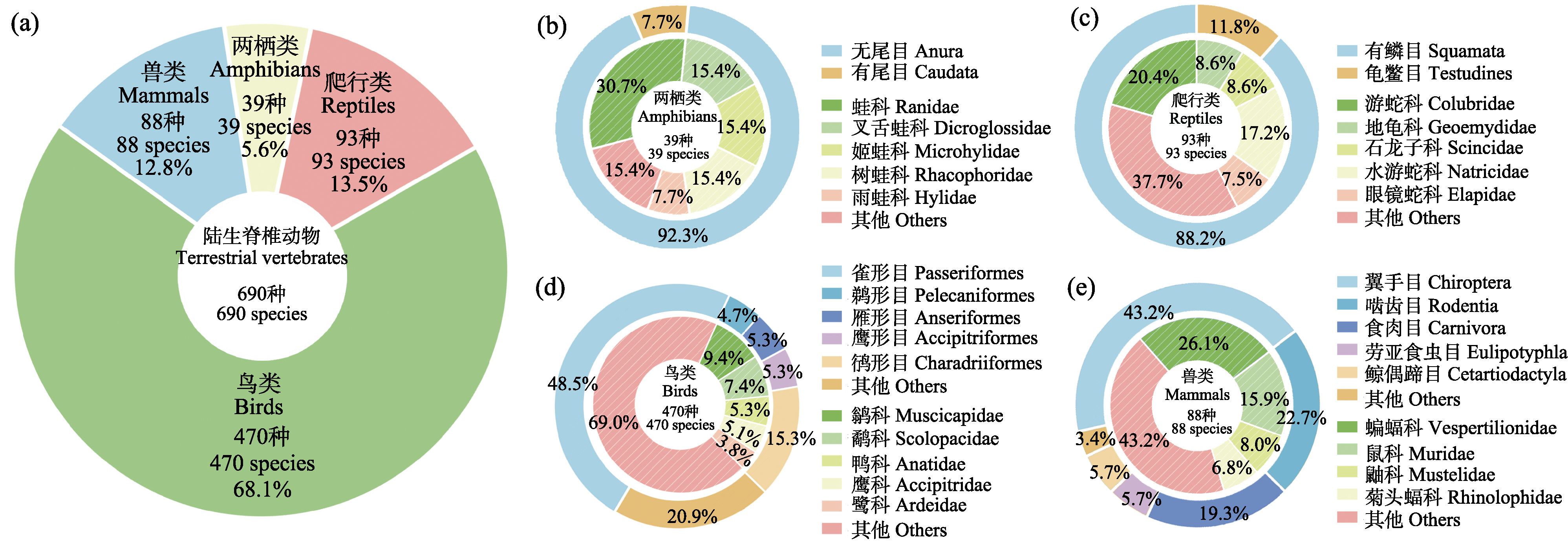
Fig. 1 Wild terrestrial vertebrate diversity and order- and family-level composition of each taxonomic group of Guangzhou
| 保护级别 Protection level | 两栖类 Amphibians | 爬行类 Reptiles | 鸟类 Birds | 兽类 Mammals | 合计 Total |
|---|---|---|---|---|---|
| 国家一级 National Class I | - | - | 18 | 4 | 22 |
| 国家二级 National Class II | 4 | 17 | 86 | 9 | 116 |
| IUCN极危 IUCN CR | 1 | 5 | 3 | 1 | 10 |
| IUCN濒危 IUCN EN | 1 | 5 | 8 | 1 | 15 |
| CITES附录I CITES Appendix I | 1 | 1 | 8 | 5 | 15 |
| CITES附录II CITES Appendix II | 1 | 12 | 46 | 2 | 61 |
| CITES附录III CITES Appendix III | - | 2 | 5 | 8 | 15 |
| 省重点 Provincial key protected species | - | 4 | 84 | 7 | 95 |
| 三有物种 Species with “Three Values” | 9 | 71 | 356 | 19 | 455 |
| 中国特有 China-endemic | 15 | 11 | 3 | 4 | 33 |
Table 4 Analysis of the conservation and endangerment status of wild terrestrial vertebrates in Guangzhou
| 保护级别 Protection level | 两栖类 Amphibians | 爬行类 Reptiles | 鸟类 Birds | 兽类 Mammals | 合计 Total |
|---|---|---|---|---|---|
| 国家一级 National Class I | - | - | 18 | 4 | 22 |
| 国家二级 National Class II | 4 | 17 | 86 | 9 | 116 |
| IUCN极危 IUCN CR | 1 | 5 | 3 | 1 | 10 |
| IUCN濒危 IUCN EN | 1 | 5 | 8 | 1 | 15 |
| CITES附录I CITES Appendix I | 1 | 1 | 8 | 5 | 15 |
| CITES附录II CITES Appendix II | 1 | 12 | 46 | 2 | 61 |
| CITES附录III CITES Appendix III | - | 2 | 5 | 8 | 15 |
| 省重点 Provincial key protected species | - | 4 | 84 | 7 | 95 |
| 三有物种 Species with “Three Values” | 9 | 71 | 356 | 19 | 455 |
| 中国特有 China-endemic | 15 | 11 | 3 | 4 | 33 |
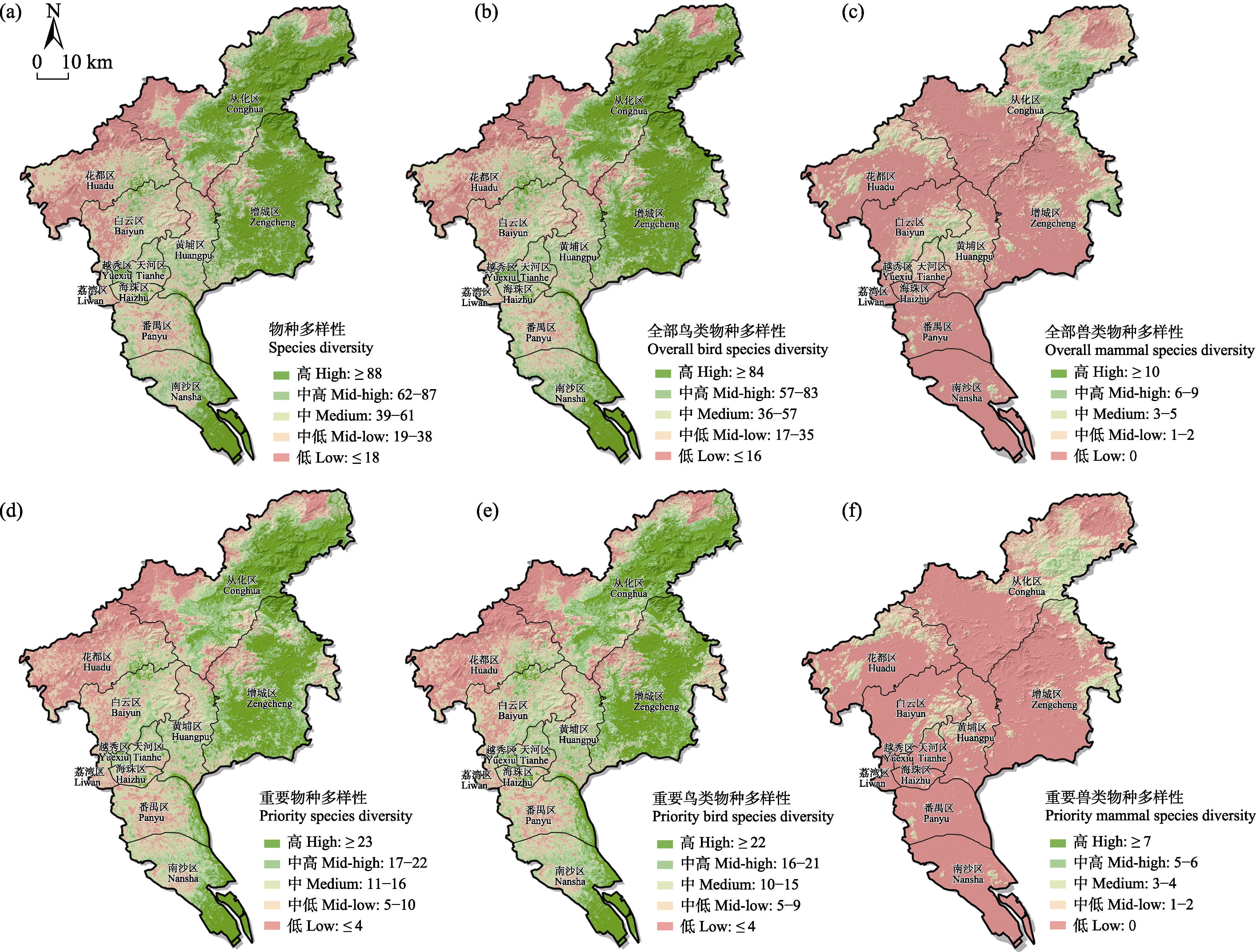
Fig. 2 Species diversity distribution pattern of terrestrial wild vertebrates in Guangzhou. (a) All species; (b) Birds; (c) Mammals; (d) All priority species; (e) Priority birds; (f) Priority mammals.
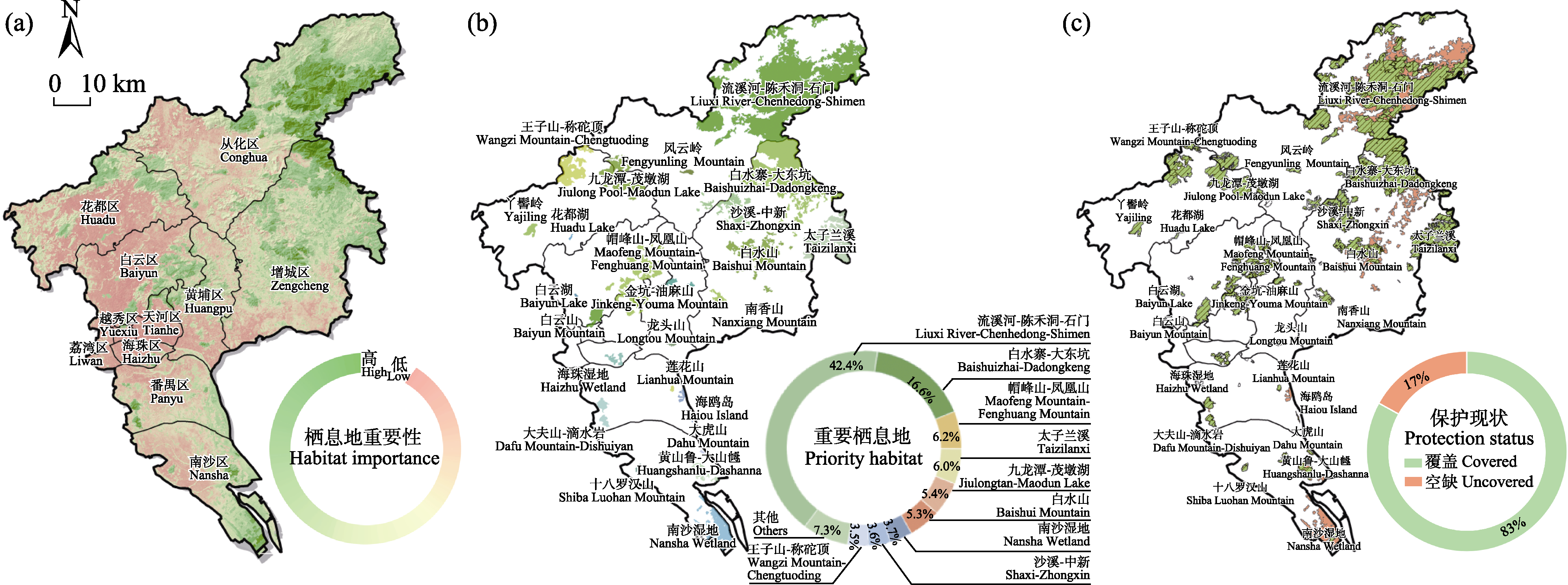
Fig. 3 Habitat importance assessment (a), distribution of priority habitats (b), and protection status (c) for terrestrial wild vertebrates in Guangzhou
| [1] | Alberti M (2016) Cities that Think like Planets: Complexity, Resilience, and Innovation in Hybrid Ecosystems. University of Washington Press, Seattle. |
| [2] |
Beninde J, Veith M, Hochkirch A (2015) Biodiversity in cities needs space: A meta-analysis of factors determining intra- urban biodiversity variation. Ecology Letters, 18, 581-592.
DOI PMID |
| [3] | Bonier F, Martin PR, Wingfield JC (2007) Urban birds have broader environmental tolerance. Biology Letters, 3, 670-673. |
| [4] |
Chandler M, See L, Copas K, Bonde AMZ, López BC, Danielsen F, Legind JK, Masinde S, Miller-Rushing AJ, Newman G, Rosemartin A, Turak E (2017) Contribution of citizen science towards international biodiversity monitoring. Biological Conservation, 213, 280-294.
DOI URL |
| [5] |
Concepción ED, Moretti M, Altermatt F, Nobis MP, Obrist MK (2015) Impacts of urbanisation on biodiversity: The role of species mobility, degree of specialisation and spatial scale. Oikos, 124, 1571-1582.
DOI URL |
| [6] | Editorial Board of Guangzhou Statistical Yearbook 2024 (2024) Guangzhou Statistical Yearbook 2024. China Statistics Press, Beijing. (in Chinese) |
| [《广州统计年鉴2024》编辑委员会 (2024) 广州统计年鉴2024. 中国统计出版社, 北京.] | |
| [7] |
Filloy J, Zurita GA, Bellocq MI (2019) Bird diversity in urban ecosystems: The role of the biome and land use along urbanization gradients. Ecosystems, 22, 213-227.
DOI |
| [8] | Guo JH, Guo TT, Jiang ZL (2024) Digitalization and application suggestions for “Multi-Level Engagement and Benefit” of biodiversity. Research of Environmental Sciences, 37, 2333-2340. (in Chinese with English abstract) |
| [郭俊华, 郭婷婷, 蒋智林 (2024) 生物多样性“多产泛融多方惠益”数字化体系构建及应用建议. 环境科学研究, 37, 2333-2340.] | |
| [9] | Hu HJ, Zhang CL, Zhang L, Liang JC (2023) Resources of Terrestrial Wild Vertebrates in Guangdong Province:Guangzhou Volume. Guangdong Science & Technology Press, Guangzhou. (in Chinese) |
| [胡慧建, 张春兰, 张亮, 梁健超 (2023) 广东省陆生野生脊椎动物资源: 广州篇. 广东科技出版社, 广州.] | |
| [10] |
Liu CR, White M, Newell G (2013) Selecting thresholds for the prediction of species occurrence with presence-only data. Journal of Biogeography, 40, 778-789.
DOI URL |
| [11] |
McKinney ML (2008) Effects of urbanization on species richness: A review of plants and animals. Urban Ecosystems, 11, 161-176.
DOI URL |
| [12] | Niemelä J (2011) Urban ecology: Patterns, processes, and applications. Oxford Biology, 100, 44-47. |
| [13] |
O’Connor LMJ, Pollock LJ, Renaud J, Verhagen W, Verburg PH, Lavorel S, Maiorano L, Thuiller W (2021) Balancing conservation priorities for nature and for people in Europe. Science, 372, 856-860.
DOI PMID |
| [14] |
Opdam P, Steingröver E (2008) Designing metropolitan landscapes for biodiversity: Deriving guidelines from metapopulation ecology. Landscape Journal, 27, 69-80.
DOI URL |
| [15] | Pan X, Zhang SW, Shen YF (2024) Study on the evolution of urban spatial performance and system coordination in Yangtze River Delta Region. Shanghai Urban Planning Review, (3), 134-142. (in Chinese with English abstract) |
| [潘鑫, 张尚武, 沈逸菲 (2024) 长三角地区城市空间绩效与系统协调性演变研究. 上海城市规划, (3), 134-142.] | |
| [16] |
Paviolo A, Angelo CD, Ferraz KMPMB, Morato RG, Martinez Pardo J, Srbek Araujo AC, Beisiegel BDM, Lima F, Sana D, Xavier da Silva M, Velázquez MC, Cullen L, Crawshaw P, Jorge MLSP, Galetti PM, Di Bitetti MS, de Paula RC, Eizirik E, Aide TM, Cruz P, Perilli MLL, Souza ASMC, Quiroga V, Nakano E, Ramírez Pinto F, Fernández S, Costa S, Moraes EA, Azevedo F (2016) A biodiversity hotspot losing its top predator: The challenge of jaguar conservation in the Atlantic Forest of South America. Scientific Reports, 6, 37147.
DOI PMID |
| [17] |
Phillips SJ, Anderson RP, Schapire RE (2006) Maximum entropy modeling of species geographic distributions. Ecological Modelling, 190, 231-259.
DOI URL |
| [18] |
Rivera K, Fidino M, Lehrer EW, Torsey HR, Allen S, Trouille L, Magle SB (2024) Optimizing community science contributions in ecology: A case study on Zooniverse’s ‘Chicago wildlife watch’. Biological Conservation, 292, 110490.
DOI URL |
| [19] |
Shanahan DF, Fuller RA, Bush R, Lin BB, Gaston KJ (2015) The health benefits of urban nature: How much do we need? BioScience, 65, 476-485.
DOI URL |
| [20] |
Sheard JK, Sanders NJ, Gundlach C, Schär S, Larsen RS (2020) Monitoring the influx of new species through citizen science: The first introduced ant in Denmark. PeerJ, 8, e8850.
DOI URL |
| [21] |
Tiago P, Leal AI, Rosário IT, Chozas S (2024) Discovering urban nature: Citizen science and biodiversity on a university campus. Urban Ecosystems, 27, 1609-1621.
DOI |
| [22] | Wang HY, Wang HQ, Chen XY, Han BL, Shu CJ, Zhang T, Ding SY (2023) Review on evaluation and enhancement of urban biodiversity. Acta Ecologica Sinica, 43, 2995-3006. (in Chinese with English abstract) |
| [王海洋, 王浩琪, 陈禧悦, 韩宝龙, 束承继, 张童, 丁仕宇 (2023) 国内外城市生物多样性评价与提升研究综述. 生态学报, 43, 2995-3006.] | |
| [23] |
Wang K, Ren JL, Chen HM, Lyu ZT, Guo XG, Jiang K, Chen JM, Li JT, Guo P, Wang YY, Che J (2020) The updated checklists of amphibians and reptiles of China. Biodiversity Science, 28, 189-218. (in Chinese with English abstract)
DOI |
|
[王剀, 任金龙, 陈宏满, 吕植桐, 郭宪光, 蒋珂, 陈进民, 李家堂, 郭鹏, 王英永, 车静 (2020) 中国两栖、爬行动物更新名录. 生物多样性, 28, 189-218.]
DOI |
|
| [24] |
Wilson JW, Sexton JO, Jobe RT, Haddad NM (2013) The relative contribution of terrain, land cover, and vegetation structure indices to species distribution models. Biological Conservation, 164, 170-176.
DOI URL |
| [25] |
Wu Q, Sun TZ, Zhao YM, Yu C, Hu JH, Li ZQ (2023) Temporal and spatial patterns of small vertebrate roadkill in a supercity of eastern China. PeerJ, 11, e16251.
DOI URL |
| [26] | Wu ZH, Ding ZF, Zhou ZX, Liang JC, Wang ZT, Zhang YN, Hu YM, Hu HJ (2023) Development status and document analysis: A review on terrestrial vertebrate field surveys in China. Biodiversity Science, 31, 22363. (in Chinese with English abstract) |
|
[吴政浩, 丁志锋, 周智鑫, 梁健超, 王卓婷, 章亚宁, 胡一鸣, 胡慧建 (2023) 中国陆生脊椎动物野外调查的发展现状与文献分析. 生物多样性, 31, 22363.]
DOI |
|
| [27] | Xia SX, Yu XB, Millington S, Liu Y, Jia YF, Wang LZ, Hou XY, Jiang LG (2017) Identifying priority sites and gaps for the conservation of migratory waterbirds in China’s coastal wetlands. Biological Conservation, 210, 72-82. |
| [28] |
Xiao ZS, Li XY, Xiang ZF, Li M, Jiang XL, Zhang LB (2017) Overview of the Mammal Diversity Observation Network of Sino BON. Biodiversity Science, 25, 237-245. (in Chinese with English abstract)
DOI |
|
[肖治术, 李学友, 向左甫, 李明, 蒋学龙, 张礼标 (2017) 中国兽类多样性监测网的建设规划与进展. 生物多样性, 25, 237-245.]
DOI |
|
| [29] | Xu HG, Cao MC, Wu Y, Cai L, Cao Y, Wu J, Lei JC, Le ZF, Ding H, Cui P (2016) Disentangling the determinants of species richness of vascular plants and mammals from national to regional scales. Scientific Reports, 6, 21988. |
| [30] |
Yong DL, Liu Y, Low BW, Española CP, Choi CY, Kawakami K (2015) Migratory songbirds in the East Asian- Australasian Flyway: A review from a conservation perspective. Bird Conservation International, 25, 1-37.
DOI URL |
| [31] |
Yu DM, Deng SQ, Liu YZH, Ruan XD, Hu HJ (2024) Experiences and prospects for national survey of terrestrial wildlife resources in China. Chinese Journal of Applied Ecology, 35, 2006-2012. (in Chinese with English abstract)
DOI |
|
[于冬梅, 邓诗泉, 刘源志弘, 阮向东, 胡慧建 (2024) 全国性陆生野生动物资源调查的经验总结与思考. 应用生态学报, 35, 2006-2012.]
DOI |
|
| [32] | Zhang QY, Deng ZD, Hu XB, Ding ZF, Xiao RB, Xiu C, Wu ZH, Wang G, Han DH, Zhang YK, Liang JC, Hu HJ (2023) The impact of urbanization on regional bird distribution and habitat connectivity in the Guangdong-Hong Kong-Macao Greater Bay Area. Biodiversity Science, 31, 22161. (in Chinese with English abstract) |
|
[张琼悦, 邓卓迪, 胡学斌, 丁志锋, 肖荣波, 修晨, 吴政浩, 汪光, 韩东晖, 张语克, 梁健超, 胡慧建 (2023) 粤港澳大湾区城市化进程对区域内鸟类分布及栖息地连通性的影响. 生物多样性, 31, 22161.]
DOI |
|
| [33] | Zhang RZ (2011) Zoogeography of China. Science Press, Beijing. (in Chinese) |
| [张荣祖 (2011) 中国动物地理. 科学出版社, 北京.] | |
| [34] | Zheng GM (2023) A Checklist on the Classification and Distribution of the Birds of China, 4th edn. Science Press, Beijing. (in Chinese) |
| [郑光美 (2023) 中国鸟类分类与分布名录(第四版). 科学出版社, 北京.] | |
| [35] | Ziliaskopoulos K, Laspidou C (2024) Using remote-sensing and citizen-science data to assess urban biodiversity for sustainable cityscapes: The case study of Athens, Greece. Landscape Ecology, 39, 9. |
| [36] | Zou FS, Ye GF (2016) A Checklist of the Distribution of Terrestrial Vertebrates in Guangdong. Guangdong Science & Technology Press, Guangzhou. (in Chinese) |
| [邹发生, 叶冠锋 (2016) 广东陆生脊椎动物分布名录. 广东科技出版社, 广州.] |
| [1] | Xixia Lu, Fengxiang Zhou, Liming Yong, Qianhui Zeng, Liyuan Zhao, Yuke Zhang, Xianyan Wang. Impacts of coastal reclamation on Chinese white dolphin (Sousa chinensis) habitats in China from 1990 to 2020 [J]. Biodiv Sci, 2026, 34(3): 25249-. |
| [2] | Ruxiao Wang, Boyang Shi, Da Pan, Hongying Sun. Biodiversity patterns and conservation gaps of the endemic freshwater crab genus Sinopotamon in China [J]. Biodiv Sci, 2025, 33(8): 25123-. |
| [3] | Yanli Wang, Ying Zhang, Chunlin Qi, Changda Zhang, Youhai Shi, Yanjun Du, Qiong Ding. Identifying biodiversity hotspots and conservation gaps in Hainan Tropical Rainforest National Park based on macrofungi and plants perspectives [J]. Biodiv Sci, 2024, 32(7): 24081-. |
| [4] | Zezhou Hao, Chengyun Zhang, Le Li, Bingtao Gao, Wei Zeng, Chun Wang, Zixuan Wang, Wantao Huang, Yue Zhang, Nancai Pei, Zhishu Xiao. Applications of passive acoustic monitoring and evaluation in urban bird research [J]. Biodiv Sci, 2024, 32(10): 24123-. |
| [5] | Xiulian Chi, Ting Guo, Qinggang Wang, Zhixian Jing, Xiaobo Zhang, Xiaolin Li, Kai Sun, Tielin Wang, Guang Yang. Evaluation of in situ conservation effectiveness on medicinal vascular plants in national nature reserves in central China [J]. Biodiv Sci, 2020, 28(2): 135-143. |
| [6] | Fei Duan, Sheng Li. The status, distribution patterns, and conservation gap for bird diversity in the Yellow River basin, China [J]. Biodiv Sci, 2020, 28(12): 1459-1468. |
| [7] | Xuemin Lang, Gankhuyag Purev-Ochir, Oyunchimeg Terbish, Dashdorj Khurelbaatar, Baasansuren Erdenechimeg, Amarkhuu Gungaa, Chunrong Mi, Yumin Guo. Luan River upper reaches: The important stopover site of the white-naped crane (Grus vipio) western population [J]. Biodiv Sci, 2020, 28(10): 1213-1221. |
| [8] | Yan Gao, Yun Bu, Yunxia Luan, Yiming Yang, Xin Ke. Community composition and diversity of soil fauna in the land use of city planning: a case study in Shanghai World Exposition Site [J]. Biodiv Sci, 2007, 15(2): 207-214. |
| Viewed | ||||||
|
Full text |
|
|||||
|
Abstract |
|
|||||
Copyright © 2026 Biodiversity Science
Editorial Office of Biodiversity Science, 20 Nanxincun, Xiangshan, Beijing 100093, China
Tel: 010-62836137, 62836665 E-mail: biodiversity@ibcas.ac.cn

