

Biodiv Sci ›› 2026, Vol. 34 ›› Issue (3): 25446. DOI: 10.17520/biods.2025446 cstr: 32101.14.biods.2025446
• Special Feature: The History and Progress of Primate Research in China—In Honor of Jane Goodall • Previous Articles Next Articles
Penglai Fan1,2,3( ), Wei Yao1,2,3, Chengming Huang4,*()(
 ), Qihai Zhou1,2,3,*()()
Received:2025-11-07
Accepted:2026-02-05
Online:2026-03-20
Published:2026-04-09
Contact:
*E-mail: Supported by:Penglai Fan, Wei Yao, Chengming Huang, Qihai Zhou. Research history and conservation progress of leaf monkeys in China[J]. Biodiv Sci, 2026, 34(3): 25446.
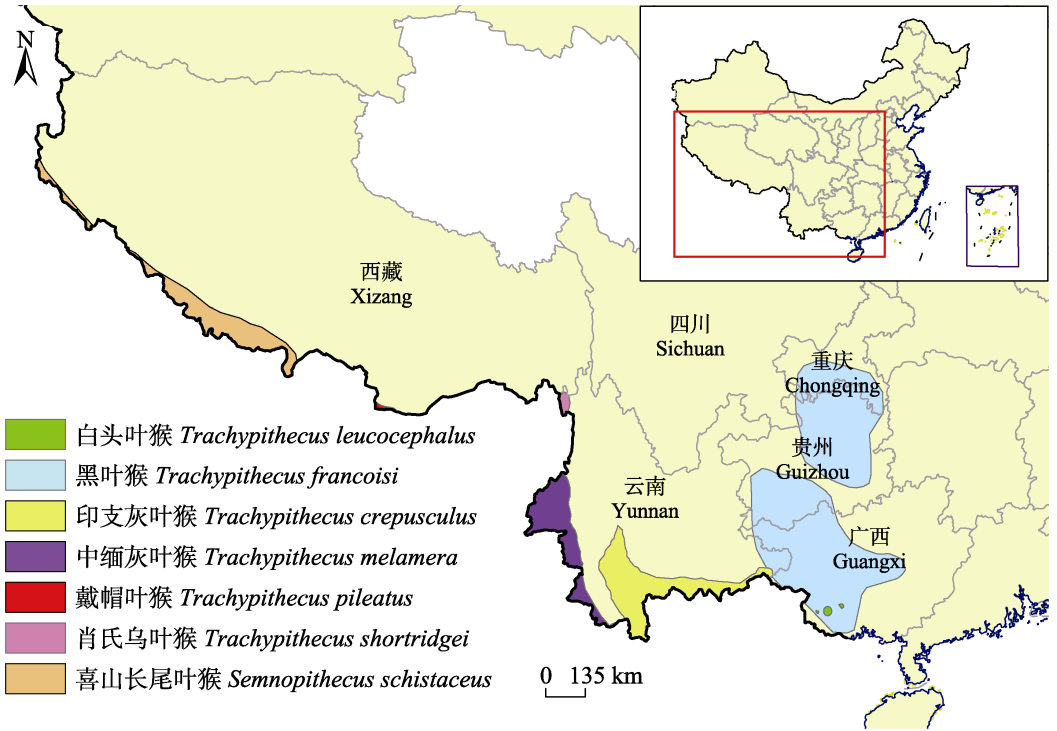
Fig. 1 Distribution of leaf monkeys in China
| 种名 Species | 研究地点 Study site | 植物部位的采食比例 Percentage of plant parts eaten (%) | 家域 Home range (ha) | 日漫游距离 Daily travel length (m) | 资料来源 Resource | ||||||
|---|---|---|---|---|---|---|---|---|---|---|---|
| 嫩叶 Young leaf | 成熟叶 Mature leaf | 树叶 Leaf | 花 Flower | 果实 Fruit | 种子 Seed | 其他 Other | |||||
| 白头叶猴 Trachypithecus leucocephalus | 广西崇左白头叶猴国家 级自然保护区 Guangxi Chongzuo White-headed Langur National Nature Reserve | 74.9 | 8.4 | 2.4 | 7.7 | 0.9 | 5.7 | 29.0 | Li & Rogers, | ||
| 75.3 | 2.3 | 22.5 | 52.0 | 585.0 | 黄乘明, | ||||||
| 91.6 | 4.2 | 4.2 | Zhou et al., | ||||||||
| 59.0 | 23.3 | 4.3 | 10.5 | 2.8 | 28.8 | 502.0 | Li et al., Zhou et al., | ||||
| 76.5 | 4.5 | 17.1 | 2.1 | 15.2 | 465.0 | Huang et al., | |||||
| 58.8 | 13.5 | 4.4 | 12.6 | 3.8 | 6.9 | Lu et al., | |||||
| 黑叶猴 T. francoisi | 广西弄岗国家级自然 保护区 Guangxi Nonggang National Nature Reserve | 38.9 | 13.9 | 7.5 | 17.2 | 14.2 | 8.3 | 69.3 | 541.0 | Zhou et al., | |
| 46.9 | 24.1 | 6.3 | 13.2 | 4.3 | 5.4 | 45.5 | 662.0 | 黄中豪等, | |||
| 广西崇左白头叶猴国家 级自然保护区 Guangxi Chongzuo White-headed Langur National Nature Reserve | 94.5 | 0.4 | 3.1 | 2.0 | 19.0 | 438.0 | Zhou et al., | ||||
| 86.9 | 0.7 | 9.3 | 3.1 | Li et al., | |||||||
| 广西恩城国家级自然 保护区 Guangxi Encheng National Nature Reserve | 51.1 | 20.1 | 5.7 | 15.9 | 1.6 | 5.6 | Yao et al., | ||||
| 贵州麻阳河国家级自然保护区 Guizhou Mayanghe National Nature Reserve | 43.3 | 20.6 | 25.7 | 6.5 | 3.9 | 78 | 881 | Hu, | |||
| 重庆金佛山国家级自然保护区 Chongqing Jinfo Mountain National Nature Reserve | 29.0 | 39.0 | 12.0 | 8.0 | 12.0 | 韩宗先和胡锦 矗, | |||||
| 印支灰叶猴 T. crepusculus | 云南无量山国家级自然保护区 Yunnan Wuliangshan National Nature Reserve | 29.5 | 24.7 | 6.3 | 32.1* | 5.7 | 446 | 1,011 | Fan et al., | ||
| 中缅灰叶猴 T. melamera | 云南高黎贡山国家级 自然保护区 Yunnan Gaoligongshan National Nature Reserve | 41.5 | 4.1 | 3.4 | 22.2 | 18.7 | 8.3 | Ma et al., | |||
| 肖氏乌叶猴 T. shortridgei | 云南独龙江流域 Dulong River Basin, Yunnan | 16.7 | 25.2 | 7.4 | 28.7 | 22 | Geng et al., | ||||
Table 1 Diet composition, home range and daily travel length of leaf monkeys in China
| 种名 Species | 研究地点 Study site | 植物部位的采食比例 Percentage of plant parts eaten (%) | 家域 Home range (ha) | 日漫游距离 Daily travel length (m) | 资料来源 Resource | ||||||
|---|---|---|---|---|---|---|---|---|---|---|---|
| 嫩叶 Young leaf | 成熟叶 Mature leaf | 树叶 Leaf | 花 Flower | 果实 Fruit | 种子 Seed | 其他 Other | |||||
| 白头叶猴 Trachypithecus leucocephalus | 广西崇左白头叶猴国家 级自然保护区 Guangxi Chongzuo White-headed Langur National Nature Reserve | 74.9 | 8.4 | 2.4 | 7.7 | 0.9 | 5.7 | 29.0 | Li & Rogers, | ||
| 75.3 | 2.3 | 22.5 | 52.0 | 585.0 | 黄乘明, | ||||||
| 91.6 | 4.2 | 4.2 | Zhou et al., | ||||||||
| 59.0 | 23.3 | 4.3 | 10.5 | 2.8 | 28.8 | 502.0 | Li et al., Zhou et al., | ||||
| 76.5 | 4.5 | 17.1 | 2.1 | 15.2 | 465.0 | Huang et al., | |||||
| 58.8 | 13.5 | 4.4 | 12.6 | 3.8 | 6.9 | Lu et al., | |||||
| 黑叶猴 T. francoisi | 广西弄岗国家级自然 保护区 Guangxi Nonggang National Nature Reserve | 38.9 | 13.9 | 7.5 | 17.2 | 14.2 | 8.3 | 69.3 | 541.0 | Zhou et al., | |
| 46.9 | 24.1 | 6.3 | 13.2 | 4.3 | 5.4 | 45.5 | 662.0 | 黄中豪等, | |||
| 广西崇左白头叶猴国家 级自然保护区 Guangxi Chongzuo White-headed Langur National Nature Reserve | 94.5 | 0.4 | 3.1 | 2.0 | 19.0 | 438.0 | Zhou et al., | ||||
| 86.9 | 0.7 | 9.3 | 3.1 | Li et al., | |||||||
| 广西恩城国家级自然 保护区 Guangxi Encheng National Nature Reserve | 51.1 | 20.1 | 5.7 | 15.9 | 1.6 | 5.6 | Yao et al., | ||||
| 贵州麻阳河国家级自然保护区 Guizhou Mayanghe National Nature Reserve | 43.3 | 20.6 | 25.7 | 6.5 | 3.9 | 78 | 881 | Hu, | |||
| 重庆金佛山国家级自然保护区 Chongqing Jinfo Mountain National Nature Reserve | 29.0 | 39.0 | 12.0 | 8.0 | 12.0 | 韩宗先和胡锦 矗, | |||||
| 印支灰叶猴 T. crepusculus | 云南无量山国家级自然保护区 Yunnan Wuliangshan National Nature Reserve | 29.5 | 24.7 | 6.3 | 32.1* | 5.7 | 446 | 1,011 | Fan et al., | ||
| 中缅灰叶猴 T. melamera | 云南高黎贡山国家级 自然保护区 Yunnan Gaoligongshan National Nature Reserve | 41.5 | 4.1 | 3.4 | 22.2 | 18.7 | 8.3 | Ma et al., | |||
| 肖氏乌叶猴 T. shortridgei | 云南独龙江流域 Dulong River Basin, Yunnan | 16.7 | 25.2 | 7.4 | 28.7 | 22 | Geng et al., | ||||
| 物种 Species | 调查区域 Survey area | 种群大小 Population size | 文献 References |
|---|---|---|---|
| 白头叶猴 Trachypithecus leucocephalus | 广西 Guangxi | 633 | 申兰田和李汉华, |
| 广西 Guangxi | 400 | 吴名川, | |
| 广西 Guangxi | 550-590 | Huang et al., | |
| 广西 Guangxi | 1,200 | Tang et al., | |
| 广西 Guangxi | 1,400 | 范鹏来(未发表数据) Penglai Fan, unpublished data | |
| 黑叶猴 T. francoisi | 广西 Guangxi | 4,000-5,000 | 吴名川, |
| 广西 Guangxi | 2,200-2,500 | 刘万福和韦振逸, | |
| 广西 Guangxi | 307 | Li et al., | |
| 广西弄岗国家级自然保护区 Guangxi Nonggang National Nature Reserve | 76 | 唐华兴等, | |
| 广西崇左白头叶猴国家级自然保护区 Guangxi Chongzuo White-headed Langur National Nature Reserve | 88 | 王振兴等, | |
| 广西恩城国家级自然保护区 Guangxi Encheng National Nature Reserve | 100-105 | 李文华等, | |
| 贵州 Guizhou | 946-1,094 | 李明晶, | |
| 贵州 Guizhou | 1,160-1,200 | 胡刚等, | |
| 贵州麻阳河国家级自然保护区 Guizhou Mayanghe National Nature Reserve | 554 | 牛克锋等, | |
| 贵州宽阔水国家级自然保护区 Guizhou Kuankuoshui National Nature Reserve | 195 | 姚小刚等, | |
| 贵州野钟黑叶猴自然保护区 Guizhou Yezhong François’ Langur Nature Reserve | 119 | 邓怀庆和周江, | |
| 贵州野钟黑叶猴自然保护区 Guizhou Yezhong François’ Langur Nature Reserve | 123 | 唐冬艳等, | |
| 贵州大沙河国家级自然保护区 Guizhou Dashahe National Nature Reserve | 166 | 胡淋正等, | |
| 重庆金佛山国家级自然保护区 Chongqing Jinfoshan National Nature Reserve | 80 | 唐洪通和张含藻, | |
| 重庆秀山、酉阳 Xiushan and Youyang, Chongqing | 200 | 王应祥等, | |
| 重庆武隆、彭水 Wulong and Pengshui, Chongqing | 40-45 | 苏化龙等, | |
| 重庆 Chongqing | 200 | Han et al., | |
| 重庆金佛山国家级自然保护区 Chongqing Jinfoshan National Nature Reserve | 180 | 王霞等, | |
| 印支灰叶猴 T. crepusculus | 云南 Yunnan | 15,000 | b |
| 云南 Yunnan | 11,500-17,000 | 马世来和王应祥, | |
| 云南无量山国家级自然保护区 Yunnan Wuliangshan National Nature Reserve | 2,000 | Ma et al., | |
| 云南 Yunnan | > 5,000 | 魏辅文, | |
| 中缅灰叶猴 T. melamera | 云南 Yunnan | 2,500 | 魏辅文, |
| 戴帽叶猴 T. pileatus | 西藏 Xizang | < 500 | 魏辅文, |
| 肖氏乌叶猴 T. shortridgei | 云南 Yunnan | 500-600 | 马世来和王应祥, |
| 云南 Yunnan | 250 | 云南省林业厅, 2001①(①云南省林业厅 (2001) 云南省陆生野生动物资源调查报告. 云南省林业厅, 昆明.) | |
| 云南 Yunnan | 250-370 | Cui et al., | |
| 喜山长尾叶猴 Semnopithecus schistaceus | 西藏 Xizang | 1,000 | 尹秉高和刘务林, |
| 西藏 Xizang | 1,300 | 魏辅文, |
Table 2 The history of population survey on leaf monkeys in China
| 物种 Species | 调查区域 Survey area | 种群大小 Population size | 文献 References |
|---|---|---|---|
| 白头叶猴 Trachypithecus leucocephalus | 广西 Guangxi | 633 | 申兰田和李汉华, |
| 广西 Guangxi | 400 | 吴名川, | |
| 广西 Guangxi | 550-590 | Huang et al., | |
| 广西 Guangxi | 1,200 | Tang et al., | |
| 广西 Guangxi | 1,400 | 范鹏来(未发表数据) Penglai Fan, unpublished data | |
| 黑叶猴 T. francoisi | 广西 Guangxi | 4,000-5,000 | 吴名川, |
| 广西 Guangxi | 2,200-2,500 | 刘万福和韦振逸, | |
| 广西 Guangxi | 307 | Li et al., | |
| 广西弄岗国家级自然保护区 Guangxi Nonggang National Nature Reserve | 76 | 唐华兴等, | |
| 广西崇左白头叶猴国家级自然保护区 Guangxi Chongzuo White-headed Langur National Nature Reserve | 88 | 王振兴等, | |
| 广西恩城国家级自然保护区 Guangxi Encheng National Nature Reserve | 100-105 | 李文华等, | |
| 贵州 Guizhou | 946-1,094 | 李明晶, | |
| 贵州 Guizhou | 1,160-1,200 | 胡刚等, | |
| 贵州麻阳河国家级自然保护区 Guizhou Mayanghe National Nature Reserve | 554 | 牛克锋等, | |
| 贵州宽阔水国家级自然保护区 Guizhou Kuankuoshui National Nature Reserve | 195 | 姚小刚等, | |
| 贵州野钟黑叶猴自然保护区 Guizhou Yezhong François’ Langur Nature Reserve | 119 | 邓怀庆和周江, | |
| 贵州野钟黑叶猴自然保护区 Guizhou Yezhong François’ Langur Nature Reserve | 123 | 唐冬艳等, | |
| 贵州大沙河国家级自然保护区 Guizhou Dashahe National Nature Reserve | 166 | 胡淋正等, | |
| 重庆金佛山国家级自然保护区 Chongqing Jinfoshan National Nature Reserve | 80 | 唐洪通和张含藻, | |
| 重庆秀山、酉阳 Xiushan and Youyang, Chongqing | 200 | 王应祥等, | |
| 重庆武隆、彭水 Wulong and Pengshui, Chongqing | 40-45 | 苏化龙等, | |
| 重庆 Chongqing | 200 | Han et al., | |
| 重庆金佛山国家级自然保护区 Chongqing Jinfoshan National Nature Reserve | 180 | 王霞等, | |
| 印支灰叶猴 T. crepusculus | 云南 Yunnan | 15,000 | b |
| 云南 Yunnan | 11,500-17,000 | 马世来和王应祥, | |
| 云南无量山国家级自然保护区 Yunnan Wuliangshan National Nature Reserve | 2,000 | Ma et al., | |
| 云南 Yunnan | > 5,000 | 魏辅文, | |
| 中缅灰叶猴 T. melamera | 云南 Yunnan | 2,500 | 魏辅文, |
| 戴帽叶猴 T. pileatus | 西藏 Xizang | < 500 | 魏辅文, |
| 肖氏乌叶猴 T. shortridgei | 云南 Yunnan | 500-600 | 马世来和王应祥, |
| 云南 Yunnan | 250 | 云南省林业厅, 2001①(①云南省林业厅 (2001) 云南省陆生野生动物资源调查报告. 云南省林业厅, 昆明.) | |
| 云南 Yunnan | 250-370 | Cui et al., | |
| 喜山长尾叶猴 Semnopithecus schistaceus | 西藏 Xizang | 1,000 | 尹秉高和刘务林, |
| 西藏 Xizang | 1,300 | 魏辅文, |
| [1] | Brandon-Jones D (1984) Colobus and leaf monkeys. In: The Encyclopedia of Mammals, Vol. 1 (ed. MacDonald DW), pp.398-410. Allen & Unwin, London. |
| [2] |
Brandon-Jones D, Eudey AA, Geissmann T, Groves CP, Melnick DJ, Morales JC, Shekelle M, Stewart CB (2004) Asian primate classification. International Journal of Primatology, 25, 97-164.
DOI |
| [3] | Chen XL, Liu YS, Yi BJ, Zhou QH, Liu RS, Fan PL (2025) Two ways of new bisexual group formation in the white-headed langur. Acta Theriologica Sinica, 45, 485-491. (in Chinese with English abstract) |
| [陈晓露, 刘银树, 易柏君, 周岐海, 刘若爽, 范鹏来 (2025) 白头叶猴两性新群形成的两种方式. 兽类学报, 45, 485-491.] | |
| [4] |
Chen Y, McConkey KR, Fan PF (2023) Sympatric primate seed dispersers and predators jointly contribute to plant diversity in a subtropical forest. Oecologia, 202, 715-727.
DOI |
| [5] | Chen Y, Zhong XK, Fan PF (2025) Fruit choice by two sympatric primate species: Determining nutritional composition using visual and tactile cues. Integrative Zoology, doi: 10.1111/1749-4877.12988. |
| [6] |
Chen YQ, Lai Y, Zheng JJ, Liu Z, Nong DP, Liang JP, Li YB, Huang ZH (2023) Seasonal variations in the gut microbiota of white-headed black langur (Trachypithecus leucocephalus) in a limestone forest in southwest Guangxi, China. Frontiers in Ecology and Evolution, 11, 1126243.
DOI URL |
| [7] | Chen Z, Huang CM, Zhou QH, Li YB, Feng YX, Dai DL (2008) Spatial temporal changes of habitat of Trachypithecus leucocephalus. Acta Ecologica Sinica, 28, 587-594. (in Chinese with English abstract) |
| [陈智, 黄乘明, 周岐海, 李友邦, 冯永新, 戴冬亮 (2008) 白头叶猴(Trachypithecus leucocephalus)栖息地景观格局的时空变化. 生态学报, 28, 587-594.] | |
| [8] |
Cui LW, Li YC, Ma C, Scott MB, Li JF, He XY, Li DH, Sun J, Sun WM, Xiao W (2016) Distribution and conservation status of shortridge’s capped langurs Trachypithecus shortridgei in China. Oryx, 50, 732-741.
DOI URL |
| [9] |
Deng HQ, Hong WQ, Zhou J, Li JX (2023) A preliminary study on home range and daily travel distance of François’ langur in a high-altitude area. Primates, 64, 247-259.
DOI |
| [10] | Deng HQ, Zhou J (2018) The survey of population size, distribution and sleeping caves of François’ langur (Trachypithecus francoisi) in Yezhong Nature Reserve. Acta Theriologica Sinica, 38, 420-425. (in Chinese with English abstract) |
| [邓怀庆, 周江 (2018) 贵州野钟保护区黑叶猴种群数量、分布及夜宿洞穴调查. 兽类学报, 38, 420-425.] | |
| [11] | Ding B, Li HP, Zhang YP, Liu ZM, Wei Y (2000) Taxonomic status of the white-headed langur (Trachypithecus francoisi leucocephalus) inferred from allozyme electrophoresis and random amplified polymorphism DNA (RAPD). Zoological Research, 39, 313-318. |
| [12] | Ding B, Zhang YP, Liu ZM, Wei Y (1999) Preliminary report on classification status of the white-headed langur inferred from random amplified polymorphism DNA. Zoological Research, 20, 1-6. (in Chinese with English abstract) |
| [丁波, 张亚平, 刘自明, 韦毅 (1999) RAPD分析与白头叶猴分类地位探讨. 动物学研究, 20, 1-6.] | |
| [13] | Eudey AA (1987) Action Plan for Asian Primate Conservation (1987-1991). IUCN, Gland, Switzerland. |
| [14] |
Fan PF, Garber P, Ma C, Ren GP, Liu CM, Chen XY, Yang JX (2015) High dietary diversity supports large group size in Indo-Chinese gray langurs in Wuliangshan, Yunnan, China. American Journal of Primatology, 77, 479-491.
DOI PMID |
| [15] | Fan PL, Lawes MJ, Liu RS, Zhou QH (2024) Hope for limestone langurs’ conservation. Science, 384, 855. |
| [16] | Fan PL, Li JX, Yang LT, Sun T, Wu SJ, Grueter CC, Huang CM, Zhou QH, Li M (2022) Vocal repertoire of the critically endangered white-headed langur (Trachypithecus leucocephalus): Call types, acoustic structures, and related social-ecological contexts. Zoological Research, 43, 875-879. |
| [17] | Geng Y, He JF, Li YC, Guan ZH, He XY, Sun J, Huang ZP, Li YP, Yong F, Xiao W, Cui LW (2020) Preliminary study on dietary selection in shortridge’s langurs (Trachypithecus shortridgei) from China. Zoological Research, 41, 715-720. |
| [18] | Groves CP (2001) Primate Taxonomy. Smithsonian Institute Press, Washington. |
| [19] | Groves CP (2007) The taxonomic diversity of the Colobinae of Africa. Journal of Anthropological Sciences, 85, 7-34. |
| [20] | Guan CY, Chen Z, Huang CM, Zhou QH (2022) Analysis of fragmentation in landscape pattern for the François’ langur’s habitats in Guangxi and its influence on population. Acta Ecologica Sinica, 42, 1203-1212. (in Chinese with English abstract) |
| [管超毅, 陈智, 黄乘明, 周岐海 (2022) 广西黑叶猴栖息地景观格局破碎化分析及其对种群的影响. 生态学报, 42, 1203-1212.] | |
| [21] | Han JL (2021) Study on Space Utilization Pattern and Habitat Evaluation of Trachypithecus francoisi in Mayanghe Nature Reserve. PhD dissertation, Inner Mongolia Agricultural University, Hohhot. (in Chinese with English abstract) |
| [韩家亮 (2021) 麻阳河自然保护区黑叶猴空间利用模式及生境适宜性评价研究. 博士学位论文, 内蒙古农业大学, 呼和浩特.] | |
| [22] |
Han JL, Zou QX, Dong BN (2024) Microhabitat selection by François’ langur Trachypithecus francoisi in Mayanghe National Nature Reserve, China. Endangered Species Research, 55, 83-92.
DOI URL |
| [23] |
Han ZX, Hu G, Wu SB, Cao CL, Dong X (2013) A census and status of the endangered François’ langur Trachypithecus francoisi in Chongqing, China. Oryx, 47, 128-133.
DOI URL |
| [24] | Han ZX, Hu JC (2010) Food selection by François’ langur (Trachypithecus francoisi francoisi) in the spring at Chongqing Jinfo Mountain National Nature Reserve. Sichuan Journal of Zoology, 29, 857-861, 867. (in Chinese with English abstract) |
| [韩宗先, 胡锦矗 (2010) 重庆金佛山国家级自然保护区黑叶猴春季食物选择. 四川动物, 29, 857-861, 867.] | |
| [25] | Han ZX, Wang W, Xie ZG, Ma JL, Chen C (2011) Study on individual behavior of François’ langur (Trachypithecus francoisi) in the Jinfo Mountain Nature Reserve. Journal of Southwest China Normal University (Natural Science Edition), 36, 102-107. (in Chinese with English abstract) |
| [韩宗先, 王维, 谢樟桂, 马建伦, 陈春 (2011) 金佛山自然保护区黑叶猴个体行为研究. 西南师范大学学报(自然科学版), 36, 102-107.] | |
| [26] |
He G, Yang HT, Pan RL, Sun YW, Zheng PB, Wang JH, Jin XL, Zhang JJ, Li BG, Guo ST (2020) Using unmanned aerial vehicles with thermal-image acquisition cameras for animal surveys: A case study on the Sichuan snub-nosed monkey in the Qinling Mountains. Integrative Zoology, 15, 79-86.
DOI PMID |
| [27] |
He K, Hu NQ, Orkin JD, Nyein DT, Ma C, Xiao W, Fan PF, Jiang XL (2012) Molecular phylogeny and divergence time of Trachypithecus: With implications for the taxonomy of T. phayrei. Zoological Research, 33, 104-110.
DOI URL |
| [28] | He XR, Yang DH (1982) Preliminary studies on the biology of Presbytis phayrei. Zoological Research, 3, 349-354. (in Chinese with English abstract) |
| [何晓瑞, 杨德华 (1982) 我国菲氏叶猴生物学的初步研究. 动物学研究, 3, 349-354.] | |
| [29] | Hong ZW, Xie YH, He K, Zhou QH, Miu YF, Peng H, Cao Z, Fan PL (2025) Deep audio detection networks from passive acoustic monitoring of a critically endangered primate. Integrative Zoology, doi: 10.1111/1749-4877.70019. |
| [30] | Hu G (2007) Socioecology and Behavioral Flexibility of François’ Langur (Trachypithecus francoisi) in Mayanghe Nature Reserve, Southwest China. PhD dissertation, The Australian National University, Canberra. |
| [31] |
Hu G (2011) Dietary breadth and resource use of François’ langur in a seasonal and disturbed habitat. American Journal of Primatology, 73, 1176-1187.
DOI URL |
| [32] | Hu G, Dong X, Luo HZ, Su XW, Li DY, Zhou CQ (2011) The distribution and population dynamics of François’ langur over the past two decades in Guizhou, China and threats to its survival. Acta Theriologica Sinica, 31, 306-311. (in Chinese with English abstract) |
| [胡刚, 董鑫, 罗洪章, 苏欣慰, 黎大勇, 周材权 (2011) 过去二十年贵州黑叶猴分布与种群动态及致危因子分析. 兽类学报, 31, 306-311.] | |
| [33] | Hu G, Dong X, Zhou CQ, Wei Y (2018) Black Phantoms—The François’ Langurs:Their Ecology and Behavior in Southwest China. Science Press, Beijing. |
| [34] | Hu LZ, Gou W, Wang WH, Feng YC, Yang XW, Su HJ (2024) A preliminary field survey on the population and distribution of François’ langur in Dashahe National Nature Reserve, Guizhou Province, China. Chinese Journal of Wildlife, 45, 1-7. (in Chinese with English abstract) |
| [胡淋正, 勾伟, 王万海, 冯育才, 杨雄威, 粟海军 (2024) 贵州大沙河国家级自然保护区黑叶猴种群数量与分布. 野生动物学报, 45, 1-7.] | |
| [35] | Hu YL, Huang CM, Que TC, Li YB, Zhou QH (2005) Research on allomothering behavior of François’ langurs (Trachypithecus francoisi) in captivity. Acta Theriologica Sinica, 25, 237-241. (in Chinese with English abstract) |
| [胡艳玲, 黄乘明, 阙腾程, 李友邦, 周岐海 (2005) 笼养黑叶猴拟母亲行为的观察. 兽类学报, 25, 237-241.] | |
| [36] | Hu YL, Que TC, Huang CM, Lai YM, Liu DR, Li HH (2004) The classification status of Presbytis leucocephalus. Chinese Journal of Zoology, 39(4), 109-111. (in Chinese with English abstract) |
| [胡艳玲, 阙腾程, 黄乘明, 赖月梅, 刘大荣, 李汉华 (2004) 关于白头叶猴分类地位的探讨. 动物学杂志, 39(4), 109-111.] | |
| [37] | Hu YM, Yao ZJ, Huang ZW, Tian Y, Li HB, Pu Q, Yang DD, Hu HJ (2014) Mammalian fauna and its vertical changes in Mt. Qomolangma National Nature Reserve. Acta Theriologica Sinica, 34, 28-37. (in Chinese with English abstract) |
| [胡一鸣, 姚志军, 黄志文, 田园, 李海滨, 普琼, 杨道德, 胡慧建 (2014) 西藏珠穆朗玛峰国家级自然保护区哺乳动物区系及其垂直变化. 兽类学报, 34, 28-37.] | |
| [38] | Hu YM, Zhou ZX, Huang ZW, Li M, Jiang ZG, Wu JP, Liu WL, Jin K, Hu HJ (2017) A new record of the capped langur (Trachypithecus pileatus) in China. Zoological Research, 38, 203-205. |
| [39] | Huang CM (2000) The White-headed Langur in China. Guangxi Normal University Press, Guilin. (in Chinese) |
| [黄乘明 (2000) 中国的白头叶猴. 广西师范大学出版社, 桂林.] | |
| [40] |
Huang CM, Li YB, Zhou QH, Feng YX, Chen Z, Yu H, Wu ZJ (2008a) Karst habitat fragmentation and conservation of the white-headed langur (Trachypithecus leucocephalus) in China. Primate Conservation, 23, 133-139.
DOI URL |
| [41] |
Huang CM, Wei FW, Li M, Li YB, Sun RY (2003) Sleeping cave selection, activity pattern and time budget of white-headed langurs. International Journal of Primatology, 24, 813-824.
DOI |
| [42] |
Huang CM, Wei FW, Li M, Quan GQ, Li HH (2002) Current status and conservation of white-headed langur (Trachypithecus leucocephalus) in China. Biological Conservation, 104, 221-225.
DOI URL |
| [43] |
Huang CM, Wu H, Zhou QH, Li YB, Cai XW (2008b) Feeding strategy of François’ langur and white-headed langur at Fusui, China. American Journal of Primatology, 70, 320-326.
DOI URL |
| [44] | Huang CM, Zhou QH, Li YB (2018) Behavioral Ecology and Conservation Biology of the François’ Langur. Shanghai Science and Technology Press, Shanghai. (in Chinese) |
| [黄乘明, 周岐海, 李友邦 (2018) 黑叶猴的行为生态与保护生物学. 上海科学技术出版社, 上海.] | |
| [45] |
Huang R, Chen HL, Guo QY, Lu MJ, Wu SJ, Nong DP, Li C, Ma YJ, Zhou QH (2025) Seasonal mercury in an endangered primate from fragmented karst forest: Does behavioral observation advance ecotoxicological risk assessment? Journal of Hazardous Materials, 499, 140162.
DOI URL |
| [46] | Huang ZH, Huang CM, Zhou QH, Wei H, Meng YJ (2010) Diet and the seasonal changes of the François’ langur (Trachypithecus francoisi). Acta Ecologica Sinica, 30, 5501-5508. (in Chinese with English abstract) |
| [黄中豪, 黄乘明, 周岐海, 韦华, 蒙渊君 (2010) 黑叶猴食物组成及其季节性变化. 生态学报, 30, 5501-5508.] | |
| [47] |
Huang ZH, Yuan PS, Huang HL, Tang XP, Xu WJ, Huang CM, Zhou QH (2017) Effect of habitat fragmentation on ranging behavior of white-headed langurs in limestone forests in southwest China. Primates, 58, 423-434.
DOI PMID |
| [48] | Huang ZH, Zhou QH, Huang CM, Meng YJ, Wei H (2011) Home range and daily ranging distance of François’ langur (Trachypithecus francoisi) in Nonggang Nature Reserve, Guangxi, China. Acta Theriologica Sinica, 31, 46-54. (in Chinese with English abstract) |
| [黄中豪, 周岐海, 黄乘明, 蒙渊君, 韦华 (2011) 广西弄岗黑叶猴的家域和日漫游距离. 兽类学报, 31, 46-54.] | |
| [49] |
Jin T, Wang DZ, Pan WS, Yao M (2015) Nonmaternal infant handling in wild white-headed langurs (Trachypithecus leucocephalus). International Journal of Primatology, 36, 269-287.
DOI URL |
| [50] |
Jin T, Wang DZ, Zhao Q, Yin LJ, Qin DG, Ran WZ, Pan WS (2009a) Social organization of white-headed langurs (Trachypithecus leucocephalus) in the Nongguan karst hills, Guangxi, China. American Journal of Primatology, 71, 206-213.
DOI URL |
| [51] |
Jin T, Wang DZ, Zhao Q, Yin LJ, Qin DG, Ran WZ, Pan WS (2009b) Reproductive parameters of wild Trachypithecus leucocephalus: Seasonality, infant mortality and interbirth interval. American Journal of Primatology, 71, 558-566.
DOI URL |
| [52] |
Lai Y, Chen YQ, Zheng JJ, Liu Z, Nong DP, Liang JP, Li YB, Huang ZH (2023) Gut microbiota of white-headed black langurs (Trachypithecus leucocephalus) in response to habitat fragmentation. Frontiers in Microbiology, 14, 1126257.
DOI URL |
| [53] | Li DY, Yuan PS, Krzton A, Huang CM, Zhou QH (2016) Dietary adaptation of white-headed langurs in a fragmented limestone habitat. Mammalia, 80, 153-162. |
| [54] |
Li DY, Zhou QH, Tang XP, Huang HL, Huang CM (2011) Sleeping site use of the white-headed langur Trachypithecus leucocephalus: The role of predation risk, territorial defense, and proximity to feeding sites. Current Zoology, 57, 260-268.
DOI URL |
| [55] | Li JX, Zhou YM, Huang CM, Fan PL, Zhou QH (2024) Effects of month age and sex on mother-infant relationship in white-headed langurs (Trachypithecus leucocephalus). Acta Theriologica Sinica, 44, 58-64. (in Chinese with English abstract) |
|
[李家兴, 周颖铭, 黄乘明, 范鹏来, 周岐海 (2024) 白头叶猴婴猴月龄和性别对母婴关系的影响. 兽类学报, 44, 58-64.]
DOI |
|
| [56] | Li MJ (1995) Ecological study of the Tonkin langur (Presbytis francoisi). In: Primate Research and Conservation (eds Xia WP, Zhang RZ), pp.226-231. China Forestry Publishing House, Beijing. (in Chinese) |
| [李明晶 (1995) 贵州黑叶猴生态研究. 见: 灵长类研究与保护(夏武平, 张荣祖主编), 226-231页. 中国林业出版社, 北京.] | |
| [57] | Li SQ, Li DY, Huang ZH, Li YB, Huang CM, Zhou QH (2016) Geographic variation in diet composition of François’ langurs (Trachypithecus francoisi). Acta Theriologica Sinica, 36, 46-55. (in Chinese with English abstract) |
|
[李生强, 黎大勇, 黄中豪, 李友邦, 黄乘明, 周岐海 (2016) 黑叶猴食物组成的地域性差异比较. 兽类学报, 36, 46-55.]
DOI |
|
| [58] | Li W, Guo AW, Wang B, Wu AK, Liu N, Hu G (2010) Nutritional contents of winter food and its influences on food choice of François’ langur at Mayanghe Nature Reserve. Acta Theriologica Sinica, 30, 151-156. (in Chinese with English abstract) |
| [李雯, 郭爱伟, 王彬, 吴安康, 刘宁, 胡刚 (2010) 冬季麻阳河黑叶猴的食物营养组分及其对食物选择的影响. 兽类学报, 30, 151-156.] | |
| [59] | Li WH, Song QC, Huang R, Zhao JX, Li YB, Zhou QH (2019) Current status and conservation of François’ langurs (Trachypithecus francoisi) in Encheng National Nature Reserve in Guangxi, China. Acta Theriologica Sinica, 39, 623-629. (in Chinese with English abstract) |
| [李文华, 宋晴川, 黄蓉, 赵家新, 李友邦, 周岐海 (2019) 广西恩城保护区黑叶猴种群数量和保护现状. 兽类学报, 39, 623-629.] | |
| [60] |
Li XR, Ru DF, Garber PA, Zhou QH, Li M, Zhao XM (2022) Climate change and human activities promoted speciation of two endangered langurs (François’ langur and white-headed langur). Global Ecology and Conservation, 38, e02185.
DOI URL |
| [61] |
Li YB, Ding P, Huang CM, Jiang PP, Wood C (2009) Dietary response of a group of François’ langur Trachypithecus francoisi in a fragmented habitat in the county of Fusui, China: Implications for conservation. Wildlife Biology, 15, 137-146.
DOI URL |
| [62] |
Li YB, Huang CM, Ding P, Tang Z, Wood C (2007) Dramatic decline of François’ langur Trachypithecus francoisi in Guangxi Province, China. Oryx, 41, 38-43.
DOI URL |
| [63] | Li ZX, Ma SL (1980) A revision of the white-headed langur. Acta Zootaxonomica Sinica, 5, 440-442. (in Chinese with English abstract) |
| [李致祥, 马世来 (1980) 白头叶猴的分类订正. 动物分类学报, 5, 440-442.] | |
| [64] | Li ZY (2000) The Socioecology of White-Headed Langurs, Presbytis leucocephalus, and Its Implications for Their Conservation. PhD dissertation, The University of Edinburgh, Edinburgh. |
| [65] |
Li ZY, Rogers ME (2004) Social organization of white-headed langurs Trachypithecus leucocephalus in Fusui, China. Folia Primatologica, 75, 97-100.
DOI URL |
| [66] |
Li ZY, Rogers ME (2005a) Are limestone hills a refuge or essential habitat for white-headed langurs in Fusui, China? International Journal of Primatology, 26, 437-452.
DOI URL |
| [67] |
Li ZY, Rogers ME (2005b) Habitat quality and range use of white-headed langurs in Fusui, China. Folia Primatologica, 76, 185-195.
DOI URL |
| [68] |
Li ZY, Rogers ME (2006) Food items consumed by white-headed langurs in Fusui, China. International Journal of Primatology, 27, 1551-1567.
DOI URL |
| [69] |
Li ZY, Wei Y, Rogers E (2003) Food choice of white-headed langurs in Fusui, China. International Journal of Primatology, 24, 1189-1205.
DOI |
| [70] | Liedigk R, Thinh VN, Nadler T, Walter L, Roos C (2009) Evolutionary history and phylogenetic position of the Indo-Chinese grey langur (Trachypithecus crepusculus). Vietnam Journal of Primatology, 3, 1-8. |
| [71] |
Liu FY, Li YB, Zhang KC, Liang JP, Nong DP, Huang ZH (2022) Habitat use of the white-headed langurs in limestone forest of Southwest Guangxi, China: Seasonality and group size effects. Ecology and Evolution, 12, e9068.
DOI PMID |
| [72] | Liu HY, Li YH, Liang JP, Nong DP, Li YB, Huang ZH (2023) Evaluation of gut microbiota stability and flexibility as a response to seasonal variation in the wild François’ langurs (Trachypithecus francoisi) in limestone forest. Microbiology Spectrum, 11, 05091-22. |
| [73] |
Liu J, Bhumpakphan N (2020) Comparison of activity budgets, diet, and habitat utilization between provisioned and wild groups of the François’ langur (Trachypithecus francoisi) in Mayanghe National Nature Reserve, China. Folia Primatologica, 91, 15-30.
DOI URL |
| [74] |
Liu JY, Zou QX, Li DY, Wang T, Han JL (2025) Gut bacterial and fungal communities of François’ langur (Trachypithecus francoisi) changed coordinate to different seasons. Frontiers in Microbiology, 16, 1547955.
DOI URL |
| [75] | Liu L, Li ZG, Deng HQ, Zhou J (2008) A report of crossbreeding offspring reproductively case of the captivity black-leafed monkey and white-headed leaf monkey (Trachypithecus francoisi). Sichuan Journal of Zoology, 27, 496. (in Chinese) |
| [刘璐, 李志刚, 邓怀庆, 周江 (2008) 笼养黑叶猴与白头叶猴杂交后代可育一例. 四川动物, 27, 496.] | |
| [76] |
Liu RS, Huang R, Huang HL, Tang XP, Huang CM, Fan PL, Zhou QH (2025) Comparative behavioral ecology of all-male and bisexual groups of white-headed langurs in fragmented limestone habitats. American Journal of Biological Anthropology, 186, e70021.
DOI URL |
| [77] | Liu WF, Wei ZY (1995) Present status and protection of primate resources in Guangxi, China. In: Primate Research and Conservation (eds Xia WP, Zhang RZ), pp.123-132. China Forestry Publishing House, Beijing. (in Chinese) |
| [刘万福, 韦振逸 (1995) 广西灵长类资源与保护. 见: 灵长类研究与保护(夏武平, 张荣祖主编), 123-132页. 中国林业出版社, 北京.] | |
| [78] | Liu XJ, Wu Q, Huang ZH, Huang CM, Zhou QH (2016) Nutritional content of dry season foods and its influences on food choice of François’ langur at Nonggang. Acta Theriologica Sinica, 36, 241-247. (in Chinese with English abstract) |
| [刘秀菊, 吴茜, 黄中豪, 黄乘明, 周岐海 (2016) 弄岗黑叶猴旱季食物营养组分及其对食物选择的影响. 兽类学报, 36, 241-247.] | |
| [79] |
Liu XY, Guan CY, Fan PL, Huang CM, Zhang MX, Zhou QH (2025) Construction and optimization of habitat ecological network of the white-headed langur (Trachypithecus leucocephalus) under landscape dynamics. American Journal of Primatology, 87, e70097.
DOI URL |
| [80] | Liu YC, Guo QY, Lu MJ, Wu SJ, Nong DP, Huang CM, Fan PL, Zhou QH (2025) Feeding on human-planted eucalyptus by the white-headed langur (Trachypithecus leucocephalus) in the wild and its nutritional analysis. Acta Theriologica Sinica, 45, 119-127. (in Chinese with English abstract) |
| [刘彦辰, 郭秋艳, 陆媚静, 吴世军, 农登攀, 黄乘明, 范鹏来, 周岐海 (2025) 白头叶猴对人工栽培桉树的取食及营养分析. 兽类学报, 45, 119-127.] | |
| [81] |
Liu ZJ, Liu GJ, Roos C, Wang ZM, Xiang ZF, Zhu PF, Wang BS, Ren BP, Shi FL, Pan HJ, Li M (2015) Implications of genetics and current protected areas for conservation of 5 endangered primates in China. Conservation Biology, 29, 1508-1517.
DOI PMID |
| [82] | Liu ZJ, Wang BS, Nadler T, Liu GJ, Sun T, Huang CM, Zhou QH, Zhou J, Que TC, Wang ZM, Roos C, Li M (2013) Relatively recent evolution of pelage coloration in Colobinae: Phylogeny and phylogeography of three closely related langur species. PLoS ONE, 8, e61659. |
| [83] |
Liu ZJ, Zhang LY, Yan ZZ, Ren ZJ, Han FM, Tan XX, Xiang ZY, Dong F, Yang ZM, Liu GJ, Wang ZM, Zhang JL, Que TC, Tang CH, Li YF, Wang S, Wu JY, Li LG, Huang CM, Roos C, Li M (2020) Genomic mechanisms of physiological and morphological adaptations of limestone langurs to karst habitats. Molecular Biology and Evolution, 37, 952-968.
DOI PMID |
| [84] | Liu ZJ, Zhang XF, Wang PP, Hong MH, Yan XC, Qi XQ, Zhao Q, Chen ZH, Nie HJ, Li H, Li ZW, Zhang LY, Qi JW, He CL, Van Truong N, Le MD, Nadler T, Imai H, Roos C, Li M (2025) Living on the rocks: Genomic analysis of limestone langurs provides novel insights into the adaptive evolution in extreme karst environments. Genomics, Proteomics & Bioinformatics, 23, qzaf007. |
| [85] | Lu LR, Li ZY (1991) On the taxonomy of the Presbytis francoisi leucocephalus—Discuss with Ma Shilai. Journal of Guangxi Normal University (Natural Science Edition), 9(2), 67-70. (in Chinese with English abstract) |
| [卢立仁, 李兆元 (1991) 论白头叶猴的分类——兼与马世来商榷. 广西师范大学学报(自然科学版), 9(2), 67-70.] | |
| [86] | Lu R, Yang YF, Fan LL, Fan PF, Ma C (2024) Effects of vegetation structure of arbor layer on overnight habitat selection of Trachypithecus crepusculus. Chinese Journal of Wildlife, 45, 461-471. (in Chinese with English abstract) |
| [陆瑞, 杨云飞, 范琳琳, 范朋飞, 马驰 (2024) 乔木层植被结构对印支灰叶猴夜宿地选择的影响. 野生动物学报, 45, 461-471.] | |
| [87] |
Lu SY, Chen T, Huang ZH, Li YB, Lu CH (2021) Interannual variation in food choice of white-headed langur inhabiting limestone forests in Fusui, southwest Guangxi, China. Ecology and Evolution, 11, 9349-9360.
DOI PMID |
| [88] |
Lu SY, Lin NX, Huang AS, Tong DW, Liang YY, Li YB, Lu CH (2024) Feeding postures and substrate use of François’ langurs (Trachypithecus francoisi) in the limestone forest of southwest China. Animals, 14, 565.
DOI URL |
| [89] |
Ma C, Fan PF (2020) Effect of substrate type on langur positional repertoire. Global Ecology and Conservation, 22, e00956.
DOI URL |
| [90] |
Ma C, Fan PF, Zhang ZY, Li JH, Shi XC, Xiao W (2017) Diet and feeding behavior of a group of 42 Phayre’s langurs in a seasonal habitat in Mt. Gaoligong, Yunnan, China. American Journal of Primatology, 79, e22695.
DOI URL |
| [91] |
Ma C, Luo ZH, Liu CM, Orkin JD, Xiao W, Fan PF (2015) Population and conservation status of Indochinese gray langurs (Trachypithecus crepusculus) in the Wuliang Mountains, Jingdong, Yunnan, China. International Journal of Primatology, 36, 749-763.
DOI URL |
| [92] |
Ma C, Xiong WG, Yang L, Zhang L, Tomlin PR, Chen W, Fan PF (2020) Living in forests: Strata use by Indo-Chinese gray langurs (Trachypithecus crepusculus) and the effect of forest cover on Trachypithecus terrestriality. Zoological Research, 41, 373-380.
DOI PMID |
| [93] |
Ma CF, Wang J, Fan PL, Wu AK, Zou QX, Yang ZH, Zhang P, Huang CM, Zhou QH (2025) Direct evidence of infanticide in wild François’ langurs (Trachypithecus francoisi) living in limestone habitats. International Journal of Primatology, 46, 316-320.
DOI |
| [94] | Ma SL, Wang YX (1988) The recent distribution, status and conservation of primates in China. Acta Theriologica Sinica, 8, 250-260. (in Chinese with English abstract) |
| [马世来, 王应祥 (1988) 中国现代灵长类的分布、现状与保护. 兽类学报, 8, 250-260.] | |
| [95] |
Ma SL, Wang YX, Poirier FE (1989) Taxonomy and distribution of the François’ langur (Presbytis francoisi). Primates, 30, 233-240.
DOI URL |
| [96] |
Niu KF, Liu W, Xiao Z, Wu AK, Yang TY, Riondato I, Ellwanger AL, Ang AD, Giamba M, Yang YQ, Giacoma C (2019) Exploring local perceptions of and attitudes toward endangered François’ langurs (Trachypithecus francoisi) in a human-modified habitat. International Journal of Primatology, 40, 331-355.
DOI |
| [97] | Niu KF, Xiao Z, Wang B, Yang D, Tan CL, Zhang P, Yan XG, Wang H, Yu B, Yang TY, Pan JD, Cui DY, Zou QX, Wu AK, Wei LM, Zou H, Gamba M, Giacoma C (2016) Population estimates and distribution of François’ langur (Trachypithecus francoisi) in Mayanghe National Nature Reserve, China. Chinese Journal of Zoology, 51, 925-938. (in Chinese with English abstract) |
| [牛克锋, 肖志, 王彬, 杨德, Chia L Tan, 张鹏, 颜修刚, 王华, 余波, 杨天友, 攀均德, 崔多英, 邹启先, 吴安康, 魏鲁明, 邹浩, Marco Gamba, Cristina Giacoma (2016) 中国麻阳河国家级自然保护区黑叶猴种群数量估计与分布. 动物学杂志, 51, 925-938.] | |
| [98] | Pan RL, Ma SL, Wang H, Ma YY (1988a) Alveolar archs in the Phayre’s and François’ leaf monkeys. Zoological Research, 9, 183-191. (in Chinese with English abstract) |
| [潘汝亮, 马世来, 王红, 马原野 (1988a) 菲氏叶猴和黑叶猴的齿弓. 动物学研究, 9, 183-191.] | |
| [99] | Pan RL, Peng YZ, Ye ZZ (1989) Body proportion of François’ leaf monkey. Acta Theriologica Sinica, 9, 247-253. (in Chinese with English abstract) |
| [潘汝亮, 彭燕章, 叶智彰 (1989) 黑叶猴外形整体结构的研究. 兽类学报, 9, 247-253.] | |
| [100] | Pan RL, Peng YZ, Ye ZZ, Wang H (1988b) The mandibules of Phayre’s and François’ leaf monkeys. Zoological Research, 9, 385-393. (in Chinese with English abstract) |
| [潘汝亮, 彭燕章, 叶智彰, 王红 (1988b) 菲氏叶猴与黑叶猴的下颌骨. 动物学研究, 9, 385-393.] | |
| [101] | Pan RL, Peng YZ, Ye ZZ, Wang H (1992a) Cranial morphological comparison between François’ and Phayre’s leaf monkeys. Acta Anthropologica Sinica, 11, 52-59. (in Chinese with English abstract) |
| [潘汝亮, 彭燕章, 叶智彰, 王红 (1992a) 黑叶猴和菲氏叶猴颅骨的比较研究. 人类学学报, 11, 52-59.] | |
| [102] | Pan RL, Peng YZ, Ye ZZ, Wang H (1992b) Cephalofacial morphological comparison between Presbytis phayrei and P. francoisi with Cartesian coordinate data. Acta Zoologica Sinica, 38, 128-135. (in Chinese with English abstract) |
| [潘汝亮, 彭燕章, 叶智彰, 王红 (1992b) 用笛卡儿座标对菲氏叶猴和黑叶猴颅骨的比较形态研究. 动物学报, 38, 128-135.] | |
| [103] | Pan RL, Ye ZZ, Peng YZ (1991) Extensor and flexor muscles of the thigh in the François’ leaf monkey. Acta Anatomica Sinica, 22, 1-6. (in Chinese with English abstract) |
| [潘汝亮, 叶智彰, 彭燕章 (1991) 黑叶猴的大腿伸肌和屈肌. 解剖学报, 22, 1-6.] | |
| [104] | Pan WS (2016) The Natural History of White-headed Langurs. Peking University Press, Beijing. (in Chinese) |
| [潘文石 (2016) 白头叶猴自然史. 北京大学出版社, 北京.] | |
| [105] | Pan WS (2021) The Population Ecology of White-headed Langurs. Peking University Press, Beijing. |
| [106] |
Pan WS, Gu TL, Pan Y, Feng CG, Long Y, Zhao Y, Meng H, Liang ZH, Yao M (2014) Birth intervention and non-maternal infant-handling during parturition in a nonhuman primate. Primates, 55, 483-488.
DOI PMID |
| [107] | Peng YZ, Pan RL, Ye ZZ, Wang H (1989) Comparative research of the craniofacial morphology between Phayre’s leaf monkey and François’ leaf monkey. Acta Theriologica Sinica, 9, 34-40. (in Chinese with English abstract) |
| [彭燕章, 潘汝亮, 叶智彰, 王红 (1989) 菲氏叶猴与黑叶猴面颅形态的比较研究. 兽类学报, 9, 34-40.] | |
| [108] | Peng YZ, Pan RL, Yu FH (1994) Comparative study on skulls of genus Presbytis. Acta Anthropologica Sinica, 13, 171-180. (in Chinese with English abstract) |
| [彭燕章, 潘汝亮, 俞发宏 (1994) 亚洲叶猴属(Presbytis)的颅骨研究. 人类学学报, 13, 171-180.] | |
| [109] |
Qi XG, Wu JW, Zhao L, Wang L, Guang XM, Garber PA, Opie C, Yuan Y, Diao RJ, Li G, Wang K, Pan RL, Ji WH, Sun HL, Huang ZP, Xu CZ, Witarto AB, Jia R, Zhang C, Deng C, Qiu Q, Zhang GJ, Grueter CC, Wu DD, Li BG (2023) Adaptations to a cold climate promoted social evolution in Asian Colobine primates. Science, 380, eabl8621.
DOI URL |
| [110] | Quan GQ, Wang S, Zhang RZ (1981a) Taxonomy and distribution of primates in China. Wildlife, (3), 7-14. (in Chinese) |
| [全国强, 汪松, 张荣祖 (1981a) 我国灵长类动物的分类与分布. 野生动物, (3), 7-14.] | |
| [111] | Quan GQ, Wang S, Zhang RZ (1981b) On the recent status and conservation of primates in China. Acta Theriologica Sinica, 1, 99-104. (in Chinese with English abstract) |
| [全国强, 汪松, 张荣祖 (1981b) 我国灵长类的现状与保护. 兽类学报, 1, 99-104.] | |
| [112] | Que TC, Hu YL, Zhang CC, Huang CM, Meng XJ (2007) Observations on the hybrid of Trachypithecus leucocephalus and T. francoisi and its offspring. Zoological Research, 28, 225-230. (in Chinese with English abstract) |
| [阙腾程, 胡艳玲, 张才昌, 黄乘明, 孟秀菊 (2007) 杂交白头叶猴F1代及其后代性状和行为跟踪观察. 动物学研究, 28, 225-230.] | |
| [113] |
Que TC, Wang HF, Yang WF, Wu JB, Hou CY, Pei SR, Wu QY, Li LM, Wei SL, Xie X, Huang HL, Chen PY, Huang YM, Wu AQ, He MH, Nong DP, Wei X, Wu JY, Nong R, Huang N, Zhou QN, Lin YW, Lu TX, Wei YJ, Li SS, Yao JL, Zhong YL, Qin HY, Tan LH, Li YJ, Li WD, Liu T, Liu SY, Yu YY, Qiu H, Jiang YH, Li YC, Liu ZJ, Huang CM, Hu YL (2021) The reference genome and transcriptome of the limestone langur, Trachypithecus leucocephalus, reveal expansion of genes related to alkali tolerance. BMC Biology, 19, 67.
DOI |
| [114] | Roos C, Helgen KM, Portela Miguez R, May Lay Thant N, Lwin N, Ko Lin A, Lin A, Mar Yi K, Soe P, Mar Hein Z, Nyein Nyein Myint M, Ahmed T, Chetry D, Urh M, Veatch EG, Duncan N, Kamminga P, Chua MAH, Yao L, Matauschek C, Meyer D, Liu ZJ, Li M, Nadler T, Fan PF, Khac Quyet L, Hofreiter M, Zinner D, Momberg F (2020) Mitogenomic phylogeny of the Asian Colobine genus Trachypithecus with special focus on Trachypithecus phayrei (Blyth, 1847) and description of a new species. Zoological Research, 41, 656-669. |
| [115] | Shen LT, Li HH (1982) White-headed langur in Guangxi. Journal of Guangxi Normal University (Natural Science Edition), 1, 27-32, 46. (in Chinese) |
| [申兰田, 李汉华 (1982) 广西的白头叶猴. 广西师范大学学报(自然科学版), 1, 27-32, 46.] | |
| [116] | Song YQ, Yi BJ, Tao MJ, Nong DP, Zhou QH, Fan PL (2025) The long-distance calling of white-headed langurs (Trachypithecus leucocephalus) serves a defensive function for their sleeping sites. Acta Theriologica Sinica, 45, 820-830. (in Chinese with English abstract) |
|
[宋雨千, 易柏君, 陶梅洁, 农登攀, 周岐海, 范鹏来 (2025) 白头叶猴的长距离鸣叫具有防御过夜地的功能. 兽类学报, 45, 820-830.]
DOI |
|
| [117] | Su HL, Lin YH, Ma Q, Zhao HD, Wu DM, Xu ZQ, Deng HL (2002) Preliminary survey on population of François’ langur (Trachypithecus francoisi) in Wulong County and Pengshui County. Acta Theriologica Sinica, 22, 169-178. (in Chinese with English abstract) |
| [苏化龙, 林英华, 马强, 赵怀东, 吴登明, 胥执清, 邓合黎 (2002) 重庆市武隆县和彭水县交界处白颊黑叶猴种群初步调查. 兽类学报, 22, 169-178.] | |
| [118] | Sun T, Wang BS, Liu ZJ, Huang CM, Zhou QH, Li M (2010a) Isolation and characterization of 10 microsatellite loci for white-headed langur (Trachypithecus leucocephalus). Conservation Genetics Resources, 2, 97-99. |
| [119] | Sun T, Wang BS, Liu ZJ, Que TC, Huang CM, Zhou QH, Li M (2010b) Identification and characterization of microsatellite markers via cross-species amplification from François’ langur (Trachypithecus francoisi). Acta Theriologica Sinica, 30, 351-353. |
| [120] |
Sun Y, Yu YZ, Wu AK, Zhang C, Liu X, Qian CJ, Li JF, Ran JC (2023) The composition and function of the gut microbiota of François’ langurs (Trachypithecus francoisi) depend on the environment and diet. Frontiers in Microbiology, 14, 1269492.
DOI URL |
| [121] | Tan BJ (1957) Rare catches by Chinese animal collectors. Zoo Life, 12, 61-63. |
| [122] | Tang DY, Zhou Y, Yang GM, He MF, Wei ZH, Su HJ, Diao YX (2025) Study on the population size and sleeping site selection strategy of Trachypithecus francoisi in the Yezhong François’ Langur Nature Reserve, Guizhou. Sichuan Journal of Zoology, 44, 361-372. (in Chinese with English abstract) |
| [唐冬艳, 周源, 杨光美, 何曼芳, 魏忠海, 粟海军, 刁奕欣 (2025) 贵州野钟黑叶猴自然保护区黑叶猴种群数量及其夜宿地选择策略研究. 四川动物, 44, 361-372.] | |
| [123] | Tang HT, Zhang HZ (1994) The survey on population and ecology of Presbytis francoisi. Sichuan Forestry Science and Technology, 15(4), 48-50. (in Chinese) |
| [唐洪通, 张含藻 (1994) 白颊黑叶猴资源及生态调查. 四川林业科技, 15(4), 48-50.] | |
| [124] | Tang HX, Chen TB, Liu SY, Nong DP, Meng YJ, Lu MX (2011) The population dynamics of François’ langur Trachypithecus francoisi in Nonggang Nature Reserve, Guangxi, China. Sichuan Journal of Zoology, 30, 136-140. (in Chinese with English abstract) |
| [唐华兴, 陈天波, 刘晟源, 农登攀, 蒙渊君, 陆茂新 (2011) 广西弄岗自然保护区黑叶猴的种群动态. 四川动物, 30, 136-140.] | |
| [125] |
Tang HX, Huang HL, Wang ZX, Wu JB, Wang AL, Nong DP, Garber PA, Zhou QH, Huang CM (2024) Population dynamics and conservation status of the white-headed langur in the Chongzuo forest fragments, Guangxi, China. Oryx, 58, 179-182.
DOI URL |
| [126] |
Wang DZ, Ran WZ, Jin T, Pan WS (2005) Population census of the white-headed langur (Trachypithecus leucocephalus) at Longrui Karst Hills, Guangxi, China. Primates, 46, 219-222.
PMID |
| [127] | Wang SL (2008) Home Range and Habitat Characteristics of François’ Langur (Trachypithecus francoisi) in Mayanghe National Nature Reserve. PhD dissertation, Beijing Forestry University, Beijing. (in Chinese with English abstract) |
| [王双玲 (2008) 贵州麻阳河自然保护区黑叶猴家域和生境特征研究. 博士学位论文, 北京林业大学, 北京.] | |
| [128] |
Wang SL, Luo Y, Cui GF (2011) Sleeping site selection of François’ langur (Trachypithecus francoisi) in two habitats in Mayanghe National Nature Reserve, Guizhou, China. Primates, 52, 51-60.
DOI URL |
| [129] |
Wang WR, Qiao Y, Pan WS, Yao M (2015) Low genetic diversity and strong geographical structure of the critically endangered white-headed langur (Trachypithecus leucocephalus) inferred from mitochondrial DNA control region sequences. PLoS ONE, 10, e0129782.
DOI URL |
| [130] |
Wang WR, Yao M (2017) Fine-scale genetic structure analyses reveal dispersal patterns in a critically endangered primate, Trachypithecus leucocephalus. American Journal of Primatology, 79, e22635.
DOI URL |
| [131] |
Wang WR, Zheng YT, Zhao JD, Yao M (2019) Low genetic diversity in a critically endangered primate: Shallow evolutionary history or recent population bottleneck? BMC Evolutionary Biology, 19, 134.
DOI PMID |
| [132] | Wang X, Chen Y, Zheng HF, Zhong W, Chen LX, Sun YW (2025) Population size, distribution and gut bacterial composition of Trachypithecus francoisi in Jinfo Mountain National Nature Reserve. Acta Theriologica Sinica, 45, 324-332. (in Chinese with English abstract) |
| [王霞, 陈雨, 郑海峰, 钟伟, 陈丽霞, 孙雅望 (2025) 金佛山国家级自然保护区黑叶猴种群数量分布与肠道微生物组成. 兽类学报, 45, 324-332.] | |
| [133] | Wang XP, Zhang YP, Yu L (2013) A summary of phylogenetic research on Colobinae. Chinese Science Bulletin, 58, 1465-1472. (in Chinese) |
| [王晓萍, 张亚平, 于黎 (2013) 疣猴亚科(Colobinae)系统发育研究概述. 科学通报, 58, 1465-1472.] | |
| [134] |
Wang XY, Li H, Yang YM, Wu ZJ, Wang ZX, Li DY, Xia WC, Zou SZ, Liu YJ, Wang F (2024) Geographic and environmental impacts on gut microbiome in Himalayan langurs (Semnopithecus schistaceus) and Xizang macaques (Macaca mulatta vestita). Frontiers in Microbiology, 15, 1452101.
DOI URL |
| [135] | Wang YX, Jiang XL, Feng Q (1999) Taxonomy, status and conservation of the leaf monkeys in China. Zoological Research, 20, 306-315. (in Chinese with English abstract) |
| [王应祥, 蒋学龙, 冯庆 (1999) 中国叶猴类的分类、现状与保护. 动物学研究, 20, 306-315.] | |
| [136] | Wang ZX, Wang AL, Huang HL, Meng YN, Liang JP, Nong DP, Jiang YH, Li YB (2014) Distribution and population number of Trachypithecus francoisi in Chongzuo White-headed Langur Nature Reserve and adjacent area, Guangxi. Sichuan Journal of Zoology, 33, 487-492. (in Chinese with English abstract) |
| [王振兴, 王爱龙, 黄恒连, 蒙育宁, 梁霁鹏, 农登攀, 蒋迎红, 李友邦 (2014) 广西崇左白头叶猴国家级自然保护区及周边区域黑叶猴种群数量与分布. 四川动物, 33, 487-492.] | |
| [137] | Wang ZX, Wei X, Zhou QH, Huang CM, Huang HL, Wu JB, Nong DP, Li YT (2019) The influence of road barrier on Trachypithecus leucocephalus migration. Journal of West China Forestry Science, 48(6), 41-47. (in Chinese with English abstract) |
| [王振兴, 韦晓, 周岐海, 黄乘明, 黄恒连, 吴坚宝, 农登攀, 李云涛 (2019) 公路阻隔对白头叶猴迁移的影响. 西部林业科学, 48(6), 41-47.] | |
| [138] | Wei FW (2024) The Evaluation Report on the Survival Status of Threatened Species of Wild Fauna and Flora in China (Vol. 1). Science Press, Beijing. (in Chinese) |
| [魏辅文 (2024) 中国濒危野生动植物种生存状况评估报告(第一辑). 科学出版社, 北京.] | |
| [139] | Wu AK, Luo Y, Wang SL, Chen ZR, Wang B (2006) Preliminary study on breeding periodicity of wild François’ langurs (Trachypithecus francoisi) in Mayanghe Nature Reserve, Guizhou. Acta Theriologica Sinica, 26, 303-306. (in Chinese with English abstract) |
| [吴安康, 罗杨, 王双玲, 陈正仁, 王彬 (2006) 贵州麻阳河自然保护区黑叶猴繁殖周期的初步研究. 兽类学报, 26, 303-306.] | |
| [140] | Wu MC (1983) On the distribution and number estimation of primates in Guangxi Province. Acta Theriologica Sinica, 3, 16. (in Chinese) |
| [吴名川 (1983) 广西灵长类动物的种类分布及数量估计. 兽类学报, 3, 16.] | |
| [141] | Wu MC, Wei ZY, He NL (1987) The distribution and ecology of François’ langurs in Guangxi. Wildlife, (4), 12-13, 19. (in Chinese) |
| [吴名川, 韦振逸, 何农林 (1987) 黑叶猴在广西的分布及生态. 野生动物, (4), 12-13, 19.] | |
| [142] | Wu Q, Huang ZH, Yuan PS, Deng FY, Zhou QH (2011) Water content of the food and its influence on food choice of François’ langur at Nonggang, Guangxi, China. Journal of Guangxi Normal University (Natural Science Edition), 29, 117-121. (in Chinese with English abstract) |
| [吴茜, 黄中豪, 袁培松, 邓凤云, 周岐海 (2011) 广西弄岗黑叶猴食物的水分含量对食物选择的影响. 广西师范大学学报(自然科学版), 29, 117-121.] | |
| [143] |
Xie YH, Liu YS, Li YF, Zhong YH, Liu RS, Fan PL (2024) Enriched social environment affects the utterance of acoustic signals of captive François’ langurs. Applied Animal Behaviour Science, 277, 106351.
DOI URL |
| [144] |
Xiong JR, Gong SH, Qiu CG, Li ZY (2009) Comparison of locomotor behavior between white-headed langurs Trachypithecus leucocephalus and François’ langurs (T. francoisi) in Fusui. Current Zoology, 55, 9-19.
DOI URL |
| [145] |
Yang LT, Sun T, Zhou YM, Tang CB, Huang CM, Fan PL, Zhou QH (2022) Pattern of play behaviour in infant (age 1 to 12 months) white-headed langurs in limestone forests, southwest China. Ecology and Evolution, 12, e9160.
DOI URL |
| [146] |
Yao M, Yin LJ, Zhang L, Liu LJ, Qin DG, Pan WS (2012) Parturition in wild white-headed langurs (Trachypithecus leucocephalus) in the Nongguan Hills, China. International Journal of Primatology, 33, 888-904.
DOI URL |
| [147] |
Yao W, Huang CM, Zhao JX, Huang R, Li WH, Fan PL, Zhou QH (2024) Feeding adaptation of François’ langurs (Trachypithecus francoisi) to the fragmented limestone habitats in Southwest China. Ecology and Evolution, 14, e11269.
DOI URL |
| [148] | Yao XG, Zhang MM, Li JX, Chen GP, Hu CS (2016) Population size and distribution of Trachypithecus francoisi in Kuankuoshui National Nature Reserve, Guizhou, China. Sichuan Journal of Zoology, 35, 641-647. (in Chinese with English abstract) |
| [姚小刚, 张明明, 李继祥, 陈光平, 胡灿实 (2016) 贵州宽阔水国家级自然保护区黑叶猴种群数量与分布. 四川动物, 35, 641-647.] | |
| [149] | Ye ZZ (1993) Biology of Leaf Monkeys. Yunnan Science and Technology Publishing House, Kunming. (in Chinese) |
| [叶智彰 (1993) 叶猴生物学. 云南科技出版社, 昆明.] | |
| [150] | Ye ZZ, Pan RL, Peng YZ (1989a) The major characteristics of musculature on the upper and lower limbs in François’ and Phayre’s leaf monkeys. Zoological Research, 10(Suppl.), 1-10. (in Chinese with English abstract) |
| [叶智彰, 潘汝亮, 彭燕章 (1989a) 黑叶猴(Presbytis francoisi)和菲氏叶猴(P. phayrei)四肢肌的主要特征. 动物学研究, 10(增刊), 1-10.] | |
| [151] | Ye ZZ, Pan RL, Peng YZ (1989b) Arterial system of François’ and Phayre’s leaf monkeys. Zoolgical Research, 10(Suppl.), 19-28. (in Chinese with English abstract) |
| [叶智彰, 潘汝亮, 彭燕章 (1989b) 黑叶猴(Presbytis francoisi)和菲氏叶猴(P. phayrei)的动脉. 动物学研究, 10(增刊), 19-28.] | |
| [152] | Ye ZZ, Pan RL, Peng YZ (1991) Dermatoglyphics of the François’ leaf monkey (Presbytis francoisi) and Phayre’s leaf monkey (P. phayrei). Acta Anthropologica Sinica, 10, 255-263. (in Chinese with English abstract) |
| [叶智彰, 潘汝亮, 彭燕章 (1991) 黑叶猴和菲氏叶猴的皮纹. 人类学学报, 10, 255-263.] | |
| [153] | Ye ZZ, Pan RL, Peng YZ, Wang H (1992a) Comparative study of facial musculature on three species in genus Presbytis. Acta Anthropologica Sinica, 11, 275-284. (in Chinese with English abstract) |
| [叶智彰, 潘汝亮, 彭燕章, 王红 (1992a) 三种叶猴面肌的比较研究. 人类学学报, 11, 275-284.] | |
| [154] | Ye ZZ, Pan RL, Peng YZ, Wang H, Yu FH (1992b) Comparative study of the spinal nervious plexus on three species of the genus Presbytis. Zoological Research, 13, 305-311. (in Chinese with English abstract) |
| [叶智彰, 潘汝亮, 彭燕章, 王红, 俞发宏 (1992b) 三种叶猴脊神经丛的比较研究. 动物学研究, 13, 305-311.] | |
| [155] |
Yi BJ, Wang S, Sun T, Liu RS, Lawes MJ, Yang L, Liu XF, Li YF, Huang CM, Zhou QH, Fan PL (2023) Maternal parity influences the birth sex ratio and birth interval of captive François’ langur (Trachypithecus francoisi). Behavioral Ecology and Sociobiology, 77, 140.
DOI |
| [156] | Yin BG, Liu WL (1993) Wildlife Protection in Xizang. China Forestry Publishing House, Beijing. (in Chinese) |
| [尹秉高, 刘务林 (1993) 西藏珍稀野生动物与保护. 中国林业出版社, 北京.] | |
| [157] | Yu FH, Peng YZ, Ye ZZ, Pan RL (1992) Studies on the biomechanicalfor elbow joint in four species of primates. Acta Theriologica Sinica, 12, 96-104. (in Chinese with English abstract) |
| [俞发宏, 彭燕章, 叶智彰, 潘汝亮 (1992) 四种灵长类肘关节的生物力学研究. 兽类学报, 12, 96-104.] | |
| [158] |
Yu WH, He K, Fan PF, Chen BY, Li S, Liu SY, Zhou J, Yang QS, Li M, Jiang XL, Yang G, Wu SB, Lu XL, Hu YB, Li BG, Li YC, Jiang TL, Wei FW, Wu Y (2021) Taxonomic and systematic research progress of mammals in China. Acta Theriologica Sinica, 41, 502-524. (in Chinese with English abstract)
DOI |
|
[余文华, 何锴, 范朋飞, 陈炳耀, 李晟, 刘少英, 周江, 杨奇森, 李明, 蒋学龙, 杨光, 吴诗宝, 卢学理, 胡义波, 李保国, 李玉春, 江廷磊, 魏辅文, 吴毅 (2021) 中国兽类分类与系统演化研究进展. 兽类学报, 41, 502-524.]
DOI |
|
| [159] | Yuan CZ, Zhou QL, Ma YY (1990) Comparative neuroanatomy and evolution of Presbytis phayrei. Acta Zoologica Sinica, 36, 324-326. (in Chinese) |
| [袁传照, 周绮楼, 马原野 (1990) 菲氏叶猴的比较神经解剖和演化. 动物学报, 36, 324-326.] | |
| [160] |
Zeng YJ, Xu JL, Wang Y, Zhou CF (2013) Habitat association and conservation implications of endangered François’ langur (Trachypithecus francoisi). PLoS ONE, 8, e75661.
DOI URL |
| [161] |
Zhang JY, Li YC, Yang Y, Garber PA, Han KG, Huang ZP, Cui LW, Xiao W (2023) Effects of food availability and climate on the activity budget of shortridge’s langur (Trachypithecus shortridgei) in the Drung Valley, Gaoligong Mountains, China. American Journal of Primatology, 85, e23467.
DOI URL |
| [162] |
Zhang JZ (2006) Parallel adaptive origins of digestive RNases in Asian and African leaf monkeys. Nature Genetics, 38, 819-823.
PMID |
| [163] |
Zhang JZ, Zhang YP, Rosenberg HF (2002) Adaptive evolution of a duplicated pancreatic ribonuclease gene in a leaf-eating monkey. Nature Genetics, 30, 411-415.
PMID |
| [164] |
Zhang KC, Zhou QH, Xu HL, Huang ZH (2020) Effect of group size on time budgets and ranging behavior of white-headed langurs in limestone forest, southwest China. Folia Primatologica, 91, 188-201.
DOI PMID |
| [165] | Zhang KC, Zhou QH, Xu HL, Huang ZH (2021) Diet, food availability, and climatic factors drive ranging behavior in white-headed langurs in the limestone forests of Guangxi, southwest China. Zoological Research, 42, 406-411. |
| [166] |
Zhang LY, Leonard N, Passaro R, Luan MS, Tuyen PV, Han LTN, Cam NH, Vogelnest L, Lynch M, Fine AE, Nga NTT, Long NV, Rawson BM, Behie A, Nguyen TV, Le MD, Nadler T, Walter L, Marques-Bonet T, Hofreiter M, Li M, Liu ZJ, Roos C (2024) Genomic adaptation to small population size and saltwater consumption in the critically endangered Cat Ba langur. Nature Communications, 15, 8531.
DOI PMID |
| [167] |
Zhang MX, Liu XY, He WM, Hughes AC, Li WQ, Sun JH, Ma CY, Zhou QH (2025) From isolation to connectivity: A graph theory approach for optimising karst protected areas using an umbrella species. Biological Conservation, 309, 111295.
DOI URL |
| [168] | Zhang RZ, Chen LW, Qu WY, Ke LS (2002) The Primates of China: Biogeography and Conservation Status:Past, Present, and Future. China Forestry Publishing House, Beijing. (in Chinese) |
| [张荣祖, 陈立伟, 瞿文元, 柯利思 (2002) 中国灵长类生物地理与自然保护: 过去、现在与未来. 中国林业出版社, 北京.] | |
| [169] | Zhang XD, Li YP, Fang YH, Hu XR, Huang ZP, Yang HH, Cui LW, Xiao W (2022) Altitude preference of Trachypithecus melamera in Longlingxiaoheishan Nature Reserve. Journal of Southwest Forestry University (Natural Science), 42, 183-188. (in Chinese with English abstract) |
| [张晓栋, 李延鹏, 房以好, 胡兴润, 黄志旁, 杨胡花, 崔亮伟, 肖文 (2022) 龙陵小黑山自然保护区中缅乌叶猴海拔利用偏好研究. 西南林业大学学报(自然科学), 42, 183-188.] | |
| [170] | Zhang Y, Yang JG, Wu QJ (1983) The larynx pouch of Presbytis francoisi. Acta Anthropologica Sinica, 2, 86-89. (in Chinese with English abstract) |
| [张一, 杨继光, 吴启军 (1983) 黑叶猴的喉囊. 人类学学报, 2, 86-89.] | |
| [171] | Zhang YY, Zhu LZ, Qin DG, Yin LJ, Wang DZ, Ran WZ, Pan WS (2001) Hierarchy, association and grooming pattern in a multi-male group of white-headed langurs (Presbytis francoisi leucocephalus) in Luobai, Guangxi, China. Acta Scientiarum Naturalium Universitatis Pekinensis, 37, 770-778. (in Chinese with English abstract) |
| [张颖溢, 朱里忠, 秦大公, 殷丽洁, 王德智, 冉文忠, 潘文石 (2001) 白头叶猴一个野生多雄多雌群的优势等级、亲密程度和梳理模式. 北京大学学报(自然科学版), 37, 770-778.] | |
| [172] |
Zhao Q, Borries C, Pan WS (2011) Male takeover, infanticide, and female countertactics in white-headed leaf monkeys (Trachypithecus leucocephalus). Behavioral Ecology and Sociobiology, 65, 1535-1547.
DOI URL |
| [173] |
Zhao Q, Jin T, Wang DZ, Qin DG, Yin LJ, Ran WZ, Pan WS (2009) Lack of sex-biased maternal investment in spite of a skewed birth sex ratio in white-headed langurs (Trachypithecus leucocephalus). Ethology, 115, 280-286.
DOI URL |
| [174] |
Zhao Q, Pan WS (2006) Male-immature interactions seem to depend on group composition in white-headed langur (Trachypithecus leucocephalus). Acta Ethologica, 9, 91-94.
DOI URL |
| [175] |
Zhao Q, Tan CL, Pan WS (2008) Weaning age, infant care, and behavioral development in Trachypithecus leucocephalus. International Journal of Primatology, 29, 583-591.
DOI URL |
| [176] | Zhou QH (2005) Behavioral Adaptation of François’ Langurs (Trachypithecus francoisi) to Karst Habitat at Nonggang Nature Reserve, China. PhD dissertation, Institute of Zoology, Chinese Academy of Sciences, Beijing. (in Chinese with English abstract) |
| [周岐海 (2005) 弄岗自然保护区黑叶猴(Trachypithecus francoisi)对喀斯特石山生境的行为适应. 博士学位论文, 中国科学院动物研究所, 北京.] | |
| [177] |
Zhou QH, Guo QY, Cui XY, Meng T, Pang ZT, Wang S, Chen H, Lu MJ, Liu GQ, Huang CM, Zhu LF (2025) Species-level exploration of the gut microbiome in the leaf-eating Presbytis monkeys reflected the effects of anthropogenic activity and specialized dietary niches: Conservation on the fourth biodiversity level. iMetaOmics, 2, e70051.
DOI URL |
| [178] |
Zhou QH, Huang CM (2021) Advances in ecological research on the limestone langurs in China. Acta Theriologica Sinica, 41, 59-70. (in Chinese with English abstract)
DOI |
|
[周岐海, 黄乘明 (2021) 中国石山叶猴生态学研究进展. 兽类学报, 41, 59-70.]
DOI |
|
| [179] |
Zhou QH, Huang CM, Li M, Wei FW (2009a) Sleeping site use by Trachypithecus francoisi at Nonggang Nature Reserve, China. International Journal of Primatology, 30, 353-365.
DOI URL |
| [180] |
Zhou QH, Huang CM, Li M, Wei FW (2011a) Ranging behavior of the François’ langur (Trachypithecus francoisi) in limestone habitats of Nonggang, China. Integrative Zoology, 6, 157-164.
DOI URL |
| [181] | Zhou QH, Huang CM, Li YB (2006) Allogrooming of captive François’ langur (Trachypithecus francoisi). Acta Theriologica Sinica, 26, 221-225. (in Chinese with English abstract) |
| [周岐海, 黄乘明, 李友邦 (2006) 笼养黑叶猴的相互理毛行为. 兽类学报, 26, 221-225.] | |
| [182] |
Zhou QH, Huang CM, Li YB, Cai XW (2007a) Ranging behavior of the François’ langur (Trachypithecus francoisi) in the Fusui Nature Reserve, China. Primates, 48, 320-323.
DOI URL |
| [183] |
Zhou QH, Huang ZH, Wei XS, Wei FW, Huang CM (2009b) Factors influencing interannual and intersite variability in the diet of Trachypithecus francoisi. International Journal of Primatology, 30, 583-599.
DOI URL |
| [184] |
Zhou QH, Luo B, Wei FW, Huang CM (2013a) Habitat use and locomotion of the François’ langur (Trachypithecus francoisi) in limestone habitats of Nonggang, China. Integrative Zoology, 8, 346-355.
DOI URL |
| [185] |
Zhou QH, Tang XP, Huang HL, Huang CM (2011b) Factors affecting the ranging behavior of white-headed langurs (Trachypithecus leucocephalus). International Journal of Primatology, 32, 511-523.
DOI URL |
| [186] |
Zhou QH, Tang Z, Li YB, Huang CM (2013b) Food diversity and choice of white-headed langur in fragmented limestone hill habitat in Guangxi, China. Acta Ecologica Sinica, 33, 109-113.
DOI URL |
| [187] |
Zhou QH, Wei FW, Huang CM, Li M, Ren BP, Luo B (2007b) Seasonal variation in the activity patterns and time budgets of Trachypithecus francoisi in the Nonggang Nature Reserve, China. International Journal of Primatology, 28, 657-671.
DOI URL |
| [188] |
Zhou QH, Wei FW, Li M, Huang CM, Luo B (2006) Diet and food choice of Trachypithecus francoisi in the Nonggang Nature Reserve, China. International Journal of Primatology, 27, 1441-1460.
DOI URL |
| [189] | Zhu LZ, Zhang YY (2002) Home range utilization in an all-male band of white-headed langur (Trachypithecus francoisi leucocephalus) in Luobai, China. Acta Scientiarum Naturalium Universitatis Pekinensis, 38, 771-778. (in Chinese with English abstract) |
| [朱里忠, 张颖溢 (2002) 一个野生白头叶猴全雄群的巢域利用. 北京大学学报(自然科学版), 38, 771-778.] |
| [1] | Zuofu Xiang. The brief research history and progress of snub-nosed monkeys in ecology, conservation and social behavior [J]. Biodiv Sci, 2026, 34(3): 25442-. |
| [2] | Dongpo Xia, Jing Li, Jundong Tian, Zhonghao Huang, Chengfeng Wu, Shiwang Chen, Jinhua Li. Research progress of wild Macaca species in China [J]. Biodiv Sci, 2026, 34(3): 25460-. |
| [3] | Qingyong Ni, Yumai Fan, Qi Zhang, Meng Xie. Conservation and research progress of Lorisidae primates in China [J]. Biodiv Sci, 2026, 34(3): 25451-. |
| [4] | Yingying Liu, Lixin Gong, Hao Zeng, Jiang Feng, Yongjun Dong, Lei Wang, Tinglei Jiang. Application of passive acoustic monitoring in Chiropteran research [J]. Biodiv Sci, 2024, 32(10): 24233-. |
| [5] | Wenxuan Xu, Feng Xu, Wei Ma, Muyang Wang, Jiancheng Wang, Weikang Yang. Proposing a quantitative selection method for determining flagship species based on an analytic hierarchy process [J]. Biodiv Sci, 2022, 30(8): 21536-. |
| [6] | Bojian Gu, Fang Wang. A review on the ecology and conservation biology of green peafowl (Pavo muticus) [J]. Biodiv Sci, 2021, 29(11): 1554-1564. |
| [7] | Wenying Zhuang,Yi Li,Huandi Zheng,Zhaoqing Zeng,Xincun Wang. Threat status of non-lichenized macro-ascomycetes in China and its threatening factors [J]. Biodiv Sci, 2020, 28(1): 26-40. |
| [8] | Shitao Xu,Xiqiang Song,Peng Ling,Yuanjun Chen,Mingxun Ren. The University Forests of Japan and implications for biodiversity conservation and national park development in China [J]. Biodiv Sci, 2018, 26(1): 96-104. |
| [9] | Hui Shang, Yuehong Yan. Natural hybridization and biodiversity conservation [J]. Biodiv Sci, 2017, 25(6): 683-688. |
| [10] | Jian Zhang. Biodiversity science and macroecology in the era of big data [J]. Biodiv Sci, 2017, 25(4): 355-363. |
| [11] | Xile Zhou, Xianchun Zhang, Jiuqiong Sun, Yuehong Yan. Diversity and distribution of lycophytes and ferns in China [J]. Biodiv Sci, 2016, 24(1): 102-107. |
| [12] | Jian Zhang,Shengbin Chen,Bin Chen,Yanjun Du,Xiaolei Huang,Xubin Pan,Qiang Zhang. Citizen science: integrating scientific research, ecological conservation and public participation [J]. Biodiv Sci, 2013, 21(6): 738-749. |
| [13] | Lisong Wang*, Lina Zhao, Haining Qin. A preliminary assessment of extinction risk from six species in the genus Pternopetalum based on herbarium specimen data [J]. Biodiv Sci, 2012, 20(6): 761-768. |
| [14] | Jing Chen, Baowei Zhang, Keping Ma, Zhigang Jiang. Bibliometric analysis of status quo of conservation biology in China [J]. Biodiv Sci, 2009, 17(4): 423-429. |
| [15] | Chunwang Li, Zhigang Jiang, Enquan Zhang, Yuan Gu, , , . Conservation Behavioral Science, a new branch of Conservation Biology [J]. Biodiv Sci, 2007, 15(3): 312-318. |
| Viewed | ||||||
|
Full text |
|
|||||
|
Abstract |
|
|||||
Copyright © 2026 Biodiversity Science
Editorial Office of Biodiversity Science, 20 Nanxincun, Xiangshan, Beijing 100093, China
Tel: 010-62836137, 62836665 E-mail: biodiversity@ibcas.ac.cn

