

Biodiv Sci ›› 2026, Vol. 34 ›› Issue (3): 25249. DOI: 10.17520/biods.2025249 cstr: 32101.14.biods.2025249
• Original Papers: Biosafety and Nature Conservation • Previous Articles Next Articles
Xixia Lu1,2,3( ), Fengxiang Zhou1,2,3, Liming Yong1,2,3(), Qianhui Zeng1,2,3(), Liyuan Zhao1,2,3, Yuke Zhang1,2,3,*()(
 ), Xianyan Wang1,2,3,*()
Received:2025-06-30
Accepted:2025-10-23
Online:2026-03-20
Published:2026-01-09
Contact:
*E-mail: Supported by:Xixia Lu, Fengxiang Zhou, Liming Yong, Qianhui Zeng, Liyuan Zhao, Yuke Zhang, Xianyan Wang. Impacts of coastal reclamation on Chinese white dolphin (Sousa chinensis) habitats in China from 1990 to 2020[J]. Biodiv Sci, 2026, 34(3): 25249.
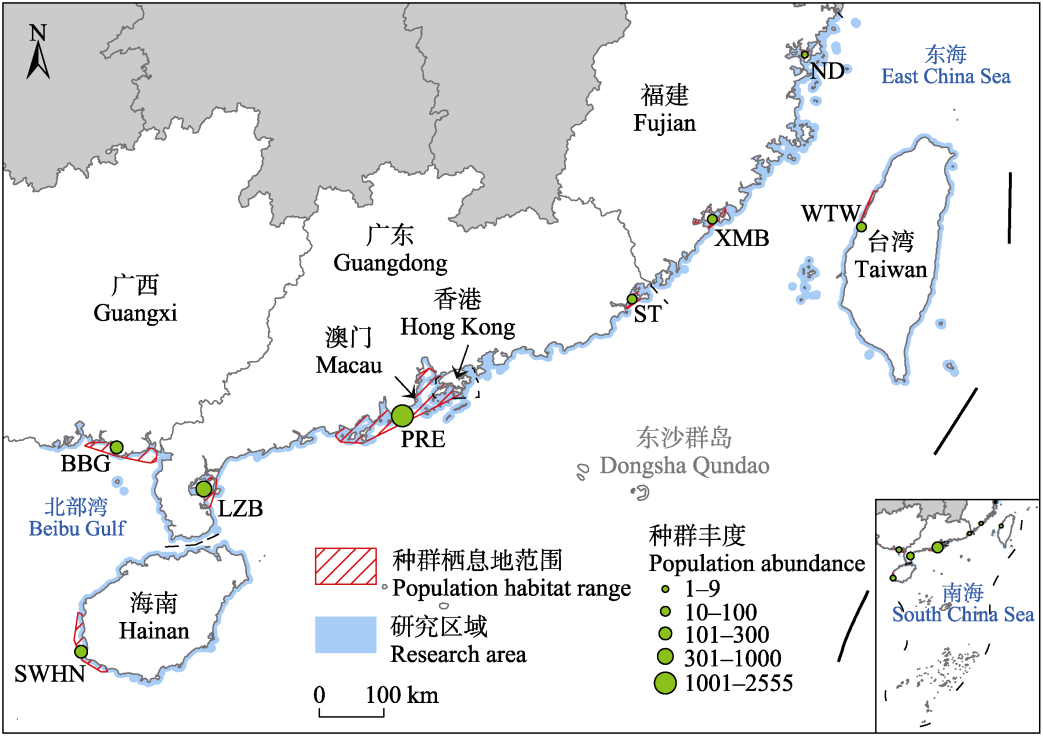
Fig. 1 Distribution and estimated abundance of the main local populations of Chinese white dolphin along the Southeast China coast. Abbreviations and data sources: ND, Ningde (Chen et al., 2012; Wu, 2013①); XMB, Xiamen Bay (Liu & Huang, 2000; Wang et al., 2021; Zhong, 2021②; He et al., 2022); WTW, West Taiwan (Huang et al., 2018; Araújo-Wang et al., 2022); ST, Shantou (Bao, 2017③; Lin et al., 2024b); PRE, Pearl River Estuary (Jefferson, 2000; Chen et al., 2010; Li et al., 2019; Zeng, 2021; Guo et al., 2022); LZB, Leizhou Bay (Liu et al., 2021; Lin et al., 2024a); BBG, Beibu Gulf (Chen et al., 2009, 2016; Peng et al., 2020; Lin et al., 2022); SWHN, Southwest Hainan (Li et al., 2016; Dong et al., 2017; Liu et al., 2020; Tang et al., 2021).
| 区域 Region | 围填海面积 Reclamation area (km2) | 年均围填海速率 Average annual reclamation rate (km2/yr) | 围填海强度 Coastal reclamation index (ha·yr-1·km-1) |
|---|---|---|---|
| 广东 Guangdong | 746.15 | 24.87 | 0.40 |
| 福建 Fujian | 496.50 | 16.55 | 0.29 |
| 广西 Guangxi | 186.37 | 6.21 | 0.36 |
| 台湾 Taiwan | 113.46 | 3.78 | 0.19 |
| 海南 Hainan | 75.13 | 2.50 | 0.15 |
| 香港 Hong Kong | 47.98 | 1.60 | 0.14 |
| 澳门 Macau | 17.60 | 0.59 | 0.55 |
| 区域综合值 Regional composite value | 1,683.20 | 56.11 | 0.30 |
Table 1 Statistics of coastal reclamation in Southeast China (1990-2020)
| 区域 Region | 围填海面积 Reclamation area (km2) | 年均围填海速率 Average annual reclamation rate (km2/yr) | 围填海强度 Coastal reclamation index (ha·yr-1·km-1) |
|---|---|---|---|
| 广东 Guangdong | 746.15 | 24.87 | 0.40 |
| 福建 Fujian | 496.50 | 16.55 | 0.29 |
| 广西 Guangxi | 186.37 | 6.21 | 0.36 |
| 台湾 Taiwan | 113.46 | 3.78 | 0.19 |
| 海南 Hainan | 75.13 | 2.50 | 0.15 |
| 香港 Hong Kong | 47.98 | 1.60 | 0.14 |
| 澳门 Macau | 17.60 | 0.59 | 0.55 |
| 区域综合值 Regional composite value | 1,683.20 | 56.11 | 0.30 |
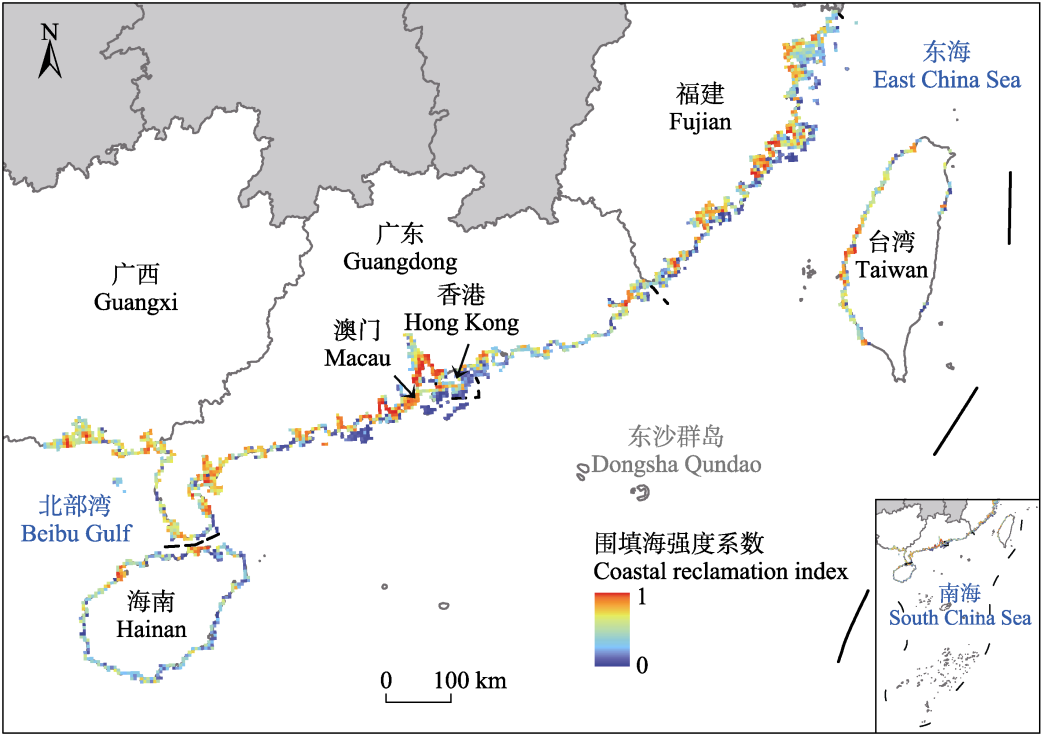
Fig. 2 Spatial pattern of coastal reclamation intensity in Southeast China (1990-2020)
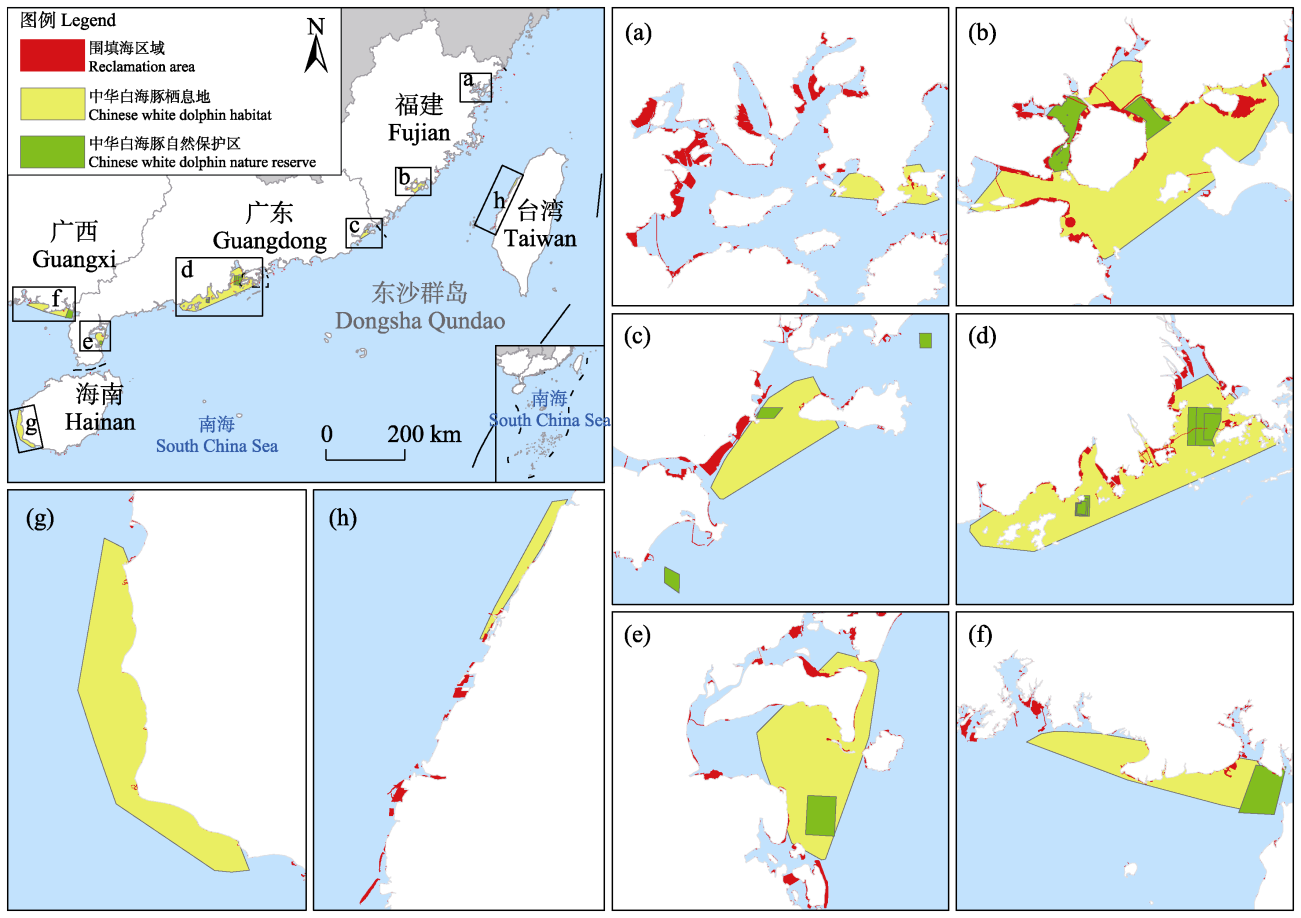
Fig. 3 The distribution of reclamation and nature reserves in the habitats of 8 Chinese white dolphin local populations along the Southeast China coast. (a) Ningde; (b) Xiamen Bay; (c) Shantou; (d) Pearl River Estuary; (e) Leizhou Bay; (f) Beibu Gulf; (g) Southwest Hainan; (h) West Taiwan.
| 变量 Variable | 地区生产总值 Gross regional product | 人均地区生产总值 Gross regional product per capita | 地区常住人口 Regional resident population | 地区常住人口密度 Regional resident population density | 区划面积 Division area | 围填海强度系数 Coastal reclamation index |
|---|---|---|---|---|---|---|
| 地区生产总值 Gross regional product | 1 | 0.859** | 0.821** | 0.713** | 0.171 | 0.587** |
| 人均地区生产总值 Gross regional product per capita | 0.859*** | 1 | 0.606** | 0.498** | 0.095 | 0.635** |
| 地区常住人口 Regional resident population | 0.821*** | 0.606*** | 1 | 0.615** | 0.536** | 0.528** |
| 地区常住人口密度 Regional resident population density | 0.713*** | 0.498** | 0.615*** | 1 | -0.235 | 0.638** |
| 区划面积 Division area | 0.171 | 0.095 | 0.536** | -0.235 | 1 | 0.078 |
| 围填海强度 Coastal reclamation index | 0.587*** | 0.635*** | 0.528** | 0.638*** | 0.078 | 1 |
Table 2 The correlation coefficient matrix of reclamation and social driving factors
| 变量 Variable | 地区生产总值 Gross regional product | 人均地区生产总值 Gross regional product per capita | 地区常住人口 Regional resident population | 地区常住人口密度 Regional resident population density | 区划面积 Division area | 围填海强度系数 Coastal reclamation index |
|---|---|---|---|---|---|---|
| 地区生产总值 Gross regional product | 1 | 0.859** | 0.821** | 0.713** | 0.171 | 0.587** |
| 人均地区生产总值 Gross regional product per capita | 0.859*** | 1 | 0.606** | 0.498** | 0.095 | 0.635** |
| 地区常住人口 Regional resident population | 0.821*** | 0.606*** | 1 | 0.615** | 0.536** | 0.528** |
| 地区常住人口密度 Regional resident population density | 0.713*** | 0.498** | 0.615*** | 1 | -0.235 | 0.638** |
| 区划面积 Division area | 0.171 | 0.095 | 0.536** | -0.235 | 1 | 0.078 |
| 围填海强度 Coastal reclamation index | 0.587*** | 0.635*** | 0.528** | 0.638*** | 0.078 | 1 |
| 中华白海豚现有种群 Existing populations of Chinese white dolphin | 1990年栖息地面积 Habitat area in 1990 (km2) | 2020年栖息地面积 Habitat area in 2020 (km2) | 栖息地丧 失面积 Habitat loss (km2) | 基于1990年的栖息地丧失比例 Proportion of habitat loss based on 1990 (%) | 栖息地内围填海强度 Coastal reclamation index in the habitat (ha·yr-1·km-1) | 栖息地内跨海大桥建设数量(座) Number of cross-sea bridges built in the habitat (n) |
|---|---|---|---|---|---|---|
| 广东珠江口 PRE | 5,989.96 | 5,712.74 | 277.21 | 4.63 | 0.43 | 13 |
| 福建厦门湾 XMB | 604.92 | 550.32 | 54.60 | 9.03 | 0.46 | 9 |
| 广西北部湾 BBG | 1,423.75 | 1,399.52 | 24.24 | 1.70 | 0.39 | 1 |
| 广东雷州湾 LZB | 634.59 | 626.75 | 7.85 | 1.24 | 0.25 | 0 |
| 台湾西海岸 WTW | 161.60 | 158.97 | 2.64 | 1.63 | 0.22 | 0 |
| 福建宁德 ND | 25.61 | 24.78 | 0.83 | 3.24 | 0.06 | 1 |
| 海南西南水域 SWHN | 1,231.70 | 1,230.97 | 0.73 | 0.06 | 0.02 | 0 |
| 广东汕头 ST | 226.07 | 225.36 | 0.72 | 0.32 | 0.09 | 1 |
| 区域综合值 Regional composite value | 10,298.21 | 9,929.40 | 368.81 | 3.58 | 0.39 | 25 |
Table 3 Reclamation in habitat of Chinese white dolphin local populations
| 中华白海豚现有种群 Existing populations of Chinese white dolphin | 1990年栖息地面积 Habitat area in 1990 (km2) | 2020年栖息地面积 Habitat area in 2020 (km2) | 栖息地丧 失面积 Habitat loss (km2) | 基于1990年的栖息地丧失比例 Proportion of habitat loss based on 1990 (%) | 栖息地内围填海强度 Coastal reclamation index in the habitat (ha·yr-1·km-1) | 栖息地内跨海大桥建设数量(座) Number of cross-sea bridges built in the habitat (n) |
|---|---|---|---|---|---|---|
| 广东珠江口 PRE | 5,989.96 | 5,712.74 | 277.21 | 4.63 | 0.43 | 13 |
| 福建厦门湾 XMB | 604.92 | 550.32 | 54.60 | 9.03 | 0.46 | 9 |
| 广西北部湾 BBG | 1,423.75 | 1,399.52 | 24.24 | 1.70 | 0.39 | 1 |
| 广东雷州湾 LZB | 634.59 | 626.75 | 7.85 | 1.24 | 0.25 | 0 |
| 台湾西海岸 WTW | 161.60 | 158.97 | 2.64 | 1.63 | 0.22 | 0 |
| 福建宁德 ND | 25.61 | 24.78 | 0.83 | 3.24 | 0.06 | 1 |
| 海南西南水域 SWHN | 1,231.70 | 1,230.97 | 0.73 | 0.06 | 0.02 | 0 |
| 广东汕头 ST | 226.07 | 225.36 | 0.72 | 0.32 | 0.09 | 1 |
| 区域综合值 Regional composite value | 10,298.21 | 9,929.40 | 368.81 | 3.58 | 0.39 | 25 |
| 中华白海豚现有保护区 Chinese white dolphin existing nature reserve | 保护区内围填海 面积 Reclamation area in the reserve (ha) | 保护区内围填海面积 占比 Proportion of reclamation area in the reserve (%) |
|---|---|---|
| 厦门珍稀海洋物种国家级自然保护区(2000年建立初始范围) Xiamen National Nature Reserve for Rare Marine Species (Initial boundary: 2000) | 809.35 | 12.97 |
| 厦门珍稀海洋物种国家级自然保护区(2016年调整后范围) Xiamen National Nature Reserve for Rare Marine Species (Adjusted boundary: 2016) | 2.94 | 0.05 |
| 潮州饶平中华白海豚县级自然保护区 Raoping Chinese White Dolphin County-level Nature Reserve, Chaozhou City | 0.00 | 0.00 |
| 汕头澄海莱芜中华白海豚市级自然保护区 Laiwu Chinese White Dolphin Municipal Nature Reserve in Chenghai District, Shantou City | 0.00 | 0.00 |
| 汕头潮阳龙头湾中华白海豚市级自然保护区 Longtou Bay Chinese White Dolphin Municipal Nature Reserve in Chaoyang District, Shantou City | 0.00 | 0.00 |
| 广东珠江口中华白海豚国家级自然保护区 Guangdong Pearl River Estuary Chinese White Dolphin National Nature Reserve | 94.92 | 0.21 |
| 广东江门中华白海豚省级自然保护区(2003年建立初始范围) Guangdong Jiangmen Chinese White Dolphin Provincial Nature Reserve (Initial boundary: 2003) | 23.59 | 0.26 |
| 广东江门中华白海豚省级自然保护区(2009年调整后范围) Guangdong Jiangmen Chinese White Dolphin Provincial Nature Reserve (Adjusted boundary: 2009) | 0.00 | 0.00 |
| 湛江雷州湾中华白海豚市级自然保护区 Leizhou Bay Chinese White Dolphin Municipal Nature Reserve, Zhanjiang City | 0.00 | 0.00 |
| 广西合浦儒艮国家级自然保护区 Guangxi Hepu Dugong National Nature Reserve | 152.59 | 0.49 |
Table 4 Reclamation in Chinese white dolphin nature reserves
| 中华白海豚现有保护区 Chinese white dolphin existing nature reserve | 保护区内围填海 面积 Reclamation area in the reserve (ha) | 保护区内围填海面积 占比 Proportion of reclamation area in the reserve (%) |
|---|---|---|
| 厦门珍稀海洋物种国家级自然保护区(2000年建立初始范围) Xiamen National Nature Reserve for Rare Marine Species (Initial boundary: 2000) | 809.35 | 12.97 |
| 厦门珍稀海洋物种国家级自然保护区(2016年调整后范围) Xiamen National Nature Reserve for Rare Marine Species (Adjusted boundary: 2016) | 2.94 | 0.05 |
| 潮州饶平中华白海豚县级自然保护区 Raoping Chinese White Dolphin County-level Nature Reserve, Chaozhou City | 0.00 | 0.00 |
| 汕头澄海莱芜中华白海豚市级自然保护区 Laiwu Chinese White Dolphin Municipal Nature Reserve in Chenghai District, Shantou City | 0.00 | 0.00 |
| 汕头潮阳龙头湾中华白海豚市级自然保护区 Longtou Bay Chinese White Dolphin Municipal Nature Reserve in Chaoyang District, Shantou City | 0.00 | 0.00 |
| 广东珠江口中华白海豚国家级自然保护区 Guangdong Pearl River Estuary Chinese White Dolphin National Nature Reserve | 94.92 | 0.21 |
| 广东江门中华白海豚省级自然保护区(2003年建立初始范围) Guangdong Jiangmen Chinese White Dolphin Provincial Nature Reserve (Initial boundary: 2003) | 23.59 | 0.26 |
| 广东江门中华白海豚省级自然保护区(2009年调整后范围) Guangdong Jiangmen Chinese White Dolphin Provincial Nature Reserve (Adjusted boundary: 2009) | 0.00 | 0.00 |
| 湛江雷州湾中华白海豚市级自然保护区 Leizhou Bay Chinese White Dolphin Municipal Nature Reserve, Zhanjiang City | 0.00 | 0.00 |
| 广西合浦儒艮国家级自然保护区 Guangxi Hepu Dugong National Nature Reserve | 152.59 | 0.49 |
| 中华白海豚现有自然保护区 Chinese white dolphin existing nature reserve | 现有保护 区面积 Existing reserve area (km2) | 保护区内栖 息地面积 Habitat area in the reserve (km2) | 保护区内栖息地占比 Proportion of habitats in reserve (%) | 种群栖息地受保护比例 Proportion of protected areas in habitat (%) |
|---|---|---|---|---|
| 厦门珍稀海洋物种国家级自然保护区(2016年调整后范围) Xiamen National Nature Reserve for Rare Marine Species (Adjusted boundary: 2016) | 55.14 | 54.23 | 98.35 | 9.85 |
| 潮州饶平中华白海豚县级自然保护区 Raoping Chinese White Dolphin County-level Nature Reserve, Chaozhou City | 6.19 | 0.00 | 0.00 | 0.00 |
| 汕头澄海莱芜中华白海豚市级自然保护区 Laiwu Chinese White Dolphin Municipal Nature Reserve in Chenghai District, Shantou City | 7.51 | 7.49 | 99.63 | 3.32 |
| 汕头潮阳龙头湾中华白海豚市级自然保护区 Longtou Bay Chinese White Dolphin Municipal Nature Reserve in Chaoyang District, Shantou City | 9.39 | 0.00 | 0.00 | 0.00 |
| 广东珠江口中华白海豚国家级自然保护区 Guangdong Pearl River Estuary Chinese White Dolphin National Nature Reserve | 450.98 | 450.03 | 99.79 | 7.88 |
| 广东江门中华白海豚省级自然保护区(2009年调整后范围) Guangdong Jiangmen Chinese White Dolphin Provincial Nature Reserve (Adjusted boundary: 2009) | 96.65 | 96.65 | 100.00 | 1.69 |
| 湛江雷州湾中华白海豚市级自然保护区 Leizhou Bay Chinese White Dolphin Municipal Nature Reserve, Zhanjiang City | 59.66 | 59.61 | 99.92 | 9.51 |
| 广西合浦儒艮国家级自然保护区 Guangxi Hepu Dugong National Nature Reserve | 312.64 | 150.94 | 48.28 | 10.79 |
| 区域综合值 Regional composite value | 998.16 | 818.94 | 82.05 | 8.25 |
Table 5 Spatial overlap between the Chinese white dolphin nature reserves and the existing population habitats
| 中华白海豚现有自然保护区 Chinese white dolphin existing nature reserve | 现有保护 区面积 Existing reserve area (km2) | 保护区内栖 息地面积 Habitat area in the reserve (km2) | 保护区内栖息地占比 Proportion of habitats in reserve (%) | 种群栖息地受保护比例 Proportion of protected areas in habitat (%) |
|---|---|---|---|---|
| 厦门珍稀海洋物种国家级自然保护区(2016年调整后范围) Xiamen National Nature Reserve for Rare Marine Species (Adjusted boundary: 2016) | 55.14 | 54.23 | 98.35 | 9.85 |
| 潮州饶平中华白海豚县级自然保护区 Raoping Chinese White Dolphin County-level Nature Reserve, Chaozhou City | 6.19 | 0.00 | 0.00 | 0.00 |
| 汕头澄海莱芜中华白海豚市级自然保护区 Laiwu Chinese White Dolphin Municipal Nature Reserve in Chenghai District, Shantou City | 7.51 | 7.49 | 99.63 | 3.32 |
| 汕头潮阳龙头湾中华白海豚市级自然保护区 Longtou Bay Chinese White Dolphin Municipal Nature Reserve in Chaoyang District, Shantou City | 9.39 | 0.00 | 0.00 | 0.00 |
| 广东珠江口中华白海豚国家级自然保护区 Guangdong Pearl River Estuary Chinese White Dolphin National Nature Reserve | 450.98 | 450.03 | 99.79 | 7.88 |
| 广东江门中华白海豚省级自然保护区(2009年调整后范围) Guangdong Jiangmen Chinese White Dolphin Provincial Nature Reserve (Adjusted boundary: 2009) | 96.65 | 96.65 | 100.00 | 1.69 |
| 湛江雷州湾中华白海豚市级自然保护区 Leizhou Bay Chinese White Dolphin Municipal Nature Reserve, Zhanjiang City | 59.66 | 59.61 | 99.92 | 9.51 |
| 广西合浦儒艮国家级自然保护区 Guangxi Hepu Dugong National Nature Reserve | 312.64 | 150.94 | 48.28 | 10.79 |
| 区域综合值 Regional composite value | 998.16 | 818.94 | 82.05 | 8.25 |
| [1] |
Araújo-Wang C, Wang JY, Draghici AM, Ross PS, Bonner SJ (2022) New abundance and survival estimates for the critically endangered Taiwanese white dolphin indicate no signs of recovery. Aquatic Conservation: Marine and Freshwater Ecosystems, 32, 1341-1350.
DOI URL |
| [2] |
Balbar AC, Metaxas A (2019) The current application of ecological connectivity in the design of marine protected areas. Global Ecology and Conservation, 17, e00569.
DOI URL |
| [3] |
Beltrán DM, Schizas NV, Appeldoorn RS, Prada C (2017) Effective dispersal of Caribbean reef fish is smaller than current spacing among marine protected areas. Scientific Reports, 7, 4689.
DOI PMID |
| [4] |
Burt WH (1943) Territoriality and home range concepts as applied to mammals. Journal of Mammalogy, 24, 346-352.
DOI URL |
| [5] | Cardoso PG (2021) Estuaries:Dynamics, biodiversity, and impacts. In: Life Below Water, Encyclopedia of the UN Sustainable Development Goals (eds Leal Filho W, Azul AM, Brandli L, Lange Salvia A, Wall T), pp.1-12. Springer, Cham. |
| [6] |
Chan SCY, Ho YW, Karczmarski L (2024) Reproductive dynamics of an inshore delphinid reflect demographic consequences of large-scale coastal constructions. Biological Conservation, 297, 110690.
DOI URL |
| [7] |
Chen BY, Xu XR, Jefferson TA, Olson PA, Qin QR, Zhang HK, He LW, Yang G (2016) Conservation status of the Indo-Pacific humpback dolphin (Sousa chinensis) in the Northern Beibu Gulf, China. Advances in Marine Biology, 73, 119-139.
DOI PMID |
| [8] | Chen BY, Zheng DM, Wang L, Xu XR, Yang G (2012) The northernmost distribution of Indo-Pacific humpback dolphin (Sousa chinensis) in the world evidence from preliminary survey in Ningde, China. Pakistan Journal of Zoology, 44, 1209-1214. |
| [9] |
Chen BY, Zheng DM, Yang G, Xu XR, Zhou KY (2009) Distribution and conservation of the Indo-Pacific humpback dolphin in China. Integrative Zoology, 4, 240-247.
DOI PMID |
| [10] |
Chen D, Wang YF, Shen ZY, Liao JF, Chen JZ, Sun SB (2022) Long time-series mapping and change detection of coastal zone land use based on Google Earth engine and multi-source data fusion. Remote Sensing, 14, 1.
DOI URL |
| [11] |
Chen T, Hung SK, Qiu YS, Jia XP, Jefferson TA (2010) Distribution, abundance, and individual movements of Indo-Pacific humpback dolphins (Sousa chinensis) in the Pearl River Estuary, China. Mammalia, 74, 117-125.
DOI URL |
| [12] | Chen YF, Wang YJ, Dong S, Qiao GP (2025) Key issues and countermeasures in estuary management and protection. Water Resources Development Research, 25, 1-7. (in Chinese with English abstract) |
| [陈雨菲, 王亚杰, 董森, 乔根平 (2025) 河口管理保护的关键问题及对策探讨. 水利发展研究, 25, 1-7.] | |
| [13] | Choi YR (2014) Modernization, development and underdevelopment: Reclamation of Korean tidal flats, 1950s-2000s. Ocean & Coastal Management, 102, 426-436. |
| [14] |
Dai MH, Su JZ, Zhao YY, Hofmann EE, Cao ZM, Cai WJ, Gan JP, Lacroix F, Laruelle GG, Meng FF, Müller JD, Regnier PAG, Wang GZ, Wang ZX (2022) Carbon fluxes in the coastal ocean: Synthesis, boundary processes and future trends. Annual Review of Earth and Planetary Sciences, 50, 593-626.
DOI URL |
| [15] |
Dong LJ, Liu MM, Dong JC, Li SH (2017) Acoustic occurrence detection of a newly recorded Indo-Pacific humpback dolphin population in waters southwest of Hainan Island, China. Journal of the Acoustical Society of America, 142, 3198-3204.
DOI PMID |
| [16] |
Elith J, Leathwick JR (2009) Species distribution models: Ecological explanation and prediction across space and time. Annual Review of Ecology, Evolution, and Systematics, 40, 677-697.
DOI URL |
| [17] | Gao WB, Liu XZ, Duan YY, Dong J (2009) Impact of the sea reclamation on fishery resources in Liaoning offshore and corresponding countermeasures. Journal of Dalian Fisheries University, 24, 163-166. (in Chinese with English abstract) |
| [高文斌, 刘修泽, 段有洋, 董婧 (2009) 围填海工程对辽宁省近海渔业资源的影响及对策. 大连水产学院学报, 24, 163-166.] | |
| [18] | Gao ZQ, Liu XY, Ning JC, Lu QS (2014) Analysis on changes in coastline and reclamation area and its causes based on 30-year satellite data in China. Transactions of the Chinese Society of Agricultural Engineering, 30(12), 140-147. (in Chinese with English abstract) |
| [高志强, 刘向阳, 宁吉才, 芦清水 (2014) 基于遥感的近30a中国海岸线和围填海面积变化及成因分析. 农业工程学报, 30(12), 140-147.] | |
| [19] |
Guo L, Luo DY, Yu RQ, Zeng C, Huang NY, Wang HR, Wu YP (2022) Habitat decline of the largest known Indo-Pacific humpback dolphin (Sousa chinensis) population in poorly protected areas associated with the hypoxic zone. Frontiers in Marine Science, 9, 1048959.
DOI URL |
| [20] | Hao XD, Song X, Cao DQ (2016) A water country— Netherlands: From inning and drainage to ecological water control. China Water & Wastewater, 32, 1-7. (in Chinese with English abstract) |
| [郝晓地, 宋鑫, 曹达啟 (2016) 水国荷兰——从围垦排涝到生态治水. 中国给水排水, 32, 1-7.] | |
| [21] |
Hayne DW (1949) Calculation of size of home range. Journal of Mammalogy, 30, 1-18.
DOI URL |
| [22] | He SX, Zhang D, Wu FX, Wang XY, Hu WJ, Liang SS, Du JG, Yu WW, Chen B (2022) Identification of potential ecological corridors for Sousa chinensis in Xiamen Bay and assessment of anthropogenic disturbance. Acta Ecologica Sinica, 42, 8555-8567. (in Chinese with English abstract) |
| [何思璇, 张典, 吴福星, 王先艳, 胡文佳, 梁姗姗, 杜建国, 俞炜炜, 陈彬 (2022) 厦门湾中华白海豚潜在生态廊道识别及人类活动干扰评估. 生态学报, 42, 8555-8567.] | |
| [23] |
Hoeksema RJ (2007) Three stages in the history of land reclamation in the Netherlands. Irrigation and Drainage, 56, S113-S126.
DOI URL |
| [24] |
Hsu CY, Shao LJ, Tseng KK, Huang WT (2019) Moon image segmentation with a new mixture histogram model. Enterprise Information Systems, 15, 1046-1069.
DOI URL |
| [25] |
Huang SL, Wang CC, Yao CJ (2018) Habitat protection actions for the Indo-Pacific humpback dolphin: Baseline gaps, scopes, and resolutions for the Taiwanese subspecies. Aquatic Conservation: Marine and Freshwater Ecosystems, 28, 733-743.
DOI URL |
| [26] |
Huang SL, Wang XY, Wu HP, Peng CW, Jefferson TA (2022) Habitat protection planning for Indo-Pacific humpback dolphins (Sousa chinensis) in deteriorating environments: Knowledge gaps and recommendations for action. Aquatic Conservation: Marine and Freshwater Ecosystems, 32, 171-185.
DOI URL |
| [27] | Huang WJ, Wen YX, Tang ZY (1978) The preliminary investigation on Chinese white dolphin. Journal of Fudan University (Natural Science), 17, 105-110. (in Chinese) |
| [黄文几, 温业新, 唐子英 (1978) 中华白海豚的初步调查研究. 复旦学报(自然科学版), 17, 105-110.] | |
| [28] |
Hutchinson GE (1957) Concluding remarks. Cold Spring Harbor Symposia on Quantitative Biology, 22, 415-427.
DOI URL |
| [29] | Jefferson TA (2000) Population biology of the Indo-Pacific hump-backed dolphin in Hong Kong waters. Wildlife Monographs, 64, 1-65. |
| [30] |
Jefferson TA, Becker EA, Huang SL (2023) Influences of natural and anthropogenic habitat variables on Indo-Pacific humpback dolphins Sousa chinensis in Hong Kong. Endangered Species Research, 51, 143-160.
DOI URL |
| [31] | Jefferson TA, Smith BD (2016) Re-assessment of the conservation status of the Indo-Pacific humpback dolphin (Sousa chinensis) using the IUCN Red List Criteria. In: Advances in Marine Biology (eds Jefferson TA, Curry BE), pp.1-26. Academic Press, Amsterdam. |
| [32] | Jefferson TA, Smith BD, Braulik GT, Perrin W (2017) Indo-Pacific humpback dolphin Sousa chinensis (errata version published in 2018). The IUCN Red List of Threatened Species 2017: e.T82031425A123794774. http://dx.doi.org/10.2305/IUCN.UK.2017-3.RLTS.T82031425A50372332.en. (accessed on 2024-12-01) |
| [33] |
Karczmarski L, Huang SL, Wong WH, Chang WL, Chan SCY, Keith M (2017) Distribution of a coastal delphinid under the impact of long-term habitat loss: Indo-Pacific humpback dolphins off Taiwan’s west coast. Estuaries and Coasts, 40, 594-603.
DOI URL |
| [34] |
Koo BJ, Shin SH, Lee S (2008) Changes in benthic macrofauna of the Saemangeum tidal flat as result of a drastic tidal reduction. Ocean and Polar Research, 30, 485-495.
DOI URL |
| [35] |
Lee S, Lie HJ, Song KM, Cho CH, Lim EP (2008) Tidal modification and its effect on sluice-gate outflow after completion of the Saemangeum dike, South Korea. Journal of Oceanography, 64, 763-776.
DOI URL |
| [36] |
Li M, Wang XX, Hung SK, Xu YW, Chen T (2019) Indo-Pacific humpback dolphins (Sousa chinensis) in the Moyang River Estuary: The western part of the world’s largest population of humpback dolphins. Aquatic Conservation: Marine and Freshwater Ecosystems, 29, 798-808.
DOI URL |
| [37] |
Li SH, Lin ML, Xu X, Xing LR, Zhang PJ, Gozlan RE, Huang SL, Wang D (2016) First record of the Indo-Pacific humpback dolphins (Sousa chinensis) southwest of Hainan Island, China. Marine Biodiversity Records, 9, 3.
DOI URL |
| [38] | Li Y, Huang H, Tong ZC (2016) Study on ecological loss and compensation value of reclamation project in Qinzhou bonded port area. Journal of Qinzhou University, 31(1), 17-21. (in Chinese) |
| [李洋, 黄鹄, 佟智成 (2016) 钦州保税港区围填海工程生态损失及其补偿价值研究. 钦州学院学报, 31(1), 17-21.] | |
| [39] |
Lin WZ, Chen SL, Liu BS, Zheng RQ, Serres A, Lin ML, Liu MM, Li SH (2024a) Survival and population size of the Indo-Pacific humpback dolphins off the eastern Leizhou Peninsula. Marine Mammal Science, 41, e13156.
DOI URL |
| [40] |
Lin WZ, Karczmarski L, Zhou RL, Mo YQ, Guo L, Yiu SKF, Ning X, Wai TC, Wu YP (2021) Prey decline leads to diet shift in the largest population of Indo-Pacific humpback dolphins? Integrative Zoology, 16, 548-574.
DOI PMID |
| [41] |
Lin WZ, Zheng RQ, Liu BS, Chen SL, Lin ML, Liu MM, Liu WH, Li SH (2022) Low survivals and rapid demographic decline of a threatened estuarine delphinid. Frontiers in Marine Science, 9, 782680.
DOI URL |
| [42] |
Lin WZ, Zheng RQ, Xu SY, Li SH (2024b) Indo-Pacific humpback dolphins face extirpation in Shantou waters. Regional Studies in Marine Science, 77, 103641.
DOI URL |
| [43] |
Liu MM, Lin ML, Dong LJ, Xue TF, Zhang PJ, Tang XM, Li SH (2020) Group sizes of Indo-Pacific humpback dolphins in waters southwest of Hainan Island, China: Insights into rare records of large groups. Aquatic Mammals, 46, 259-265.
DOI URL |
| [44] | Liu MM, Lin ML, Li SH (2022) Species diversity and spatiotemporal patterns based on cetacean stranding records in China, 1950-2018. Science of the Total Environment, 822, 153651. |
| [45] |
Liu MM, Lin ML, Li SH (2023) Population distribution, connectivity and differentiation of Indo-Pacific humpback dolphins in Chinese waters: Key baselines for improving conservation management. Aquatic Conservation: Marine and Freshwater Ecosystems, 33, 409-422.
DOI URL |
| [46] |
Liu MM, Lin ML, Tang XM, Dong LJ, Zhang PJ, Lusseau D, Li SH (2021) Group size of Indo-Pacific humpback dolphins (Sousa chinensis): An examination of methodological and biogeographical variances. Frontiers in Marine Science, 8, 655595.
DOI URL |
| [47] | Liu WH, Huang ZG (2000) Distribution and abundance of Chinese white dolphins (Sousa chinensis) in Xiamen. Acta Oceanologica Sinica, 22, 95-101. (in Chinese with English abstract) |
| [刘文华, 黄宗国 (2000) 厦门中华白海豚的分布和数量. 海洋学报, 22, 95-101.] | |
| [48] |
Liu YS, Li JT (2020) The patterns and driving mechanisms of reclaimed land use in China’s coastal areas in recent 30 years. Scientia Sinica Terrae, 50, 761-774. (in Chinese)
DOI URL |
| [刘彦随, 李进涛 (2020) 近30年中国沿海围垦土地利用格局及其驱动机制. 中国科学: 地球科学, 50, 761-774.] | |
| [49] | Lu JY, Cao L, Zeng C (2024) Ecological connectivity of marine protected areas: An overview. Natural Protected Areas, 4(4), 107-121. (in Chinese with English abstract) |
| [卢嘉颖, 曹玲, 曾聪 (2024) 海洋保护区间生态连通性研究进展及思考. 自然保护地, 4(4), 107-121.] | |
| [50] | Lü H, Zhang SF, Song DH, Bao XW (2021) The cumulative effect of land reclamation on hydrodynamics in Qinzhou Bay. Oceanologia et Limnologia Sinica, 52, 823-833. (in Chinese with English abstract) |
| [吕赫, 张少峰, 宋德海, 鲍献文 (2021) 围填海累积效应对钦州湾水动力环境的影响. 海洋与湖沼, 52, 823-833.] | |
| [51] |
Martín-Antón M, Negro V, del Campo JM, Santos López-Gutiérrez J, Esteban MD(2016) Review of coastal land reclamation situation in the world. Journal of Coastal Research, 75, 667-671.
DOI URL |
| [52] |
Meng WQ, Hu BB, He MX, Liu BQ, Mo XQ, Li HY, Wang ZL, Zhang Y (2017) Temporal-spatial variations and driving factors analysis of coastal reclamation in China. Estuarine Coastal and Shelf Science, 191, 39-49.
DOI URL |
| [53] | Min L, Gao K, Li W, Wang H, Li T, Wu Q, Jiao JC (2020) A review of the optical remote sensing image segmentation technology. Spacecraft Recovery & Remote Sensing, 41(6), 1-13. (in Chinese with English abstract) |
| [闵蕾, 高昆, 李维, 王红, 李婷, 吴穹, 焦建超 (2020) 光学遥感图像分割技术综述. 航天返回与遥感, 41(6), 1-13.] | |
| [54] |
Mohr CO (1947) Table of equivalent populations of North American small mammals. The American Midland Naturalist, 37, 223-249.
DOI URL |
| [55] |
Pang SEH, Zeng YW, De Alban JDT, Webb EL (2022) Occurrence-habitat mismatching and niche truncation when modelling distributions affected by anthropogenic range contractions. Diversity and Distributions, 28, 1327-1343.
DOI URL |
| [56] |
Parra GJ (2006) Resource partitioning in sympatric delphinids: Space use and habitat preferences of Australian snubfin and Indo-Pacific humpback dolphins. Journal of Animal Ecology, 75, 862-874.
DOI PMID |
| [57] |
Peng CW, Wu HP, Wang XY, Zhu Q, Jefferson TA, Wang CC, Xu YH, Li J, Huang H, Chen M, Huang SL (2020) Abundance and residency dynamics of the Indo-Pacific humpback dolphin, Sousa chinensis, in the Dafengjiang River Estuary, China. Marine Mammal Science, 36, 623-637.
DOI URL |
| [58] |
Phillips SJ, Anderson RP, Schapire RE (2006) Maximum entropy modeling of species geographic distributions. Ecological Modelling, 190, 231-259.
DOI URL |
| [59] | Powell RA (2000) Animal home ranges and territories and home range estimators. In: Research Techniques in Animal Ecology: Controversies and Consequences (eds Boitani L, Fuller TK), pp.65-110. Columbia University Press, New York. |
| [60] | Rodgers AR, Kie JG (2011) HRT: Home Range Tools for ArcGIS. Version 1.1. https://www.jennessent.com/arcgis/HRT/index.html. (accessed on 2023-07-07) |
| [61] | Ryu J, Nam J, Park J, Kwon BO, Lee JH, Song SJ, Hong S, Chang WK, Khim JS (2014) The Saemangeum tidal flat: Long-term environmental and ecological changes in marine benthic flora and fauna in relation to the embankment. Ocean & Coastal Management, 102, 559-571. |
| [62] | Suo AN, Zhang MH, Yu YH, Han FW (2012) Post project environmental retrospective evaluation of reclamation in Caofeidian. Environmental Monitoring in China, 28(2), 105-111. (in Chinese with English abstract) |
| [索安宁, 张明慧, 于永海, 韩富伟 (2012) 曹妃甸围填海工程的环境影响回顾性评价. 中国环境监测, 28(2), 105-111.] | |
| [63] |
Tang XM, Lin WZ, Karczmarski L, Lin ML, Chan SCY, Liu MM, Xue TF, Wu YP, Zhang PJ, Li SH (2021) Photo-identification comparison of four Indo-Pacific humpback dolphin populations off southeast China. Integrative Zoology, 16, 586-593.
DOI PMID |
| [64] |
Tian B, Wu WT, Yang ZQ, Zhou YX (2016) Drivers, trends, and potential impacts of long-term coastal reclamation in China from 1985 to 2010. Estuarine, Coastal and Shelf Science, 170, 83-90.
DOI URL |
| [65] | Wan Y (2022) Numerical study of the hydrodynamic and scouring and silting effects of the opening of the Bachimen seawall in Dongshan Bay. Marine Forecasts, 39(6), 13-24. (in Chinese with English abstract) |
| [万艳 (2022) 东山八尺门海堤开口水动力及冲淤影响数值研究. 海洋预报, 39(6), 13-24.] | |
| [66] | Wang HJ, Yuan GJ, Liu L, Lin N (2021) Effective methodologies for coastline classification and delimitation. Marine Environmental Science, 40, 430-434. (in Chinese with English abstract) |
| [王厚军, 袁广军, 刘亮, 林宁 (2021) 海岸线分类及划定方法研究. 海洋环境科学, 40, 430-434.] | |
| [67] | Wang XX, Chen T, Li M, Wang YZ (2022) Long-term changes in habitat use of Indo-Pacific humpback dolphins (Sousa chinensis) in response to anthropogenic coastline shift in Lingding Bay of Pearl River Estuary, China. Acta Ecologica Sinica, 42, 2962-2973. (in Chinese with English abstract) |
| [王新星, 陈涛, 李敏, 王跃中 (2022) 珠江口伶仃洋中华白海豚栖息地利用对海岸线等变迁的响应. 生态学报, 42, 2962-2973.] | |
| [68] | Wang XY, Miao X, Wu FX, Yan CX, Liu WH, Zhu Q (2012) Investigation on the distribution of Sousa chinensis in the coastal waters between Xiamen and the Pearl River Estuary. Journal of Oceanography in Taiwan Strait, 31, 225-230. (in Chinese with English abstract) |
| [王先艳, 妙星, 吴福星, 闫晨曦, 刘文华, 祝茜 (2012) 厦门至珠江口间沿岸海域中华白海豚分布的调查研究. 台湾海峡, 31, 225-230.] | |
| [69] |
Wang XY, Wu FX, Zhu Q, Huang SL (2017) Long-term changes in the distribution and core habitat use of a coastal delphinid in response to anthropogenic coastal alterations. Aquatic Conservation: Marine and Freshwater Ecosystems, 27, 643-652.
DOI URL |
| [70] | Wang XY, Zhong MD, Wu FX, Dai YF, Lin L (2021) Indo-Pacific humpback dolphins (Sousa chinensis) in Xiamen Bay: Threats and conservation. Journal of Applied Oceanography, 40(1), 154-162. (in Chinese with English abstract) |
| [王先艳, 钟铭鼎, 吴福星, 戴宇飞, 林莉 (2021) 厦门湾中华白海豚: 面临的威胁与保护对策. 应用海洋学学报, 40(1), 154-162.] | |
| [71] | Wei T (2014) Study of the impact of sea reclamation engineering to Lianyungang marine ecological environment and of protection countermeasures. Land and Resources Information, (6), 22-27. (in Chinese with English abstract) |
| [魏婷 (2014) 连云港围填海工程对海洋生态环境的影响及防治对策研究. 国土资源情报, (6), 22-27.] | |
| [72] | Wen H, Duan GQ, Huang ZX, Xian XH (2016) Preliminary study of Chinese white dolphin protection management in the construction period of Hong Kong-Zhuhai-Macao Bridge Main Bridge Project. Transactions of Oceanology and Limnology, 38(3), 68-74. (in Chinese with English abstract) |
| [温华, 段国钦, 黄志雄, 冼宪恒 (2016) 港珠澳大桥主体工程建设期中华白海豚保护管理实践初探. 海洋湖沼通报, 38(3), 68-74.] | |
| [73] |
Wu FX, Wang XY, Ding XH, Miao X, Zhu Q (2014) Distribution pattern of Indo-Pacific humpback dolphins (Sousa chinensis) along coastal waters of Fujian Province, China. Aquatic Mammals, 40, 341-349.
DOI URL |
| [74] |
Wu HP, Xu YH, Peng CW, Liao YY, Wang XY, Jefferson TA, Huang H, Huang SL (2017) Long-term habitat loss in a lightly-disturbed population of the Indo-Pacific humpback dolphin, Sousa chinensis. Aquatic Conservation: Marine and Freshwater Ecosystems, 27, 1198-1208.
DOI URL |
| [75] | Wu QE, Li CH, Sun DR (2010) Effects of nature reserve adjustment on Jiangmen Chinese white dolphin. Journal of Anhui Agricultural Sciences, 38, 18216-18218, 18246. (in Chinese with English abstract) |
| [吴洽儿, 李纯厚, 孙典荣 (2010) 江门中华白海豚自然保护区调整对中华白海豚的影响. 安徽农业科学, 38, 18216-18218, 18246.] | |
| [76] | Wu YQ, Liu ZL (2019) Research progress on methods of automatic coastline extraction based on remote sensing images. Journal of Remote Sensing, 23, 582-602. (in Chinese with English abstract) |
| [吴一全, 刘忠林 (2019) 遥感影像的海岸线自动提取方法研究进展. 遥感学报, 23, 582-602.] | |
| [77] | Xu CY, Pu LJ, Zhu M (2018) Effect of reclamation activity on coastal ecological environment: Progress and perspectives. Acta Ecologica Sinica, 38, 1148-1162. (in Chinese with English abstract) |
| [徐彩瑶, 濮励杰, 朱明 (2018) 沿海滩涂围垦对生态环境的影响研究进展. 生态学报, 38, 1148-1162.] | |
| [78] | Xu HQ (2005) A study on information extraction of water body with the modified normalized difference water index (MNDWI). Journal of Remote Sensing, 9, 589-595. (in Chinese with English abstract) |
| [徐涵秋 (2005) 利用改进的归一化差异水体指数(MNDWI)提取水体信息的研究. 遥感学报, 9, 589-595.] | |
| [79] | Xu JK, Liu YC, Xu XQ, Zhai GJ, Lin YC, Bao JY, Huang CH (2007) Scientific locating and practical descripting on mean high water springs. Hydrographic Surveying and Charting, 27(6), 19-24. (in Chinese with English abstract) |
| [许家琨, 刘雁春, 许希启, 翟国军, 林有财, 暴景阳, 黄辰虎 (2007) 平均大潮高潮面的科学定位和现实描述. 海洋测绘, 27(6), 19-24.] | |
| [80] |
Yong LM, Lu XX, Zeng QH, Zhao LY, Zhang YK, Wang XY (2025) Decoding anthropogenic risk through historical baselines: A conservation prioritization framework for Chinese white dolphin in anthropogenic seascapes. Frontiers in Marine Science, 12, 1607234.
DOI URL |
| [81] |
Yong LM, Zhang YK, Zhao LY, Zeng QH, Lin LS, Gao MH, Cheng H, Wang XY (2023) Research advances on the ecology of Sousa chinensis. Biodiversity Science, 31, 22670. (in Chinese with English abstract)
DOI URL |
|
[雍李明, 张语克, 赵丽媛, 曾千慧, 林龙山, 高旻昊, 程昊, 王先艳 (2023) 中华白海豚生态学研究进展. 生物多样性, 31, 22670.]
DOI |
|
| [82] | Zeng QH (2021) Studies on the Spatial Use, Community Dynamics and Reproductive Ecology of Indo-Pacific Humpback Dolphins (Sousa chinensis) in Jiangmen Waters. PhD dissertation, Shandong University, Weihai, Shandong. (in Chinese with English abstract) |
| [曾千慧 (2021) 江门水域中华白海豚空间利用、社群动态及繁殖生态的研究. 博士学位论文, 山东大学, 山东威海.] | |
| [83] | Zhang H (2010) The influence of bridge engineering construction on ecological environment. Shanxi Science & Technology of Communications, (1), 22-24. (in Chinese with English abstract) |
| [张华 (2010) 桥梁工程建设对生态环境的影响. 山西交通科技, (1), 22-24.] | |
| [84] | Zhang MH, Chen CP, Suo AN, Lin Y (2012) International advance of sea areas reclamation impact on marine environment. Ecology and Environmental Sciences, 21, 1509-1513. (in Chinese with English abstract) |
|
[张明慧, 陈昌平, 索安宁, 林勇 (2012) 围填海的海洋环境影响国内外研究进展. 生态环境学报, 21, 1509-1513.]
DOI |
|
| [85] |
Zhang YK, Zeng QH, Turvey ST, Zhao LY, Yong LM, Lu XX, Wang XY (2025) Rapid habitat fragmentation and niche shifting of an estuarine dolphin driven by coastal urbanization. Global Ecology and Conservation, 58, e03448.
DOI URL |
| [86] | Zhao J, Cui CL, Wu YB, Li JW, Chen Z (2025) Coastline extraction method for water inundation frequency based on GEE platform. Geospatial Information, 23(8), 68-71. (in Chinese with English abstract) |
| [赵静, 崔长露, 吴仪邦, 李经纬, 陈喆 (2025) 基于GEE平台的水体淹没频率的湖泊水域岸线提取方法. 地理空间信息, 23(8), 68-71.] |
| [1] | Hua Guo, Yutian Luo, Yili Dong, Lü Zhou, Shimao Yao, Xufei Zhu, Cheng Tian. Effects of livestock grazing on the spatio-temporal distribution of Tragopan temminckii in Wanglang National Nature Reserve [J]. Biodiv Sci, 2026, 34(6): 25501-. |
| [2] | Jianchao Liang, Shutian Chen, Wenxiang He, Chunni Xiong, Zhenzhou Xu, Yuanxin Huang, Yuanzhihong Liu, Lang Zhang, Huijian Hu. Wild terrestrial vertebrate resources in Guangzhou: Diversity, distribution, and conservation gaps [J]. Biodiv Sci, 2026, 34(5): 25422-. |
| [3] | Cuiyi Jiang, Zhijing Xie, Zhongping Tian, Yueying Li, Mingxin Zheng, Shuai Fang, Mierkamili Maimaiti, Erfan Akberjan, Meixiang Gao, Jian Zhang. The role of microtopography in shaping forest soil Collembola community assembly in western Tianshan Mountains of Xinjiang [J]. Biodiv Sci, 2026, 34(4): 25300-. |
| [4] | Linxi Yuan, Meizhen Wang, Lixiang Zhang, Peng Li, Yongsheng Zhang, Xuelong Jiang, Zhenhua Guan. Impact of human activities on the diversity of trees and potential food resources in the habitat of Hoolock tianxing [J]. Biodiv Sci, 2026, 34(2): 25271-. |
| [5] | Yu Luo, Xuyan Zheng, Li Cao, Bo Wang, Yanqiong Peng, Yinling Luo, Huiping Zhou, Xiaofang Yang, Baige Miao, Chaoya Wang, Jie Gao. Habitat simplification reshapes the fig-fig wasp interaction network: Adaptive responses of volatile composition and community structure [J]. Biodiv Sci, 2026, 34(2): 25328-. |
| [6] | Shengnan Ji, Jiarong Han, Yueheng Ren, Xiaodong Mu, Yanpeng Zhu. Prediction of suitable habitats and risk assessment for key invasive alien plant species on Hainan Island based on the MaxEnt model [J]. Biodiv Sci, 2025, 33(8): 25037-. |
| [7] | Luyao Tian, Hao Yin. Research status and strategies for China’s ecological railway development based on biodiversity conservation [J]. Biodiv Sci, 2025, 33(8): 24495-. |
| [8] | Ruxiao Wang, Boyang Shi, Da Pan, Hongying Sun. Biodiversity patterns and conservation gaps of the endemic freshwater crab genus Sinopotamon in China [J]. Biodiv Sci, 2025, 33(8): 25123-. |
| [9] | Yu Li, Lizhi Zhou. Spatiotemporal patterns and influencing factors of wintering waterbird diversity in the mainstream of Huaihe River [J]. Biodiv Sci, 2025, 33(8): 24590-. |
| [10] | Fengxiang Zhou, Xixia Lu, Liming Yong, Qianhui Zeng, Liangliang Yang, Ping Li, Yuke Zhang, Xianyan Wang. Research progress on acoustic monitoring of cetaceans [J]. Biodiv Sci, 2025, 33(7): 24556-. |
| [11] | Lü Zhou, Hua Guo, Shimao Yao, Cheng Tian. The spatio-temporal distribution patterns of Tragopan temminckii in Wanglang National Nature Reserve [J]. Biodiv Sci, 2025, 33(7): 24537-. |
| [12] | Jinbo Xu, Yaqian Cui, Yuan Wang, Weibo Wang, Feng Liu, Guanglong Wang, Jingjing Hu, Dunzhu Pubu, Duoji Bianba, Zeng Dan, Kai Hu, Xiaochuan Wang, Gang Song, Yonglei Lü, Zhixin Wen. Habitat suitability evaluation of Macaca leucogenys in the Xizang Yarlung Zangbo Grand Canyon National Nature Reserve [J]. Biodiv Sci, 2025, 33(7): 24493-. |
| [13] | Huan Xu, Fengfei Xin, Hongliang Shi, Lin Yuan, Shunqi Bo, Xinyi Zhao, Shuaitao Deng, Tingting Pan, Jing Yu, Saisai Sun, Cheng Xue. Evaluation of effects of integrated ecological restoration technology on habitat and bird diversity improvement in the North Branch of Yangtze River Estuary [J]. Biodiv Sci, 2025, 33(5): 24478-. |
| [14] | Yan Kang, Jing Gan, Linlin Yu, Chenjing He, Liqing Zhang, Jingbin Wu. Design pattern and network development of urban microhabitat based on nature-based solutions (NbS): A case study of habitat gardens in Changning District, Shanghai [J]. Biodiv Sci, 2025, 33(5): 24528-. |
| [15] | Zhang Mingyi, Wang Xiaomei, Zheng Yanxin, Wu Nan, Li Donghao, Fan Enyuan, Li Na, Shan Xiujuan, Yu Tao, Zhao Chunnuan, Li Bo, Xu Shuai, Wu Yuping, Ren Liqun. Resource status and habitat function of typical oyster reef areas in the Yellow River Estuary [J]. Biodiv Sci, 2025, 33(4): 24208-. |
| Viewed | ||||||
|
Full text |
|
|||||
|
Abstract |
|
|||||
Copyright © 2026 Biodiversity Science
Editorial Office of Biodiversity Science, 20 Nanxincun, Xiangshan, Beijing 100093, China
Tel: 010-62836137, 62836665 E-mail: biodiversity@ibcas.ac.cn

