

Biodiv Sci ›› 2025, Vol. 33 ›› Issue (12): 25229. DOI: 10.17520/biods.2025229 cstr: 32101.14.biods.2025229
• Reviews • Previous Articles Next Articles
Xiuzi Huang1, Yuming Guo2, Hongtao Dai2, Ying Qiao3, Lizhen Guo2, Bingyao Chen1,*( )
)
Received:2025-06-17
Accepted:2025-11-06
Online:2025-12-20
Published:2026-01-09
Supported by:Xiuzi Huang, Yuming Guo, Hongtao Dai, Ying Qiao, Lizhen Guo, Bingyao Chen. Species composition, geographic distribution and conservation strategies of marine mammals in the Beibu Gulf[J]. Biodiv Sci, 2025, 33(12): 25229.
| 目 Order | 科 Family | 属 Genus | 种 Species | IUCN濒危等级 IUCN endangered level | 中国保护等级 China protection level | 出现时间 Occurrence time | 类别 Category | |
|---|---|---|---|---|---|---|---|---|
| 1949-2000 | 2000-2025 | |||||||
| 海牛目 Sirenia | 儒艮科 Dugongidae | 儒艮属 Dugong | 儒艮 D. dugon | 易危 VU | 国家一级 Grade I | 是 Yes | 是 Yes | 定居种 R |
| 食肉目 Carnivora | 海豹科 Phocidae | 海豹属 Phoca | 斑海豹 P. largha | 无危 LC | 国家一级 Grade I | 是 Yes | 是 Yes | 偶见种 VA |
| 髯海豹属 Erignathus | 髯海豹 E. barbatus | 无危 LC | 国家二级 Grade II | 否 No | 是 Yes | 偶见种 VA | ||
| 鲸偶蹄目 Cetartiodactyla | 须鲸科 Balaenopteridae | 须鲸属 Balaenoptera | 小须鲸 B. acutorostrata | 无危 LC | 国家一级 Grade I | 是 Yes | 是 Yes | 偶见种 VA |
| 大村鲸 B. omurai | 数据缺乏 DD | 国家一级 Grade I | 否 No | 是 Yes | 偶见种 VA | |||
| 布氏鲸 B. edeni | 无危 LC | 国家一级 Grade I | 是 Yes | 是 Yes | 季节性常见种 S | |||
| 塞鲸 B. borealis | 濒危 EN | 国家一级 Grade I | 是 Yes | 否 No | 偶见种 VA | |||
| 大翅鲸属 Megaptera | 大翅鲸 M. novaeangliae | 无危 LC | 国家一级 Grade I | 是 Yes | 否 No | 偶见种 VA | ||
| 海豚科 Delphinidae | 瓶鼻海豚属 Tursiops | 印太瓶鼻海豚 T. aduncus | 近危 NT | 国家二级 Grade II | 是 Yes | 是 Yes | 常见种 VI | |
| 瓶鼻海豚 T. truncatus | 无危 LC | 国家二级 Grade II | 是 Yes | 是 Yes | 常见种 VI | |||
| 原海豚属 Stenella | 飞旋原海豚 S. longirostris | 无危 LC | 国家二级 Grade II | 是 Yes | 是 Yes | 常见种 VI | ||
| 热带点斑原海豚 S. attenuata | 无危 LC | 国家二级 Grade II | 是 Yes | 是 Yes | 常见种 VI | |||
| 条纹原海豚 S. coeruleoalba | 无危 LC | 国家二级 Grade II | 是 Yes | 是 Yes | 常见种 VI | |||
| 领航鲸属 Globicephala | 短肢领航鲸 G. macrorhynchus | 无危 LC | 国家二级 Grade II | 是 Yes | 是 Yes | 常见种 VI | ||
| 真海豚属 Delphinus | 真海豚 D. delphis | 无危 LC | 国家二级 Grade II | 是 Yes | 是 Yes | 季节性常见种 S | ||
| 白海豚属 Sousa | 中华白海豚 S. chinensis | 易危 VU | 国家一级 Grade I | 是 Yes | 是 Yes | 定居种 R | ||
| 伪虎鲸属 Pseudorca | 伪虎鲸 P. crassidens | 近危 NT | 国家二级 Grade II | 是 Yes | 是 Yes | 常见种 VI | ||
| 斑纹海豚属 Lagenorhynchus | 太平洋斑纹海豚 L. obliquidens | 无危 LC | 国家二级 Grade II | 是 Yes | 否 No | 偶见种 VA | ||
| 灰海豚属 Grampus | 里氏海豚 G. griseus | 无危 LC | 国家二级 Grade II | 否 No | 是 Yes | 常见种 VI | ||
| 瓜头鲸属 Peponocephala | 瓜头鲸 P. electra | 无危 LC | 国家二级 Grade II | 是 Yes | 是 Yes | 偶见种 VA | ||
| 糙齿海豚属 Steno | 糙齿海豚 S. bredanensis | 无危 LC | 国家二级 Grade II | 否 No | 是 Yes | 偶见种 VA | ||
| 灰鲸科 Eschrichtiidae | 灰鲸属 Eschrichtius | 灰鲸 E. robustus | 无危 LC | 国家一级 Grade I | 是 Yes | 否 No | 偶见种 VA | |
| 抹香鲸科 Physeteridae | 抹香鲸属 Physeter | 抹香鲸 P. macrocephalus | 易危 VU | 国家一级 Grade I | 是 Yes | 是 Yes | 常见种 VI | |
| 小抹香鲸科 Kogiidae | 小抹香鲸属 Kogia | 侏抹香鲸 K. sima | 无危 LC | 国家二级 Grade II | 否 No | 是 Yes | 常见种 VI | |
| 小抹香鲸 K. breviceps | 无危 LC | 国家二级 Grade II | 是 Yes | 是 Yes | 常见种 VI | |||
| 鼠海豚科 Phocoenidae | 江豚属 Neophocaena | 印太江豚 N. phocaenoides | 易危 VU | 国家二级 Grade II | 是 Yes | 是 Yes | 定居种 R | |
Table 1 Species composition, endangered level and protection level of marine mammals in the Beibu Gulf
| 目 Order | 科 Family | 属 Genus | 种 Species | IUCN濒危等级 IUCN endangered level | 中国保护等级 China protection level | 出现时间 Occurrence time | 类别 Category | |
|---|---|---|---|---|---|---|---|---|
| 1949-2000 | 2000-2025 | |||||||
| 海牛目 Sirenia | 儒艮科 Dugongidae | 儒艮属 Dugong | 儒艮 D. dugon | 易危 VU | 国家一级 Grade I | 是 Yes | 是 Yes | 定居种 R |
| 食肉目 Carnivora | 海豹科 Phocidae | 海豹属 Phoca | 斑海豹 P. largha | 无危 LC | 国家一级 Grade I | 是 Yes | 是 Yes | 偶见种 VA |
| 髯海豹属 Erignathus | 髯海豹 E. barbatus | 无危 LC | 国家二级 Grade II | 否 No | 是 Yes | 偶见种 VA | ||
| 鲸偶蹄目 Cetartiodactyla | 须鲸科 Balaenopteridae | 须鲸属 Balaenoptera | 小须鲸 B. acutorostrata | 无危 LC | 国家一级 Grade I | 是 Yes | 是 Yes | 偶见种 VA |
| 大村鲸 B. omurai | 数据缺乏 DD | 国家一级 Grade I | 否 No | 是 Yes | 偶见种 VA | |||
| 布氏鲸 B. edeni | 无危 LC | 国家一级 Grade I | 是 Yes | 是 Yes | 季节性常见种 S | |||
| 塞鲸 B. borealis | 濒危 EN | 国家一级 Grade I | 是 Yes | 否 No | 偶见种 VA | |||
| 大翅鲸属 Megaptera | 大翅鲸 M. novaeangliae | 无危 LC | 国家一级 Grade I | 是 Yes | 否 No | 偶见种 VA | ||
| 海豚科 Delphinidae | 瓶鼻海豚属 Tursiops | 印太瓶鼻海豚 T. aduncus | 近危 NT | 国家二级 Grade II | 是 Yes | 是 Yes | 常见种 VI | |
| 瓶鼻海豚 T. truncatus | 无危 LC | 国家二级 Grade II | 是 Yes | 是 Yes | 常见种 VI | |||
| 原海豚属 Stenella | 飞旋原海豚 S. longirostris | 无危 LC | 国家二级 Grade II | 是 Yes | 是 Yes | 常见种 VI | ||
| 热带点斑原海豚 S. attenuata | 无危 LC | 国家二级 Grade II | 是 Yes | 是 Yes | 常见种 VI | |||
| 条纹原海豚 S. coeruleoalba | 无危 LC | 国家二级 Grade II | 是 Yes | 是 Yes | 常见种 VI | |||
| 领航鲸属 Globicephala | 短肢领航鲸 G. macrorhynchus | 无危 LC | 国家二级 Grade II | 是 Yes | 是 Yes | 常见种 VI | ||
| 真海豚属 Delphinus | 真海豚 D. delphis | 无危 LC | 国家二级 Grade II | 是 Yes | 是 Yes | 季节性常见种 S | ||
| 白海豚属 Sousa | 中华白海豚 S. chinensis | 易危 VU | 国家一级 Grade I | 是 Yes | 是 Yes | 定居种 R | ||
| 伪虎鲸属 Pseudorca | 伪虎鲸 P. crassidens | 近危 NT | 国家二级 Grade II | 是 Yes | 是 Yes | 常见种 VI | ||
| 斑纹海豚属 Lagenorhynchus | 太平洋斑纹海豚 L. obliquidens | 无危 LC | 国家二级 Grade II | 是 Yes | 否 No | 偶见种 VA | ||
| 灰海豚属 Grampus | 里氏海豚 G. griseus | 无危 LC | 国家二级 Grade II | 否 No | 是 Yes | 常见种 VI | ||
| 瓜头鲸属 Peponocephala | 瓜头鲸 P. electra | 无危 LC | 国家二级 Grade II | 是 Yes | 是 Yes | 偶见种 VA | ||
| 糙齿海豚属 Steno | 糙齿海豚 S. bredanensis | 无危 LC | 国家二级 Grade II | 否 No | 是 Yes | 偶见种 VA | ||
| 灰鲸科 Eschrichtiidae | 灰鲸属 Eschrichtius | 灰鲸 E. robustus | 无危 LC | 国家一级 Grade I | 是 Yes | 否 No | 偶见种 VA | |
| 抹香鲸科 Physeteridae | 抹香鲸属 Physeter | 抹香鲸 P. macrocephalus | 易危 VU | 国家一级 Grade I | 是 Yes | 是 Yes | 常见种 VI | |
| 小抹香鲸科 Kogiidae | 小抹香鲸属 Kogia | 侏抹香鲸 K. sima | 无危 LC | 国家二级 Grade II | 否 No | 是 Yes | 常见种 VI | |
| 小抹香鲸 K. breviceps | 无危 LC | 国家二级 Grade II | 是 Yes | 是 Yes | 常见种 VI | |||
| 鼠海豚科 Phocoenidae | 江豚属 Neophocaena | 印太江豚 N. phocaenoides | 易危 VU | 国家二级 Grade II | 是 Yes | 是 Yes | 定居种 R | |
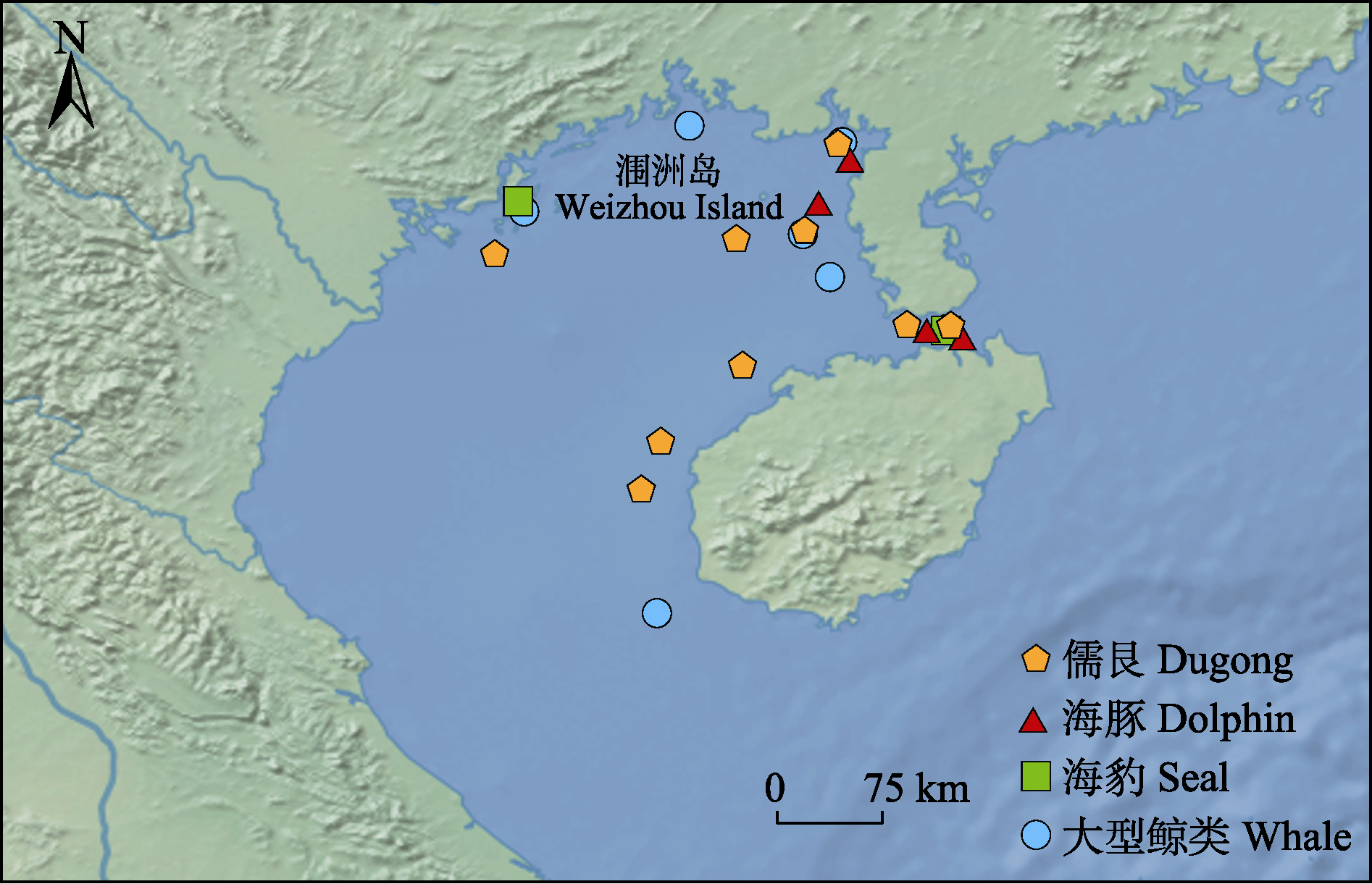
Fig. 1 Distribution sites of marine mammals in the Beibu Gulf recorded in historical documents
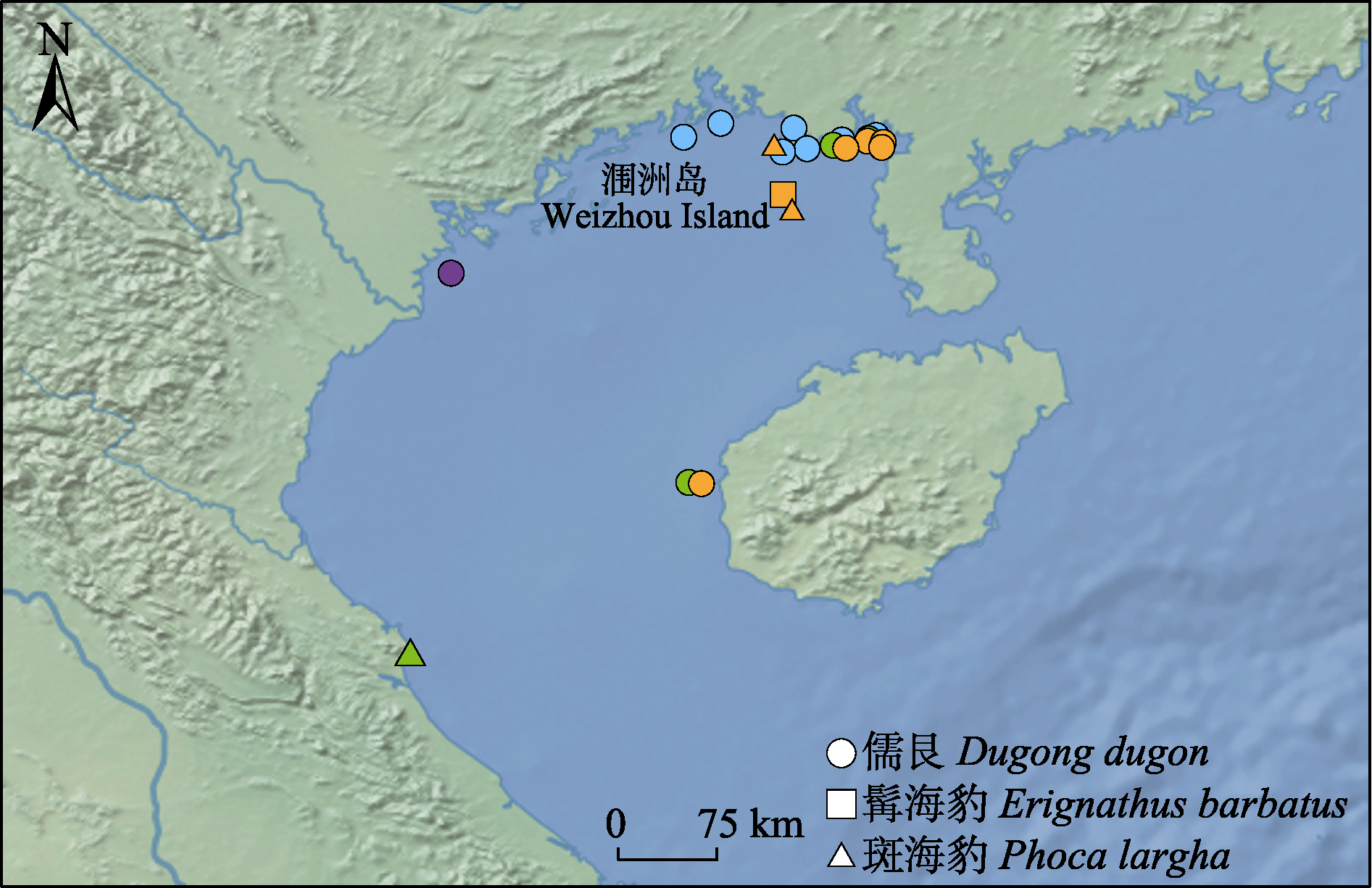
Fig. 2 Geographical distribution of Sirenia and Carnivora in the Beibu Gulf. Blue, Stranding; Yellow, Wild sighting; Green, Bycatch/catch; Purple, Specimen.
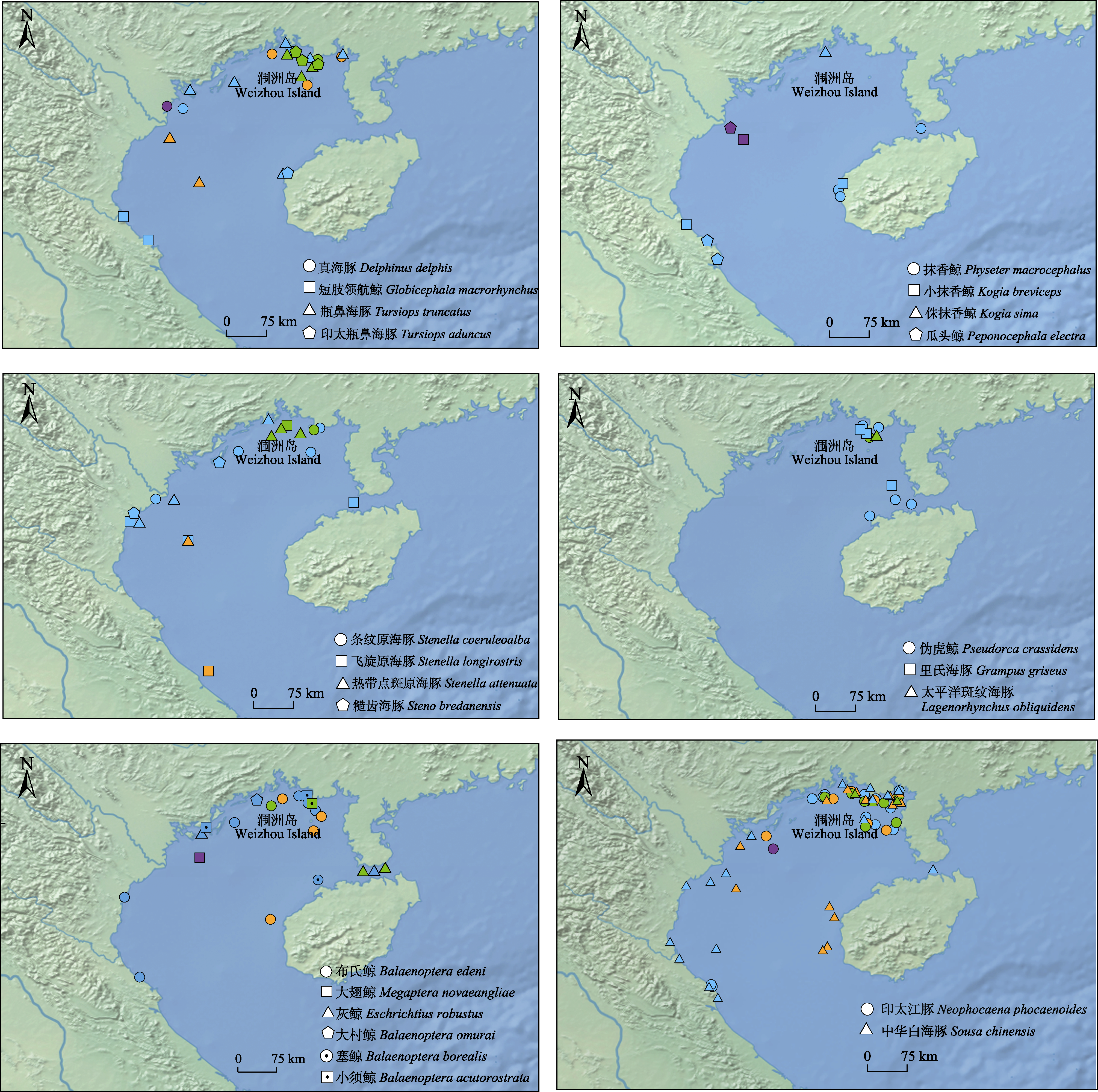
Fig. 3 Geographical distribution of Cetartiodactyla in the Beibu Gulf. Blue, Stranding; Yellow, Wild sighting; Green, Bycatch/catch; Purple, Specimen.
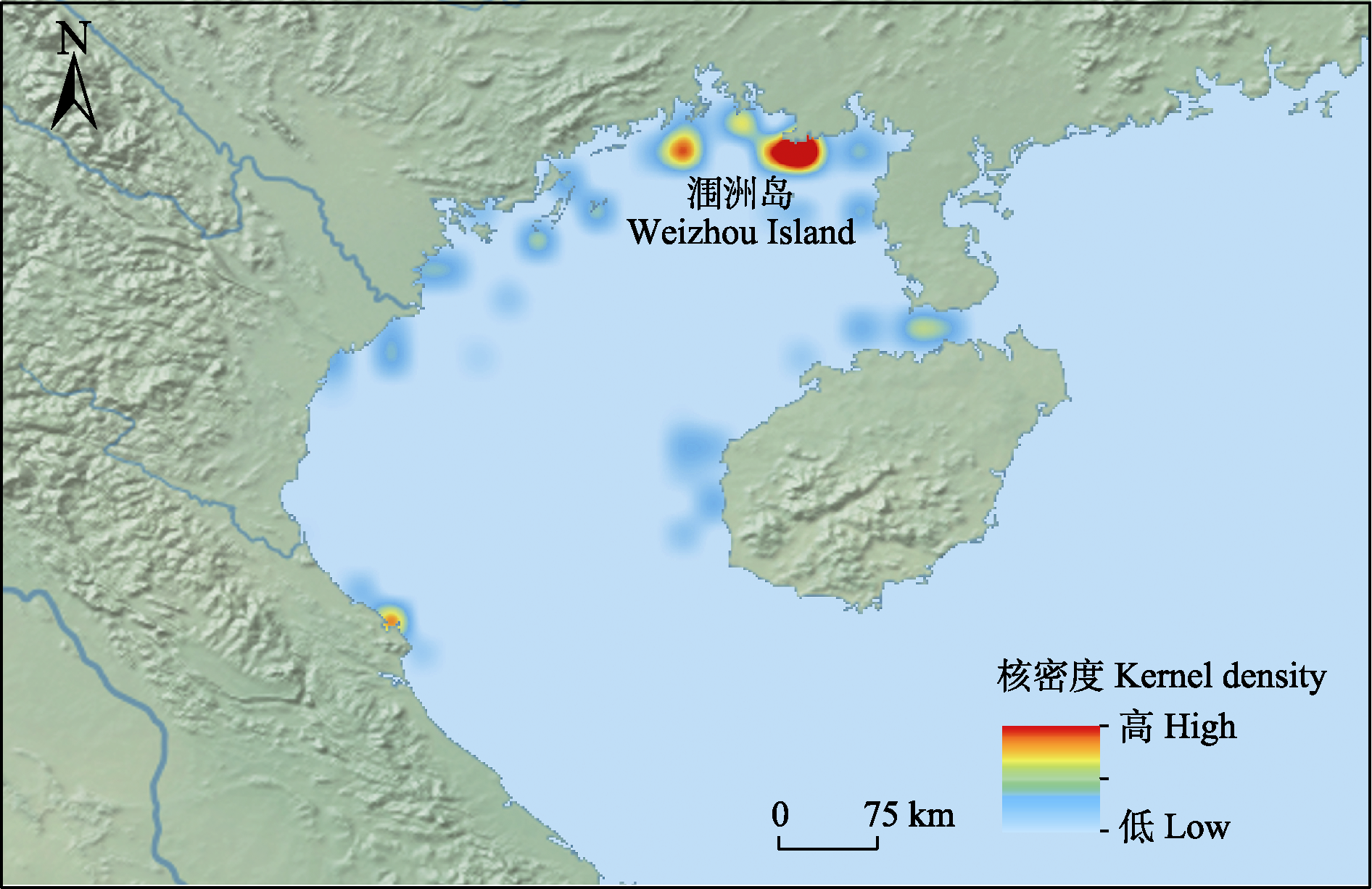
Fig. 4 Kernel density distribution of marine mammals in the Beibu Gulf
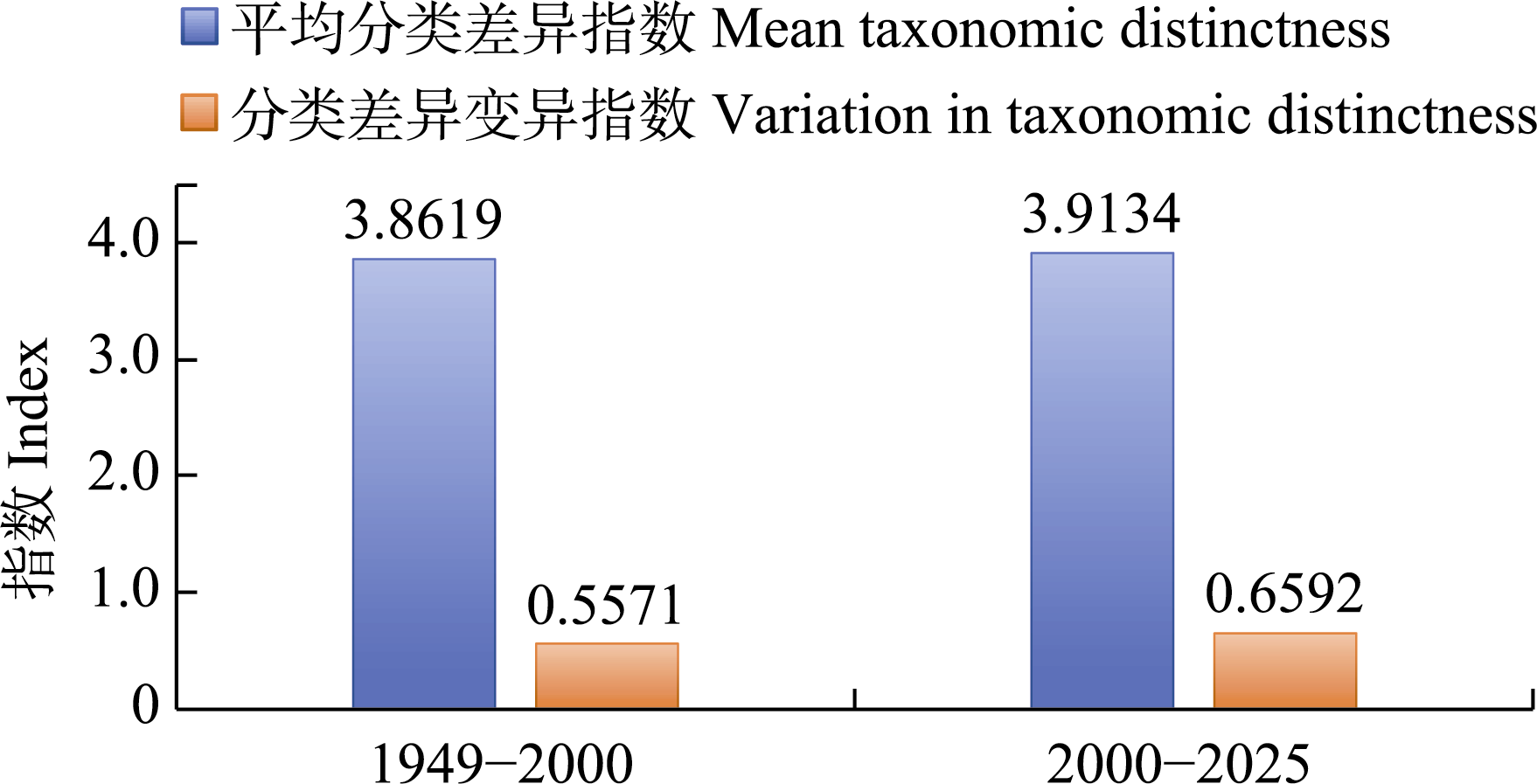
Fig. 5 Taxonomic diversity of marine mammals in the Beibu Gulf during the 20th and 21st centuries
| [1] |
Bai SJ, Zhang PJ, Lin ML, Lin WZ, Yang ZX, Li SH (2021) Microbial diversity and structure in the gastrointestinal tracts of two stranded short-finned pilot whales (Globicephala macrorhynchus) and a pygmy sperm whale (Kogia breviceps). Integrative Zoology, 16, 324-335.
DOI PMID |
| [2] |
Banks-Leite C, Ewers RM, Folkard-Tapp H, Fraser A (2020) Countering the effects of habitat loss, fragmentation, and degradation through habitat restoration. One Earth, 3, 672-676.
DOI URL |
| [3] |
Blair HB, Merchant ND, Friedlaender AS, Wiley DN, Parks SE (2016) Evidence for ship noise impacts on humpback whale foraging behaviour. Biology Letters, 12, 20160005.
DOI URL |
| [4] |
Campana I, Angeletti D, Giovani G, Paraboschi M, Arcangeli A (2022) Cetacean sensitivity and threats analysis to assess effectiveness of protection measures: An example of integrated approach for cetacean conservation in the Bonifacio Bouches. Biodiversity and Conservation, 31, 517-541.
DOI |
| [5] | Carlson C (2001) A Review of Whale Watch Guidelines and Regulations around the World: Version 2001. International Whaling Commission, Cambridge, UK. |
| [6] | Chen BY, Chen LW, Zhang J, You QY, Hao XQ, Liu S (2024) Impact of vessels on the behavior of Yangtze finless porpoises in Nanjing. Acta Hydrobiologica Sinica, 48, 1672-1679. (in Chinese with English abstract) |
| [陈炳耀, 陈力文, 张俊, 游秋逸, 郝秀青, 刘杉 (2024) 船只对南京长江江豚的行为影响分析. 水生生物学报, 48, 1672-1679.] | |
| [7] | Chen BY, Lu FT, Zhang XL, Wu CW, Lü LG, Jefferson TA (2025) The largest known population of Eden’s whale aggregates in the Beibu Gulf Southern China. Marine Mammal Science, 41, e13226. |
| [8] | Chen BY, Sun J, Mao BN, Guan ZH, Jiang XY, Wang J (2025) The impacts evaluation of whale-watching vessels on Bryde’s whales and implications for whale-watching regulations. Acta Theriologica Sinica, 45, 681-693. (in Chinese with English abstract) |
| [陈炳耀, 孙婧, 毛保能, 关泽华, 姜新月, 王静 (2025) 观鲸船只对布氏鲸的影响评价及对观鲸规则的启示. 兽类学报, 45, 681-693.] | |
| [9] |
Chen BY, Xu XR, Jefferson TA, Olson PA, Qin QR, Zhang HK, He LW, Yang G (2016) Conservation status of the Indo-Pacific humpback dolphin (Sousa chinensis) in the Northern Beibu Gulf, China. Advances in Marine Biology, 73, 119-139.
DOI PMID |
| [10] |
Chen BY, Zhu L, Jefferson TA, Zhou KY, Yang G (2019) Coastal Bryde’s whales’ (Balaenoptera edeni) foraging area near Weizhou Island in the Beibu Gulf. Aquatic Mammals, 45, 274-279.
DOI URL |
| [11] | Chen ZZ, Qiu YS, Xu SN (2011) Changes in trophic flows and ecosystem properties of the Beibu Gulf ecosystem before and after the collapse of fish stocks. Ocean & Coastal Management, 54, 601-611. |
| [12] |
Clarke KR, Warwick RM (1998) A taxonomic distinctness index and its statistical properties. Journal of Applied Ecology, 35, 523-531.
DOI URL |
| [13] |
Clarke KR, Warwick RM (2001) A further biodiversity index applicable to species lists: Variation in taxonomic distinctness. Marine Ecology Progress Series, 216, 265-278.
DOI URL |
| [14] |
Dawson SM, Northridge S, Waples D, Read AJ (2013) To Ping or not to Ping: The use of active acoustic devices in mitigating interactions between small cetaceans and gillnet fisheries. Endangered Species Research, 19, 201-221.
DOI URL |
| [15] | Deng CB (2002) Dugongs and Marine Biodiversity in Beibu Bay. Guangxi Science & Technology Publishing House, Nanning. (in Chinese) |
| [邓超冰 (2002) 北部湾儒艮及海洋生物多样性. 广西科学技术出版社, 南宁.] | |
| [16] |
Dong LJ, Liu MM, Lin WZ, Li SH, Dong LJ, Liu MM, Lin WZ, Li SH (2022) First suction cup tagging on a small and coastal form Bryde’s whale (Balaenoptera edeni edeni) in China to investigate its dive profiles and foraging behaviours. Journal of Marine Science and Engineering, 10, 1422.
DOI URL |
| [17] | Hamer DJ, Childerhouse SJ, Gales NJ (2012) Odontocete bycatch and depredation in longline fisheries: A review of available literature and of potential solutions. Marine Mammal Science, 28, E345-E374. |
| [18] | He AY, Wang DP, Cheng SL, Shi J, Han YQ, Chen XH (2013) Investigation and research on rare animals of Guangxi Beibu Gulf. Journal of Anhui Agricultural Sciences, 41, 13258-13261. (in Chinese with English abstract) |
| [何安尤, 王大鹏, 程胜龙, 施军, 韩耀全, 陈晓汉 (2013) 广西北部湾珍稀动物现状调查与研究. 安徽农业科学, 41, 13258-13261.] | |
| [19] | IUCN (2024) The IUCN Red List of Threatened Species. Version 2024-1. https://www.iucnredlist.org. (accessed on 2025-05-06) (accessed on 2025-05-06) |
| [20] | Ji GQ, Yang G, Liu S, Zhou KY (2002) Variability of the mitochondrial DNA control region of bottlenose dolphins (Genus Delphinus) in Chinese waters. Acta Zoologica Sinica, 48, 487-493. (in Chinese with English abstract) |
| [季国庆, 杨光, 刘珊, 周开亚 (2002) 中国水域瓶鼻海豚的mtDNA控制区序列变异性分析. 动物学报, 48, 487-493.] | |
| [21] | Jin Y, Yang SB, Jiang SJ, Liu ZL, Li SF (2026) Modeling spatio-temporal variations in the habitat utilization of cetaceans in the East China Sea. Ocean & Coastal Management, 271, 107987. |
| [22] |
Lambert E, Hunter C, Pierce GJ, MacLeod CD (2010) Sustainable whale-watching tourism and climate change: Towards a framework of resilience. Journal of Sustainable Tourism, 18, 409-427.
DOI URL |
| [23] |
Li SH, Lin ML, Caruso F, Dong LJ, Lin WZ, Rosso M, Bocconcelli A (2020) Cetaceans under threat in South China Sea. Science, 368, 1074-1075.
DOI PMID |
| [24] |
Li SH, Lin ML, Xu X, Xing LR, Zhang PJ, Gozlan RE, Huang SL, Wang D (2016) First record of the Indo-Pacific humpback dolphins (Sousa chinensis) southwest of Hainan Island, China. Marine Biodiversity Records, 9, 3.
DOI URL |
| [25] | Li Y, Ren JF (2020) Study on the development and utilization change monitoring of coastal zone in Beibu Gulf of Guangxi based on geographical national conditions survey. Geomatics & Spatial Information Technology, 43(9), 93-99. (in Chinese with English abstract) |
| [李毅, 任建福 (2020) 基于地理国情普查的广西北部湾海岸带开发利用变化监测研究. 测绘与空间地理信息, 43(9), 93-99.] | |
| [26] | Lin J, Lin HY, Luo X, Guo MX, Li MM, Pang BJ, Huang XL, Wang Z, Lan WL (2024) Seasonal variation characteristics of phytoplankton community structure and environmental impact factors in the Weizhou Island, Guangxi. Guangxi Sciences, 31, 224-236. (in Chinese with English abstract) |
| [林佳, 林海英, 骆鑫, 郭梅修, 黎明民, 庞碧剑, 黄雄良, 王宙, 蓝文陆 (2024) 广西涠洲岛海域浮游植物群落结构季节变化特征及环境影响因素. 广西科学, 31, 224-236.] | |
| [27] |
Lin WZ, Zheng RQ, Liu BS, Chen SL, Lin ML, Serres A, Liu MM, Liu WH, Li SH (2023) Ranging pattern development of a declining delphinid population: A potential cascade effect of vessel activities. Journal of Environmental Management, 330, 117120.
DOI URL |
| [28] | Liu J, Wu RX, Kang B, Ma L (2016) Fishes of Beibu Gulf. Science Press, Beijing. (in Chinese) |
| [刘静, 吴仁协, 康斌, 马琳 (2016) 北部湾鱼类图鉴. 科学出版社, 北京.] | |
| [29] |
Liu M, Lin M, Turvey ST, Li S (2017) Fishers’ knowledge as an information source to investigate bycatch of marine mammals in the South China Sea. Animal Conservation, 20, 182-192.
DOI URL |
| [30] |
Liu MM, Lin ML, Zhang PJ, Xue TF, Li SH (2019) An overview of cetacean stranding around Hainan Island in the South China Sea, 1978-2016: Implications for research, conservation and management. Marine Policy, 101, 147-153.
DOI URL |
| [31] | Liu MM, Lin WZ, Liu BS, Chen SL, Lin ML, Dong LJ, Kang H, Ouyang MY, Yang ZX, Huang XY, Rosso M, Pusser LT, Wang JY, Pitman RL, Li SH (2025) Observations on Deraniyagala’s beaked whale (Mesoplodon hotaula) in the South China Sea based on the first confirmed live sightings. Marine Mammal Science, 41, e13178. |
| [32] |
Long Y, Liu LJ (2016) First record of the short-finned pilot whale (Globicephala macrorhynchus) in the Chinese Beibu Gulf. Aquatic Mammals, 42, 372-375.
DOI URL |
| [33] |
Luo DY, Guo L, Huang NY, Wang HR, Zeng C, Tang XK, Xu Z, Wu YP, Sun X (2024) Vulnerability and conservation of nearshore cetaceans to increasing vessel traffic: The Indo-Pacific humpback dolphin in the South China Sea. Journal of Ocean University of China, 23, 1003-1014.
DOI |
| [34] | Mackay AI, Knuckey IA (2013) Mitigation of Marine Mammal Bycatch in Gillnet Fisheries Using Acoustic Devices Literature Review. Final Report to the Australian Fisheries Management Authority. South Australian Research and Development Institute (SARDI), West Beach, SA. |
| [35] |
Meng XY, Wang HZ, Zhou Y, Zhang HK, Qiao Y, Chen BY (2022) Density estimation and suitable habitat prediction of Indo-Pacific finless porpoise in the Beibu Gulf. Acta Theriologica Sinica, 42, 362-369. (in Chinese with English abstract)
DOI |
|
[孟祥垚, 汪华志, 周煜, 张宏科, 乔莹, 陈炳耀 (2022) 北部湾印太江豚密度估算及适宜栖息地预测. 兽类学报, 42, 362-369.]
DOI |
|
| [36] |
Peng CW, Wu HP, Wang XY, Zhu Q, Jefferson TA, Wang CC, Xu YH, Li J, Huang H, Chen M, Huang SL (2020) Abundance and residency dynamics of the Indo-Pacific humpback dolphin, Sousa chinensis, in the Dafengjiang River Estuary, China. Marine Mammal Science, 36, 623-637.
DOI URL |
| [37] |
Piroddi C, Bearzi G, Gonzalvo J, Christensen V (2011) From common to rare: The case of the Mediterranean common dolphin. Biological Conservation, 144, 2490-2498.
DOI URL |
| [38] |
Piroddi C, Giovanni B, Villy C (2010) Effects of local fisheries and ocean productivity on the northeastern Ionian Sea ecosystem. Ecological Modelling, 221, 1526-1544.
DOI URL |
| [39] | Qiao YL, Lin ZJ (2007) The relationship between the main features of landform, the distritubiton of bottom sediment and fishery distribution. Transactions of Oceanology and Limnology, (S1), 232-238. (in Chinese) |
| [乔延龙, 林昭进 (2007) 北部湾地形、底质特征与渔场分布的关系. 海洋湖沼通报, (S1), 232-238.] | |
| [40] | Reynolds JE, Marsh H, Ragen TJ (2009) Marine mammal conservation. Endangered Species Research, 7, 202-230. |
| [41] |
Santana-Garcon J, Wakefield CB, Dorman SR, Denham A, Blight S, Molony BW, Newman SJ (2018) Risk versus reward: Interactions, depredation rates and bycatch mitigation of dolphins in demersal fish trawls. Canadian Journal of Fisheries and Aquatic Sciences, 75, 2233-2240.
DOI URL |
| [42] |
Schoeman RP, Patterson-Abrolat C, Plön S (2020) A global review of vessel collisions with marine animals. Frontiers in Marine Science, 7, 292.
DOI URL |
| [43] | SEAFDEC (Southeast Asian Fisheries Development Center) (2009) Report of the 1st Regional Workshop on Information Gathering and Cetacean Research in the Southeast Asian Waters. Training Department, Southeast Asian Fisheries Development Center, TD/RP/134, Samut Prakan, Thailand. |
| [44] | Shaw TH (1958) The dugong discovered in the Beibu Gulf of Guangdong. Chinese Journal of Zoology, 3, 146-152. (in Chinese) |
| [寿振黄 (1958) 广东北部湾所发现的儒艮. 动物学杂志, 3, 146-152.] | |
| [45] | Shi MC, Chen B, Zhang JY (2022) Research status and prospect of runoff in the Beibu Gulf. Guangxi Sciences, 29, 1026-1032. (in Chinese with English abstract) |
| [侍茂崇, 陈波, 张继云 (2022) 北部湾入海径流研究展望. 广西科学, 29, 1026-1032.] | |
| [46] |
Sitar A, May-Collado LJ, Wright A, Peters-Burton E, Rockwood L, Parsons ECM (2017) Tourists’ perspectives on dolphin watching in Bocas Del Toro Panama. Tourism in Marine Environments, 12, 79-94.
DOI URL |
| [47] | Smith BD, Braulik G, Jefferson TA, Chung BD, Vinh CT, Du DV, Hanh BV, Trong PD, Ho DT, Quang VV (2003) Notes on two cetacean surveys in the Gulf of Tonkin, Vietnam. Raffles Bulletin of Zoology, 51, 165-171. |
| [48] | Smith BD, Jefferson TA, Ho DT, Leatherwood S, Thuoc CV, Chiam E (1995) Marine mammal of Vietnam: A preliminary checklist. Collection of Marine Research Works, 6, 147-176. |
| [49] |
Sun J, Lu FT, Liao BL, Xiao BH, Li M, He LY, Bai L, Chen BY (2023) A young Eden’s whale (Balaenoptera edeni edeni) wandering in a busy international container port. Aquatic Mammals, 49, 321-328.
DOI URL |
| [50] | Sun JY (1999) Marine mammals from the coastal water of Guangxi, China. Journal of Guangxi Academy of Sciences, 15(2), 29-33. (in Chinese with English abstract) |
| [孙建运 (1999) 广西沿海海兽种类研究. 广西科学院学报, 15(2), 29-33.] | |
| [51] |
Vanderlaan ASM, Taggart CT (2007) Vessel collisions with whales: The probability of lethal injury based on vessel speed. Marine Mammal Science, 23, 144-156.
DOI URL |
| [52] |
Wakefield CB, Santana-Garcon J, Dorman SR, Blight S, Denham A, Wakeford J, Molony BW, Newman SJ (2017) Performance of bycatch reduction devices varies for chondrichthyan, reptile, and cetacean mitigation in demersal fish trawls: Assimilating subsurface interactions and unaccounted mortality. ICES Journal of Marine Science, 74, 343-358.
DOI URL |
| [53] | Wang JL, Yang G, Zhou KY, Wei FW (2003) A preliminary study on the cranial characters for common dolphins (genus Delphinus) in Chinese waters. Chinese Journal of Zoology, 38(5), 30-34. (in Chinese with English abstract) |
| [王加连, 杨光, 周开亚, 魏辅文 (2003) 中国水域真海豚头骨特征的初步研究. 动物学杂志, 38(5), 30-34.] | |
| [54] | Wang LJ, Xing ZG, Wang JC, Liang W, Hong ML, Shi HT (2010) The recovered carcass of a Dugong (Dugong dugon) in Yelin Bay of Wenchang City, Hainan Province and its cause of death. Acta Theriologica Sinica, 30, 354-356. (in Chinese with English abstract) |
| [王力军, 邢志刚, 汪继超, 梁伟, 洪美玲, 史海涛 (2010) 海南文昌椰林湾发现儒艮的尸体及死亡原因分析. 兽类学报, 30, 354-356.] | |
| [55] | Wang PL (1982) Marine Mammals of the Beibu Gulf. Fisheries Science, 1(2), 34-39. (in Chinese) |
| [王丕烈 (1982) 北部湾的海兽类. 水产科学, 1(2), 34-39.] | |
| [56] | Wang PL (1984a) Distribution of the gray whale (Eschrichtius gibbosus) off the coast of China. Acta Theriologica Sinica, 4, 21-26. (in Chinese with English abstract) |
| [王丕烈 (1984a) 灰鲸在中国近海的分布. 兽类学报, 4, 21-26.] | |
| [57] | Wang PL (1984b) Distribution of cetaceans offshore China. Chinese Journal of Zoology, 19(6), 52-56. (in Chinese) |
| [王丕烈 (1984b) 中国近海鲸类的分布. 动物学杂志, 19(6), 52-56.] | |
| [58] | Wang PL (2011) Chinese Cetaceans. Chemical Industry Press, Beijing. (in Chinese) |
| [王丕烈 (2011) 中国鲸类. 化学工业出版社, 北京.] | |
| [59] | Wang PL, Han JB (2007) Present status of distribution and protection of Chinese white dolphins (Sousa chinensis) population in Chinese waters. Marine Environmental Science, 26, 484-487. (in Chinese with English abstract) |
| [王丕烈, 韩家波 (2007) 中国水域中华白海豚种群分布现状与保护. 海洋环境科学, 26, 484-487.] | |
| [60] | Wang PL, Sun JY (1986) Distribution of the Dugong off the coast of China. Acta Theriologica Sinica, 6, 175-181. (in Chinese) |
| [王丕烈, 孙建运 (1986) 儒艮在中国近海的分布. 兽类学报, 6, 175-181.] | |
| [61] | Wang XX, Chen T, Li M, Wang YZ (2022) Long-term changes in habitat use of Indo-Pacific humpback dolphins (Sousa chinensis) in response to anthropogenic coastline shift in Lingding Bay of Pearl River Estuary, China. Acta Ecologica Sinica, 42, 2962-2973. (in Chinese with English abstract) |
| [王新星, 陈涛, 李敏, 王跃中 (2022) 珠江口伶仃洋中华白海豚栖息地利用对海岸线等变迁的响应. 生态学报, 42, 2962-2973.] | |
| [62] | Wang Y, Fang ZQ, Zhou HY (2008) Concentrations and distrubution of oranochlorine pesticide and polychlorinated biphenyls in finless porpoise in Beibu Gulf. Marine Environmental Science, 27, 343-347. (in Chinese with English abstract) |
| [王艳, 方展强, 周海云 (2008) 北部湾海域江豚体内有机氯农药和多氯联苯的含量及分布. 海洋环境科学, 27, 343-347.] | |
| [63] | Wang ZT, Au WW, Rendell L, Wang KX, Wu HP, Wu YP, Liu JC, Duan GQ, Cao HJ, Wang D (2016) Apparent source levels and active communication space of whistles of free-ranging Indo-Pacific humpback dolphins (Sousa chinensis) in the Pearl River Estuary and Beibu Gulf, China. PeerJ, 4, e1695. |
| [64] |
Wang ZT, Duan PX, Chen M, Mei ZG, Sun XD, Nong ZW, Liu MH, Akamatsu T, Wang KX, Wang D (2022) Vocalization of Bryde’s whales (Balaenoptera edeni) in the Beibu Gulf, China. Marine Mammal Science, 38, 1118-1139.
DOI URL |
| [65] | Wei FW, Yang QS, Wu Y, Jiang XL, Liu SY, Hu YB, Ge DY, Li BG, Yang G, Li M, Zhou J, Li S, Li S, Yu WH, Chen BY, Zhang ZJ, Zhou CQ, Wu SB, Zhang L, Chen ZZ, Chen SD, Deng HQ, Jiang TL, Zhang LB, Shi HY, Lu XL, Li Q, Liu Z, Cui YQ, Li YC, He K (2025) Catalogue of mammals in China (2024). Acta Theriologica Sinica, 45, 1-16. (in Chinese with English abstract) |
| [魏辅文, 杨奇森, 吴毅, 蒋学龙, 刘少英, 胡义波, 葛德燕, 李保国, 杨光, 李明, 周江, 李松, 李晟, 余文华, 陈炳耀, 张泽钧, 周材权, 吴诗宝, 张立, 陈中正, 陈顺德, 邓怀庆, 江廷磊, 张礼标, 石红艳, 卢学理, 李权, 刘铸, 崔雅倩, 李玉春, 何锴 (2025) 中国兽类名录(2024版). 兽类学报, 45, 1-16.] | |
| [66] | Wu CW, Jiang HP, Zhang D, Zhu L, Hao XQ, Zhang HK, Zhou Y, Qiao Y, Zhang XL, Sun L, Yang G, Chen BY (2020) The finding of a Bryde’s whale with abnormal upper jaw and baleen near Weizhou Island in the Beibu Gulf: Implication for conservation. Acta Theriologica Sinica, 40, 329-336. (in Chinese with English abstract) |
| [吴采雯, 江慧萍, 张迪, 朱林, 郝秀青, 张宏科, 周煜, 乔莹, 张学雷, 孙璐, 杨光, 陈炳耀 (2020) 北部湾涠洲岛水域发现上颌和须板异常的布氏鲸: 对保护的启示. 兽类学报, 40, 329-336.] | |
| [67] |
Wu CW, Zeng F, Liu R, Hao XQ, Chen XY, Qiao Y, Zhang HK, Zhou Y, Guo YM, Yang G, Chen BY, Jefferson TA (2021) Prediction of suitable habitats for the Indo-Pacific humpback dolphin (Sousa chinensis) in the Beibu Gulf of China and Vietnam. Bulletin of Marine Science, 97, 39-52.
DOI URL |
| [68] | Wu FX, Jin N, Gao MH, Zhong MD, Dai YF, Li YP (2025) First report of a common dolphin (Delphinus delphis) feeding alongside Indo-Pacific humpback dolphins (Sousa chinensis) in the Beibuwan Gulf, China. Ecology and Evolution, 15, e71767. |
| [69] | Xu YH (2024) Ecological conservation and sustainable development of Chinese white dolphins in Sanniang Bay. Democracy and Science, (6), 31-33. (in Chinese) |
| [许尤厚 (2024) 三娘湾中华白海豚的生态保护与可持续发展. 民主与科学, (6), 31-33.] | |
| [70] |
Yang G, Xu SX, Chen BY, Shan L (2018) Advances in marine mammal research in China. Acta Theriologica Sinica, 38, 572-585. (in Chinese with English abstract)
DOI |
| [杨光, 徐士霞, 陈炳耀, 单磊 (2018) 中国海兽研究进展. 兽类学报, 38, 572-585.] | |
| [71] | Zellar R, Pulkkinen A, Moore K, Rousseaux CS, Reeb D (2021) Oceanic and atmospheric correlations to cetacean mass stranding events in Cape Cod, Massachusetts, USA. Geophysical Research Letters, 48, e2021GL093697. |
| [72] | Zhang HK (2016) Current status and conservation strategies of Indo-Pacific humpback dolphins in Guangxi waters. Journal of Kaifeng Institute of Education, 36(6), 292-293. (in Chinese) |
| [张宏科 (2016) 广西海域中华白海豚现状及保护对策. 开封教育学院学报, 36(6), 292-293.] | |
| [73] |
Zhang TC, Ju T, Li SH, Xie Y, Wang D, Wang ZT, Wang KX (2018) Navigation noise properties of large vessels in Hechangzhou region of the Yangtze River and their potential effects on the Yangtze finless porpoise. Acta Theriologica Sinica, 38, 543-550. (in Chinese with English abstract)
DOI |
| [张天赐, 居涛, 李松海, 谢燕, 王丁, 王志陶, 王克雄 (2018) 长江和畅洲江段大型船舶的噪声特征及其对长江江豚的潜在影响. 兽类学报, 38, 543-550.] | |
| [74] |
Zhao LY, Zhong MD, Wu FX, Dai YF, Aierken R, Chen M, Wang XY (2020) First record of Omura’s whale (Balaenoptera omurai) in the Beibu Gulf, China. Aquatic Mammals, 46, 301-306.
DOI URL |
| [75] |
Zheng FY, Qiu GL, Fan HQ, Zhang W (2013) Diversity, distribution and conservation of Chinese seagrass species. Biodiversity Science, 21, 517-526. (in Chinese with English abstract)
DOI |
|
[郑凤英, 邱广龙, 范航清, 张伟 (2013) 中国海草的多样性、分布及保护. 生物多样性, 21, 517-526.]
DOI |
|
| [76] | Zheng RD, Chen BY, Zhang S, Mai JX, Jiang PW, Wang WX, Li M (2024) Preliminary exploration of Balaenoptera edeni edeni population distribution in surrounding waters of Weizhou Island based on environmental DNA. South China Fisheries Science, 20(3), 36-46. (in Chinese with English abstract) |
| [郑若丹, 陈炳耀, 张帅, 麦俊晓, 蒋佩文, 王文欣, 李敏 (2024) 基于环境DNA的涠洲岛周围海域布氏鲸种群分布初探. 南方水产科学, 20(3), 36-46.] | |
| [77] | Zhou GQ, Huang JJ, Zhang GY (2015) Evaluation of the wave energy conditions along the coastal waters of Beibu Gulf, China. Energy, 85, 449-457. |
| [78] | Zhou J (2019) The practice of international law on the delimitation of Beibu Gulf between China and Vietnam. Journal of Boundary and Ocean Studies, 4(5), 6-37. (in Chinese with English abstract) |
| [周健 (2019) 中越北部湾划界的国际法实践. 边界与海洋研究, 4(5), 6-37.] | |
| [79] | Zhou KY (2004) Fauna Sinica·Mammalia (Vol.9). Science Press, Beijing. (in Chinese) |
| [周开亚 (2004) 中国动物志∙兽纲(第九卷). 科学出版社, 北京.] | |
| [80] | Zhou KY, Jefferson TA, Leatherwood S, Wang PL, Wang D, Chou LX (2001) Marine Mammals of China. Food and Agriculture Organization of the United Nations, Rome. |
| [81] |
Zolman ES (2002) Residence of bottlenose dolphins (Tursiops truncatus) in the Stono River Estuary, Charleston County, South Carolina, USA. Marine Mammal Science, 18, 879-892.
DOI URL |
| [82] | Zou JW, Lin PW, Wang QZ (2013) Evaluation of catch in Beibu Gulf of South China Sea in 2012. South China Fisheries Science, 9, 75-81. |
| [1] | Qingyong Ni, Yumai Fan, Qi Zhang, Meng Xie. Conservation and research progress of Lorisidae primates in China [J]. Biodiv Sci, 2026, 34(3): 25451-. |
| [2] | Wenqi Gao, Jingrong Xiang, Yao Zhao, Lingshuang Fan, Yuan Gu, Weihan Shao, Gaojun Li, Guangjun Zhao, Mingbin Chen, Xingwei Cai, Kai Chen. Stream fish community characteristics and their response to land use in Limushan and Jianfengling of Hainan Tropical Rainforest National Park [J]. Biodiv Sci, 2026, 34(2): 25374-. |
| [3] | Shurong Tian, Ying Wei, Fen Xiao, Yunyun Zhou, Yixing Xie, Cheng Wang, Fen Song, Zhiqiang Liang, Xiaojie Gui. Population dynamics and conservation strategies of Andrias davidianus in Hunan Zhangjiajie Giant Salamander National Nature Reserve, China [J]. Biodiv Sci, 2025, 33(7): 24581-. |
| [4] | Yixuan Wang, Hao Li, Qiang Sun, Zijing Li, Mingle Li, Yabo Shi, Ying Zheng, Xing Li, Yu Mo, Lei Fan, Xiao Guo, Bailing Miao, Ying Han, Na Sha, Lei Dong, Jinghui Zhang, Zhiyong Li, Lixin Wang, Liqing Zhao, Cunzhu Liang. Dataset on geographical distribution and classification of Potaninia mongolica communities [J]. Biodiv Sci, 2025, 33(6): 25095-. |
| [5] | Yizhe Wang, Yuchen Feng, Xiaolei Huang. The diversity of aphids and their host plants in Fujian Province, China [J]. Biodiv Sci, 2025, 33(6): 25159-. |
| [6] | Zhongwen Ding, Yiting Chen, Wen Yu, Jingjing Zhang, Yibin Huang, Dingke Li, Zhaojie Peng, Han Lai, Shichao Wei, Mingpan Huang. Application of baited remote underwater video technology in assessing nearshore reef fish diversity [J]. Biodiv Sci, 2025, 33(6): 24572-. |
| [7] | Yuan Jingyi, Zhang Xu, Tian Zhenpeng, Wang Zizhe, Gao Yongping, Yao Dizhao, Guan Hongcan, Li Wenkai, Liu Jing, Zhang Hong, Ma Qin. A comparison of methods for extracting tree species composition and quantitative characteristics in urban plant communities using UAV high-resolution RGB imagery and LiDAR point cloud [J]. Biodiv Sci, 2025, 33(4): 24237-. |
| [8] | Ma Wenjun, Liu Sijia, Li Kemao, Jian Shenglong, Xue Chang’an, Han Qingxiango, Wei Jinliang, Chen Shengxue, Niu Yimeng, Cui Zhouping, Sui Ruichen, Tian Fei, Zhao Kai. Fish diversity and distribution in the source region of the Yangtze River in Qinghai Province [J]. Biodiv Sci, 2025, 33(2): 24494-. |
| [9] | Panlong Tong, Hanwen Zhang, Yanmei Wang, Shunzhong Wang, Yan Zhu. Drivers of temporal beta diversity in woody seedlings in Donglingshan, Beijing [J]. Biodiv Sci, 2025, 33(11): 25309-. |
| [10] | Wenqing Chang, Lihui Zhang, Yiling Wang, Xinyang Zhong, Yongfu Xu. A dataset on the checklist and geographical distribution of wild seed plants in Hunan, China [J]. Biodiv Sci, 2025, 33(10): 25202-. |
| [11] | Jia Xu, Xiaojuan Cui, Yifei Zhang, Chang Wu, Yuandong Sun. Fish diversity and distribution in the Nanling region [J]. Biodiv Sci, 2024, 32(7): 23482-. |
| [12] | Yongqiang Shi, Qingshan Luan, Xiujuan Shan, Chao Wei, Yongsong Zhao, Cece Sun, Xianshi Jin. Annual changes in zooplankton biodiversity in the southern waters of Changdao [J]. Biodiv Sci, 2024, 32(7): 23428-. |
| [13] | Yongqiang Zhao, Xiyu Yan, Jiaqi Xie, Mengting Hou, Danmei Chen, Lipeng Zang, Qingfu Liu, Mingzhen Sui, Guangqi Zhang. Species diversity and community assembly of woody plants at different life history stages during the natural restoration of degraded karst forests [J]. Biodiv Sci, 2024, 32(5): 23462-. |
| [14] | Di Lin, Shuanglin Chen, Que Du, Wenlong Song, Gu Rao, Shuzhen Yan. Investigation of species diversity of myxomycetes in Dabie Mountains [J]. Biodiv Sci, 2024, 32(2): 23242-. |
| [15] | Jia Yao, Congling Zhang, Shixuan Li, Yang Lin, Zhen Wang, Yuhan Zhang, Weilong Zhou, Xinhe Pan, Shan Zhu, Yiqing Wu, Dan Wang, Jinliang Liu, Shanshan Tan, Guochun Shen, Mingjian Yu. Characteristics of plant communities in the Baishanzu continuous elevational transect [J]. Biodiv Sci, 2024, 32(12): 24052-. |
| Viewed | ||||||
|
Full text |
|
|||||
|
Abstract |
|
|||||
Copyright © 2026 Biodiversity Science
Editorial Office of Biodiversity Science, 20 Nanxincun, Xiangshan, Beijing 100093, China
Tel: 010-62836137, 62836665 E-mail: biodiversity@ibcas.ac.cn

