

Biodiv Sci ›› 2025, Vol. 33 ›› Issue (11): 25309. DOI: 10.17520/biods.2025309 cstr: 32101.14.biods.2025309
• Original Papers: Plant Diversity • Previous Articles Next Articles
Panlong Tong1,2, Hanwen Zhang2,3, Yanmei Wang1,*( ), Shunzhong Wang2,*, Yan Zhu2,*(
 )
)
Received:2025-08-04
Accepted:2025-10-22
Online:2025-11-20
Published:2025-12-26
Contact:
Yanmei Wang, Shunzhong Wang, Yan Zhu
Supported by:Panlong Tong, Hanwen Zhang, Yanmei Wang, Shunzhong Wang, Yan Zhu. Drivers of temporal beta diversity in woody seedlings in Donglingshan, Beijing[J]. Biodiv Sci, 2025, 33(11): 25309.
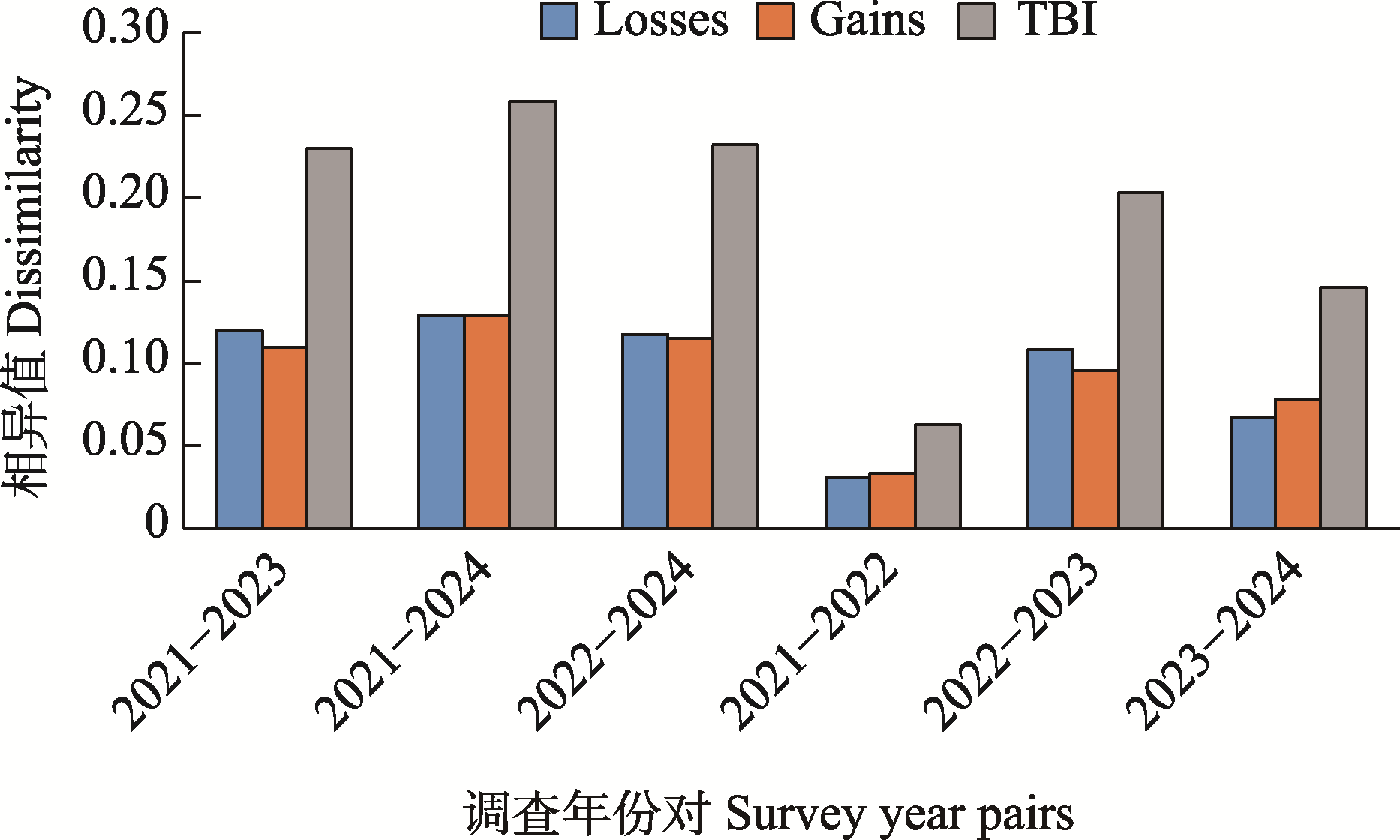
Fig. 1 Changes in temporal beta diversity index (TBI) and its components, losses and gains, in the seedling community of 20-ha warm temperate deciduous broad-leaved forest dynamics plot in Donglingshan from 2021 to 2024. Losses represents species loss, and Gains represents species gain. A TBI value of 1 indicates that the species composition of the area has completely changed over the time span. A Losses value of 1 indicates that the area is dominated entirely by species loss over the time span. A Gains value of 1 indicates that the area is dominated entirely by species gain over the time span.
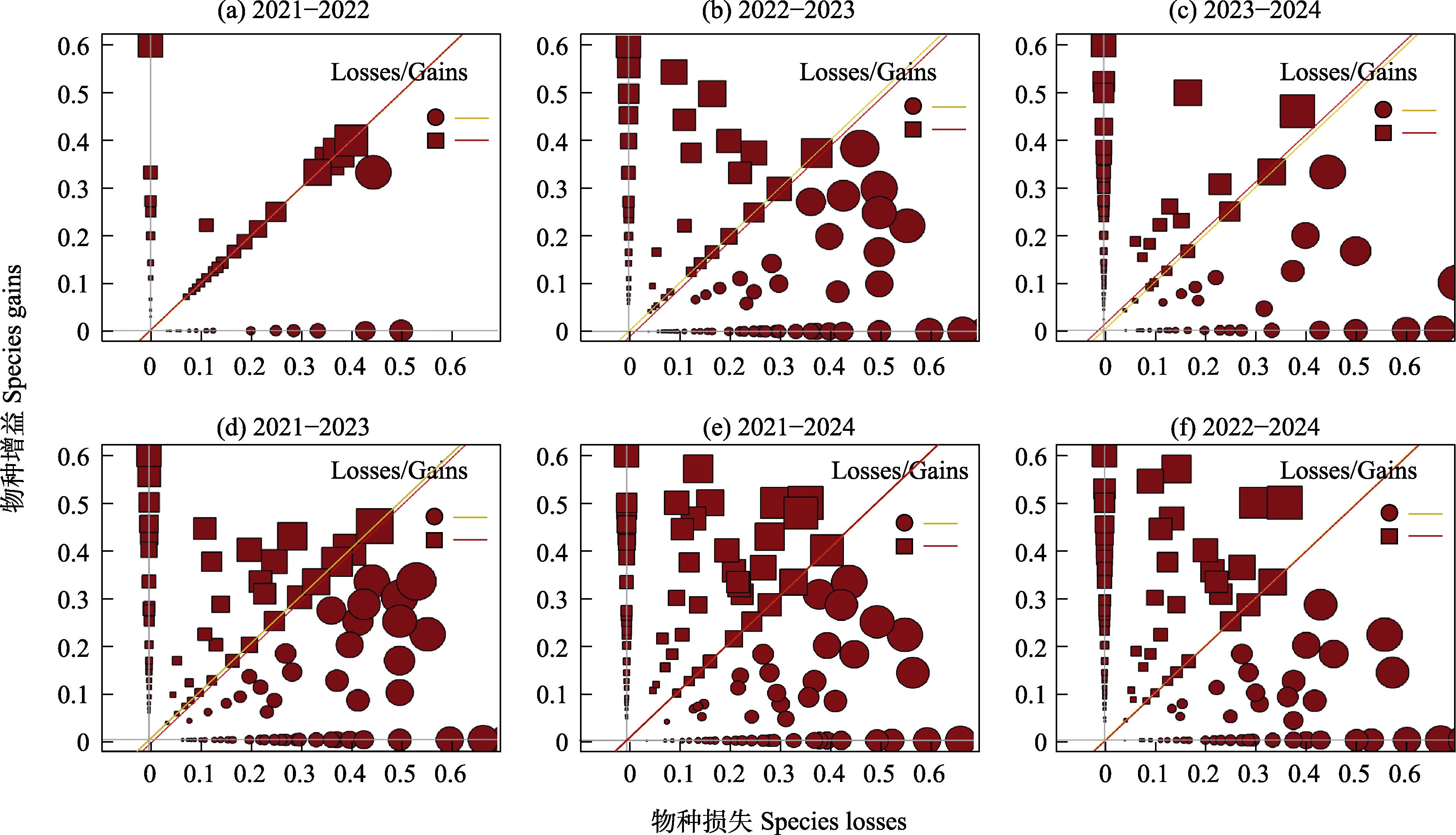
Fig. 2 Gains/losses of seedling communities in the 20-ha warm temperate deciduous broad-leaved forest dynamics plot in Donglingshan. Squares (Gains) and circles (Losses) represent 450 seedling quadrats (points). The red and yellow lines are parallel (with a slope of 1). The size of the symbols is proportional to the TBI statistic. If the yellow line is above the red line, it indicates that species losses dominate; conversely, species gains dominate.
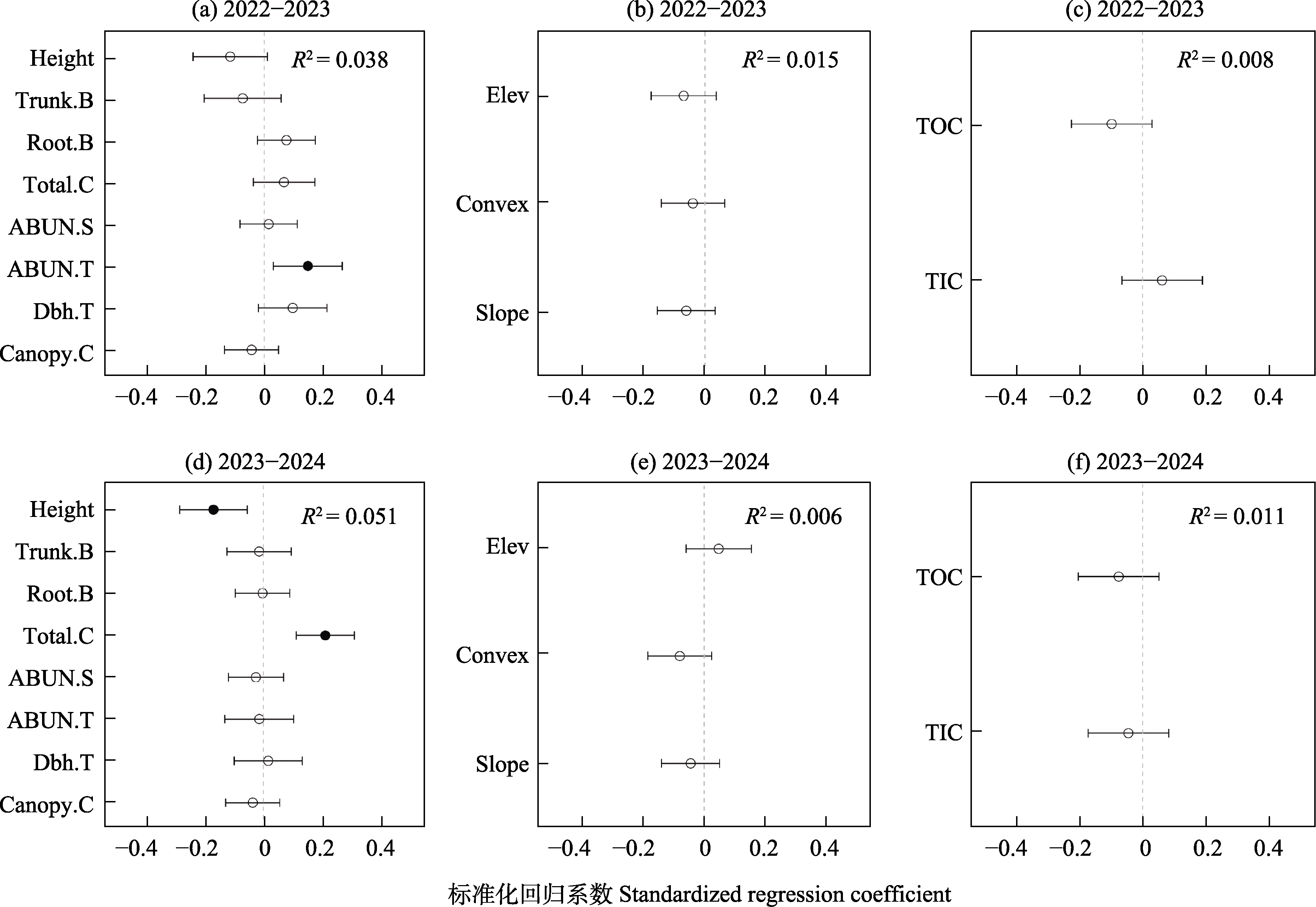
Fig. 3 Effects of biotic (a, d), topographic (b, e), and soil (c, f) factors on temporal beta diversity index (TBI) in the 20 ha warm temperate deciduous broad-leaved forest dynamic plot in Donglingshan seedling communities from 2022-2024. Height, Average height of seedlings; Trunk.B, Average number of main leaves on the seedlings; Root.B, Average number of root-derived leaves per seedling; Total.C, Total seedling coverage; ABUN.S, Seedling abundance; ABUN.T, Tree abundance; Dbh.T, Tree DBH; Canopy.C, Canopy cover; Elev, Elevation; Convex, Convexity; Slope, Slope; TOC, Total organic carbon; TIC, Total inorganic carbon. The circles and short lines represent the estimated values of standardized regression coefficients and the 95% confidence interval, respectively. A solid circle means the effect is significant (P < 0.05), while a hollow circle is not significant (P ≥ 0.05).
| [1] |
Anderegg LDL, HilleRisLambers J (2019) Local range boundaries vs. large-scale trade-offs: Climatic and competitive constraints on tree growth. Ecology Letters, 22, 787-796.
DOI PMID |
| [2] | Anderson MJ, Crist TO, Chase JM, Vellend M, Inouye BD, Freestone AL, Sanders NJ, Cornell HV, Comita LS, Davies KF, Harrison SP, Kraft NJB, Stegen JC, Swenson NG (2011) Navigating the multiple meanings of β diversity: A roadmap for the practicing ecologist. Ecology Letters, 14, 19-28. |
| [3] |
Brice MH, Cazelles K, Legendre P, Fortin MJ (2019) Disturbances amplify tree community responses to climate change in the temperate-boreal ecotone. Global Ecology and Biogeography, 28, 1668-1681.
DOI URL |
| [4] |
Chase JM (2014) Spatial scale resolves the niche versus neutral theory debate. Journal of Vegetation Science, 25, 319-322.
DOI URL |
| [5] | Chase JM, Kraft NJB, Smith KG, Vellend M, Inouye BD (2011) Using null models to disentangle variation in community dissimilarity from variation in α-diversity. Ecosphere, 2, art24. |
| [6] |
Chen SB, Ouyang ZY, Xu WH, Xiao Y (2010) A review of beta diversity studies. Biodiversity Science, 18, 323-335. (in Chinese with English abstract)
DOI |
|
[ 陈圣宾, 欧阳志云, 徐卫华, 肖燚 (2010) Beta多样性研究进展. 生物多样性, 18, 323-335.]
DOI |
|
| [7] |
Chen WM, Jiao S, Li QP, Du NN (2020) Dispersal limitation relative to environmental filtering governs the vertical small-scale assembly of soil microbiomes during restoration. Journal of Applied Ecology, 57, 402-412.
DOI URL |
| [8] | Chen X, Li YH, Zuo YF, Lin S, Chu DJ, He KN (2022) Effects of stand characteristics and soil nutrient characteristics on herbaceous diversity. Acta Botanica Boreali-Occidentalia Sinica, 42, 1396-1407. (in Chinese with English abstract) |
| [ 陈笑, 李远航, 左亚凡, 林莎, 初鼎晋, 贺康宁 (2022) 林分特征和土壤养分对林下草本物种多样性的影响. 西北植物学报, 42, 1396-1407.] | |
| [9] |
Chesson P (2000) General theory of competitive coexistence in spatially-varying environments. Theoretical Population Biology, 58, 211-237.
PMID |
| [10] |
Clark JS (2010) Individuals and the variation needed for high species diversity in forest trees. Science, 327, 1129-1132.
DOI PMID |
| [11] |
Clark JS, Dietze M, Chakraborty S, Agarwal PK, Ibanez I, LaDeau S, Wolosin M (2007) Resolving the biodiversity paradox. Ecology Letters, 10, 647-659.
PMID |
| [12] |
Clark JS, Silman M, Kern R, Macklin E, HilleRisLambers J (1999) Seed dispersal near and far: Patterns across temperate and tropical forests. Ecology, 80, 1475-1494.
DOI URL |
| [13] |
Comita LS, Muller-Landau HC, Aguilar S, Hubbell SP (2010) Asymmetric density dependence shapes species abundances in a tropical tree community. Science, 329, 330-332.
DOI PMID |
| [14] |
Connell JH, Green PT (2000) Seedling dynamics over thirty-two years in a tropical rain forest tree. Ecology, 81, 568-584.
DOI URL |
| [15] |
Cook JE (2015) Structural effects on understory attributes in second-growth forests of northern Wisconsin, USA. Forest Ecology and Management, 347, 188-199.
DOI URL |
| [16] |
Deng TT, Du QQ, Zhu Y, Queenborough SA (2025) Environmental drivers of herbaceous plant diversity in the understory community of a warm-temperate forest. Plant Diversity, 47, 282-290.
DOI |
| [17] |
Deng TT, Wei Y, Ren SY, Zhu Y (2023) Effects of topography and stand structure of warm temperate deciduous broad- leaved forest on understory herb diversity in Donglingshan, Beijing. Biodiversity Science, 31, 22671. (in Chinese with English abstract)
DOI URL |
|
[ 邓婷婷, 魏岩, 任思远, 祝燕 (2023) 北京东灵山暖温带落叶阔叶林地形和林分结构对林下草本植物物种多样性的影响. 生物多样性, 31, 22671.]
DOI |
|
| [18] |
Dornelas M, Gotelli NJ, McGill B, Shimadzu H, Moyes F, Sievers C, Magurran AE (2014) Assemblage time series reveal biodiversity change but not systematic loss. Science, 344, 296-299.
DOI PMID |
| [19] | Dray S, Bauman D, Blanchet G, Borcard D, Clappe S, Guenard G, Jombart T, Larocque G, Legendre P, Madi N, Wagner HH (2025) adespatial: Multivariate Multiscale spatial analysis. R package version 0. 3-28. (accessed on 2025-04-16) |
| [20] |
Du QQ, Ren SY, Yuan NTS, Zhu Y (2024) Factors affecting the productivity of sapling and adult trees in the warm temperate deciduous broad-leaved forest of Donglingshan, Beijing. Biodiversity Science, 32, 24284. (in Chinese with English abstract)
DOI |
|
[ 杜晴晴, 任思远, Nicole Tsz Shun Yuan, 祝燕 (2024) 北京东灵山暖温带落叶阔叶林幼树及成树生产力的影响因素. 生物多样性, 32, 24284.]
DOI |
|
| [21] |
Gilliam FS (2007) The ecological significance of the herbaceous layer in temperate forest ecosystems. BioScience, 57, 845-858.
DOI URL |
| [22] |
Grime JP (1973) Competitive exclusion in herbaceous vegetation. Nature, 242, 344-347.
DOI |
| [23] |
Hu TY, Liu XQ, Wu XY, Niu CY, Su YJ (2025) Advance in forest canopy structural complexity research. National Remote Sensing Bulletin, 29, 83-101. (in Chinese with English abstract)
DOI URL |
| [ 胡天宇, 刘小强, 吴晓永, 牛春跃, 苏艳军 (2025) 森林冠层结构复杂性研究进展及展望. 遥感学报, 29, 83-101.] | |
| [24] | Hubbell SP (2001) The Unified Neutral Theory of Biodiversity and Biogeography. Princeton University Press, Princeton. |
| [25] | Jackson ST, Blois JL (2015) Community ecology in a changing environment: Perspectives from the Quaternary. Proceedings of the National Academy of Sciences, USA, 112, 4915-4921. |
| [26] |
Jiang ZH, Ma KM (2015) Environmental filtering drives herb community composition and functional trait changes across an elevational gradient. Plant Ecology and Evolution, 148, 301-310.
DOI URL |
| [27] |
Jiménez M, Zavala-Hurtado JA, Vega E, Márquez-Haro M (2024) Temporal beta diversity and plant metacommunity structure dynamics over a 43-year period in an inter-tropical Mexican arid region. Journal of Arid Environments, 222, 105175.
DOI URL |
| [28] | John R, Dalling JW, Harms KE, Yavitt JB, Stallard RF, Mirabello M, Hubbell SP, Valencia R, Navarrete H, Vallejo M, Foster RB (2007) Soil nutrients influence spatial distributions of tropical tree species. Proceedings of the National Academy of Sciences, USA, 104, 864-869. |
| [29] | Kraft NJB, Godoy O, Levine JM (2015) Plant functional traits and the multidimensional nature of species coexistence. Proceedings of the National Academy of Sciences, USA, 112, 797-802. |
| [30] |
Kuczynski L, Legendre P, Grenouillet G (2018) Concomitant impacts of climate change, fragmentation and non-native species have led to reorganization of fish communities since the 1980s. Global Ecology and Biogeography, 27, 213-222.
DOI URL |
| [31] | Lawson L, Edge CB, Fortin MJ, Jackson DA (2024) Temporal change in urban fish biodiversity—Gains, losses, and drivers of change. Ecology and Evolution, 14, e10845. |
| [32] |
Legendre P (2019) A temporal beta-diversity index to identify sites that have changed in exceptional ways in space-time surveys. Ecology and Evolution, 9, 3500-3514.
DOI |
| [33] |
Legendre P, Condit R (2019) Spatial and temporal analysis of beta diversity in the Barro Colorado Island forest dynamics plot, Panama. Forest Ecosystems, 6, 7.
DOI |
| [34] |
Legendre P, De Cáceres M (2013) Beta diversity as the variance of community data: Dissimilarity coefficients and partitioning. Ecology Letters, 16, 951-963.
DOI PMID |
| [35] |
Legendre P, Mi XC, Ren HB, Ma KP, Yu MJ, Sun IF, He FL (2009) Partitioning beta diversity in a subtropical broad-leaved forest of China. Ecology, 90, 663-674.
DOI PMID |
| [36] | Leibold MA, Rudolph FJ, Blanchet FG, De Meester L, Gravel D, Hartig F, Peres-Neto P, Shoemaker L, Chase JM (2022) The internal structure of metacommunities. Oikos, 2022, e08618. |
| [37] |
Lindholm M, Alahuhta J, Heio J, Toivonen H (2021) Temporal beta diversity of lake plants is determined by concomitant changes in environmental factors across decades. Journal of Ecology, 109, 819-832.
DOI URL |
| [38] |
Liu HF, Li L, Sang WG (2011) Species composition and community structure of the Donglingshan forest dynamics plot in a warm temperate deciduous broad-leaved secondary forest, China. Biodiversity Science, 19, 232-242. (in Chinese with English abstract)
DOI URL |
|
[ 刘海丰, 李亮, 桑卫国 (2011) 东灵山暖温带落叶阔叶次生林动态监测样地: 物种组成与群落结构. 生物多样性, 19, 232-242.]
DOI |
|
| [39] |
Machado MA, De Almeida JEB (2019) Spatial structure, diversity, and edaphic factors of an area of Amazonian coast vegetation in Brazil. The Journal of the Torrey Botanical Society, 146, 58-68.
DOI URL |
| [40] |
Ma R, Soininen J, Zhou AF, Ji PP, Jiang TZ, Martín-Devasa R, Chen JH (2024) Temporal dynamics of alpha and beta diversity of lake algae: Opposing patterns and influencing factors over the past 200 years. Freshwater Biology, 69, 1885-1898.
DOI URL |
| [41] |
Myers JA, Chase JM, Jiménez I, Jørgensen PM, Araujo-Murakami A, Paniagua-Zambrana N, Seidel R (2013) Beta-diversity in temperate and tropical forests reflects dissimilar mechanisms of community assembly. Ecology Letters, 16, 151-157.
DOI PMID |
| [42] |
Nielsen TF, Sand-Jensen K, Dornelas M, Bruun HH (2019) More is less: Net gain in species richness, but biotic homogenization over 140 years. Ecology Letters, 22, 1650-1657.
DOI URL |
| [43] |
Niu KC, Liu YN, Shen ZH, He FL, Fang JY (2009) Community assembly: The relative importance of neutral theory and niche theory. Biodiversity Science, 17, 579-593. (in Chinese with English abstract)
DOI |
|
[ 牛克昌, 刘怿宁, 沈泽昊, 何芳良, 方精云 (2009) 群落构建的中性理论和生态位理论. 生物多样性, 17, 579-593.]
DOI |
|
| [44] | Rao MD, Feng G, Zhang JL, Mi XC, Chen JH (2013) Effects of environmental filtering and dispersal limitation on species and phylogenetic beta diversity in Gutianshan National Nature Reserve. Chinese Science Bulletin, 58, 1204-1212. (in Chinese with English abstract) |
| [ 饶米德, 冯刚, 张金龙, 米湘成, 陈建华 (2013) 生境过滤和扩散限制作用对古田山森林物种和系统发育β多样性的影响. 科学通报, 58, 1204-1212.] | |
| [45] |
Shimadzu H, Dornelas M, Magurran AE (2015) Measuring temporal turnover in ecological communities. Methods in Ecology and Evolution, 6, 1384-1394.
DOI URL |
| [46] | Tian K, Chen L, Mi XC, Ma KP, Chen JH (2013) The effect of habitat filtering on tree seedling distribution in a subtropical evergreen broadleaf forest in China. Chinese Science Bulletin, 58, 3561-3569. (in Chinese with English abstract) |
| [ 田锴, 陈磊, 米湘成, 马克平, 陈建华 (2013) 亚热带常绿阔叶林木本植物幼苗分布格局及其对生境过滤的响应. 科学通报, 58, 3561-3569.] | |
| [47] |
Uriarte M, Condit R, Canham CD, Hubbell SP (2004) A spatially explicit model of sapling growth in a tropical forest: Does the identity of neighbours matter? Journal of Ecology, 92, 348-360.
DOI URL |
| [48] | Vellend M (2016) The Theory of Ecological Communities. Princeton University Press, Princeton. |
| [49] |
Wang CH, Li JQ, Chen FQ, Yang Y (2011) Factors affecting seedling regeneration of Liquidambar formosana in the L. formosana forests in hilly regions of Southeast Hubei, China. Chinese Journal of Plant Ecology, 35, 187-194. (in Chinese with English abstract)
DOI URL |
|
[ 王传华, 李俊清, 陈芳清, 杨莹 (2011) 鄂东南低丘地区枫香林下枫香幼苗更新限制因子. 植物生态学报, 35, 187-194.]
DOI |
|
| [50] |
Wang XY, Meng JH, Ren SY, Zhu Y (2024) Relationship between biodiversity and aboveground biomass in the warm temperate deciduous broad-leaved forest of Donglingshan, Beijing. Biodiversity Science, 32, 24230. (in Chinese with English abstract)
DOI |
|
[ 王兴煜, 孟京辉, 任思远, 祝燕 (2024) 北京东灵山暖温带落叶阔叶林群落生物多样性与地上生物量的关系. 生物多样性, 32, 24230.]
DOI |
|
| [51] |
Weiner J, Thomas SC (1986) Size variability and competition in plant monocultures. Oikos, 47, 211-222.
DOI URL |
| [52] |
Whittaker RH (1972) Evolution and measurement of species diversity. Taxon, 21, 213-251.
DOI URL |
| [53] |
Wulf M, Naaf T (2009) Herb layer response to broadleaf tree species with different leaf litter quality and canopy structure in temperate forests. Journal of Vegetation Science, 20, 517-526.
DOI URL |
| [54] | Xie JY, Chen LZ (1994) Species diversity characteristics of deciduous forests in the warm temperate zone of North China. Acta Ecologica Sinica, 14, 337-344. (in Chinese with English abstract) |
| [ 谢晋阳, 陈灵芝 (1994) 暖温带落叶阔叶林的物种多样性特征. 生态学报, 14, 337-344.] | |
| [55] | Xu ZC, Johnson DJ, Zhu K, Lin F, Ye J, Yuan ZQ, Mao ZK, Fang S, Hao ZQ, Wang XG (2022) Interannual climate variability has predominant effects on seedling survival in a temperate forest. Ecology, 103, e3643. |
| [56] | Zettlemoyer MA, Munck S, Poschlod P, Rosbakh S (2024) Subtle changes in plant diversity in the Bavarian Alps over the past eight decades. Ecology and Evolution, 14, e70035. |
| [57] |
Zhang J, Li BH, Bai XJ, Yuan ZQ, Wang XG, Ye J, Hao ZQ (2009) Composition and interannual dynamics of tree seedlings in broad-leaved Korean pine (Pinus koraiensis) mixed forest in Changbai Mountain. Biodiversity Science, 17, 385-396. (in Chinese with English abstract)
DOI URL |
|
[ 张健, 李步杭, 白雪娇, 原作强, 王绪高, 叶吉, 郝占庆 (2009) 长白山阔叶红松林乔木树种幼苗组成及其年际动态. 生物多样性, 17, 385-396.]
DOI |
|
| [58] |
Zhang W, Liu WC, Xu MP, Deng J, Han XH, Yang G, Feng YZ, Ren GX (2019) Response of forest growth to C : N : P stoichiometry in plants and soils during Robinia pseudoacacia afforestation on the Loess Plateau, China. Geoderma, 337, 280-289.
DOI |
| [59] | Zhao ZH, Hui GY (2020) Advances in structural diversity of stand structure. Scientia Silvae Sinicae, 56(9), 143-152. (in Chinese with English abstract) |
| [ 赵中华, 惠刚盈 (2020) 林分结构多样性研究进展. 林业科学, 56(9), 143-152.] | |
| [60] |
Zhu Y, Bai F, Liu HF, Li WC, Li L, Li GQ, Wang SZ, Sang WG (2011) Population distribution patterns and interspecific spatial associations in warm temperate secondary forests, Beijing. Biodiversity Science, 19, 252-259. (in Chinese with English abstract)
DOI |
|
[ 祝燕, 白帆, 刘海丰, 李文超, 李亮, 李广起, 王顺忠, 桑卫国 (2011) 北京暖温带次生林种群分布格局与种间空间关联性. 生物多样性, 19, 252-259.]
DOI |
|
| [61] |
Zhu Y, Queenborough SA, Condit R, Hubbell SP, Ma KP, Comita LS (2018) Density-dependent survival varies with species life-history strategy in a tropical forest. Ecology Letters, 21, 506-515.
DOI PMID |
| [62] | Zhu YJ, Yang XH, Shi ZJ, Liu YS, Zhang X (2018) The influence of stand factors on species diversity of herb layer in Zhangbei poplar plantations. Chinese Journal of Ecology, 37, 2869-2879. (in Chinese with English abstract) |
| [ 朱媛君, 杨晓晖, 时忠杰, 刘艳书, 张晓 (2018) 林分因子对张北杨树人工林林下草本层物种多样性的影响. 生态学杂志, 37, 2869-2879.] |
| [1] | Tingting Deng, Yan Wei, Siyuan Ren, Yan Zhu. Effects of topography and stand structure of warm temperate deciduous broad-leaved forest on understory herb diversity in Donglingshan, Beijing [J]. Biodiv Sci, 2023, 31(7): 22671-. |
| [2] | Xin Yang, Zhiliang Yao, Bin Wang, Handong Wen, Yun Deng, Min Cao, Zhiming Zhang, Zhenghong Tan, Luxiang Lin. Driving effects of forest stand structure of a subtropical evergreen broad-leaved forest on species composition variation: From local to regional scales [J]. Biodiv Sci, 2023, 31(2): 22139-. |
| [3] | Weikai Bao, Bo Lei, Xueyong Pang, Xiaoli Yan, Yu Jia. Species composition and synusia structure of ground bryophyte communities under different aged spruce plantations and primary forest in the upper reaches of the Dadu River, Sichuan [J]. Biodiv Sci, 2009, 17(2): 201-209. |
| Viewed | ||||||
|
Full text |
|
|||||
|
Abstract |
|
|||||
Copyright © 2026 Biodiversity Science
Editorial Office of Biodiversity Science, 20 Nanxincun, Xiangshan, Beijing 100093, China
Tel: 010-62836137, 62836665 E-mail: biodiversity@ibcas.ac.cn

