

生物多样性 ›› 2025, Vol. 33 ›› Issue (10): 25179. DOI: 10.17520/biods.2025179 cstr: 32101.14.biods.2025179
周宣宏( ), 杨军*()(
 )
)
收稿日期:2025-05-15
接受日期:2025-08-18
出版日期:2025-10-20
发布日期:2025-11-20
通讯作者:
* E-mail: larix@tsinghua.edu.cn基金资助:
Xuanhong Zhou(), Jun Yang*()()
Received:2025-05-15
Accepted:2025-08-18
Online:2025-10-20
Published:2025-11-20
Contact:
* E-mail: larix@tsinghua.edu.cnSupported by:摘要:
生物多样性保护对于维护生态安全和支撑人类社会的可持续发展具有重要意义。然而生态系统内错综复杂的相互作用关系和人为活动、气候变化等外部因子的复合影响给生物多样性保护的研究和实践工作带来挑战。人工智能(artificial intelligence, AI)和大语言模型(large language models, LLMs)的兴起为生物多样性保护研究和实践中的生物多样性知识发现、生态系统建模、监测与评估、保护决策以及保护行动等方面提供了新的工具。本文总结了AI和LLMs在上述方向的应用进展, 分析了当前在生物多样性保护研究和实践中应用AI和LLMs时所面临的数据质量问题、模型响应速度、生态系统异质性及伦理和数据安全等挑战, 并提出未来应聚焦于构建高质量的生物多样性多模态数据集, 以及开发适合于生物多样性保护的领域大模型等优先研究方向。文章可为AI和LLMs驱动的生物多样性保护研究和实践提供一定参考。
周宣宏, 杨军 (2025) AI和LLMs在生物多样性保护研究和实践中的应用与挑战. 生物多样性, 33, 25179. DOI: 10.17520/biods.2025179.
Xuanhong Zhou, Jun Yang (2025) Applications and challenges of AI and LLMs in biodiversity conservation research and practices. Biodiversity Science, 33, 25179. DOI: 10.17520/biods.2025179.
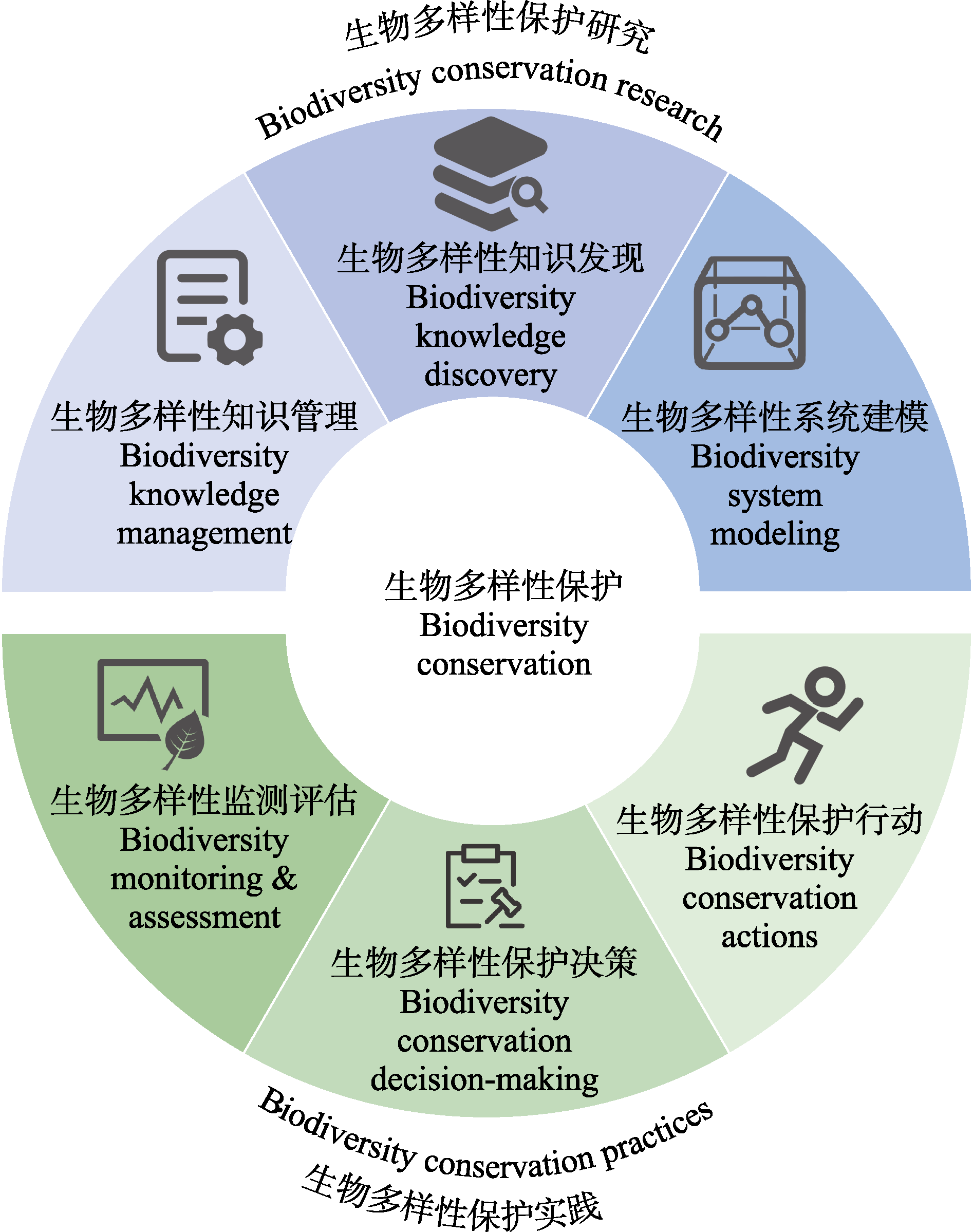
图1 人工智能(AI)和大语言模型(LLMs)在生物多样性保护研究和实践中的应用
Fig. 1 Applications of artificial intelligence (AI) and large language models (LLMs) in biodiversity conservation research and practices
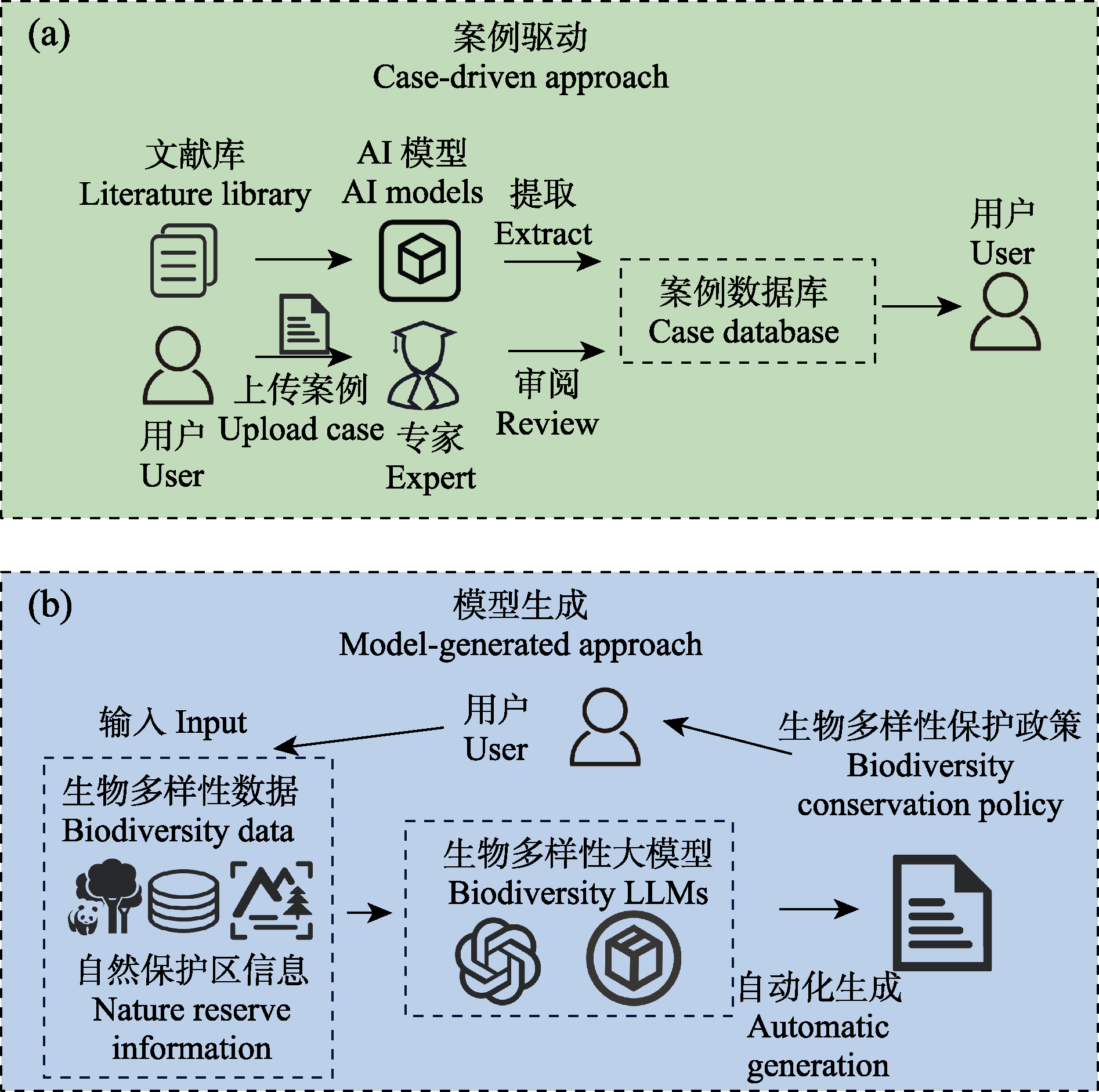
图2 案例驱动(a)和模型生成(b)两种不同的技术路径。AI:人工智能(AI); LLMs: 大语言模型。
Fig. 2 Two distinct technical approaches: Case-driven (a) and model-generated (b). AI, Artificial intelligence; LLMs, Large language models.
| 应用场景 Application scenarios | 传统方法及优劣 Traditional methods & Pros/Cons | AI/LLMs方法及优劣 AI/LLMs methods & Pros/Cons |
|---|---|---|
| 生物多样性信息抽取 Biodiversity information extraction | 人工审阅文献、抽取数据: 准确率较高, 但是抽取效率低、容易遗漏信息 Manual literature review and data extraction: high accuracy, but low efficiency and prone to missing information | 基于LLMs提取生物多样性数据: 信息抽取速度快, 在名称识别上准确率高, 但是部分任务上准确率较低 LLMs-based biodiversity data extraction: high efficiency, high accuracy in name recognition, but lower accuracy in some tasks |
| 生物多样性知识发现 Biodiversity knowledge discovery | 人工审读文献、总结知识、提出科学发现: 提出的假设通常较为合理, 但是效率低, 难以处理海量文献间关系 Manual literature review, summarization, and scientific discovery: proposed hypotheses are generally reasonable, but efficiency is low and it is difficult to establish relationships between massive amounts of literature | LLMs合作支持科学发现: 效率高, 可以发现海量文献中潜在的关联, 但是缺乏自动验证能力 LLMs cooperation supports scientific discovery: high efficiency, capable of discovering potential correlations in massive literature, but lacks automatic validation capabilities |
| 生物多样性系统建模 Biodiversity system modeling | 回归模型、猎食者-猎物模型、种群增长模型等数学模型: 理论基础坚实, 但因对适用情况的假设, 其应用受到限制 Mathematical models such as regression models, predator-prey models, and population growth models: possess a solid theoretical foundation, but their application is limited due to assumptions about applicable conditions | 多模态LLMs建模框架: 统一多模态输入、有望挖掘生物多样性潜在关系, 但是可解释性差、对复杂生态系统推理能力有待验证 Multimodal LLMs based modeling frameworks: capable of unifying multimodal inputs and show promise in uncovering latent biodiversity relationships, but suffer from poor interpretability and require further validation of their reasoning capabilities for complex ecosystems |
| 生物多样性监测 Biodiversity monitoring | 专家判读监测数据和统计模型评估: 响应速度慢 Expert manual interpretation of monitoring data and statistical model assessment: slow response speed | 卷积神经网络等深度学习模型用于物种识别: 高效处理海量数据 Deep learning models such as convolutional neural networks (CNNs) used for species identification: efficient processing of massive data |
| 生物多样性保护决策 Biodiversity conservation decision-making | 基于经验和专家决策: 可靠性和可解释性强, 但是效率低且成本高 Experience-based and expert-driven decision-making: high reliability and strong interpretability, but low efficiency and high cost | 基于领域大模型的决策制定: 定制化水平高、快速决策但是可解释性差 Domain-specific large model-based decision-making: high level of customization, fast decision-making, but poor interpretability |
| 生物多样性保护中非法活动监测 Monitoring of illegal activities in biodiversity conservation | 人工监测: 效率低、成本高 Manual monitoring: low efficiency and high cost | 基于声音检测模型和视觉模型监测: 快速响应 Sound detection models and vision models for monitoring: fast response |
表1 人工智能(AI)与传统方法在生物多样性关键应用场景中的优劣。LLMs: 大语言模型。
Table 1 Advantages and disadvantages of artificial intelligence (AI) vs. traditional methods in key biodiversity application scenarios. LLMs, Large language models.
| 应用场景 Application scenarios | 传统方法及优劣 Traditional methods & Pros/Cons | AI/LLMs方法及优劣 AI/LLMs methods & Pros/Cons |
|---|---|---|
| 生物多样性信息抽取 Biodiversity information extraction | 人工审阅文献、抽取数据: 准确率较高, 但是抽取效率低、容易遗漏信息 Manual literature review and data extraction: high accuracy, but low efficiency and prone to missing information | 基于LLMs提取生物多样性数据: 信息抽取速度快, 在名称识别上准确率高, 但是部分任务上准确率较低 LLMs-based biodiversity data extraction: high efficiency, high accuracy in name recognition, but lower accuracy in some tasks |
| 生物多样性知识发现 Biodiversity knowledge discovery | 人工审读文献、总结知识、提出科学发现: 提出的假设通常较为合理, 但是效率低, 难以处理海量文献间关系 Manual literature review, summarization, and scientific discovery: proposed hypotheses are generally reasonable, but efficiency is low and it is difficult to establish relationships between massive amounts of literature | LLMs合作支持科学发现: 效率高, 可以发现海量文献中潜在的关联, 但是缺乏自动验证能力 LLMs cooperation supports scientific discovery: high efficiency, capable of discovering potential correlations in massive literature, but lacks automatic validation capabilities |
| 生物多样性系统建模 Biodiversity system modeling | 回归模型、猎食者-猎物模型、种群增长模型等数学模型: 理论基础坚实, 但因对适用情况的假设, 其应用受到限制 Mathematical models such as regression models, predator-prey models, and population growth models: possess a solid theoretical foundation, but their application is limited due to assumptions about applicable conditions | 多模态LLMs建模框架: 统一多模态输入、有望挖掘生物多样性潜在关系, 但是可解释性差、对复杂生态系统推理能力有待验证 Multimodal LLMs based modeling frameworks: capable of unifying multimodal inputs and show promise in uncovering latent biodiversity relationships, but suffer from poor interpretability and require further validation of their reasoning capabilities for complex ecosystems |
| 生物多样性监测 Biodiversity monitoring | 专家判读监测数据和统计模型评估: 响应速度慢 Expert manual interpretation of monitoring data and statistical model assessment: slow response speed | 卷积神经网络等深度学习模型用于物种识别: 高效处理海量数据 Deep learning models such as convolutional neural networks (CNNs) used for species identification: efficient processing of massive data |
| 生物多样性保护决策 Biodiversity conservation decision-making | 基于经验和专家决策: 可靠性和可解释性强, 但是效率低且成本高 Experience-based and expert-driven decision-making: high reliability and strong interpretability, but low efficiency and high cost | 基于领域大模型的决策制定: 定制化水平高、快速决策但是可解释性差 Domain-specific large model-based decision-making: high level of customization, fast decision-making, but poor interpretability |
| 生物多样性保护中非法活动监测 Monitoring of illegal activities in biodiversity conservation | 人工监测: 效率低、成本高 Manual monitoring: low efficiency and high cost | 基于声音检测模型和视觉模型监测: 快速响应 Sound detection models and vision models for monitoring: fast response |
| [1] |
Austin M (2007) Species distribution models and ecological theory: A critical assessment and some possible new approaches. Ecological Modelling, 200, 1-19.
DOI URL |
| [2] |
Ayoola VB, Idoko IP, Eromonsei SO, Afolabi O, Apampa AR, Oyebanji OS (2024) The role of big data and AI in enhancing biodiversity conservation and resource management in the USA. World Journal of Advanced Research and Reviews, 23, 1851-1873.
DOI URL |
| [3] |
Bakana SR, Zhang YF, Twala B (2024) WildARe-YOLO: A lightweight and efficient wild animal recognition model. Ecological Informatics, 80, 102541.
DOI URL |
| [4] |
Baltrušaitis T, Ahuja C, Morency LP (2019) Multimodal machine learning: A survey and taxonomy. IEEE Transactions on Pattern Analysis and Machine Intelligence, 41, 423-443.
DOI PMID |
| [5] | Beck J, Böller M, Erhardt A, Schwanghart W (2014) Spatial bias in the GBIF database and its effect on modeling species’ geographic distributions. Ecological Informatics, 19, 10-15. |
| [6] | Bellamy RKE, Dey K, Hind M, Hoffman SC, Houde S, Kannan K, Lohia P, Martino J, Mehta S, Mojsilović A, Nagar S, Ramamurthy KN, Richards J, Saha D, Sattigeri P, Singh M, Varshney KR, Zhang Y (2019) AI Fairness 360: An extensible toolkit for detecting and mitigating algorithmic bias. IBM Journal of Research and Development, 63, 1-15. |
| [7] |
Cai YL, Zhu HG, Li JX (2024) Biodiversity conservation in China: Policy evolution, main measures and development trends. Biodiversity Science, 32, 23386. (in Chinese with English abstract)
DOI |
|
[蔡颖莉, 朱洪革, 李家欣 (2024) 中国生物多样性保护政策演进、主要措施与发展趋势. 生物多样性, 32, 23386.]
DOI |
|
| [8] |
Callaghan M, Schleussner CF, Nath S, Lejeune Q, Knutson TR, Reichstein M, Hansen G, Theokritoff E, Andrijevic M, Brecha RJ, Hegarty M, Jones C, Lee K, Lucas A, van Maanen N, Menke I, Pfleiderer P, Yesil B, Minx JC (2021) Machine-learning-based evidence and attribution mapping of 100,000 climate impact studies. Nature Climate Change, 11, 966-972.
DOI |
| [9] | Cambria E, Malandri L, Mercorio F, Nobani N, Seveso A (2024) XAI meets LLMs: A survey of the relation between explainable AI and large language models. arXiv, doi: 10.48550/arXiv.2407.15248. |
| [10] | Carbajal W, Llantoy J, Alarcon J (2024) Model for detecting illegal tree felling in the protected area of Bagua in Amazonas using convolutional neural networks. In: Proceedings of the 20th International Conference on Web Information Systems and Technologies (WEBIST 2024), pp. 242-249. SciTePress, Porto, Portugal. |
| [11] | Chatzinikolaou E (2012) Use and limitations of ecological models. Transitional Waters Bulletin, 6, 34-41. |
| [12] | Cheeseman T, Johnson T, Southerland K, Muldavin N (2017) Happywhale: Globalizing Marine Mammal Photo Identification via a Citizen Science Web Platform. Happywhale, Santa Cruz, CA, USA. |
| [13] | Chen ZJ, Li JZ, Chen PP, Li ZR, Sun K, Luo YK, Mao QR, Li M, Xiao LK, Yang DQ, Ban YK, Sun HL, Yu PS (2025) Harnessing multiple large language models: A survey on LLM ensemble. arXiv, doi: 10.48550/arXiv.2502.18036. |
| [14] | Cui JX, Ning MN, Li ZJ, Chen BH, Yan Y, Li H, Ling B, Tian YH, Yuan L (2023) Chatlaw: A multi-agent collaborative legal assistant with knowledge graph enhanced mixture-of-experts large language model. arXiv, doi: 10.48550/arXiv.2306.16092. |
| [15] | Danks D, London AJ (2017) Algorithmic bias in autonomous systems. In: Proceedings of the Twenty-Sixth International Joint Conference on Artificial Intelligence AI and Autonomy Track (IJCAI-17) (ed. Sierra C), pp. 4691-4697, AAAI Press, Melbourne. |
| [16] |
DeSantis N, Supples C, Phillips L, Pigot J, Ervin J, Wade T (2025) Leveraging AI for enhanced alignment of national biodiversity targets with the global biodiversity goals. Nature-Based Solutions, 7, 100198.
DOI URL |
| [17] | Doi H, Osawa T, Tsutsumida N (2024) The role of large pre-trained models in ecology and biodiversity conservation: Opportunities and challenges. Authorea Preprints, doi: 10.22541/au.171137459.97301207/v1. |
| [18] | Dorm F, Millard J, Purves D, Harfoot M, Mac Aodha O, (2025) Large language models possess some ecological knowledge, but how much? bioRxiv, doi: 10.1101/2025.02.10.637097. |
| [19] |
El Ouadrhiri A, Abdelhadi A (2022) Differential privacy for deep and federated learning: A survey. IEEE Access, 10, 22359-22380.
DOI URL |
| [20] |
Elliott M, Fortes J (2023) Using ChatGPT with confidence for biodiversity-related information tasks. Biodiversity Information Science and Standards, 7, e112926.
DOI URL |
| [21] | Estopinan J, Bonnet P, Servajean M, Munoz F, Joly A (2024) Modelling species distributions with deep learning to predict plant extinction risk and assess climate change impacts. arXiv, doi: 10.48550/arXiv.2401.05470. |
| [22] | Feng SB, Ding WX, Liu A, Wang ZF, Shi WJ, Wang YK, Shen ZJ, Han XC, Lang H, Lee CY, Pfister T, Choi Y, Tsvetkov Y (2025) When one LLM drools, multi-LLM collaboration rules. arXiv, doi: 10.48550/arXiv.2502.04506. |
| [23] |
Feng X, Enquist BJ, Park DS, Boyle B, Breshears DD, Gallagher RV, Lien A, Newman EA, Burger JR, Maitner BS, Merow C, Li YQ, Huynh KM, Ernst K, Baldwin E, Foden W, Hannah L, Jørgensen PM, Kraft NJB, Lovett JC, Marquet PA, McGill BJ, Morueta-Holme N, Neves DM, Núñez-Regueiro MM, Oliveira-Filho AT, Peet RK, Pillet M, Roehrdanz PR, Sandel B, Serra-Diaz JM, Šímová I, Svenning JC, Violle C, Weitemier TD, Wiser S, López-Hoffman L (2022) A review of the heterogeneous landscape of biodiversity databases: Opportunities and challenges for a synthesized biodiversity knowledge base. Global Ecology and Biogeography, 31, 1242-1260.
DOI URL |
| [24] |
Fergus P, Chalmers C, Matthews N, Nixon S, Burger A, Hartley O, Sutherland C, Lambin X, Longmore S, Wich S (2024) Towards context-rich automated biodiversity assessments: Deriving AI-powered insights from camera trap data. Sensors, 24, 8122.
DOI URL |
| [25] |
Garmestani A, Allen CR, Angeler DG, Gunderson L, Ruhl JB (2023) Multiscale adaptive management of social-ecological systems. BioScience, 73, 800-807.
DOI PMID |
| [26] | Gharaee Z, Lowe SC, Gong ZM, Arias PM, Pellegrino N, Wang AT, Haurum JB, Zarubiieva I, Kari L, Steinke D, Taylor GW, Fieguth P, Chang AX (2024) BIOSCAN-5M: A multimodal dataset for insect biodiversity. arXiv, doi: 10.48550/arXiv.2406.12723. |
| [27] | Gibbons A, King E, Donohue I, Parnell A (2024) Generative AI-based data augmentation for improved bioacoustic classification in noisy environments. arXiv, doi: 10.48550/arXiv.2412.01530. |
| [28] | Giebink N, Gupta A, Verìssimo D, Chang CH, Chang T, Brennan A, Dickson B, Bowmer A, Baillie J (2024) Automating the analysis of public saliency and attitudes towards biodiversity from digital media. arXiv, doi: 10.48550/arXiv.2405.01610. |
| [29] |
Gougherty AV, Clipp HL (2024) Testing the reliability of an AI-based large language model to extract ecological information from the scientific literature. NPJ Biodiversity, 3, 13.
DOI PMID |
| [30] |
Gu JQ, Chen JP, Lai JS (2024) Application of large language models in biodiversity research. Biodiversity Science, 32, 24258. (in Chinese with English abstract)
DOI |
|
[谷际岐, 陈建平, 赖江山 (2024) 大语言模型在生物多样性研究中的应用. 生物多样性, 32, 24258.]
DOI |
|
| [31] | Haider T, Perschl T, Rehbein M (2025) Quantification of biodiversity from historical survey text with LLM-based best-worst scaling. arXiv, doi: 10.48550/arXiv.2502.04022. |
| [32] | Herwix A (2020) Towards a Panorama of Sustainable Solutions: Exploring a Global Learning Partnership for Sustainable Development. Research Papers. 158. https://aisel.aisnet.org/ecis2020_rp/158. (accessed 2025-07-20) |
| [33] |
Hirn J, García JE, Montesinos-Navarro A, Sánchez-Martín R, Sanz V, Verdú M (2022) A deep generative artificial intelligence system to predict species coexistence patterns. Methods in Ecology and Evolution, 13, 1052-1061.
DOI URL |
| [34] |
Hofer M, Obraczka D, Saeedi A, Köpcke H, Rahm E (2024) Construction of knowledge graphs: Current state and challenges. Information, 15, 509.
DOI URL |
| [35] |
Hu YF, Yu WH, Yue Y, Huang ZLY, Li YC, Wu Y (2019) Species diversity and potential distribution of Chiroptera on Hainan Island, China. Biodiversity Science, 27, 400-408. (in Chinese with English abstract)
DOI |
|
[胡宜峰, 余文华, 岳阳, 黄正澜懿, 李玉春, 吴毅 (2019) 海南岛翼手目物种多样性现状与分布预测. 生物多样性, 27, 400-408.]
DOI |
|
| [36] |
Iyer R, Christie AP, Madhavapeddy A, Reynolds S, Sutherland W, Jaffer S (2025) Careful design of large language model pipelines enables expert-level retrieval of evidence-based information from syntheses and databases. PLoS ONE, 20, e0323563.
DOI URL |
| [37] | Kaplan J, McCandlish S, Henighan T, Brown TB, Chess B, Child R, Gray S, Radford A, Wu J, Amodei D (2020) Scaling laws for neural language models. arXiv, doi: 10.48550/arXiv.2001.08361. |
| [38] | Keck F, Broadbent H, Altermatt F (2025) Extracting massive ecological data on state and interactions of species using large language models. bioRxiv, doi: 10.1101/2025.01.24.634685. |
| [39] | Kline J, O’Quinn A, Berger-Wolf T, Stewart C (2025) Characterizing and modeling AI-driven animal ecology studies at the edge. In: 2024 IEEE/ACM Symposium on Edge Computing (SEC), pp. 220-233. IEEE, Rome, Italy. |
| [40] |
Kulkarni R, Di Minin E, (2023) Towards automatic detection of wildlife trade using machine vision models. Biological Conservation, 279, 109924.
DOI URL |
| [41] | Leblanc C, Picek L, Deneu B, Bonnet P, Servajean M, Palard R, Joly A (2025) Mapping biodiversity at very-high resolution in Europe. arXiv, doi: 10.48550/arXiv.2504.05231. |
| [42] | Lesperance N, Ratnasingham S, Taylor GW (2025) Taxonomic reasoning for rare arthropods: Combining dense image captioning and RAG for interpretable classification. arXiv, doi:10.48550/arXiv.2503.10886. |
| [43] | Liu YH, Huang YX, Wang YQ, Li P, Liu Y (2025) AI mathematician: Towards fully automated frontier mathematical research. arXiv, doi: 10.48550/arXiv.2505.22451. |
| [44] | Lu CY, Arcega Rustia DJ, Lin TT (2019) Generative adversarial network based image augmentation for insect pest classification enhancement. IFAC, 52, 1-5. |
| [45] | Lu JL, Pang ZL, Xiao M, Zhu YC, Xia R, Zhang JJ (2024) Merge, ensemble, and cooperate! A survey on collaborative strategies in the era of large language models. arXiv, doi: 10.48550/arXiv.2407.06089. |
| [46] |
Lu XQ, Dong SS, Ma Y, Xu X, Qiu F, Zang MY, Wan YQ, Li LX, Yu CG, Liu Y (2025) Current status, challenges, and prospects of frontier technologies in biodiversity conservation applications. Biodiversity Science, 33, 24440. (in Chinese with English abstract)
DOI |
|
[卢晓强, 董姗姗, 马月, 徐徐, 邱凤, 臧明月, 万雅琼, 李孪鑫, 于赐刚, 刘燕 (2025) 前沿技术在生物多样性研究中的应用现状、挑战与展望. 生物多样性, 33, 24440.]
DOI |
|
| [47] | Luo SY, Ni JT, Chen SY, Yu RL, Xie YQ, Liu LC, Jin ZN, Yao HX, Jia XW (2023) FREE: The foundational semantic recognition for modeling environmental ecosystems. arXiv, doi: 10.48550/arXiv.2311.10255. |
| [48] | Lyu Y, Zheng X, Zhou JZ, Wang L (2024) UniBind: LLM-augmented unified and balanced representation space to bind them all. In: 2024 IEEE/CVF Conference on Computer Vision and Pattern Recognition (CVPR), pp. 26742-26752. IEEE, Seattle, WA, USA. |
| [49] | Ma PC, Wang TH, Guo MH, Sun ZQ, Tenenbaum JB, Rus D, Gan C, Matusik W (2024) LLM and simulation as bilevel optimizers: A new paradigm to advance physical scientific discovery. arXiv, doi: 10.48550/arXiv.2405.09783. |
| [50] | McMahan HB, Moore E, Ramage D, Hampson S, Agüre B (2017) Communication-efficient learning of deep networks from decentralized data. arXiv, doi: 10.48550/arXiv.1602.05629. |
| [51] | Miao Z, Zhang Y, Fabian Z, Celis AH, Beery S, Li C, Liu Z, Gupta A, Nasir M, Li W (2024) New frontiers in AI for biodiversity research and conservation with multimodal language models. arXiv, doi: 10.48550/arXiv.2503.00296. |
| [52] | Miranda M, Ruzzetti ES, Santilli A, Zanzotto FM, Bratières S, Rodolà E (2024) Preserving privacy in large language models: A survey on current threats and solutions. arXiv, doi: 10.48550/arXiv.2408.05212. |
| [53] | Mo B, Yu K, Kazdan J, Mpala P, Yu LS, Cundy C, Kanatsoulis C, Koyejo S (2025) KGGen: Extracting knowledge graphs from plain text with language models. arXiv, doi: 10.48550/arXiv.2502.09956. |
| [54] |
Mohan M, Richardson G, Gopan G, Aghai MM, Bajaj S, Pabodha G, Vastaranta M, Arachchige PSP, Amorós L, Dalla Corte AP, de-Miguel S, Leite RV, Kganyago M, Broadbent EN, Doaemo W, Shorab MAB, Cardil A (2021) UAV-supported forest regeneration: Current trends, challenges and implications. Remote Sensing, 13, 2596.
DOI URL |
| [55] | Morandín-Ahuerma F (2023) Ten UNESCO Recommendations on the Ethics of Artificial Intelligence. https://osf.io/pre prints/osf/csyux. (accessed 2025-07-20) |
| [56] |
Mori AS, Isbell F, Seidl R (2018) β-diversity, community assembly, and ecosystem functioning. Trends in Ecology & Evolution, 33, 549-564.
DOI URL |
| [57] |
Mosebo Fernandes AC, Quintero Gonzalez R, Lenihan-Clarke MA, Leslie Trotter EF, Jokar Arsanjani J (2020) Machine learning for conservation planning in a changing climate. Sustainability, 12, 7657.
DOI URL |
| [58] |
Nishant R, Kennedy M, Corbett J (2020) Artificial intelligence for sustainability: Challenges, opportunities, and a research agenda. International Journal of Information Management, 53, 102104.
DOI URL |
| [59] |
Pan BW, Liu CH, Su BF, Ju YL, Fan XC, Zhang Y, Sun L, Fang YL, Jiang JF (2024) Research on species identification of wild grape leaves based on deep learning. Scientia Horticulturae, 327, 112821.
DOI URL |
| [60] |
Penev L, Dimitrova M, Senderov V, Zhelezov G, Georgiev T, Stoev P, Simov K (2019) OpenBiodiv: A knowledge graph for literature-extracted linked open data in biodiversity science. Publications, 7, 38.
DOI URL |
| [61] | Rafiq K, Beery S, Palmer MS, Harchaoui Z, Abrahms B (2025) Generative AI as a tool to accelerate the field of ecology. Nature Ecology & Evolution, 9, 378-385. |
| [62] |
Raihan A (2023) Artificial intelligence and machine learning applications in forest management and biodiversity conservation. Natural Resources Conservation and Research, 6, 3825.
DOI URL |
| [63] | Rawarkar CW, Agrawal S (2024) Analyzing the role of machine learning and satellite image processing in predicting deforestation. In: 2024 2nd DMIHER International Conference on Artificial Intelligence in Healthcare, Education and Industry (IDICAIEI), pp. 1-6. IEEE, Wardha, India. |
| [64] |
Reynolds SA, Beery S, Burgess N, Burgman M, Butchart SHM, Cooke SJ, Coomes D, Danielsen F, Di Minin E, Durán AP, Gassert F, Hinsley A, Jaffer S, Jones JPG, Li BV, Mac Aodha O, Madhavapeddy A, O’Donnell SAL, Oxbury WM, Peck L, Pettorelli N, Rodríguez JP, Shuckburgh E, Strassburg B, Yamashita H, Miao ZQ, Sutherland WJ (2025) The potential for AI to revolutionize conservation: A horizon scan. Trends in Ecology & Evolution, 40, 191-207.
DOI URL |
| [65] |
Sani-Mohammed A, Yao W, Heurich M (2022) Instance segmentation of standing dead trees in dense forest from aerial imagery using deep learning. ISPRS Open Journal of Photogrammetry and Remote Sensing, 6, 100024.
DOI URL |
| [66] | SCBD Secretariat of the Convention on Biological Diversity (2020) Global Biodiversity Outlook 5—Summary for Policy Makers. World Trade Centre, Montréal. |
| [67] |
Shivaprakash KN, Swami N, Mysorekar S, Arora R, Gangadharan A, Vohra K, Jadeyegowda M, Kiesecker JM (2022) Potential for artificial intelligence (AI) and machine learning (ML) applications in biodiversity conservation, managing forests, and related services in India. Sustainability, 14, 7154.
DOI URL |
| [68] | Sierra E, Gillespie LE, Soltani S, Exposito-Alonso M, Kattenborn T (2025) DivShift: Exploring domain-specific distribution shifts in large-scale, volunteer-collected biodiversity datasets. Proceedings of the AAAI Conference on Artificial Intelligence, 39, 28386-28396. |
| [69] |
Silvestro D, Goria S, Sterner T, Antonelli A (2022) Improving biodiversity protection through artificial intelligence. Nature Sustainability, 5, 415-424.
DOI PMID |
| [70] |
Singhal K, Tu T, Gottweis J, Sayres R, Wulczyn E, Amin M, Hou L, Clark K, Pfohl SR, Cole-Lewis H (2025) Toward expert-level medical question answering with large language models. Nature Medicine, 31, 943-950.
DOI |
| [71] |
Sorte CJB, Williams SL, Carlton JT (2010) Marine range shifts and species introductions: Comparative spread rates and community impacts. Global Ecology and Biogeography, 19, 303-316.
DOI URL |
| [72] |
Stamatopoulos I, Le TC, Daver F (2024) UAV-assisted seeding and monitoring of reforestation sites: A review. Australian Forestry, 87, 90-98.
DOI URL |
| [73] | Stasinos S, Mensio M, Lazovik E, Trantas A (2025) BioCube: A multimodal dataset for biodiversity research. arXiv, doi: 10.48550/arXiv.2505.11568. |
| [74] |
Stein A, Gerstner K, Kreft H (2014) Environmental heterogeneity as a universal driver of species richness across taxa, biomes and spatial scales. Ecology Letters, 17, 866-880.
DOI PMID |
| [75] |
Stephenson P (2020) Technological advances in biodiversity monitoring: Applicability, opportunities and challenges. Current Opinion in Environmental Sustainability, 45, 36-41.
DOI URL |
| [76] | Su HY, Chen RQ, Tang SX, Yin ZF, Zheng XZ, Li JZ, Qi BQ, Wu Q, Li H, Ouyang WL, Torr P, Zhou BW, Dong NQ (2024) Many heads are better than one: Improved scientific idea generation by a LLM-based multi-agent system. arXiv, doi: 10.48550/arXiv.2410.09403. |
| [77] | Sutherland WJ, Dicks LV, Petrovan SO, Smith RK (2021) What Works in Conservation 2021. Open Book Publishers, Cambridge, UK. |
| [78] |
Tan AS, Dimayuga PM, Gabud R (2024) BiodiViz: Leveraging NER and RE for automated knowledge graph generation in biodiversity research. Biodiversity Information Science and Standards, 8, e140428.
DOI URL |
| [79] |
Tan YL, Yiew TH, Habibullah MS, Chen JE, Mat Kamal SN, Saud NA (2023) Research trends in biodiversity loss: A bibliometric analysis. Environmental Science and Pollution Research, 30, 2754-2770.
DOI |
| [80] |
Tarling P, Cantor M, Clapés A, Escalera S (2022) Deep learning with self-supervision and uncertainty regularization to count fish in underwater images. PLoS ONE, 17, e0267759.
DOI URL |
| [81] | Thompson PL, Kéfi S, Zelnik YR, Dee LE, Wang SP, de Mazancourt C, Loreau M, Gonzalez A (2021) Scaling up biodiversity-ecosystem functioning relationships:The role of environmental heterogeneity in space and time. Proceedings of the Royal Society B: Biological Sciences, 288, 20202779. |
| [82] |
Ullah F, Saqib S, Xiong YC (2025) Integrating artificial intelligence in biodiversity conservation: Bridging classical and modern approaches. Biodiversity and Conservation, 34, 45-65.
DOI |
| [83] |
Van Noorden R (2023) ChatGPT-like AIs are coming to major science search engines. Nature, 620, 258.
DOI |
| [84] | Volkanovska E (2025) Large language models as annotators of named entities in climate change and biodiversity: A preliminary study. In: Proceedings of the 1st Workshop on Ecology, Environment, and Natural Language Processing (NLP4Ecology2025), pp. 24-33. University of Tartu Library, Tallinn, Estonia. |
| [85] |
Wallingford PD, Sorte CJB (2022) Dynamic species interactions associated with the range-shifting marine gastropod Mexacanthina lugubris. Oecologia, 198, 749-761.
DOI PMID |
| [86] |
Wang R, Gamon JA (2019) Remote sensing of terrestrial plant biodiversity. Remote Sensing of Environment, 231, 111218.
DOI URL |
| [87] | Wang ZY, Elfardy H, Dreyer M, Small K, Bansal M (2024) Unified embeddings for multimodal retrieval via frozen LLMs. In: Findings of the Association for Computational Linguistics: EACL 2024 (eds Graham Y, Purver M), pp. 1537-1547, Association for Computational Linguistics, St. Julian’s, Malta. |
| [88] |
Wesselkamp M, Moser N, Kalweit M, Boedecker J, Dormann CF (2024) Process-informed neural networks: A hybrid modelling approach to improve predictive performance and inference of neural networks in ecology and beyond. Ecology Letters, 27, e70012.
DOI URL |
| [89] |
Wu H, Xu XH, Feng XJ, Mi XC, Su YJ, Xiao ZS, Zhu CD, Cao L, Gao X, Song CY, Guo LD, Wu DH, Jiang JP, Shen H, Ma KP (2022) Progress and prospect of China biodiversity monitoring from a global perspective. Biodiversity Science, 30, 22434. (in Chinese with English abstract)
DOI |
|
[吴慧, 徐学红, 冯晓娟, 米湘成, 苏艳军, 肖治术, 朱朝东, 曹垒, 高欣, 宋创业, 郭良栋, 吴东辉, 江建平, 沈浩, 马克平 (2022) 全球视角下的中国生物多样性监测进展与展望. 生物多样性, 30, 22434.]
DOI |
|
| [90] | Wu X, Tsioutsiouliklis K (2024) Thinking with knowledge graphs: Enhancing LLM reasoning through structured data. arXiv, doi: 10.48550/arXiv.2412.10654. |
| [91] | Wysocki O, Wysocka M, Carvalho D, Bogatu AT, Gusicuma DM, Delmas M, Unsworth H, Freitas A (2024) An LLM-based knowledge synthesis and scientific reasoning framework for biomedical discovery. arXiv, doi: 10.48550/arXiv.2406.18626. |
| [92] | Yang ZL, Du XY, Li JX, Zheng J, Poria S, Cambria E (2024) Large language models for automated open-domain scientific hypotheses discovery. arXiv, doi: 10.48550/arXiv.2309.02726. |
| [93] |
Yates KL, Bouchet PJ, Caley MJ, Mengersen K, Randin CF, Parnell S, Fielding AH, Bamford AJ, Ban S, Barbosa AM, Dormann CF, Elith J, Embling CB, Ervin GN, Fisher R, Gould S, Graf RF, Gregr EJ, Halpin PN, Heikkinen RK, Heinänen S, Jones AR, Krishnakumar PK, Lauria V, Lozano-Montes H, Mannocci L, Mellin C, Mesgaran MB, Moreno-Amat E, Mormede S, Novaczek E, Oppel S, Ortuño Crespo G, Peterson AT, Rapacciuolo G, Roberts JJ, Ross RE, Scales KL, Schoeman D, Snelgrove P, Sundblad G, Thuiller W, Torres LG, Verbruggen H, Wang LF, Wenger S, Whittingham MJ, Zharikov Y, Zurell D, Sequeira AMM (2018) Outstanding challenges in the transferability of ecological models. Trends in Ecology & Evolution, 33, 790-802.
DOI URL |
| [94] |
Zhang GL, Wang M, Liu K (2019) Forest fire susceptibility modeling using a convolutional neural network for Yunnan Province of China. International Journal of Disaster Risk Science, 10, 386-403.
DOI |
| [95] | Zhang HY, Feng J, Zhang Z, Qi Y, Liu HY (2025) The practical model of biodiversity conservation in China: A study based on typical biodiversity cases. Research of Environmental Sciences, 38(1), 1-8. (in Chinese with English abstract) |
| [张惠远, 冯骥, 张哲, 齐月, 刘海燕 (2025) 中国生物多样性保护实践模式: 基于生物多样性典型案例的研究. 环境科学研究, 38(1), 1-8.] | |
| [96] |
Zhang T, Liu JC, Chen ZD, Chen YC, Amoon M, Kumari S, Liu XH (2025) LAMNet: Fine-grained few-shot image classification with LLM-assisted multi-modal learning for urban biodiversity monitoring. Applied Soft Computing, 181, 113454.
DOI URL |
| [97] |
Zhong YJ, Li X, Xie JJ, Zhang JG (2023) A lightweight automatic wildlife recognition model design method mitigating shortcut learning. Animals, 13, 838.
DOI URL |
| [98] |
Zhu HY, Xu JJ, Liu SQ, Jin YC (2021) Federated learning on non-IID data: A survey. Neurocomputing, 465, 371-390.
DOI URL |
| [99] |
Zizka A, Silvestro D, Vitt P, Knight TM (2021) Automated conservation assessment of the orchid family with deep learning. Conservation Biology, 35, 897-908.
DOI URL |
| [1] | 孔孜亦, 王德港, 王建涛, 裴志永, 孙晶, 张长春, 张军国. 基于SCD-HRNet模型的野生动物姿态估计及其在生物多样性监测中的应用: 以内蒙古赛罕乌拉地区为例[J]. 生物多样性, 2026, 34(4): 25287-. |
| [2] | 周丽洁, 郝珉辉, 何怀江, 程艳霞, 张春雨, 赵秀海. 小兴安岭森林β多样性格局、组分及其影响因素[J]. 生物多样性, 2026, 34(4): 25443-. |
| [3] | 卢晓强, 芮丹, 张江峰, 尹冰鑫, 王雨露, 岑雨婷, 崔怡晨, 杨万霞. 氮输入驱动的关键生态过程对生物多样性的影响及其管理启示[J]. 生物多样性, 2026, 34(2): 25368-. |
| [4] | 田璐瑶, 尹豪. 国外生物多样性抵消研究现状和对策[J]. 生物多样性, 2026, 34(1): 25187-. |
| [5] | 杨方义, 靳彤, 申小莉, 张立, 杨彪. 生物多样性公益捐赠对《中国生物多样性保护战略与行动计划(2023‒2030年)》的贡献[J]. 生物多样性, 2026, 34(1): 25269-. |
| [6] | 明玥, 郝培尧, 谭铃千, 郑曦. 基于城市绿色高质量发展理念的中国城市生物多样性保护与提升[J]. 生物多样性, 2025, 33(5): 24524-. |
| [7] | 王欣, 鲍风宇. 基于鸟类多样性提升的南滇池国家湿地公园生态修复效果[J]. 生物多样性, 2025, 33(5): 24531-. |
| [8] | 祝晓雨, 王晨灏, 王忠君, 张玉钧. 城市绿地生物多样性研究进展与展望[J]. 生物多样性, 2025, 33(5): 25027-. |
| [9] | 卢晓强, 董姗姗, 马月, 徐徐, 邱凤, 臧明月, 万雅琼, 李孪鑫, 于赐刚, 刘燕. 前沿技术在生物多样性研究中的应用现状、挑战与展望[J]. 生物多样性, 2025, 33(4): 24440-. |
| [10] | 谢淦, 宣晶, 付其迪, 魏泽, 薛凯, 雒海瑞, 高吉喜, 李敏. 草地植物多样性无人机调查的物种智能识别模型构建[J]. 生物多样性, 2025, 33(4): 24236-. |
| [11] | 刘立, 臧明月, 马月, 万雅琼, 胡飞龙, 卢晓强, 刘燕. 央地协同推动国家生物多样性战略和行动计划执行的措施、进展与展望[J]. 生物多样性, 2025, 33(3): 24532-. |
| [12] | 周志华, 金效华, 罗颖, 李迪强, 岳建兵, 刘芳, 何拓, 李希, 董晖, 罗鹏. 中国林草部门落实《昆明-蒙特利尔全球生物多样性框架》的机制、成效分析及建议[J]. 生物多样性, 2025, 33(3): 24487-. |
| [13] | 武慧, 俞乐, 杜贞容, 赵强, 戚文超, 曹越, 王金洲, 申小莉, 孙尧, 马克平. 基于遥感监测的《昆蒙框架》执行进展快速评估: 路径与展望[J]. 生物多样性, 2025, 33(3): 24526-. |
| [14] | 赵维洋, 王伟, 马冰然. 其他有效的区域保护措施(OECMs)研究进展与展望[J]. 生物多样性, 2025, 33(3): 24525-. |
| [15] | 孔祥飞, 丁强, 王国全, 黄国华, 田哲豪, 王新谱, 佟一杰, 宋志顺, 张晓宁, 李卫海, 韩辉林, 李文亮, 聂瑞娥, 杨海东, 杨星科, 刘梅柯, 孙永明, 崔亚琴, 杨美霞, 刘宁, 路园园, 李盼盼, 白明. “SITE-100”中国样地昆虫多样性监测研究进展[J]. 生物多样性, 2025, 33(12): 24323-. |
| 阅读次数 | ||||||
|
全文 |
|
|||||
|
摘要 |
|
|||||
备案号:京ICP备16067583号-7
Copyright © 2026 版权所有 《生物多样性》编辑部
地址: 北京香山南辛村20号, 邮编:100093
电话: 010-62836137, 62836665 E-mail: biodiversity@ibcas.ac.cn
