

生物多样性 ›› 2025, Vol. 33 ›› Issue (12): 25329. DOI: 10.17520/biods.2025329 cstr: 32101.14.biods.2025329
俞乐1,2,*( )(
)( ), 顾珈同1(), 武慧3(), 杜贞容4(), 李曦煜1(), 申小莉5(), 朱丽5(), 马克平3,5()
收稿日期:2025-08-18
接受日期:2025-10-11
出版日期:2025-12-20
发布日期:2026-01-09
通讯作者:
* leyu@tsinghua.edu.cn
基金资助:
Le Yu1,2,*()(), Jiatong Gu1(), Hui Wu3(), Zhenrong Du4(), Xiyu Li1(), Xiaoli Shen5(), Li Zhu5(), Keping Ma3,5()
Received:2025-08-18
Accepted:2025-10-11
Online:2025-12-20
Published:2026-01-09
Supported by:摘要:
生物多样性保护是国际社会最为关注的热点之一, 有效遏制并扭转全球生物多样性的丧失趋势是当前全球生态治理的重大挑战, 亟需构建有效的全球生物多样性早期预警体系, 以实时监测和评估生物多样性变化。《生物多样性公约》第十五次缔约方大会制定并通过的《昆明-蒙特利尔全球生物多样性框架》(简称《昆蒙框架》)为全球生物多样性治理指明了方向。本文基于《昆蒙框架》目标, 探讨了全球生物多样性早期预警体系建设的现状、关键问题、潜在机遇及实现路径。首先, 本文阐述了全球早期预警系统的建设现状, 并分析全球其他领域早期预警对生物多样性早期预警的启示。本文指出, 尽管当前全球在生物多样性早期预警体系建设方面取得了一定进展, 但仍面临数据不完善、技术手段落后、跨国合作不足等困难。其次, 本文从《昆蒙框架》出发, 系统梳理了全球生物多样性早期预警体系建设的基本框架和关键要素, 并设计了全球早期预警指标。最后, 本文提出通过整合卫星遥感、地面相机等多源数据, 依托云计算、人工智能等先进技术, 构建具有高扩展性和强容错性的数据-知识-计算一体化生物多样性早期预警体系, 以实现对生物多样性的多维度、多层次、多尺度综合分析。在国际政策协同合作的基础上, 面向《昆蒙框架》的全球生物多样性早期预警体系建设将推动全球生物多样性治理的科学化与智能化, 为各国制定与实施生物多样性保护政策提供坚实的科学依据, 并为全球生物多样性保护和可持续发展做出积极贡献。
俞乐, 顾珈同, 武慧, 杜贞容, 李曦煜, 申小莉, 朱丽, 马克平 (2025) 面向《昆蒙框架》目标的生物多样性早期预警. 生物多样性, 33, 25329. DOI: 10.17520/biods.2025329.
Le Yu, Jiatong Gu, Hui Wu, Zhenrong Du, Xiyu Li, Xiaoli Shen, Li Zhu, Keping Ma (2025) Biodiversity early warning for the objectives of Kunming-Montreal Global Biodiversity Framework. Biodiversity Science, 33, 25329. DOI: 10.17520/biods.2025329.
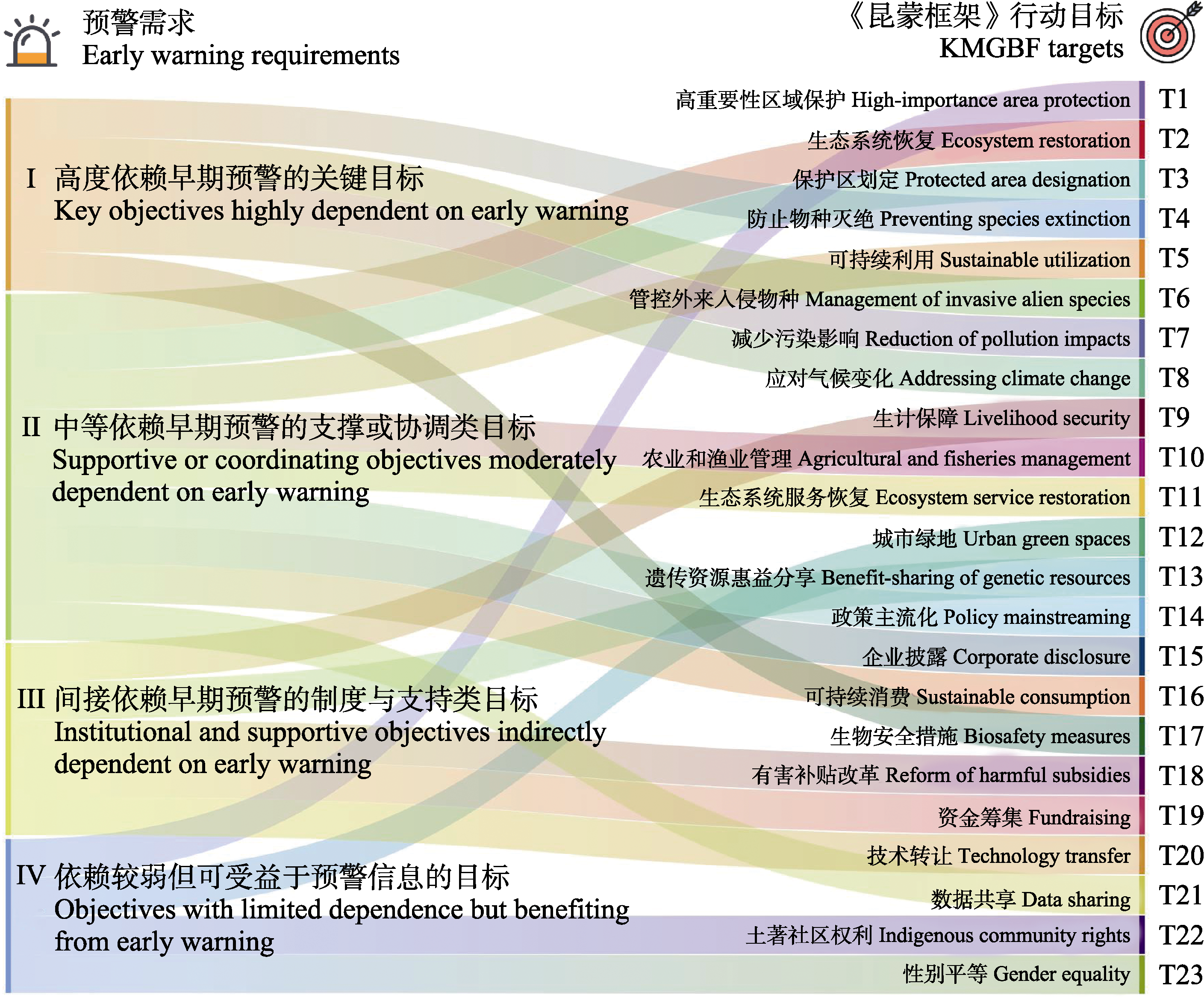
图1 《昆明-蒙特利尔全球生物多样性框架》与早期预警系统需求的关联性
Fig. 1 Correlation between the Kunming-Montreal Global Biodiversity Framework (KMGBF) and the requirements of the early warning system
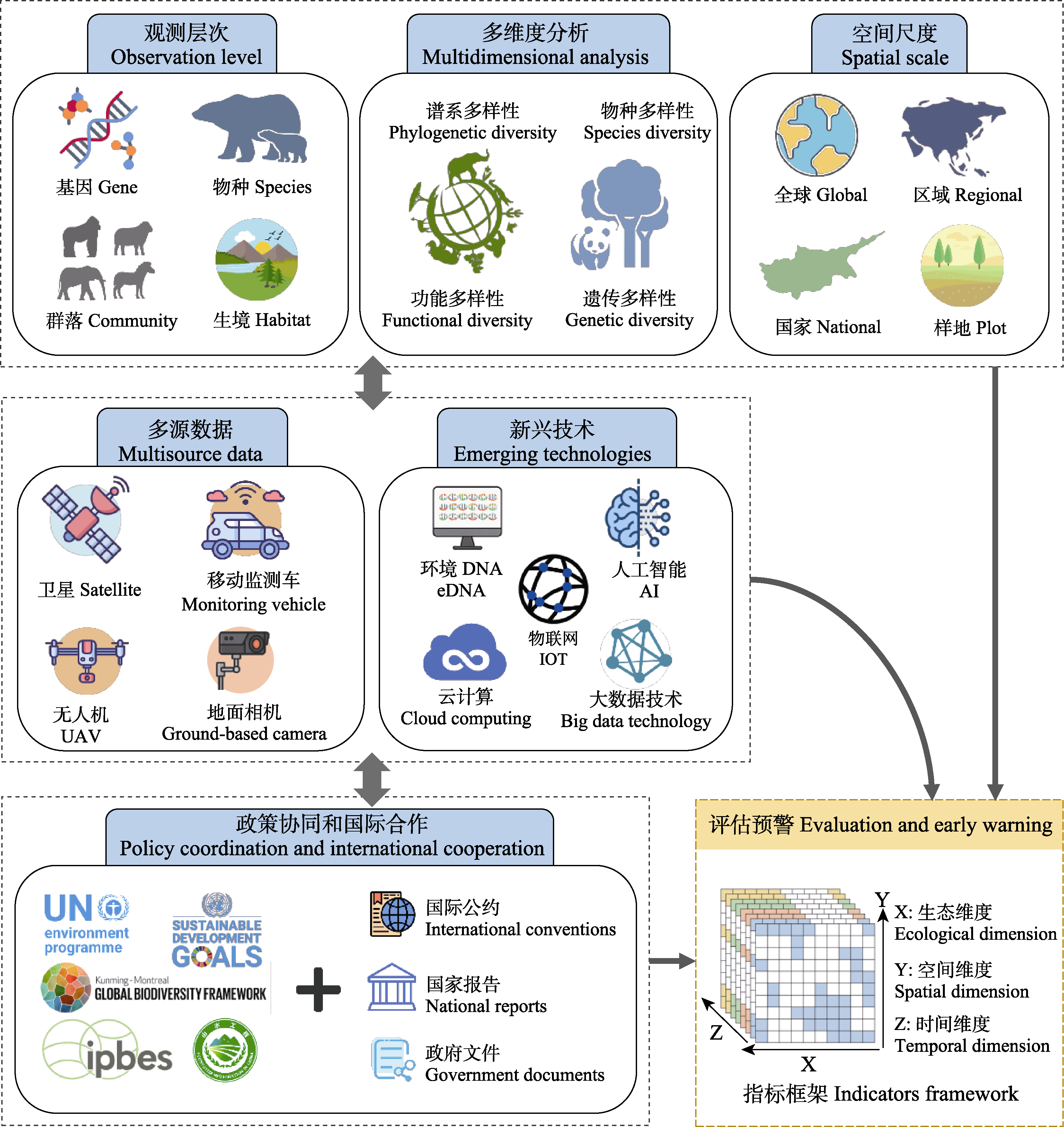
图2 面向《昆明-蒙特利尔全球生物多样性框架》的全球生物多样性早期预警体系
Fig. 2 Global biodiversity early warning system for the Kunming-Montreal Global Biodiversity Framework. AI, Artificial intelligence; eDNA, Environmental DNA; IOT, Internet of Things; UAV, Unmanned aerial vehicle.
| 序号 Number | 类别 Category | 指标参数 Indicator parameter |
|---|---|---|
| 1 | 生境条件 Habitat condition | 大气降水 Atmospheric precipitation |
| 2 | 地表温度 Surface temperature | |
| 3 | 高程 Elevation | |
| 4 | 土壤含水量 Soil moisture | |
| 5 | 生境结构 Habitat structure | 冰盖栖息地 Ice cover habitat |
| 6 | 城市栖息地 Urban habitat | |
| 7 | 土地覆盖 Land cover | |
| 8 | 地上生物量 Above-ground biomass | |
| 9 | 植被覆盖度 Fraction of vegetation cover | |
| 10 | 植被密度 Vegetation density | |
| 11 | 植被高度 Vegetation height | |
| 12 | 生境质量 Habitat quality | 生态系统破碎化 Ecosystem fragmentation |
| 13 | 生态系统结构差异 Ecosystem structural variance | |
| 14 | 碳循环 Carbon cycle | |
| 15 | 光合有效辐射吸收比率 Fraction of absorbed photosynthetically active radiation | |
| 16 | 总初级生产力 Gross primary productivity | |
| 17 | 净初级生产力 Net primary productivity | |
| 18 | 叶面积指数 Leaf area index | |
| 19 | 叶绿素含量与通量 Chlorophyll content and flux | |
| 20 | 蒸散发 Evapotranspiration | |
| 21 | 生态系统物候学 Ecosystem phenology | 返青期(季节开始) Green-up (start of season) |
| 22 | 峰值(季节最大值) Peak (maximum of season) | |
| 23 | 衰老期(季节结束) Senescence (end of season) | |
| 24 | 物种种群 Species population | 物种丰度 Species abundance |
| 25 | 相对物种丰度 Relative species abundance | |
| 26 | 种群密度 Population density | |
| 27 | 干扰影响 Interference impact | 极端天气频度及强度 The frequency and intensity of extreme weather events |
| 28 | 野火扰动的生物学影响 Biological effects of fire disturbance | |
| 29 | 生物干扰类型及影响程度 Types and severity of biological interference | |
| 30 | 非法活动类型及规模 Types and scale of illegal activities | |
| 31 | 背景完整度 Contextual intactness |
表1 全球生物多样性早期预警体系的指标设计
Table 1 Indicator design for the global biodiversity early warning system
| 序号 Number | 类别 Category | 指标参数 Indicator parameter |
|---|---|---|
| 1 | 生境条件 Habitat condition | 大气降水 Atmospheric precipitation |
| 2 | 地表温度 Surface temperature | |
| 3 | 高程 Elevation | |
| 4 | 土壤含水量 Soil moisture | |
| 5 | 生境结构 Habitat structure | 冰盖栖息地 Ice cover habitat |
| 6 | 城市栖息地 Urban habitat | |
| 7 | 土地覆盖 Land cover | |
| 8 | 地上生物量 Above-ground biomass | |
| 9 | 植被覆盖度 Fraction of vegetation cover | |
| 10 | 植被密度 Vegetation density | |
| 11 | 植被高度 Vegetation height | |
| 12 | 生境质量 Habitat quality | 生态系统破碎化 Ecosystem fragmentation |
| 13 | 生态系统结构差异 Ecosystem structural variance | |
| 14 | 碳循环 Carbon cycle | |
| 15 | 光合有效辐射吸收比率 Fraction of absorbed photosynthetically active radiation | |
| 16 | 总初级生产力 Gross primary productivity | |
| 17 | 净初级生产力 Net primary productivity | |
| 18 | 叶面积指数 Leaf area index | |
| 19 | 叶绿素含量与通量 Chlorophyll content and flux | |
| 20 | 蒸散发 Evapotranspiration | |
| 21 | 生态系统物候学 Ecosystem phenology | 返青期(季节开始) Green-up (start of season) |
| 22 | 峰值(季节最大值) Peak (maximum of season) | |
| 23 | 衰老期(季节结束) Senescence (end of season) | |
| 24 | 物种种群 Species population | 物种丰度 Species abundance |
| 25 | 相对物种丰度 Relative species abundance | |
| 26 | 种群密度 Population density | |
| 27 | 干扰影响 Interference impact | 极端天气频度及强度 The frequency and intensity of extreme weather events |
| 28 | 野火扰动的生物学影响 Biological effects of fire disturbance | |
| 29 | 生物干扰类型及影响程度 Types and severity of biological interference | |
| 30 | 非法活动类型及规模 Types and scale of illegal activities | |
| 31 | 背景完整度 Contextual intactness |
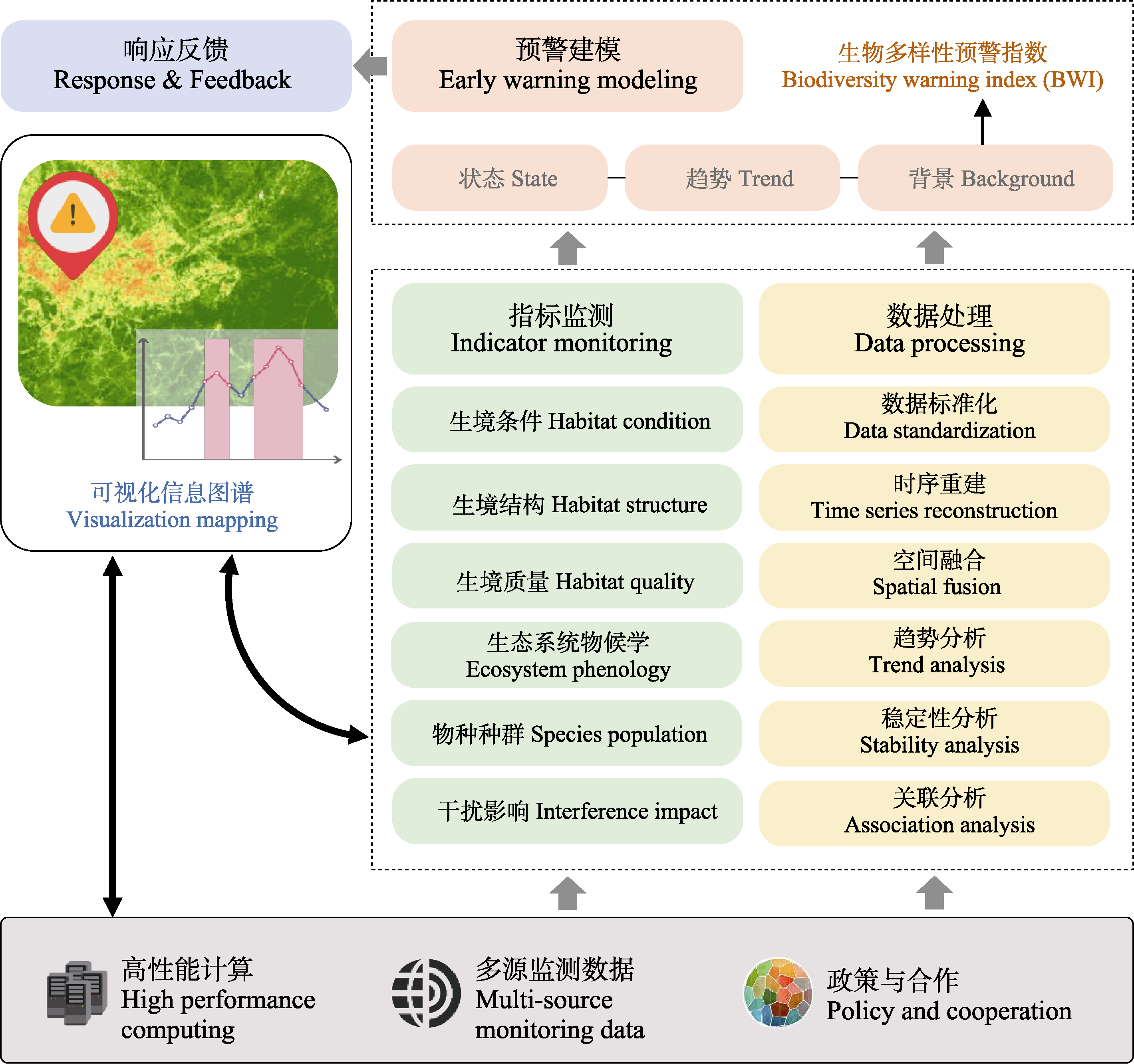
图3 生物多样性早期预警监测与评估系统
Fig. 3 Biodiversity early warning monitoring and assessment system
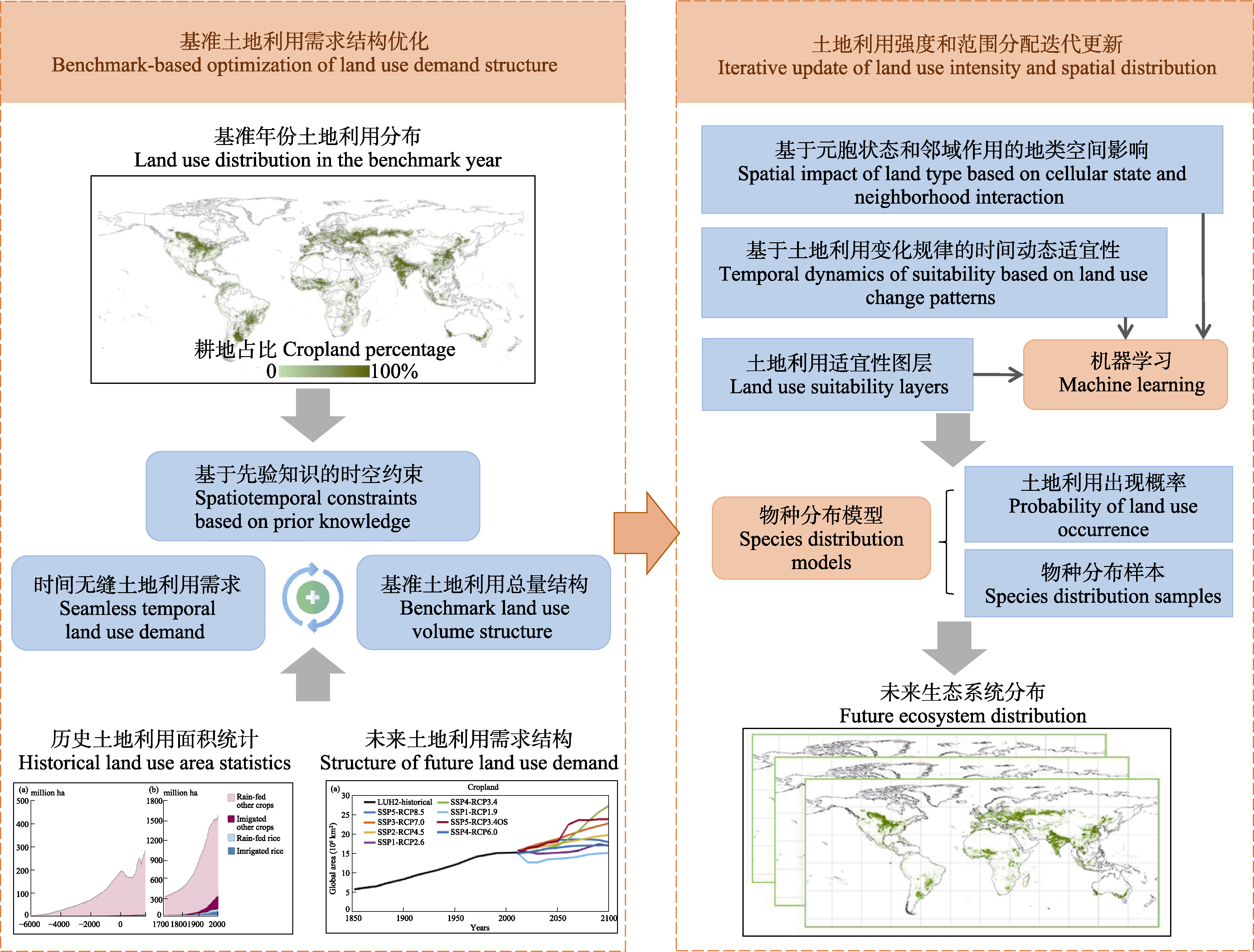
图4 未来情景土地利用模拟流程图
Fig. 4 Future scenario land use simulation flowchart
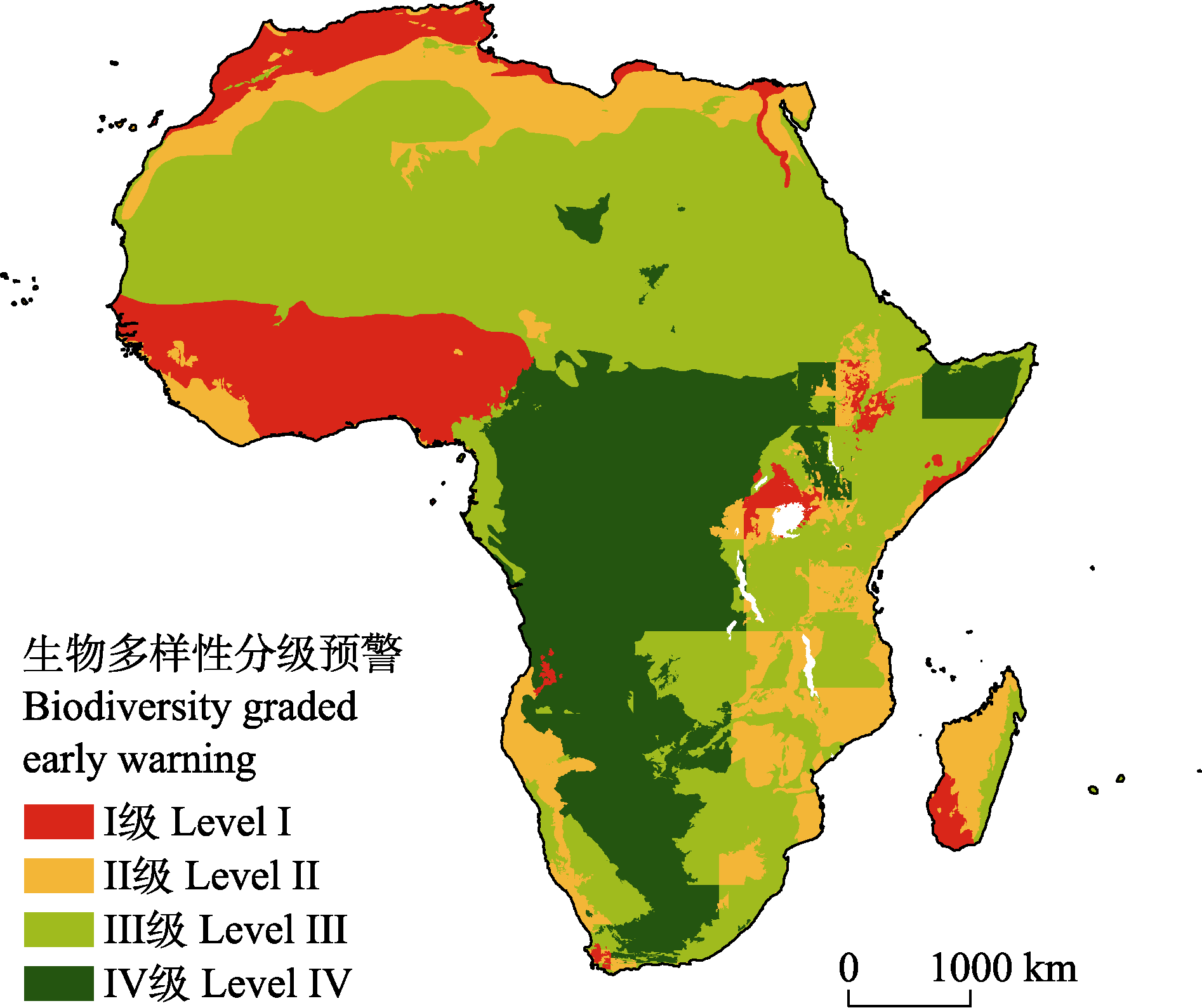
图5 非洲区域生态分区尺度下的生物多样性早期预警结果
Fig. 5 Early warning results of biodiversity at the ecological zoning scale in the African region
| [1] |
Abbott I, Le Maitre D (2010) Monitoring the impact of climate change on biodiversity: The challenge of megadiverse Mediterranean climate ecosystems. Austral Ecology, 35, 406-422.
DOI URL |
| [2] |
Antonelli A, Dhanjal-Adams KL, Silvestro D (2023) Integrating machine learning, remote sensing and citizen science to create an early warning system for biodiversity. Plants, People, Planet, 5, 307-316.
DOI URL |
| [3] |
Barnard P, Altwegg R, Ebrahim I, Underhill LG (2017) Early warning systems for biodiversity in southern Africa—How much can citizen science mitigate imperfect data? Biological Conservation, 208, 183-188.
DOI URL |
| [4] |
Burgess ND, Ali N, Bedford J, Bhola N, Brooks S, Cierna A, Correa R, Harris M, Hargey A, Hughes J, McDermott-Long O, Miles L, Ravilious C, Rodrigues AR, van Soesbergen A, Sihvonen H, Seager A, Swindell L, Vukelic M, Durán AP, Green JMH, West C, Weatherdon LV, Hawkins F, Brooks TM, Kingston N, Butchart SHM (2024) Global metrics for terrestrial biodiversity. Annual Review of Environment and Resources, 49, 673-709.
DOI URL |
| [5] |
Cardinale B (2012) Impacts of biodiversity loss. Science, 336, 552-553.
DOI PMID |
| [6] | Cardinale BJ, Duffy JE, Gonzalez A, Hooper DU, Perrings C, Venail P, Narwani A, Mace GM, Tilman D, Wardle DA, Kinzig AP, Daily GC, Loreau M, Grace JB, Larigauderie A, Srivastava DS, Naeem S (2012) Biodiversity loss and its impact on humanity. Nature, 486, 59-67. |
| [7] | CBD (Convention on Biological Diversity) (2022) Kunming-Montreal Global Biodiversity Framework. https://www.cbd.int/doc/decisions/cop-15/cop-15-dec-04-en.pdf/. (accessed on 2025-06-01) |
| [8] | Chaplin-Kramer R, Brauman KA, Cavender-Bares J, Díaz S, Duarte GT, Enquist BJ, Garibaldi LA, Geldmann J, Halpern BS, Hertel TW, Khoury CK, Krieger JM, Lavorel S, Mueller T, Neugarten RA, Pinto-Ledezma J, Polasky S, Purvis A, Reyes-García V, Roehrdanz PR, Shannon LJ, Shaw MR, Strassburg BBN, Tylianakis JM, Verburg PH, Visconti P, Zafra-Calvo N (2022) Conservation needs to integrate knowledge across scales. Nature Ecology & Evolution, 6, 118-119. |
| [9] | Chew YJ, Ooi SY, Pang YH (2025) AI in Disaster Monitoring and Early Warning Systems. In: The Smart Life Revolution, pp. 83-100. CRC Press, London. |
| [10] | Díaz SM, Settele J, Brondízio E, Ngo H, Guèze M, Agard J, Arneth A, Balvanera P, Brauman K, Butchart S, Chan K, Garibaldi LA, Ichii K, Liu J, Subramanian S, Midgley G, Miloslavich P, Molnár Z, Obura D, Pfaff A, Polasky S, Purvis A, Razzaque J, Reyers B, Roy Chowdhury R, Shin Y, Visseren-Hamakers I, Willis K, Zayas C (2019) The Global Assessment Report on Biodiversity and Ecosystem Services: Summary for Policy Makers. Bonn, Germany. |
| [11] | Du ZR, Yu L, Arvor D, Li XY, Cao X, Zhong LH, Zhao Q, Ma XR, Wang HY, Liu XX, Zhang MJ, Xu B, Gong P (2024) Dual data- and knowledge-driven land cover mapping framework for monitoring annual and near-real-time changes. IEEE Transactions on Geoscience and Remote Sensing, 62, 4411314. |
| [12] | Egerton P (2022) Early Warnings for All: The UN Global Early Warning Initiative for the Implementation of Climate Adaptation. World Meteorological Organization, Geneva, Switzerland. |
| [13] |
Feng X, Merow C, Liu ZH, Park DS, Roehrdanz PR, Maitner B, Newman EA, Boyle BL, Lien A, Burger JR, Pires MM, Brando PM, Bush MB, McMichael CNH, Neves DM, Nikolopoulos EI, Saleska SR, Hannah L, Breshears DD, Evans TP, Soto JR, Ernst KC, Enquist BJ (2021) How deregulation, drought and increasing fire impact Amazonian biodiversity. Nature, 597, 516-521.
DOI |
| [14] | Fu CC, Steckbauer A, Mann H, Duarte CM (2024) Achieving the Kunming-Montreal Global Biodiversity Targets for blue carbon ecosystems. Nature Reviews Earth & Environment, 5, 538-552. |
| [15] | Gao JX, Wan HW, Lu LH, Wang YC, Shi PR, Zhang ZR, Xiao C (2025) Research on the construction of China’s monitoring technology system for biodiversity based on ‘multilevel platform’ collaboration. Research of Environmental Sciences, 38(1), 18-28. (in Chinese with English abstract) |
| [高吉喜, 万华伟, 卢龙辉, 王永财, 施佩荣, 张志如, 肖翠 (2025) “五基”协同生物多样性监测技术体系构建研究. 环境科学研究, 38(1), 18-28.] | |
| [16] | Harrison JB, Sunday JM, Rogers SM (2019) Predicting the fate of eDNA in the environment and implications for studying biodiversity. Proceedings of the Royal Society B: Biological Sciences, 286, 20191409. |
| [17] | Hisano M, Searle EB, Chen HYH (2018) Biodiversity as a solution to mitigate climate change impacts on the functioning of forest ecosystems. Biological Reviews, 93, 439-456. |
| [18] |
Hughes AC (2023) Developing biodiversity baselines to develop and implement future conservation targets. Plants, 12, 2291.
DOI URL |
| [19] | IPBES (Intergovernmental Science-Policy Platform on Biodiversity and Ecosystem Services) (2019) Summary for Policymakers of the Global Assessment Report on Biodiversity and Ecosystem Services of the Intergovernmental Science-Policy Platform on Biodiversity and Ecosystem Services. IPBES Secretariat, Bonn, Germany. |
| [20] |
Jetz W, Thomas GH, Joy JB, Hartmann K, Mooers AO (2012) The global diversity of birds in space and time. Nature, 491, 444-448.
DOI |
| [21] |
Jiang XY, Xu JY, Sheng XM, Zhu Y (2025) Synergies and differences between the China National Biodiversity Conservation Strategy and Action Plan (2023-2030) and the Kunming-Montreal Global Biodiversity Framework. Biodiversity Science, 33, 24575. (in Chinese with English abstract)
DOI URL |
|
[姜雪原, 徐嘉忆, 盛学敏, 朱源 (2025) 《中国生物多样性保护战略与行动计划(2023-2030年)》与《昆蒙框架》的协同与差异. 生物多样性, 33, 24575.]
DOI |
|
| [22] |
Keith DA, Mahony M, Hines H, Elith J, Regan TJ, Baumgartner JB, Hunter D, Heard GW, Mitchell NJ, Parris KM, Penman T, Scheele B, Simpson CC, Tingley R, Tracy CR, West M, Akçakaya HR (2014) Detecting extinction risk from climate change by IUCN Red List criteria. Conservation Biology, 28, 810-819.
DOI PMID |
| [23] |
Kuenzer C, Ottinger M, Wegmann M, Guo HD, Wang CL, Zhang JZ, Dech S, Wikelski M (2014) Earth observation satellite sensors for biodiversity monitoring: Potentials and bottlenecks. International Journal of Remote Sensing, 35, 6599-6647.
DOI URL |
| [24] |
Li QY, Ge YX, Sayer JA (2023) Challenges to implementing the Kunming-Montreal Global Biodiversity Framework. Land, 12, 2166.
DOI URL |
| [25] | Lopoukhine N, Crawhall N, Dudley N, Figgis P, Karibuhoye C, Laffoley D, Londoño JM, MacKinnon K, Sandwith T (2012) Protected areas: Providing natural solutions to 21st Century challenges. Surveys and Perspectives Integrating Environment and Society, 5, 117-131. |
| [26] |
Ma KP (2023) Kunming-Montreal Global Biodiversity Framework: An important global agenda for biodiversity conservation. Biodiversity Science, 31, 23133. (in Chinese)
DOI |
|
[马克平 (2023) 《昆明-蒙特利尔全球生物多样性框架》是重要的全球生物多样性保护议程. 生物多样性, 31, 23133.]
DOI |
|
| [27] | Mi XC, Feng G, Hu YB, Zhang J, Chen L, Corlett RT, Hughes AC, Pimm S, Schmid B, Shi SH, Svenning JC, Ma KP (2021) The global significance of biodiversity science in China: An overview.National Science Review, 8, nwab032. |
| [28] |
Newbold T, Hudson LN, Hill SLL, Contu S, Lysenko I, Senior RA, Börger L, Bennett DJ, Choimes A, Collen B, Day J, De Palma A, Díaz S, Echeverria-Londoño S, Edgar MJ, Feldman A, Garon M, Harrison MLK, Alhusseini T, Ingram DJ, Itescu Y, Kattge J, Kemp V, Kirkpatrick L, Kleyer M, Correia DLP, Martin CD, Shai MR, Novosolov M, Yuan P, Phillips HRP, Purves DW, Robinson A, Simpson J, Tuck SL, Weiher E, White HJ, Ewers RM, Mace GM, Scharlemann JPW, Purvis A (2015) Global effects of land use on local terrestrial biodiversity. Nature, 520, 45-50.
DOI |
| [29] |
Obura D (2023) The Kunming-Montreal Global Biodiversity Framework: Business as usual or a turning point? One Earth, 6, 77-80.
DOI URL |
| [30] |
Pereira HM, Ferrier S, Walters M, Geller GN, Jongman RHG, Scholes RJ, Bruford MW, Brummitt N, Butchart SHM, Cardoso AC, Coops NC, Dulloo E, Faith DP, Freyhof J, Gregory RD, Heip C, Höft R, Hurtt G, Jetz W, Karp DS, McGeoch MA, Obura D, Onoda Y, Pettorelli N, Reyers B, Sayre R, Scharlemann JPW, Stuart SN, Turak E, Walpole M, Wegmann M (2013) Essential biodiversity variables. Science, 339, 277-278.
DOI PMID |
| [31] | Quansah JE, Engel B, Rochon GL (2010) Early warning systems: A review. Journal of Terrestrial Observation, 2, 5. |
| [32] |
Shih WY, Mabon L, Puppim de Oliveira JA (2020) Assessing governance challenges of local biodiversity and ecosystem services: Barriers identified by the expert community. Land Use Policy, 91, 104291.
DOI URL |
| [33] |
Silvestro D, Goria S, Sterner T, Antonelli A (2022) Improving biodiversity protection through artificial intelligence. Nature Sustainability, 5, 415-424.
DOI PMID |
| [34] |
Simelton E, Carew-Reid J, Coulier M, Damen B, Howell J, Pottinger-Glass C, Tran HV, van der Meiren M (2021) NBS framework for agricultural landscapes. Frontiers in Environmental Science, 9, 678367.
DOI URL |
| [35] | Skidmore AK, Coops NC, Neinavaz E, Ali A, Schaepman ME, Paganini M, Kissling WD, Vihervaara P, Darvishzadeh R, Feilhauer H, Fernandez M, Fernández N, Gorelick N, Geijzendorffer I, Heiden U, Heurich M, Hobern D, Holzwarth S, Muller-Karger FE, Van De Kerchove R, Lausch A, Leitão PJ, Lock MC, Mücher CA, O’Connor B, Rocchini D, Roeoesli C, Turner W, Vis JK, Wang TJ, Wegmann M, Wingate V (2021) Priority list of biodiversity metrics to observe from space. Nature Ecology & Evolution, 5, 896-906. |
| [36] | Thenmozhi E, Jeya MR, Meenakshi L, Elakya V, Devi R, Rejees JD, Hemalatha D, Divyalakshmi V (2025) Harnessing the Transformative Power of AI for Enhanced Disaster Prediction and Comprehensive Risk Assessment. In: Harnessing AI in Geospatial Technology for Environmental Monitoring and Management, pp. 177-200. IGI Global Scientific Publishing, Hershey, Pennsylvania. |
| [37] | Tian Y, Li JS (2024) Analysis of the connotation and implementation path for the 30 by 30 target in the Kunming-Montreal Global Biodiversity Framework. Biodiversity Science, 32, 24086. (in Chinese with English abstract) |
|
[田瑜, 李俊生 (2024) 《昆明-蒙特利尔全球生物多样性框架》“3030”目标的内涵及实现路径分析. 生物多样性, 32, 24086.]
DOI |
|
| [38] | UN/ISDR (2006) Developing Early Warning Systems: A Checklist. Presented at the Third International Conference on Early Warning (EWC III), 27-29 March 2006, Bonn, Germany. |
| [39] | United Nations Office for Disaster Risk Reduction, World Meteorological Organization (2024) Global Status of Multi-Hazard Early Warning Systems. Geneva, Switzerland. |
| [40] |
Wei FW, Wu Q, Hu YB, Huang GP, Nie YG, Yan L (2019) Conservation metagenomics: A new branch of conservation biology. Science China: Life Sciences, 62, 168-178.
DOI |
| [41] | Wu H, Yu L, Shen XL, Watson JEM, Wan HW, Cao Y, Hua T, Liu T, Zhao JQ, Liu JG, Gao JX, Ma KP (2025) Bridging conservation gaps under climate change at multiple scales to protect 30% of Earth’s surface by 2030. Conservation Biology, 39, e70054. |
| [42] |
Wu H, Yu Y, Du ZR, Zhao Q, Qi WC, Cao Y, Wang JZ, Shen XL, Sun Y, Ma KP (2025) Rapid assessment of the Kunming-Montreal Global Biodiversity Framework implementation progress based on remote sensing monitoring: Pathway and prospects. Biodiversity Science, 33, 24526. (in Chinese with English abstract)
DOI |
|
[武慧, 俞乐, 杜贞容, 赵强, 戚文超, 曹越, 王金洲, 申小莉, 孙尧, 马克平 (2025) 基于遥感监测的《昆蒙框架》执行进展快速评估: 路径与展望. 生物多样性, 33, 24526.]
DOI |
|
| [43] | WWF (World Wide Fund for Nature) (2024) Living Planet Report 2024—A System in Peril. WWF, Gland, Switzerland. |
| [44] | Xie ZQ, Zhang YJ, Wang YQ, Ge JL, Xu WT, Xiong GM, Xu K, Mao JT, Chen SQ, Feng Z (2023) Biodiversity maintenance and warning technology in rural ecological landscapes. Chinese Journal of Eco-Agriculture, 31, 1873-1882. (in Chinese with English abstract) |
| [谢宗强, 张玉钧, 王义强, 葛结林, 徐文婷, 熊高明, 徐凯, 毛江涛, 陈思淇, 冯致 (2023) 乡村生态景观生物多样性维护与预警技术研究. 中国生态农业学报(中英文), 31, 1873-1882.] | |
| [45] |
Xu J, Wang JZ (2023) Analysis of the main elements and implications of the Kunming-Montreal Global Biodiversity Framework. Biodiversity Science, 31, 23020. (in Chinese with English abstract)
DOI |
|
[徐靖, 王金洲 (2023) 《昆明-蒙特利尔全球生物多样性框架》主要内容及其影响. 生物多样性, 31, 23020.]
DOI |
|
| [46] | Xu WT, Xie ZQ, Ge JL, Xu K, Xiong GM, Mao JT (2023) Biodiversity early warning of rural ecological landscape based on DPSIR model. Chinese Journal of Eco-Agriculture, 31, 1943-1952. (in Chinese with English abstract) |
| [徐文婷, 谢宗强, 葛结林, 徐凯, 熊高明, 毛江涛 (2023) 基于DPSIR模型的乡村生态景观生物多样性预警. 中国生态农业学报(中英文), 31, 1943-1952.] | |
| [47] | Yu L, Du ZR, Dong RM, Zheng JP, Tu Y, Chen X, Hao PY, Zhong B, Peng DL, Zhao JY, Li XY, Yang JY, Fu HH, Yang GW, Gong P (2022) FROM-GLC Plus: Toward near real-time and multi-resolution land cover mapping. GIScience & Remote Sensing, 59, 1026-1047. |
| [48] |
Yu L, Du ZR, Li XY, Zhao Q, Wu H, weise DJ, Yuan XQ, Yang YZ, Cai WH, Song WM, Wang P, Zhao ZC, Long Y, Zhang YG, Peng JB, Xin XP, Xu F, Shen MG, Wang H, Jiao YM, Li TT, Sun ZT, Zhao YG, Fang MY, Peng DL, Wu CY, Li S, Shen XL, Ma KP, Lin GH, Luo Y (2024) Near surface camera informed agricultural land monitoring for climate smart agriculture. Climate Smart Agriculture, 1, 100008.
DOI URL |
| [49] |
Yu L, Du ZR, Li XY, Zheng JH, Zhao Q, Wu H, weise DJ, Yang YZ, Zhang Q, Li XY, Ma XR, Huang XM (2025) Enhancing global agricultural monitoring system for climate-smart agriculture. Climate Smart Agriculture, 2, 100037.
DOI URL |
| [1] | 梁竣策, 李开枝, 谭烨辉. 南海翼足类物种多样性与分布[J]. 生物多样性, 2026, 34(5): 25487-. |
| [2] | 周丽洁, 郝珉辉, 何怀江, 程艳霞, 张春雨, 赵秀海. 小兴安岭森林β多样性格局、组分及其影响因素[J]. 生物多样性, 2026, 34(4): 25443-. |
| [3] | 彭昀月, 彭奎, 刘昕然, 孙天怡, 张小全. 生物多样性信用的企业参与途径、市场发展障碍与建议[J]. 生物多样性, 2026, 34(4): 26031-. |
| [4] | 李伯尧, 盛天成, 幸小云. 生物多样性风险对企业财务绩效的影响: 来自中国上市公司的证据[J]. 生物多样性, 2026, 34(4): 25330-. |
| [5] | 刘昊, 张玉霄, 刘冰, 李飞飞, 马洪峥, 覃海宁, 李德铢, 陈文俐. 中国禾本科植物多样性及其物种名录[J]. 生物多样性, 2026, 34(4): 25438-. |
| [6] | 孔孜亦, 王德港, 王建涛, 裴志永, 孙晶, 张长春, 张军国. 基于SCD-HRNet模型的野生动物姿态估计及其在生物多样性监测中的应用: 以内蒙古赛罕乌拉地区为例[J]. 生物多样性, 2026, 34(4): 25287-. |
| [7] | 朱浩友, 周友兵, 罗怡, 周昭敏. 南充市城区繁殖鸟类群落20年前后的变化[J]. 生物多样性, 2026, 34(3): 24560-. |
| [8] | 侯姝彧, 刘盈盈, 杨锐. 《昆蒙框架》背景下国际OECMs体系构建实践进展及中国化思路[J]. 生物多样性, 2026, 34(3): 25264-. |
| [9] | 程晓帆, 李青媛, 李媛辉, 张明祥. 外来入侵物种治理政策体系的困境与出路[J]. 生物多样性, 2026, 34(2): 25332-. |
| [10] | 陈璐露, 汤皓婷, 冷红, 袁青, 杨昕悦. 城市街区建成环境对生物多样性的影响[J]. 生物多样性, 2026, 34(2): 25286-. |
| [11] | 高雯琪, 向景荣, 赵耀, 范灵霜, 谷圆, 邵韦涵, 李高俊, 赵光军, 陈明斌, 蔡杏伟, 陈凯. 海南热带雨林国家公园黎母山和尖峰岭溪流鱼类群落特征及其对土地利用的响应[J]. 生物多样性, 2026, 34(2): 25374-. |
| [12] | 卢晓强, 芮丹, 张江峰, 尹冰鑫, 王雨露, 岑雨婷, 崔怡晨, 杨万霞. 氮输入驱动的关键生态过程对生物多样性的影响及其管理启示[J]. 生物多样性, 2026, 34(2): 25368-. |
| [13] | 谭廷鸿, 高帆, 杨雨, 肖群英, 吴春芳, 邱娜, 赵宁宁, 周敏, 康公平, 卢志宏, 高健强, 杨红, 杨传东, 邓春英. 中国西南喀斯特地区大型真菌物种编目[J]. 生物多样性, 2026, 34(2): 25281-. |
| [14] | 章旭日, 罗标, 赵彤, 黄丹, 艾为明. 浙江鱼类多样性: 编目、分布与保护[J]. 生物多样性, 2026, 34(2): 25225-. |
| [15] | 刘海鸥, 郝志明, 杜乐山, 刘文慧, 李子圆, 刘蕾. 全球生物多样性框架基金运行进展、挑战与启示[J]. 生物多样性, 2026, 34(2): 25463-. |
| 阅读次数 | ||||||
|
全文 |
|
|||||
|
摘要 |
|
|||||
备案号:京ICP备16067583号-7
Copyright © 2026 版权所有 《生物多样性》编辑部
地址: 北京香山南辛村20号, 邮编:100093
电话: 010-62836137, 62836665 E-mail: biodiversity@ibcas.ac.cn
