

生物多样性 ›› 2008, Vol. 16 ›› Issue (6): 578-585. DOI: 10.3724/SP.J.1003.2008.08195 cstr: 32101.14.SP.J.1003.2008.08195
所属专题: 生物入侵
陈立立, 余岩, 何兴金( )
)
收稿日期:2008-08-09
接受日期:2008-11-11
出版日期:2008-11-20
发布日期:2008-11-20
通讯作者:
何兴金
基金资助:
Lili Chen, Yan Yu, Xingjin He()
Received:2008-08-09
Accepted:2008-11-11
Online:2008-11-20
Published:2008-11-20
Contact:
Xingjin He
About author:* E-mail: xjhe@scu.edu.cn摘要:
喜旱莲子草(Alternanthera philoxeroides)是苋科莲子草属的一种多年生草本植物, 原产于南美洲, 19世纪末侵入我国以后, 经过50年左右的停滞期, 在我国中部和南部的广大区域迅速蔓延传播, 已成为我国分布最广、危害最为严重的杂草之一, 目前分布范围仍在扩大。本研究基于大量的标本分布数据, 使用生态位模型(GARP)对其在中国的潜在扩散区域进行了预测。结果表明: 喜旱莲子草抗逆性较强, 坡度、汇流累积量、年均温、年降雨量对其分布影响较大; 而海拔、日照等对其分布影响较小。目前, 喜旱莲子草的潜在入侵区仍大于实际分布区, 因此, 预测该物种还将会继续扩散。容易被入侵的地区包括了除青海、西藏、四川西部、新疆南部、甘肃西部、吉林、黑龙江、内蒙古北部以及海南以外的中国大部分地区, 其中陕西、山西以及甘肃东南部不仅属于最易被入侵的地区, 且邻近地区已被入侵, 因此应采取紧急措施防止喜旱莲子草侵入和扩散。
陈立立, 余岩, 何兴金 (2008) 喜旱莲子草在中国的入侵和扩散动态及其潜在分布区预测. 生物多样性, 16, 578-585. DOI: 10.3724/SP.J.1003.2008.08195.
Lili Chen, Yan Yu, Xingjin He (2008) Historical invasion and expansion process of Alternanthera philoxeroides and its potential spread in China. Biodiversity Science, 16, 578-585. DOI: 10.3724/SP.J.1003.2008.08195.
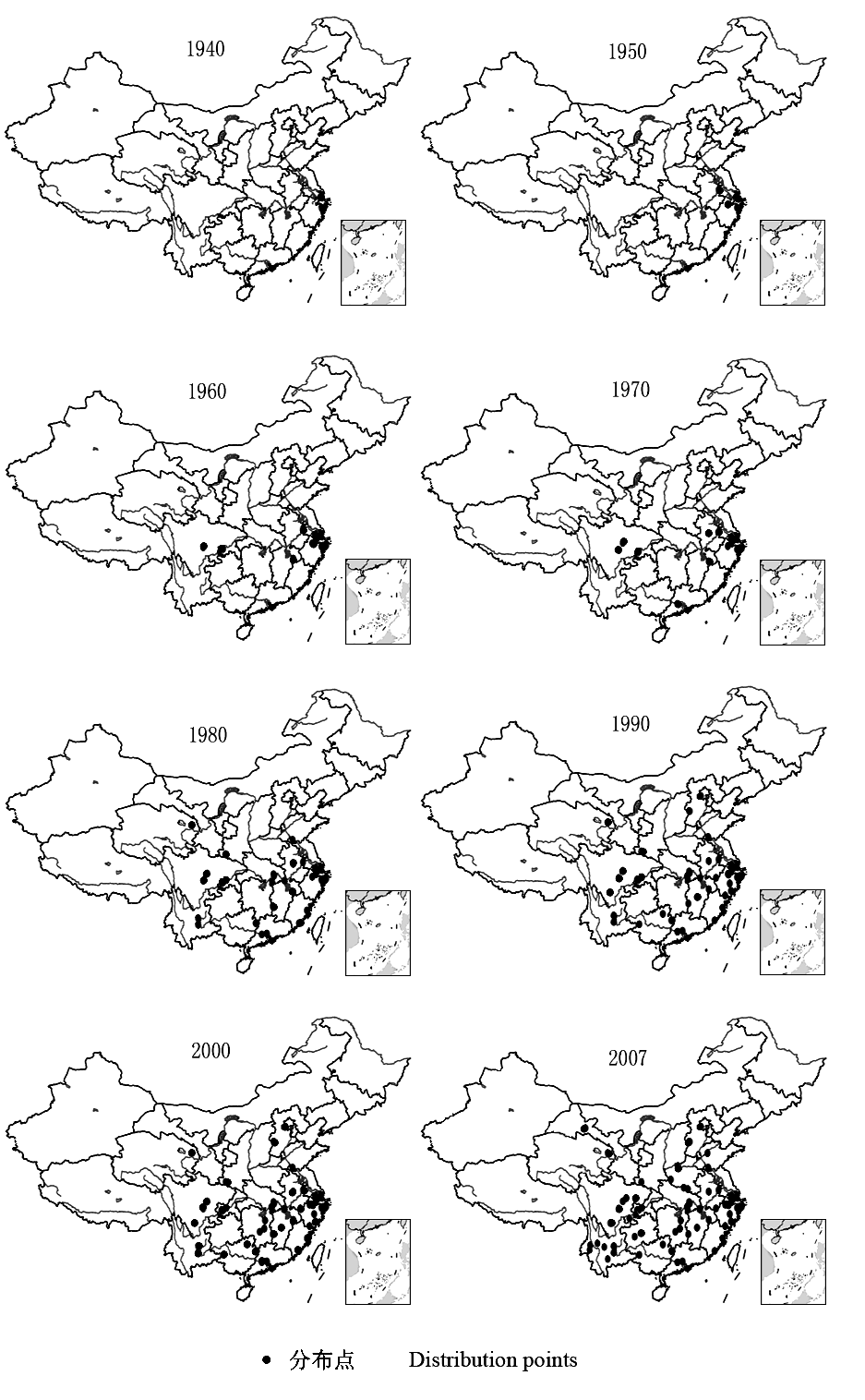
图1 喜旱莲子草在中国的分布动态图
Fig. 1 Historical invasion and expansion process of Alternanthera philoxeroides in China
| 环境因子 Environmental parameters | 影响 Effect | 遗漏误差 Omission error | 是否采用 Contain or not |
|---|---|---|---|
| 坡度 Slope | 显著 Significant | 1.2125 | + |
| 汇流累积量 Flow accumulation | 显著 Significant | 1.1438 | + |
| 年均温 Mean annual temperature (1961-1990) | 显著 Significant | 1.1307 | + |
| 年降雨量 Annual precipitation (1961-1990) | 显著 Significant | 1.1087 | + |
| 水汽压 Water vapour pressure (1961-1990) | 一般 Limited | 0.9353 | + |
| 极端低温 Minimum temperature (1961-1990) | 一般 Limited | 0.9335 | + |
| 极端高温 Maximum temperature (1961-1990) | 一般 Limited | 0.9263 | + |
| 水流方向 Flow direction | 一般 Limited | 0.9259 | + |
| 雨日频率 Wet days (1961-1990) | 一般 Limited | 0.9157 | + |
| 地形指数 Topographic index | 一般 Limited | 0.9063 | + |
| 坡向 Aspect | 一般 Limited | 0.8989 | + |
| 霜日频率 Frost days (1961-1990) | 一般 Limited | 0.8958 | + |
| 太阳辐射 Solar radiation (1961-1990) | 误差 Uninfluential | 0.6018 | - |
| 海拔 Elevation | 误差 Uninfluential | 0.5726 | - |
表1 影响喜旱莲子草分布区预测的生态位模型参数
Table 1 Environmental parameters influencing the prediction of distribution of Alternanthera philoxeroides
| 环境因子 Environmental parameters | 影响 Effect | 遗漏误差 Omission error | 是否采用 Contain or not |
|---|---|---|---|
| 坡度 Slope | 显著 Significant | 1.2125 | + |
| 汇流累积量 Flow accumulation | 显著 Significant | 1.1438 | + |
| 年均温 Mean annual temperature (1961-1990) | 显著 Significant | 1.1307 | + |
| 年降雨量 Annual precipitation (1961-1990) | 显著 Significant | 1.1087 | + |
| 水汽压 Water vapour pressure (1961-1990) | 一般 Limited | 0.9353 | + |
| 极端低温 Minimum temperature (1961-1990) | 一般 Limited | 0.9335 | + |
| 极端高温 Maximum temperature (1961-1990) | 一般 Limited | 0.9263 | + |
| 水流方向 Flow direction | 一般 Limited | 0.9259 | + |
| 雨日频率 Wet days (1961-1990) | 一般 Limited | 0.9157 | + |
| 地形指数 Topographic index | 一般 Limited | 0.9063 | + |
| 坡向 Aspect | 一般 Limited | 0.8989 | + |
| 霜日频率 Frost days (1961-1990) | 一般 Limited | 0.8958 | + |
| 太阳辐射 Solar radiation (1961-1990) | 误差 Uninfluential | 0.6018 | - |
| 海拔 Elevation | 误差 Uninfluential | 0.5726 | - |
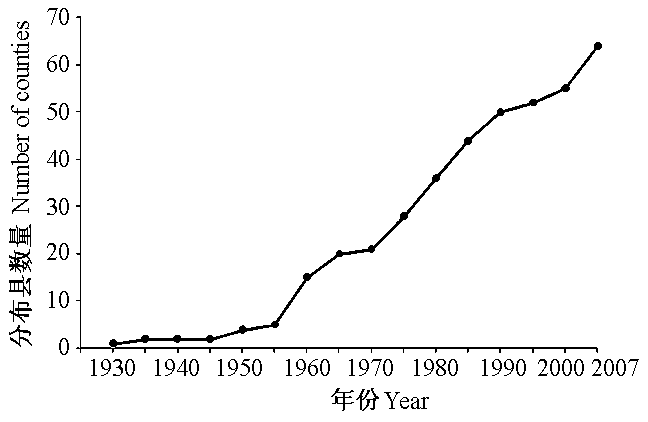
图2 喜旱莲子草在中国入侵地点数量随时间变化曲线
Fig. 2 Changes of the number of invaded counties with time
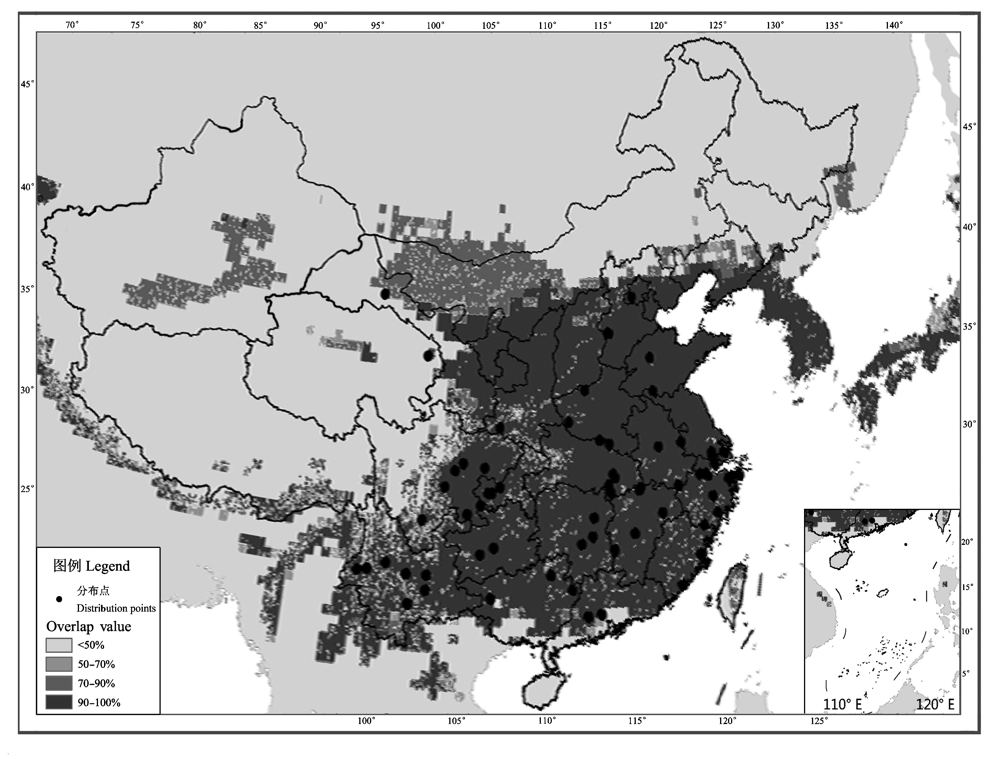
图3 生态位模型预测喜旱莲子草在我国的适生区图
Fig. 3 Potential range prediction for Alternanthera philoxeroides applied GARP ecological niche model
| [1] | Buckingham GR (1996) Biological control of alligatorweed, Alternanthera philoxeroides, the world’s first aquatic weed success story. Castanea, 61,232-243. |
| [2] | Fertig W, Reiners WA (2002) Predicting presence/absence of plant species for range mapping:a case study from Wyoming. In: Predicting Species Occurrences: Issues of Accuracy and Scale (eds Scott JM, Heglund PJ, Morrison ML, Haufler JB, Raphael MG, Wall WA, Samson FB), pp.483-489. Island Press, Washington, DC. |
| [3] | Fleishman E, MacNally R, Fay JP, Murphy DD (2001) Modeling and predicting species occurrences using broad-scale environmental variables: an example with butterflies of the Great Basin. Conservation Biology, 15,1674-1685. |
| [4] | Geng YP, Pan XY, Xu CY, Zhang WJ, Li B, Chen JK, Lu BR, Song ZP (2007) Phenotypic plasticity rather than locally adapted ecotypes allows invasive alligator weed to colonize a wide range of habitats. Biological Invasions, 9,245-256. |
| [5] | Hijmans RJ, Cameron SE, Parra JL, Jones PG, Jarvis A (2004) The WorldClim Interpolated Global Terrestrial Climate Surfaces. Version 1. 3. Available at http://biogeo.berkeley.edu (June 2008) |
| [6] | Julien MH, Broadbent JE (1980) The biology of Australian weeds. 3. Alternanthera philoxeroides (Mart.) Griseb. Journal of the Australian Institute of Agricultural Science, 46,150-155. |
| [7] | Julien MH, Skarratt B, Maywald GF (1995) Potential geographical distribution of alligator weed and its biological control by Agasicles hygrophila. Journal of Aquatic Plant Management, 33,55-60. |
| [8] | Kay SH, Haller WT (1982) Evidence for the existence of distinct alligator weed biotypes. Journal of Aquatic Plant Management, 20,37-41. |
| [9] | Li J, Ye WH (2006) Genetic diversity of alligator weed ecotypes is not the reason for their different responses to biological control. Aquatic Botany, 85,155-158. |
| [10] | Li YH (李扬汉) (1998) Weeds of China (中国杂草志), pp.81-82. China Agriculture Press, Beijing. (in Chinese) |
| [11] | Li ZY (李振宇), Xie Y (解焱) (2002) Invasive Alien Species in China (中国外来入侵种). China Forestry Publishing House, Beijing. (in Chinese) |
| [12] | Lin GL (林冠伦), Yang YZ (杨益众) (1990) Studies on biology and control of Alternanthera philoxeroides. Journal of Yangzhou University (Agriculture and Life Sciences Edition) (扬州大学学报(农业与生命科学版)), 11(2),57-62. (in Chinese with English abstract) |
| [13] | Longstreth DJ, Bolanos JA, Goddard RH (1985) Photosynthetic rate and mesophyll surface area in expanding leaves of Alternanthera philoxeroides grown at two light levels. American Journal of Botany, 72,14-19. |
| [14] | Longstreth DJ, Mason CB (1984) The effect of light on growth and dry matter allocation patterns of Alternanthera philoxeroides (Mart.) Griseb. Botany Gazette, 145,105-109. |
| [15] | Lou YL (娄远来), Deng YY (邓渊钰), Shen JD (沈纪冬), Li YH (李亚浩) (2002) Research on Alternanthera philoxeroides in China. Jiangsu Agricultural Sciences (江苏农业科学), (4),46-48. (in Chinese) |
| [16] | Pan XY (潘晓云) (2005) Canopy Constant: Growth Responses of Invasive Alternanthera philoxeroides to Shade, Density and Disturbance (冠层恒定型: 喜旱莲子草对遮荫、密度和干扰的生长反应). Post-doctoral Research Report, Fudan University, Shanghai. (in Chinese with English abstract) |
| [17] | Pan XY (潘晓云), Liang HZ (梁汉钊), Sosa AJ, Geng YP (耿宇鹏), Sosa AJ, Zhang WJ (张文驹), Li B (李博), Chen JK (陈家宽) (2006) Patterns of morphological variation of alligator weed (Alternanthera philoxeroides): from native to invasive regions. Biodiversity Science (生物多样性), 14,232-240. (in Chinese with English abstract) |
| [18] | Pan XY (潘晓云), Geng YP (耿宇鹏), Sosa AJ, Zhang WJ (张文驹), Li B (李博), Chen JK (陈家宽) (2007) Invasive Alternanthera philoxeroides: biology, ecology and management. Acta Phytotaxonomica Sinica (植物分类学报), 45,884-900. (in Chinese with English abstract) |
| [19] | Pedersen TM (1967) Studies in South American Amaranthaceae. Darwiniana, 14,430-463. |
| [20] | Pedersen TM (1999) Amaranthaceae (Catalogo de las plantas Vasculares de la Argentina). II. In: Monographs in Sys-tematic Botany from the Missouri Botanical Garden (eds Zuloaga FO, Morrone O). Missouri Botanical Garden, St. Louis, Missouri, USA. |
| [21] | Peterson AT, Vieglais DA (2001) Predicting species invasions using ecological niche modeling: new approaches from bioinformatics attack a pressing problem. BioScience, 51,363-371. |
| [22] | Scott JM, Heglund PJ, Morrison ML, Haufler JB, Raphael MG, Wall WA, Samson FB (2002) Predicting Species Occurrences: Issues of Accuracy and Scale. Island Press, Washington, DC. |
| [23] | Scachetti-Pereira R (2002) Desktop Garp Lawrence, Kansas: University of Kansas Center for Research. http://www.lifemapper.org/desktopgarp/ (October 2006) |
| [24] | Shen JY, Shen MQ, Wang XH, Lu YT (2005) Effect of environmental factors on shoot emergence and vegetative growth of alligator weed (Alternanthera philoxeroides). Weed Science, 53,471-478. |
| [25] | Shigesada N, Kawasaki K (1997) Biological Invasions: Theory and Practice. Oxford University Press, Oxford. |
| [26] | Sosa AJ, Julien M, Cordo HA (2004) New research on alligator weed (Alternanthera philoxeroides) in its South American native range. In: Proceedings of the XI International Symposium on Biological Control of Weeds (eds Cullen JM, Briese DT, Kriticos DJK, Lonsdale WM, Morin L, Scott JK), pp.180-185. CSIRO Entomology, Canberra. |
| [27] | Stockwell D, Peters D (1999) The GARP modelling system: problems and solutions to automated spatial prediction. International Journal of Geographic Information Systems, 13,143-158. |
| [28] | Tao Y (陶勇), Jiang MX (江明喜) (2004) Study on anatomical structure adaptation of stem of Alternanthera philoxeroides (Mart.) Griseb to various water condition. Journal of Wuhan Botanical Research (武汉植物学研究), 22,65-71. (in Chinese with English abstract) |
| [29] |
Waage JK, Reaser JK (2001) A global strategy to defeat invasive species. Science, 292,1486.
DOI URL PMID |
| [30] | Wang BR, Li WG, Wang JB (2005) Genetic diversity of Alternanthera philoxeroides in China. Aquatic Botany, 81,277-283. |
| [31] | Wang R (王瑞) (2006) Historical Reconstruction of Invasion and Expansion and Potential Spread of Some Threatening Invasive Species in China (我国严重威胁性外来入侵植物入侵与扩散历史过程重建及其潜在分布区的预测). PhD dissertation, Institute of Botany of the Chinese Academy of Sciences, Beijing. (in Chinese with English abstract) |
| [32] |
Williamson M (1996) Biological Invasions. Chapman and Hall, London.
DOI URL PMID |
| [33] | Xu CY, Zhang WJ, Fu CZ, Lu BR (2003) Genetic diversity of alligator weed in China by RAPD analysis. Biodiversity and Conservation, 12,637-645. |
| [34] | Ye WH, Mu HP, Cao HL, Ge XJ (2004) Genetic structure of the invasive Chromolaena odorata in China. Weed Research, 44,129-135. |
| [35] | Zhang GC (张格成), Li JX (李继祥), Chen XH (陈秀华) (1993) Mainly biological characteristics of Alternanthera philoxeroides. Weed Science (杂草科学), (2),10-12. (in Chinese) |
| [1] | 张海龙, 聂海燕, 刘萌萌, 魏美才, 李泽建. 浙江乌岩岭叶蜂多样性分布及影响因素[J]. 生物多样性, 2026, 34(5): 25459-. |
| [2] | 安明态, 吴旭, 余江洪, 胡国雄, 王琨, 刘锋, 吴天柔, 徐钦, 张豪, 徐建, 杨焱冰, 曹威, 严令斌, 李鹤, 李志, 余德会, 黄郎, 陈志萍, 李晓芳, 邹华凯, 龙敏, 顾伟豪, 马宇航, 邱剪. 贵州省高等植物物种多样性编目及分布数据集[J]. 生物多样性, 2026, 34(4): 25427-. |
| [3] | 康志成, 高春蕾, 郭嘉宁, 孟范平, 王宗灵. 渤海与北黄海春季有害甲藻包囊: 多样性、分布及环境相关性[J]. 生物多样性, 2026, 34(3): 25426-. |
| [4] | 高雯琪, 向景荣, 赵耀, 范灵霜, 谷圆, 邵韦涵, 李高俊, 赵光军, 陈明斌, 蔡杏伟, 陈凯. 海南热带雨林国家公园黎母山和尖峰岭溪流鱼类群落特征及其对土地利用的响应[J]. 生物多样性, 2026, 34(2): 25374-. |
| [5] | 章旭日, 罗标, 赵彤, 黄丹, 艾为明. 浙江鱼类多样性: 编目、分布与保护[J]. 生物多样性, 2026, 34(2): 25225-. |
| [6] | 纪林, 邓宸迅, 王丽凤, 王德港, 王建涛, 于永永, 张军国. 基于Diff-SCC模型的偏态分布野生动物识别方法[J]. 生物多样性, 2026, 34(2): 25256-. |
| [7] | 周铝, 姚世贸, 赵战合, 郭画, 田成. 庞泉沟国家级自然保护区狍和野猪时空共存格局[J]. 生物多样性, 2026, 34(2): 25327-. |
| [8] | 谷际岐, 赖江山, 王瑛, 吴浩然, 张雪, 宋晓彤, 邵小明, 娄安如. 联合物种分布模型与生物群落层次建模框架: 生态学理论、方法及应用[J]. 生物多样性, 2026, 34(1): 25364-. |
| [9] | 邢丁亮. 空间聚集度指数及其估计不确定性对聚集度-多度关系的影响[J]. 生物多样性, 2026, 34(1): 25398-. |
| [10] | 乔慧捷. 物种分布模型在宏观生态学和生物地理学中应用的思考[J]. 生物多样性, 2026, 34(1): 25238-. |
| [11] | 岳可欣, 牛钟辉, 刘念, 徐琳, 吕韦韦, 徐茂宏, 崔绍朋. 山西历山三种同域分布食肉动物昼夜活动节律及与月光周期的关系[J]. 生物多样性, 2025, 33(9): 25084-. |
| [12] | 冯缨, 宋凤, 金光照, Komiljon Tojibaev, 葛学军. 中亚荒漠区沙拐枣属的分布格局与物种多样性[J]. 生物多样性, 2025, 33(8): 25086-. |
| [13] | 吉晟男, 韩佳蓉, 任月恒, 穆晓东, 朱彦鹏. 基于MaxEnt模型预测海南岛重点管理外来入侵植物适生区及其入侵风险[J]. 生物多样性, 2025, 33(8): 25037-. |
| [14] | 范平, 王欢, 温知新, 宋刚, 雷富民. 气候因子对鸟类遗传多样性与物种分布面积关系的影响[J]. 生物多样性, 2025, 33(8): 25072-. |
| [15] | 王儒晓, 史博洋, 潘达, 孙红英. 中国特有华溪蟹属淡水蟹多样性格局及其保护空缺[J]. 生物多样性, 2025, 33(8): 25123-. |
| 阅读次数 | ||||||
|
全文 |
|
|||||
|
摘要 |
|
|||||
备案号:京ICP备16067583号-7
Copyright © 2026 版权所有 《生物多样性》编辑部
地址: 北京香山南辛村20号, 邮编:100093
电话: 010-62836137, 62836665 E-mail: biodiversity@ibcas.ac.cn
