

生物多样性 ›› 2026, Vol. 34 ›› Issue (7): 25418. DOI: 10.17520/biods.2025418 cstr: 32101.14.biods.2025418
金倩1( ), 王卫军1, 潘明泉1, 杨珂1, 沈伟2, 朱超3, 姜雷3, 赖上坤1,*(
 ), 张爱兵4,*()()
收稿日期:2025-10-21
接受日期:2026-05-31
出版日期:2026-07-20
发布日期:2026-09-21
通讯作者:
赖上坤,张爱兵
基金资助:
Qian Jin1(), Weijun Wang1, Mingquan Pan1, Ke Yang1, Wei Shen2, Chao Zhu3, Lei Jiang3, Shangkun Lai1,*(), Aibing Zhang4,*()()
Received:2025-10-21
Accepted:2026-05-31
Online:2026-07-20
Published:2026-09-21
Contact:
Shangkun Lai, Aibing Zhang
Supported by:摘要:
农田节肢动物群落动态是理解天敌-害虫互作关系和评估自然控害潜力的重要基础, 但高粱-小麦轮作系统的长期连续监测资料仍较少。本研究以江苏宿迁一处高粱-小麦轮作长期定位样地为对象, 于2019-2023年利用马来氏网(Malaise trap)连续采集节肢动物样本, 并基于COI (cytochrome c oxidase subunit I)基因DNA宏条形码技术对64组样本进行可操作分类单元(operational taxonomic unit, OTU)聚类和分类注释, 分析不同年份、季节和作物阶段节肢动物群落组成、多样性及主要天敌类群相对丰度变化, 并结合气象数据探讨其与降水量、温度和日照时数的关系。结果表明: (1)双翅目为该样地节肢动物群落中的主要优势类群, 其中食蚜蝇科和瓢虫科为主要天敌类群; (2) OTU层面α多样性无显著年际差异(P > 0.05), 但在季节间存在显著差异(P < 0.05), 夏季多样性相对较高, 且与温度呈显著正相关(P < 0.01); (3) β多样性分析表明, 高粱季与小麦季的样本群落组成的主坐标分析(principal coordinates analysis, PCoA)存在显著差异(P < 0.001); (4)主要天敌类群的相对丰度与部分气象因子存在相关关系, 其中食蚜蝇科相对丰度与日照时数呈显著正相关(P < 0.05), 而与降水量、温度呈显著负相关(P < 0.01), 瓢虫科相对丰度表现出一定的季节性波动; (5)混合效应模型显示, 在将年份作为随机效应纳入控制后, 作物类型和季节的单一主效应均不显著, 但不同作物-季节组合在2019-2023年间呈现出差异化变化趋势, 提示该样地节肢动物群落动态可能受作物更替、季节转换和年际环境波动的共同影响。本研究提供了该样地5年连续监测资料, 但因缺乏空间重复和对照样地, 且DNA宏条形码相对丰度不能直接等同于个体数量, 相关结果主要反映该监测样地的长期动态特征, 不宜作为高粱-小麦轮作系统的一般规律。
金倩, 王卫军, 潘明泉, 杨珂, 沈伟, 朱超, 姜雷, 赖上坤, 张爱兵 (2026) 基于DNA宏条形码的江苏宿迁高粱-小麦轮作农田节肢动物群落长期动态. 生物多样性, 34, 25418. DOI: 10.17520/biods.2025418.
Qian Jin, Weijun Wang, Mingquan Pan, Ke Yang, Wei Shen, Chao Zhu, Lei Jiang, Shangkun Lai, Aibing Zhang (2026) DNA metabarcoding reveals long-term arthropod community dynamics in a sorghum-wheat rotation field in Suqian, Jiangsu, China. Biodiversity Science, 34, 25418. DOI: 10.17520/biods.2025418.
| 正向引物 Forward primer (5'-3') | 反向引物 Reverse primer (5'-3') | ||
|---|---|---|---|
| BarcodingF1 | ATCACGGGWACWGGWTGAACWGTWTAYCCYCC | BarcodingR1 | CGATGTTAAACTTCAGGGTGACCAAAAAATCA |
| BarcodingF2 | AGTTCCGGWACWGGWTGAACWGTWTAYCCYCC | BarcodingR2 | TTAGGCTAAACTTCAGGGTGACCAAAAAATCA |
| BarcodingF3 | GTCCGCGGWACWGGWTGAACWGTWTAYCCYCC | BarcodingR3 | TGACCATAAACTTCAGGGTGACCAAAAAATCA |
| BarcodingF4 | CACCGGGGWACWGGWTGAACWGTWTAYCCYCC | BarcodingR4 | GCCAATTAAACTTCAGGGTGACCAAAAAATCA |
| BarcodingF5 | TCCCGAGGWACWGGWTGAACWGTWTAYCCYCC | BarcodingR5 | CAGATCTAAACTTCAGGGTGACCAAAAAATCA |
| BarcodingF6 | TCGAAGGGWACWGGWTGAACWGTWTAYCCYCC | BarcodingR6 | GATCAGTAAACTTCAGGGTGACCAAAAAATCA |
| BarcodingF7 | TCGGCAGGWACWGGWTGAACWGTWTAYCCYCC | BarcodingR7 | TAGCTTTAAACTTCAGGGTGACCAAAAAATCA |
| BarcodingF8 | TACAGCGGWACWGGWTGAACWGTWTAYCCYCC | BarcodingR8 | GGCTACTAAACTTCAGGGTGACCAAAAAATCA |
| BarcodingF9 | TATAATGGWACWGGWTGAACWGTWTAYCCYCC | BarcodingR9 | CTTGTATAAACTTCAGGGTGACCAAAAAATCA |
| BarcodingF10 | TCATTCGGWACWGGWTGAACWGTWTAYCCYCC | BarcodingR10 | AGTCAATAAACTTCAGGGTGACCAAAAAATCA |
| BarcodingF11 | CCGTCCGGWACWGGWTGAACWGTWTAYCCYCC | BarcodingR11 | ATGTCATAAACTTCAGGGTGACCAAAAAATCA |
表1 COI基因通用引物及标签序列
Table 1 General primer sequences and tag sequences for the COI gene
| 正向引物 Forward primer (5'-3') | 反向引物 Reverse primer (5'-3') | ||
|---|---|---|---|
| BarcodingF1 | ATCACGGGWACWGGWTGAACWGTWTAYCCYCC | BarcodingR1 | CGATGTTAAACTTCAGGGTGACCAAAAAATCA |
| BarcodingF2 | AGTTCCGGWACWGGWTGAACWGTWTAYCCYCC | BarcodingR2 | TTAGGCTAAACTTCAGGGTGACCAAAAAATCA |
| BarcodingF3 | GTCCGCGGWACWGGWTGAACWGTWTAYCCYCC | BarcodingR3 | TGACCATAAACTTCAGGGTGACCAAAAAATCA |
| BarcodingF4 | CACCGGGGWACWGGWTGAACWGTWTAYCCYCC | BarcodingR4 | GCCAATTAAACTTCAGGGTGACCAAAAAATCA |
| BarcodingF5 | TCCCGAGGWACWGGWTGAACWGTWTAYCCYCC | BarcodingR5 | CAGATCTAAACTTCAGGGTGACCAAAAAATCA |
| BarcodingF6 | TCGAAGGGWACWGGWTGAACWGTWTAYCCYCC | BarcodingR6 | GATCAGTAAACTTCAGGGTGACCAAAAAATCA |
| BarcodingF7 | TCGGCAGGWACWGGWTGAACWGTWTAYCCYCC | BarcodingR7 | TAGCTTTAAACTTCAGGGTGACCAAAAAATCA |
| BarcodingF8 | TACAGCGGWACWGGWTGAACWGTWTAYCCYCC | BarcodingR8 | GGCTACTAAACTTCAGGGTGACCAAAAAATCA |
| BarcodingF9 | TATAATGGWACWGGWTGAACWGTWTAYCCYCC | BarcodingR9 | CTTGTATAAACTTCAGGGTGACCAAAAAATCA |
| BarcodingF10 | TCATTCGGWACWGGWTGAACWGTWTAYCCYCC | BarcodingR10 | AGTCAATAAACTTCAGGGTGACCAAAAAATCA |
| BarcodingF11 | CCGTCCGGWACWGGWTGAACWGTWTAYCCYCC | BarcodingR11 | ATGTCATAAACTTCAGGGTGACCAAAAAATCA |
| 分组 Group | OTU数量 No. of OTUs | 目数量 No. of orders | 科数量 No. of families | 属数量 No. of genera | 分组 Group | OTU数量 No. of OTUs | 目数量 No. of orders | 科数量 No. of families | 属数量 No. of genera |
|---|---|---|---|---|---|---|---|---|---|
| 2019春 Spring 2019 | 244 | 8 | 45 | 79 | 2021秋 Autumn 2021 | 373 | 8 | 45 | 74 |
| 147 | 6 | 40 | 59 | 487 | 9 | 45 | 93 | ||
| 241 | 10 | 48 | 76 | 200 | 7 | 42 | 67 | ||
| 2019夏 Summer 2019 | 289 | 11 | 59 | 92 | 2021冬 Winter 2021 | 229 | 8 | 46 | 73 |
| 316 | 11 | 58 | 90 | 2022春 Spring 2022 | 270 | 8 | 46 | 75 | |
| 414 | 8 | 51 | 72 | 293 | 7 | 46 | 84 | ||
| 435 | 10 | 41 | 59 | 172 | 8 | 52 | 74 | ||
| 55 | 3 | 15 | 15 | 101 | 9 | 39 | 41 | ||
| 2019秋 Autumn 2019 | 296 | 7 | 44 | 86 | 2022夏 Summer 2022 | 171 | 14 | 50 | 55 |
| 296 | 7 | 44 | 86 | 116 | 8 | 38 | 43 | ||
| 197 | 7 | 37 | 55 | 233 | 10 | 42 | 58 | ||
| 2019冬 Winter 2019 | 354 | 9 | 52 | 88 | 204 | 8 | 44 | 56 | |
| 112 | 6 | 31 | 41 | 387 | 9 | 47 | 73 | ||
| 2020春 Spring 2020 | 234 | 8 | 49 | 83 | 2022秋 Autumn 2022 | 152 | 8 | 35 | 43 |
| 347 | 10 | 63 | 113 | 223 | 11 | 49 | 66 | ||
| 291 | 10 | 62 | 92 | 137 | 7 | 36 | 44 | ||
| 2020夏 Summer 2020 | 300 | 11 | 53 | 80 | 61 | 7 | 16 | 18 | |
| 300 | 7 | 34 | 54 | 2022冬 Winter 2022 | 70 | 7 | 12 | 12 | |
| 362 | 9 | 42 | 58 | 2023春 Spring 2023 | 131 | 8 | 36 | 43 | |
| 233 | 5 | 29 | 36 | 186 | 7 | 43 | 64 | ||
| 362 | 8 | 39 | 57 | 127 | 7 | 35 | 52 | ||
| 2020秋 Autumn 2020 | 310 | 4 | 33 | 57 | 176 | 6 | 46 | 60 | |
| 497 | 9 | 59 | 104 | 2023夏 Summer 2023 | 364 | 10 | 75 | 120 | |
| 192 | 10 | 42 | 61 | 270 | 7 | 57 | 84 | ||
| 170 | 9 | 41 | 52 | 390 | 8 | 60 | 106 | ||
| 2020冬 Winter 2020 | 156 | 8 | 41 | 58 | 238 | 8 | 59 | 89 | |
| 125 | 5 | 32 | 36 | 196 | 8 | 49 | 72 | ||
| 2021春 Spring 2021 | 231 | 8 | 41 | 69 | 2023秋 Autumn 2023 | 178 | 7 | 45 | 72 |
| 239 | 7 | 43 | 69 | 131 | 10 | 43 | 57 | ||
| 2021夏 Summer 2021 | 184 | 11 | 39 | 53 | 191 | 8 | 49 | 81 | |
| 320 | 8 | 25 | 25 | 126 | 8 | 36 | 51 | ||
| 2021秋 Autumn 2021 | 330 | 5 | 34 | 51 | 2023冬 Winter 2023 | 147 | 9 | 37 | 50 |
表2 各样本分类注释信息
Table 2 Summary of taxonomic annotation for each sample
| 分组 Group | OTU数量 No. of OTUs | 目数量 No. of orders | 科数量 No. of families | 属数量 No. of genera | 分组 Group | OTU数量 No. of OTUs | 目数量 No. of orders | 科数量 No. of families | 属数量 No. of genera |
|---|---|---|---|---|---|---|---|---|---|
| 2019春 Spring 2019 | 244 | 8 | 45 | 79 | 2021秋 Autumn 2021 | 373 | 8 | 45 | 74 |
| 147 | 6 | 40 | 59 | 487 | 9 | 45 | 93 | ||
| 241 | 10 | 48 | 76 | 200 | 7 | 42 | 67 | ||
| 2019夏 Summer 2019 | 289 | 11 | 59 | 92 | 2021冬 Winter 2021 | 229 | 8 | 46 | 73 |
| 316 | 11 | 58 | 90 | 2022春 Spring 2022 | 270 | 8 | 46 | 75 | |
| 414 | 8 | 51 | 72 | 293 | 7 | 46 | 84 | ||
| 435 | 10 | 41 | 59 | 172 | 8 | 52 | 74 | ||
| 55 | 3 | 15 | 15 | 101 | 9 | 39 | 41 | ||
| 2019秋 Autumn 2019 | 296 | 7 | 44 | 86 | 2022夏 Summer 2022 | 171 | 14 | 50 | 55 |
| 296 | 7 | 44 | 86 | 116 | 8 | 38 | 43 | ||
| 197 | 7 | 37 | 55 | 233 | 10 | 42 | 58 | ||
| 2019冬 Winter 2019 | 354 | 9 | 52 | 88 | 204 | 8 | 44 | 56 | |
| 112 | 6 | 31 | 41 | 387 | 9 | 47 | 73 | ||
| 2020春 Spring 2020 | 234 | 8 | 49 | 83 | 2022秋 Autumn 2022 | 152 | 8 | 35 | 43 |
| 347 | 10 | 63 | 113 | 223 | 11 | 49 | 66 | ||
| 291 | 10 | 62 | 92 | 137 | 7 | 36 | 44 | ||
| 2020夏 Summer 2020 | 300 | 11 | 53 | 80 | 61 | 7 | 16 | 18 | |
| 300 | 7 | 34 | 54 | 2022冬 Winter 2022 | 70 | 7 | 12 | 12 | |
| 362 | 9 | 42 | 58 | 2023春 Spring 2023 | 131 | 8 | 36 | 43 | |
| 233 | 5 | 29 | 36 | 186 | 7 | 43 | 64 | ||
| 362 | 8 | 39 | 57 | 127 | 7 | 35 | 52 | ||
| 2020秋 Autumn 2020 | 310 | 4 | 33 | 57 | 176 | 6 | 46 | 60 | |
| 497 | 9 | 59 | 104 | 2023夏 Summer 2023 | 364 | 10 | 75 | 120 | |
| 192 | 10 | 42 | 61 | 270 | 7 | 57 | 84 | ||
| 170 | 9 | 41 | 52 | 390 | 8 | 60 | 106 | ||
| 2020冬 Winter 2020 | 156 | 8 | 41 | 58 | 238 | 8 | 59 | 89 | |
| 125 | 5 | 32 | 36 | 196 | 8 | 49 | 72 | ||
| 2021春 Spring 2021 | 231 | 8 | 41 | 69 | 2023秋 Autumn 2023 | 178 | 7 | 45 | 72 |
| 239 | 7 | 43 | 69 | 131 | 10 | 43 | 57 | ||
| 2021夏 Summer 2021 | 184 | 11 | 39 | 53 | 191 | 8 | 49 | 81 | |
| 320 | 8 | 25 | 25 | 126 | 8 | 36 | 51 | ||
| 2021秋 Autumn 2021 | 330 | 5 | 34 | 51 | 2023冬 Winter 2023 | 147 | 9 | 37 | 50 |
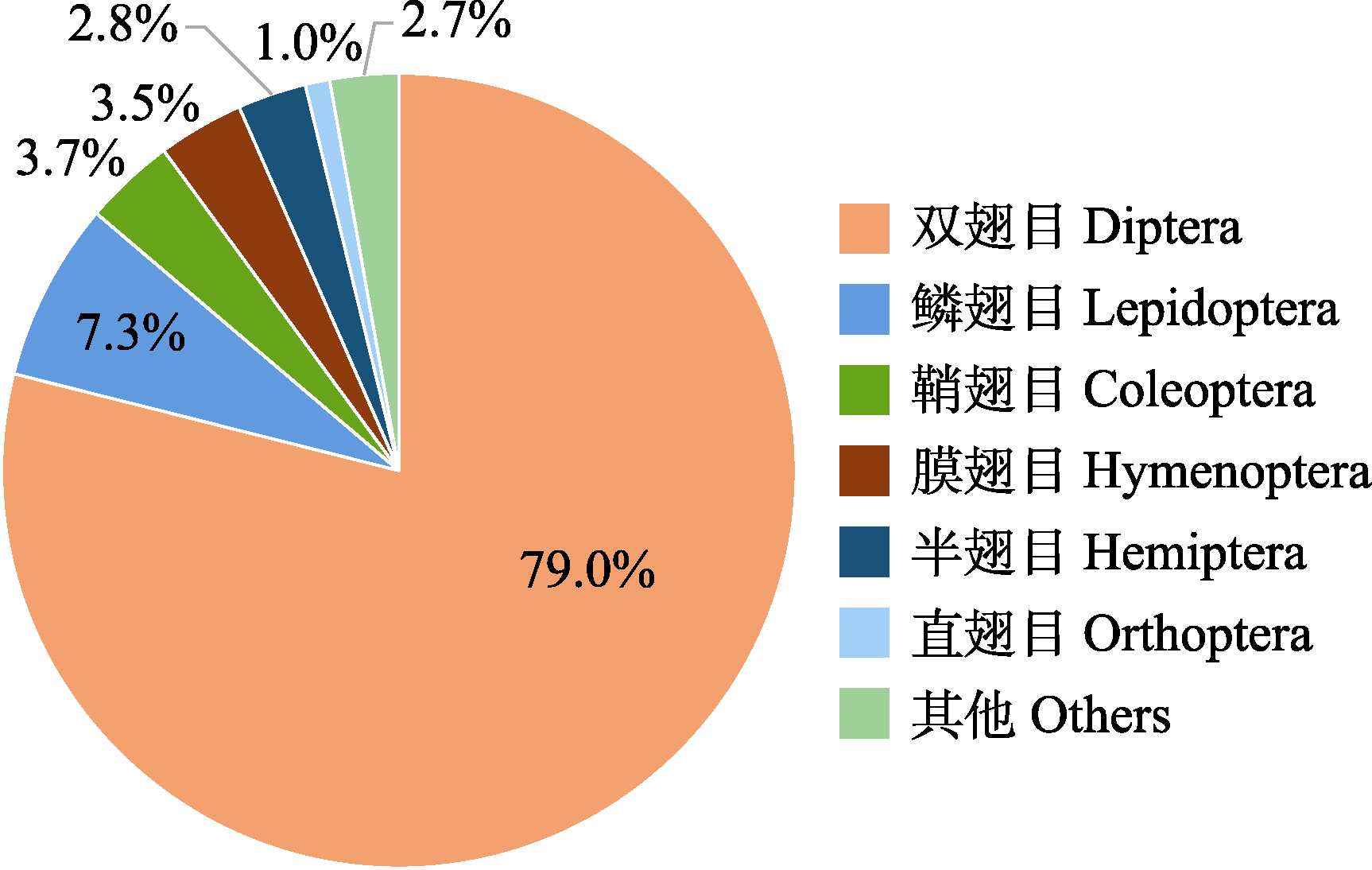
图1 2019-2023年高粱-小麦轮作农田节肢动物优势目组成
Fig. 1 Dominant arthropod orders in the sorghum-wheat rotation system from 2019 to 2023
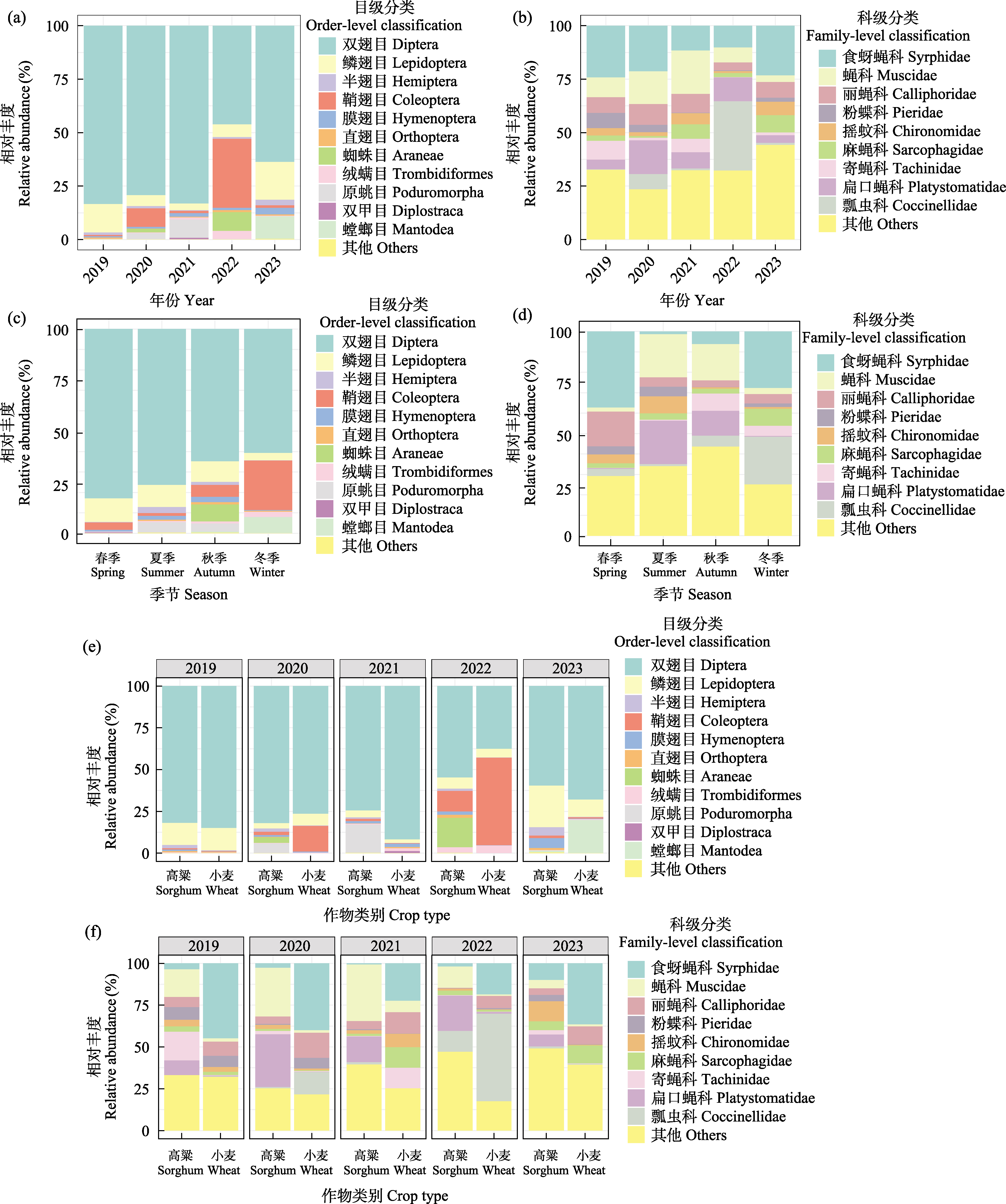
图2 节肢动物群落在不同年份(a, b)、季节(c, d)和不同作物种植季(e, f)之间目水平与科水平相对丰度
Fig. 2 Relative abundance of the arthropod community at the order and family levels across different years (a, b), seasons (c, d), and crop-growing seasons (e, f)
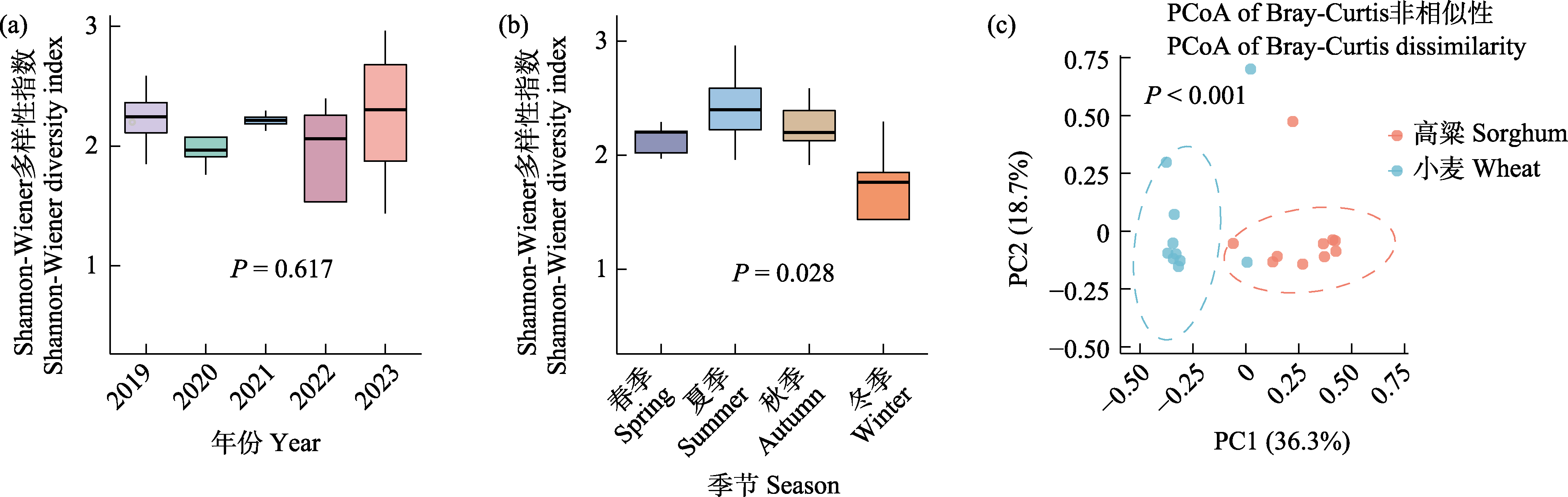
图3 节肢动物群落多样性分析。(a)不同年份α多样性; (b)不同季节α多样性; (c)高粱季与小麦季之间的β多样性。
Fig. 3 Diversity analysis of arthropod communities. (a) Alpha diversity across different years; (b) Alpha diversity across different seasons; (c) Beta diversity between sorghum-growing season and wheat-growing season.
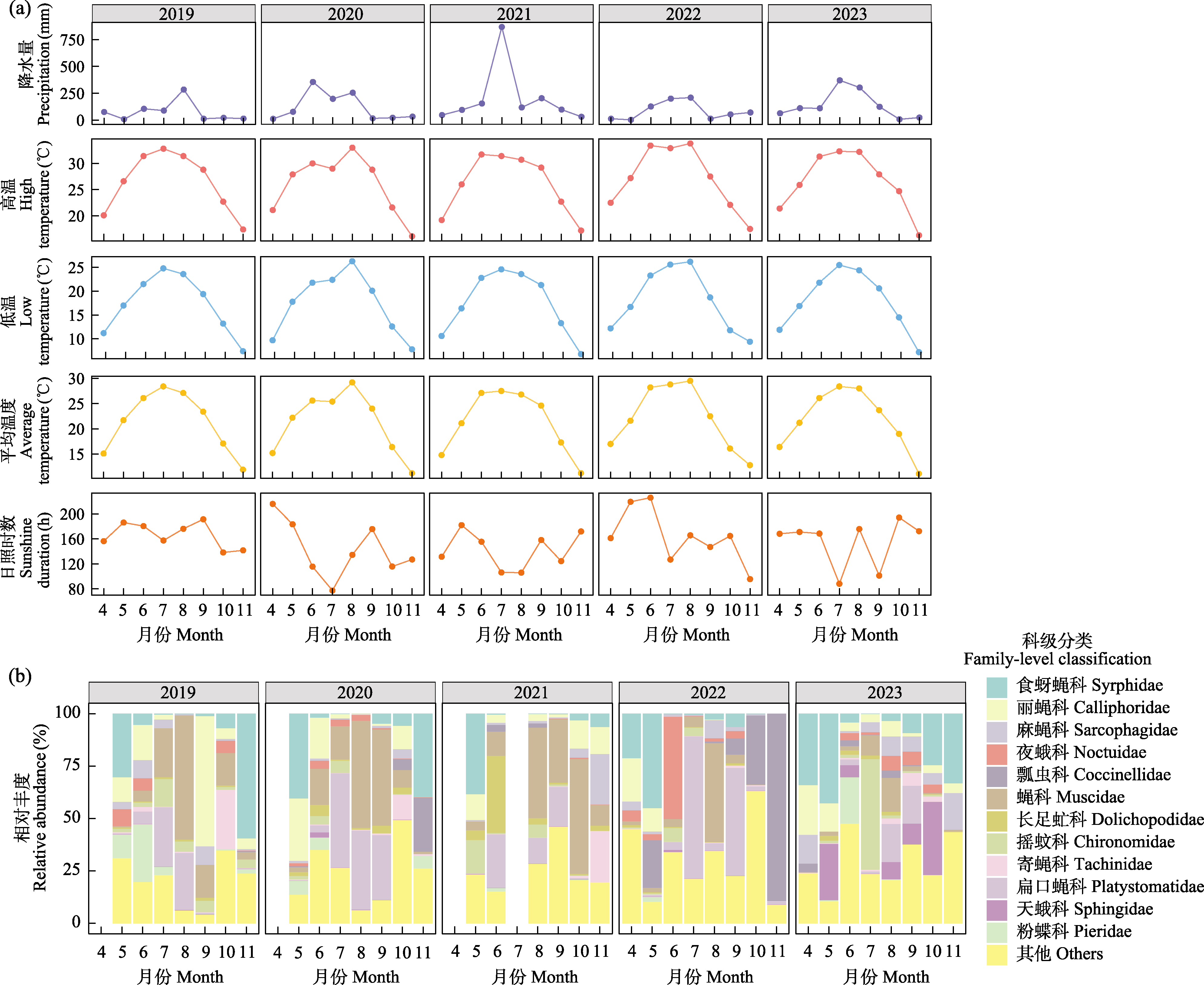
图4 气象因子与节肢动物群落组成变化。(a) 2019-2023年4-11月气象因子变化; (b)对应月份主要节肢动物科级分类单元相对丰度变化。
Fig. 4 Variation in meteorological factors and arthropod community composition. (a) Variation in meteorological factors from April to November during 2019-2023; (b) Monthly changes in the relative abundance of major arthropod family-level taxa.
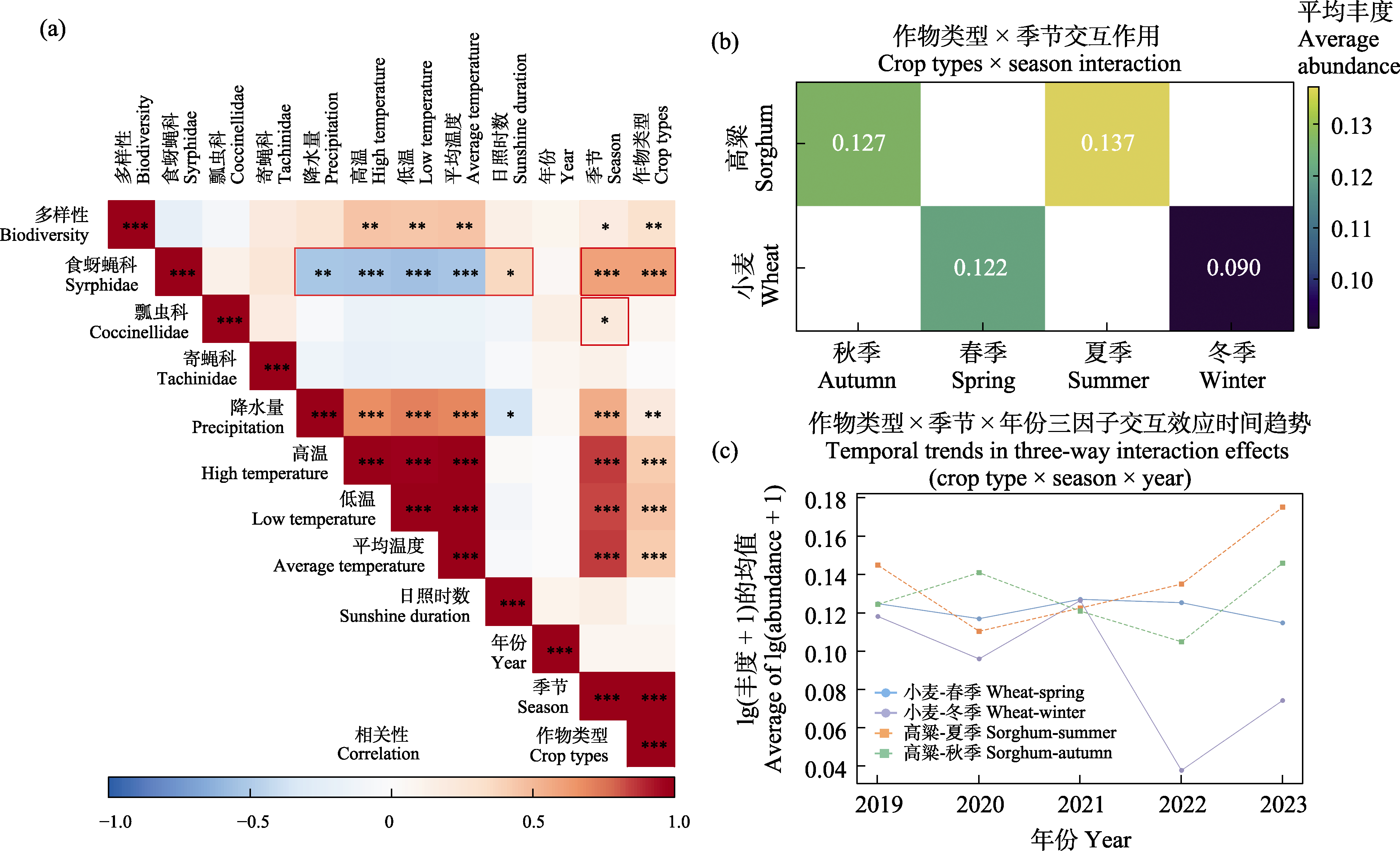
图5 不同因子对主要节肢动物类群相对丰度的独立或者交互影响。(a)不同因子与主要节肢动物类群相对丰度的Spearman相关性热图; (b)作物类型与季节交互作用分析; (c)作物类型与季节交互效应随年份变化的趋势。
Fig. 5 Independent and interactive effects of different factors on the relative abundance of major arthropod taxa. (a) Heatmap of Spearman correlation between various factors and the relative abundance of major arthropod taxa; (b) Interaction between crop type and season; (c) Temporal trends in the interaction between crop type and season across years.
| [1] | Barton PS, Cunningham SA, Lindenmayer DB, Manning AD (2013) The role of carrion in maintaining biodiversity and ecological processes in terrestrial ecosystems. Oecologia, 171, 761-772. |
| [2] | Bolger AM, Lohse M, Usadel B (2014) Trimmomatic: A flexible trimmer for Illumina sequence data. Bioinformatics, 30, 2114-2120. |
| [3] | Chen XX, Liu YQ, Ren SX, Zhang F, Zhang WQ, Ge F (2014) Plant-mediated support system for natural enemies of insect pests. Chinese Journal of Applied Entomology, 51, 1-12. (in Chinese with English abstract) |
| [陈学新, 刘银泉, 任顺祥, 张帆, 张文庆, 戈峰 (2014) 害虫天敌的植物支持系统. 应用昆虫学报, 51, 1-12.] | |
| [4] | Cheng YQ, Tan L, Wu SL, Zhu SR, Li JY, Fan JJ, Hu QL (2019) Influence of temperature and photoperiod on pupae developmental durations of Episyrphus balteatus and eclosion rate of Diplazon laetatorius. Guizhou Agricultural Sciences, 47(4), 56-59. (in Chinese with English abstract) |
| [程予奇, 谭琳, 伍绍龙, 朱三荣, 李佳颖, 樊吉君, 胡秋龙 (2019) 温度和光周期对黑带食蚜蝇蛹及食蚜蝇姬蜂羽化的影响. 贵州农业科学, 47(4), 56-59.] | |
| [5] | Day RL, Hickman JM, Sprague RI, Wratten SD (2015) Predatory hoverflies increase oviposition in response to colour stimuli offering no reward: Implications for biological control. Basic and Applied Ecology, 16, 544-552. |
| [6] | de Sena Brandine G, Smith AD (2021) Falco: High-speed FastQC emulation for quality control of sequencing data. F1000Research, 8, 1874. |
| [7] | Ferrington LC (2008) Global diversity of non-biting midges (Chironomidae; Insecta-Diptera) in freshwater. Hydrobiologia, 595, 447-455. |
| [8] | Ficetola GF, Taberlet P (2023) Towards exhaustive community ecology via DNA metabarcoding. Molecular Ecology, 32, 6320-6329. |
| [9] | Ge F (2020) From ‘comprehensive’ to ‘integrated’ pest management. Chinese Journal of Applied Entomology, 57, 1-9. (in Chinese with English abstract) |
| [戈峰 (2020) 害虫管理: 从“综合”到“整合”. 应用昆虫学报, 57, 1-9.] | |
| [10] | Hussain S, Hussain S, Guo R, Sarwar M, Ren XL, Krstic D, Aslam Z, Zulifqar U, Rauf A, Hano C, El-Esawi MA (2021) Carbon sequestration to avoid soil degradation: A review on the role of conservation tillage. Plants, 10, 2001. |
| [11] | Ives AR, Kareiva P, Perry R (1993) Response of a predator to variation in prey density at three hierarchical scales lady beetles feeding on aphids. Ecology, 74, 1929-1938. |
| [12] | Kogan M (1998) Integrated pest management: Historical perspectives and contemporary developments. Annual Review of Entomology, 43, 243-270. |
| [13] | Landis DA, Wratten SD, Gurr GM (2000) Habitat management to conserve natural enemies of arthropod pests in agriculture. Annual Review of Entomology, 45, 175-201. |
| [14] | Liang XY, Zhang XR, Zhao CL, Yan LY, Zhang XN, Chang CY, Jiang X, Li Z, Ge F (2025) Effects of Cnidium monnieri planting on the conservation of natural enemy ladybirds and their aphid control effects in fields in wheat-maize rotation cropping system. Acta Entomologica Sinica, 68, 1361-1371. (in Chinese with English abstract) |
| [梁潇以, 张兴瑞, 赵传麟, 燕立媛, 张晓宁, 常春燕, 蒋欣, 李卓, 戈峰 (2025) 小麦-玉米轮作系统中种植蛇床草对田间天敌瓢虫保育的影响及其控蚜效果. 昆虫学报, 68, 1361-1371.] | |
| [15] | Liu XW, Lu YH, Yang YJ, Xu HX, Lü ZX (2025) Evaluation of the synergistic effects of functional plants Cnidium monnieri and Vicia faba on conserving predatory natural enemies in wheat fields. Chinese Journal of Applied Entomology, 62, 594-606. (in Chinese with English abstract) |
| [刘晓微, 鲁艳辉, 杨亚军, 徐红星, 吕仲贤 (2025) 功能植物蛇床草和蚕豆协同涵养麦田捕食性天敌的效果评价. 应用昆虫学报, 62, 594-606.] | |
| [16] | Magoč T, Salzberg SL (2011) FLASH: Fast length adjustment of short reads to improve genome assemblies. Bioinformatics, 27, 2957-2963. |
| [17] | Meyer M, Ott D, Götze P, Koch HJ, Scherber C (2019) Crop identity and memory effects on aboveground arthropods in a long-term crop rotation experiment. Ecology and Evolution, 9, 7307-7323. |
| [18] | Minhas WA, Mumtaz N, Ur-Rehman H, Farooq S, Farooq M, Ali HM, Hussain M (2023) Weed infestation and productivity of wheat crop sown in various cropping systems under conventional and conservation tillage. Frontiers in Plant Science, 14, 1176738. |
| [19] | Morsello SC, Groves RL, Nault BA, Kennedy GG (2008) Temperature and precipitation affect seasonal patterns of dispersing tobacco thrips, Frankliniella fusca, and onion thrips, Thrips tabaci (Thysanoptera: Thripidae) caught on sticky traps. Environmental Entomology, 37, 79-86. |
| [20] | Naranjo SE, Ellsworth PC, Frisvold GB (2015) Economic value of biological control in integrated pest management of managed plant systems. Annual Review of Entomology, 60, 621-645. |
| [21] | Pooniya V, Zhiipao RR, Biswakarma N, Kumar D, Shivay YS, Babu S, Das K, Choudhary AK, Swarnalakshmi K, Jat RD, Choudhary RL, Ram H, Khokhar MK, Mukri G, Lakhena KK, Puniya MM, Jat R, Muralikrishnan L, Singh AK, Lama A (2022) Conservation agriculture based integrated crop management sustains productivity and economic profitability along with soil properties of the maize-wheat rotation. Scientific Reports, 12, 1962. |
| [22] | Rognes T, Flouri T, Nichols B, Quince C, Mahé F (2016) VSEARCH: A versatile open source tool for metagenomics. PeerJ, 4, e2584. |
| [23] | Romano I, Bodenhausen N, Basch G, Soares M, Faist H, Trognitz F, Sessitsch A, Doubell M, Declerck S, Symanczik S (2023) Impact of conservation tillage on wheat performance and its microbiome. Frontiers in Plant Science, 14, 1211758. |
| [24] | Rusch A, Bommarco R, Jonsson M, Smith HG, Ekbom B (2013) Flow and stability of natural pest control services depend on complexity and crop rotation at the landscape scale. Journal of Applied Ecology, 50, 345-354. |
| [25] | Shang QZ (2024) Effects of wheat-corn rotation on the structure and function of farmland ecosystem. Grain Oil and Feed Technology, (3), 87-89. (in Chinese with English abstract) |
| [尚青竹 (2024) 小麦-玉米轮作对农田生态系统结构和功能的影响研究. 粮油与饲料科技, (3), 87-89.] | |
| [26] | Stell E, Meiss H, Lasserre-Joulin F, Therond O (2022) Towards predictions of interaction dynamics between cereal aphids and their natural enemies: A review. Insects, 13, 479. |
| [27] | Wang B, Lu Y, Long LQ, Li Z, Ke X, Hu XS, Zhou ZX, Liu TX, Zhang SZ, Liu TT, Feng Y (2024) A dataset of Coccinellidae and Syrphidae in Yangling from 2018 to 2022. China Scientific Data, 9(1), 328-337. (in Chinese with English abstract) |
| [王博, 卢砚, 龙莉群, 李紫, 柯雪, 胡想顺, 周昭旭, 刘同先, 张世泽, 刘婷婷, 冯毅 (2024) 2018-2022年杨凌地区天敌瓢虫、食蚜蝇数据集. 中国科学数据, 9(1), 328-337.] | |
| [28] | Wang C, Liu B, Lu W, Lu YH (2025) Niche and interspecific associations of major pests and predatory enemies in cotton fields of Xinjiang, China. Plant Protection, 51(2), 52-60. (in Chinese with English abstract) |
| [王淳, 刘冰, 路伟, 陆宴辉 (2025) 新疆棉田主要害虫及其捕食性天敌的生态位与种间联结性研究. 植物保护, 51(2), 52-60.] | |
| [29] | Xu FX (2015) The occurrence and control of plant diseases and pests. China Agricultural Informatics, (7), 72. (in Chinese) |
| [徐福星 (2015) 植物病虫害的发生与防治. 中国农业信息, (7), 72.] | |
| [30] | Young MR, Hebert PDN (2022) Unearthing soil arthropod diversity through DNA metabarcoding. PeerJ, 10, e12845. |
| [31] | Yu QQ, Ji YT, Wei JW, Wang JJ, Wang S, Li S, Jin ZY (2025) Evaluation of spatiotemporal matching of phytomorphological characteristics of functional plants to enhance the effect of natural enemies. Journal of Hebei Normal University (Natural Science), 49, 390-398. (in Chinese with English abstract) |
| [于倩倩, 季怡同, 魏敬伟, 汪加佳, 王甦, 李姝, 金振宇 (2025) 功能植物物候特性对天敌增效的时空匹配评价. 河北师范大学学报(自然科学版), 49, 390-398.] | |
| [32] | Zhou Q, Zhang P, Wang ZQ, Wang LX, Wang SB, Yang WT, Yang BJ, Huang GQ (2023) Winter crop rotation intensification to increase rice yield, soil carbon, and microbial diversity. Heliyon, 9, e12903. |
| [1] | 王宇博, 武崇高, 朱桐, 崔云龙, 张宝华, 刁桂萍. 东北亚地区大型真菌物种多样性编目[J]. 生物多样性, 2026, 34(8): 26230-. |
| [2] | 刘湘逸, 鲜雅雯, 邓子为, 李坤厚, 孔觉, 周平, 宋凤, 张志强. 基于微型摄像机与粪便DNA宏条形码技术的红嘴相思鸟雏鸟食物多样性[J]. 生物多样性, 2026, 34(8): 26180-. |
| [3] | 李新豪, 蒲发光, 程扬, 周美生, 易厚启, 万霞. 皖西大别山源头溪流水生昆虫多样性及其对环境因子的响应[J]. 生物多样性, 2026, 34(7): 26110-. |
| [4] | 巩中军, 李为争, 姚永生, 左旭琦, 武予清, 苗进. 农田土壤节肢动物eDNA在固-液-气三相中的分布特征[J]. 生物多样性, 2026, 34(7): 26146-. |
| [5] | 张海波, 吴忠荣, 胡灿实, 匡中帆, 李毅, 张明明, 杨雄威, 粟海军, 李筑眉. 贵州省鸟类物种多样性及名录更新[J]. 生物多样性, 2026, 34(7): 25381-. |
| [6] | 李明慧, 侯鹏, 徐畅, 刘旭升, 刘丽, 姚志远, 张春田. 中国东北大兴安岭山脉寄蝇科昆虫物种名录[J]. 生物多样性, 2026, 34(6): 26159-. |
| [7] | 肖银润, 裘源春, 王赟萍, 马吉平, 钟啟萍, 王素贞, 钟国祥, 张诚. 江西九连山大型真菌多样性及资源评价[J]. 生物多样性, 2026, 34(6): 26103-. |
| [8] | 康志成, 高春蕾, 郭嘉宁, 孟范平, 王宗灵. 渤海与北黄海春季有害甲藻包囊: 多样性、分布及环境相关性[J]. 生物多样性, 2026, 34(3): 25426-. |
| [9] | 夏东坡, 李静, 田军东, 黄中豪, 伍乘风, 陈仕望, 李进华. 中国野生猕猴属动物的研究进展[J]. 生物多样性, 2026, 34(3): 25460-. |
| [10] | 黄莉, 刘志发, 龚粤宁, 李步杭, 张健. 广东南岭16个1 ha森林动态监测样地植物群落组成与结构[J]. 生物多样性, 2026, 34(3): 25357-. |
| [11] | 罗熙, 王啟芳, 王建佳, 杨倩曦, 方鸿飞, 洪淼, 张琦, 蔡灵, 周曦杰, 黄丁勇, 郑新庆. 福建东山海域新记录种揭示我国北缘造礁石珊瑚群落多样性[J]. 生物多样性, 2026, 34(2): 25335-. |
| [12] | 刘俊, 张天祥, 张壹萱, 黄晓凤, 韩卫杰, 吴问国, 黄晓飞, 黄理政, 张阳. 基于DNA宏条形码的江西桃红岭梅花鹿食性与营养策略[J]. 生物多样性, 2026, 34(2): 25214-. |
| [13] | 周婷婷, 张浩淼, 王浩杰, 廖健, 陈晓丹, 杨楠, 韩博平, 刘振元. 广东省蜻蜓目物种多样性空间格局及关键影响因素[J]. 生物多样性, 2026, 34(2): 25337-. |
| [14] | 刘振元, 周婷婷, 王伟民, 韩博平, 谢志才. 城市化对深圳地区河流大型底栖无脊椎动物群落物种多样性和功能多样性的影响机制[J]. 生物多样性, 2025, 33(9): 25135-. |
| [15] | 冯缨, 宋凤, 金光照, Komiljon Tojibaev, 葛学军. 中亚荒漠区沙拐枣属的分布格局与物种多样性[J]. 生物多样性, 2025, 33(8): 25086-. |
| 阅读次数 | ||||||
|
全文 |
|
|||||
|
摘要 |
|
|||||
备案号:京ICP备16067583号-7
Copyright © 2026 版权所有 《生物多样性》编辑部
地址: 北京香山南辛村20号, 邮编:100093
电话: 010-62836137, 62836665 E-mail: biodiversity@ibcas.ac.cn
