

生物多样性 ›› 2026, Vol. 34 ›› Issue (6): 26159. DOI: 10.17520/biods.2026159 cstr: 32101.14.biods.2026159
• 生物编目 • 上一篇
李明慧1,#( ), 侯鹏2,#(), 徐畅1(), 刘旭升1(), 刘丽2, 姚志远1,*()(
 ), 张春田1,*()
收稿日期:2026-04-30
接受日期:2026-06-14
出版日期:2026-06-20
发布日期:2026-07-31
通讯作者:
*共同通讯作者 E-mail: chuntianzhang@aliyun.com; yaozy@synu.edu.cn
作者简介:#共同第一作者
基金资助:
Minghui Li1,#(), Peng Hou2,#(), Chang Xu1(), Xusheng Liu1(), Li Liu2, Zhiyuan Yao1,*()(), Chuntian Zhang1,*()
Received:2026-04-30
Accepted:2026-06-14
Online:2026-06-20
Published:2026-07-31
Contact:
*Co-authors for correspondence. E-mail: chuntianzhang@aliyun.com; yaozy@synu.edu.cn
About author:#Co-first authors
Supported by:摘要: 为了解我国东北地区寄蝇科昆虫资源本底、区系特征与空间分布格局, 揭示其生态调控功能, 本研究以沈阳师范大学昆虫标本馆馆藏的2,961号大兴安岭山脉寄蝇标本为研究材料, 开展系统的整理、分类鉴定与区系分析。研究记录大兴安岭山脉寄蝇科昆虫4亚科18族85属193种, 分别占中国已知寄蝇的属、物种总数的30.91%和15.48%, 其中包含内蒙古新记录21种、黑龙江新记录47种。区系组成分析显示, 该区域寄蝇以古北界成分为绝对主导, 古北界特有种占比26.94%, 古北+东洋界共有种占比62.69%, 两类区系成分之和占比达89.63%, 构成了大兴安岭寄蝇的主体分布格局。本研究完善了大兴安岭山脉寄蝇科昆虫资源分布数据, 明晰了其区系组成特征, 可为区域昆虫多样性保护与农林牧草生态系统的害虫生物防治提供基础数据。
李明慧, 侯鹏, 徐畅, 刘旭升, 刘丽, 姚志远, 张春田 (2026) 中国东北大兴安岭山脉寄蝇科昆虫物种名录. 生物多样性, 34, 26159. DOI: 10.17520/biods.2026159.
Minghui Li, Peng Hou, Chang Xu, Xusheng Liu, Li Liu, Zhiyuan Yao, Chuntian Zhang (2026) A checklist of Tachinidae (Diptera) in the Greater Khingan Mountains, northeastern China. Biodiversity Science, 34, 26159. DOI: 10.17520/biods.2026159.
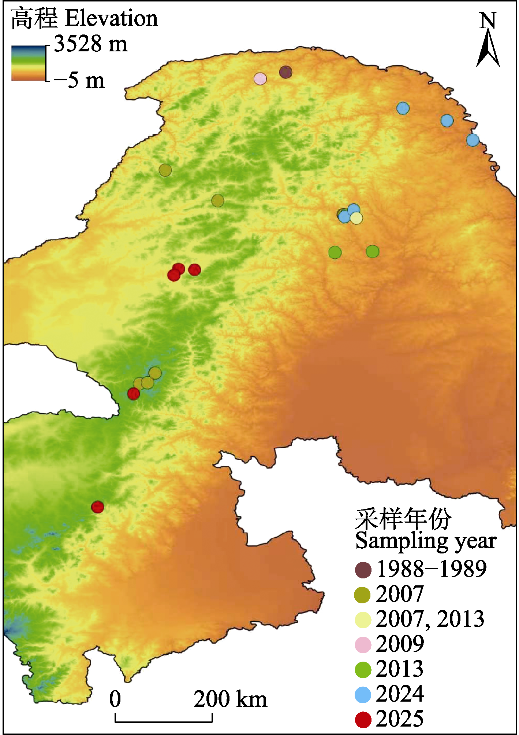
图1 1988-2025年大兴安岭山脉寄蝇科昆虫采集点分布图
Fig. 1 Distribution of collection sites of Tachinidae in the Greater Khingan Mountains from 1988 to 2025
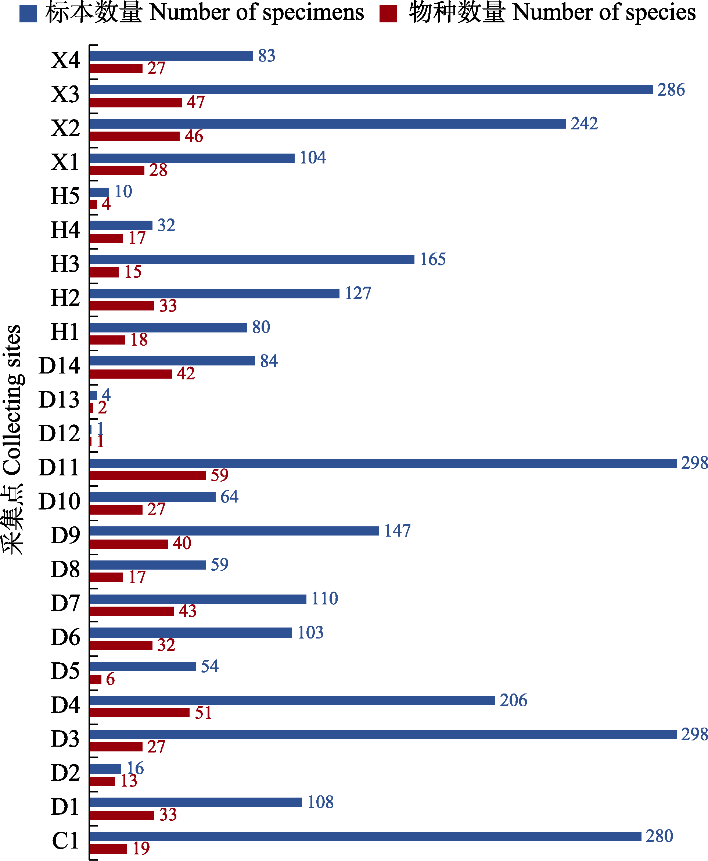
图2 大兴安岭山脉各采集点寄蝇标本采集量。采集点编号信息见附录1。
Fig. 2 Specimen collection quantities of tachinid flies at different collecting sites in the Greater Khingan Mountains. Details of collection site codes are given in Appendix 1.
| 地区 Area | 优势种数量 No. of dominant species | 常见种数量 No. of common species | 稀有种数量 No. of rare species | 优势种 Dominant species |
|---|---|---|---|---|
| I. 东北部针阔混交林区 Northeastern mixed broadleaf-conifer forest region | 4 | 27 | 29 | 暗黑柔寄蝇、钩肛短须寄蝇、金色异寄蝇、灿烂温寄蝇 Thelaira nigripes, Linnaemya (Ophina) picta, Allophorocera rutila, Winthemia venusta |
| II. 北部落叶针叶林区 Northern deciduous conifer forest region | 3 | 18 | 109 | 对眼阳寄蝇、钩肛短须寄蝇、凶猛温寄蝇 Panzeria consobrina, Linnaemya (Ophina) picta, Winthemia cruentata |
| III. 中部草原森林区 Central forest-steppe region | 3 | 30 | 58 | 对眼阳寄蝇、钩肛短须寄蝇、彩艳宽额寄蝇 Panzeria consobrina, Linnaemya (Ophina) picta, Frontina laeta |
| IV. 西部森林草原区 Western forest-steppe region | 6 | 56 | 40 | 黑股宽额寄蝇、黄跗寄蝇、望天阳寄蝇、对眼阳寄蝇、普通球腹寄蝇、巨爪寄蝇 Frontina femorata, Tachina (Tachina) fera, Panzeria connivens, P. consobrina, Gymnosoma rotundatum, Tachina (Tachina) macropuchia |
| V. 南部草原区 Southern steppe region | 3 | 7 | 9 | 怒寄蝇、钩肛短须寄蝇、查禾短须寄蝇 Tachina (Tachina) nupta, Linnaemya (Ophina) picta, L. (Ophina) zachvatkini |
表1 大兴安岭自然地理小区寄蝇群落组成特征
Table 1 Tachinid community composition features in the Greater Khingan Mountains physiographic subregions
| 地区 Area | 优势种数量 No. of dominant species | 常见种数量 No. of common species | 稀有种数量 No. of rare species | 优势种 Dominant species |
|---|---|---|---|---|
| I. 东北部针阔混交林区 Northeastern mixed broadleaf-conifer forest region | 4 | 27 | 29 | 暗黑柔寄蝇、钩肛短须寄蝇、金色异寄蝇、灿烂温寄蝇 Thelaira nigripes, Linnaemya (Ophina) picta, Allophorocera rutila, Winthemia venusta |
| II. 北部落叶针叶林区 Northern deciduous conifer forest region | 3 | 18 | 109 | 对眼阳寄蝇、钩肛短须寄蝇、凶猛温寄蝇 Panzeria consobrina, Linnaemya (Ophina) picta, Winthemia cruentata |
| III. 中部草原森林区 Central forest-steppe region | 3 | 30 | 58 | 对眼阳寄蝇、钩肛短须寄蝇、彩艳宽额寄蝇 Panzeria consobrina, Linnaemya (Ophina) picta, Frontina laeta |
| IV. 西部森林草原区 Western forest-steppe region | 6 | 56 | 40 | 黑股宽额寄蝇、黄跗寄蝇、望天阳寄蝇、对眼阳寄蝇、普通球腹寄蝇、巨爪寄蝇 Frontina femorata, Tachina (Tachina) fera, Panzeria connivens, P. consobrina, Gymnosoma rotundatum, Tachina (Tachina) macropuchia |
| V. 南部草原区 Southern steppe region | 3 | 7 | 9 | 怒寄蝇、钩肛短须寄蝇、查禾短须寄蝇 Tachina (Tachina) nupta, Linnaemya (Ophina) picta, L. (Ophina) zachvatkini |
| 区系分布类型 Faunal distribution pattern | 种类数量 No. of species | 占比 Proportion (%) |
|---|---|---|
| 古北界 Palearctic | 52 | 26.94 |
| 古北界+东洋界 Palearctic+Oriental | 121 | 62.69 |
| 古北界+新北界 Palearctic+Nearctic | 1 | 0.52 |
| 古北界+非洲热带界 Palearctic+Afrotropical | 1 | 0.52 |
| 古北界+东洋界+新北界 Palearctic+Oriental+Nearctic | 2 | 1.04 |
| 古北界+东洋界+非洲热带界 Palearctic+Oriental+Afrotropical | 11 | 5.70 |
| 古北界+东洋界+新北界+澳洲界 Palearctic+Oriental+Nearctic+Australasian | 1 | 0.52 |
| 古北界+东洋界+新北界+非洲热带界 Palearctic+Oriental+Nearctic+ Afrotropical | 2 | 1.04 |
| 古北界+东洋界+澳洲界+非洲热带界 Palearctic+Oriental+Australasian+ Afrotropical | 1 | 0.52 |
| 古北界+东洋界+澳洲界+非洲热带界+新热带界 Palearctic+Oriental+Australasian+ Afrotropical+Neotripical | 1 | 0.52 |
表2 大兴安岭山脉寄蝇科昆虫区系分布格局
Table 2 Faunal distribution patterns of tachinid species from the Greater Khingan Mountains
| 区系分布类型 Faunal distribution pattern | 种类数量 No. of species | 占比 Proportion (%) |
|---|---|---|
| 古北界 Palearctic | 52 | 26.94 |
| 古北界+东洋界 Palearctic+Oriental | 121 | 62.69 |
| 古北界+新北界 Palearctic+Nearctic | 1 | 0.52 |
| 古北界+非洲热带界 Palearctic+Afrotropical | 1 | 0.52 |
| 古北界+东洋界+新北界 Palearctic+Oriental+Nearctic | 2 | 1.04 |
| 古北界+东洋界+非洲热带界 Palearctic+Oriental+Afrotropical | 11 | 5.70 |
| 古北界+东洋界+新北界+澳洲界 Palearctic+Oriental+Nearctic+Australasian | 1 | 0.52 |
| 古北界+东洋界+新北界+非洲热带界 Palearctic+Oriental+Nearctic+ Afrotropical | 2 | 1.04 |
| 古北界+东洋界+澳洲界+非洲热带界 Palearctic+Oriental+Australasian+ Afrotropical | 1 | 0.52 |
| 古北界+东洋界+澳洲界+非洲热带界+新热带界 Palearctic+Oriental+Australasian+ Afrotropical+Neotripical | 1 | 0.52 |
| [1] | Cumming J, Wood DM (2017) Adult morphology and terminology. In: Manual of Afrotropical Diptera, Vol. 1: Suricata 4 (eds Kirk-Spriggs AH, Sinclair BJ), pp. 89-133. South African National Biodiversity Institute, Pretoria. |
| [2] | Ellenrieder NV, Hauser M, Kinnee S, O’Hara JE, Stireman JO III, Cerretti P, Wood DM (2014) First record of a parasitoid tachinid fly (Diptera: Tachinidae) on a dragonfly (Odonata: Calopterygidae). Studia Dipterologica, 21, 335-341. |
| [3] | Encyclopædia Britannica (2025) Da Hinggan Range. https://w ww.britannica.com/place/Da-Hinggan-Range. (accessed on 2026-06-01) |
| [4] | Ge ZX, Cai TJ, Duan BX, Xu ZP, Lang MH, Man XL (2023) Water use characteristics of Larix gmelinii and Betula platyphylla in the cold temperate zone during the growing season. Acta Ecologica Sinica, 43, 10142-10155. (in Chinese with English abstract) |
| [葛照欣, 蔡体久, 段北星, 徐志鹏, 郎明翰, 满秀玲 (2023) 寒温带兴安落叶松和白桦生长季水分利用特征. 生态学报, 43, 10142-10155.] | |
| [5] | Guo XY, Zhang HY (2013) The vegetation dynamic research under of eco-geographical region framework on Greater Khingan Mountains. Scientia Geographica Sinica, 33, 181-188. (in Chinese with English abstract) |
| [郭笑怡, 张洪岩 (2013) 生态地理分区框架下的大兴安岭植被动态研究. 地理科学, 33, 181-188.] | |
| [6] | Jiang M, Zou YC, Qin L, (2025) axing’an Ling. In: Encyclopedia of China (Third Edition Online). (in Chinese) |
| [姜明, 邹元春, 秦雷 (2025) 大兴安岭. 见: 中国大百科全书(第三版网络版).] https://www.zgbk.com/ecph/words?SiteID=1&ID=D41ox&Type=bkzyb&SubID=217059. (accessed on 2026-06-01) | |
| [7] | Liu H, Li XS, Cai DZ, Liu Z, Li XS, Wang DS (2021) Butterfly diversity and its influencing factors in Jigongshan Nature Reserve. Journal of Environmental Entomology, 43, 1190-1202. (in Chinese with English abstract) |
| [刘昊, 李新生, 蔡东章, 刘争, 李学松, 王德森 (2021) 鸡公山自然保护区蝶类多样性及其影响因素. 环境昆虫学报, 43, 1190-1202.] | |
| [8] | Lu ZT, Hou SB, Zhou YL, Hu BG (2023) Analysis of temperature change characteristics in Greater Khingan Region in the last 30 years. Heilongjiang Meteorology, 40(2), 22-24. (in Chinese) |
| [陆忠涛, 侯士彬, 周彦玲, 胡本刚 (2023) 大兴安岭地区近30 a气温变化特征分析. 黑龙江气象, 40(2), 22-24.] | |
| [9] | Ma YX, Li JH, Chen YH (2019) Geomorphological characteristics of the quaternary volcanoes and their tectonic implications in Aershan region, central Greater Khingan Range. Acta Scientiarum Naturalium Universitatis Pekinensis, 55, 289-298. (in Chinese with English abstract) |
| [马雨轩, 李江海, 陈耀华 (2019) 大兴安岭中段阿尔山地区第四纪火山地貌特征及其构造意义. 北京大学学报(自然科学版), 55, 289-298.] | |
| [10] | Mesnil LP (1980) Larvaevorinae (Tachininae). In: Die Fliegen der Palaearktischen Region (ed. Erwin L). E. Schweizerbart’sche Verlagsbuchhandlung, Stuttgart. (in German) |
| [11] | Ni J, Li YY, Zhang XS (1999) The scientific significance of the north east China transect (NECT) to global change study by its ecogeographical characteristics. Acta Ecologica Sinica, 19, 622-629. (in Chinese with English abstract) |
| [倪健, 李宜垠, 张新时 (1999) 从生态地理特征论中国东北样带(NECT)在全球变化研究中的科学意义. 生态学报, 19, 622-629.] | |
| [12] | O’Hara JE, Henderson SJ, Wood DM (2020a) Preliminary Checklist of the Tachinidae of the World, Version 2.1. http://www.nadsdiptera.org/Tach/WorldTachs/Checklist/Worldchecklist.html. (accessed on 2026-06-01) |
| [13] | O’Hara JE, Shima H, Zhang CT (2009) Annotated catalogue of the Tachinidae (Insecta: Diptera) of China. Zootaxa, 2190, 1-236. |
| [14] | O’Hara JE, Zhang CT, Shima H (2020b) Tachinidae. In: Species Catalogue of China, Vol. 2. Animals. Insecta (VII). Diptera (3): Cyclorrhaphous Brachycera (eds Yang D, Wang MQ, Li WL), pp. 841-963. Science Press, Beijing. |
| [15] | Shan ZQ (2026) Northeast China is the densest region of natural provinces. Chinese National Geography, (3), 28-53. (in Chinese) |
| [单之蔷 (2026) 我发现东北是中国自然省最密集的地方. 中国国家地理, (3), 28-53.] | |
| [16] | Shi L, Wang ZW, Ma R, Wang YW, Yang YG (2025) A survey of the Calyptratae (Diptera) in the Northern Primitive Forest Region of Greater Khingan Mountains, Inner Mongolia with a checklist of fifty-five species. Zootaxa, 5683, 451-491. |
| [17] | Stireman JO III, O’Hara JE, Wood DM (2006) TACHINIDAE: Evolution, behavior, and ecology. Annual Review of Entomology, 51, 525-555. |
| [18] | Sun HL (2005) China Ecosystems, Vol. 1. Science Press, Beijing. (in Chinese) |
| [孙鸿烈 (2005) 中国生态系统(上册). 科学出版社, 北京.] | |
| [19] | Tschorsnig HP, Richter VA (1998) Family Tachinidae. In: Contributions to a Manual of Palaearctic Diptera with special reference to flies of economic importance, Vol. 3 (eds Papp L, Darvas B), pp. 691-827. Science Herald, Budapest. |
| [20] | Wang J, Ji LZ, Khomutova M (2007) Relationships between forest insect pest occurrence area and meteorological factors in Great Xing’an Mountains of Heilongjiang Province, Northeast China. Chinese Journal of Ecology, 26, 673-677. (in Chinese with English abstract) |
| [王娟, 姬兰柱, Khomutova M (2007) 黑龙江大兴安岭地区森林害虫发生面积与气象因子的关系. 生态学杂志, 26, 673-677.] | |
| [21] | Wang YZ, Li HN, Hao B, Liu JY, Li JJ, Dong YJ, Zhang BH, Liu SD, Li XY, Zhang D, Zhang CT (2022) Fauna resource investigation of Tachinidae (Diptera) from Liaoning Heshangmao Nature Reserve, China. Journal of Environmental Entomology, 44, 92-105. (in Chinese with English abstract) |
| [王玉卓, 李赫男, 郝博, 刘家宇, 李君健, 董艳杰, 张百惠, 刘诗叠, 李辛夷, 张东, 张春田 (2022) 辽宁和尚帽自然保护区寄蝇科昆虫资源调查. 环境昆虫学报, 44, 92-105.] | |
| [22] | Xue WQ, Zhao JM (1996) Flies of China, Vol. 2. Liaoning Science and Technology Press, Shenyang. (in Chinese) |
| [薛万琦, 赵建铭 (1996) 中国蝇类(下册). 辽宁科学技术出版社, 沈阳.] | |
| [23] | Zhang CT (2016) Tachinidae of Northeast China. Science Press, Beijing. (in Chinese) |
| [张春田 (2016) 中国东北地区寄蝇科昆虫. 科学出版社, 北京.] | |
| [24] | Zhang CT, Li B, Sun Q, Shen RR, Zhang YZ, Shi L (2017) Preliminary investigation on Tachinidae (Diptera) of Hanma National Nature Reserve, Inner Mongolia, China. Journal of Shenyang Normal University (Natural Science Edition), 35, 257-264. (in Chinese with English abstract) |
| [张春田, 李冰, 孙琦, 申荣荣, 张怡卓, 史丽 (2017) 内蒙古汗马国家级自然保护区寄蝇科初步调查. 沈阳师范大学学报(自然科学版), 35, 257-264.] | |
| [25] | Zhang KY, Li TQ, Qu YH, Gao F, Lin JW, Jiang LC (2018) Analysis of precipitation and temperature change in the Daxing’anling area. Forest Engineering, 34(5), 8-14. (in Chinese with English abstract) |
| [张可扬, 李天权, 曲延浩, 高峰, 林婧文, 姜立春 (2018) 大兴安岭地区降水量和气温变化趋势分析. 森林工程, 34(5), 8-14.] | |
| [26] | Zhang RZ (1999) Zoogeography of China. Science Press, Beijing. (in Chinese) |
| [张荣祖 (1999) 中国动物地理. 科学出版社, 北京.] | |
| [27] | Zhang YH, Li JJ, Li Y, Zhang BH, Wang YZ, Hao B, Li XY, Zhang CT (2024) Tachinidae (Insecta: Diptera) from the Qilian Mountains of Qinghai, China. Chinese Journal of Applied Entomology, 61, 217-228. (in Chinese with English abstract) |
| [张雅惠, 李君健, 李月, 张百惠, 王玉卓, 郝博, 李辛夷, 张春田 (2024) 青海祁连山区寄蝇科昆虫资源调查. 应用昆虫学报, 61, 217-228.] | |
| [28] | Zhao JM, Liang EY, Shi YS, Zhou SX (2001) Fauna Sinica, Insecta, Vol. 23. Diptera: Tachinidae (I). Science Press, Beijing. (in Chinese) |
| [赵建铭, 梁恩义, 史永善, 周士秀 (2001) 中国动物志·昆虫纲(第二十三卷): ·双翅目·寄蝇科(一). 科学出版社, 北京.] | |
| [29] | Zheng D (2008) Study on China’s Ecogeographical Regional System. The Commercial Press, Beijing. (in Chinese) |
| [郑度 (2008) 中国生态地理区域系统研究. 商务印书馆, 北京.] | |
| [30] | Zhou M, Yu XX, Feng L (2002) Analysis on the driving force of the permafrost degeneration in Daxinganling. Journal of Arid Land Resources & Environment, 16(4), 44-47. (in Chinese with English abstract) |
| [周梅, 余新晓, 冯林 (2002) 大兴安岭林区多年冻土退化的驱动力分析. 干旱区资源与环境, 16(4), 44-47.] |
| [1] | 张海波, 吴忠荣, 胡灿实, 匡中帆, 李毅, 张明明, 杨雄威, 粟海军, 李筑眉. 贵州省鸟类名录更新[J]. 生物多样性, 2026, 34(7): 25381-. |
| [2] | 肖银润, 裘源春, 王赟萍, 马吉平, 钟啟萍, 王素贞, 钟国祥, 张诚. 江西九连山大型真菌多样性及资源评价[J]. 生物多样性, 2026, 34(6): 26103-. |
| [3] | 黄莉, 刘志发, 龚粤宁, 李步杭, 张健. 广东南岭16个1 ha森林动态监测样地植物群落组成与结构[J]. 生物多样性, 2026, 34(3): 25357-. |
| [4] | 夏东坡, 李静, 田军东, 黄中豪, 伍乘风, 陈仕望, 李进华. 中国野生猕猴属动物的研究进展[J]. 生物多样性, 2026, 34(3): 25460-. |
| [5] | 周婷婷, 张浩淼, 王浩杰, 廖健, 陈晓丹, 杨楠, 韩博平, 刘振元. 广东省蜻蜓目物种多样性空间格局及关键影响因素[J]. 生物多样性, 2026, 34(2): 25337-. |
| [6] | 罗熙, 王啟芳, 王建佳, 杨倩曦, 方鸿飞, 洪淼, 张琦, 蔡灵, 周曦杰, 黄丁勇, 郑新庆. 福建东山海域新记录种揭示我国北缘造礁石珊瑚群落多样性[J]. 生物多样性, 2026, 34(2): 25335-. |
| [7] | 刘振元, 周婷婷, 王伟民, 韩博平, 谢志才. 城市化对深圳地区河流大型底栖无脊椎动物群落物种多样性和功能多样性的影响机制[J]. 生物多样性, 2025, 33(9): 25135-. |
| [8] | 杨洋, 邹睿, 谯娅琴, 孟想, 涂飞云. 海南省陆生哺乳动物物种多样性[J]. 生物多样性, 2025, 33(8): 25044-. |
| [9] | 冯缨, 宋凤, 金光照, Komiljon Tojibaev, 葛学军. 中亚荒漠区沙拐枣属的分布格局与物种多样性[J]. 生物多样性, 2025, 33(8): 25086-. |
| [10] | 章洋, 王彦平. SLOSS争论研究进展: 分析方法、理论机制及保护实践[J]. 生物多样性, 2025, 33(7): 25081-. |
| [11] | 潘正东, 林熙戎, 薛华, 胡治颖, 郭弘艺, 张亚, 吴阿娜, 唐文乔. 上海主要内陆水体鱼类物种多样性本底及群落结构[J]. 生物多样性, 2025, 33(6): 24290-. |
| [12] | 彭文, 邓泽帅, 郑文宝, 龚凌轩, 曾玉枫, 孟昊, 陈军, 杨道德. eDNA技术在两栖动物调查中的应用: 以湖南莽山国家级自然保护区为例[J]. 生物多样性, 2025, 33(6): 24552-. |
| [13] | 张璐璐, 任昭杰, 于宁宁, 赵奉熙, 赵遵田. 甘肃省苔藓植物名录[J]. 生物多样性, 2025, 33(6): 24451-. |
| [14] | 吴晓晴, 张美惠, 葛苏婷, 李漫淑, 达良俊, 宋坤, 沈国春, 张健. 上海近自然林重建过程中木本植物物种多样性与地上生物量的时空动态: 以闵行区生态岛为例[J]. 生物多样性, 2025, 33(5): 24444-. |
| [15] | 王太, 宋福俊, 张永胜, 娄忠玉, 张艳萍, 杜岩岩. 河西走廊内陆河水系鱼类多样性及资源现状[J]. 生物多样性, 2025, 33(4): 24387-. |
| 阅读次数 | ||||||
|
全文 |
|
|||||
|
摘要 |
|
|||||
备案号:京ICP备16067583号-7
Copyright © 2026 版权所有 《生物多样性》编辑部
地址: 北京香山南辛村20号, 邮编:100093
电话: 010-62836137, 62836665 E-mail: biodiversity@ibcas.ac.cn
