

生物多样性 ›› 2026, Vol. 34 ›› Issue (5): 25394. DOI: 10.17520/biods.2025394 cstr: 32101.14.biods.2025394
何天琪1, 翟东东1,2,*( ), 蔡方陶1, 王东1, 陈元元1,2, 刘红艳1,2(
 ), 熊飞1,2(), 刘明典3,*(), 段辛斌3
收稿日期:2025-10-09
接受日期:2026-01-12
出版日期:2026-05-20
发布日期:2026-06-28
通讯作者:
翟东东,刘明典
基金资助:
Tianqi He1, Dongdong Zhai1,2,*(), Fangtao Cai1, Dong Wang1, Yuanyuan Chen1,2, Hongyan Liu1,2(), Fei Xiong1,2(), Mingdian Liu3,*(), Xinbin Duan3
Received:2025-10-09
Accepted:2026-01-12
Online:2026-05-20
Published:2026-06-28
Contact:
Dongdong Zhai, Mingdian Liu
Supported by:摘要:
澜沧江下游生境独特, 鱼类资源丰富, 受水电开发等人类活动影响, 干流鱼类群落结构正在发生显著变化, 特别是外来鱼类的侵入, 导致河流生态风险增加。本研究于2023-2024年对澜沧江下游干流不同江段(库区江段、坝下江段、自然江段)鱼类进行了季节性(枯水期、丰水期)调查采样, 分析了鱼类群落结构时空变化特征及外来鱼类种类、分布和入侵风险。结果表明, 在澜沧江下游干流共采集鱼类56种, 隶属于8目22科47属, 鲤形目占据主导地位。采集到澜沧江流域特有鱼类4种, 主要分布在坝下和自然江段; 外来鱼类25种, 主要分布在库区和坝下江段。相对重要性指数分析结果表明, 库区、坝下江段的鱼类优势种为䱗(Hemiculter leucisculus)、花身副丽鱼(Parachromis managuensis)、齐氏罗非鱼(Coptodon zillii)及尼罗罗非鱼(Oreochromis niloticus)等外来鱼类, 自然江段为长臀鲃(Mystacoleucus marginatus)、短吻鱼(Sikukia gudgeri)、云南吻孔鲃(Poropuntius huangchuchieni)等土著鱼类。非度量多维尺度分析结果表明, 澜沧江下游干流鱼类群落结构空间上差异显著, 主要是因为库区江段外来鱼类较多, 自然江段土著鱼类较多, 而季节上丰水期与枯水期差异较小。单独针对外来鱼类进行分析, 从渔获物数量来看, 䱗、花身副丽鱼、罗非鱼等为主要外来鱼类; 在空间分布上, 外来鱼类在澜沧江下游干流库区江段分布多, 自然江段分布少, 其种类与数量在渔获物中的占比沿河流纵向梯度递减。外来鱼类入侵风险评估结果表明, 齐氏罗非鱼、尼罗罗非鱼、花身副丽鱼、下口鲇(Hypostomus plecostomus)、莫桑比克罗非鱼(Oreochromis mossambicus)、䱗等物种为该区域高入侵风险外来鱼类。综上, 水电开发在改变澜沧江下游干流鱼类群落结构的同时, 也为外来鱼类入侵创造了有利条件。建议采取差异化对策对该区域鱼类资源进行保护: 库区江段优先防控外来鱼类, 重点关注数量优势种及高入侵风险种; 自然江段则建立土著鱼类保护区, 维护土著鱼类生存与繁衍环境。
何天琪, 翟东东, 蔡方陶, 王东, 陈元元, 刘红艳, 熊飞, 刘明典, 段辛斌 (2026) 澜沧江下游干流鱼类群落结构特征及外来鱼类入侵风险评估. 生物多样性, 34, 25394. DOI: 10.17520/biods.2025394.
Tianqi He, Dongdong Zhai, Fangtao Cai, Dong Wang, Yuanyuan Chen, Hongyan Liu, Fei Xiong, Mingdian Liu, Xinbin Duan (2026) Characteristics of fish community structure in the lower mainstream of the Lancang River and risk assessment of alien fish invasion. Biodiversity Science, 34, 25394. DOI: 10.17520/biods.2025394.
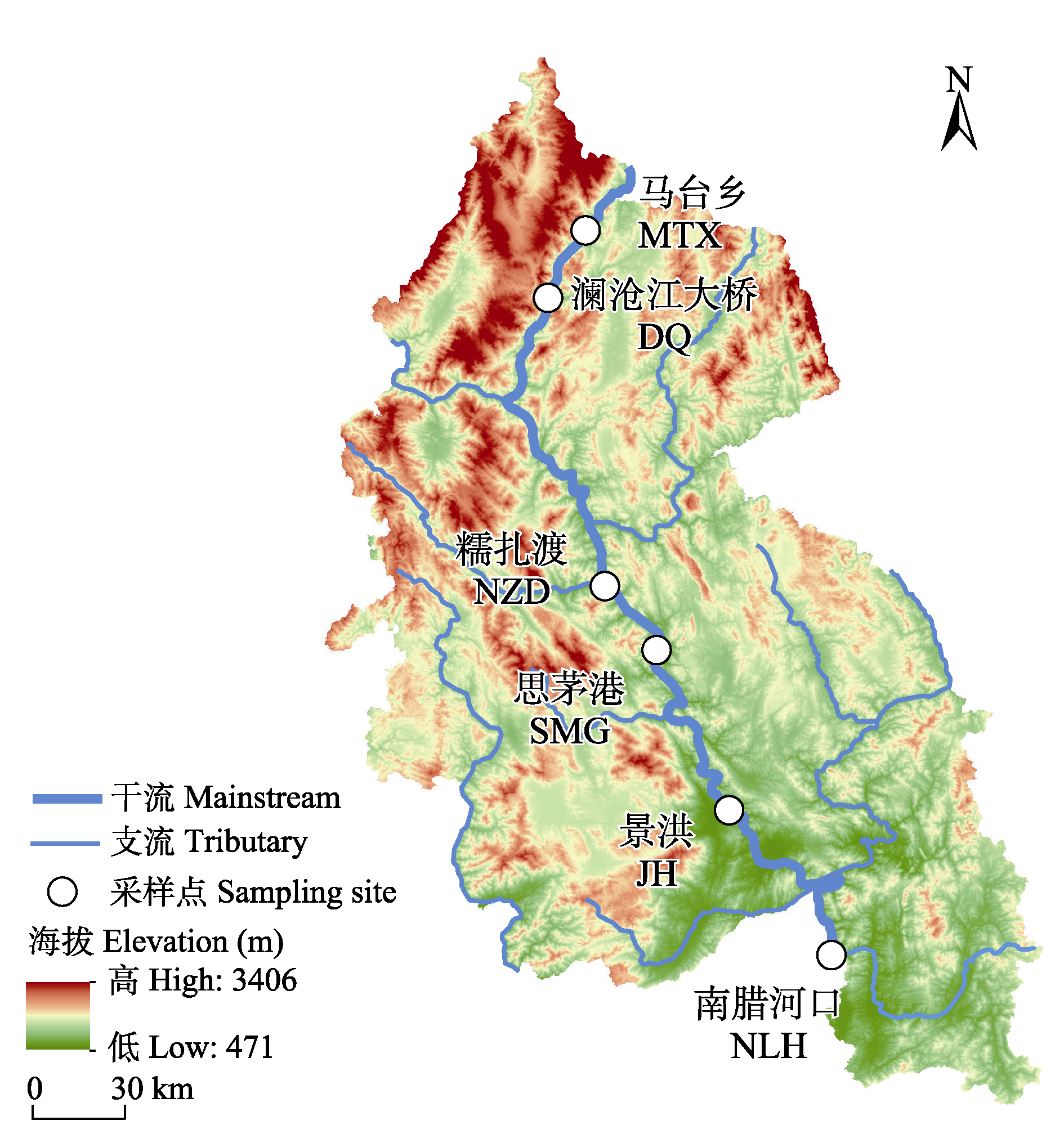
图1 澜沧江下游干流鱼类采样点分布图
Fig. 1 Map of fish sampling sites in the lower mainstream of the Lancang River. MTX, Matai Town; DQ, Lancang River Bridge; NZD, Nuozhadu Town; SMG, Simaogang Town; JH, Jinghong City; NLH, Nanla River Estuary.
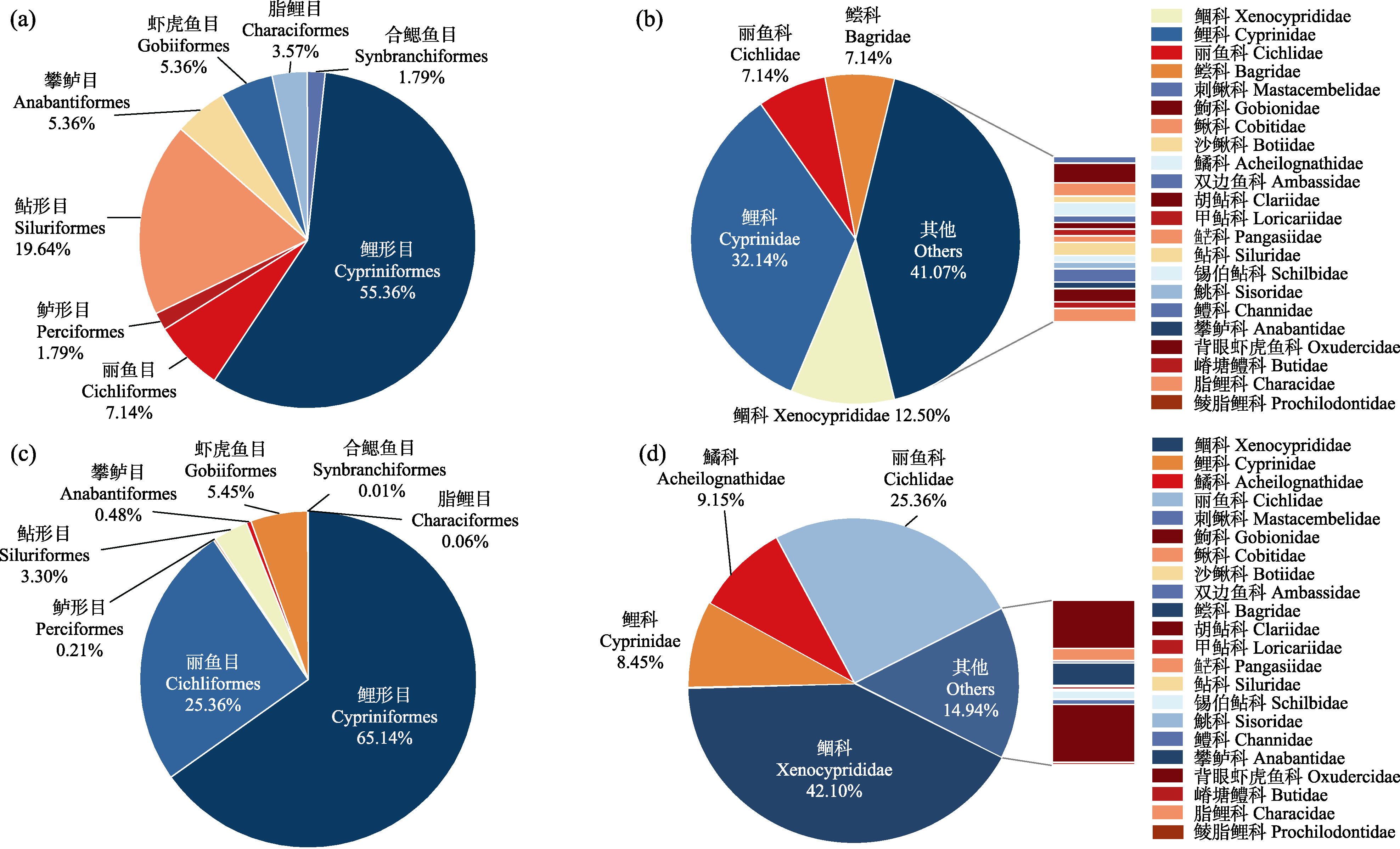
图2 澜沧江下游干流鱼类物种组成。 (a)澜沧江下游干流各目鱼类物种数占比; (b)澜沧江下游干流各科鱼类物种数占比; (c)澜沧江下游干流各目鱼类丰度占比; (d)澜沧江下游干流各科鱼类丰度占比。
Fig. 2 Fish species composition in the lower mainstream of the Lancang River. (a) Proportion of fish species number by order in the lower mainstream of the Lancang River; (b) Proportion of fish species number by family in the lower mainstream of the Lancang River; (c) Proportion of fish abundance by order in the lower mainstream of the Lancang River; (d) Proportion of fish abundance by family in the lower mainstream of the Lancang River.
| 名称 Name | 优势种 Dominant species | 丰水期优势种 Dominant species in the high-flow period | 枯水期优势种 Dominant species in the low-flow period | 不同采样点优势种 Dominant species in different sampling sites | |||||
|---|---|---|---|---|---|---|---|---|---|
| 马台乡 MTX | 澜沧江大桥 DQ | 糯扎渡 NZD | 思茅港 SMG | 景洪 JH | 南腊河口 NLH | ||||
| 䱗 Hemiculter leucisculus* | + | + | + | + | + | + | + | ||
| 花身副丽鱼 Parachromis managuensis* | + | + | + | + | + | + | |||
| 齐氏罗非鱼 Coptodon zillii* | + | + | + | + | + | ||||
| 尼罗罗非鱼 Oreochromis niloticus* | + | + | + | + | |||||
| 鳙 Hypophthalmichthys nobilis* | + | ||||||||
| 高体鳑鲏 Rhodeus ocellatus* | + | + | |||||||
| 马口鱼 Opsariichthys bidens | + | ||||||||
| 罗碧鱼 Paralaubuca barroni | + | ||||||||
| 真吻虾虎鱼 Rhinogobius similis* | + | ||||||||
| 棒花鱼 Abbottina rivularis* | + | ||||||||
| 黄颡鱼 Pelteobagrus fulvidraco* | + | ||||||||
| 长臀鲃 Mystacoleucus marginatus | + | ||||||||
| 红鳍原鲌 Cultrichthys erythropterus* | + | ||||||||
| 短吻鱼 Sikukia gudgeri | + | ||||||||
| 鲤 Cyprinus carpio* | + | ||||||||
| 云南吻孔鲃 Poropuntius huangchuchieni | + | ||||||||
| 中华鲱鲇 Clupisoma sinense | + | ||||||||
表1 澜沧江下游干流鱼类优势种
Table 1 Dominant fish species in the lower mainstream of the Lancang River
| 名称 Name | 优势种 Dominant species | 丰水期优势种 Dominant species in the high-flow period | 枯水期优势种 Dominant species in the low-flow period | 不同采样点优势种 Dominant species in different sampling sites | |||||
|---|---|---|---|---|---|---|---|---|---|
| 马台乡 MTX | 澜沧江大桥 DQ | 糯扎渡 NZD | 思茅港 SMG | 景洪 JH | 南腊河口 NLH | ||||
| 䱗 Hemiculter leucisculus* | + | + | + | + | + | + | + | ||
| 花身副丽鱼 Parachromis managuensis* | + | + | + | + | + | + | |||
| 齐氏罗非鱼 Coptodon zillii* | + | + | + | + | + | ||||
| 尼罗罗非鱼 Oreochromis niloticus* | + | + | + | + | |||||
| 鳙 Hypophthalmichthys nobilis* | + | ||||||||
| 高体鳑鲏 Rhodeus ocellatus* | + | + | |||||||
| 马口鱼 Opsariichthys bidens | + | ||||||||
| 罗碧鱼 Paralaubuca barroni | + | ||||||||
| 真吻虾虎鱼 Rhinogobius similis* | + | ||||||||
| 棒花鱼 Abbottina rivularis* | + | ||||||||
| 黄颡鱼 Pelteobagrus fulvidraco* | + | ||||||||
| 长臀鲃 Mystacoleucus marginatus | + | ||||||||
| 红鳍原鲌 Cultrichthys erythropterus* | + | ||||||||
| 短吻鱼 Sikukia gudgeri | + | ||||||||
| 鲤 Cyprinus carpio* | + | ||||||||
| 云南吻孔鲃 Poropuntius huangchuchieni | + | ||||||||
| 中华鲱鲇 Clupisoma sinense | + | ||||||||
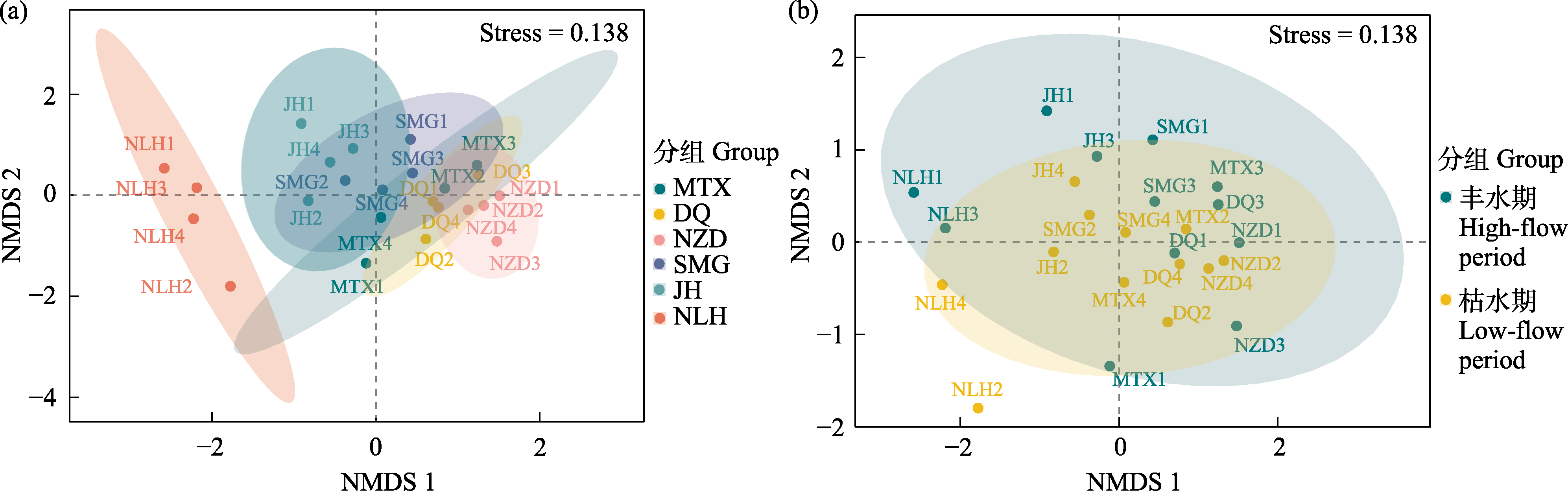
图3 澜沧江下游干流鱼类群落结构非度量多维尺度(NMDS)分析排序图。MTX: 马台乡; DQ: 澜沧江大桥; NZD: 糯扎渡; SMG: 思茅港; JH: 景洪; NLH: 南腊河口; MTX1: 马台乡2023年丰水期; MTX2: 马台乡2023年枯水期; MTX3: 马台乡2024年丰水期; MTX4: 马台乡2024年枯水期, 其他以此类推。
Fig. 3 Non-metric multidimensional scaling (NMDS) ordination diagram of fish community structure in the lower mainstream of the Lancang River. MTX, Matai Town; DQ, Lancang River Bridge; NZD, Nuozhadu Town; SMG, Simaogang Town; JH, Jinghong City; NLH, Nanla River Estuary. MTX1 represents the high-flow period of 2023 in MTX, MTX2 represents the low-flow period of 2023 in MTX, MTX3 represents the high-flow period of 2024 in MTX, and MTX4 represents the low-flow period of 2024 in MTX, the rest can be deduced by analogy.
| 马台乡 MTX | 澜沧江大桥 DQ | 糯扎渡 NZD | 思茅港 SMG | 景洪 JH | 南腊河口 NLH | |
|---|---|---|---|---|---|---|
| 马台乡 MTX | 0.127 | 0.151 | 0.031* | 0.002* | 0.029* | |
| 澜沧江大桥 DQ | 2.372 | 0.428 | 0.028* | 0.026* | 0.024* | |
| 糯扎渡 NZD | 1.731 | 0.816 | 0.030* | 0.032* | 0.033* | |
| 思茅港 SMG | 3.859 | 5.606 | 4.922 | 0.030* | 0.027* | |
| 景洪 JH | 5.311 | 9.603 | 8.222 | 3.670 | 0.028* | |
| 南腊河口 NLH | 6.462 | 8.411 | 6.553 | 5.628 | 6.634 |
表2 澜沧江下游各样点鱼类群落成对置换多元方差(PERMANOVA)分析结果。下三角为F值, 上三角为P值。
Table 2 Results of pairwise permutational multivariate analysis of variance (PERMANOVA) on fish community structure among sampling sites in the lower mainstream of the Lancang River. The lower triangle represents F-values, the upper triangle represents P-values.
| 马台乡 MTX | 澜沧江大桥 DQ | 糯扎渡 NZD | 思茅港 SMG | 景洪 JH | 南腊河口 NLH | |
|---|---|---|---|---|---|---|
| 马台乡 MTX | 0.127 | 0.151 | 0.031* | 0.002* | 0.029* | |
| 澜沧江大桥 DQ | 2.372 | 0.428 | 0.028* | 0.026* | 0.024* | |
| 糯扎渡 NZD | 1.731 | 0.816 | 0.030* | 0.032* | 0.033* | |
| 思茅港 SMG | 3.859 | 5.606 | 4.922 | 0.030* | 0.027* | |
| 景洪 JH | 5.311 | 9.603 | 8.222 | 3.670 | 0.028* | |
| 南腊河口 NLH | 6.462 | 8.411 | 6.553 | 5.628 | 6.634 |
| 马台乡 MTX | 澜沧江大桥 DQ | 糯扎渡 NZD | 思茅港 SMG | 景洪 JH | 南腊河口 NLH | |
|---|---|---|---|---|---|---|
| 马台乡 MTX | 30.5 | 156.3 | 184.4 | 266.9 | 363.2 | |
| 澜沧江大桥 DQ | 0.29 | 125.8 | 153.9 | 236.4 | 332.7 | |
| 糯扎渡 NZD | 0.46 | 0.33 | 28.1 | 110.6 | 206.9 | |
| 思茅港 SMG | 0.73 | 0.73 | 0.79 | 82.5 | 178.8 | |
| 景洪 JH | 0.80 | 0.82 | 0.92 | 0.73 | 96.3 | |
| 南腊河口 NLH | 0.97 | 0.96 | 0.98 | 0.95 | 0.91 |
表3 各样点之间的Bray-Curtis相异性指数(对角线下方)与河道距离(对角线上方, km)
Table 3 Pairwise Bray-Curtis dissimilarity (below the diagonal) and waterway distance (above the diagonal, km) among sampling sites
| 马台乡 MTX | 澜沧江大桥 DQ | 糯扎渡 NZD | 思茅港 SMG | 景洪 JH | 南腊河口 NLH | |
|---|---|---|---|---|---|---|
| 马台乡 MTX | 30.5 | 156.3 | 184.4 | 266.9 | 363.2 | |
| 澜沧江大桥 DQ | 0.29 | 125.8 | 153.9 | 236.4 | 332.7 | |
| 糯扎渡 NZD | 0.46 | 0.33 | 28.1 | 110.6 | 206.9 | |
| 思茅港 SMG | 0.73 | 0.73 | 0.79 | 82.5 | 178.8 | |
| 景洪 JH | 0.80 | 0.82 | 0.92 | 0.73 | 96.3 | |
| 南腊河口 NLH | 0.97 | 0.96 | 0.98 | 0.95 | 0.91 |
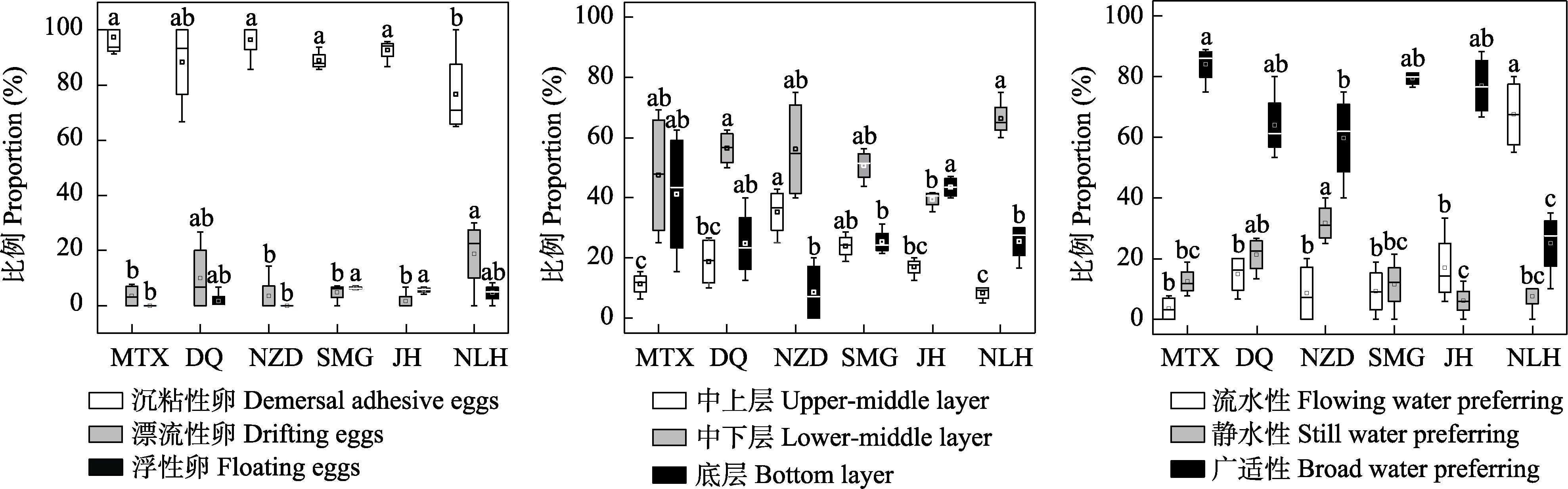
图4 澜沧江下游干流各采样点不同生态类型鱼类种数占比箱型图。MTX: 马台乡; DQ: 澜沧江大桥; NZD: 糯扎渡; SMG: 思茅港; JH: 景洪; NLH: 南腊河口。不同字母(a, b, c)表示P < 0.05水平上差异显著。
Fig. 4 Box plots of the proportion of fish species in different ecological types at each sampling site in the lower mainstream of the Lancang River. MTX, Matai Town; DQ, Lancang River Bridge; NZD, Nuozhadu Town; SMG, Simaogang Town; JH, Jinghong City; NLH, Nanla River Estuary. Different letters (a, b, c) indicate significant differences among groups at P < 0.05.
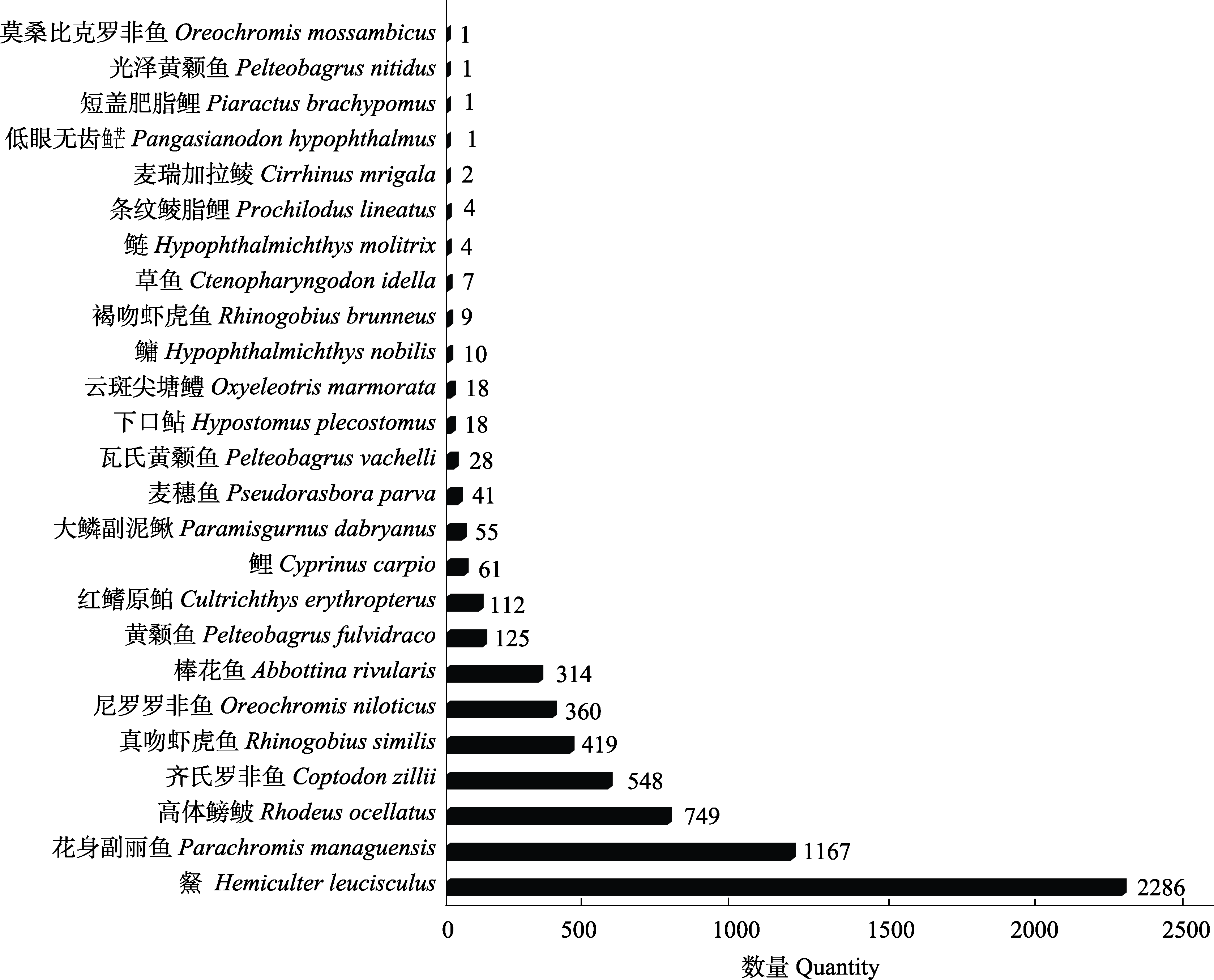
图5 澜沧江下游干流外来鱼类渔获量
Fig. 5 Catch of alien fish species in the lower mainstream of the Lancang River
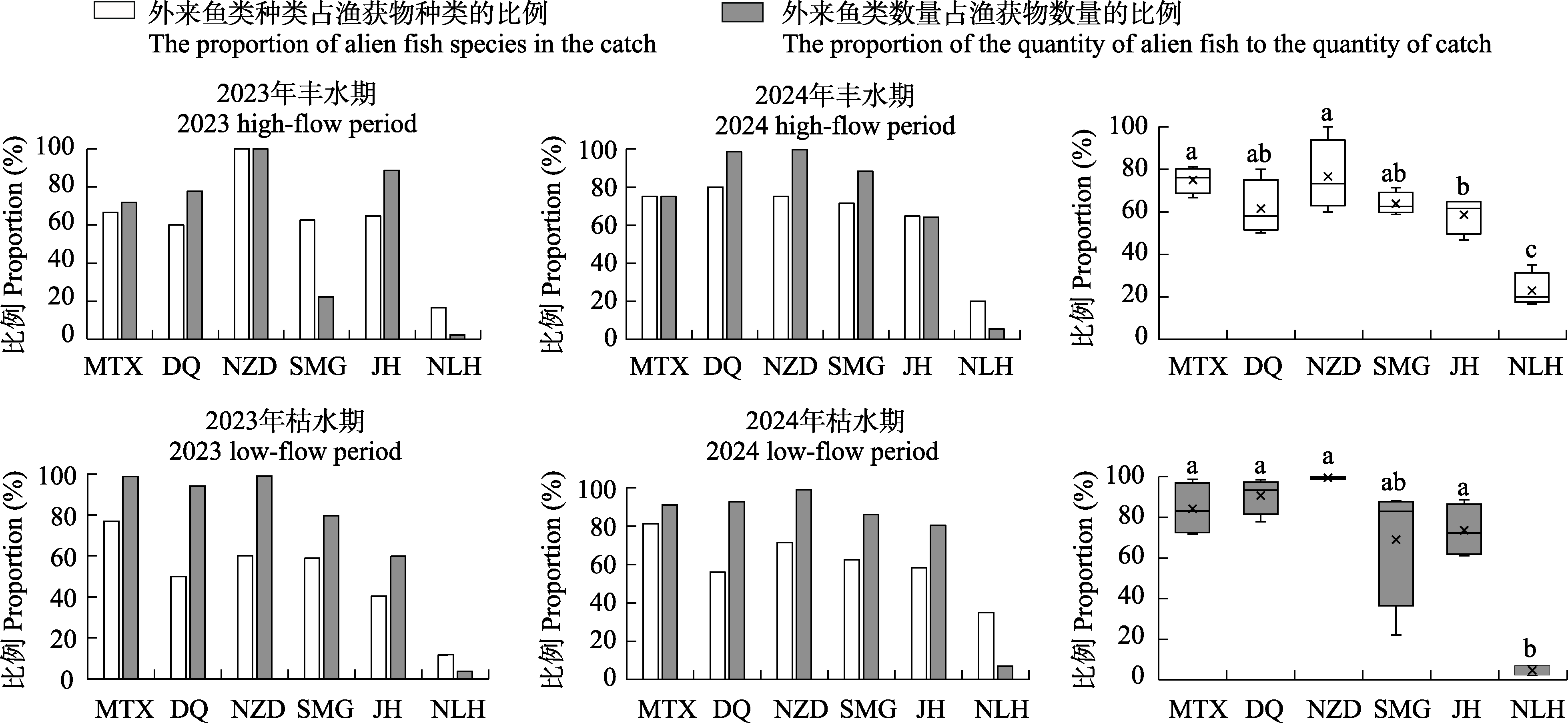
图6 澜沧江下游干流外来鱼类种类及数量占渔获物种类及数量比例的空间分布图。MTX: 马台乡; DQ: 澜沧江大桥; NZD: 糯扎渡; SMG: 思茅港; JH: 景洪; NLH: 南腊河口。不同字母(a, b, c)表示P < 0.05水平上差异显著。
Fig. 6 Spatial distribution map of the proportion of alien fish species and quantity to the species and quantity of catches in the lower mainstream of the Lancang River. MTX, Matai Town; DQ, Lancang River Bridge; NZD, Nuozhadu Town; SMG, Simaogang Town; JH, Jinghong City; NLH, Nanla River Estuary. Different letters (a, b, c) indicate significant differences among groups at P < 0.05.
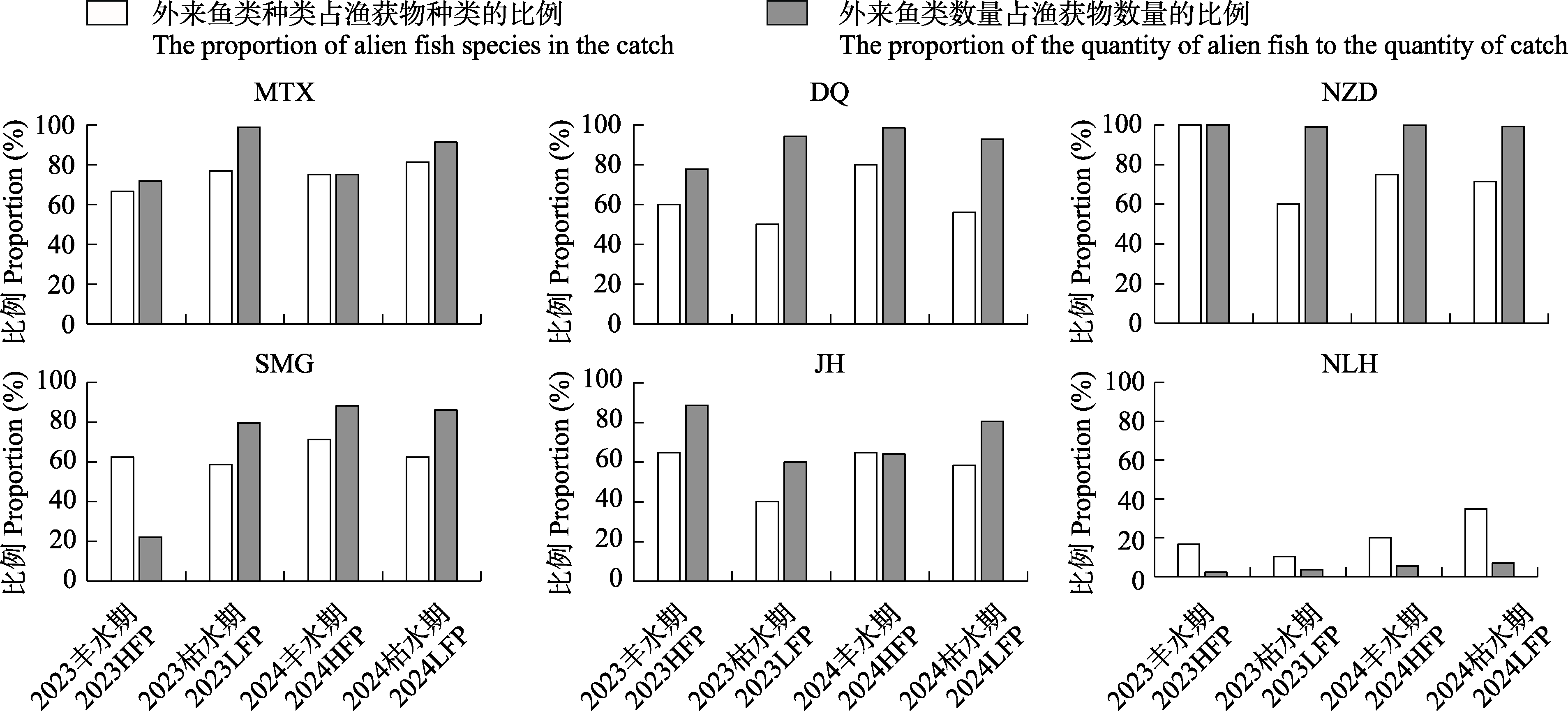
图7 澜沧江下游干流不同采样点外来鱼类种类及数量占渔获物种类及数量比例的时序变化图。MTX: 马台乡; DQ: 澜沧江大桥; NZD: 糯扎渡; SMG: 思茅港; JH: 景洪; NLH: 南腊河口; HFP: 丰水期; LFP: 枯水期。
Fig. 7 Temporal variation diagram of the proportions of alien fish species and their quantities in the total catch (by species and quantity) at different sampling sites in the lower mainstream of the Lancang River. MTX, Matai Town; DQ, Lancang River Bridge; NZD, Nuozhadu Town; SMG, Simaogang Town; JH, Jinghong City; NLH, Nanla River Estuary; HFP, High-flow period; LFP, Low-flow period.
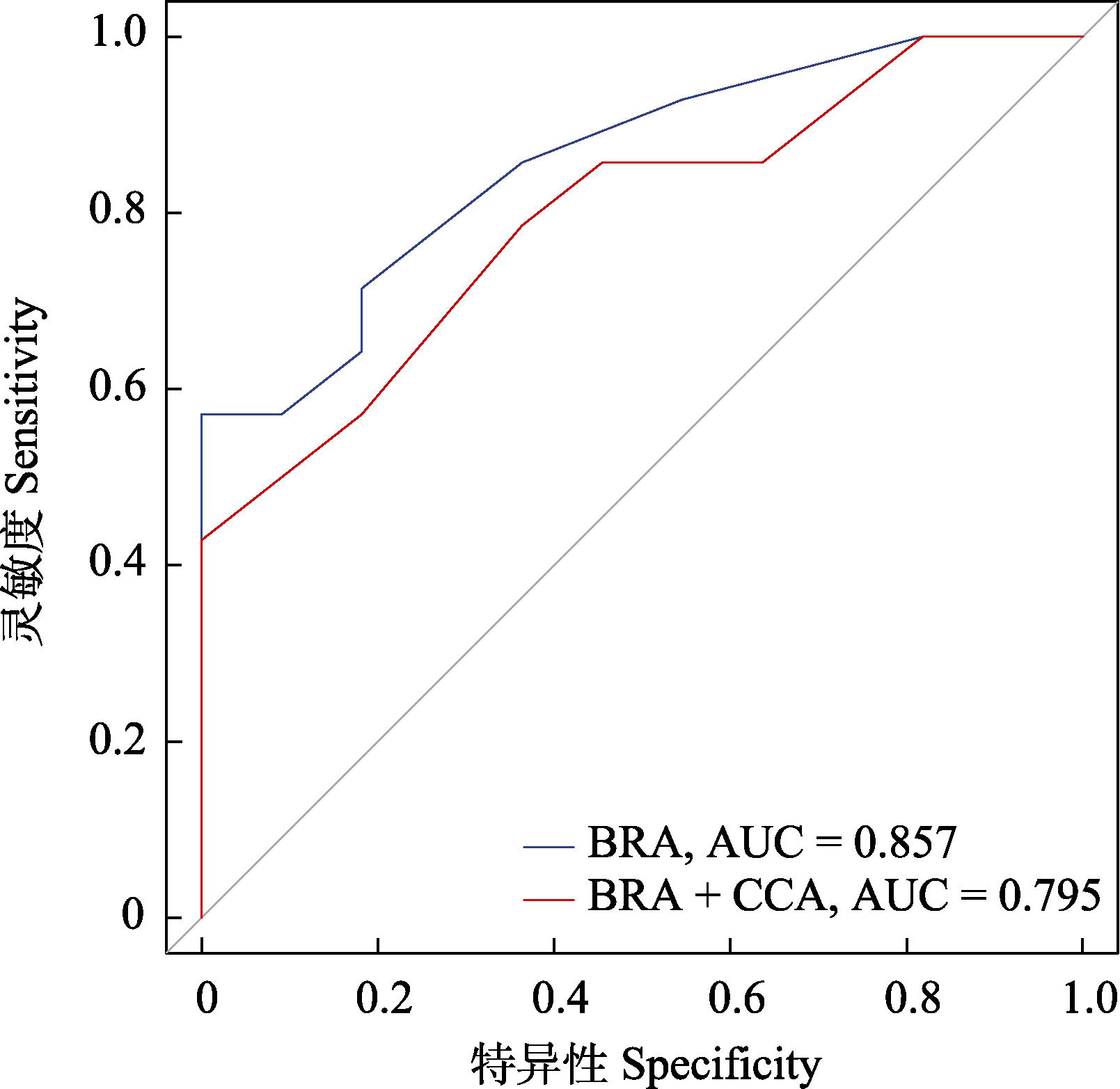
图8 澜沧江下游干流外来鱼类入侵风险评估受试者工作特征(ROC)曲线图。BRA为AS-ISK基础风险评估模块(basic risk assessment, BRA)得分, CCA为AS-ISK气候变化评估模块(climate change assessment, CCA)得分, AUC为ROC曲线下面积。
Fig. 8 Receiver operating characteristic (ROC) curve for invasive fish risk assessment in the lower mainstream of the Lancang River. BRA is basic risk assessment (BRA) score of AS-ISK; CCA is climate change assessment (CCA) score of AS-ISK; AUC is area under the ROC curve.
| 物种 Species | 评估结果 Assessment results | 置信因子 Confidence factor | |||||
|---|---|---|---|---|---|---|---|
| BRA得分 BRA score | 入侵风险 Invasion risk | BRA + CCA 得分 BRA + CCA score | 入侵风险 Invasion risk | BRA | CCA | BRA + CCA | |
| 齐氏罗非鱼 Coptodon zillii* | 39 | 高风险 High risk | 40.5 | 高风险 High risk | 0.83 | 0.64 | 0.76 |
| 尼罗罗非鱼 Oreochromis niloticus* | 37.5 | 高风险 High risk | 38 | 高风险 High risk | 0.85 | 0.63 | 0.77 |
| 花身副丽鱼 Parachromis managuensis* | 37 | 高风险 High risk | 35 | 高风险 High risk | 0.78 | 0.62 | 0.74 |
| 下口鲇 Hypostomus plecostomus* | 35 | 高风险 High risk | 37 | 高风险 High risk | 0.86 | 0.68 | 0.8 |
| 莫桑比克罗非鱼 Oreochromis mossambicus* | 32 | 高风险 High risk | 30 | 高风险 High risk | 0.81 | 0.62 | 0.75 |
| 䱗 Hemiculter leucisculus* | 25 | 高风险 High risk | 24 | 高风险 High risk | 0.88 | 0.61 | 0.74 |
| 麦穗鱼 Pseudorasbora parva* | 25 | 高风险 High risk | 22 | 中风险 Medium risk | 0.75 | 0.57 | 0.68 |
| 麦瑞加拉鲮 Cirrhinus mrigala* | 23 | 高风险 High risk | 19 | 中风险 Medium risk | 0.77 | 0.68 | 0.71 |
| 真吻虾虎鱼 Rhinogobius similis | 22 | 中风险 Medium risk | 22 | 中风险 Medium risk | 0.76 | 0.64 | 0.72 |
| 条纹鲮脂鲤 Prochilodus lineatus* | 21 | 中风险 Medium risk | 20 | 中风险 Medium risk | 0.79 | 0.68 | 0.72 |
| 云斑尖塘鳢 Oxyeleotris marmorata | 21 | 中风险 Medium risk | 19 | 中风险 Medium risk | 0.69 | 0.62 | 0.63 |
| 短盖肥脂鲤 Piaractus brachypomus* | 19 | 中风险 Medium risk | 19 | 中风险 Medium risk | 0.73 | 0.64 | 0.68 |
| 鲤 Cyprinus carpio* | 18 | 中风险 Medium risk | 19 | 中风险 Medium risk | 0.82 | 0.64 | 0.75 |
| 草鱼 Ctenopharyngodon idella* | 18 | 中风险 Medium risk | 16 | 中风险 Medium risk | 0.79 | 0.61 | 0.65 |
| 黄颡鱼 Pelteobagrus fulvidraco | 18 | 中风险 Medium risk | 17 | 中风险 Medium risk | 0.81 | 0.64 | 0.73 |
| 大鳞副泥鳅 Paramisgurnus dabryanus | 18 | 中风险 Medium risk | 16 | 中风险 Medium risk | 0.78 | 0.64 | 0.76 |
| 棒花鱼 Abbottina rivularis | 17 | 中风险 Medium risk | 20 | 中风险 Medium risk | 0.73 | 0.64 | 0.65 |
| 鲢 Hypophthalmichthys molitrix* | 17 | 中风险 Medium risk | 18 | 中风险 Medium risk | 0.84 | 0.67 | 0.78 |
| 褐吻虾虎鱼 Rhinogobius brunneus | 17 | 中风险 Medium risk | 18 | 中风险 Medium risk | 0.72 | 0.59 | 0.64 |
| 鳙 Hypophthalmichthys nobilis* | 16 | 中风险 Medium risk | 16 | 中风险 Medium risk | 0.83 | 0.68 | 0.76 |
| 瓦氏黄颡鱼 Pelteobagrus vachelli | 16 | 中风险 Medium risk | 17 | 中风险 Medium risk | 0.73 | 0.62 | 0.66 |
| 红鳍原鲌 Cultrichthys erythropterus | 16 | 中风险 Medium risk | 14 | 中风险 Medium risk | 0.71 | 0.62 | 0.64 |
| 高体鳑鲏 Rhodeus ocellatus | 16 | 中风险 Medium risk | 19 | 中风险 Medium risk | 0.76 | 0.67 | 0.72 |
| 低眼无齿𩷶Pangasianodon hypophthalmus | 15 | 中风险 Medium risk | 16 | 中风险 Medium risk | 0.71 | 0.62 | 0.66 |
| 光泽黄颡鱼 Pelteobagrus nitidus | 14 | 中风险 Medium risk | 12 | 中风险 Medium risk | 0.72 | 0.6 | 0.65 |
表4 澜沧江下游干流外来鱼类入侵风险评估结果
Table 4 Results of the risk assessment for alien fish invasion in the lower mainstream of the Lancang River
| 物种 Species | 评估结果 Assessment results | 置信因子 Confidence factor | |||||
|---|---|---|---|---|---|---|---|
| BRA得分 BRA score | 入侵风险 Invasion risk | BRA + CCA 得分 BRA + CCA score | 入侵风险 Invasion risk | BRA | CCA | BRA + CCA | |
| 齐氏罗非鱼 Coptodon zillii* | 39 | 高风险 High risk | 40.5 | 高风险 High risk | 0.83 | 0.64 | 0.76 |
| 尼罗罗非鱼 Oreochromis niloticus* | 37.5 | 高风险 High risk | 38 | 高风险 High risk | 0.85 | 0.63 | 0.77 |
| 花身副丽鱼 Parachromis managuensis* | 37 | 高风险 High risk | 35 | 高风险 High risk | 0.78 | 0.62 | 0.74 |
| 下口鲇 Hypostomus plecostomus* | 35 | 高风险 High risk | 37 | 高风险 High risk | 0.86 | 0.68 | 0.8 |
| 莫桑比克罗非鱼 Oreochromis mossambicus* | 32 | 高风险 High risk | 30 | 高风险 High risk | 0.81 | 0.62 | 0.75 |
| 䱗 Hemiculter leucisculus* | 25 | 高风险 High risk | 24 | 高风险 High risk | 0.88 | 0.61 | 0.74 |
| 麦穗鱼 Pseudorasbora parva* | 25 | 高风险 High risk | 22 | 中风险 Medium risk | 0.75 | 0.57 | 0.68 |
| 麦瑞加拉鲮 Cirrhinus mrigala* | 23 | 高风险 High risk | 19 | 中风险 Medium risk | 0.77 | 0.68 | 0.71 |
| 真吻虾虎鱼 Rhinogobius similis | 22 | 中风险 Medium risk | 22 | 中风险 Medium risk | 0.76 | 0.64 | 0.72 |
| 条纹鲮脂鲤 Prochilodus lineatus* | 21 | 中风险 Medium risk | 20 | 中风险 Medium risk | 0.79 | 0.68 | 0.72 |
| 云斑尖塘鳢 Oxyeleotris marmorata | 21 | 中风险 Medium risk | 19 | 中风险 Medium risk | 0.69 | 0.62 | 0.63 |
| 短盖肥脂鲤 Piaractus brachypomus* | 19 | 中风险 Medium risk | 19 | 中风险 Medium risk | 0.73 | 0.64 | 0.68 |
| 鲤 Cyprinus carpio* | 18 | 中风险 Medium risk | 19 | 中风险 Medium risk | 0.82 | 0.64 | 0.75 |
| 草鱼 Ctenopharyngodon idella* | 18 | 中风险 Medium risk | 16 | 中风险 Medium risk | 0.79 | 0.61 | 0.65 |
| 黄颡鱼 Pelteobagrus fulvidraco | 18 | 中风险 Medium risk | 17 | 中风险 Medium risk | 0.81 | 0.64 | 0.73 |
| 大鳞副泥鳅 Paramisgurnus dabryanus | 18 | 中风险 Medium risk | 16 | 中风险 Medium risk | 0.78 | 0.64 | 0.76 |
| 棒花鱼 Abbottina rivularis | 17 | 中风险 Medium risk | 20 | 中风险 Medium risk | 0.73 | 0.64 | 0.65 |
| 鲢 Hypophthalmichthys molitrix* | 17 | 中风险 Medium risk | 18 | 中风险 Medium risk | 0.84 | 0.67 | 0.78 |
| 褐吻虾虎鱼 Rhinogobius brunneus | 17 | 中风险 Medium risk | 18 | 中风险 Medium risk | 0.72 | 0.59 | 0.64 |
| 鳙 Hypophthalmichthys nobilis* | 16 | 中风险 Medium risk | 16 | 中风险 Medium risk | 0.83 | 0.68 | 0.76 |
| 瓦氏黄颡鱼 Pelteobagrus vachelli | 16 | 中风险 Medium risk | 17 | 中风险 Medium risk | 0.73 | 0.62 | 0.66 |
| 红鳍原鲌 Cultrichthys erythropterus | 16 | 中风险 Medium risk | 14 | 中风险 Medium risk | 0.71 | 0.62 | 0.64 |
| 高体鳑鲏 Rhodeus ocellatus | 16 | 中风险 Medium risk | 19 | 中风险 Medium risk | 0.76 | 0.67 | 0.72 |
| 低眼无齿𩷶Pangasianodon hypophthalmus | 15 | 中风险 Medium risk | 16 | 中风险 Medium risk | 0.71 | 0.62 | 0.66 |
| 光泽黄颡鱼 Pelteobagrus nitidus | 14 | 中风险 Medium risk | 12 | 中风险 Medium risk | 0.72 | 0.6 | 0.65 |
| [1] | Chen XY (2013) Checklist of fishes of Yunnan. Zoological Research, 34, 281-343. (in Chinese with English abstract) |
| [陈小勇 (2013) 云南鱼类名录. 动物学研究, 34, 281-343.] | |
| [2] | Chu XL, Chen YR (1989) Fauna of Fishes of Yunnan (Volume I). Science Press, Beijing. (in Chinese) |
| [褚新洛, 陈银瑞 (1989) 云南鱼类志(上册). 科学出版社, 北京.] | |
| [3] | Chu XL, Chen YR (1990) Fauna of Fishes of Yunnan (Volume II). Science Press, Beijing. (in Chinese) |
| [褚新洛, 陈银瑞 (1990) 云南鱼类志(下册). 科学出版社, 北京.] | |
| [4] |
Copp G, Vilizzi L, Tidbury H, Stebbing P, Tarkan AS, Miossec L, Goulletquer P (2016) Development of a generic decision-support tool for identifying potentially invasive aquatic taxa: AS-ISK. Management of Biological Invasions, 7, 343-350.
DOI URL |
| [5] |
Ding CZ, Jiang XM, Xie ZC, Brosse S (2016) Seventy-five years of biodiversity decline of fish assemblages in Chinese isolated plateau lakes: Widespread introductions and extirpations of narrow endemics lead to regional loss of dissimilarity. Diversity and Distributions, 23, 171-184.
DOI URL |
| [6] |
Eloranta AP, Finstad AG, Helland IP, Ugedal O, Power M (2018) Hydropower impacts on reservoir fish populations are modified by environmental variation. Science of the Total Environment, 618, 313-322.
DOI URL |
| [7] |
Fan H, He DM, Wang HL (2015) Environmental consequences of damming the mainstream Lancang-Mekong River: A review. Earth-Science Reviews, 146, 77-91.
DOI URL |
| [8] | Fang YH, Cui L, Xiong MT, Li SY, Yuan T, Chen F (2025) Changes in fish resources and conservation recommendations in middle reaches of Jinsha River. Yangtze River, 56, 48-57. (in Chinese with English abstract) |
| [方艳红, 崔磊, 熊满堂, 李世元, 袁婷, 陈锋 (2025) 金沙江中游鱼类资源变化及保护建议. 人民长江, 56, 48-57.] | |
| [9] |
Fráguas PS, Pompeu PS (2021) Hydropower affects fish trophic structure both downstream of the dam and upstream of the reservoir. Neotropical Ichthyology, 19, e200071.
DOI URL |
| [10] | Fu GQ, Qin T, Chen XY, Lei CY, Li GH (2021) Composition and species diversity of fishes in Xishuangbanna reach of Lancang River. Acta Ecologica Sinica, 41, 9557-9573. (in Chinese with English abstract) |
| [付贵权, 秦涛, 陈小勇, 雷春云, 李光华 (2021) 澜沧江西双版纳段鱼类组成和物种多样性. 生态学报, 41, 9557-9573.] | |
| [11] | Gu C, Li XL, Zhang SB, Tang Y (2019) Charm of Lancang River, a south-flowing river. Forest & Humankind, (8), 24-29. (in Chinese) |
| [顾纯, 李小龙, 张胜邦, 唐云 (2019) 澜沧江一条南流大江的魅力. 森林与人类, (8), 24-29.] | |
| [12] |
Habit E, Belk MC, Parra O (2007) Response of the riverine fish community to the construction and operation of a diversion hydropower plant in central Chile. Aquatic Conservation: Marine and Freshwater Ecosystems, 17, 37-49.
DOI URL |
| [13] |
Haworth MR, Bestgen KR (2024) Low-head dam fragmentation, habitat alteration, and invasive predators degrade a Western United States stream fish assemblage. Ecology of Freshwater Fish, 33, e12773.
DOI URL |
| [14] | He DM, Tang QC (2000) China’s International Rivers. Science Press, Beijing. (in Chinese) |
| [何大明, 汤奇成 (2000) 中国国际河流. 科学出版社, 北京.] | |
| [15] | He JY, Wu ZQ, Huang LL, Chen ZB, Wang DJ, Sun YY, Wen H, Song QL (2023) Risk analysis of alien fishes invasion in inland waters of Guangxi. Journal of Biosafety, 32, 168-177. (in Chinese with English abstract) |
| [何佳洋, 吴志强, 黄亮亮, 陈中兵, 王冬杰, 孙扬言, 文浩, 宋琦亮 (2023) 广西内陆水域外来鱼类入侵风险分析. 生物安全学报(中英文), 32, 168-177.] | |
| [16] |
Hlungwani HA, Marr SM, Weyl O, Sara JR (2023) Biological and life-history parameters for Labeo rosae Steindachner, 1894 and Oreochromis mossambicus (Peters, 1852) from Flag Boshielo Dam, Olifants River, South Africa. African Journal of Aquatic Science, 48, 199-212.
DOI URL |
| [17] |
Hong YX, Shi WQ, Chen YC, Liu DS, Ma HH, Zhu HY, Chen QW (2021) Succession of fish community in the mainstream of Lancang River during cascade hydropower development. Acta Ecologica Sinica, 41, 235-253. (in Chinese with English abstract)
DOI URL |
| [洪迎新, 施文卿, 陈宇琛, 刘东升, 马宏海, 朱昊彧, 陈求稳 (2021) 水电梯级开发进程中澜沧江干流鱼类群落演变特征. 生态学报, 41, 235-253.] | |
| [18] |
Huang YF, Liu LG, Yang CY, Yang WJ, Zhou Y, Wu MQ (2022) Life history traits of the sharpbelly Hemiculter leucisculus in a dammed tributary of the middle Yangtze River, China. Fisheries Science, 88, 751-765.
DOI |
| [19] | Kang B, He DM (2007) Research progress of biodiversity of fish species in the Lancangjiang River. Resources Science, 29(5), 195-200. (in Chinese with English abstract) |
| [康斌, 何大明 (2007) 澜沧江鱼类生物多样性研究进展. 资源科学, 29(5), 195-200.] | |
| [20] |
Kenkel NC, Orlóci L (1986) Applying metric and nonmetric multidimensional scaling to ecological studies: Some new results. Ecology, 67, 919-928.
DOI URL |
| [21] |
Kishida M, Specker JL (2000) Paternal mouthbrooding in the black-chinned tilapia, Sarotherodon melanotheron (Pisces: Cichlidae): Changes in gonadal steroids and potential for vitellogenin transfer to larvae. Hormones and Behavior, 37, 40-48.
PMID |
| [22] | Li F (2024) Fresh Water Fishes of China. Strait Publishing House, Fuzhou. (in Chinese) |
| [李帆 (2024) 中国淡水鱼类图鉴. 海峡书局, 福州.] | |
| [23] |
Li JP, Dong SK, Peng MC, Yang ZF, Liu SL, Li XY, Zhao C (2013) Effects of damming on the biological integrity of fish assemblages in the middle Lancang-Mekong River basin. Ecological Indicators, 34, 94-102.
DOI URL |
| [24] | Li QX, Li PY, He YH, Chen DW (2018) Correlative analysis of major hydro-meteorological factors in the downstream of the Lancang River. Journal of Irrigation and Drainage, 37(9), 100-107. (in Chinese with English abstract) |
| [黎清霞, 李佩怡, 何艳虎, 陈栋为 (2018) 澜沧江流域中下游主要水文气象要素变化相关性分析. 灌溉排水学报, 37(9), 100-107.] | |
| [25] |
Liu MD, Chen DQ, Duan XB, Wang K, Liu SP (2011) Ichthyofauna composition and distribution of fishes in Yunnan section of Lancang River. Journal of Fishery Sciences of China, 18, 156-170. (in Chinese with English abstract)
DOI URL |
| [刘明典, 陈大庆, 段辛斌, 王珂, 刘绍平 (2011) 澜沧江云南段鱼类区系组成与分布. 中国水产科学, 18, 156-170.] | |
| [26] | Liu MD, Wang X, Zhu FY, Duan XB, Liu SP, Chen DQ, Dai R (2021) The status and distribution characteristics of fishery resources in Simao District, Pu’er City, Yunnan Province, China. Freshwater Fisheries, 51(3), 82-90. (in Chinese with English abstract) |
| [刘明典, 汪曦, 朱峰跃, 段辛斌, 刘绍平, 陈大庆, 戴蓉 (2021) 云南普洱思茅区鱼类组成及资源分布特征. 淡水渔业, 51(3), 82-90.] | |
| [27] |
Lora D, Contador I, Pérez-Regadera JF, de la Cámara AG (2016) Features of the area under the receiver operating characteristic (ROC) curve. A good practice. Stata Journal, 16, 185-196.
DOI URL |
| [28] |
Macnaughton CJ, McLaughlin F, Bourque G, Senay C, Lanthier G, Harvey-Lavoie S, Legendre P, Lapointe M, Boisclair D (2017) The effects of regional hydrologic alteration on fish community structure in regulated rivers. River Research and Applications, 33, 249-257.
DOI URL |
| [29] |
Piesiewicz R, Krzystolik J, Korzelecka-Orkisz A, Tański A, Formicki K (2024) Early ontogeny of cichlids using selected species as examples. Animals, 14, 1238.
DOI URL |
| [30] | Pinkas L, Oliphant MS, Iverson ILK (1971) Food habits of albacore, bluefin tuna, and bonito in California waters. Fish Bulletin, 152, 1-105. |
| [31] |
Quan DL, Yang B, Ma WZ, Song L, Shen T (2021) Bryophyte diversity and its threat status in Xishuangbanna. Biodiversity Science, 29, 545-553. (in Chinese with English abstract)
DOI |
|
[全东丽, 杨斌, 马文章, 宋亮, 沈婷 (2021) 西双版纳苔藓植物多样性及其濒危状况. 生物多样性, 29, 545-553.]
DOI |
|
| [32] |
Resende AGA, de França EJ, de Oliveira CDL, Santana FM (2020) Maturity, growth and natural mortality rate of the introduced fish Parachromis managuensis (Perciformes: Cichlidae) in the semiarid region of Brazil. Acta Limnologica Brasiliensia, 32, e29.
DOI URL |
| [33] |
Ruykys L, Ta KAT, Bui TD, Vilizzi L, Copp GH (2021) Risk screening of the potential invasiveness of non-native aquatic species in Vietnam. Biological Invasions, 23, 2047-2060.
DOI |
| [34] |
Šmejkal M, Bartoň D, Duras J, Horký P, Muška ML, Kubečka J, Pfauserová N, Tesfaye M, Slavík O (2023) Living on the edge: Reservoirs facilitate enhanced interactions among generalist and rheophilic fish species in tributaries. Frontiers in Environmental Science, 11, 1099030.
DOI URL |
| [35] |
Starrs T, Starrs D, Lintermans M, Fulton CJ (2017) Assessing upstream invasion risk in alien freshwater fishes based on intrinsic variations in swimming speed performance. Ecology of Freshwater Fish, 26, 75-86.
DOI URL |
| [36] | Sun JR, Galib SM, Ding LY, Tao J, Ding CZ, He DM (2023) Research status of the Lancang-Mekong River Basin: Fish and environmental stressors. Reviews in Fish Biology and Fisheries, 33, 89-109. |
| [37] |
Tang J, Yin XA, Yang P, Yang ZF (2015) Climate-induced flow regime alterations and their implications for the Lancang River, China. River Research and Applications, 31, 422-432.
DOI URL |
| [38] | Wan CY, Fang K, Dong F, Zhang YY, Wu JM, Mu XD, Zhang H (2025) Status and ecological risk assessment of alien fish in the Yangtze River basin. Journal of Fisheries of China, 49(8), 59-71. (in Chinese with English abstract) |
| [万朝阳, 方康, 董芳, 张蓥钰, 吴金明, 牟希东, 张辉 (2025) 长江流域外来鱼类现状与生态风险评估. 水产学报, 49(8), 59-71.] | |
| [39] | Wei N, Zhang Y, Wu F, Shen ZW, Ru HJ, Ni ZH (2021) Current status and changes in fish assemblages in the Three Gorges Reservoir. Resources and Environment in the Yangtze Basin, 30, 1858-1869. (in Chinese with English abstract) |
| [魏念, 张燕, 吴凡, 沈子伟, 茹辉军, 倪朝辉 (2021) 三峡库区鱼类群落结构现状及变化. 长江流域资源与环境, 30, 1858-1869.] | |
| [40] | Wu F, Li YF, Ma BS, Zhang Y, Ru HJ, Shen ZW, Wei N (2025) Fish community structure and environmental impact factors in Three Gorges Reservoir during summer and autumn. South China Fisheries Science, 21(2), 81-89. (in Chinese with English abstract) |
| [吴凡, 李云峰, 马宝珊, 张燕, 茹辉军, 沈子伟, 魏念 (2025) 三峡库区夏季和秋季鱼类群落结构及环境影响因子研究. 南方水产科学, 21(2), 81-89.] | |
| [41] |
Xiao YS, Liu J, Wei JH, Xiao ZZ, Li J, Aguilar-Perera A, Herrera-Ulloa A (2023) Future climate change accelerates the invasive rhythm of alien marine species: New insights into the invasive potential of the world’s aquaculture species red drum Sciaenops ocellatus. Ecological Indicators, 155, 111069.
DOI URL |
| [42] | Xing Y, Tang SJ, Geletu TT, Zhao JL (2025) Invasion and management implications of Coptodon zillii in China. Chinese Journal of Ecology, 44, 645-653. (in Chinese with English abstract) |
| [邢盈, 唐首杰, Temesgen Tola Geletu, 赵金良 (2025) 中国齐氏罗非鱼入侵现状与防控建议. 生态学杂志, 44, 645-653.] | |
| [43] | Xu B, Sun Y, Huang X, Zhong PA, Zhu FL, Zhang JY, Wang XJ, Wang GQ, Ma YF, Lu QW, Wang H, Guo L (2022) Scenario-based multiobjective robust optimization and decision-making framework for optimal operation of a cascade hydropower system under multiple uncertainties. Water Resources Research, 58, e2021WR030965. |
| [44] | Xue F (2025) Discussion on the protection and utilization of aquatic biological resources in Lancang River with reference to the experience of fishing ban in Yangtze River. China Fisheries, (4), 49-52. (in Chinese) |
| [薛飞 (2025) 借鉴长江禁渔经验探讨澜沧江水生生物资源保护与利用. 中国水产, (4), 49-52.] | |
| [45] | Yi JL, Wang CY, Liu JW (2024) Study on landscape ecological risk assessment and influencing factors of Lancang River Basin in Yunnan Province. Agriculture and Technology, 44(2), 99-106. (in Chinese) |
| [易佳伶, 王晨阳, 刘嘉纬 (2024) 云南省澜沧江流域景观生态风险评估及影响因素研究. 农业与技术, 44(2), 99-106.] | |
| [46] |
Yi YJ, Tang CH, Yang ZF, Chen X (2014) Influence of Manwan Reservoir on fish habitat in the middle reach of the Lancang River. Ecological Engineering, 69, 106-117.
DOI URL |
| [47] | Yin MC (1995) Fish Ecology. China Agricultural Press, Beijing. (in Chinese) |
| [殷名称 (1995) 鱼类生态学. 中国农业出版社, 北京.] | |
| [48] |
Youden WJ (1950) Index for rating diagnostic tests. Cancer, 3, 32-35.
DOI PMID |
| [49] |
Zhang C, Ding CZ, Ding LY, Chen LQ, Hu JM, Tao J, Jiang XM (2019) Large-scale cascaded dam constructions drive taxonomic and phylogenetic differentiation of fish fauna in the Lancang River, China. Reviews in Fish Biology and Fisheries, 29, 895-916.
DOI |
| [50] |
Zhang C, Ding LY, Ding CZ, Chen LQ, Sun J, Jiang XM (2018) Responses of species and phylogenetic diversity of fish communities in the Lancang River to hydropower development and exotic invasions. Ecological Indicators, 90, 261-279.
DOI URL |
| [51] | Zhu TB, Hu FF, Gong JL, Wang XG, Chen K, Du HC, Yang DG, Wu XB (2022) Community structure and species diversity of fishes in the Tibet reach of the Lancang River, China. Journal of Fishery Sciences of China, 29, 304-313. (in Chinese with English abstract) |
| [朱挺兵, 胡飞飞, 龚进玲, 王旭歌, 陈康, 杜红春, 杨德国, 吴兴兵 (2022) 澜沧江西藏段鱼类群落结构及多样性. 中国水产科学, 29, 304-313.] |
| [1] | 潘正东, 林熙戎, 薛华, 胡治颖, 郭弘艺, 张亚, 吴阿娜, 唐文乔. 上海主要内陆水体鱼类物种多样性本底及群落结构[J]. 生物多样性, 2025, 33(6): 24290-. |
| [2] | 李雪原, 孙智闲, 王凤震, 席蕊, 方雨田, 郝浚源, 盛冬, 孙书雅, 赵亚辉. 城市发展对鱼类功能多样性的影响: 以超大城市北京为例[J]. 生物多样性, 2024, 32(8): 24150-. |
| [3] | 黄骏涵, 余梵冬, 王裕祥, 黄哲, 张铭斯, 房苗, 舒璐, 徐猛, 韦慧, 汪学杰, 顾党恩, 罗思. 花地河中下游外来鱼类入侵现状及其与环境因子的关系[J]. 生物多样性, 2024, 32(11): 24249-. |
| [4] | 何德奎, 陈晋南, 丁刘勇, 徐一扬, 黄俊豪, 隋晓云. 雅鲁藏布江鱼类多样性现状与分布格局[J]. 生物多样性, 2024, 32(11): 24143-. |
| [5] | 沈梅, 郭宁宁, 罗遵兰, 郭晓晨, 孙光, 肖能文. 基于eDNA metabarcoding探究北京市主要河流鱼类分布及影响因素[J]. 生物多样性, 2022, 30(7): 22240-. |
| [6] | 白敬沛, 黄耿, 蒋长军, 章伟成, 王齐东, 姚伦广. 丹江口水库鱼类群落特征及其历史变化[J]. 生物多样性, 2020, 28(10): 1202-1212. |
| [7] | 李渊, 张静, 张然, 宋普庆, 钟指挥, 王燕平, 林龙山. 南沙群岛西南部和北部湾口海域鱼类物种多样性[J]. 生物多样性, 2016, 24(2): 166-174. |
| [8] | 汪振华, 章守宇, 陈清满, 许强, 王凯. 马鞍列岛岩礁生境鱼类群落生态学. I.种类组成和多样性[J]. 生物多样性, 2012, 20(1): 41-50. |
| [9] | 茹辉军, 王海军, 赵伟华, 沈亚强, 王勇, 张晓可. 黄河干流鱼类群落特征及其历史变化[J]. 生物多样性, 2010, 18(2): 169-174. |
| 阅读次数 | ||||||
|
全文 |
|
|||||
|
摘要 |
|
|||||
备案号:京ICP备16067583号-7
Copyright © 2026 版权所有 《生物多样性》编辑部
地址: 北京香山南辛村20号, 邮编:100093
电话: 010-62836137, 62836665 E-mail: biodiversity@ibcas.ac.cn
