

生物多样性 ›› 2026, Vol. 34 ›› Issue (5): 25347. DOI: 10.17520/biods.2025347 cstr: 32101.14.biods.2025347
周楠, 黄美玲, 谭筱彩( ), 刘骏杰(), 文可, 蒋爱伍*()(
 )
)
收稿日期:2025-08-27
接受日期:2026-03-12
出版日期:2026-05-20
发布日期:2026-07-02
通讯作者:
蒋爱伍
基金资助:
Nan Zhou, Meiling Huang, Xiaocai Tan(), Junjie Liu(), Ke Wen, Aiwu Jiang*()()
Received:2025-08-27
Accepted:2026-03-12
Online:2026-05-20
Published:2026-07-02
Contact:
Aiwu Jiang
Supported by:摘要:
在快速城市化背景下, 城市公园作为生物多样性庇护所的功能日益凸显。但全国尺度下公园鸟类群落组成特征及公园空间特征(面积、水体分布)对物种丰富度的影响仍缺乏量化研究。本研究基于中国观鸟记录中心截至2023年12月31日的审核数据, 整合175个地级以上城市942个公园的标准化记录, 解析城市公园鸟类多样性格局及其驱动机制, 并编制中国城市公园鸟类名录。主要发现如下: 共记录到鸟类751种, 隶属于22目91科, 占中国鸟类物种数的49.8%, 其中国家一级保护野生鸟类26种, 二级46种, IUCN极危(CR) 4种, 濒危(EN) 8种; 公园鸟类以候鸟为主, 南方公园留鸟比例显著高于北方, 北方候鸟比例高于南方; 北方鸟类更倾向于食虫和植食(种食); 南方更倾向于食虫和杂食; 公园面积(估计值 = 0.1899, P < 0.001)、内部水体(估计值 = 0.2512, P < 0.001)及外部0.5 km缓冲区水体(估计值 = 0.2581, P = 0.004)均显著正向影响鸟类物种多样性, 其中水体(尤其外部水体)的影响超过面积效应。鉴于食虫候鸟(40.8%)的主导地位及濒危鸟类对水体的高度依赖, 建议优先构建半自然灌丛生境并优化水体-生态廊道系统。
周楠, 黄美玲, 谭筱彩, 刘骏杰, 文可, 蒋爱伍 (2026) 基于公民科学数据的全国地级以上城市公园鸟类群落特征及环境影响因子. 生物多样性, 34, 25347. DOI: 10.17520/biods.2025347.
Nan Zhou, Meiling Huang, Xiaocai Tan, Junjie Liu, Ke Wen, Aiwu Jiang (2026) Bird community characteristics and their environmental drivers in urban parks across Chinese prefecture-level cities based on citizen science data. Biodiversity Science, 34, 25347. DOI: 10.17520/biods.2025347.
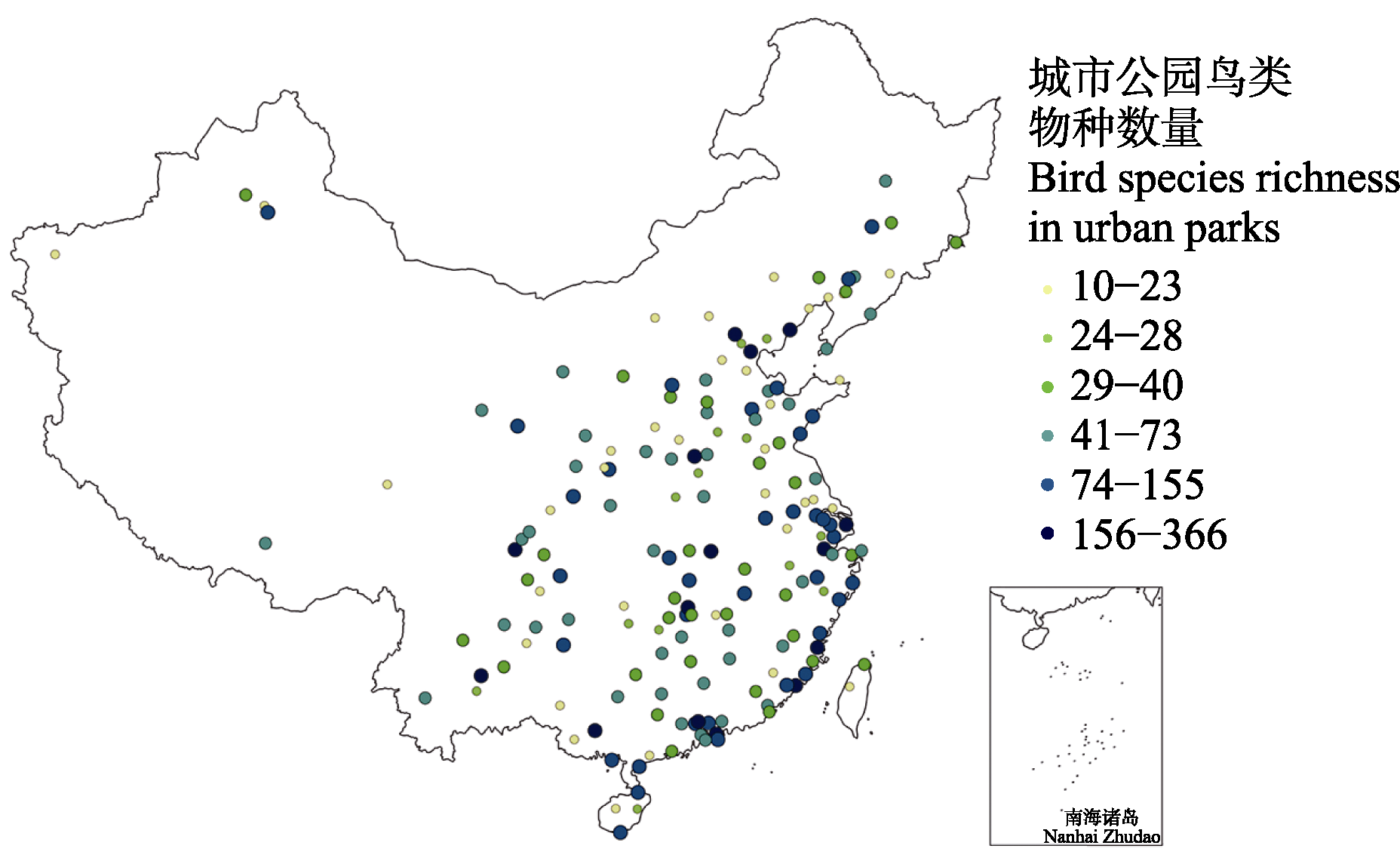
图1 不同城市(n = 175)的城市公园(n = 942)鸟类物种丰富度(数据来源: 中国观鸟记录中心)
Fig. 1 Bird species richness in 942 urban parks across 175 Chinese prefecture-level cities (Data from BirdReporting)
| 居留型 Residence pattern | 食性 Feeding habit | 数量 Number | 占所属居留型的比例 Proportion of resident pattern | 占所有鸟类物种的比例 Proportion of all species |
|---|---|---|---|---|
| 留鸟 Resident | 食虫类 Insectivorous | 106 | 49.5% | 14.1% |
| 植食(种食)类 Herbivorous (Granivorous) | 32 | 15.0% | 4.3% | |
| 肉食类 Carnivorous | 9 | 4.2% | 1.2% | |
| 杂食类 Omnivorous | 52 | 24.3% | 6.9% | |
| 食果/食蜜类 Frugivorous/Nectarivorous | 15 | 7.0% | 2.0% | |
| 候鸟 Migratory | 食虫类 Insectivorous | 306 | 57.0% | 40.8% |
| 植食(种食)类 Herbivorous (Granivorous) | 76 | 14.2% | 10.1% | |
| 肉食类 Carnivorous | 88 | 16.4% | 11.7% | |
| 杂食类 Omnivorous | 55 | 10.2% | 7.3% | |
| 食果/食蜜类 Frugivorous/Nectarivorous | 12 | 2.2% | 1.6% |
表1 中国城市公园不同居留型鸟类食性组成及占比
Table 1 Feeding habit and residence pattern of birds by residency type in Chinese urban parks
| 居留型 Residence pattern | 食性 Feeding habit | 数量 Number | 占所属居留型的比例 Proportion of resident pattern | 占所有鸟类物种的比例 Proportion of all species |
|---|---|---|---|---|
| 留鸟 Resident | 食虫类 Insectivorous | 106 | 49.5% | 14.1% |
| 植食(种食)类 Herbivorous (Granivorous) | 32 | 15.0% | 4.3% | |
| 肉食类 Carnivorous | 9 | 4.2% | 1.2% | |
| 杂食类 Omnivorous | 52 | 24.3% | 6.9% | |
| 食果/食蜜类 Frugivorous/Nectarivorous | 15 | 7.0% | 2.0% | |
| 候鸟 Migratory | 食虫类 Insectivorous | 306 | 57.0% | 40.8% |
| 植食(种食)类 Herbivorous (Granivorous) | 76 | 14.2% | 10.1% | |
| 肉食类 Carnivorous | 88 | 16.4% | 11.7% | |
| 杂食类 Omnivorous | 55 | 10.2% | 7.3% | |
| 食果/食蜜类 Frugivorous/Nectarivorous | 12 | 2.2% | 1.6% |
| 居留型 Residence pattern | 食性 Feeding habit | 数量 Number |
|---|---|---|
| 北方 Northern China | ||
| 候鸟 Migratory | 食虫类 Insectivorous | 191 |
| 植食(种食)类 Herbivorous (Granivorous) | 66 | |
| 肉食类 Carnivorous | 66 | |
| 杂食类 Omnivorous | 43 | |
| 食果/食蜜类 Frugivorous/Nectarivorous | 6 | |
| 留鸟 Resident | 食虫类 Insectivorous | 38 |
| 植食(种食)类 Herbivorous (Granivorous) | 21 | |
| 肉食类 Carnivorous | 4 | |
| 杂食类 Omnivorous | 20 | |
| 食果/食蜜类 Frugivorous/Nectarivorous | 2 | |
| 南方 Southern China | ||
| 候鸟 Migratory | 食虫类 Insectivorous | 281 |
| 植食(种食)类 Herbivorous (Granivorous) | 63 | |
| 肉食类 Carnivorous | 77 | |
| 杂食类 Omnivorous | 46 | |
| 食果/食蜜类 Frugivorous/Nectarivorous | 12 | |
| 留鸟 Resident | 食虫类 Insectivorous | 92 |
| 植食(种食)类 Herbivorous (Granivorous) | 16 | |
| 肉食类 Carnivorous | 8 | |
| 杂食类 Omnivorous | 42 | |
| 食果/食蜜类 Frugivorous/Nectarivorous | 13 | |
表2 中国南、北方城市公园不同居留型鸟类食性组成
Table 2 Feeding habit and residence pattern of birds with different residency types in urban parks in northern and southern China
| 居留型 Residence pattern | 食性 Feeding habit | 数量 Number |
|---|---|---|
| 北方 Northern China | ||
| 候鸟 Migratory | 食虫类 Insectivorous | 191 |
| 植食(种食)类 Herbivorous (Granivorous) | 66 | |
| 肉食类 Carnivorous | 66 | |
| 杂食类 Omnivorous | 43 | |
| 食果/食蜜类 Frugivorous/Nectarivorous | 6 | |
| 留鸟 Resident | 食虫类 Insectivorous | 38 |
| 植食(种食)类 Herbivorous (Granivorous) | 21 | |
| 肉食类 Carnivorous | 4 | |
| 杂食类 Omnivorous | 20 | |
| 食果/食蜜类 Frugivorous/Nectarivorous | 2 | |
| 南方 Southern China | ||
| 候鸟 Migratory | 食虫类 Insectivorous | 281 |
| 植食(种食)类 Herbivorous (Granivorous) | 63 | |
| 肉食类 Carnivorous | 77 | |
| 杂食类 Omnivorous | 46 | |
| 食果/食蜜类 Frugivorous/Nectarivorous | 12 | |
| 留鸟 Resident | 食虫类 Insectivorous | 92 |
| 植食(种食)类 Herbivorous (Granivorous) | 16 | |
| 肉食类 Carnivorous | 8 | |
| 杂食类 Omnivorous | 42 | |
| 食果/食蜜类 Frugivorous/Nectarivorous | 13 | |
| 变量 Variable | 估计值 Estimate | 置信区间下限 Lower confidence internal | 置信区间上限 Upper confidence internal | P |
|---|---|---|---|---|
| 公园面积 Park area | 0.1899 | 0.1498 | 0.2234 | < 0.001 |
| 内部具有水体 With water bodies within the park | 0.2512 | 0.1443 | 0.3725 | < 0.001 |
| 外部(0.5 km缓冲区)具有水体 Water bodies outside the park (0.5 km buffer zone) | 0.2581 | 0.0990 | 0.3505 | 0.004 |
表3 广义线性混合模型(GLMM)不同变量估计值以及95%置信区间
Table 3 Estimated values of different variables in the generalized linear mixed model (GLMM) and their 95% confidence intervals
| 变量 Variable | 估计值 Estimate | 置信区间下限 Lower confidence internal | 置信区间上限 Upper confidence internal | P |
|---|---|---|---|---|
| 公园面积 Park area | 0.1899 | 0.1498 | 0.2234 | < 0.001 |
| 内部具有水体 With water bodies within the park | 0.2512 | 0.1443 | 0.3725 | < 0.001 |
| 外部(0.5 km缓冲区)具有水体 Water bodies outside the park (0.5 km buffer zone) | 0.2581 | 0.0990 | 0.3505 | 0.004 |
| [1] |
Canedoli C, Manenti R, Padoa-Schioppa E (2018) Birds biodiversity in urban and periurban forests: Environmental determinants at local and landscape scales. Urban Ecosystems, 21, 779-793.
DOI |
| [2] |
Cornelis J, Hermy M (2004) Biodiversity relationships in urban and suburban parks in Flanders. Landscape and Urban Planning, 69, 385-401.
DOI URL |
| [3] | Deng ZD, Ding ZF, Zeng XY, Zhang CL, Li XE, He ZQ, Liang JC, Hu HJ (2023) Landscape characteristics of urban green spaces and their effects on bird diversity: The case of Guangzhou. Sichuan Journal of Zoology, 42, 568-578. (in Chinese with English abstract) |
| [邓卓迪, 丁志锋, 曾小悦, 张春兰, 李孝恩, 何子晴, 梁健超, 胡慧建 (2023) 广州城市绿地景观特征及其对鸟类多样性的影响. 四川动物, 42, 568-578.] | |
| [4] | Fan JX, Lian Y, Gao HC, Li HX, He MX, Cui L, Mo XQ (2025) Characteristics of avian species diversity and influencing factors in Chinese mainland. Acta Ecologica Sinica, 45, 596-614. (in Chinese with English abstract) |
| [范佳旭, 连懿, 高晖春, 李海笑, 贺梦璇, 崔磊, 莫训强 (2025) 中国大陆鸟类物种多样性特征及影响因素. 生态学报, 45, 596-614.] | |
| [5] |
Fahrig L (2003) Effects of habitat fragmentation on biodiversity. Annual Review of Ecology, Evolution, and Systematics, 34, 487-515.
DOI URL |
| [6] | Fernández-Juricic E (2001) Avian spatial segregation at edges and interiors of urban parks in Madrid, Spain. Biodiversity & Conservation, 10, 1303-1316. |
| [7] |
Fontana S, Sattler T, Bontadina F, Moretti M (2011) How to manage the urban green to improve bird diversity and community structure. Landscape and Urban Planning, 101, 278-285.
DOI URL |
| [8] | Gaston KJ, Blackburn TM (1995) Birds, body size and the threat of extinction. Philosophical Transactions of the Royal Society of London Series B: Biological Sciences, 347, 205-212. |
| [9] |
Gregory RD, van Strien A (2010) Wild bird indicators: Using composite population trends of birds as measures of environmental health. Ornithological Science, 9, 3-22.
DOI URL |
| [10] | Guo L, Du SH, Xue DY, Jiang XD (2009) Spatio-temporal variation of landscape patterns during rapid urbanization in Guangzhou City. Acta Scientiarum Naturalium Universitatis Pekinensis, 45, 129-136. (in Chinese with English abstract) |
| [郭泺, 杜世宏, 薛达元, 江学顶 (2009) 快速城市化进程中广州市景观格局时空分异特征的研究. 北京大学学报(自然科学版), 45, 129-136.] | |
| [11] |
Guo TR, Shan BQ (2021) Urban wilderness construction: An example of Shanghai urban biodiversity education base. Landscape Architecture Frontiers, 9, 120-131. (in Chinese with English abstract)
DOI |
| [郭陶然, 山冰沁 (2021) 城市荒野景观营造: 以上海乡土生态科普示范基地为例, 景观设计学, 9, 120-131.] | |
| [12] |
Guthula VB, Shrotriya S, Nigam P, Goyal SP, Mohan D, Habib B (2022) Biodiversity significance of small habitat patches: More than half of Indian bird species are in academic campuses. Landscape and Urban Planning, 228, 104552.
DOI URL |
| [13] | Hitchmough J, Liu B, Hang Y (2013) Applying an ecological approach to extensive, designed herbaceous vegetation in urban green infrastructure. Chinese Landscape Architecture, 29(3), 16-26. (in Chinese with English abstract) |
| [詹姆斯·希契莫夫, 刘波, 杭烨 (2013) 城市绿色基础设施中大规模草本植物群落种植设计与管理的生态途径. 中国园林, 29(3), 16-26.] | |
| [14] | Huang Y, Zhao YZ, Li SH, von Gadow K (2015) The effects of habitat area, vegetation structure and insect richness on breeding bird populations in Beijing urban parks. Urban Forestry & Urban Greening, 14, 1027-1039. |
| [15] |
Hyseni C, Heino J, Bini LM, Bjelke U, Johansson F (2021) The importance of blue and green landscape connectivity for biodiversity in urban ponds. Basic and Applied Ecology, 57, 129-145.
DOI |
| [16] | Ji T, Zhang YY (2011) Impacts of ambient noise on bird song and adaptation strategies of birds. Chinese Journal of Ecology, 30, 831-836. (in Chinese with English abstract) |
| [季婷, 张雁云 (2011) 环境噪音对鸟类鸣声的影响及鸟类的适应对策. 生态学杂志, 30, 831-836.] | |
| [17] | Katuwal HB, Basnet K, Khanal B, Devkota S, Rai SK, Gajurel JP, Scheidegger C, Nobis MP (2016) Seasonal changes in bird species and feeding guilds along elevational gradients of the central Himalayas, Nepal. PLoS ONE, 11, e0158362. |
| [18] |
Keten A, Eroglu E, Kaya S, Anderson JT (2020) Bird diversity along a riparian corridor in a moderate urban landscape. Ecological Indicators, 118, 106751.
DOI URL |
| [19] |
Knapp S, Kühn I, Schweiger O, Klotz S (2008) Challenging urban species diversity: Contrasting phylogenetic patterns across plant functional groups in Germany. Ecology Letters, 11, 1054-1064.
DOI PMID |
| [20] | Kontsiotis VJ, Valsamidis E, Liordos V (2019) Organization and differentiation of breeding bird communities across a forested to urban landscape. Urban Forestry & Urban Greening, 38, 242-250. |
| [21] |
Larson DM, Cordts SD, Hansel-Welch N (2020) Shallow lake management enhanced habitat and attracted waterbirds during fall migration. Hydrobiologia, 847, 3365-3379.
DOI |
| [22] |
Lepczyk CA, Aronson MFJ, Evans KL, Goddard MA, Lerman SB, MacIvor JS (2017) Biodiversity in the city: Fundamental questions for understanding the ecology of urban green spaces for biodiversity conservation. BioScience, 67, 799-807.
DOI URL |
| [23] | Lewis-Phillips J, Brooks SJ, Sayer CD, Patmore IR, Hilton GM, Harrison A, Robson H, Axmacher JC (2020) Ponds as insect chimneys: Restoring overgrown farmland ponds benefits birds through elevated productivity of emerging aquatic insects. Biological Conservation, 241, 108253. |
| [24] | Li X, Tian YL, He YW, Sun XF (2024) Characteristics of urban avian diversity in China and the construction of urban green space guided by bird protection. Acta Ecologica Sinica, 44, 10234-10246. (in Chinese with English abstract) |
| [李旭, 田永莲, 贺禹文, 孙秀锋 (2024) 我国城市鸟类多样性特征及鸟类保护导向的城市绿地营建. 生态学报, 44, 10234-10246.] | |
| [25] |
Marzluff JM, Ewing K (2001) Restoration of fragmented landscapes for the conservation of birds: A general framework and specific recommendations for urbanizing landscapes. Restoration Ecology, 9, 280-292.
DOI URL |
| [26] |
McDonnell MJ, Pickett STA (1990) Ecosystem structure and function along urban-rural gradients: An unexploited opportunity for ecology. Ecology, 71, 1232-1237.
DOI URL |
| [27] |
McKinney ML (2006) Urbanization as a major cause of biotic homogenization. Biological Conservation, 127, 247-260.
DOI URL |
| [28] |
Nummi P, Kattainen S, Ulander P, Hahtola A (2011) Bats benefit from beavers: A facilitative link between aquatic and terrestrial food webs. Biodiversity and Conservation, 20, 851-859.
DOI URL |
| [29] |
Ocampo D, Londoño GA (2015) Tropical montane birds have increased nesting success on small river islands. The Auk, 132, 1-10.
DOI URL |
| [30] |
Pagani-Núñez E, Xu Y, Yan MX, He JK, Jiang ZF, Jiang HS (2022) Trade-offs between economic development and biodiversity conservation on a tropical island. Conservation Biology, 36, e139121.
DOI URL |
| [31] |
Palomino D, Carrascal LM (2006) Urban influence on birds at a regional scale: A case study with the avifauna of northern Madrid Province. Landscape and Urban Planning, 77, 276-290.
DOI URL |
| [32] |
Pereira HM, Navarro LM, Santos Martins I (2012) Global biodiversity change: The bad, the good, and the unknown. Annual Review of Environment and Resources, 37, 25-50.
DOI |
| [33] |
Rebele F (1994) Urban ecology and special features of urban ecosystems. Global Ecology and Biogeography Letters, 4, 173-187.
DOI URL |
| [34] |
Sandström UG, Angelstam P, Mikusiński G (2006) Ecological diversity of birds in relation to the structure of urban green space. Landscape and Urban Planning, 77, 39-53.
DOI URL |
| [35] | Wang CX, He JH, Liu DF, Yu XB, Shi QQ (2022) Impact of land use change on bird habitat connectivity: A case study in Ezhou City. Acta Ecologica Sinica, 42, 4197-4208. (in Chinese with English abstract) |
| [王春晓, 何建华, 刘殿锋, 于秀波, 石青青 (2022) 土地利用变化对鸟类栖息地连通性的影响——以鄂州市为例. 生态学报, 42, 4197-4208.] | |
| [36] |
Wang Y, Xu J, Yang G, Li HQ, Wu SY, Tang HM, Ma B, Wang ZH (2014) The composition of common woody plant species and their influence on bird communities in urban green areas. Biodiversity Science, 22, 196-207. (in Chinese with English abstract)
DOI |
|
[王勇, 许洁, 杨刚, 李宏庆, 吴时英, 唐海明, 马波, 王正寰 (2014) 城市公共绿地常见木本植物组成对鸟类群落的影响. 生物多样性, 22, 196-207.]
DOI |
|
| [37] |
Wang YP, Song YF, Zhong YX, Chen CW, Zhao YH, Zeng D, Wu YR, Ding P (2021) A dataset on the life-history and ecological traits of Chinese birds. Biodiversity Science, 29, 1149-1153. (in Chinese with English abstract)
DOI URL |
|
[王彦平, 宋云枫, 钟雨茜, 陈传武, 赵郁豪, 曾頔, 吴亦如, 丁平 (2021) 中国鸟类的生活史和生态学特征数据集. 生物多样性, 29, 1149-1153.]
DOI |
|
| [38] |
Wong JSY, Soh MCK, Low BW, Er KBH (2023) Tropical bird communities benefit from regular-shaped and naturalised urban green spaces with water bodies. Landscape and Urban Planning, 231, 104644.
DOI URL |
| [39] | Wu MQ, Hu MM, Wang T, Fan C, Xia BC (2019) Recognition of urban ecological source area based on ecological security pattern and multi-scale landscape connectivity. Acta Ecologica Sinica, 39, 4720-4731. (in Chinese with English abstract) |
| [吴茂全, 胡蒙蒙, 汪涛, 凡宸, 夏北成 (2019) 基于生态安全格局与多尺度景观连通性的城市生态源地识别. 生态学报, 39, 4720-4731.] | |
| [40] |
Xie SL, Wang XK, Ren YF, Su ZM, Su YB, Wang SQ, Zhou WQ, Lu F, Qian YG, Gong C, Huang BB, Ouyang ZY (2020) Factors responsible for forest and water bird distributions in rivers and lakes along an urban gradient in Beijing. Science of the Total Environment, 735, 139308.
DOI URL |
| [41] |
Yang XR, Tan XW, Chen CW, Wang YP (2020) The influence of urban park characteristics on bird diversity in Nanjing, China. Avian Research, 11, 45.
DOI |
| [42] |
Yuan J, You FY, Hou CL, Ou HJ, Yin Y (2021) Reconstruction of urban wilderness habitats based on vegetation rewilding: Taking wildflower meadows as an example. Landscape Architecture Frontiers, 9, 26-39. (in Chinese with English abstract)
DOI |
| [袁嘉, 游奉溢, 侯春丽, 欧桦杰, 尹渊 (2021) 基于植被再野化的城市荒野生境重建——以野花草甸为例. 景观设计学(中英文), 9, 26-39.] | |
| [43] | Zeng XY, Song YH (2023) Study on the biodiversity distribution pattern of the green space in the central city of Kunming based on the key species and habitat quality assessment. Chinese Landscape Architecture, 39(9), 126-132. (in Chinese with English abstract) |
| [曾欣怡, 宋钰红 (2023) 基于关键物种与生境质量评估的昆明市中心城区绿色空间生物多样性分布格局研究. 中国园林, 39(9), 126-132.] | |
| [44] |
Zhang P, Dong YL, Ren ZB, Wang GD, Guo YJ, Wang CC, Ma ZJ (2023) Rapid urbanization and meteorological changes are reshaping the urban vegetation pattern in urban core area: A national 315-city study in China. Science of the Total Environment, 904, 167269.
DOI URL |
| [45] |
Zhang WJ, Liang CX, Liu J, Si XF, Feng G (2018) Species richness, phylogenetic and functional structure of bird communities in Chinese university campuses are associated with divergent variables. Urban Ecosystems, 21, 1213-1225.
DOI |
| [46] | Zheng BJ, Dong L (2019) Study on plant landscape of Beijing urban linear parks based on bird diversity improvement. Landscape Architecture, 26(1), 53-57. (in Chinese with English abstract) |
| [郑冰晶, 董丽 (2019) 基于提高鸟类多样性的北京城市线性公园绿地植物景观探析. 风景园林, 26(1), 53-57.] | |
| [47] | Zheng GM (2012) Ornithology, 2nd edn. Beijing Normal University Press, Beijing. (in Chinese) |
| [郑光美 (2012) 鸟类学, 第二版. 北京师范大学出版社, 北京.] | |
| [48] | Zheng GM (2023) A Checklist on the Classification and Distribution of the Birds of China, 4th edn. Science Press, Beijing. (in Chinese) |
| [郑光美 (2023) 中国鸟类分类与分布名录, 第四版. 科学出版社, 北京.] | |
| [49] |
Zivanovic AJ, Luck GW (2016) Social and environmental factors drive variation in plant and bird communities across urban greenspace in Sydney, Australia. Journal of Environmental Management, 169, 210-222.
DOI PMID |
| [1] | 鲁夕霞, 周冯祥, 雍李明, 曾千慧, 赵丽媛, 张语克, 王先艳. 1990-2020年围填海对我国中华白海豚栖息地的影响[J]. 生物多样性, 2026, 34(3): 25249-. |
| [2] | 潘正东, 林熙戎, 薛华, 胡治颖, 郭弘艺, 张亚, 吴阿娜, 唐文乔. 上海主要内陆水体鱼类物种多样性本底及群落结构[J]. 生物多样性, 2025, 33(6): 24290-. |
| [3] | 胡敏, 李彬彬, Coraline Goron. 只绿是不够的: 一个生物多样性友好的城市公园管理框架[J]. 生物多样性, 2025, 33(5): 24483-. |
| [4] | 王秦韵, 张玉泉, 刘浩, 李明, 刘菲, 赵宁, 陈鹏, 齐敦武, 阙品甲. 成都大熊猫繁育研究基地鸟类多样性[J]. 生物多样性, 2024, 32(8): 24066-. |
| [5] | 顾燚芸, 薛嘉祈, 高金会, 谢心仪, 韦铭, 雷进宇, 闻丞. 一种基于公众科学数据的区域性鸟类多样性评价方法[J]. 生物多样性, 2024, 32(7): 24080-. |
| [6] | 王鹏, 隋佳容, 丁欣瑶, 王伟中, 曹雪倩, 赵海鹏, 王彦平. 郑州城市公园鸟类群落嵌套分布格局及其影响因素[J]. 生物多样性, 2024, 32(3): 23359-. |
| [7] | 吴相獐, 雷富民, 单壹壹, 于晶. 上海城市公园苔藓植物多样性分布格局及其环境影响因子[J]. 生物多样性, 2024, 32(2): 23364-. |
| [8] | 谭娟, 朱丹丹, 王卿, 王敏. 被动声学技术在城市公园绿地鸟类多样性监测中的应用: 以上海闵行区春申公园为例[J]. 生物多样性, 2024, 32(10): 24262-. |
| [9] | 刘焕章, 杨君兴, 刘淑伟, 高欣, 陈宇顺, 张春光, 赵凯, 李新辉, 刘伟. 鱼类多样性监测的理论方法及中国内陆 水体鱼类多样性监测[J]. 生物多样性, 2016, 24(11): 1227-1233. |
| [10] | 王宜成. 用原图-对偶图法设计内部间隔最小的自然保护区[J]. 生物多样性, 2011, 19(4): 404-413. |
| [11] | 赵月琴, 卢剑波, 朱磊, 傅智慧. 不同营养水平对外来物种凤眼莲生长特征及其竞争力的影响[J]. 生物多样性, 2006, 14(2): 159-164. |
| [12] | 胡慧建, 蒋志刚, 王祖望. 中国不同地理区域鸟兽物种丰富度的相关性[J]. 生物多样性, 2001, 09(2): 95-101. |
| [13] | 于丹, 种云霄, 涂芒辉, 汪小炎, 周晓华. 中国水生高等植物受危种的研究[J]. 生物多样性, 1998, 06(1): 13-21. |
| 阅读次数 | ||||||
|
全文 |
|
|||||
|
摘要 |
|
|||||
备案号:京ICP备16067583号-7
Copyright © 2026 版权所有 《生物多样性》编辑部
地址: 北京香山南辛村20号, 邮编:100093
电话: 010-62836137, 62836665 E-mail: biodiversity@ibcas.ac.cn
