

生物多样性 ›› 2026, Vol. 34 ›› Issue (1): 25308. DOI: 10.17520/biods.2025308 cstr: 32101.14.biods.2025308
张霜1( ), 宋波2,*()(
 )
)
收稿日期:2025-08-05
接受日期:2025-12-10
出版日期:2026-01-20
发布日期:2026-01-21
通讯作者:
宋波
基金资助:
Shuang Zhang1(), Bo Song2,*()()
Received:2025-08-05
Accepted:2025-12-10
Online:2026-01-20
Published:2026-01-21
Contact:
Bo Song
Supported by:摘要:
Meta分析是通过对不同案例数据进行加权整合分析, 以得到普适性结论的重要统计工具, 在生态学领域具有广阔的应用价值。但长期以来, 科研人员对Meta分析的基本理念和方法体系具有较多的认识误区, 一定程度上造成了该方法的误用甚至错用。本文从Meta分析的操作步骤出发, 从其基本特征、文献的查询与筛选、效应值的构建、模型的选取、特殊数据结构的纳入、解释变量的引入、结果可靠性的判定、软件工具介绍等几个方面, 介绍了Meta分析的基本理念和应用中应注意的问题。相关概念和技术要点的厘清, 将为我们构建更为精准、合理的Meta分析模型, 提升结果可靠性提供帮助。Meta分析技术的不断更新进步, 必将为生态学领域众多基础科学问题的回答提供更有力、可靠的技术支撑。
张霜, 宋波 (2026) Meta分析应用中应注意的几个关键问题. 生物多样性, 34, 25308. DOI: 10.17520/biods.2025308.
Shuang Zhang, Bo Song (2026) Several key questions when conducting a meta-analysis. Biodiversity Science, 34, 25308. DOI: 10.17520/biods.2025308.
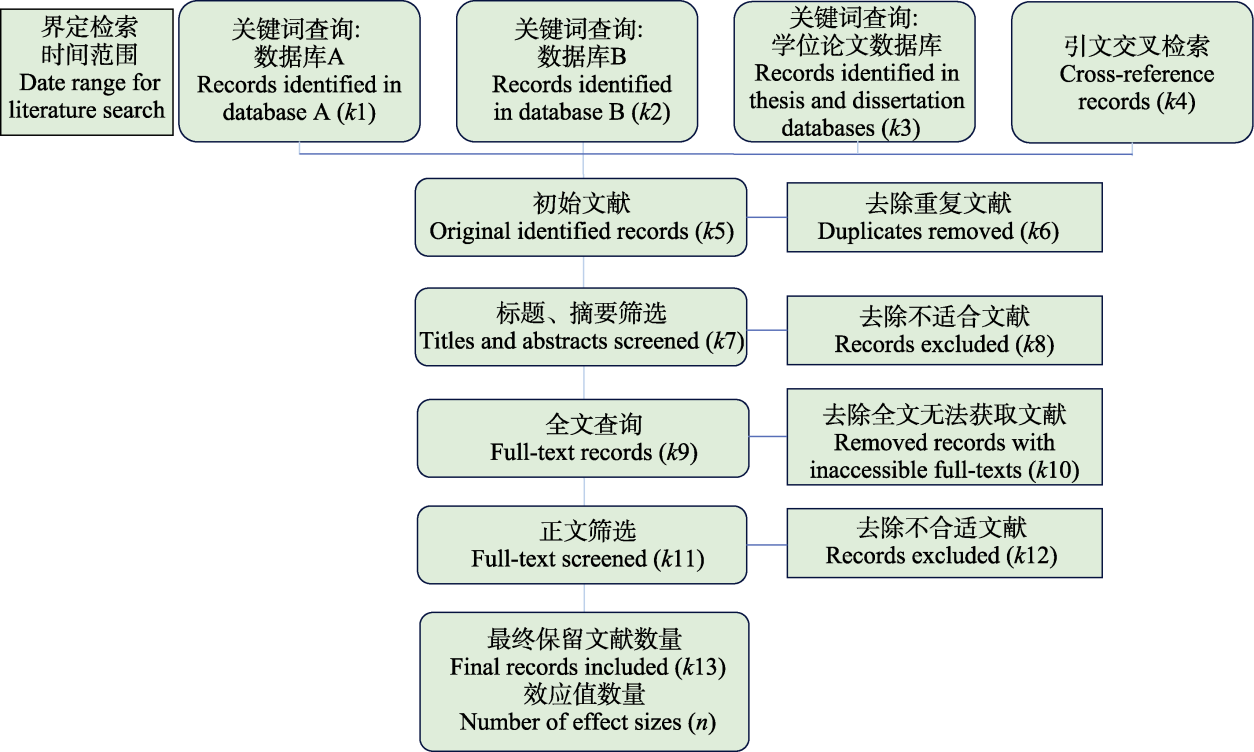
图1 PRISMA-文献筛选流程示意图。其中k1-k13代表每一步中涉及的文献数量, n为从文献中总共提取的效应值(即研究案例)数量。
Fig. 1 The PRISMA-flowchart in literature search. k1 to k13 represents the number of publications included or excluded at each stage of the literature search and n represents the total number of effect sizes derived from the selected literature.
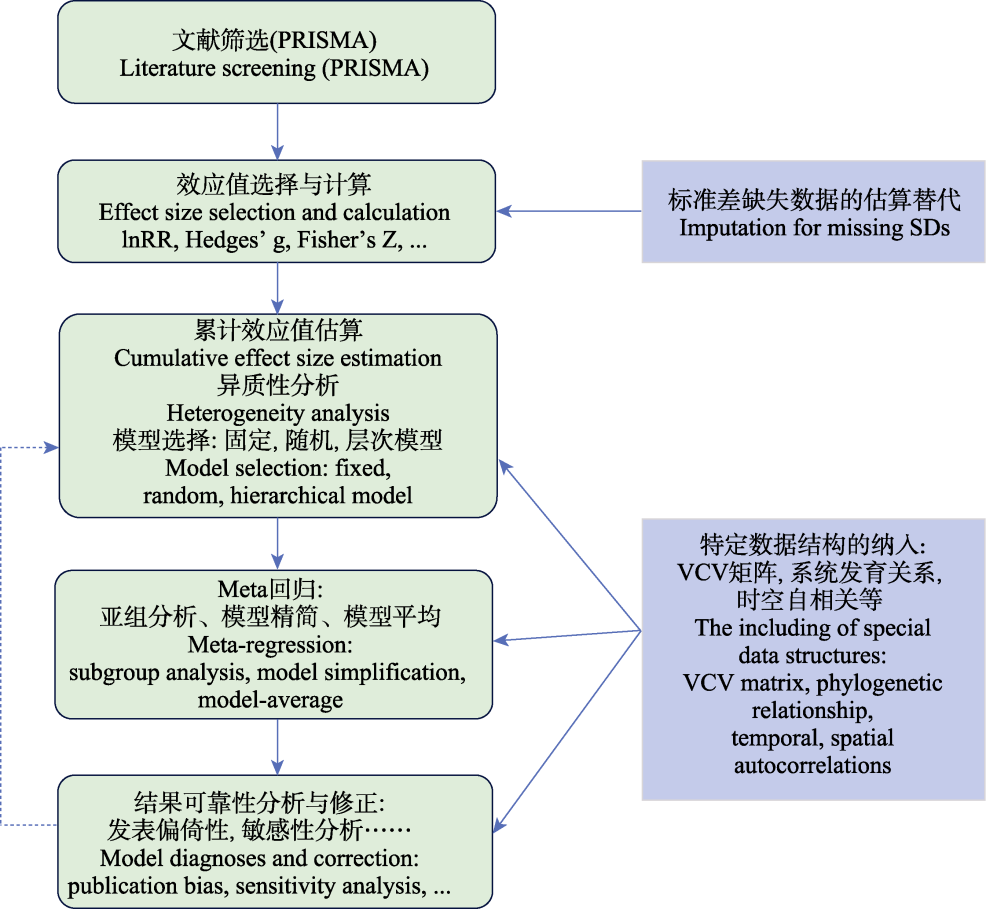
图2 Meta分析的数据分析流程示意图。其中右侧方框部分为数据存在标准差缺失或特殊数据结构时的应对方法。虚线表示侦测到明显的发表偏倚性时, 应对累计效应值进行必要的修正。
Fig. 2 The flowchart of the data analysis in meta-analysis. The right part shows methods that can be used in datasets with missing SDs or different non-independent data structures. The dotted line represents the needed correction for cumulative effect size when publication bias was detected.
| [1] |
Benítez-López A, Alkemade R, Schipper AM, Ingram DJ, Verweij PA, Eikelboom JAJ, Huijbregts MAJ (2017) The impact of hunting on tropical mammal and bird populations. Science, 356, 180-183.
DOI PMID |
| [2] |
Bennett JM, Steets JA, Burns JH, Burkle LA, Vamosi JC, Wolowski M, Arceo-Gómez G, Burd M, Durka W, Ellis AG, Freitas L, Li JM, Rodger JG, Ştefan V, Xia J, Knight TM, Ashman TL (2020) Land use and pollinator dependency drives global patterns of pollen limitation in the Anthropocene. Nature Communications, 11, 3999.
DOI |
| [3] |
Chen C, Xiao WY, Chen HYH (2025) Meta-analysis reveals global variations in plant diversity effects on productivity. Nature, 638, 435-440.
DOI |
| [4] |
Chen SC, Antonelli A, Huang X, Wei N, Dai C, Wang QF (2025) Large seeds as a defensive strategy against partial granivory in the Fagaceae. Journal of Ecology, 113, 598-607.
DOI URL |
| [5] |
Doi SAR, Thalib L (2008) A quality-effects model for meta-analysis. Epidemiology, 19, 94-100.
DOI PMID |
| [6] |
Driscoll DA, MacDonald KJ, Gibson RK, Doherty TS, Nimmo DG, Nolan RH, Ritchie EG, Williamson GJ, Heard GW, Tasker EM, …, Green M, Gilpin AM, Cook JM, Power SA, Hogendoorn K, Brawata R, Jolly CJ, Tozer M, Reiter N, Phillips RD (2024) Biodiversity impacts of the 2019-2020 Australian megafires. Nature, 635, 898-905.
DOI |
| [7] | Fanelli D, Costas R, Ioannidis JPA (2017) Meta-assessment of bias in science. Proceedings of the National Academy of USA, 114, 3714-3719. |
| [8] |
Feng YH, Schmid B, Loreau M, Forrester DI, Fei SL, Zhu JX, Tang ZY, Zhu JL, Hong PB, Ji CJ, Shi Y, Su HJ, Xiong XY, Xiao J, Wang SP, Fang JY (2022) Multispecies forest plantations outyield monocultures across a broad range of conditions. Science, 376, 865-868.
DOI PMID |
| [9] |
Fernandez-Duque E, Valeggia C (1994) Meta-analysis: A valuable tool in conservation research. Conservation Biology, 8, 555-561.
DOI URL |
| [10] |
Gillman LN, Wright SD (2010) Mega mistakes in meta-analyses: Devil in the detail. Ecology, 91, 2550-2552.
PMID |
| [11] |
Gurevitch J, Koricheva J, Nakagawa S, Stewart G (2018) Meta-analysis and the science of research synthesis. Nature, 555, 175-182.
DOI URL |
| [12] | Higgins JPT, Thompson SG (2002) Quantifying heterogeneity in a meta-analysis. Statistics in Medicine, 21, 1539-1558. |
| [13] | Higgins JPT, Thompson SG, Deeks JJ, Altman DG (2003) Measuring inconsistency in meta-analyses. BMJ, 327, 557-560. |
| [14] |
Hooper DU, Adair EC, Cardinale BJ, Byrnes JEK, Hungate BA, Matulich KL, Gonzalez A, Duffy JE, Gamfeldt L, O’Connor MI (2012) A global synthesis reveals biodiversity loss as a major driver of ecosystem change. Nature, 486, 105-108.
DOI |
| [15] |
Hua FY, Bruijnzeel LA, Meli P, Martin PA, Zhang J, Nakagawa S, Miao XR, Wang WY, McEvoy C, Peña-Arancibia JL, Brancalion PHS, Smith P, Edwards DP, Balmford A (2022) The biodiversity and ecosystem service contributions and trade-offs of forest restoration approaches. Science, 376, 839-844.
DOI URL |
| [16] | Hülsmann L, Chisholm RA, Comita L, Visser MD, de Souza Leite M, Aguilar S, Anderson-Teixeira KJ, Bourg NA, Brockelman WY, Bunyavejchewin S, Castaño N, Chang-Yang CH, Chuyong GB, Clay K, Davies SJ, Duque A, Ediriweera S, Ewango C, Gilbert GS, Holík J, Howe RW, Hubbell SP, Itoh A, Johnson DJ, Kenfack D, Král K, Larson AJ, Lutz JA, Makana JR, Malhi Y, McMahon SM, McShea WJ, Mohamad M, Nasardin M, Nathalang A, Norden N, Oliveira AA, Parmigiani R, Perez R, Phillips RP, Pongpattananurak N, Sun IF, Swanson ME, Tan S, Thomas D, Thompson J, Uriarte M, Wolf AT, Yao TL, Zimmerman JK, Zuleta D, Hartig F (2024) Latitudinal patterns in stabilizing density dependence of forest communities. Nature, 627, 564-571. |
| [17] |
Kambach S, Bruelheide H, Gerstner K, Gurevitch J, Beckmann M, Seppelt R (2020) Consequences of multiple imputation of missing standard deviations and sample sizes in meta-analysis. Ecology and Evolution, 10, 11699-11712.
DOI PMID |
| [18] |
Keck F, Peller T, Alther R, Barouillet C, Blackman R, Capo E, Chonova T, Couton M, Fehlinger L, Kirschner D, Knüsel M, Muneret L, Oester R, Tapolczai K, Zhang H, Altermatt F (2025) The global human impact on biodiversity. Nature, 641, 395-400.
DOI |
| [19] |
Langhammer PF, Bull JW, Bicknell JE, Oakley JL, Brown MH, Bruford MW, Butchart SHM, Carr JA, Church D, Cooney R, Cutajar S, Foden W, Foster MN, Gascon C, Geldmann J, Genovesi P, Hoffmann M, Howard-McCombe J, Lewis T, MacFarlane NBW, Melvin ZE, Merizalde RS, Morehouse MG, Pagad S, Polidoro B, Sechrest W, Segelbacher G, Smith KG, Steadman J, Strongin K, Williams J, Woodley S, Brooks TM (2024) The positive impact of conservation action. Science, 384, 453-458.
DOI PMID |
| [20] |
Lawton JH (1999) Are there general laws in ecology? Oikos, 84, 177-192.
DOI URL |
| [21] | Lortie CJ, Filazzola A (2020) A contrast of meta and metafor packages for meta-analyses in R. Ecology and Evolution, 10, 10916-10921. |
| [22] |
Lundgren EJ, Bergman J, Trepel J, Roux E, Monsarrat S, Kristensen JA, Pedersen RØ, Pereyra P, Tietje M, Svenning JC (2024) Functional traits—not nativeness—shape the effects of large mammalian herbivores on plant communities. Science, 383, 531-537.
DOI PMID |
| [23] |
Moher D, Liberati A, Tetzlaff J, Altman DG (2010) Preferred reporting items for systematic reviews and meta-analyses: The PRISMA statement. International Journal of Surgery, 8, 336-341.
DOI PMID |
| [24] |
Møller AP, Jennions MD (2001) Testing and adjusting for publication bias. Trends in Ecology & Evolution, 16, 580-586.
DOI URL |
| [25] |
Nakagawa S, Lagisz M, Jennions MD, Koricheva J, Noble DWA, Parker TH, Sánchez-Tójar A, Yang YF, O’Dea RE (2022a) Methods for testing publication bias in ecological and evolutionary meta-analyses. Methods in Ecology and Evolution, 13, 4-21.
DOI URL |
| [26] |
Nakagawa S, Lagisz M, O’Dea RE, Pottier P, Rutkowska J, Senior AM, Yang YF, Noble DWA (2023a) orchaRd 2.0: An R package for visualising meta-analyses with orchard plots. Methods in Ecology and Evolution, 14, 2003-2010.
DOI URL |
| [27] |
Nakagawa S, Noble DWA, Lagisz M, Spake R, Viechtbauer W, Senior AM (2023b) A robust and readily implementable method for the meta-analysis of response ratios with and without missing standard deviations. Ecology Letters, 26, 232-244.
DOI URL |
| [28] |
Nakagawa S, Noble DWA, Senior AM, Lagisz M (2017) Meta-evaluation of meta-analysis: Ten appraisal questions for biologists. BMC Biology, 15, 18.
DOI PMID |
| [29] | Nakagawa S, Senior AM, Viechtbauer W, Noble DWA (2022b) An assessment of statistical methods for nonindependent data in ecological meta-analyses: Comment. Ecology, 101, e03490. |
| [30] |
Nakagawa S, Yang YF, MacArtney EL, Spake R, Lagisz Ma (2023c) Quantitative evidence synthesis: A practical guide on meta-analysis, meta-regression, and publication bias tests for environmental sciences. Environmental Evidence, 12, 8.
DOI |
| [31] |
O’Dea RE, Lagisz M, Jennions MD, Koricheva J, Noble DWA, Parker TH, Gurevitch J, Page MJ, Stewart G, Moher D, Nakagawa S (2021) Preferred reporting items for systematic reviews and meta-analyses in ecology and evolutionary biology: A PRISMA extension. Biological Reviews, 96, 1695-1722.
DOI URL |
| [32] | Ohayon S, Granot I, Belmaker J (2021) A meta-analysis reveals edge effects within marine protected areas. Nature Ecology & Evolution, 5, 1301-1308. |
| [33] |
Page MJ, McKenzie JE, Bossuyt PM, Boutron I, Hoffmann TC, Mulrow CD, Shamseer L, Tetzlaff JM, Akl EA, Brennan SE, Chou R, Glanville J, Grimshaw JM, Hróbjartsson A, Lalu MM, Li TJ, Loder EW, Mayo-Wilson E, McDonald S, McGuinness LA, Stewart LA, Thomas J, Tricco AC, Welch VA, Whiting P, Moher D (2021) The PRISMA 2020 statement: An updated guideline for reporting systematic reviews. Systematic Reviews, 10, 89.
DOI PMID |
| [34] | Peng SJ, Kinlock NL, Gurevitch J, Peng SL (2019) Correlation of native and exotic species richness: A global meta-analysis finds no invasion paradox across scales. Ecology, 100, e02552. |
| [35] |
Pottier P, Noble DWA, Seebacher F, Wu NC, Burke S, Lagisz M, Schwanz LE, Drobniak SM, Nakagawa S (2024) New horizons for comparative studies and meta-analyses. Trends in Ecology & Evolution, 39, 435-445.
DOI URL |
| [36] |
Rossetti MR, Tscharntke T, Aguilar R, Batáry P (2017) Responses of insect herbivores and herbivory to habitat fragmentation: A hierarchical meta-analysis. Ecology Letters, 20, 264-272.
DOI PMID |
| [37] |
Senior AM, Grueber CE, Kamiya T, Lagisz M, O’Dwyer K, Santos ESA, Nakagawa S (2016) Heterogeneity in ecological and evolutionary meta-analyses: Its magnitude and implications. Ecology, 97, 3293-3299.
DOI PMID |
| [38] |
Shaw RE, Farquharson KA, Bruford MW, Coates DJ, Elliott CP, Mergeay J, Ottewell KM, Segelbacher G, Hoban S, Hvilsom C, Pérez-Espona S, Ruņģis D, Aravanopoulos F, Bertola LD, Cotrim H, Cox K, Cubric-Curik V, Ekblom R, Godoy JA, Konopiński MK, Laikre L, Russo IM, Veličković N, Vergeer P, Vilà C, Brajkovic V, Field DL, Goodall-Copestake WP, Hailer F, Hopley T, Zachos FE, Alves PC, Biedrzycka A, Binks RM, Buiteveld J, Buzan E, Byrne M, Huntley B, Iacolina L, Keehnen NLP, Klinga P, Kopatz A, Kurland S, Leonard JA, Manfrin C, Marchesini A, Millar MA, Orozco-terWengel P, Ottenburghs J, Posledovich D, Spencer PB, Tourvas N, Unuk Nahberger T, van Hooft P, Verbylaite R, Vernesi C, Grueber CE (2025) Global meta-analysis shows action is needed to halt genetic diversity loss. Nature, 638, 704-710.
DOI |
| [39] | Song C, Peacor SD, Osenberg CW, Bence JR (2020) An assessment of statistical methods for nonindependent data in ecological meta-analyses. Ecology, 101, e03184. |
| [40] | Spake R, O’Dea RE, Nakagawa S, Doncaster CP, Ryo M, Callaghan CT, Bullock JM (2022) Improving quantitative synthesis to achieve generality in ecology. Nature Ecology & Evolution, 6, 1818-1828. |
| [41] |
Terrer C, Phillips RP, Hungate BA, Rosende J, Pett-Ridge J, Craig ME, van Groenigen KJ, Keenan TF, Sulman BN, Stocker BD, Reich PB, Pellegrini AFA, Pendall E, Zhang H, Evans RD, Carrillo Y, Fisher JB, Van Sundert K, Vicca S, Jackson RB (2021) A trade-off between plant and soil carbon storage under elevated CO2. Nature, 591, 599-603.
DOI |
| [42] |
Thakur MP, Gu ZZ, van Kleunen M, Zhou XH (2025) Invasion impacts in terrestrial ecosystems: Global patterns and predictors. Science, 390, 381-385.
DOI URL |
| [43] |
Tucker MA, Schipper AM, Adams TSF, Attias N, Avgar T, Babic NL, Barker KJ, Bastille-Rousseau G, Behr DM, Belant JL, …, Wagler BL, Whittington J, Wikelski M, Wilmers CC, Wittemyer G, Young JK, Zięba F, Zwijacz-Kozica T, Huijbregts MAJ, Mueller T (2023) Behavioral responses of terrestrial mammals to COVID-19 lockdowns. Science, 380, 1059-1064.
DOI PMID |
| [44] |
Urban MC (2024) Climate change extinctions. Science, 386, 1123-1128.
DOI PMID |
| [45] |
van Klink R, Bowler DE, Gongalsky KB, Swengel AB, Gentile A, Chase JM (2020) Meta-analysis reveals declines in terrestrial but increases in freshwater insect abundances. Science, 368, 417-420.
DOI PMID |
| [46] | Viechtbauer W (2010) Conducting meta-analyses in R with the metafor package. Journal of Statistical Software, 36, 1-48. |
| [47] |
Wallace BC, Lajeunesse MJ, Dietz G, Dahabreh IJ, Trikalinos TA, Schmid CH, Gurevitch J (2017) OpenMEE: Intuitive, open-source software for meta-analysis in ecology and evolutionary biology. Methods in Ecology and Evolution, 8, 941-947.
DOI URL |
| [48] |
Wu DH, Du EZ, Eisenhauer N, Mathieu J, Chu CJ (2025) Global engineering effects of soil invertebrates on ecosystem functions. Nature, 640, 120-129.
DOI |
| [49] |
Xu CL, Silliman BR, Chen JS, Li XC, Thomsen MS, Zhang Q, Lee J, Lefcheck JS, Daleo P, Hughes BB, Jones HP, Wang R, Wang SP, Smith CS, Xi XQ, Altieri AH, van de Koppel J, Palmer TM, Liu LL, Wu JH, Li B, He Q (2023) Herbivory limits success of vegetation restoration globally. Science, 382, 589-594.
DOI PMID |
| [50] |
Yang YF, Hillebrand H, Lagisz M, Cleasby I, Nakagawa S (2022) Low statistical power and overestimated anthropogenic impacts, exacerbated by publication bias, dominate field studies in global change biology. Global Change Biology, 28, 969-989.
DOI URL |
| [1] | 李伯尧, 盛天成, 幸小云. 生物多样性风险对企业财务绩效的影响: 来自中国上市公司的证据[J]. 生物多样性, 2026, 34(4): 25330-. |
| [2] | 张晋越, 卞宝乐, 唐泰然, 农文豪, 朱书峰, 卢新民. 植物-根际微生物互作及对昆虫胁迫的响应[J]. 生物多样性, 2026, 34(4): 25334-. |
| [3] | 蒋翠憶, 谢致敬, 田中平, 李玥莹, 郑明心, 房帅, 米尔卡米力∙麦麦提, 依里帆∙艾克拜尔江, 高梅香, 张健. 微地形生境异质性对新疆西天山森林土壤跳虫群落分异的塑造作用[J]. 生物多样性, 2026, 34(4): 25300-. |
| [4] | 谷际岐, 赖江山, 王瑛, 吴浩然, 张雪, 宋晓彤, 邵小明, 娄安如. 联合物种分布模型与生物群落层次建模框架: 生态学理论、方法及应用[J]. 生物多样性, 2026, 34(1): 25364-. |
| [5] | 刘志祥, 谢华, 张慧, 黄晓磊. 表皮碳氢化合物在社会性昆虫中的功能多样性及其调控[J]. 生物多样性, 2025, 33(2): 24302-. |
| [6] | 陈瑶琪, 郭晶晶, 蔡国俊, 葛依立, 廖宇, 董正, 符辉. 近七十年(1954-2021)长江中下游湖泊沉水植物群落多样性演变特征[J]. 生物多样性, 2024, 32(3): 23319-. |
| [7] | 杨舒涵, 王贺, 陈磊, 廖蓥飞, 严光, 伍一宁, 邹红菲. 松嫩平原异质生境对土壤线虫群落特征的影响[J]. 生物多样性, 2024, 32(1): 23295-. |
| [8] | 王明慧, 陈昭铨, 李帅锋, 黄小波, 郎学东, 胡子涵, 尚瑞广, 刘万德. 云南普洱季风常绿阔叶林不同种子扩散方式的优势种空间点格局分析[J]. 生物多样性, 2023, 31(9): 23147-. |
| [9] | 谢艳秋, 黄晖, 王春晓, 何雅琴, 江怡萱, 刘子琳, 邓传远, 郑郁善. 福建海岛滨海特有植物种-面积关系及物种丰富度决定因素[J]. 生物多样性, 2023, 31(5): 22345-. |
| [10] | 李艳辉, 兰天元, 王月, 于洋, 赵常明, 李利华, 徐文婷, 申国珍. 神农架植物物种空间周转的驱动因素[J]. 生物多样性, 2022, 30(4): 21377-. |
| [11] | 韩雪, 苏锦权, 姚娜娜, 陈宝明. 外来入侵植物的根系觅养行为研究进展[J]. 生物多样性, 2020, 28(6): 727-733. |
| [12] | 孙远, 胡维刚, 姚树冉, 孙颖, 邓建明. 黄河流域被子植物和陆栖脊椎动物丰富度格局及其影响因子[J]. 生物多样性, 2020, 28(12): 1523-1532. |
| [13] | 周昌艳, 王彬, 邓云, 乌俊杰, 曹敏, 林露湘. 林冠结构是局域尺度木本植物功能性状beta多样性形成的重要驱动力[J]. 生物多样性, 2020, 28(12): 1546-1557. |
| [14] | 杨贵军, 王敏, 杨益春, 李欣芸, 王新谱. 贺兰山甲虫物种丰富度分布格局及其环境解释[J]. 生物多样性, 2019, 27(12): 1309-1319. |
| [15] | 刘硕然, 杨道德, 李先福, 谭路, 孙军, 和晓阳, 杨文书, 任国鹏, Davide Fornacca, 蔡庆华, 肖文. 滇西北高山微水体与溪流生境底栖动物多样性和环境特征[J]. 生物多样性, 2019, 27(12): 1298-1308. |
| 阅读次数 | ||||||
|
全文 |
|
|||||
|
摘要 |
|
|||||
备案号:京ICP备16067583号-7
Copyright © 2026 版权所有 《生物多样性》编辑部
地址: 北京香山南辛村20号, 邮编:100093
电话: 010-62836137, 62836665 E-mail: biodiversity@ibcas.ac.cn
