

生物多样性 ›› 2026, Vol. 34 ›› Issue (8): 25205. DOI: 10.17520/biods.2025205 cstr: 32101.14.biods.2025205
• 研究报告: 遗传多样性 • 下一篇
杨至恒1, 王则夫2,*( )(
 ), 刘建全1,3(), 毛康珊1(), 李家亮1,*()()
收稿日期:2026-03-13
接受日期:2026-07-20
出版日期:2026-08-20
发布日期:2026-10-21
通讯作者:
*共同通讯作者:E-mail: wangzefu@njfu.edu.cn;
lijl459@scu.edu.cn
基金资助:
Zhiheng Yang1, Zefu Wang2,*()(), Jianquan Liu1,3(), Kangshan Mao1(), Jialiang Li1,*()()
Received:2026-03-13
Accepted:2026-07-20
Online:2026-08-20
Published:2026-10-21
Contact:
*Co-authors for correspondence: E-mail: wangzefu@njfu.edu.cn;
lijl459@scu.edu.cn
Supported by:摘要:
杂交是推动物种形成和表型多样化的重要机制之一。然而, 杂交后代如何在较短时间内建立与亲本物种之间的生殖隔离并进一步演化为独立谱系, 仍是演化生物学领域的关键科学问题。本研究以分布于亚马孙地区的同倍体杂交物种——金冠娇鹟(Lepidothrix vilasboasi)为研究对象, 基于其与亲本物种白顶娇鹟(L. nattereri)和乳白冠娇鹟(L. iris)的已发表基因组数据, 对其种群遗传结构、基因流和正选择基因进行了进一步探索, 旨在解析其同倍体杂交物种形成的分子机制。本研究在进一步证实金冠娇鹟为古老杂交起源的基础上, 还发现其基因组中交替继承并重新组合了来自两个亲本物种的与生殖隔离相关的正选择基因, 从而促成了其与亲本物种之间的生殖隔离, 并最终使其演化成为新物种。这些基因主要与皮肤色素沉淀和生殖系统发育有关, 可能参与合子前或合子后生殖隔离过程。进一步的基因家族分析显示, ADAMTS10、ASTL和ALX4基因经历了多次复制事件, ESRRG基因显著扩张, 而OCA2基因则表现出较强的演化保守性。本研究揭示了杂交在鸟类物种形成及表型多样化过程中的重要作用, 为理解同倍体杂交物种形成过程中生殖隔离建立的遗传基础提供了新的分子证据。此外, 本研究进一步验证了此前提出的同倍体杂交物种形成分子机制模型在不同类群中的适用性, 表明杂交后亲本遗传成分的重新组合及其后续演化可能是推动新物种形成的重要机制, 为深入探索杂交驱动物种形成的遗传基础提供了新的理论支持。
杨至恒, 王则夫, 刘建全, 毛康珊, 李家亮 (2026) 亚马孙金冠娇鹟同倍体杂交物种形成的分子机制. 生物多样性, 34, 25205. DOI: 10.17520/biods.2025205.
Zhiheng Yang, Zefu Wang, Jianquan Liu, Kangshan Mao, Jialiang Li (2026) Molecular mechanisms underlying homoploid hybrid speciation in the Amazonian golden-crowned manakin. Biodiversity Science, 34, 25205. DOI: 10.17520/biods.2025205.
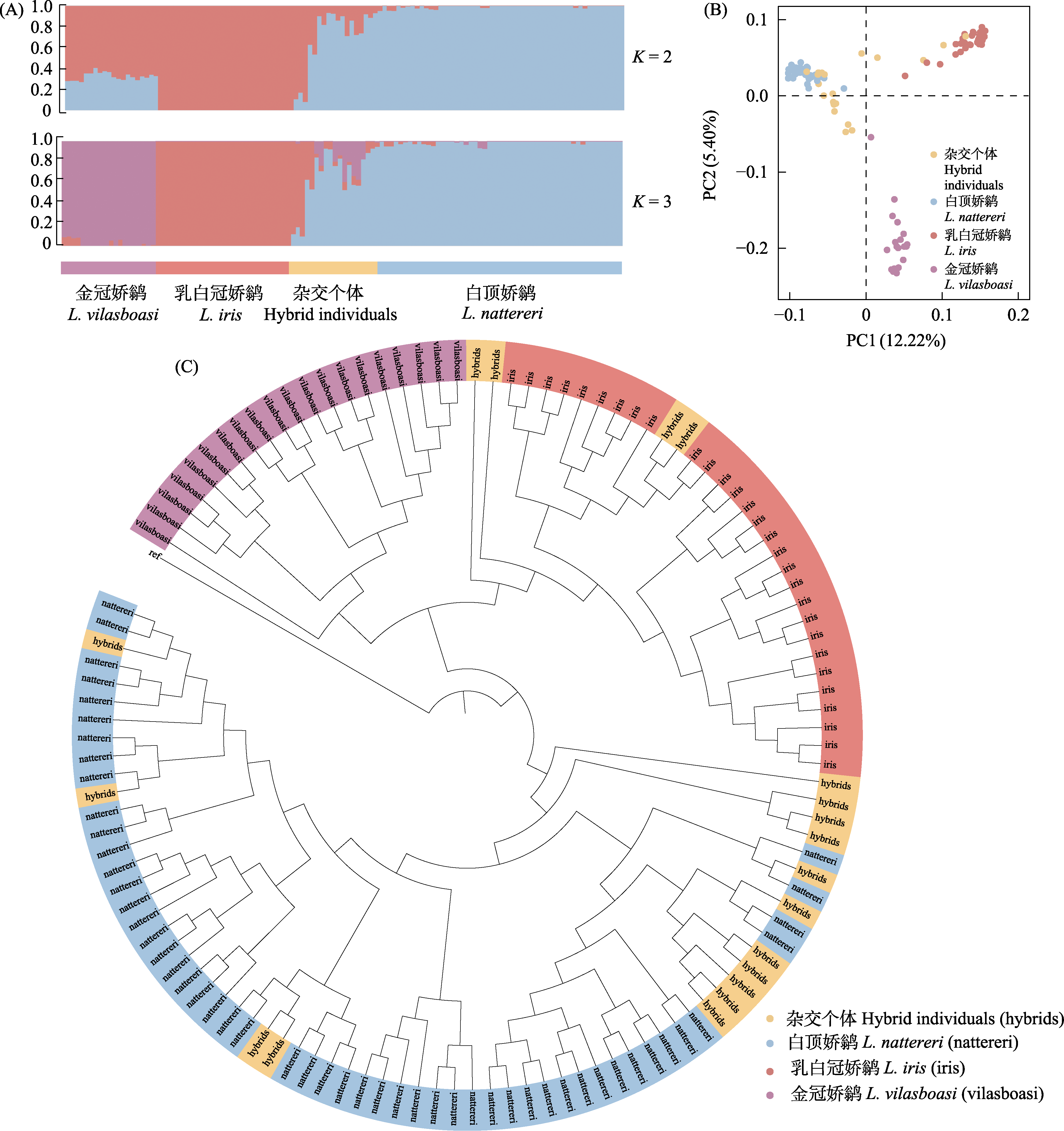
图1 金冠娇鹟(Lepidothrix vilasboasi)、乳白冠娇鹟(L. iris)和白顶娇鹟(L. nattereri) 120个个体的种群遗传结构分析。(A) ADMIXTURE分析; (B)主成分分析(PCA); (C)基于最大似然法构建的系统发育树。
Fig. 1 Population genetic analyses of the Lepidothrix vilasboasi, L. iris and L. nattereri based on 120 individuals. (A) ADMIXTURE analysis; (B) Principal component analysis (PCA); (C) Maximum-likelihood phylogenetic tree.
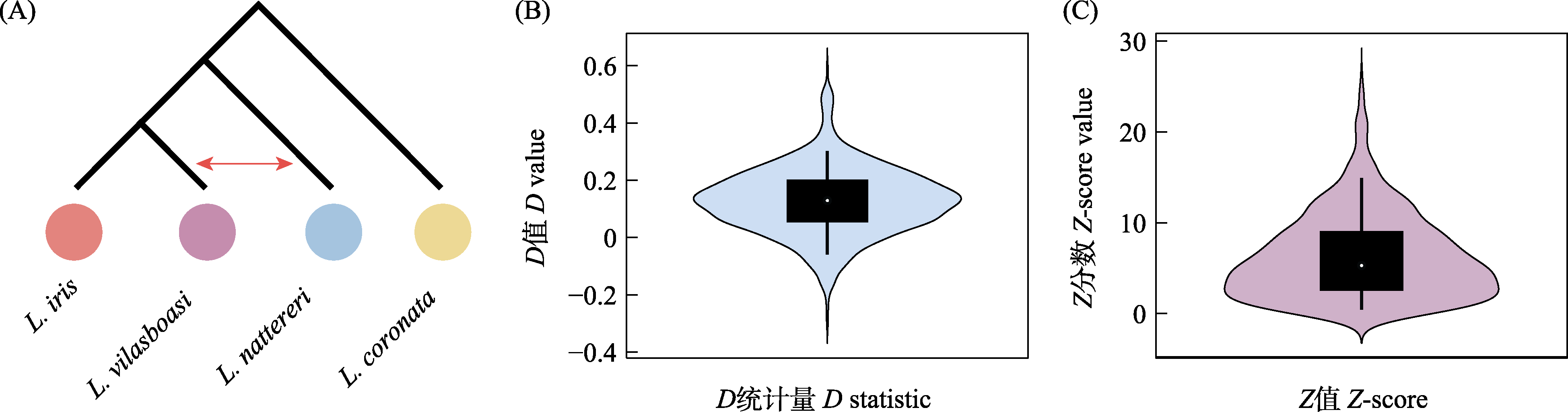
图2 金冠娇鹟(Lepidothrix vilasboasi)、白顶娇鹟(L. nattereri)和乳白冠娇鹟(L. iris)的物种基因流分析。(A) ABBA-BABA检验模式图, 从左到右的物种表示P1 (乳白冠娇鹟)、P2 (金冠娇鹟)、P3 (白顶娇鹟)和Outgroup (蓝冠娇鹟)。(B)小提琴图描述了ABBA-BABA测试中D统计量的分布模式。小提琴图中的黑条和细线分别代表四分位数范围和整个数据范围。中间的白点表示平均值。小提琴图的宽度代表了分布的密度。(C)小提琴图描述了ABBA-BABA测试中Z值分布模式。
Fig. 2 Analysis of gene flow among the Lepidothrix vilasboasi, L. iris and L. nattereri. (A) Schematic representation of the ABBA-BABA test, with species ordered from left to right as P1 (L. iris), P2 (L. vilasboasi), P3 (L. nattereri), and Outgroup (L. coronata); (B) Violin plot showing the distribution of D-statistics from the ABBA-BABA tests. The black bar and thin line within each violin represent the interquartile range and the full data range, respectively. The white dot denotes the mean value. The width of the violin indicates the density of the distribution; (C) Violin plot illustrating the distribution of Z-score obtained from the ABBA-BABA tests.
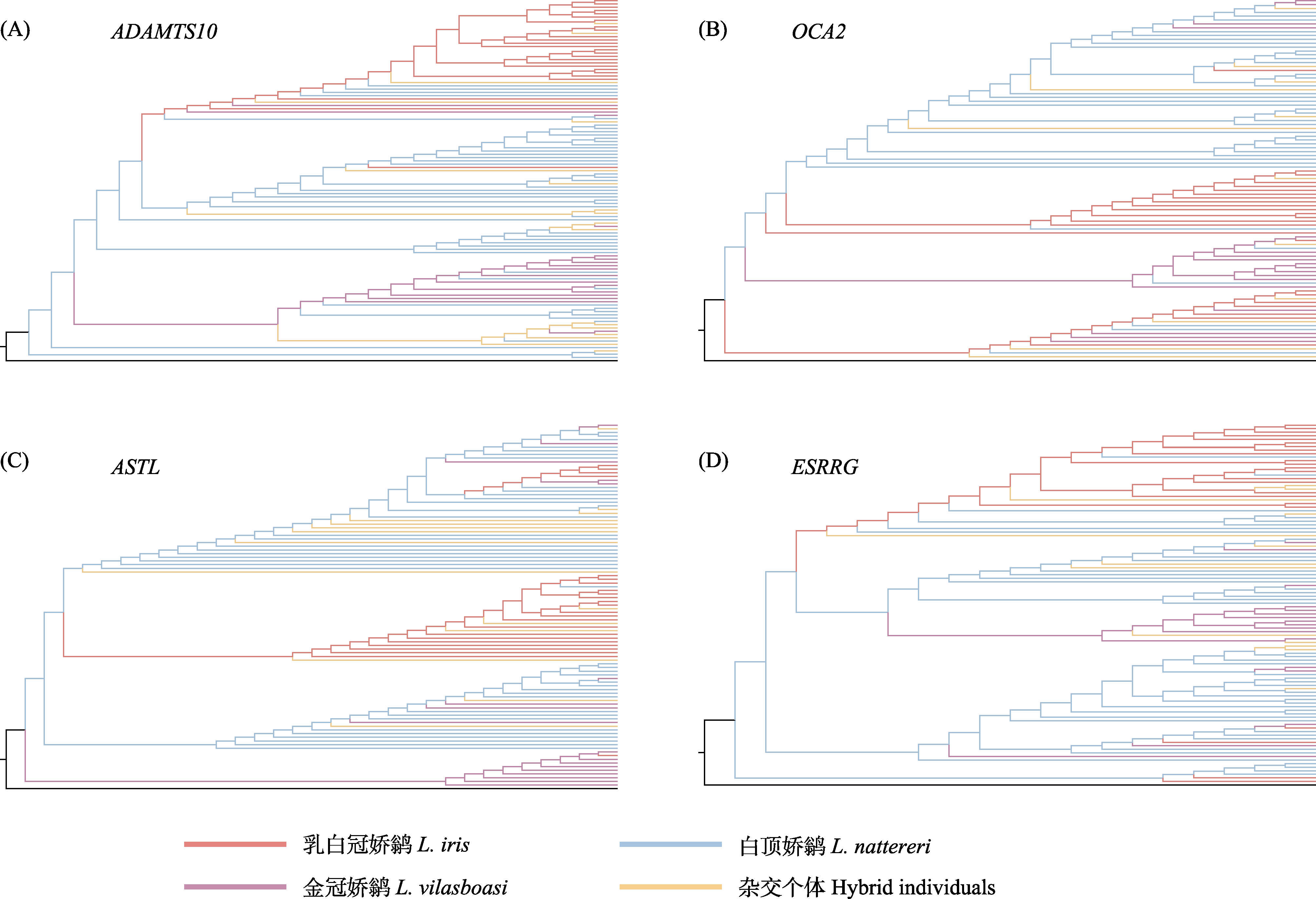
图3 金冠娇鹟(Lepidothrix vilasboasi)中与生殖隔离相关候选基因的系统发育分析。与羽色和发育相关的候选基因包括ADAMTS10 (A)和OCA2 (B); 与生殖发育相关的候选基因包括ASTL (C)和ESRRG (D)。
Fig. 3 Phylogenetic analysis of candidate reproductive isolation-related genes in Lepidothrix vilasboasi. Candidate genes associated with plumage coloration and development, including ADAMTS10 (A) and OCA2 (B); Candidate genes associated with reproductive development, including ASTL (C) and ESRRG (D).
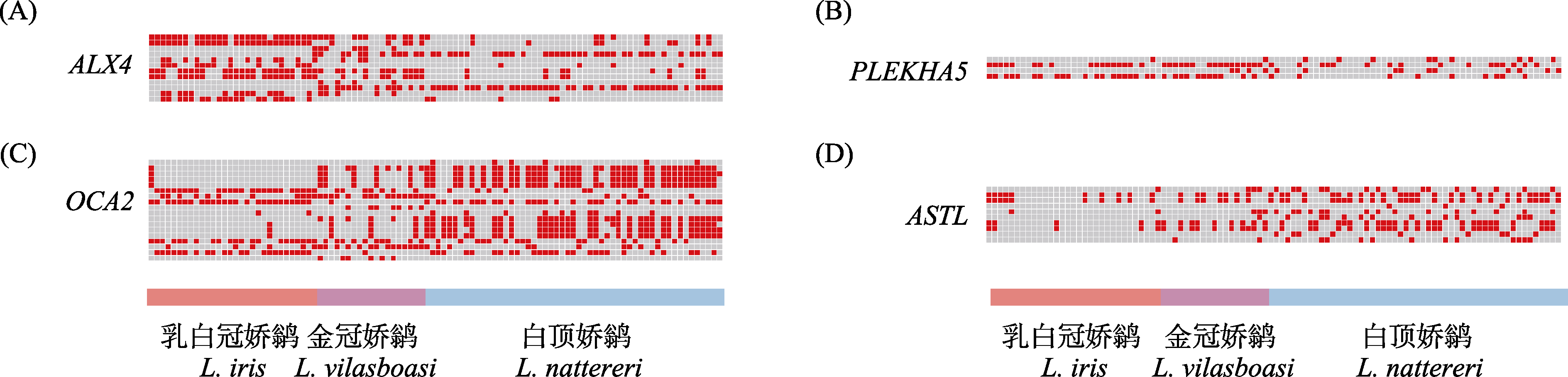
图4 与生殖隔离相关候选基因的单倍型结构热图。每列表示1个个体, 并按种群顺序排列, 从左到右依次为乳白冠娇鹟(Lepidothrix iris)、金冠娇鹟(L. vilasboasi)和白顶娇鹟(L. nattereri)。每个单核苷酸多态性(SNP)位点由2个单倍型拷贝(Hap1和Hap2)表示, 相邻两行对应同一SNP位点的两个单倍型。灰色和红色分别表示参考等位基因(0)和替代等位基因(1), 用于展示杂交物种及其亲本物种间候选基因区域的单倍型组成差异。
Fig. 4 Heatmap of haplotype structures of candidate reproductive isolation-related genes. Each column represents an individual, arranged according to population order (from left to right: Lepidothrix iris, L. vilasboasi, and L. nattereri). Each single nucleotide polymorphism (SNP) site is represented by two haplotype copies (Hap1 and Hap2), with two adjacent rows corresponding to the two haplotypes of the same SNP site. Gray and red indicate the reference allele (0) and alternative allele (1), respectively, illustrating differences in haplotype composition across candidate gene regions between the hybrid species and its parental species.
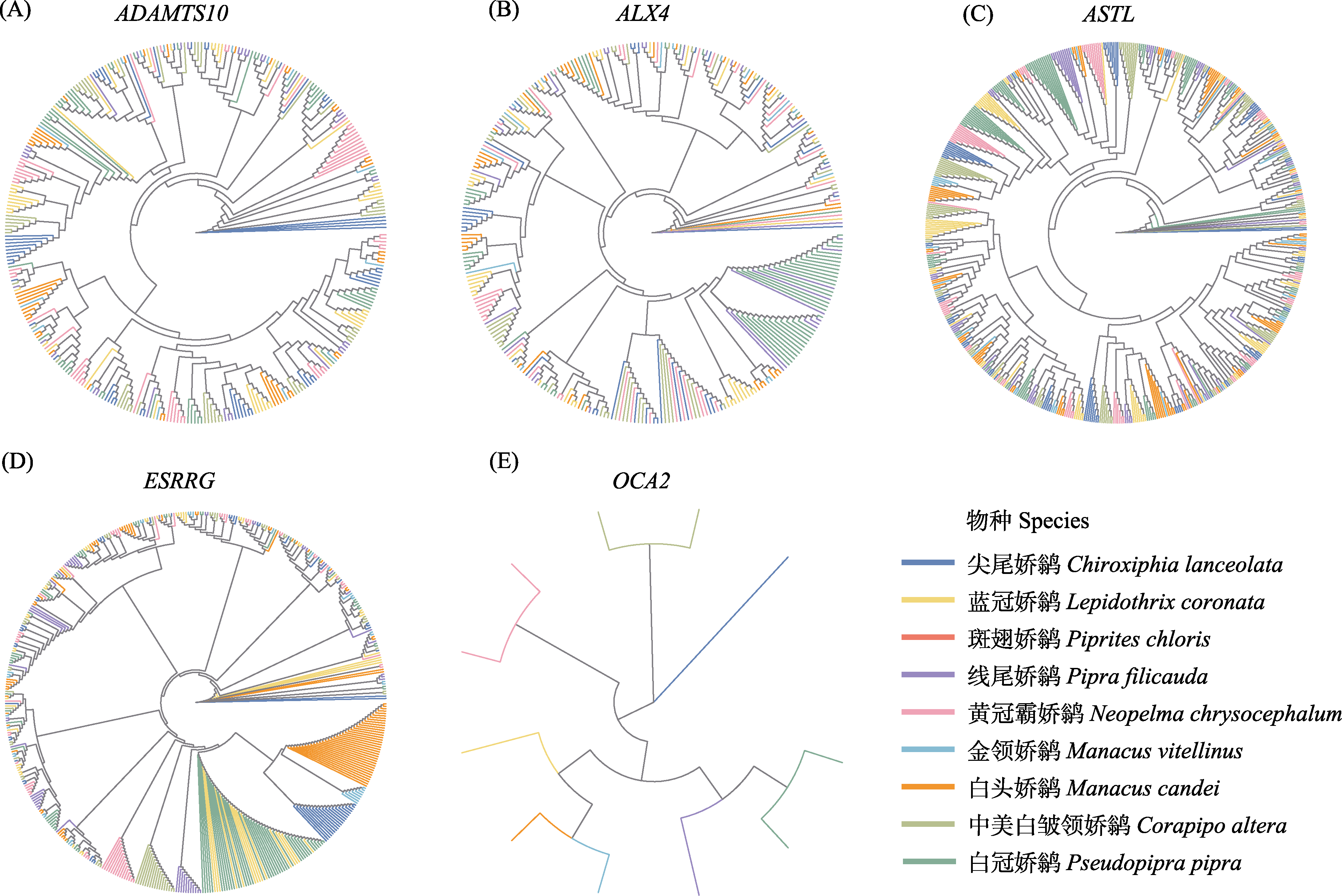
图5 9个娇鹟科物种在5个正选择候选基因(ADAMTS10、ALX4、ASTL、ESRRG和OCA2)上的选择信号值比较
Fig. 5 Comparison of positive selection signal intensities for five candidate genes (ADAMTS10, ALX4, ASTL, ESRRG, and OCA2) across nine Pipridae species
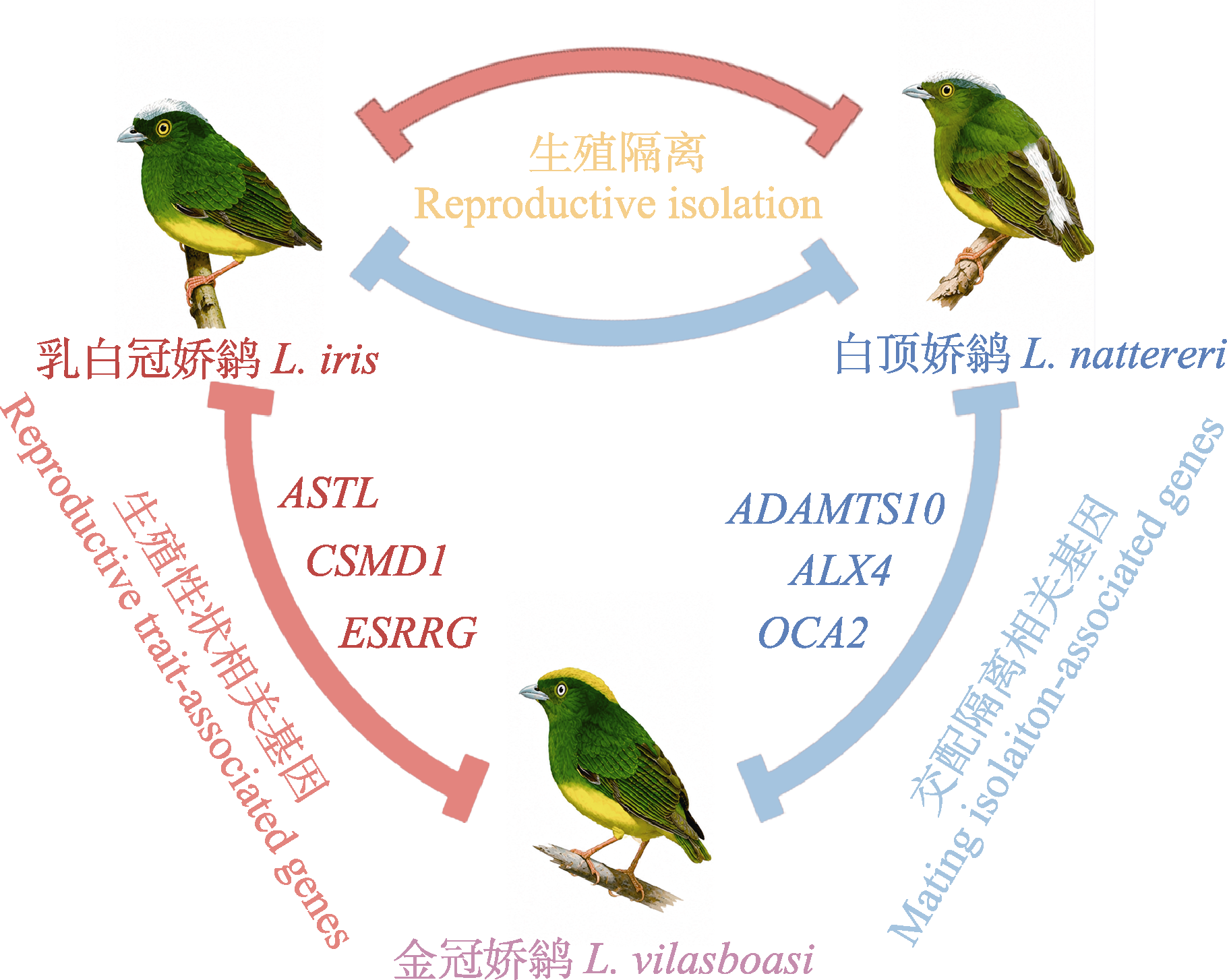
图6 金冠娇鹟同倍体杂交物种形成的进化模式。金冠娇鹟的基因组来源于乳白冠娇鹟(亲本A)与白顶娇鹟(亲本B)的历史杂交事件。来自亲本B的羽色和皮肤发育相关基因(ADAMTS10、ALX4和OCA2)可能通过形成独特的羽色表型, 促进配偶识别和择偶偏好, 从而建立以交配隔离(mating isolation)为主的合子前生殖隔离。与此同时, 来自亲本A的精子发生、卵母细胞成熟及生殖系统发育相关基因(ASTL、CSMD1和ESRRG)可能对合子后生殖隔离的形成发挥辅助作用。鸟类图片修改自Barrera-Guzmán等(2018)。
Fig. 6 A proposed model of homoploid hybrid speciation in Lepidothrix vilasboasi. The genome of the L. vilasboasi originated through historical hybridization between the L. iris (parental species A) and the L. nattereri (parental species B). Following hybridization, genes inherited from parental species B, including ADAMTS10, ALX4, and OCA2, which are involved in plumage pigmentation and skin development, may have produced the distinctive plumage phenotype of L. vilasboasi, thereby promoting mate recognition and assortative mating and establishing prezygotic reproductive isolation through mating isolation. In contrast, genes inherited from parental species A, including ASTL, CSMD1, and ESRRG, which are associated with spermatogenesis, oocyte maturation, and reproductive system development, may have contributed secondarily to postzygotic reproductive isolation. Bird images adapted from Barrera-Guzmán et al. (2018).
| [1] | Abbott R, Albach D, Ansell S, Arntzen JW, Baird SJE, Bierne N, Boughman J, Brelsford A, Buerkle CA, Buggs R, Butlin RK, Dieckmann U, Eroukhmanoff F, Grill A, Cahan SH, Hermansen JS, Hewitt G, Hudson AG, Jiggins C, Jones J, Keller B, Marczewski T, Mallet J, Martinez-Rodriguez P, Möst M, Mullen S, Nichols R, Nolte AW, Parisod C, Pfennig K, Rice AM, Ritchie MG, Seifert B, Smadja CM, Stelkens R, Szymura JM, Väinölä R, Wolf JBW, Zinner D (2013) Hybridization and speciation. Journal of Evolutionary Biology, 26, 229-246. |
| [2] | Abbott RJ, Barton NH, Good JM (2016) Genomics of hybridization and its evolutionary consequences. Molecular Ecology, 25, 2325-2332. |
| [3] | Alexander DH, Novembre J, Lange K (2009) Fast model-based estimation of ancestry in unrelated individuals. Genome Research, 19, 1655-1664. |
| [4] | Altschul SF, Gish W, Miller W, Myers EW, Lipman DJ (1990) Basic local alignment search tool. Journal of Molecular Biology, 215, 403-410. |
| [5] | Balakrishnan CN, Toda Y, Ko MC, Wirthlin ME, Driver RJ, Bolton PE, Miller ET, Mendez-Aranda D, Dikow RB, Frandsen PB (2026) Genomic and physiological changes in a sexually selected and frugivorous bird radiation. Current Biology, 36, 3061-3076. |
| [6] | Barrera-Guzmán AO, Aleixo A, Shawkey MD, Weir JT (2018) Hybrid speciation leads to novel male secondary sexual ornamentation of an Amazonian bird. Proceedings of the National Academy of Sciences, USA, 115, E218-E225. |
| [7] | Bellono NW, Escobar IE, Lefkovith AJ, Marks MS, Oancea E (2014) An intracellular anion channel critical for pigmentation. eLife, 3, e04543. |
| [8] | Browning BL, Tian XW, Zhou Y, Browning SR (2021) Fast two-stage phasing of large-scale sequence data. The American Journal of Human Genetics, 108, 1880-1890. |
| [9] | Catchen J, Hohenlohe PA, Bassham S, Amores A, Cresko WA (2013) Stacks: An analysis tool set for population genomics. Molecular Ecology, 22, 3124-3140. |
| [10] | Danecek P, Auton A, Abecasis G, Albers CA, Banks E, DePristo MA, Handsaker RE, Lunter G, Marth GT, Sherry ST, McVean G, Durbin R, Group GPA (2011) The variant call format and VCFtools. Bioinformatics, 27, 2156-2158. |
| [11] | Hoang DT, Chernomor O, von Haeseler A, Minh BQ, Vinh LS (2018) UFBoot2: Improving the ultrafast bootstrap approximation. Molecular Biology and Evolution, 35, 518-522. |
| [12] | Hong H, Yang L, Stallcup MR (1999) Hormone-independent transcriptional activation and coactivator binding by novel orphan nuclear receptor ERR3. Journal of Biological Chemistry, 274, 22618-22626. |
| [13] | Jia DR, Wang YJ, Liu TL, Wu GL, Kou YX, Cheng K, Liu JQ (2016) Diploid hybrid origin of Hippophaë gyantsensis (Elaeagnaceae) in the western Qinghai-Tibet Plateau. Biological Journal of the Linnean Society, 117, 658-671. |
| [14] | Kalyaanamoorthy S, Minh BQ, Wong TKF, von Haeseler A, Jermiin LS (2017) ModelFinder: Fast model selection for accurate phylogenetic estimates. Nature Methods, 14, 587-589. |
| [15] | Karoulias SZ, Taye N, Stanley S, Hubmacher D (2020) The ADAMTS/Fibrillin connection: Insights into the biological functions of ADAMTS10 and ADAMTS17 and their respective sister proteases. Biomolecules, 10, 596. |
| [16] | Katoh K, Misawa K, Kuma K, Miyata T (2002) MAFFT: A novel method for rapid multiple sequence alignment based on fast Fourier transform. Nucleic Acids Research, 30, 3059-3066. |
| [17] | Kayserili H, Uz E, Niessen C, Vargel I, Alanay Y, Tuncbilek G, Yigit G, Uyguner O, Candan S, Okur H, Kaygin S, Balci S, Mavili E, Alikasifoglu M, Haase I, Wollnik B, Akarsu NA (2009) ALX4 dysfunction disrupts craniofacial and epidermal development. Human Molecular Genetics, 18, 4357-4366. |
| [18] | Knaus BJ, Grünwald NJ (2017) VCFR: A package to manipulate and visualize variant call format data in R. Molecular Ecology Resources, 17, 44-53. |
| [19] | Langmead B, Salzberg SL (2012) Fast gapped-read alignment with Bowtie 2. Nature Methods, 9, 357-359. |
| [20] | Lee AS, Rusch J, Lima AC, Usmani A, Huang N, Lepamets M, Vigh-Conrad KA, Worthington RE, Mägi R, Wu XB, Aston KI, Atkinson JP, Carrell DT, Hess RA, O’Bryan MK, Conrad DF (2019) Rare mutations in the complement regulatory gene CSMD1 are associated with male and female infertility. Nature Communications, 10, 4626. |
| [21] | Long ZQ, Rieseberg LH (2025) Documenting homoploid hybrid speciation. Molecular Ecology, 34, e17412. |
| [22] | Maddirevula S, Coskun S, Al-Qahtani M, Aboyousef O, Alhassan S, Aldeery M, Alkuraya FS (2022) ASTL is mutated in female infertility. Human Genetics, 141, 49-54. |
| [23] | Mallet J (2005) Hybridization as an invasion of the genome. Trends in Ecology & Evolution, 20, 229-237. |
| [24] | Mallet J (2007) Hybrid speciation. Nature, 446, 279-283. |
| [25] | Minh BQ, Schmidt HA, Chernomor O, Schrempf D, Woodhams MD, von Haeseler A, Lanfear R (2020) IQ-TREE 2: New models and efficient methods for phylogenetic inference in the genomic era. Molecular Biology and Evolution, 37, 1530-1534. |
| [26] | Nevado B, Chapman MA, Brennan AC, Clark JW, Wong ELY, Batstone T, McCarthy SA, Tracey A, Torrance J, Sims Y, Abbott RJ, Filatov D, Hiscock SJ (2024) Genomic changes and stabilization following homoploid hybrid speciation of the Oxford ragwort Senecio squalidus. Current Biology, 34, 4412-4423. |
| [27] | Price AL, Patterson NJ, Plenge RM, Weinblatt ME, Shadick NA, Reich D (2006) Principal components analysis corrects for stratification in genome-wide association studies. Nature Genetics, 38, 904-909. |
| [28] | Rieseberg LH (1997) Hybrid origins of plant species. Annual Review of Ecology and Systematics, 28, 359-389. |
| [29] | Ru DF, Sun YS, Wang DL, Chen Y, Wang TJ, Hu QJ, Abbott RJ, Liu JQ (2018) Population genomic analysis reveals that homoploid hybrid speciation can be a lengthy process. Molecular Ecology, 27, 4875-4887. |
| [30] | Schumer M, Rosenthal GG, Andolfatto P (2014) How common is homoploid hybrid speciation? Evolution, 68, 1553-1560. |
| [31] | Semenov GA, Scordato ESC, Khaydarov DR, Smith CCR, Kane NC, Safran RJ (2017) Effects of assortative mate choice on the genomic and morphological structure of a hybrid zone between two bird subspecies. Molecular Ecology, 26, 6430-6444. |
| [32] | Stre GP, Moum T, Bureš S, Král M, Adamjan M, Moreno J (1997) A sexually selected character displacement in flycatchers reinforces premating isolation. Nature, 387, 589-592. |
| [33] | Turbek SP, Browne M, Di Giacomo AS, Kopuchian C, Hochachka WM, Estalles C, Lijtmaer DA, Tubaro PL, Silveira LF, Lovette IJ, Safran RJ, Taylor SA, Campagna L (2021) Rapid speciation via the evolution of pre-mating isolation in the Iberá Seedeater. Science, 371, eabc0256. |
| [34] | Wang ZF, Jiang YZ, Bi H, Lu ZQ, Ma YZ, Yang XY, Chen NN, Tian B, Liu BB, Mao XX, Ma T, DiFazio SP, Hu QJ, Abbott RJ, Liu JQ (2021) Hybrid speciation via inheritance of alternate alleles of parental isolating genes. Molecular Plant, 14, 208-222. |
| [35] | Wang ZF, Liu JQ (2025) Speciation studies in the genomic era. Hereditas (Beijing), 47, 71-100. (in Chinese with English abstract) |
| [王则夫, 刘建全 (2025) 基因组时代的物种形成研究. 遗传, 47, 71-100.] | |
| [36] | Wickham H, François R, Henry L, Müller K, Vaughan D (2023) dplyr: A Grammar of Data Manipulation. R package version 1.1.4. https://CRAN.R-project.org/package=dplyr. (accessed on 2026-02-02) |
| [37] | Wickham H, Vaughan D, Girlich M (2024) tidyr: Tidy Messy Data. R package version 1.3.1. https://CRAN.R-project.org/package=tidyr. (accessed on 2026-02-02) |
| [38] | Zou TT, Kuang WM, Yin TT, Frantz L, Zhang C, Liu JQ, Wu H, Yu L (2022) Uncovering the enigmatic evolution of bears in greater depth: The hybrid origin of the Asiatic black bear. Proceedings of the National Academy of Sciences, USA, 119, e2120307119. |
| [1] | 张海波, 吴忠荣, 胡灿实, 匡中帆, 李毅, 张明明, 杨雄威, 粟海军, 李筑眉. 贵州省鸟类物种多样性及名录更新[J]. 生物多样性, 2026, 34(7): 25381-. |
| [2] | 李菡, 何兴成, 张尚明玉, 曹一唯, 张家语, 彭可欣, 吴永杰. 横断山区鸟类名录[J]. 生物多样性, 2026, 34(7): 25375-. |
| [3] | 李雨声, 邢晓莹. 黑龙江省鸟类名录更新[J]. 生物多样性, 2026, 34(6): 25521-. |
| [4] | 谢冰, 杨海涛, 曹吉鑫, 李进宇, 王茂良, 张微, 李建强, 徐基良. 应用激光雷达技术探究北京地区乌鸦夜栖地选择机制[J]. 生物多样性, 2026, 34(5): 26004-. |
| [5] | 周楠, 黄美玲, 谭筱彩, 刘骏杰, 文可, 蒋爱伍. 基于公民科学数据的全国地级以上城市公园鸟类群落特征及环境影响因子[J]. 生物多样性, 2026, 34(5): 25347-. |
| [6] | 郝泽周, 申小莉, 斯幸峰, 赵岩岩, 魏晨韬, 吴飞, 许晓青, 阙品甲, 董路, 华方圆, 张立勋, 张承云, 刘阳. 中国鸟类被动声学监测规范与建议[J]. 生物多样性, 2026, 34(5): 25474-. |
| [7] | 姚可侃, 余卉, 张巧玲, 陈琳. AI声纹监测与人工样线调查在鸟类多样性监测中的差异比较: 以西溪国家湿地公园为例[J]. 生物多样性, 2026, 34(4): 25239-. |
| [8] | 朱浩友, 周友兵, 罗怡, 周昭敏. 南充市城区繁殖鸟类群落20年前后的变化[J]. 生物多样性, 2026, 34(3): 24560-. |
| [9] | 李世娴, 冯刚. 中国鸟类纬度梯度种域格局及Rapoport法则的检验[J]. 生物多样性, 2026, 34(3): 25274-. |
| [10] | 柴恩平, 葛苏婷, 王锡茂, 杨州, 向昭宜, 张美惠, 李漫淑, 沈瑶, 斯幸峰. 基于高频监测研究人为干扰对城市夜鹭巢址分布动态及繁殖成功的影响[J]. 生物多样性, 2025, 33(9): 25025-. |
| [11] | 范平, 王欢, 温知新, 宋刚, 雷富民. 气候因子对鸟类遗传多样性与物种分布面积关系的影响[J]. 生物多样性, 2025, 33(8): 25072-. |
| [12] | 徐欢, 辛凤飞, 施宏亮, 袁琳, 薄顺奇, 赵欣怡, 邓帅涛, 潘婷婷, 余婧, 孙赛赛, 薛程. 生态修复技术集成应用对长江口北支生境与鸟类多样性提升效果评估[J]. 生物多样性, 2025, 33(5): 24478-. |
| [13] | 蒋承汛, 张塔星, 权子豪, 刘郢, 柴璐艳, 冉江洪. 青藏高原国家重点保护野生鸟类丰富度空间格局及热点区域[J]. 生物多样性, 2025, 33(11): 25171-. |
| [14] | 廖之锴, 白皓天, 张修瀚, 余上, 凌嘉乐, 刘阳. 海南热带雨林国家公园常见鸟类鸣声数据集[J]. 生物多样性, 2025, 33(11): 25194-. |
| [15] | 李菡, 董伟, 陆江涛, 吴永杰, 何兴成, 刘林, 木留里哈, 张学林. 四川省甘洛县马鞍山省级自然保护区及周边地区红外相机鸟兽监测数据集[J]. 生物多样性, 2025, 33(10): 25165-. |
| 阅读次数 | ||||||
|
全文 |
|
|||||
|
摘要 |
|
|||||
备案号:京ICP备16067583号-7
Copyright © 2026 版权所有 《生物多样性》编辑部
地址: 北京香山南辛村20号, 邮编:100093
电话: 010-62836137, 62836665 E-mail: biodiversity@ibcas.ac.cn
