

生物多样性 ›› 2015, Vol. 23 ›› Issue (5): 681-688. DOI: 10.17520/biods.2015158 cstr: 32101.14.biods.2015158
兰存子, 田瑜*( ), 徐靖, 李俊生
收稿日期:2015-06-09
接受日期:2015-07-16
出版日期:2015-09-20
发布日期:2015-10-12
通讯作者:
田瑜
基金资助:
Cunzi Lan, Yu Tian*(), Jing Xu, Junsheng Li
Received:2015-06-09
Accepted:2015-07-16
Online:2015-09-20
Published:2015-10-12
Contact:
Tian Yu
摘要:
生物多样性和生态系统服务政府间科学-政策平台(Intergovernmental Science-Policy Platform on Biodiversity and Ecosystem Services, IPBES)于2012年4月正式成立, 其目标是建立科学与政策之间的联系, 加强生物多样性保护与可持续利用, 确保长期人类福祉和社会可持续发展。为了促进不同学科、知识体系和利益相关方之间的协作, 多学科专家小组组织制定了IPBES概念框架, 并在2013年第二届全体会议上正式通过。本文介绍了IPBES概念框架的基本要素及其相互关系以及IPBES科学和政策互动的运作模式, 讨论了IPBES对政府间气候变化专门委员会(Intergovernmental Panel on Climate Change, IPCC)、生物多样性科学知识国际机制(International Mechanism of Scientific Expertise on Biodiversity, IMoSEB)和千年生态系统评估(Millennium Ecosystem Assessment, MA)的借鉴和发展。概念框架识别了自然与人类复杂关系中的6个基本要素: (1)自然; (2)自然对人类的福祉; (3)好的生活质量; (4)人类财产; (5)直接驱动力; (6)制度、治理和其他间接驱动力, 并说明了各要素间的相互作用及其在时间和空间尺度上的对应关系。IPBES运作的概念模型展示了科学和政策通过IPBES实现互动的过程: 科学和其他知识体系经过概念框架的过滤持续向平台流动, 并通过IPBES职能和工作方案的实现来影响政策。IPBES将成为今后各国在生物多样性领域对话、博弈、争取利益最大化的舞台, 其多学科、多尺度评估结果将在政策的支持和导向方面对国际社会产生重大影响。我国应积极主动参与IPBES的工作并发挥建设性作用, 确保我国相关科研成果的应用, 同时借鉴IPBES的思路, 改进我国生物多样性保护。
兰存子, 田瑜, 徐靖, 李俊生 (2015) 生物多样性和生态系统服务政府间科学-政策平台的概念框架和运作模式. 生物多样性, 23, 681-688. DOI: 10.17520/biods.2015158.
Cunzi Lan, Yu Tian, Jing Xu, Junsheng Li (2015) Conceptual framework and operational model of Intergovernmental Science-Policy Platform on Biodiversity and Ecosystem Services. Biodiversity Science, 23, 681-688. DOI: 10.17520/biods.2015158.
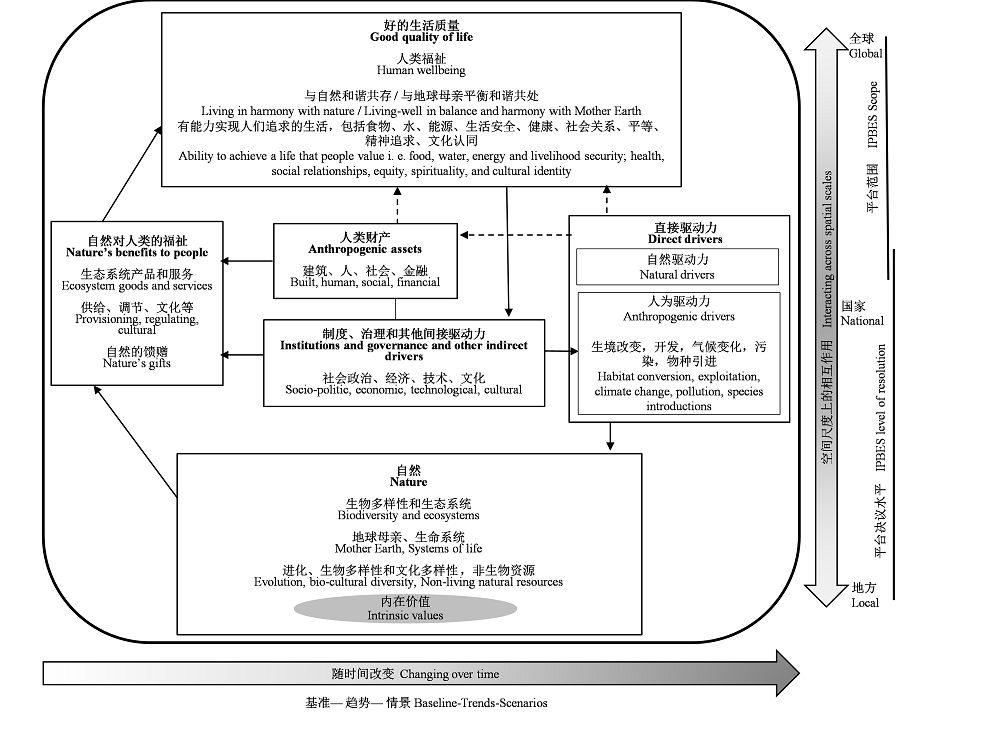
图1 生物多样性和生态系统服务政府间科学-政策平台(IPBES)的概念框架(引自IPBES/2/17(http://ipbes.net/images/doc-uments/plenary/second/working/2_17/Final/IPBES_2_17_en.pdf))
Fig. 1 Intergovernmental Science-Policy Platform on Biodiversity and Ecosystem Services (IPBES) conceptual framework (Adopted from IPBES/2/17 (http://www.ipbes.net/images/documents/plenary/second/working/2_17/Final/IPBES_2_17_en.pdf))
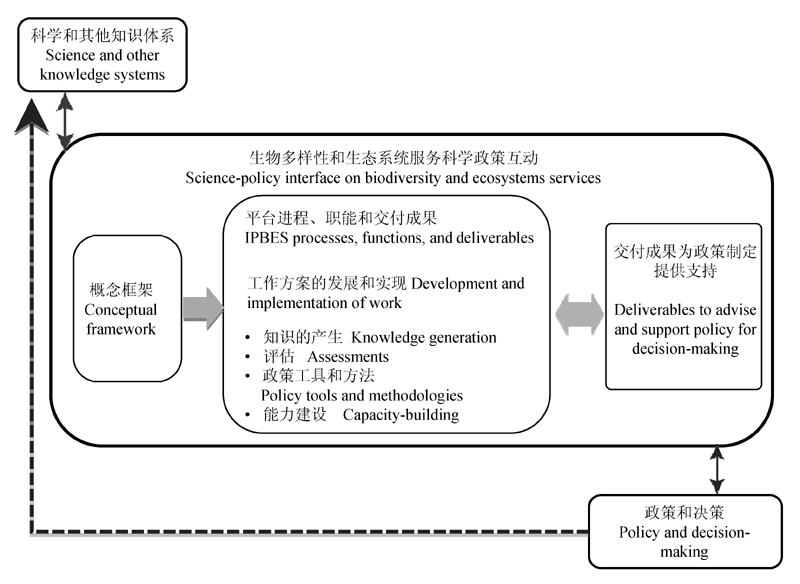
图2 生物多样性和生态系统服务政府间科学-政策平台(IPBES)运作的概念模型。双向箭头(粗和细)表示科学-IPBES-政策之间的互动, 单向箭头表示概念框架影响IPBES的进程、职能和交付成果, 虚线箭头表示政策对科学和其他知识体系的影响。(引自IPBES/2/17 (http://www.ipbes.net/images/documents/plenary/second/working/2_17/Final/IPBES_2_17_en.pdf))
Fig. 2 Operational conceptual model of the Intergovernmental Science-Policy Platform on Biodiversity and Ecosystem Services (IPBES). The double sided arrows (thin and thick) indicate the relationships among science, IPBES and Policy. The one sided arrow indicates the conceptual framework influencing IPBES processes, functions and deliverables. The dotted arrow denotes that policy in turn influence science and other knowledge systems. (Adopted from IPBES/2/17 (http://www.ipbes.net/images/documents/plenary/ second/working/2_17/Final/IPBES_2_17_en.pdf))
| [1] | Beck S, Borie M, Chilvers J, Esguerra A, Heubach K, Hulme M, Lidskog R, Lövbrand E, Marquard E, Miller C, Nadim T, Nesshoever C, Settele J, Turnhout E, Vasileiadou E, Goerg C (2014) Towards a reflexive turn in the governance of global environmental expertise: the cases of the IPCC and the IPBES.Gaia Ecological Perspectives for Science and Society, 23, 80-87. |
| [2] | Bennet EM, Peterson CD, Gordon LJ (2009) Understanding relationships among multiple ecosystem services.Ecology Letters, 12, 1-11. |
| [3] | Breidenich C, Magraw D, Rowley A, Rubin JW (1998) The Kyoto protocol to the United Nation’s framework convention on climate change.American Journal of International Law, 92, 315-331. |
| [4] | Brooks TM, Lamoreux JF, Soberon J (2014) IPBES ≠ IPCC.Trends in Ecology and Evolution, 29, 543-545. |
| [5] | Carpenter SR, Mooney HA, Agard J, Capistrano D, DeFries RS, Diaz S, Dietz T, Duraiappah AK, Oteng-Yeboah A, Pereira HM, Perrings C, Reid WV, Sarukhan J, Scholes RJ, Whyte A (2009) Science for managing ecosystem services: beyond the Millennium Ecosystem Assessment.Proceedings of the National Academy of Sciences, USA, 106, 1305-1312. |
| [6] | Díaz S, Demissew S, Carabias J, Joly C, Lonsdale M, Ash N, Larigauderie A, Adhikari JR, Arico Set al., (2015) The IPBES Conceptual Framework—connecting nature and people.Current Opinion in Environmental Sustainability, 14, 1-16. |
| [7] | Díaz S, Demissew S, Joly CA, Lonsdale WM, Larigauderie A (2015) A rosetta stone for nature’s benefits to people. PLoS Biology, 13, 1-8. |
| [8] | Duraiappah AK, Asah ST, Brondizio ES, Kosoy N, O’Farrell PJ, Prieur-Richard AH, Subramanian SM, Takeuchi K (2014) Managing the mismatches to provide ecosystem services for human well-being: a conceptual framework for understanding the new commons.Current Opinion in Environmental Sustainability, 7, 94-100. |
| [9] | Guo ZF (郭正府), Liu JQ (刘嘉麒), Chen XY (陈晓雨) (2007) The influence of volcanism on the biological existence environment in Miocene Shanwang of Shandong.Science in China(中国科学), 37, 1169-1175. (in Chinese) |
| [10] | Hotes S, Opgenoorth L (2014) Trust and control at the science- policy interface in IPBES.BioScience, 64, 277-278. |
| [11] | Hulme M, Mahony M, Beck S, Görg C, Hansjürgens B, Hauck J, Nesshöver C, Paulsch A, Vandewalle M, Wittmer H, Böschen S, Bridgewater P, Diaw MC, Fabre P, Figueroa A, Heong KL, Korn H, Leemans R, Lövbrand E, Hamid MN, Monfreda C, Pielke R, Settele J, Winter M, Vadrot ABM, Hove S, Sluijs JP (2011) Science-policy interface: beyond assessments.Science, 333, 697-698. |
| [12] | Intergovernmental Science-Policy Platform on Biodiversity and Ecosystem Services (IPBES) (2013) IPBES/2/17: Report of the second session of the Plenary of the Intergovernmental Science-Policy Platform on Biodiversity and Ecosystem Services. |
| [13] | Koetz T, Farrell KN, Bridgewater P (2012) Building better science-policy interfaces for international environmental governance: assessing potential within the Intergovernmental Platform for Biodiversity and Ecosystem Services.International Environmental Agreements Politics Law and Economics, 12, 1-21. |
| [14] | Larigauderie A, Mooney HA (2010) The Intergovernmental Science-Policy Platform on Biodiversity and Ecosystem Services: moving a step closer to an IPCC-like mechanism for biodiversity.Current Opinion in Environmental Sustainability, 2, 1-6. |
| [15] | Lavoie M, Paré D, Bergeron Y (2005) Impact of global change and forest management on carbon sequestration in northern forested peatlands.Environmental Reviews, 13, 199-240. |
| [16] | Loreau M, Oteng-Yeboah A, Arroyo MT, Babin D, Barbault R, Donoghue M, Gadgil M, Häuser C, Heip C, Larigauderie A, Ma K, Mace G, Mooney HA, Perrings C, Raven P, Sarukhan J, Schei P, Scholes RJ, Watson RT (2006) Diversity without representation.Nature, 442, 245-246. |
| [17] | Ma KP (马克平) (2012) IPBES: Intergovernmental Science-Policy Platform on Biodiversity and Ecosystem Services (IPBES): an IPCC for biodiversity.Biodiversity Science(生物多样性), 20, 409-410. (in Chinese) |
| [18] | Millennium Ecosystem Assessment (2003) Ecosystems and Human Well-Being: A Framework for Assessment. Island Press, Washington, DC. |
| [19] | Perrings C, Duraiappah A, Larigauderie A, Mooney H (2011) The biodiversity and ecosystem services Science-policy interface.Science, 331, 1139-1141. |
| [20] | Ostrom E (2009) A general framework for analyzing sustainability of social-ecological systems.Science, 325, 419-422. |
| [21] | Rampino MR, Koeberl C (2006) Comparison of Bosumtwi impact crater (Ghana) and Crater Lake volcanic caldera (Oregon, USA): implications for biotic recovery after catastrophic events. In: Biological Processes Associated with Impact Events (eds Cockell CS, Koeberl C, Gilmour I), pp. 101-120. Springer Heidelberg, Berlin. |
| [22] | Scheffer M, Carpenter CS, Foley JA, Folke C, Walker B (2001) Catastrophic shifts in ecosystems.Nature, 413, 591-596. |
| [23] | Tian Y (田瑜), Li JS (李俊生), Lan CZ (兰存子), Li XS (李秀山) (2015) Interpretation of the work programme of Intergovernmental Science-Policy Platform on Biodiversity and Ecosystem Services for the period 2014-2018.Biodiversity Science(生物多样性), 23, 543-549. (in Chinese with English abstract) |
| [24] | Turnhout E, Bloomfield B, Hulme M, Vogel J, Wynne B (2012) Conservation policy: listen to the voices of experience.Nature, 488, 454-455. |
| [25] | Zhang YM (张永民), Zhao SD (赵士洞) (2010) The Millennium Ecosystem Assessment Follow-up: a global strategy for turning knowledge into action.Journal of Natural Resources(自然资源学报), 25, 522-528. (in Chinese with English abstract) |
| [1] | 何天琪, 翟东东, 蔡方陶, 王东, 陈元元, 刘红艳, 熊飞, 刘明典, 段辛斌. 澜沧江下游干流鱼类群落结构特征及外来鱼类入侵风险评估[J]. 生物多样性, 2026, 34(5): 25394-. |
| [2] | 梁竣策, 李开枝, 谭烨辉. 南海翼足类物种多样性与分布[J]. 生物多样性, 2026, 34(5): 25487-. |
| [3] | 周丽洁, 郝珉辉, 何怀江, 程艳霞, 张春雨, 赵秀海. 小兴安岭森林β多样性格局、组分及其影响因素[J]. 生物多样性, 2026, 34(4): 25443-. |
| [4] | 彭昀月, 彭奎, 刘昕然, 孙天怡, 张小全. 生物多样性信用的企业参与途径、市场发展障碍与建议[J]. 生物多样性, 2026, 34(4): 26031-. |
| [5] | 李伯尧, 盛天成, 幸小云. 生物多样性风险对企业财务绩效的影响: 来自中国上市公司的证据[J]. 生物多样性, 2026, 34(4): 25330-. |
| [6] | 刘昊, 张玉霄, 刘冰, 李飞飞, 马洪峥, 覃海宁, 李德铢, 陈文俐. 中国禾本科植物多样性及其物种名录[J]. 生物多样性, 2026, 34(4): 25438-. |
| [7] | 孔孜亦, 王德港, 王建涛, 裴志永, 孙晶, 张长春, 张军国. 基于SCD-HRNet模型的野生动物姿态估计及其在生物多样性监测中的应用: 以内蒙古赛罕乌拉地区为例[J]. 生物多样性, 2026, 34(4): 25287-. |
| [8] | 朱浩友, 周友兵, 罗怡, 周昭敏. 南充市城区繁殖鸟类群落20年前后的变化[J]. 生物多样性, 2026, 34(3): 24560-. |
| [9] | 侯姝彧, 刘盈盈, 杨锐. 《昆蒙框架》背景下国际OECMs体系构建实践进展及中国化思路[J]. 生物多样性, 2026, 34(3): 25264-. |
| [10] | 程晓帆, 李青媛, 李媛辉, 张明祥. 外来入侵物种治理政策体系的困境与出路[J]. 生物多样性, 2026, 34(2): 25332-. |
| [11] | 陈璐露, 汤皓婷, 冷红, 袁青, 杨昕悦. 城市街区建成环境对生物多样性的影响[J]. 生物多样性, 2026, 34(2): 25286-. |
| [12] | 高雯琪, 向景荣, 赵耀, 范灵霜, 谷圆, 邵韦涵, 李高俊, 赵光军, 陈明斌, 蔡杏伟, 陈凯. 海南热带雨林国家公园黎母山和尖峰岭溪流鱼类群落特征及其对土地利用的响应[J]. 生物多样性, 2026, 34(2): 25374-. |
| [13] | 卢晓强, 芮丹, 张江峰, 尹冰鑫, 王雨露, 岑雨婷, 崔怡晨, 杨万霞. 氮输入驱动的关键生态过程对生物多样性的影响及其管理启示[J]. 生物多样性, 2026, 34(2): 25368-. |
| [14] | 谭廷鸿, 高帆, 杨雨, 肖群英, 吴春芳, 邱娜, 赵宁宁, 周敏, 康公平, 卢志宏, 高健强, 杨红, 杨传东, 邓春英. 中国西南喀斯特地区大型真菌物种编目[J]. 生物多样性, 2026, 34(2): 25281-. |
| [15] | 章旭日, 罗标, 赵彤, 黄丹, 艾为明. 浙江鱼类多样性: 编目、分布与保护[J]. 生物多样性, 2026, 34(2): 25225-. |
| 阅读次数 | ||||||
|
全文 |
|
|||||
|
摘要 |
|
|||||
备案号:京ICP备16067583号-7
Copyright © 2026 版权所有 《生物多样性》编辑部
地址: 北京香山南辛村20号, 邮编:100093
电话: 010-62836137, 62836665 E-mail: biodiversity@ibcas.ac.cn
