

Biodiv Sci ›› 2010, Vol. 18 ›› Issue (1): 76-82. DOI: 10.3724/SP.J.1003.2010.076 cstr: 32101.14.SP.J.1003.2010.076
• Original Papers • Previous Articles Next Articles
Yu Zheng1,3, Bo Gao4, Lifu Sun1,2, Yanhong Bing1, Kequan Pei1,*( )
)
Received:2009-10-14
Accepted:2009-11-27
Online:2010-01-20
Published:2010-01-20
Contact:
Kequan Pei
Yu Zheng, Bo Gao, Lifu Sun, Yanhong Bing, Kequan Pei. Diversity of fungi associated with Rhododendron argyrophyllum and R. floribundum hair roots in Sichuan, China[J]. Biodiv Sci, 2010, 18(1): 76-82.
| 克隆 Clone | 序列号 GenBank accession no. | BLAST最接近的比对 Closest BLAST match | 重叠区 Overlap (bp) | 相似度 Identity (%) | 克隆数目 Clone No. | ||
|---|---|---|---|---|---|---|---|
| RA | RF | ||||||
| 子囊菌纲 Ascomycota | |||||||
| 061229 | GU256941 | Alternaria alternate (DQ023279) | 608 | 100 | 1 | 3 | |
| 0612271 | GU256942 | — | — | — | 1 | 0 | |
| 061266 | GU256943 | Uncultured Geoglossaceae clone Y43 (DQ273321) | 565 | 90.2 | 8 | 6 | |
| 061626 | GU256944 | Uncultured Rhizoscyphus ericae complex clone K10-16 (AY394687) | 591 | 93.3 | 1 | 5 | |
| 061206 | GU256945 | Uncultured Rhizoscyphus ericae complex clone K10-16 (AY394687) | 550 | 92.5 | 7 | 12 | |
| 061619 | GU256946 | Rhizoscyphus ericae aggregate (AM084704) | 573 | 94.5 | 0 | 2 | |
| 061239 | GU256947 | Rhizoscyphus ericae aggregate (AY394684) | 550 | 87.1 | 3 | 0 | |
| 061286 | GU256948 | Oidiodendron maius strain UAMH 8921 (AF062800) | 527 | 99.1 | 9 | 0 | |
| 061210 | GU256949 | Cryptosporiopsis ericae voucher UAMH 10419 (AY853167) | 599 | 88.1 | 1 | 0 | |
| 061235 | GU256950 | Phialea strobilina strain CBS 643.85 (EF596821) | 571 | 88.3 | 3 | 0 | |
| 061214 | GU256951 | Salal root associated fungus UBCtra1011.13 (AF300726) | 367 | 99.2 | 1 | 0 | |
| 061655 | GU256952 | Mycorrhizal ascomycete of Rhododendron type 3 (AB089663) | 522 | 93.3 | 0 | 4 | |
| 061223 | GU256953 | Mycorrhizal ascomycete of Rhododendron type 2 (AB089660) | 521 | 95.4 | 1 | 0 | |
| 061245 | GU256954 | Mycorrhizal ascomycete of Rhododendron type 2 (AB089660) | 530 | 80.8 | 4 | 0 | |
| 061289 | GU256955 | Penicillium griseofulvum (AB369901) | 577 | 99.6 | 12 | 0 | |
| 061642 | GU256956 | Penicillium sp. 5/97-5 (AJ279476) | 615 | 99.1 | 2 | 2 | |
| 061211 | GU256957 | Paecilomyces sp. JCM 12545 (AB217857) | 632 | 100 | 1 | 0 | |
| 担子菌纲 Basidiomyota | |||||||
| 061221 | GU256958 | Erythrobasidium hasegawianum strain CBS 8253 (AF444522) | 617 | 85.5 | 1 | 0 | |
| 061284 | GU256959 | Erythrobasidium hasegawianum strain CBS 8253 (AF444522) | 635 | 81.6 | 1 | 0 | |
| 061230 | GU256960 | Sporobolomyces yunnanensis (AB030353) | 601 | 99.1 | 10 | 0 | |
| 061277 | GU256961 | Uncultured ectomycorrhiza (Basidiomycota) (AY641466) | 701 | 91.1 | 4 | 0 | |
| 061201 | GU256962 | Cryptococcus terricola strain CBS 6435 (AF444377) | 645 | 100 | 2 | 0 | |
| 061241 | GU256963 | Cryptococcus sp. BF73 (AM901689) | 631 | 98.3 | 1 | 0 | |
| 061624 | GU256964 | Uncultured cf. Tricholoma sp. clone d485.8 (AY254876) | 542 | 79.4 | 0 | 14 | |
| 061265 | GU256965 | Uncultured cf. Tricholoma sp. clone d485.8 (AY254876) | 542 | 82.4 | 2 | 0 | |
| 061647 | GU256966 | Uncultured cf. Tricholoma sp. clone d485.8 (AY254876) | 536 | 89.7 | 0 | 3 | |
| 061692 | GU256967 | Uncultured cf. Tricholoma sp. clone d485.8 (AY254876) | 542 | 80.8 | 0 | 1 | |
| 061632 | GU256968 | Uncultured cf. Tricholoma (AY097046) | 670 | 98.5 | 0 | 2 | |
| 061628 | GU256969 | Uncultured ectomycorrhiza (Tricholomataceae) (AM113458) | 645 | 85.4 | 1 | 20 | |
| 061610 | GU256970 | Tricholoma sp. Umpqua (AF377204) | 725 | 82.6 | 0 | 1 | |
| 061207 | GU256971 | Uncultured mycorrhiza (Sebacinaceae) 4078 (AY634132) | 664 | 84.6 | 5 | 0 | |
| 061220 | GU256972 | Uncultured mycorrhiza (Sebacinales) voucher 04A16 (DQ352049) | 494 | 88.5 | 1 | 0 | |
| 0616101 | GU256973 | Uncultured Sebacinales clone R33 (EF030897) | 412 | 93.0 | 0 | 1 | |
| 061203 | GU256974 | Uncultured Sebacinales clone Rhoner_6300 (EF127237) | 674 | 92.8 | 2 | 20 | |
| 061209 | GU256975 | Uncultured Sebacinales clone Rhoner_6300 (EF127237) | 674 | 91.6 | 2 | 0 | |
| 061606 | GU256976 | Uncultured Sebacinales clone Rhoner_6300 (EF127237) | 671 | 91.6 | 0 | 2 | |
| 061262 | GU256977 | Uncultured Sebacinales clone Rhoner_6300 (EF127237) | 673 | 90.6 | 4 | 0 | |
| 061607 | GU256978 | Uncultured Sebacinales clone Rhoner_6300 (EF127237) | 689 | 96.3 | 0 | 1 | |
| 061267 | GU256979 | Uncultured Sebacinales clone Rhoner_6300 (EF127237) | 679 | 92.1 | 1 | 0 | |
| 061668 | GU256980 | Uncultured Sebacinales clone Rhoner_6300 (EF127237) | 669 | 91.2 | 0 | 2 | |
| 061675 | GU256981 | Gymnopus austrosemihirtipes AWW65 (AY263422) | 796 | 95.3 | 0 | 4 | |
Table 1 The number of each ITS taxa clones from root systems of Rhododendron argyrophyllum (RA) and R. floribundum (RF), and their closest match in GenBank database
| 克隆 Clone | 序列号 GenBank accession no. | BLAST最接近的比对 Closest BLAST match | 重叠区 Overlap (bp) | 相似度 Identity (%) | 克隆数目 Clone No. | ||
|---|---|---|---|---|---|---|---|
| RA | RF | ||||||
| 子囊菌纲 Ascomycota | |||||||
| 061229 | GU256941 | Alternaria alternate (DQ023279) | 608 | 100 | 1 | 3 | |
| 0612271 | GU256942 | — | — | — | 1 | 0 | |
| 061266 | GU256943 | Uncultured Geoglossaceae clone Y43 (DQ273321) | 565 | 90.2 | 8 | 6 | |
| 061626 | GU256944 | Uncultured Rhizoscyphus ericae complex clone K10-16 (AY394687) | 591 | 93.3 | 1 | 5 | |
| 061206 | GU256945 | Uncultured Rhizoscyphus ericae complex clone K10-16 (AY394687) | 550 | 92.5 | 7 | 12 | |
| 061619 | GU256946 | Rhizoscyphus ericae aggregate (AM084704) | 573 | 94.5 | 0 | 2 | |
| 061239 | GU256947 | Rhizoscyphus ericae aggregate (AY394684) | 550 | 87.1 | 3 | 0 | |
| 061286 | GU256948 | Oidiodendron maius strain UAMH 8921 (AF062800) | 527 | 99.1 | 9 | 0 | |
| 061210 | GU256949 | Cryptosporiopsis ericae voucher UAMH 10419 (AY853167) | 599 | 88.1 | 1 | 0 | |
| 061235 | GU256950 | Phialea strobilina strain CBS 643.85 (EF596821) | 571 | 88.3 | 3 | 0 | |
| 061214 | GU256951 | Salal root associated fungus UBCtra1011.13 (AF300726) | 367 | 99.2 | 1 | 0 | |
| 061655 | GU256952 | Mycorrhizal ascomycete of Rhododendron type 3 (AB089663) | 522 | 93.3 | 0 | 4 | |
| 061223 | GU256953 | Mycorrhizal ascomycete of Rhododendron type 2 (AB089660) | 521 | 95.4 | 1 | 0 | |
| 061245 | GU256954 | Mycorrhizal ascomycete of Rhododendron type 2 (AB089660) | 530 | 80.8 | 4 | 0 | |
| 061289 | GU256955 | Penicillium griseofulvum (AB369901) | 577 | 99.6 | 12 | 0 | |
| 061642 | GU256956 | Penicillium sp. 5/97-5 (AJ279476) | 615 | 99.1 | 2 | 2 | |
| 061211 | GU256957 | Paecilomyces sp. JCM 12545 (AB217857) | 632 | 100 | 1 | 0 | |
| 担子菌纲 Basidiomyota | |||||||
| 061221 | GU256958 | Erythrobasidium hasegawianum strain CBS 8253 (AF444522) | 617 | 85.5 | 1 | 0 | |
| 061284 | GU256959 | Erythrobasidium hasegawianum strain CBS 8253 (AF444522) | 635 | 81.6 | 1 | 0 | |
| 061230 | GU256960 | Sporobolomyces yunnanensis (AB030353) | 601 | 99.1 | 10 | 0 | |
| 061277 | GU256961 | Uncultured ectomycorrhiza (Basidiomycota) (AY641466) | 701 | 91.1 | 4 | 0 | |
| 061201 | GU256962 | Cryptococcus terricola strain CBS 6435 (AF444377) | 645 | 100 | 2 | 0 | |
| 061241 | GU256963 | Cryptococcus sp. BF73 (AM901689) | 631 | 98.3 | 1 | 0 | |
| 061624 | GU256964 | Uncultured cf. Tricholoma sp. clone d485.8 (AY254876) | 542 | 79.4 | 0 | 14 | |
| 061265 | GU256965 | Uncultured cf. Tricholoma sp. clone d485.8 (AY254876) | 542 | 82.4 | 2 | 0 | |
| 061647 | GU256966 | Uncultured cf. Tricholoma sp. clone d485.8 (AY254876) | 536 | 89.7 | 0 | 3 | |
| 061692 | GU256967 | Uncultured cf. Tricholoma sp. clone d485.8 (AY254876) | 542 | 80.8 | 0 | 1 | |
| 061632 | GU256968 | Uncultured cf. Tricholoma (AY097046) | 670 | 98.5 | 0 | 2 | |
| 061628 | GU256969 | Uncultured ectomycorrhiza (Tricholomataceae) (AM113458) | 645 | 85.4 | 1 | 20 | |
| 061610 | GU256970 | Tricholoma sp. Umpqua (AF377204) | 725 | 82.6 | 0 | 1 | |
| 061207 | GU256971 | Uncultured mycorrhiza (Sebacinaceae) 4078 (AY634132) | 664 | 84.6 | 5 | 0 | |
| 061220 | GU256972 | Uncultured mycorrhiza (Sebacinales) voucher 04A16 (DQ352049) | 494 | 88.5 | 1 | 0 | |
| 0616101 | GU256973 | Uncultured Sebacinales clone R33 (EF030897) | 412 | 93.0 | 0 | 1 | |
| 061203 | GU256974 | Uncultured Sebacinales clone Rhoner_6300 (EF127237) | 674 | 92.8 | 2 | 20 | |
| 061209 | GU256975 | Uncultured Sebacinales clone Rhoner_6300 (EF127237) | 674 | 91.6 | 2 | 0 | |
| 061606 | GU256976 | Uncultured Sebacinales clone Rhoner_6300 (EF127237) | 671 | 91.6 | 0 | 2 | |
| 061262 | GU256977 | Uncultured Sebacinales clone Rhoner_6300 (EF127237) | 673 | 90.6 | 4 | 0 | |
| 061607 | GU256978 | Uncultured Sebacinales clone Rhoner_6300 (EF127237) | 689 | 96.3 | 0 | 1 | |
| 061267 | GU256979 | Uncultured Sebacinales clone Rhoner_6300 (EF127237) | 679 | 92.1 | 1 | 0 | |
| 061668 | GU256980 | Uncultured Sebacinales clone Rhoner_6300 (EF127237) | 669 | 91.2 | 0 | 2 | |
| 061675 | GU256981 | Gymnopus austrosemihirtipes AWW65 (AY263422) | 796 | 95.3 | 0 | 4 | |
| 真菌 Fungus | 种类数目 No. of ITS taxa | 相对频率 Relative frequency1 | |
|---|---|---|---|
| RA | RF | ||
| Ascomycota | |||
| Helotiales | 10 | 28.2 | 27.6 |
| Eurotiales | 3 | 16.3 | 1.9 |
| Oidiodendron | 1 | 9.9 | 0 |
| Other Ascomycetes | 3 | 5.4 | 2.8 |
| Subtotal | 17 | 59.8 | 32.3 |
| Basidiomycota | |||
| Sebacinales | 10 | 16.3 | 24.8 |
| Erythrobasidiales | 3 | 13.0 | 0 |
| Agaricales | 9 | 7.6 | 42.9 |
| Filobasidiales | 2 | 3.3 | 0 |
| Subtotal | 24 | 40.2 | 67.7 |
Table 2 Relative frequency of fungi orders from root systems of R. argyrophyllum (RA) and R. floribundum(RF)
| 真菌 Fungus | 种类数目 No. of ITS taxa | 相对频率 Relative frequency1 | |
|---|---|---|---|
| RA | RF | ||
| Ascomycota | |||
| Helotiales | 10 | 28.2 | 27.6 |
| Eurotiales | 3 | 16.3 | 1.9 |
| Oidiodendron | 1 | 9.9 | 0 |
| Other Ascomycetes | 3 | 5.4 | 2.8 |
| Subtotal | 17 | 59.8 | 32.3 |
| Basidiomycota | |||
| Sebacinales | 10 | 16.3 | 24.8 |
| Erythrobasidiales | 3 | 13.0 | 0 |
| Agaricales | 9 | 7.6 | 42.9 |
| Filobasidiales | 2 | 3.3 | 0 |
| Subtotal | 24 | 40.2 | 67.7 |
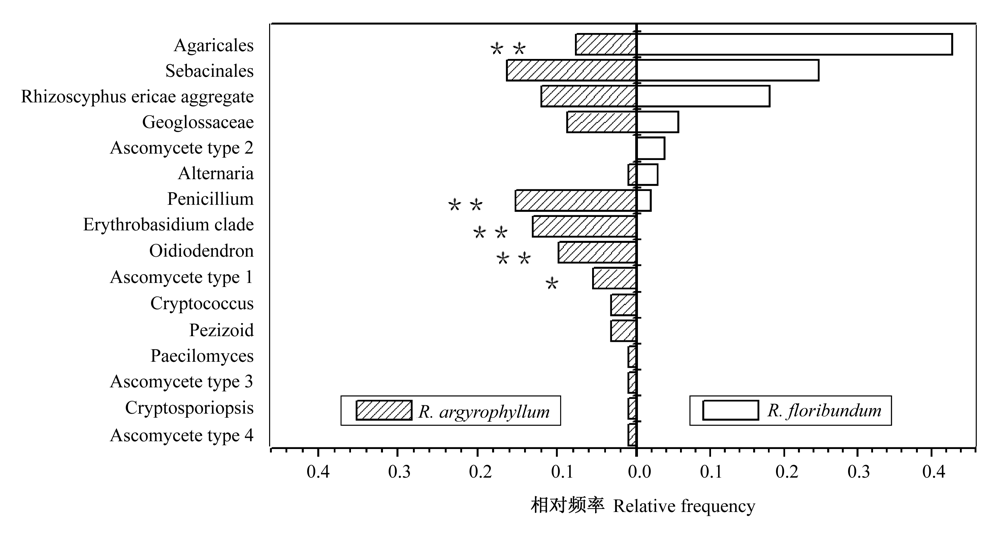
Fig. 1 Relative frequency was calculated as the number of clones from fungi genus, family or order divided by the total number of clones from R. argyrophyllum and R. floribundum. Bars with*were statistically significant (P <0.05); Bars with ** were extremely statistically significant (P<0.01). Ascomycete type 1 Closest BLAST match is AB089660; Ascomycete type 2 Closest BLAST match is AB089663; Ascomycete type 3 Closest BLAST match is AF300726; Ascomycete type 4 is unknown environmental fungi.
| [1] | Allen TR, Millar T, Berch SM, Berbee ML (2003) Culturing and direct DNA extraction find different fungi from the same ericoid mycorrhizal roots. New Phytologist, 160, 255-272. |
| [2] | Berch SM, Allen TR, Berbee ML (2002) Molecular detection, community structure and phylogeny of ericoid mycorrhizal fungi. Plant and Soil, 244, 55-66. |
| [3] |
Bougoure DS, Cairney JWG (2005) Fungi associated with hair roots of Rhododendron lochiae (Ericaceae) in an Australian tropical cloud forest revealed by culturing and culture-independent molecular methods. Environmental Microbiology, 7, 1743-1754.
URL PMID |
| [4] |
Bougoure DS, Parkin PI, Cairney JWG, Alexander IJ, Anderson IC (2007) Diversity of fungi in hair roots of Ericaceae varies along a vegetation gradient. Molecular Ecology, 16, 4624-4636.
DOI URL PMID |
| [5] | Cairney JWG, Ashford AE (2002) Biology of mycorrhizal associations of epacrids (Ericaceae). New Phytologist, 154, 305-326. |
| [6] | Cairney JWG, Meharg AA (2003) Ericoid mycorrhiza: a partnership that exploits harsh edaphic conditions. European Journal of Soil Science, 54, 735-740. |
| [7] | Clarkson DB, Fan Y, Joe H (1993) A remark on algorithm 643: FEXACT: an algorithm for performing fisher's exact test in r × c contingency tables. ACM Transactions on Mathematical Software, 19, 484-488. |
| [8] | Egger KN, Sigler L (1993) Relatedness of the ericoid endophytes Scytalidium vaccinii and Hymenoscyphus ericae inferred from analysis of ribosomal DNA. Mycologia, 85, 219-230. |
| [9] |
Grades M, Bruns TD (1993) ITS primers with enhanced specificity for basidiomycetes-application to the identification of mycorrhizae and rusts. Molecular Ecology, 2, 113-118.
DOI URL PMID |
| [10] | Guo LD, Hyde KD, Liew ECY (2000) Identification of endophytic fungi from Livistona chinensis based on morphology and rDNA sequences. New Phytologist, 147, 617-630. |
| [11] | Hambleton S, Currah RS (1997) Fungal endophytes from the roots of alpine and boreal Ericaceae. Canadian Journal of Botany, 75, 1570-1581. |
| [12] | Johansson M (2001) Fungal associations of Danish Calluna vulgaris roots with special reference to ericoid mycorrhiza. Plant and Soil, 231, 225-232. |
| [13] | Lereau MJ (1985) Rooting and establishment of in vitro blueberry plants in the presence of mycorrhizal fungi. Acta Horticulturae, 165, 197-201. |
| [14] | Li XL (李雪玲) (2004) A study on the variety of the endo-epiphyte and rhizo-epiphyte of Rhdododendron microphyton. Journal of Chuxiong Normal University (楚雄师范学院学报), 19, 87-91. (in Chinese with English abstract) |
| [15] | Martin KJ, Rygiewicz PT (2005) Fungal-specific PCR primers developed for analysis of the ITS region of environmental DNA extracts. BMC Microbiology, 5, 28. |
| [16] | Monreal M, Berch SM, Berbee M (1999) Molecular diversity of ericoid mycorrhizal fungi. Canadian Journal of Botany, 77, 1580-1594. |
| [17] | Pearson V, Read DJ (1973) The biology of mycorrhzia in the Ericaceae. II. New Phytologist, 72, 1325-1331. |
| [18] |
Perotto S, ActisPerino E, Perugini J, Bonfante P (1996) Molecular diversity of fungi from ericoid mycorrhizal roots. Molecular Ecology, 5, 123-131.
DOI URL |
| [19] | Perotto S, Peretto R, Faccio A, Schubert A, Varma A, Bonfante P (1995) Ericoid mycorrhizal fungi―cellular and molecular-bases of their interactions with the host-plant. Canadian Journal of Botany, 73, S557-S568. |
| [20] | Read DJ (1996) The structure and function of the ericoid mycorrhizal root. Annals of Botany 77, 365-374. |
| [21] | Renker C, Weibhuhn K, Kellner H, Buscot F (2006) Rationalizing molecular analysis of field-collected roots for assessing diversity of arbuscular mycorrhizal fungi: to pool, or not to pool, that is the question. Mycorrhiza, 16, 525-531. |
| [22] | Selosse MA, Setaro S, Glatard F, Richard F, Urcelay C, Weiss M (2007) Sebacinales are common mycorrhizal associates of Ericaceae. New Phytologist, 174, 864-878. |
| [23] | Setaro S, Weiss M, Oberwinkler F, Kottke I (2006) Sebacinales form ectendomycorrhizas with Cavendishia nobilis, a member of the Andean clade of Ericaceae, in the mountain rain forest of southern Ecuador. New Phytologist, 169, 355-365. |
| [24] | Sigler L, Allan T, Lim SR, Berch S, Berbee M (2005) Two new Cryptosporiopsis species from roots of ericaceous hosts in western North America. Studies in Mycology, 53, 53-62. |
| [25] | Smith SE, Read DJ (1997) Mycorrhizal Symbiosis. Academic Press, London. |
| [26] | Straker CJ (1996) Ericoid mycorrhiza: ecological and host specificity. Mycorrhiza, 6, 215-225. |
| [27] | Usuki F, Abe JP, Kakishima M (2003) Diversity of ericoid mycorrhizal fungi isolated from hair roots of Rhododendron obtusum var. kaempferi in a Japanese red pine forest. Mycoscience, 44, 97-102. |
| [28] | Vralstad T, Myhre E, Schumacher T (2002) Molecular diversity and phylogenetic affinities of symbiotic root-associated ascomycetes of the Helotiales in burnt and metal polluted habitats. New Phytologist, 155, 131-148. |
| [29] |
Weiss M, Selosse MA, Rexer KH, Urban A, Oberwinkler F (2004) Sebacinales: a hitherto overlooked cosm of heterobasidiomycetes with a broad mycorrhizal potential. Mycological Research, 108, 1003-1010.
URL PMID |
| [30] | Wu CH (吴重华), Wang JR (王吉忍), Yang JX (杨俊秀), Hu CD (胡崇德) (2000) A study on Rhododendron clementiae Forrest ex W.W. Smith Subsp. aureodorsale W. P. Fang’Mycorrhiaze in the Nature Preserve of the Taibai Mountains. Journal of Northwest Forestry University (西北林学院学报), 15(3), 68-70. (in Chinese with English abstract) |
| [31] | Zhang C, Yin L, Dai S (2009) Diversity of root-associated fungal endophytes in Rhododendron fortunei in subtropical forests of China. Mycorrhiza, 19, 417-423. |
| [32] | Zhang YH, Zhuang WY (2004) Phylogenetic relationships of some members in the genus Hymenoscyphus (Ascomycetes, Helotiales). Nova Hedwigia, 78, 475-484. |
| [33] | Zijlstra JD, Van't Hof P, Baar J, Verkley GJM, Summerbell RC, Paradi I, Braakhekke WG, Berendse F (2005) Diversity of symbiotic root endophytes of the Helotiales in ericaceous plants and the grass, Deschampsia flexuosa. Studies in Mycology, 53, 147-162. |
| [1] | Xiangzheng Yin, Haiyan Jiang, Jun Zhang, Chunsheng Luo, Yuanming Zhang. Diversity characteristics of phyllosphere bacterial communities in desert shrubs in hyper-arid regions [J]. Biodiv Sci, 2026, 34(4): 25485-. |
| [2] | Qianlu Wang, Yuxi Wang, Ye Wang, Yang Zhao, Xin Wang. Comparative analysis of biodiversity credits mechanisms in China and abroad and implications for China [J]. Biodiv Sci, 2026, 34(1): 25299-. |
| [3] | Xiangxiang Ge, Yujie Xu, Ju Tang. Effect of flower orientation variation on pollinator foraging behavior and pollination efficiency in Prunus mume f. purpurea [J]. Biodiv Sci, 2025, 33(9): 25221-. |
| [4] | Deju Yu, Yunyun He, Min Cao, Gang Wang, Jie Yang. Coexistence mechanism of tropical forest tree species based on metabolomics and transcriptomics technologies: Taking Ficus species as an example [J]. Biodiv Sci, 2025, 33(7): 24475-. |
| [5] | Zhao Yifan, Wang Yanping. A database of life-history, ecological, and biogeographical traits of snakes worldwide [J]. Biodiv Sci, 2025, 33(2): 24476-. |
| [6] | Zhang Songqi, Lu Yi, Chen Bingyao, Yang Guang, Wang Yanping, Chen Chuanwu. A dataset on the morphological, life-history, and ecological traits of cetaceans worldwide [J]. Biodiv Sci, 2025, 33(2): 24442-. |
| [7] | Chunsheng Luo, Jun Zhang, Hua Jin, Xiangzheng Yin, Yuanming Zhang. Diversity characteristics and driving factors of phyllosphere bacterial communities in shrubs of the Gurbantunggut Desert [J]. Biodiv Sci, 2025, 33(12): 25340-. |
| [8] | Xiaopeng Liu, Xinye Wang, Qingmin Yue, Yang Bai, Chunyu Zhang, Xiuhai Zhao, Minhui Hao. Unraveling the ecological strategies of major tree species in a mixed conifer- broadleaf forest of Northeast China: Insights from functional traits [J]. Biodiv Sci, 2025, 33(11): 25324-. |
| [9] | Xiaoqian Ju, Yun Tian, Mingze Xu, Yuanmeng Dai, Manle Li, Yuhan Zhou, Peng Liu, Xin Jia, Tianshan Zha. How soil environmental factors shape leaf traits in arid-land vegetation [J]. Biodiv Sci, 2025, 33(11): 25158-. |
| [10] | Ke Wang, Mingjun Zhao, Lei Cai. Annual review on nomenclature novelties of fungi in China and around the world (2024) [J]. Biodiv Sci, 2025, 33(10): 25355-. |
| [11] | Jing Chen, Bingchang Zhang, Yanjin Liu, Jie Wu, Kang Zhao, Jiao Ming. Diversity of Leptolyngbya-like cyanobacteria in biocrusts in desert area [J]. Biodiv Sci, 2024, 32(9): 24186-. |
| [12] | Chuan Jin, Zijia Zhang, Kai Di, Weirong Zhang, Dong Qiao, Siyuan Cheng, Zhongmin Hu. A dataset on fluorescence, photosynthesis gas exchange, and leaf traits of Hainan tropical rainforest plant species [J]. Biodiv Sci, 2024, 32(9): 24139-. |
| [13] | Hongyu Niu, Lu Chen, Hengyue Zhao, Gulzar Abdukirim, Hongmao Zhang. Effects of urbanization on animals: From community to individual level [J]. Biodiv Sci, 2024, 32(8): 23489-. |
| [14] | Fei Duan, Mingzhang Liu, Hongliang Bu, Le Yu, Sheng Li. Effects of urbanization on bird community composition and functional traits: A case study of the Beijing-Tianjin-Hebei region [J]. Biodiv Sci, 2024, 32(8): 23473-. |
| [15] | Bohan Zheng, Xinyao Chen, Jian Ni. A dataset on the plant growth form and life form of vascular plants in China [J]. Biodiv Sci, 2024, 32(7): 23468-. |
| Viewed | ||||||
|
Full text |
|
|||||
|
Abstract |
|
|||||
Copyright © 2026 Biodiversity Science
Editorial Office of Biodiversity Science, 20 Nanxincun, Xiangshan, Beijing 100093, China
Tel: 010-62836137, 62836665 E-mail: biodiversity@ibcas.ac.cn

