

Biodiv Sci ›› 2025, Vol. 33 ›› Issue (11): 25324. DOI: 10.17520/biods.2025324 cstr: 32101.14.biods.2025324
• Original Papers: Plant Diversity • Previous Articles Next Articles
Xiaopeng Liu1, Xinye Wang1, Qingmin Yue2( ), Yang Bai3(), Chunyu Zhang1(), Xiuhai Zhao1(), Minhui Hao1,*()(
 )
)
Received:2025-08-24
Accepted:2025-10-27
Online:2025-11-20
Published:2026-01-07
Contact:
Minhui Hao
Supported by:Xiaopeng Liu, Xinye Wang, Qingmin Yue, Yang Bai, Chunyu Zhang, Xiuhai Zhao, Minhui Hao. Unraveling the ecological strategies of major tree species in a mixed conifer- broadleaf forest of Northeast China: Insights from functional traits[J]. Biodiv Sci, 2025, 33(11): 25324.
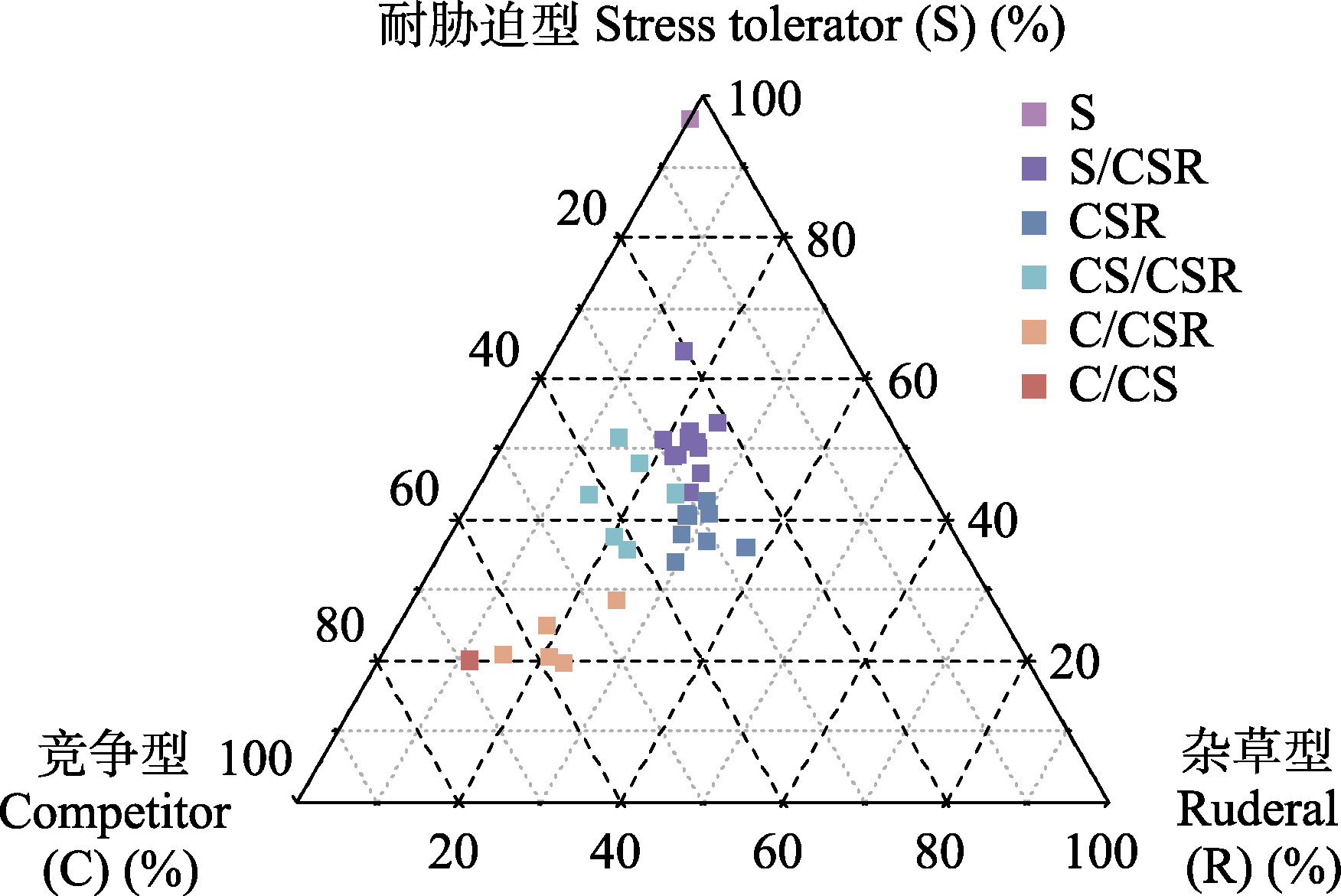
Fig. 1 Classification of the competitor-stress tolerator- ruderal ecological strategy among 32 tree species in a mixed conifer-broadleaf forest of Northeast China. S, Stress tolerator; S/CSR, Stress tolerator /competitor-stress tolerator-ruderal; CSR, Competitor-stress tolerator-ruderal; CS/CSR, Competitor-stress tolerator/competitor-stress tolerator-ruderal; C/CSR, Competitor/competitor-stress tolerator-ruderal; C/CS, Competitor /competitor-stress tolerator.
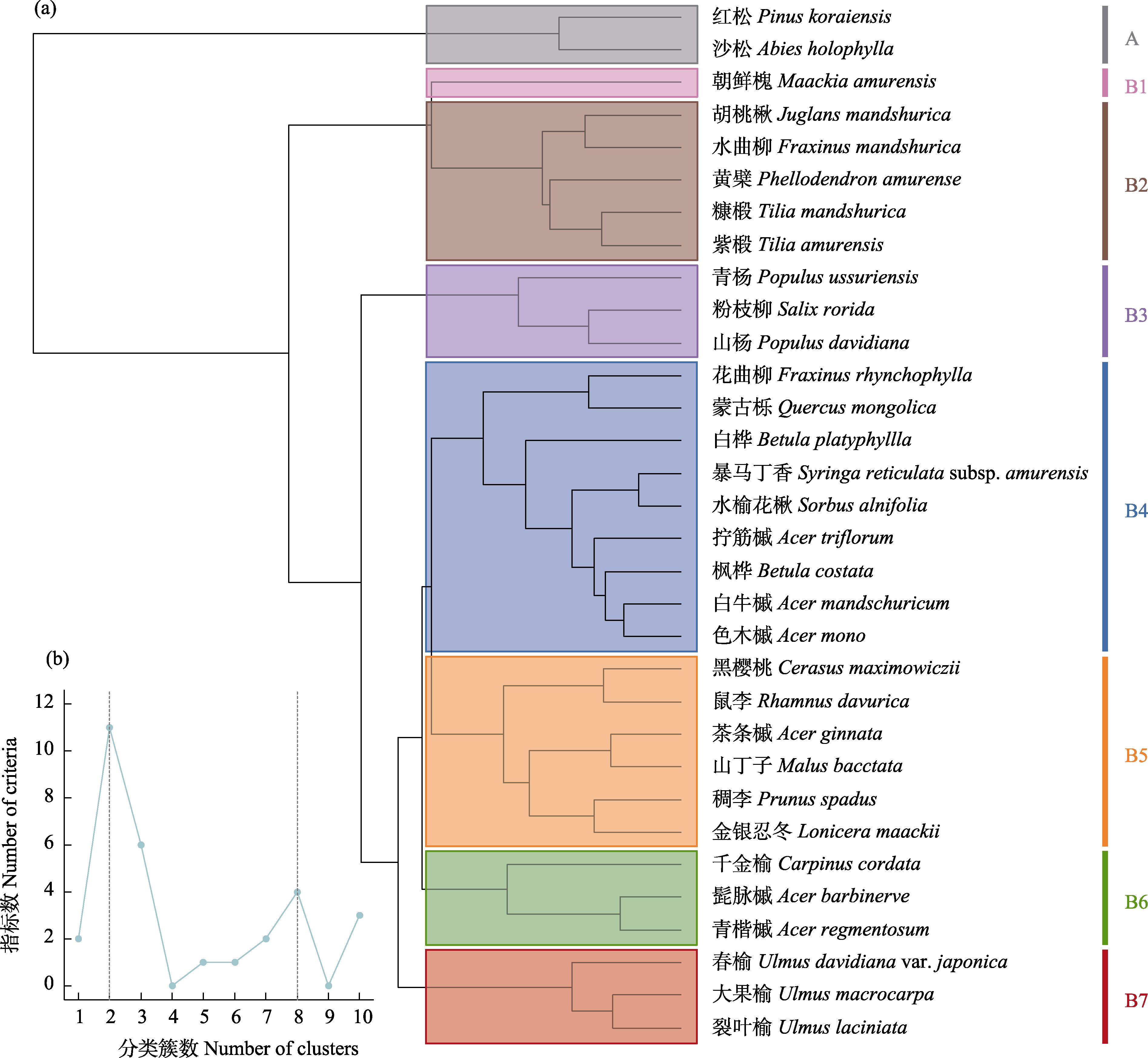
Fig. 2 Clustering results of plant functional traits. (a) Clustering dendrogram of the plant functional traits. Different color represents different tree species classifications, with the letter-number combinations on the right indicating the classification serial numbers. All tree species are divided into two major groups, Group A and Group B, with Group B further subdivided into seven subgroups. (b) Line chart of cluster analysis. The peak value corresponds to the optimal number of clusters for the cluster analysis.
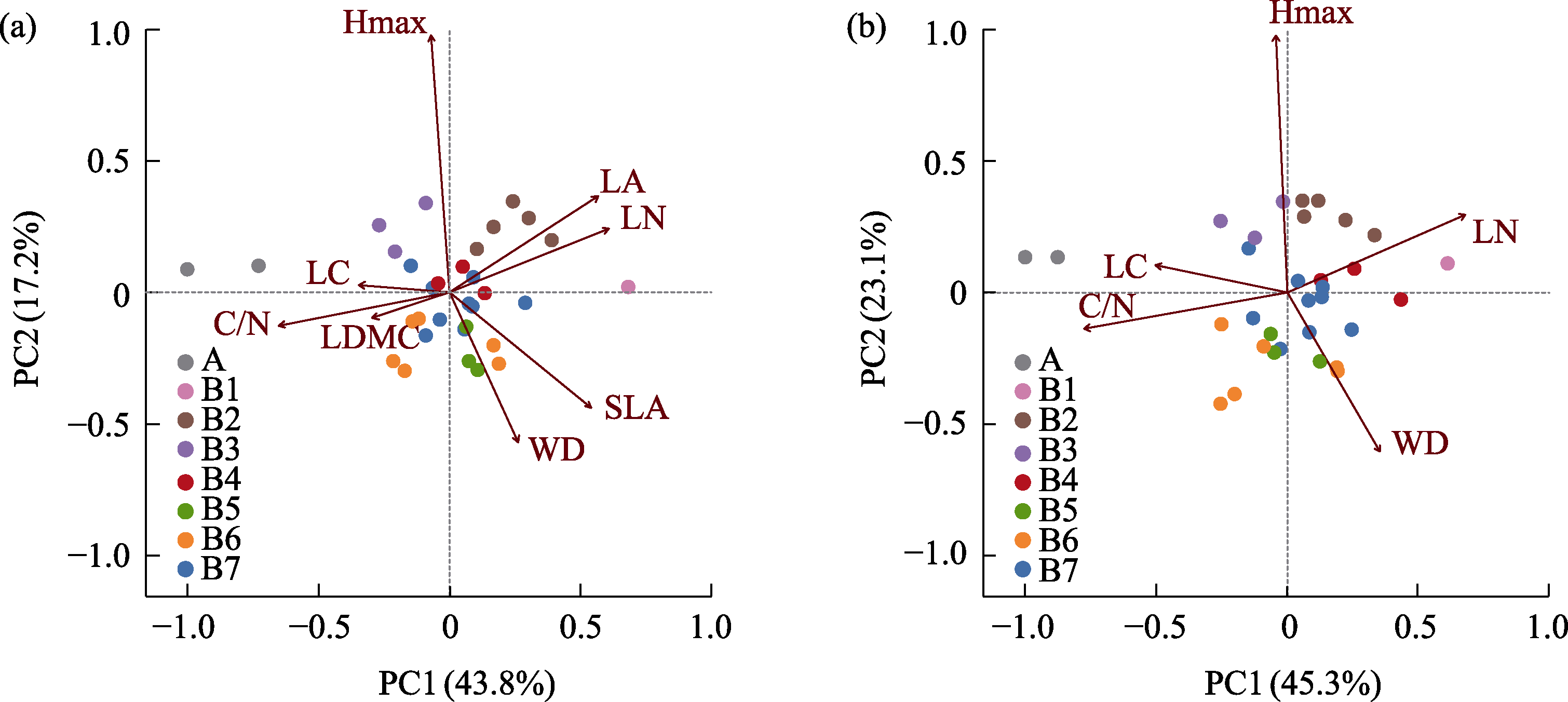
Fig. 3 Biplots of principal component analysis. (a) Based on eight functional traits; (b) Based on five functional traits. A, Coniferous species; B1, Maackia amurensis; B2, Succession climax broadleaf species; B3, Pioneer species; B4, Succession transitional species; B5, Shrubs; B6, Small trees; B7, Ulmaceae plants. LA, Leaf area; SLA, Specific leaf area; LDMC, Leaf dry mass content; LC, Leaf carbon content; LN, Leaf nitrogen content; C/N, Leaf carbon to nitrogen ratio; Hmax, Maximum tree height; WD, Wood density.
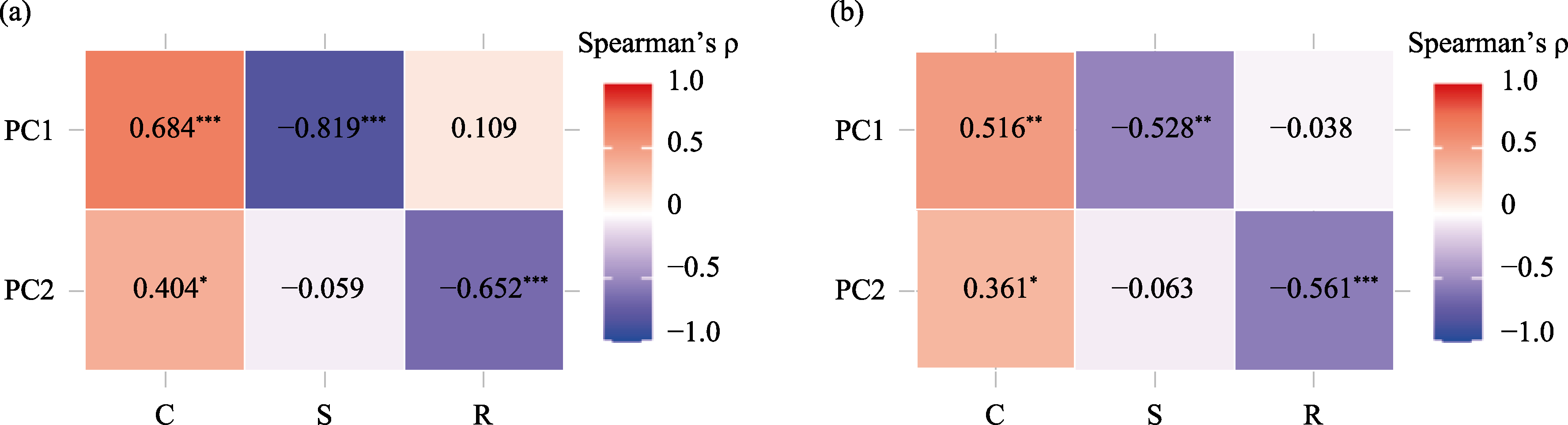
Fig. 4 Heatmap of correlations between principal components of principal component analysis (PCA) and CSR strategy scores. (a) Based on eight functional traits; (b) Based on five functional traits. C, Competitor; S, Stress tolerator; R, Ruderal; * P < 0.05; ** P < 0.01; *** P < 0.001.
| [1] |
Barba-Escoto L, Ponce-Mendoza A, García-Romero A, Calvillo-Medina RP (2019) Plant community strategies responses to recent eruptions of Popocatépetl volcano, Mexico. Journal of Vegetation Science, 30, 375-385.
DOI |
| [2] |
Burton JI, Perakis SS, McKenzie SC, Lawrence CE, Puettmann KJ (2017) Intraspecific variability and reaction norms of forest understorey plant species traits. Functional Ecology, 31, 1881-1893.
DOI URL |
| [3] |
Caccianiga M, Luzzaro A, Pierce S, Ceriani RM, Cerabolini B (2006) The functional basis of a primary succession resolved by CSR classification. Oikos, 112, 10-20.
DOI URL |
| [4] |
Cerabolini BEL, Brusa G, Ceriani RM, De Andreis R, Luzzaro A, Pierce S (2010) Can CSR classification be generally applied outside Britain? Plant Ecology, 210, 253-261.
DOI URL |
| [5] | Charrad M, Ghazzali N, Boiteau V, Niknafs A (2014) NbClust: An R package for determining the relevant number of clusters in a data set. Journal of Statistical Software, 61, 1-36. |
| [6] |
Chave J, Muller-Landau HC, Baker TR, Easdale TA, ter Steege H, Webb CO (2006) Regional and phylogenetic variation of wood density across 2456 neotropical tree species. Ecological Applications, 16, 2356-2367.
DOI PMID |
| [7] |
Chave J, Coomes D, Jansen S, Lewis SL, Swenson NG, Zanne AE (2009) Towards a worldwide wood economics spectrum. Ecology Letters, 12, 351-366.
DOI PMID |
| [8] |
Chen HY, Huang YM, He KJ, Qi Y, Li EG, Jiang ZY, Sheng ZL, Li XY (2019) Temporal intraspecific trait variability drives responses of functional diversity to interannual aridity variation in grasslands. Ecology and Evolution, 9, 5731-5742.
DOI URL |
| [9] | Cheng XY, Sun XD, Wang XY, Shang YJ, Pang XP, Li J (2024) Response of ecological strategies of noxious weeds to plateau pika (Ochotona curzoniae) disturbance in an alpine meadow. Acta Agrestia Sinica, 32, 2459-2468. (in Chinese with English abstract) |
|
[ 程小云, 孙小丹, 王新源, 尚艺婕, 庞晓攀, 李捷 (2024) 高寒草甸主要毒杂草生态策略对高原鼠兔干扰的响应. 草地学报, 32, 2459-2468.]
DOI |
|
| [10] |
Coomes DA, Heathcote S, Godfrey ER, Shepherd JJ, Sack L (2008) Scaling of xylem vessels and veins within the leaves of oak species. Biology Letters, 4, 302-306.
DOI PMID |
| [11] |
Cornelissen JHC, Lavorel S, Garnier E, Díaz S, Buchmann N, Gurvich DE, Reich PB, ter Steege H, Morgan HD, van der Heijden MGA, Pausas JG, Poorter H (2003) A handbook of protocols for standardised and easy measurement of plant functional traits worldwide. Australian Journal of Botany, 51, 335-380.
DOI URL |
| [12] |
de Paula LFA, Negreiros D, Azevedo LO, Fernandes RL, Stehmann JR, Silveira FAO (2015) Functional ecology as a missing link for conservation of a resource-limited flora in the Atlantic forest. Biodiversity and Conservation, 24, 2239-2253.
DOI URL |
| [13] |
De Smedt P, Ottaviani G, Wardell-Johnson G, Sýkora KV, Mucina L (2018) Habitat heterogeneity promotes intraspecific trait variability of shrub species in Australian granite inselbergs. Folia Geobotanica, 53, 133-145.
DOI |
| [14] |
Díaz S, Kattge J, Cornelissen JHC, Wright IJ, Lavorel S, Dray S, Reu B, Kleyer M, Wirth C, Colin Prentice I, Garnier E, Bönisch G, Westoby M, Poorter H, Reich PB, Moles AT, Dickie J, Gillison AN, Zanne AE, Chave J, Joseph Wright S, Sheremet’ev SN, Jactel H, Baraloto C, Cerabolini B, Pierce S, Shipley B, Kirkup D, Casanoves F, Joswig JS, Günther A, Falczuk V, Rüger N, Mahecha MD, Gorné LD (2016) The global spectrum of plant form and function. Nature, 529, 167-171.
DOI |
| [15] | Douma JC, Aerts R, Witte JPM, Bekker RM, Kunzmann D, Metselaar K, van Bodegom PM (2012) A combination of functionally different plant traits provides a means to quantitatively predict a broad range of species assemblages in NW Europe. Ecography, 35, 364-373. |
| [16] |
Frenette-Dussault C, Shipley B, Léger JF, Meziane D, Hingrat Y (2012) Functional structure of an arid steppe plant community reveals similarities with Grime’s C-S-R theory. Journal of Vegetation Science, 23, 208-222.
DOI URL |
| [17] |
Freschet GT, Cornelissen JHC, van Logtestijn RSP, Aerts R (2010) Substantial nutrient resorption from leaves, stems and roots in a subarctic flora: What is the link with other resource economics traits? New Phytologist, 186, 879-889.
DOI PMID |
| [18] |
Fu PL, Jiang YJ, Wang AY, Brodribb TJ, Zhang JL, Zhu SD, Cao KF (2012) Stem hydraulic traits and leaf water-stress tolerance are co-ordinated with the leaf phenology of angiosperm trees in an Asian tropical dry karst forest. Annals of Botany, 110, 189-199.
DOI URL |
| [19] |
Grime JP (1974) Vegetation classification by reference to strategies. Nature, 250, 26-31.
DOI |
| [20] |
Grime JP (1977) Evidence for the existence of three primary strategies in plants and its relevance to ecological and evolutionary theory. The American Naturalist, 111, 1169-1194.
DOI URL |
| [21] | Grime JP (2001) Plant Strategies, Vegetation Processes, and Ecosystem Properties, 2nd edn. John Wiley & Sons, Chichester. |
| [22] |
Guo WY, van Kleunen M, Winter M, Weigelt P, Stein A, Pierce S, Pergl J, Moser D, Maurel N, Lenzner B, Kreft H, Essl F, Dawson W, Pyšek P (2018) The role of adaptive strategies in plant naturalization. Ecology Letters, 21, 1380-1389.
DOI URL |
| [23] | Hang YJ, Chen ZC, Wang L, Niu BL, Liu SS, Yu B, Wang X, Liu SR (2024) Anatomical determinants of wood density of eight broad-leaved tree species in Baotianman and their coordination and trade-off with leaf traits. Scientia Silvae Sinicae, 60(4), 62-70. (in Chinese with English abstract) |
| [ 杭宇杰, 陈志成, 王林, 牛保亮, 刘松松, 于博, 王晓, 刘世荣 (2024) 宝天曼8种阔叶树木材密度的解剖学决定因素及其与叶性状的协同与权衡. 林业科学, 60(4), 62-70.] | |
| [24] | Hao MH, Zhang ZH, Zhao SS, Zhao XH, Baiketuerhan Y, Zhang CY (2017) Habitat associations of tree growth in a coniferous and broad-leaved mixed forest in Jiaohe, Jilin Province. Acta Ecologica Sinica, 37, 3437-3444. (in Chinese with English abstract) |
| [ 郝珉辉, 张忠辉, 赵珊珊, 赵秀海, 叶尔江·拜克吐尔汉, 张春雨 (2017) 吉林蛟河针阔混交林树木生长与生境的关联性. 生态学报, 37, 3437-3444.] | |
| [25] | Hao ZQ, Zhang J, Li BH, Ye J, Wang XG, Yao XL (2008) Natural secondary poplar-birch forest in Changbai Mountain: Species composition and community structure. Journal of Plant Ecology (Chinese Version), 32, 251-261. (in Chinese with English abstract) |
|
[ 郝占庆, 张健, 李步杭, 叶吉, 王绪高, 姚晓琳 (2008) 长白山次生杨桦林样地: 物种组成与群落结构. 植物生态学报, 32, 251-261.]
DOI |
|
| [26] | He NP, Liu CC, Zhang JH, Xu L, Yu GR (2018) Perspectives and challenges in plant traits: From organs to communities. Acta Ecologica Sinica, 38, 6787-6796. (in Chinese with English abstract) |
| [ 何念鹏, 刘聪聪, 张佳慧, 徐丽, 于贵瑞 (2018) 植物性状研究的机遇与挑战: 从器官到群落. 生态学报, 38, 6787-6796.] | |
| [27] |
He YY, Guo SL, Wang Z (2019) Research progress of trade-off relationships of plant functional traits. Chinese Journal of Plant Ecology, 43, 1021-1035. (in Chinese with English abstract)
DOI URL |
|
[ 何芸雨, 郭水良, 王喆 (2019) 植物功能性状权衡关系的研究进展. 植物生态学报, 43, 1021-1035.]
DOI |
|
| [28] |
Hodgson JG, Santini BA, Montserrat Marti G, Royo Pla F, Jones G, Bogaard A, Charles M, Font X, Ater M, Taleb A, Poschlod P, Hmimsa Y, Palmer C, Wilson PJ, Band SR, Styring A, Diffey C, Green L, Nitsch E, Stroud E, Romo-Díez A, de Torres Espuny L, Warham G (2017) Trade-offs between seed and leaf size (seed-phytomer-leaf theory): Functional glue linking regenerative with life history strategies…and taxonomy with ecology? Annals of Botany, 120, 633-652.
DOI PMID |
| [29] | Hu ZD, Liu SR, Liu XL, Hu J, Luo MX, Li YF, Shi SL, Wu DY, Xiao JJ (2021) Soil and soil microbial biomass contents and C : N : P stoichiometry at different succession stages of natural secondary forest in sub-alpine area of western Sichuan, China. Acta Ecologica Sinica, 41, 4900-4912. (in Chinese with English abstract) |
| [ 胡宗达, 刘世荣, 刘兴良, 胡璟, 罗明霞, 李亚非, 石松林, 吴德勇, 肖玖金 (2021) 川西亚高山天然次生林不同演替阶段土壤-微生物生物量及其化学计量特征. 生态学报, 41, 4900-4912.] | |
| [30] | Jin S, Yan SJ, Huang LJ, Chen Y, Ma WW, Wang YX, Wang Z (2019) Research progress in trade-offs among leaf functional traits. Journal of Sichuan Forestry Science and Technology, 40(5), 96-103. (in Chinese with English abstract) |
| [ 靳莎, 闫淑君, 黄柳菁, 陈莹, 马雯雯, 王云霄, 王喆 (2019) 植物叶功能性状间的权衡研究进展. 四川林业科技, 40(5), 96-103.] | |
| [31] | Kabacoff R (2022) R in Action: Data analysis and Graphics with R and Tidyverse, 3rd edn. Manning Publications, Shelton. |
| [32] |
Kattenborn T, Fassnacht FE, Pierce S, Lopatin J, Grime JP, Schmidtlein S (2017) Linking plant strategies and plant traits derived by radiative transfer modelling. Journal of Vegetation Science, 28, 717-727.
DOI URL |
| [33] |
Kazakou E, Garnier E, Navas ML, Roumet C, Collin C, Laurent G (2007) Components of nutrient residence time and the leaf economics spectrum in species from Mediterranean old-fields differing in successional status. Functional Ecology, 21, 235-245.
DOI URL |
| [34] |
Kleyer M, Minden V (2015) Why functional ecology should consider all plant organs: An allocation-based perspective. Basic and Applied Ecology, 16, 1-9.
DOI URL |
| [35] |
Laughlin DC, Leppert JJ, Moore MM, Sieg CH (2010) A multi-trait test of the leaf-height-seed plant strategy scheme with 133 species from a pine forest flora. Functional Ecology, 24, 493-501.
DOI URL |
| [36] |
Laughlin DC, Lusk CH, Bellingham PJ, Burslem DFRP, Simpson AH, Kramer-Walter KR (2017) Intraspecific trait variation can weaken interspecific trait correlations when assessing the whole-plant economic spectrum. Ecology and Evolution, 7, 8936-8949.
DOI PMID |
| [37] | Li RH, Zhu SD, Chen HYH, John R, Zhou GY, Zhang DQ, Zhang QM, Ye Q (2015) Are functional traits a good predictor of global change impacts on tree species abundance dynamics in a subtropical forest? Ecology Letters, 18, 1181-1189. |
| [38] | Liang XY (2017) Leaf Functional Traits and Ecological Stoichiometry of the Dominant Tree Species along Forest Succession of Korean Pine and Broad-leaved Mixed Forest in Changbai Mountains, Northeastern China. PhD dissertation, Ecology and Nature Conservation Institute, Chinese Academy of Forestry, Beijing. (in Chinese with English abstract) |
| [ 梁星云 (2017) 长白山阔叶红松林演替系列主要树种叶片功能性状与化学计量学研究. 博士学位论文, 中国林业科学研究院森林生态环境与自然保护研究所, 北京.] | |
| [39] |
Lin XW, Zhu JG, Xie ZB (2024) Evolution of soil quality of temperate conifer and broad-leaved mixed forests at different successional stages in Jiaohe, Jilin Province, China. Chinese Journal of Ecology, 43, 433-444. (in Chinese with English abstract)
DOI |
| [ 蔺兴武, 朱建国, 谢祖彬 (2024) 吉林蛟河不同演替阶段温带针阔混交林土壤质量演变. 生态学杂志, 43, 433-444.] | |
| [40] | Liu C, Li S, Li JS, Guo DG, Zhang QX (2023) Spatial pattern of CSR strategies of wetland plants in Shanxi Province, China and their relationship with climate factors. Mountain Research, 41, 634-647. (in Chinese with English abstract) |
| [ 刘灿, 李帅, 李佳晟, 郭东罡, 张全喜 (2023) 山西省湿地植物CSR策略的空间分布格局及其与气候因子的关系. 山地学报, 41, 634-647.] | |
| [41] |
Liu XJ, Ma KP (2015) Research progress on plant functional traits. Scientia Sinica Vitae, 45, 325-339. (in Chinese with English abstract)
DOI URL |
| [ 刘晓娟, 马克平 (2015) 植物功能性状研究进展. 中国科学: 生命科学, 45, 325-339.] | |
| [42] |
Luo JX, Zang RG, Li CY (2006) Physiological and morphological variations of Picea asperata populations originating from different altitudes in the mountains of southwestern China. Forest Ecology and Management, 221, 285-290.
DOI URL |
| [43] |
Lusk CH, Laughlin DC (2017) Regeneration patterns, environmental filtering and tree species coexistence in a temperate forest. New Phytologist, 213, 657-668.
DOI PMID |
| [44] |
Martínez-Cabrera HI, Jones CS, Espino S, Schenk HJ (2009) Wood anatomy and wood density in shrubs: Responses to varying aridity along transcontinental transects. American Journal of Botany, 96, 1388-1398.
DOI PMID |
| [45] |
Moles AT, Warton DI, Warman L, Swenson NG, Laffan SW, Zanne AE, Pitman A, Hemmings FA, Leishman MR (2009) Global patterns in plant height. Journal of Ecology, 97, 923-932.
DOI URL |
| [46] |
Naeem S, Thompson LJ, Lawler SP, Lawton JH, Woodfin RM (1994) Declining biodiversity can alter the performance of ecosystems. Nature, 368, 734-737.
DOI |
| [47] |
Niklas KJ (1995) Size-dependent allometry of tree height, diameter and trunk-taper. Annals of Botany, 75, 217-227.
DOI URL |
| [48] | Oksanen J, Blanchet FG, Kindt R, Legendre P, Minchin PR, O’Hara RB, Solymos P, Stevens MHH, Szoecs E, Wagner H, Barbour M, Bedward M, Bolker B, Borcard D, Borman T, Carvalho G, Chirico M, Caceres MD, Durand S, Evangelista HBA, FitzJohn R, Friendly M, Furneaux B, Hannigan G, Hill MO, Lahti L, Martino C, McGlinn D, Ouellette MH, Cunha ER, Smith T, Stier A, Braak CJFT, Weedon J (2013) Package ‘vegan’. Community Ecology Package, Version, 21-295. |
| [49] |
Osnas JLD, Lichstein JW, Reich PB, Pacala SW (2013) Global leaf trait relationships: Mass, area, and the leaf economics spectrum. Science, 340, 741-744.
DOI PMID |
| [50] |
Ostertag R, Warman L, Cordell S, Vitousek PM (2015) Using plant functional traits to restore Hawaiian rainforest. Journal of Applied Ecology, 52, 805-809.
DOI URL |
| [51] |
Pérez-Harguindeguy N, Díaz S, Garnier E, Lavorel S, Poorter H, Jaureguiberry P, Bret-Harte MS, Cornwell WK, Craine JM, Gurvich DE, Urcelay C, Veneklaas EJ, Reich PB, Poorter L, Wright IJ, Ray P, Enrico L, Pausas JG, de Vos AC, Buchmann N, Funes G, Quétier F, Hodgson JG, Thompson K, Morgan HD, ter Steege H, Sack L, Blonder B, Poschlod P, Vaieretti MV, Conti G, Staver AC, Aquino S, Cornelissen JHC (2016) Corrigendum to: New handbook for standardised measurement of plant functional traits worldwide. Australian Journal of Botany, 64, 715-716.
DOI URL |
| [52] |
Pierce S, Brusa G, Sartori M, Cerabolini BEL (2012) Combined use of leaf size and economics traits allows direct comparison of hydrophyte and terrestrial herbaceous adaptive strategies. Annals of Botany, 109, 1047-1053.
DOI PMID |
| [53] |
Pierce S, Brusa G, Vagge I, Cerabolini BEL (2013) Allocating CSR plant functional types: The use of leaf economics and size traits to classify woody and herbaceous vascular plants. Functional Ecology, 27, 1002-1010.
DOI URL |
| [54] |
Pierce S, Negreiros D, Cerabolini BEL, Kattge J, Díaz S, Kleyer M, Shipley B, Wright SJ, Soudzilovskaia NA, Onipchenko VG, van Bodegom PM, Frenette-Dussault C, Weiher E, Pinho BX, Cornelissen JHC, Grime JP, Thompson K, Hunt R, Wilson PJ, Buffa G, Nyakunga OC, Reich PB, Caccianiga M, Mangili F, Ceriani RM, Luzzaro A, Brusa G, Siefert A, Barbosa NPU, Chapin III FS, Cornwell WK, Fang JY, Fernandes GW, Garnier E, Le Stradic S, Peñuelas J, Melo FPL, Slaviero A, Tabarelli M, Tampucci D (2017) A global method for calculating plant CSR ecological strategies applied across biomes world-wide. Functional Ecology, 31, 444-457.
DOI URL |
| [55] |
Pinho BX, de Melo FPL, Arroyo-Rodríguez V, Pierce S, Lohbeck M, Tabarelli M (2018) Soil-mediated filtering organizes tree assemblages in regenerating tropical forests. Journal of Ecology, 106, 137-147.
DOI URL |
| [56] | Poorter L, McDonald I, Alarcón A, Fichtler E, Licona JC, Peña-Claros M, Sterck F, Villegas Z, Sass-Klaassen U (2010) The importance of wood traits and hydraulic conductance for the performance and life history strategies of 42 rainforest tree species. New Phytologist, 185, 481-492. |
| [57] |
Reich PB (2014) The world-wide ‘fast-slow’ plant economics spectrum: A traits manifesto. Journal of Ecology, 102, 275-301.
DOI URL |
| [58] |
Reich PB, Uhl C, Walters MB, Ellsworth DS (1991) Leaf lifespan as a determinant of leaf structure and function among 23 Amazonian tree species. Oecologia, 86, 16-24.
DOI PMID |
| [59] |
Rosenfield MF, Müller SC, Overbeck GE (2019) Short gradient, but distinct plant strategies: The CSR scheme applied to subtropical forests. Journal of Vegetation Science, 30, 984-993.
DOI |
| [60] |
Santiago LS (2007) Extending the leaf economics spectrum to decomposition: Evidence from a tropical forest. Ecology, 88, 1126-1131.
PMID |
| [61] |
Schmidtlein S, Feilhauer H, Bruelheide H (2012) Mapping plant strategy types using remote sensing. Journal of Vegetation Science, 23, 395-405.
DOI URL |
| [62] | Shi SR, Qi MJ, Wang SR, Bai YF, Wang H, Wang JD, Jiang CQ (2022) Ecological strategies of main understory woody plants in the Cyclobalanopsis glauca secondary forest in west Hunan. Journal of Central South University of Forestry & Technology, 42(3), 53-61. (in Chinese with English abstract) |
| [ 石朔蓉, 齐梦娟, 王书韧, 白彦峰, 王辉, 王景弟, 姜春前 (2022) 湘西青冈栎次生林林下主要木本植物的生态策略. 中南林业科技大学学报, 42(3), 53-61.] | |
| [63] |
Silvertown J (2004) Plant coexistence and the niche. Trends in Ecology & Evolution, 19, 605-611.
DOI URL |
| [64] | Wang RZ, Huang WW, Chen L, Ma LN, Guo CY, Liu XQ (2011) Anatomical and physiological plasticity in Leymus chinensis (Poaceae) along large-scale longitudinal gradient in Northeast China. PLoS ONE, 6, e26209. |
| [65] |
Westoby M (1998) A leaf-height-seed (LHS) plant ecology strategy scheme. Plant and Soil, 199, 213-227.
DOI |
| [66] | Xia MJ, Wang XX, Hao MH, Zhao XH, Zhang CY (2021) Distribution pattern of functional traits and its response to topographic factors in a conifer and broad-leaved mixed forest in Jiaohe, Jilin Province. Acta Ecologica Sinica, 41, 2794-2802. (in Chinese with English abstract) |
| [ 夏梦洁, 王晓霞, 郝珉辉, 赵秀海, 张春雨 (2021) 吉林蛟河针阔混交林功能性状分布格局及其对地形因素的响应. 生态学报, 41, 2794-2802.] | |
| [67] | Xu PC, You ZT, Ji YH, Zhou JC, Zhang QF, Zheng W, Liu XF, Lin WS, Yang ZJ, Yang YS (2019) Study on ecological strategies of 22 common woody plants in Castanopsis kawakami Nature Reserve. Journal of Subtropical Resources and Environment, 14(4), 23-29. (in Chinese with English abstract) |
| [ 徐鹏程, 游章湉, 纪宇皝, 周嘉聪, 张秋芳, 郑蔚, 刘小飞, 林伟盛, 杨智杰, 杨玉盛 (2019) 格氏栲自然保护区22种常见木本植物的生态策略. 亚热带资源与环境学报, 14(4), 23-29.] | |
| [68] |
Yao Z, Wu YM, You HL, Xin ZJ (2022) Research progress of plant competitor-stress tolerator-ruderal (CSR) theory and its application. Acta Ecologica Sinica, 42, 24-36. (in Chinese with English abstract)
DOI URL |
| [ 姚忠, 吴永明, 游海林, 辛在军 (2022) 竞争-耐胁迫-杂草型植物对策理论及其应用研究进展. 生态学报, 42, 24-36.] | |
| [69] | Yue LY, Zheng JQ, Han SJ, Yang JH, Geng SC, Chen ZJ, Zhang X, Gu Y (2015) Soil chemical properties and microbial community structure at different succession stages of temperate forest in Changbai Mountains. Chinese Journal of Ecology, 34, 2590-2597. (in Chinese with English abstract) |
| [ 岳琳艳, 郑俊强, 韩士杰, 杨建华, 耿世聪, 陈志杰, 张雪, 谷越 (2015) 长白山温带森林不同演替阶段土壤化学性质及微生物群落结构的变化. 生态学杂志, 34, 2590-2597.] | |
| [70] | Yue QM, He HJ, Zhang CY, Zhao XH, Hao MH (2024) Response of trees and stand growth to cutting disturbance in Korean pine-broadleaved forests. Acta Ecologica Sinica, 44, 2019-2028. (in Chinese with English abstract) |
| [ 岳庆敏, 何怀江, 张春雨, 赵秀海, 郝珉辉 (2024) 阔叶红松林林木与林分生长对采伐干扰的响应. 生态学报, 44, 2019-2028.] | |
| [71] |
Zanzottera M, Dalle Fratte M, Caccianiga M, Pierce S, Cerabolini BEL (2020) Community-level variation in plant functional traits and ecological strategies shapes habitat structure along succession gradients in alpine environment. Community Ecology, 21, 55-65.
DOI |
| [72] |
Zemunik G, Turner BL, Lambers H, Laliberté E (2015) Diversity of plant nutrient-acquisition strategies increases during long-term ecosystem development. Nature Plants, 1, 15050.
DOI |
| [73] | Zhang XJ (2022) Naturalness in Different Successional Stages of Korean Pine Forests and Driven by Ecological Strategies and Environment. PhD dissertation, Northeast Forestry University, Harbin. (in Chinese with English abstract) |
| [ 张象君 (2022) 红松林不同演替阶段的近自然度及生态策略和环境驱动. 博士学位论文, 东北林业大学, 哈尔滨.] | |
| [74] | Zhang YS, Meiners SJ, Meng YN, Yao Q, Guo K, Guo WY, Li SP (2024) Temporal dynamics of Grime’s CSR strategies in plant communities during 60 years of succession. Ecology Letters, 27, e14446. |
| [75] | Zhao HC, Gao F, Li SW, Gao L, Wang MZ, Cui XY (2019) Co-accumulation characters of soil organic carbon and nitrogen under broadleaved Korean pine and Betula platyphylla secondary forests in Changbai Mountain, China. Chinese Journal of Applied Ecology, 30, 1615-1624. (in Chinese with English abstract) |
|
[ 赵华晨, 高菲, 李斯雯, 高雷, 王明哲, 崔晓阳 (2019) 长白山阔叶红松林和杨桦次生林土壤有机碳氮的协同积累特征. 应用生态学报, 30, 1615-1624.]
DOI |
|
| [76] |
Zhao XF, Xu HL, Zhang P, Tu WX, Zhang QQ (2014) Effects of nutrient and water additions on plant community structure and species diversity in desert grasslands. Chinese Journal of Plant Ecology, 38, 167-177. (in Chinese with English abstract)
DOI URL |
|
[ 赵新风, 徐海量, 张鹏, 涂文霞, 张青青 (2014) 养分与水分添加对荒漠草地植物群落结构和物种多样性的影响. 植物生态学报, 38, 167-177.]
DOI |
|
| [77] | Zhu JY, Yu Q, Liu YP, Qin GM, Li JH, Xu CY, He WJ (2018) Response of plant functional traits and leaf economics spectrum to urban thermal environment. Journal of Beijing Forestry University, 40(9), 72-81. (in Chinese with English abstract) |
| [ 朱济友, 于强, 刘亚培, 覃国铭, 李金航, 徐程扬, 何韦均 (2018) 植物功能性状及其叶经济谱对城市热环境的响应. 北京林业大学学报, 40(9), 72-81.] |
| Viewed | ||||||
|
Full text |
|
|||||
|
Abstract |
|
|||||
Copyright © 2026 Biodiversity Science
Editorial Office of Biodiversity Science, 20 Nanxincun, Xiangshan, Beijing 100093, China
Tel: 010-62836137, 62836665 E-mail: biodiversity@ibcas.ac.cn

