

Biodiv Sci ›› 2025, Vol. 33 ›› Issue (12): 24323. DOI: 10.17520/biods.2024323 cstr: 32101.14.biods.2024323
• Reviews • Next Articles
Xiangfei Kong1,2( ), Qiang Ding1,3(), Guoquan Wang4(), Guohua Huang5(), Zhehao Tian1,6, Xinpu Wang6(), Yijie Tong1(), Zhishun Song7(), Xiaoning Zhang8,9, Weihai Li2(), Huilin Han10(), Wenliang Li11(), Rui’e Nie12(), Haidong Yang1,13, Xingke Yang1,13, Meike Liu14(), Yongming Sun15(), Yaqin Cui15(), Meixia Yang16(), Ning Liu1, Yuanyuan Lu1(), Panpan Li1,4(), Ming Bai1,3,*()(
 )
)
Received:2025-08-18
Accepted:2025-10-11
Online:2025-12-20
Published:2026-01-09
Supported by:Xiangfei Kong, Qiang Ding, Guoquan Wang, Guohua Huang, Zhehao Tian, Xinpu Wang, Yijie Tong, Zhishun Song, Xiaoning Zhang, Weihai Li, Huilin Han, Wenliang Li, Rui’e Nie, Haidong Yang, Xingke Yang, Meike Liu, Yongming Sun, Yaqin Cui, Meixia Yang, Ning Liu, Yuanyuan Lu, Panpan Li, Ming Bai. Research progress of insect diversity in “SITE-100” sampling sites in China[J]. Biodiv Sci, 2025, 33(12): 24323.
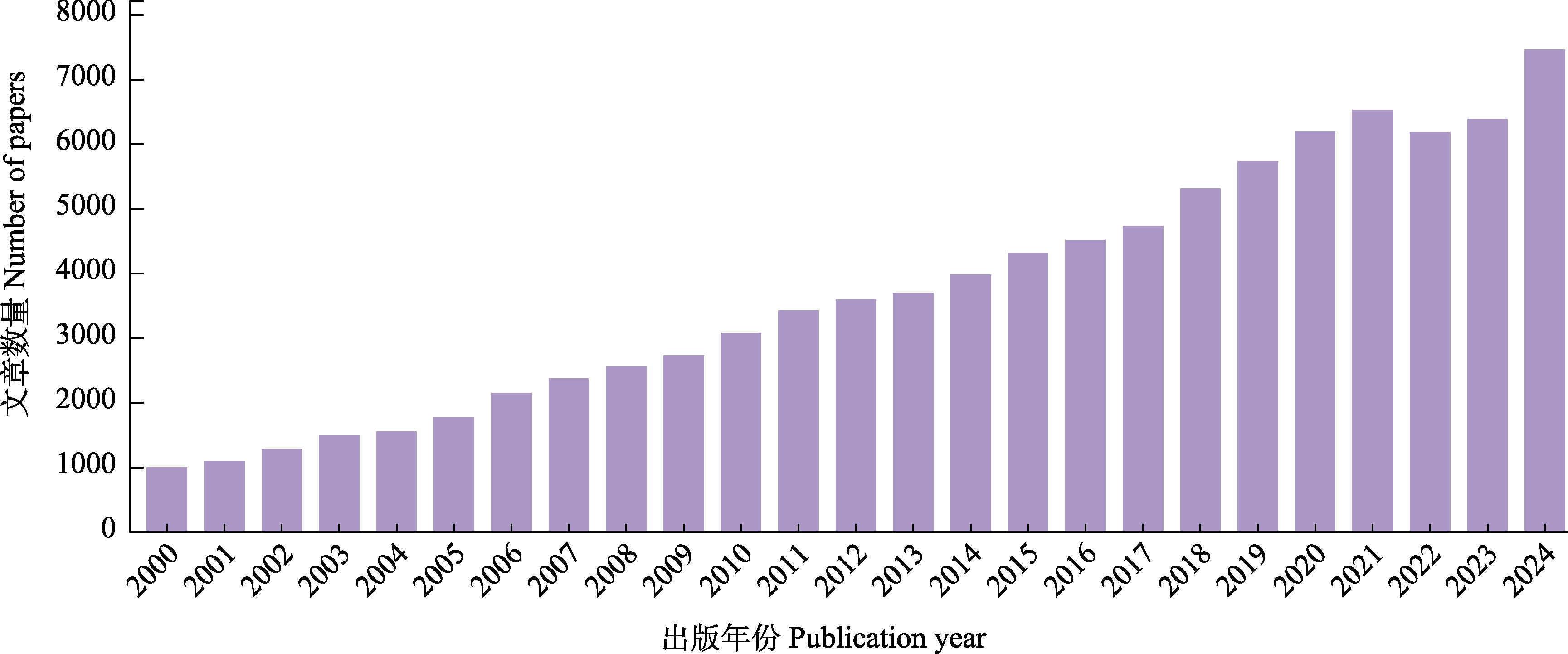
Fig. 1 The number of papers retrieved from the Web of Science on the topic of insect diversity published between 2000 and 2024
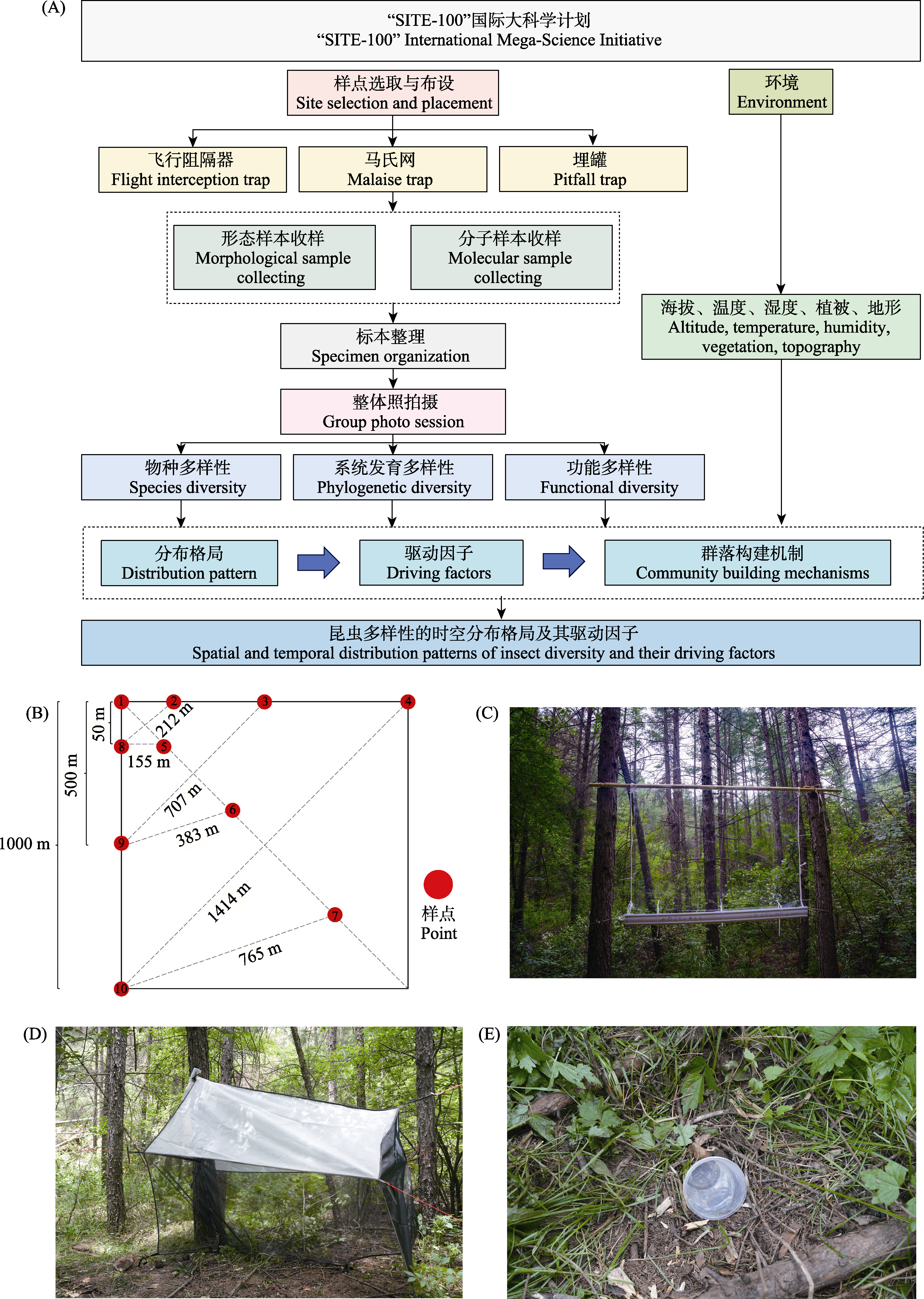
Fig. 2 Technical roadmap and sample point construction of “SITE-100”. (A) The frame work of “SITE-100”; (B) The theoretical position of 10 sample points is set in one square kilometer quadrat; (C) Flight interception trap; (D) Malaise trap; (E) Pitfall trap.
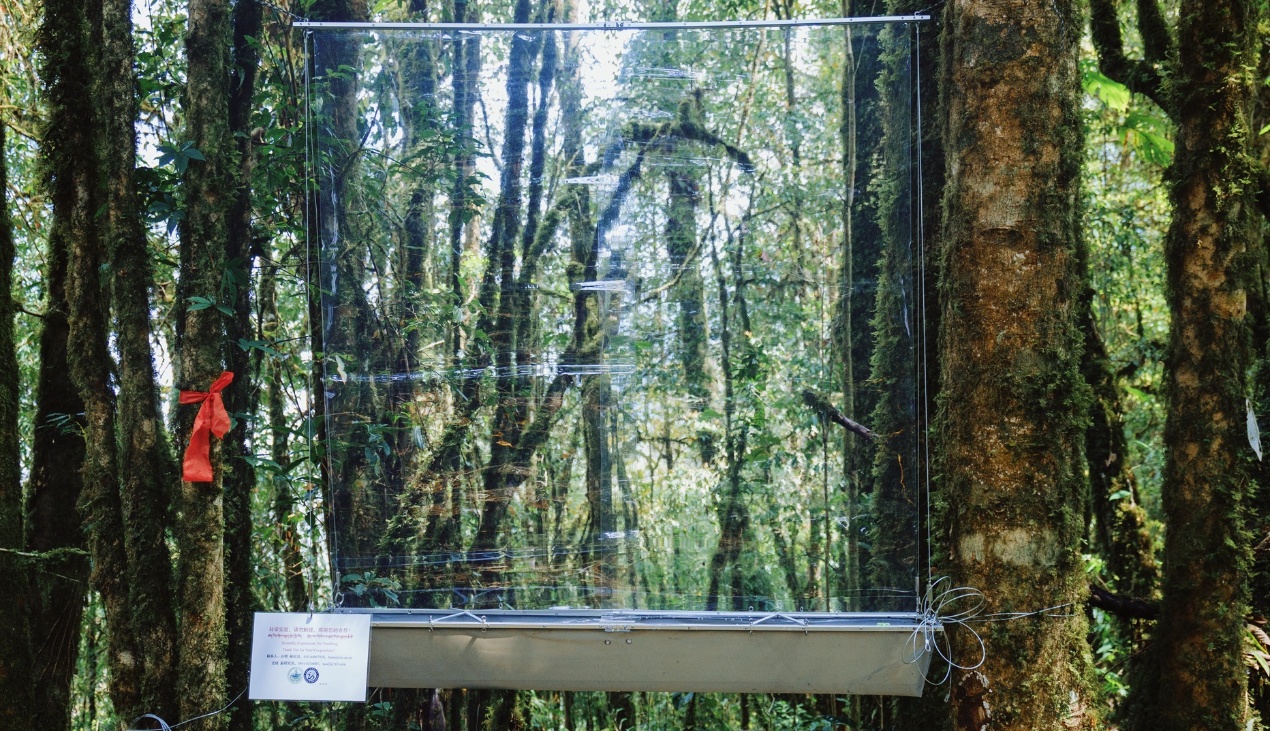
Fig. 3 Commercialized version of the flight interception trap
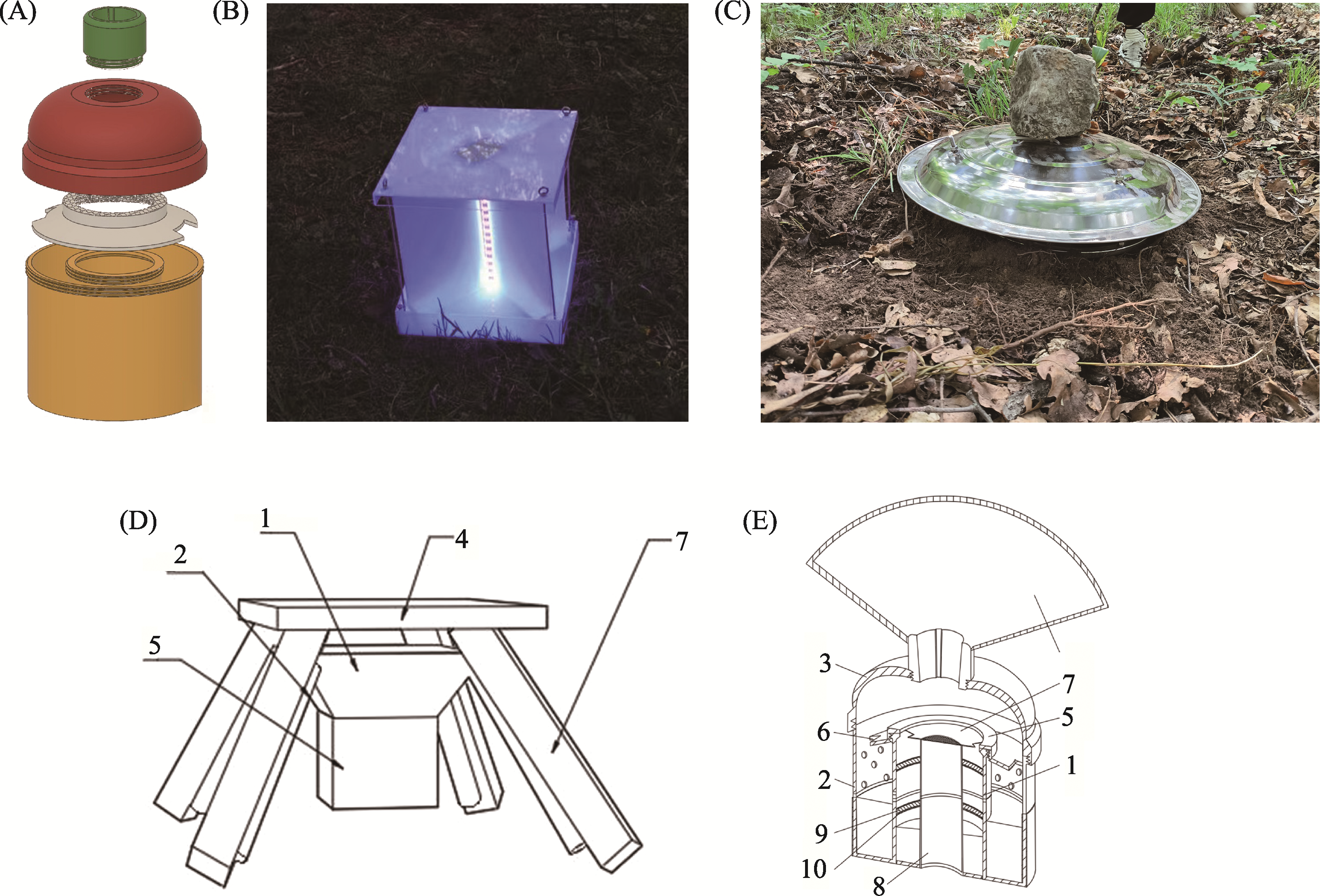
Fig. 4 Various new devices designed by “SITE-100” China team. (A) Water exclusion trap (Photo credits: Lee et al, 2023); (B) Portable funnel light trap; (C) Shallow soil trap; (D) Surface insect collection device (Photo credits: Zhao et al, 2023); (E) A funnel-shaped insect trap (Photo credits: Zhang et al, 2023).
| [1] | Baillie JEM, Hilton-Taylor C, Stuart SN (2004) 2004 IUCN Red List of Threatened Species. A Global Species Assessment. IUCN, Gland, Switzerland and Cambridge, UK. |
| [2] | Chen YD, Yang HD, Leung MH, Cheung KH, Lee YM, He X, Huang ZZ, Bai M (2022) Evaluation of efficiency of flight interception trap (FIT) in collecting rare beetles and application potential of FIT in biodiversity research: A case study in Hong Kong. Journal of Environmental Entomology, 44, 1113-1123. (in Chinese with English abstract) |
| [陈炎栋, 杨海东, 梁敏轩, 张嘉康, 李英铭, 贺旭, 黄正中, 白明 (2022) 飞行阻隔器获取罕见甲虫标本的效能及在生物多样性调查中应用潜力的评价——以香港采集为例. 环境昆虫学报, 44, 1113-1123.] | |
| [3] | Chen YK, Bai M, Wang JF, Wang XP, Wang T, Han YJ, Lu JB, Han MY, Shen H (2021) Insect trapping device. 202121722523.9, China. 2021-07-27. (in Chinese) |
| [陈云康, 白明, 王继飞, 王新谱, 王涛, 韩永金, 路金博, 韩勐扬, 申昊 (2021) 昆虫诱集装置. 202121722523.9, 中国. 2021-07-27.] | |
| [4] | Cooke R, Outhwaite CL, Bladon AJ, Millard J, Rodger JG, Dong ZK, Dyer EE, Edney S, Murphy JF, Dicks LV, Hui C, Jones JI, Newbold T, Purvis A, Roy HE, Woodcock BA, Isaac NJB (2025) Integrating multiple evidence streams to understand insect biodiversity change. Science, 388, eadq2110. |
| [5] |
Dornelas M, Daskalova GN (2020) Nuanced changes in insect abundance. Science, 368, 368-369.
DOI PMID |
| [6] |
Druckenmiller H (2022) Accounting for ecosystem service values in climate policy. Nature Climate Change, 12, 596-598.
DOI |
| [7] | French CM, Bertola LD, Carnaval AC, Economo EP, Kass JM, Lohman DJ, Marske KA, Meier R, Overcast I, Rominger AJ, Staniczenko PPA, Hickerson MJ (2023) Global determinants of insect mitochondrial genetic diversity. Nature Communications, 14, 5276. |
| [8] | Geiger MF, Moriniere J, Hausmann A, Haszprunar G, Wägele W, Hebert PDN, Rulik B (2016) Testing the Global Malaise Trap Program—How well does the current barcode reference library identify flying insects in Germany? Biodiversity Data Journal, (4), e10671. |
| [9] | Habel JC, Segerer A, Ulrich W, Torchyk O, Weisser WW, Schmitt T (2016) Butterfly community shifts over two centuries. Conservation Biology, 30, 754-762. |
| [10] | Hallmann CA, Sorg M, Jongejans E, Siepel H, Hofland N, Schwan H, Stenmans W, Müller A, Sumser H, Hörren T, Goulson D, de Kroon H (2017) More than 75 percent decline over 27 years in total flying insect biomass in protected areas. PLoS ONE, 12, e0185809. |
| [11] |
Halsch CA, Elphick CS, Bahlai CA, Forister ML, Wagner DL, Ware JL, Grames EM (2025) Meta-synthesis reveals interconnections among apparent drivers of insect biodiversity loss. BioScience, 75, 448-456.
DOI URL |
| [12] | Han YJ, Liang YL, Tong YJ, Ding Q, Tian ZH, Li LL, Li XJ, Shen H, Zhu YC, Liu N, Wang XP, Bai M (2024) Dataset of beetle specimen images based on three passive acquisition methods in Mt. Helanshan, Ningxia. Biodiversity Science, 32, 24054. (in Chinese with English abstract) |
|
[韩永金, 梁咏亮, 佟一杰, 丁强, 田哲豪, 李露露, 李晓娟, 申昊, 朱亚超, 刘宁, 王新谱, 白明 (2024) 基于三种被动式采集方法采集的宁夏贺兰山甲虫标本照片数据集. 生物多样性, 32, 24054.]
DOI |
|
| [13] | Hudson LN, Blagoderov V, Heaton A, Holtzhausen P, Livermore L, Price BW, van der Walt S, Smith VS (2015) Inselect: Automating the digitization of natural history collections. PLoS ONE, 10, e0143402. |
| [14] |
Humphreys RK, Ruxton GD (2018) A review of thanatosis (death feigning) as an anti-predator behaviour. Behavioral Ecology and Sociobiology, 72, 22.
DOI PMID |
| [15] |
Keil P, Storch D, Jetz W (2015) On the decline of biodiversity due to area loss. Nature Communications, 6, 8837.
DOI PMID |
| [16] | Lagos-Kutz D, Voegtlin DJ, Onstad D, Hogg D, Ragsdale D, Tilmon K, Hodgson E, Difonzo C, Groves R, Krupke C, Laforest J, Seiter NJ, Duerr E, Bradford B, Hartman GL (2020) The soybean aphid suction trap network: Sampling the aerobiological “soup”. American Entomologist, 66, 48-55. |
| [17] |
Lee S, Orr MC, Seung J, Yang Y, Tian ZH, Lee M, Tak JH, Lee S, Bai M (2024) Designing and evaluating a portable UV-LED vane trap to expedite arthropod biodiversity discovery. Insects, 15, 21.
DOI URL |
| [18] |
Lee S, Seung J, Yang Y, Orr M, Lee M, Tak J, Vogler AP, Bai M, Lee S (2023) The Water-Exclusion Trap (WET): A 3D printable window trap collector that prevents DNA degradation. Methods in Ecology and Evolution, 14, 2774-2779.
DOI URL |
| [19] |
Li J, Wang WC, Li LL, Ding Q, Bai M (2024) Hexagon-based adaptive hierarchies for efficient point-in-spherical-polygon tests on GPUs. International Journal of Geographical Information Science, 38, 322-353.
DOI URL |
| [20] |
Li PP, Tong YJ, Cao HY, Rong GS, Qin SQ, Yang XK, Wang GQ, Bai M (2021) A photographic dataset of the beetle specimens from a SITE100 standardized sampling area in Huaping Guangxi. Biodiversity Science, 29, 1165-1169. (in Chinese with English abstract)
DOI URL |
|
[李盼盼, 佟一杰, 曹浩宇, 容国森, 覃诗晴, 杨星科, 王国全, 白明 (2021) 广西花坪SITE100样地甲虫标本照片数据集. 生物多样性, 29, 1165-1169.]
DOI |
|
| [21] |
Montgomery GA, Belitz MW, Guralnick RP, Tingley MW (2021) Standards and best practices for monitoring and benchmarking insects. Frontiers in Ecology and Evolution, 8, 579193.
DOI URL |
| [22] |
Nie RE, Li LL, Feijó A, Yang MX, Bai M, Creedy TJ, Jin X, Hao JS, Ruan YY, Liu HX, Garner BH, Bocak L, Yang XK, Vogler AP (2024) Phylogenetic origin of an insect fauna at the boundary of the Palaearctic and Oriental realms: Evidence from ‘site-based’ mitogenomics. Journal of Biogeography, 51, 1329-1339.
DOI URL |
| [23] | Nie RE, Yang MX, Xue HJ, Yang YR, Tong YJ, Qiu TF, Bai M, Yang XK (2017) The application and effectiveness of a flight interception trap for insect collecting. Chinese Journal of Applied Entomology, 54, 530-535. (in Chinese with English abstract) |
| [聂瑞娥, 杨美霞, 薛怀君, 杨御儒, 佟一杰, 邱腾飞, 白明, 杨星科 (2017) 飞行阻隔器在昆虫采集中的应用探究. 应用昆虫学报, 54, 530-535.] | |
| [24] |
Ollerton J, Winfree R, Tarrant S (2011) How many flowering plants are pollinated by animals? Oikos, 120, 321-326.
DOI URL |
| [25] | Schultheiss P, Nooten SS, Wang RX, Wong MKL, Brassard F, Guénard B (2022) The abundance, biomass, and distribution of ants on Earth. Proceedings of the National Academy of Sciences, USA, 119, e2201550119. |
| [26] |
Stork NE (2018) How many species of insects and other terrestrial arthropods are there on earth? Annual Review of Entomology, 63, 31-45.
DOI PMID |
| [27] |
Teng B, Yang HD, Tong YJ, Leung MH, Cheung KH, Lee YM, Guenard B, Bai M (2021) A comparative study on the collection effectiveness of beetles by three passive acquisition methods in Shing Mun (Hong Kong). Biodiversity Science, 29, 1386-1395. (in Chinese with English abstract)
DOI |
|
[滕备, 杨海东, 佟一杰, 梁敏轩, 张嘉康, 李英铭, Benoit Guénard, 白明 (2021) 三种被动式采集方法对甲虫收集效果的比较研究: 以香港城门样地为例. 生物多样性, 29, 1386-1395.]
DOI |
|
| [28] | Thomas JA, Telfer MG, Roy DB, Preston CD, Greenwood JJD, Asher J, Fox R, Clarke RT, Lawton JH (2004) Comparative losses of British butterflies, birds, and plants and the global extinction crisis. Science, 303, 1879-1881. |
| [29] |
Vanbergen AJ, the Insect Pollinators Initiative (2013) Threats to an ecosystem service: Pressures on pollinators. Frontiers in Ecology and the Environment, 11, 251-259.
DOI URL |
| [30] |
Wagner DL (2020) Insect declines in the Anthropocene. Annual Review of Entomology, 65, 457-480.
DOI PMID |
| [31] | Wagner DL, Fox R, Salcido DM, Dyer LA (2021) A window to the world of global insect declines: Moth biodiversity trends are complex and heterogeneous, Proceedings of the National Academy of Sciences, USA,118, e2002549117. |
| [32] | Wang YQ, Zhou QS, Bai M, Chen J, Zhu CD, Liu XY (2025) Chinese top 10 new insect species of 2024. Biodiversity Science, 33, 25107. (in Chinese) |
|
[王彦卿, 周青松, 白明, 陈军, 朱朝东, 刘星月 (2025) 2024年度中国十大昆虫新物种. 生物多样性, 33, 25107.]
DOI |
|
| [33] |
Wilson EO (1987) The little things that run the world (the importance and conservation of invertebrates). Conservation Biology, 1, 344-346.
DOI URL |
| [34] | Yang ZW, Ding SX, Zhang AJ, Hua BZ (2009) New insect collection method—Flight interception trap. Shaanxi Journal of Agricultural Sciences, 55(4), 84-85. (in Chinese) |
| [杨宗武, 丁升选, 张爱娟, 花保祯 (2009) 昆虫采集新方法——飞行拦截网. 陕西农业科学, 55(4), 84-85.] | |
| [35] | Zhang AJ, Bai M, Wang XP, Tian ZH, Lee SY, Zhao K (2023) A funnel-shaped insect trap. 202323102086.2, China. 2023-11-16. (in Chinese) |
| [张爱军, 白明, 王新谱, 田哲豪, 李升铉, 赵奎 (2023) 一种漏斗型昆虫诱捕器. 202323102086.2, 中国. 2023-11-16.] | |
| [36] | Zhao K, Song ZS, Xu SY, Yin F, Zhang AJ, Zhong TM, Bai M, Wang XP (2023) Surface insect collection device. 202322241603.8, China. 2023-08-21. (in Chinese) |
| [赵奎, 宋志顺, 徐思远, 殷凡, 张爱军, 钟天民, 白明, 王新谱 (2023) 地表昆虫采集装置. 202322241603.8, 中国. 2023-08-21.] | |
| [37] |
Zhao SZ, Tong YJ, Teng B, Chen X, Yang XK, Li J, Bai M (2022) A species diversity dataset of beetles by three passive acquisition methods in Tei Tong Tsai (Hong Kong). Scientific Data, 9, 210.
DOI PMID |
| [38] |
Zhao ZY, Lu YY, Tong YJ, Chen X, Bai M (2023) PENet: A phenotype encoding network for automatic extraction and representation of morphological discriminative features. Methods in Ecology and Evolution, 14, 3035-3046.
DOI URL |
| [1] | Lijie Zhou, Minhui Huang, Huaijiang He, Yanxia Cheng, Chunyu Zhang, Xiuhai Zhao. Disentangling the patterns, components, and influencing factors of forest β diversity in the Xiaoxing’an Mountains, Northeast China [J]. Biodiv Sci, 2026, 34(4): 25443-. |
| [2] | Yunyue Peng, Kui Peng, Xinran Liu, Tianyi Sun, Xiaoquan Zhang. Corporate engagement pathways, market development barriers and recommendations for biodiversity credits [J]. Biodiv Sci, 2026, 34(4): 26031-. |
| [3] | Boyao Li, Tiancheng Sheng, Xiaoyun Xing. Impact of biodiversity risk on corporate financial performance: Evidence from listed companies in China [J]. Biodiv Sci, 2026, 34(4): 25330-. |
| [4] | Hao Liu, Yuxiao Zhang, Bing Liu, Feifei Li, Hongzheng Ma, Haining Qin, Dezhu Li, Wenli Chen. Diversity and checklist of grasses (Poaceae) in China [J]. Biodiv Sci, 2026, 34(4): 25438-. |
| [5] | Ziyi Kong, Degang Wang, Jiantao Wang, Zhiyong Pei, Jing Sun, Changchun Zhang, Junguo Zhang. Wildlife pose estimation based on the SCD-HRNet model and its application in biodiversity monitoring: A case study of the Saihanwula Region, Inner Mongolia [J]. Biodiv Sci, 2026, 34(4): 25287-. |
| [6] | Haoyou Zhu, Youbing Zhou, Yi Luo, Zhaomin Zhou. Changes in breeding bird community in an urban area of Nanchong over two decades [J]. Biodiv Sci, 2026, 34(3): 24560-. |
| [7] | Shuyu Hou, Yingying Liu, Rui Yang. Progress of international OECMs practices under the Kunming-Montreal Global Biodiversity Framework and pathways for localization in China [J]. Biodiv Sci, 2026, 34(3): 25264-. |
| [8] | Xiaofan Cheng, Qingyuan Li, Yuanhui Li, Mingxiang Zhang. The dilemmas and solutions for invasive alien species governance policy systems [J]. Biodiv Sci, 2026, 34(2): 25332-. |
| [9] | Lulu Chen, Haoting Tang, Hong Leng, Qing Yuan, Xinyue Yang. Impacts of urban block built environments on biodiversity—A review and outlook [J]. Biodiv Sci, 2026, 34(2): 25286-. |
| [10] | Wenqi Gao, Jingrong Xiang, Yao Zhao, Lingshuang Fan, Yuan Gu, Weihan Shao, Gaojun Li, Guangjun Zhao, Mingbin Chen, Xingwei Cai, Kai Chen. Stream fish community characteristics and their response to land use in Limushan and Jianfengling of Hainan Tropical Rainforest National Park [J]. Biodiv Sci, 2026, 34(2): 25374-. |
| [11] | Xiaoqiang Lu, Dan Rui, Jiangfeng Zhang, Bingxin Yin, Yulu Wang, Yuting Cen, Yichen Cui, Wanxia Yang. Impacts of nitrogen inputs-driven key ecological processes on biodiversity and their management implications [J]. Biodiv Sci, 2026, 34(2): 25368-. |
| [12] | Tinghong Tan, Fan Gao, Yu Yang, Qunying Xiao, Chunfang Wu, Na Qiu, Ningning Zhao, Min Zhou, Gongping Kang, Zhihong Lu, Jianqiang Gao, Hong Yang, Chuandong Yang, Chunying Deng. Macrofungal species cataloging in karst areas of southwestern China [J]. Biodiv Sci, 2026, 34(2): 25281-. |
| [13] | Xuri Zhang, Biao Luo, Tong Zhao, Dan Huang, Weiming Ai. Fish diversity of Zhejiang Province: Inventory, distribution and conservation [J]. Biodiv Sci, 2026, 34(2): 25225-. |
| [14] | Haiou Liu, Zhiming Hao, Leshan Du, Wenhui Liu, Ziyuan Li, Lei Liu. Progress, challenges, and insights on the operation of the Global Biodiversity Framework Fund [J]. Biodiv Sci, 2026, 34(2): 25463-. |
| [15] | Xi Luo, Qifang Wang, Jianjia Wang, Qianxi Yang, Hongfei Fang, Miao Hong, Qi Zhang, Ling Cai, Xijie Zhou, Dingyong Huang, Xinqing Zheng. Newly recorded coral species near the region of Dongshan, Fujian Province expands the biodiversity of the northernmost scleractinian communities of China [J]. Biodiv Sci, 2026, 34(2): 25335-. |
| Viewed | ||||||
|
Full text |
|
|||||
|
Abstract |
|
|||||
Copyright © 2026 Biodiversity Science
Editorial Office of Biodiversity Science, 20 Nanxincun, Xiangshan, Beijing 100093, China
Tel: 010-62836137, 62836665 E-mail: biodiversity@ibcas.ac.cn

