

Biodiv Sci ›› 2025, Vol. 33 ›› Issue (9): 25267. DOI: 10.17520/biods.2025267 cstr: 32101.14.biods.2025267
Special Issue: 世界生物圈保护区专题
• Special Feature: Biosphere Reserves • Previous Articles Next Articles
Hui Wu1,2( ), Le Yu1,3,*()(
 ), Jianqiao Zhao4(), Shijun Zheng1(), Tao Liu1(), Wenchao Qi1(), Qiang Zhao1(), Li Zhu5(), Xiaoli Shen5(), Keping Ma2,5()
Online:2025-09-20
Published:2025-10-31
Contact:
*E-mail: leyu@tsinghua.edu.cn
Supported by:Hui Wu, Le Yu, Jianqiao Zhao, Shijun Zheng, Tao Liu, Wenchao Qi, Qiang Zhao, Li Zhu, Xiaoli Shen, Keping Ma. Global South-North differences in ecological representativeness and conservation performance of the World Network of Biosphere Reserves[J]. Biodiv Sci, 2025, 33(9): 25267.
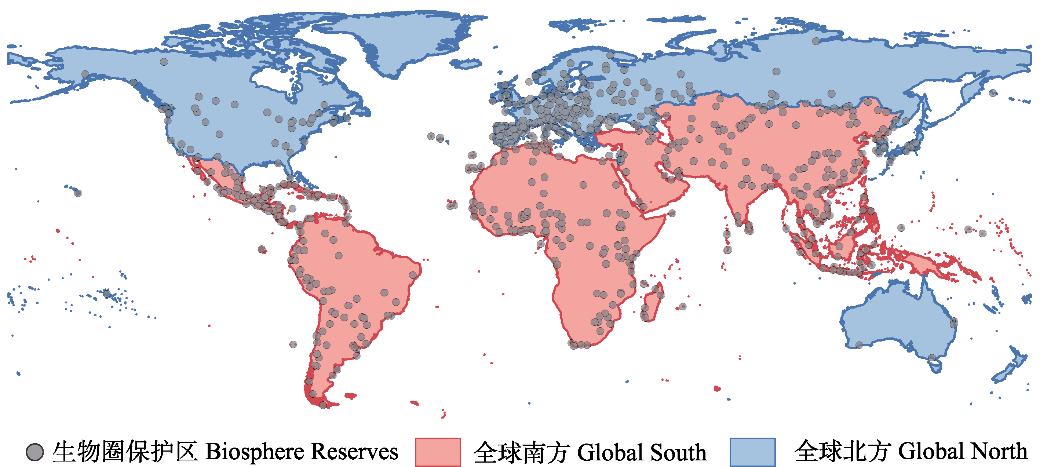
Fig. 1 Global distribution of Biosphere Reserves across the Global South and Global North. Gray dots indicate the locations of 759 Biosphere Reserves worldwide. Background colors denote the Global South (red) and the Global North (blue). Following the United Nations Statistics Division (UNSD) classification of “developed regions,” countries categorized as developed economies (e.g., the United States, Canada, Germany, France, the United Kingdom, Italy, Sweden, Australia, New Zealand, Japan, the Republic of Korea, and Israel) are grouped as the “Global North”; all other countries are grouped as the “Global South”.
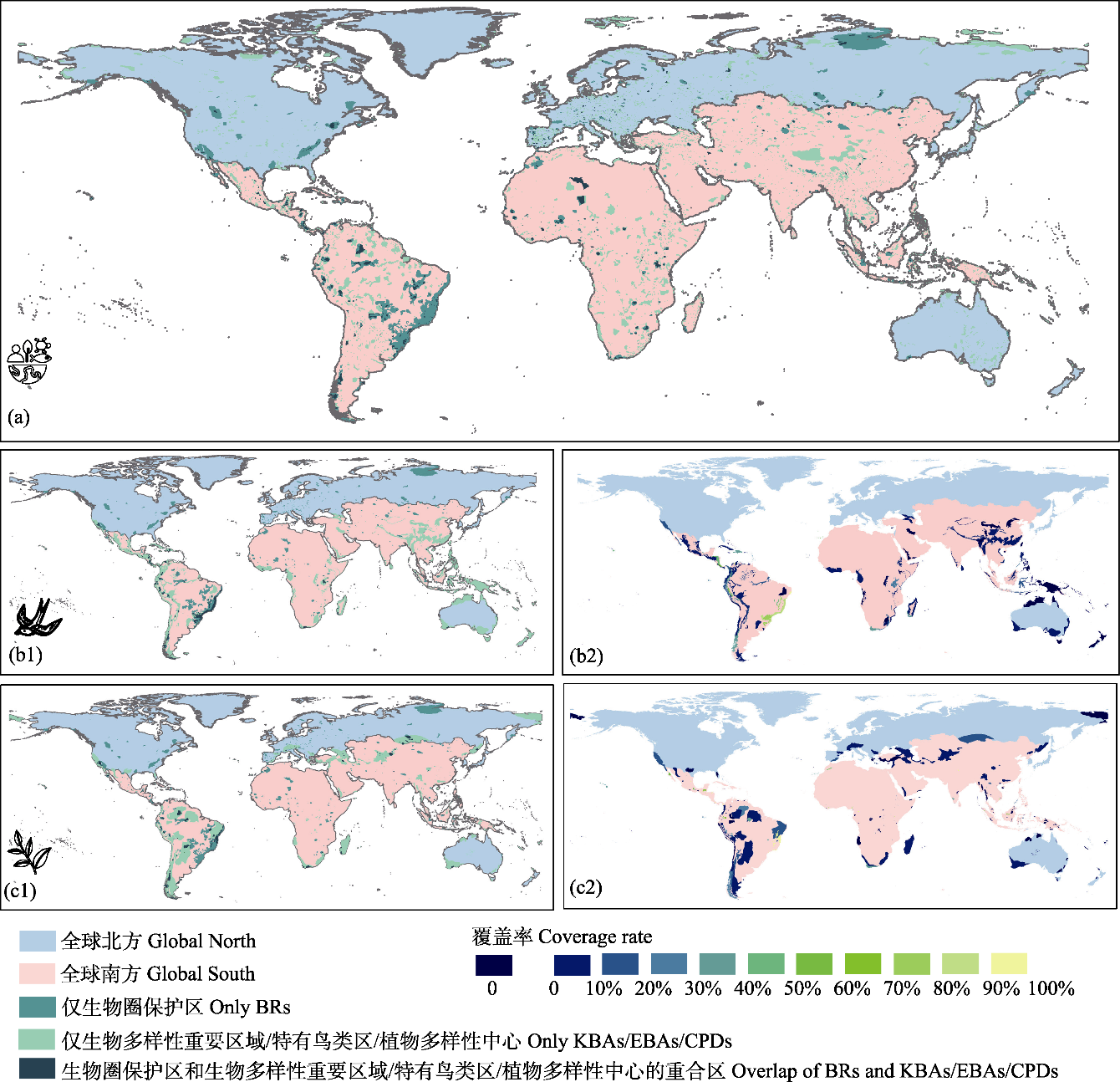
Fig. 2 Representativeness of Biosphere Reserves (BRs) for Key Biodiversity Areas (KBAs), Endemic Bird Areas (EBAs), and Centres of Plant Diversity (CPDs). (a) Spatial overlap between global BRs and KBAs; (b1) Spatial overlap between global BRs and EBAs; (b2) Coverage rate of BRs across 218 global EBAs; (c1) Spatial overlap between global BRs and CPDs; (c2) Coverage rate of BRs across 234 global CPDs.
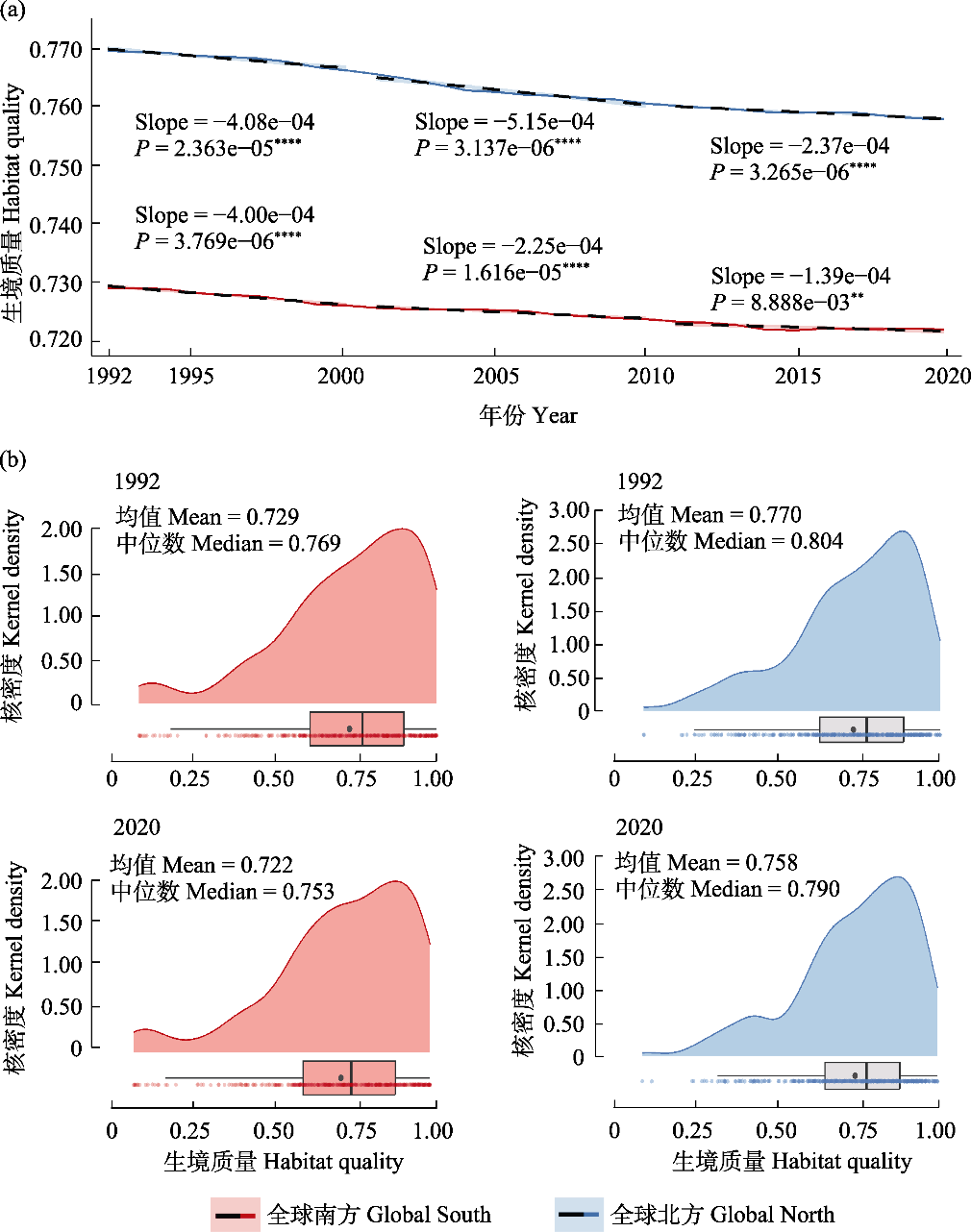
Fig. 3 Habitat quality trends and distributions for Biosphere Reserves in the Global South (red) and Global North (blue), 1992-2020. (a) Annual habitat quality trends: Linear fits are shown for three periods—1992-2000, 2001-2010, and 2011-2020; shaded areas indicate 95% confidence intervals; **** P < 0.0001; ** P < 0.01. (b) Habitat quality distributions in 1992 and 2020: Kernel density curves (top) and boxplots (bottom) showing the median, interquartile range, and range, with the mean and median annotated.
| [1] | Bridgewater P, Babin D (2017) UNESCO-MAB Biosphere Reserves already deal with ecosystem services and sustainable development. Proceedings of the National Academy of Sciences, USA, 114, e4318. |
| [2] | CBD (Convention on Biological Diversity) (2022) Monitoring Framework for the Kunming-Montreal Global Biodiversity Framework. https://www.cbd.int/doc/decisions/cop-15/cop-15-dec-05-en.pdf/. (accessed on 2025-09-30) |
| [3] | Cuong CV, Dart P, Dudley N, Hockings M (2017) Factors influencing successful implementation of biosphere reserves in Vietnam: Challenges, opportunities and lessons learnt. Environmental Science & Policy, 67, 16-26. |
| [4] |
Dabard CH, Mann C, Martín-López B (2025) Biosphere Reserves as catalysts for sustainability transformations: Five strategies to support place-based innovation. Current Opinion in Environmental Sustainability, 73, 101508.
DOI URL |
| [5] |
Eken G, Bennun L, Brooks TM, Darwall W, Fishpool LDC, Foster M, Knox D, Langhammer P, Matiku P, Radford E, Salaman P, Sechrest W, Smith ML, Spector S, Tordoff A (2004) Key biodiversity areas as site conservation targets. BioScience, 54, 1110.
DOI URL |
| [6] | Gohr C, von Wehrden H, Saatchi S, Pettorelli N, Ibisch PL (2025) Effectiveness of the World Network of Biosphere Reserves in maintaining forest ecosystem functions. Communications Earth & Environment, 6, 83. |
| [7] | Gunawan H, Tryanto DH, Mizuno K, Kozan O (2023) Toward climate change mitigation:Restoration of the Indonesian peat swamp. In: Vulnerability and Transformation of Indonesian Peatlands (ed. Abe K), pp. 141-157. Springer Nature, Singapore. |
| [8] | Kuiper J, Carpenter-Urquhart L, Berbés-Blázquez M, Oteros-Rozas E, Fredström L, Psiuk K, Savu C, Kautsky R, Guerry A, Carpenter S, Green C, Meacham M, Remme R, Ravera F, Wankmüller F, Arkema K, Pereira L, Peterson G (2024) Biosphere Futures: A database of social-ecological scenarios. Ecology and Society, 29, art19. |
| [9] |
Mirtl M, Borer ET, Djukic I, Forsius M, Haubold H, Hugo W, Jourdan J, Lindenmayer D, McDowell WH, Muraoka H, Orenstein DE, Pauw JC, Peterseil J, Shibata H, Wohner C, Yu X, Haase P (2018) Genesis, goals and achievements of Long-Term Ecological Research at the global scale: A critical review of ILTER and future directions. Science of the Total Environment, 626, 1439-1462.
DOI URL |
| [10] |
Pettorelli N, Safi K, Turner W (2014) Satellite remote sensing, biodiversity research and conservation of the future. Philosophical Transactions of the Royal Society B: Biological Sciences, 369, 20130190.
DOI URL |
| [11] |
Plummer R, Baird J, Dzyundzyak A, Armitage D, Bodin Ö, Schultz L (2017) Is adaptive co-management delivering? Examining relationships between collaboration, learning and outcomes in UNESCO biosphere reserves. Ecological Economics, 140, 79-88.
DOI URL |
| [12] | Reed M, Price MF (2019) Introducing UNESCO Biosphere Reserves. In: UNESCO Biosphere Reserves: Supporting Biocultural Diversity, Sustainability and Society (eds Reed M, Price M), pp. 1-14. Routledge, Abingdon. |
| [13] |
Sandström C, Mancheva I, Laudon H (2025) Unlocking the potential of biosphere reserves: A review of structural, institutional, and ideational challenges to transformational learning. Current Opinion in Environmental Sustainability, 75, 101543.
DOI URL |
| [14] |
Schultz L, West S, Bourke AJ, D’Armengol L, Torrents P, Hardardottir H, Jansson A, Roldán AM (2018) Learning to live with social-ecological complexity: An interpretive analysis of learning in 11 UNESCO Biosphere Reserves. Global Environmental Change, 50, 75-87.
DOI URL |
| [15] |
Seddon N, Smith A, Smith P, Key I, Chausson A, Girardin C, House J, Srivastava S, Turner B (2021) Getting the message right on nature-based solutions to climate change. Global Change Biology, 27, 1518-1546.
DOI PMID |
| [16] | Stattersfield AJ, Crosby M, Long A, Wege D (1998) Endemic Bird Areas of the World:Priorities for Biodiversity Conservation. Smithsonian Institute Press, Washington, DC. |
| [17] |
Thakur TK, Patel DK, Bijalwan A, Dobriyal MJ, Kumar A, Thakur A, Bohra A, Bhat JA (2020) Land use land cover change detection through geospatial analysis in an Indian Biosphere Reserve. Trees, Forests and People, 2, 100018.
DOI URL |
| [18] |
Turner W, Rondinini C, Pettorelli N, Mora B, Leidner AK, Szantoi Z, Buchanan G, Dech S, Dwyer J, Herold M, Koh LP, Leimgruber P, Taubenboeck H, Wegmann M, Wikelski M, Woodcock C (2015) Free and open-access satellite data are key to biodiversity conservation. Biological Conservation, 182, 173-176.
DOI URL |
| [19] | UNESCO (United Nations Educational, Scientific and Cultural Organization) (1995) The Seville Strategy for Biosphere Reserves. UNESCO, Paris. |
| [20] | UNESCO (United Nations Educational, Scientific and Cultural Organization) (2016) Lima Action Plan (2016-2025) for UNESCO’s Man and the Biosphere Programme and Its World Network of Biosphere Reserves. UNESCO, Paris. |
| [21] | UNESCO (United Nations Educational, Scientific and Cultural Organization) (2024) Regional and Thematic Networks: IberoMAB Mid-Term Assessment Report. UNESCO, Paris. |
| [22] | UNESCO (United Nations Educational, Scientific and Cultural Organization) (2025) Mangrove Restoration as a Nature-Based Solution in Biosphere Reserves of Latin America and the Caribbean. UNESCO, Paris. |
| [23] | WWF (World Wide Fund for Nature), IUCN (International Union for Conservation of Nature) (1994-1997) Centres of Plant Diversity: A Guide and Strategy for Their Conservation, Three Volumes. IUCN Publications Unit, Cambridge. |
| [24] | Zhao JQ, Yu L, Newbold T, Chen X (2025) Trends in habitat quality and habitat degradation in terrestrial protected areas. Conservation Biology, 39, e14348. |
| [1] | Lijie Zhou, Minhui Huang, Huaijiang He, Yanxia Cheng, Chunyu Zhang, Xiuhai Zhao. Disentangling the patterns, components, and influencing factors of forest β diversity in the Xiaoxing’an Mountains, Northeast China [J]. Biodiv Sci, 2026, 34(4): 25443-. |
| [2] | Yunyue Peng, Kui Peng, Xinran Liu, Tianyi Sun, Xiaoquan Zhang. Corporate engagement pathways, market development barriers and recommendations for biodiversity credits [J]. Biodiv Sci, 2026, 34(4): 26031-. |
| [3] | Boyao Li, Tiancheng Sheng, Xiaoyun Xing. Impact of biodiversity risk on corporate financial performance: Evidence from listed companies in China [J]. Biodiv Sci, 2026, 34(4): 25330-. |
| [4] | Hao Liu, Yuxiao Zhang, Bing Liu, Feifei Li, Hongzheng Ma, Haining Qin, Dezhu Li, Wenli Chen. Diversity and checklist of grasses (Poaceae) in China [J]. Biodiv Sci, 2026, 34(4): 25438-. |
| [5] | Ziyi Kong, Degang Wang, Jiantao Wang, Zhiyong Pei, Jing Sun, Changchun Zhang, Junguo Zhang. Wildlife pose estimation based on the SCD-HRNet model and its application in biodiversity monitoring: A case study of the Saihanwula Region, Inner Mongolia [J]. Biodiv Sci, 2026, 34(4): 25287-. |
| [6] | Haoyou Zhu, Youbing Zhou, Yi Luo, Zhaomin Zhou. Changes in breeding bird community in an urban area of Nanchong over two decades [J]. Biodiv Sci, 2026, 34(3): 24560-. |
| [7] | Shuyu Hou, Yingying Liu, Rui Yang. Progress of international OECMs practices under the Kunming-Montreal Global Biodiversity Framework and pathways for localization in China [J]. Biodiv Sci, 2026, 34(3): 25264-. |
| [8] | Xiaofan Cheng, Qingyuan Li, Yuanhui Li, Mingxiang Zhang. The dilemmas and solutions for invasive alien species governance policy systems [J]. Biodiv Sci, 2026, 34(2): 25332-. |
| [9] | Lulu Chen, Haoting Tang, Hong Leng, Qing Yuan, Xinyue Yang. Impacts of urban block built environments on biodiversity—A review and outlook [J]. Biodiv Sci, 2026, 34(2): 25286-. |
| [10] | Wenqi Gao, Jingrong Xiang, Yao Zhao, Lingshuang Fan, Yuan Gu, Weihan Shao, Gaojun Li, Guangjun Zhao, Mingbin Chen, Xingwei Cai, Kai Chen. Stream fish community characteristics and their response to land use in Limushan and Jianfengling of Hainan Tropical Rainforest National Park [J]. Biodiv Sci, 2026, 34(2): 25374-. |
| [11] | Xiaoqiang Lu, Dan Rui, Jiangfeng Zhang, Bingxin Yin, Yulu Wang, Yuting Cen, Yichen Cui, Wanxia Yang. Impacts of nitrogen inputs-driven key ecological processes on biodiversity and their management implications [J]. Biodiv Sci, 2026, 34(2): 25368-. |
| [12] | Tinghong Tan, Fan Gao, Yu Yang, Qunying Xiao, Chunfang Wu, Na Qiu, Ningning Zhao, Min Zhou, Gongping Kang, Zhihong Lu, Jianqiang Gao, Hong Yang, Chuandong Yang, Chunying Deng. Macrofungal species cataloging in karst areas of southwestern China [J]. Biodiv Sci, 2026, 34(2): 25281-. |
| [13] | Xuri Zhang, Biao Luo, Tong Zhao, Dan Huang, Weiming Ai. Fish diversity of Zhejiang Province: Inventory, distribution and conservation [J]. Biodiv Sci, 2026, 34(2): 25225-. |
| [14] | Haiou Liu, Zhiming Hao, Leshan Du, Wenhui Liu, Ziyuan Li, Lei Liu. Progress, challenges, and insights on the operation of the Global Biodiversity Framework Fund [J]. Biodiv Sci, 2026, 34(2): 25463-. |
| [15] | Xi Luo, Qifang Wang, Jianjia Wang, Qianxi Yang, Hongfei Fang, Miao Hong, Qi Zhang, Ling Cai, Xijie Zhou, Dingyong Huang, Xinqing Zheng. Newly recorded coral species near the region of Dongshan, Fujian Province expands the biodiversity of the northernmost scleractinian communities of China [J]. Biodiv Sci, 2026, 34(2): 25335-. |
| Viewed | ||||||
|
Full text |
|
|||||
|
Abstract |
|
|||||
Copyright © 2026 Biodiversity Science
Editorial Office of Biodiversity Science, 20 Nanxincun, Xiangshan, Beijing 100093, China
Tel: 010-62836137, 62836665 E-mail: biodiversity@ibcas.ac.cn

