

Biodiv Sci ›› 2023, Vol. 31 ›› Issue (2): 22310. DOI: 10.17520/biods.2022310 cstr: 32101.14.biods.2022310
Special Issue: 昆虫多样性与生态功能
• Original Papers: Animal Diversity • Previous Articles Next Articles
Muqing Lin1,2, Yingming Zhang3, Fang Ouyang1, Zufei Shu3, Chaodong Zhu1,2,4, Zhishu Xiao1,2,*( )
)
Received:2022-06-08
Accepted:2022-11-21
Online:2023-02-20
Published:2022-12-31
Contact:
*Zhishu Xiao, E-mail: xiaozs@ioz.ac.cn
Muqing Lin, Yingming Zhang, Fang Ouyang, Zufei Shu, Chaodong Zhu, Zhishu Xiao. Spatial distribution of species diversity of solitary wasps (Vespidae) and its responses to environmental factors in the Chebaling National Nature Reserve, Guangdong Province[J]. Biodiv Sci, 2023, 31(2): 22310.
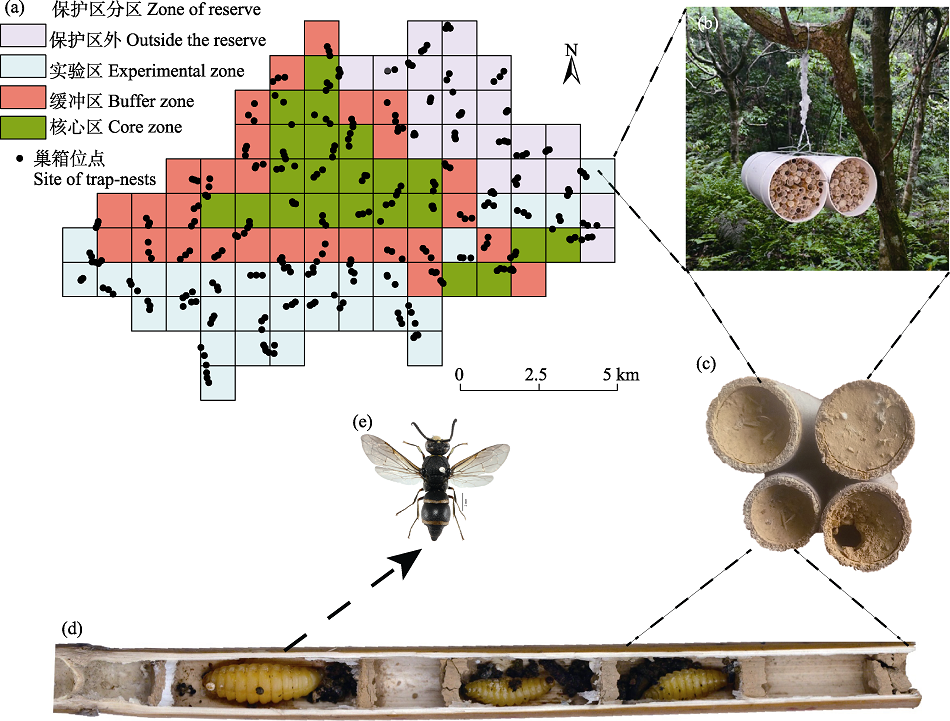
Fig. 1 Schematic illustration about trap-nests used for the collection of solitary wasps in the Chebaling National Nature Reserve, Guangdong Province. (a) Distribution of trap-nests. The whole reserve (including experimental zone, buffer zone, and core zone) and surrounding areas (outside zone) with 100 kilometer-grids (each grid, 1 km × 1 km) and 300 trap-nesting sites (black solid points). (b) A typical trap-nest with a pair of PVC pipes. (c) Trap-nests with a closed end after the oviposition is finished. (d) An dissected trap-nest for direct observation of wasp biology until wasp emergence or death. (e) Anterhynchium flavomarginatum.
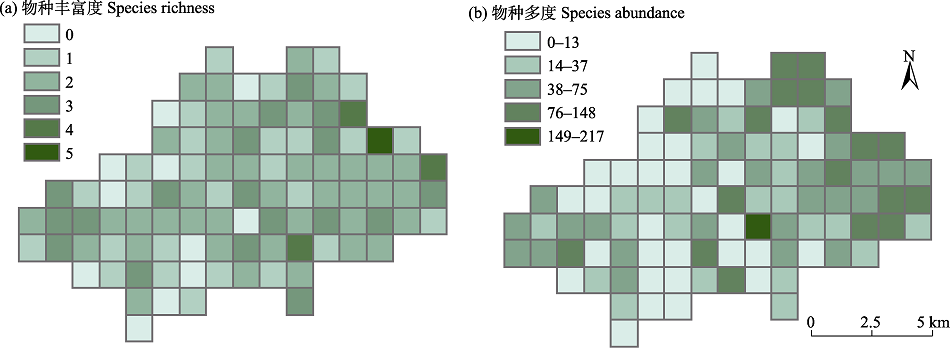
Fig. 2 Spatial distribution of species richness (a) and species abundance (number of nests) (b) of Vespidae wasps in the Chebaling National Nature Reserve, Guangdong Province
| 物种 Species | 巢材 Nesting materials | 网格占有率 Grid occupancy (%) | 累计巢管数 Cumulative number of nests | 累计孵育室数 Cumulative number of brood cells | 保护区功能分区 Functional zone | |||
|---|---|---|---|---|---|---|---|---|
| 保护区外 Outside | 实验区 Experimental zone | 缓冲区 Buffer zone | 核心区 Core zone | |||||
| 黄缘蜾蠃 Anterhynchium flavomarginatum | 黄泥 Mud | 86 | 3,733 | 9,269 | √ | √ | √ | √ |
| 福建埃蜾蠃 Epsilon fujianensis | 树脂 Resin | 58 | 346 | 515 | √ | √ | √ | √ |
| 日本元蜾蠃 Discoelius japonicus | 黄泥 + 碎叶 Mud + Broken leaf | 10 | 21 | 56 | √ | √ | √ | √ |
| 棘秀蜾蠃 Pareumenes quadrispinosus | 黄泥 + 树脂 Mud + Resin | 12 | 31 | 64 | √ | √ | √ | √ |
| 旁喙蜾蠃 Pararrhynchium septemfasciatus | 黄泥 Mud | 3 | 5 | 7 | √ | √ | √ | - |
| 丽胸蜾蠃 Orancistrocerus drewseni | 黄泥 Mud | 2 | 3 | 8 | √ | - | - | - |
| 虚长腹胡蜂 Zethus dolosus | 黄泥 + 碎叶 Mud + Broken leaf | 5 | 12 | 39 | √ | √ | √ | - |
| 旁沟蜾蠃 Parancistrocerus lamnulus | 黄泥 Mud | 1 | 2 | 3 | √ | √ | - | - |
| 同蜾蠃 Symmorphus ambotretus | 黄泥 Mud | 1 | 3 | 12 | √ | - | - | - |
| 总计 Total | 89 | 4,156 | 9,973 | 9 | 7 | 6 | 4 | |
Table 1 Summary of Vespidae wasps based on trap-nests in the Chebaling National Nature Reserve, Guangdong Province (2018-2020)
| 物种 Species | 巢材 Nesting materials | 网格占有率 Grid occupancy (%) | 累计巢管数 Cumulative number of nests | 累计孵育室数 Cumulative number of brood cells | 保护区功能分区 Functional zone | |||
|---|---|---|---|---|---|---|---|---|
| 保护区外 Outside | 实验区 Experimental zone | 缓冲区 Buffer zone | 核心区 Core zone | |||||
| 黄缘蜾蠃 Anterhynchium flavomarginatum | 黄泥 Mud | 86 | 3,733 | 9,269 | √ | √ | √ | √ |
| 福建埃蜾蠃 Epsilon fujianensis | 树脂 Resin | 58 | 346 | 515 | √ | √ | √ | √ |
| 日本元蜾蠃 Discoelius japonicus | 黄泥 + 碎叶 Mud + Broken leaf | 10 | 21 | 56 | √ | √ | √ | √ |
| 棘秀蜾蠃 Pareumenes quadrispinosus | 黄泥 + 树脂 Mud + Resin | 12 | 31 | 64 | √ | √ | √ | √ |
| 旁喙蜾蠃 Pararrhynchium septemfasciatus | 黄泥 Mud | 3 | 5 | 7 | √ | √ | √ | - |
| 丽胸蜾蠃 Orancistrocerus drewseni | 黄泥 Mud | 2 | 3 | 8 | √ | - | - | - |
| 虚长腹胡蜂 Zethus dolosus | 黄泥 + 碎叶 Mud + Broken leaf | 5 | 12 | 39 | √ | √ | √ | - |
| 旁沟蜾蠃 Parancistrocerus lamnulus | 黄泥 Mud | 1 | 2 | 3 | √ | √ | - | - |
| 同蜾蠃 Symmorphus ambotretus | 黄泥 Mud | 1 | 3 | 12 | √ | - | - | - |
| 总计 Total | 89 | 4,156 | 9,973 | 9 | 7 | 6 | 4 | |
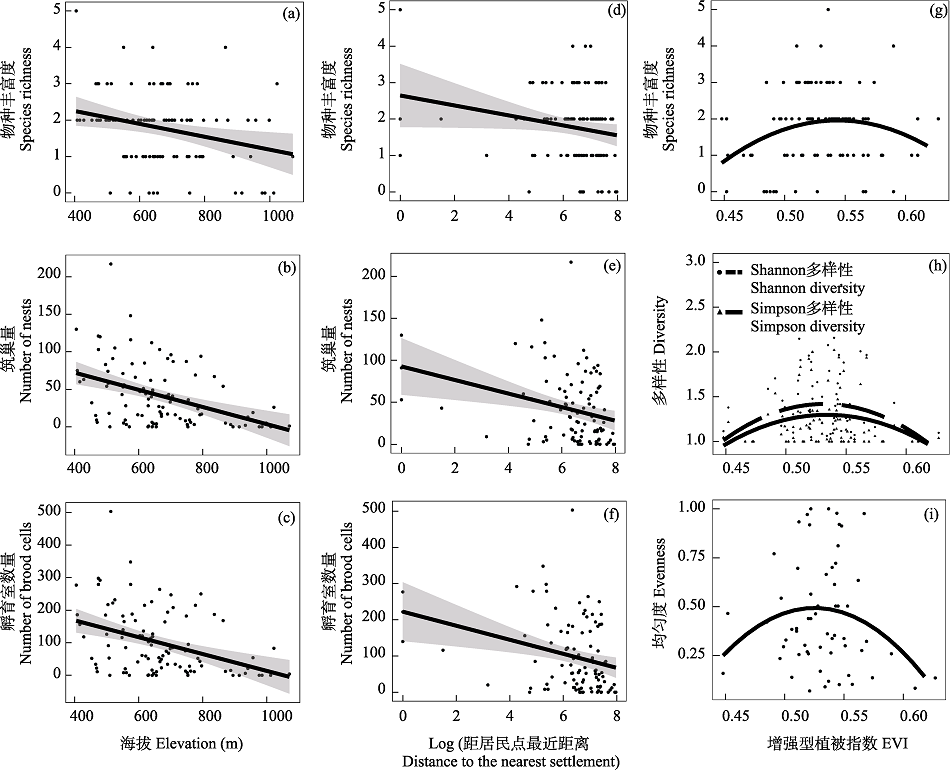
Fig. 3 Effects of elevation, distance to the nearest settlement and enhanced vegetation index (EVI) on the diversity of Vespidae wasps
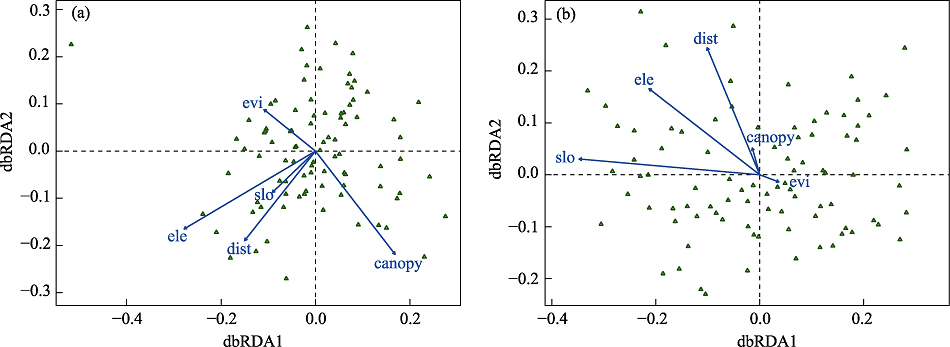
Fig. 4 Distance-based redundancy analyses of the matrix of species turnover (a) and nestedness (b) for Vespidae wasps explained by the environmental variables. ele, Elevation; slo, Slope; dist, Distance to the nearest settlement; canopy, Canopy density; evi, Enhanced vegetation index.
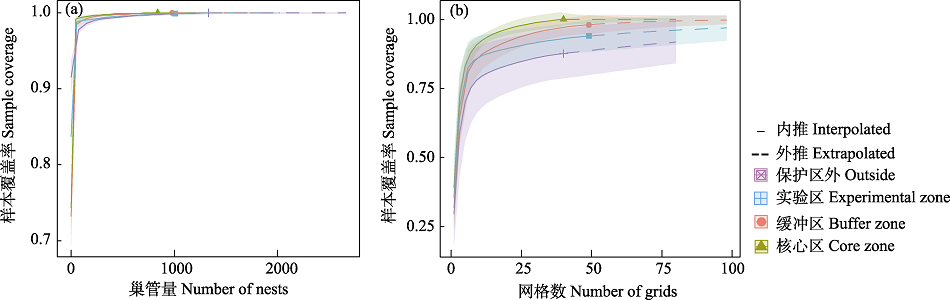
Fig. 5 Rarefaction curves of species richness for Vespidae wasps based on the number of nests (a) and grids (b)
| 分区 Zone | 网格数 No. of grids | 累计物种数 Cumulative number of species | 平均物种数 Average number of species | 平均相对 巢管量 Average relative number of nests | 平均相对孵 育室数量 Average relative number of brood cells | Shannon 多样性 Shannon diversity | Simpson 多样性 Simpson diversity | Pielou 均匀度 Pielou evenness |
|---|---|---|---|---|---|---|---|---|
| 保护区外 Outside | 20 | 9 | 2.00 ± 1.26a | 4.42 ± 2.44a | 10.26 ± 5.48a | 1.29 ± 0.24a | 1.18 ± 0.37a | 0.33 ± 0.24a |
| 实验区 Experimental zone | 30 | 7 | 1.68 ± 1.08a | 1.20 ± 1.28b | 2.95 ± 3.21b | 1.36 ± 0.46a | 1.25 ± 0.42a | 0.44 ± 0.26a |
| 缓冲区 Buffer zone | 28 | 6 | 1.74 ± 1.06a | 1.07 ± 1.37b | 2.53 ± 3.28b | 1.42 ± 0.34a | 1.30 ± 0.32a | 0.49 ± 0.27a |
| 核心区 Core zone | 22 | 4 | 1.82 ± 0.73a | 1.73 ± 1.63b | 4.28 ± 4.08b | 1.35 ± 0.36a | 1.36 ± 0.32a | 0.54 ± 0.28a |
| 总计 Total | 100 | 9 | 1.78 ± 1.03 | 1.79 ± 1.98 | 4.28 ± 4.66 | 1.36 ± 0.41 | 1.25 ± 0.36 | 0.45 ± 0.27 |
Table 2 Multiple comparisons of Vespidae wasps diversity based on trap-nests among the four zones in the Chebaling National Nature Reserve, Guangdong Province (2018-2020)
| 分区 Zone | 网格数 No. of grids | 累计物种数 Cumulative number of species | 平均物种数 Average number of species | 平均相对 巢管量 Average relative number of nests | 平均相对孵 育室数量 Average relative number of brood cells | Shannon 多样性 Shannon diversity | Simpson 多样性 Simpson diversity | Pielou 均匀度 Pielou evenness |
|---|---|---|---|---|---|---|---|---|
| 保护区外 Outside | 20 | 9 | 2.00 ± 1.26a | 4.42 ± 2.44a | 10.26 ± 5.48a | 1.29 ± 0.24a | 1.18 ± 0.37a | 0.33 ± 0.24a |
| 实验区 Experimental zone | 30 | 7 | 1.68 ± 1.08a | 1.20 ± 1.28b | 2.95 ± 3.21b | 1.36 ± 0.46a | 1.25 ± 0.42a | 0.44 ± 0.26a |
| 缓冲区 Buffer zone | 28 | 6 | 1.74 ± 1.06a | 1.07 ± 1.37b | 2.53 ± 3.28b | 1.42 ± 0.34a | 1.30 ± 0.32a | 0.49 ± 0.27a |
| 核心区 Core zone | 22 | 4 | 1.82 ± 0.73a | 1.73 ± 1.63b | 4.28 ± 4.08b | 1.35 ± 0.36a | 1.36 ± 0.32a | 0.54 ± 0.28a |
| 总计 Total | 100 | 9 | 1.78 ± 1.03 | 1.79 ± 1.98 | 4.28 ± 4.66 | 1.36 ± 0.41 | 1.25 ± 0.36 | 0.45 ± 0.27 |
| [1] |
Albrecht J, Classen A, Vollstädt MGR, Mayr A, Mollel NP, Costa DS, Dulle HI, Fischer M, Hemp A, Howell KM, Kleyer M, Nauss T, Peters MK, Tschapka M, Steffan-Dewenter I, Böhning-Gaese K, Schleuning M (2018) Plant and animal functional diversity drive mutualistic network assembly across an elevational gradient. Nature Communications, 9, 3177.
DOI PMID |
| [2] |
Angeler DG (2013) Revealing a conservation challenge through partitioned long-term beta diversity: Increasing turnover and decreasing nestedness of boreal lake metacommunities. Diversity and Distributions, 19, 772-781.
DOI URL |
| [3] |
Batra SWT (1984) Solitary bees. Scientific American, 250, 120-127.
DOI URL |
| [4] |
Bergamin RS, Bastazini VAG, Vélez-Martin E, Debastiani V, Zanini KJ, Loyola R, Müller SC (2017) Linking beta diversity patterns to protected areas: Lessons from the Brazilian Atlantic Rainforest. Biodiversity and Conservation, 26, 1557-1568.
DOI URL |
| [5] |
Burkle LA, Marlin JC, Knight TM (2013) Plant-pollinator interactions over 120 years: Loss of species, co-occurrence, and function. Science, 339, 1611-1615.
DOI PMID |
| [6] |
Hsieh TC, Ma KH, Chao A (2016) iNEXT: An R package for rarefaction and extrapolation of species diversity (Hill numbers). Methods in Ecology and Evolution, 7, 1451-1456.
DOI URL |
| [7] | Huyan JQ, Xiao J, Yu BW, Xu WH (2014) Research progress in function zoning of nature reserves in China. Acta Ecologica Sinica, 34, 6391-6396. (in Chinese with English abstract) |
| [呼延佼奇, 肖静, 于博威, 徐卫华 (2014) 我国自然保护区功能分区研究进展. 生态学报, 34, 6391-6396.] | |
| [8] |
James A, Pitchford JW, Plank MJ (2012) Disentangling nestedness from models of ecological complexity. Nature, 487, 227-230.
DOI |
| [9] |
Kremen C, Williams NM, Aizen MA, Gemmill-Herren B, LeBuhn G, Minckley R, Packer L, Potts SG, Roulston T, Steffan-Dewenter I, Vázquez DP, Winfree R, Adams L, Crone EE, Greenleaf SS, Keitt TH, Klein AM, Regetz J, Ricketts TH (2007) Pollination and other ecosystem services produced by mobile organisms: A conceptual framework for the effects of land-use change. Ecology Letters, 10, 299-314.
PMID |
| [10] | Krombein KV (1967) Trap-nesting Wasps and Bees: Life Histories, Nests, and Associates. Smithsonian Press, Washington. |
| [11] | Li LP, He SY, Jiang YM, Wang T, Zhao HH, Cui WH, Zheng YM, Hai Y, Wan HW (2019) Species range size patterns and their significance on biodiversity conservation. Scientia Sinica (Vitae), 49, 929-937. (in Chinese with English abstract) |
| [李利平, 何思源, 蒋样明, 王拓, 赵辉辉, 崔伟宏, 郑姚闽, 海鹰, 万华伟 (2019) 物种分布区特征及其对生物多样性保育的意义. 中国科学: 生命科学, 49, 929-937.] | |
| [12] | Lin MQ, Liu YF, Wu CF, Shu ZF, Zhu CD, Xiao ZS (2022) Oviposition behavior of the solitary wasp Anterhynchium flavomarginatum (Hymenoptera: Eumeninae) in relation to parasitism pressure. Acta Entomologica Sinica, 65, 1185-1195. (in Chinese with English abstract) |
| [林木青, 刘益帆, 吴琛帆, 束祖飞, 朱朝东, 肖治术 (2022) 独栖蜂黄缘蜾蠃的产卵行为及其与寄生胁迫的关系. 昆虫学报, 65, 1185-1195.] | |
| [13] |
Liu FZ, Feng CT, Zhou Y, Zhang LB, Du JH, Huang WJ, Luo JW, Wang W (2022) Effectiveness of functional zones in national nature reserves for the protection of forest ecosystems in China. Journal of Environmental Management, 308, 114593.
DOI URL |
| [14] |
Martínez-Núñez C, Manzaneda AJ, Lendínez S, Pérez AJ, Ruiz-Valenzuela L, Rey PJ (2019) Interacting effects of landscape and management on plant-solitary bee networks in olive orchards. Functional Ecology, 33, 2316-2326.
DOI URL |
| [15] |
Martinson HM, Fagan WF (2014) Trophic disruption: A meta-analysis of how habitat fragmentation affects resource consumption in terrestrial arthropod systems. Ecology Letters, 17, 1178-1189.
DOI PMID |
| [16] |
Matos MCB, Santos Silva S, Teodoro AV (2016) Seasonal population abundance of the assembly of solitary wasps and bees (Hymenoptera) according to land-use in Maranhão State, Brazil. Revista Brasileira De Entomologia, 60, 171-176.
DOI URL |
| [17] |
Mayr AV, Peters MK, Eardley CD, Renner ME, Röder J, Steffan-Dewenter I (2020) Climate and food resources shape species richness and trophic interactions of cavity-nesting Hymenoptera. Journal of Biogeography, 47, 854-865.
DOI URL |
| [18] |
Morris RJ, Sinclair FH, Burwell CJ (2015) Food web structure changes with elevation but not rainforest stratum. Ecography, 38, 792-802.
DOI URL |
| [19] |
Nagendra H (2001) Using remote sensing to assess biodiversity. International Journal of Remote Sensing, 22, 2377-2400.
DOI URL |
| [20] |
Outhwaite CL, McCann P, Newbold T (2022) Agriculture and climate change are reshaping insect biodiversity worldwide. Nature, 605, 97-102.
DOI |
| [21] |
Peters MK, Hemp A, Appelhans T, Behler C, Classen A, Detsch F, Ensslin A, Ferger SW, Frederiksen SB, Gebert F, Haas M, Helbig-Bonitz M, Hemp C, Kindeketa WJ, Mwangomo E, Ngereza C, Otte I, Röder J, Rutten G, Schellenberger Costa D, Tardanico J, Zancolli G, Deckert J, Eardley CD, Peters RS, Rödel MO, Schleuning M, Ssymank A, Kakengi V, Zhang J, Böhning-Gaese K, Brandl R, Kalko EKV, Kleyer M, Nauss T, Tschapka M, Fischer M, Steffan-Dewenter I (2016) Predictors of elevational biodiversity gradients change from single taxa to the multi-taxa community level. Nature Communications, 7, 13736.
DOI PMID |
| [22] | Plowman NS, Hood ASC, Moses J, Redmond C, Novotny V, Klimes P, Fayle TM (2017) Network reorganization and breakdown of an ant-plant protection mutualism with elevation. Proceedings of the Royal Society B: Biological Sciences, 284, 20162564. |
| [23] |
Podani J, Schmera D (2011) A new conceptual and methodological framework for exploring and explaining pattern in presence-absence data. Oikos, 120, 1625-1638.
DOI URL |
| [24] |
Potts SG, Biesmeijer JC, Kremen C, Neumann P, Schweiger O, Kunin WE (2010) Global pollinator declines: Trends, impacts and drivers. Trends in Ecology & Evolution, 25, 345-353.
DOI URL |
| [25] | R Core Team (2018) R: A Language and Environment for Statistical Computing. R Foundation for Statistical Computing, Vienna, Austria. |
| [26] |
Rezende MQ, Venzon M, Perez AL, Cardoso IM, Janssen A (2014) Extrafloral nectaries of associated trees can enhance natural pest control. Agriculture, Ecosystems & Environment, 188, 198-203.
DOI URL |
| [27] |
Sánchez-Bayo F, Wyckhuys KAG (2019) Worldwide decline of the entomofauna: A review of its drivers. Biological Conservation, 232, 8-27.
DOI URL |
| [28] |
Senapathi D, Goddard MA, Kunin WE, Baldock KCR (2017) Landscape impacts on pollinator communities in temperate systems: Evidence and knowledge gaps. Functional Ecology, 31, 26-37.
DOI URL |
| [29] | Staab M, Bruelheide H, Durka W, Michalski S, Purschke O, Zhu CD, Klein AM (2016) Tree phylogenetic diversity promotes host-parasitoid interactions. Proceedings of the Royal Society B: Biological Sciences, 283, 20160275. |
| [30] |
Staab M, Pufal G, Tscharntke T, Klein AM (2018) Trap nests for bees and wasps to analyse trophic interactions in changing environments—A systematic overview and user guide. Methods in Ecology and Evolution, 9, 2226-2239.
DOI URL |
| [31] |
Tscharntke T, Gathmann A, Steffan-Dewenter I (1998) Bioindication using trap-nesting bees and wasps and their natural enemies: Community structure and interactions. Journal of Applied Ecology, 35, 708-719.
DOI URL |
| [32] |
Tuanmu MN, Jetz W (2015) A global, remote sensing-based characterization of terrestrial habitat heterogeneity for biodiversity and ecosystem modelling. Global Ecology and Biogeography, 24, 1329-1339.
DOI URL |
| [33] | Watson JEM, Dudley N, Segan DB, Hockings M (2014) The performance and potential of protected areas. Nature, 515, 67-73. |
| [34] | Xiao ZS (2019) Inventory and Assessment of Wildlife and Its Habitat in Protected Areas—An Example from Chebaling National Nature Reserve, Guangdong, China. China Forestry Publishing House, Beijing. (in Chinese) |
| [肖治术 (2019) 自然保护地野生动物及栖息地的调查与评估研究——广东车八岭国家级自然保护区案例分析. 中国林业出版社, 北京.] | |
| [35] | Xu WH, Luo C, Ouyang ZY, Zhang L (2010) Designing regional nature reserves group: The case study of Qinling Mountain Range, China. Acta Ecologica Sinica, 30, 1648-1654. (in Chinese with English abstract) |
| [徐卫华, 罗翀, 欧阳志云, 张路 (2010) 区域自然保护区群规划——以秦岭山系为例. 生态学报, 30, 1648-1654.] | |
| [36] | Xu YQ (1993) A comprehensive report on investigation in Chebaling National Nature Reserve. In: Collected Papers for Investigation in Chebaling National Nature Reserve (ed. Editorial Committee of Collected Papers for Investigation in Chebaling National Nature Reserve), pp. 1-7. Guangdong Science and Technology Press, Guangzhou. (in Chinese with English abstract) |
| [徐燕千 (1993) 车八岭国家级自然保护区调查研究综合报告. 见: 车八岭国家级自然保护区调查研究论文集(车八岭国家级自然保护区调查研究论文集编委会编), 1-7页. 广东科技出版社, 广州.] | |
| [37] | Zhai WD, Ma NX (2000) Guiding ideology and basic principles of nature reserve management zoning. China Environmental Science, 20, 337-340. (in Chinese with English abstract) |
| [翟惟东, 马乃喜 (2000) 自然保护区功能区划的指导思想和基本原则. 中国环境科学, 20, 337-340.] | |
| [38] |
Zhang K, Lin SL, Ji YQ, Yang CX, Wang XY, Yang CY, Wang HS, Jiang HS, Harrison RD, Yu DW (2016) Plant diversity accurately predicts insect diversity in two tropical landscapes. Molecular Ecology, 25, 4407-4419.
DOI PMID |
| [1] | Junce Liang, Kaizhi Li, Yehui Tan. Species diversity and distribution of pteropods in the South China Sea [J]. Biodiv Sci, 2026, 34(5): 25487-. |
| [2] | Jianchao Liang, Shutian Chen, Wenxiang He, Chunni Xiong, Zhenzhou Xu, Yuanxin Huang, Yuanzhihong Liu, Lang Zhang, Huijian Hu. Wild terrestrial vertebrate resources in Guangzhou: Diversity, distribution, and conservation [J]. Biodiv Sci, 2026, 34(5): 25422-. |
| [3] | Jin Li, Minghao Cheng, Yi Zhang, Feng Liu, Qinghu Jiang, Jirong Ye, Zhan Chen, Yuguang Zhang. Soil microbial diversity and plant-microbe inter-kingdom ecological networks across an elevational gradient in Abies fargesii forests [J]. Biodiv Sci, 2026, 34(4): 25276-. |
| [4] | Dongpo Xia, Jing Li, Jundong Tian, Zhonghao Huang, Chengfeng Wu, Shiwang Chen, Jinhua Li. Research progress of wild Macaca species in China [J]. Biodiv Sci, 2026, 34(3): 25460-. |
| [5] | Li Huang, Zhifa Liu, Yuening Gong, Buhang Li, Jian Zhang. Plant community composition and structure of sixteen 1-ha forest dynamics monitoring plots of Nanling Mountains in Guangdong Province [J]. Biodiv Sci, 2026, 34(3): 25357-. |
| [6] | Tingting Zhou, Haomiao Zhang, Haojie Wang, Jian Liao, Xiaodan Chen, Nan Yang, Bo-Ping Han, Zhenyuan Liu. Geographical patterns and key influence factors of Odonata species diversity in Guangdong Province [J]. Biodiv Sci, 2026, 34(2): 25337-. |
| [7] | Wenqi Gao, Jingrong Xiang, Yao Zhao, Lingshuang Fan, Yuan Gu, Weihan Shao, Gaojun Li, Guangjun Zhao, Mingbin Chen, Xingwei Cai, Kai Chen. Stream fish community characteristics and their response to land use in Limushan and Jianfengling of Hainan Tropical Rainforest National Park [J]. Biodiv Sci, 2026, 34(2): 25374-. |
| [8] | Chunting Feng, Chen Wu, Xiqing Sun, Wei Wang. Assessment of human-nature relationship in China’s World Biosphere Reserves [J]. Biodiv Sci, 2025, 33(9): 25248-. |
| [9] | Ying Feng, Feng Song, Guangzhao Jin, Komiljon Tojibaev, Xuejun Ge. Distribution patterns and species diversity of the genus Calligonum in the desert regions of Central Asia [J]. Biodiv Sci, 2025, 33(8): 25086-. |
| [10] | Yang Yang, Rui Zou, Yaqin Qiao, Xiang Meng, Feiyun Tu. The species diversity of terrestrial mammals in Hainan Province, China [J]. Biodiv Sci, 2025, 33(8): 25044-. |
| [11] | Ruxiao Wang, Boyang Shi, Da Pan, Hongying Sun. Biodiversity patterns and conservation gaps of the endemic freshwater crab genus Sinopotamon in China [J]. Biodiv Sci, 2025, 33(8): 25123-. |
| [12] | Yang Zhang, Yanping Wang. A review of the SLOSS debate: Analysis methods, theoretical mechanisms and conservation practices [J]. Biodiv Sci, 2025, 33(7): 25081-. |
| [13] | Zhengdong Pan, Xirong Lin, Hua Xue, Zhiying Hu, Hongyi Guo, Ya Zhang, Enuo Wu, Wenqiao Tang. Fish species diversity background and community structure in the main inland water bodies of Shanghai [J]. Biodiv Sci, 2025, 33(6): 24290-. |
| [14] | Wen Peng, Zeshuai Deng, Wenbao Zheng, Lingxuan Gong, Yufeng Zeng, Hao Meng, Jun Chen, Daode Yang. Application of eDNA technology in amphibian surveys: A case study of Hunan Mangshan National Nature Reserve [J]. Biodiv Sci, 2025, 33(6): 24552-. |
| [15] | Lulu Zhang, Zhaojie Ren, Ningning Yu, Fengxi Zhao, Zuntian Zhao. List of bryophytes in Gansu Province, China [J]. Biodiv Sci, 2025, 33(6): 24451-. |
| Viewed | ||||||
|
Full text |
|
|||||
|
Abstract |
|
|||||
Copyright © 2026 Biodiversity Science
Editorial Office of Biodiversity Science, 20 Nanxincun, Xiangshan, Beijing 100093, China
Tel: 010-62836137, 62836665 E-mail: biodiversity@ibcas.ac.cn

