

生物多样性 ›› 2026, Vol. 34 ›› Issue (7): 26110. DOI: 10.17520/biods.2026110 cstr: 32101.14.biods.2026110
李新豪1, 蒲发光2, 程扬2, 周美生2, 易厚启3, 万霞1,*( )
)
收稿日期:2026-03-31
接受日期:2026-06-07
出版日期:2026-07-20
发布日期:2026-09-21
通讯作者:
万霞
基金资助:
Xinhao Li1, Faguang Pu2, Yang Cheng2, Meisheng Zhou2, Houqi Yi3, Xia Wan1,*()
Received:2026-03-31
Accepted:2026-06-07
Online:2026-07-20
Published:2026-09-21
Contact:
Xia Wan
Supported by:摘要:
源头溪流是维持区域淡水生物多样性的重要生境, 但针对山区源头溪流水生昆虫多样性及其对环境因子的响应研究仍相对不足。本文于2024-2025年在金寨天马国家级自然保护区沿海拔梯度设置10个样点, 采用索伯网法对该区域水生昆虫展开调查, 研究其群落组成并进行α和β多样性分析, 探讨其多样性格局及其对海拔、生境及水环境指标等环境因子的响应。本次调查共采集到水生昆虫10,592头, 隶属于8目45科119个分类单元, 优势类群为蜉蝣目、毛翅目、双翅目和蜻蜓目。不同海拔段的水生昆虫群落结构差异显著, 低海拔段(400-600 m)和中海拔段(600-800 m)物种丰富度、Shannon-Wiener多样性指数及Margalef丰富度指数均高于高海拔段(800-1,000 m)。冗余分析结果显示, 海拔、水温、高锰酸盐指数等是影响群落结构的关键环境因子。广义线性模型进一步揭示海拔和水温是影响群落多样性的关键因子, 溶解氧、总氮、水深等也是重要因子。研究表明, 海拔梯度通过调节温度及水化学条件显著影响源头溪流水生昆虫群落组成与多样性格局。研究结果丰富了大别山区源头溪流水生昆虫多样性的基础资料, 可为区域源头溪流生态保护、生物多样性监测及自然保护区管理提供科学依据。
李新豪, 蒲发光, 程扬, 周美生, 易厚启, 万霞 (2026) 皖西大别山源头溪流水生昆虫多样性及其对环境因子的响应. 生物多样性, 34, 26110. DOI: 10.17520/biods.2026110.
Xinhao Li, Faguang Pu, Yang Cheng, Meisheng Zhou, Houqi Yi, Xia Wan (2026) Diversity of aquatic insects in headwater streams of Dabie Mountains in western Anhui and their responses to environmental factors. Biodiversity Science, 34, 26110. DOI: 10.17520/biods.2026110.
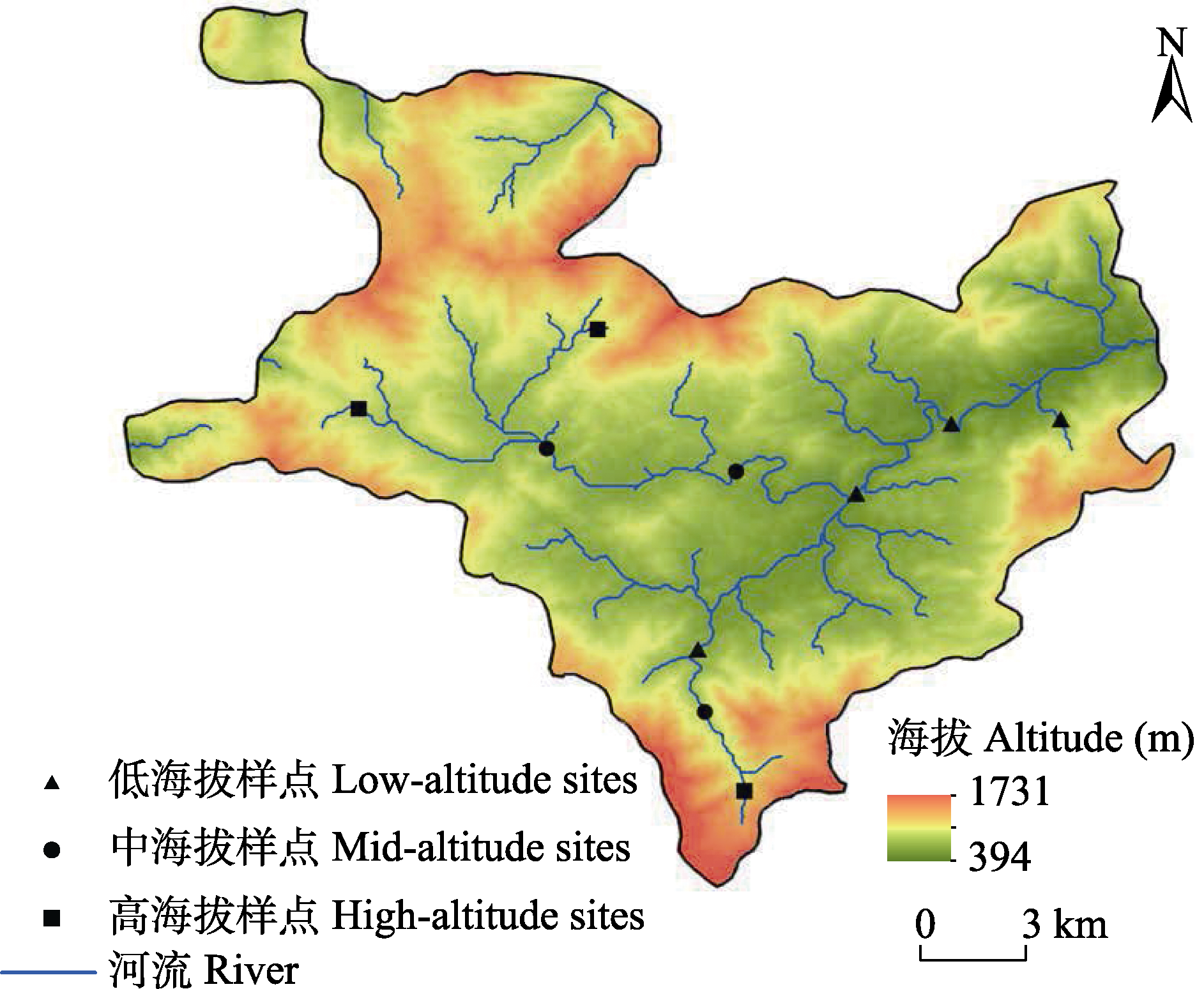
图1 金寨天马国家级自然保护区水生昆虫调查样点分布图
Fig. 1 Location of sampling sites for aquatic insects in Jinzhai Tianma National Nature Reserve
| 目 Order | 科 Family | 分类单元 Taxon | 个体 Individual | |||
|---|---|---|---|---|---|---|
| 数量 Number | 百分比 Percentage (%) | 数量 Number | 百分比 Percentage (%) | 数量 Number | 百分比 Percentage (%) | |
| 蜉蝣目 Ephemeroptera | 9 | 20.00 | 43 | 36.13 | 3,477 | 32.83 |
| 毛翅目 Trichoptera | 8 | 17.78 | 17 | 14.29 | 2,383 | 22.50 |
| 双翅目 Diptera | 11 | 24.44 | 29 | 24.37 | 2,189 | 20.67 |
| 蜻蜓目 Odonata | 6 | 13.33 | 10 | 8.40 | 1,327 | 12.53 |
| 鞘翅目 Coleoptera | 6 | 13.33 | 9 | 7.56 | 389 | 3.67 |
| 襀翅目 Plecoptera | 3 | 6.67 | 4 | 3.36 | 460 | 4.34 |
| 广翅目 Megaloptera | 1 | 2.22 | 3 | 2.52 | 326 | 3.07 |
| 半翅目 Hemiptera | 1 | 2.22 | 4 | 3.36 | 41 | 0.39 |
| 总计 Total | 45 | 100.00 | 119 | 100.00 | 10,592 | 100.00 |
表1 金寨天马国家级自然保护区水生昆虫物种组成
Table 1 Species composition of aquatic insects in Jinzhai Tianma National Nature Reserve
| 目 Order | 科 Family | 分类单元 Taxon | 个体 Individual | |||
|---|---|---|---|---|---|---|
| 数量 Number | 百分比 Percentage (%) | 数量 Number | 百分比 Percentage (%) | 数量 Number | 百分比 Percentage (%) | |
| 蜉蝣目 Ephemeroptera | 9 | 20.00 | 43 | 36.13 | 3,477 | 32.83 |
| 毛翅目 Trichoptera | 8 | 17.78 | 17 | 14.29 | 2,383 | 22.50 |
| 双翅目 Diptera | 11 | 24.44 | 29 | 24.37 | 2,189 | 20.67 |
| 蜻蜓目 Odonata | 6 | 13.33 | 10 | 8.40 | 1,327 | 12.53 |
| 鞘翅目 Coleoptera | 6 | 13.33 | 9 | 7.56 | 389 | 3.67 |
| 襀翅目 Plecoptera | 3 | 6.67 | 4 | 3.36 | 460 | 4.34 |
| 广翅目 Megaloptera | 1 | 2.22 | 3 | 2.52 | 326 | 3.07 |
| 半翅目 Hemiptera | 1 | 2.22 | 4 | 3.36 | 41 | 0.39 |
| 总计 Total | 45 | 100.00 | 119 | 100.00 | 10,592 | 100.00 |
| 物种 Species | 低海拔 Low-altitude | 中海拔 Mid-altitude | 高海拔 High-altitude | 全海拔 Total |
|---|---|---|---|---|
| 安徽宽基蜉 Choroterpes anhuiensis | 0.1020 | 0.0882 | - | 0.0769 |
| 二翅花翅蜉 Baetiella bispinosa | 0.0325 | 0.0379 | 0.0456 | 0.0374 |
| 中华越南蜉 Vietnamella sinensis | - | - | 0.0463 | - |
| 尼泊尔大腮蜉 Torleya nepalica | 0.0203 | - | 0.0371 | 0.0221 |
| 逸仙丽翅蜉 Alainites yixiani | - | - | 0.0426 | - |
| 鹿角亚非蜉 Afronurus alces | - | - | 0.0265 | 0.0202 |
| 具纹亚非蜉 Afronurus costatus | 0.0277 | 0.0458 | 0.0320 | 0.0340 |
| 绢蜉 Ephemera serica | - | - | 0.0713 | 0.0297 |
| 格氏纹石蛾 Hydropsyche grahami | 0.0904 | - | - | 0.0472 |
| 纹石蛾属一种2 Hydropsyche sp. 2 | 0.0395 | - | - | 0.0268 |
| 纹石蛾属一种3 Hydropsyche sp. 3 | 0.0341 | - | - | - |
| 横带长角纹石蛾 Macrostemum fastosum | 0.0234 | - | 0.0511 | 0.0260 |
| 斑纹角石蛾 Stenopsyche marmorata | - | 0.0240 | - | - |
| 裂片乌石蛾 Uenoa lobata | - | 0.0497 | 0.0470 | 0.0277 |
| 摇蚊属一种 Chironomus sp. | 0.0693 | 0.0352 | 0.0261 | 0.0484 |
| 多足摇蚊属一种 Polypedilum sp. | 0.0565 | 0.0227 | - | 0.0380 |
| 棒脉摇蚊属一种 Corynoneura sp. | 0.0244 | 0.0682 | - | 0.0249 |
| 黄蜻 Pantala flavescens | 0.0935 | 0.1920 | 0.0496 | 0.1100 |
| 大别山钩襀 Kamimuria dabieshana | - | - | 0.0331 | 0.0211 |
| 黄襀属一种 Xanthoperla sp. | - | 0.0336 | 0.0522 | 0.0281 |
| 花边星齿蛉 Protohermes costalis | 0.0223 | 0.0224 | - | 0.0220 |
表2 金寨天马国家级自然保护区水生昆虫优势种及优势度
Table 2 Dominant species and dominance of aquatic insects in Jinzhai Tianma National Nature Reserve
| 物种 Species | 低海拔 Low-altitude | 中海拔 Mid-altitude | 高海拔 High-altitude | 全海拔 Total |
|---|---|---|---|---|
| 安徽宽基蜉 Choroterpes anhuiensis | 0.1020 | 0.0882 | - | 0.0769 |
| 二翅花翅蜉 Baetiella bispinosa | 0.0325 | 0.0379 | 0.0456 | 0.0374 |
| 中华越南蜉 Vietnamella sinensis | - | - | 0.0463 | - |
| 尼泊尔大腮蜉 Torleya nepalica | 0.0203 | - | 0.0371 | 0.0221 |
| 逸仙丽翅蜉 Alainites yixiani | - | - | 0.0426 | - |
| 鹿角亚非蜉 Afronurus alces | - | - | 0.0265 | 0.0202 |
| 具纹亚非蜉 Afronurus costatus | 0.0277 | 0.0458 | 0.0320 | 0.0340 |
| 绢蜉 Ephemera serica | - | - | 0.0713 | 0.0297 |
| 格氏纹石蛾 Hydropsyche grahami | 0.0904 | - | - | 0.0472 |
| 纹石蛾属一种2 Hydropsyche sp. 2 | 0.0395 | - | - | 0.0268 |
| 纹石蛾属一种3 Hydropsyche sp. 3 | 0.0341 | - | - | - |
| 横带长角纹石蛾 Macrostemum fastosum | 0.0234 | - | 0.0511 | 0.0260 |
| 斑纹角石蛾 Stenopsyche marmorata | - | 0.0240 | - | - |
| 裂片乌石蛾 Uenoa lobata | - | 0.0497 | 0.0470 | 0.0277 |
| 摇蚊属一种 Chironomus sp. | 0.0693 | 0.0352 | 0.0261 | 0.0484 |
| 多足摇蚊属一种 Polypedilum sp. | 0.0565 | 0.0227 | - | 0.0380 |
| 棒脉摇蚊属一种 Corynoneura sp. | 0.0244 | 0.0682 | - | 0.0249 |
| 黄蜻 Pantala flavescens | 0.0935 | 0.1920 | 0.0496 | 0.1100 |
| 大别山钩襀 Kamimuria dabieshana | - | - | 0.0331 | 0.0211 |
| 黄襀属一种 Xanthoperla sp. | - | 0.0336 | 0.0522 | 0.0281 |
| 花边星齿蛉 Protohermes costalis | 0.0223 | 0.0224 | - | 0.0220 |
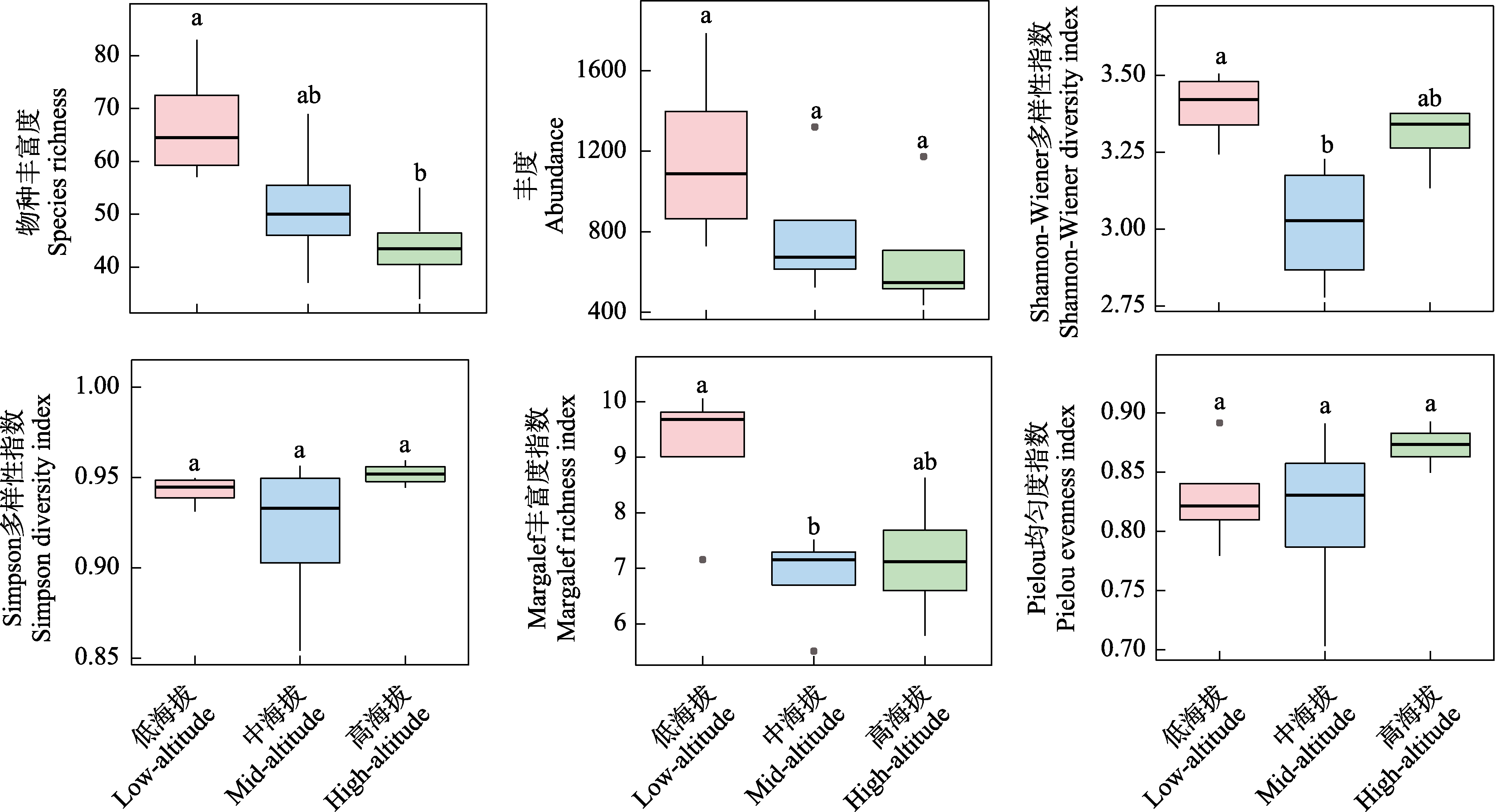
图2 金寨天马国家级自然保护区不同海拔段水生昆虫群落多样性。不同字母表示不同海拔段间差异显著(P < 0.05)。
Fig. 2 Community diversity of aquatic insect at different altitudes in Jinzhai Tianma National Nature Reserve. Different letters indicate significant differences at different altitudes (P < 0.05).
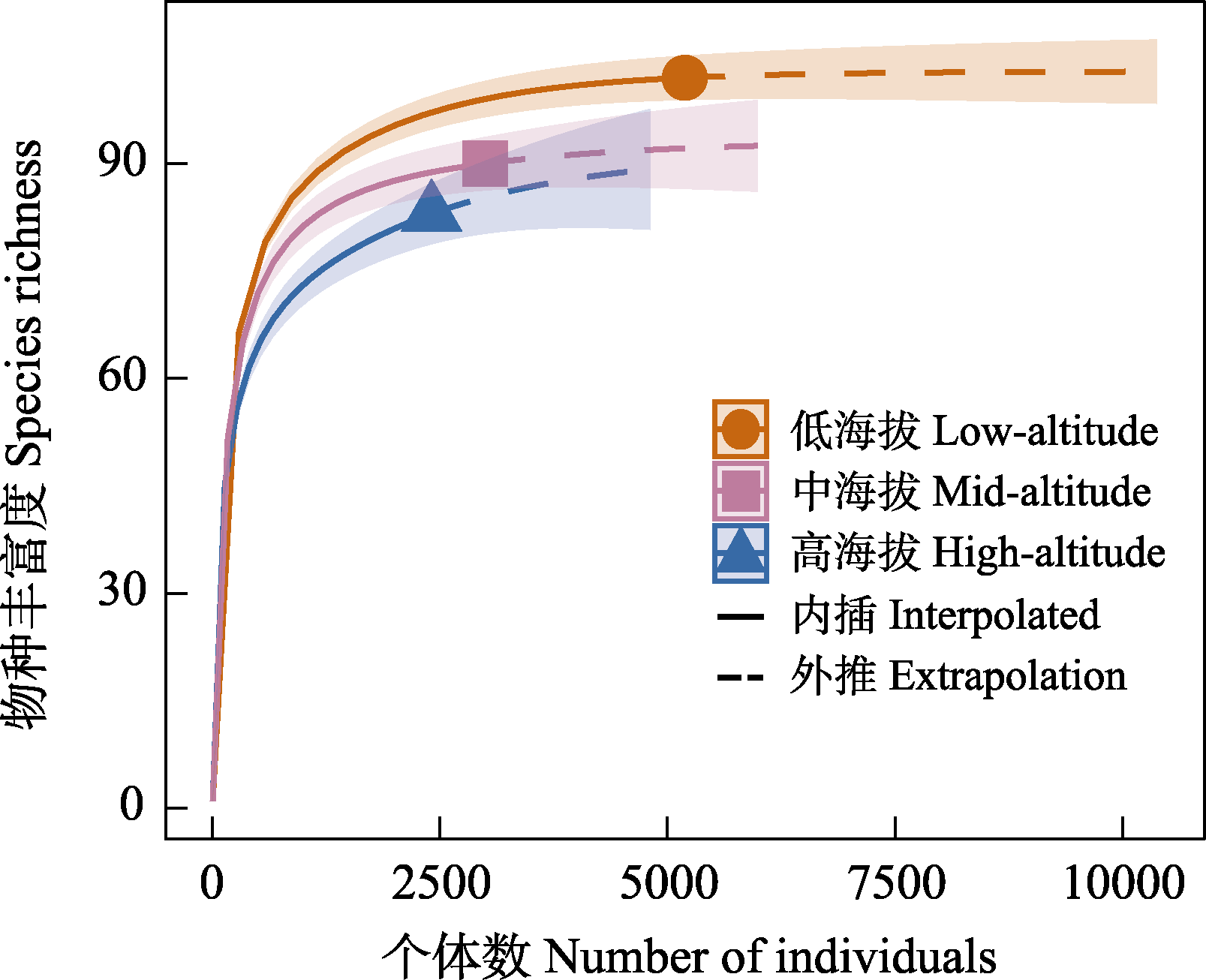
图3 金寨天马国家级自然保护区不同海拔段物种丰富度稀疏外推分析结果
Fig. 3 Sparse extrapolation analysis results of species richness at different altitudes in Jinzhai Tianma National Nature Reserve
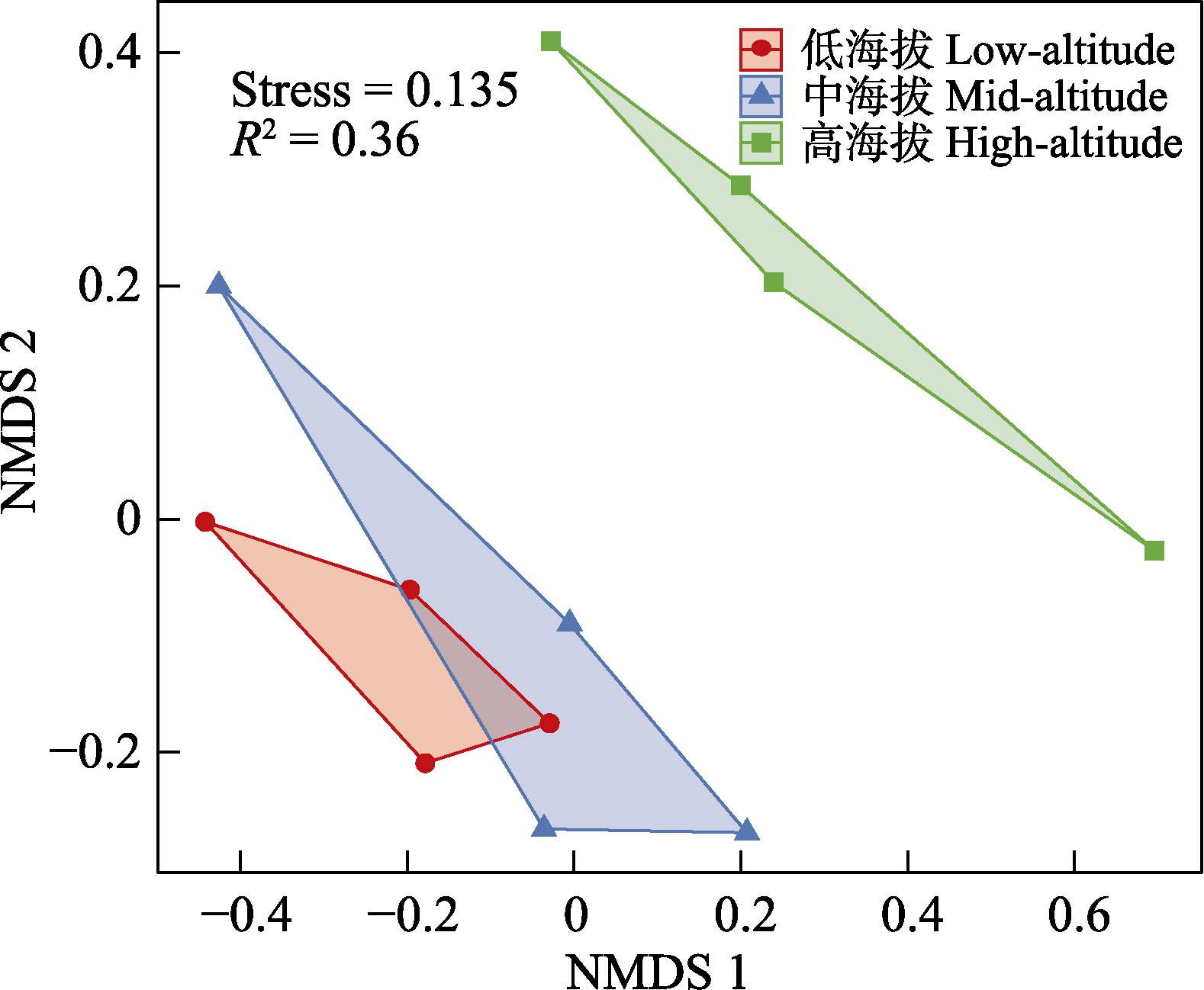
图4 金寨天马国家级自然保护区不同海拔段水生昆虫群落非度量多维尺度排序分析
Fig. 4 Non-metric multidimensional scaling (NMDS) analysis of aquatic insect communities at different altitudes in Jinzhai Tianma National Nature Reserve
| 低海拔 Low-altitude | 中海拔 Mid-altitude | 高海拔 High-altitude | P | |
|---|---|---|---|---|
| 酸碱度 pH | 7.40 ± 0.48 | 7.48 ± 0.55 | 6.98 ± 0.16 | 0.371 |
| 溶解氧 Dissolved oxygen (mg/L) | 9.05 ± 0.32 | 8.82 ± 0.13 | 8.58 ± 0.41 | 0.207 |
| 水温 Water temperature (℃) | 18.69 ± 2.61a | 14.94 ± 1.72a | 7.24 ± 1.82b | < 0.001 |
| 电导率 Electrical conductivity (μS/cm) | 58.48 ± 10.50a | 58.57 ± 3.62a | 33.40 ± 6.35b | < 0.01 |
| 总磷 Total phosphorus (mg/L) | 0.03 ± 0.00 | 0.03 ± 0.01 | 0.03 ± 0.00 | 0.727 |
| 总氮 Total nitrogen (mg/L) | 0.70 ± 0.24ab | 1.02 ± 0.29a | 0.41 ± 0.15b | < 0.05 |
| 氨氮 Ammonium nitrogen (mg/L) | 0.07 ± 0.03 | 0.07 ± 0.05 | 0.05 ± 0.02 | 0.766 |
| 高锰酸盐指数 Permanganate index (mg/L) | 1.75 ± 0.35a | 1.25 ± 0.14ab | 1.15 ± 0.27b | < 0.05 |
| 流速 Velocity (m/s) | 0.16 ± 0.06 | 0.08 ± 0.02 | 0.12 ± 0.06 | 0.273 |
| 水深 Water depth (m) | 0.17 ± 0.01a | 0.12 ± 0.01b | 0.07 ± 0.00c | < 0.001 |
| 水宽 Water width (m) | 13.56 ± 12.02 | 14.95 ± 7.44 | 6.21 ± 5.28 | 0.490 |
表3 金寨天马国家级自然保护区的环境因子(平均值 ± 标准差)
Table 3 Environmental factors of Jinzhai Tianma National Nature Reserve (mean ± SD)
| 低海拔 Low-altitude | 中海拔 Mid-altitude | 高海拔 High-altitude | P | |
|---|---|---|---|---|
| 酸碱度 pH | 7.40 ± 0.48 | 7.48 ± 0.55 | 6.98 ± 0.16 | 0.371 |
| 溶解氧 Dissolved oxygen (mg/L) | 9.05 ± 0.32 | 8.82 ± 0.13 | 8.58 ± 0.41 | 0.207 |
| 水温 Water temperature (℃) | 18.69 ± 2.61a | 14.94 ± 1.72a | 7.24 ± 1.82b | < 0.001 |
| 电导率 Electrical conductivity (μS/cm) | 58.48 ± 10.50a | 58.57 ± 3.62a | 33.40 ± 6.35b | < 0.01 |
| 总磷 Total phosphorus (mg/L) | 0.03 ± 0.00 | 0.03 ± 0.01 | 0.03 ± 0.00 | 0.727 |
| 总氮 Total nitrogen (mg/L) | 0.70 ± 0.24ab | 1.02 ± 0.29a | 0.41 ± 0.15b | < 0.05 |
| 氨氮 Ammonium nitrogen (mg/L) | 0.07 ± 0.03 | 0.07 ± 0.05 | 0.05 ± 0.02 | 0.766 |
| 高锰酸盐指数 Permanganate index (mg/L) | 1.75 ± 0.35a | 1.25 ± 0.14ab | 1.15 ± 0.27b | < 0.05 |
| 流速 Velocity (m/s) | 0.16 ± 0.06 | 0.08 ± 0.02 | 0.12 ± 0.06 | 0.273 |
| 水深 Water depth (m) | 0.17 ± 0.01a | 0.12 ± 0.01b | 0.07 ± 0.00c | < 0.001 |
| 水宽 Water width (m) | 13.56 ± 12.02 | 14.95 ± 7.44 | 6.21 ± 5.28 | 0.490 |
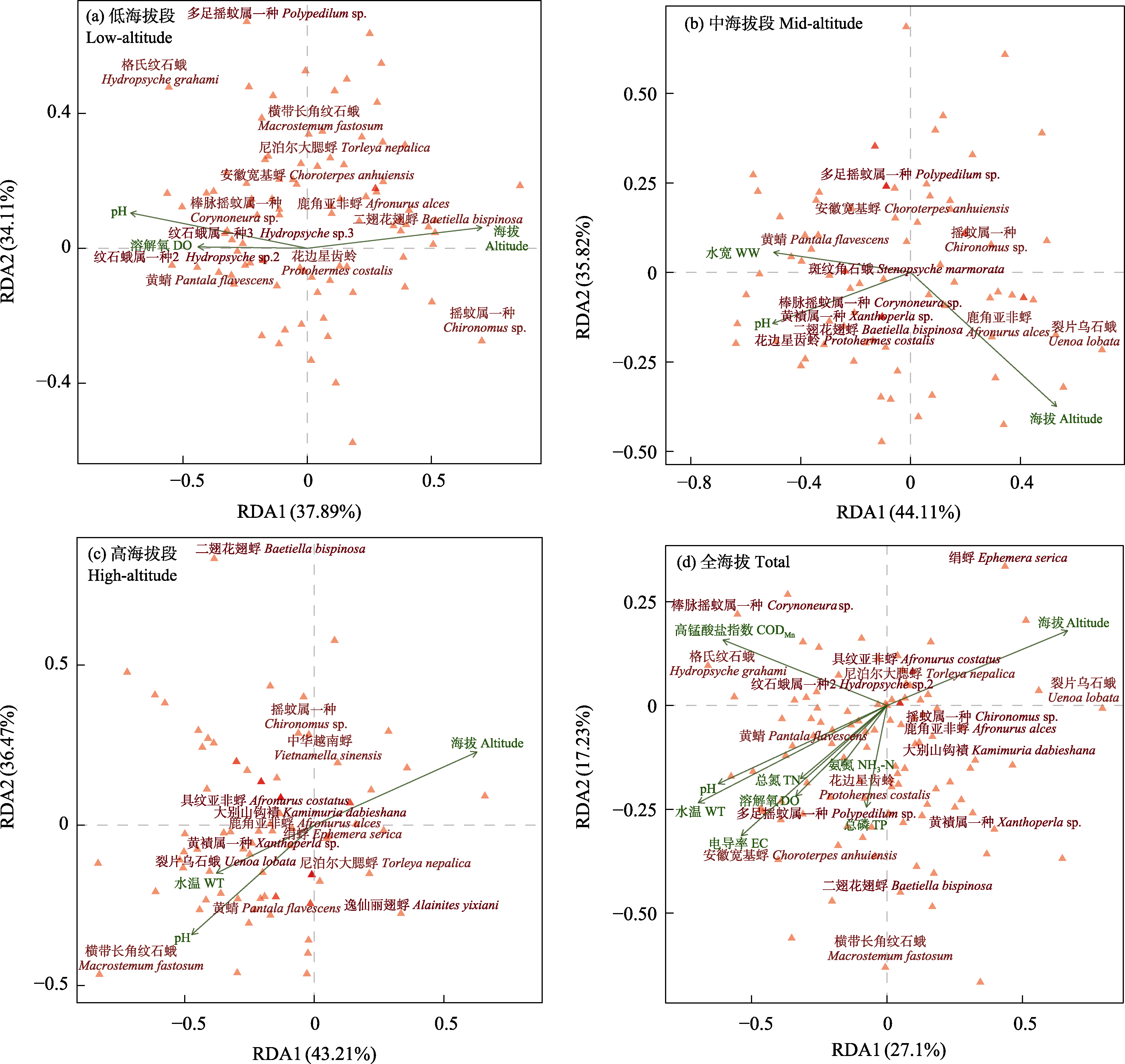
图5 金寨天马国家级自然保护区水生昆虫群落结构与环境因子的冗余分析(RDA)排序图
Fig. 5 Redundancy analysis (RDA) ordination diagram of aquatic insect community structure and environmental factors in Jinzhai Tianma National Nature Reserve. DO, Dissolved oxygen; WW, Water width; WT, Water temperature; EC, Electrical conductivity; TP, Total phosphorus; TN, Total nitrogen; NH3-N, Ammonium nitrogen.; CODMn, Permanganate index.
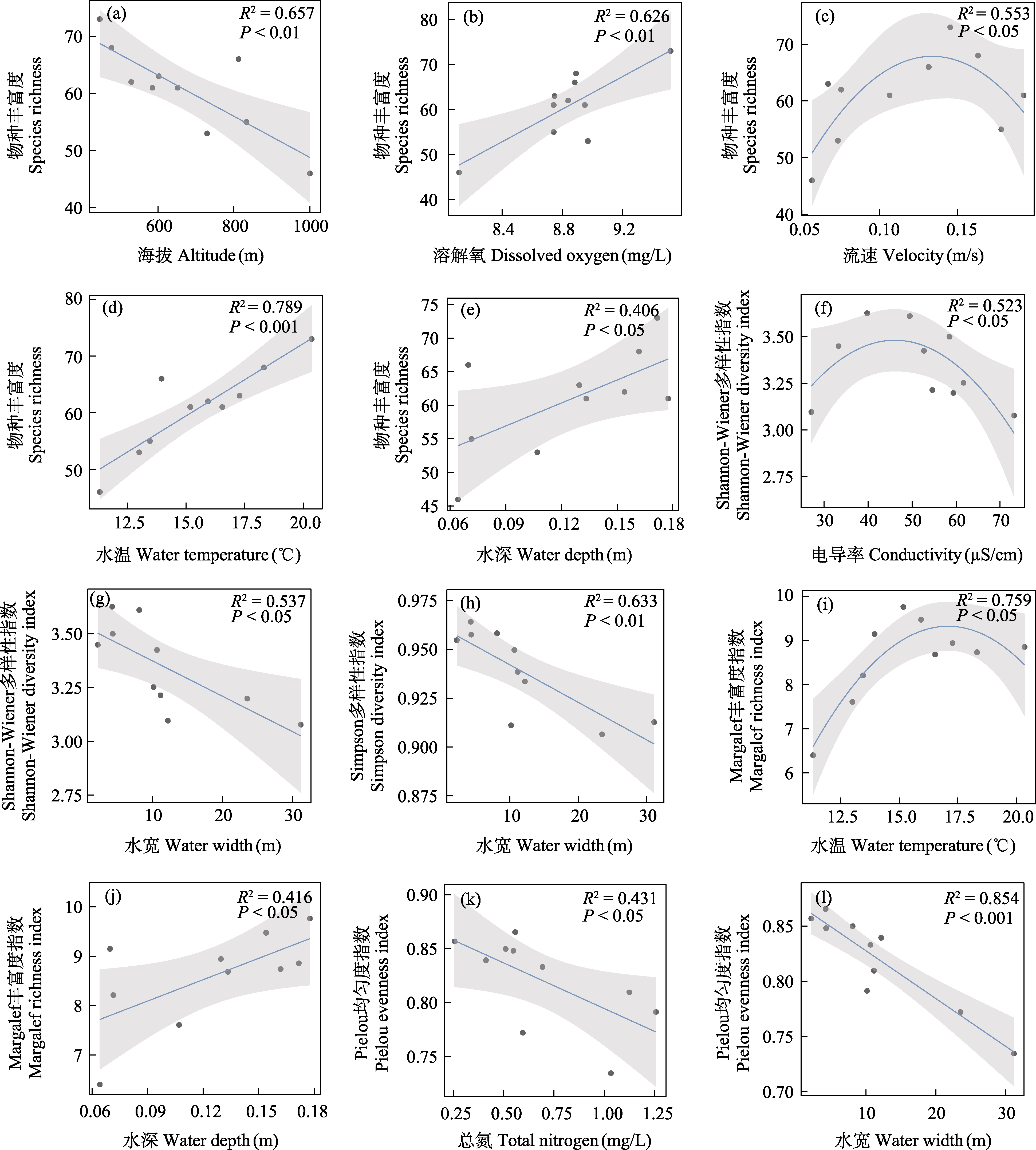
图6 水生昆虫多样性与环境因子的广义线性模型拟合曲线。实线表示相关性显著(P < 0.05), 阴影区域表示95%置信区间。
Fig. 6 Generalized linear model fitting curve of aquatic insect diversity and environmental factors. The solid line shows a significant correlation (P < 0.05), and the shaded area represents the 95% confidence interval.
| [1] | Arimoro FO, Ikomi RB (2009) Ecological integrity of upper Warri River, Niger Delta using aquatic insects as bioindicators. Ecological Indicators, 9, 455-461. |
| [2] | Bae MJ, Chun JH, Chon TS, Park YS (2016) Spatio-temporal variability in benthic macroinvertebrate communities in headwater streams in South Korea. Water, 8, 99. |
| [3] | Berger WH, Parker FL (1970) Diversity of planktonic foraminifera in deep-sea sediments. Science, 168, 1345-1347. |
| [4] | Birrell JH, Woods HA (2023) Going with the flow-How a stream insect, Pteronarcys californica, exploits local flows to increase oxygen availability. The Journal of Experimental Biology, 226, jeb244609. |
| [5] | Bonacina L, Fasano F, Mezzanotte V, Fornaroli R (2023) Effects of water temperature on freshwater macroinvertebrates: A systematic review. Biological Reviews, 98, 191-221. |
| [6] | Bozdogan H (1987) Model selection and Akaike’s information criterion (AIC): The general theory and its analytical extensions. Psychometrika, 52, 345-370. |
| [7] | Caruso T, Pigino G, Bernini F, Bargagli R, Migliorini M (2007) The Berger-Parker index as an effective tool for monitoring the biodiversity of disturbed soils: A case study on Mediterranean oribatid (Acari: Oribatida) assemblages. Biodiversity and Conservation, 16, 3277-3285. |
| [8] | Castro DMP, Callisto M, Solar RRC, Macedo DR, Fernandes GW (2019) Beta diversity of aquatic invertebrates increases along an altitudinal gradient in a Neotropical mountain. Biotropica, 51, 399-411. |
| [9] | Chao A, Gotelli NJ, Hsieh TC, Sander EL, Ma KH, Colwell RK, Ellison AM (2014) Rarefaction and extrapolation with Hill numbers: A framework for sampling and estimation in species diversity studies. Ecological Monographs, 84, 45-67. |
| [10] | Chen HM, Qu XD, Wang F (2019) Research progress of river dynamic influences on the distribution of macroinvertebrates. Research of Environmental Sciences, 32, 758-765. (in Chinese with English abstract) |
| [陈含墨, 渠晓东, 王芳 (2019) 河流水动力条件对大型底栖动物分布影响研究进展. 环境科学研究, 32, 758-765.] | |
| [11] | Chiu MC, Ao SC, He FZ, Resh VH, Cai QH (2020) Elevation shapes biodiversity patterns through metacommunity-structuring processes. Science of the Total Environment, 743, 140548. |
| [12] | Curtean-Bănăduc A (2015) Biotope determinants of EPT assemblages structure-Târnava watershed (Transylvania, Romania) case study. Transylvanian Review of Systematical and Ecological Research, 17, 95-104. |
| [13] | Dixon P (2003) Vegan, a package of R functions for community ecology. Journal of Vegetation Science, 14, 927-930. |
| [14] | Dong JY, Sun X, Zhan QP, Zhang YY, Zhang XM (2022) Patterns and drivers of beta diversity of subtidal macrobenthos community on the eastern coast of Laizhou Bay. Biodiversity Science, 30, 21388. (in Chinese with English abstract) |
| [董建宇, 孙昕, 詹启鹏, 张宇洋, 张秀梅 (2022) 莱州湾东岸潮下带大型底栖动物群落beta多样性格局及其驱动因素. 生物多样性, 30, 21388.] | |
| [15] | Guo DX, Shen YG, Pu FG, Cheng Y, Yi HQ, Song ZH, Lan X, Wan X (2025) Insect diversity and its correlation with environmental factors in Tianma National Nature Reserve, the Dabie Mountains of western Anhui, China. Chinese Journal of Ecology, 44, 1818-1827. (in Chinese with English abstract) |
| [郭东旭, 申亚钢, 蒲发光, 程扬, 易厚启, 宋祖华, 兰霞, 万霞 (2025) 皖西大别山天马国家级自然保护区昆虫多样性及其与环境因子的相关性. 生态学杂志, 44, 1818-1827.] | |
| [16] | Kassambara A (2019) Practical Statistics in R for Comparing Groups: Numerical Variables. Independently published. |
| [17] | Kautza A, Sullivan SMP (2016) The energetic contributions of aquatic primary producers to terrestrial food webs in a mid-size river system. Ecology, 97, 694-705. |
| [18] | Kenkel NC, Orlóci L (1986) Applying metric and nonmetric multidimensional scaling to ecological studies: Some new results. Ecology, 67, 919-928. |
| [19] | Krajenbrink HJ, Acreman M, Dunbar MJ, Hannah DM, Laizé CLR, Wood PJ (2019) Macroinvertebrate community responses to river impoundment at multiple spatial scales. Science of the Total Environment, 650, 2648-2656. |
| [20] | Kubo JS, Torgersen CE, Bolton SM, Weekes AA, Gara RI (2013) Aquatic insect assemblages associated with subalpine stream segment types in relict glaciated headwaters. Insect Conservation and Diversity, 6, 422-434. |
| [21] | Lencioni V (2018) Glacial influence and stream macroinvertebrate biodiversity under climate change: Lessons from the Southern Alps. Science of the Total Environment, 622, 563-575. |
| [22] | Leps M, Tonkin JD, Dahm V, Haase P, Sundermann A (2015) Disentangling environmental drivers of benthic invertebrate assemblages: The role of spatial scale and riverscape heterogeneity in a multiple stressor environment. Science of the Total Environment, 536, 546-556. |
| [23] | Li R, Li XF, Yang RL, Farooq M, Tian Z, Xu YN, Shao N, Liu SR, Xiao W (2024) Bioassessment of macroinvertebrate communities influenced by gradients of human activities. Insects, 15, 131. |
| [24] | Liu SR, Li XF, Tan L, Fornacca D, Fang YH, Zhu L, Rao CH, Cao YD, Huang JM, Ren GP, Cai QH, Xiao W (2021) The ecological niche and terrestrial environment jointly influence the altitudinal pattern of aquatic biodiversity. Science of the Total Environment, 800, 149404. |
| [25] | Liu YY, Zhang WZ, Wang YX, Wang SY (1979) Fauna of Economic Animals in China:Freshwater Molluscs. Science Press, Beijing. (in Chinese) |
| [刘月英, 张文珍, 王耀先, 王思义 (1979) 中国经济动物志: 淡水软体动物. 科学出版社, 北京.] | |
| [26] | Loewen CJG, Jackson DA, Gilbert B (2023) Biodiversity patterns diverge along geographic temperature gradients. Global Change Biology, 29, 603-617. |
| [27] | Lu BL (1997) Fauna Sinica∙Insecta (Vol. 8): Diptera∙Culicidae (I). Science Press, Beijing. (in Chinese) |
| [陆宝麟 (1997) 中国动物志∙昆虫纲(第八卷): 双翅目∙蚊科(上). 科学出版社, 北京.] | |
| [28] | Ma BS, Xu B, Wei KJ, Liang M, Xu J, Zhu XY (2019) Macroinvertebrate community structure and its relation to the environmental conditions in the middle Anning River. Acta Hydrobiologica Sinica, 43, 643-653. (in Chinese with English abstract) |
| [马宝珊, 徐滨, 魏开金, 梁孟, 徐进, 朱祥云 (2019) 安宁河中游底栖动物群落结构及其与环境因子的关系. 水生生物学报, 43, 643-653.] | |
| [29] | Margalef R (1958) Information theory in Ecology. International Journal of General Systems, 3, 36-71. |
| [30] | Martínez A, Basaguren A, Larrañaga A, Molinero J, Pérez J, Sagarduy M, Pozo J (2016) Differences in water depth determine leaf-litter decomposition in streams: Implications on impact assessment reliability. Knowledge and Management of Aquatic Ecosystems, 2016, 23. |
| [31] | Meng XL, Jiang XM, Xiong X, Wu CX, Xie ZC (2016) Mediated spatio-temporal patterns of macroinvertebrate assemblage associated with key environmental factors in the Qinghai Lake area, China. Limnologica, 56, 14-22. |
| [32] | Morse JC, Yang LF, Tian LX (1994) Aquatic Insects of China Useful for Monitoring Water Quality. Hohai University Press, Nanjing. |
| [33] | Negishi JN, Richardson JS (2003) Responses of organic matter and macroinvertebrates to placements of boulder clusters in a small stream of southwestern British Columbia, Canada. Canadian Journal of Fisheries and Aquatic Sciences, 60, 247-258. |
| [34] | Olson JR, Hawkins CP (2017) Effects of total dissolved solids on growth and mortality predict distributions of stream macroinvertebrates. Freshwater Biology, 62, 779-791. |
| [35] | Pielou EC (1966) The measurement of diversity in different types of biological collections. Journal of Theoretical Biology, 13, 131-144. |
| [36] | Rafia R, Ashok KP (2014) Macroinvertebrates (Oligochaetes) as indicators of pollution: A review. Journal of Ecology and the Natural Environment, 6, 140-144. |
| [37] | Ren HQ, Yuan XZ, Liu H, Zhang YW, Zhou SB (2015) The effects of environment factors on community structure of benthic invertebrate in rivers. Acta Ecologica Sinica, 35, 3148-3156. (in Chinese with English abstract) |
| [任海庆, 袁兴中, 刘红, 张跃伟, 周上博 (2015) 环境因子对河流底栖无脊椎动物群落结构的影响. 生态学报, 35, 3148-3156.] | |
| [38] | Richardson JS (2019) Biological diversity in headwater streams. Water, 11, 366. |
| [39] | Sargac J, Johnson RK, Burdon FJ, Truchy A, Rîşnoveanu G, Goethals P, McKie BG (2021) Forested riparian buffers change the taxonomic and functional composition of stream invertebrate communities in agricultural catchments. Water, 13, 1028. |
| [40] | Shahidi-Hakak F, Amid-Motlagh MH, Khosravani M (2022) A quick review of the family Chironomidae (order Diptera) with effect on the environment. Trends in Medical Sciences, 2, e129263. |
| [41] | Shannon CE (1948) A mathematical theory of communication. Bell Systems Technical Journal, 27, 379-423. |
| [42] | Shen HY, Cao ZH, Liu JW, Wang WH, Zhang Y (2015) Relationship between functional feeding groups of macroinvertebrates and environmental factors in Taizi River basin. China Environmental Science, 35, 579-590. (in Chinese with English abstract) |
| [沈洪艳, 曹志会, 刘军伟, 王文欢, 张远 (2015) 太子河流域大型底栖动物功能摄食类群与环境要素的关系. 中国环境科学, 35, 579-590.] | |
| [43] | Simpson EH (1949) Measurement of diversity. Nature, 163, 688-688. |
| [44] | State Environmental Protection Administration (2002) Analytical Methods for Water and Waste Water Monitoring, 4th edn. China Environmental Science Press, Beijing. (in Chinese) |
| [国家环境保护总局 (2002) 水和废水监测分析方法(第四版). 中国环境科学出版社, 北京.] | |
| [45] | Tonkin JD, Shah DN, Kuemmerlen M, Li FQ, Cai QH, Haase P, Jähnig SC (2015) Climatic and catchment-scale predictors of Chinese stream insect richness differ between taxonomic groups. PLoS ONE, 10, e0123250. |
| [46] | Wang CM, Huang DZ, Zhang Y, Tian Q, Yin K, Xiong L, Chen Y (2023) Assessment of integrity of macrobenthos in Lake Dongting (1988-2021) and impacts from environmental stress. Journal of Lake Sciences, 35, 1765-1773. (in Chinese with English abstract) |
| [王丑明, 黄代中, 张屹, 田琪, 阴琨, 熊莉, 陈勇 (2023) 1988-2021年洞庭湖大型底栖动物完整性评价及环境压力影响分析. 湖泊科学, 35, 1765-1773.] | |
| [47] | Wang L, Yang HJ, Li K, Li L, Nan XF, Zhang ZX (2018) Seasonal dynamics of macroinvertebrate community structure in a headwater stream in the Changbai Mountains. Acta Ecologica Sinica, 38, 4834-4842. (in Chinese with English abstract) |
| [王璐, 杨海军, 李昆, 李玲, 南晓飞, 张振兴 (2018) 长白山源头溪流底栖动物群落结构季节动态. 生态学报, 38, 4834-4842.] | |
| [48] | Wang YY (2020) Atlas of Common Hydrobion in River Basin, China (I). Science Press, Beijing. (in Chinese) |
| [王业耀 (2020) 中国流域常见水生生物图集(上). 科学出版社, 北京.] | |
| [49] | Wei HY, Chen K, Wang BX (2020) The spatial scale dependency of elevational patterns of taxonomic and functional diversity in aquatic insects in the Lancang River, Yunnan, China. Biodiversity Science, 28, 504-514. (in Chinese with English abstract) |
| [魏慧玉, 陈凯, 王备新 (2020) 澜沧江流域水生昆虫群落分类多样性和功能多样性海拔格局的空间尺度依赖性. 生物多样性, 28, 504-514.] | |
| [50] | White JC, Krajenbrink HJ, Hill MJ, Hannah DM, House A, Wood PJ (2019) Habitat-specific invertebrate responses to hydrological variability, anthropogenic flow alterations, and hydraulic conditions. Freshwater Biology, 64, 555-576. |
| [51] | Wickham H, Chang W (2016) Ggplot2:Elegant Graphics for Data Analysis. Springer, Cham. |
| [52] | Xu MZ, Zhao N, Zhou XD, Pan BZ, Liu W, Tian SM, Wang ZY (2018) Macroinvertebrate biodiversity trends and habitat relationships within headwater rivers of the Qinghai-Tibet Plateau. Water, 10, 1214. |
| [53] | Xu RM, Sun Y (2013) Fauna Sinica∙Insecta (Vol. 59): Diptera∙Tabanidae. Science Press, Beijing. (in Chinese) |
| [许荣满, 孙毅 (2013) 中国动物志∙昆虫纲(第五十九卷): 双翅目∙虻科. 科学出版社, 北京.] | |
| [54] | Yan YJ, Qiu S (2020) Researches on Trichoptera Taxonomy and Faunal of Dabie Mountains, Yangtze River Basin. Technology Press, Wuhan. (in Chinese) |
| [闫云君, 邱爽 (2020) 长江流域大别山脉地区毛翅目昆虫分类学与区系研究. 华中科技大学出版社, 武汉.] | |
| [55] | Yanygina LV, Burmistrova OC, Volgina DD, Kotovschikov AV, Paradossky VL, Shipunov PA (2023) Macroinvertebrates of Altai Mountain rivers: Factors of their formation and features of distribution within altitudinal gradient. Proceedings of the Zoological Institute RAS, 327, 419-429. |
| [56] | Yi HQ, Song ZH, Lan X, Wang LJ, Cai XL (2025) Study on the number and distribution characteristics of ancient trees in Anhui Tianma National Nature Reserve. Anhui Forestry Science and Technology, 51(3), 37-42. (in Chinese with English abstract) |
| [易厚启, 宋祖华, 兰霞, 王陆军, 蔡新玲 (2025) 安徽天马国家级自然保护区古树数量及其分布特征研究. 安徽林业科技, 51(3), 37-42.] | |
| [57] | Zhang M, Muñoz-Mas R, Martínez-Capel F, Qu XD, Zhang HP, Peng WQ, Liu XB (2018) Determining the macroinvertebrate community indicators and relevant environmental predictors of the Hun-Tai River Basin (Northeast China): A study based on community patterning. Science of the Total Environment, 634, 749-759. |
| [58] | Zhang XJ, Song K, Pan YJ, Gao ZW, Pu FG, Lu JH, Shang KK, Da LJ, Cieraad E (2020) Responses of leaf traits to low temperature in an evergreen oak at its upper limit. Ecological Research, 35, 900-911. |
| [59] | Zhang Y, Cai YJ, Zhang Y, Gao JF, Li KY (2021) The response of benthic macroinvertebrate communities to environmental pressures in streams and rivers: A case study of Taihu and Chaohu basins. Journal of Lake Sciences, 33, 204-217. (in Chinese with English abstract) |
| [张又, 蔡永久, 张颖, 高俊峰, 李宽意 (2021) 河流大型底栖动物对环境压力的响应: 以太湖、巢湖流域为例. 湖泊科学, 33, 204-217.] | |
| [60] | Zhao Q, Pan FX, Li B, Zang XM, Ding S (2024) Distribution patterns of macroinvertebrate community diversity and their impact factors analysis in mountainous rivers at lower Yellow River Basin based on environmental DNA technology. Journal of Lake Sciences, 36, 523-535. (in Chinese with English abstract) |
| [赵茜, 潘福霞, 李斌, 臧小苗, 丁森 (2024) 基于环境DNA技术的黄河流域下游山区河流大型底栖动物群落多样性特征及其影响要素分析. 湖泊科学, 36, 523-535.] | |
| [61] | Zhao WQ, Hu A, Ni ZY, Wang Q, Zhang EL, Yang XD, Dong HL, Shen J, Zhu LF, Wang JJ (2019) Biodiversity patterns across taxonomic groups along a lake water-depth gradient: Effects of abiotic and biotic drivers. Science of the Total Environment, 686, 1262-1271. |
| [62] | Zhou CF, Su CR, Gui H (2015) Outline of Chinese Mayflies. Science Press, Beijing. (in Chinese) |
| [周长发, 苏翠荣, 归鸿 (2015) 中国蜉蝣概述. 科学出版社, 北京.] | |
| [63] | Zhou WL, Pan T, Li B, Chen JY, Song T, Peng ZJ, Zhang GC, Pu FG, Zhang BW (2014) Camera trapping survey of mammals and birds in Tianma National Nature Reserve, China. Biodiversity Science, 22, 776-778. (in Chinese) |
| [周文良, 潘涛, 李斌, 陈锦云, 宋涛, 彭昭杰, 张国晨, 蒲发光, 张保卫 (2014) 利用红外相机对安徽天马国家级自然保护区鸟兽的初步调查. 生物多样性, 22, 776-778.] |
| [1] | 王宇博, 武崇高, 朱桐, 崔云龙, 张宝华, 刁桂萍. 东北亚地区大型真菌物种多样性编目[J]. 生物多样性, 2026, 34(8): 26230-. |
| [2] | 刘湘逸, 鲜雅雯, 邓子为, 李坤厚, 孔觉, 周平, 宋凤, 张志强. 基于微型摄像机与粪便DNA宏条形码技术的红嘴相思鸟雏鸟食物多样性[J]. 生物多样性, 2026, 34(8): 26180-. |
| [3] | 徐光来, 叶文郡, 田柳燕, 张婷, 吴顺, 马健维, 武宗帝, 张寒旭, 池建宇. 青弋江支流大型底栖动物时空beta多样性及影响因素[J]. 生物多样性, 2026, 34(7): 26024-. |
| [4] | 张海波, 吴忠荣, 胡灿实, 匡中帆, 李毅, 张明明, 杨雄威, 粟海军, 李筑眉. 贵州省鸟类物种多样性及名录更新[J]. 生物多样性, 2026, 34(7): 25381-. |
| [5] | 金倩, 王卫军, 潘明泉, 杨珂, 沈伟, 朱超, 姜雷, 赖上坤, 张爱兵. 基于DNA宏条形码的江苏宿迁高粱-小麦轮作农田节肢动物群落长期动态[J]. 生物多样性, 2026, 34(7): 25418-. |
| [6] | 李明慧, 侯鹏, 徐畅, 刘旭升, 刘丽, 姚志远, 张春田. 中国东北大兴安岭山脉寄蝇科昆虫物种名录[J]. 生物多样性, 2026, 34(6): 26159-. |
| [7] | 肖银润, 裘源春, 王赟萍, 马吉平, 钟啟萍, 王素贞, 钟国祥, 张诚. 江西九连山大型真菌多样性及资源评价[J]. 生物多样性, 2026, 34(6): 26103-. |
| [8] | 夏东坡, 李静, 田军东, 黄中豪, 伍乘风, 陈仕望, 李进华. 中国野生猕猴属动物的研究进展[J]. 生物多样性, 2026, 34(3): 25460-. |
| [9] | 黄莉, 刘志发, 龚粤宁, 李步杭, 张健. 广东南岭16个1 ha森林动态监测样地植物群落组成与结构[J]. 生物多样性, 2026, 34(3): 25357-. |
| [10] | 罗熙, 王啟芳, 王建佳, 杨倩曦, 方鸿飞, 洪淼, 张琦, 蔡灵, 周曦杰, 黄丁勇, 郑新庆. 福建东山海域新记录种揭示我国北缘造礁石珊瑚群落多样性[J]. 生物多样性, 2026, 34(2): 25335-. |
| [11] | 周婷婷, 张浩淼, 王浩杰, 廖健, 陈晓丹, 杨楠, 韩博平, 刘振元. 广东省蜻蜓目物种多样性空间格局及关键影响因素[J]. 生物多样性, 2026, 34(2): 25337-. |
| [12] | 邹怡. α多样性指数选择: 不等量采样下的模拟比较[J]. 生物多样性, 2026, 34(1): 25278-. |
| [13] | 刘振元, 周婷婷, 王伟民, 韩博平, 谢志才. 城市化对深圳地区河流大型底栖无脊椎动物群落物种多样性和功能多样性的影响机制[J]. 生物多样性, 2025, 33(9): 25135-. |
| [14] | 冯缨, 宋凤, 金光照, Komiljon Tojibaev, 葛学军. 中亚荒漠区沙拐枣属的分布格局与物种多样性[J]. 生物多样性, 2025, 33(8): 25086-. |
| [15] | 杨洋, 邹睿, 谯娅琴, 孟想, 涂飞云. 海南省陆生哺乳动物物种多样性[J]. 生物多样性, 2025, 33(8): 25044-. |
| 阅读次数 | ||||||
|
全文 |
|
|||||
|
摘要 |
|
|||||
备案号:京ICP备16067583号-7
Copyright © 2026 版权所有 《生物多样性》编辑部
地址: 北京香山南辛村20号, 邮编:100093
电话: 010-62836137, 62836665 E-mail: biodiversity@ibcas.ac.cn
