

生物多样性 ›› 2025, Vol. 33 ›› Issue (10): 25133. DOI: 10.17520/biods.2025133 cstr: 32101.14.biods.2025133
罗怀英1,#, 张超1,2,3,#, 钱长江1, 李剑峰1,4, 程搏幸1, 何勇1, 孙悦1,4,*( )
)
收稿日期:2025-04-08
接受日期:2025-08-08
出版日期:2025-10-20
发布日期:2025-11-21
通讯作者:
* E-mail: sunyue@ioz.ac.cn作者简介:# 共同第一作者
基金资助:
Huaiying Luo1,#, Chao Zhang1,2,3,#, Changjiang Qian1, Jianfeng Li1,4, Boxing Cheng1, Yong He1, Yue Sun1,4,*()
Received:2025-04-08
Accepted:2025-08-08
Online:2025-10-20
Published:2025-11-21
Contact:
* E-mail: sunyue@ioz.ac.cnAbout author:# Co-first authors
Supported by:摘要:
圈养动物行为研究对于改善动物福利、优化管理策略、指导濒危物种保护性繁殖以及揭示环境适应机制具有重要的科学价值。2022年10月至2023年12月, 作者在贵州森林野生动物园采用目标动物取样法与瞬时扫描记录法, 对圈养川金丝猴(Rhinopithecus roxellana)的行为内容、发生环境及其时间节律进行了系统观察与记录。基于“姿势-动作-环境” (posture-act-environment, PAE)三维框架, 结合行为的生态功能进行编码, 构建了适用于川金丝猴的PAE行为分类系统, 并据此建立系统的PAE行为谱。研究共记录到20种姿势、99种动作和69种行为, 并将行为划分为觅食、取食、亲密、调温、休息、运动、异常、繁殖、育幼、交配和其他共11个类别。不同年龄组的川金丝猴在日活动时间分配上表现出显著差异: 成年个体的休息行为频率高于青年个体, 而青年个体在运动、取食及游戏行为上的频率更高。在取食高峰期, 川金丝猴的休息频率下降, 运动频率上升; 在非取食高峰期, 其中午前运动频率逐渐降低, 随后缓慢回升至第2个取食高峰前达到峰值, 之后再度下降, 休息频率的变化趋势则与此相反。理毛行为与游戏行为的频率在中午时段达到高峰, 攻击行为及其他行为的整体频率变化较为平缓。本研究结果可为提升圈养川金丝猴的环境丰容水平、基础设施配置及食物供给策略等饲养管理措施提供理论依据。
罗怀英, 张超, 钱长江, 李剑峰, 程搏幸, 何勇, 孙悦 (2025) 圈养川金丝猴行为谱、PAE编码系统及行为节律. 生物多样性, 33, 25133. DOI: 10.17520/biods.2025133.
Huaiying Luo, Chao Zhang, Changjiang Qian, Jianfeng Li, Boxing Cheng, Yong He, Yue Sun (2025) Ethogram, PAE coding system, and behavioral rhythm of captive golden snub-nosed monkeys. Biodiversity Science, 33, 25133. DOI: 10.17520/biods.2025133.
| 个体 Individual | 笼舍 Cage | 年龄 Age (year) | 性别 Gender | 社会关系 Social relations |
|---|---|---|---|---|
| 大王 Dawang | A | > 3 | 雄性 Male | 主雄性 Alpha male |
| 西西 Xixi | A | > 3 | 雌性 Female | 大王配偶 Spouse of Dawang |
| 叮当妈妈 Dingdang mom | A | > 3 | 雌性 Female | 大王配偶 Spouse of Dawang |
| 小23 Xiao 23 | A | 0.5-1 | 雌性 Female | 叮当妈妈的幼崽 Dingdang mom’s cub |
| 叮当 Dingdang | B | > 3 | 雄性 Male | 主雄性 Alpha male |
| 黑手背 Heishoubei | B | > 3 | 雌性 Female | 大王配偶 Spouse of Dawang |
| 花手背 Huashoubei | B | > 3 | 雌性 Female | 大王配偶 Spouse of Dawang |
| 花花 Huahua | B | 1-2 | 雄性 Male | 花手背的幼崽 Huashoubei’s cub |
| 桃桃 Taotao | B | 1-2 | 雌性 Female | 黑手背的幼崽 Heishoubei’s cub |
表1 圈养川金丝猴个体信息
Table 1 Individual information of captive golden snub-nosed monkeys
| 个体 Individual | 笼舍 Cage | 年龄 Age (year) | 性别 Gender | 社会关系 Social relations |
|---|---|---|---|---|
| 大王 Dawang | A | > 3 | 雄性 Male | 主雄性 Alpha male |
| 西西 Xixi | A | > 3 | 雌性 Female | 大王配偶 Spouse of Dawang |
| 叮当妈妈 Dingdang mom | A | > 3 | 雌性 Female | 大王配偶 Spouse of Dawang |
| 小23 Xiao 23 | A | 0.5-1 | 雌性 Female | 叮当妈妈的幼崽 Dingdang mom’s cub |
| 叮当 Dingdang | B | > 3 | 雄性 Male | 主雄性 Alpha male |
| 黑手背 Heishoubei | B | > 3 | 雌性 Female | 大王配偶 Spouse of Dawang |
| 花手背 Huashoubei | B | > 3 | 雌性 Female | 大王配偶 Spouse of Dawang |
| 花花 Huahua | B | 1-2 | 雄性 Male | 花手背的幼崽 Huashoubei’s cub |
| 桃桃 Taotao | B | 1-2 | 雌性 Female | 黑手背的幼崽 Heishoubei’s cub |
| 编码 Code | 姿势 Posture | 编码 Code | 姿势 Posture |
|---|---|---|---|
| 1 | 站 Standing | 11 | 悬挂 Hanging |
| 2 | 立 Rearing | 12 | 爬跨 Mounting |
| 3 | 走 Walking | 13 | 匍匐 Crawling |
| 4 | 爬(攀爬) Climbing | 14 | 臂摆荡 Brachiation |
| 5 | 坐 Sitting | 15 | 携挂 Carrying |
| 6 | 跑 Running | 16 | 蹲 Squatting |
| 7 | 趴 Groveling | 17 | 环抚 Circular stroking |
| 8 | 跳 Jumping | 18 | 上身展体 Body stretching |
| 9 | 躺 Lying | 19 | 蜷缩 Crouching |
| 10 | 抱 Cradling | 20 | 拉尾 Tail pulling |
表2 川金丝猴姿势编码
Table 2 Postural encoding of golden snub-nosed monkeys
| 编码 Code | 姿势 Posture | 编码 Code | 姿势 Posture |
|---|---|---|---|
| 1 | 站 Standing | 11 | 悬挂 Hanging |
| 2 | 立 Rearing | 12 | 爬跨 Mounting |
| 3 | 走 Walking | 13 | 匍匐 Crawling |
| 4 | 爬(攀爬) Climbing | 14 | 臂摆荡 Brachiation |
| 5 | 坐 Sitting | 15 | 携挂 Carrying |
| 6 | 跑 Running | 16 | 蹲 Squatting |
| 7 | 趴 Groveling | 17 | 环抚 Circular stroking |
| 8 | 跳 Jumping | 18 | 上身展体 Body stretching |
| 9 | 躺 Lying | 19 | 蜷缩 Crouching |
| 10 | 抱 Cradling | 20 | 拉尾 Tail pulling |
| 部位 Part | 编码 Code | 动作 Act | 部位 Part | 编码 Code | 动作 Act |
|---|---|---|---|---|---|
| 头颈部 Head and neck | 四肢 Arms and legs | ||||
| 1 | 摇头 Shake head | 50 | 按 Press | ||
| 2 | 晃头 Dazzle head | 51 | 抓 Grasp | ||
| 3 | 上抬 Raise head | 52 | 握 Hold | ||
| 4 | 下低 Lower head | 53 | 理毛 Groom | ||
| 5 | 摆头 Swing | 54 | 扒 Strip | ||
| 6 | 左转 Turn left | 55 | 拉 Haul | ||
| 7 | 右转 Turn right | 56 | 抱 Embrace | ||
| 8 | 前倾 Extend forward | 57 | 拍 Slapping | ||
| 9 | 缩头 Shrink head | 58 | 四肢站立 Standing | ||
| 10 | 蹭 Scrape | 59 | 后肢站立 Hindlegs stand | ||
| 11 | 甩头 Throw head | 60 | 摸 Touch | ||
| 眼耳鼻部 Eyes, ears and nose | 61 | 前迈步 Step forward | |||
| 12 | 闭眼 Close eyes | 62 | 侧迈步 Side diagonally | ||
| 13 | 眨眼 Blink | 63 | 跳 Jump | ||
| 14 | 注视 Watch | 64 | 单前肢弯曲 A foreleg bends | ||
| 15 | 眺望 Overlook | 65 | 单前肢伸展 A foreleg straightens | ||
| 16 | 出气 Exhale | 66 | 前肢弯曲 Forelegs bent | ||
| 17 | 吸气 Inhale | 67 | 打 Impact | ||
| 18 | 嗅 Sniff | 68 | 搓 Rub | ||
| 腰腹部 Waist and abdomen | 69 | 前肢伸展 Forelegs straight | |||
| 19 | 抖 Shiver | 70 | 单后肢弯曲 A hindleg bends | ||
| 20 | 塌腰 Cave | 71 | 单后肢伸展 A hindleg straightens | ||
| 21 | 弯腰 Bend | 72 | 后肢弯曲 Hindlegs bent | ||
| 22 | 平腰 Plane | 73 | 后肢伸展 Hindlegs straight | ||
| 23 | 弓背 Hunch back | 74 | 前肢抬起 Forelegs raise | ||
| 24 | 左转身 Turn left | 75 | 后肢抬起 Hindlegs raise | ||
| 25 | 右转身 Turn right | 76 | 掀 Uncover | ||
| 26 | 排粪 Defecate | 77 | 踩 Stamp | ||
| 27 | 排尿 Urinate | 78 | 扶 Lean | ||
| 28 | 抬尾 Tail shake | 79 | 揪 Drag | ||
| 29 | 翘尾 Tail raised | 80 | 捏 Pinch | ||
| 30 | 展腰 Stretch | 81 | 抱头 Embrace head | ||
| 嘴部 Mouth | 82 | 挖 Dig | |||
| 31 | 啃 Gnaw | 83 | 荡 Wander | ||
| 32 | 嚼 Chew | 84 | 勃起 Erect | ||
| 33 | 舔 Lick | 85 | 插入 Insert | ||
| 34 | 咬 Bite | 86 | 射精 Ejaculate | ||
| 35 | 撕 Rip | 87 | 停顿 Pause | ||
| 36 | 衔 Hold in mouth | 88 | 退下 Withdraw | ||
| 37 | 张嘴 Open mouth | 89 | 抽动 Vellicate | ||
| 38 | 露齿 Showing teeth | 90 | 丢 Throw | ||
| 39 | 吞咽 Swallow | 91 | 蹬腿 Drive leg | ||
| 40 | 闭嘴 Close mouth | 92 | 摇 Shake | ||
| 41 | 呵欠 Yawn | 93 | 摘 Pluck | ||
| 42 | 扯 Pull | 94 | 扣 Buckle | ||
| 43 | 喷气 Blow | 95 | 触 Touch | ||
| 44 | 伸舌 Tongue out | 96 | 接住 Catch | ||
| 45 | 嚎叫 Howl | 97 | 揉 Knead | ||
| 46 | 吼叫 Roar | 98 | 揽 Pull into arms | ||
| 47 | 牙齿发颤 Teeth chattering | 99 | 挠 Scratch | ||
| 48 | 吐 Vomit | ||||
| 49 | 喝 Drink |
表3 川金丝猴动作编码
Table 3 Action code of golden snub-nosed monkeys
| 部位 Part | 编码 Code | 动作 Act | 部位 Part | 编码 Code | 动作 Act |
|---|---|---|---|---|---|
| 头颈部 Head and neck | 四肢 Arms and legs | ||||
| 1 | 摇头 Shake head | 50 | 按 Press | ||
| 2 | 晃头 Dazzle head | 51 | 抓 Grasp | ||
| 3 | 上抬 Raise head | 52 | 握 Hold | ||
| 4 | 下低 Lower head | 53 | 理毛 Groom | ||
| 5 | 摆头 Swing | 54 | 扒 Strip | ||
| 6 | 左转 Turn left | 55 | 拉 Haul | ||
| 7 | 右转 Turn right | 56 | 抱 Embrace | ||
| 8 | 前倾 Extend forward | 57 | 拍 Slapping | ||
| 9 | 缩头 Shrink head | 58 | 四肢站立 Standing | ||
| 10 | 蹭 Scrape | 59 | 后肢站立 Hindlegs stand | ||
| 11 | 甩头 Throw head | 60 | 摸 Touch | ||
| 眼耳鼻部 Eyes, ears and nose | 61 | 前迈步 Step forward | |||
| 12 | 闭眼 Close eyes | 62 | 侧迈步 Side diagonally | ||
| 13 | 眨眼 Blink | 63 | 跳 Jump | ||
| 14 | 注视 Watch | 64 | 单前肢弯曲 A foreleg bends | ||
| 15 | 眺望 Overlook | 65 | 单前肢伸展 A foreleg straightens | ||
| 16 | 出气 Exhale | 66 | 前肢弯曲 Forelegs bent | ||
| 17 | 吸气 Inhale | 67 | 打 Impact | ||
| 18 | 嗅 Sniff | 68 | 搓 Rub | ||
| 腰腹部 Waist and abdomen | 69 | 前肢伸展 Forelegs straight | |||
| 19 | 抖 Shiver | 70 | 单后肢弯曲 A hindleg bends | ||
| 20 | 塌腰 Cave | 71 | 单后肢伸展 A hindleg straightens | ||
| 21 | 弯腰 Bend | 72 | 后肢弯曲 Hindlegs bent | ||
| 22 | 平腰 Plane | 73 | 后肢伸展 Hindlegs straight | ||
| 23 | 弓背 Hunch back | 74 | 前肢抬起 Forelegs raise | ||
| 24 | 左转身 Turn left | 75 | 后肢抬起 Hindlegs raise | ||
| 25 | 右转身 Turn right | 76 | 掀 Uncover | ||
| 26 | 排粪 Defecate | 77 | 踩 Stamp | ||
| 27 | 排尿 Urinate | 78 | 扶 Lean | ||
| 28 | 抬尾 Tail shake | 79 | 揪 Drag | ||
| 29 | 翘尾 Tail raised | 80 | 捏 Pinch | ||
| 30 | 展腰 Stretch | 81 | 抱头 Embrace head | ||
| 嘴部 Mouth | 82 | 挖 Dig | |||
| 31 | 啃 Gnaw | 83 | 荡 Wander | ||
| 32 | 嚼 Chew | 84 | 勃起 Erect | ||
| 33 | 舔 Lick | 85 | 插入 Insert | ||
| 34 | 咬 Bite | 86 | 射精 Ejaculate | ||
| 35 | 撕 Rip | 87 | 停顿 Pause | ||
| 36 | 衔 Hold in mouth | 88 | 退下 Withdraw | ||
| 37 | 张嘴 Open mouth | 89 | 抽动 Vellicate | ||
| 38 | 露齿 Showing teeth | 90 | 丢 Throw | ||
| 39 | 吞咽 Swallow | 91 | 蹬腿 Drive leg | ||
| 40 | 闭嘴 Close mouth | 92 | 摇 Shake | ||
| 41 | 呵欠 Yawn | 93 | 摘 Pluck | ||
| 42 | 扯 Pull | 94 | 扣 Buckle | ||
| 43 | 喷气 Blow | 95 | 触 Touch | ||
| 44 | 伸舌 Tongue out | 96 | 接住 Catch | ||
| 45 | 嚎叫 Howl | 97 | 揉 Knead | ||
| 46 | 吼叫 Roar | 98 | 揽 Pull into arms | ||
| 47 | 牙齿发颤 Teeth chattering | 99 | 挠 Scratch | ||
| 48 | 吐 Vomit | ||||
| 49 | 喝 Drink |
| 环境 Environment | 生物环境 Biotic (E1) | 非生物环境 Abiotic (E2) | 编码 Code | 环境 Environment | 生物环境 Biotic (E1) | 非生物环境 Abiotic (E2) | 编码 Code |
|---|---|---|---|---|---|---|---|
| 灌木 Bush | +++ | 1 | 幼猴 Infant monkey | +++ | 12 | ||
| 屋顶 Roof | +++ | 2 | 青年雌性 Young female | ++ | 13 | ||
| 平地 Flat ground | ++ | 3 | 青年雄性 Young male | ++ | 14 | ||
| 铁笼上 On the cage | + | 4 | 单一个体 Single | ++ | 15 | ||
| 铁笼旁 Beside the cage | + | 5 | 混合群 Mixed group | + | 16 | ||
| 笼舍顶网 Cage roof wire mesh | ++ | 6 | 草丛 Grass | + | 17 | ||
| 水泥坑 Cement pit | + | 7 | 墙壁笼舍旁 Beside cage on the wall | + | 18 | ||
| 雄性 Male | +++ | 8 | 乔木低部 Lower arbor | + | 19 | ||
| 雌性 Female | +++ | 9 | 乔木中部 Middle arbor | +++ | 20 | ||
| 成年雄性 Adult male | ++ | 10 | 乔木高处 Higher arbor | + | 21 | ||
| 成年雌性 Adult female | ++ | 11 | 人工木巢穴 Artificial wood nests | + | 22 |
表4 川金丝猴环境编码
Table 4 Environment encoding of golden snub-nosed monkeys
| 环境 Environment | 生物环境 Biotic (E1) | 非生物环境 Abiotic (E2) | 编码 Code | 环境 Environment | 生物环境 Biotic (E1) | 非生物环境 Abiotic (E2) | 编码 Code |
|---|---|---|---|---|---|---|---|
| 灌木 Bush | +++ | 1 | 幼猴 Infant monkey | +++ | 12 | ||
| 屋顶 Roof | +++ | 2 | 青年雌性 Young female | ++ | 13 | ||
| 平地 Flat ground | ++ | 3 | 青年雄性 Young male | ++ | 14 | ||
| 铁笼上 On the cage | + | 4 | 单一个体 Single | ++ | 15 | ||
| 铁笼旁 Beside the cage | + | 5 | 混合群 Mixed group | + | 16 | ||
| 笼舍顶网 Cage roof wire mesh | ++ | 6 | 草丛 Grass | + | 17 | ||
| 水泥坑 Cement pit | + | 7 | 墙壁笼舍旁 Beside cage on the wall | + | 18 | ||
| 雄性 Male | +++ | 8 | 乔木低部 Lower arbor | + | 19 | ||
| 雌性 Female | +++ | 9 | 乔木中部 Middle arbor | +++ | 20 | ||
| 成年雄性 Adult male | ++ | 10 | 乔木高处 Higher arbor | + | 21 | ||
| 成年雌性 Adult female | ++ | 11 | 人工木巢穴 Artificial wood nests | + | 22 |
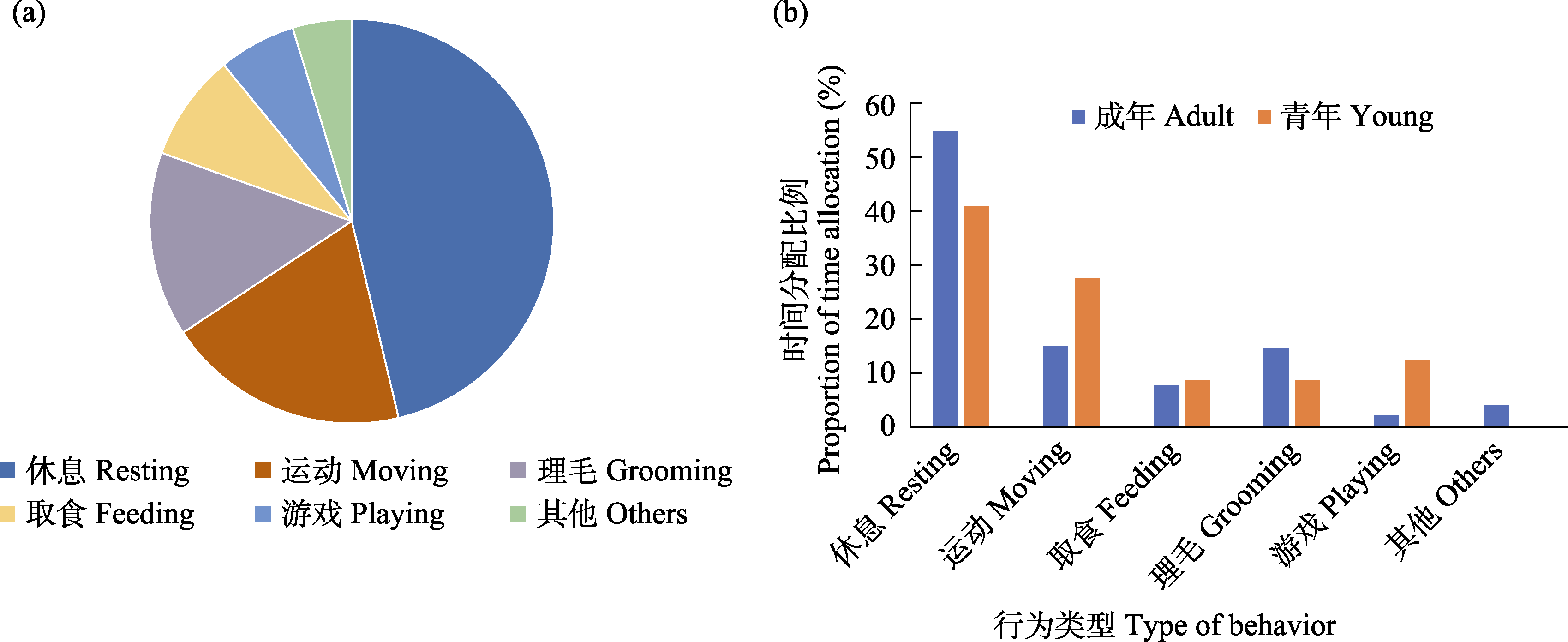
图1 成年与青年川金丝猴在不同行为类型上的时间分配比例。(a)总体; (b)成年与青年。
Fig. 1 Proportion of time allocation in different behavioral types of adult and young golden snub-nosed monkeys. (a) Overall; (b) Adult and young.
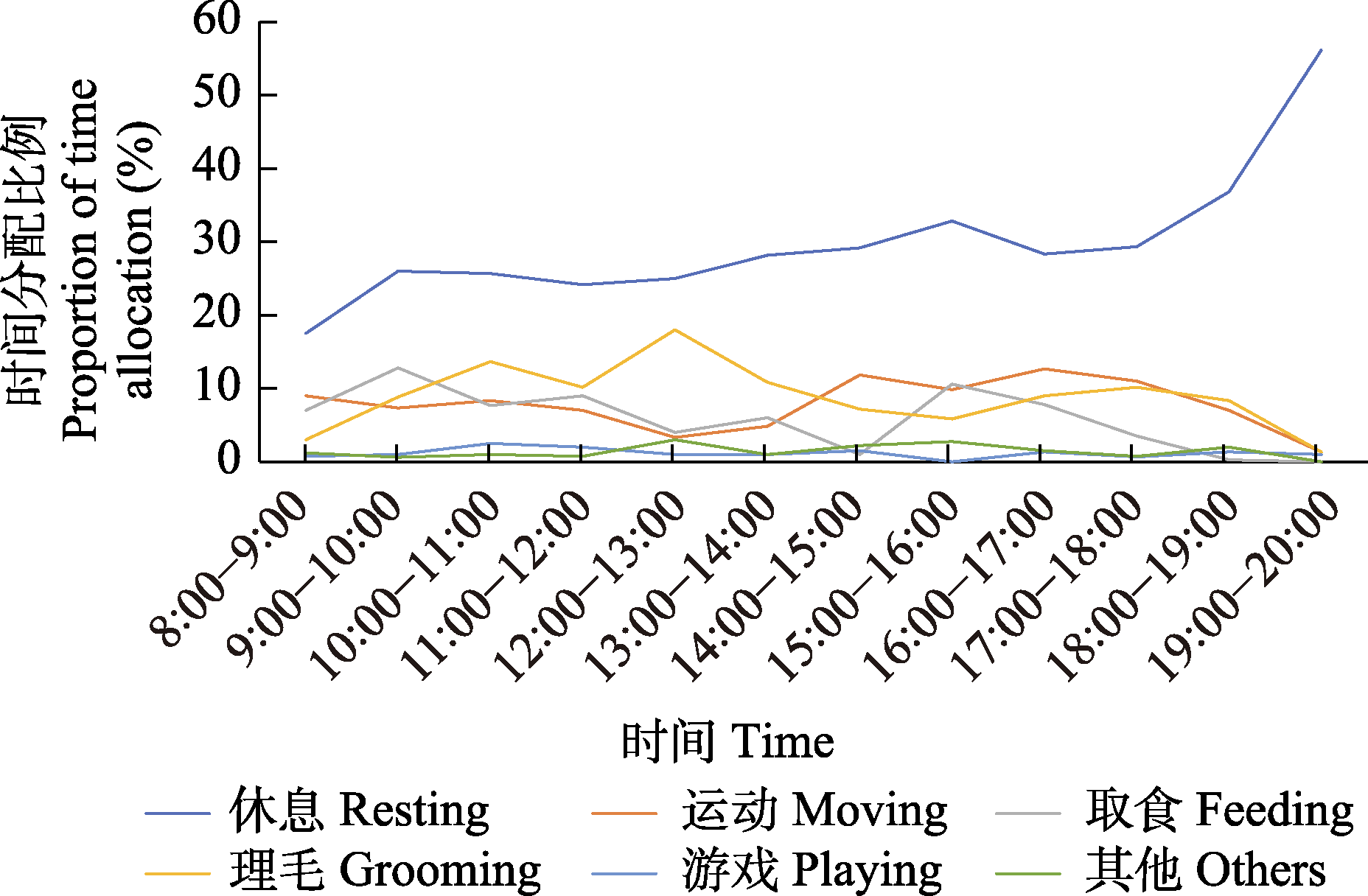
图2 川金丝猴主要活动行为节律
Fig. 2 Main activity behavior rhythms of golden snub-nosed monkeys
| [1] |
Boinski S, Swing SP, Gross TS, Davis JK (1999) Environmental enrichment of brown capuchins (Cebus apella): Behavioral and plasma and fecal cortisol measures of effectiveness. American Journal of Primatology, 48, 49-68.
PMID |
| [2] | Cui DY, Niu KF, Luen TC, Yang MY, Zhang YY, Zhang JG, Yang YQ (2014) Behavior coding and ethogram of Guizhou snub-nosed monkey (Rhinopithecus brelichi). Sichuan Journal of Zoology, 33, 815-828. (in Chinese with English abstract) |
| [崔多英, 牛克锋, Tan Chia Luen, Mouyu Yang, 张媛媛, 张金国, 杨业勤 (2014) 黔金丝猴的行为谱及PAE编码系统. 四川动物, 33, 815-828.] | |
| [3] | Dunbar RM (1988) Primate Social Systems. Croom Helm, London. |
| [4] | Evers DC (1994) Activity budgets of a marked common loon (Gavia immer) nesting population. Hydrobiologia, 279, 415-420. |
| [5] | Guo ST, Li BG, Watanabe K (2007) Diet and activity budget of Rhinopithecus roxellana in the Qinling Mountains, China. Journal of Primatology, 48, 268-276. |
| [6] | Han JL, Nazila A, Hu G (2013) Diurnal time budget of captive françois’ langur at Kunming Zoo. Journal of China West Normal University (Natural Sciences), 34, 22-27. (in Chinese with English abstract) |
| [韩家亮, 娜孜拉·阿克木汗, 胡刚 (2013) 昆明动物园笼养黑叶猴日活动时间分配. 西华师范大学学报(自然科学版), 34, 22-27.] | |
| [7] | He XL, Zhao QC, Feng YT, Li YF, Huang ZH, Li YB (2023) PAE coding system-based ethogram of captive françois’ langurs in Guangxi, China. Chinese Journal of Wildlife, 44, 727-743. (in Chinese with English abstract) |
| [何晓露, 赵秋程, 冯月婷, 李毅峰, 黄中豪, 李友邦 (2023) 基于PAE编码系统笼养黑叶猴的行为谱. 野生动物学报, 44, 727-743.] | |
| [8] |
Izawa K (1980) Social behavior of the wild black-capped capuchin (Cebus apella). Primates, 21, 443-467.
DOI URL |
| [9] | Jiang ZG (2000) Elk ethogram and PAE coding system. Acta Theriologica Sinica, 20, 1-12. (in Chinese with English abstract) |
| [蒋志刚 (2000) 麋鹿行为谱及PAE编码系统. 兽类学报, 20, 1-12.] | |
| [10] | Jiang ZG, Li CW, Zeng Y, Yu GZ, Lei RH (2004) Principles of Animal Behavior and Species Conservation Methods. Science Press, Beijing. (in Chinese) |
| [蒋志刚, 李春旺, 曾岩, 于广志, 雷润华 (2004) 动物行为原理与物种保护方法. 科学出版社, 北京.] | |
| [11] |
Li BG, Ren BP, Gao YF (1999) A change in the summer home range of golden snub-nosed monkeys in Yuhuangmiao, Qinling Mountains. Folia Primatologica, 70, 269-273.
PMID |
| [12] |
Li BG, Zhao DP (2007) Copulation behavior within one-male groups of wild Rhinopithecus roxellana in the Qinling Mountains of China. Primates, 48, 190-196.
DOI URL |
| [13] | Li DY, Jiang X, Huang CM, Zhou QH (2013) Playing behavior of captive immature Trachypithecus francoisi individuals. Sichuan Journal of Zoology, 32, 824-829. (in Chinese with English abstract) |
| [黎大勇, 江峡, 黄乘明, 周岐海 (2013) 笼养黑叶猴未成年个体的玩耍行为. 四川动物, 32, 824-829.] | |
| [14] | Li Y, Ren BP, Li YH, Li DY, Hu J (2013) Behavior ethogram and PAE coding system of Rhinopithecus bieti. Sichuan Journal of Zoology, 32, 641-650. (in Chinese with English abstract) |
| [李勇, 任宝平, 李艳红, 黎大勇, 胡杰 (2013) 滇金丝猴的行为谱及PAE编码系统. 四川动物, 32, 641-650.] | |
| [15] | Lü JQ, Li BG (2006) Diurnal activity budgets of the Sichuan snub-nosed monkey (Rhinopithecus roxellana) in the Qinling Mountains of China. Acta Theriologica Sinica, 26, 26-32. (in Chinese with English abstract) |
| [吕九全, 李保国 (2006) 秦岭川金丝猴的昼间活动时间分配. 兽类学报, 26, 26-32.] | |
| [16] | Luo H, Xiao X, Li YJ, Hou J, Dong X, Zhang JD, Bai WK, Li C (2019) Establishment of PAE coding system and ethogram of Rhinopithecus roxellana using infrared camera. Sichuan Journal of Zoology, 38, 646-656. (in Chinese with English abstract) |
| [罗欢, 肖雪, 李玉杰, 侯金, 董鑫, 张晋东, 白文科, 李程 (2019) 利用红外相机建立川金丝猴的行为谱及PAE编码系统. 四川动物, 38, 646-656.] | |
| [17] |
Marsh CW (2008) Time budget of Tana River red colobus. Folia Primatologica, 35, 30-50.
DOI URL |
| [18] | Mcfarland D (1981) The Oxford Companion to Animal Behavior. Oxford University Press, Oxford. |
| [19] | Miao XL, Ma Z, Guan H, Sai DJ, Huang JZ, Dou LZ (2006) Infants behavioral development of Sichuan snub-nosed monkeys (Rhinopithecus roxellana) in captive. Journal of Shandong Forestry Science and Technology, 36(6), 17-18, 16. (in Chinese with English abstract) |
| [苗秀莲, 马战, 管宏, 赛道建, 黄继志, 窦礼正 (2006) 笼养婴幼川金丝猴个体的行为发育. 山东林业科技, 36(6), 17-18, 16.] | |
| [20] |
Ning ZY, Dong GX, Tang H, Lan DY, Hu HJ (2017) Behavioral diversity of semi-captive hamadryas baboons (Papio hamadryas) on the basis of the PAE coding system. Biodiversity Science, 25, 1008-1018. (in Chinese with English abstract)
DOI URL |
| [宁致远, 董贵信, 唐虹, 蓝道英, 胡慧建 (2017) 基于PAE编码系统的半放养阿拉伯狒狒的行为多样性. 生物多样性, 25, 1008-1018.] | |
| [21] |
Post DG (1981) Activity patterns of yellow baboons (Papio cynocephalus) in the Amboseli National Park, Kenya. Animal Behaviour, 29, 357-374.
DOI URL |
| [22] | Shang YC (2014) Animal Ethology. Peking University Press, Beijing. (in Chinese) |
| [尚玉昌 (2014) 动物行为学. 北京大学出版社, 北京.] | |
| [23] | Tian JD, Wang ZL, Lu JQ, Guo XB, Liu JD (2011) PAE coding system-based ethogram of Taihangshan macaque (Macaca mulatta tcheliensis), Jiyuan, Henan Province, China. Acta Theriologica Sinica, 31, 125-140. (in Chinese with English abstract) |
| [田军东, 王振龙, 路纪琪, 郭相保, 刘金栋 (2011) 基于PAE编码系统的太行山猕猴行为谱. 兽类学报, 31, 125-140.] | |
| [24] | Wang Y, Xie M, He X, Meng XY, Zhang C, Gao YX, Ni QY (2019) The behavior ethogram and PAE coding system of captive Bengal slow lorises. Journal of Sichuan Agricultural University, 37, 860-867. (in Chinese with English abstract) |
| [王钰, 解萌, 何鑫, 孟祥云, 张晨, 高云霞, 倪庆永 (2019) 圈养蜂猴的行为谱及PAE编码系统. 四川农业大学学报, 37, 860-867.] | |
| [25] | Xiao J, Zheng WC, Jin GX, Li DY (2016) Ethogram of Macaca thibetana in Minshan Mountains on the basis of PAE coding system. Journal of Sichuan Forestry Science and Technology, 37(5), 55-60. (in Chinese with English abstract) |
| [肖俊, 郑维超, 金贵祥, 黎大勇 (2016) 基于PAE编码的岷山藏酋猴(Macaca thibetana)行为谱. 四川林业科技, 37(5), 55-60.] | |
| [26] | Yan CE, Jiang ZG, Li CW, Zeng Y, Tan NN, Xia SZ (2003) Relationship between sexual solicitations and urinary estradiol in the female Sichuan golden monkey (Rhinopithecus roxellana). Acta Zoologica Sinica, 49, 736-741. (in Chinese with English abstract) |
| [阎彩娥, 蒋志刚, 李春旺, 曾岩, 谭妮妮, 夏述忠 (2003) 雌性川金丝猴的邀配行为与尿液雌二醇水平的关系. 动物学报, 49, 736-741.] | |
| [27] |
Zhao DP, Li BG, Li YH, Wada K (2005) Extra-unit sexual behaviour among wild Sichuan snub-nosed monkeys (Rhinopithecus roxellana) in the Qinling Mountains of China. Folia Primatologica, 76, 172-176.
PMID |
| [28] | Zheng JL, Cheng K, Liu Y, Liu H, Pu LJ (2020) Effects of food and environmental enrichment on the diurnal behaviors of half free-living ring-tailed lemurs (Lemur catta). Chinese Journal of Wildlife, 41, 288-295. (in Chinese with English abstract) |
| [郑金玲, 程鲲, 刘莹, 刘辉, 蒲丽君 (2020) 食物和环境丰容对半散放环尾狐猴日行为活动的影响. 野生动物学报, 41, 288-295.] | |
| [29] | Zhu RH, Li DY, Yao G, Hu J (2016) The time budget of the captive Rhinopithecus roxellana. Journal of China West Normal University (Natural Sciences), 37, 253-255, 278. (in Chinese with English abstract) |
| [朱荣华, 黎大勇, 姚刚, 胡杰 (2016) 圈养川金丝猴活动时间分配研究. 西华师范大学学报(自然科学版), 37, 253-255, 278.] |
| [1] | 王倩倩, 陈孝国, 朱锐丰, 张明春, 王新, 李世林, 仁增江措, 彭武, 杨彪. 藏东南黑麝及其同域有蹄类物种的生态适应性差异[J]. 生物多样性, 2026, 34(5): 25433-. |
| [2] | 杨恩美, 杨祖伟, 鲁茜, 左安如, 李月体, 段玉宝. 云南盈江3种犀鸟繁殖期的行为谱及PAE编码系统的建立[J]. 生物多样性, 2026, 34(2): 25250-. |
| [3] | 周铝, 姚世贸, 赵战合, 郭画, 田成. 庞泉沟国家级自然保护区狍和野猪时空共存格局[J]. 生物多样性, 2026, 34(2): 25327-. |
| [4] | 岳可欣, 牛钟辉, 刘念, 徐琳, 吕韦韦, 徐茂宏, 崔绍朋. 山西历山三种同域分布食肉动物昼夜活动节律及与月光周期的关系[J]. 生物多样性, 2025, 33(9): 25084-. |
| [5] | 周铝, 郭画, 姚世贸, 田成. 王朗国家级自然保护区红腹角雉时空分布模式[J]. 生物多样性, 2025, 33(7): 24537-. |
| [6] | 黄定旭, 肖文宏, 白小节, 刘邦友, 黎源君, 梁盛, 肖治术, 刘伟. 赤水桫椤国家级自然保护区中小型食肉目动物昼夜活动节律的比较[J]. 生物多样性, 2025, 33(6): 24376-. |
| [7] | 罗敏, 杨永川, 靳程, 周礼华, 龙宇潇. 重庆中心城区城市森林兽类组成特征及其对人类活动的响应[J]. 生物多样性, 2025, 33(5): 24402-. |
| [8] | 朱芸, 王凯红, 李洪磊, 徐向龙, 段文斌, 陈浩, 邱国强, 陈卫华, 卢靖, 丁长青. 朱鹮非繁殖期行为谱及PAE编码系统[J]. 生物多样性, 2024, 32(9): 24075-. |
| [9] | 高翔, 潘淑芳, 孙争争, 李霁筱, 高天雨, 董路, 王宁. 广东珠海凤凰山和淇澳岛小灵猫的分布与活动节律[J]. 生物多样性, 2024, 32(8): 24045-. |
| [10] | 卢佳玉, 石小亿, 多立安, 王天明, 李治霖. 基于红外相机技术的天津城市地栖哺乳动物昼夜活动节律评价[J]. 生物多样性, 2024, 32(8): 23369-. |
| [11] | 宋芬, 周芸芸, 黄太福, 杨存存, 于桂清, 田书荣, 向左甫. 基于红外相机技术的林麝行为PAE编码与多样性[J]. 生物多样性, 2024, 32(6): 24042-. |
| [12] | 张明军, 王合升, 颜文博, 符运南, 王琦, 曾治高. 海南大田国家级自然保护区小灵猫的活动节律与栖息地选择[J]. 生物多样性, 2024, 32(6): 23420-. |
| [13] | 任嘉隆, 王永珍, 冯怡琳, 赵文智, 严祺涵, 秦畅, 方静, 辛未冬, 刘继亮. 基于陷阱法采集的河西走廊戈壁荒漠甲虫数据集[J]. 生物多样性, 2024, 32(2): 23375-. |
| [14] | 麦晓烔, 康佳, 李梓琛, 王天明. 东北虎豹国家公园梅花鹿活动节律及其对道路的响应[J]. 生物多样性, 2024, 32(11): 24178-. |
| [15] | 赵坤明, 陈圣宾, 杨锡福. 基于红外相机技术调查四川都江堰破碎化森林鸟兽多样性及优势种活动节律[J]. 生物多样性, 2023, 31(6): 22529-. |
| 阅读次数 | ||||||
|
全文 |
|
|||||
|
摘要 |
|
|||||
备案号:京ICP备16067583号-7
Copyright © 2026 版权所有 《生物多样性》编辑部
地址: 北京香山南辛村20号, 邮编:100093
电话: 010-62836137, 62836665 E-mail: biodiversity@ibcas.ac.cn
