

生物多样性 ›› 2026, Vol. 34 ›› Issue (6): 25478. DOI: 10.17520/biods.2025478 cstr: 32101.14.biods.2025478
蔡莉1,2,#( ), 葛丽萍1,*,#()(
 ), 彭丹晓2,3(), 胡海花2,3(), 陈之端2,3(), 牛艳婷2,*()()
收稿日期:2025-11-25
接受日期:2026-02-05
出版日期:2026-06-20
发布日期:2026-07-30
通讯作者:
*共同通讯作者 E-mail: 2052631809@qq.com; niuyanting@ibcas.ac.cn
作者简介:#共同第一作者
基金资助:
Li Cai1,2,#(), Liping Ge1,*,#()(), Danxiao Peng2,3(), Haihua Hu2,3(), Zhiduan Chen2,3(), Yanting Niu2,*()()
Received:2025-11-25
Accepted:2026-02-05
Online:2026-06-20
Published:2026-07-30
Contact:
*Co-authors for correspondence. E-mail: 2052631809@qq.com; niuyanting@ibcas.ac.cn
About author:#Co-first authors
Supported by:摘要: 预测未来气候变化下植物分布区的改变, 是评估物种生存潜力和生物多样性风险的重要依据。东亚-北美间断分布属因其跨大陆的亲缘关系与生态位保守性, 成为揭示气候变化响应区域差异的理想研究对象。本研究选取15个东亚-北美间断分布属(洲际物种分布范围相当)的71种植物, 利用MaxEnt模型模拟了其当前及未来的潜在分布区, 从适生区面积变化、纬度迁移及生境破碎化程度3个方面, 对比分析了东亚与北美区域物种及不同生活型植物对未来气候变化的响应差异。结果表明, 东亚-北美间断分布属整体呈现出相似的响应模式, 但也存在差异: (1)北美的物种相较于东亚的物种对全球气候变化的响应更敏感, 表现在面积显著变化的物种比例更高、分布区北移趋势更普遍且生境破碎化程度加剧更明显。(2)乔木和藤本植物在北美表现出更强烈的响应, 具体为分布区变化幅度更大、迁移趋势更显著、生境破碎化更剧烈; 灌木在两地表现出相当的迁移趋势; 草本在两地表现各异, 在东亚受地形限制, 表现为更强的破碎化, 而在北美则表现为扩张与连通性增强。本研究量化了东亚-北美间断分布类群对未来气候变化的响应差异, 揭示宏观地形格局与生活型特性共同驱动该差异, 并凸显地形在决定物种气候韧性中的重要作用, 为识别保护优先区、制定生活型特异性保护策略及实施适应性管理提供了关键科学依据。
蔡莉, 葛丽萍, 彭丹晓, 胡海花, 陈之端, 牛艳婷 (2026) 未来气候变化情景下东亚-北美间断分布属植物潜在分布区比较. 生物多样性, 34, 25478. DOI: 10.17520/biods.2025478.
Li Cai, Liping Ge, Danxiao Peng, Haihua Hu, Zhiduan Chen, Yanting Niu (2026) Comparison of potential distribution of East Asian-North American disjunct distribution genera in response to future climate change. Biodiversity Science, 34, 25478. DOI: 10.17520/biods.2025478.
| 物种比 Species ratio (EA : NA) | 属 Genus | 物种 Species | 生活型 Life form | 地区 Region | 中高适生区面积变化率 Rate of change in mid-to-high suitable habitat area (%) | 高适生区面积变化率 Rate of change in high suitable habitat area (%) | 质心迁移纬度 Latitudinal shift of the centroid | |
|---|---|---|---|---|---|---|---|---|
| 1 : 1 | 鹅掌楸属 Liriodendron | 鹅掌楸 L. chinense | 乔木 Trees | 东亚 EA | -0.14 | 22.17 | -0.063 | |
| 鹅掌楸属 Liriodendron | 北美鹅掌楸 L. tulipifera | 乔木 Trees | 北美 NA | 4.83 | -11.08 | 3.860* | ||
| 檀梨属 Pyrularia | 檀梨 P. edulis | 灌木 Shurbs | 东亚 EA | 19.94 | 34.03 | 1.580* | ||
| 檀梨属 Pyrularia | 美洲檀梨 P. pubera# | 灌木 Shurbs | 北美 NA | 6.31 | -2.32 | 2.173* | ||
| 扯根菜属 Penthorum | 扯根菜 P. chinense | 草本 Herbs | 东亚 EA | 25.16 | -2.86 | 2.654* | ||
| 扯根菜属 Penthorum | 北美扯根菜 P. sedoides | 草本 Herbs | 北美 NA | 27.47 | 41.15 | 2.849* | ||
| 凌霄属 Campsis | 凌霄 C. grandiflora | 藤本 Lianas | 东亚 EA | 25.74 | 59.79 | 0.862 | ||
| 凌霄属 Campsis | 厚萼凌霄 C. radicans | 藤本 Lianas | 北美 NA | 23.09 | -9.32 | 1.375* | ||
| 荷包藤属 Adlumia | 荷包藤 A. asiatica | 草本 Herbs | 东亚 EA | 40.11 | 59.98 | 3.422* | ||
| 荷包藤属 Adlumia | 北美荷包藤 A. fungosa | 草本 Herbs | 北美 NA | -39.79 | -51.96 | 3.671* | ||
| n : 1 | 崖柏属 Thuja | 朝鲜崖柏 T. koraiensis# | 乔木 Trees | 东亚 EA | -4.66 | -36.16 | 1.210* | |
| 崖柏属 Thuja | 日本香柏 T. standishii# | 乔木 Trees | 东亚 EA | -35.46 | -3.07 | 0.002 | ||
| 崖柏属 Thuja | 崖柏 T. sutchuenensis# | 乔木 Trees | 东亚 EA | 4.80 | 9.12 | -0.023 | ||
| 崖柏属 Thuja | 北美香柏 T. occidentalis | 乔木 Trees | 北美 NA | -2.43 | -2.25 | 0.872 | ||
| 崖柏属 Thuja | 北美乔柏 T. plicata | 乔木 Trees | 北美 NA | 7.99 | 12.99 | 1.590* | ||
| 刺人参属 Oplopanax | 刺参 O. elatus# | 灌木 Shurbs | 东亚 EA | 9.88 | 69.55 | 1.851* | ||
| 刺人参属 Oplopanax | 日本刺参 O. japonicus # | 灌木 Shurbs | 东亚 EA | -7.63 | -9.86 | 0.741 | ||
| 刺人参属 Oplopanax | 美洲刺参 O. horridus | 灌木 Shurbs | 北美 NA | 3.29 | 17.98 | 1.474* | ||
| 金刚大属 Croomia | 异被金刚大 C. heterosepala# | 草本 Herbs | 东亚 EA | -24.04 | -32.30 | 0.749 | ||
| 金刚大属 Croomia | 紫心金刚大 C. hyugaensis# | 草本 Herbs | 东亚 EA | 8.76 | 3.93 | 1.251* | ||
| 金刚大属 Croomia | 金刚大 C. japonica# | 草本 Herbs | 东亚 EA | 1.90 | 47.34 | 0.784 | ||
| 金刚大属 Croomia | 北美金刚大 C. pauciflora# | 草本 Herbs | 北美 NA | 125.74 | 195.72 | 0.765 | ||
| 土圞儿属 Apios | 肉色土圞儿 A. carnea | 草本 Herbs | 东亚 EA | -7.32 | -0.27 | 0.281 | ||
| 土圞儿属 Apios | 云南土圞儿 A. delavayi | 草本 Herbs | 东亚 EA | -12.35 | -15.33 | 0.452 | ||
| 土圞儿属 Apios | 土圞儿 A. fortunei | 草本 Herbs | 东亚 EA | -17.21 | -8.52 | 0.010 | ||
| 土圞儿属 Apios | 大花土圞儿 A. macrantha | 草本 Herbs | 东亚 EA | -9.69 | -17.67 | 0.633 | ||
| 土圞儿属 Apios | 长延土圞儿 A. priceana# | 草本 Herbs | 北美 NA | 185.31 | 378.89 | 1.070* | ||
| 土圞儿属 Apios | 北美土圞儿 A. americana | 草本 Herbs | 北美 NA | 15.49 | -19.34 | 2.855* | ||
| 地锦属 Parthenocissus | 三叶地锦 P. semicordata | 藤本 Lianas | 东亚 EA | -2.44 | 2.46 | 0.380 | ||
| 地锦属 Parthenocissus | 小叶地锦 P. chinensis | 藤本 Lianas | 东亚 EA | 3.84 | -2.24 | 0.000 | ||
| 地锦属 Parthenocissus | 长柄地锦 P. feddei | 藤本 Lianas | 东亚 EA | -13.00 | -28.98 | 0.167 | ||
| 地锦属 Parthenocissus | 三叉虎 P. heterophylla | 藤本 Lianas | 东亚 EA | -19.07 | -19.39 | 0.097 | ||
| 地锦属 Parthenocissus | 栓翅地锦 P. suberosa | 藤本 Lianas | 东亚 EA | 34.40 | 47.02 | 0.224 | ||
| 地锦属 Parthenocissus | 异叶地锦 P. dalzielii | 藤本 Lianas | 东亚 EA | 7.34 | 25.58 | 1.868* | ||
| 地锦属 Parthenocissus | 地锦 P. tricuspidata | 藤本 Lianas | 东亚 EA | -6.95 | 70.11 | -0.350 | ||
| 地锦属 Parthenocissus | 绿叶地锦 P. laetevirens | 藤本 Lianas | 东亚 EA | -0.16 | 1.99 | 0.320 | ||
| 地锦属 Parthenocissus | 花叶地锦 P. henryan | 藤本 Lianas | 东亚 EA | 20.73 | 14.61 | 0.628 | ||
| 地锦属 Parthenocissus | 七叶地锦 P. heptaphylla | 藤本 Lianas | 北美 NA | 56.69 | 63.62 | 0.755 | ||
| 地锦属 Parthenocissus | 五叶地锦 P. quinquefolia | 藤本 Lianas | 北美 NA | 89.95 | 265.02 | 1.351* | ||
| 地锦属 Parthenocissus | 葡萄地锦 P. vitacea | 藤本 Lianas | 北美 NA | -6.91 | 1.78 | 2.620* | ||
| 物种比 Species ratio (EA : NA) | 属 Genus | 物种 Species | 生活型 Life form | 地区 Region | 中高适生区面积变化率 Rate of change in mid-to-high suitable habitat area (%) | 高适生区面积变化率 Rate of change in high suitable habitat area (%) | 质心迁移纬度 Latitudinal shift of the centroid | |
| 1 : n | 山核桃属 Carya | 山核桃 C. cathayensis | 乔木 Trees | 东亚 EA | 39.19 | 59.77 | 1.338* | |
| 山核桃属 Carya | 湖南山核桃 C. hunanensis | 乔木 Trees | 东亚 EA | 13.58 | 36.23 | 0.317 | ||
| 山核桃属 Carya | 贵州山核桃 C. kweichowensis# | 乔木 Trees | 东亚 EA | 34.51 | 51.33 | 0.000 | ||
| 山核桃属 Carya | 越南山核桃 C. tonkinensis# | 乔木 Trees | 东亚 EA | 14.93 | 17.44 | -0.593 | ||
| 山核桃属 Carya | 水山核桃 C. aquatica | 乔木 Trees | 北美 NA | 41.16 | 38.65 | 1.160* | ||
| 山核桃属 Carya | 苦味山核桃 C. cordiformis | 乔木 Trees | 北美 NA | 32.15 | 30.56 | 2.712 | ||
| 山核桃属 Carya | 佛罗里达山核桃 C. floridana# | 乔木 Trees | 北美 NA | 44.07 | -16.72 | 0.034 | ||
| 山核桃属 Carya | 沼泽山核桃 C. glabra | 乔木 Trees | 北美 NA | 34.75 | -4.25 | 4.774* | ||
| 山核桃属 Carya | 美国山核桃 C. illinoinensis | 乔木 Trees | 北美 NA | 11.94 | 15.38 | 1.251* | ||
| 山核桃属 Carya | 条裂山核桃 C. laciniosa | 乔木 Trees | 北美 NA | 23.97 | 10.70 | 1.813* | ||
| 山核桃属 Carya | 肉豆蔻山核桃 C. myristiciformis# | 乔木 Trees | 北美 NA | 56.80 | 62.36 | 1.186* | ||
| 山核桃属 Carya | 粗皮山核桃 C. ovata | 乔木 Trees | 北美 NA | 12.51 | 11.00 | 1.321* | ||
| 山核桃属 Carya | 苍白山核桃 C. pallida | 乔木 Trees | 北美 NA | 22.61 | -41.09 | 1.700 | ||
| 山核桃属 Carya | 墨西哥山核桃 C. palmeri# | 乔木 Trees | 北美 NA | -28.64 | -18.59 | 0.000 | ||
| 山核桃属 Carya | 得州山核桃 C. texana | 乔木 Trees | 北美 NA | 31.42 | 31.42 | 1.374* | ||
| 山核桃属 Carya | 硬壳山核桃 C. tomentosa | 乔木 Trees | 北美 NA | 28.87 | 23.06 | 1.710* | ||
| 夏蜡梅属 Calycanthus | 夏蜡梅 C. chinensis# | 灌木 Shurbs | 东亚 EA | 22.07 | 25.25 | 1.012* | ||
| 夏蜡梅属 Calycanthus | 美国蜡梅 C. floridus | 灌木 Shurbs | 北美 NA | 17.03 | 10.74 | 1.242* | ||
| 夏蜡梅属 Calycanthus | 加州夏蜡梅 C. occidentalis# | 灌木 Shurbs | 北美 NA | -0.68 | -8.87 | 0.375 | ||
| 红毛七属 Caulophyllum | 红毛七 C. robustum | 草本 Herbs | 东亚 EA | 1.54 | 9.35 | 5.709* | ||
| 红毛七属 Caulophyllum | 大红毛七 C. giganteum | 草本 Herbs | 北美 NA | 13.43 | 7.06 | 2.831* | ||
| 红毛七属 Caulophyllum | 唐松草状红毛七 C. thalictroides | 草本 Herbs | 北美 NA | 1.51 | -11.44 | 3.860* | ||
| 梓属 Catalpa | 楸 C. bungei | 乔木 Trees | 东亚 EA | 6.72 | 13.65 | 0.181 | ||
| 梓属 Catalpa | 梓 C. ovata | 乔木 Trees | 东亚 EA | 9.76 | -7.58 | 0.328 | ||
| 梓属 Catalpa | 美国梓树 C. bignonioides | 乔木 Trees | 北美 NA | 23.20 | 12.63 | 1.868* | ||
| 梓属 Catalpa | 短柄梓 C. brevipes# | 乔木 Trees | 北美 NA | 1.05 | 39.25 | -1.837* | ||
| 梓属 Catalpa | 大果梓 C. macrocarpa# | 乔木 Trees | 北美 NA | 125.91 | 187.02 | 1.111* | ||
| 梓属 Catalpa | 黄金树 C. speciosa | 乔木 Trees | 北美 NA | -15.38 | -1.92 | 1.473* | ||
| 钩吻属 Gelsemium | 钩吻 G. elegans | 藤本 Lianas | 东亚 EA | 19.12 | 4.59 | 1.326* | ||
| 钩吻属 Gelsemium | 沼生钩吻 G. rankinii# | 藤本 Lianas | 北美 NA | 32.36 | 55.98 | 0.114 | ||
| 钩吻属 Gelsemium | 常绿钩吻藤 G. sempervirens | 藤本 Lianas | 北美 NA | 18.32 | 24.07 | 1.308* | ||
表1 基于MaxEnt模拟的东亚(EA)-北美(NA)间断分布属71种植物潜在适生区的变化程度
Table 1 Potential suitable habitat change of 71 plant species in East Asian (EA)-North American (NA) disjunct distribution genera based on MaxEnt modeling
| 物种比 Species ratio (EA : NA) | 属 Genus | 物种 Species | 生活型 Life form | 地区 Region | 中高适生区面积变化率 Rate of change in mid-to-high suitable habitat area (%) | 高适生区面积变化率 Rate of change in high suitable habitat area (%) | 质心迁移纬度 Latitudinal shift of the centroid | |
|---|---|---|---|---|---|---|---|---|
| 1 : 1 | 鹅掌楸属 Liriodendron | 鹅掌楸 L. chinense | 乔木 Trees | 东亚 EA | -0.14 | 22.17 | -0.063 | |
| 鹅掌楸属 Liriodendron | 北美鹅掌楸 L. tulipifera | 乔木 Trees | 北美 NA | 4.83 | -11.08 | 3.860* | ||
| 檀梨属 Pyrularia | 檀梨 P. edulis | 灌木 Shurbs | 东亚 EA | 19.94 | 34.03 | 1.580* | ||
| 檀梨属 Pyrularia | 美洲檀梨 P. pubera# | 灌木 Shurbs | 北美 NA | 6.31 | -2.32 | 2.173* | ||
| 扯根菜属 Penthorum | 扯根菜 P. chinense | 草本 Herbs | 东亚 EA | 25.16 | -2.86 | 2.654* | ||
| 扯根菜属 Penthorum | 北美扯根菜 P. sedoides | 草本 Herbs | 北美 NA | 27.47 | 41.15 | 2.849* | ||
| 凌霄属 Campsis | 凌霄 C. grandiflora | 藤本 Lianas | 东亚 EA | 25.74 | 59.79 | 0.862 | ||
| 凌霄属 Campsis | 厚萼凌霄 C. radicans | 藤本 Lianas | 北美 NA | 23.09 | -9.32 | 1.375* | ||
| 荷包藤属 Adlumia | 荷包藤 A. asiatica | 草本 Herbs | 东亚 EA | 40.11 | 59.98 | 3.422* | ||
| 荷包藤属 Adlumia | 北美荷包藤 A. fungosa | 草本 Herbs | 北美 NA | -39.79 | -51.96 | 3.671* | ||
| n : 1 | 崖柏属 Thuja | 朝鲜崖柏 T. koraiensis# | 乔木 Trees | 东亚 EA | -4.66 | -36.16 | 1.210* | |
| 崖柏属 Thuja | 日本香柏 T. standishii# | 乔木 Trees | 东亚 EA | -35.46 | -3.07 | 0.002 | ||
| 崖柏属 Thuja | 崖柏 T. sutchuenensis# | 乔木 Trees | 东亚 EA | 4.80 | 9.12 | -0.023 | ||
| 崖柏属 Thuja | 北美香柏 T. occidentalis | 乔木 Trees | 北美 NA | -2.43 | -2.25 | 0.872 | ||
| 崖柏属 Thuja | 北美乔柏 T. plicata | 乔木 Trees | 北美 NA | 7.99 | 12.99 | 1.590* | ||
| 刺人参属 Oplopanax | 刺参 O. elatus# | 灌木 Shurbs | 东亚 EA | 9.88 | 69.55 | 1.851* | ||
| 刺人参属 Oplopanax | 日本刺参 O. japonicus # | 灌木 Shurbs | 东亚 EA | -7.63 | -9.86 | 0.741 | ||
| 刺人参属 Oplopanax | 美洲刺参 O. horridus | 灌木 Shurbs | 北美 NA | 3.29 | 17.98 | 1.474* | ||
| 金刚大属 Croomia | 异被金刚大 C. heterosepala# | 草本 Herbs | 东亚 EA | -24.04 | -32.30 | 0.749 | ||
| 金刚大属 Croomia | 紫心金刚大 C. hyugaensis# | 草本 Herbs | 东亚 EA | 8.76 | 3.93 | 1.251* | ||
| 金刚大属 Croomia | 金刚大 C. japonica# | 草本 Herbs | 东亚 EA | 1.90 | 47.34 | 0.784 | ||
| 金刚大属 Croomia | 北美金刚大 C. pauciflora# | 草本 Herbs | 北美 NA | 125.74 | 195.72 | 0.765 | ||
| 土圞儿属 Apios | 肉色土圞儿 A. carnea | 草本 Herbs | 东亚 EA | -7.32 | -0.27 | 0.281 | ||
| 土圞儿属 Apios | 云南土圞儿 A. delavayi | 草本 Herbs | 东亚 EA | -12.35 | -15.33 | 0.452 | ||
| 土圞儿属 Apios | 土圞儿 A. fortunei | 草本 Herbs | 东亚 EA | -17.21 | -8.52 | 0.010 | ||
| 土圞儿属 Apios | 大花土圞儿 A. macrantha | 草本 Herbs | 东亚 EA | -9.69 | -17.67 | 0.633 | ||
| 土圞儿属 Apios | 长延土圞儿 A. priceana# | 草本 Herbs | 北美 NA | 185.31 | 378.89 | 1.070* | ||
| 土圞儿属 Apios | 北美土圞儿 A. americana | 草本 Herbs | 北美 NA | 15.49 | -19.34 | 2.855* | ||
| 地锦属 Parthenocissus | 三叶地锦 P. semicordata | 藤本 Lianas | 东亚 EA | -2.44 | 2.46 | 0.380 | ||
| 地锦属 Parthenocissus | 小叶地锦 P. chinensis | 藤本 Lianas | 东亚 EA | 3.84 | -2.24 | 0.000 | ||
| 地锦属 Parthenocissus | 长柄地锦 P. feddei | 藤本 Lianas | 东亚 EA | -13.00 | -28.98 | 0.167 | ||
| 地锦属 Parthenocissus | 三叉虎 P. heterophylla | 藤本 Lianas | 东亚 EA | -19.07 | -19.39 | 0.097 | ||
| 地锦属 Parthenocissus | 栓翅地锦 P. suberosa | 藤本 Lianas | 东亚 EA | 34.40 | 47.02 | 0.224 | ||
| 地锦属 Parthenocissus | 异叶地锦 P. dalzielii | 藤本 Lianas | 东亚 EA | 7.34 | 25.58 | 1.868* | ||
| 地锦属 Parthenocissus | 地锦 P. tricuspidata | 藤本 Lianas | 东亚 EA | -6.95 | 70.11 | -0.350 | ||
| 地锦属 Parthenocissus | 绿叶地锦 P. laetevirens | 藤本 Lianas | 东亚 EA | -0.16 | 1.99 | 0.320 | ||
| 地锦属 Parthenocissus | 花叶地锦 P. henryan | 藤本 Lianas | 东亚 EA | 20.73 | 14.61 | 0.628 | ||
| 地锦属 Parthenocissus | 七叶地锦 P. heptaphylla | 藤本 Lianas | 北美 NA | 56.69 | 63.62 | 0.755 | ||
| 地锦属 Parthenocissus | 五叶地锦 P. quinquefolia | 藤本 Lianas | 北美 NA | 89.95 | 265.02 | 1.351* | ||
| 地锦属 Parthenocissus | 葡萄地锦 P. vitacea | 藤本 Lianas | 北美 NA | -6.91 | 1.78 | 2.620* | ||
| 物种比 Species ratio (EA : NA) | 属 Genus | 物种 Species | 生活型 Life form | 地区 Region | 中高适生区面积变化率 Rate of change in mid-to-high suitable habitat area (%) | 高适生区面积变化率 Rate of change in high suitable habitat area (%) | 质心迁移纬度 Latitudinal shift of the centroid | |
| 1 : n | 山核桃属 Carya | 山核桃 C. cathayensis | 乔木 Trees | 东亚 EA | 39.19 | 59.77 | 1.338* | |
| 山核桃属 Carya | 湖南山核桃 C. hunanensis | 乔木 Trees | 东亚 EA | 13.58 | 36.23 | 0.317 | ||
| 山核桃属 Carya | 贵州山核桃 C. kweichowensis# | 乔木 Trees | 东亚 EA | 34.51 | 51.33 | 0.000 | ||
| 山核桃属 Carya | 越南山核桃 C. tonkinensis# | 乔木 Trees | 东亚 EA | 14.93 | 17.44 | -0.593 | ||
| 山核桃属 Carya | 水山核桃 C. aquatica | 乔木 Trees | 北美 NA | 41.16 | 38.65 | 1.160* | ||
| 山核桃属 Carya | 苦味山核桃 C. cordiformis | 乔木 Trees | 北美 NA | 32.15 | 30.56 | 2.712 | ||
| 山核桃属 Carya | 佛罗里达山核桃 C. floridana# | 乔木 Trees | 北美 NA | 44.07 | -16.72 | 0.034 | ||
| 山核桃属 Carya | 沼泽山核桃 C. glabra | 乔木 Trees | 北美 NA | 34.75 | -4.25 | 4.774* | ||
| 山核桃属 Carya | 美国山核桃 C. illinoinensis | 乔木 Trees | 北美 NA | 11.94 | 15.38 | 1.251* | ||
| 山核桃属 Carya | 条裂山核桃 C. laciniosa | 乔木 Trees | 北美 NA | 23.97 | 10.70 | 1.813* | ||
| 山核桃属 Carya | 肉豆蔻山核桃 C. myristiciformis# | 乔木 Trees | 北美 NA | 56.80 | 62.36 | 1.186* | ||
| 山核桃属 Carya | 粗皮山核桃 C. ovata | 乔木 Trees | 北美 NA | 12.51 | 11.00 | 1.321* | ||
| 山核桃属 Carya | 苍白山核桃 C. pallida | 乔木 Trees | 北美 NA | 22.61 | -41.09 | 1.700 | ||
| 山核桃属 Carya | 墨西哥山核桃 C. palmeri# | 乔木 Trees | 北美 NA | -28.64 | -18.59 | 0.000 | ||
| 山核桃属 Carya | 得州山核桃 C. texana | 乔木 Trees | 北美 NA | 31.42 | 31.42 | 1.374* | ||
| 山核桃属 Carya | 硬壳山核桃 C. tomentosa | 乔木 Trees | 北美 NA | 28.87 | 23.06 | 1.710* | ||
| 夏蜡梅属 Calycanthus | 夏蜡梅 C. chinensis# | 灌木 Shurbs | 东亚 EA | 22.07 | 25.25 | 1.012* | ||
| 夏蜡梅属 Calycanthus | 美国蜡梅 C. floridus | 灌木 Shurbs | 北美 NA | 17.03 | 10.74 | 1.242* | ||
| 夏蜡梅属 Calycanthus | 加州夏蜡梅 C. occidentalis# | 灌木 Shurbs | 北美 NA | -0.68 | -8.87 | 0.375 | ||
| 红毛七属 Caulophyllum | 红毛七 C. robustum | 草本 Herbs | 东亚 EA | 1.54 | 9.35 | 5.709* | ||
| 红毛七属 Caulophyllum | 大红毛七 C. giganteum | 草本 Herbs | 北美 NA | 13.43 | 7.06 | 2.831* | ||
| 红毛七属 Caulophyllum | 唐松草状红毛七 C. thalictroides | 草本 Herbs | 北美 NA | 1.51 | -11.44 | 3.860* | ||
| 梓属 Catalpa | 楸 C. bungei | 乔木 Trees | 东亚 EA | 6.72 | 13.65 | 0.181 | ||
| 梓属 Catalpa | 梓 C. ovata | 乔木 Trees | 东亚 EA | 9.76 | -7.58 | 0.328 | ||
| 梓属 Catalpa | 美国梓树 C. bignonioides | 乔木 Trees | 北美 NA | 23.20 | 12.63 | 1.868* | ||
| 梓属 Catalpa | 短柄梓 C. brevipes# | 乔木 Trees | 北美 NA | 1.05 | 39.25 | -1.837* | ||
| 梓属 Catalpa | 大果梓 C. macrocarpa# | 乔木 Trees | 北美 NA | 125.91 | 187.02 | 1.111* | ||
| 梓属 Catalpa | 黄金树 C. speciosa | 乔木 Trees | 北美 NA | -15.38 | -1.92 | 1.473* | ||
| 钩吻属 Gelsemium | 钩吻 G. elegans | 藤本 Lianas | 东亚 EA | 19.12 | 4.59 | 1.326* | ||
| 钩吻属 Gelsemium | 沼生钩吻 G. rankinii# | 藤本 Lianas | 北美 NA | 32.36 | 55.98 | 0.114 | ||
| 钩吻属 Gelsemium | 常绿钩吻藤 G. sempervirens | 藤本 Lianas | 北美 NA | 18.32 | 24.07 | 1.308* | ||
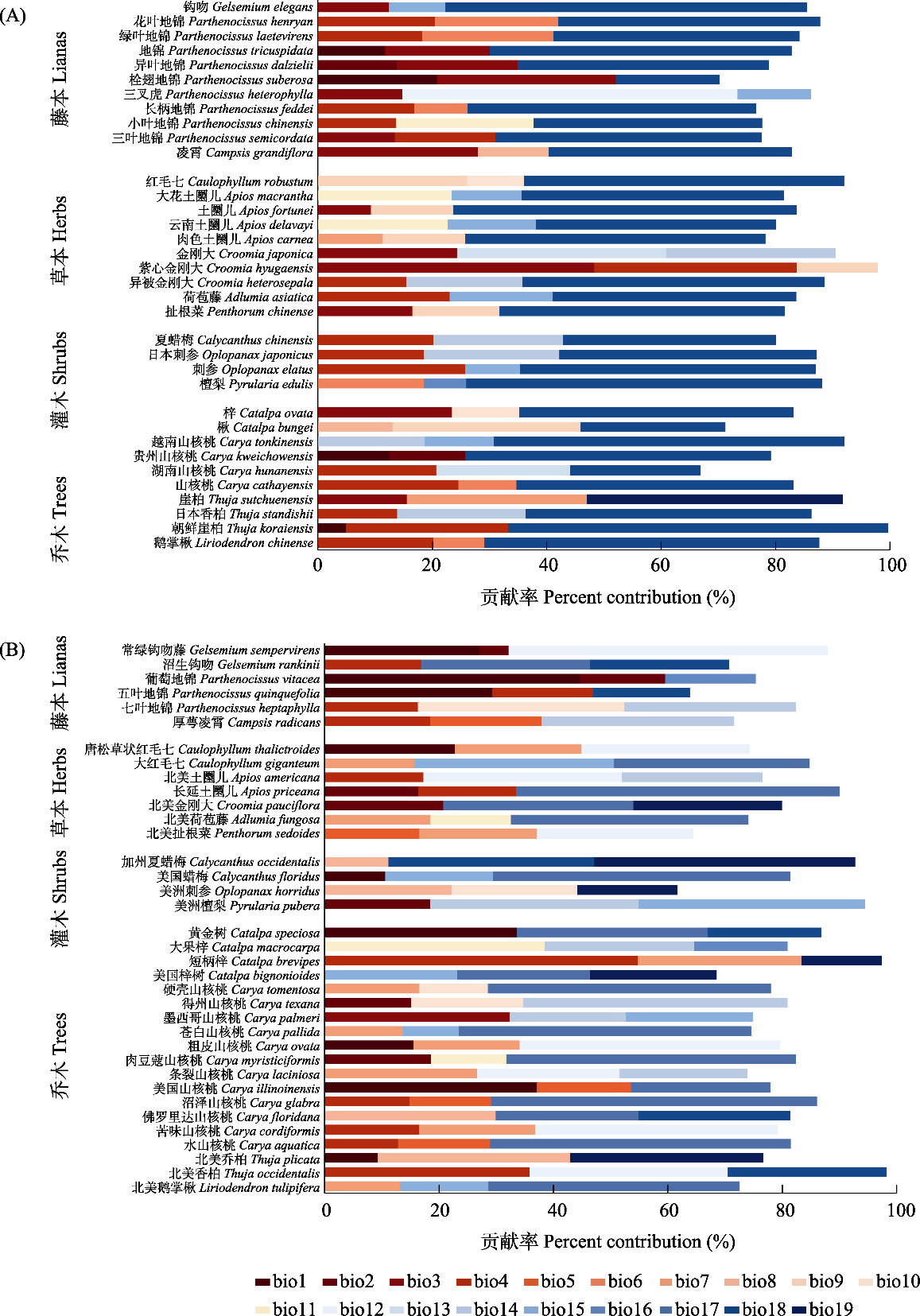
图1 影响东亚(A)和北美(B)不同生活型植物分布的关键气候因子。各气候因子(bio1-bio19)定义详见附录1。
Fig. 1 Key climate factors affecting the distribution of plants with different life forms in East Asia (A) and North America (B). Definitions of climate factors (bio1-bio19) are provided in Appendix 1.
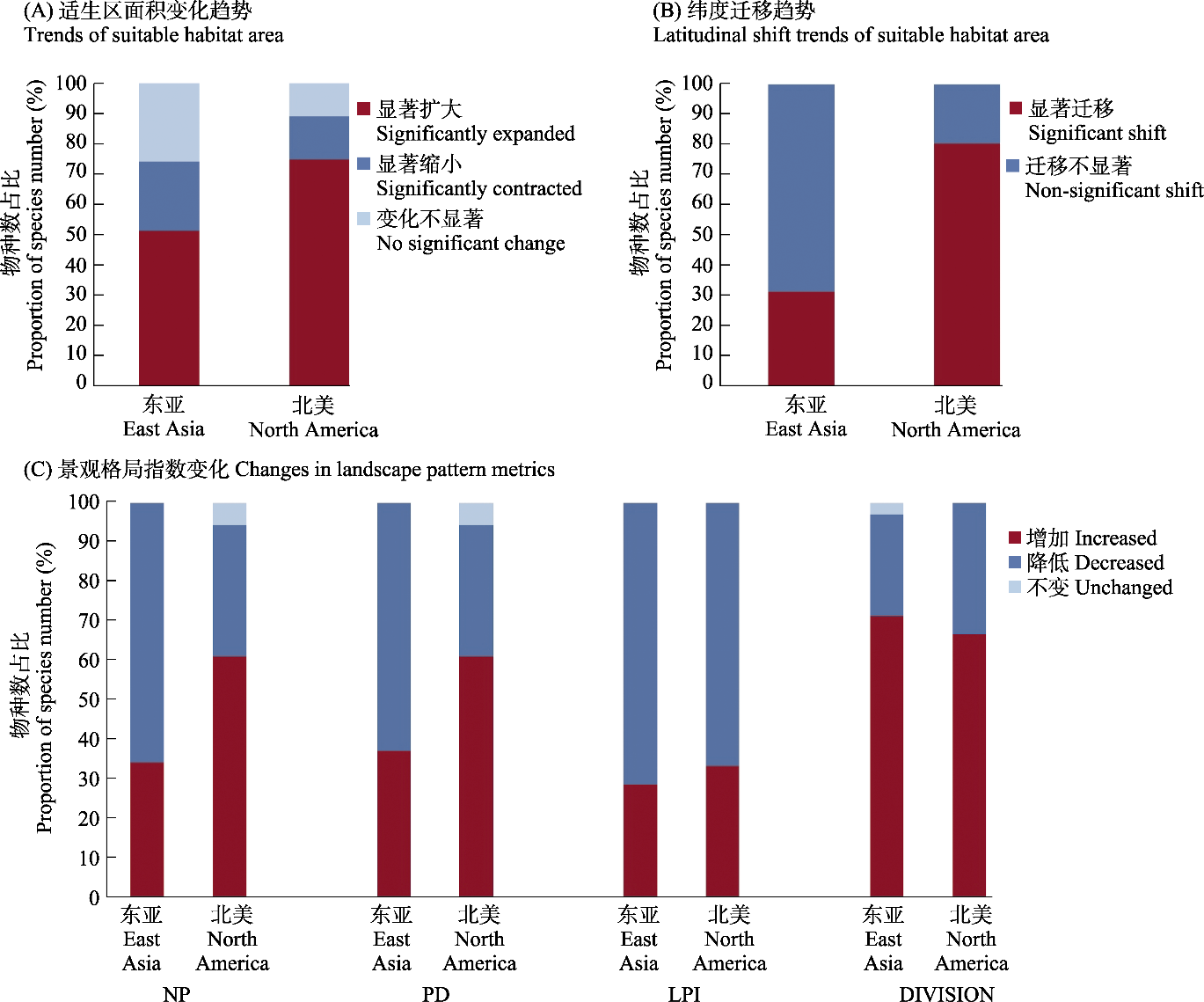
图2 东亚-北美间断分布属植物未来适生区变化趋势。NP: 斑块数量; PD: 斑块密度; LPI: 最大斑块指数; DIVISION: 景观分割指数。
Fig. 2 Future trends in suitable habitat for East Asian-North American disjunct distribution genera. NP, Number of patches; PD, Patch density; LPI, Largest patch index; DIVISION, Landscape division index.
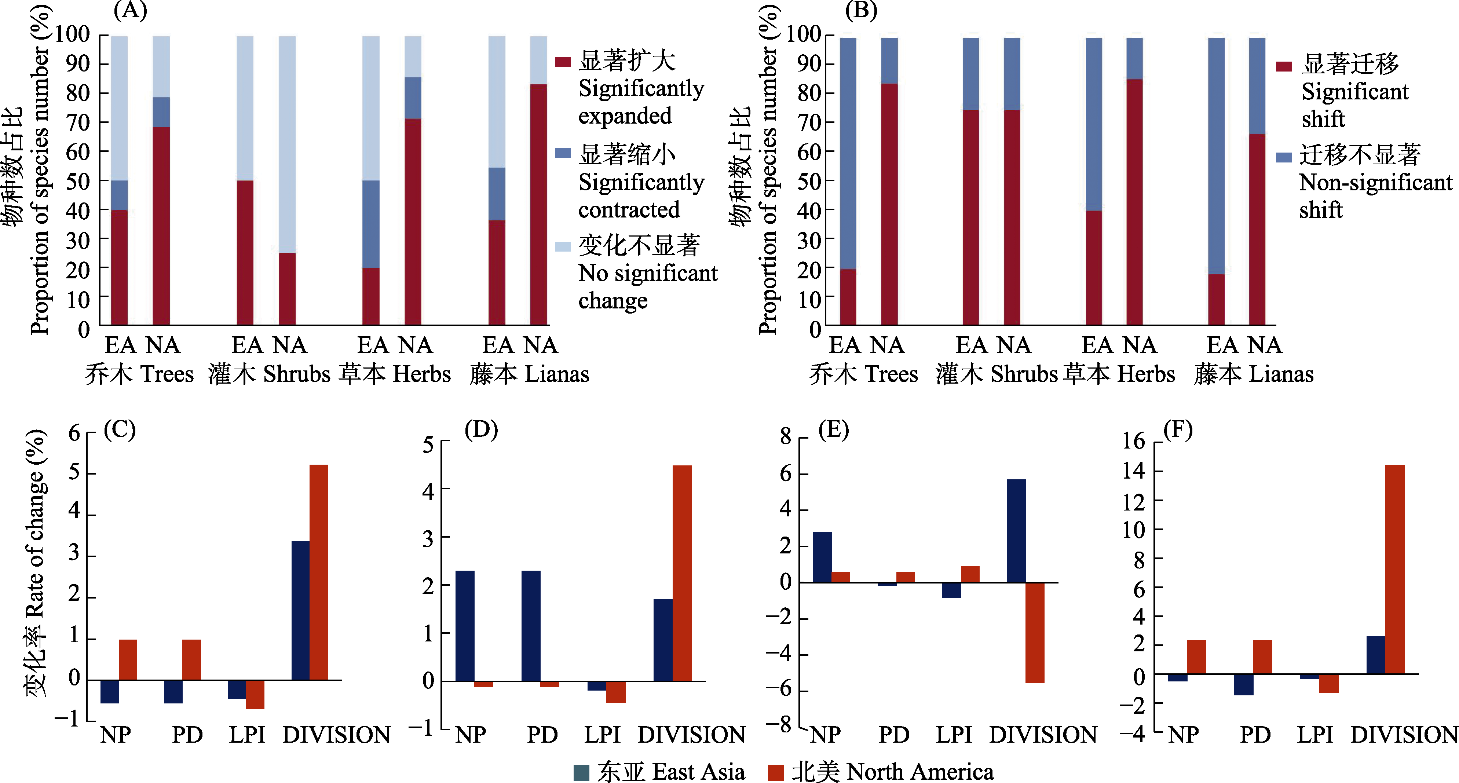
图3 东亚-北美间断分布属植物地区间不同生活型未来适生区变化趋势。(A)未来中高适生区面积变化趋势; (B)未来高适生区纬度迁移趋势; (C)乔木景观格局指数变化; (D)灌木景观格局指数变化; (E)草本景观格局指数变化; (F)藤本景观格局指数变化。EA: 东亚; NA: 北美; NP: 斑块数量; PD: 斑块密度; LPI: 最大斑块指数; DIVISION: 景观分割指数。
Fig. 3 Future trends in suitable habitats for East Asian-North American disjunct distribution genera across regions and life forms. (A) Future trends in mid-to-high suitable habitat area; (B) Future latitudinal shift trend of high suitable habitat area; (C) Changes in trees landscape pattern metrics; (D) Changes in shrubs landscape pattern metrics; (E) Changes in herbs landscape pattern metrics; (F) Changes in lianas landscape pattern metrics. EA, East Asia; NA, North America; NP, Number of patches; PD, Patch density; LPI, Largest patch index; DIVISION, Landscape division index.
| [1] | Aitken SN, Yeaman S, Holliday JA, Wang TL, Curtis-McLane S (2008) Adaptation, migration or extirpation: Climate change outcomes for tree populations. Evolutionary Applications, 1, 95-111. |
| [2] | Alipour S, Walas Ł (2023) The influence of climate and population density on Buxus hyrcana potential distribution and habitat connectivity. Journal of Plant Research, 136, 501-514. |
| [3] | Almazroui M, Islam MN, Saeed F, Saeed S, Ismail M, Ehsan MA, Diallo I, O’Brien E, Ashfaq M, Martínez-Castro D, Cavazos T, Cerezo-Mota R, Tippett MK, Gutowski WJ, Alfaro EJ, Hidalgo HG, Vichot-Llano A, Campbell JD, Kamil S, Rashid IU, Sylla MB, Stephenson T, Taylor M, Barlow M (2021) Projected changes in temperature and precipitation over the United States, central America, and the Caribbean in CMIP 6 GCMs. Earth Systems and Environment, 5, 1-24. |
| [4] | Bhattacharya RK, Das Chatterjee N, Das K (2024) Modelling of soil erosion susceptibility incorporating sediment connectivity and export at landscape scale using integrated machine learning, InVEST-SDR and Fragstats. Journal of Environmental Management, 353, 120164. |
| [5] | Brummitt NA, Bachman SP, Griffiths-Lee J, Lutz M, Moat JF, Farjon A, Donaldson JS, Hilton-Taylor C, Meagher TR, Albuquerque S, Aletrari E, Andrews AK, Atchison G, Baloch E, Barlozzini B, Brunazzi A, Carretero J, Celesti M, Chadburn H, Cianfoni E, Cockel C, Coldwell V, Concetti B, Contu S, Crook V, Dyson P, Gardiner L, Ghanim N, Greene H, Groom A, Harker R, Hopkins D, Khela S, Lakeman-Fraser P, Lindon H, Lockwood H, Loftus C, Lombrici D, Lopez-Poveda L, Lyon J, Malcolm-Tompkins P, McGregor K, Moreno L, Murray L, Nazar K, Power E, Quiton Tuijtelaars M, Salter R, Segrott R, Thacker H, Thomas LJ, Tingvoll S, Watkinson G, Wojtaszekova K, Nic Lughadha EM (2015) Green plants in the red: A baseline global assessment for the IUCN sampled red list index for Plants. PLoS ONE, 10, e0135152. |
| [6] | Carón MM, De Frenne P, Brunet J, Chabrerie O, Cousins SAO, De Backer L, Decocq G, Diekmann M, Heinken T, Kolb A, Naaf T, Plue J, Selvi F, Strimbeck GR, Wulf M, Verheyen K (2015) Interacting effects of warming and drought on regeneration and early growth of Acer pseudoplatanus and A. platanoides. Plant Biology, 17, 52-62. |
| [7] | Chen IC, Hill JK, Ohlemüller R, Roy DB, Thomas CD (2011) Rapid range shifts of species associated with high levels of climate warming. Science, 333, 1024-1026. |
| [8] | Chukwuma EC, Mankga LT (2025) A MaxEnt model for estimating suitable habitats for some important Pelargonium species in South Africa. Journal for Nature Conservation, 84, 126845. |
| [9] | Cook BI, Ault TR, Smerdon JE (2015) Unprecedented 21st century drought risk in the American Southwest and Central Plains. Science Advances, 1, e1400082. |
| [10] | Díaz S, Kattge J, Cornelissen JHC, Wright IJ, Lavorel S, Dray S, Reu B, Kleyer M, Wirth C, Prentice IC, Garnier E, Bönisch G, Westoby M, Poorter H, Reich PB, Moles AT, Dickie J, Gillison AN, Zanne AE, Chave J, Wright SJ, Sheremet’ev SN, Jactel H, Baraloto C, Cerabolini B, Pierce S, Shipley B, Kirkup D, Casanoves F, Joswig JS, Günther A, Falczuk V, Rüger N, Mahecha MD, Gorné LD (2016) The global spectrum of plant form and function. Nature, 529, 167-171. |
| [11] | Dyderski MK, Paź-Dyderska S, Jagodziński AM, Puchałka R (2025) Shifts in native tree species distributions in Europe under climate change. Journal of Environmental Management, 373, 123504. |
| [12] | Favre A, Päckert M, Pauls SU, Jähnig SC, Uhl D, Michalak I, Muellner-Riehl AN (2015) The role of the uplift of the Qinghai-Tibetan Plateau for the evolution of Tibetan biotas. Biological Reviews of the Cambridge Philosophical Society, 90, 236-253. |
| [13] | Feeley KJ, Freeman BG (2023) Global warming: Plants and animals on the move. Frontiers for Young Minds, 11, 999231. |
| [14] | Franks SJ, Sim S, Weis AE (2007) Rapid evolution of flowering time by an annual plant in response to a climate fluctuation. Proceedings of the National Academy of Sciences, USA, 104, 1278-1282. |
| [15] | Gao JB, Liu LL, Guo LH, Sun DQ, Liu WL, Hou WJ, Wu SH (2022) Synergic effects of climate change and phenological variation on agricultural production and its risk pattern in black soil region of Northeast China. Acta Geographica Sinica, 77, 1681-1700. (in Chinese with English abstract) |
| [高江波, 刘路路, 郭灵辉, 孙东琪, 刘婉露, 侯文娟, 吴绍洪 (2022) 气候变化和物候变动对东北黑土区农业生产的协同作用及未来粮食生产风险. 地理学报, 77, 1681-1700.] | |
| [16] | Götmark F, Götmark E, Jensen AM (2016) Why be a shrub? A basic model and hypotheses for the adaptive values of a common growth form. Frontiers in Plant Science, 7, 1095. |
| [17] | Guo QF, Ricklefs RE (2000) Species richness in plant genera disjunct between temperate eastern Asia and North America. Botanical Journal of the Linnean Society, 134, 401-423. |
| [18] | Hannah L, Midgley G, Andelman S, Araújo M, Hughes G, Martinez-Meyer E, Pearson R, Williams P (2007) Protected area needs in a changing climate. Frontiers in Ecology and the Environment, 5, 131-138. |
| [19] | Hay NM, Akinwuntan JV, Cai V, Windham MD, Pryer KM (2023) Exploring past and future distributions of the rare Appalachian oak fern using MaxEnt modeling. American Fern Journal, 113, 109-125. |
| [20] | Kelly AE, Goulden ML (2008) Rapid shifts in plant distribution with recent climate change. Proceedings of the National Academy of Sciences, USA, 105, 11823-11826. |
| [21] | Lawler JJ, Shafer SL, Bancroft BA, Blaustein AR (2010) Projected climate impacts for the amphibians of the western hemisphere. Conservation Biology, 24, 38-50. |
| [22] | Leicht-Young SA, Pavlovic NB, Frohnapple KJ, Grundel R (2010) Liana habitat and host preferences in northern temperate forests. Forest Ecology and Management, 260, 1467-1477. |
| [23] | Lenoir J, Gégout JC, Marquet PA, de Ruffray P, Brisse H (2008) A significant upward shift in plant species optimum elevation during the 20th century. Science, 320, 1768-1771. |
| [24] | Lian L, Shen JY, Ortiz RDC, Yu SX, Chen ZD, Wang W (2021) Phylogenetic analyses and modelling distributions guide conservation of a critically endangered liana species, Eleutharrhena macrocarpa (Menispermaceae). Taxon, 70, 931-945. |
| [25] | Liao HX, Xue YL (2024) A meta analysis of the association between functional trait and tree regeneration capacity under drought. Acta Scientiarum Naturalium Universitatis Sunyatseni, 63(6), 122-131. (in Chinese with English abstract) |
| [廖慧璇, 薛亚林 (2024) 功能性状与干旱下树木自然更新能力关系的meta分析. 中山大学学报(自然科学版中英文), 63(6), 122-131.] | |
| [26] | Liu CR, Berry PM, Dawson TP, Pearson RG (2005) Selecting thresholds of occurrence in the prediction of species distributions. Ecography, 28, 385-393. |
| [27] | Loarie SR, Duffy PB, Hamilton H, Asner GP, Field CB, Ackerly DD (2009) The velocity of climate change. Nature, 462, 1052-1055. |
| [28] | Lu F, Li JX, Wang B, Li DX, Guo YL, Wen SJ, Liu SY, Lu SH, Huang FZ, Chen T, Wang DH, Xiang WS, Li XK (2025) Selectivity of lianas to wood climbing with different supports in karst seasonal rain forest. Acta Ecologica Sinica, 45, 10277-10290. (in Chinese with English abstract) |
| [陆芳, 李健星, 王斌, 李冬兴, 郭屹立, 文淑均, 刘晟源, 陆树华, 黄甫昭, 陈婷, 王登惠, 向悟生, 李先琨 (2025) 喀斯特季节性雨林中木质藤本对不同支持木的攀附选择性. 生态学报, 45, 10277-10290.] | |
| [29] | Lu HY, Feng H, Lyu HZ, Wang HL, Zhang XJ, Zhang HZ, Wang XY, Li YX (2023) Formation and evolution of the Asian landscape during the Cenozoic. The Innovation Geoscience, 1, 100020. |
| [30] | Martínez-López V, García C, Zapata V, Robledano F, De la Rúa P (2020) Intercontinental long-distance seed dispersal across the Mediterranean Basin explains population genetic structure of a bird-dispersed shrub. Molecular Ecology, 29, 1408-1420. |
| [31] | McIntyre NE, Wright CK, Swain S, Hayhoe K, Liu GM, Schwartz FW, Henebry GM (2014) Climate forcing of wetland landscape connectivity in the Great Plains. Frontiers in Ecology and the Environment, 12, 59-64. |
| [32] | Melton AE, Clinton MH, Wasoff DN, Lu LM, Hu HH, Chen ZD, Ma KP, Soltis DE, Soltis PS (2022) Climatic niche comparisons of eastern North American and eastern Asian disjunct plant genera. Global Ecology and Biogeography, 31, 1290-1302. |
| [33] | Naughtin SR, Castilla AR, Smith AB, Strand AE, Dawson A, Hoban S, Abhainn EA, Romero-Severson J, Robinson JD (2025) Integrating genomic data and simulations to evaluate alternative species distribution models and improve predictions of glacial refugia and future responses to climate change. Ecography, 2025, e07196. |
| [34] | Niu YT, Ye JF, Zhang JL, Wan JZ, Yang T, Wei XX, Lu LM, Li JH, Chen ZD (2018) Long-distance dispersal or postglacial contraction? Insights into disjunction between Himalaya-Hengduan Mountains and Taiwan in a cold-adapted herbaceous genus, Triplostegia. Ecology and Evolution, 8, 1131-1146. |
| [35] | Parmesan C, Yohe G (2003) A globally coherent fingerprint of climate change impacts across natural systems. Nature, 421, 37-42. |
| [36] | Parra A, Pratt RB, Jacobsen AL, Chamorro D, Torres I, Moreno JM (2023) Functional response and resistance to drought in seedlings of six shrub species with contrasting leaf traits from the Mediterranean Basin and California. Tree Physiology, 43, 1758-1771. |
| [37] | Pecl GT, Araújo MB, Bell JD, Blanchard J, Bonebrake TC, Chen IC, Clark TD, Colwell RK, Danielsen F, Evengård B, Falconi L, Ferrier S, Frusher S, Garcia RA, Griffis RB, Hobday AJ, Janion-Scheepers C, Jarzyna MA, Jennings S, Lenoir J, Linnetved HI, Martin VY, McCormack PC, McDonald J, Mitchell NJ, Mustonen T, Pandolfi JM, Pettorelli N, Popova E, Robinson SA, Scheffers BR, Shaw JD, Sorte CJB, Strugnell JM, Sunday JM, Tuanmu MN, Vergés A, Villanueva C, Wernberg T, Wapstra E, Williams SE (2017) Biodiversity redistribution under climate change: Impacts on ecosystems and human well-being. Science, 355, eaai9214. |
| [38] | Peterson TC, Zhang XB, Brunet-India M, Vázquez-Aguirre JL (2008) Changes in North American extremes derived from daily weather data. Journal of Geophysical Research: Atmospheres, 113, D07113. |
| [39] | Pitman NCA, Jørgensen PM (2002) Estimating the size of the world’s threatened flora. Science, 298, 989. |
| [40] | Puchałka R, Dyderski MK, Vítková M, Sádlo J, Klisz M, Netsvetov M, Prokopuk Y, Matisons R, Mionskowski M, Wojda T, Koprowski M, Jagodziński AM (2021) Black locust (Robinia pseudoacacia L.) range contraction and expansion in Europe under changing climate. Global Change Biology, 27, 1587-1600. |
| [41] | Raven PH (2021) Plants make our existence possible. Plants, People, Planet, 3, 2-6. |
| [42] | Rota F, Casazza G, Genova G, Midolo G, Prosser F, Bertolli A, Wilhalm T, Nascimbene J, Wellstein C (2022) Topography of the Dolomites modulates range dynamics of narrow endemic plants under climate change. Scientific Reports, 12, 1398. |
| [43] | Sandel B, Arge L, Dalsgaard B, Davies RG, Gaston KJ, Sutherland WJ, Svenning JC (2011) The influence of Late Quaternary climate-change velocity on species endemism. Science, 334, 660-664. |
| [44] | Schnitzer SA (2014) A mechanistic explanation for global patterns of liana abundance and distribution. The American Naturalist, 166, 262-276. |
| [45] | Song CY, Huang C, Liu HM (2013) Predictive vegetation mapping approach based on spectral data, DEM and generalized additive models. Chinese Geographical Science, 23, 331-343. |
| [46] | Song HJ, Ordonez A, Svenning JC, Qian H, Yin X, Mao LF, Deng T, Zhang J (2021) Regional disparity in extinction risk: Comparison of disjunct plant genera between eastern Asia and eastern North America. Global Change Biology, 27, 1904-1914. |
| [47] | Sung K, Bohrer G, Stagge JH (2024) Centennial-scale intensification of wet and dry extremes in North America. Geophysical Research Letters, 51, e2023GL107400. |
| [48] | Sykes MT, Prentice IC (1995) Boreal forest futures: Modelling the controls on tree species range limits and transient responses to climate change. Water, Air and Soil Pollution, 82, 415-428. |
| [49] | Tóth JP, Végvári Z (2016) Future of winegrape growing regions in Europe. Australian Journal of Grape and Wine Research, 22, 64-72. |
| [50] | Tulowiecki SJ, LaDuke N (2024) Models reveal shifting distribution of climatic suitability for pawpaw (Asimina triloba [L.] Dunal) cultivation under future climate change scenarios. Scientia Horticulturae, 338, 113837. |
| [51] | Van Daele F, Honnay O, Janssens S, De Kort H (2024) Habitat fragmentation affects climate adaptation in a forest herb. Journal of Ecology, 112, 246-264. |
| [52] | Wagner T, Schliep EM, North JS, Kundel H, Custer CA, Ruzich JK, Hansen GJA (2023) Predicting climate change impacts on poikilotherms using physiologically guided species abundance models. Proceedings of the National Academy of Sciences, USA, 120, e2214199120. |
| [53] | Wang JH, Qu WJ, Qu JJ, Yang XG, Wang L, Yang Y, Qin WC, Zhang B, Niu JS (2023) The process and influencing factors of wind retransmission of Caragana korshinskii seeds in the southeast edge of Tengger Desert. Journal of Desert Research, 43(5), 108-115. (in Chinese with English abstract) |
| [王家辉, 曲文杰, 屈建军, 杨新国, 王磊, 杨悦, 秦伟春, 张波, 牛金帅 (2023) 腾格里沙漠东南缘柠条(Caragana korshinskii)种子风力再传播过程及其影响因素. 中国沙漠, 43(5), 108-115.] | |
| [54] | Wang XC, Yang JW, Zhang QL (2021) Response of global alpine treeline dynamics and shrub expansion to climate change. Journal of Henan Normal University (Natural Science Edition), 49(6), 1-10, 133. (in Chinese with English abstract) |
| [王晓春, 杨婧雯, 张秋良 (2021) 全球林线动态和灌木扩张对气候变化响应的研究进展. 河南师范大学学报(自然科学版), 49(6), 1-10, 133.] | |
| [55] | Wang Z, Luo MM, Ye LX, Peng J, Luo X, Gao L, Huang Q, Chen QH, Zhang L (2024) Prediction of the potentially suitable areas of Actinidia latifolia in China based on climate change using the optimized MaxEnt model. Sustainability, 16, 5975. |
| [56] | Wanga VO, Ngarega BK, Oulo MA, Mkala EM, Ngumbau VM, Onjalalaina GE, Odago WO, Nanjala C, Ochieng CO, Gichua MK, Gituru RW, Hu GW (2024) Projected impacts of climate change on the habitat of Xerophyta species in Africa. Plant Diversity, 46, 91-100. |
| [57] | Warren DL, Glor RE, Turelli M (2008) Environmental niche equivalency versus conservatism: Quantitative approaches to niche evolution. Evolution, 62, 2868-2883. |
| [58] | Wen J (1999) Evolution of eastern Asian and eastern North American disjunct distributions in flowering plants. Annual Review of Ecology and Systematics, 30, 421-455. |
| [59] | Wu ZY (1983) On the significance of Pacific intercontinental discontinuity. Annals of the Missouri Botanical Garden, 70, 557-590. |
| [60] | Xie YH, Hunter M, Sorensen A, Nogeire-McRae T, Murphy R, Suraci JP, Lischka S, Lark TJ (2023) U.S. farmland under threat of urbanization: Future development scenarios to 2040. Land, 12, 574. |
| [61] | Ye WQ, Zhu SS, Comes HP, Yang T, Lian L, Wang W, Qiu YX (2022) Phylogenomics and diversification drivers of the Eastern Asian-Eastern North American disjunct Podophylloideae. Molecular Phylogenetics and Evolution, 169, 107427. |
| [1] | 卢晓强, 杨万霞, 马月, 刘威, 徐徐, 刘立, 刘燕. 基于IPBES转型变革框架分析中国生物多样性治理路径[J]. 生物多样性, 2026, 34(8): 26131-. |
| [2] | 张宇彤, 何志健, 董雪云, 杨成君, 王洪峰, 马克平. 全球植被样地调查数据特征[J]. 生物多样性, 2026, 34(8): 25477-. |
| [3] | 钱应俊, 万敏, 王广君, 李红梅, 王文凯. 铺散矢车菊在Biomod2组合模型下的潜在分布预测[J]. 生物多样性, 2026, 34(8): 26006-. |
| [4] | 沈舟, 尹海伟, 孔繁花, 黄淑萍, 刘宏庆, 苏子康, 张杰辉. 代理种方法在城乡生态空间治理中的应用: 认知重构、路径嵌入与实施框架[J]. 生物多样性, 2026, 34(8): 26078-. |
| [5] | 张萌, 王彦平. Zeta多样性研究进展:分析方法、保护应用及总结展望[J]. 生物多样性, 2026, 34(8): 0-. |
| [6] | 朱晨超, 顾灵桢, 周梁宇, 闫淑君, 曾玉喧, 叶鹏. 城市公园入侵与非入侵植物访花昆虫多样性及其网络差异[J]. 生物多样性, 2026, 34(8): 26115-. |
| [7] | 蔡妤, 张晓川, 连梦佳. 城市蜻蜓生境面临的威胁、需求与生态恢复研究进展[J]. 生物多样性, 2026, 34(8): 26096-. |
| [8] | 郑欢. 面向国土空间规划制度的生物多样性净增益设计逻辑与工具构建[J]. 生物多样性, 2026, 34(7): 25440-. |
| [9] | 巩中军, 李为争, 姚永生, 左旭琦, 武予清, 苗进. 农田土壤节肢动物eDNA在固-液-气三相中的分布特征[J]. 生物多样性, 2026, 34(7): 26146-. |
| [10] | 黎明, 朱玉茹, 秦响玲, 李乔坤, 邢伟. 生物多样性投资的底层逻辑、体系架构与运营模式[J]. 生物多样性, 2026, 34(7): 26157-. |
| [11] | 彭昀月, 靳彤, 刁澄怡, 申小莉. 适应气候变化的生物多样性保护政策措施和行动进展: 基于欧盟、美国与澳大利亚的分析[J]. 生物多样性, 2026, 34(7): 26054-. |
| [12] | 李菡, 何兴成, 张尚明玉, 曹一唯, 张家语, 彭可欣, 吴永杰. 横断山区鸟类名录[J]. 生物多样性, 2026, 34(7): 25375-. |
| [13] | 张洁, 路昊明, 陈佳杰, 陈江源, 毛宇帆, 胡骏熙, 张保卫. 中国软骨鱼类拉-英-汉-日物种名录及各海域多样性比较[J]. 生物多样性, 2026, 34(6): 25522-. |
| [14] | 李保平, 张展豪, 魏雅丹. 人工智能背景下中国履行《生物多样性公约》获取与惠益分享制度的挑战与优化路径[J]. 生物多样性, 2026, 34(6): 26073-. |
| [15] | 华方圆, 刘双祺, 彭杨靖, 龚善星, 申小莉, 金崑. 自然保护地和生态保护红线生物多样性与气候变化风险源的协同治理框架[J]. 生物多样性, 2026, 34(6): 25492-. |
| 阅读次数 | ||||||
|
全文 |
|
|||||
|
摘要 |
|
|||||
备案号:京ICP备16067583号-7
Copyright © 2026 版权所有 《生物多样性》编辑部
地址: 北京香山南辛村20号, 邮编:100093
电话: 010-62836137, 62836665 E-mail: biodiversity@ibcas.ac.cn
