

Biodiv Sci ›› 2009, Vol. 17 ›› Issue (6): 605-612. DOI: 10.3724/SP.J.1003.2009.09141 cstr: 32101.14.SP.J.1003.2009.09141
Special Issue: 群落中的物种多样性:格局与机制; 物种形成与系统进化
• Articles • Previous Articles Next Articles
Jingyun Fang*( ), Xiangping Wang, Zhiyao Tang
Received:2009-06-03
Accepted:2009-11-30
Online:2009-11-20
Published:2009-11-20
Contact:
Jingyun Fang
Jingyun Fang, Xiangping Wang, Zhiyao Tang. Local and regional processes control species richness of plant communities: the species pool hypothesis[J]. Biodiv Sci, 2009, 17(6): 605-612.
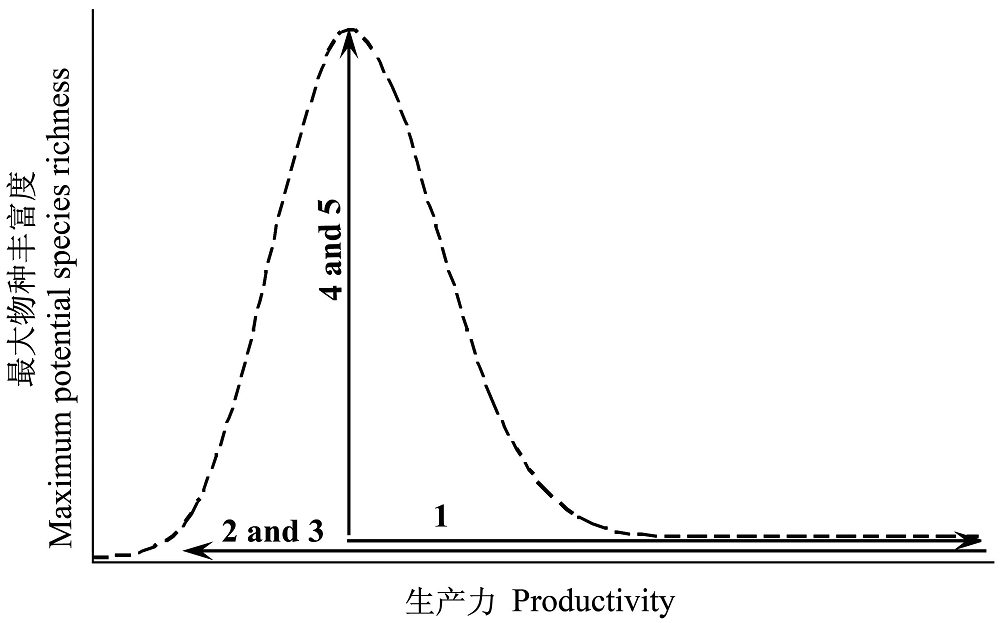
Fig. 1 The “hump-backed” model of Grime (1979). The model incorporates five processes that affect community species richness: (1) dominance; (2) stress; (3) disturbance; (4) niche differentiation; and (5) colonization.
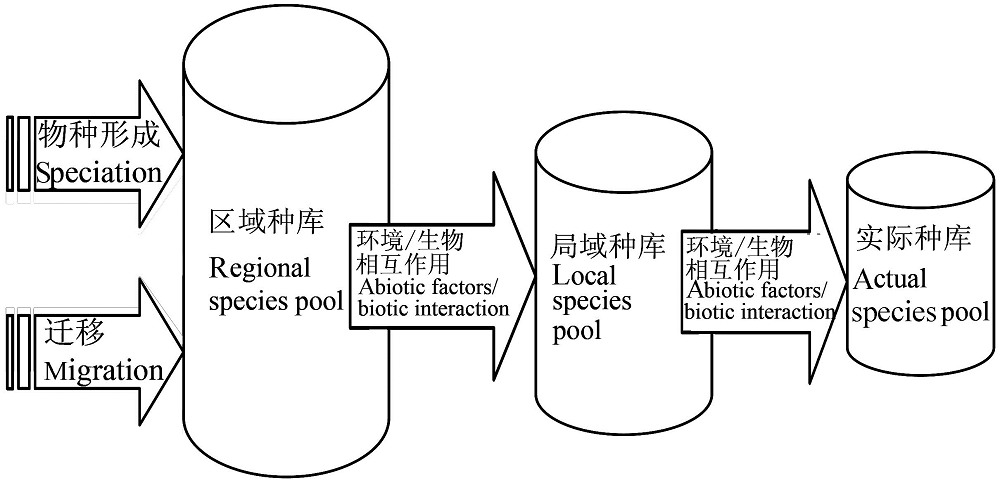
Fig. 2 Relationship between species pools at regional, local and community scales, adapted from Zobel (1997).
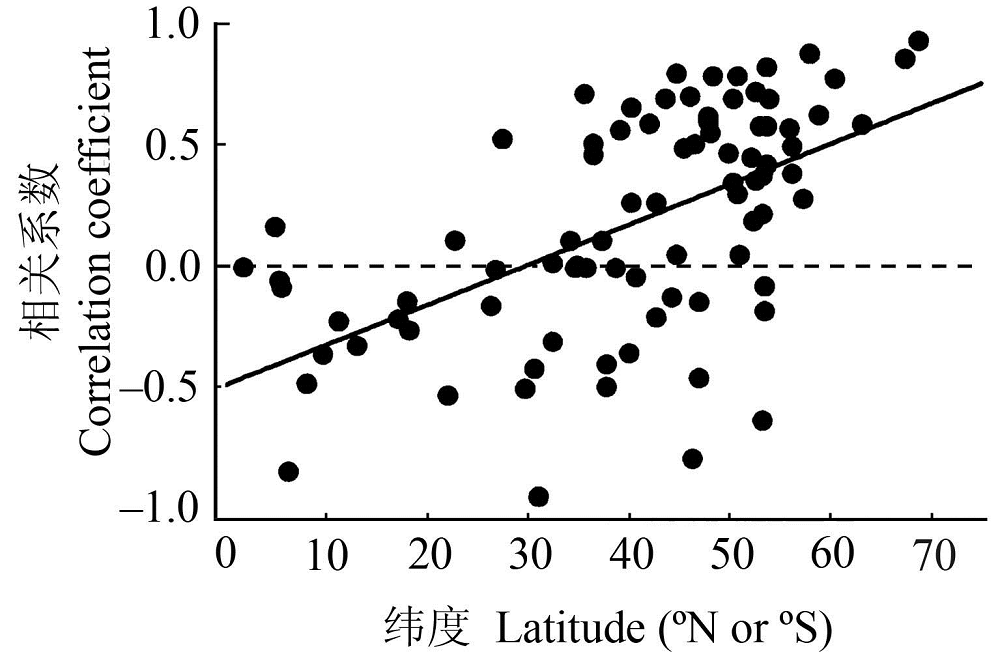
Fig. 3 Changes in the correlation coefficient of the relationship between vascular plant species richness and soil pH with latitude. The relationship between species richness and soil pH shows a negative correlation at low latitudes (below the dashed line), while a positive relationship at high latitudes(P?rtel, 2002).
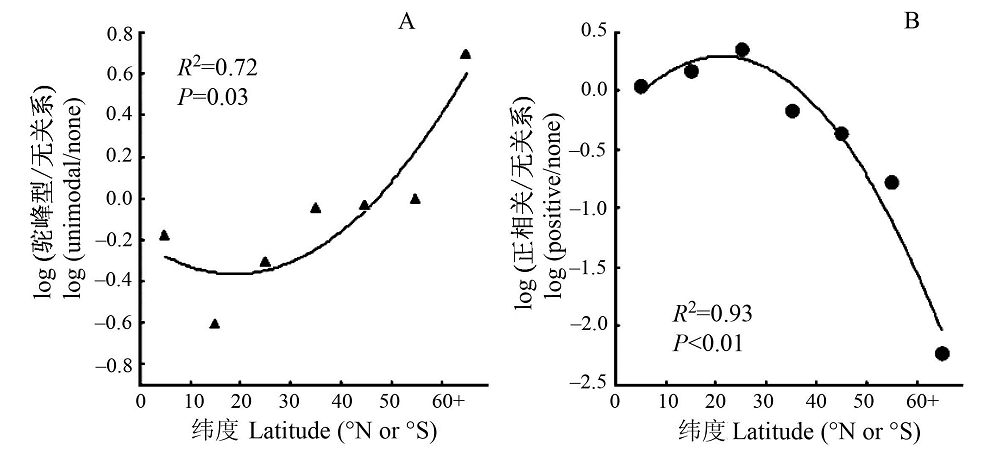
Fig. 4 Changes in productivity-plant diversity relationships with latitude. Y axis is the proportion of unimodal (A) and positive (B) relationships to cases in which no significant relations are found between productivity and diversity. With increasing latitude, the proportion of unimodal relationships increased remarkably (R2 = 0.72, P = 0.034) while that of positive relationships decreased (R2 = 0.93, P = 0.002) (P?rtel et al., 2007).
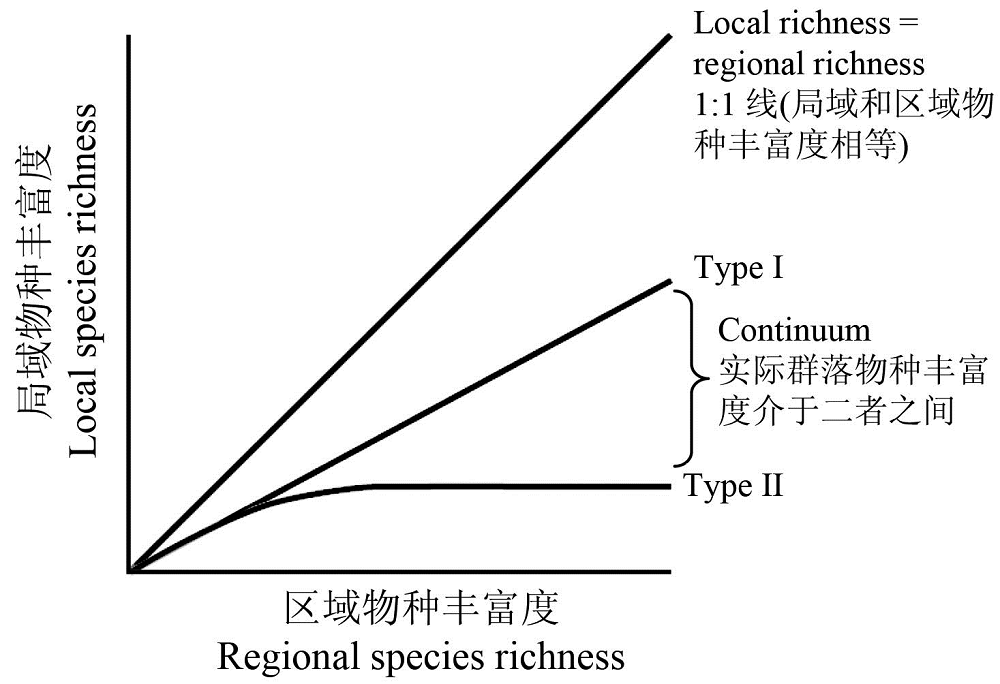
Fig. 5 Two theoretical relationships between local and regional species richness. For the unsaturated relationship (Type I), community richness is not limited by biotic interactions in the local habitat and increases proportionately with regional richness. In the saturated relationship (Type II), however, biotic interactions limit community richness which saturates and becomes independent of regional species pool. Communities in the real world probably fall on a continuum between the two extremes (Gaston, 2000).
| [1] | Begon M, Townsend CA, Harper JL (2006) Ecology: From Individuals to Ecosystems. Blackwell Publishing, Oxford: |
| [2] | Brudvig LA, Mabry CM (2008) Trait-based filtering of the regional species pool to guide understory plant reintroductions in midwestern oak savannas, U.S.A. Restoration Ecology, 16, 290-304. |
| [3] | Chytry M, Danihelka J, Ermakov N, Hajek M, Hajkova P, Koci M, Kubesova S, Lustyk P, Otypkova Z, Popov D, Roleeek J, Reznickova M, Smarda P, Valachovic M (2007) Plant species richness in continental southern Siberia: effects of pH and climate in the context of the species pool hypothesis. Global Ecology and Biogeography, 16, 668-678. |
| [4] | Cornell HV, Lawton JH (1992) Species interactions, local and regional processes, and limits to the richness of ecological communities: a theoretical perspective. Journal of Animal Ecology, 61, 1-12. |
| [5] | Cornwell WK, Grubb PJ (2003) Regional and local patterns in plant species richness with respect to resource availability. Oikos, 100, 417-428. |
| [6] | Dupré C (2000) How to determine a regional species pool: a study in two Swedish regions. Oikos, 89, 128-136. |
| [7] | Dupré C, Wessberg C, Diekmann M (2002) Species richness in deciduous forests: effects of species pools and environmental variables. Journal of Vegetation Science, 13, 505-516. |
| [8] | Ellenberg H, Weber HE, Duell R, Wirth V, Werner W, Paulissen D (1991) Indicator Values of Plants in Central Europe. Goltze, Goettingen. |
| [9] | Eriksson O (1993) The species-pool hypothesis and plant community diversity. Oikos, 68, 371-374. |
| [10] | Ewald J (2003) The calcareous riddle: why are there so many calciphilous species in the central European flora? Folia Geobotanica, 38, 357-366. |
| [11] |
Gaston KJ (2000) Global patterns in biodiversity. Nature, 405, 220-227.
DOI URL PMID |
| [12] | Goldberg DE, Rajaniemi T, Gurevitch J, Stewart-Oaten A (1999) Empirical approaches to quantifying interaction intensity: competition and facilitation along productivity gradient. Ecology, 80, 1118-1131. |
| [13] | Grace JB (1999) The factors controlling species density in herbaceous plant communities: an assessment. Perspectives in Plant Ecology, Evolution and Systematics, 2, 1-28. |
| [14] | Grace JB (2001) Difficulties with estimating and interpreting species pools and the implications for understanding patterns of diversity. Folia Geobotanica, 36, 71-83. |
| [15] | Grime JP (1973a) Competitive exclusion in herbaceous vegetation. Nature, 242, 344-347. |
| [16] | Grime JP (1973b) Control of species diversity in herbaceous vegetation. Journal of Environmental Management, 1, 151-167. |
| [17] | Grime JP (1979) Plant Strategies and Vegetation Processes. John Wiley & Sons, London. |
| [18] | Grubb PJ (1987) Global trends in species-richness in terrestrial vegetation: a view from the northern hemisphere, In: Organization of Communities: Past and Present (eds Gee JHR, Giller PS), pp. 99-118. Blackwell Scientific Publications, Oxford, UK. |
| [19] | Houseman GR, Gross KL (2006) Does ecological filtering across a productivity gradient explain variation in species pool-richness relationships? Oikos, 115, 148-154. |
| [20] | Huston MA (1979) A general hypothesis of species diversity. The American Naturalist, 113, 81-101. |
| [21] | Huston MA (1999) Local processes and regional patterns: appropriate scales for understanding variation in the diversity of plants and animals. Oikos, 86, 393-401. |
| [22] |
Jetz W, Rahbek C (2002) Geographic range size and determinants of avian species richness. Science, 297, 1548-1551.
DOI URL PMID |
| [23] |
Karlson RH, Cornell HV, Hughes TP (2004) Coral communities are regionally enriched along an oceanic biodiversity gradient. Nature, 429, 867-870.
DOI URL PMID |
| [24] | Laanisto L, Urbas P, Partel M (2008) Why does the unimodal species richness-productivity relationship not apply to woody species: a lack of clonality or a legacy of tropical evolutionary history? Global Ecology and Biogeography, 17, 320-326. |
| [25] | Latham RE, Ricklefs RE (1993) Global patterns of tree species richness in moist forests: energy diversity theory does not account for variation in species richness. Oikos, 67, 325-333. |
| [26] | Oksanen J (1996) Is the humped relationship between species richness and biomass an artefact due to plot size? Journal of Ecology, 84, 293-295. |
| [27] | Parmentier I, Malhi Y, Senterre B, Whittaker RJ, A. T. D N, Alonso A, Balinga MPB, Bakayoko A, Bongers F, Chatelain C, Comiskey JA, Cortay R, Kamdem M-ND, Doucet J-L, Gautier L, Hawthorne WD, Issembe YA, Kouame FN, Kouka LA, Leal ME, Lejoly J, Lewis SL, Nusbaumer L, Parren MPE, Peh KSH, Phillips OL, Sheil D, Sonke B, Sosef MSM, Sunderland TCH, Stropp J, Ter Steege H, Swaine MD, Tchouto MGP (2007) The odd man out? Might climate explain the lower tree α-diversity of African rain forests relative to Amazonian rain forests? Journal of Ecology, 95, 1058-1071. |
| [28] | Pärtel M (2002) Local plant diversity patterns and evolutionary history at the regional scale. Ecology, 83, 2361-2366. |
| [29] | Pärtel M, Helm A, Ingerpuu N, Reier Ü, Tuvi E-L (2004) Conservation of Northern European plant diversity: the correspondence with soil pH. Biological Conservation, 120, 525-531. |
| [30] |
Pärtel M, Laanisto L, Zobel M (2007) Contrasting plant productivity-diversity relationships across latitude: the role of evolutionary history. Ecology, 88, 1091-1097.
URL PMID |
| [31] | Pärtel M, Zobel M, Liira J, Zobel K (2000) Species richness limitations in productive and oligotrophic plant communities. Oikos, 90, 191-193. |
| [32] | Pärtel M, Zobel M, Zobel K, van der Maarel E (1996) The species pool and its relation to species richness: evidence from Estonian plant communities. Oikos, 75, 111-117. |
| [33] | Peet RK, Fridley JD, Gramling JM (2003) Variation in species richness and species pool size across a pH gradient in forests of the southern Blue Ridge Mountains. Folio Geobotanica, 38, 391-401. |
| [34] |
Rajaniemi TK, Goldberg DE, Turkington R, Dyer AR (2006) Quantitative partitioning of regional and local processes shaping regional diversity patterns. Ecology Letters, 9, 121-128.
DOI URL PMID |
| [35] |
Ricklefs RE (1987) Community diversity: relative roles of local and regional processes. Science, 235, 167-171.
URL PMID |
| [36] | Ricklefs RE (2004) A comprehensive framework for global patterns in biodiversity. Ecology Letters, 7, 1-15. |
| [37] |
Ricklefs RE (2006) Evolutionary diversification and the origin of the diversity-environment relationship. Ecology, 87, S3-S13.
DOI URL PMID |
| [38] | Schuster B, Diekmann M (2003) Changes in species density along the soil pH gradient: evidence from German plant communities. Folia Geobotanica, 38, 367-379. |
| [39] | Taylor DR, Aarssen LW, Loehle C (1990) On the relationship between r/K selection and environmental carrying capacity: a new habitat templet for plant life history strategies. Oikos, 58, 239-250. |
| [40] | Tilman D (1982) Resource Competition and Community Structure. Princeton University Press, Princeton. |
| [41] | Tilman D (1994) Competition and biodiversity in spatially structured habitats. Ecology, 75, 2-16. |
| [42] | Wamelink GWW, Joosten V, van Dobben HF, Berendse F (2002) Validity of Ellenberg indicator values judged from physico-chemical field measurements. Journal of Vegetation Science, 13, 269-278. |
| [43] | Weiher E, Forbes S, Schauwecker T, Grace JB (2004) Multivariate control of plant species richness and community biomass in blackland prairie. Oikos, 106, 151-157. |
| [44] | Wilson JB, Anderson BJ (2001) Species-pool relations: like a wooden light bulb? Folia Geobotanica, 36, 35-44. |
| [45] | Zinko U, Dynesius M, Nilsson C, Seibert J (2006) The role of soil pH in linking groundwater flow and plant species density in boreal forest landscapes. Ecography, 29, 515-524. |
| [46] | Zobel K (2001) On the species-pool hypothesis and on the quasi-neutral concept of plant community diversity. Folia Geobotanica, 36, 3-8. |
| [47] |
Zobel M (1992) Plant species coexistence: the role of historical, evolutionary and ecological factors. Oikos, 65, 314-320.
DOI URL |
| [48] |
Zobel M (1997) The relative role of species pools in determining plant species richness: an alternative explanation of species coexistence? Trends in Ecology and Evolution, 12, 266-269.
DOI URL PMID |
| [49] | Zobel M, van der Maarel E, Dupré C (1998) Species pool: the concept, its determination and significance for community restoration. Applied Vegetation Science, 1, 55-66. |
| [1] | Jianchao Liang, Shutian Chen, Wenxiang He, Chunni Xiong, Zhenzhou Xu, Yuanxin Huang, Yuanzhihong Liu, Lang Zhang, Huijian Hu. Wild terrestrial vertebrate resources in Guangzhou: Diversity, distribution, and conservation [J]. Biodiv Sci, 2026, 34(5): 25422-. |
| [2] | Cuiyi Jiang, Zhijing Xie, Zhongping Tian, Yueying Li, Mingxin Zheng, Shuai Fang, Mierkamili Maimaiti, Erfan Akberjan, Meixiang Gao, Jian Zhang. The role of microtopography in shaping forest soil Collembola community assembly in western Tianshan Mountains of Xinjiang [J]. Biodiv Sci, 2026, 34(4): 25300-. |
| [3] | Xixia Lu, Fengxiang Zhou, Liming Yong, Qianhui Zeng, Liyuan Zhao, Yuke Zhang, Xianyan Wang. Impacts of coastal reclamation on Chinese white dolphin (Sousa chinensis) habitats in China from 1990 to 2020 [J]. Biodiv Sci, 2026, 34(3): 25249-. |
| [4] | Linxi Yuan, Meizhen Wang, Lixiang Zhang, Peng Li, Yongsheng Zhang, Xuelong Jiang, Zhenhua Guan. Impact of human activities on the diversity of trees and potential food resources in the habitat of Hoolock tianxing [J]. Biodiv Sci, 2026, 34(2): 25271-. |
| [5] | Yu Luo, Xuyan Zheng, Li Cao, Bo Wang, Yanqiong Peng, Yinling Luo, Huiping Zhou, Xiaofang Yang, Baige Miao, Chaoya Wang, Jie Gao. Habitat simplification reshapes the fig-fig wasp interaction network: Adaptive responses of volatile composition and community structure [J]. Biodiv Sci, 2026, 34(2): 25328-. |
| [6] | Yi Zou. Alpha-diversity index selection: Simulation comparison under unequal sampling [J]. Biodiv Sci, 2026, 34(1): 25278-. |
| [7] | Enping Chai, Suting Ge, Ximao Wang, Zhou Yang, Zhaoyi Xiang, Meihui Zhang, Manshu Li, Yao Shen, Xingfeng Si. Effects of human disturbance on nest-site dynamics and breeding success of urban Nycticorax nycticorax: Insights from high-frequency monitoring [J]. Biodiv Sci, 2025, 33(9): 25025-. |
| [8] | Guangtai Fan, Yining Chen, Jibai He, Hailong Dou, Jiyuan Chen, Haitao Yang, Qiu Shen, Hongcan Guan. Investigating the adaptation of Eurasian otters (Lutra lutra) to human disturbance and the coexistence with sympatric species using camera trapping: A case study from Jintang Island, Zhejiang Province, China [J]. Biodiv Sci, 2025, 33(9): 25148-. |
| [9] | Shengnan Ji, Jiarong Han, Yueheng Ren, Xiaodong Mu, Yanpeng Zhu. Prediction of suitable habitats and risk assessment for key invasive alien plant species on Hainan Island based on the MaxEnt model [J]. Biodiv Sci, 2025, 33(8): 25037-. |
| [10] | Luyao Tian, Hao Yin. Research status and strategies for China’s ecological railway development based on biodiversity conservation [J]. Biodiv Sci, 2025, 33(8): 24495-. |
| [11] | Qilong Yu, Minhui Hao, Huaijiang He, Chunyu Zhang, Xiuhai Zhao. Relationships of biodiversity and productivity change with forest succession in Changbai Mountains: Insights from species, traits, and phylogeny [J]. Biodiv Sci, 2025, 33(8): 25060-. |
| [12] | Yu Li, Lizhi Zhou. Spatiotemporal patterns and influencing factors of wintering waterbird diversity in the mainstream of Huaihe River [J]. Biodiv Sci, 2025, 33(8): 24590-. |
| [13] | Fengxiang Zhou, Xixia Lu, Liming Yong, Qianhui Zeng, Liangliang Yang, Ping Li, Yuke Zhang, Xianyan Wang. Research progress on acoustic monitoring of cetaceans [J]. Biodiv Sci, 2025, 33(7): 24556-. |
| [14] | Lü Zhou, Hua Guo, Shimao Yao, Cheng Tian. The spatio-temporal distribution patterns of Tragopan temminckii in Wanglang National Nature Reserve [J]. Biodiv Sci, 2025, 33(7): 24537-. |
| [15] | Jinbo Xu, Yaqian Cui, Yuan Wang, Weibo Wang, Feng Liu, Guanglong Wang, Jingjing Hu, Dunzhu Pubu, Duoji Bianba, Zeng Dan, Kai Hu, Xiaochuan Wang, Gang Song, Yonglei Lü, Zhixin Wen. Habitat suitability evaluation of Macaca leucogenys in the Xizang Yarlung Zangbo Grand Canyon National Nature Reserve [J]. Biodiv Sci, 2025, 33(7): 24493-. |
| Viewed | ||||||
|
Full text |
|
|||||
|
Abstract |
|
|||||
Copyright © 2026 Biodiversity Science
Editorial Office of Biodiversity Science, 20 Nanxincun, Xiangshan, Beijing 100093, China
Tel: 010-62836137, 62836665 E-mail: biodiversity@ibcas.ac.cn

