

Biodiv Sci ›› 2026, Vol. 34 ›› Issue (6): 26073. DOI: 10.17520/biods.2026073 cstr: 32101.14.biods.2026073
• Conservation and Governance • Previous Articles Next Articles
Baoping Li*( ), Zhanhao Zhang, Yadan Wei*()
Received:2026-03-06
Accepted:2026-05-20
Online:2026-06-20
Published:2026-07-30
Contact:
*Co-authors for correspondence. E-mail: ping@guet.edu.cn; wyd@guet.edu.cn
Supported by:Baoping Li, Zhanhao Zhang, Yadan Wei. Challenges and optimization paths for China in implementing the access and benefit-sharing system of the Convention on Biological Diversity in the context of artificial intelligence[J]. Biodiv Sci, 2026, 34(6): 26073.
| 项目 Item | 公约要旨 Core objective | 与CBD关系 Relationship with CBD | 遗传资源获取与惠益分享核心规则 Core rules on access and benefit-sharing of genetic resources | 传统知识获取与惠益分享规则 Rules on access and benefit- sharing for traditional knowledge | 数智化适配性主要缺口 Main gaps in Digital & AI adaptability |
|---|---|---|---|---|---|
| 《生物多样性公约》 Convention on Biological Diversity (CBD) | 基础国际条约, 统筹生物多样性保护与可持续利用 A foundational international treaty governing the conservation and sustainable use of biological diversity | - | 国家主权原则; 事先知情同意与共同商定条件规则 Principle of national sovereignty; prior informed consent and mutually agreed terms regimes | 承认传统知识重要性 Recognizes the significance of traditional knowledge | 缺乏人工智能场景“获取” “惠益”的界定标准 Lacks defined criteria for “access” and “benefits” under artificial intelligence scenarios |
| 《名古屋议定书》 Nagoya Protocol | CBD补充法律文件, 细化获取与惠益分享规则 Supplementary legal instrument to the CBD that elaborates access and benefit-sharing rules | 补充并细化CBD中获取与惠益分享规定 Supplements and elaborates the access and benefit-sharing provisions of the CBD | 提供获取与惠益分享法律框架; 明确经济与非经济惠益形式 Establishes a legal framework for access and benefit-sharing; defines monetary and non-monetary benefits | 确保土著和地方社区的PIC与惠益分享 Guarantees PIC and benefit-sharing for indigenous and local communities | 未覆盖数字化传统 知识的获取与惠益 分享规则 Fails to cover access and benefit-sharing rules for digitized traditional knowledge |
| 《粮食和农业植物遗传资源国际条约》 International Treaty on Plant Genetic Resources for Food and Agriculture (ITPGRFA) | 专注于粮农植物遗传资源的国际法律框架 International legal framework focusing on plant genetic resources for food and agriculture | 与CBD相辅相成, 侧重粮农植物遗传资源 Complementary to the CBD, with a special focus on agricultural plant genetic resources | 多边获取与惠益分享系统; 设立多边惠益分享基金 Multilateral access and benefit-sharing system set up a multilateral benefit-sharing fund | 涉及与粮农相关的传统知识保护利用 Covers the conservation and utilization of food and agriculture related traditional knowledge | 多边系统未对接人工智能数据追溯平台 The multilateral system is not linked to AI data traceability platforms |
| 《与贸易相关的知识产权协定》 Agreement on Trade-Related Aspects of Intellectual Property Rights (TRIPS) | 世贸组织管辖的多边贸易协定, 聚焦知识产权保护 Multilateral trade agreement under WTO focusing on intellectual property protection | 知识产权保护与生物多样性保护目标一致 Aligns with the objectives of biodiversity conservation through intellectual property protection | 知识产权商业化惠益, 不专门针对遗传资源 Regulates commercial benefits from intellectual property, with no special provisions for genetic resources | 无专门规定 No dedicated provisions | 未明确人工智能育种成果的知识产权归属 Does not clarify intellectual property ownership of AI-bred crop varieties |
| 《国际植物新品种保护公约》 International Convention for the Protection of New Varieties of Plants (UPOV Convention) | 植物新品种保护及产权相关国际公约 International convention on the protection of new plant varieties and related proprietary rights | CBD在植物新品种保护方面的补充 CBD as complement to the new plant variety protection system | 植物新品种商业利用相关惠益分享 Benefit-sharing related to the commercial utilization of new plant varieties | 涉及与植物新品种相关的传统知识保护问题 Addresses issues on protecting traditional knowledge associated with new plant varieties | 缺乏算法育种与传统品种权益的协调规则 Lacks coordination rules for algorithmic breeding and rights to traditional varieties |
Table 1 Core rules relevant international treaties on access and benefit-sharing and comparison of their digital adaptability
| 项目 Item | 公约要旨 Core objective | 与CBD关系 Relationship with CBD | 遗传资源获取与惠益分享核心规则 Core rules on access and benefit-sharing of genetic resources | 传统知识获取与惠益分享规则 Rules on access and benefit- sharing for traditional knowledge | 数智化适配性主要缺口 Main gaps in Digital & AI adaptability |
|---|---|---|---|---|---|
| 《生物多样性公约》 Convention on Biological Diversity (CBD) | 基础国际条约, 统筹生物多样性保护与可持续利用 A foundational international treaty governing the conservation and sustainable use of biological diversity | - | 国家主权原则; 事先知情同意与共同商定条件规则 Principle of national sovereignty; prior informed consent and mutually agreed terms regimes | 承认传统知识重要性 Recognizes the significance of traditional knowledge | 缺乏人工智能场景“获取” “惠益”的界定标准 Lacks defined criteria for “access” and “benefits” under artificial intelligence scenarios |
| 《名古屋议定书》 Nagoya Protocol | CBD补充法律文件, 细化获取与惠益分享规则 Supplementary legal instrument to the CBD that elaborates access and benefit-sharing rules | 补充并细化CBD中获取与惠益分享规定 Supplements and elaborates the access and benefit-sharing provisions of the CBD | 提供获取与惠益分享法律框架; 明确经济与非经济惠益形式 Establishes a legal framework for access and benefit-sharing; defines monetary and non-monetary benefits | 确保土著和地方社区的PIC与惠益分享 Guarantees PIC and benefit-sharing for indigenous and local communities | 未覆盖数字化传统 知识的获取与惠益 分享规则 Fails to cover access and benefit-sharing rules for digitized traditional knowledge |
| 《粮食和农业植物遗传资源国际条约》 International Treaty on Plant Genetic Resources for Food and Agriculture (ITPGRFA) | 专注于粮农植物遗传资源的国际法律框架 International legal framework focusing on plant genetic resources for food and agriculture | 与CBD相辅相成, 侧重粮农植物遗传资源 Complementary to the CBD, with a special focus on agricultural plant genetic resources | 多边获取与惠益分享系统; 设立多边惠益分享基金 Multilateral access and benefit-sharing system set up a multilateral benefit-sharing fund | 涉及与粮农相关的传统知识保护利用 Covers the conservation and utilization of food and agriculture related traditional knowledge | 多边系统未对接人工智能数据追溯平台 The multilateral system is not linked to AI data traceability platforms |
| 《与贸易相关的知识产权协定》 Agreement on Trade-Related Aspects of Intellectual Property Rights (TRIPS) | 世贸组织管辖的多边贸易协定, 聚焦知识产权保护 Multilateral trade agreement under WTO focusing on intellectual property protection | 知识产权保护与生物多样性保护目标一致 Aligns with the objectives of biodiversity conservation through intellectual property protection | 知识产权商业化惠益, 不专门针对遗传资源 Regulates commercial benefits from intellectual property, with no special provisions for genetic resources | 无专门规定 No dedicated provisions | 未明确人工智能育种成果的知识产权归属 Does not clarify intellectual property ownership of AI-bred crop varieties |
| 《国际植物新品种保护公约》 International Convention for the Protection of New Varieties of Plants (UPOV Convention) | 植物新品种保护及产权相关国际公约 International convention on the protection of new plant varieties and related proprietary rights | CBD在植物新品种保护方面的补充 CBD as complement to the new plant variety protection system | 植物新品种商业利用相关惠益分享 Benefit-sharing related to the commercial utilization of new plant varieties | 涉及与植物新品种相关的传统知识保护问题 Addresses issues on protecting traditional knowledge associated with new plant varieties | 缺乏算法育种与传统品种权益的协调规则 Lacks coordination rules for algorithmic breeding and rights to traditional varieties |
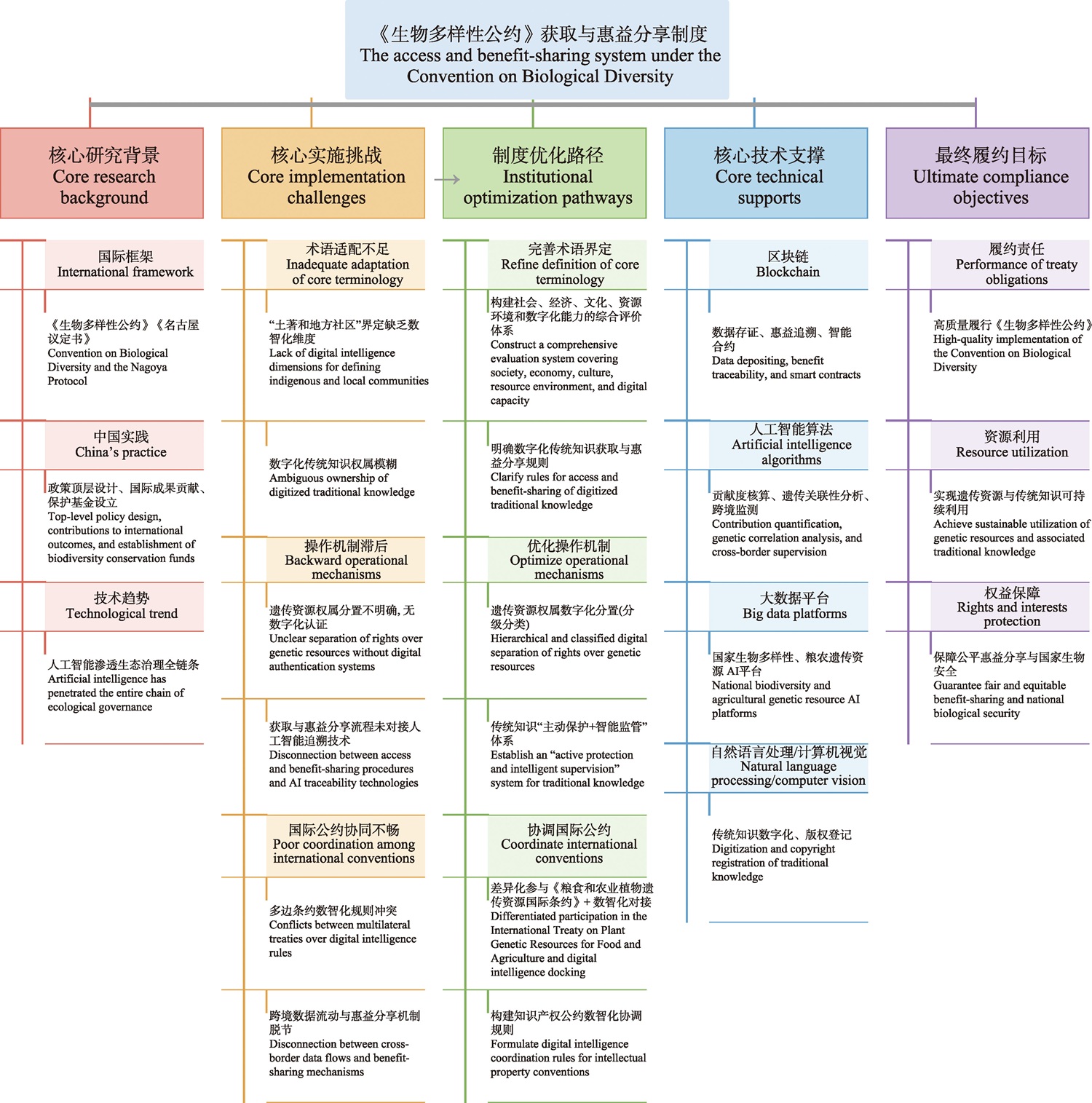
Fig. 1 Background, challenges and optimization pathways for China’s implementation of the access and benefit-sharing system under the Convention on Biological Diversity in the context of artificial intelligence
| [1] | CBD (Convention on Biological Diversity) (2025) Guide for Databases: The Multilateral Mechanism for the Fair and Equitable Sharing of Benefits from the Use of Digital Sequence Information on Genetic Resources, and the Cali Fund. https://www.cbd.int/califund/guides/guide-for-databas es.pdf. (accessed on 2025-10-16) |
| [2] | INSDC (International Nucleotide Sequence Database Collaboration) (2023) INSDC Spatiotemporal Metadata Minimum Standards Update. https://www.insdc.org/news/ins dc-spatiotemporal-metadata-minimum-standards-update-03-03-2023/. (accessed on 2025-10-16) |
| [3] | Lawson C, Humphries F, Rourke M (2024) Challenging the existing order of knowledge sharing governance with digital sequence information on genetic resources. Journal of Intellectual Property Law and Practice, 19, 337-357. |
| [4] | Li BP, Xue DY (2021) Applicability and evaluation index system of the term “indigenous and local communities” of the Convention on Biological Diversity in China. Biodiversity Science, 29, 193-199. (in Chinese with English abstract) |
| [李保平, 薛达元 (2021) 《生物多样性公约》中“土著和地方社区”术语在中国的适用性和评价指标体系. 生物多样性, 29, 193-199.] | |
| [5] | Liu LJ, Song M (2011) Conflicts and harmonization in the international regime for proprietorship of biological and genetic resources and policy options in China. Resources Science, 33, 1750-1756. (in Chinese with English abstract) |
| [刘丽军, 宋敏 (2011) 生物遗传资源权属国际制度安排的冲突、协调及中国的应对策略. 资源科学, 33, 1750-1756.] | |
| [6] | Ma Y, Yang JB, Wen Q, Xue DY (2019) A study on the changes of traditional knowledge related to biodiversity of ecological immigrants—Based on the investigation of immigrant villages in Hongsipu District, Ningxia. Social Sciences in Ningxia, (1), 145-150. (in Chinese with English abstract) |
| [马瑛, 杨京彪, 文琦, 薛达元 (2019) 生态移民的生物多样性相关传统知识变迁研究——基于宁夏红寺堡区移民村落的调查. 宁夏社会科学, (1), 145-150.] | |
| [7] | Wu JY, Xue DY, Zhao FW (2013) Plant genetic resources collection of some botanic gardens in the USA and UK from China. Resources Science, 35, 1499-1509. (in Chinese with English abstract) |
| [武建勇, 薛达元, 赵富伟 (2013) 欧美植物园引种中国植物遗传资源案例研究. 资源科学, 35, 1499-1509.] | |
| [8] | Xu J, Wang JZ (2023) Analysis of the main elements and implications of the Kunming-Montreal Global Biodiversity Framework. Biodiversity Science, 31, 23020. (in Chinese with English abstract) |
| [徐靖, 王金洲 (2023) 《昆明-蒙特利尔全球生物多样性框架》主要内容及其影响. 生物多样性, 31, 23020.] | |
| [9] | Xue DY (2017) The latest development for implementation of the Convention on Biological Diversity. Biodiversity Science, 25, 1145-1146. (in Chinese) |
| [薛达元 (2017) 《生物多样性公约》履约新进展. 生物多样性, 25, 1145-1146.] | |
| [10] | Yu WX (2013) Study on Biodiversity Policy and Legislation. Intellectual Property Press, Beijing. (in Chinese) |
| [于文轩 (2013) 生物多样性政策与立法研究. 知识产权出版社, 北京.] | |
| [11] | Zhang XY (2018) Research on International Legal Issues of Genetic Resources. Intellectual Property Press, Beijing. (in Chinese) |
| [张小勇 (2018) 遗传资源国际法问题研究. 知识产权出版社, 北京.] | |
| [12] | Zhao FW (2025) The negotiation process of the multilateral mechanism of digital sequence information on genetic resources and China’s response to it. Biodiversity Science, 33, 24599. (in Chinese with English abstract) |
| [赵富伟 (2025) 遗传资源数字序列信息多边机制的谈判进程及我国的对策. 生物多样性, 33, 24599.] |
| [1] | Jianping Chen, Xin Zhong, Bin Chen, Binjie Ge, Cheng Du, Yanping Gao, Li Guo, Dongmei Jin, Qixia Ma, Yonghong Hu. AI capability development for China’s national botanical garden system: A reference model, maturity assessment framework, and application architecture [J]. Biodiv Sci, 2026, 34(7): 26124-. |
| [2] | Ye Wang, Qianlu Wang, Jing Guan, Ying Wang. The current financial mechanisms of the Convention on Biological Diversity and its alternatives [J]. Biodiv Sci, 2026, 34(1): 25353-. |
| [3] | Zhongqing Wang, Zhiwei Hu. Empirical study on access and benefit-sharing information disclosure of biological genetic resources by Chinese listed companies [J]. Biodiv Sci, 2025, 33(8): 25125-. |
| [4] | Fuwei Zhao. The negotiation process of the multilateral mechanism of digital sequence information on genetic resources and China’s response to it [J]. Biodiv Sci, 2025, 33(6): 24559-. |
| [5] | Xiaoyu Zhu, Chenhao Wang, Zhongjun Wang, Yujun Zhang. Research progress and prospect of urban green space biodiversity [J]. Biodiv Sci, 2025, 33(5): 25027-. |
| [6] | Mingyue Zang, Li Liu, Yue Ma, Xu Xu, Feilong Hu, Xiaoqiang Lu, Jiaqi Li, Cigang Yu, Yan Liu. China’s urban biodiversity conservation under the Kunming-Montreal Global Biodiversity Framework [J]. Biodiv Sci, 2025, 33(5): 24482-. |
| [7] | Lu Xiaoqiang, Dong Shanshan, Ma Yue, Xu Xu, Qiu Feng, Zang Mingyue, Wan Yaqiong, Li Luanxin, Yu Cigang, Liu Yan. Current status, challenges, and prospects of frontier technologies in biodiversity conservation applications [J]. Biodiv Sci, 2025, 33(4): 24440-. |
| [8] | Xie Gan, Xuan Jing, Fu Qidi, Wei Ze, Xue Kai, Luo Hairui, Gao Jixi, Li Min. Establishing an intelligent identification model for unmanned aerial vehicle surveys of grassland plant diversity [J]. Biodiv Sci, 2025, 33(4): 24236-. |
| [9] | Gu Jingjing, Liu Yizhuo, Su Yang. The functions and challenges of grass-roots local governments in fulfilling the Kunming-Montreal Global Biodiversity Framework—A comparative analysis with the objectives of the United Nations Framework Convention on Climate Change [J]. Biodiv Sci, 2025, 33(3): 24585-. |
| [10] | Wu Hui, Yu Le, Du Zhenrong, Zhao Qiang, Qi Wenchao, Cao Yue, Wang Jinzhou, Shen Xiaoli, Sun Yao, Ma Keping. Rapid assessment of the Kunming-Montreal Global Biodiversity Framework implementation progress based on remote sensing monitoring: Pathway and prospects [J]. Biodiv Sci, 2025, 33(3): 24526-. |
| [11] | Xiangfei Kong, Qiang Ding, Guoquan Wang, Guohua Huang, Zhehao Tian, Xinpu Wang, Yijie Tong, Zhishun Song, Xiaoning Zhang, Weihai Li, Huilin Han, Wenliang Li, Rui’e Nie, Haidong Yang, Xingke Yang, Meike Liu, Yongming Sun, Yaqin Cui, Meixia Yang, Ning Liu, Yuanyuan Lu, Panpan Li, Ming Bai. Research progress of insect diversity in “SITE-100” sampling sites in China [J]. Biodiv Sci, 2025, 33(12): 24323-. |
| [12] | Xi Li, Xiaoge Ping, Xuehong Xu, Yu Cao, Boxuan Gao, Yiming Bao, Jiliang Xu. Progress and prospects of the important issues of the 16th Meeting of the Conference of the Parties to the Convention on Biological Diversity [J]. Biodiv Sci, 2025, 33(12): 25121-. |
| [13] | Xuanhong Zhou, Jun Yang. Applications and challenges of AI and LLMs in biodiversity conservation research and practices [J]. Biodiv Sci, 2025, 33(10): 25179-. |
| [14] | Lei Liu, Zhiming Hao, Leshan Du, Haiou Liu. Mainstreaming gender in China’s biodiversity actions under Kunming-Montreal Global Biodiversity Framework [J]. Biodiv Sci, 2025, 33(1): 24235-. |
| [15] | Haiou Liu, Leshan Du, Wenhui Liu, Ziyuan Li, Libo Pan, Lei Liu. Analysis and enlightenment on Global Biodiversity Framework Fund management policy [J]. Biodiv Sci, 2024, 32(3): 23334-. |
| Viewed | ||||||
|
Full text |
|
|||||
|
Abstract |
|
|||||
Copyright © 2026 Biodiversity Science
Editorial Office of Biodiversity Science, 20 Nanxincun, Xiangshan, Beijing 100093, China
Tel: 010-62836137, 62836665 E-mail: biodiversity@ibcas.ac.cn
