

Biodiv Sci ›› 2025, Vol. 33 ›› Issue (12): 25400. DOI: 10.17520/biods.2025400 cstr: 32101.14.biods.2025400
• Data Paper • Previous Articles Next Articles
Yifan Zhang1,2,3( ), Wenyuan Zhang3(), Di Wang3(), Zhiheng Wang1,2,*()(
 ), Rongjiang Wang1,3,*()()
Received:2025-10-10
Accepted:2025-12-11
Online:2025-12-20
Published:2026-01-09
Supported by:Yifan Zhang, Wenyuan Zhang, Di Wang, Zhiheng Wang, Rongjiang Wang. A list of threatened butterfly species in China under future global change scenarios[J]. Biodiv Sci, 2025, 33(12): 25400.
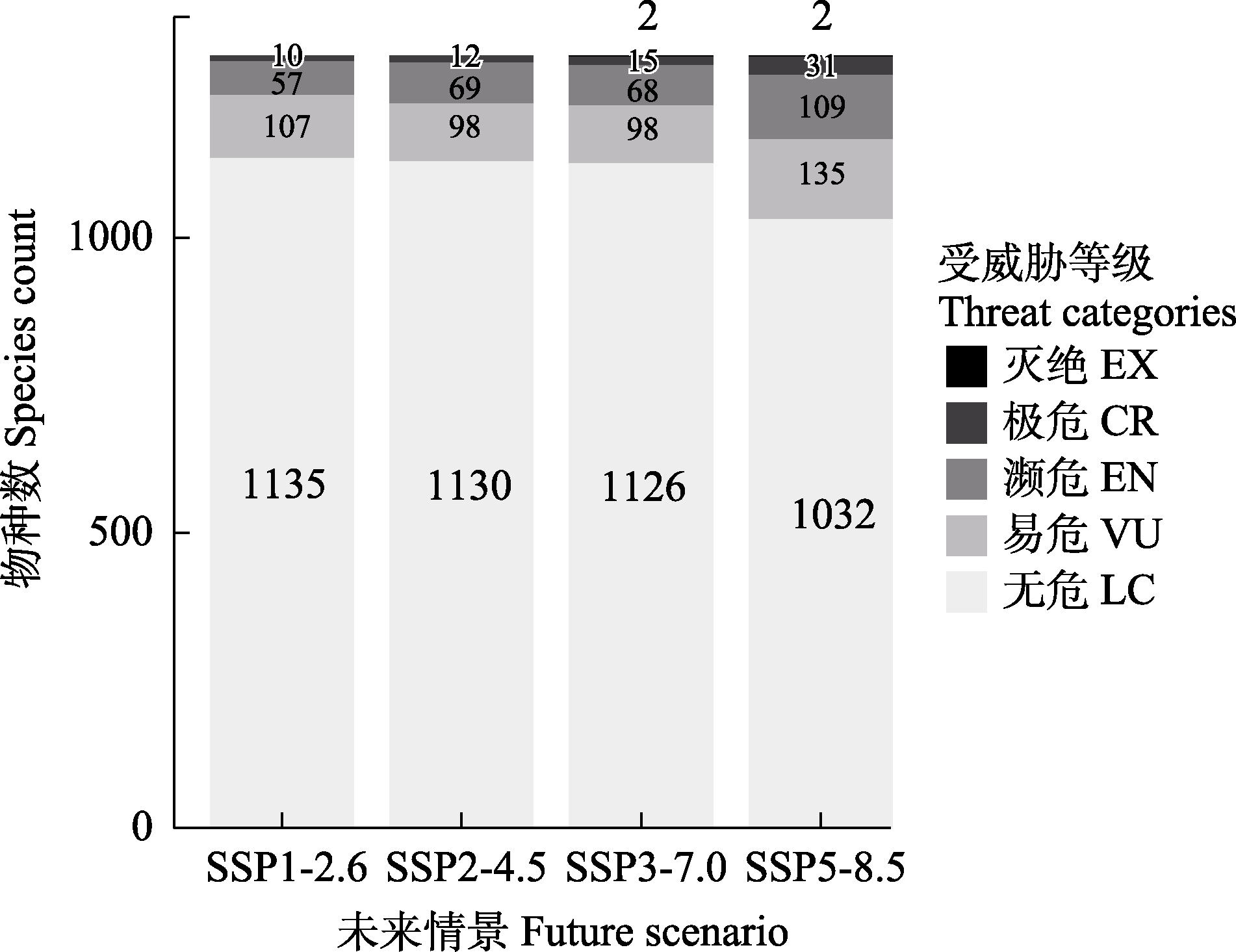
Fig. 1 Distribution of threat categories for butterflies in China under different future climate and land-use scenarios. EX, Extinct; CR, Critically Endangered; EN, Endangered; VU, Vulnerable; LC, Least Concern.
| [1] |
Araújo MB, Peterson AT (2012) Uses and misuses of bioclimatic envelope modeling. Ecology, 93, 1527-1539.
DOI PMID |
| [2] |
Bellard C, Bertelsmeier C, Leadley P, Thuiller W, Courchamp F (2012) Impacts of climate change on the future of biodiversity. Ecology Letters, 15, 365-377.
DOI PMID |
| [3] |
Beyer RM, Manica A (2020) Historical and projected future range sizes of the world’s mammals, birds, and amphibians. Nature Communications, 11, 5633.
DOI |
| [4] | Ceballos G, Ehrlich PR, Barnosky AD, García A, Pringle RM, Palmer TM (2015) Accelerated modern human-induced species losses: Entering the sixth mass extinction. Science Advances, 1, e1400253. |
| [5] |
Fick SE, Hijmans RJ (2017) WorldClim 2: New 1-km spatial resolution climate surfaces for global land areas. International Journal of Climatology, 37, 4302-4315.
DOI URL |
| [6] |
Fitzpatrick MC, Sanders NJ, Ferrier S, Longino JT, Weiser MD, Dunn R (2011) Forecasting the future of biodiversity: A test of single- and multi-species models for ants in North America. Ecography, 34, 836-847.
DOI URL |
| [7] | Guéguen M, Blancheteau H, Lemaire-Patin R, Thuiller W (2025) biomod2: Ensemble Platform for Species Distribution Modeling. https://biomodhub.github.io/biomod2/. (accessed on 2024-05-03) |
| [8] | Hill GM, Kawahara AY, Daniels JC, Bateman CC, Scheffers BR (2021) Climate change effects on animal ecology: Butterflies and moths as a case study.Biological Reviews, 96, 2113-2126. |
| [9] | IUCN (2012a) IUCN Red List Categories and Criteria: Version 3.1, Second edition. IUCN, Gland, Switzerland and Cambridge, UK. |
| [10] | IUCN (2012b) Guidelines for Application of IUCN Red List Criteria at Regional and National Levels, Version 4.0. IUCN, Gland, Switzerland and Cambridge, UK. |
| [11] | Ma FZ, Xu HG, Chen MM, Tong WJ, Wang CB, Cai L (2018) Progress in construction of China Butterfly Diversity Observation Network (China BON-Butterflies). Journal of Ecology and Rural Environment, 34, 27-36. (in Chinese with English abstract) |
| [马方舟, 徐海根, 陈萌萌, 童文君, 王晨彬, 蔡蕾 (2018) 全国蝴蝶多样性观测网络(China BON-Butterflies)建设进展. 生态与农村环境学报, 34, 27-36.] | |
| [12] |
Peng SJ, Luo Y, Cai HY, Zhang XL, Wang ZH (2022) A new list of threatened woody species in China under future global change scenarios. Biodiversity Science, 30, 21459. (in Chinese with English abstract)
DOI |
|
[彭莳嘉, 罗源, 蔡宏宇, 张晓玲, 王志恒 (2022) 全球变化情景下的中国木本植物受威胁物种名录. 生物多样性, 30, 21459.]
DOI |
|
| [13] | Pinkert S, Barve V, Guralnick R, Jetz W (2022) Global geographical and latitudinal variation in butterfly species richness captured through a comprehensive country-level occurrence database. Global Ecology and Biogeography, 31, 830-839. |
| [14] | Pinkert S, Farwig N, Kawahara AY, Jetz W (2025) Global hotspots of butterfly diversity are threatened in a warming world. Nature Ecology & Evolution, 9, 789-800. |
| [15] |
van Klink R, Bowler DE, Gongalsky KB, Swengel AB, Gentile A, Chase JM (2020) Meta-analysis reveals declines in terrestrial but increases in freshwater insect abundances. Science, 368, 417-420.
DOI PMID |
| [16] | Wang D, Zhang YF, Lu LZ, Li S, Wang RJ (2025) Butterfly diversity patterns provide new insights into biodiversity conservation in China. Global Ecology and Biogeography, 34, e13946. |
| [17] | Wang S, Xie Y (2005) China Species Red List (Vol. 3): Invertebrate. Higher Education Press, Beijing. (in Chinese) |
| [汪松, 解焱 (2005) 中国物种红色名录(第三卷): 无脊椎动物. 高等教育出版社, 北京.] | |
| [18] |
Wisz MS, Hijmans RJ, Li J, Peterson AT, Graham CH, Guisan A, NCEAS Predicting Species Distributions Working Group 2008) Effects of sample size on the performance of species distribution models. Diversity and Distributions, 14, 763-773.
DOI URL |
| [19] | Wu CS, Hsu YF (2017) Illustrated Handbook of Chinese Butterflies. Straits Publishing House, Fuzhou. (in Chinese) |
| [武春生, 徐堉峰 (2017) 中国蝴蝶图鉴. 海峡书局, 福州.] | |
| [20] |
Xie Y (2022) Progress and application of IUCN Red List of Threatened Species. Biodiversity Science, 30, 22445. (in Chinese with English abstract)
DOI |
|
[解焱 (2022) IUCN受威胁物种红色名录进展及应用. 生物多样性, 30, 22445.]
DOI |
|
| [21] |
Yu XT, Yang FL, Da W, Li YC, Xi HM, Cotton AM, Zhang HH, Duan K, Xu ZB, Gong ZX, Wang WL, Hu SJ (2023) Species richness of Papilionidae butterflies (Lepidoptera: Papilionoidea) in the Hengduan Mountains and its future shifts under climate change. Insects, 14, 259.
DOI URL |
| [22] |
Zhang TY, Cheng CX, Wu XD (2023) Mapping the spatial heterogeneity of global land use and land cover from 2020 to 2100 at a 1 km resolution. Scientific Data, 10, 748.
DOI PMID |
| [23] |
Zizka A, Silvestro D, Andermann T, Azevedo J, Duarte Ritter C, Edler D, Farooq H, Herdean A, Ariza M, Scharn R, Svantesson S, Wengström N, Zizka V, Antonelli A (2019) CoordinateCleaner: Standardized cleaning of occurrence records from biological collection databases. Methods in Ecology and Evolution, 10, 744-751.
DOI URL |
| Viewed | ||||||
|
Full text |
|
|||||
|
Abstract |
|
|||||
Copyright © 2026 Biodiversity Science
Editorial Office of Biodiversity Science, 20 Nanxincun, Xiangshan, Beijing 100093, China
Tel: 010-62836137, 62836665 E-mail: biodiversity@ibcas.ac.cn

