

Biodiv Sci ›› 2026, Vol. 34 ›› Issue (1): 25308. DOI: 10.17520/biods.2025308 cstr: 32101.14.biods.2025308
• Special Feature: Methods for Ecological Data Analysis • Previous Articles Next Articles
Shuang Zhang1( ), Bo Song2,*()(
 )
)
Received:2025-08-05
Accepted:2025-12-10
Online:2026-01-20
Published:2026-01-21
Contact:
Bo Song
Supported by:Shuang Zhang, Bo Song. Several key questions when conducting a meta-analysis[J]. Biodiv Sci, 2026, 34(1): 25308.
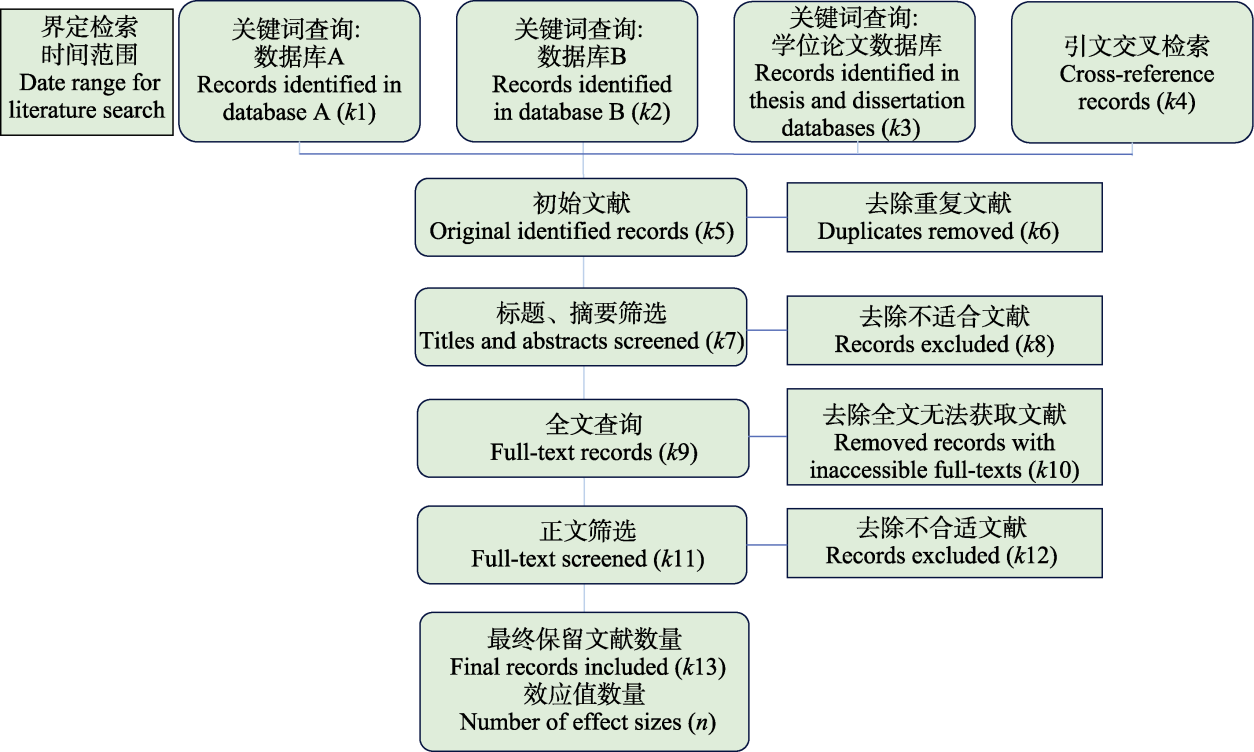
Fig. 1 The PRISMA-flowchart in literature search. k1 to k13 represents the number of publications included or excluded at each stage of the literature search and n represents the total number of effect sizes derived from the selected literature.
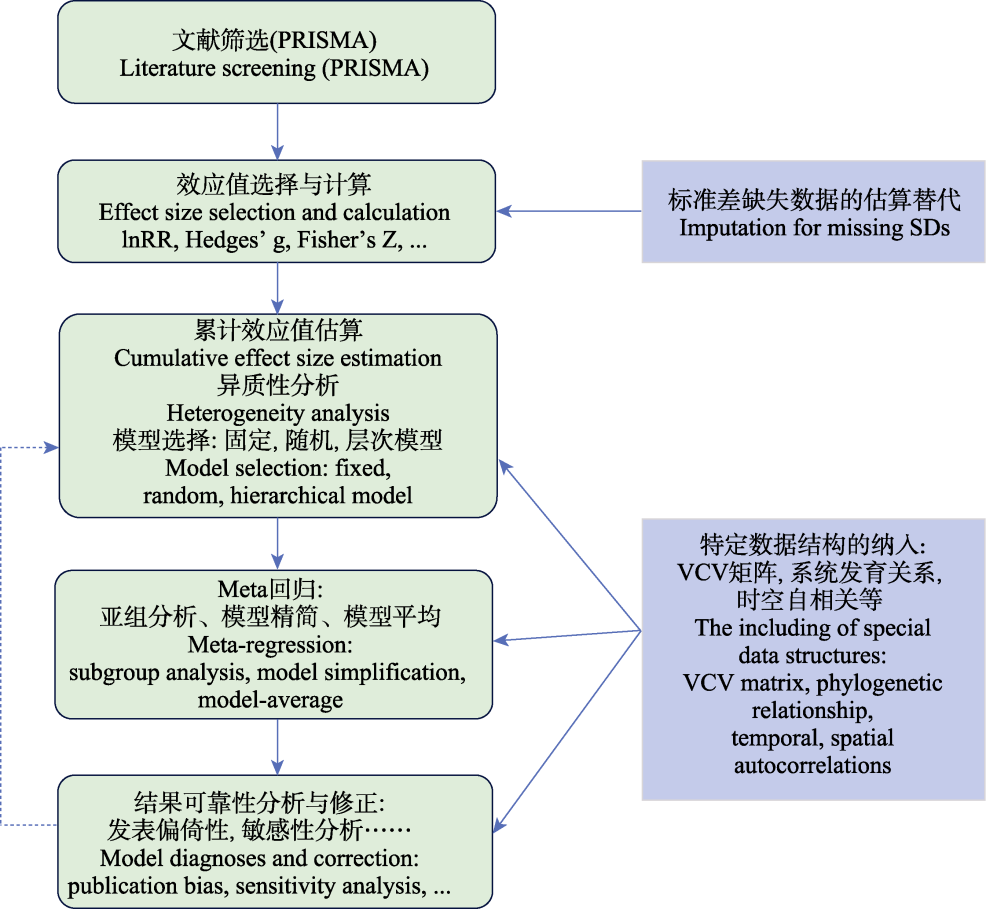
Fig. 2 The flowchart of the data analysis in meta-analysis. The right part shows methods that can be used in datasets with missing SDs or different non-independent data structures. The dotted line represents the needed correction for cumulative effect size when publication bias was detected.
| [1] |
Benítez-López A, Alkemade R, Schipper AM, Ingram DJ, Verweij PA, Eikelboom JAJ, Huijbregts MAJ (2017) The impact of hunting on tropical mammal and bird populations. Science, 356, 180-183.
DOI PMID |
| [2] |
Bennett JM, Steets JA, Burns JH, Burkle LA, Vamosi JC, Wolowski M, Arceo-Gómez G, Burd M, Durka W, Ellis AG, Freitas L, Li JM, Rodger JG, Ştefan V, Xia J, Knight TM, Ashman TL (2020) Land use and pollinator dependency drives global patterns of pollen limitation in the Anthropocene. Nature Communications, 11, 3999.
DOI |
| [3] |
Chen C, Xiao WY, Chen HYH (2025) Meta-analysis reveals global variations in plant diversity effects on productivity. Nature, 638, 435-440.
DOI |
| [4] |
Chen SC, Antonelli A, Huang X, Wei N, Dai C, Wang QF (2025) Large seeds as a defensive strategy against partial granivory in the Fagaceae. Journal of Ecology, 113, 598-607.
DOI URL |
| [5] |
Doi SAR, Thalib L (2008) A quality-effects model for meta-analysis. Epidemiology, 19, 94-100.
DOI PMID |
| [6] |
Driscoll DA, MacDonald KJ, Gibson RK, Doherty TS, Nimmo DG, Nolan RH, Ritchie EG, Williamson GJ, Heard GW, Tasker EM, …, Green M, Gilpin AM, Cook JM, Power SA, Hogendoorn K, Brawata R, Jolly CJ, Tozer M, Reiter N, Phillips RD (2024) Biodiversity impacts of the 2019-2020 Australian megafires. Nature, 635, 898-905.
DOI |
| [7] | Fanelli D, Costas R, Ioannidis JPA (2017) Meta-assessment of bias in science. Proceedings of the National Academy of USA, 114, 3714-3719. |
| [8] |
Feng YH, Schmid B, Loreau M, Forrester DI, Fei SL, Zhu JX, Tang ZY, Zhu JL, Hong PB, Ji CJ, Shi Y, Su HJ, Xiong XY, Xiao J, Wang SP, Fang JY (2022) Multispecies forest plantations outyield monocultures across a broad range of conditions. Science, 376, 865-868.
DOI PMID |
| [9] |
Fernandez-Duque E, Valeggia C (1994) Meta-analysis: A valuable tool in conservation research. Conservation Biology, 8, 555-561.
DOI URL |
| [10] |
Gillman LN, Wright SD (2010) Mega mistakes in meta-analyses: Devil in the detail. Ecology, 91, 2550-2552.
PMID |
| [11] |
Gurevitch J, Koricheva J, Nakagawa S, Stewart G (2018) Meta-analysis and the science of research synthesis. Nature, 555, 175-182.
DOI URL |
| [12] | Higgins JPT, Thompson SG (2002) Quantifying heterogeneity in a meta-analysis. Statistics in Medicine, 21, 1539-1558. |
| [13] | Higgins JPT, Thompson SG, Deeks JJ, Altman DG (2003) Measuring inconsistency in meta-analyses. BMJ, 327, 557-560. |
| [14] |
Hooper DU, Adair EC, Cardinale BJ, Byrnes JEK, Hungate BA, Matulich KL, Gonzalez A, Duffy JE, Gamfeldt L, O’Connor MI (2012) A global synthesis reveals biodiversity loss as a major driver of ecosystem change. Nature, 486, 105-108.
DOI |
| [15] |
Hua FY, Bruijnzeel LA, Meli P, Martin PA, Zhang J, Nakagawa S, Miao XR, Wang WY, McEvoy C, Peña-Arancibia JL, Brancalion PHS, Smith P, Edwards DP, Balmford A (2022) The biodiversity and ecosystem service contributions and trade-offs of forest restoration approaches. Science, 376, 839-844.
DOI URL |
| [16] | Hülsmann L, Chisholm RA, Comita L, Visser MD, de Souza Leite M, Aguilar S, Anderson-Teixeira KJ, Bourg NA, Brockelman WY, Bunyavejchewin S, Castaño N, Chang-Yang CH, Chuyong GB, Clay K, Davies SJ, Duque A, Ediriweera S, Ewango C, Gilbert GS, Holík J, Howe RW, Hubbell SP, Itoh A, Johnson DJ, Kenfack D, Král K, Larson AJ, Lutz JA, Makana JR, Malhi Y, McMahon SM, McShea WJ, Mohamad M, Nasardin M, Nathalang A, Norden N, Oliveira AA, Parmigiani R, Perez R, Phillips RP, Pongpattananurak N, Sun IF, Swanson ME, Tan S, Thomas D, Thompson J, Uriarte M, Wolf AT, Yao TL, Zimmerman JK, Zuleta D, Hartig F (2024) Latitudinal patterns in stabilizing density dependence of forest communities. Nature, 627, 564-571. |
| [17] |
Kambach S, Bruelheide H, Gerstner K, Gurevitch J, Beckmann M, Seppelt R (2020) Consequences of multiple imputation of missing standard deviations and sample sizes in meta-analysis. Ecology and Evolution, 10, 11699-11712.
DOI PMID |
| [18] |
Keck F, Peller T, Alther R, Barouillet C, Blackman R, Capo E, Chonova T, Couton M, Fehlinger L, Kirschner D, Knüsel M, Muneret L, Oester R, Tapolczai K, Zhang H, Altermatt F (2025) The global human impact on biodiversity. Nature, 641, 395-400.
DOI |
| [19] |
Langhammer PF, Bull JW, Bicknell JE, Oakley JL, Brown MH, Bruford MW, Butchart SHM, Carr JA, Church D, Cooney R, Cutajar S, Foden W, Foster MN, Gascon C, Geldmann J, Genovesi P, Hoffmann M, Howard-McCombe J, Lewis T, MacFarlane NBW, Melvin ZE, Merizalde RS, Morehouse MG, Pagad S, Polidoro B, Sechrest W, Segelbacher G, Smith KG, Steadman J, Strongin K, Williams J, Woodley S, Brooks TM (2024) The positive impact of conservation action. Science, 384, 453-458.
DOI PMID |
| [20] |
Lawton JH (1999) Are there general laws in ecology? Oikos, 84, 177-192.
DOI URL |
| [21] | Lortie CJ, Filazzola A (2020) A contrast of meta and metafor packages for meta-analyses in R. Ecology and Evolution, 10, 10916-10921. |
| [22] |
Lundgren EJ, Bergman J, Trepel J, Roux E, Monsarrat S, Kristensen JA, Pedersen RØ, Pereyra P, Tietje M, Svenning JC (2024) Functional traits—not nativeness—shape the effects of large mammalian herbivores on plant communities. Science, 383, 531-537.
DOI PMID |
| [23] |
Moher D, Liberati A, Tetzlaff J, Altman DG (2010) Preferred reporting items for systematic reviews and meta-analyses: The PRISMA statement. International Journal of Surgery, 8, 336-341.
DOI PMID |
| [24] |
Møller AP, Jennions MD (2001) Testing and adjusting for publication bias. Trends in Ecology & Evolution, 16, 580-586.
DOI URL |
| [25] |
Nakagawa S, Lagisz M, Jennions MD, Koricheva J, Noble DWA, Parker TH, Sánchez-Tójar A, Yang YF, O’Dea RE (2022a) Methods for testing publication bias in ecological and evolutionary meta-analyses. Methods in Ecology and Evolution, 13, 4-21.
DOI URL |
| [26] |
Nakagawa S, Lagisz M, O’Dea RE, Pottier P, Rutkowska J, Senior AM, Yang YF, Noble DWA (2023a) orchaRd 2.0: An R package for visualising meta-analyses with orchard plots. Methods in Ecology and Evolution, 14, 2003-2010.
DOI URL |
| [27] |
Nakagawa S, Noble DWA, Lagisz M, Spake R, Viechtbauer W, Senior AM (2023b) A robust and readily implementable method for the meta-analysis of response ratios with and without missing standard deviations. Ecology Letters, 26, 232-244.
DOI URL |
| [28] |
Nakagawa S, Noble DWA, Senior AM, Lagisz M (2017) Meta-evaluation of meta-analysis: Ten appraisal questions for biologists. BMC Biology, 15, 18.
DOI PMID |
| [29] | Nakagawa S, Senior AM, Viechtbauer W, Noble DWA (2022b) An assessment of statistical methods for nonindependent data in ecological meta-analyses: Comment. Ecology, 101, e03490. |
| [30] |
Nakagawa S, Yang YF, MacArtney EL, Spake R, Lagisz Ma (2023c) Quantitative evidence synthesis: A practical guide on meta-analysis, meta-regression, and publication bias tests for environmental sciences. Environmental Evidence, 12, 8.
DOI |
| [31] |
O’Dea RE, Lagisz M, Jennions MD, Koricheva J, Noble DWA, Parker TH, Gurevitch J, Page MJ, Stewart G, Moher D, Nakagawa S (2021) Preferred reporting items for systematic reviews and meta-analyses in ecology and evolutionary biology: A PRISMA extension. Biological Reviews, 96, 1695-1722.
DOI URL |
| [32] | Ohayon S, Granot I, Belmaker J (2021) A meta-analysis reveals edge effects within marine protected areas. Nature Ecology & Evolution, 5, 1301-1308. |
| [33] |
Page MJ, McKenzie JE, Bossuyt PM, Boutron I, Hoffmann TC, Mulrow CD, Shamseer L, Tetzlaff JM, Akl EA, Brennan SE, Chou R, Glanville J, Grimshaw JM, Hróbjartsson A, Lalu MM, Li TJ, Loder EW, Mayo-Wilson E, McDonald S, McGuinness LA, Stewart LA, Thomas J, Tricco AC, Welch VA, Whiting P, Moher D (2021) The PRISMA 2020 statement: An updated guideline for reporting systematic reviews. Systematic Reviews, 10, 89.
DOI PMID |
| [34] | Peng SJ, Kinlock NL, Gurevitch J, Peng SL (2019) Correlation of native and exotic species richness: A global meta-analysis finds no invasion paradox across scales. Ecology, 100, e02552. |
| [35] |
Pottier P, Noble DWA, Seebacher F, Wu NC, Burke S, Lagisz M, Schwanz LE, Drobniak SM, Nakagawa S (2024) New horizons for comparative studies and meta-analyses. Trends in Ecology & Evolution, 39, 435-445.
DOI URL |
| [36] |
Rossetti MR, Tscharntke T, Aguilar R, Batáry P (2017) Responses of insect herbivores and herbivory to habitat fragmentation: A hierarchical meta-analysis. Ecology Letters, 20, 264-272.
DOI PMID |
| [37] |
Senior AM, Grueber CE, Kamiya T, Lagisz M, O’Dwyer K, Santos ESA, Nakagawa S (2016) Heterogeneity in ecological and evolutionary meta-analyses: Its magnitude and implications. Ecology, 97, 3293-3299.
DOI PMID |
| [38] |
Shaw RE, Farquharson KA, Bruford MW, Coates DJ, Elliott CP, Mergeay J, Ottewell KM, Segelbacher G, Hoban S, Hvilsom C, Pérez-Espona S, Ruņģis D, Aravanopoulos F, Bertola LD, Cotrim H, Cox K, Cubric-Curik V, Ekblom R, Godoy JA, Konopiński MK, Laikre L, Russo IM, Veličković N, Vergeer P, Vilà C, Brajkovic V, Field DL, Goodall-Copestake WP, Hailer F, Hopley T, Zachos FE, Alves PC, Biedrzycka A, Binks RM, Buiteveld J, Buzan E, Byrne M, Huntley B, Iacolina L, Keehnen NLP, Klinga P, Kopatz A, Kurland S, Leonard JA, Manfrin C, Marchesini A, Millar MA, Orozco-terWengel P, Ottenburghs J, Posledovich D, Spencer PB, Tourvas N, Unuk Nahberger T, van Hooft P, Verbylaite R, Vernesi C, Grueber CE (2025) Global meta-analysis shows action is needed to halt genetic diversity loss. Nature, 638, 704-710.
DOI |
| [39] | Song C, Peacor SD, Osenberg CW, Bence JR (2020) An assessment of statistical methods for nonindependent data in ecological meta-analyses. Ecology, 101, e03184. |
| [40] | Spake R, O’Dea RE, Nakagawa S, Doncaster CP, Ryo M, Callaghan CT, Bullock JM (2022) Improving quantitative synthesis to achieve generality in ecology. Nature Ecology & Evolution, 6, 1818-1828. |
| [41] |
Terrer C, Phillips RP, Hungate BA, Rosende J, Pett-Ridge J, Craig ME, van Groenigen KJ, Keenan TF, Sulman BN, Stocker BD, Reich PB, Pellegrini AFA, Pendall E, Zhang H, Evans RD, Carrillo Y, Fisher JB, Van Sundert K, Vicca S, Jackson RB (2021) A trade-off between plant and soil carbon storage under elevated CO2. Nature, 591, 599-603.
DOI |
| [42] |
Thakur MP, Gu ZZ, van Kleunen M, Zhou XH (2025) Invasion impacts in terrestrial ecosystems: Global patterns and predictors. Science, 390, 381-385.
DOI URL |
| [43] |
Tucker MA, Schipper AM, Adams TSF, Attias N, Avgar T, Babic NL, Barker KJ, Bastille-Rousseau G, Behr DM, Belant JL, …, Wagler BL, Whittington J, Wikelski M, Wilmers CC, Wittemyer G, Young JK, Zięba F, Zwijacz-Kozica T, Huijbregts MAJ, Mueller T (2023) Behavioral responses of terrestrial mammals to COVID-19 lockdowns. Science, 380, 1059-1064.
DOI PMID |
| [44] |
Urban MC (2024) Climate change extinctions. Science, 386, 1123-1128.
DOI PMID |
| [45] |
van Klink R, Bowler DE, Gongalsky KB, Swengel AB, Gentile A, Chase JM (2020) Meta-analysis reveals declines in terrestrial but increases in freshwater insect abundances. Science, 368, 417-420.
DOI PMID |
| [46] | Viechtbauer W (2010) Conducting meta-analyses in R with the metafor package. Journal of Statistical Software, 36, 1-48. |
| [47] |
Wallace BC, Lajeunesse MJ, Dietz G, Dahabreh IJ, Trikalinos TA, Schmid CH, Gurevitch J (2017) OpenMEE: Intuitive, open-source software for meta-analysis in ecology and evolutionary biology. Methods in Ecology and Evolution, 8, 941-947.
DOI URL |
| [48] |
Wu DH, Du EZ, Eisenhauer N, Mathieu J, Chu CJ (2025) Global engineering effects of soil invertebrates on ecosystem functions. Nature, 640, 120-129.
DOI |
| [49] |
Xu CL, Silliman BR, Chen JS, Li XC, Thomsen MS, Zhang Q, Lee J, Lefcheck JS, Daleo P, Hughes BB, Jones HP, Wang R, Wang SP, Smith CS, Xi XQ, Altieri AH, van de Koppel J, Palmer TM, Liu LL, Wu JH, Li B, He Q (2023) Herbivory limits success of vegetation restoration globally. Science, 382, 589-594.
DOI PMID |
| [50] |
Yang YF, Hillebrand H, Lagisz M, Cleasby I, Nakagawa S (2022) Low statistical power and overestimated anthropogenic impacts, exacerbated by publication bias, dominate field studies in global change biology. Global Change Biology, 28, 969-989.
DOI URL |
| [1] | Boyao Li, Tiancheng Sheng, Xiaoyun Xing. Impact of biodiversity risk on corporate financial performance: Evidence from listed companies in China [J]. Biodiv Sci, 2026, 34(4): 25330-. |
| [2] | Jinyue Zhang, Baole Bian, Tairan Tang, Wenhao Nong, Shufeng Zhu, Xinmin Lu. Plant-rhizosphere microbe interaction and its response to herbivory: A review [J]. Biodiv Sci, 2026, 34(4): 25334-. |
| [3] | Cuiyi Jiang, Zhijing Xie, Zhongping Tian, Yueying Li, Mingxin Zheng, Shuai Fang, Mierkamili Maimaiti, Erfan Akberjan, Meixiang Gao, Jian Zhang. The role of microtopography in shaping forest soil Collembola community assembly in western Tianshan Mountains of Xinjiang [J]. Biodiv Sci, 2026, 34(4): 25300-. |
| [4] | Jiqi Gu, Jiangshan Lai, Ying Wang, Haoran Wu, Xue Zhang, Xiaotong Song, Xiaoming Shao, Anru Lou. Theoretical foundations, methodological advances, and applications of joint species distribution models with a focus on the HMSC framework in ecology [J]. Biodiv Sci, 2026, 34(1): 25364-. |
| [5] | Liu Zhixiang, Xie Hua, Zhang Hui, Huang Xiaolei. Functional diversity and regulation of cuticular hydrocarbons in social insects [J]. Biodiv Sci, 2025, 33(2): 24302-. |
| [6] | Yaoqi Chen, Jingjing Guo, Guojun Cai, Yili Ge, Yu Liao, Zheng Dong, Hui Fu. Evolution characteristics of submerged macrophyte community diversity in the middle and lower reaches of the Yangtze River in the past seventy years (1954-2021) [J]. Biodiv Sci, 2024, 32(3): 23319-. |
| [7] | Shuhan Yang, He Wang, Lei Chen, Yingfei Liao, Guang Yan, Yining Wu, Hongfei Zou. Effects of heterogeneous habitat on soil nematode community characteristics in the Songnen Plain [J]. Biodiv Sci, 2024, 32(1): 23295-. |
| [8] | Minghui Wang, Zhaoquan Chen, Shuaifeng Li, Xiaobo Huang, Xuedong Lang, Zihan Hu, Ruiguang Shang, Wande Liu. Spatial pattern of dominant species with different seed dispersal modes in a monsoon evergreen broad-leaved forest in Pu’er, Yunnan Province [J]. Biodiv Sci, 2023, 31(9): 23147-. |
| [9] | Yanqiu Xie, Hui Huang, Chunxiao Wang, Yaqin He, Yixuan Jiang, Zilin Liu, Chuanyuan Deng, Yushan Zheng. Determinants of species-area relationship and species richness of coastal endemic plants in the Fujian islands [J]. Biodiv Sci, 2023, 31(5): 22345-. |
| [10] | Yanhui Li, Tianyuan Lan, Yue Wang, Yang Yu, Changming Zhao, Lihua Li, Wenting Xu, Guozhen Shen. Driving factors of spatial turnover of plant species in Shennongjia [J]. Biodiv Sci, 2022, 30(4): 21377-. |
| [11] | Xue Han, Jinquan Su, Nana Yao, Baoming Chen. Advances in root foraging behavior of exotic invasive plants [J]. Biodiv Sci, 2020, 28(6): 727-733. |
| [12] | Yuan Sun, Weigang Hu, Shuran Yao, Ying Sun, Jianming Deng. Geographic patterns and environmental determinants of angiosperm and terrestrial vertebrate species richness in the Yellow River basin [J]. Biodiv Sci, 2020, 28(12): 1523-1532. |
| [13] | Changyan Zhou, Bin Wang, Yun Deng, Junjie Wu, Min Cao, Luxiang Lin. Canopy structure is an important factor driving local-scale woody plant functional beta diversity [J]. Biodiv Sci, 2020, 28(12): 1546-1557. |
| [14] | Guijun Yang, Min Wang, Yichun Yang, Xinyun Li, Xinpu Wang. Distribution patterns and environmental interpretation of beetle species richness in Helan Mountain of northern China [J]. Biodiv Sci, 2019, 27(12): 1309-1319. |
| [15] | Shuoran Liu, Daode Yang, Xianfu Li, Lu Tan, Jun Sun, Xiaoyang He, Wenshu Yang, Guopeng Ren, Davide Fornacca, Qinghua Cai, Wen Xiao. Diversity in benthic and environmental characteristics on alpine micro-waterbodies and stream ecosystems in northwest Yunnan [J]. Biodiv Sci, 2019, 27(12): 1298-1308. |
| Viewed | ||||||
|
Full text |
|
|||||
|
Abstract |
|
|||||
Copyright © 2026 Biodiversity Science
Editorial Office of Biodiversity Science, 20 Nanxincun, Xiangshan, Beijing 100093, China
Tel: 010-62836137, 62836665 E-mail: biodiversity@ibcas.ac.cn

