

Biodiv Sci ›› 2026, Vol. 34 ›› Issue (3): 25290. DOI: 10.17520/biods.2025290 cstr: 32101.14.biods.2025290
• Original Papers: Microbial Diversity • Previous Articles Next Articles
Zhao Chen,#, Ying Xu,#, Tianyu Liang, Yanling Zhao, Xuan Zhang, Lujing Wang, Yanci Yang*( ), Yonglong Wang*()
Received:2025-07-21
Accepted:2025-11-28
Online:2026-03-20
Published:2026-04-09
Contact:
*E-mail: About author:#Co-first authors
Supported by:Zhao Chen, Ying Xu, Tianyu Liang, Yanling Zhao, Xuan Zhang, Lujing Wang, Yanci Yang, Yonglong Wang. Diversity and mechanisms underlying community assembly of the fungi associated with Tetraena mongolica, an endangered relict plant in West Ordos[J]. Biodiv Sci, 2026, 34(3): 25290.
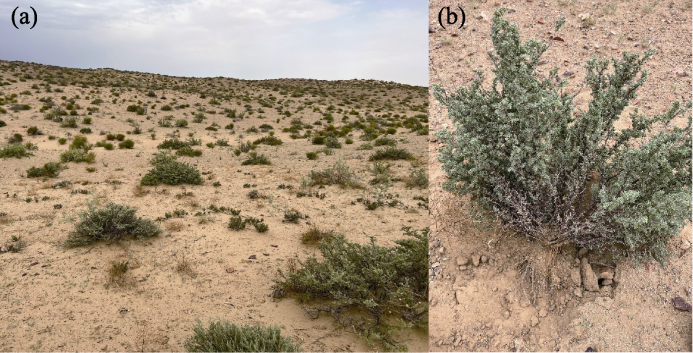
Fig. 1 Field photos of Tetraena mongolica, an endangered relict plant in West Ordos Plateau. (a) Field population; (b) Single plant individual.
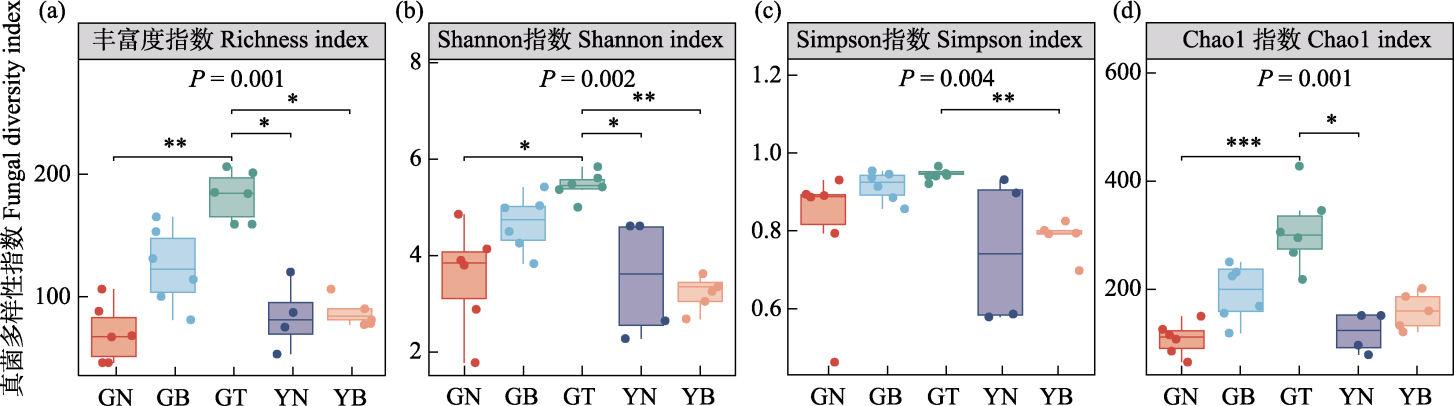
Fig. 2 Analysis on diversity of fungal alpha in different compartments of Tetraena mongolica. (a) Richness indices; (b) Shannon indices; (c) Simpson indices; (d) Chao1 indices. GN, Root endophytic fungi; GB, Root epiphytic fungi; GT, Rhizosphere soil; YN, Phyllosphere endophytic fungi; YB, Phyllosphere epiphytic fungi. * P < 0.05; ** P < 0.01; *** P < 0.001.
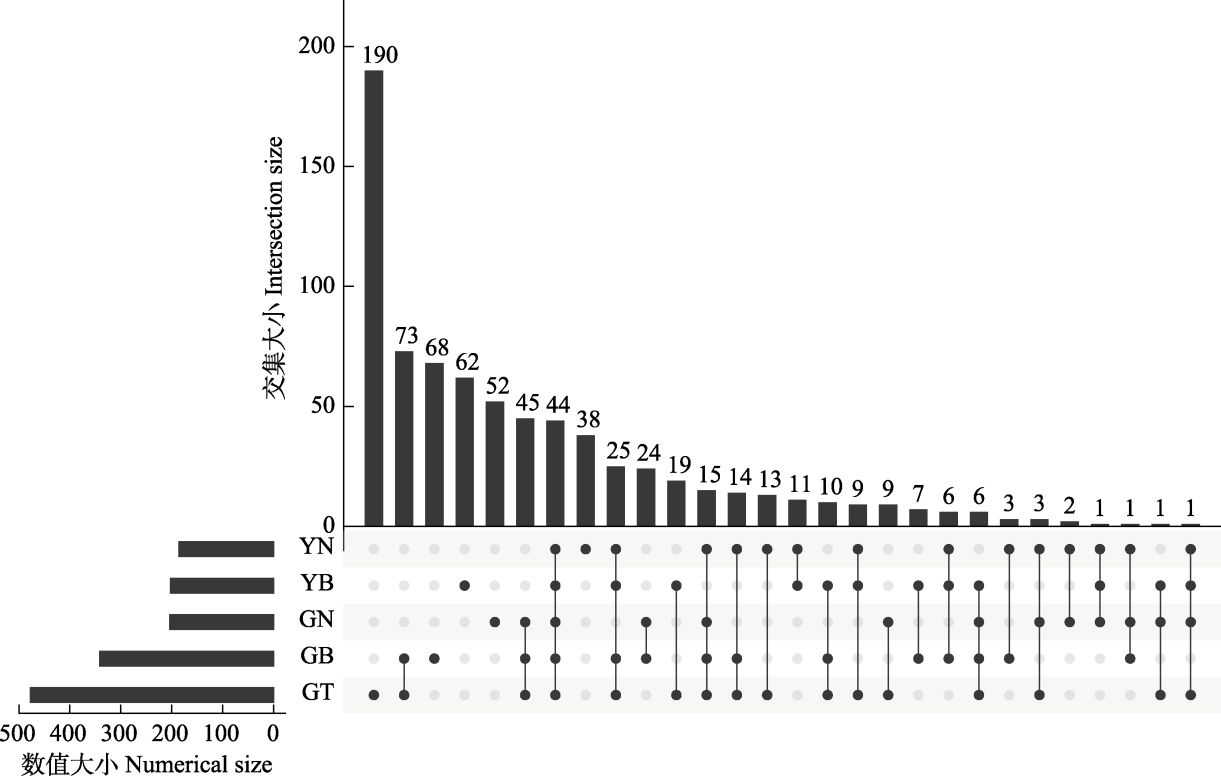
Fig. 3 Upset diagram of distribution of unique and shared fungal operational taxonomic units (OTUs) across different compartments of Tetraena mongolica. GN, Root endophytic fungi; GB, Root epiphytic fungi; GT, Rhizosphere soil; YN, Phyllosphere endophytic fungi; YB, Phyllosphere epiphytic fungi. Numerical size indicates OTUs richness; intersection size indicates the number of shared OTUs across different plant compartments; black dots indicate plant compartments.
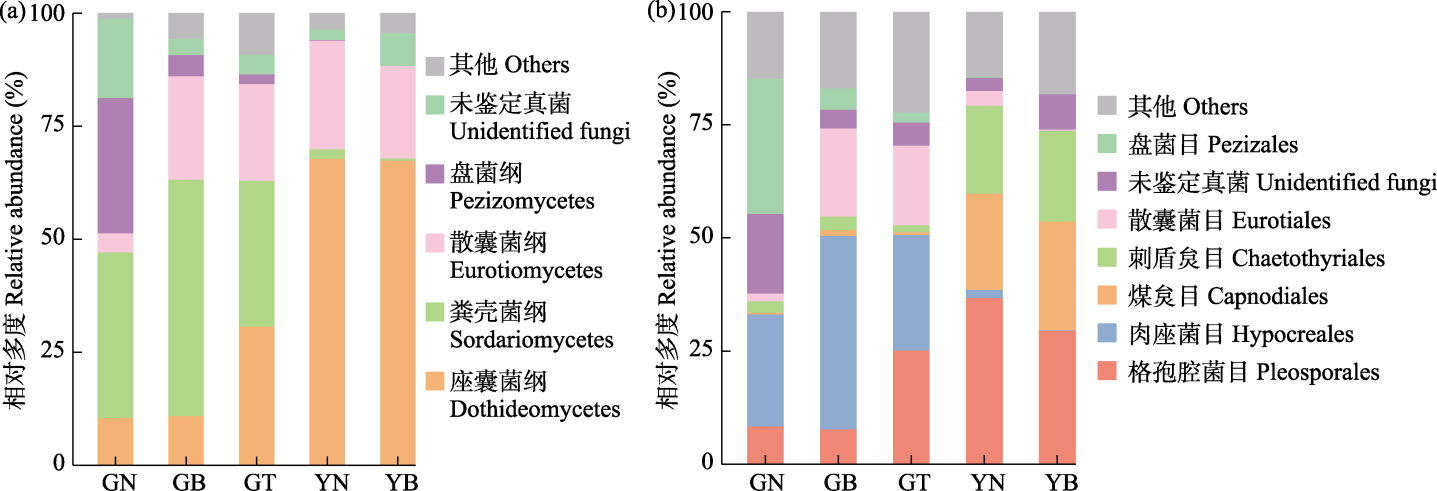
Fig. 4 Relative abundance of dominant fungal taxonomy associated with Tetraena mongolica at the class (a) and order (b) levels (more than 5% of total reads). GN, Root endophytic fungi; GB, Root epiphytic fungi; GT, Rhizosphere soil; YN, Phyllosphere endophytic fungi; YB, Phyllosphere epiphytic fungi.
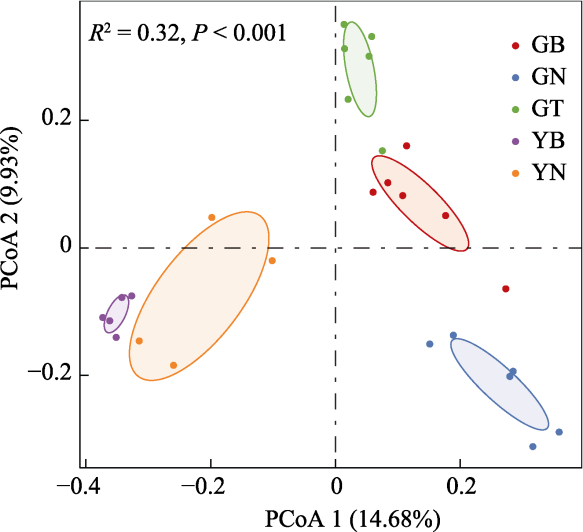
Fig. 5 Principle coordinate analysis (PCoA) of fungal communities in Tetraena mongolica based on Bray-Curtis distance. GN, Root endophytic fungi; GB, Root epiphytic fungi; GT, Rhizosphere soil; YN, Phyllosphere endophytic fungi; YB, Phyllosphere epiphytic fungi.
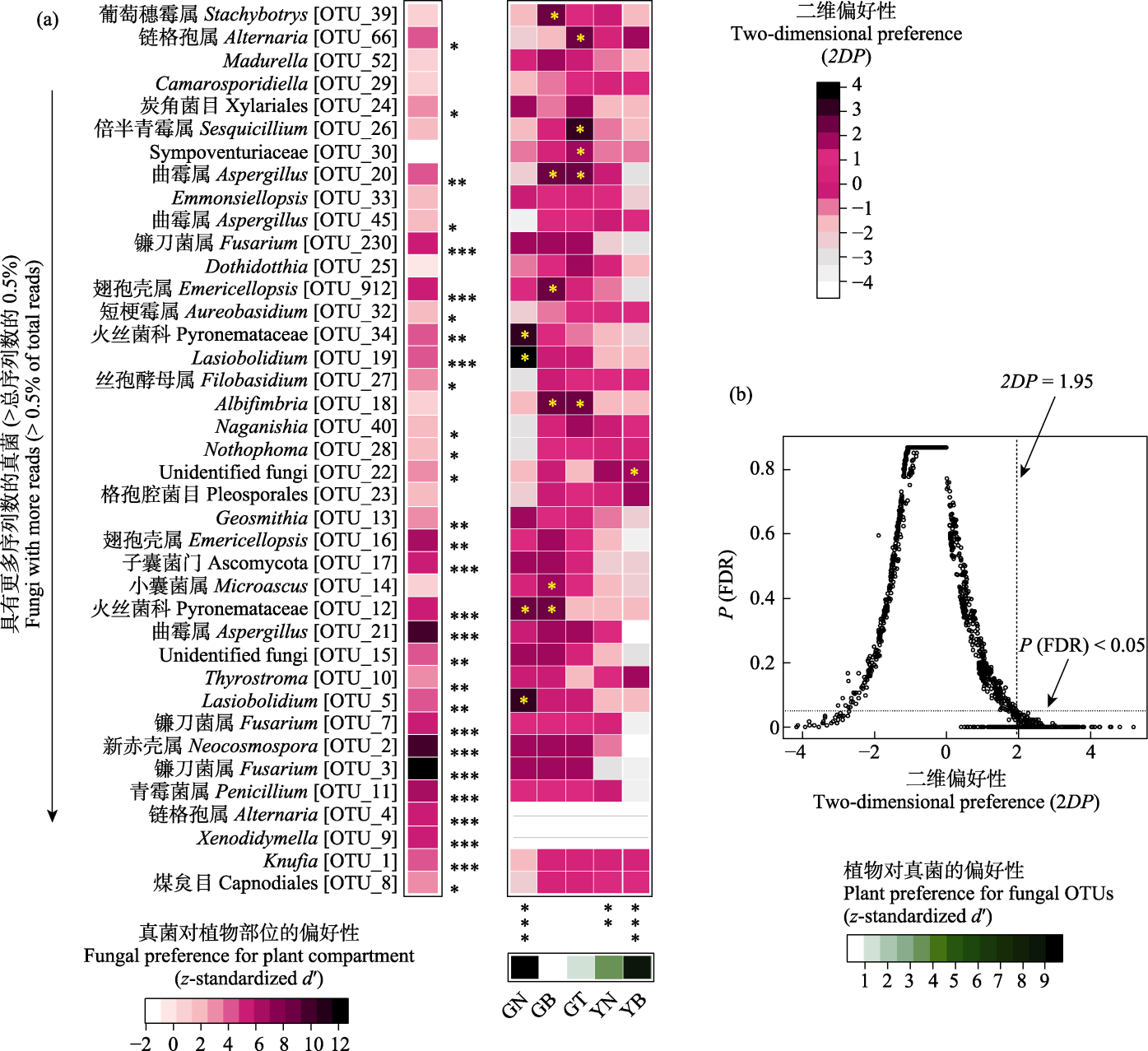
Fig. 6 Preference of plant compartment-fungus associations. (a) Preferences between the 39 dominant fungal OTUs and plant compartment. (b) Relationship between 2DP and FDR-adjusted P values. 2DP, Two-dimentional preference. FDR, False discovery rate. GN, Root endophytic fungi; GB, Root epiphytic fungi; GT, Rhizosphere soil; YN, Phyllosphere endophytic fungi; YB, Phyllosphere epiphytic fungi. * P < 0.05, ** P < 0.01, *** P < 0.001.
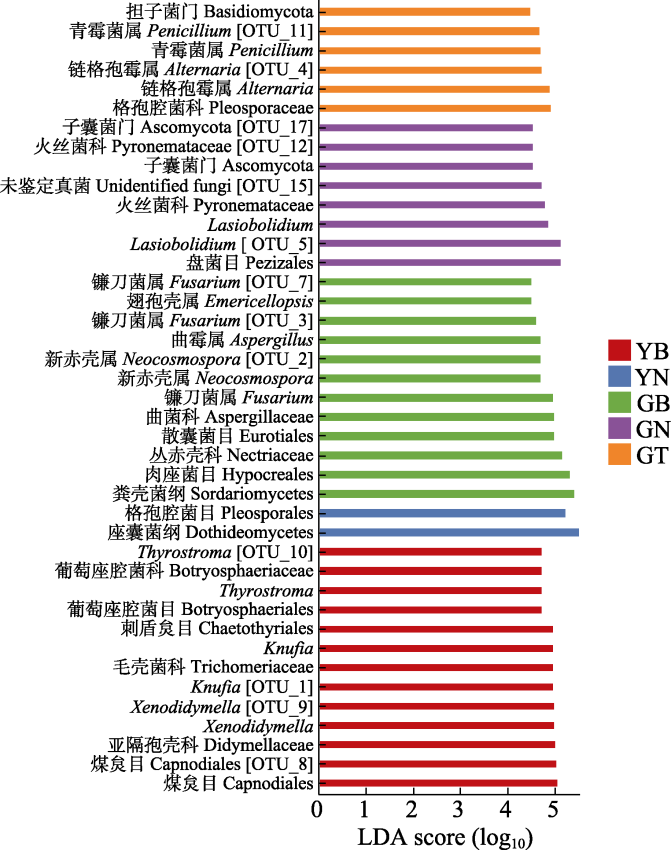
Fig. 7 Fungal biomarkers in each plant compartments of Tetraena mongolica. (LEfSe: LDA > 4.5, P < 0.05). LDA score (log10), Linear discriminant analysis score (log10). YB, Phyllosphere epiphytic fungi; YN, Phyllosphere endophytic fungi; GB, Root epiphytic fungi; GN, Root endophytic fungi; GT, Rhizosphere soil fungi.
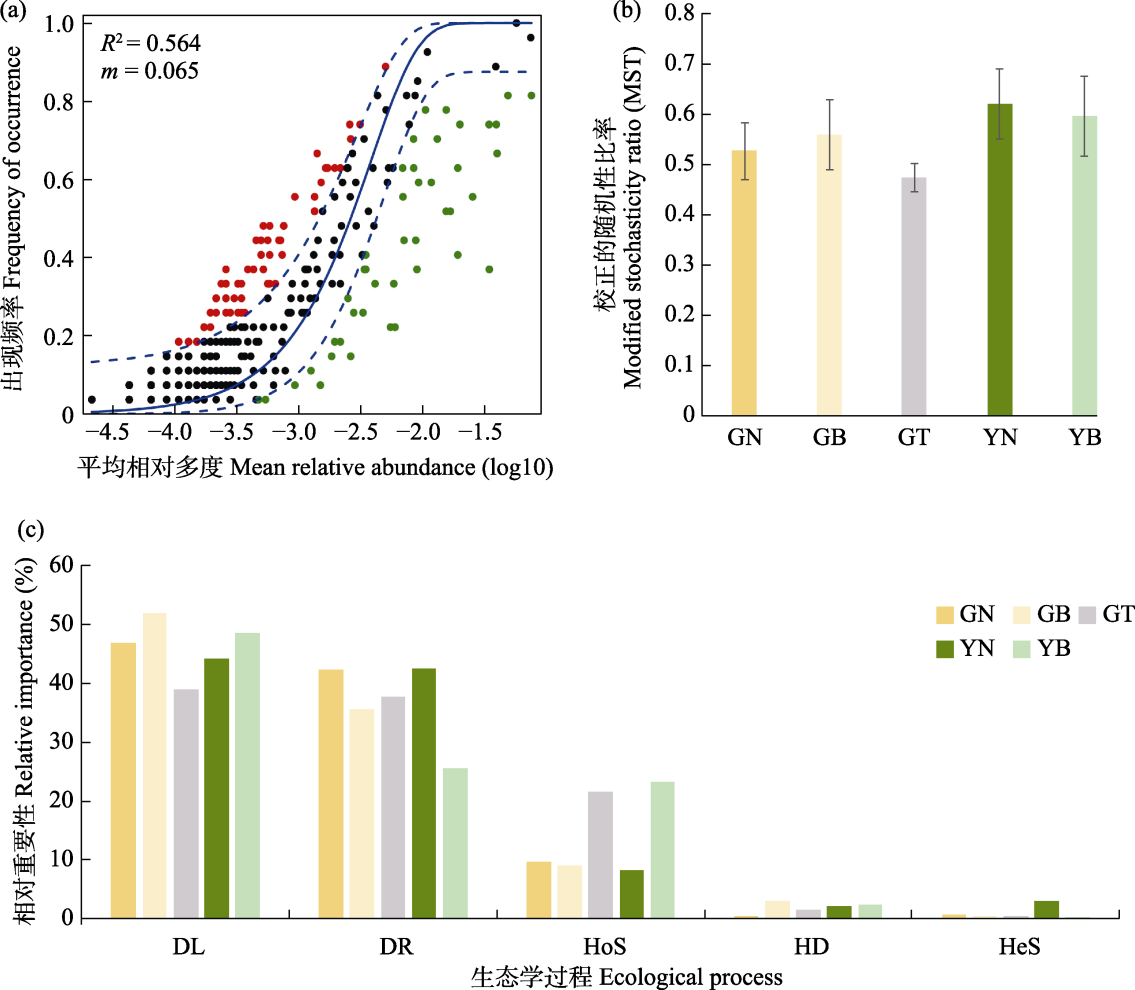
Fig. 8 Ecological assembly mechanisms of fungal communities associated with Tetraena mongolica. (a) Neutral community model (NCM) analyses for fungal communities; (b) Modified stochasticity ration (MST) analyses for fungal communities; (c) The relative importance of ecological processes in driving fungal community assembly. DL, Dispersal limitation; DR, Drift; HoS, Homogeneous selection; HD, Homogenizing dispersal; HeS, Heterogeneous selection; GN, Root endophytic fungi; GB, Root epiphytic fungi; GT, Rhizosphere soil fungi; YN, Phyllosphere endophytic fungi; YB, Phyllosphere epiphytic fungi.
| [1] |
Akbar K, Fan YH, Dilara H (2022) High throughput analysis of the microbial community in different parts of Nitraria in saline alkali land. Xinjiang Agricultural Sciences, 59, 2562-2573. (in Chinese with English abstract)
DOI |
|
[艾海白尔·卡斯木, 樊永红, 迪拉热·海米提 (2022) 盐碱地白刺不同部位微生物群落高通量分析. 新疆农业科学, 59, 2562-2573.]
DOI |
|
| [2] |
Bahram M, Kohout P, Anslan S, Harend H, Abarenkov K, Tedersoo L (2016) Stochastic distribution of small soil eukaryotes resulting from high dispersal and drift in a local environment. The ISME Journal, 10, 885-896.
DOI URL |
| [3] | Bai NE, Deng W, Cheng YT, Zhong XY, Yuan CL, Yang XY (2025) The dominant role of microbial groups in the community assembly process of phyllospheric microorganisms. Microbiology China, 52, 1587-1599. (in Chinese with English abstract) |
| [白农恩, 邓巍, 程依婷, 钟欣媛, 袁彩莲, 杨晓燕 (2025) 微生物类群在叶际微生物群落构建过程中的主导作用. 微生物学通报, 52, 1587-1599.] | |
| [4] |
Barbour KM, Barrón-Sandoval A, Walters KE, Martiny JBH (2023) Towards quantifying microbial dispersal in the environment. Environmental Microbiology, 25, 137-142.
DOI URL |
| [5] |
Behie SW, Bidochka MJ (2014) Nutrient transfer in plant-fungal symbioses. Trends in Plant Science, 19, 734-740.
DOI PMID |
| [6] |
Bennett JA, Maherali H, Reinhart KO, Lekberg Y, Hart MM, Klironomos J (2017) Plant-soil feedbacks and mycorrhizal type influence temperate forest population dynamics. Science, 355, 181-184.
DOI PMID |
| [7] |
Blüthgen N, Menzel F, Hovestadt T, Fiala B, Blüthgen N (2007) Specialization, constraints, and conflicting interests in mutualistic networks. Current Biology, 17, 341-346.
DOI PMID |
| [8] |
Chander AM, de Melo Teixeira M, Singh NK, Williams MP, Parker CW, Leo P, Stajich JE, Torok T, Tighe S, Mason CE, Venkateswaran K (2024) Genomic and morphological characterization of Knufia obscura isolated from the Mars 2020 spacecraft assembly facility. Scientific Reports, 14, 12249.
DOI PMID |
| [9] |
Chen DQ, Yang JJ, Wu CP, Li LY, Lan SR, Zhang DX, Liu ZJ, Qian X (2025) Drivers of root-associated fungal community structure in a common drought-tolerant shrub at a regional scale. Journal of Plant Ecology, 18, rtaf016.
DOI URL |
| [10] |
Chen PL, Zhao ML, Tang F, Hu YM, Peng XJ, Shen SH (2020) The effect of plant compartments on the Broussonetia papyrifera-associated fungal and bacterial communities. Applied Microbiology and Biotechnology, 104, 3627-3641.
DOI |
| [11] |
Compant S, Samad A, Faist H, Sessitsch A (2019) A review on the plant microbiome: Ecology, functions, and emerging trends in microbial application. Journal of Advanced Research, 19, 29-37.
DOI PMID |
| [12] |
Cregger MA, Veach AM, Yang ZK, Crouch MJ, Vilgalys R, Tuskan GA, Schadt CW (2018) The Populus holobiont: Dissecting the effects of plant niches and genotype on the microbiome. Microbiome, 6, 31.
DOI PMID |
| [13] |
Custer GF, Bresciani L, Dini-Andreote F (2022) Ecological and evolutionary implications of microbial dispersal. Frontiers in Microbiology, 13, 855859.
DOI URL |
| [14] |
Danielsen L, Thürmer A, Meinicke P, Buée M, Morin E, Martin F, Pilate G, Daniel R, Polle A, Reich M (2012) Fungal soil communities in a young transgenic poplar plantation form a rich reservoir for fungal root communities. Ecology and Evolution, 2, 1935-1948.
DOI PMID |
| [15] |
del Pilar Martínez-Diz M, Andrés-Sodupe M, Bujanda R, Díaz-Losada E, Eichmeier A, Gramaje D (2019) Soil-plant compartments affect fungal microbiome diversity and composition in grapevine. Fungal Ecology, 41, 234-244.
DOI URL |
| [16] |
Díaz-González S, González-Bodí S, González-Sanz C, Marín P, Brunner F, Sacristán S (2025) Maize associated bacterial and fungal microbiomes show contrasting conformation patterns dependent on plant compartment and water availability. BMC Plant Biology, 25, 448.
DOI PMID |
| [17] |
Dong L, Li MX, Li S, Yue LX, Ali M, Han JR, Lian WH, Hu CJ, Lin ZL, Shi GY, Wang PD, Gao SM, Lian ZH, She TT, Wei QC, Deng QQ, Hu Q, Xiong JL, Liu YH, Li L, Abdelshafy OA, Li WJ (2024) Aridity drives the variability of desert soil microbiomes across north-western China. Science of the Total Environment, 907, 168048.
DOI URL |
| [18] |
Dormann CF, Fründ J, Blüthgen N, Gruber B (2009) Indices, graphs and null models: Analyzing bipartite ecological networks. The Open Ecology Journal, 2, 7-24.
DOI URL |
| [19] | Duan YZ, Du ZY, Wang HT (2019) Chloroplast genome characteristics of endangered relict plant Tetraena mongolica in the arid region of northwest China. Bulletin of Botanical Research, 39, 653-663. (in Chinese with English abstract) |
|
[段义忠, 杜忠毓, 王海涛 (2019) 西北干旱区孑遗濒危植物四合木(Tetraena mongolica)叶绿体基因组特征研究及比较分析. 植物研究, 39, 653-663.]
DOI |
|
| [20] |
Fan QP, Liu KF, Wang ZL, Liu D, Li T, Hou HY, Zhang ZJ, Chen DH, Zhang S, Yu AL, Deng YC, Cui XY, Che RX (2024) Soil microbial subcommunity assembly mechanisms are highly variable and intimately linked to their ecological and functional traits. Molecular Ecology, 33, e17302.
DOI URL |
| [21] |
Fang SB, Zhang XS (2013) Control of vegetation distribution: Climate, geological substrate, and geomorphic factors. A case study of grassland in Ordos, Inner Mongolia, China. Canadian Journal of Remote Sensing, 39, 167-174.
DOI URL |
| [22] |
Faticov M, Abdelfattah A, Hambäck P, Roslin T, Tack AJM (2023) Different spatial structure of plant-associated fungal communities above- and belowground. Ecology and Evolution, 13, e10065.
DOI URL |
| [23] | Feng Y, Zu YQ, Chen HY, Li Y (2010) Effects of enhanced UV-B radiation on growth, physiology and pathogenicity of Alternaria alternata. Plant Protection, 36(4), 64-69. (in Chinese with English abstract) |
| [冯源, 祖艳群, 陈海燕, 李元 (2010) UV-B辐射增强对链格孢菌(Alternaria alternata)生长、生理及致病力的影响. 植物保护, 36(4), 64-69.] | |
| [24] |
Fu W, Chen BD, Rillig MC, Jansa J, Ma W, Xu C, Luo WT, Wu HH, Hao ZP, Wu H, Zhao AH, Yu Q, Han XG (2022) Community response of arbuscular mycorrhizal fungi to extreme drought in a cold-temperate grassland. New Phytologist, 234, 2003-2017.
DOI URL |
| [25] |
Gao C, Guo LD (2022) Progress on microbial species diversity, community assembly and functional traits. Biodiversity Science, 30, 22429. (in Chinese with English abstract)
DOI |
|
[高程, 郭良栋 (2022) 微生物物种多样性、群落构建与功能性状研究进展. 生物多样性, 30, 22429.]
DOI |
|
| [26] |
Gao C, Montoya L, Xu L, Madera M, Hollingsworth J, Purdom E, Singan V, Vogel J, Hutmacher RB, Dahlberg JA, Coleman-Derr D, Lemaux PG, Taylor JW (2020) Fungal community assembly in drought-stressed sorghum shows stochasticity, selection, and universal ecological dynamics. Nature Communications, 11, 34.
DOI PMID |
| [27] | Gu YM, Shen M, Zhao S (2024) Fungal diversity in the plant and rhizosphere soil of Valeriana jatamansi Jones. Microbiology China, 51, 2475-2485. (in Chinese with English abstract) |
| [古玉梅, 申敏, 赵爽 (2024) 蜘蛛香内生真菌及其根际土壤真菌群落多样性. 微生物学通报, 51, 2475-2485.] | |
| [28] |
Hassani MA, Durán P, Hacquard S (2018) Microbial interactions within the plant holobiont. Microbiome, 6, 58.
DOI PMID |
| [29] | Isola D, Prigione VP, Zucconi L, Varese GC, Poli AN, Turchetti B, Canini F (2022) Knufia obscura sp. nov. and Knufia victoriae sp. nov., two new species from extreme environments. International Journal of Systematic and Evolutionary Microbiology, 72, 005530. |
| [30] | Ji YF, Yang YZ, Pang LD, Jia FB, Lu XY, Gao RH (2024) Response of Tetraena mongolica plant community to varying grazing intensities. Forest and Grassland Resources Research, (4), 84-93. (in Chinese with English abstract) |
| [姬玉飞, 杨永志, 庞立东, 贾芳彬, 鲁雪妍, 高润红 (2024) 四合木植物群落对不同放牧强度的响应. 林草资源研究, (4), 84-93.] | |
| [31] | Jia FB, Dai R, Lu XY, Ji YF, Gao RH (2025) Photosynthetic physiological characteristics of six relict plants in west Ordos under different water conditions. Journal of Inner Mongolia Agricultural University (Natural Science Edition), https://kns.cnki.net/kcms/detail/15.1209.S.20250529.1330.002.html. (in Chinese with English abstract) |
| [贾芳彬, 代瑞, 鲁雪妍, 姬玉飞, 高润红 (2025) 不同水分条件下西鄂尔多斯6种孑遗植物光合生理特征研究. 内蒙古农业大学学报(自然科学版), https://kns.cnki.net/kcms/detail/15.1209.S.20250529.1330.002.html.] | |
| [32] |
Jiao S, Zhang BG, Zhang GZ, Chen WM, Wei GH (2021) Stochastic community assembly decreases soil fungal richness in arid ecosystems. Molecular Ecology, 30, 4338-4348.
DOI URL |
| [33] | Jin H, Yang XY, Liu HY, Zhao YH, Zheng WL, Cheng JN, Min D, Xu XX, Qin B (2021) The structure of rhizosphere soil and endophytic fungal communities associated with Stipa purpurea and their correlation with soil environmental factors. Acta Microbiologica Sinica, 61, 3520-3541. (in Chinese with English abstract) |
| [金辉, 杨晓燕, 柳皓月, 赵玉卉, 郑伟丽, 程济南, 闵灯, 许欣欣, 秦波 (2021) 紫花针茅根际和体内真菌群落结构及与土壤环境因子的相关性研究. 微生物学报, 61, 3520-3541.] | |
| [34] |
Kivlin SN, Winston GC, Goulden ML, Treseder KK (2014) Environmental filtering affects soil fungal community composition more than dispersal limitation at regional scales. Fungal Ecology, 12, 14-25.
DOI URL |
| [35] |
Li J, Li XC, Guo LD (2023) Research progress on community assembly mechanisms of fungi. Mycosystema, 42, 13-25. (in Chinese with English abstract)
DOI |
|
[李洁, 李杏春, 郭良栋 (2023) 真菌群落构建机制研究进展. 菌物学报, 42, 13-25.]
DOI |
|
| [36] | Li J, Liu YX, Lü PP, Wang YL, Li ZF, Zhang Y, Gan HY, Li XC, Mandal D, Cai J, Guo ZX, Yao H, Guo LD (2022) Community assembly of fungi and bacteria along soil-plant continuum differs in a Zoige Wetland. Microbiology Spectrum, 10, e02260-22. |
| [37] | Liu JL, Wang YN, Wei L, Wang J, Lü Y, Sun QF, Gou Q, Li JY (2021) Effect of relict plant Tetraena mongolica on archaeal community in desert soil. Acta Ecologica Sinica, 41, 3548-3563. (in Chinese with English abstract) |
| [刘建利, 王英娜, 未丽, 王静, 吕燕, 孙钦飞, 苟琪, 李靖宇 (2021) 荒漠孑遗植物四合木对土壤古菌群落的影响. 生态学报, 41, 3548-3563.] | |
| [38] | Liu SG, García-Palacios P, Tedersoo L, Guirado E, van der Heijden MGA, Wagg C, Chen DM, Wang QK, Wang JT, Singh BK, Delgado-Baquerizo M (2022) Phylotype diversity within soil fungal functional groups drives ecosystem stability. Nature Ecology & Evolution, 6, 900-909. |
| [39] |
Liu Z, Wang C, Yang X, Liu G, Cui Q, Indree T, Ye X, Huang Z (2023) The relationship and influencing factors between endangered plant Tetraena mongolica and soil microorganisms in West Ordos desert ecosystem, northern China. Plants, 12, 1048.
DOI URL |
| [40] | Lü ZW, Zhu XR, Ye XZ, Wen GW, Jiang TY, Lai WF, Shi CY, Huang QL, Zhang GF (2024) Impacts of climate change on the suitable habitats and spatial migration of Tetraena mongolica. Acta Ecologica Sinica, 44, 1164-1176. (in Chinese with English abstract) |
| [吕增伟, 朱晓如, 叶兴状, 文国卫, 蒋天雨, 赖文峰, 施晨阳, 黄秋良, 张国防 (2024) 气候变化对四合木适生区及空间迁移的影响. 生态学报, 44, 1164-1176.] | |
| [41] |
Ma LJ, Geiser DM, Proctor RH, Rooney AP, O’Donnell K, Trail F, Gardiner DM, Manners JM, Kazan K (2013) Fusarium pathogenomics. Annual Review of Microbiology, 67, 399-416.
DOI URL |
| [42] |
Manici LM, Caputo F, De Sabata D, Fornasier F (2024a) The enzyme patterns of Ascomycota and Basidiomycota fungi reveal their different functions in soil. Applied Soil Ecology, 196, 105323.
DOI URL |
| [43] |
Manici LM, Caputo F, Fornasier F, Paletto A, Ceotto E, De Meo I (2024b) Ascomycota and Basidiomycota fungal Phyla as indicators of land use efficiency for soil organic carbon accrual with woody plantations. Ecological Indicators, 160, 111796.
DOI URL |
| [44] |
Marro N, Grilli G, Soteras F, Caccia M, Longo S, Cofré N, Borda V, Burni M, Janoušková M, Urcelay C (2022) The effects of arbuscular mycorrhizal fungal species and taxonomic groups on stressed and unstressed plants: A global meta-analysis. New Phytologist, 235, 320-332.
DOI PMID |
| [45] | Ning DL, Deng Y, Tiedje JM, Zhou JZ (2019) A general framework for quantitatively assessing ecological stochasticity. Proceedings of the National Academy of Sciences, USA, 116, 16892-16898. |
| [46] |
Ning DL, Yuan MT, Wu LW, Zhang Y, Guo X, Zhou XS, Yang YF, Arkin AP, Firestone MK, Zhou JZ (2020) A quantitative framework reveals ecological drivers of grassland microbial community assembly in response to warming. Nature Communications, 11, 4717.
DOI PMID |
| [47] | Põlme S, Abarenkov K, Nilsson RH, Lindahl BD, Clemmensen KE, Kauserud H, Nguyen N, Kjøller R, Bates ST, Baldrian P, …, Li W, Coimbra VRM, de Lima VX, Mikryukov VS, Lu YZ, Matsuda Y, Miyamoto Y, Kõljalg, Tedersoo L (2020) FungalTraits: A user-friendly traits database of fungi and fungus-like stramenopiles. Fungal Diversity, 105, 1-16. |
| [48] |
Prieto-Rubio J, Garrido JL, Pérez-Izquierdo L, Alcántara JM, Azcón-Aguilar C, López-García A, Rincón A (2022) Scale dependency of ectomycorrhizal fungal community assembly processes in Mediterranean mixed forests. Mycorrhiza, 32, 315-325.
DOI PMID |
| [49] |
Qian X, Li HZ, Wang YL, Wu BW, Wu MS, Chen L, Li XC, Zhang Y, Wang XP, Shi MM, Zheng Y, Guo LD, Zhang DX (2019) Leaf and root endospheres harbor lower fungal diversity and less complex fungal co-occurrence patterns than rhizosphere. Frontiers in Microbiology, 10, 1015.
DOI PMID |
| [50] |
Sapkota R, Jørgensen LN, Boeglin L, Nicolaisen M (2023) Fungal communities of spring barley from seedling emergence to harvest during a severe Puccinia hordei epidemic. Microbial Ecology, 85, 617-627.
DOI |
| [51] |
Shi Y, Li YT, Xiang XJ, Sun RB, Yang T, He D, Zhang KP, Ni YY, Zhu YG, Adams JM, Chu HY (2018) Spatial scale affects the relative role of stochasticity versus determinism in soil bacterial communities in wheat fields across the North China Plain. Microbiome, 6, 27.
DOI PMID |
| [52] |
Sloan WT, Lunn M, Woodcock S, Head IM, Nee S, Curtis TP (2006) Quantifying the roles of immigration and chance in shaping prokaryote community structure. Environmental Microbiology, 8, 732-740.
DOI PMID |
| [53] |
Sonam W, Liu YQ (2024) Plant compartment niche is more important in structuring the fungal community associated with alpine herbs in the subnival belt of the Qiangyong glacier than plant species. Symbiosis, 92, 289-304.
DOI |
| [54] |
Tiwari P, Bose SK, Park KI, Dufossé L, Fouillaud M (2024) Plant-microbe interactions under the extreme habitats and their potential applications. Microorganisms, 12, 448.
DOI URL |
| [55] |
Toju H, Tanabe AS, Ishii HS (2016) Ericaceous plant-fungus network in a harsh alpine-subalpine environment. Molecular Ecology, 25, 3242-3257.
DOI PMID |
| [56] |
Trivedi P, Leach JE, Tringe SG, Sa TM, Singh BK (2020) Plant-microbiome interactions: From community assembly to plant health. Nature Reviews Microbiology, 18, 607-621.
DOI |
| [57] | Wang YL, Gao C, Chen L, Ji NN, Wu BW, Li XC, Lü PP, Zheng Y, Guo LD (2019) Host plant phylogeny and geographic distance strongly structure Betulaceae-associated ectomycorrhizal fungal communities in Chinese secondary forest ecosystems. FEMS Microbiology Ecology, 95, fiz037. |
| [58] | Wang YN (2024) Mechanisms of Livestock Grazing Regulating Decomposition of Dominant Plant Litters in a Typical Steppe of Inner Mongolia. PhD dissertation, Inner Mongolia University, Hohhot. (in Chinese with English abstract) |
| [王桠楠 (2024) 家畜放牧调控内蒙古典型草原优势植物凋落物分解的机制研究. 博士学位论文, 内蒙古大学, 呼和浩特.] | |
| [59] |
Xiong C, Singh BK, He JZ, Han YL, Li PP, Wan LH, Meng GZ, Liu SY, Wang JT, Wu CF, Ge AH, Zhang LM (2021) Plant developmental stage drives the differentiation in ecological role of the maize microbiome. Microbiome, 9, 171.
DOI PMID |
| [60] |
Xu ZW, Guo X, Allen WJ, Hu Y, Wang JF, Li MY, Wu LW, Guo WH (2025) Soil fungi influence the relationship between plant diversity and ecosystem multifunctionality. Nature Communications, 16, 5521.
DOI |
| [61] | Yang H, Yang ZJ, Wang QC, Wang YL, Hu HW, He JZ, Zheng Y, Yang YS (2022) Compartment and plant identity shape tree mycobiome in a subtropical forest. Microbiology Spectrum, 10, e01347-22. |
| [62] |
Yao H, Sun X, He C, Maitra P, Li XC, Guo LD (2019) Phyllosphere epiphytic and endophytic fungal community and network structures differ in a tropical mangrove ecosystem. Microbiome, 7, 57.
DOI PMID |
| [63] | Zhang L, Wang TJ, Guo JT, Li XT, Zhang H, Liu YJ, Liu XT (2023) Population distribution pattern analysis of the rare and endangered plant Tetraena mongolica in western Ordos, China. Acta Agrestia Sinica, 31, 551-557. (in Chinese with English abstract) |
|
[张丽, 王铁娟, 郭金停, 李晓田, 张慧, 刘雅洁, 刘晓婷 (2023) 西鄂尔多斯珍稀濒危植物四合木种群分布格局分析. 草地学报, 31, 551-557.]
DOI |
|
| [64] |
Zhang X, Wang YL, Xu Y, Babalola BJ, Xiang SM, Ma JJ, Su Y, Fan YJ (2023) Stochastic processes dominate community assembly of ectomycorrhizal fungi associated with Picea crassifolia in the Helan Mountains, China. Frontiers in Microbiology, 13, 1061819.
DOI URL |
| [65] |
Zhang X, Xu Y, Yang YC, Zhao YL, Men ZH, Wang YL (2024) The diversity and assembly mechanism of phyllosphere fungal communities in the relict plant Helianthemum songaricum. Biodiversity Science, 32, 23384. (in Chinese with English abstract)
DOI URL |
|
[张旋, 徐颖, 杨颜慈, 赵艳玲, 门中华, 王永龙 (2024) 孑遗植物半日花叶际真菌群落的多样性与构建机制. 生物多样性, 32, 23384.]
DOI |
|
| [66] |
Zhang YZ, Hogan JA, Crowther TW, Xu SJ, Zhao RS, Song PF, Cui MF, Song XY, Cao M, Yang J (2024) Drivers and mechanisms that contribute to microbial β-diversity patterns and range sizes in mountains across a climatic variability gradient. Ecography, 2024, e07049.
DOI URL |
| [67] |
Zhang ZY, Dong YD, Chen X, Zhang GZ, Liang CL, Zhou YX, Huang ZY, Shi LP, Chen SL, Dong LL, Wei GF (2025) Ecological niche imprints the structure and network of microbial communities in Lonicera japonica Thunb. Plant and Soil, 513, 1541-1555.
DOI |
| [68] |
Zheng Y, Gong X (2019) Niche differentiation rather than biogeography shapes the diversity and composition of microbiome of Cycas panzhihuaensis. Microbiome, 7, 152.
DOI PMID |
| [1] | Lijie Zhou, Minhui Huang, Huaijiang He, Yanxia Cheng, Chunyu Zhang, Xiuhai Zhao. Disentangling the patterns, components, and influencing factors of forest β diversity in the Xiaoxing’an Mountains, Northeast China [J]. Biodiv Sci, 2026, 34(4): 25443-. |
| [2] | Song Wei, Cheng Cai, Wang Jiawei, Wu Jihua. Soil microbes regulate the relationships between plant diversity and ecosystem functions [J]. Biodiv Sci, 2025, 33(4): 24579-. |
| [3] | Changqiao Chen, Yanfei Feng, Liqi Lu, Huaijiang He, Chunyu Zhang, Xiuhai Zhao, Minhui Hao. β-diversity pattern and mechanism in a conifer-broadleaf mixed forest in Jiaohe, Jilin Province [J]. Biodiv Sci, 2025, 33(12): 25169-. |
| [4] | Xiaoqian Ju, Yun Tian, Mingze Xu, Yuanmeng Dai, Manle Li, Yuhan Zhou, Peng Liu, Xin Jia, Tianshan Zha. How soil environmental factors shape leaf traits in arid-land vegetation [J]. Biodiv Sci, 2025, 33(11): 25158-. |
| [5] | Guoshan Shi, Feng Liu, Guanghong Cao, Dian Chen, Shangwen Xia, Yun Deng, Bin Wang, Xiaodong Yang, Luxiang Lin. Beta diversity of woody plants in a tropical seasonal rainforest at Xishuangbanna: Roles of space, environment, and forest stand structure [J]. Biodiv Sci, 2024, 32(12): 24285-. |
| [6] | Weiwei Lin, Chengming Tian, Dianguang Xiong, Weihang Liu, Ryhguli Sidike, Yingmei Liang. Influencing factors of spider community diversity in poplar plantations in Xinjiang, China [J]. Biodiv Sci, 2023, 31(3): 22493-. |
| [7] | Ruihe Gao, Shiming Fan, Jianghai Dong, Rongjiao Li, Zhiwei Zhang. Characteristics and vertical distribution of insect functional groups along an altitude gradient in Guandi Mountains [J]. Biodiv Sci, 2023, 31(10): 23152-. |
| [8] | Anlun Wang, Ping He, Xinyuan Long. Spatial differentiation of fish functional groups in the Yangtze River [J]. Biodiv Sci, 2023, 31(10): 23095-. |
| [9] | Yongqingcuomu , Xinqiang Xi, Kechang Niu. Effect of plant species loss on grassland caterpillar in alpine meadows [J]. Biodiv Sci, 2022, 30(11): 22069-. |
| [10] | Mengjun Qu, Nueryila·Ababaike , Xuge Zou, Hang Zhao, Weilin Zhu, Jianming Wang, Jingwen Li. Influence of geographic distance and environmental factors on beta diversity of plants in the Alxa gobi region in northern China [J]. Biodiv Sci, 2022, 30(11): 22029-. |
| [11] | Xiangcheng Mi, Xugao Wang, Guochun Shen, Xubin Liu, Xiaoyang Song, Xiujuan Qiao, Gang Feng, Jie Yang, Zikun Mao, Xuehong Xu, Keping Ma. Chinese Forest Biodiversity Monitoring Network (CForBio): Twenty years of exploring community assembly mechanisms and prospects for future research [J]. Biodiv Sci, 2022, 30(10): 22504-. |
| [12] | Yu Zhang, Luyu Wang, Changlin Xiang, Meichun Duan, Zhisheng Zhang. Effects of different grazing intensities on spider diversity in Saihanwula Grassland [J]. Biodiv Sci, 2021, 29(4): 467-476. |
| [13] | Feng Zhang, Jiahua Zheng, Mengli Zhao, Daling Chen, Yang Yang, Jirong Qiao, Tianqi Zhao. Effects of mowing intensity on temporal stability of aboveground biomass in the Stipa grandis steppe [J]. Biodiv Sci, 2020, 28(7): 779-786. |
| [14] | Zhiliang Yao,Handong Wen,Yun Deng,Min Cao,Luxiang Lin. Driving forces underlying the beta diversity of tree species in subtropical mid-mountain moist evergreen broad-leaved forests in Ailao Mountains [J]. Biodiv Sci, 2020, 28(4): 445-454. |
| [15] | Xiangyu Liu, Ciliang Zhao, Mingshan Xu, Qiming Liang, Xiaotong Zhu, Liang Li, Enrong Yan. Beta diversity of vascular plants and its drivers in sea-islands of eastern China [J]. Biodiv Sci, 2019, 27(4): 380-387. |
| Viewed | ||||||
|
Full text |
|
|||||
|
Abstract |
|
|||||
Copyright © 2026 Biodiversity Science
Editorial Office of Biodiversity Science, 20 Nanxincun, Xiangshan, Beijing 100093, China
Tel: 010-62836137, 62836665 E-mail: biodiversity@ibcas.ac.cn

