

Biodiv Sci ›› 2026, Vol. 34 ›› Issue (8): 26006. DOI: 10.17520/biods.2020000 cstr: 32101.14.biods.2026006
• Original Papers: Plant Diversity • Previous Articles Next Articles
Yingjun Qian1,2, Min Wan2,3, Guangjun Wang2,4, Hongmei Li2,3,*( ), Wenkai Wang1,*()
Received:2026-01-09
Accepted:2026-04-14
Online:2026-08-20
Published:2026-10-21
Contact:
*Co-authors for correspondence: E-mail: h.li@cabi.org;
wwk@yangtzeu.edu.cn
Supported by:Yingjun Qian, Min Wan, Guangjun Wang, Hongmei Li, Wenkai Wang. Potential distribution prediction of Centaurea diffusa based on a Biomod2 ensemble model[J]. Biodiv Sci, 2026, 34(8): 26006.
| 序号 No. | 变量 Variable | 相对重要性 Relative importance (%) |
|---|---|---|
| 1 | 最冷季均温 Mean temperature of coldest quarter (Bio11) | 26.3 |
| 2 | 人类足迹指数 Human footprint index (Hfp) | 20.7 |
| 3 | 年均温 Annual mean temperature (Bio1) | 16.6 |
| 4 | 最干月降水量 Precipitation of driest month (Bio14) | 5.9 |
| 5 | 最干季降水量 Precipitation of driest quarter (Bio17) | 4.3 |
| 6 | 最冷月最低温 Minimum temperature of coldest month (Bio6) | 3.9 |
| 7 | 最暖季降水量 Precipitation of warmest quarter (Bio18) | 3.1 |
| 8 | 下层土壤盐基饱和度 Base saturation of subsoil (S_bs) | 2.9 |
| 9 | 最冷季降水量 Precipitation of coldest quarter (Bio19) | 2.9 |
| 10 | 最热月最高温 Maximum temperature of warmest month (Bio5) | 2.3 |
Table 1 Main environmental variables and their relative importance
| 序号 No. | 变量 Variable | 相对重要性 Relative importance (%) |
|---|---|---|
| 1 | 最冷季均温 Mean temperature of coldest quarter (Bio11) | 26.3 |
| 2 | 人类足迹指数 Human footprint index (Hfp) | 20.7 |
| 3 | 年均温 Annual mean temperature (Bio1) | 16.6 |
| 4 | 最干月降水量 Precipitation of driest month (Bio14) | 5.9 |
| 5 | 最干季降水量 Precipitation of driest quarter (Bio17) | 4.3 |
| 6 | 最冷月最低温 Minimum temperature of coldest month (Bio6) | 3.9 |
| 7 | 最暖季降水量 Precipitation of warmest quarter (Bio18) | 3.1 |
| 8 | 下层土壤盐基饱和度 Base saturation of subsoil (S_bs) | 2.9 |
| 9 | 最冷季降水量 Precipitation of coldest quarter (Bio19) | 2.9 |
| 10 | 最热月最高温 Maximum temperature of warmest month (Bio5) | 2.3 |
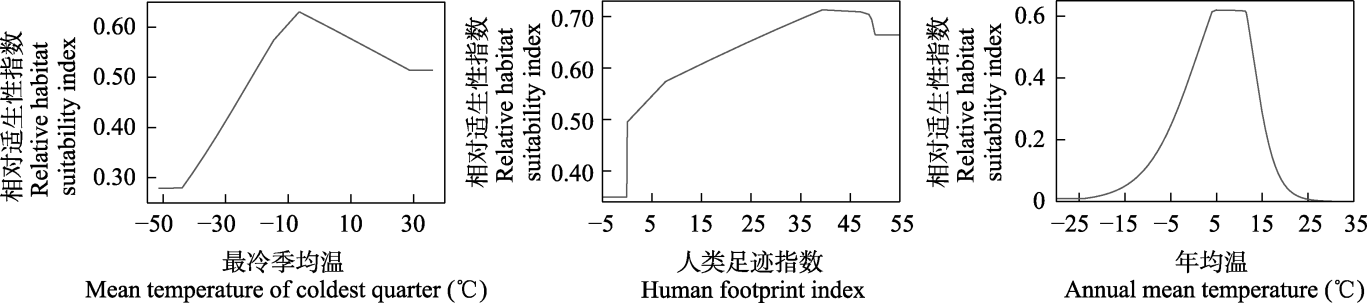
Fig. 1 Response curves of the three key environmental variables generated by the Biomod2 ensemble model
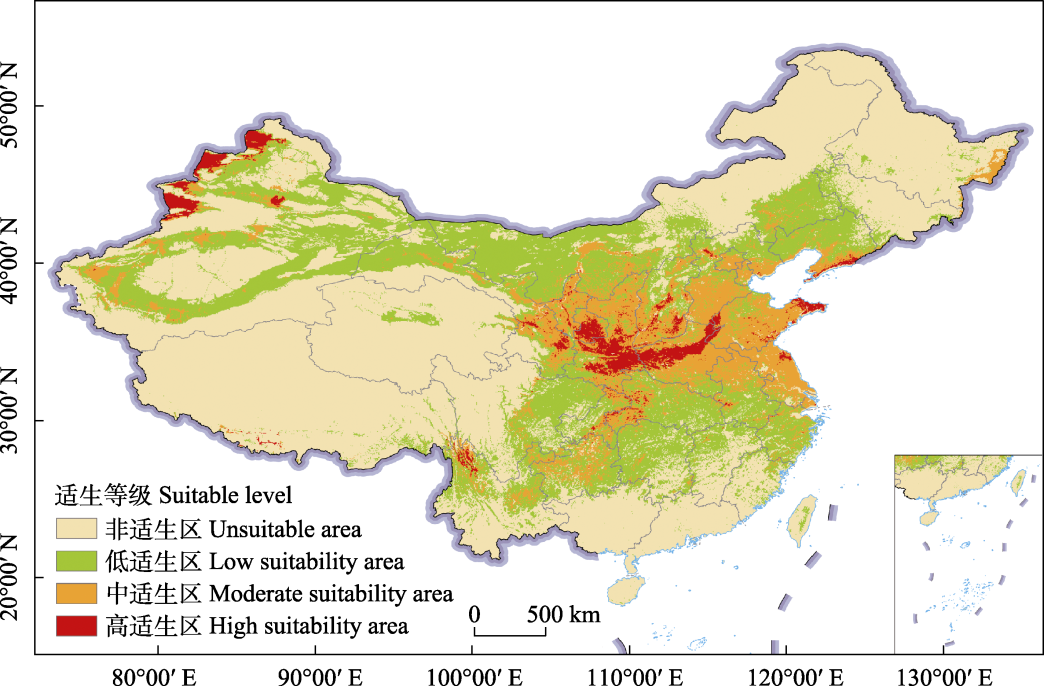
Fig. 2 Potential distribution areas for the current scenario of Centaurea diffusa in China
| 气候情景 Climate scenario | 时期 Period | 低适生区面积 Area of low suitability (× 106 km2) | 中适生区面积 Area of moderate suitability (× 106 km2) | 高适生区面积 Area of high suitability (× 106 km2) | 总适生区面积 Total suitable area (× 106 km2) |
|---|---|---|---|---|---|
| 当前 Current | 当前 Current | 3.254 | 1.430 | 0.312 | 4.996 |
| SSP1-2.6 | 2050s | 3.784 | 1.012 | 0.240 | 5.036 |
| 2070s | 3.781 | 0.933 | 0.302 | 5.016 | |
| 2090s | 3.519 | 1.081 | 0.304 | 4.904 | |
| SSP2-4.5 | 2050s | 3.526 | 1.377 | 0.432 | 5.335 |
| 2070s | 3.222 | 1.432 | 0.547 | 5.200 | |
| 2090s | 3.068 | 1.375 | 0.586 | 5.029 | |
| SSP5-8.5 | 2050s | 3.704 | 1.058 | 0.309 | 5.072 |
| 2070s | 3.164 | 1.192 | 0.421 | 4.777 | |
| 2090s | 3.232 | 0.950 | 0.281 | 4.463 |
Table 2 Potential suitable area of Centaurea diffusa in China under different climatic scenarios
| 气候情景 Climate scenario | 时期 Period | 低适生区面积 Area of low suitability (× 106 km2) | 中适生区面积 Area of moderate suitability (× 106 km2) | 高适生区面积 Area of high suitability (× 106 km2) | 总适生区面积 Total suitable area (× 106 km2) |
|---|---|---|---|---|---|
| 当前 Current | 当前 Current | 3.254 | 1.430 | 0.312 | 4.996 |
| SSP1-2.6 | 2050s | 3.784 | 1.012 | 0.240 | 5.036 |
| 2070s | 3.781 | 0.933 | 0.302 | 5.016 | |
| 2090s | 3.519 | 1.081 | 0.304 | 4.904 | |
| SSP2-4.5 | 2050s | 3.526 | 1.377 | 0.432 | 5.335 |
| 2070s | 3.222 | 1.432 | 0.547 | 5.200 | |
| 2090s | 3.068 | 1.375 | 0.586 | 5.029 | |
| SSP5-8.5 | 2050s | 3.704 | 1.058 | 0.309 | 5.072 |
| 2070s | 3.164 | 1.192 | 0.421 | 4.777 | |
| 2090s | 3.232 | 0.950 | 0.281 | 4.463 |
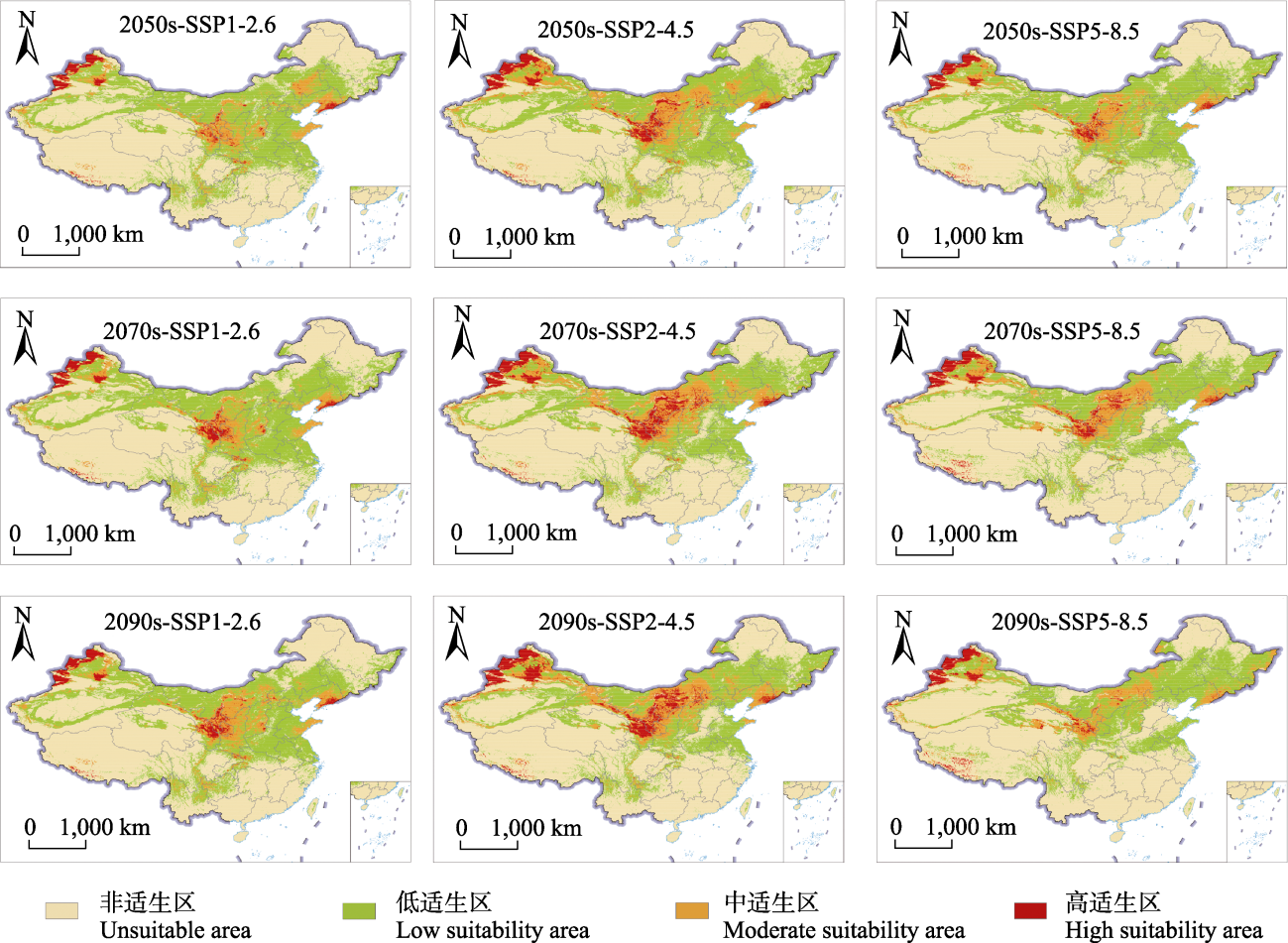
Fig. 3 Spatial distribution pattern of Centaurea diffusa in China under different climate scenarios in the future
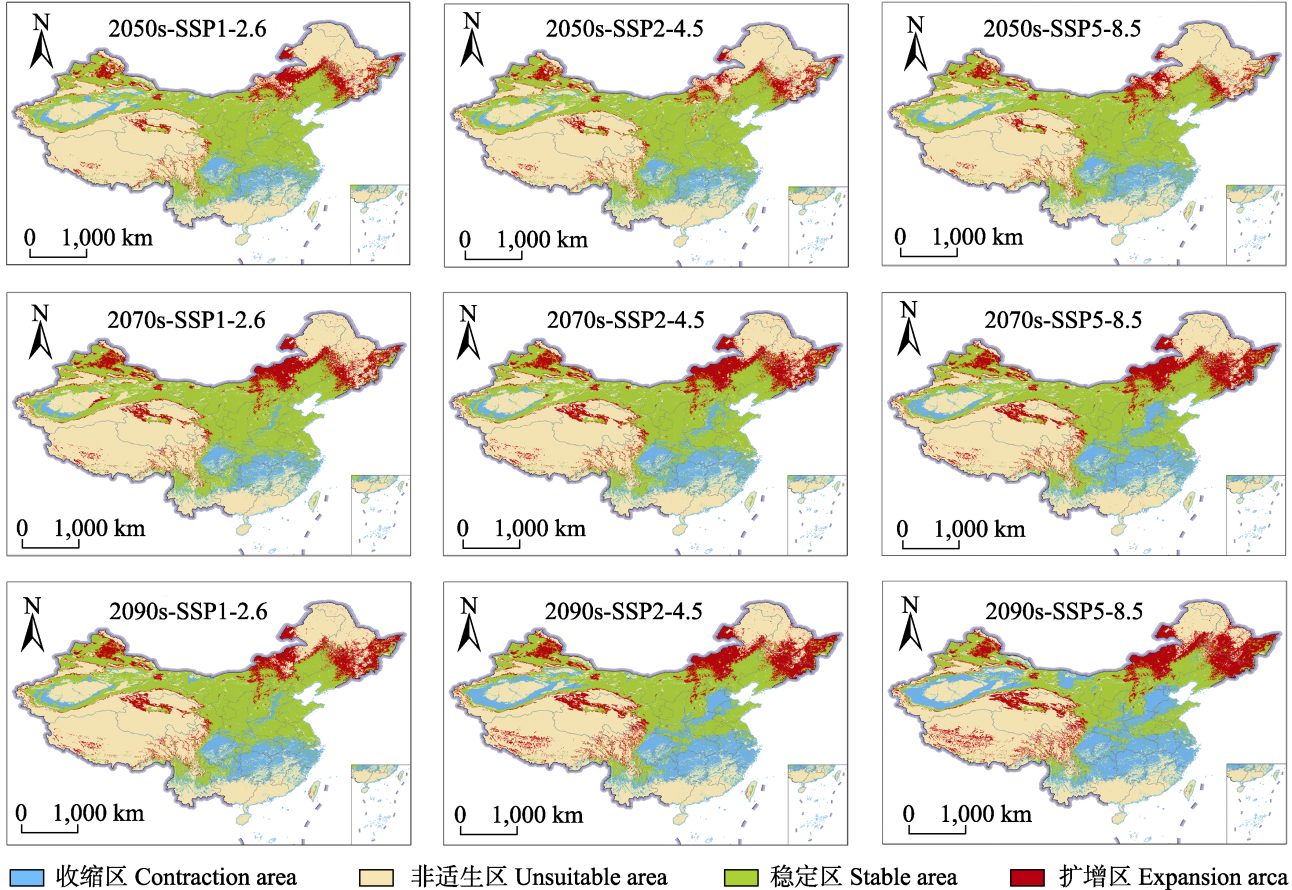
Fig. 4 Spatiotemporal changes of Centaurea diffusa suitable areas in China under different climate scenarios in the future
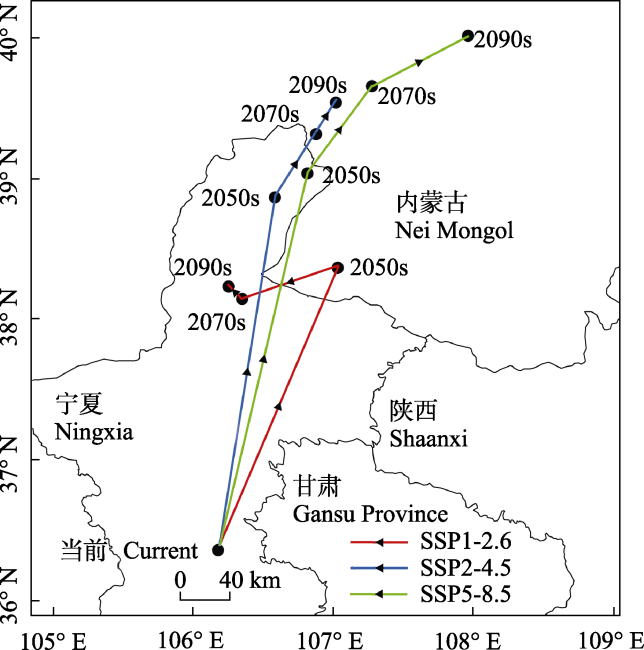
Fig. 5 Distribution centroid and migration path of Centaurea diffusa suitable areas in different periods predicted by Biomod2 ensemble model
| [1] | Allouche O, Tsoar A, Kadmon R (2006) Assessing the accuracy of species distribution models: Prevalence, Kappa and the true skill statistic (TSS). Journal of Applied Ecology, 43, 1223-1232. |
| [2] | Araújo MB, Pearson RG, Thuiller W, Erhard M (2005) Validation of species-climate impact models under climate change. Global Change Biology, 11, 1504-1513. |
| [3] | Austin MP, Van Niel KP (2011) Improving species distribution models for climate change studies: Variable selection and scale. Journal of Biogeography, 38, 1-8. |
| [4] | Barbet-Massin M, Jiguet F, Albert CH, Thuiller W (2012) Selecting pseudo-absences for species distribution models: How, where and how many? Methods in Ecology and Evolution, 3, 327-338. |
| [5] | Bertrand R, Perez V, Gégout JC (2012) Disregarding the edaphic dimension in species distribution models leads to the omission of crucial spatial information under climate change: The case of Quercus pubescens in France. Global Change Biology, 18, 2648-2660. |
| [6] | Bi YQ, Zhang MX, Chen Y, Wang AX, Li MH (2022) Applying Biomod 2 for modeling of species suitable habitats: A case study of Paeonia lactiflora in China. China Journal of Chinese Materia Medica, 47, 376-384. (in Chinese with English abstract) |
| [毕雅琼, 张明旭, 陈元, 王爱祥, 李旻辉 (2022) 基于Biomod2组合模型的中国野生芍药Paeonia lactiflora适宜生境分布. 中国中药杂志, 47, 376-384.] | |
| [7] | CABI (Centre for Agriculture and Bioscience International). (2019) Centaurea diffusa (Diffuse Knapweed). https://doi.org/10.1079/cabicompendium.12039/. (accessed on 2025-12-31) |
| [8] | Essl F, Lenzner B, Bacher S, Bailey S, Capinha C, Daehler C, Dullinger S, Genovesi P, Hui C, Hulme PE, Jeschke JM, Katsanevakis S, Kühn I, Leung B, Liebhold A, Liu CL, MacIsaac HJ, Meyerson LA, Nuñez MA, Pauchard A, Pyšek P, Rabitsch W, Richardson DM, Roy HE, Ruiz GM, Russell JC, Sanders NJ, Sax DF, Scalera R, Seebens H, Springborn M, Turbelin A, van Kleunen M, von Holle B, Winter M, Zenni RD, Mattsson BJ, Roura-Pascual N (2020) Drivers of future alien species impacts: An expert-based assessment. Global Change Biology, 26, 4880-4893. |
| [9] | Falk W, Mellert KH (2011) Species distribution models as a tool for forest management planning under climate change: Risk evaluation of Abies alba in Bavaria. Journal of Vegetation Science, 22, 621-634. |
| [10] | Fan YH, Zhang XM, Zhou YT, Zong SX (2024) Prediction of the global distribution of Arhopalus rusticus under future climate change scenarios of the CMIP6. Forests, 15, 955. |
| [11] | Fielding AH, Bell JF (1997) A review of methods for the assessment of prediction errors in conservation presence/ absence models. Environmental Conservation, 24, 38-49. |
| [12] | Gu R, Wei SP, Li JR, Zheng SH, Li ZT, Liu GL, Fan SH (2024) Predicting the impacts of climate change on the geographic distribution of moso bamboo in China based on Biomod2 model. European Journal of Forest Research, 143, 1499-1512. |
| [13] | Guo WC, Zhang XL, Wu W, Zhang W, Fu KY, Tursun A, Ding XH, Yimit R (2017) Current situation, trends and research progress of invasive alien species in agriculture and foresty in oases in Xinjiang, China. Journal of Biosafety, 26, 1-11. (in Chinese with English abstract) |
| [郭文超, 张祥林, 吴卫, 张伟, 付开赟, 吐尔逊·阿合买提, 丁新华, 依米提·热苏力, (2017) 新疆农林外来入侵生物的发生现状、趋势及其研究进展. 生物安全学报, 26, 1-11.] | |
| [14] | Hastie T, Fithian W (2013) Inference from presence-only data: The ongoing controversy. Ecography, 36, 864-867. |
| [15] | Jacobs J, Sing S (2008) Ecology and management of diffuse knapweed (Centaurea diffusa Lam.). Invasive Species Technical Note No. MT-20. U.S.Department of Agriculture, Natural Resources Conservation Service, Bozeman, MT. |
| [16] | Li CR, Luo GF, Yue CR, Zhang LZ, Duan YF, Liu Y, Yang S, Wang ZM, Chen P (2024) Distribution patterns and potential suitable habitat prediction of Ceracris kiangsu (Orthoptera: Arcypteridae) under climate change: A case study of China and Southeast Asia. Scientific Reports, 14, 20580. |
| [17] | Li WS, Zhang Y, Zhang N, Qin YJ, Li ZH (2025) Prediction of the potential geographical distribution of breadfruit fly Bactrocera scutellata in China based on ensemble modeling approach. Journal of Plant Protection, 52, 1527-1535. (in Chinese with English abstract) |
| [李维松, 张源, 张能, 秦誉嘉, 李志红 (2025) 基于集成模型预测三带实蝇在我国的潜在地理分布区. 植物保护学报, 52, 1527-1535.] | |
| [18] | Liu C, Huo HL, Tian LM, Dong XG, Xu JY, Qi D, Zhang Y, Cao YF (2020) Prediction of potential geographical distribution patterns of Pyrus xerophila under different climate scenarios. Chinese Journal of Applied Ecology, 31, 4073-4079. (in Chinese with English abstract) |
| [刘超, 霍宏亮, 田路明, 董星光, 徐家玉, 齐丹, 张莹, 曹玉芬 (2020) 不同气候情景下木梨潜在地理分布格局变化的预测. 应用生态学报, 31, 4073-4079.] | |
| [19] | Liu CL, Diagne C, Angulo E, Banerjee AK, Chen YF, Cuthbert RN, Haubrock PJ, Kirichenko N, Pattison Z, Watari Y, Xiong W, Courchamp F (2021) Economic costs of biological invasions in Asia. NeoBiota, 67, 53-78. |
| [20] | Liu CR, White M, Newell G (2013) Selecting thresholds for the prediction of species occurrence with presence-only data. Journal of Biogeography, 40, 778-789. |
| [21] | Liu YH, Zhang XM, Zong SX (2024) Prediction of the potential distribution of Teinopalpus aureus Mell, 1923 (Lepidoptera, Papilionidae) in China using habitat suitability models. Forests, 15, 828. |
| [22] | Liu YJ, Huang W, Yang Q, Zheng YL, Li SP, Wu H, Ju RT, Sun Y, Ding JQ (2022) Research advances of plant invasion ecology over the past 10 years. Biodiversity Science, 30, 22438. (in Chinese with English abstract) |
| [刘艳杰, 黄伟, 杨强, 郑玉龙, 黎绍鹏, 吴昊, 鞠瑞亭, 孙燕, 丁建清 (2022) 近十年植物入侵生态学重要研究进展. 生物多样性, 30, 22438.] | |
| [23] | Ministry of Agriculture and Rural Affairs, General Administration of Customs (2024) List of Quarantine Pests of the People’s Republic of China. (in Chinese) |
| [农业农村部, 海关总署 (2024) 中华人民共和国进境植物检疫性有害生物名录. https://www.cceeccic.org/1504164808.html. (accessed on 2025-12-31)] | |
| [24] | Mu HW, Li XC, Wen YN, Huang JX, Du PJ, Su W, Miao SX, Geng MQ (2022) A global record of annual terrestrial Human Footprint dataset from 2000 to 2018. Scientific Data, 9, 176. |
| [25] | Muscarella R, Galante PJ, Soley-Guardia M, Boria RA, Kass JM, Uriarte M, Anderson RP (2014) ENMeval: An R package for conducting spatially independent evaluations and estimating optimal model complexity for MaxEnt ecological niche models. Methods in Ecology and Evolution, 5, 1198-1205. |
| [26] | National Technical Committee for Plant Quarantine of Standardization Administration of China (2018) Detection and identification of Centaurea diffusa Lamarck: GB/T 36754-2018. Standards Press of China, Beijing. (in Chinese) |
| [全国植物检疫标准化技术委员会 (2018) 铺散矢车菊检疫鉴定方法: GB/T 36754-2018. 中国标准出版社, 北京.] | |
| [27] | O’Hanley JR (2009) NeuralEnsembles: A neural network based ensemble forecasting program for habitat and bioclimatic suitability analysis. Ecography, 32, 89-93. |
| [28] | Phillips SJ, Anderson RP, Schapire RE (2006) Maximum entropy modeling of species geographic distributions. Ecological Modelling, 190, 231-259. |
| [29] | Phillips SJ, Elith J (2013) On estimating probability of presence from use-availability or presence-background data. Ecology, 94, 1409-1419. |
| [30] | Tabor K, Williams JW (2010) Globally downscaled climate projections for assessing the conservation impacts of climate change. Ecological Applications, 20, 554-565. |
| [31] | Wang HR, Zhi FY, Zhang GF (2024) Predicting impacts of climate change on suitable distribution of Critically Endangered tree species Yulania zenii (W. C. Cheng) D. L. Fu in China. Forests, 15, 883. |
| [32] | Wang Y, Yang YG, Zhang MG (2024) The influence of climate change on the potential distribution of Ageratum conyzoides in China. Ecology and Evolution, 14, e11513. |
| [33] | Wang ZW, Yin J, Wang X, Chen Y, Mao ZK, Lin F, Gong ZQ, Wang XG (2023) Habitat suitability evaluation of invasive plant species Datura stramonium in Liaoning Province: Based on Biomod2 combination model. Chinese Journal of Applied Ecology, 34, 1272-1280. (in Chinese with English abstract) |
| [王子文, 尹进, 王星, 陈越, 毛子昆, 蔺菲, 巩宗强, 王绪高 (2023) 辽宁省入侵植物曼陀罗的生境适宜性评价--基于Biomod2组合模型. 应用生态学报, 34, 1272-1280.] | |
| [34] | Xia LH, Yimiti R, Xin B (2024) Risk analysis and potential distribution prediction of Myiopardalis pardalina in China. Biological Disaster Science, 47, 517-523. (in Chinese with English abstract) |
| [夏丽华, 依米提·热苏力, 辛蓓 (2024) 甜瓜迷实蝇在中国的适生区预测及风险分析. 生物灾害科学, 47, 517-523.] | |
| [35] | Xu CY, Zhang WJ, Lu BR, Chen JK (2001) Progress in studies on mechanisms of biological invasion. Biodiversity Science, 9, 430-438. (in Chinese with English abstract) |
| [徐承远, 张文驹, 卢宝荣, 陈家宽 (2001) 生物入侵机制研究进展. 生物多样性, 9, 430-438.] | |
| [36] | Yang JT, Huang Y, Su MM, Liu M, Yang JX, Wu QG (2024) Spatial distribution patterns of the key afforestation species Cupressus funebris: Insights from an ensemble model under climate change scenarios. Forests, 15, 1280. |
| [37] | Yang L (2024) Prediction of invasive trend of alien plant Amaranthus retroflexus based on ensemble model. Ecology and Environmental Sciences, 33, 888-899. (in Chinese with English abstract) |
| [杨乐 (2024) 基于集合模型预测外来植物反枝苋的入侵趋势. 生态环境学报, 33, 888-899.] | |
| [38] | Zhang HY, Wei YN, Yue JJ, Wang ZY, Zou HC, Ji XD, Zhang SJ, Liu Z (2024) Prediction of potential suitable areas and priority protection for Cupressus gigantea on the Tibetan Plateau. Plants, 13, 896. |
| [39] | Zhang XY, Jin YN, Wang CY, Shao F, Chen FJ, Wang YM (2025) Predicted distribution of suitable habitats for horsenettle Solanum carolinense in China under climate change based on the MaxEnt model. Journal of Plant Protection, 52, 896-906. (in Chinese with English abstract) |
| [张雪艳, 金叶宁, 王长宇, 邵帆, 陈法军, 王雨蒙 (2025) 基于MaxEnt模型预测气候变化下北美刺龙葵在中国的适生区分布. 植物保护学报, 52, 896-906.] | |
| [40] | Zhang Y, Qin YJ, Zhang Y, Fu WD, Zhang GL, Li ZH (2022) Ensemble models to predict the suitable areas of alien invasive horsenettle Solanum carolinense. Journal of Plant Protection, 49, 1434-1439. (in Chinese with English abstract) |
| [张源, 秦誉嘉, 张岳, 付卫东, 张国良, 李志红 (2022) 基于集成模型预测外来入侵植物北美刺龙葵的适生区. 植物保护学报, 49, 1434-1439.] | |
| [41] | Zhao GH, Gao ML, Wang D, Fan SQ, Tang J, Sun K, Wen XY (2024) Economic cost assessment of global invasive plants. Acta Prataculturae Sinica, 33(5), 16-24. (in Chinese with English abstract) |
| [赵光华, 高明龙, 王朵, 范世奇, 唐健, 孙阔, 温玄烨 (2024) 全球入侵植物的经济成本评估. 草业学报, 33(5), 16-24.] | |
| [42] | Zhu XH, Zhou LP, Liu YF, Zhang LC, Sun HX, Sun AJ, Ru GX (2025) Investigation on the invasive alien plants in Neihuang County, Anyang City. Journal of Henan Agricultural University, 59(1), 68-78. (in Chinese with English abstract) |
| [朱秀红, 周琳坡, 刘宇凡, 张龙冲, 孙合祥, 孙翱杰, 茹广欣 (2025) 安阳市内黄县外来入侵植物的调查研究. 河南农业大学学报, 59(1), 68-78.] |
| Viewed | ||||||
|
Full text |
|
|||||
|
Abstract |
|
|||||
Copyright © 2026 Biodiversity Science
Editorial Office of Biodiversity Science, 20 Nanxincun, Xiangshan, Beijing 100093, China
Tel: 010-62836137, 62836665 E-mail: biodiversity@ibcas.ac.cn
