

Biodiv Sci ›› 2025, Vol. 33 ›› Issue (11): 25171. DOI: 10.17520/biods.2025171 cstr: 32101.14.biods.2025171
• Original Papers: Animal Diversity • Previous Articles Next Articles
Chengxun Jiang1,2( ), Taxing Zhang1,2, Zihao Quan1,2, Ying Liu1,2, Luyan Chai3, Jianghong Ran1,2,*
Received:2025-05-09
Accepted:2025-09-28
Online:2025-11-20
Published:2025-12-26
Contact:
Jianghong Ran
Supported by:Chengxun Jiang, Taxing Zhang, Zihao Quan, Ying Liu, Luyan Chai, Jianghong Ran. The richness pattern and hotspot areas of national key protected wild birds on the Qinghai-Xizang Plateau[J]. Biodiv Sci, 2025, 33(11): 25171.
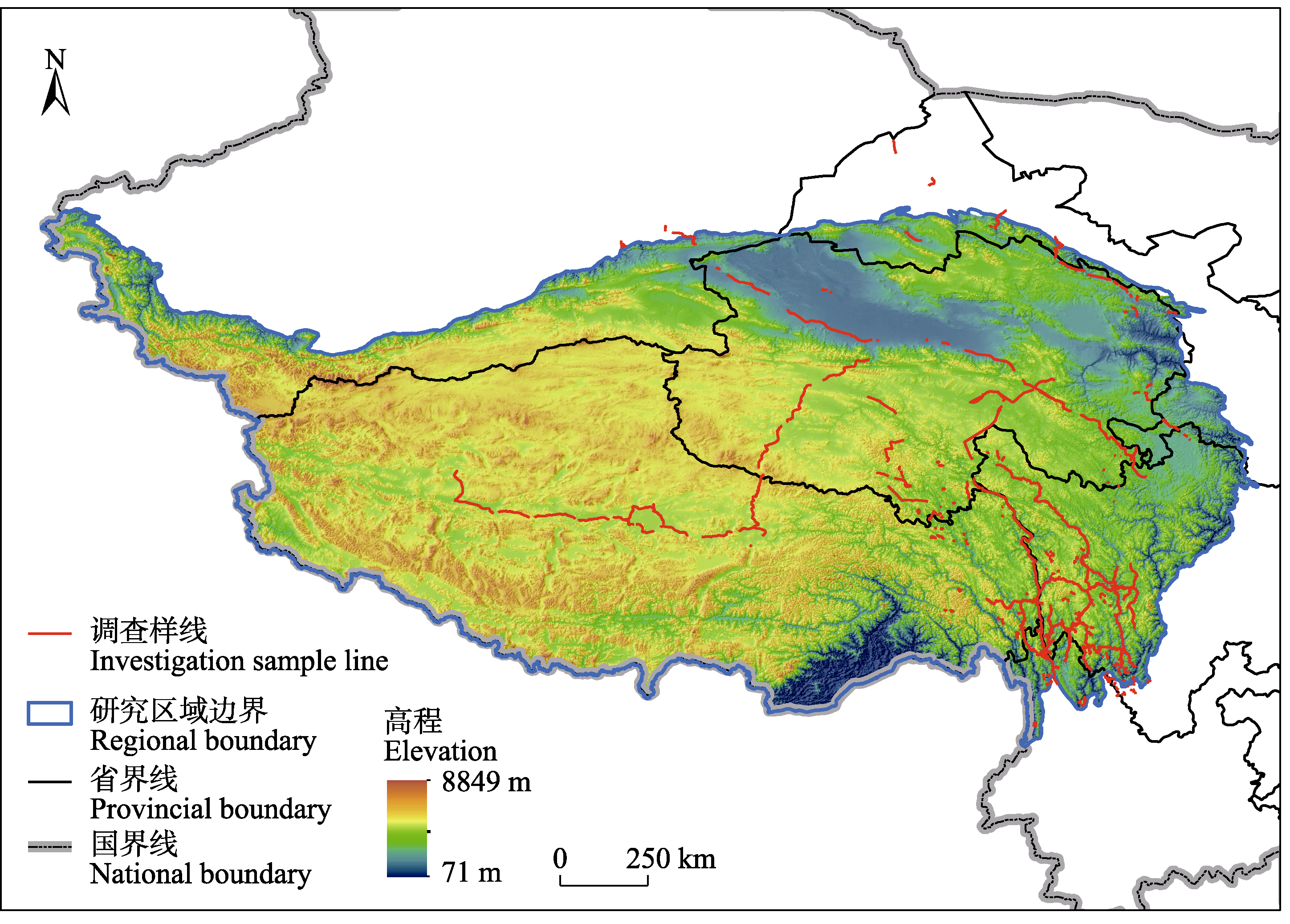
Fig. 1 The elevation map of the study area and the field investigation sample lines
| 目 Order | 数量(占比) Number (Percentage) | 目 Order | 数量(占比) Number (Percentage) | ||
|---|---|---|---|---|---|
| 1 | 雀形目 Passeriformes | 73 (25.17%) | 12 | 啄木鸟目 Piciformes | 7 (2.41%) |
| 2 | 鹰形目 Accipitriformes | 49 (16.90%) | 13 | 鹈形目 Pelecaniformes | 6 (2.07%) |
| 3 | 鸡形目 Galliformes | 31 (10.69%) | 14 | 鹳形目 Ciconiiformes | 5 (1.72%) |
| 4 | 鸮形目 Strigiformes | 24 (8.28%) | 15 | 犀鸟目 Bucerotiformes | 4 (1.38%) |
| 5 | 鸻形目 Charadriiformes | 16 (5.52%) | 16 | 鸨形目 Otidiformes | 2 (0.69%) |
| 6 | 雁形目 Anseriformes | 14 (4.83%) | 17 | 鹃形目 Cuculiformes | 2 (0.69%) |
| 7 | 鸽形目 Columbiformes | 12 (4.14%) | 18 | 䴙䴘目 Podicipediformes | 2 (0.69%) |
| 8 | 隼形目 Falconiformes | 12 (4.14%) | 19 | 咬鹃目 Trogoniformes | 2 (0.69%) |
| 9 | 佛法僧目 Coraciiformes | 9 (3.10%) | 20 | 夜鹰目 Caprimulgiformes | 2 (0.69%) |
| 10 | 鹤形目 Gruiformes | 9 (3.10%) | 21 | 鲣鸟目 Suliformes | 1 (0.34%) |
| 11 | 鹦鹉目 Psittaciformes | 8 (2.76%) |
Table 1 Composition of the order of national key protected wild birds on the Qinghai-Xizang Plateau
| 目 Order | 数量(占比) Number (Percentage) | 目 Order | 数量(占比) Number (Percentage) | ||
|---|---|---|---|---|---|
| 1 | 雀形目 Passeriformes | 73 (25.17%) | 12 | 啄木鸟目 Piciformes | 7 (2.41%) |
| 2 | 鹰形目 Accipitriformes | 49 (16.90%) | 13 | 鹈形目 Pelecaniformes | 6 (2.07%) |
| 3 | 鸡形目 Galliformes | 31 (10.69%) | 14 | 鹳形目 Ciconiiformes | 5 (1.72%) |
| 4 | 鸮形目 Strigiformes | 24 (8.28%) | 15 | 犀鸟目 Bucerotiformes | 4 (1.38%) |
| 5 | 鸻形目 Charadriiformes | 16 (5.52%) | 16 | 鸨形目 Otidiformes | 2 (0.69%) |
| 6 | 雁形目 Anseriformes | 14 (4.83%) | 17 | 鹃形目 Cuculiformes | 2 (0.69%) |
| 7 | 鸽形目 Columbiformes | 12 (4.14%) | 18 | 䴙䴘目 Podicipediformes | 2 (0.69%) |
| 8 | 隼形目 Falconiformes | 12 (4.14%) | 19 | 咬鹃目 Trogoniformes | 2 (0.69%) |
| 9 | 佛法僧目 Coraciiformes | 9 (3.10%) | 20 | 夜鹰目 Caprimulgiformes | 2 (0.69%) |
| 10 | 鹤形目 Gruiformes | 9 (3.10%) | 21 | 鲣鸟目 Suliformes | 1 (0.34%) |
| 11 | 鹦鹉目 Psittaciformes | 8 (2.76%) |
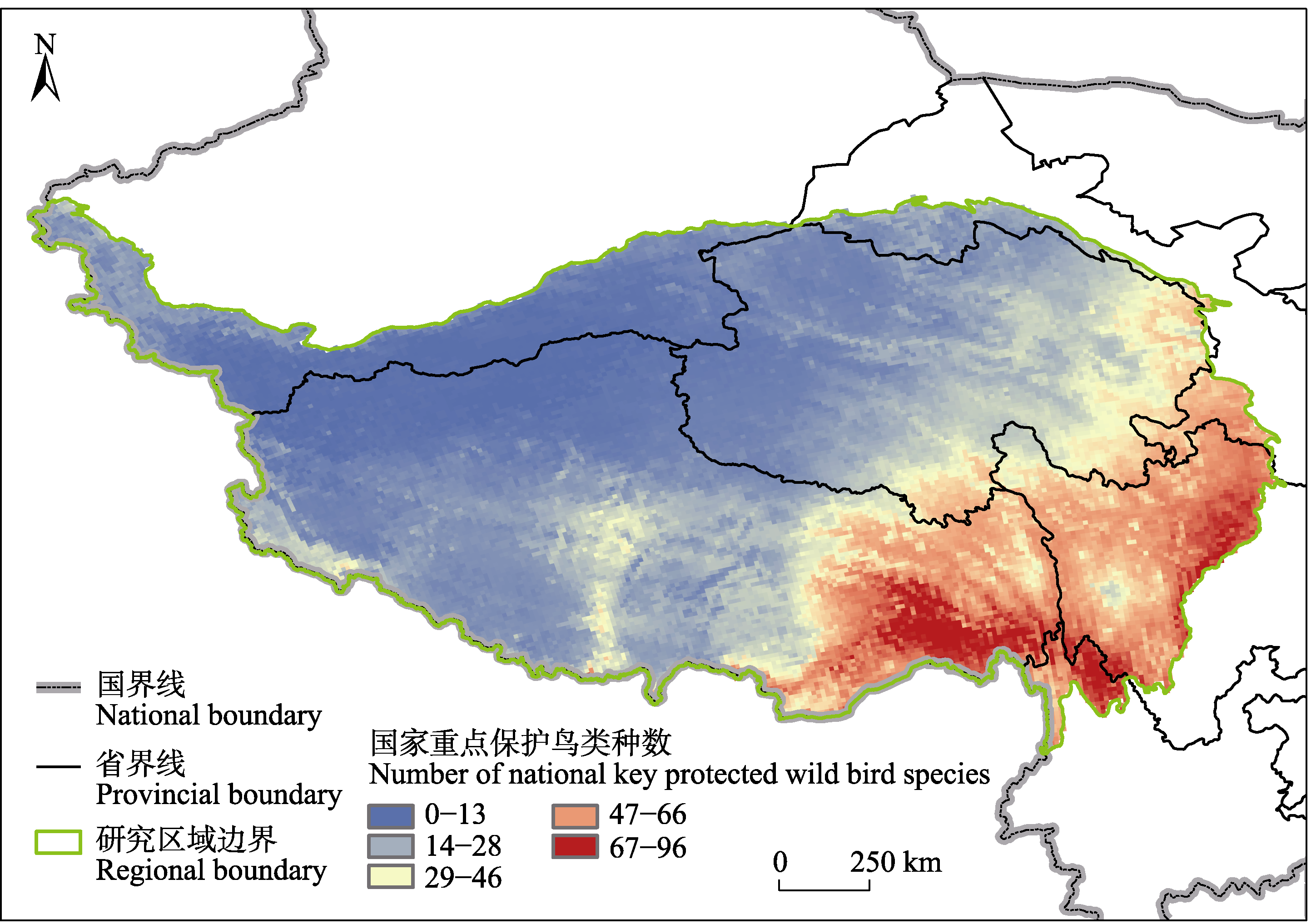
Fig. 2 Distribution pattern map of species richness of national key protected wild birds on the Qinghai-Xizang Plateau
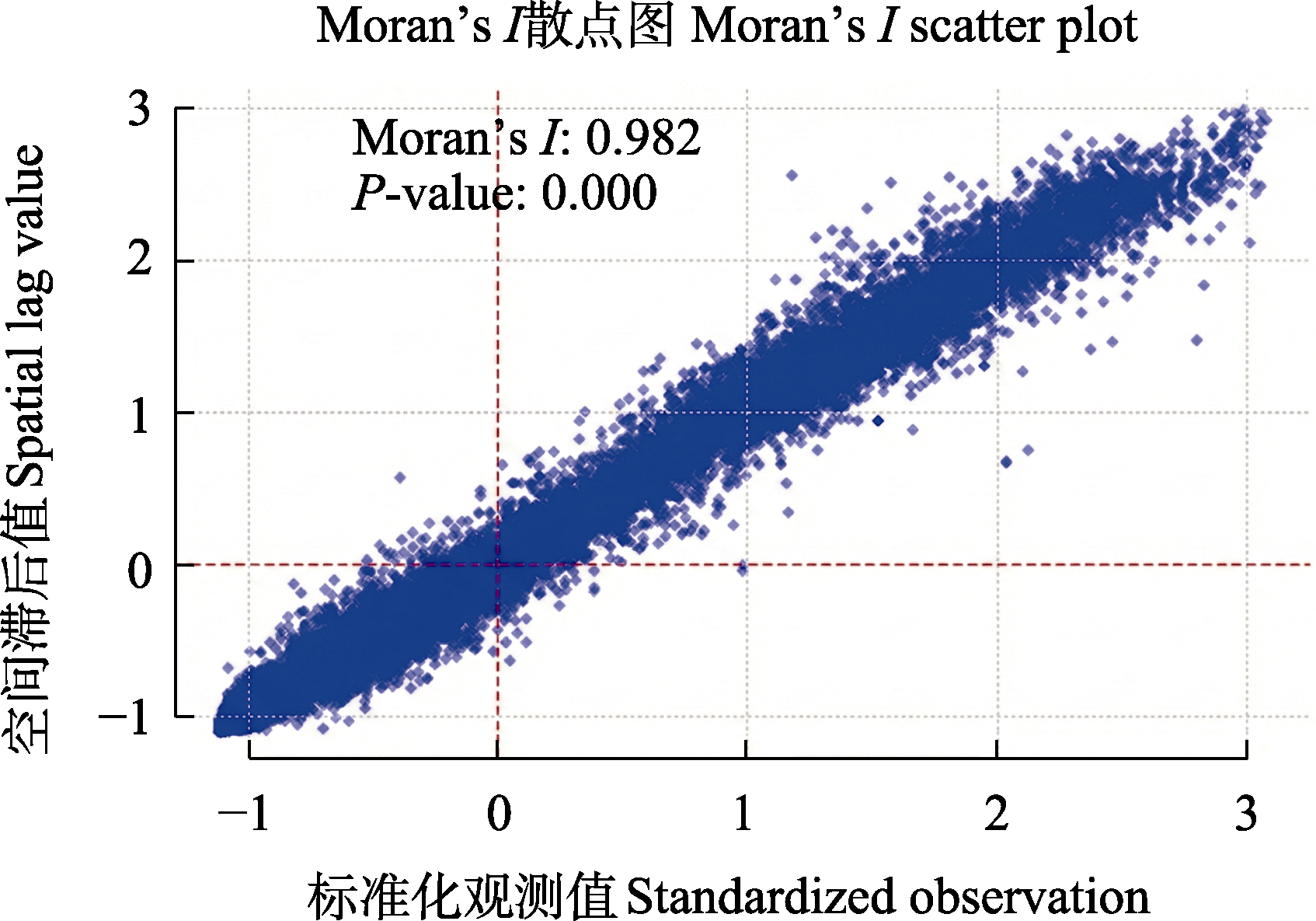
Fig. 3 Scatter plot of the Moran’s I index of species richness
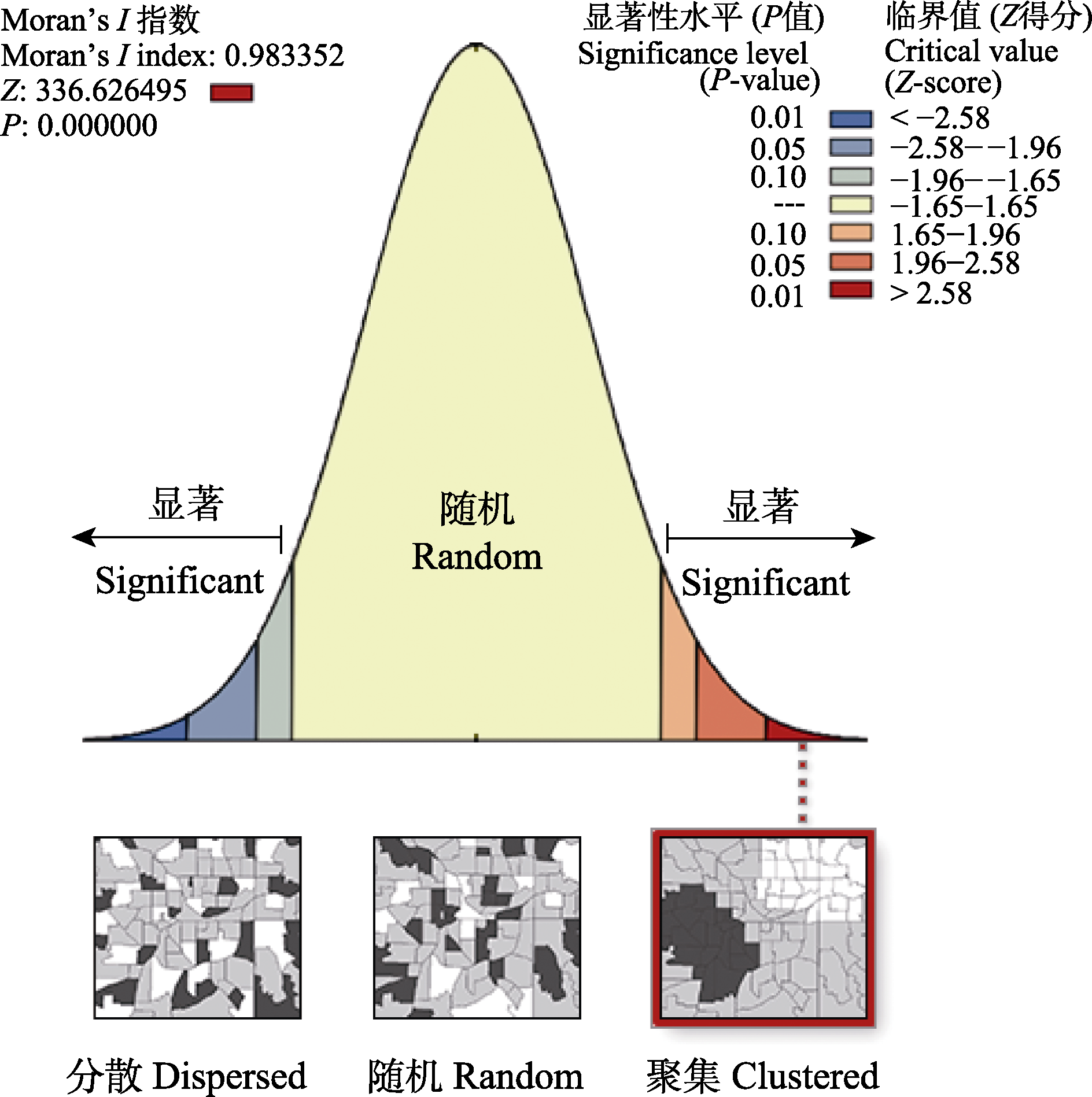
Fig. 4 Spatial autocorrelation reports
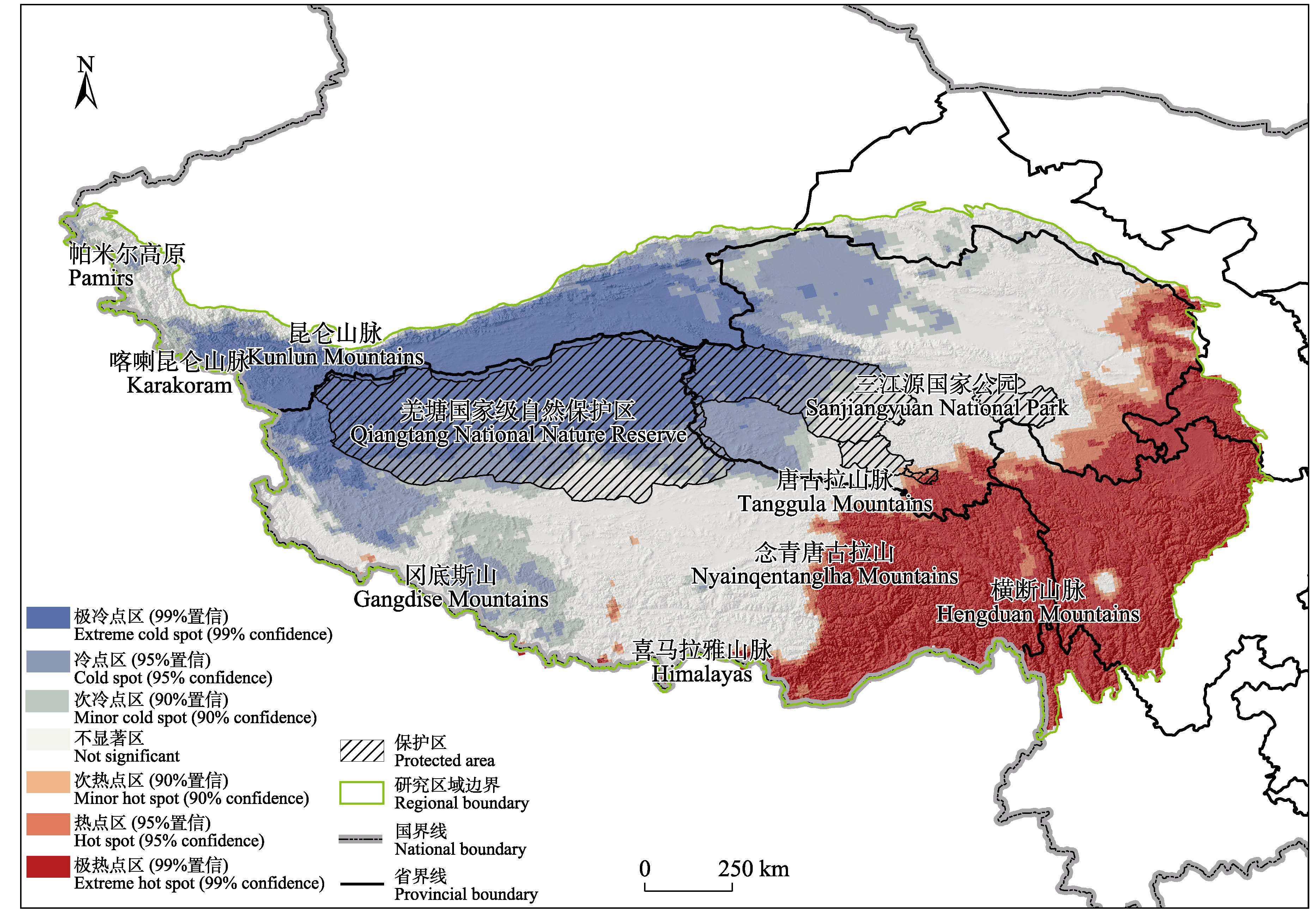
Fig. 5 Hot spot analysis result chart of the richness of national key protected birds on the Qinghai-Xizang Plateau
| [1] |
Cleasby IR, Owen E, Wilson L, Wakefield ED, O’Connell P, Bolton M (2020) Identifying important at-sea areas for seabirds using species distribution models and hotspot mapping. Biological Conservation, 241, 108375.
DOI URL |
| [2] |
Cushman SA, Kaszta ZM, Burns P, Hakkenberg CR, Jantz P, MacDonald DW, Brodie JF, Deith MCM, Goetz S (2024) Simulating multi-scale optimization and variable selection in species distribution modeling. Ecological Informatics, 83, 102832.
DOI URL |
| [3] |
Deng T, Wang XM, Wang SQ, Li Q, Hou SK (2015) Evolution of the Chinese Neogene mammalian faunas and its relationship to uplift of the Tibetan Plateau. Advances in Earth Science, 30, 407-415. (in Chinese with English abstract)
DOI |
|
[ 邓涛, 王晓鸣, 王世骐, 李强, 侯素宽 (2015) 中国新近纪哺乳动物群的演化与青藏高原隆升的关系. 地球科学进展, 30, 407-415.]
DOI |
|
| [4] | Huang DY, An QJ, Huang SP, Tan GD, Quan HG, Chen YN, Zhou JY, Liao H (2023) Biomod 2 modeling for predicting the potential ecological distribution of three Fritillaria species under climate change. Scientific Reports, 13, 18801. |
| [5] |
Li B, Liang CB, Song PF, Liu DX, Qin W, Jiang F, Gu HF, Gao HM, Zhang TZ (2023) Threatened birds face new distribution under future climate change on the Qinghai- Tibet Plateau (QTP). Ecological Indicators, 150, 110217.
DOI URL |
| [6] | Li DQ, Song YL (2000) Review on hot spot and GAP analysis. Chinese Biodiversity, 8, 208-214. (in Chinese with English abstract) |
| [ 李迪强, 宋延龄 (2000) 热点地区与GAP分析研究进展. 生物多样性, 8, 208-214.] | |
| [7] | Li ZQ, Ouyang ZY, Zeng HQ (2010) Assessment methods for territorial biodiversity hotspot based on species richness at broad scale. Acta Ecologica Sinica, 30, 1586-1593. (in Chinese with English abstract) |
| [ 李智琦, 欧阳志云, 曾慧卿 (2010) 基于物种的大尺度生物多样性热点研究方法. 生态学报, 30, 1586-1593.] | |
| [8] | Liang JC, Ding ZF, Zhang CL, Hu HJ, Duo HR, Tang H (2017) Bird diversity spatial distribution patterns and hotspots in Maixiu Area of Sanjiangyuan National Nature Reserve, Qinghai Province. Biodiversity Science, 25, 294-303. (in Chinese with English abstract) |
|
[ 梁健超, 丁志锋, 张春兰, 胡慧建, 朵海瑞, 唐虹 (2017) 青海三江源国家级自然保护区麦秀分区鸟类多样性空间格局及热点区域研究. 生物多样性, 25, 294-303.]
DOI |
|
| [9] |
Liang Y, Song W (2022) Integrating potential ecosystem services losses into ecological risk assessment of land use changes: A case study on the Qinghai-Tibet Plateau. Journal of Environmental Management, 318, 115607.
DOI URL |
| [10] | Liu C, Zheng CY, Zhang T, Zeng FX, Wang YR (2014) Geographic patterns of avian species richness in China and their environmental factors. Acta Scientiarum Naturalium Universitatis Pekinensis, 50, 429-438. (in Chinese with English abstract) |
| [ 刘澈, 郑成洋, 张腾, 曾发旭, 王逸然 (2014) 中国鸟类物种丰富度的地理格局及其与环境因子的关系. 北京大学学报(自然科学版), 50, 429-438.] | |
| [11] | Liu NF, Bao XK, Liao JC (2013) The Classification and Distribution of the Birds in Qingzang Plateau. Science Press, Beijing. (in Chinese) |
| [ 刘迺发, 包新康, 廖继承 (2013) 青藏高原鸟类分类与分布. 科学出版社, 北京.] | |
| [12] |
Liu WH, Zheng JW, Wang ZR, Li R, Wu TH (2021) A bibliometric review of ecological research on the Qinghai-Tibet Plateau, 1990-2019. Ecological Informatics, 64, 101337.
DOI URL |
| [13] |
Luo ZH, Wei SC, Zhang W, Zhao M, Wu H (2015) Amphibian biodiversity congruence and conservation priorities in China: Integrating species richness, endemism, and threat patterns. Biological Conservation, 191, 650-658.
DOI URL |
| [14] | Ma M (2011) A Checklist on the Distribution of the Birds in Xinjiang. Science Press, Beijing. (in Chinese) |
| [ 马鸣 (2011) 新疆鸟类分布名录. 科学出版社, 北京.] | |
| [15] |
Ma XY, Xu H, Cao ZY, Shu L, Zhu RL (2022) Will climate change cause the global peatland to expand or contract? Evidence from the habitat shift pattern of Sphagnum mosses. Global Change Biology, 28, 6419-6432.
DOI URL |
| [16] | Mi XC, Feng G, Hu YB, Zhang J, Chen L, Corlett RT, Hughes AC, Pimm S, Schmid B, Shi SH, Svenning JC, Ma KP (2021) The global significance of biodiversity science in China: An overview. National Science Review, 8, nwab032. |
| [17] |
Myers N, Mittermeier RA, Mittermeier CG, da Fonseca GAB, Kent J (2000) Biodiversity hotspots for conservation priorities. Nature, 403, 853-858.
DOI |
| [18] | Pang RQ, Teng F, Wei Y (2014) A GWR-based study on dynamic mechanism of population urbanization in Jilin Province. Scientia Geographica Sinica, 34, 1210-1217. (in Chinese with English abstract) |
|
[ 庞瑞秋, 腾飞, 魏冶 (2014) 基于地理加权回归的吉林省人口城镇化动力机制分析. 地理科学, 34, 1210-1217.]
DOI |
|
| [19] |
Pereira HM, Ferrier S, Walters M, Geller GN, Jongman RHG, Scholes RJ, Bruford MW, Brummitt N, Butchart SHM, Cardoso AC, Coops NC, Dulloo E, Faith DP, Freyhof J, Gregory RD, Heip C, Höft R, Hurtt G, Jetz W, Karp DS, McGeoch MA, Obura D, Onoda Y, Pettorelli N, Reyers B, Sayre R, Scharlemann JPW, Stuart SN, Turak E, Walpole M, Wegmann M (2013) Essential biodiversity variables. Science, 339, 277-278.
DOI PMID |
| [20] | Piao SL, Zhang XZ, Wang T, Liang EY, Wang SP, Zhu JT, Niu B (2019) Responses and feedback of the Tibetan Plateau’s alpine ecosystem to climate change. Chinese Science Bulletin, 64, 2842-2855. (in Chinese with English abstract) |
| [ 朴世龙, 张宪洲, 汪涛, 梁尔源, 汪诗平, 朱军涛, 牛犇 (2019) 青藏高原生态系统对气候变化的响应及其反馈. 科学通报, 64, 2842-2855.] | |
| [21] | Qi SW (2022) Topographic and geomorphic data of the Qinghai-Tibet Plateau (2021). (in Chinese) |
| [ 祁生文 (2022) 青藏高原地形地貌数据(2021). https://www.tpdc.ac.cn/zh-hans/data/be293ab9-c579-41a6-a0a8-fbf65adb9eac.] | |
| [22] | Tang CZ (1996) Birds of the Hengduan Mountains Region. Science Press, Beijing. (in Chinese) |
| [ 唐蟾珠 (1996) 横断山区鸟类. 科学出版社, 北京.] | |
| [23] |
Venter O, Sanderson EW, Magrach A, Allan JR, Beher J, Jones KR, Possingham HP, Laurance WF, Wood P, Fekete BM, Levy MA, Watson JEM (2016) Sixteen years of change in the global terrestrial human footprint and implications for biodiversity conservation. Nature Communications, 7, 12558.
DOI PMID |
| [24] | Wang C, Hu Y, Li MM, Ran JH, Tang RH (2022) Spatial distribution pattern of birds in the list of wild animals under state priority conservation in Sichuan Province. Sichuan Journal of Zoology, 41, 601-610. (in Chinese with English abstract) |
| [ 王灿, 胡烨, 李明明, 冉江洪, 唐荣华 (2022) 四川省国家重点保护野生鸟类的空间分布格局. 四川动物, 41, 601-610.] | |
| [25] |
Wang YL, Zhang Y, Qi CL, Zhang CD, Shi YH, Du YJ, Ding Q (2024) Identifying biodiversity hotspots and conservation gaps in Hainan Tropical Rainforest National Park based on macrofungi and plants perspectives. Biodiversity Science, 32, 24081. (in Chinese with English abstract)
DOI |
|
[ 王艳丽, 张英, 戚春林, 张昌达, 史佑海, 杜彦君, 丁琼 (2024) 海南热带雨林国家公园生物多样性热点与保护空缺区域识别: 基于大型真菌与植物视角. 生物多样性, 32, 24081.]
DOI |
|
| [26] | Wang YX, Qin Q (2022) GIS-based analysis of urban economic differences and spatial pattern: A case study of Henan Province. Journal of Shanxi Normal University (Natural Science Edition), 36(3), 86-93. (in Chinese with English abstract) |
| [ 王迎新, 秦青 (2022) 基于GIS的城市经济差异与空间格局分析: 以河南省为例. 山西师范大学学报(自然科学版), 36(3), 86-93.] | |
| [27] | Wei ZG, Huang RH, Dong WJ (2003) Interannual and interdecadal variations of air temperature and precipitation over the Tibetan Plateau. Chinese Journal of Atmospheric Sciences, 27, 157-170. (in Chinese with English abstract) |
| [ 韦志刚, 黄荣辉, 董文杰 (2003) 青藏高原气温和降水的年际和年代际变化. 大气科学, 27, 157-170.] | |
| [28] | Wilson KA, Underwood EC, Morrison SA, Klausmeyer KR, Murdoch WW, Reyers B, Wardell-Johnson G, Marquet PA, Rundel PW, McBride MF, Pressey RL, Bode M, Hoekstra JM, Andelman S, Looker M, Rondinini C, Kareiva P, Shaw MR, Possingham HP (2007) Conserving biodiversity efficiently: What to do, where, and when. PLoS Biology, 5, e223. |
| [29] | Wu YJ (2024) Birds Identification and Bird-Strike Prevention at Airports in the Qinghai-Xizang Plateau. Sichuan University Press, Chengdu. (in Chinese) |
| [ 吴永杰 (2024) 青藏高原机场鸟类识别与防控. 四川大学出版社, 成都.] | |
| [30] | Wu ZY (1980) Vegetation of China. Science Press, Beijing. (in Chinese) |
| [ 吴征镒 (1980) 中国植被. 科学出版社, 北京.] | |
| [31] | Yao TD (2014) TPE international program: A program for coping with major future environmental challenges of the Third Pole region. Progress in Geography, 33, 884-892. (in Chinese with English abstract) |
| [ 姚檀栋 (2014) “第三极环境(TPE)”国际计划——应对区域未来环境生态重大挑战问题的国际计划. 地球科学进展, 33, 884-892.] | |
| [32] | Yao TD, Zhu LP (2006) The response of environmental changes on Tibetan Plateau to global changes and adaptation strategy. Advances in Earth Science, 21, 459-464. (in Chinese with English abstract) |
|
[ 姚檀栋, 朱立平 (2006) 青藏高原环境变化对全球变化的响应及其适应对策. 地球科学进展, 21, 459-464.]
DOI |
|
| [33] | Yong F, Xu HG, Cui P, Cao MC, Lei JC, Wu Y, Ding H, Wu J, Lu XQ, Le ZF (2015) Distribution pattern of forest birds in breeding and wintering seasons in China and the influencing factors. Journal of Ecology and Rural Environment, 31, 658-663. (in Chinese with English abstract) |
| [ 雍凡, 徐海根, 崔鹏, 曹铭昌, 雷军成, 吴翼, 丁晖, 吴军, 卢晓强, 乐志芳 (2015) 中国森林鸟类繁殖季和越冬季分布格局及其影响因子. 生态与农村环境学报, 31, 658-663.] | |
| [34] | Zang ZH, Shen GZ, Xu WT, Li JQ, Xie ZQ (2015) Spatial distribution patterns of rare and endangered species richness and hotspot analysis in giant panda distribution areas. Journal of Beijing Forestry University, 37(7), 1-10. (in Chinese with English abstract) |
| [ 臧振华, 申国珍, 徐文婷, 李俊清, 谢宗强 (2015) 大熊猫分布区珍稀濒危物种丰富度空间格局与热点区分析. 北京林业大学学报, 37(7), 1-10.] | |
| [35] | Zhang CL, Lei FM (2013) Topographic heterogeneity determines bird distribution on the Qinghai-Tibet Plateau. In: The 12th National Ornithology Symposium and the 10th Cross-Strait Ornithology Symposium Abstracts Collection, pp. 45-46. Hangzhou. (in Chinese) |
| [ 张春兰, 雷富民 (2013) 地形异质性决定青藏高原鸟类分布. 见: 第十二届全国鸟类学术研讨会暨第十届海峡两岸鸟类学术研讨会论文摘要集, 45-46页. 杭州.] | |
| [36] | Zhang CL, Quan Q, Wu YJ, Chen YH, He P, Qu YH, Lei FM (2017) Topographic heterogeneity and temperature amplitude explain species richness patterns of birds in the Qinghai-Tibetan Plateau. Current Zoology, 63, 131-137. |
| [37] |
Zhang YJ, Hu J, Wang CB, Wan YQ, Ji ML, Ma FZ, Lu YQ (2024) Estimating global geographical distribution and ecological niche dynamics of Ammannia coccinea under climate change based on Biomod2. Scientific Reports, 14, 30579.
DOI |
| [38] | Zhang YL, Li BY, Zheng D (2002) A discussion on the boundary and area of the Tibetan Plateau in China. Geographical Research, 21, 1-8. (in Chinese with English abstract) |
| [ 张镱锂, 李炳元, 郑度 (2002) 论青藏高原范围与面积. 地理研究, 21, 1-8.] | |
| [39] | Zhao Y (2022) Impacts of Climate Warming and Wetting on Bird Distribution on the Qinghai-Tibet Plateau. PhD dissertation, University of Chinese Academy of Sciences, Beijing. (in Chinese with English abstract) |
| [ 赵岩 (2022) 气候暖湿化对青藏高原鸟类分布的影响. 博士学位论文, 中国科学院大学, 北京.] | |
| [40] | Zheng GM (2023) A Checklist on the Classification and Distribution of the Birds of China, 4th edn. Science Press, Beijing. (in Chinese) |
| [ 郑光美 (2023) 中国鸟类分类与分布名录(第四版). 科学出版社, 北京.] |
| [1] | Jianchao Liang, Zhifeng Ding, Chunlan Zhang, Huijian Hu, Hairui Duo, Hong Tang. Bird diversity spatial distribution patterns and hotspots in Maixiu Area of Sanjiangyuan National Nature Reserve, Qinghai Province [J]. Biodiv Sci, 2017, 25(3): 294-303. |
| [2] | Yan Liu, Daoyuan Zhang. Spatial genetic structure in five natural populations of Eremosparton songoricum as revealed by ISSR analysis [J]. Biodiv Sci, 2010, 18(2): 129-136. |
| [3] | Youyu Zhang, Lizhi Zhou, Qishan Wang, Xinjian Wang, Yajun Xing. Distribution pattern and hotspot analysis of breeding birds in Anhui Province [J]. Biodiv Sci, 2008, 16(3): 305-312. |
| [4] | LI Zuo-Zhou, GONG Jun-Jie, WANG Ying, HUANG Hong-Wen. Spatial structure of AFLP genetic diversity of remnant populations of Metasequoia glyptostroboides (Taxodiaceae) [J]. Biodiv Sci, 2003, 11(4): 265-275. |
| Viewed | ||||||
|
Full text |
|
|||||
|
Abstract |
|
|||||
Copyright © 2026 Biodiversity Science
Editorial Office of Biodiversity Science, 20 Nanxincun, Xiangshan, Beijing 100093, China
Tel: 010-62836137, 62836665 E-mail: biodiversity@ibcas.ac.cn

