

生物多样性 ›› 2026, Vol. 34 ›› Issue (8): 26067. DOI: 10.17520/biods.2026067 cstr: 32101.14.biods.2026067
钟秋菊1( ), 张娟娟1(), 贾尤鑫1(), 张学聪1(), 任芷叶1(), 冯赣鑫1(), 杨静2(), 姜沄林2(), 廖慧璇1(), 梁敏霞1,*()(
 )
收稿日期:2026-03-03
接受日期:2026-06-21
出版日期:2026-08-20
发布日期:2026-10-21
通讯作者:
*E-mail: liangmx3@mail.sysu.edu.cn
基金资助:
Qiuju Zhong1(), Juanjuan Zhang1(), Youxian Jia1(), Xuecong Zhang1(), Zhiye Ren1(), Ganxin Feng1(), Jing Yang2(), Yunlin Jiang2(), Huixuan Liao1(), Minxia Liang1,*()()
Received:2026-03-03
Accepted:2026-06-21
Online:2026-08-20
Published:2026-10-21
Contact:
*E-mail: liangmx3@mail.sysu.edu.cn
Supported by:摘要:
热带新成珊瑚岛生态系统的形成与演替是实现其可持续发展的关键生态过程之一。然而, 评估其生物群落演替阶段缺乏定量方法与参照基准。本研究基于全球生物多样性信息网络(GBIF)中241个热带海岛的植物、昆虫与鸟类物种分布记录, 结合气候与土壤因子进行k-means聚类分析, 采用空间代替时间的方法, 分环境簇构建了科/目水平的群落演替参照系, 通过指示类群相对丰富度判定生态演替阶段; 据此评估了我国热带新成珊瑚岛(A岛)的生态演替阶段。结果表明, A岛在植物、昆虫与鸟类三大类群上分别处于环境簇1参照系约第10年、第10年与第20年演替阶段, 呈“多类群异步演替”格局, 其中, 鸟类表现出相对较快演替进程; A岛生态系统仍处于生态演替早期, 需重视岛上植物-动物互馈与类群间协同发展。本研究建立的演替参照系方法可为缺乏监测数据的新成岛生态系统评估提供科学依据。
钟秋菊, 张娟娟, 贾尤鑫, 张学聪, 任芷叶, 冯赣鑫, 杨静, 姜沄林, 廖慧璇, 梁敏霞 (2026) 基于物种分布数据的海岛多类群演替参照系构建及其在热带新成岛生态系统的应用. 生物多样性, 34, 26067. DOI: 10.17520/biods.2026067.
Qiuju Zhong, Juanjuan Zhang, Youxian Jia, Xuecong Zhang, Zhiye Ren, Ganxin Feng, Jing Yang, Yunlin Jiang, Huixuan Liao, Minxia Liang (2026) Construction and application of multi-taxon successional reference frameworks in newly formed tropical island ecosystems based on species distribution data. Biodiversity Science, 34, 26067. DOI: 10.17520/biods.2026067.
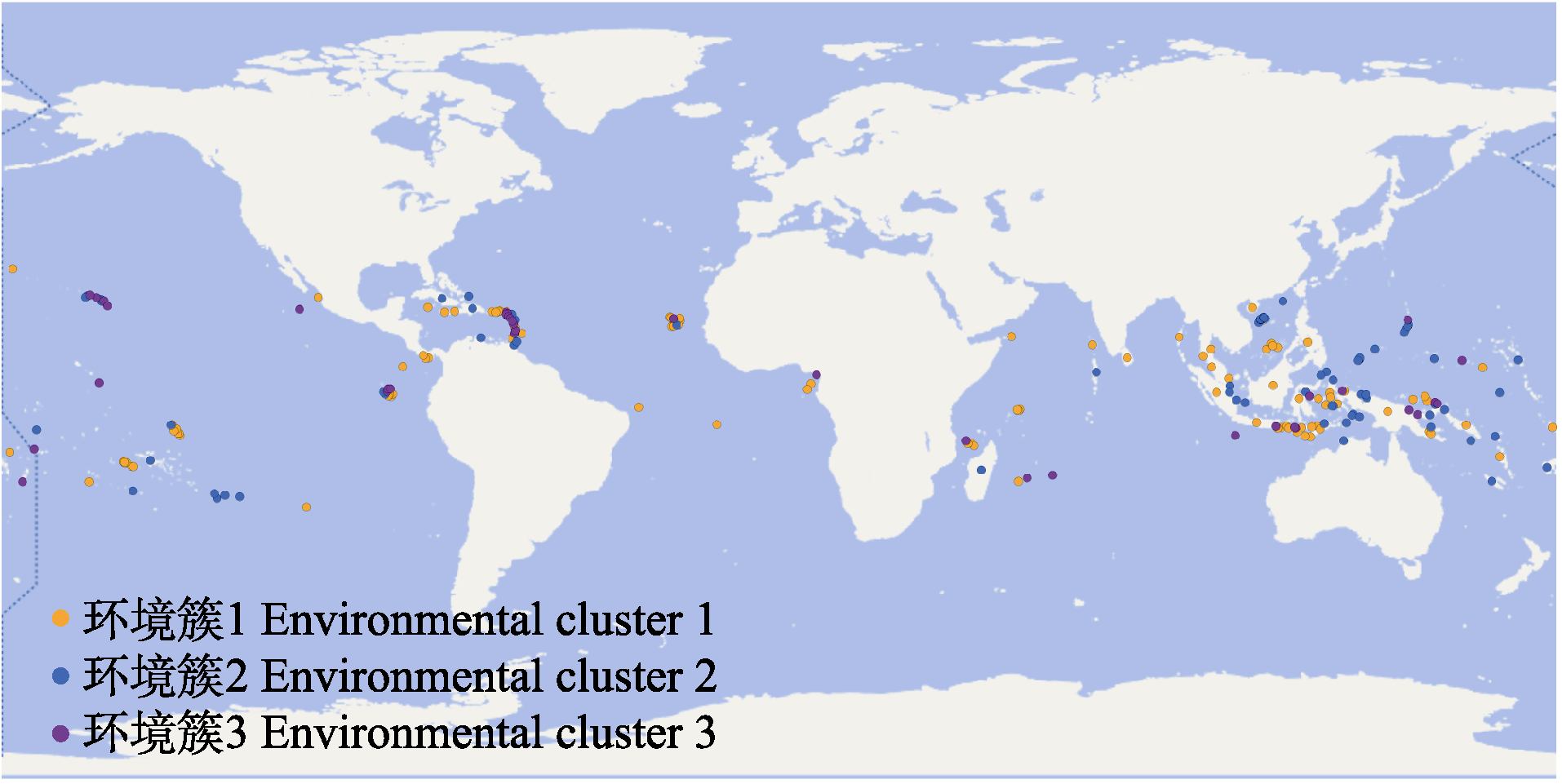
图1 纳入演替参照系构建的241个全球热带岛屿的空间分布。不同颜色的圆点代表不同环境簇下的岛屿。
Fig. 1 Spatial distribution of the 241 global tropical islands included in the construction of the successional reference framework. Dots of different colors represent islands belonging to different environmental clusters.
| 生物类群 Taxonomic groups | 包含时间的分布记录 Distribution records with temporal information | 岛屿数量 Number of islands |
|---|---|---|
| 植物 Plants | 572,381 | 88 |
| 昆虫 Insects | 375,705 | 67 |
| 鸟类 Birds | 17,920,489 | 219 |
表1 构建演替参照系所用三大生物类群的分布记录与岛屿数量统计
Table 1 Distribution records and number of islands for the three major taxonomic groups used in constructing the successional reference framework
| 生物类群 Taxonomic groups | 包含时间的分布记录 Distribution records with temporal information | 岛屿数量 Number of islands |
|---|---|---|
| 植物 Plants | 572,381 | 88 |
| 昆虫 Insects | 375,705 | 67 |
| 鸟类 Birds | 17,920,489 | 219 |
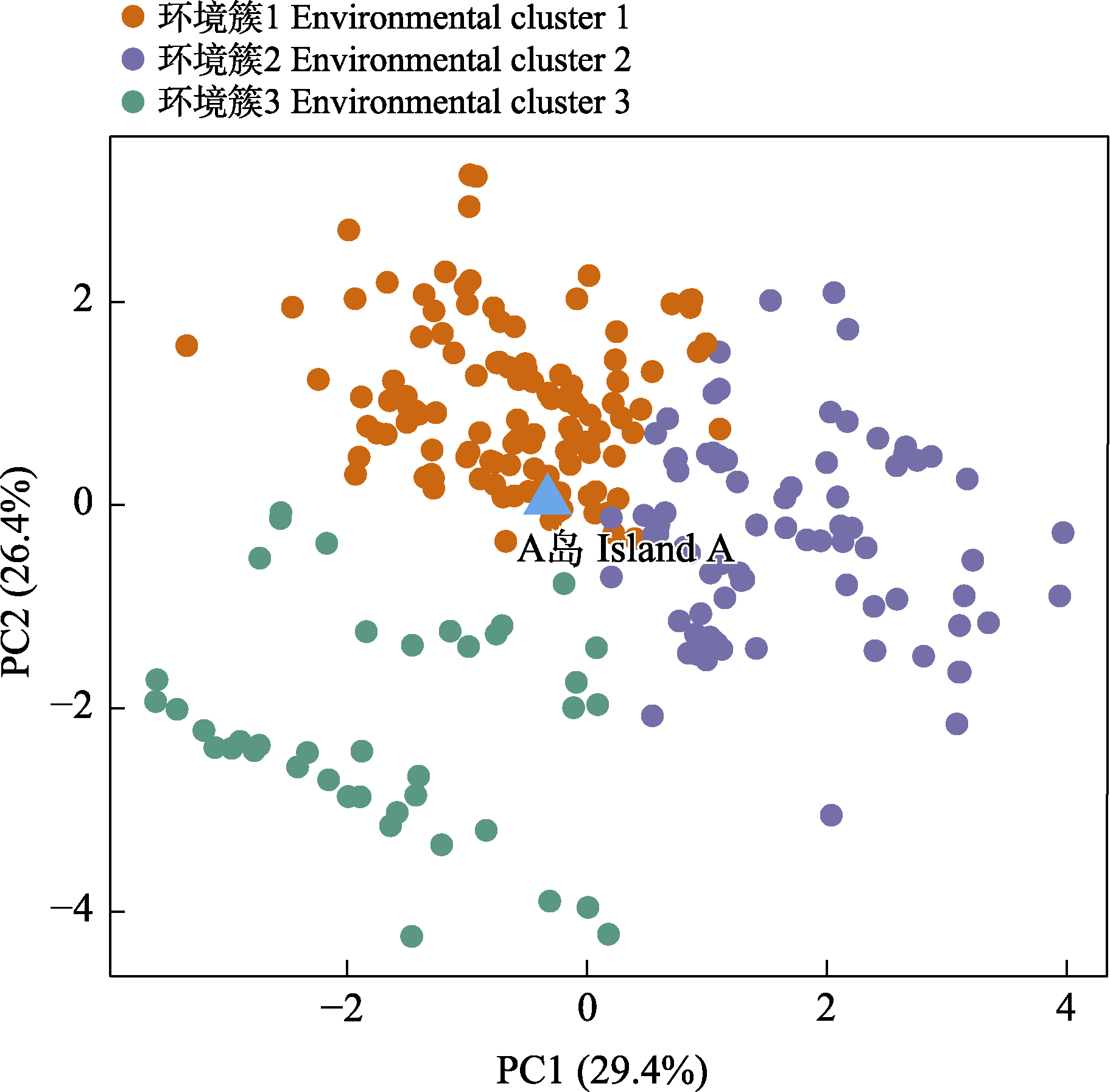
图2 基于气候与土壤因子的全球热带海岛聚类分析结果(k = 3)
Fig. 2 Results of k-means clustering of global tropical islands based on climatic and soil factors (k = 3)
| 环境变量 Environmental variable | 环境簇1 Environmental cluster 1 | 环境簇2 Environmental cluster 2 | 环境簇3 Environmental cluster 3 |
|---|---|---|---|
| 岛屿数量 Number of islands | 117 | 84 | 40 |
| 年均温 Mean annual temperature (℃) | 25.47 ± 1.55 | 23.51 ± 2.86 | 25.31 ± 2.19 |
| 温度季节性变化 Temperature seasonality (SD × 100) | 66.1 ± 29.6 | 179.9 ± 42.1 | 100.7 ± 57.5 |
| 年降水量 Annual precipitation (mm) | 2,269 ± 826 | 1,076 ± 582 | 1,875 ± 809 |
| 降水变异系数 Coefficient of variation of precipitation (%) | 39.17 ± 21.23 | 76.08 ± 38.11 | 46.71 ± 24.59 |
| 总氮 Total nitrogen (g/kg) | 1.21 ± 0.52 | 1.19 ± 0.61 | 4.65 ± 1.32 |
| 有机碳 Organic carbon (%) | 1.46 ± 0.78 | 1.38 ± 0.73 | 6.47 ± 1.82 |
| 土壤pH Soil pH | 6.00 ± 0.78 | 5.74 ± 0.78 | 5.45 ± 0.31 |
| C/N比 Carbon-to-nitrogen ratio | 11.54 ± 1.10 | 11.64 ± 1.15 | 12.90 ± 2.27 |
表2 k-means聚类分析所获三大环境簇的气候与土壤特征指标对比(平均值 ± 标准差)
Table 2 Comparison of climatic and soil characteristics among the three environmental clusters derived from k-means clustering (mean ± SD)
| 环境变量 Environmental variable | 环境簇1 Environmental cluster 1 | 环境簇2 Environmental cluster 2 | 环境簇3 Environmental cluster 3 |
|---|---|---|---|
| 岛屿数量 Number of islands | 117 | 84 | 40 |
| 年均温 Mean annual temperature (℃) | 25.47 ± 1.55 | 23.51 ± 2.86 | 25.31 ± 2.19 |
| 温度季节性变化 Temperature seasonality (SD × 100) | 66.1 ± 29.6 | 179.9 ± 42.1 | 100.7 ± 57.5 |
| 年降水量 Annual precipitation (mm) | 2,269 ± 826 | 1,076 ± 582 | 1,875 ± 809 |
| 降水变异系数 Coefficient of variation of precipitation (%) | 39.17 ± 21.23 | 76.08 ± 38.11 | 46.71 ± 24.59 |
| 总氮 Total nitrogen (g/kg) | 1.21 ± 0.52 | 1.19 ± 0.61 | 4.65 ± 1.32 |
| 有机碳 Organic carbon (%) | 1.46 ± 0.78 | 1.38 ± 0.73 | 6.47 ± 1.82 |
| 土壤pH Soil pH | 6.00 ± 0.78 | 5.74 ± 0.78 | 5.45 ± 0.31 |
| C/N比 Carbon-to-nitrogen ratio | 11.54 ± 1.10 | 11.64 ± 1.15 | 12.90 ± 2.27 |
| 生物类群 Taxonomic groups | 参照系总时长 Reference framework duration (yr) | “逐渐上升”类群(代表科/目) Gradually increasing groups (representative families/orders) | 参照系关键年份及比例 Key years and proportions in the reference framework | A岛“逐渐上升”类群占比 Proportion of gradually increasing groups on Island A (%) | 判定阶段 Determined successional stage |
|---|---|---|---|---|---|
| 植物 Plants | 35 | 豆科、野牡丹科、桃金娘科等 Fabaceae, Melastomataceae, Myrtaceae, etc. | 0年(0 yr): 18.1% 10年(10 yr): 30.3% 25年(25 yr): 48.5% 35年(35 yr): 60.6% | 30.2 | 约10年 About 10 yr |
| 昆虫 Insects | 30 | 半翅目、膜翅目 Hemiptera, Hymenoptera | 0年(0 yr): 6.7% 10年(10 yr): 20.8% 20年(20 yr): 34.9% 30年(30 yr): 49.0% | 19.2 | 约10年 About 10 yr |
| 鸟类 Birds | 90 | 鸦科、鹦鹉科、椋鸟科等 Corvidae, Psittacidae, Sturnidae, etc. | 0年(0 yr): 15.2% 10年(10 yr): 17.5% 20年(20 yr): 19.7% 90年(90 yr): 35.3% | 19.2 | 约20年 About 20 yr |
表3 A岛三大生物类群演替阶段判定结果及异步性差异
Table 3 Determined successional stages and successional asynchrony of the three major taxonomic groups on Island A
| 生物类群 Taxonomic groups | 参照系总时长 Reference framework duration (yr) | “逐渐上升”类群(代表科/目) Gradually increasing groups (representative families/orders) | 参照系关键年份及比例 Key years and proportions in the reference framework | A岛“逐渐上升”类群占比 Proportion of gradually increasing groups on Island A (%) | 判定阶段 Determined successional stage |
|---|---|---|---|---|---|
| 植物 Plants | 35 | 豆科、野牡丹科、桃金娘科等 Fabaceae, Melastomataceae, Myrtaceae, etc. | 0年(0 yr): 18.1% 10年(10 yr): 30.3% 25年(25 yr): 48.5% 35年(35 yr): 60.6% | 30.2 | 约10年 About 10 yr |
| 昆虫 Insects | 30 | 半翅目、膜翅目 Hemiptera, Hymenoptera | 0年(0 yr): 6.7% 10年(10 yr): 20.8% 20年(20 yr): 34.9% 30年(30 yr): 49.0% | 19.2 | 约10年 About 10 yr |
| 鸟类 Birds | 90 | 鸦科、鹦鹉科、椋鸟科等 Corvidae, Psittacidae, Sturnidae, etc. | 0年(0 yr): 15.2% 10年(10 yr): 17.5% 20年(20 yr): 19.7% 90年(90 yr): 35.3% | 19.2 | 约20年 About 20 yr |
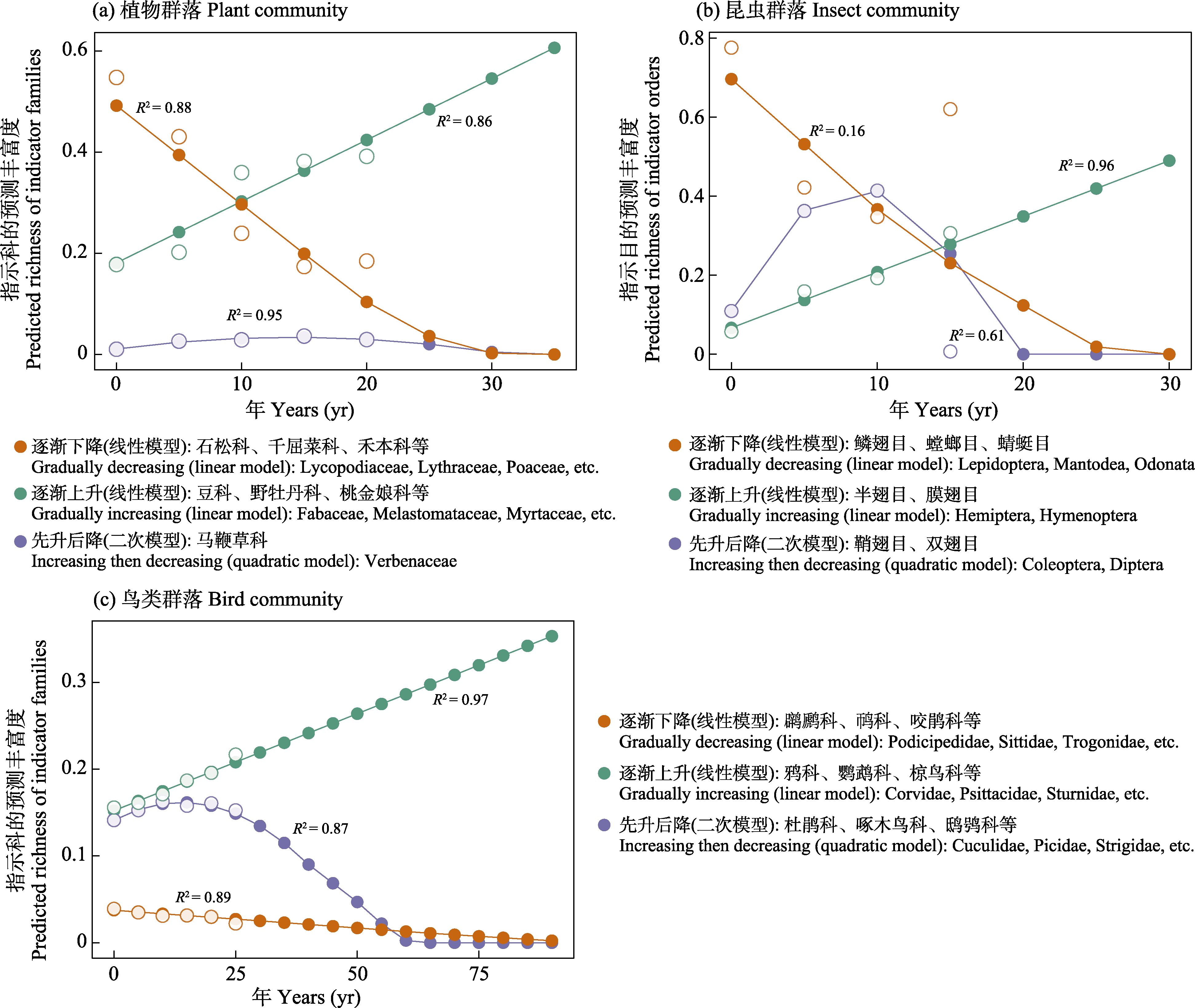
图3 环境簇1参照系中植物、昆虫和鸟类三大类群的演替趋势动态。图中空心圆点代表实际观测数据(由相同演替类群下各科/目的平均丰富度加和得出), 实心圆点及实线代表模型拟合与预测的演替趋势。图内标注了对应类群的最佳拟合模型类型以及总体拟合优度指标(R2)。R2为实际观测值与模型预测值之间Pearson相关系数的平方, 用于反映汇总预测趋势与实际观测波动的一致性。
Fig. 3 Successional dynamics of the three major taxa (plants, insects, and birds) within the reference framework of environmental cluster 1. Open circles represent observed data, calculated as the sum of the mean richness of all families/orders within the same successional group. Solid circles and solid lines represent model-fitted and predicted successional trends. The best-fitting model type and the overall goodness-of-fit statistic (R2) are shown in each panel. The R2 value is the square of the Pearson correlation coefficient between observed and predicted values and reflects the agreement between the aggregated predicted trend and the observed fluctuations.
| 生物类群 Taxonomic groups | 参照系总时长 Reference framework duration (yr) | 参照系关键年份及相对占比 Key years and relative proportions in the reference framework | A岛“逐渐上升”类群相对占比 Relative proportion of gradually increasing groups on Island A (%) | 判定阶段 Determined successional stage |
|---|---|---|---|---|
| 植物 Plants | 35 | 0年(0 yr): 26.5% 15年(15 yr): 60.9% 20年(20 yr): 76.0% 35年(35 yr): 100.0% | 72.7 | 约15-20年 About 15-20 yr |
| 昆虫 Insects | 30 | 0年(0 yr): 7.7% 10年(10 yr): 21.1% 15年(15 yr): 36.4% 30年(30 yr): 100.0% | 27.8 | 约10-15年 About 10-15 yr |
| 鸟类 Birds | 90 | 0年(0 yr): 46.1% 40年(40 yr): 68.6% 45年(45 yr): 74.2% 90年(90 yr): 100.0% | 71.4 | 约40-45年 About 40-45 yr |
表4 剔除非演替参照系物种后A岛三大生物类群演替阶段的验证结果
Table 4 Validation of successional stages of the three major taxonomic groups on Island A after excluding non-reference species
| 生物类群 Taxonomic groups | 参照系总时长 Reference framework duration (yr) | 参照系关键年份及相对占比 Key years and relative proportions in the reference framework | A岛“逐渐上升”类群相对占比 Relative proportion of gradually increasing groups on Island A (%) | 判定阶段 Determined successional stage |
|---|---|---|---|---|
| 植物 Plants | 35 | 0年(0 yr): 26.5% 15年(15 yr): 60.9% 20年(20 yr): 76.0% 35年(35 yr): 100.0% | 72.7 | 约15-20年 About 15-20 yr |
| 昆虫 Insects | 30 | 0年(0 yr): 7.7% 10年(10 yr): 21.1% 15年(15 yr): 36.4% 30年(30 yr): 100.0% | 27.8 | 约10-15年 About 10-15 yr |
| 鸟类 Birds | 90 | 0年(0 yr): 46.1% 40年(40 yr): 68.6% 45年(45 yr): 74.2% 90年(90 yr): 100.0% | 71.4 | 约40-45年 About 40-45 yr |
| [1] | Armanuos AM, Al-Ansari N, Yaseen ZM (2020) Cross assessment of twenty-one different methods for missing precipitation data estimation. Atmosphere, 11, 389. |
| [2] | Atkinson J, Brudvig LA, Mallen-Cooper M, Nakagawa S, Moles AT, Bonser SP (2022) Terrestrial ecosystem restoration increases biodiversity and reduces its variability, but not to reference levels: A global meta-analysis. Ecology Letters, 25, 1725-1737. |
| [3] | Burnham KP, Anderson DR (2002) Model Selection and Multimodel Inference: A Practical Information-theoretic Approach, 2nd edn. Springer, New York. |
| [4] | Chang CC, Turner BL (2019) Ecological succession in a changing world. Journal of Ecology, 107, 503-509. |
| [5] | Chen CW, Holyoak M, Wang YP, Si XF, Ding P (2019) Spatiotemporal distribution of seasonal bird assemblages on land-bridge islands: Linking dynamic and static views of metacommunities. Avian Research, 10, 25. |
| [6] | Comer PJ, Eckert GE, Gann GD (2025) Establishing reference models for ecological restoration: Case study from Colorado National Monument, USA. Land, 14, 1871. |
| [7] | Connell JH (1978) Diversity in tropical rain forests and coral reefs. Science, 199, 1302-1310. |
| [8] | de Lange PJ (2015) Recent vegetation succession and flora of Macauley Island, southern Kermadec Islands. Bulletin of the Auckland Museum, 20, 115-137. |
| [9] | Dini-Andreote F, Stegen JC, van Elsas JD, Salles JF (2015) Disentangling mechanisms that mediate the balance between stochastic and deterministic processes in microbial succession. Proceedings of the National Academy of Sciences, USA, 112, E1326-E1332. |
| [10] | Erwin RM, Allen DH, Jenkins D (2003) Created versus natural coastal islands: Atlantic waterbird populations, habitat choices, and management implications. Estuaries, 26, 949-955. |
| [11] | Ferretti A, Maggini I, Fusani L (2021) How to recover after sea crossing: The importance of small islands for passerines during spring migration. Ethology Ecology & Evolution, 33, 307-320. |
| [12] | Ferretti A, Maggini I, Lupi S, Cardinale M, Fusani L (2019) The amount of available food affects diurnal locomotor activity in migratory songbirds during stopover. Scientific Reports, 9, 19027. |
| [13] | Gann GD, McDonald T, Walder B, Aronson J, Nelson CR, Hallett JG, Guariguata MR, Gonzales EK, Hua F, Echeverría C, Eisenberg C, Liu J, Decleer K, Barr ZE, Bartholomew DC, Best M, Chazdon R, Cliquet A, Cortina-Segarra J, Kalirai H, MacCallum K, Mosyaftiani A, Pedrini S, Young R, Dixon KW (2026) International principles and standards for the practice of ecological restoration, third edition. Restoration Ecology, 34, e70441. |
| [14] | Griffiths ME, Orians CM (2004) Salt spray effects on forest succession in rare coastal sandplain heathlands: Evidence from field surveys and Pinus rigida transplant experiments. Journal of the Torrey Botanical Society, 131, 23-31. |
| [15] | Hartigan JA, Wong MA (1979) Algorithm AS 136: A k-means clustering algorithm. Journal of the Royal Statistical Society C: Applied Statistics, 28, 100-108. |
| [16] | Hubbell SP (2001) The Unified Neutral Theory of Biodiversity and Biogeography. Princeton University Press, Princeton. |
| [17] | James Reynolds S, Ibáñez-Álamo JD, Sumasgutner P, Mainwaring MC (2019) Urbanisation and nest building in birds: A review of threats and opportunities. Journal of Ornithology, 160, 841-860. |
| [18] | Jian SG, Ren H (2017) Atlas on Tool Species for Vegetation Restoration on Tropical Coral Islands. China Forestry Publishing House, Beijing. (in Chinese) |
| [简曙光, 任海 (2017) 热带珊瑚岛植被恢复工具种图谱. 中国林业出版社, 北京.] | |
| [19] | Josse J, Husson F (2016) missMDA: A package for handling missing values in multivariate data analysis. Journal of Statistical Software, 70, 1-31. |
| [20] | Kraft NJB, Adler PB, Godoy O, James EC, Fuller S, Levine JM (2015) Community assembly, coexistence and the environmental filtering metaphor. Functional Ecology, 29, 592-599. |
| [21] | Levey DR, Patten MA, Enríquez PL, Navarro-Sigüenza AG, Sonawane C, Dirzo R, MacGregor-Fors I, Daily GC (2025) Contrasting patterns of land use by resident and migratory bird assemblages in a tropical working landscape. Oikos, 2025, e11302. |
| [22] | Li J, Hughes AC, Dudgeon D (2019) Mapping wader biodiversity along the East Asian-Australasian flyway. PLoS ONE, 14, e0210552. |
| [23] | Li ZA (2021) Soil Properties and Improvement of Tropical Coral Islands in China. Guangdong Science & Technology Press, Guangzhou. (in Chinese) |
| [李志安 (2021) 中国热带珊瑚岛土壤性状与改良. 广东科技出版社, 广州.] | |
| [24] | MacArthur RH, Wilson EO (1967) The Theory of Island Biogeography. Princeton University Press, Princeton. |
| [25] | Maggini I, Trez M, Cardinale M, Fusani L (2020) Stopover dynamics of 12 passerine migrant species in a small Mediterranean island during spring migration. Journal of Ornithology, 161, 793-802. |
| [26] | Magnússon B, Magnússon SH, Ólafsson E, Sigurdsson BD (2014) Plant colonization, succession and ecosystem development on Surtsey with reference to neighbouring islands. Biogeosciences, 11, 5521-5537. |
| [27] | Mainwaring MC (2015) The use of man-made structures as nesting sites by birds: A review of the costs and benefits. Journal for Nature Conservation, 25, 17-22. |
| [28] | Nilsson S (2022) Twenty-two years of vegetation succession on the constructed Danish island Peberholm. Nordic Journal of Botany, 2022, e03721. |
| [29] | Odum EP (1969) The strategy of ecosystem development. Science, 164, 262-270. |
| [30] | Peng SL, Hou YP, Chen BM (2010) Establishment of Markov successional model and its application for forest restoration reference in southern China. Ecological Modelling, 221, 1317-1324. |
| [31] | Ren YJ, Lü YH, Fu BJ (2016) Quantifying the impacts of grassland restoration on biodiversity and ecosystem services in China: A meta-analysis. Ecological Engineering, 95, 542-550. |
| [32] | Rousseeuw PJ (1987) Silhouettes: A graphical aid to the interpretation and validation of cluster analysis. Journal of Computational and Applied Mathematics, 20, 53-65. |
| [33] | Russell JC, Kueffer C (2019) Island biodiversity in the Anthropocene. Annual Review of Environment and Resources, 44, 31-60. |
| [34] | Scarton F, Cecconi G, Cerasuolo C, Valle R (2013) The importance of dredge islands for breeding waterbirds: A three-year study in the Venice Lagoon (Italy). Ecological Engineering, 54, 39-48. |
| [35] | Shi ZY, Cao JT, Wang ZY, Zhang L, Niu SS, Wang WQ (2025) Revelation of native vegetation succession on tropical coral island ecological restoration. Ecosphere, 16, e70245. |
| [36] | Siddig AAH, Ellison AM, Ochs A, Villar-Leeman C, Lau MK (2016) How do ecologists select and use indicator species to monitor ecological change? Insights from 14 years of publication in Ecological Indicators. Ecological Indicators, 60, 223-230. |
| [37] | Silva CM, Pereira JAC, Gusmões JDSP, Mendes BEP, Valente H, Morgan AP, Goulart D, Hasui É (2020) Birds’ gap-crossing in open matrices depends on landscape structure, tree size, and predation risk. Perspectives in Ecology and Conservation, 18, 73-82. |
| [38] | Spatz DR, Young LC, Holmes ND, Jones HP, VanderWerf EA, Lyons DE, Kress S, Miskelly CM, Taylor GA (2023) Tracking the global application of conservation translocation and social attraction to reverse seabird declines. Proceedings of the National Academy of Sciences, USA, 120, e2214574120. |
| [39] | Stoddard JL, Larsen DP, Hawkins CP, Johnson RK, Norris RH (2006) Setting expectations for the ecological condition of streams: The concept of reference condition. Ecological Applications, 16, 1267-1276. |
| [40] | Stoddard MT, Roccaforte JP, Meador AJS, Huffman DW, Fulé PZ, Waltz AEM, Covington WW (2021) Ecological restoration guided by historical reference conditions can increase resilience to climate change of southwestern U.S. ponderosa pine forests. Forest Ecology and Management, 493, 119256. |
| [41] | Storlazzi CD, Gingerich SB, van Dongeren A, Cheriton OM, Swarzenski PW, Quataert E, Voss CI, Field DW, Annamalai H, Piniak GA, McCall R (2018) Most atolls will be uninhabitable by the mid-21st century because of sea-level rise exacerbating wave-driven flooding. Science Advances, 4, eaap9741. |
| [42] | Ulrich W, Zaplata MK, Winter S, Schaaf W, Fischer A, Soliveres S, Gotelli NJ (2016) Species interactions and random dispersal rather than habitat filtering drive community assembly during early plant succession. Oikos, 125, 698-707. |
| [43] | Vellend M (2010) Conceptual synthesis in community ecology. Quarterly Review of Biology, 85, 183-206. |
| [44] | Weiher E, Freund D, Bunton T, Stefanski A, Lee T, Bentivenga S (2011) Advances, challenges and a developing synthesis of ecological community assembly theory. Philosophical Transactions of the Royal Society B: Biological Sciences, 366, 2403-2413. |
| [45] | Whittaker RJ (2000) Scale, succession and complexity in island biogeography: Are we asking the right questions? Global Ecology and Biogeography, 9, 75-85. |
| [46] | Worthy SJ, Rubio VE, Staiger K, Ngouajio B, Yang J, Swenson NG (2021) Site-specific impacts of a major hurricane on alpha and beta diversity in tropical forest seedling communities. Ecosphere, 12, e03651. |
| [47] | Wu WJ, Wang J, Yan BY, Mou ZJ, Yuan Y, Li Y, Zhang J, Kuang LH, Cai HY, Tong FC, Jian SG, Lu HF, Ren H, Liu ZF (2024) Giant African snail invasion homogenizes seasonal soil biodiversity in tropical coral islands. Plant and Soil, 500, 571-585. |
| [48] | Yesson C, Brewer PW, Sutton T, Caithness N, Pahwa JS, Burgess M, Gray WA, White RJ, Jones AC, Bisby FA, Culham A (2007) How global is the Global Biodiversity Information Facility? PLoS ONE, 2, e1124. |
| [49] | Yin DY, Jian SG, Lu HF, Zhang QM, Ren H (2025) Primary saltmarsh succession on a tropical coral island in the South China Sea: Human influences initiate and accelerate the process of succession. Ecological Solutions and Evidence, 6, e70064. |
| [50] | Yong DL, Liu Y, Low BW, Española CP, Choi CY, Kawakami K (2015) Migratory songbirds in the East Asian-Australasian Flyway: A review from a conservation perspective. Bird Conservation International, 25, 1-37. |
| [51] | Zhang C, Jiao JH, Wang Z, Feng C, Zhang YC, Du YG (2020) Main chemical properties and microbial community structure of surface soil in coral reefs. Environmental Ecology, 2(6), 1-6. (in Chinese with English abstract) |
| [张琛, 焦建会, 王倬, 冯翠, 张毓宸, 杜昱光 (2020) 珊瑚岛屿表层土壤的主要化学性质和微生物群落结构研究. 环境生态学, 2(6), 1-6.] |
| [1] | 卢晓强, 杨万霞, 马月, 刘威, 徐徐, 刘立, 刘燕. 基于IPBES转型变革框架分析中国生物多样性治理路径[J]. 生物多样性, 2026, 34(8): 26131-. |
| [2] | 沈舟, 尹海伟, 孔繁花, 黄淑萍, 刘宏庆, 苏子康, 张杰辉. 代理种方法在城乡生态空间治理中的应用: 认知重构、路径嵌入与实施框架[J]. 生物多样性, 2026, 34(8): 26078-. |
| [3] | 张萌, 王彦平. Zeta多样性研究进展: 分析方法、保护应用及展望[J]. 生物多样性, 2026, 34(8): 26138-. |
| [4] | 朱晨超, 顾灵桢, 周梁宇, 闫淑君, 曾玉喧, 叶鹏. 城市公园入侵与非入侵植物访花昆虫多样性及网络差异[J]. 生物多样性, 2026, 34(8): 26115-. |
| [5] | 蔡妤, 张晓川, 连梦佳. 城市蜻蜓生境的生态胁迫、生境需求与恢复策略研究进展[J]. 生物多样性, 2026, 34(8): 26096-. |
| [6] | 李菡, 何兴成, 张尚明玉, 曹一唯, 张家语, 彭可欣, 吴永杰. 横断山区鸟类名录[J]. 生物多样性, 2026, 34(7): 25375-. |
| [7] | 黎明, 朱玉茹, 秦响玲, 李乔坤, 邢伟. 生物多样性投资的底层逻辑、体系架构与运营模式[J]. 生物多样性, 2026, 34(7): 26157-. |
| [8] | 巩中军, 李为争, 姚永生, 左旭琦, 武予清, 苗进. 农田土壤节肢动物eDNA在固-液-气三相中的分布特征[J]. 生物多样性, 2026, 34(7): 26146-. |
| [9] | 郑欢. 面向国土空间规划制度的生物多样性净增益设计逻辑与工具构建[J]. 生物多样性, 2026, 34(7): 25440-. |
| [10] | 张洁, 路昊明, 陈佳杰, 陈江源, 毛宇帆, 胡骏熙, 张保卫. 中国软骨鱼类拉-英-汉-日物种名录及各海域多样性比较[J]. 生物多样性, 2026, 34(6): 25522-. |
| [11] | 田瑜, 耿宜佳, 李俊生, 李明. 《昆明-蒙特利尔全球生物多样性框架》全球目标与执行尺度差异及解决路径[J]. 生物多样性, 2026, 34(6): 26086-. |
| [12] | 华方圆, 刘双祺, 彭杨靖, 龚善星, 申小莉, 金崑. 自然保护地和生态保护红线生物多样性与气候变化风险源的协同治理框架[J]. 生物多样性, 2026, 34(6): 25492-. |
| [13] | 李保平, 张展豪, 魏雅丹. 人工智能背景下中国履行《生物多样性公约》获取与惠益分享制度的挑战与优化路径[J]. 生物多样性, 2026, 34(6): 26073-. |
| [14] | 蔡莉, 葛丽萍, 彭丹晓, 胡海花, 陈之端, 牛艳婷. 未来气候变化情景下东亚-北美间断分布属植物潜在分布区比较[J]. 生物多样性, 2026, 34(6): 25478-. |
| [15] | 魏能, 周亚东, 张彩飞, 王生位, 胡光万, Geoffrey Mwachala, 王青锋. 《肯尼亚植物志》编研概况和阶段性成果[J]. 生物多样性, 2026, 34(5): 25423-. |
| 阅读次数 | ||||||
|
全文 |
|
|||||
|
摘要 |
|
|||||
备案号:京ICP备16067583号-7
Copyright © 2026 版权所有 《生物多样性》编辑部
地址: 北京香山南辛村20号, 邮编:100093
电话: 010-62836137, 62836665 E-mail: biodiversity@ibcas.ac.cn
