

生物多样性 ›› 2026, Vol. 34 ›› Issue (7): 25440. DOI: 10.17520/biods.2025440 cstr: 32101.14.biods.2025440
郑欢*( )(
 )
收稿日期:2025-11-05
接受日期:2026-06-16
出版日期:2026-07-20
发布日期:2026-09-21
通讯作者:
郑欢
Huan Zheng*()()
Received:2025-11-05
Accepted:2026-06-16
Online:2026-07-20
Published:2026-09-21
Contact:
Huan Zheng
摘要:
生物多样性净增益(biodiversity net gain, BNG)要求开发活动在避免、减缓和修复生态影响后, 实现相较开发前基线可测量的生物多样性净改善。本文借鉴英国强制BNG制度与美国湿地缓解银行在规划嵌入、量化核算和场外履约方面的经验, 重点考察BNG与我国国土空间规划制度的衔接。研究发现, “三区三线”、详细规划、用途管制、国有建设用地有偿使用及“一张图”实施监督信息系统, 为BNG提供了从目标分解、许可控制到履约监管的制度接口, 但仍面临技术标准缺失、法律授权不足、部门协同不畅和市场基础设施薄弱等障碍。据此, 本文提出构建以第三次全国国土调查数据为基础的“1+N”分级分类指标体系, 探索政府监管下的国土生境银行和增益权益登记机制, 将BNG义务嵌入规划编制审批、详细规划、用途转用、土地出让和环境影响评价等环节, 并依托“一张图”实施全周期监督。由此, BNG可转化为可量化、可履约、可追踪的国土空间规划约束。
郑欢 (2026) 面向国土空间规划制度的生物多样性净增益设计逻辑与工具构建. 生物多样性, 34, 25440. DOI: 10.17520/biods.2025440.
Huan Zheng (2026) The design logic and tool construction of the biodiversity net gain system under China’s territorial spatial planning framework. Biodiversity Science, 34, 25440. DOI: 10.17520/biods.2025440.
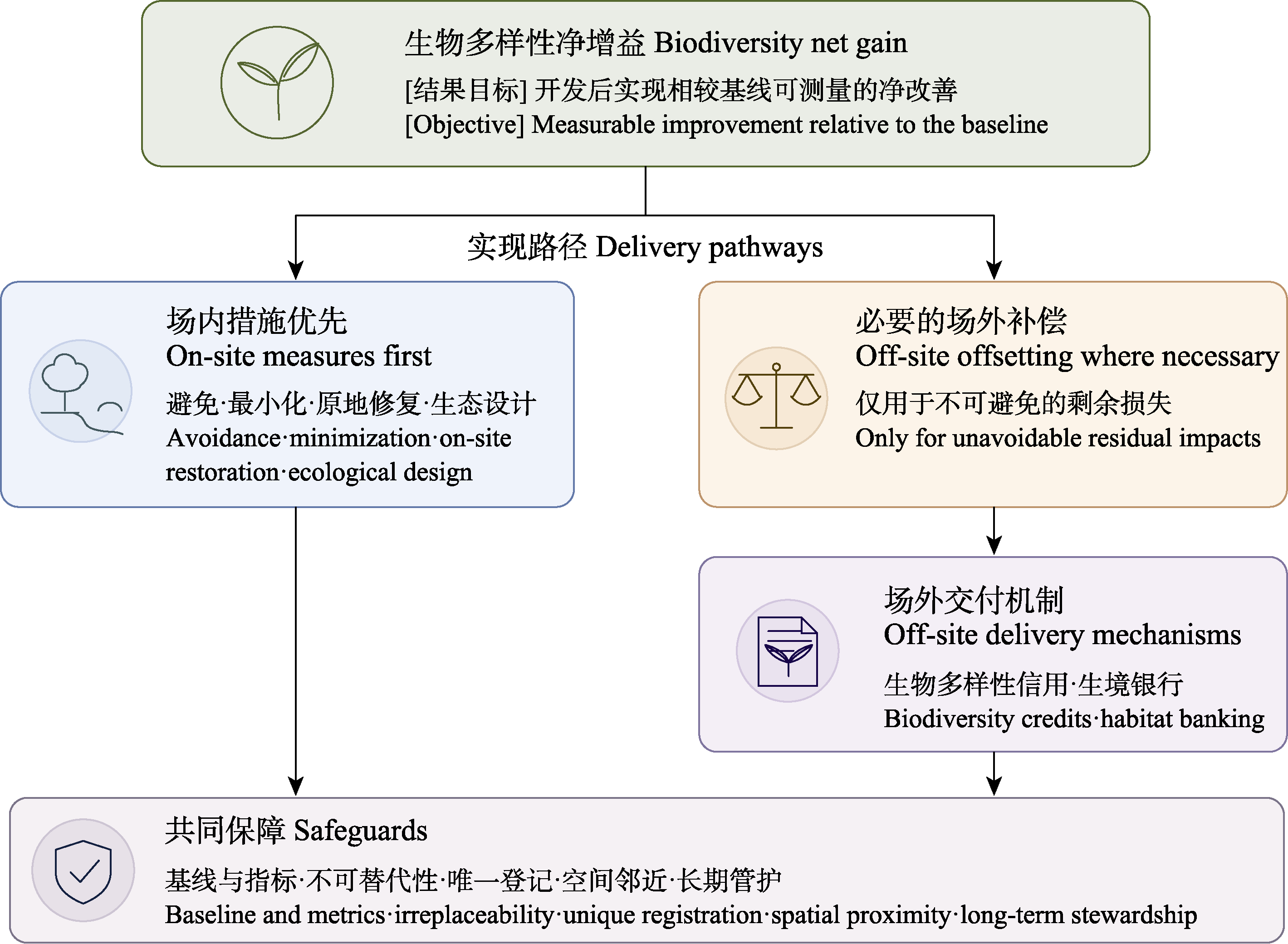
图1 生物多样性净增益的目标、实现路径与场外交付机制
Fig. 1 Objective, delivery pathways and off-site mechanisms of biodiversity net gain
| 比较对象 Comparison item | 美国湿地缓解银行 US wetland mitigation banking | 英国生境银行 UK habitat banking |
|---|---|---|
| 治理目标 Governance objectives | 无净损失: 以抵消湿地损失、维持生态基线为目标 No net loss: offsets wetland losses and maintains the ecological baseline | 净增益: 在抵消损失后要求额外、可测量的生物多样性改善Net gain: requires additional, measurable biodiversity improvement after losses are offset |
| 度量方法 Measurement method | 功能评估法: 侧重生态功能, 科学性较强, 但评估成 本较高 Functional assessment: function-oriented and scientifically robust, but relatively costly | 标准化生物多样性指标: 以生境面积、质量等为代理变量, 便于统一核算和执行 Standardized biodiversity metric: uses habitat area, condition, and related proxies to facilitate unified accounting and implementation |
| 责任转移机制 Responsibility transfer mechanism | 责任转移: 开发者购买合格信用后, 后续管护责任 主要由银行运营者承担 Liability transfer: after developers purchase eligible credits, the post-purchase management responsibility is mainly assumed by the bank operator | 长期义务与土地绑定: 通过规划义务或保育契约锁定长期管护责任 Long-term land-based obligation: long-term management is secured through planning obligations or conservation covenants |
表1 英美市场化生态补偿机制对比
Table 1 Comparison of market-based ecological compensation mechanisms between the UK and the US
| 比较对象 Comparison item | 美国湿地缓解银行 US wetland mitigation banking | 英国生境银行 UK habitat banking |
|---|---|---|
| 治理目标 Governance objectives | 无净损失: 以抵消湿地损失、维持生态基线为目标 No net loss: offsets wetland losses and maintains the ecological baseline | 净增益: 在抵消损失后要求额外、可测量的生物多样性改善Net gain: requires additional, measurable biodiversity improvement after losses are offset |
| 度量方法 Measurement method | 功能评估法: 侧重生态功能, 科学性较强, 但评估成 本较高 Functional assessment: function-oriented and scientifically robust, but relatively costly | 标准化生物多样性指标: 以生境面积、质量等为代理变量, 便于统一核算和执行 Standardized biodiversity metric: uses habitat area, condition, and related proxies to facilitate unified accounting and implementation |
| 责任转移机制 Responsibility transfer mechanism | 责任转移: 开发者购买合格信用后, 后续管护责任 主要由银行运营者承担 Liability transfer: after developers purchase eligible credits, the post-purchase management responsibility is mainly assumed by the bank operator | 长期义务与土地绑定: 通过规划义务或保育契约锁定长期管护责任 Long-term land-based obligation: long-term management is secured through planning obligations or conservation covenants |
| 国土空间规划工具 Territorial spatial planning tool | 现行制度功能 Current function | BNG嵌入接口 BNG interface |
|---|---|---|
| “三区三线” Three Zones and Three Lines | 划定生态保护红线、永久基本农田保护红线、城镇开发边界, 确立空间管控底线 Delineate the ecological protection redline, the permanent basic farmland protection redline, and the urban development boundary, establishing the bottom line of spatial control | 红线为不可替代生态资产; 城镇开发边界内的开发活动触发BNG义务; 红线外、边界外区域作为高质量生境信用的供给区 Redlines are designated as non-substitutable ecological assets; development activities within the urban development boundary trigger BNG obligations; areas outside the redlines and beyond the urban development boundary serve as supply zones for high-quality habitat credits |
| 详细规划 Detailed regulatory plan | 在控制性详细规划中确定地块开发的强度、用途及配套要求, 是核发建设用地规划许可的依据 Determine the development intensity, land use, and supporting requirements of plots in regulatory detailed plans, serving as the basis for issuing construction land planning permits | 将BNG指标作为地块控规的约束性指标, 与容积率、绿地率等并列, 从源头嵌入开发约束 Incorporate BNG indicators as binding indicators of plot-level regulatory plans, on par with floor area ratio and green space ratio, embedding development constraints at the source |
| 用途管制 Land use control | 通过分区准入清单、用途转用许可与生态保护修复制度, 实现全域全要素管控 Achieve full-domain and full-element control through zoning admission lists, land-use conversion permits, and the ecological protection and restoration system | 将BNG交付义务纳入用途转用审批条件; 生态修复纳入“国土空间生态修复”的统一框架 Incorporate BNG delivery obligations into the approval conditions for land-use conversion; integrate ecological restoration into the unified framework of “territorial spatial ecological restoration” |
| 国有建设用地 有偿使用 Paid use of state-owned construction land | 通过土地出让合同明确受让人的开发义务与履约责任 Specify the development obligations and performance responsibilities of the transferee through land transfer contracts | 将BNG义务作为出让合同的强制性条款, 未履行者按违约处理, 必要时收回土地使用权 Stipulate BNG obligations as mandatory clauses in transfer contracts, treat non-compliance as a breach of contract and, where necessary, revoke the land-use right |
| “一张图”实施监督 信息系统 “One Map” supervision information system | 整合多源国土空间数据, 实现规划实施的动态 监测与监督 Integrate multi-source territorial spatial data to achieve dynamic monitoring and supervision of plan implementation | 作为BNG信用登记、交易追溯与履约监管的数字化基础设施 Serve as the digital infrastructure for BNG credit registration, transaction traceability, and compliance supervision |
表2 生物多样性净增益(BNG)与我国国土空间规划核心工具的衔接接口
Table 2 Interfaces between biodiversity net gain (BNG) and core tools of China’s territorial spatial planning system
| 国土空间规划工具 Territorial spatial planning tool | 现行制度功能 Current function | BNG嵌入接口 BNG interface |
|---|---|---|
| “三区三线” Three Zones and Three Lines | 划定生态保护红线、永久基本农田保护红线、城镇开发边界, 确立空间管控底线 Delineate the ecological protection redline, the permanent basic farmland protection redline, and the urban development boundary, establishing the bottom line of spatial control | 红线为不可替代生态资产; 城镇开发边界内的开发活动触发BNG义务; 红线外、边界外区域作为高质量生境信用的供给区 Redlines are designated as non-substitutable ecological assets; development activities within the urban development boundary trigger BNG obligations; areas outside the redlines and beyond the urban development boundary serve as supply zones for high-quality habitat credits |
| 详细规划 Detailed regulatory plan | 在控制性详细规划中确定地块开发的强度、用途及配套要求, 是核发建设用地规划许可的依据 Determine the development intensity, land use, and supporting requirements of plots in regulatory detailed plans, serving as the basis for issuing construction land planning permits | 将BNG指标作为地块控规的约束性指标, 与容积率、绿地率等并列, 从源头嵌入开发约束 Incorporate BNG indicators as binding indicators of plot-level regulatory plans, on par with floor area ratio and green space ratio, embedding development constraints at the source |
| 用途管制 Land use control | 通过分区准入清单、用途转用许可与生态保护修复制度, 实现全域全要素管控 Achieve full-domain and full-element control through zoning admission lists, land-use conversion permits, and the ecological protection and restoration system | 将BNG交付义务纳入用途转用审批条件; 生态修复纳入“国土空间生态修复”的统一框架 Incorporate BNG delivery obligations into the approval conditions for land-use conversion; integrate ecological restoration into the unified framework of “territorial spatial ecological restoration” |
| 国有建设用地 有偿使用 Paid use of state-owned construction land | 通过土地出让合同明确受让人的开发义务与履约责任 Specify the development obligations and performance responsibilities of the transferee through land transfer contracts | 将BNG义务作为出让合同的强制性条款, 未履行者按违约处理, 必要时收回土地使用权 Stipulate BNG obligations as mandatory clauses in transfer contracts, treat non-compliance as a breach of contract and, where necessary, revoke the land-use right |
| “一张图”实施监督 信息系统 “One Map” supervision information system | 整合多源国土空间数据, 实现规划实施的动态 监测与监督 Integrate multi-source territorial spatial data to achieve dynamic monitoring and supervision of plan implementation | 作为BNG信用登记、交易追溯与履约监管的数字化基础设施 Serve as the digital infrastructure for BNG credit registration, transaction traceability, and compliance supervision |
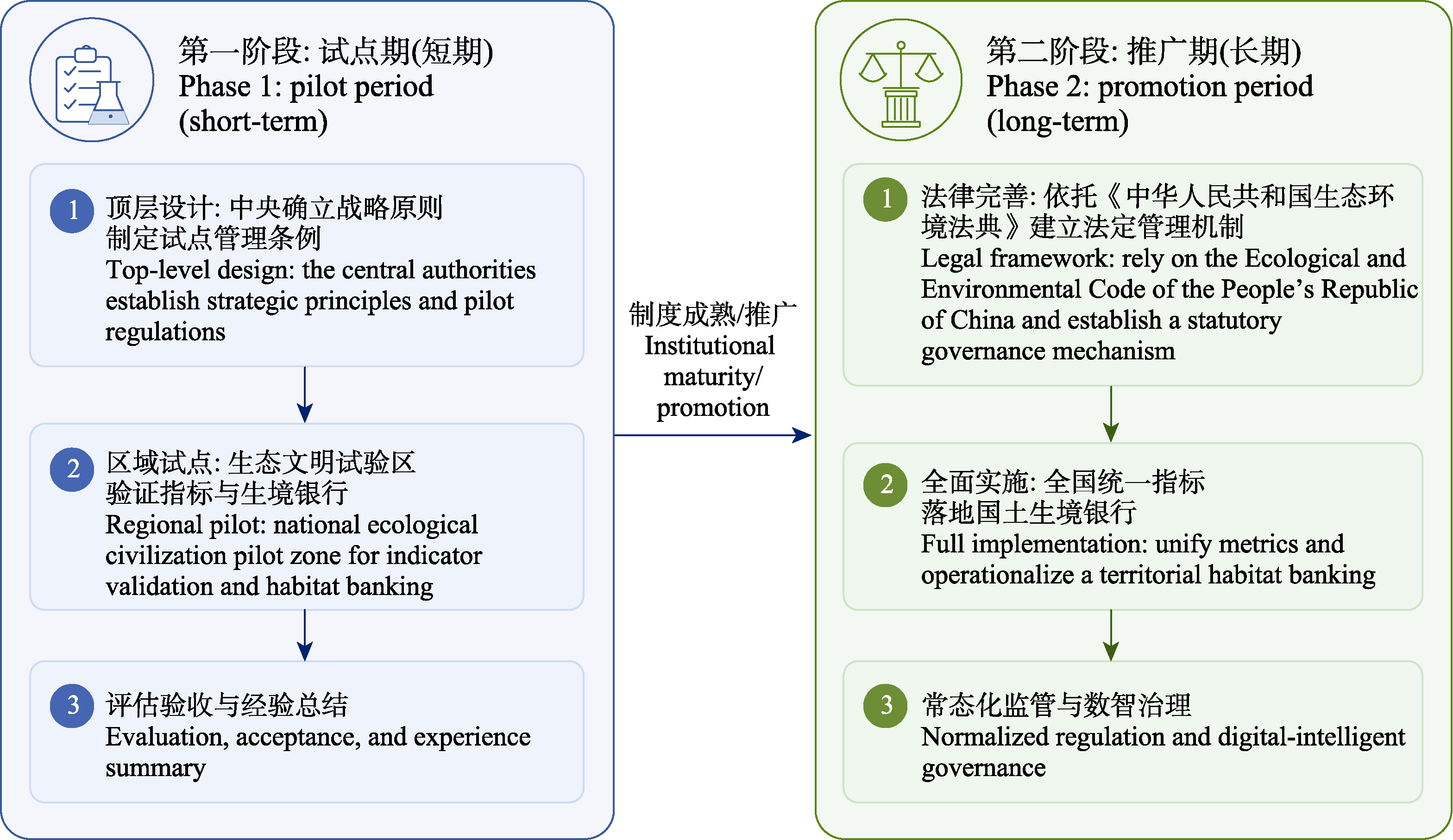
图2 我国生物多样性净增益(BNG)制度分步实施路径
Fig. 2 Step-by-step implementation path of China’s biodiversity net gain (BNG) system
| [1] | BBOP (Business and Biodiversity Offsets Programme)(2013) To No Net Loss and Beyond: An Overview of the Business and Biodiversity Offsets Programme. Forest Trends, Washington, DC. |
| [2] | Bekessy SA, Wintle BA, Lindenmayer DB, McCarthy MA, Colyvan M, Burgman MA, Possingham HP (2010) The biodiversity bank cannot be a lending bank. Conservation Letters, 3, 151-158. |
| [3] |
Bull JW, Brownlie S (2017) The transition from no net loss to a net gain of biodiversity is far from trivial. Oryx, 51, 53-59.
DOI URL |
| [4] | Cui QX, Wei CK, He C (2025) Construction of ecological product value realization mechanism from the perspective of the “Two Mountains” concept. Environmental Protection, 53(Z2), 59-64. (in Chinese) |
| [崔权雪, 魏陈凯, 贺超 (2025) “两山”理念视域下生态产品价值实现机制建构. 环境保护, 53(Z2), 59-64.] | |
| [5] | DEFRA (Department for Environment, Food & Rural Affairs) (2024) The Statutory Biodiversity Metric: User Guide. DEFRA, London. |
| [6] | DEFRA (Department for Environment, Food & Rural Affairs) (2025) Improving the Implementation of Biodiversity Net Gain for Minor, Medium and Brownfield Development. DEFRA, London. |
| [7] | Hao CX, Zhao YH, Zhou Q, Qu AY, Han C (2024) Research on the status quo, problems and optimization path of marketized and diversified ecological protection compensation mechanism. Environmental Protection, 52(5), 38-42. (in Chinese) |
| [郝春旭, 赵元浩, 周全, 璩爱玉, 韩聪 (2024) 市场化、多元化生态保护补偿机制现状、问题与优化路径研究. 环境保护, 52(5), 38-42.] | |
| [8] | IPBES (Intergovernmental Science-Policy Platform on Biodiversity and Ecosystem Services) (2019) Global Assessment Report on Biodiversity and Ecosystem Services of the Intergovernmental Science-Policy Platform on Biodiversity and Ecosystem Services. PBES Secretariat, Bonn. |
| [9] | Li XF, Chai LY, Guo MC (2024) Application of ecological compensation mechanism in environmental impact assessment. Heilongjiang Environmental Journal, 37(9), 93-95. (in Chinese with English abstract) |
| [李晓芬, 柴璐艳, 过美超 (2024) 生态补偿机制在环境影响评价中的应用. 黑龙江环境通报, 37(9), 93-95.] | |
| [10] | Liu R (2022) Study on the introduction of environmental impact assessment into ecological compensation mechanism. Heilongjiang Science, 13(14), 118-119. (in Chinese with English abstract) |
| [刘冉 (2022) 环境影响评价中引入生态补偿机制研究. 黑龙江科学, 13(14), 118-119.] | |
| [11] | Lü ZM (2021) On Ecological Civilization Rule of Law Theory of Xi Jinping Thought on the Rule of Law. China Legal Science, (1), 48-64. (in Chinese with English abstract) |
| [吕忠梅 (2021) 习近平法治思想的生态文明法治理论. 中国法学, (1), 48-64.] | |
| [12] |
Maron M, Brownlie S, Bull JW, Evans MC, von Hase A, Quétier F, Watson JEM, Gordon A (2018) The many meanings of no net loss in environmental policy. Nature Sustainability, 1, 19-27.
DOI |
| [13] | Miao MY, Zhao SC, Pan WL, Zhang R, Gu Q (2026) Thoughts on value transformation and compensation mechanism of ecological products of soil and water conservation in Henan Province. Soil and Water Conservation in China, (2), 20-23, 54. (in Chinese) |
| [苗梦媛, 赵胜朝, 潘文玲, 张茹, 谷启 (2026) 河南省水土保持生态产品价值转化及补偿机制思考. 中国水土保持, (2), 20-23, 54.] | |
| [14] | OECD (Organisation for Economic Co-operation and Development) (2016) Biodiversity Offsets: Effective Design and Implementation. OECD Publishing, Paris. |
| [15] | Qiu J, Xu XJ, Lin NF, Zhang K, Zou CX (2025) The policy evolution, problems and optimization pathways of China’s ecological conservation redline policy. Environmental Impact Assessment, 47(4), 38-44. (in Chinese with English abstract) |
| [仇洁, 许小娟, 林乃峰, 张琨, 邹长新 (2025) 我国生态保护红线制度政策历程、存在问题与优化路径. 环境影响评价, 47(4), 38-44.] | |
| [16] |
Quétier F, Lavorel S (2011) Assessing ecological equivalence in biodiversity offset schemes: Key issues and solutions. Biological Conservation, 144, 2991-2999.
DOI URL |
| [17] | Quétier F, Regnery B, Levrel H (2014) No net loss of biodiversity or paper offsets? A critical review of the French no net loss policy. Environmental Science & Policy, 38, 120-131. |
| [18] |
Salzman J, Ruhl JB (2000) Currencies and the commodification of environmental law. Stanford Law Review, 53, 607-694.
DOI URL |
| [19] |
Simmonds JS, Sonter LJ, Watson JEM, Bennun L, Costa HM, Dutson G, Edwards S, Grantham H, Griffiths VF, Jones JPG, Kiesecker J, Possingham HP, Puydarrieux P, Quétier F, Rainer H, Rainey H, Roe D, Savy CE, Souquet M, ten Kate K, Victurine R, von Hase A, Maron M,(2020) Moving from biodiversity offsets to a target-based approach for ecological compensation. Conservation Letters, 13, e12695.
DOI URL |
| [20] |
Spash CL (2015) Bulldozing biodiversity: The economics of offsets and trading-in nature. Biological Conservation, 192, 541-551.
DOI URL |
| [21] | UK Government (2021) Environment Act 2021. The Stationery Office, London. |
| [22] | Wauchope HS zu Ermgassen SOSE, Jones JPG, Carter H, Schulte to Bühne H, Milner-Gulland EJ (2024) What is a unit of nature? Measurement challenges in the emerging biodiversity credit market. Proceedings of the Royal Society B: Biological Sciences, 291, 20242353. |
| [23] | World Economic Forum (2024) Biodiversity Credits: Demystifying Metrics for Nature Markets. World Economic Forum, Geneva. |
| [24] | Zhang HW, Wan J, Qin CB, Yu L, Niu R, Zhang PP, Yang LY (2024) Suggestions on strengthening the linkage between ecological & environmental zoning-based regulation and territorial spatial planning. Chinese Journal of Environmental Management, 16(6), 24-31. (in Chinese with English abstract) |
| [张瀚文, 万军, 秦昌波, 于雷, 牛韧, 张培培, 杨丽阎 (2024) 加强生态环境分区管控与国土空间规划衔接的建议. 中国环境管理, 16(6), 24-31.] | |
| [25] |
zu Ermgassen SOSE, Marsh S, Ryland K, Church E, Marsh R, Bull JW (2021) Exploring the ecological outcomes of mandatory biodiversity net gain using evidence from early-adopter jurisdictions in England. Conservation Letters, 14, e12820.
DOI URL |
| [1] | 沈舟, 尹海伟, 孔繁花, 黄淑萍, 刘宏庆, 苏子康, 张杰辉. 代理种方法在城乡生态空间治理中的应用: 认知重构、路径嵌入与实施框架[J]. 生物多样性, 2026, 34(8): 26078-. |
| [2] | 彭昀月, 彭奎, 刘昕然, 孙天怡, 张小全. 生物多样性信用的企业参与途径、市场发展障碍与建议[J]. 生物多样性, 2026, 34(4): 26031-. |
| [3] | 侯姝彧, 刘盈盈, 杨锐. 《昆蒙框架》背景下国际OECMs体系构建实践进展及中国化思路[J]. 生物多样性, 2026, 34(3): 25264-. |
| [4] | 苏红巧, 余得光, 牟昆仑. 国家公园与国土空间规划和用途管制制度衔接路径探讨[J]. 生物多样性, 2025, 33(3): 24570-. |
| [5] | 杨锐, 侯姝彧, 张引, 赵智聪. 论建立中国自然保护兼用地的必要性和可行性[J]. 生物多样性, 2024, 32(4): 23454-. |
| [6] | 张书杰, 庄优波. 管控视角下生态空间与生态保护红线关系研究[J]. 生物多样性, 2022, 30(4): 21441-. |
| [7] | 李锋, 成超男, 杨锐. 生态系统修复国内外研究进展与展望[J]. 生物多样性, 2022, 30(10): 22519-. |
| [8] | 唐小平. 国家公园规划制度功能定位与空间属性[J]. 生物多样性, 2020, 28(10): 1246-1254. |
| [9] | 杨锐,彭钦一,曹越,钟乐,侯姝彧,赵智聪,黄澄. 中国生物多样性保护的变革性转变及路径[J]. 生物多样性, 2019, 27(9): 1032-1040. |
| 阅读次数 | ||||||
|
全文 |
|
|||||
|
摘要 |
|
|||||
备案号:京ICP备16067583号-7
Copyright © 2026 版权所有 《生物多样性》编辑部
地址: 北京香山南辛村20号, 邮编:100093
电话: 010-62836137, 62836665 E-mail: biodiversity@ibcas.ac.cn
