

生物多样性 ›› 2025, Vol. 33 ›› Issue (12): 25169. DOI: 10.17520/biods.2025169 cstr: 32101.14.biods.2025169
陈长樵1, 冯艳飞1, 卢力奇1, 何怀江2, 张春雨1( ), 赵秀海1(), 郝珉辉1,*()(
 )
)
收稿日期:2025-05-07
接受日期:2025-08-10
出版日期:2025-12-20
发布日期:2026-01-09
通讯作者:
*E-mail: haomh@bjfu.edu.cn
基金资助:
Changqiao Chen1, Yanfei Feng1, Liqi Lu1, Huaijiang He2, Chunyu Zhang1(), Xiuhai Zhao1(), Minhui Hao1,*()()
Received:2025-05-07
Accepted:2025-08-10
Online:2025-12-20
Published:2026-01-09
Supported by:摘要:
β多样性是生物多样性的一个重要维度, 反映了物种组成在时间和空间上的变化。探讨β多样性的分布格局及其背后的生态学过程, 有助于揭示生物多样性的形成和维持机制, 为生物多样性保护提供指导。β多样性可以划分为不同组分, 但目前温带针阔混交林中不同组分对β多样性的贡献及其驱动机制并不清楚。本研究基于吉林蛟河针阔混交林30 ha动态监测样地的植被调查数据, 利用Jaccard指数和Sørenson指数量化群落β多样性, 通过Podani分解方法将群落β多样性分解为物种替换和丰富度差异两种组分, 检验其对群落β多样性的贡献; 同时利用样方-物种多度矩阵的总方差量化β多样性, 并将其划分为不同物种对β多样性的贡献(species contribution to β diversity, SCBD)和不同样方对β多样性的贡献(local contribution to β diversity, LCBD)。通过线性回归和二次项回归分析分别检验SCBD与物种频度、LCBD与物种丰富度的关系; 最后, 结合环境和空间数据, 采用变差分解检验环境过滤和扩散限制两种生态过程对森林生态特异性的影响。结果表明: (1)吉林蛟河针阔混交林的β多样性主要由物种替换导致, 而丰富度差异的贡献相对较小; (2) SCBD与物种频度显著相关, 随着频度的增加呈现先上升后下降的趋势, 其中对森林β多样性贡献最高的物种是千金榆(Carpinus cordata), 贡献最低的物种是毛山楂(Crataegus maximowiczii); (3) LCBD与物种丰富度显著相关, 随着物种丰富度的升高呈现先下降后上升的趋势; (4)森林生态特异性由环境过滤和扩散限制共同驱动, 但扩散限制的影响更大。本研究揭示了吉林蛟河针阔混交林β多样性及其不同组分的空间分布特征与生态驱动机制, 研究结果有助于促进对温带森林β多样性形成机制的理解, 同时能够为东北地区次生林的生态修复和生物多样性保护提供科学依据。
陈长樵, 冯艳飞, 卢力奇, 何怀江, 张春雨, 赵秀海, 郝珉辉 (2025) 吉林蛟河针阔混交林β多样性格局及其形成机制. 生物多样性, 33, 25169. DOI: 10.17520/biods.2025169.
Changqiao Chen, Yanfei Feng, Liqi Lu, Huaijiang He, Chunyu Zhang, Xiuhai Zhao, Minhui Hao (2025) β-diversity pattern and mechanism in a conifer-broadleaf mixed forest in Jiaohe, Jilin Province. Biodiversity Science, 33, 25169. DOI: 10.17520/biods.2025169.
| 相异性 Dissimilarity | 物种替换 Species replacement | 丰富度差异 Richness difference | |
|---|---|---|---|
| Jaccard指数 Jaccard index | |||
| Sørenson指数 Sørenson index |
表1 基于Jaccard指数与Sørenson指数的β多样性计算公式(Podani和Schmera, 2011)
Table 1 Formulas for β diversity based on the Jaccard index and Sørenson index (Podani & Schmera, 2011)
| 相异性 Dissimilarity | 物种替换 Species replacement | 丰富度差异 Richness difference | |
|---|---|---|---|
| Jaccard指数 Jaccard index | |||
| Sørenson指数 Sørenson index |
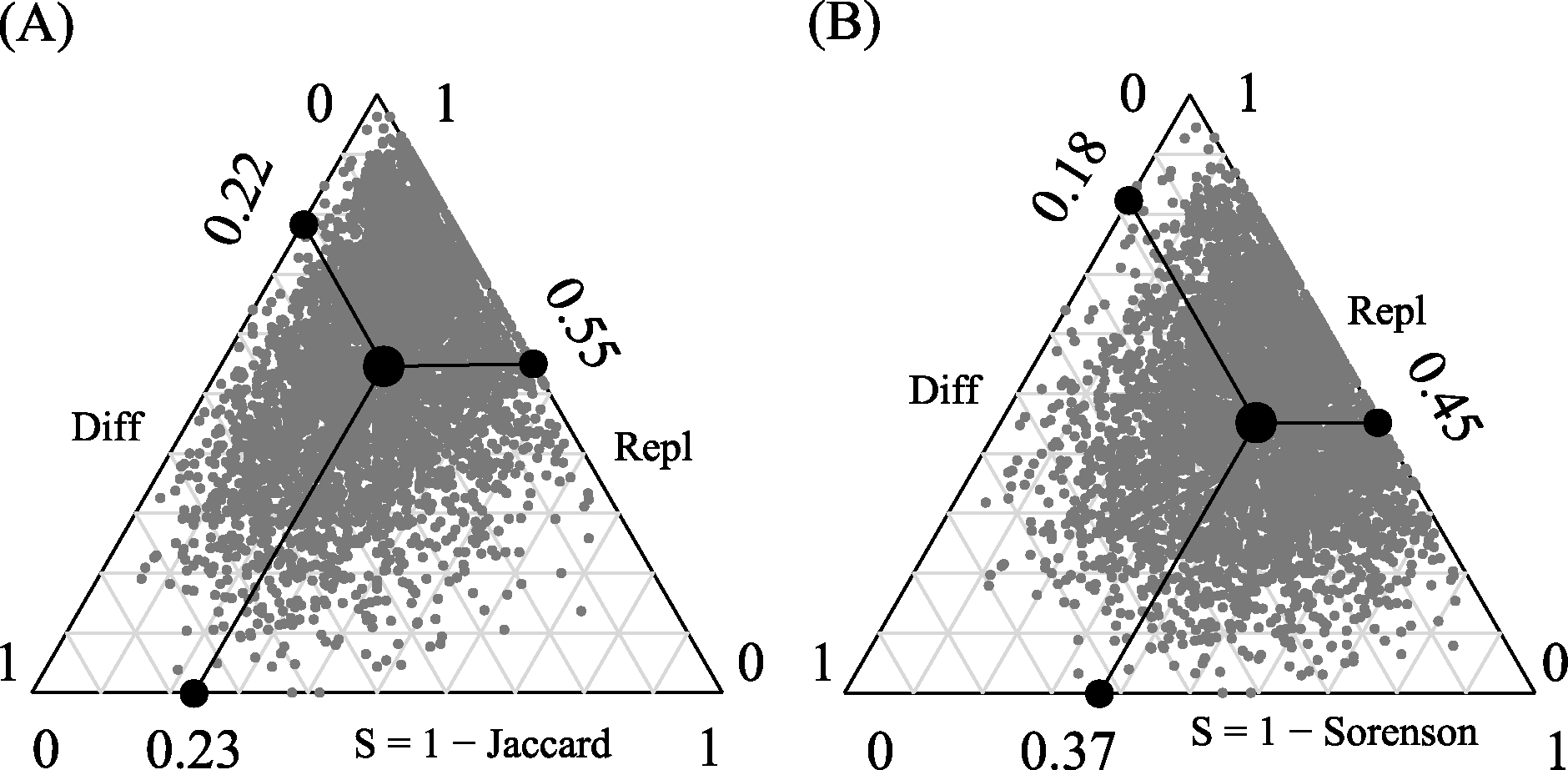
图1 丰富度差异(Diff)、物种替换(Repl)和相似性指数(S)的三元图。(A)基于Jaccard指数的β多样性; (B)基于Sørenson指数的β多样性。三元图内每一个灰点表示一个样方对, 黑点表示灰点的质心。
Fig. 1 Triangular plots of the species richness difference (Diff), species replacement (Repl), and similarity index (S). (A) β diversity based on Jaccard index; (B) β diversity based on Sørenson index. Each grey dot represents a pair of forest plots, and the black dots represent the centroid of these grey dots.
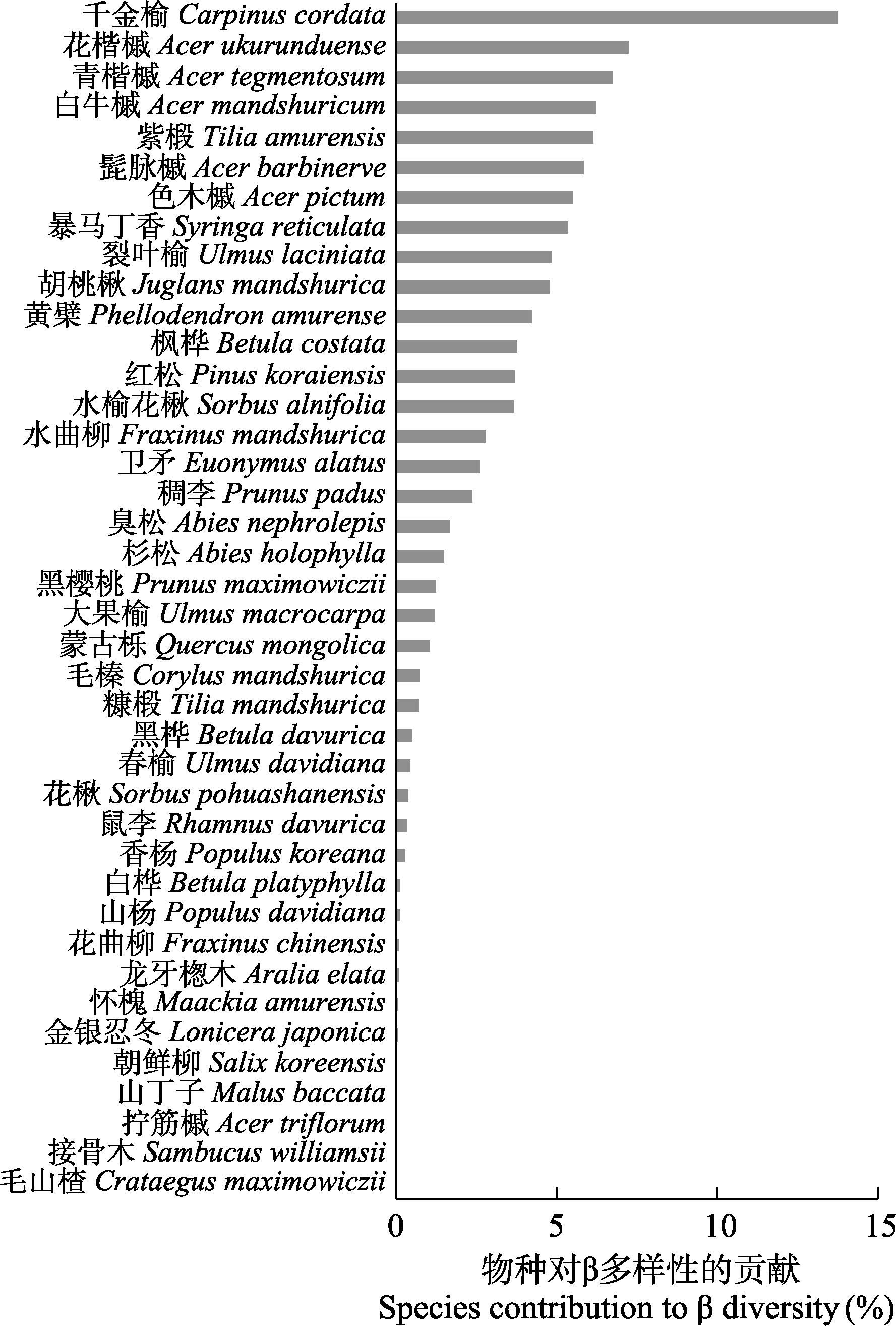
图2 吉林蛟河针阔混交林不同物种对β多样性的贡献(SCBD)
Fig. 2 Species contribution to β diversity (SCBD) in a conifer-broadleaf mixed forest in Jiaohe, Jilin
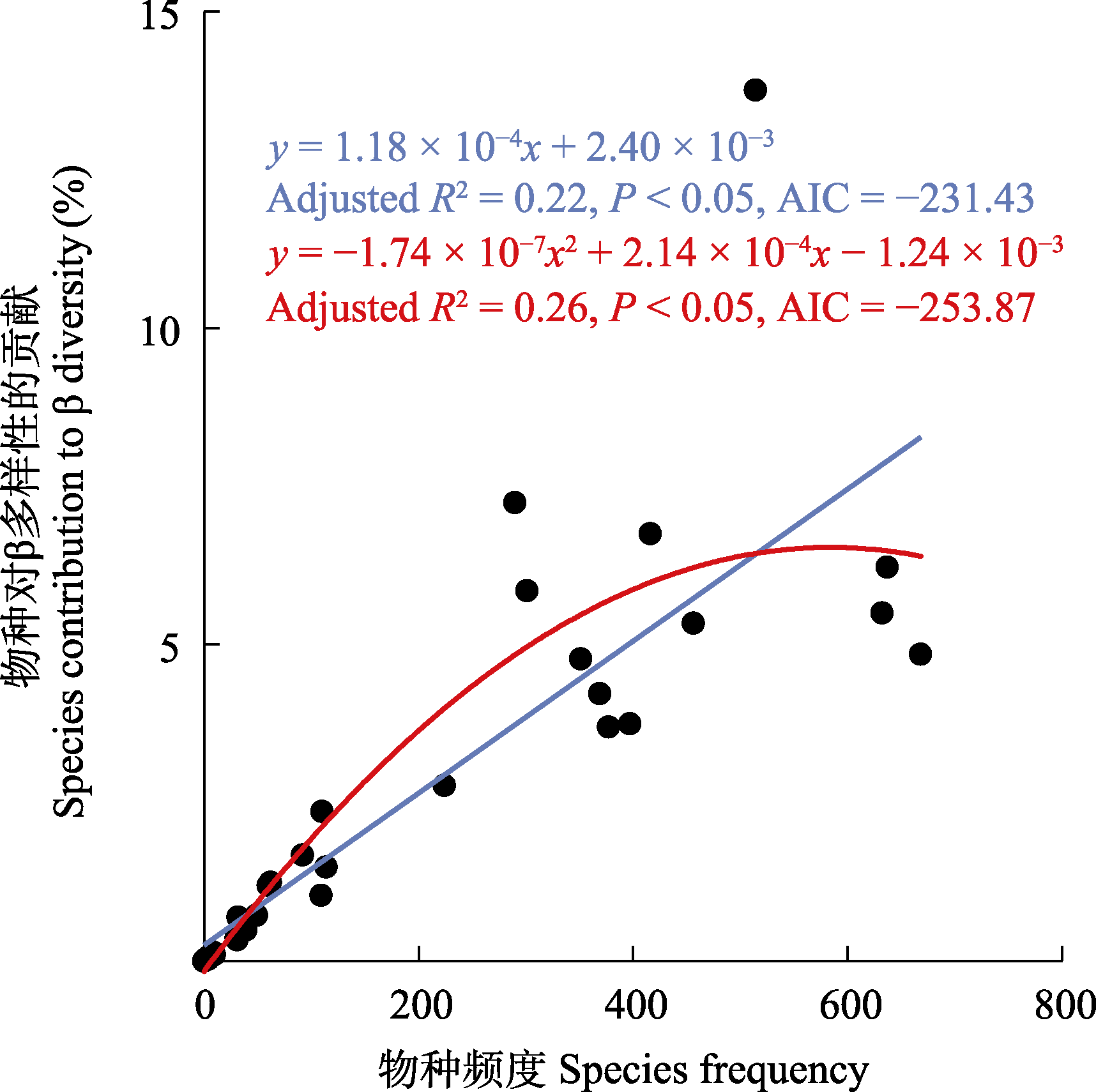
图3 物种频度与物种对β多样性的贡献(SCBD)线性(蓝色)和二次项(红色)回归模型
Fig. 3 Linear (blue) and quadratic (red) regression models depicting the relationships between species frequency and species contribution to β diversity (SCBD)
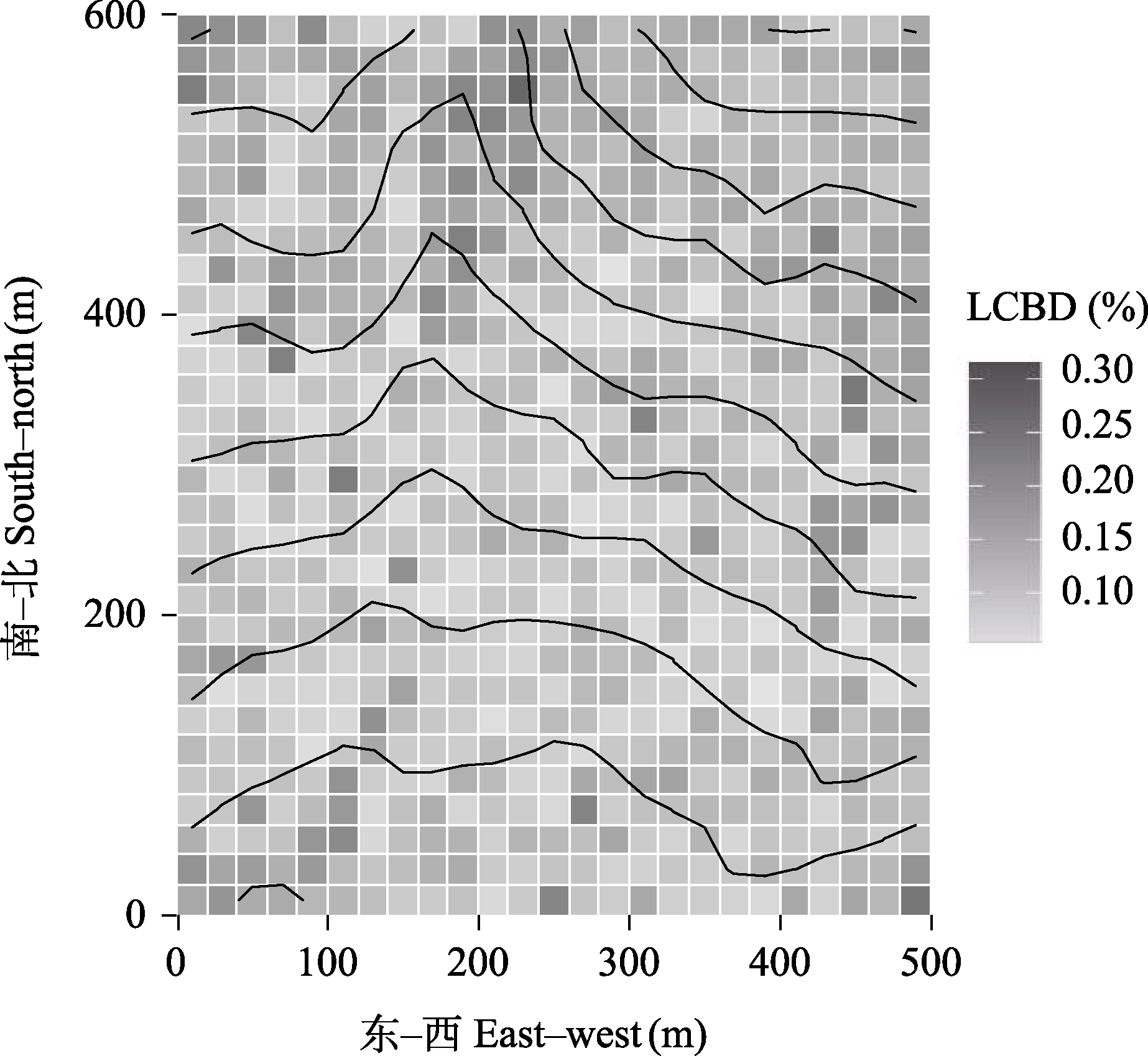
图4 吉林蛟河针阔混交林不同样方对β多样性的贡献(LCBD)
Fig. 4 Map of the forest plots showing the local contributions to β diversity (LCBD) in a conifer-broadleaf mixed forest in Jiaohe, Jilin
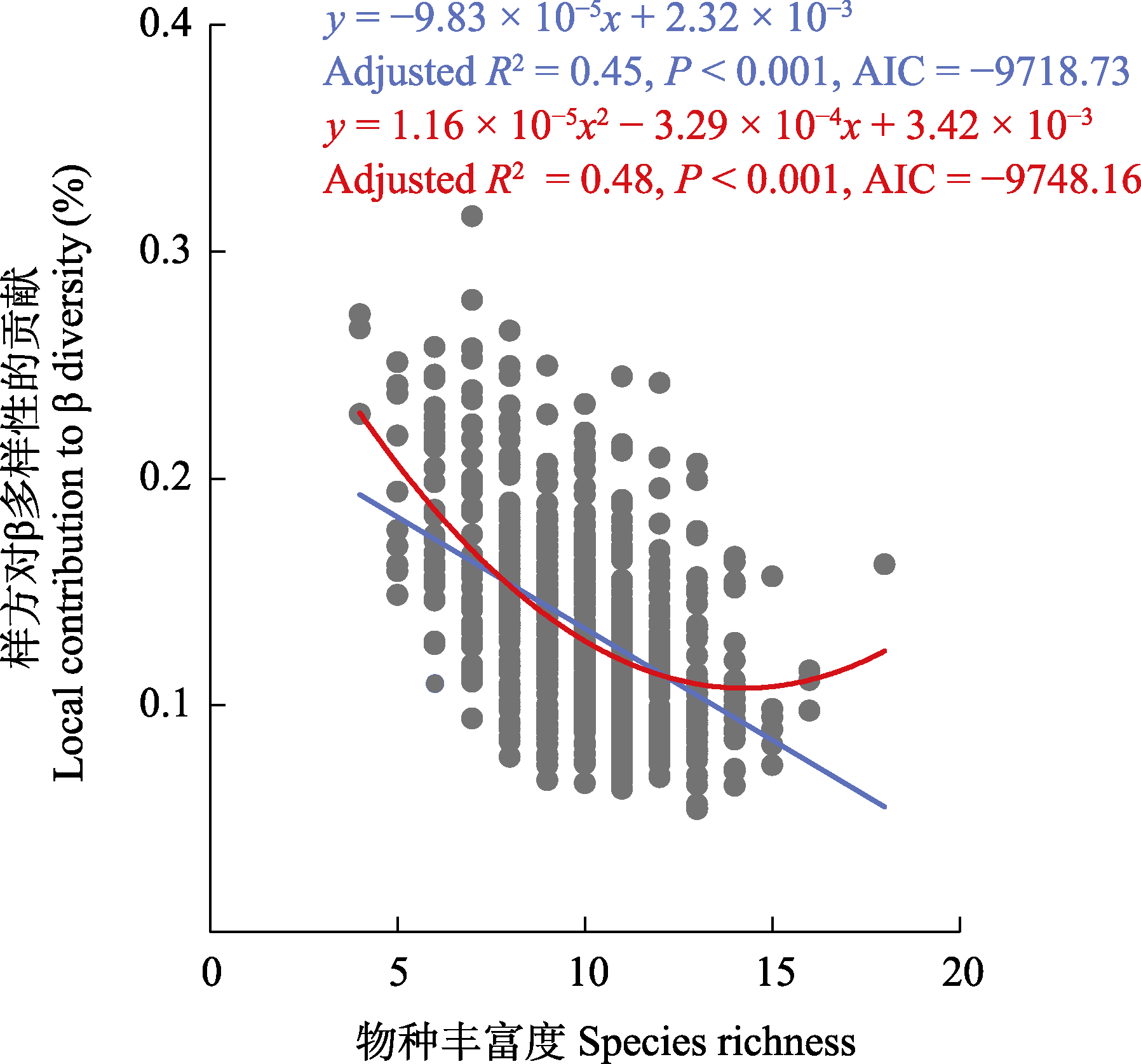
图5 物种丰富度与样方对β多样性的贡献(LCBD)线性(蓝色)和二次项(红色)回归模型
Fig. 5 Linear (blue) and quadratic (red) regression models depicting the relationships between species richness and local contribution to β diversity (LCBD)
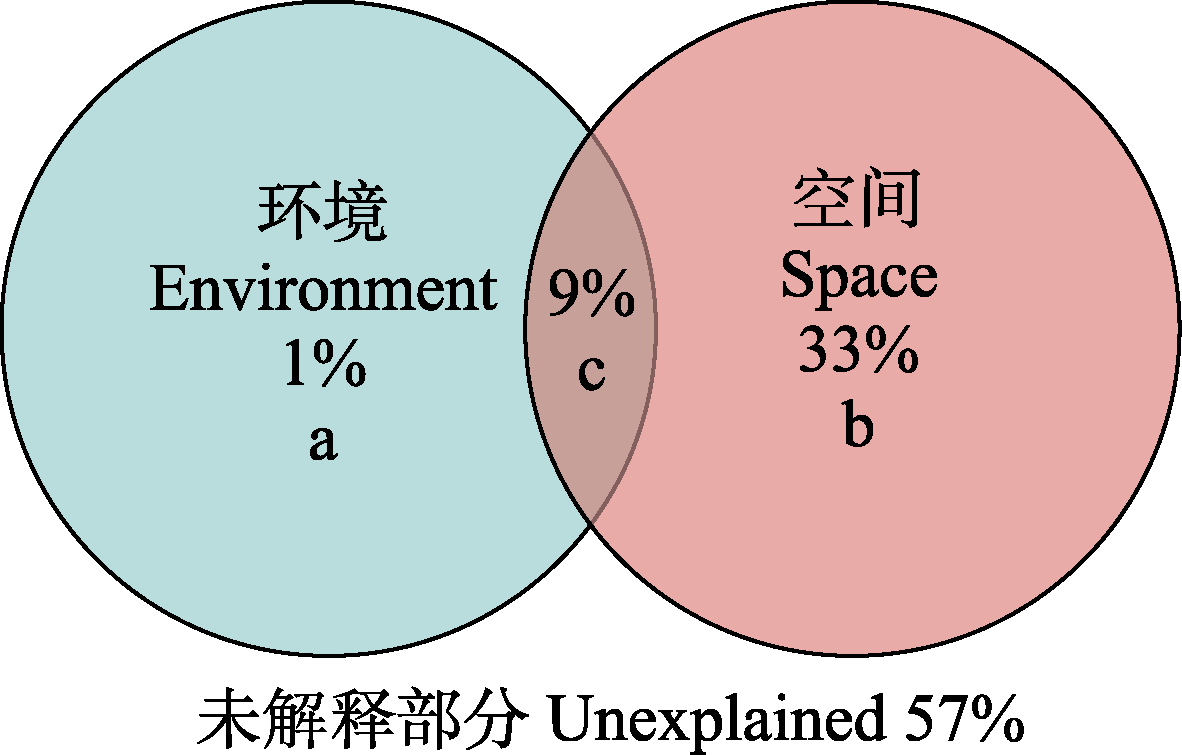
图6 环境和空间变量对不同样方对β多样性贡献(LCBD)的影响
Fig. 6 Relative impact of environmental and spatial variables on local contribution to β diversity (LCBD)
| [1] | Anderson MJ, Crist TO, Chase JM, Vellend M, Inouye BD, Freestone AL, Sanders NJ, Cornell HV, Comita LS, Davies KF, Harrison SP, Kraft NJB, Stegen JC, Swenson NG (2011) Navigating the multiple meanings of β diversity: A roadmap for the practicing ecologist. Ecology Letters 14, 19-28. |
| [2] | Barton PS, Cunningham SA, Manning AD, Gibb H, Lindenmayer DB, Didham RK (2013) The spatial scaling of beta diversity. Global Ecology and Biogeography, 22, 639-647. |
| [3] |
Bell G (2001) Neutral macroecology. Science, 293, 2413-2418.
PMID |
| [4] |
Bevilacqua S, Plicanti A, Sandulli R, Terlizzi A (2012) Measuring more of β-diversity: Quantifying patterns of variation in assemblage heterogeneity. An insight from marine benthic assemblages. Ecological Indicators, 18, 140-148.
DOI URL |
| [5] |
Borcard D, Legendre P (2002) All-scale spatial analysis of ecological data by means of principal coordinates of neighbour matrices. Ecological Modelling, 153, 51-68.
DOI URL |
| [6] |
Brown JH (1984) On the relationship between abundance and distribution of species. The American Naturalist, 124, 255-279.
DOI URL |
| [7] | Burnham KP, Anderson DR (2004) Multimodel inference: Understanding AIC and BIC in model selection. Sociological Methods & Research, 33, 261-304. |
| [8] |
Chang LW, Zelený D, Li CF, Chiu ST, Hsieh CF (2013) Better environmental data may reverse conclusions about niche and dispersal-based processes in community assembly. Ecology, 94, 2145-2151.
PMID |
| [9] |
Chen SB, Ouyang ZY, Xu WH, Xiao Y (2010) A review of beta diversity studies. Biodiversity Science, 18, 323-335. (in Chinese with English abstract)
DOI |
|
[陈圣宾, 欧阳志云, 徐卫华, 肖燚 (2010) Beta多样性研究进展. 生物多样性, 18, 323-335.]
DOI |
|
| [10] | Condit R (1998) Tropical Forest Census Plots: Methods and Results from Barro Colorado Island, Panama and a Comparison with Other Plots. Springer-Verlag, Berlin. |
| [11] |
da Silva PG, Hernández MIM, Heino J (2018) Disentangling the correlates of species and site contributions to beta diversity in dung beetle assemblages. Diversity and Distributions, 24, 1674-1686.
DOI URL |
| [12] |
Dai LM, Zhao FQ, Shao GF, Zhou L, Tang LN (2009) China’s classification-based forest management: Procedures, problems and prospects. Environmental Management, 43, 1162-1173.
DOI URL |
| [13] | Dansereau G, Legendre P, Poisot T (2022) Evaluating ecological uniqueness over broad spatial extents using species distribution modelling. Oikos, 2022, e09063. |
| [14] |
De Cáceres M, Legendre P, Valencia R, Cao M, Chang LW, Chuyong G, Condit R, Hao ZQ, Hsieh CF, Hubbell S, Kenfack D, Ma KP, Mi XC, Noor MNS, Kassim AR, Ren HB, Su SH, Sun IF, Thomas D, Ye WH, He FL (2012) The variation of tree beta diversity across a global network of forest plots. Global Ecology and Biogeography, 21, 1191-1202.
DOI URL |
| [15] |
De K, Dipti D, Megha S, Virendra PU, Bhupendra SA, Jeyaraj AJ, Hussain SA (2023a) β-diversity of odonate community of the Ganga River: Partitioning and insights from local and species contribution. Wetlands Ecology and Management, 31, 899-912.
DOI |
| [16] |
De K, Singh AP, Sarkar A, Singh K, Siliwal M, Uniyal VP, Hussain SA (2023b) Local and species contribution to the beta diversity and rarity of riparian spider community of the Ganga River, India. Community Ecology, 24, 189-199.
DOI |
| [17] |
Dornelas M, Moonen AC, Magurran AE, Bàrberi P (2009) Species abundance distributions reveal environmental heterogeneity in modified landscapes. Journal of Applied Ecology, 46, 666-672.
DOI URL |
| [18] | Dray S, Bauman S, Blanchet G, Borcard D, Clappe S, Guenard G, Jombart T, Larocque G, Legendre P, Madi N, Wagner HH (2023) Adespatial: Multivariate Multiscale Spatial Analysis. R package version 0.3-23. https://cran.r-project.org/web/packages/adespatial/. (accessed on 2023-12-16) |
| [19] |
Gaston KJ, Borges PAV, He FL, Gaspar C (2006) Abundance, spatial variance and occupancy: Arthropod species distribution in the Azores. Journal of Animal Ecology, 75, 646-656.
DOI PMID |
| [20] |
Gianuca AT, Declerck SAJ, Lemmens P, De Meester L (2017) Effects of dispersal and environmental heterogeneity on the replacement and nestedness components of beta-diversity. Ecology, 98, 525-533.
DOI PMID |
| [21] | Gilbert B, Lechowicz MJ (2004) Neutrality, niches, and dispersal in a temperate forest understory. Proceedings of the National Academy of Sciences, USA, 101, 7651-7656. |
| [22] |
González E, Buffa L, Defagó MT, Molina SI, Salvo A, Valladares G (2018) Something is lost and something is gained: Loss and replacement of species and functional groups in ant communities at fragmented forests. Landscape Ecology, 33, 2089-2102.
DOI |
| [23] |
Gray JS (2000) The measurement of marine species diversity, with an application to the benthic fauna of the Norwegian continental shelf. Journal of Experimental Marine Biology and Ecology, 250, 23-49.
DOI PMID |
| [24] |
Green JL, Ostling A (2003) Endemics-area relationships: The influence of species dominance and spatial aggregation. Ecology, 84, 3090-3097.
DOI URL |
| [25] |
Hao MH, Ganeshaiah KN, Zhang CY, Zhao XH, von Gadow K (2019) Discriminating among forest communities based on taxonomic, phylogenetic and trait distances. Forest Ecology and Management, 440, 40-47.
DOI URL |
| [26] |
Harrison S, Ross SJ, Lawton JH (1992) Beta-diversity on geographic gradients in Britain. Journal of Animal Ecology, 61, 151-158.
DOI URL |
| [27] | He MX, Li QZ, Mo XQ, Meng WQ, Hu BB (2023) Study on vegetation β diversity and its relations to α diversity in Beidagang Wetland. Acta Scientiarum Naturalium Universitatis Nankaiensis, 56(3), 103-111. (in Chinese with English abstract) |
| [贺梦璇, 李权洲, 莫训强, 孟伟庆, 胡蓓蓓 (2023) 北大港湿地自然保护区植物群落β多样性及其与α多样性关系研究. 南开大学学报(自然科学版), 56(3), 103-111.] | |
| [28] | Jones MM, Tuomisto H, Borcard D, Legendre P, Clark DB, Olivas PC (2008) Explaining variation in tropical plant community composition: Influence of environmental and spatial data quality. Oecologia, 155, 593-604. |
| [29] |
Landeiro VL, Franz B, Heino J, Siqueira T, Bini LM (2018) Species-poor and low-lying sites are more ecologically unique in a hyperdiverse Amazon region: Evidence from multiple taxonomic groups. Diversity and Distributions, 24, 966-977.
DOI URL |
| [30] |
Legendre P, De Cáceres M (2013) Beta diversity as the variance of community data: Dissimilarity coefficients and partitioning. Ecology Letters, 16, 951-963.
DOI PMID |
| [31] |
Legendre P, Mi XC, Ren HB, Ma KP, Yu MJ, Sun IF, He FL (2009) Partitioning beta diversity in a subtropical broad-leaved forest of China. Ecology, 90, 663-674.
DOI PMID |
| [32] |
Lennon JJ, Koleff P, Greenwood JJD, Gaston KJ (2001) The geographical structure of British bird distributions: Diversity, spatial turnover and scale. Journal of Animal Ecology, 70, 966-979.
DOI URL |
| [33] |
Liu YN, Tang ZY, Fang JY (2015) Contribution of environmental filtering and dispersal limitation to species turnover of temperate deciduous broad-leaved forests in China. Applied Vegetation Science, 18, 34-42.
DOI URL |
| [34] | Moritz C, Richardson KS, Ferrier S, Monteith GB, Stanisic J, Williams SE, Whiffin T (2001) Biogeographical concordance and efficiency of taxon indicators for establishing conservation priority in a tropical rainforest biota. Proceedings of the Royal Society B: Biological Sciences, 268, 1875-1881. |
| [35] |
Myers JA, Chase JM, Jiménez I, Jørgensen PM, Araujo-Murakami A, Paniagua-Zambrana N, Seidel R (2013) Beta-diversity in temperate and tropical forests reflects dissimilar mechanisms of community assembly. Ecology Letters, 16, 151-157.
DOI PMID |
| [36] | Oksanen J, Blanchet FG, Friendly M, Kindt R, Legendre P, McGlinn D, Minchin PR, O’Hara RB, Simpson GL, Solymos P, Stevens MHH, Szoecs E, Wagner H (2022) vegan: Community Ecology Package. R package version 2.6-4.. https://cran.r-project.org/web/packages/vegan/. (accessed on 2023-12-16) |
| [37] |
Palmer MW, Dixon PM (1990) Small-scale environmental heterogeneity and the analysis of species distributions along gradients. Journal of Vegetation Science, 1, 57-65.
DOI URL |
| [38] |
Podani J, Ricotta C, Schmera D (2013) A general framework for analyzing beta diversity, nestedness and related community-level phenomena based on abundance data. Ecological Complexity, 15, 52-61.
DOI URL |
| [39] |
Podani J, Schmera D (2011) A new conceptual and methodological framework for exploring and explaining pattern in presence-absence data. Oikos, 120, 1625-1638.
DOI URL |
| [40] |
Pozzobom UM, Heino J, da Silva Brito MT, Landeiro VL (2020) Untangling the determinants of macrophyte beta diversity in tropical floodplain lakes: Insights from ecological uniqueness and species contributions. Aquatic Sciences, 82, 56.
DOI |
| [41] |
Qian H, Ricklefs RE (2007) A latitudinal gradient in large-scale beta diversity for vascular plants in North America. Ecology Letters, 10, 737-744.
DOI PMID |
| [42] |
Qiao XJ, Li QX, Jiang QH, Lu JM, Franklin S, Tang ZY, Wang QG, Zhang JX, Lu ZJ, Bao DC, Guo YL, Liu HB, Xu YZ, Jiang MX (2015) Beta diversity determinants in Badagongshan, a subtropical forest in central China. Scientific Reports, 5, 17043.
DOI PMID |
| [43] |
Si XF, Zhao YH, Chen CW, Ren P, Zeng D, Wu LB, Ding P (2017) Beta-diversity partitioning: Methods, applications and perspectives. Biodiversity Science, 25, 464-480. (in Chinese with English abstract)
DOI |
|
[斯幸峰, 赵郁豪, 陈传武, 任鹏, 曾頔, 吴玲兵, 丁平 (2017) Beta多样性分解: 方法、应用与展望. 生物多样性, 25, 464-480.]
DOI |
|
| [44] |
Socolar JB, Gilroy JJ, Kunin WE, Edwards DP (2016) How should beta-diversity inform biodiversity conservation? Trends in Ecology & Evolution, 31, 67-80.
DOI URL |
| [45] |
Sor R, Legendre P, Lek S (2018) Uniqueness of sampling site contributions to the total variance of macroinvertebrate communities in the Lower Mekong basin. Ecological Indicators, 84, 425-432.
DOI URL |
| [46] | Svenning JC, Eiserhardt WL, Normand S, Ordonez A, Sandel B (2015) The influence of paleoclimate on present-day patterns in biodiversity and ecosystems. Annual Review of Ecology, Evolution, and Systematics, 46, 551-572. |
| [47] | Tan LZ (2020) β Diversity and Community Assembly Mechanism of Temperate Forests at Different Spatial Scales in Northeastern China. PhD dissertation, Beijing Forestry University, Beijing. (in Chinese with English abstract) |
| [谭凌照 (2020) 东北温带森林群落不同空间尺度下β多样性及群落构建机制. 博士学位论文, 北京林业大学, 北京.] | |
| [48] |
Tuomisto H, Ruokolainen K, Kalliola R, Linna A, Danjoy W, Rodriguez Z (1995) Dissecting Amazonian biodiversity. Science, 269, 63-66.
DOI PMID |
| [49] |
Vilmi A, Karjalainen SM, Heino J (2017) Ecological uniqueness of stream and lake diatom communities shows different macroecological patterns. Diversity and Distributions, 23, 1042-1053.
DOI URL |
| [50] |
Wang JM, Lei X, Feng YM, Wu B, Lu Q, He NP, Li JW (2023) The ecological uniqueness of plant communities and their determinants across the temperate deserts of China. Biodiversity Science, 31, 23144. (in Chinese with English abstract)
DOI |
|
[王健铭, 雷训, 冯益明, 吴波, 卢琦, 何念鹏, 李景文 (2023) 中国温带荒漠植物群落生态特异性格局及其影响因素. 生物多样性, 31, 23144.]
DOI |
|
| [51] | Wang WG (2018) Analysis of the beta diversity of snails in the lakes of mid-lower reaches of the Yangtze River. Ecological Science, 37(6), 122-130. (in Chinese with English abstract) |
| [王魏根 (2018) 长江中下游湖泊螺类beta多样性分析. 生态科学, 37(6), 122-130.] | |
| [52] |
Wang XG, Wiegand T, Anderson-Teixeira KJ, Bourg NA, Hao ZQ, Howe R, Jin GZ, Orwig DA, Spasojevic MJ, Wang SZ, Wolf A, Myers JA (2018) Ecological drivers of spatial community dissimilarity, species replacement and species nestedness across temperate forests. Global Ecology and Biogeography, 27, 581-592.
DOI URL |
| [53] |
Wang XG, Wiegand T, Swenson NG, Wolf AT, Howe RW, Hao ZQ, Lin F, Ye J, Yuan ZQ (2015) Mechanisms underlying local functional and phylogenetic beta diversity in two temperate forests. Ecology, 96, 1062-1073.
PMID |
| [54] |
Whittaker RH (1960) Vegetation of the Siskiyou Mountains,Oregon and California. Ecological Monographs, 30, 279-338.
DOI URL |
| [55] |
Yao J, Zhang CY, De Cáceres M, Legendre P, Zhao XH (2019) Variation in compositional and structural components of community assemblage and its determinants. Journal of Vegetation Science, 30, 257-268.
DOI URL |
| [56] |
Yao ZL, Wen HD, Deng Y, Cao M, Lin LX (2020) Driving forces underlying the beta diversity of tree species in subtropical mid-mountain moist evergreen broad-leaved forests in Ailao Mountains. Biodiversity Science, 28, 445-454. (in Chinese with English abstract)
DOI |
|
[姚志良, 温韩东, 邓云, 曹敏, 林露湘 (2020) 哀牢山亚热带中山湿性常绿阔叶林树种beta多样性格局形成的驱动力. 生物多样性, 28, 445-454.]
DOI |
|
| [57] | Yue QM, He HJ, Zhang CY, Zhao XH, Hao MH (2024) Response of phylogenetic and functional diversity to harvesting disturbance in the Korean pine-broadleaved forest. Acta Ecologica Sinica, 44, 8617-8626. (in Chinese with English abstract) |
| [岳庆敏, 何怀江, 张春雨, 赵秀海, 郝珉辉 (2024) 吉林蛟河阔叶红松林谱系多样性和功能多样性对采伐干扰的响应. 生态学报, 44, 8617-8626.] |
| [1] | 周丽洁, 郝珉辉, 何怀江, 程艳霞, 张春雨, 赵秀海. 小兴安岭森林β多样性格局、组分及其影响因素[J]. 生物多样性, 2026, 34(4): 25443-. |
| [2] | 陈昭, 徐颖, 梁田雨, 赵艳玲, 张旋, 王禄景, 杨颜慈, 王永龙. 西鄂尔多斯高原濒危孑遗植物四合木相关真菌的多样性与群落构建机制[J]. 生物多样性, 2026, 34(3): 25290-. |
| [3] | 谷际岐, 赖江山, 王瑛, 吴浩然, 张雪, 宋晓彤, 邵小明, 娄安如. 联合物种分布模型与生物群落层次建模框架: 生态学理论、方法及应用[J]. 生物多样性, 2026, 34(1): 25364-. |
| [4] | 曹世宁, 余博航, 李景文, 冯益明, 卢琦, 王健铭. 中国黑戈壁地区植物群落物种、功能与系统发育β多样性分布格局及其影响因素[J]. 生物多样性, 2025, 33(8): 25134-. |
| [5] | 李燚, 赵艳超, 陈立同. 高寒草甸α与β多样性对增温的响应受海拔和土壤养分水平调控[J]. 生物多样性, 2025, 33(12): 25062-. |
| [6] | 吴琪, 张晓青, 杨雨婷, 周艺博, 马毅, 许大明, 斯幸峰, 王健. 浙江钱江源-百山祖国家公园庆元片区叶附生苔多样性及其时空变化[J]. 生物多样性, 2024, 32(4): 24010-. |
| [7] | 陈瑶琪, 郭晶晶, 蔡国俊, 葛依立, 廖宇, 董正, 符辉. 近七十年(1954-2021)长江中下游湖泊沉水植物群落多样性演变特征[J]. 生物多样性, 2024, 32(3): 23319-. |
| [8] | 施国杉, 刘峰, 曹光宏, 陈典, 夏尚文, 邓云, 王彬, 杨效东, 林露湘. 西双版纳热带季节雨林木本植物的beta多样性: 空间、环境与林分结构的作用[J]. 生物多样性, 2024, 32(12): 24285-. |
| [9] | 王巍伟, 米湘成, 王宁宁, 任海保, 唐治喜, 张主宁, 马克平, 陈磊. 2005-2020年浙江古田山24 ha亚热带常绿阔叶林动态监测样地植物多样性数据集[J]. 生物多样性, 2024, 32(12): 24417-. |
| [10] | 陈越, 毛子昆, 王绪高. 基于生态独特性的β多样性研究进展与未来展望[J]. 生物多样性, 2024, 32(12): 24199-. |
| [11] | 王明慧, 陈昭铨, 李帅锋, 黄小波, 郎学东, 胡子涵, 尚瑞广, 刘万德. 云南普洱季风常绿阔叶林不同种子扩散方式的优势种空间点格局分析[J]. 生物多样性, 2023, 31(9): 23147-. |
| [12] | 冯志荣, 陈有城, 彭艳琼, 李莉, 王波. 生态网络分析: 从集合群落到集合网络[J]. 生物多样性, 2023, 31(8): 23171-. |
| [13] | 陈晓澄, 张鹏展, 康斌, 刘林山, 赵亮. 基于中国科学院西北高原生物研究所馆藏标本分析青藏高原雀形目鸟类物种和功能多样性[J]. 生物多样性, 2023, 31(5): 22638-. |
| [14] | 杨清, 李晓东, 杨胜娴, 巢欣, 刘惠秋, 巴桑. 雅鲁藏布江中游丰水期原生动物群落多样性及其影响因子[J]. 生物多样性, 2023, 31(4): 22500-. |
| [15] | 王晓凤, 饶杰生, 杨涛, 刘文聪, 田希, 陈稀, 刘其明, 徐衍潇, 张秋雨, 张洪强, 张旭, 欧晓昆, 沈泽昊. 云南鸡足山半湿润常绿阔叶林群落木本植物多样性格局与环境解释[J]. 生物多样性, 2023, 31(11): 23217-. |
| 阅读次数 | ||||||
|
全文 |
|
|||||
|
摘要 |
|
|||||
备案号:京ICP备16067583号-7
Copyright © 2026 版权所有 《生物多样性》编辑部
地址: 北京香山南辛村20号, 邮编:100093
电话: 010-62836137, 62836665 E-mail: biodiversity@ibcas.ac.cn
