

Biodiv Sci ›› 2026, Vol. 34 ›› Issue (5): 25482. DOI: 10.17520/biods.2025482 cstr: 32101.14.biods.2025482
• Original Papers: Plant Diversity • Previous Articles Next Articles
Lifang Zhou1,2( ), Xiuqin Ci1,*()(
 ), Junling Chen1,2(), Yanping Su1, Jianyong Shen1, Jie Li1,*()()
Received:2025-11-28
Accepted:2026-04-06
Online:2026-05-20
Published:2026-07-01
Contact:
Xiuqin Ci, Jie Li
Supported by:Lifang Zhou, Xiuqin Ci, Junling Chen, Yanping Su, Jianyong Shen, Jie Li. Assessing plant survival in tropical botanical gardens based on climatic and soil factors using mixed-effects Cox proportional hazards models[J]. Biodiv Sci, 2026, 34(5): 25482.
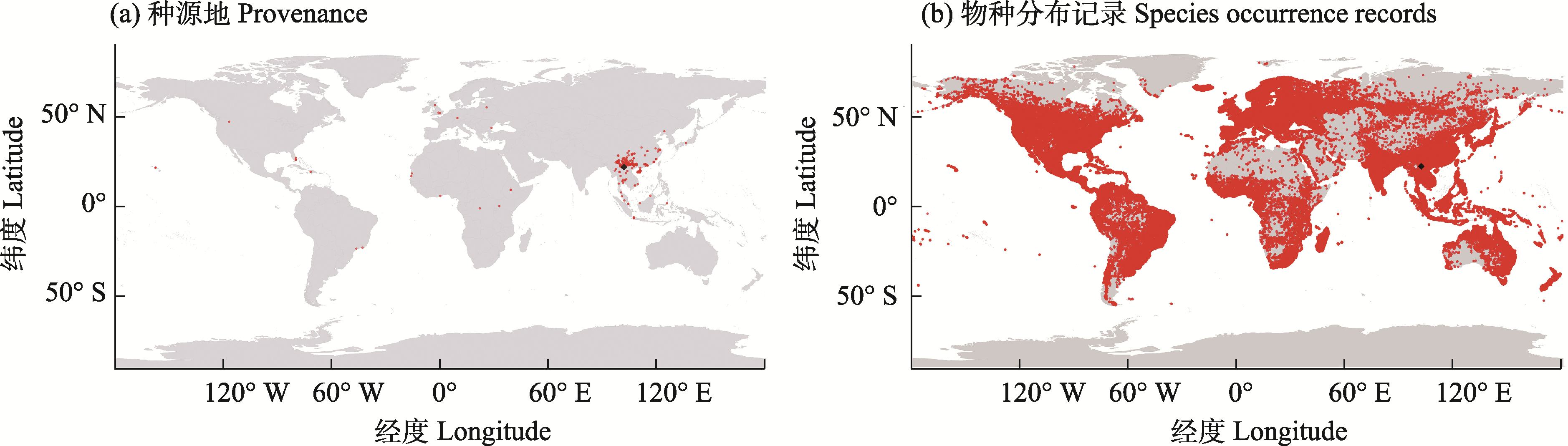
Fig. 1 Geographic distribution of provenance (a) and species occurrence records (b) for introduced plants included in this study. Propagules were obtained from 435 provenances through field collection, exchange with other botanical gardens, and purchase, all coordinated by the Xishuangbanna Tropical Botanical Garden, Chinese Academy of Sciences (XTBG). This study includes 1,232 species, with 3,152,039 occurrence records obtained from the Global Biodiversity Information Facility (GBIF, https://www.gbif.org/) and cleaned by removing outliers. The number of occurrence records per species had a median of 47, a mean of 2,767, and ranged from 1 to 500,332. The location of XTBG (21°41′ N, 101°25′ E) is marked by a black diamond. Red circles indicate provenance in (a) and species occurrence records in (b).
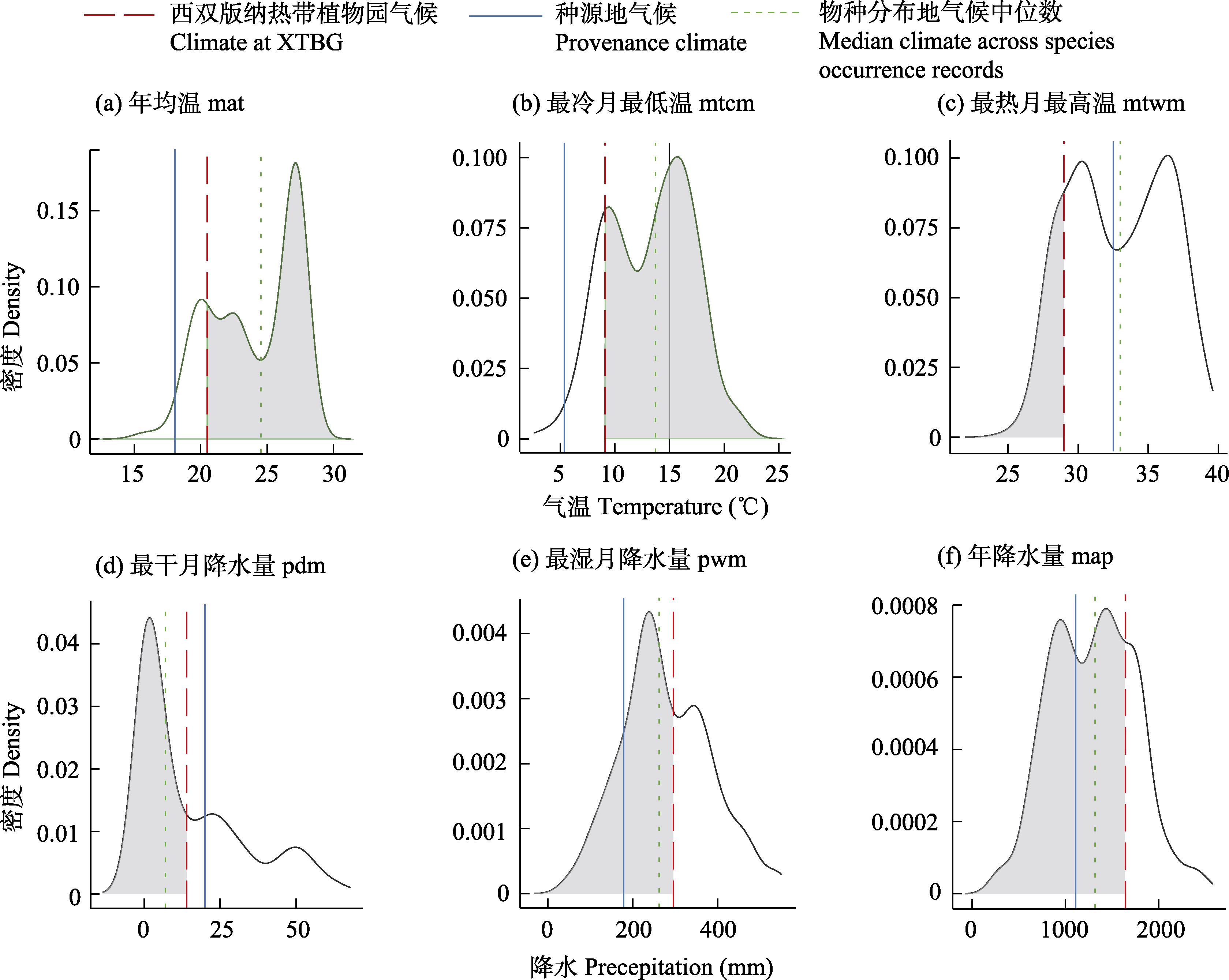
Fig. 2 Climatic differences between Xishuangbanna Tropical Botanical Garden, Chinese Academy of Sciences (XTBG) and the distribution of plants in the wild based on the proportion of the climatic distribution of each species that was more extreme than the climate at XTBG, illustrated with one of the study species: Ficus virens. Red long-dashed vertical lines indicate the climatic parameter values at XTBG; blue lines indicate the climate at the provenance; green short-dashed vertical lines indicate the median climate across occurrence records of the species; and gray shaded curves represent the density of the species climatic distribution constructed using kernel density estimation, with climatic data for occurrence records extracted by matching GBIF distribution records with WorldClim 2.1. This metric was derived by calculating the cumulative proportion of species occurrence records falling on the side more extreme than the XTBG threshold. Specifically, for minimum temperature of coldest month (mtcm), we calculated the proportion of occurrence records with temperatures warmer than that at XTBG; for maximum temperature of warmest month (mtwm), we calculated the proportion of occurrence records with temperatures colder than that at XTBG. For mean annual temperature (mat), the metric depended on the relative position between the species median and XTBG: When the species median was lower, we calculated the proportion of occurrence records with temperatures lower than that at XTBG; otherwise, we calculated the proportion of occurrence records with temperature higher than that at XTBG. For precipitation variables—annual precipitation (map), precipitation of driest month (pdm), and precipitation of wettest month (pwm)—we consistently calculated the proportion of occurrence records with precipitation lower than that at XTBG. This approach emphasizes climatic properties of the whole species distribution, as opposed to propagule provenance under the assumption of local adaptation, and may be useful when species’ climatic niches are largely determined by the tolerance of generalist genotypes.
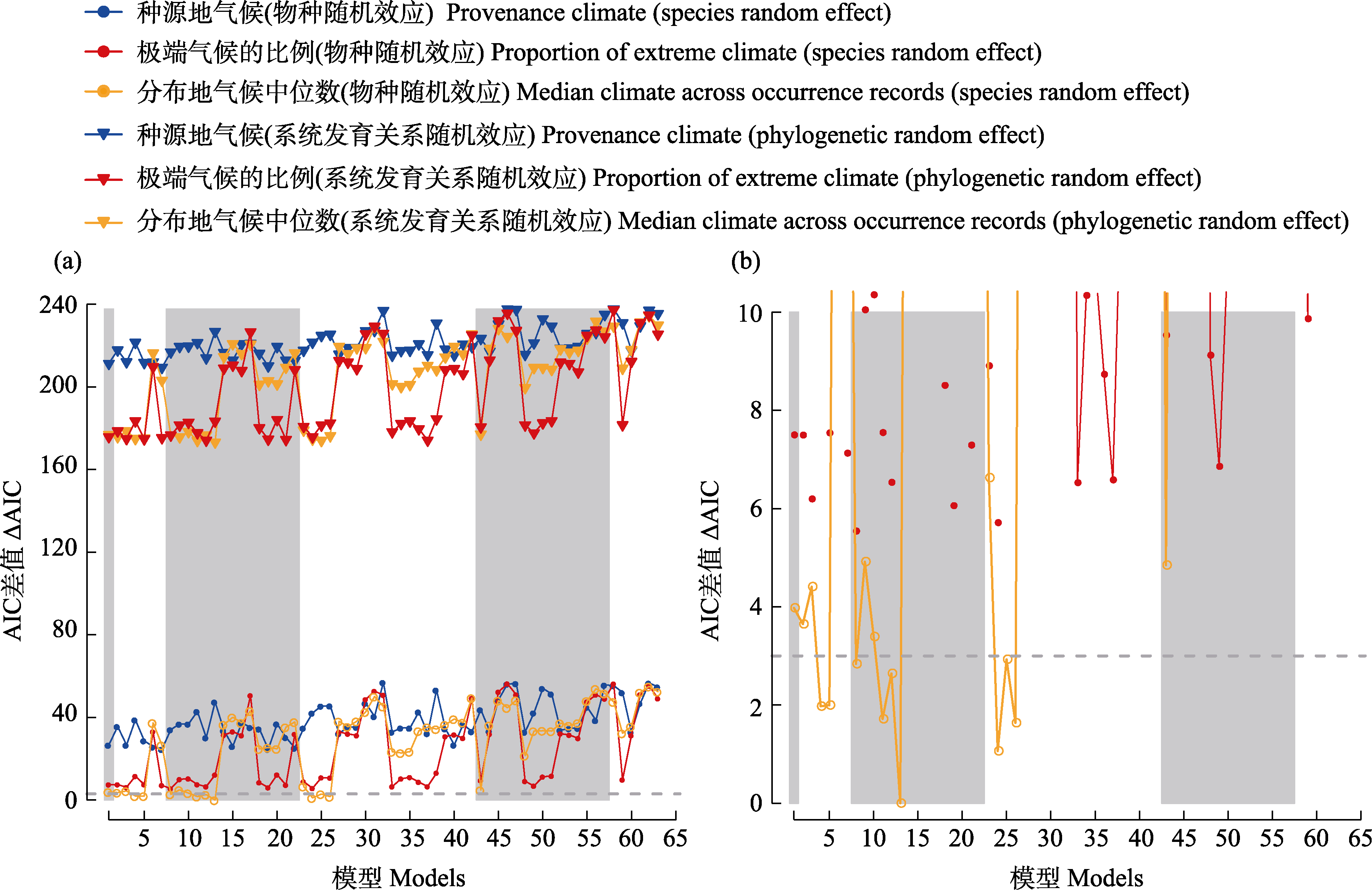
Fig. 3 Comparison of empirical support for mixed-effects Cox proportional hazards models assessing effects of climatic difference metrics and growth form on survival of introduced plants. The x-axis indicates candidate model numbers (1-63) grouped by the number of climatic variables included (decreasing from 6 to 1 from left to right, indicated by alternating gray and white bands); the y-axis indicates Akaike information criterion differences (ΔAIC, relative to the best-supported model). Models incorporated three climatic difference metrics: difference from climate at provenance (blue), difference from median climate across occurrence records (orange), and proportion of extreme climat (red); and two random-effect structures: uncorrelated species random effects (circles) and phylogenetically correlated random effects (triangles). The gray dashed line indicates the ΔAIC = 3 threshold. Panel (b) provides a detailed view of the upper range (ΔAIC ≤ 10) in panel (a), highlighting models with highest support (ΔAIC ≤ 3). All models included growth form as a fixed effect.
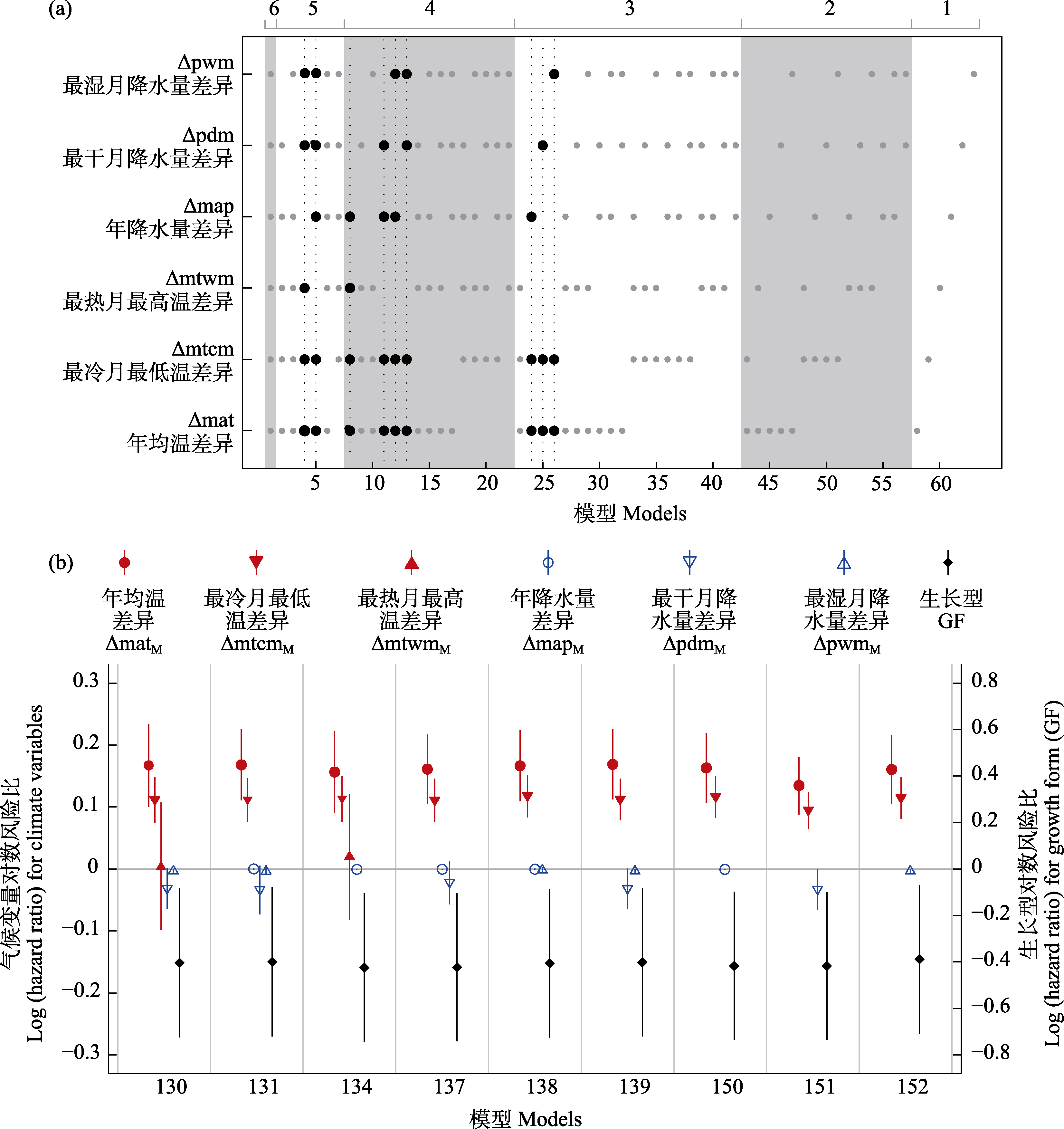
Fig. 4 Comparison of mixed-effects Cox proportional hazards models for introduced plant survival in relation to climatic differences and growth form, and corresponding effect estimates. (a) Combinations of climatic variables included in each model. The ordinate shows six climatic difference variables: difference in mean annual temperature (Δmat), difference in minimum temperature of coldest month (Δmtcm), difference in maximum temperature of warmest month (Δmtwm), difference in annual precipitation (Δmap), difference in precipitation of driest month (Δpdm), difference in precipitation of wettest month (Δpwm). The abscissa shows all non-empty combinations of these variables. Gray dots indicate variable inclusion; vertical dotted lines mark models with the highest empirical support (ΔAIC ≤ 3), with variables in these models highlighted by large black dots. The numbers and alternating gray/white bands at the top serve as visual separators for model groups. All models included growth form as an explanatory variable in the analysis. (b) Effect estimates from the best-supported models (ΔAIC ≤ 3). Point estimates (red for temperature, blue down for precipitation, black diamonds for growth form) and 95% confidence intervals are shown for nine top-ranked models (Model IDs 130-152). Coefficients are log (hazard ratio); statistical significance at P = 0.05 is indicated when 95% confidence intervals do not overlap 0 (gray horizontal line). For climatic variables, regression coefficients > 0 indicate increased mortality risk per unit increase in climatic difference; for growth form, regression coefficients < 0 indicate lower mortality risk for herbal than for woody plants.
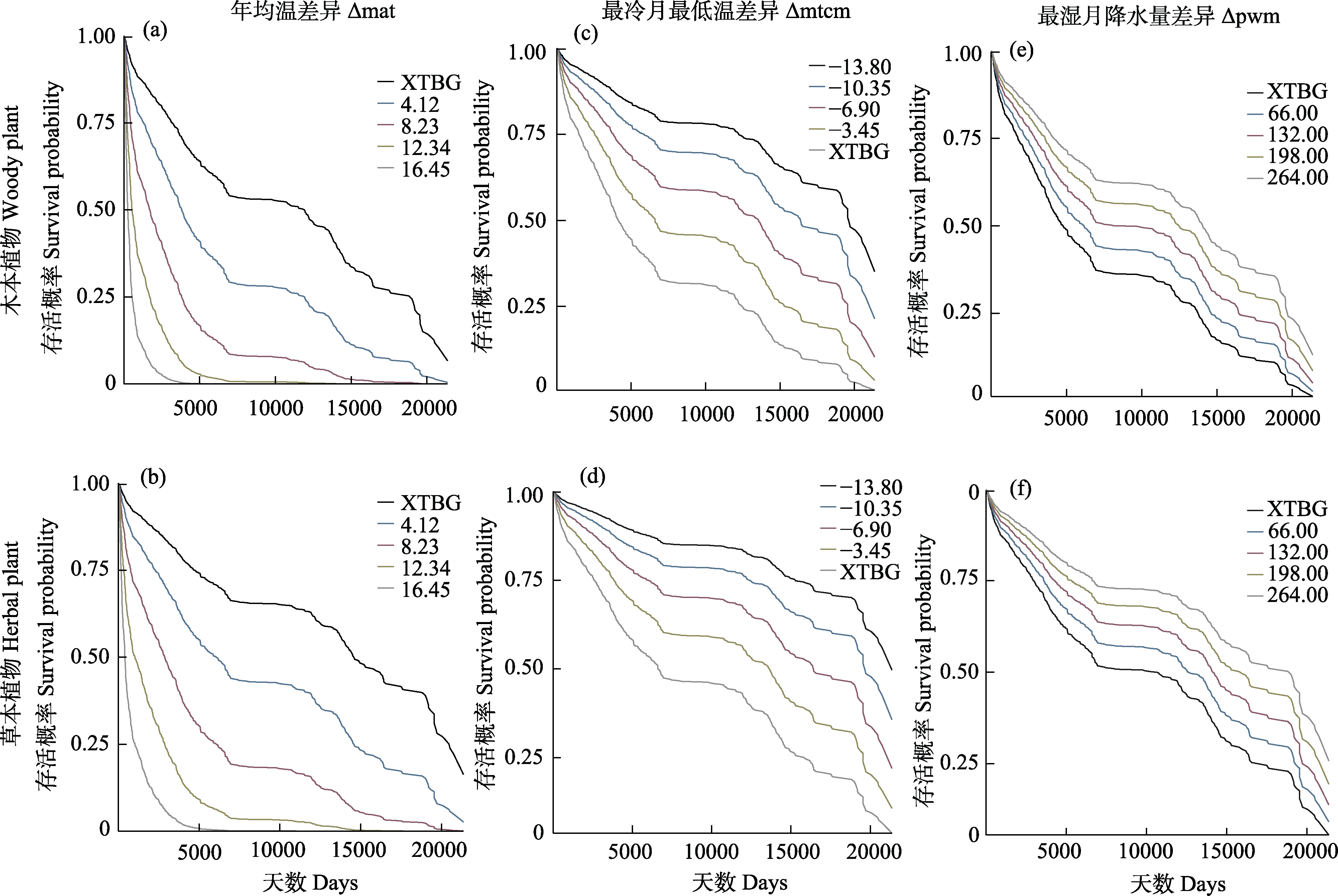
Fig. 5 Effects of varying climatic values on predicted introduced plant survival, according to one of the models with highest empirical support (ΔAIC = 0; Model 13 in Fig. 3, Model 139 in Fig. 4). The curves relate survival time (abscissa) to probability of plant survival at XTBG (ordinate). In each panel, the curve labeled “XTBG” describes the predicted survival when the median climate of the species distribution is identical to the climate of XTBG (i.e., the baseline prediction when climatic difference equals zero); other curves correspond to survival conditions at four representative values: the maximum observed difference, and three equally spaced intermediate levels between zero and the maximum. Survival curves are based on the Nelson-Altschuler-Aalen estimator of the hazards. Panels (a-b) show the effect of differences in median mean annual temperature (ΔmatM); panels (c-d) show the effect of differences in median minimum temperature of coldest month (ΔmtcmM); while panels (e-f) show the effect of differences in median precipitation of wettest month (ΔpwmM).
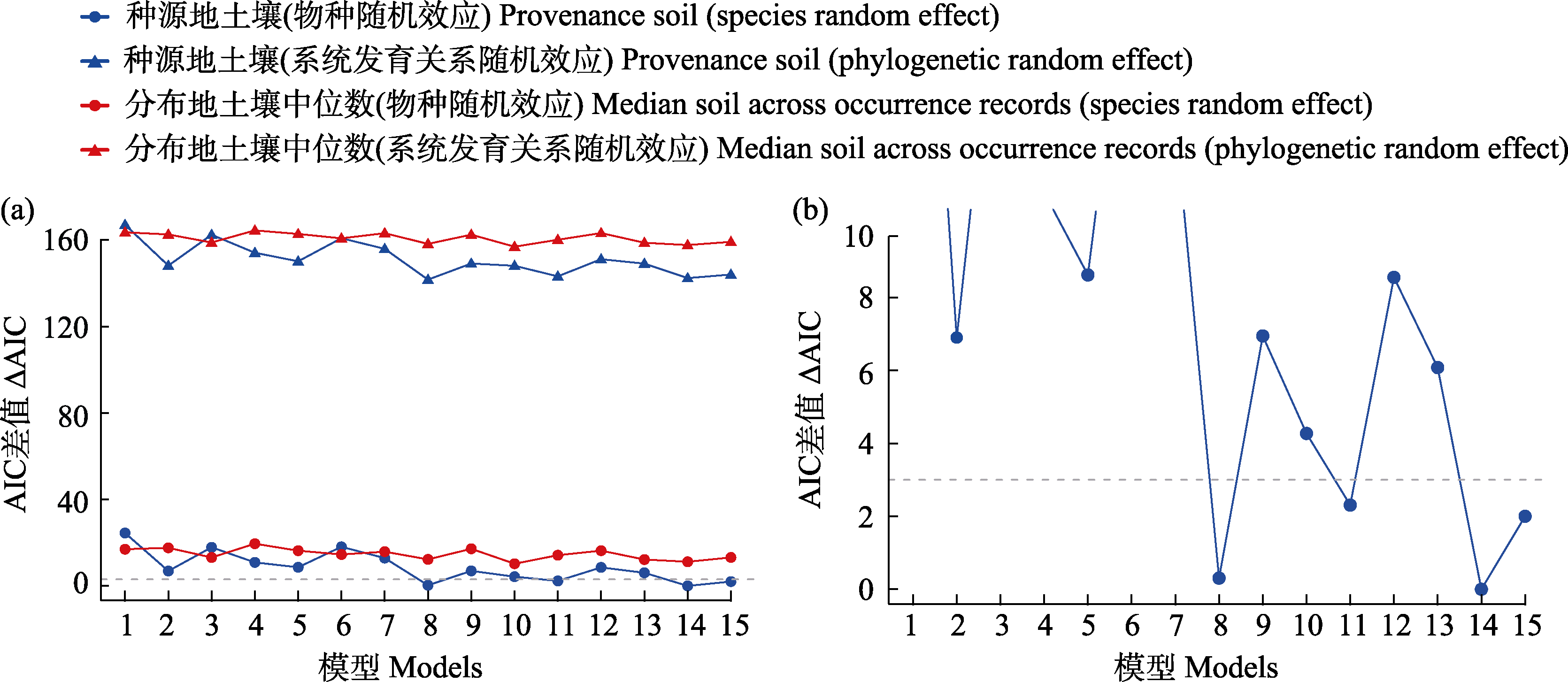
Fig. 6 Comparison of empirical support for mixed-effects Cox proportional hazards models relating introduced plant survival to soil differences and growth form. Empirical support for 60 models was measured as differences in the Akaike information criterion (ΔAIC). Models quantified soil differences between XTBG and species’ wild distributions in two ways: difference from soil at provenances (labeled “Provenance soil”) and difference from the median soil across occurrence records of a species (labeled “Median soil across occurrence records”). Additionally, models accounted for evolutionary relationships among plantings using uncorrelated species random effects (labeled “species random effect”) or phylogenetically correlated species random effects (labeled “phylogenetic random effect”). The abscissa indicates candidate model numbers (1-15), and the ordinate indicates ΔAIC values. Blue circles represent provenance soil with uncorrelated species random effects (s), and red circles represent the median soil across occurrence records with uncorrelated species random effects (s); blue triangles represent provenance soil with phylogenetic random effect, and red triangles represent the median soil across occurrence records with phylogenetic random effect. Gray dashed lines in both panel (a) and panel (b) indicate ΔAIC = 3, serving as the threshold to identify models with highest empirical support (ΔAIC ≤ 3). Panel (b) Magnified view the lower part of the ordinate in panel (a) (0-10), highlighting the models with highest empirical support (ΔAIC ≤ 3). Growth form was included as an explanatory variable in all models.
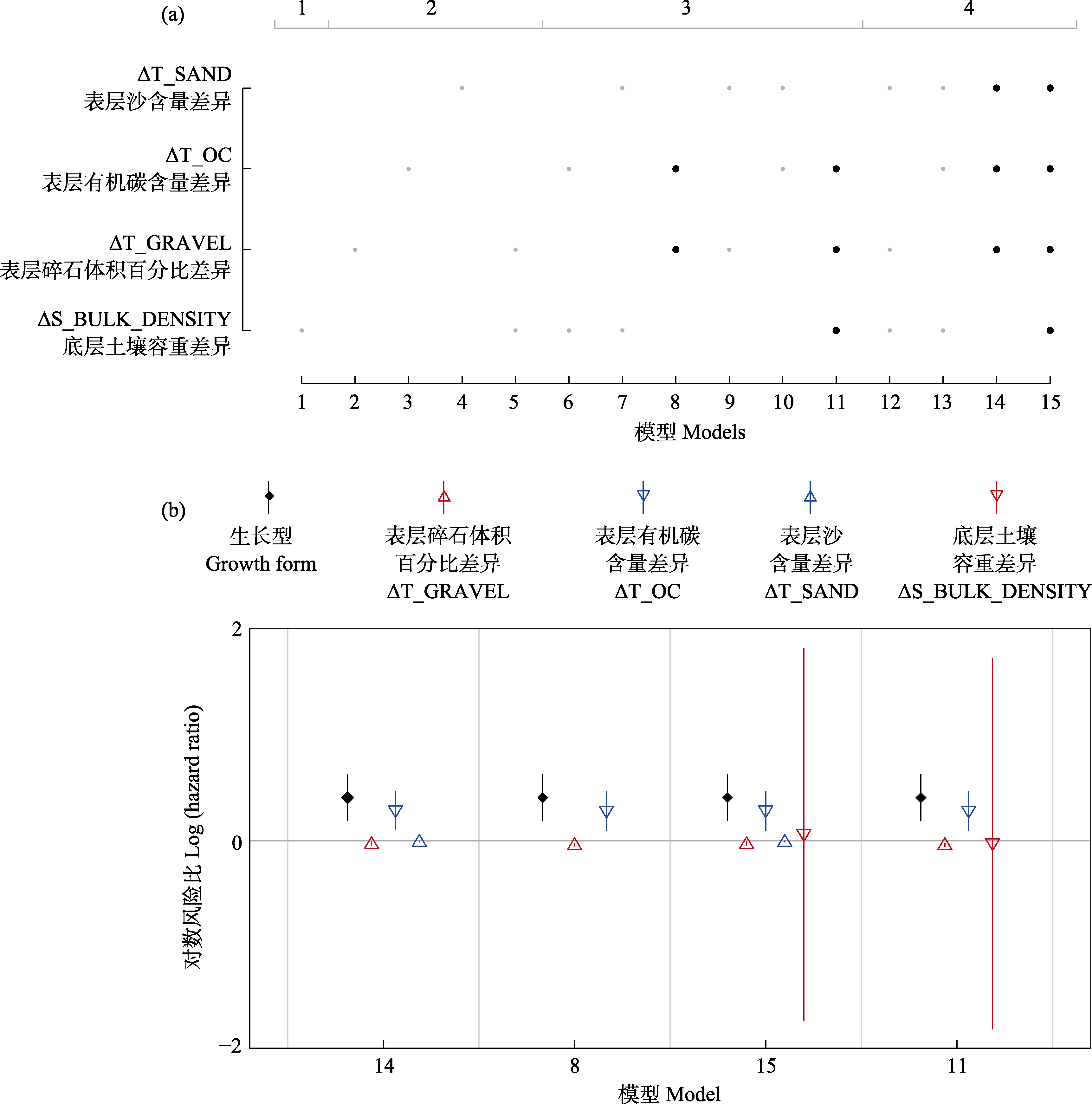
Fig. 7 Comparison of mixed-effects Cox proportional hazards models for introduced plant survival in relation to soil differences and growth form, with effect estimates. (a) Combinations of soil variables included in each model. The ordinate (y-axis) displays four soil difference variables: difference in topsoil sand content (ΔT_SAND), difference in topsoil organic carbon content (ΔT_OC), difference in topsoil gravel content (ΔT_GRAVEL), and difference in subsoil bulk density (ΔS_BULK_DENSITY); the abscissa (x-axis) shows 15 candidate models (numbered 1-15) representing all possible combinations of these variables. Dots indicate variable inclusion; large black dots mark variables present in models with the highest empirical support (ΔAIC ≤ 3, indicated by vertical dotted lines). Numbers at the top of panel (a) denote the number of soil variables included in each model (1-4). All models included growth form as an explanatory variable. (b) Effect estimates from the highest empirical support models (ΔAIC ≤ 3). The abscissa (x-axis) indicates model numbers (14, 8, 15, 11), and the ordinate (y-axis) represents the natural logarithm of the hazard ratio (log hazard ratio). Point estimates and 95% confidence intervals (vertical lines) show regression coefficients. Statistical significance (P ≤ 0.05) is indicated when confidence intervals do not overlap zero (gray horizontal line). regression coefficients > 0 for soil variables indicate increased mortality risk per unit increase in soil difference; for growth form, regression coefficients > 0 indicate higher mortality risk for herbal compared to woody plants.
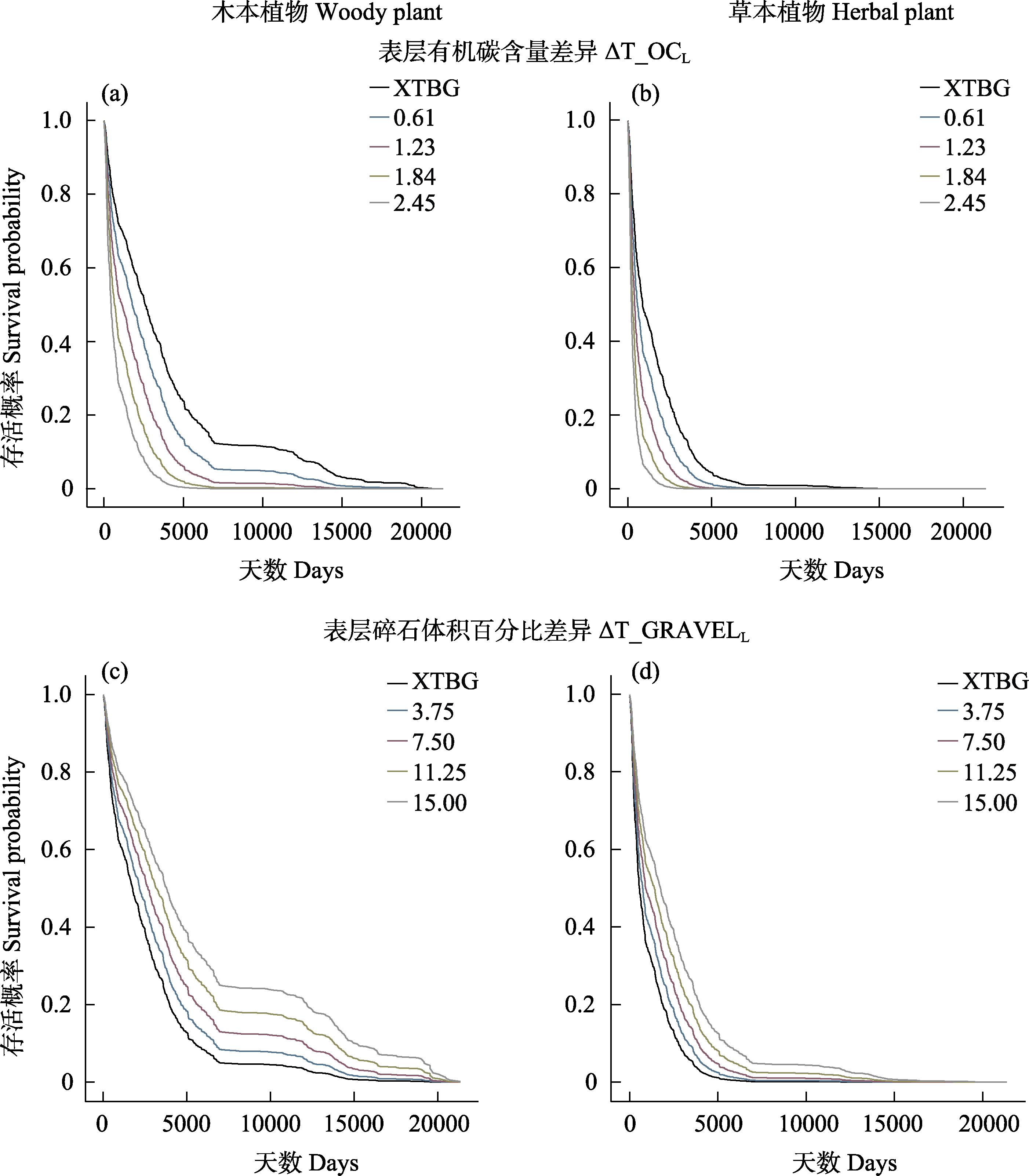
Fig. 8 Predicted effects of soil variable differences on introduced plant survival curves based on the model with the highest empirical support (Model 14 in Fig. 6). The panels display predicted survival probability (ordinate) over time since survival time (abscissa). The left column presents predictions for woody plants and the right column for herbal plants; the upper row (a-b) shows the effect of topsoil organic carbon content difference (ΔT_OCL), and the lower row (c-d) shows the effect of topsoil gravel volume percentage difference (ΔT_GRAVELL). In each panel, the curve labeled “XTBG” represents the reference scenario with zero soil difference from XTBG; the other four curves correspond to four equally-spaced gradient levels of that soil variable across the range from 0 to the maximum observed difference (including the maximum). Survival curves were derived from Nelson-Aalen cumulative hazard estimates.
| [1] |
Abeli T, Dalrymple S, Godefroid S, Mondoni A, Müller JV, Rossi G, Orsenigo S (2020) Ex situ collections and their potential for the restoration of extinct plants. Conservation Biology, 34, 303-313.
DOI URL |
| [2] | Anderson JV (2015) Advances in Plant Dormancy. Springer, Cham, Switzerland. |
| [3] | Barandun M, Paz A, van Tiel N, van den Hoogen J, Pellissier L, Crowther TW, Maynard DS (2025) Global patterns in plant environmental breadths. Ecography, 2025, e07637. |
| [4] | Bharti K (2021) Crop residues and their impact on crop production: A review. Journal of Emerging Technologies and Innovative Research, 8, 613-618. |
| [5] |
Briscoe Runquist RD, Gorton AJ, Yoder JB, Deacon NJ, Grossman JJ, Kothari S, Lyons MP, Sheth SN, Tiffin P, Moeller DA (2020) Context dependence of local adaptation to abiotic and biotic environments: A quantitative and qualitative synthesis. The American Naturalist, 195, 412-431.
DOI PMID |
| [6] | Burnham KP, Anderson DR (2002) Model Selection and Multimodel Inference: A practical information-theoretic approach. Springer, New York. |
| [7] |
Cayuela L, Granzow-de la Cerda Í, Albuquerque FS, Golicher DJ (2012) Taxonstand: An R package for species names standardisation in vegetation databases. Methods in Ecology and Evolution, 3, 1078-1083.
DOI URL |
| [8] |
Ceballos G, Ehrlich PR, Barnosky AD, García A, Pringle RM, Palmer TM (2015) Accelerated modern human-induced species losses: Entering the sixth mass extinction. Science Advances, 1, e1400253.
DOI URL |
| [9] | Chen PQ, Xue YG (2024) Relationship between functional characteristics of herbs and soil physical and chemical factors in Dashiwei Tiankeng Group, Guangxi. Seed Science and Technology, 42(12), 154-157. (in Chinese with English abstract) |
| [陈佩琦, 薛跃规 (2024) 广西大石围天坑群草本植物功能性状与土壤理化因子的关系. 种子科技, 42(12), 154-157.] | |
| [10] |
Deng B, Wang XF, Liao J (2024) Ecophysiological responses of herbaceous and woody plants to environmental stresses in the riparian zone of Three Gorges Reservoir: A meta-analysis. Chinese Journal of Plant Ecology, 48, 623-637. (in Chinese with English abstract)
DOI |
|
[邓蓓, 王晓锋, 廖君 (2024) 环境胁迫影响三峡库区消落带草本和木本植物生理生态特征的meta分析. 植物生态学报, 48, 623-637.]
DOI |
|
| [11] | Doughty CE, Goulden ML (2008) Are tropical forests near a high temperature threshold? Journal of Geophysical Research: Biogeosciences, 113, 2007JG000632. |
| [12] |
Drake JM, Wares JP, Byers JE, Anderson JT (2025) Two hypotheses about climate change and species distributions. Ecology Letters, 28, e70134.
DOI URL |
| [13] |
El Omari B (2022) Accumulation versus storage of total non-structural carbohydrates in woody plants. Trees, 36, 869-881.
DOI |
| [14] |
Fan ZF, Kabrick JM, Shifley SR (2006) Classification and regression tree based survival analysis in oak-dominated forests of Missouri’s Ozark Highlands. Canadian Journal of Forest Research, 36, 1740-1748.
DOI URL |
| [15] |
Feng C, Zhang J, Huang HW (2023) Parallel situ conservation: A new plant conservation strategy to integrate in situ and ex situ conservation of plants. Biodiversity Science, 31, 23184. (in Chinese with English abstract)
DOI URL |
|
[冯晨, 张洁, 黄宏文 (2023) 统筹植物就地保护与迁地保护的解决方案: 植物并地保护(parallel situ conservation). 生物多样性, 31, 23184.]
DOI |
|
| [16] | Feng Y, Wang YQ, Li YK, Han L, Wang HZ (2024) Relationship between leaf functional traits of Populus euphratica and soil factors. Acta Ecologica Sinica, 44, 1717-1726. (in Chinese with English abstract) |
| [冯宇, 王雨晴, 李沅楷, 韩路, 王海珍 (2024) 胡杨叶功能性状与土壤因子的关系. 生态学报, 44, 1717-1726.] | |
| [17] |
Fick SE, Hijmans RJ (2017) WorldClim 2: New 1-km spatial resolution climate surfaces for global land areas. International Journal of Climatology, 37, 4302-4315.
DOI URL |
| [18] | Harrell FE (2015) Regression Modeling Strategies: With Applications to Linear Models, Logistic and Ordinal Regression, and Survival Analysis. Springer, Cham, Switzerland. |
| [19] | Hijmans RJ (2025) raster: Geographic Data Analysis and Modeling. (accessed on 2025-04-12) |
| [20] |
Jin Y, Qian H (2019) V.PhyloMaker: An R package that can generate very large phylogenies for vascular plants. Ecography, 42, 1353-1359.
DOI |
| [21] |
Jhanji S, Chumber M, Kaur G, Kaur R, Goyal E, Dhingra M (2025) Nutrient driven stress resilience: Mechanisms of nutrient uptake, sensing and signaling in plants. Plant Physiology and Biochemistry, 229, 110456.
DOI URL |
| [22] |
Küpper FC, Kamenos NA (2018) The future of marine biodiversity and marine ecosystem functioning in UK coastal and territorial waters (including UK Overseas Territories) with an emphasis on marine macrophyte communities. Botanica Marina, 61, 521-535.
DOI URL |
| [23] |
Lee-Yaw JA, Kharouba HM, Bontrager M, Mahony C, Csergő AM, Noreen AME, Li Q, Schuster R, Angert AL (2016) A synthesis of transplant experiments and ecological niche models suggests that range limits are often niche limits. Ecology Letters, 19, 710-722.
DOI PMID |
| [24] | Li CM (2020) Mortality model of Larix olgensis-Abies nephrolepis-Picea jazoensis mixed stands based on Cox proportional hazard function and mixed effect model. Forest Research, 33(3), 92-98. (in Chinese with English abstract) |
| [李春明 (2020) 基于Cox比例风险函数及混合效应的落叶松云冷杉混交林林木枯损模型研究. 林业科学研究, 33(3), 92-98.] | |
| [25] |
Li WT, Migliavacca M, Forkel M, Denissen JMC, Reichstein M, Yang H, Duveiller G, Weber U, Orth R (2022) Widespread increasing vegetation sensitivity to soil moisture. Nature Communications, 13, 3959.
DOI PMID |
| [26] |
Lin YW, Xie T, Shan RX, Li XR (2025) Non-linear responses of life-history strategies to warming in arid desert herbaceous plants. Ecological Indicators, 176, 113742.
DOI URL |
| [27] |
Liu MX, Liang GL (2016) Research progress on leaf mass per area. Chinese Journal of Plant Ecology, 40, 847-860. (in Chinese with English abstract)
DOI URL |
|
[刘明秀, 梁国鲁 (2016) 植物比叶质量研究进展. 植物生态学报, 40, 847-860.]
DOI |
|
| [28] |
Lubbe FC, Klimešová J, Henry HAL (2021) Winter belowground: Changing winters and the perennating organs of herbaceous plants. Functional Ecology, 35, 1627-1639.
DOI URL |
| [29] |
Ma Z, Guo D, Xu X, Lu M, Bardgett RD, Eissenstat DM, McCormack ML, Hedin LO (2018) Evolutionary history resolves global organization of root functional traits. Nature, 555, 94-99.
DOI URL |
| [30] | Mao X, Jiang HC, Yang GF, Xu HY (2011) Preliminary study on spatial and temporal characteristics of palaeoclimate evolution in China during the last deglaciation. Quaternary Sciences, 31, 57-65. (in Chinese with English abstract) |
| [毛雪, 蒋汉朝, 杨桂芳, 徐红艳 (2011) 我国末次冰消期古气候时空演化特征初探. 第四纪研究, 31, 57-65.] | |
| [31] |
Mauget SA, Himanshu SK, Goebel TS, Ale S, Lascano RJ, Gitz DC III (2021) Soil and soil organic carbon effects on simulated Southern High Plains dryland cotton production. Soil and Tillage Research, 212, 105040.
DOI URL |
| [32] | Moore DF (2016) Applied Survival Analysis Using R. Springer, Cham, Switzerland. |
| [33] |
Nievola CC, Carvalho CP, Carvalho V, Rodrigues E (2017) Rapid responses of plants to temperature changes. Temperature, 4, 371-405.
DOI PMID |
| [34] |
Passioura JB (2002) Soil conditions and plant growth. Plant, Cell & Environment, 25, 311-318.
DOI URL |
| [35] |
Peng N, Wang Y, Wu HF, Hao HJ, Sailike A, Yu ZC, Li SC, Shi RH, Hao WF, Zhang W (2025) Phosphorus cycling dominates microbial regulation of synergistic carbon, nitrogen, and phosphorus gene dynamics during Robinia pseudoacacia restoration on the Loess Plateau. Agronomy, 15, 797.
DOI URL |
| [36] |
Penksza K, Szabó-Szöllősi T, Sipos L, Szentes S, Saláta-Falusi E, Takács A, Boros N, Sebők A, Dálnoki BA, Fuchs M, Micheli E, Gulyás M, Penksza P, Pintér O, Wagenhoffer Z, Kende Z, Csízi I, Tuba G, Zsembeli J (2025) Which soil type is optimal for Festuca wagneri, a species of the pannonian region adapted to drought? Land, 14, 2405.
DOI URL |
| [37] |
Reich PB (2014) The world-wide ‘fast-slow’ plant economics spectrum: A traits manifesto. Journal of Ecology, 102, 275-301.
DOI URL |
| [38] |
Ren XY, Cai LQ, Wu J, Ahmad MK, Haider FU (2025) Dynamics of soil organic carbon mineralization under straw addition: Evidence from a controlled incubation experiment. Agronomy, 15, 2642.
DOI URL |
| [39] |
Rosenblad KC, Perret DL, Sax DF (2019) Niche syndromes reveal climate-driven extinction threat to island endemic conifers. Nature Climate Change, 9, 627-631.
DOI |
| [40] |
Sáenz-Romero C, Mendoza-Maya E, Gómez-Pineda E, Blanco-García A, Endara-Agramont AR, Lindig-Cisneros R, López-Upton J, Trejo-Ramírez O, Wehenkel C, Cibrián-Tovar D, Flores-López C, Plascencia-González A, Vargas-Hernández JJ (2020) Recent evidence of Mexican temperate forest decline and the need for ex situ conservation, assisted migration, and translocation of species ensembles as adaptive management to face projected climatic change impacts in a megadiverse country. Canadian Journal of Forest Research, 50, 843-854.
DOI URL |
| [41] |
Shi FX, Zhao CZ, Ren H, Zhou W, Gao FY, Sheng YP, Li LL (2012) Plant functional types and their impact environmental factors in a naturally recovered poplar-birch woodland on the north slope of Qilian Mountains, China. Chinese Journal of Applied and Environmental Biology, 18, 546-552. (in Chinese with English abstract)
DOI URL |
| [石福习, 赵成章, 任珩, 周伟, 高福元, 盛亚萍, 李丽丽 (2012) 祁连山北坡自然恢复杨桦林地植物功能型组成及其影响因素. 应用与环境生物学报, 18, 546-552.] | |
| [42] |
Smith SA, Donoghue MJ (2008) Rates of molecular evolution are linked to life history in flowering plants. Science, 322, 86-89.
DOI PMID |
| [43] | Therneau TM (2024) Coxme: Mixed Effects Cox Models. . (accessed on 2025-06-20) |
| [44] | Therneau TM, Grambsch PM (2000) The Cox model. In: Modeling Survival Data: Extending the Cox Model (eds Dietz K, Gail M, Krickeberg K, Samet J, Tsiatis A), pp.39-77. Springer, New York. |
| [45] |
Thomas G, Sucher R, Wyatt A, Jiménez I (2022) Ex situ species conservation: Predicting plant survival in botanic gardens based on climatic provenance. Biological Conservation, 265, 109410.
DOI URL |
| [46] | Vincent H, Bornand CN, Kempel A, Fischer M (2020) Rare species perform worse than widespread species under changed climate. Biological Conservation, 246, 108586. |
| [47] |
Volaire F, Norton M (2006) Summer dormancy in perennial temperate grasses. Annals of Botany, 98, 927-933.
DOI PMID |
| [48] | Wang N, Zhao MM, Li Q, Liu X, Song HJ, Peng XQ, Wang H, Yang N, Fan PX, Wang RQ, Du N (2020) Effects of defoliation modalities on plant growth, leaf traits, and carbohydrate allocation in Amorpha fruticosa L. and Robinia pseudoacacia L. seedlings. Annals of Forest Science, 77, 53. |
| [49] |
Wang TT, Huang L, Zhang X, Wang M, Tan DY (2022) Root morphology and biomass allocation of 50 annual ephemeral species in relation to two soil conditions. Plants, 11, 2495.
DOI URL |
| [50] |
Weigel R, Werner A, Würzberg L, Zembold K, Angulo K, Bach W, Hémonnet-Dal C, Nähring T, Hiebenga M, Muffler L (2025) Root and shoot traits of two common herbs respond differently to drought and fertilization in a multifactorial global change experiment. Plant and Soil, 514, 2975-2990.
DOI |
| [51] |
Woodall CW, Grambsch PL, Thomas W (2005) Applying survival analysis to a large-scale forest inventory for assessment of tree mortality in Minnesota. Ecological Modelling, 189, 199-208.
DOI URL |
| [52] | Woodward FI (1987) Climate and Plant Distribution. Cambridge University Press, Cambridge. |
| [53] | Wu JZ, Sun F, Cui Y, He JW, Liu Y, Li J, Lin YM, Wang DJ (2020) Relationship between vegetation biomass and soil bulk density on unstable slopes in different climatic regions: A case study of Jiangjiagou Watershed in Dongchuan District of Kunming City, Yunnan Province of southwestern China. Journal of Beijing Forestry University, 42(3), 24-35. (in Chinese with English abstract) |
| [吴建召, 孙凡, 崔羽, 贺静雯, 刘颖, 李键, 林勇明, 王道杰 (2020) 不同气候区失稳性坡面植被生物量与土壤密度的关系——以云南省昆明市东川区蒋家沟流域为例. 北京林业大学学报, 42(3), 24-35.] | |
| [54] | Xi LL, Gou QQ, Wang GH, Song B (2021) The responses of typical annual herbaceous plants to drought stress in a desert-oasis ecotone. Acta Ecologica Sinica, 41, 5425-5434. (in Chinese with English abstract) |
| [席璐璐, 缑倩倩, 王国华, 宋冰 (2021) 荒漠绿洲过渡带一年生草本植物对干旱胁迫的响应. 生态学报, 41, 5425-5434.] | |
| [55] | Xing YJ, Chen MH, Dao JC, Lin LX, Chen CY, Chen YL, Wang ZT (2024) Fine-root morphology of woody and herbaceous plants responds differently to altered precipitation: A meta-analysis. Forest Ecology and Management, 552, 121570. |
| [56] | Xu LM, Cao Y, Tang SW, Lu YH, Luo SS, Ma YS (2020) Effects of drought stress and rewatering on physiological characteristics of Arundo donax var. versicolor. Science of Soil and Water Conservation, 18(3), 59-66. (in Chinese with English abstract) |
| [许令明, 曹昀, 汤思文, 陆远鸿, 罗姗姗, 马银山 (2020) 干旱胁迫及复水对花叶芦竹生理特性的影响. 中国水土保持科学(中英文), 18(3), 59-66.] | |
| [57] | Yang ZB, Tao JC, Huang ZY, Zong SX, Hao RM (2000) Ex situ conservation of rare and endangered plants of subtropical distribution in China. Journal of Nanjing Forestry University (Natural Sciences Edition), 24(S1), 43-46. (in Chinese with English abstract) |
|
[杨志斌, 陶金川, 黄致远, 宗世贤, 郝日明 (2000) 中国亚热带稀有濒危活植物的迁地保育. 南京林业大学学报(自然科学版), 24(S1), 43-46.]
DOI |
|
| [58] | Zhang JL, Cao KF (2003) The effects of night chilling on chlorophyll fluorescence in seedlings of two tropical rain forest tree species. Journal of Wuhan Botanical Research, 21, 356-360. (in Chinese with English abstract) |
| [张教林, 曹坤芳 (2003) 夜间低温对2种热带雨林树种幼苗叶绿素荧光的影响. 武汉植物学研究, 21, 356-360.] | |
| [59] | Zhang JQ, Zhang JY, Wang YR, Han TW (2014) Adaptability of introduced species for improvement of degraded alpine grassland in Gannan areas, China. Pratacultural Science, 31, 744-753. (in Chinese with English abstract) |
| [张建全, 张吉宇, 王彦荣, 韩天文 (2014) 高寒草甸退化草地引种适应性. 草业科学, 31, 744-753.] | |
| [60] | Zhang XP, Luo ZR, Li X, Chen J, Wan LX (2016) Evaluation on the adaptability of the introduction of 36 species of rare and endangered plants. Journal of Green Science and Technology, (15), 33-35, 37. (in Chinese with English abstract) |
| [张学平, 罗昭润, 李鑫, 陈杰, 万利鑫 (2016) 36种珍稀濒危植物引种适应性评价. 绿色科技, (15), 33-35, 37.] | |
| [61] |
Zhang Z, Wang SJ, Chen MK, Cao R, Li SH (2019) Temporal characteristics of soil N2O emission of different succession stages in Xishuangbanna tropical forests. Ecology and Environment Sciences, 28, 702-708. (in Chinese with English abstract)
DOI |
|
[张哲, 王邵军, 陈闽昆, 曹润, 李少辉 (2019) 西双版纳不同演替阶段热带森林土壤N2O排放的时间特征. 生态环境学报, 28, 702-708.]
DOI |
|
| [62] | Zhao DD, Ma HY, Li Y, Wei JP, Wang ZC (2019) Effects of water and nutrient additions on functional traits and aboveground biomass of Leymus chinensis. Chinese Journal of Plant Ecology, 43, 501-511. (in Chinese with English abstract) |
|
[赵丹丹, 马红媛, 李阳, 魏继平, 王志春 (2019) 水分和养分添加对羊草功能性状和地上生物量的影响. 植物生态学报, 43, 501-511.]
DOI |
|
| [63] |
Zhao JB, Zhang YP, Song FQ, Xu ZF, Xiao YL (2009) A comparison of the phenological characteristics of introduced plant species in the Xishuangbanna Tropical Botanical Garden. Bulletin of Botany, 44, 464-472. (in Chinese with English abstract)
DOI |
|
[赵俊斌, 张一平, 宋富强, 许再富, 肖云来 (2009) 西双版纳热带植物园引种植物物候特征比较. 植物学报, 44, 464-472.]
DOI |
|
| [64] |
Zhao JB, Zhang YP, Song FQ, Xu ZF, Xiao LY (2010) Spring phenology of introduced species in response to extreme chilliness in Xishuangbanna Tropical Botanical Garden. Bulletin of Botany, 45, 435-443. (in Chinese with English abstract)
DOI |
|
[赵俊斌, 张一平, 宋富强, 许再富, 肖来云 (2010) 引种保护植物对西双版纳极端冷年的春季物候响应. 植物学报, 45, 435-443.]
DOI |
|
| [65] | Zhao XQ, Pan XZ, Ma HY, Dong XY, Che J, Wang C, Shi Y, Liu KL, Shen RF (2023) Scientific issues and strategies of acid soil use in China. Acta Pedologica Sinica, 60, 1248-1263. (in Chinese with English abstract) |
| [赵学强, 潘贤章, 马海艺, 董晓英, 车景, 王超, 时玉, 柳开楼, 沈仁芳 (2023) 中国酸性土壤利用的科学问题与策略. 土壤学报, 60, 1248-1263.] | |
| [66] | Zheng ZM, Kong LL, He Y (2025) TCN-GRU model with SMA-IQR and attention mechanism for ultra-short term wind power prediction. Journal of Yunnan University of Nationalities (Natural Sciences Edition), 34, 480-486. (in Chinese with English abstract) |
| [郑哲明, 孔玲玲, 何印 (2025) 引入SMA-IQR和注意力机制的TCN-GRU模型超短期风电功率预测. 云南民族大学学报(自然科学版), 34, 480-486.] | |
| [67] | Zhou YH, Liu H, Zhang SK, Liu FY, Liu N (2023) Adaptation strategies of 29 species to tropical coral islands based on leaf anatomical traits. Journal of Tropical and Subtropical Botany, 31, 747-756. (in Chinese with English abstract) |
| [周雨珩, 刘慧, 张世柯, 刘芳延, 刘楠 (2023) 基于叶片解剖性状探究29种植物对热带珊瑚岛的适应策略. 热带亚热带植物学报, 31, 747-756.] | |
| [68] | Zhu H, Wang H, Li BG, Xu ZF (1999) The urgency of protection for tropical vegetation and its diversity in Xishuangbanna. Tropical Plant Research, (44), 1-10. (in Chinese) |
| [朱华, 王洪, 李保贵, 许再富 (1999) 西双版纳热带植被及其多样性保护的迫切性. 热带植物研究, (44), 1-10.] | |
| [69] | Zhu H (2007) On the classification of forest vegetation in Xishuangbanna, Southern Yunnan. Acta Bontanica Yunnanica, 29, 377-387. (in Chinese with English abstract) |
| [朱华 (2007) 论滇南西双版纳的森林植被分类. 云南植物研究, 29, 377-387.] | |
| [70] |
Zizka A, Silvestro D, Andermann T, Azevedo J, Duarte Ritter C, Edler D, Farooq H, Herdean A, Ariza M, Scharn R, Svantesson S, Wengström N, Zizka V, Antonelli A (2019) CoordinateCleaner: Standardized cleaning of occurrence records from biological collection databases. Methods in Ecology and Evolution, 10, 744-751.
DOI URL |
| [1] | Ya Gao, Qi Liu, Minfeng Liu, Ruixia Ma, Fuzhao Huang, Dongxing Li, Wusheng Xiang, Tao Ding, Bin Wang, Xiankun Li, Yili Guo. Spatiotemporal dynamics of litterfall production and driving factors in the Fangcheng seasonal rainforest, Guangxi [J]. Biodiv Sci, 2026, 34(1): 25326-. |
| [2] | Ping Fan, Huan Wang, Zhixin Wen, Gang Song, Fuming Lei. Impact of climatic factors on the genetic diversity-species area relationship of birds [J]. Biodiv Sci, 2025, 33(8): 25072-. |
| [3] | Jingci Meng, Guodong Wang, Guanglan Cao, Nanlin Hu, Meiling Zhao, Yantong Zhao, Zhenshan Xue, Bo Liu, Wenhua Piao, Ming Jiang. Patterns and drivers of plant species richness in Phragmites australis marshes in China [J]. Biodiv Sci, 2024, 32(2): 23194-. |
| [4] | Xuerui Dong, Hong Zhang, Minggang Zhang. Explaining the diversity and endemic patterns based on phylogenetic approach for woody plants of the Loess Plateau [J]. Biodiv Sci, 2019, 27(12): 1269-1278. |
| [5] | Kexiao Gao, Feifei Li, Xiaoyan Liu, Yunqi Xiong, Junsheng Li, Caiyun Zhao. Elevational patterns of invasive nonnative and native herbaceous species in Jiuwan Mountain National Nature Reserve of Guangxi [J]. Biodiv Sci, 2019, 27(10): 1047-1055. |
| [6] | Jiaxiang Li, Xu Zhang, Zongqiang Xie, Congfa Lu, Xiangyang Tu, Yuan Xun. Community composition and structure of Rhododendron simsii shrubland in the Dawei Mountain, Hunan Province [J]. Biodiv Sci, 2015, 23(6): 815-823. |
| [7] | Qun Dai,Shuzhen Yan,Huiqin Yao,Shuanglin Chen. Myxomycete diversity in hilly forests of East China [J]. Biodiv Sci, 2013, 21(4): 507-513. |
| [8] | Jing Yang, Xueli He, Lili Zhao. Species diversity of arbuscular mycorrhizal fungi in the rhizosphere of Salix psammophila in Inner Mongolia desert [J]. Biodiv Sci, 2011, 19(3): 377-385. |
| [9] | Xueli He, Lingyun Wang, Jing Ma, Lili Zhao. AM fungal diversity in the rhizosphere of Salvia miltiorrhiza in Anguo City of Hebei Province [J]. Biodiv Sci, 2010, 18(2): 175-181. |
| [10] | Jianmeng Feng. Spatial patterns of species diversity of seed plants in China and their climatic explanation [J]. Biodiv Sci, 2008, 16(5): 470-476. |
| [11] | Xiao Zhou, Tianhou Wang, Zhenming Ge, Wenyu Shi, Lichen Zhou. Impact of Spartina alterniflora invasion on the macrobethos community of Jiuduansha’s intertidal mudflat in the Yangtze River estuary [J]. Biodiv Sci, 2006, 14(2): 165-171. |
| Viewed | ||||||
|
Full text |
|
|||||
|
Abstract |
|
|||||
Copyright © 2026 Biodiversity Science
Editorial Office of Biodiversity Science, 20 Nanxincun, Xiangshan, Beijing 100093, China
Tel: 010-62836137, 62836665 E-mail: biodiversity@ibcas.ac.cn

