

Biodiv Sci ›› 2025, Vol. 33 ›› Issue (8): 25072. DOI: 10.17520/biods.2025072 cstr: 32101.14.biods.2025072
• Special Feature: Genetic Diversity and Conservation • Previous Articles Next Articles
Ping Fan1,2( ), Huan Wang2, Zhixin Wen2(), Gang Song2(), Fuming Lei2,*(
 )
)
Received:2025-02-27
Accepted:2025-06-25
Online:2025-08-20
Published:2025-09-17
Contact:
*E-mail: leifm@ioz.ac.cn
Supported by:Ping Fan, Huan Wang, Zhixin Wen, Gang Song, Fuming Lei. Impact of climatic factors on the genetic diversity-species area relationship of birds[J]. Biodiv Sci, 2025, 33(8): 25072.
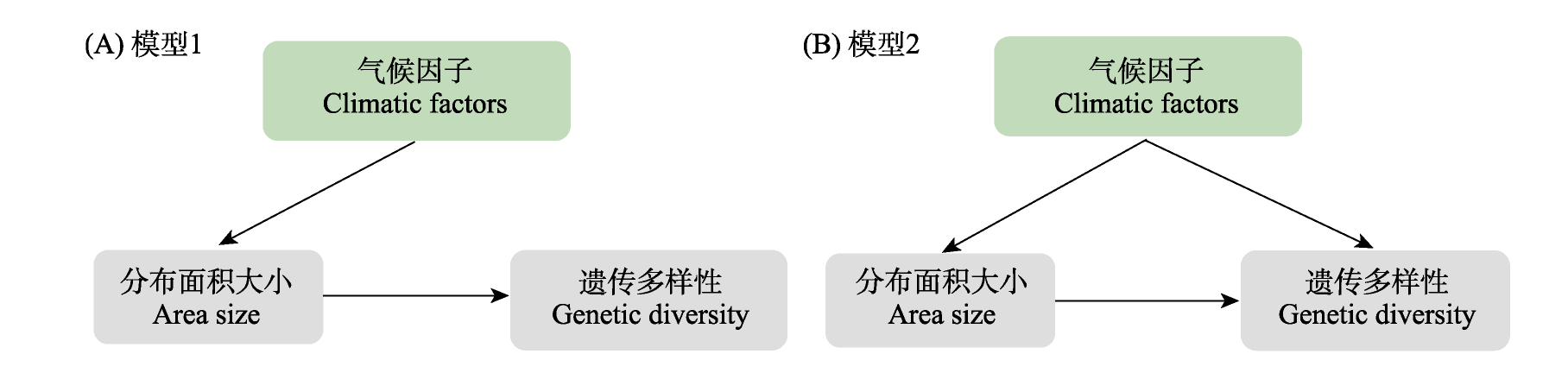
Fig. 1 Models tested by structural equation models of the relationships among genetic diversity, area size, and climatic factors. Black arrows indicate the relationships between each two factors. (A) Model 1: Climatic factors are directly associated with area size of species, while area size is directly associated with genetic diversity. (B) Model 2: Climatic factors are directly associated with both area size and genetic diversity, and area size is directly associated with genetic diversity.
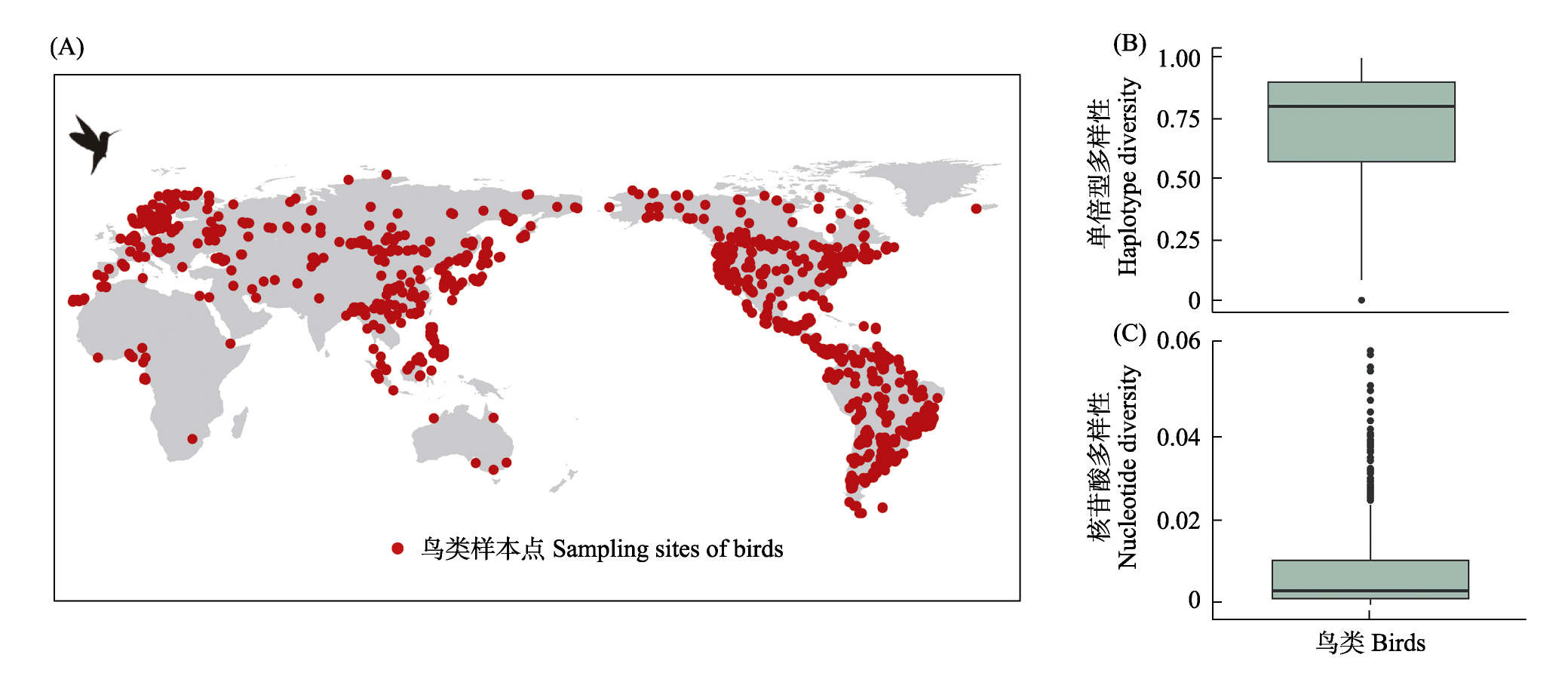
Fig. 2 The distributions of bird samples (A) and their haplotype diversity (B) and nucleotide diversity (C)
| 模型 Models | df | χ2 | P | AIC | BIC | |
|---|---|---|---|---|---|---|
| 单倍型多样性 Haplotype diversity | 模型1 Model 1 | 6 | 10.77 | > 0.05 | 2,231.8 | 2,270.5 |
| 模型2 Model 2 | 0 | 0 | 1 | 2,233.0 | 2,297.5 | |
| 核苷酸多样性 Nucleotide diversity | 模型1 Model 1 | 6 | 87.809 | < 0.05 | 2,230.8 | 2,269.6 |
| 模型2 Model 2 | 0 | 0 | 1 | 2,155.0 | 2,219.6 |
Table 1 Structural equation model results of birds
| 模型 Models | df | χ2 | P | AIC | BIC | |
|---|---|---|---|---|---|---|
| 单倍型多样性 Haplotype diversity | 模型1 Model 1 | 6 | 10.77 | > 0.05 | 2,231.8 | 2,270.5 |
| 模型2 Model 2 | 0 | 0 | 1 | 2,233.0 | 2,297.5 | |
| 核苷酸多样性 Nucleotide diversity | 模型1 Model 1 | 6 | 87.809 | < 0.05 | 2,230.8 | 2,269.6 |
| 模型2 Model 2 | 0 | 0 | 1 | 2,155.0 | 2,219.6 |
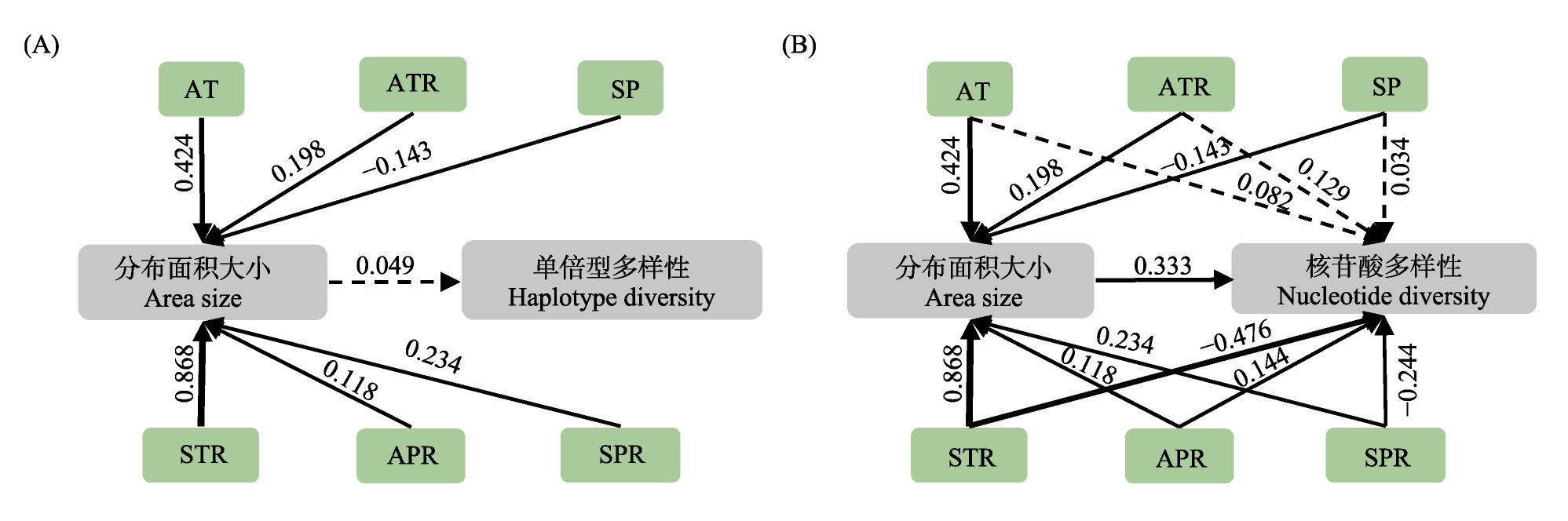
Fig. 3 The optimal structural equation model illustrating the relationships among climatic factors, area size, and genetic diversity (A, Haplotype diversity; B, Nucleotide diversity). Black solid/dashed arrows indicate correlations with significant/non-significant directions. The thickness of each line segment in the diagram is proportionally representative of the magnitude of the standardized path coefficient indicated adjacent to it. The climatic factors used in this study are annual temperature (AT), annual temperature range (ATR), temperature seasonality range (STR), annual precipitation range (APR), precipitation seasonality (SP), and precipitation seasonality range (SPR).
| 生态类群 Ecological groups | 模型1 Model 1 | 模型2 Model 2 | |||||||||
|---|---|---|---|---|---|---|---|---|---|---|---|
| df | χ2 | P | AIC | BIC | df | χ2 | P | AIC | BIC | ||
| 单倍型多样性 Haplotype diversity | 游禽 Natatores (n = 34) | 6 | 10.075 | > 0.05 | 148.732 | 162.469 | 0 | 0 | 1 | 150.657 | 173.552 |
| 涉禽 Wading birds (n = 40) | 6 | 10.986 | > 0.05 | 172.220 | 187.420 | 0 | 0 | 1 | 173.234 | 198.568 | |
| 陆禽 Landfowl (n = 30) | 6 | 4.882 | > 0.05 | 143.666 | 156.277 | 0 | 0 | 1 | 150.784 | 171.802 | |
| 攀禽 Climbing birds ( n = 73) | 6 | 10.601 | > 0.05 | 327.464 | 348.078 | 0 | 0 | 1 | 328.863 | 363.220 | |
| 猛禽 Raptors (n = 32) | 6 | 6.707 | > 0.05 | 130.392 | 143.584 | 0 | 0 | 1 | 135.685 | 157.671 | |
| 鸣禽 Songbirds (n = 377) | 6 | 5.264 | > 0.05 | 1,392.849 | 1,427.849 | 0 | 0 | 1 | 399.585 | 1,456.752 | |
| 核苷酸多样性 Nucleotide diversity | 游禽 Natatores (n = 34) | 6 | 6.020 | > 0.05 | 151.392 | 165.129 | 0 | 0 | 1 | 157.372 | 180.268 |
| 涉禽 Wading birds (n = 40) | 6 | 11.259 | > 0.05 | 170.348 | 185.548 | 0 | 0 | 1 | 171.089 | 196.422 | |
| 陆禽 Landfowl (n = 30) | 6 | 8.130 | > 0.05 | 138.462 | 151.073 | 0 | 0 | 1 | 142.332 | 163.350 | |
| 攀禽 Climbing birds (n = 73) | 6 | 21.202 | > 0.05 | 327.575 | 348.189 | 0 | 0 | 1 | 318.373 | 352.730 | |
| 猛禽 Raptors (n = 32) | 6 | 10.006 | > 0.05 | 129.977 | 143.169 | 0 | 0 | 1 | 131.972 | 153.958 | |
| 鸣禽 Songbirds (n = 377) | 6 | 71.636 | > 0.05 | 1,395.794 | 1,430.094 | 0 | 0 | 1 | 1,336.158 | 1,393.325 | |
Table 2 Results of the structural equation model for the six major ecological groups of birds
| 生态类群 Ecological groups | 模型1 Model 1 | 模型2 Model 2 | |||||||||
|---|---|---|---|---|---|---|---|---|---|---|---|
| df | χ2 | P | AIC | BIC | df | χ2 | P | AIC | BIC | ||
| 单倍型多样性 Haplotype diversity | 游禽 Natatores (n = 34) | 6 | 10.075 | > 0.05 | 148.732 | 162.469 | 0 | 0 | 1 | 150.657 | 173.552 |
| 涉禽 Wading birds (n = 40) | 6 | 10.986 | > 0.05 | 172.220 | 187.420 | 0 | 0 | 1 | 173.234 | 198.568 | |
| 陆禽 Landfowl (n = 30) | 6 | 4.882 | > 0.05 | 143.666 | 156.277 | 0 | 0 | 1 | 150.784 | 171.802 | |
| 攀禽 Climbing birds ( n = 73) | 6 | 10.601 | > 0.05 | 327.464 | 348.078 | 0 | 0 | 1 | 328.863 | 363.220 | |
| 猛禽 Raptors (n = 32) | 6 | 6.707 | > 0.05 | 130.392 | 143.584 | 0 | 0 | 1 | 135.685 | 157.671 | |
| 鸣禽 Songbirds (n = 377) | 6 | 5.264 | > 0.05 | 1,392.849 | 1,427.849 | 0 | 0 | 1 | 399.585 | 1,456.752 | |
| 核苷酸多样性 Nucleotide diversity | 游禽 Natatores (n = 34) | 6 | 6.020 | > 0.05 | 151.392 | 165.129 | 0 | 0 | 1 | 157.372 | 180.268 |
| 涉禽 Wading birds (n = 40) | 6 | 11.259 | > 0.05 | 170.348 | 185.548 | 0 | 0 | 1 | 171.089 | 196.422 | |
| 陆禽 Landfowl (n = 30) | 6 | 8.130 | > 0.05 | 138.462 | 151.073 | 0 | 0 | 1 | 142.332 | 163.350 | |
| 攀禽 Climbing birds (n = 73) | 6 | 21.202 | > 0.05 | 327.575 | 348.189 | 0 | 0 | 1 | 318.373 | 352.730 | |
| 猛禽 Raptors (n = 32) | 6 | 10.006 | > 0.05 | 129.977 | 143.169 | 0 | 0 | 1 | 131.972 | 153.958 | |
| 鸣禽 Songbirds (n = 377) | 6 | 71.636 | > 0.05 | 1,395.794 | 1,430.094 | 0 | 0 | 1 | 1,336.158 | 1,393.325 | |
| [1] |
Bellard C, Bertelsmeier C, Leadley P, Thuiller W, Courchamp F (2012) Impacts of climate change on the future of biodiversity. Ecology Letters, 15, 365-377.
DOI PMID |
| [2] |
Blomberg SP, Garland TJ, Ives AR (2003) Testing for phylogenetic signal in comparative data: Behavioral traits are more labile. Evolution, 57, 717-745.
DOI PMID |
| [3] |
Brambilla M, Scridel D, Bazzi G, Ilahiane L, Iemma A, Pedrini P, Bassi E, Bionda R, Marchesi L, Genero F, Teufelbauer N, Probst R, Vrezec A, Kmecl P, Mihelič T, Bogliani G, Schmid H, Assandri G, Pontarini R, Braunisch V, Arlettaz R, Chamberlain D (2020) Species interactions and climate change: How the disruption of species co-occurrence will impact on an avian forest guild. Global Change Biology, 26, 1212-1224.
DOI PMID |
| [4] |
Chapin III FS, Zavaleta ES, Eviner VT, Naylor RL, Vitousek PM, Reynolds HL, Hooper DU, Lavorel S, Sala OE, Hobbie SE, Mack MC, Díaz SM (2000) Consequences of changing biodiversity. Nature, 405, 234-242.
DOI |
| [5] | Chen IC, Hill JK, Ohlemüller R, Roy DB, Thomas CD (2011) Rapid range shifts of species associated with high levels of climate warming. Science, 333, 1024-1026. |
| [6] |
Cramer MJ, Willig MR (2005) Habitat heterogeneity, species diversity and null models. Oikos, 108, 209-218.
DOI URL |
| [7] |
De Kort H, Prunier JG, Ducatez S, Honnay O, Baguette M, Stevens VM, Blanchet S (2021) Life history, climate and biogeography interactively affect worldwide genetic diversity of plant and animal populations. Nature Communications, 12, 516.
DOI PMID |
| [8] | DeAngelis DL (1995) Relationships Between the Energetics of Species and Large-scale Species Richness. Springer, New York. |
| [9] |
Doyle JM, Hacking CC, Willoughby JR, Sundaram M, DeWoody JA (2015) Mammalian genetic diversity as a function of habitat, body size, trophic class, and conservation status. Journal of Mammalogy, 96, 564-572.
DOI URL |
| [10] |
Dziak JJ, Coffman DL, Lanza ST, Li RZ, Jermiin LS (2020) Sensitivity and specificity of information criteria. Briefings in Bioinformatics, 21, 553-565.
DOI PMID |
| [11] |
Evans MC, Jarman PJ (1999) Diets and feeding selectivities of bridled nailtail wallabies and black-striped wallabies. Wildlife Research, 26, 1-19
DOI URL |
| [12] |
Fan H, Zhang Q, Rao J, Cao J, Lu X (2019) Genetic diversity-area relationships across bird species. The American Naturalist, 194, 736-740.
DOI PMID |
| [13] |
Fan P, Fjeldså J, Liu X, Dong YF, Chang YB, Qu YH, Song G, Lei FM (2021) An approach for estimating haplotype diversity from sequences with unequal lengths. Methods in Ecology and Evolution, 12, 1658-1667.
DOI URL |
| [14] | Fan P, Song G, Qiao HJ, Zhang DZ, Ji YZ, Qu YH, Fjeldså J, Lei FM (2025) Revaluation of the genetic diversity-area relationship by integrating nucleotide and haplotype diversity. Current Zoology, doi: 10.1093/cz/zoae078. |
| [15] |
Fan P, Wen ZX, Song G (2025) The effect of climatic factors and anthropogenic activities on different genetic diversity indicators of amphibians and mammals. Biodiversity Science, 33, 25022. (in Chinese with English abstract)
DOI |
|
[范平, 温知新, 宋刚 (2025) 气候因子和人类活动对两栖及哺乳动物不同遗传多样性指标的影响. 生物多样性, 33, 25022.]
DOI |
|
| [16] |
Gillman LN, Wright SD (2014) Species richness and evolutionary speed: The influence of temperature, water and area. Journal of Biogeography, 41, 39-51.
DOI URL |
| [17] |
Graham RW, Lundelius EL, Graham MA, Schroeder EK, Toomey RS, Anderson E, Barnosky AD, Burns JA, Churcher CS, Grayson DK, Guthrie RD, Harington CR, Jefferson GT, Martin LD, McDonald HG, Morlan RE, Semken HA, Webb SD, Werdelin L, Wilson MC (1996) Spatial response of mammals to late quaternary environmental fluctuations. Science, 272, 1601-1606.
PMID |
| [18] |
Grant W, Bowen B (1998) Shallow population histories in deep evolutionary lineages of marine fishes: Insights from sardines and anchovies and lessons for conservation. Journal of Heredity, 89, 415-426.
DOI URL |
| [19] |
Gratton P, Marta S, Bocksberger G, Winter M, Trucchi E, Kühl H (2017) A world of sequences: Can we use georeferenced nucleotide databases for a robust automated phylogeography? Journal of Biogeography, 44, 475-486.
DOI URL |
| [20] | Haberl H, Erb KH, Krausmann F, Gaube V, Bondeau A, Plutzar C, Gingrich S, Lucht W, Fischer-Kowalski M (2007) Quantifying and mapping the human appropriation of net primary production in earth’s terrestrial ecosystems. Proceedings of the National Academy of Sciences, USA, 104, 12942-12947. |
| [21] |
Hewitt GM (1996) Some genetic consequences of ice ages, and their role in divergence and speciation. Biological Journal of the Linnean Society, 58, 247-276.
DOI URL |
| [22] |
Hijmans RJ, Cameron SE, Parra JL, Jones PG, Jarvis A (2005) Very high resolution interpolated climate surfaces for global land areas. International Journal of Climatology, 25, 1965-1978.
DOI URL |
| [23] | Hof C (2021) Towards more integration of physiology, dispersal and land-use change to understand the responses of species to climate change. The Journal of Experimental Biology, 224, jeb238352. |
| [24] | Hofreiter M, Rödder D, Lawing AM, Flecks M, Ahmadzadeh F, Dambach J, Engler JO, Habel JC, Hartmann T, Hörnes D, Ihlow F, Schidelko K, Stiels D, Polly PD (2013) Evaluating the significance of paleophylogeographic species distribution models in reconstructing quaternary range-shifts of Nearctic chelonians. PLoS ONE, 8, e72855. |
| [25] |
Huston MA (1979) A general hypothesis of species diversity. The American Naturalist, 113, 81-101.
DOI URL |
| [26] |
Janzen DH (1967) Why mountain passes are higher in the tropics. The American Naturalist, 101, 233-249.
DOI URL |
| [27] |
Lefcheck JS (2016) piecewiseSEM: Piecewise structural equation modelling in R for ecology, evolution, and systematics. Methods in Ecology and Evolution, 7, 573-579.
DOI URL |
| [28] | Lv L, van de Pol M, Osmond HL, Liu Y, Cockburn A, Kruuk LEB (2023) Winter mortality of a passerine bird increases following hotter summers and during winters with higher maximum temperatures. Science Advances, 9, eabm0197. |
| [29] |
McDonald KW, McClure CJW, Rolek BW, Hill GE (2012) Diversity of birds in eastern North America shifts north with global warming. Ecology and Evolution, 2, 3052-3060.
DOI PMID |
| [30] |
McGlaughlin ME, Wallace LE, Wheeler GL, Bresowar G, Riley L, Britten NR, Helenurm K (2014) Do the island biogeography predictions of MacArthur and Wilson hold when examining genetic diversity on the near mainland California Channel Islands? Examples from endemic Acmispon (Fabaceae). Botanical Journal of the Linnean Society, 174, 289-304.
DOI URL |
| [31] |
Meng LH, Chen G, Li ZH, Yang YP, Wang ZK, Wang LY (2015) Refugial isolation and range expansions drive the genetic structure of Oxyria sinensis (Polygonaceae) in the Himalaya-Hengduan Mountains. Scientific Reports, 5, 10396.
DOI |
| [32] |
Mimura M, Yahara T, Faith DP, Vázquez-Domínguez E, Colautti RI, Araki H, Javadi F, Núñez-Farfán J, Mori AS, Zhou SL, Hollingsworth PM, Neaves LE, Fukano Y, Smith GF, Sato YI, Tachida H, Hendry AP (2017) Understanding and monitoring the consequences of human impacts on intraspecific variation. Evolutionary Applications, 10, 121-139.
DOI PMID |
| [33] |
Miraldo A, Li S, Borregaard MK, Flórez-Rodríguez A, Gopalakrishnan S, Rizvanovic M, Wang ZH, Rahbek C, Marske KA, Nogués-Bravo D (2016) An Anthropocene map of genetic diversity. Science, 353, 1532-1535.
PMID |
| [34] |
Neto EDC, de Oliveira VM, Rosas A, Campos PRA (2011) The effect of spatially correlated environments on genetic diversity-area relationships. Journal of Theoretical Biology, 288, 57-65.
DOI PMID |
| [35] | Pimm SL, Jenkins CN, Abell R, Brooks TM, Gittleman JL, Joppa LN, Raven PH, Roberts CM, Sexton JO (2014) The biodiversity of species and their rates of extinction, distribution, and protection. Science, 344, 1246752. |
| [36] |
Qu YH, Ericson PGP, Quan Q, Song G, Zhang RY, Gao B, Lei FM (2014) Long-term isolation and stability explain high genetic diversity in the Eastern Himalaya. Molecular Ecology, 23, 705-720.
PMID |
| [37] |
Romiguier J, Gayral P, Ballenghien M, Bernard A, Cahais V, Chenuil A, Chiari Y, Dernat R, Duret L, Faivre N, Loire E, Lourenco JM, Nabholz B, Roux C, Tsagkogeorga G, Weber AAT, Weinert LA, Belkhir K, Bierne N, Glémin S, Galtier N (2014) Comparative population genomics in animals uncovers the determinants of genetic diversity. Nature, 515, 261-263.
DOI |
| [38] | Sillero N, Huey RB, Gilchrist G, Rissler L, Pascual M (2020) Distribution modelling of an introduced species:Do adaptive genetic markers affect potential range? Proceedings of the Royal Society B: Biological Sciences, 287, 20201791. |
| [39] |
Slatyer RA, Hirst M, Sexton JP (2013) Niche breadth predicts geographical range size: A general ecological pattern. Ecology Letters, 16, 1104-1114.
DOI PMID |
| [40] |
Stein CM, Morris NJ, Nock NL (2012). Structural equation modeling. Methods in Molecular Biology, 850, 495-512.
DOI PMID |
| [41] |
Tajima F (1983) Evolutionary relationship of DNA sequences in finite populations. Genetics, 105, 437-460.
DOI PMID |
| [42] |
Tajima F (1993) Statistical analysis of DNA polymorphism. The Japanese Journal of Genetics, 68, 567-595.
DOI URL |
| [43] |
Tang ZY, Qiao XJ, Fang JY (2009) Species-area relationship in biological communities. Biodiversity Science, 17, 549-559. (in Chinese with English abstract)
DOI URL |
|
[唐志尧, 乔秀娟, 方精云 (2009) 生物群落的种-面积关系. 生物多样性, 17, 549-559.]
DOI |
|
| [44] | Teixeira JC, Huber CD (2021) The inflated significance of neutral genetic diversity in conservation genetics. Proceedings of the National Academy of Sciences, USA, 118, e2015096118. |
| [45] |
Theodoridis S, Fordham DA, Brown SC, Li S, Rahbek C, Nogues-Bravo D (2020) Evolutionary history and past climate change shape the distribution of genetic diversity in terrestrial mammals. Nature Communications, 11, 2557.
DOI PMID |
| [46] |
Virkkala R, Lehikoinen A (2017) Birds on the move in the face of climate change: High species turnover in northern Europe. Ecology and Evolution, 7, 8201-8209.
DOI PMID |
| [47] |
Voelker G, Wogan GOU, Huntley JW, Kaliba PM, DE Swardt DH, Bowie RCK (2025) Climate cycling did not affect haplotype distribution in an abundant Southern African avian habitat generalist species, the familiar chat (Oenanthe familiaris). Integrative Zoology, 20, 595-607.
DOI URL |
| [48] |
Wang SP, Zhu W, Gao X, Li XP, Yan SF, Liu X, Yang J, Gao ZX, Li YM (2014) Population size and time since island isolation determine genetic diversity loss in insular frog populations. Molecular Ecology, 23, 637-648.
DOI PMID |
| [49] | Zillig MW, Brooks W, Fleishman E (2024) Shifts in elevational distributions of montane birds in an arid ecosystem. Ecography, 2024, e06780. |
| [1] | Bing Xie, Haitao Yang, Jixin Cao, Jinyu Li, Maoliang Wang, Wei Zhang, Jianqiang Li, Jiliang Xu. LiDAR-based investigation of the mechanisms governing nocturnal roost selection by crows in the Beijing urban area [J]. Biodiv Sci, 2026, 34(5): 26004-. |
| [2] | Shixian Li, Gang Feng. Latitudinal patterns of species range size of birds in China: A test of Rapoport’s rule [J]. Biodiv Sci, 2026, 34(3): 25274-. |
| [3] | Haoyou Zhu, Youbing Zhou, Yi Luo, Zhaomin Zhou. Changes in breeding bird community in an urban area of Nanchong over two decades [J]. Biodiv Sci, 2026, 34(3): 24560-. |
| [4] | Ya Gao, Qi Liu, Minfeng Liu, Ruixia Ma, Fuzhao Huang, Dongxing Li, Wusheng Xiang, Tao Ding, Bin Wang, Xiankun Li, Yili Guo. Spatiotemporal dynamics of litterfall production and driving factors in the Fangcheng seasonal rainforest, Guangxi [J]. Biodiv Sci, 2026, 34(1): 25326-. |
| [5] | Shuangqi Liu, Fangyuan Hua, Fang Xia, Liangliang Yan, Fang Yu, Hong Ye, Peng Peng, Dongyuan Zhang, Xueyan Guan, Jianping Fu, Xuan Liang, Xiaoru Hou, Xiaoyang Li, Xinru Zhao. Stopover habitat quality of urban green space for migratory landbirds and the impact of urban wilding measures [J]. Biodiv Sci, 2024, 32(8): 24046-. |
| [6] | Qiong Wu, Zixi Zhao, Taozhu Sun, Yumeng Zhao, Cong Yu, Qin Zhu, Zhongqiu Li. Impact of urban road characteristics and natural landscapes on animal vehicle collisions: A case study in Nanjing [J]. Biodiv Sci, 2024, 32(8): 24141-. |
| [7] | Zhiqing Hu, Lu Dong. Effects of urbanization on interspecific interactions involving birds [J]. Biodiv Sci, 2024, 32(8): 24048-. |
| [8] | Yiyun Gu, Jiaqi Xue, Jinhui Gao, Xinyi Xie, Ming Wei, Jinyu Lei, Cheng Wen. A public science data-based regional bird diversity assessment method [J]. Biodiv Sci, 2024, 32(7): 24080-. |
| [9] | Baican Li, Junguo Zhang, Changchun Zhang, Lifeng Wang, Jiliang Xu, Li Liu. Rare bird recognition method in Beijing based on TC-YOLO model [J]. Biodiv Sci, 2024, 32(5): 24056-. |
| [10] | Peng Wang, Jiarong Sui, Xinyao Ding, Weizhong Wang, Xueqian Cao, Haipeng Zhao, Yanping Wang. Nested distribution patterns of bird assemblages and their influencing factors in Zhengzhou urban parks [J]. Biodiv Sci, 2024, 32(3): 23359-. |
| [11] | Juan Tan, Dandan Zhu, Qing Wang, Min Wang. Application of passive acoustic technology in monitoring bird diversity in urban park green space: A case study of Chunshen Park in Minhang District, Shanghai [J]. Biodiv Sci, 2024, 32(10): 24262-. |
| [12] | Xiaohu Shen, Guanyu Li, Hongfei Shi, Chuanzhi Wang. Ensemble learning strategy for birdsong recognition under data imbalance [J]. Biodiv Sci, 2024, 32(10): 24215-. |
| [13] | Yuqi Liu, Jinglan Liu, Xiaoli Fan, Yishen Hu, Hongxiao Guo, Fan Xue. Perceived birdsong diversity and restorativeness effect of soundscape: Interventions of birdsong audio and messaging [J]. Biodiv Sci, 2024, 32(1): 23230-. |
| [14] | Jiajia Chen, Zhen Pu, Zhonghong Huang, Fengqin Yu, Jianjun Zhang, Donghua Xu, Junquan Xu, Peng Shang, Dilimulati·Parhati, Yaojiang Li, Jigme Tshering, Yumin Guo. Global distribution and number of overwintering black-necked crane (Grus nigricollis) [J]. Biodiv Sci, 2023, 31(6): 22400-. |
| [15] | Xiaocheng Chen, Pengzhan Zhang, Bin Kang, Linshan Liu, Liang Zhao. Species and functional diversity of the passerine birds in the Tibetan Plateau based on specimens from the collection of Northwest Institute of Plateau Biology, Chinese Academy of Sciences [J]. Biodiv Sci, 2023, 31(5): 22638-. |
| Viewed | ||||||
|
Full text |
|
|||||
|
Abstract |
|
|||||
Copyright © 2026 Biodiversity Science
Editorial Office of Biodiversity Science, 20 Nanxincun, Xiangshan, Beijing 100093, China
Tel: 010-62836137, 62836665 E-mail: biodiversity@ibcas.ac.cn

