

Biodiv Sci ›› 2025, Vol. 33 ›› Issue (11): 25101. DOI: 10.17520/biods.2025101 cstr: 32101.14.biods.2025101
• Original Papers: Plant Diversity • Previous Articles Next Articles
Yingni Wang, Jingjing Lei, Yuxin Bao, Dan Liao, Xinna Zhang( ), Juan Wang*()(
 )
)
Received:2025-03-24
Accepted:2025-09-19
Online:2025-11-20
Published:2025-11-21
Contact:
Juan Wang
Supported by:Yingni Wang, Jingjing Lei, Yuxin Bao, Dan Liao, Xinna Zhang, Juan Wang. Divergent of sexual systems in impacting the spatial distribution patterns of dominant tree species within natural coniferous-broadleaf mixed forests in Northeast China[J]. Biodiv Sci, 2025, 33(11): 25101.
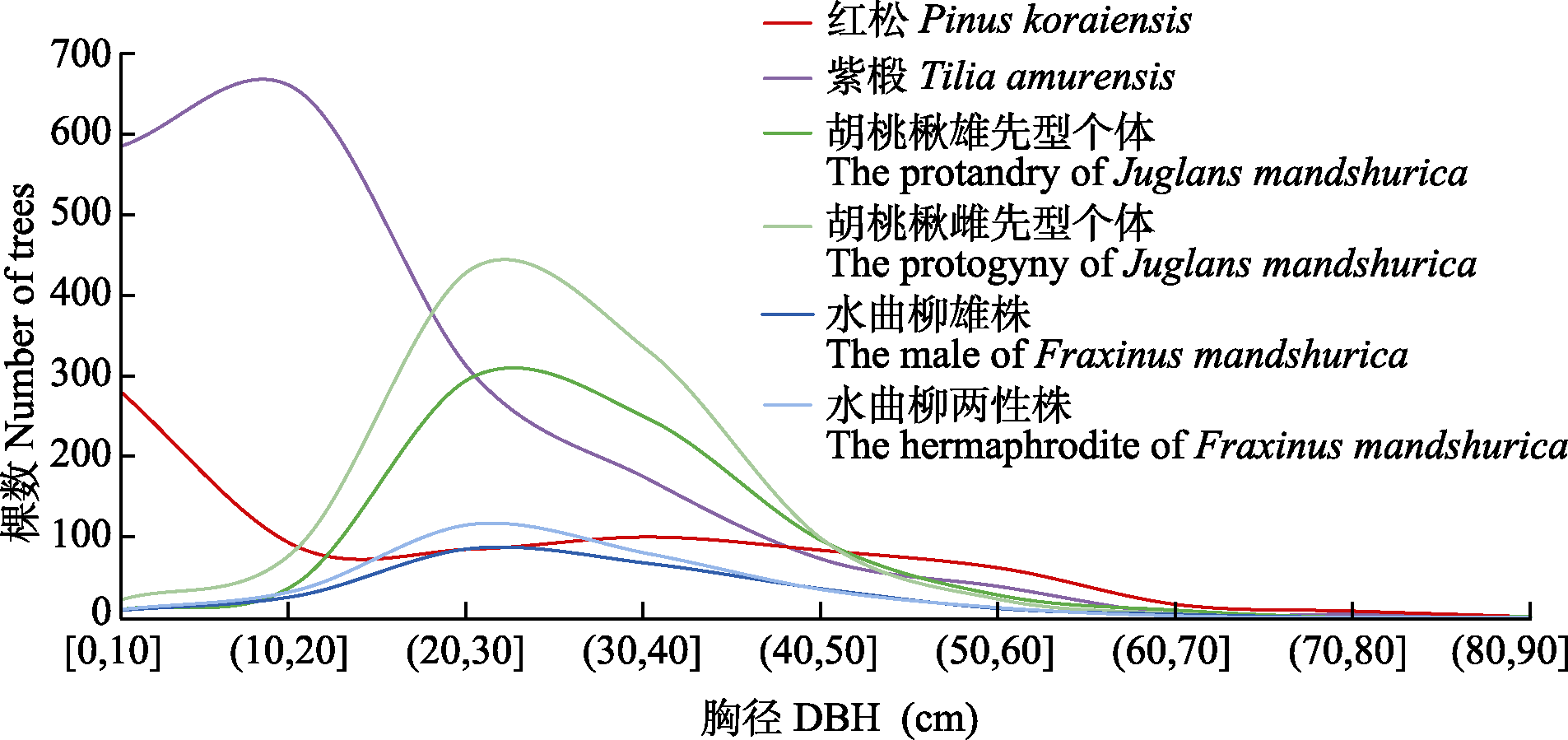
Fig. 1 Overview of sizes of dominant tree species of Pinus koraiensis, Tilia amurensis, Juglans mandshurica, and Fraxinus mandshurica in natural coniferous-broadleaf mixed forests in Northeast China
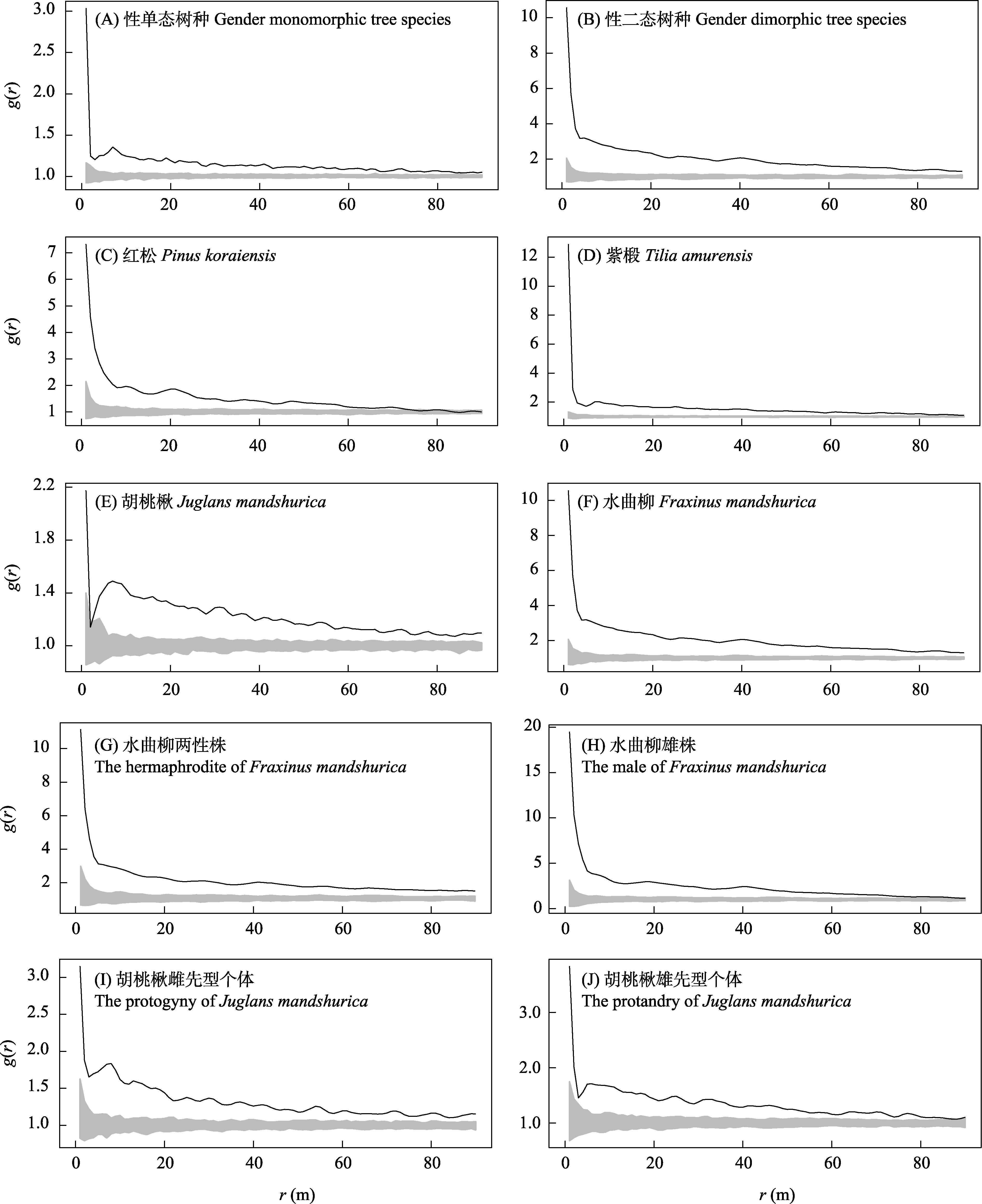
Fig. 2 Spatial distribution pattern of dominant tree species in natural coniferous-broadleaf mixed forests in northeast China. (A) Gender monomorphic tree species; (B) Gender dimorphic tree species; (C) Pinus koraiensis; (D) Tilia amurensis; (E) Juglans mandshurica; (F) Fraxinus mandshurica; (G) The hermaphrodite of Fraxinus mandshurica; (H) The male of Fraxinus mandshurica; (I) The protogyny of Juglans mandshurica; (J) The protandry of Juglans mandshurica. Black solid lines indicated the values of g(r), and the gray area is the confidence interval constructed using the 199 simulations.
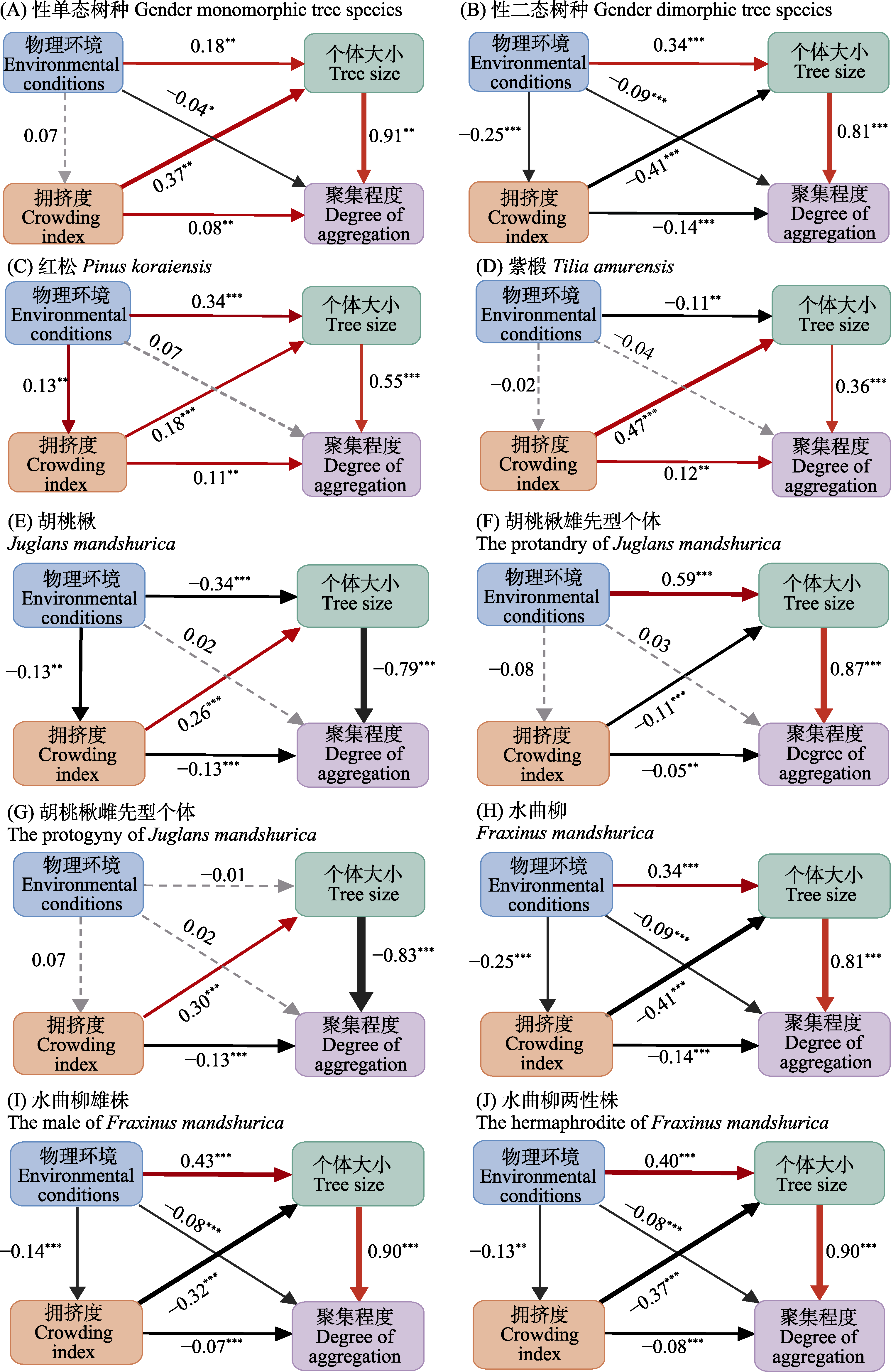
Fig. 3 Structural equation modeling models of the impact of three types of ecological factors on the distribution of the different tree species. (A) Gender monomorphic tree species; (B) Gender dimorphic tree species; (C) Pinus koraiensis; (D) Tilia amurensis; (E) Juglans mandshurica; (F) The protandry of Juglans mandshurica; (G) The protogyny of Juglans mandshurica; (H) Fraxinus mandshurica; (I) The male of Fraxinus mandshurica; (J) The hermaphrodite of Fraxinus mandshurica. Solid red, black, and dashed lines represent positive, negative, and non-significant paths, respectively. Standardized path coefficients are indicated near the arrow lines, and thickness of the path indicates the absolute value of standardized path coefficients. *, P < 0.05; *, P < 0.01; ***, P < 0.001.
| [1] | Allen M, Poggiali D, Whitaker K, Marshall TR, van Langen J, Kievit RA (2021) Raincloud plots: A multi-platform tool for robust data visualization. Welcome Open Research, 21, 63. |
| [2] |
Andrieu E, Debussche M, Thompson JD (2007) Size-dependent reproduction and gender modification in the hermaphroditic perennial plant Paeonia officinalis. International Journal of Plant Sciences, 168, 435-441.
DOI URL |
| [3] | Ban Y (1995) Evolution of life history strategy in plants. Chinese Journal of Ecology, 14(3), 33-39. (in Chinese with English abstract) |
| [ 班勇 (1995) 植物生活史对策的进化. 生态学杂志, 14(3), 33-39.] | |
| [4] | Bao GD, Liu T, Zhang ZH, Ren ZB, Zhai C, Ding MM, Jiang XF (2024) Remote sensing inversion of effective leaf area index of four coniferous forest types and their spatial distribution rule in Changbai Mountain. Scientia Silvae Sinicae, 60(5), 127-138. (in Chinese with English abstract) |
| [ 包广道, 刘婷, 张忠辉, 任志彬, 翟畅, 丁铭铭, 姜雪菲 (2024) 长白山区4种针叶林有效叶面积指数遥感精细反演及空间分布规律. 林业科学, 60(5), 127-138.] | |
| [5] |
Barrett SCH (1998) The evolution of mating strategies in flowering plants. Trends in Plant Science, 3, 335-341.
DOI URL |
| [6] |
Brown JH, Maurer BA (1986) Body size, ecological dominance and Cope’s rule. Nature, 324, 248-250.
DOI |
| [7] |
Chen J, Li CY (2014) Sex-specific responses to environmental stresses and sexual competition of dioecious plants. Chinese Journal of Applied and Environmental Biology, 20, 743-750. (in Chinese with English abstract)
DOI URL |
| [ 陈娟, 李春阳 (2014) 环境胁迫下雌雄异株植物的性别响应差异及竞争关系. 应用与环境生物学报, 20, 743-750.] | |
| [8] | Chen L, Zhao XH, Zhang Y (2009) Spatial distribution patterns and associations of Pinus koraiensis and Tilia amurensis in Tilia-Korean pine forest on the north slope of Changbai Mountain, northeastern China. Journal of Beijing Forestry University, 31(3), 6-10. (in Chinese with English abstract) |
| [ 陈列, 赵秀海, 张赟 (2009) 长白山北坡椴树红松林空间分布及其空间关联. 北京林业大学学报, 31(3), 6-10.] | |
| [9] |
Condit R, Ashton PS, Baker P, Bunyavejchewin S, Gunatilleke S, Gunatilleke N, Hubbell SP, Foster RB, Itoh A, LaFrankie JV, Lee HS, Losos E, Manokaran N, Sukumar R, Yamakura T (2000) Spatial patterns in the distribution of tropical tree species. Science, 288, 1414-1418.
DOI PMID |
| [10] | Cong RD, Qin SL, Jin GZ (2022) Effects of micro-topography on the distribution and growth of two forms of Korean pine with coarse bark and fine bark. Scientia Silvae Sinicae, 58(12), 1-11. (in Chinese with English abstract) |
| [ 丛日荻, 秦树林, 金光泽 (2022) 微地形对粗皮红松和细皮红松分布与生长的影响. 林业科学, 58(12), 1-11.] | |
| [11] |
Da RH, Fan CY, Zhang CY, Zhao XH, von Gadow K (2023) Are absorptive root traits good predictors of ecosystem functioning? A test in a natural temperate forest. New Phytologist, 239, 75-86.
DOI URL |
| [12] | Darwin CR (1859) On the Origin of Species by Means of Natural Selection, or the Preservation of Favoured Races in the Struggle for Life. John Murray, London. |
| [13] | Darwin CR (1877) The Different Forms of Flowers on Plants of the Same Species. John Murray, London. |
| [14] |
Dawson TE, Bliss LC (1989) Patterns of water use and the tissue water relations in the dioecious shrub, Salix arctica: The physiological basis for habitat partitioning between the sexes. Oecologia, 79, 332-343.
DOI PMID |
| [15] | Delecti Florae Reipublicae Popularis Sinicae Agendae Academiae Sinicae (1959- 2004) Flora Reipublicae Popularis Sinicae, Tomus 1- 80. Science Press, Beijing. (in Chinese) |
| [ 中国科学院中国植物志编辑委员会 (1959- 2004) 中国植物志(第1-80卷). 科学出版社, 北京.] | |
| [16] | Dellaporta SL, Calderon-Urrea A (1993) Sex determination in flowering plants. The Plant Cell, 5, 1241-1251. |
| [17] |
Delph LF (1990) Sex-differential resource allocation patterns in the subdioecious shrub hebe subalpina. Ecology, 71, 1342-1351.
DOI URL |
| [18] |
Dong TF, Li JY, Liao YM, Chen BJW, Xu X (2017) Root-mediated sex recognition in a dioecious tree. Scientific Reports, 7, 801.
DOI PMID |
| [19] | Fan CN, Zheng JP, Han SJ, Guo ZL, Wang LL, Zhou ZZ (2017) Resource distribution and ecological characteristics of Fraxinus mandshurica in central-eastern forest region of Jilin Province, northeastern China. Journal of Beijing Forestry University, 39(4), 1-11. (in Chinese with English abstract) |
| [ 范春楠, 郑金萍, 韩士杰, 郭忠玲, 王丽丽, 周振钊 (2017) 吉林省中东部森林分布区水曲柳分布及其生态特征. 北京林业大学学报, 39(4), 1-11.] | |
| [20] | Fan ZQ, Shen HL, Wang QC, Wang ZQ, Zhang YD (2002) Study on the site conditions suitable for young plantation of Fraxinus mandshurica. Scientia Silvae Sinicae, 38(2), 38-43. (in Chinese with English abstract) |
| [ 范志强, 沈海龙, 王庆成, 王政权, 张彦东 (2002) 水曲柳幼林适生立地条件研究. 林业科学, 38(2), 38-43.] | |
| [21] |
Ge XY, Zhu BR, Liao WJ (2012) Male biased sex allocation with plant size in gynomonoecious Aster ageratoides. Biodiversity Science, 20, 386-390. (in Chinese with English abstract)
DOI |
|
[ 戈星月, 朱璧如, 廖万金 (2012) 雌全同株植物三脉紫菀花期偏雄的个体大小依赖的性别分配. 生物多样性, 20, 386-390.]
DOI |
|
| [22] | Gong QB, Li ZM, Peng DL, Niu Y, Sun H, Zhang ZQ (2015) Male flowers and relationship between plant size and sex expression in herbaria of Nomocharis species (Liliaceae). Plant Diversity and Resources, 37, 11-20. (in Chinese with English abstract) |
| [ 龚强帮, 李志敏, 彭德力, 牛洋, 孙航, 张志强 (2015) 利用腊叶标本初探豹子花属植物的性表达及其与个体大小的关系. 植物分类与资源学报, 37, 11-20.] | |
| [23] |
Gremer JR (2023) Looking to the past to understand the future: Linking evolutionary modes of response with functional and life history traits in variable environments. New Phytologist, 237, 751-757.
DOI URL |
| [24] |
Guo YL, Wang B, Xiang WS, Ding T, Lu SH, Huang YS, Huang FZ, Li DX, Li XK (2015) Spatial distribution of tree species in a tropical karst seasonal rainforest in Nonggang, Guangxi, southern China. Biodiversity Science, 23, 183-191. (in Chinese with English abstract)
DOI |
|
[ 郭屹立, 王斌, 向悟生, 丁涛, 陆树华, 黄俞淞, 黄甫昭, 李冬兴, 李先琨 (2015) 广西弄岗北热带喀斯特季节性雨林监测样地种群空间点格局分析. 生物多样性, 23, 183-191.]
DOI |
|
| [25] | Guo ZL, Song XT, Fan CN, Liu D, Guo MY, Zhang YX (2022) Analysis of spatial distribution and life structure characteristics of Tilia amurensis natural population. Journal of Beihua University (Natural Science), 23, 726-732. (in Chinese with English abstract) |
| [ 郭忠玲, 宋雪婷, 范春楠, 刘丹, 郭梦媛, 张永鑫 (2022) 紫椴天然种群空间分布与生命结构特征分析. 北华大学学报(自然科学版), 23, 726-732.] | |
| [26] | Han YZ, Wang ZQ (2002) Spatial pattern of manchurian ash seed dispersal in secondary hardwood forests. Acta Phytoecologica Sinica, 26, 51-57. (in Chinese with English abstract) |
| [ 韩有志, 王政权 (2002) 天然次生林中水曲柳种子的扩散格局. 植物生态学报, 26, 51-57.] | |
| [27] | He XX, Ümüt H, Dong ZW, Asadilla Y, Alishir K (2023) Spatial distribution pattern and intraspecific competition of Populus euphratica riparian forests under different water gradients. Acta Ecologica Sinica, 43, 7497-7506. (in Chinese with English abstract) |
| [ 何熙祥, 玉米提·哈力克, 董宗炜, 艾萨迪拉·玉苏甫, 艾里西尔·库尔班, (2023) 水分梯度下胡杨荒漠河岸林种内竞争及空间格局变化特征. 生态学报, 43, 7497-7506.] | |
| [28] |
Huang JH, Liu YB, Wang YM, Huang PP, Dong TF (2025) Response of female and male mulberry seedlings to neighbors with different genders. Chinese Journal of Ecology, 44, 720-727. (in Chinese with English abstract)
DOI |
| [ 黄俊翰, 刘一伯, 王雅蔓, 黄平平, 董廷发 (2025) 雌雄桑树幼苗对不同性别邻株的响应. 生态学杂志, 44, 720-727.] | |
| [29] | Huang P, Mao X, Han G, Chen XL, Fu XX (2018) Dynamic changes of nutrients during flora development in heterodichogamous Cyclocarya paliurus. Journal of Nanjing Forestry University (Natural Sciences Edition), 42(5), 1-9. (in Chinese with English abstract) |
|
[ 黄鹏, 毛霞, 韩歌, 陈小玲, 洑香香 (2018) 雌雄异型异熟青钱柳花发育过程中养分的动态变化. 南京林业大学学报(自然科学版), 42(5), 1-9.]
DOI |
|
| [30] |
Kimura MK, Goto S, Suyama Y, Matsui M, Woeste K, Seiwa K (2012) Morph-specific mating patterns in a low-density population of a heterodichogamous tree, Juglans ailantifolia. Plant Ecology, 213, 1477-1487.
DOI URL |
| [31] |
Klinkhamer PGL, de Jong TJ, Metz H (1997) Sex and size in cosexual plants. Trends in Ecology & Evolution, 12, 260-265.
DOI URL |
| [32] |
Kobayashi K (2019) Sexual selection sustains biodiversity via producing negative density-dependent population growth. Journal of Ecology, 107, 1433-1438.
DOI |
| [33] |
Kobe RK, Vriesendorp CF (2011) Conspecific density dependence in seedlings varies with species shade tolerance in a wet tropical forest. Ecology Letters, 14, 503-510.
DOI PMID |
| [34] |
Laporte MM, Delph LF (1996) Sex-specific physiology and source-sink relations in the dioecious plant Silene latifolia. Oecologia, 106, 63-72.
DOI PMID |
| [35] |
Lebrija-Trejos E, Reich PB, Hernández A, Wright SJ (2016) Species with greater seed mass are more tolerant of conspecific neighbours: A key driver of early survival and future abundances in a tropical forest. Ecology Letters, 19, 1071-1080.
DOI PMID |
| [36] |
Levin DA (2010) Environment-enhanced self-fertilization: Implications for niche shifts in adjacent populations. Journal of Ecology, 98, 1276-1283.
DOI URL |
| [37] | Li C, Luo P, Li ZQ (2017) Spatial heterogeneity of diameter at breast height growth for Korean pine natural forest and its relationships with terrain factors. Journal of Nanjing Forestry University (Natural Sciences Edition), 41(1), 129-135. (in Chinese with English abstract) |
|
[ 李程, 罗鹏, 李志清 (2017) 红松天然林胸径生长的空间异质性及其与地形的关系. 南京林业大学学报(自然科学版), 41(1), 129-135.]
DOI |
|
| [38] | Li JF, Gao HC, Yin GS, Liang ZY, Yang XH, Zhai SH (2025) Population spatial pattern and intraspecific correlation of the rare and endangered aquatic plant Ottelia acuminata var. jingxiensis. Chinese Journal of Ecology, 44, 2150-2156. (in Chinese with English abstract) |
| [ 李峻峰, 高鸿灿, 殷根深, 梁梓煜, 杨晓虹, 翟书华 (2025) 珍稀濒危水生植物靖西海菜花的种群空间格局与种内关联性. 生态学杂志, 44, 2150-2156.] | |
| [39] |
Li JZ, Zhang MM, Wu JW, Qin BT, Liu CP, Zhang LJ (2024) Identification and analysis of key miRNA for sex differentiation in hermaphroditic Juglans mandshurica Maxim. Plant Molecular Biology Reporter, 43, 777-793.
DOI |
| [40] | Li SM (2023) Study on the Mechanism of Differential Responses to Lead and Zinc Stress in Female and Male Litsea cubeba. PhD dissertation, Central South University of Forestry and Technology, Changsha. (in Chinese with English abstract) |
| [ 李斯濛 (2023) 山苍子雌雄株对铅锌胁迫差异响应机制研究. 博士学位论文, 中南林业科技大学, 长沙.] | |
| [41] |
Li W, Wei X, Wei QY, Wu CZ (2025) Role of stand density in shaping interactions and growth strategies of dioecious tree species: A case study of Fraxinus mandshurica. Forests, 16, 639.
DOI URL |
| [42] |
Liao D, Wang YT, Lei JJ, Wang YN, Zhang XN, Wang J (2024) Gender-specific responses to interspecific competition in the dioecious clonal plant Acer barbinerve. Chinese Journal of Plant Ecology, 48, 1623-1636. (in Chinese with English abstract)
DOI URL |
|
[ 廖丹, 王艺彤, 雷晶晶, 王映霓, 张新娜, 王娟 (2024) 雌雄异株克隆植物髭脉槭对种间竞争的性别差异响应. 植物生态学报, 48, 1623-1636.]
DOI |
|
| [43] | Liao J (2020) Sex-related Physiological Responses and Molecular Mechanisms of Salix paraplesia to Warming. PhD dissertation, Institute of Mountain Hazards and Environment, Chinese Academy of Sciences, Chengdu. (in Chinese with English abstract) |
| [ 廖君 (2020) 雌雄康定柳(Salix paraplesia)对增温的差异响应及分子机制. 博士学位论文, 中国科学院水利部成都山地灾害与环境研究所, 成都.] | |
| [44] | Liu JJ, Mao X, Li XC, Fu XX (2016) A review on flowering mechanism in heterodichogamous plants. Journal of Nanjing Forestry University (Natural Sciences Edition), 40(1), 147-154. (in Chinese with English abstract) |
|
[ 刘晶晶, 毛霞, 李晓春, 洑香香 (2016) 雌雄异型异熟植物的开花机制研究进展. 南京林业大学学报(自然科学版), 40(1), 147-154.]
DOI |
|
| [45] |
Liu M, Korpelainen H, Li CY (2021) Sexual differences and sex ratios of dioecious plants under stressful environments. Journal of Plant Ecology, 14, 920-933.
DOI |
| [46] | Liu YJ, Wang TJ, Liu XT, Li XT, Zhang L (2025) Spatial pattern and correlation of endangered plant Amygdalus mongolica in different environment. Journal of Inner Mongolia University (Natural Science Edition), 56(2), 187-195. (in Chinese with English abstract) |
| [ 刘雅洁, 王铁娟, 刘晓婷, 李晓田, 张丽 (2025) 不同环境条件下濒危植物蒙古扁桃种群分布格局及其关联性. 内蒙古大学学报(自然科学版), 56(2), 187-195.] | |
| [47] | Liu ZL, Lü YD, Yao Y, Liu JM, Wen AT, Qi YH (2020) Comparative study on growth of natural secondary forests of Juglans mandshurica Maxim. with different densities. Forest Investigation Design, 49(2), 44-54. (in Chinese with English abstract) |
| [ 刘忠玲, 吕跃东, 姚颖, 刘建明, 温爱亭, 祁永会 (2020) 不同密度胡桃楸天然次生林生长情况对比研究. 林业勘查设计, 49(2), 44-54.] | |
| [48] | Lloyd DG, Bawa KS (1984) Modification of the gender of seed plants in varying conditions. Evolutionary Biology, 17, 255-388. |
| [49] | Ma SW (2019) Study on Sex Ratio Pattern and Sexual Differences of Salix gordejevii in Hunshandake Sandy Land. PhD dissertation, Inner Mongolia Agricultural University, Hohhot. (in Chinese with English abstract) |
| [ 马少薇 (2019) 浑善达克沙地黄柳雌雄性比格局及性别差异研究. 博士学位论文, 内蒙古农业大学, 呼和浩特.] | |
| [50] |
Mao LF, Chen SB, Zhang J, Zhou GS (2018) Altitudinal patterns of maximum plant height on the Tibetan Plateau. Journal of Plant Ecology, 11, 85-91.
DOI |
| [51] |
Obeso JR (2002) The costs of reproduction in plants. New Phytologist, 155, 321-348.
DOI PMID |
| [52] | Pan HL, Li MH, Cai XH, Wu J, Du Z, Liu XL (2009) Responses of growth and ecophsiology of plants to altitude. Ecology and Environmental Sciences, 18, 722-730. (in Chinese with English abstract) |
|
[ 潘红丽, 李迈和, 蔡小虎, 吴杰, 杜忠, 刘兴良 (2009) 海拔梯度上的植物生长与生理生态特性. 生态环境学报, 18, 722-730.]
DOI |
|
| [53] |
Pickup M, Barrett SCH (2012) Reversal of height dimorphism promotes pollen and seed dispersal in a wind-pollinated dioecious plant. Biology Letters, 8, 245-248.
DOI PMID |
| [54] | Purves DW, Lichstein JW, Pacala SW (2007) Crown plasticity and competition for canopy space: A new spatially implicit model parameterized for 250 North American tree species. PLoS ONE, 2, e870. |
| [55] |
Qiang YQ, Zhang XN, Wang J, Zhang CY (2024) Variation of conspecific and heterospecific density-dependent survival along life stages in natural secondary forests in Northeast China. Chinese Journal of Plant Ecology, 48, 1612-1622. (in Chinese with English abstract)
DOI |
|
[ 强亚琪, 张新娜, 王娟, 张春雨 (2024) 东北天然次生林同种和异种密度制约效应随生活史阶段变化规律. 植物生态学报, 48, 1612-1622.]
DOI |
|
| [56] |
Ren MX, Jiang XH, Zhang DY (2012) Some important questions in plant reproductive ecology. Biodiversity Science, 20, 241-249. (in Chinese with English abstract)
DOI URL |
|
[ 任明迅, 姜新华, 张大勇 (2012) 植物繁殖生态学的若干重要问题. 生物多样性, 20, 241-249.]
DOI |
|
| [57] |
Rogers SR, Eppley SM (2012) Testing the interaction between inter-sexual competition and phosphorus availability in a dioecious grass. Botany, 90, 704-710.
DOI URL |
| [58] |
Sarkissian TS, Barrett SCH, Harder LD (2001) Gender variation in Sagittaria latifolia (Alismataceae): Is size all that matters? Ecology, 82, 360-373.
DOI URL |
| [59] |
Silertown J (1987) The evolution of hermaphroditism: An experimental test of the resource model. Oecologia, 72, 157-159.
DOI PMID |
| [60] | Shi CY, Lai WF, Wen GW, Jiang TY, Zhu XR, Lü ZW, Zhang GF (2022) Prediction of the potentially suitable area of Fraxinus mandshurica based on MaxEnt model. Journal of Northwest Forestry University, 37(2), 149-156. (in Chinese with English abstract) |
| [ 施晨阳, 赖文峰, 文国卫, 蒋天雨, 朱晓如, 吕增伟, 张国防 (2022) 基于MaxEnt模型预测水曲柳的潜在适生区. 西北林学院学报, 37(2), 149-156.] | |
| [61] |
Song YB, Xu L, Duan JP, Zhang WJ, Shentu XL, Li TX, Zang RG, Dong M (2020) Sex ratio and spatial pattern of Taxus fuana, a wild plant with extremely small populations in Tibet. Biodiversity Science, 28, 269-276. (in Chinese with English abstract)
DOI URL |
|
[ 宋垚彬, 徐力, 段俊鹏, 张卫军, 申屠晓露, 李天翔, 臧润国, 董鸣 (2020) 西藏极小种群野生植物密叶红豆杉种群的性比及雌雄空间格局. 生物多样性, 28, 269-276.]
DOI |
|
| [62] |
Tang LL, Zhang M, Zhao XL, Kang MY, Liu HY, Gao XM, Yang T, Zheng PF, Shi FC (2019) Species distribution and community assembly rules of Juglans mandshurica in North China. Chinese Journal of Plant Ecology, 43, 753-761. (in Chinese with English abstract)
DOI |
|
[ 唐丽丽, 张梅, 赵香林, 康慕谊, 刘鸿雁, 高贤明, 杨彤, 郑璞帆, 石福臣 (2019) 华北地区胡桃楸林分布规律及群落构建机制分析. 植物生态学报, 43, 753-761.]
DOI |
|
| [63] | Tang XX (2020) Characteristics and research progress of sex-specific responses to environmental stresses of dioecious plants. Periodical of Ocean University of China, 50(7), 74-81. (in Chinese with English abstract) |
| [ 唐学玺 (2020) 环境胁迫下雌雄异株植物的差异响应特征及研究进展. 中国海洋大学学报(自然科学版), 50(7), 74-81.] | |
| [64] | Tao FQ, Gao LS, Wang XM (2015) Determination and climatic response of growth release/inhibition of diecious species. Journal of Beijing Forestry University, 37(3), 111-117. (in Chinese with English abstract) |
| [ 陶发墙, 高露双, 王晓明(2015) 雌雄异株植物生长释放/抑制判定及其气候解释. 北京林业大学学报, 37(3), 111-117.] | |
| [65] |
Tasiken H, Cai HY, Jin GZ (2021) Effects of canopy structure on productivity in a typical mixed broadleaved-Korean pine forest. Chinese Journal of Plant Ecology, 45, 38-50. (in Chinese with English abstract)
DOI URL |
| [ 哈努拉·塔斯肯, 蔡慧颖, 金光泽 (2021) 树冠结构对典型阔叶红松林生产力的影响. 植物生态学报, 45, 38-50.] | |
| [66] |
Thomson FJ, Letten AD, Tamme R, Edwards W, Moles AT (2018) Can dispersal investment explain why tall plant species achieve longer dispersal distances than short plant species? New Phytologist, 217, 407-415.
DOI PMID |
| [67] |
Varga S, Kytöviita MM (2012) Differential competitive ability between sexes in the dioecious Antennaria dioica (Asteraceae). Annals of Botany, 110, 1461.
DOI PMID |
| [68] |
Varga S, Soulsbury CD (2020) Environmental stressors affect sex ratios in sexually dimorphic plant sexual systems. Plant Biology, 22, 890-898.
DOI URL |
| [69] | Wang X, Wang GR, Xia FC, Ni CC, Sun Y, Liu BD, Gao W, Zhou HC (2017) Sexual system and ecological links of woody plants in Changbai Mountains, northeastern China. Journal of Beijing Forestry University, 39(5), 58-64. (in Chinese with English abstract) |
| [ 王熊, 王戈戎, 夏富才, 倪成才, 孙越, 刘宝东, 高伟, 周海城 (2017) 长白山木本植物性别系统及其生态关联性. 北京林业大学学报, 39(5), 58-64.] | |
| [70] | Wang XH (2001) Study on the dichogamy of Juglans mandshurica Maxim. Bulletin of Botanical Research, 21, 388-391. (in Chinese with English abstract) |
| [ 王秀华 (2001) 核桃楸雌雄异熟性的初步研究. 植物研究, 21, 388-391.] | |
| [71] |
Wang YC, Lin JY, Xu H, Lin MX, Li YD (2019) Numerical characteristics of plant sexual system of the woody plants in the 60 ha plot in the tropical rain forest in Jianfengling, Hainan Island. Biodiversity Science, 27, 297-305. (in Chinese with English abstract)
DOI |
|
[ 王颖灿, 林家怡, 许涵, 林明献, 李意德 (2019) 海南尖峰岭热带山地雨林60ha大样地木本植物性别系统数量特征. 生物多样性, 27, 297-305.]
DOI |
|
| [72] |
Wang YY, Hao ZQ (2022) Angiosperm sexual systems—Concepts, evolution, ecology, and future directions. Biodiversity Science, 30, 22065. (in Chinese with English abstract)
DOI URL |
|
[ 王芸芸, 郝占庆 (2022) 被子植物性系统的多样性、生态功能及分布规律. 生物多样性, 30, 22065.]
DOI |
|
| [73] |
Wang YY, Lyu T, Shrestha N, Lyu LS, Li YQ, Schmid B, Freckleton RP, Dimitrov D, Liu SG, Hao ZQ, Wang ZH (2020) Drivers of large-scale geographical variation in sexual systems of woody plants. Global Ecology and Biogeography, 29, 546-557.
DOI URL |
| [74] | Wiegand T, Moloney KA (2014) A Handbook of Spatial Point Pattern Analysis in Ecology. CRC Press, Boca Raton. |
| [75] |
Wu MX, An MT, Tian L, Liu F (2022) Effects of environmental factors on quantitative characteristics of woody plant sexual system in Maolan karst forest. Biodiversity Science, 30, 22025. (in Chinese with English abstract)
DOI |
|
[ 吴墨栩, 安明态, 田力, 刘锋 (2022) 茂兰喀斯特森林木本植物性系统数量特征及其与环境因子的关系. 生物多样性, 30, 22025.]
DOI |
|
| [76] |
Xia ZC, Chen BJW, Korpelainen H, Niinemets Ü, Li CY (2024) Belowground ecological interactions in dioecious plants: Why do opposites attract but similar ones repel? Trends in Plant Science, 29, 630-637.
DOI PMID |
| [77] | Xing HC (2007) The Basic Studies on Sexual Determination and Related Gene in Ramie (Boehmeria nivea). PhD dissertation, Institute of Bast Fiber Crops, Chinese Academy of Agricultural Sciences, Beijing. (in Chinese with English abstract) |
| [ 邢虎成 (2007) 苎麻性别决定及相关基因的基础研究. 博士学位论文, 中国农业科学院麻类研究所, 北京.] | |
| [78] |
Xu X, Yang F, Xiao XW, Zhang S, Korpelainen H, Li CY (2008) Sex-specific responses of Populus cathayana to drought and elevated temperatures. Plant, Cell & Environment, 31, 850-860.
DOI URL |
| [79] | Xu X, Yang F, Yin CY, Li CY (2007) Research advances in sex-specific responses of dioecious plants to environmental stresses. Chinese Journal of Applied Ecology, 18, 2626-2631. (in Chinese with English abstract) |
| [ 胥晓, 杨帆, 尹春英, 李春阳 (2007) 雌雄异株植物对环境胁迫响应的性别差异研究进展. 应用生态学报, 18, 2626-2631.] | |
| [80] | Yang HX, Zhang JT, Wu B, Li XS, Zhang YY (2006) Point pattern analysis of Artemisia ordosica population in the Mu Us Sandy Land. Journal of Plant Ecology (Chinese Version), 30, 563-570. (in Chinese with English abstract) |
|
[ 杨洪晓, 张金屯, 吴波, 李晓松, 张友炎 (2006) 毛乌素沙地油蒿种群点格局分析. 植物生态学报, 30, 563-570.]
DOI |
|
| [81] | Yang ZC, Luo Y, Ye N, Yang L, Yin QL, Jia SH, He CM, Yuan ZQ, Hao ZQ, Ali A (2022) Disentangling the effects of species interactions and environmental factors on the spatial pattern and coexistence of two congeneric Pinus species in a transitional climatic zone. Ecology and Evolution, 12, e9275. |
| [82] | Zhang CY, Wei YB, Wang DS, Xia FC, Zhao YZ, Zhao XH (2010) Analysis of sex ratios and spatial distribution of dioecious Fraxinus mandshurica. Scientia Silvae Sinicae, 46(10), 167-172. (in Chinese with English abstract) |
| [ 张春雨, 魏彦波, 王德胜, 夏富才, 赵亚洲, 赵秀海 (2010) 水曲柳种群性比及空间分布. 林业科学, 46(10), 167-172.] | |
| [83] |
Zhang CY, Zhao XH, Gao LS, Gadow KV (2009) Gender, neighboring competition and habitat effects on the stem growth in dioecious Fraxinus mandshurica trees in a northern temperate forest. Annals of Forest Science, 66, 812.
DOI URL |
| [84] | Zhang DY (2004) Plant Life History Evolution and Reproductive Ecology. Science Press, Beijing. (in Chinese) |
| [ 张大勇 (2004) 植物生活史进化与繁殖生态学. 科学出版社, 北京.] | |
| [85] | Zhang DY, Jiang XH (2001) Mating system evolution, resource allocation, and genetic diversity in plants. Acta Phytoecologica Sinica, 25, 130-143. (in Chinese with English abstract) |
| [ 张大勇, 姜新华 (2001) 植物交配系统的进化、资源分配对策与遗传多样性. 植物生态学报, 25, 130-143.] | |
| [86] |
Zhang H, Liu WS, Wang YQ, Chen X, Mu LQ (2024) Intraspecific and interspecific competitions of the three hardwood tree species in Northeast China. Bulletin of Botanical Research, 44, 870-878. (in Chinese with English abstract)
DOI |
|
[ 张浩, 刘万生, 王彦琦, 陈曦, 穆立蔷 (2024) 东北三大硬阔种内和种间竞争关系. 植物研究, 44, 870-878.]
DOI |
|
| [87] |
Zhang J, Nielsen SE, Mao LF, Chen SB, Svenning JC (2016) Regional and historical factors supplement current climate in shaping global forest canopy height. Journal of Ecology, 104, 469-478.
DOI URL |
| [88] | Zhang Q, Baiketuerhan Y, Wang J (2023) Gender differences in responses to interspecific competition among dioecious individuals of Rhamnus schneideri var. manshurica. Scientia Silvae Sinicae, 59(11), 33-41. (in Chinese with English abstract) |
| [ 张琦, 叶尔江·拜克吐尔汉, 王娟, (2023) 东北鼠李雌雄异株个体对种间竞争响应的性别差异. 林业科学, 59(11), 33-41.] | |
| [89] |
Zhang S, Jiang H, Peng SM, Korpelainen H, Li CY (2011) Sex-related differences in morphological, physiological, and ultrastructural responses of Populus cathayana to chilling. Journal of Experimental Botany, 62, 675-686.
DOI URL |
| [90] | Zhang YM (2018) A preliminary discussion on the distribution of Fraxinus mandshurica in different site conditions. Forest Investigation Design, 47(4), 64-65. (in Chinese with English abstract) |
| [ 张云明 (2018) 浅谈水曲柳在不同立地条件上的分布. 林业勘查设计, 47(4), 64-65.] | |
| [91] |
Zhao ZH (2012) The novel methods of quantitative classification of plant life cycle forms and weight collocation: Taking classification of life cycle forms of Psophocarpus tetragonolobus as an example. Acta Ecologica Sinica, 32, 5110-5120. (in Chinese with English abstract)
DOI URL |
| [ 赵则海(2012) 植物生活史型定量划分及其权重配置方法——以四棱豆生活史型划分为例. 生态学报, 32, 5110-5120.] | |
| [92] | Zheng JP, Fan CN, Yu SY, Wang LL (2022) Influence of terrain factors on DBH growth of Tilia amurensis with different ages in natural deciduous broad-leaved forest. Journal of Beihua University (Natural Science), 23, 733-738. (in Chinese with English abstract) |
| [ 郑金萍, 范春楠, 于舒洋, 王丽丽 (2022) 地形因子对天然落叶阔叶林不同年龄紫椴(Tilia amurensis)胸径生长的影响. 北华大学学报(自然科学版), 23, 733-738.] | |
| [93] | Zhong HT, Cong RD, Liu DL, Wang QB, Gao TP (2024) Distribution of Korean pine with coarse bark and fine bark on different topography. Journal of Temperate Forestry Research, 7(4), 29-35. (in Chinese with English abstract) |
| [ 钟海涛, 丛日荻, 刘冬亮, 王全波, 高太平 (2024) 粗皮红松和细皮红松在不同地形上的分布规律. 温带林业研究, 7(4), 29-35.] | |
| [94] | Zhu Z (2016) Sexual Differences and Floral Genes Expression of Floral Development in Fraxinus mandshurica. PhD dissertation, Northeast Forestry University, Harbin. (in Chinese with English abstract) |
| [ 朱珠 (2016) 水曲柳成花性别差异研究及开花基因表达分析. 博士学位论文, 东北林业大学, 哈尔滨.] | |
| [95] | Zong DD, Dong LB, Liu ZG (2024) Potential distribution predictions of three precious hard broad-leaved tree species based on MaxEnt and RF models. Guangxi Forestry Science, 53(1), 1-9. (in Chinese with English abstract) |
| [ 宗迪迪, 董灵波, 刘兆刚 (2024) 基于最大熵和随机森林模型的3种珍贵硬阔叶树种潜在分布预测. 广西林业科学, 53(1), 1-9.] |
| [1] | Dingliang Xing. Influence of aggregation indices and estimation uncertainty on the aggregation-abundance relationship [J]. Biodiv Sci, 2026, 34(1): 25398-. |
| [2] | Hua He, Dunyan Tan, Xiaochen Yang. Cryptic dioecy in angiosperms: Diversity, phylogeny and evolutionary significance [J]. Biodiv Sci, 2024, 32(6): 24149-. |
| [3] | Kailun Xu, Xiaorong Chen, Minhua Zhang, Wanwan Yu, Sumei Wu, Zhicheng Zhu, Dingyun Chen, Rongguang Lan, Shu Dong, Yu Liu. Succession and topography jointly influence the diversity of plant sexual systems in the Baishanzu forest community [J]. Biodiv Sci, 2024, 32(12): 24338-. |
| [4] | Shidong Li. On the spatiotemporal development and driving factors of national parks in China and the United States [J]. Biodiv Sci, 2023, 31(6): 23040-. |
| [5] | Hong Chen, Xiaoqing Xian, Yixue Chen, Na Lin, Miaomiao Wang, Zhipeng Li, Jian Zhao. Spatial pattern and driving factors on the prevalence of red imported fire ant (Solenopsis invicta) in island cities: A case study of Haitan Island, Fujian [J]. Biodiv Sci, 2023, 31(5): 22501-. |
| [6] | Wei Zhang, Dongdong Zhai, Fei Xiong, Hongyan Liu, Yuanyuan Chen, Ying Wang, Chuansong Liao, Xinbin Duan, Huiwu Tian, Huatang Deng, Daqing Chen. Community structure and functional diversity of fishes in the Three Gorges Reservoir [J]. Biodiv Sci, 2023, 31(2): 22136-. |
| [7] | Xi Tian, Wencong Liu, Jiesheng Rao, Xiaofeng Wang, Tao Yang, Xi Chen, Qiuyu Zhang, Qiming Liu, Yanxiao Xu, Xu Zhang, Zehao Shen. Patterns and causes of forest gap disturbance in a semi-humid evergreen broadleaved forest in the Jizu Mountains, Yunnan [J]. Biodiv Sci, 2023, 31(11): 23219-. |
| [8] | Yunyun Wang, Zhanqing Hao. Angiosperm sexual systems-Concepts, evolution, ecology, and future directions [J]. Biodiv Sci, 2022, 30(7): 22065-. |
| [9] | Nan Ye, Beibei Hou, Chao Wang, Ruiwu Wang, Jianxiao Song. Spatial self-organization in microbial interactions [J]. Biodiv Sci, 2022, 30(5): 21458-. |
| [10] | Fei Fu, Huiyu Wei, Yuteng Chang, Beixin Wang, Kai Chen. Elevational patterns of life history and ecological trait diversity of aquatic insects in the middle of the Lancang River: The effects of climate and land use variables [J]. Biodiv Sci, 2022, 30(5): 21332-. |
| [11] | Jiahuan Sun, Dong Liu, Jiaqi Zhu, Shuning Zhang, Meixiang Gao. Spatial distribution pattern of soil mite community and body size in wheat- maize rotation farmland [J]. Biodiv Sci, 2022, 30(12): 22292-. |
| [12] | Moxu Wu, Mingtai An, Li Tian, Feng Liu. Effects of environmental factors on quantitative characteristics of woody plant sexual system in Maolan karst forest [J]. Biodiv Sci, 2022, 30(11): 22025-. |
| [13] | Yaobin Song, Li Xu, Junpeng Duan, Weijun Zhang, Xiaolu Shentu, Tianxiang Li, Runguo Zang, Ming Dong. Sex ratio and spatial pattern of Taxus fuana, a Wild Plant with Extremely Small Populations in Tibet [J]. Biodiv Sci, 2020, 28(3): 269-276. |
| [14] | Zhenpeng Ge, Quanxing Liu. More than the sum of its parts: Self-organized patterns and emergent properties of ecosystems [J]. Biodiv Sci, 2020, 28(11): 1431-1443. |
| [15] | Li Qiang, Wang Bin, Deng Yun, Lin Luxiang, Dawa Zhaxi, Zhang Zhiming. Correlation between spatial distribution of forest canopy gaps and plant diversity indices in Xishuangbanna tropical forests [J]. Biodiv Sci, 2019, 27(3): 273-285. |
| Viewed | ||||||
|
Full text |
|
|||||
|
Abstract |
|
|||||
Copyright © 2026 Biodiversity Science
Editorial Office of Biodiversity Science, 20 Nanxincun, Xiangshan, Beijing 100093, China
Tel: 010-62836137, 62836665 E-mail: biodiversity@ibcas.ac.cn

